
Saudi Arabia Trade Surveillance System Market (2025-2030)

The Saudi Arabia Trade Surveillance System Market was valued at $50.1 Million in 2025 and projected to reach to $86.5 Million by 2030, representing a compound annual growth rate of 11.5%. Saudi Arabia's trade surveillance system market is positioned for sustained growth through 2030, driven by the Kingdom's Vision 2030 initiatives and commitment to strengthening customs enforcement capabilities.


| Market Size in | USD 26.32 MN |
| Market Forecast in | |
| CAGR | |
| Forecast Period | |
| Units Considered | Value (USD MN) |
Saudi Arabia Trade Surveillance System Market Trends and Insights
- This expansion reflects Saudi Arabia's strategic commitment to enhancing customs compliance, combating illicit trade, and strengthening border security infrastructure.
- The market growth in Saudi Arabia is driven by increased regulatory requirements, digital transformation initiatives, and the nation's Vision 2030 economic diversification agenda. The trade surveillance system market in Saudi Arabia is benefiting from heightened government investment in advanced monitoring technologies and cross-border trade facilitation.
- Saudi Arabia's position as a major regional trade hub necessitates sophisticated surveillance capabilities to manage complex supply chains and ensure regulatory adherence.
- Between 2025 and 2030, Saudi Arabia is expected to witness accelerated adoption of AI-powered analytics, real-time tracking systems, and integrated customs platforms, positioning the country as a leader in regional trade security innovation..
Key Market Statistics
- CAGR (2025-2030) 11.5% CAGR
- Market Size, 2025 ~USD 50.1 Million
- Forecast, 2030 ~USD 86.5 Million
- Country Saudi Arabia
Saudi Arabia Trade Surveillance System Market Overview
Market Valuation Growth :
Saudi Arabia's trade surveillance system market is valued at USD 50.1 million in 2025, with a projected CAGR of 11.5%, reaching USD 86.5 million by 2030, demonstrating strong regional investment momentum.
Regulatory Compliance Drivers :
Enhanced customs compliance requirements and stricter border security regulations in Saudi Arabia are propelling demand for advanced trade surveillance solutions across ports and land borders.
Illicit Trade Combatting :
Saudi Arabia's strategic focus on combating smuggling, counterfeiting, and illegal trade activities is accelerating adoption of sophisticated surveillance technologies and monitoring systems.
Border Security Infrastructure :
Significant investments in modernizing Saudi Arabia's border security infrastructure, particularly along major trade corridors, are creating substantial opportunities for surveillance system deployments.
Saudi Arabia Trade Surveillance System Market Dynamics
- Government investments in digital transformation and border security modernization are creating favorable conditions for market expansion.
- The market will benefit from increased adoption of AI-powered monitoring solutions and integrated customs platforms across major ports and checkpoints.
- Regional trade agreements and compliance with international standards will further accelerate technology adoption among customs authorities and logistics operators..
Market Ecosystem
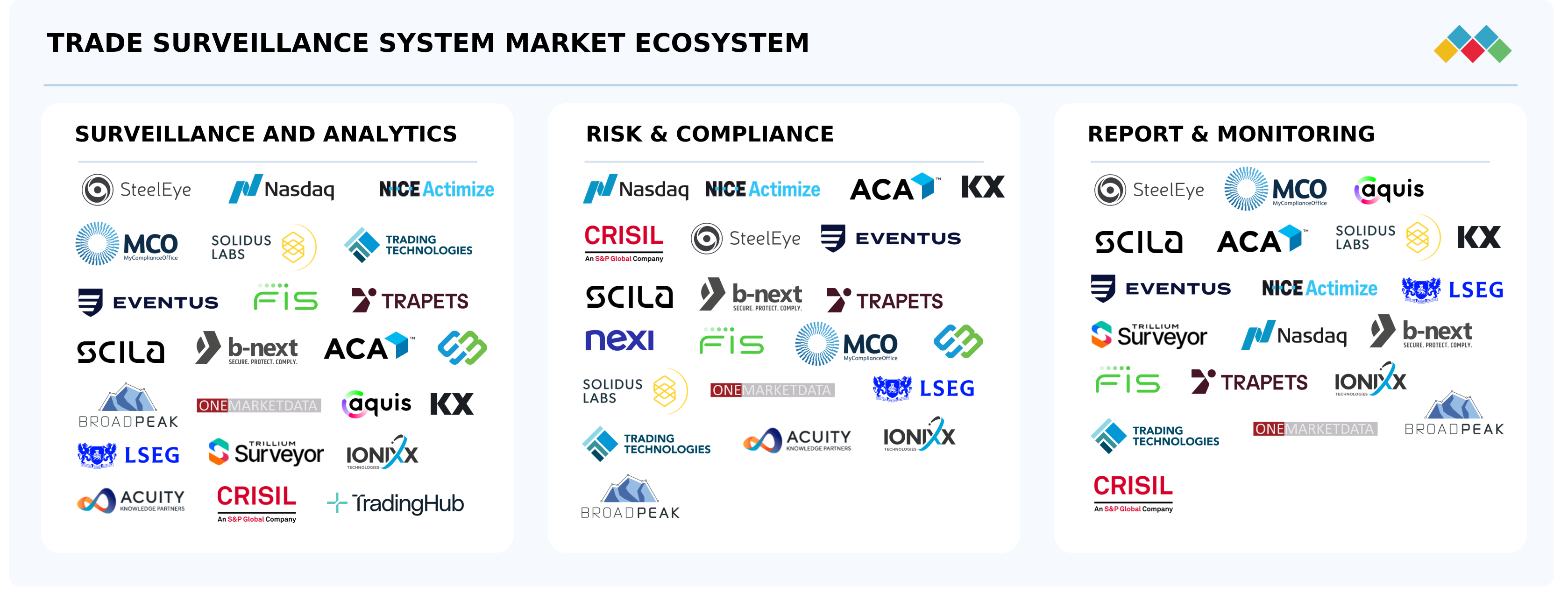
Trade Surveillance System Market: COMMERCIAL USE CASES ACROSS INDUSTRIES
| COMPANY | USE CASE DESCRIPTION | BENEFITS |
|---|---|---|
 |
Implementation of cloud-based trade surveillance and risk platforms enables real-time cross-asset monitoring, regulatory compliance, and operational efficiency, strengthening transparency and trust in capital markets. | Cloud-based trade surveillance improved compliance, reduced costs, and enabled faster, smarter decisions. |
 |
Unified reporting, trade surveillance, and best execution on a single platform with high automation and workflow visibility. | Delivered stronger compliance, lower costs, and greater efficiency through automation and centralization. |
 |
Implemented crypto-native trade surveillance to monitor transactions, detect suspicious activities, and onboard new venues seamlessly. | Enhanced compliance, security, and trust while enabling scalable growth in digital asset markets. |
Logos and trademarks shown above are the property of their respective owners. Their use here is for informational and illustrative purposes only.
Related Ecosystem
Software And Services
- Natural Language Processing (NLP)
- Machine Learning
- Supply Chain Management
- Predictive Analytics
- Image Sensors
- International Business Machines Corporation
- MICROSOFT CORPORATION
- Oracle Corporation
- SAP SE
- Amazon.com, Inc.
Key Takeaways
- Saudi Arabia's trade surveillance system market is valued at USD 50.1 million in 2025 and is forecast to reach USD 86.5 million by 2030, representing a 11.5% CAGR.
- Saudi Arabia is investing heavily in digital customs infrastructure and AI-powered monitoring solutions to strengthen trade security and regulatory compliance.
- Saudi Arabia's strategic geographic position and Vision 2030 initiatives are driving demand for advanced surveillance technologies across ports and border checkpoints.
- Saudi Arabia is emerging as a regional leader in trade surveillance innovation, with increasing adoption of real-time analytics and integrated cross-border platforms.
Trade Surveillance System Market Report Scope
| Report Metric | Details |
|---|---|
| Base Year | 2025 |
| Fastest Growing Segment | SUPPORT & MAINTENANCE (Service Type) |
| Forecast Period | 2025–2030 |
| Growth Rate | CAGR of 14.5% from 2025 to 2030 |
| Largest Segment | SOLUTIONS (Offering) |
| Market Size Base Year (Billions) | ~USD 3 (2025) |
| Revenue Forecast (Billions) | ~USD 5.9 (2030) |
| Segments Covered | Offering, Service Type, Application, Deployment Type, Organization Size, End User, Solution, System Type |
Saudi Arabia Trade Surveillance System Market Report Segmentation
8 segment dimensions are covered across the global market.
By Offering
- Hardware
- Service
- Services
- Software
- Solutions
By Service Type
- Deployment & Integration
- Support & Maintenance
- Training & Consulting
By Application
- Case Management
- Other Applications
- Reports & Monitoring
- Risk & Compliance
- Surveillance & Analytics
By Deployment Type
- Cloud-Based
- On-Premises
By Organization Size
- Large Enterprises
- Smes
By End User
- Capital Markets
- Digital Asset Exchange
- Financial Institutions
By Solution
- Case Management & Reporting
- Kyc/Cdd & Sanction Screening
- Transaction Monitoring
By System Type
- Analog
- Hybrid
- Ip
Target Audience
- Government & Customs Authorities : Saudi customs and border security agencies require market intelligence to justify budget allocations, evaluate technology vendors, and plan infrastructure modernization initiatives.
- Technology Solution Providers : Software and surveillance system vendors need Saudi Arabia-specific market data to develop localized offerings, identify customer segments, and establish competitive positioning strategies.
- Logistics & Port Operators : Port authorities and logistics companies operating in Saudi Arabia need insights into compliance requirements and surveillance technologies to optimize operations and reduce regulatory risks.
- Investment & Private Equity Firms : Investors evaluating opportunities in Saudi Arabia's security and customs technology sectors require detailed market sizing, growth projections, and competitive landscape analysis.
- System Integrators & Consultants : IT consultants and system integrators serving Saudi Arabian clients need market context and regulatory requirements to design effective trade surveillance implementations.
Key Companies in the Saudi Arabia Trade Surveillance System Market
| Company | HQ | Ownership | Strongest segments |
|---|---|---|---|
| WNS GLOBAL SERVICES | India | Private Company | Surveillance & Analytics,Risk & Compliance,Reports & Monitoring, |
| NICE | Israel | Public Company | Surveillance & Analytics,Risk & Compliance,Reports & Monitoring, |
| NASDAQ | United States | Public Company | Surveillance & Analytics,Risk & Compliance,Reports & Monitoring, |
| FIS | United States | Public Company | Surveillance & Analytics,Risk & Compliance,Reports & Monitoring, |
| IPC SYSTEMS | United States | Private Company | Surveillance & Analytics,Risk & Compliance,Reports & Monitoring, |
| CRISIL | India | Public Company | Surveillance & Analytics,Risk & Compliance,Reports & Monitoring, |
| NEXI S.P.A | Italy | Public Company | Surveillance & Analytics,Risk & Compliance,Reports & Monitoring, |
| LSEG | United Kingdom | Public Company | Surveillance & Analytics,Risk & Compliance,Reports & Monitoring, |
| KX | Canada | Public Company | Surveillance & Analytics,Risk & Compliance,Reports & Monitoring, |
WNS GLOBAL SERVICES
WNS Global Services is an India-based private company founded in 1998 with 66,085 employees. The company provides business process management and outsourcing services.
NICE
NICE is an Israel-based public company founded in 1986 with 9,626 employees. The company specializes in software solutions for customer engagement and business intelligence.
NASDAQ
NASDAQ is a United States-based public company founded in 1971 with 9,630 employees. The company operates as a global stock exchange and marketplace infrastructure provider.
FIS
FIS is a United States-based public company founded in 1968 with 44,000 employees. The company provides financial services technology and processing solutions.
IPC SYSTEMS
IPC Systems is a United States-based private company founded in 1973 with 765 employees. The company offers voice and communication technology solutions for financial markets.
CRISIL
CRISIL is an India-based public company founded in 1987 with 5,081 employees. The company provides credit ratings, research, and risk and policy advisory services.
NEXI S.P.A
Nexi S.p.A is an Italy-based public company founded in 1939 with 9,595 employees. The company operates as a payment services and digital transaction provider.
LSEG
LSEG is a United Kingdom-based public company founded in 1698 with 28,516 employees. The company operates as a global financial markets infrastructure and data provider.
KX
KX is a Canada-based public company founded in 1984 with 1,837 employees. The company provides data analytics and database technology solutions.
Reasons to Buy this Report
- Market-Specific Growth Projections : Access detailed forecasts showing Saudi Arabia's market expansion from USD 50.1M to USD 86.5M by 2030, enabling precise investment planning and resource allocation decisions.
- Regulatory Landscape Analysis : Understand Saudi Arabia's evolving customs compliance requirements and border security regulations that directly impact procurement decisions and technology adoption timelines.
- Competitive Positioning Insights : Identify key players and market dynamics specific to Saudi Arabia's trade surveillance ecosystem, helping you benchmark performance and identify partnership opportunities.
- Strategic Investment Opportunities : Discover high-growth segments within Saudi Arabia's market aligned with Vision 2030 initiatives, including digital customs transformation and port modernization projects.
- Risk Mitigation & Compliance : Gain actionable intelligence on Saudi Arabia's illicit trade challenges and security priorities to develop compliant solutions that meet local regulatory requirements.
Frequently asked questions
What is the current market size of trade surveillance systems in Saudi Arabia?
Saudi Arabia's trade surveillance system market is valued at USD 50.1 million in 2025 and is projected to grow to USD 86.5 million by 2030.
What is the expected growth rate for Saudi Arabia's trade surveillance market?
Saudi Arabia's trade surveillance system market is expected to grow at a compound annual growth rate (CAGR) of 11.5% from 2025 to 2030.
What factors are driving growth in Saudi Arabia's trade surveillance market?
Growth in Saudi Arabia is driven by Vision 2030 economic initiatives, increased regulatory requirements, digital transformation of customs infrastructure, and the nation's role as a major regional trade hub.
Which technologies are being adopted in Saudi Arabia's trade surveillance systems?
Saudi Arabia is increasingly adopting AI-powered analytics, real-time tracking systems, integrated customs platforms, and advanced border monitoring technologies.
How does Saudi Arabia's market compare to the global trade surveillance market?
While the global trade surveillance market grows at 14.5% CAGR, Saudi Arabia's market grows at 11.5% CAGR, reflecting strong regional demand but slightly slower expansion than the global average.
RESEARCH METHODOLOGY
This research study used extensive secondary sources, directories, and databases, such as D&B Hoovers, Bloomberg Businessweek, and Factiva, to identify and collect information for a technical, market-oriented, and commercial study of the global trade surveillance system market. A few other market-related reports and analyses published by various industry associations, such as the National Security Agency (NSA) and SC Magazine, were considered while doing the extensive secondary research. The primary sources were mainly the industry experts from the core and related industries and preferred suppliers, manufacturers, distributors, service providers, technology developers, and technologists from companies and organizations related to all segments of this industry’s value chain.
In-depth interviews were conducted with primary respondents, including key industry participants, subject-matter experts, C-level executives of key market players, and industry consultants to obtain and verify critical qualitative and quantitative information and assess the prospects. The market has been estimated by analyzing various driving factors, such as improving organizational compliance requirements, enhancing operational efficiency, and simplifying workflows to eliminate bottlenecks.
Secondary Research
The market size of companies offering trade surveillance systems was derived based on secondary data available through paid and unpaid sources, analyzing the product portfolios of major companies in the ecosystem, and rating the companies based on their product capabilities and business strategies.Various sources were referenced in the secondary research process to identify and collect information for the study. These sources included annual reports, press releases, investor presentations of companies, product data sheets, white papers, journals, certified publications, and articles from recognized authors, government websites, directories, and databases.
Secondary research was mainly used to obtain key information about the industry’s supply chain, the total pool of key players, market classification and segmentation according to industry trends to the bottom-most level, regional markets, and key developments from market- and technology-oriented perspectives, all of which were further validated by primary sources.
Primary Research
In the primary research process, various sources from the supply and demand sides were interviewed to obtain qualitative and quantitative information for this report. The primary sources from the supply side included industry experts, such as chief executive officers (CEOs), vice presidents (VPs), marketing directors, technology and innovation directors, and related key executives from various key companies and organizations operating in the trade surveillance system market.
Primary interviews were conducted to gather insights, such as market statistics, the latest trends disrupting the market, new use cases implemented, data on revenue collected from products and services, market breakups, market size estimations, market forecasts, and data triangulation. Primary research also helped understand various technology-related trends, segmentation types, industry trends, and regions.
Demand-side stakeholders, such as Chief Information Officers (CIOs), Chief Technology Officers (CTOs), Chief Security Officers (CSOs), installation teams of governments and end users who utilize trade surveillance system, and digital initiatives project teams, were interviewed to understand the buyers’ perspectives on suppliers, products, service providers, and their current use of services, which would influence the overall trade surveillance system market.
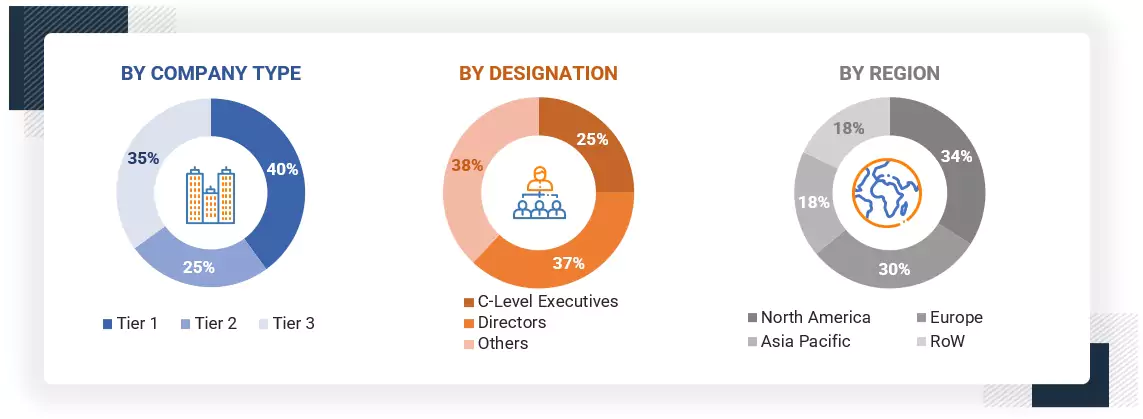
Note: Tier 1 companies have revenues greater than USD 10 billion; tier 2 companies’ revenues range
between USD 1 and 10 billion; and tier 3 companies’ revenues range between USD 500 million and 1 billion.
Others include sales, marketing, and product managers.
Source: Secondary Literature, Interviews with Experts, and MarketsandMarkets Analysis
To know about the assumptions considered for the study, download the pdf brochure
Market Size Estimation
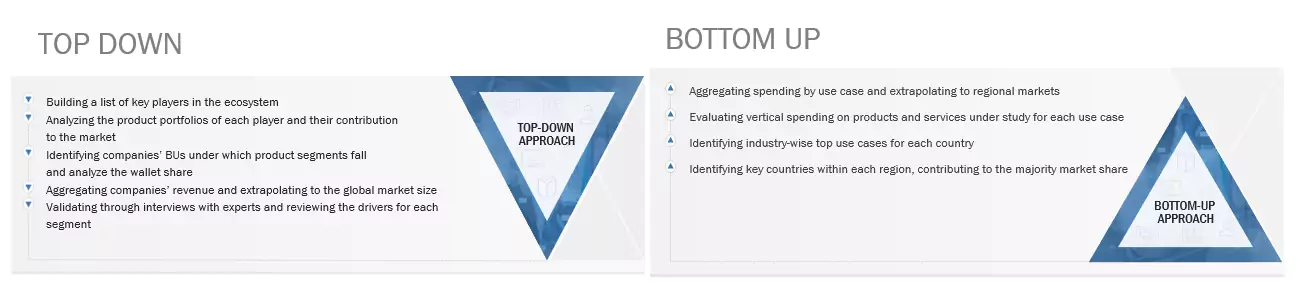
Multiple approaches were adopted to estimate and forecast the trade surveillance system market. The first approach involved estimating the market size by summing the companies’ revenue generated through the sale of services.
The research methodology used to estimate the market size included the following:
- Primary and secondary research were conducted to assess the revenue contributions of major market participants in each country, with secondary research identifying these participants.
- Critical insights were obtained by conducting in-depth interviews with industry professionals, including directors, CEOs, VPs, and marketing executives, and by reading the annual and financial reports of the top firms in the market.
- Primary sources were used to verify all percentage splits and breakups, which we calculated using secondary sources.
Trade Surveillance System Market : Top-Down and Bottom-Up Approach
Data Triangulation
Once the overall market size was determined, the market was divided into segments and subsegments using the previously described market size estimation procedures. When required, market breakdown and data triangulation procedures were used to complete the market engineering process and specify the exact figures for every market segment and subsegment. The data was triangulated by examining several variables and patterns from the government entities’ supply and demand sides.
Market Definition
Trade surveillance systems are software that prevent and investigate market abuse, market manipulation, or unethical trading practices in the securities market. Market surveillance helps organizations ensure an efficient process flow in markets, where buyers, brokers, and sellers willingly enter the market. Without using surveillance tools during market orders, the market is susceptible to abuse and manipulation, which could discourage investment and hinder economic growth.
Trade surveillance is about implementing a surveillance system that monitors and detects activities for market manipulation, fraud, behavioral patterning, and more across all asset classes and all products, thereby ensuring the prevention and investigation of abusive, manipulative, or illegal Trade surveillance, or market surveillance, involves monitoring the activities of the firm and its employees to detect illegal and unethical trading practices, including market manipulation, fraud, money laundering, insider trading, speculation, and unsuitable investments (Source: MyComplianceOffice)
Stakeholders
- Trade Surveillance Solution Providers
- Regulators
- Market Operators
- Brokers/Dealers
- Professional Service Providers
- Managed Service Providers (MSPs)
- System Integrators
- Cloud Platform Providers
- Resellers and Distributors
- Investors and Venture Capitalists
Report Objectives
- To define, describe, and forecast the trade surveillance system market based on offering, application, deployment mode, by organization size, by end user, and region
- To forecast the market size of five major regional segments: North America, Europe, Asia Pacific, the Middle East & Africa, and Latin America
- To strategically analyze the market subsegments concerning individual growth trends, prospects, and contributions to the total market
- To provide detailed information related to the major factors influencing the growth of the market (drivers, restraints, opportunities, and challenges)
- To strategically analyze macro and micro markets, considering growth trends, prospects, and their contributions to the overall market
- To analyze industry trends, patents and innovations, and pricing data related to the market
- To analyze the opportunities in the market for stakeholders and provide details of the competitive landscape for major players
- To analyze the impact of AI/generative AI on the market
- To profile key players in the market and comprehensively analyze their market share/ranking and core competencies
- To track and analyze competitive developments such as mergers & acquisitions, product launches, and partnerships & collaborations in the market
- To track and analyze competitive developments such as mergers & acquisitions, product launches, and partnerships & collaborations in the market
Available Customizations
MarketsandMarkets provides customizations based on the company’s unique requirements using market data. The following customization options are available for the report.
Product Analysis
- The product matrix provides a detailed comparison of each company’s portfolio.
Geographic Analysis as per Feasibility
- Further breakup of the trade surveillance system market
Company Information
- Detailed analysis and profiling of five additional market players
Get the Full Trade Surveillance System Market Report
Full forecast, segment splits, and company analysis for all Trade Surveillance System Market.
- US Trade Surveillance System Market
- Canada Trade Surveillance System Market
- UK Trade Surveillance System Market
- Germany Trade Surveillance System Market
- France Trade Surveillance System Market
- Italy Trade Surveillance System Market
- China Trade Surveillance System Market
- Japan Trade Surveillance System Market
- India Trade Surveillance System Market
- UAE Trade Surveillance System Market
- South Africa Trade Surveillance System Market
- Brazil Trade Surveillance System Market
- Mexico Trade Surveillance System Market
- Rest Of Europe Trade Surveillance System Market
- Rest Of Asia Pacific Trade Surveillance System Market
- Rest Of Latin America Trade Surveillance System Market
- GCC Countries Trade Surveillance System Market
- Rest Of GCC Countries Trade Surveillance System Market
Need a Tailored Report?
Customize this report to your needs
Get 10% FREE Customization
Customize This Report
