
Brazil Traditional Wound Care Market (2025-2030)

The Brazil Traditional Wound Care Market was valued at $88.1 Million in 2025 and projected to reach to $122.16 Million by 2030, representing a compound annual growth rate of 6.8%. Brazil's traditional wound care market is positioned for sustained growth through 2030, driven by expanding healthcare infrastructure investments and increasing accessibility of wound management solutions across diverse healthcare settings.


| Market Size in | USD 26.32 MN |
| Market Forecast in | |
| CAGR | |
| Forecast Period | |
| Units Considered | Value (USD MN) |
Brazil Traditional Wound Care Market Trends and Insights
- This growth trajectory reflects Brazil's increasing healthcare infrastructure investments and rising demand for accessible wound management solutions across both urban and emerging healthcare settings.
- Brazil's market growth rate of 6.8% CAGR significantly outpaces the global average of 4.2%, positioning the country as a key growth driver in Latin America's wound care sector. The expansion in Brazil is driven by an aging population, higher prevalence of chronic conditions, and improved healthcare accessibility in underserved regions.
- Brazil's traditional wound care segment benefits from strong demand for cost-effective, proven treatment modalities that remain essential in clinical practice.
- Between 2025 and 2030, Brazil is expected to see increased adoption of traditional wound care products in hospitals, clinics, and home care settings, supported by growing awareness and healthcare provider confidence in established wound management protocols..
Key Market Statistics
- CAGR (2025-2030) 6.8% CAGR
- Market Size, 2025 ~USD 88.1 Million
- Forecast, 2030 ~USD 122.16 Million
- Country Brazil
Brazil Traditional Wound Care Market Overview
Market Valuation Growth :
Brazil's traditional wound care market is valued at USD 88.1 million in 2025, with projections reaching USD 122.16 million by 2030, representing a strong 6.8% CAGR that outpaces the global average of 4.2%.
Healthcare Infrastructure Expansion :
Increasing investments in Brazil's healthcare infrastructure are driving demand for accessible wound management solutions, particularly in urban centers and emerging healthcare facilities across the country.
Regional Market Leadership :
Brazil demonstrates the highest growth potential in Latin America's wound care sector, driven by rising healthcare spending, improved hospital networks, and growing awareness of advanced wound management protocols.
Accessibility & Demand Drivers :
Growing demand for cost-effective wound care solutions in both public and private healthcare settings is fueling market expansion, with particular emphasis on accessible products for underserved populations.
Brazil Traditional Wound Care Market Dynamics
- The market's 6.8% CAGR reflects strong demand from both urban hospitals and emerging regional healthcare facilities seeking reliable, cost-effective wound care products.
- Government healthcare initiatives and rising private sector participation are expected to further accelerate market penetration in underserved areas, creating significant opportunities for market participants..
Market Ecosystem
Related Ecosystem
Medical Devices
- Polymerase Chain Reaction (PCR)
- Magnetic Resonance Imaging (MRI)
- Disposable Autoinjectors
- Pulse Oximeters
- Blood Pressure Monitors
- Medtronic plc
- Abbott Laboratories
- Stryker Corporation
- Becton, Dickinson and Company
- JOHNSON & JOHNSON
Key Takeaways
- Brazil's traditional wound care market is valued at USD 88.1 million in 2025 and is forecast to reach USD 122.16 million by 2030, representing a 6.8% CAGR.
- Brazil's market growth rate of 6.8% CAGR significantly exceeds the global average of 4.2%, making Brazil a high-growth market in the traditional wound care sector.
- Brazil's aging population and rising chronic disease prevalence are primary drivers of increased demand for traditional wound care products and services.
- Brazil's expanding healthcare infrastructure and improved accessibility in underserved regions are creating new opportunities for traditional wound care market penetration through 2030.
Traditional Wound Care Market Report Scope
| Report Metric | Details |
|---|---|
| Base Year | 2025 |
| Fastest Growing Segment | ADHESIVE TAPES (Type) |
| Forecast Period | 2025–2030 |
| Growth Rate | CAGR of 4.2% from 2025 to 2030 |
| Largest Segment | ACUTE WOUNDS (Application) |
| Market Size Base Year (Billions) | ~USD 7.42 (2025) |
| Revenue Forecast (Billions) | ~USD 9.12 (2030) |
| Segments Covered | Product Type, Type, Application, Distribution Channel, End User |
Brazil Traditional Wound Care Market Report Segmentation
5 segment dimensions are covered across the global market.
By Product Type
- Absorbent Pads
- Bandages
- Compression Products
- Dressings
- First-Aid Plasters
- Fixation Products
- Gauze
- Hydrocolloid Dressings
- Other Traditional Wound Care Products
By Type
- Adhesive Tapes
- All Compression Bandages
- Burns
- Compression Socks
- Diabetic Foot Ulcers
- Film Dressings
- Inpatient Settings
- Island Dressings
- Non-Adhesive Fixation Products
- Non-Sterile Gauze
- Non-Woven Gauze
- Other Chronic Wounds
- Outpatient Settings
- Pressure Ulcers
- Sterile Gauze
- Surgical And Traumatic Wounds
- Venous Leg Ulcers
- Woven Gauze
By Application
- Acute Wounds
- Chronic Wounds
By Distribution Channel
- Healthcare Institutions
- Home Care Settings
- Other Distribution Channels
- Pharmacies & Drug Stores
- Supermarkets
By End User
- Ambulatory Surgery Centers
- Home Healthcare
- Hospitals & Clinics
- Other End Users
BRAZIL: TRADITIONAL WOUND CARE MARKET, BY END USER, 2022–2030
| Segment | 2022 | 2023 | 2024 | 2025 | 2026 | 2028 | 2029 | 2030 | CAGR (%) |
|---|---|---|---|---|---|---|---|---|---|
| AMBULATORY SURGERY CENTERS | 18.79 | 19.7 | 20.67 | 21.71 | 22.81 | 25.27 | 26.62 | 28.07 | 5.3 |
| HOME HEALTHCARE | 128.86 | 134.73 | 140.94 | 147.66 | 154.79 | 170.71 | 179.44 | 188.91 | 5 |
| HOSPITALS & CLINICS | 72.91 | 77.62 | 82.67 | 88.16 | 94.04 | 107.34 | 114.75 | 122.84 | 6.9 |
| OTHER END USERS | 33.96 | 35.86 | 37.88 | 40.07 | 42.41 | 47.69 | 50.61 | 53.8 | 6.1 |
| TOTAL | 254.52 | 267.91 | 282.16 | 297.6 | 314.06 | 351.02 | 371.42 | 393.63 | 5.8 |
Target Audience
- Healthcare Manufacturers & Distributors : Wound care product manufacturers and distributors need Brazil-specific market data to identify growth opportunities, optimize product portfolios, and develop localized distribution strategies for this high-growth market.
- Hospital & Healthcare Facility Operators : Hospital networks and healthcare facility managers require market insights to benchmark procurement strategies, evaluate supplier options, and plan wound care program investments aligned with market trends.
- Private Equity & Investment Firms : Investment professionals evaluating healthcare sector opportunities in Brazil need detailed market analysis to assess growth potential, identify acquisition targets, and structure investment theses in wound care.
- Government & Healthcare Policy Makers : Brazilian healthcare policymakers and government agencies need market intelligence to inform healthcare infrastructure planning, procurement policies, and initiatives supporting wound care accessibility.
- Market Consultants & Business Strategists : Consultants advising healthcare clients on Brazil market entry, expansion, or strategic positioning require comprehensive market data to develop evidence-based recommendations and competitive strategies.
Key Companies in the Brazil Traditional Wound Care Market
| Company | HQ | Ownership | Strongest segments |
|---|---|---|---|
| SOLVENTUM | United States | Public Company | Medsurg,Dental Solutions,Health Information Systems, |
| CARDINAL HEALTH | United States | Public Company | Branded pharmaceutical distribution,Generic and OTC pharmaceutical distribution,Specialty pharmaceutical and manufacturer services, |
| ESSITY AKTIEBOLAG | Sweden | Public Company | Health & Medical (incontinence, wound care, compression, orthopedics, digital solutions),Consumer Goods – Tissue (toilet paper, household towels, facial tissues, napkins),Consumer Goods – Femcare, Baby, and Intimate Hygiene & Apparel, |
| PAUL HARTMANN AG | Germany | Public Company | Wound Care,Incontinence Management,Infection Management, |
| MöLNLYCKE AB | Sweden | Private Company | Wound Care (acute and chronic),Operating Room Solutions (drapes, gowns, trays, instruments),Gloves, |
| BEIERSDORF | Germany | Public Company | Mass skincare and body care (NIVEA, Labello, ATRIX, 8x4, HIDROFUGAL, regional brands),Dermocosmetic and therapeutic skincare (Eucerin, Aquaphor, SKIN STORIES),Premium and luxury skincare (La Prairie, Chantecaille), |
| OWENS & MINOR, INC. | United States | Public Company | In-home diabetes care and supplies,Home respiratory therapy (oxygen and non-invasive ventilation),Obstructive sleep apnea (CPAP/BiPAP and support services), |
| KENVUE | United States | Public Company | Self Care (OTC and naturally inspired self-care),Skin Health and Beauty,Essential Health, |
| SMITH+NEPHEW | United Kingdom | Public Company | Orthopaedics (Knee, Hip, Trauma & Reconstruction),Sports Medicine & ENT,Advanced Wound Care, |
| NITTO DENKO CORPORATION | Japan | Public Company | Adhesive tapes and surface protection films,Electronics materials (FPD/touch, semiconductor process, FPC),Fluoroplastic and porous materials (NITOFLON, TEMISH, breathable sheets), |
| MCKESSON CORPORATION | United States | Public Company | North American Pharmaceutical distribution (branded, generic, specialty, biosimilar, OTC),Oncology & Multispecialty services and distribution,Prescription Technology Solutions, |
SOLVENTUM
Solventum is a United States-based public company founded in 2023 with 20,584 employees.
CARDINAL HEALTH
Cardinal Health is a United States-based public company founded in 1979 with 55,392 employees.
ESSITY AKTIEBOLAG
Essity Aktiebolag is a Swedish public company founded in 1849 with 36,000 employees.
PAUL HARTMANN AG
Paul Hartmann AG is a German public company founded in 1818 with 10,066 employees.
MöLNLYCKE AB
Mölnlycke AB is a Swedish private company founded in 1849 with 8,463 employees.
BEIERSDORF
Beiersdorf is a German public company founded in 1882 with 21,589 employees.
OWENS & MINOR, INC.
Owens & Minor, Inc. is a United States-based public company founded in 1882 with 6,500 employees.
KENVUE
Kenvue is a United States-based public company founded in 2022 with 21,890 employees.
SMITH+NEPHEW
Smith+Nephew is a United Kingdom-based public company founded in 1856 with 16,988 employees.
NITTO DENKO CORPORATION
Nitto Denko Corporation is a Japanese public company founded in 1918 with 26,477 employees.
MCKESSON CORPORATION
McKesson Corporation is a United States-based public company founded in 1833 with 42,300 employees.
Reasons to Buy this Report
- Market-Specific Growth Intelligence : Gain detailed insights into Brazil's 6.8% CAGR trajectory and understand the specific drivers differentiating this market from global trends, enabling targeted investment and expansion strategies.
- Competitive Positioning Data : Access Brazil-specific market dynamics, competitive landscape analysis, and regional player strategies to identify gaps and opportunities for market entry or portfolio expansion.
- Infrastructure & Accessibility Trends : Understand how Brazil's healthcare infrastructure investments and accessibility initiatives are reshaping demand patterns, helping you align products and services with regional healthcare priorities.
- Forecast-Driven Decision Making : Leverage precise 2025-2030 market projections (USD 88.1M to USD 122.16M) to make informed decisions on resource allocation, partnership development, and market entry timing in Brazil.
- Regional Market Differentiation : Distinguish Brazil's market characteristics from other Latin American countries and understand urban vs. emerging healthcare setting dynamics to optimize go-to-market strategies.
Frequently asked questions
What is the current size of Brazil's traditional wound care market?
Brazil's traditional wound care market is valued at USD 88.1 million in 2025 and is expected to grow to USD 122.16 million by 2030.
What is the projected growth rate for Brazil's traditional wound care market?
Brazil's traditional wound care market is projected to grow at a compound annual growth rate (CAGR) of 6.8% from 2025 to 2030.
How does Brazil's market growth compare to global trends?
Brazil's traditional wound care market growth rate of 6.8% CAGR significantly outpaces the global average of 4.2%, indicating stronger regional demand and market expansion.
What factors are driving growth in Brazil's traditional wound care market?
Key growth drivers in Brazil include an aging population, increased prevalence of chronic conditions, expanding healthcare infrastructure, and improved accessibility in underserved regions.
Which healthcare settings are driving demand for traditional wound care in Brazil?
Demand for traditional wound care in Brazil is being driven across hospitals, clinics, and home care settings, supported by growing healthcare provider confidence and patient awareness.
RESEARCH METHODOLOGY
This study involved the extensive use of both primary and secondary sources. The research process involved the study of various factors affecting the industry to identify the segmentation types, industry trends, key players, competitive landscape, fundamental market dynamics, and key player strategies.
Secondary Research
The secondary research process involves the widespread use of secondary sources, directories, databases (such as Bloomberg Businessweek, Factiva, and D&B Hoovers), white papers, annual reports, investor presentations, SEC filings of companies and publications from government sources [such as National Institutes of Health (NIH), US FDA, US Census Bureau, World Health Organization (WHO), , Global Burden of Disease Study, and Centers for Medicare and Medicaid Services (CMS) were referred to identify and collect information for the global vaccine storage equipment market study. It was also used to obtain important information about the key players and market classification & segmentation according to industry trends to the bottom-most level and key developments related to market and technology perspectives. A database of the key industry leaders was also prepared using secondary research.
Primary Research
In the primary research process, various sources from both the supply and demand sides were interviewed to obtain qualitative and quantitative information for this report. The primary sources from the supply side include industry experts such as CEOs, vice presidents, marketing and sales directors, technology & innovation directors, and related key executives from various key companies and organizations in traditional wound care market. The primary sources from the demand side include pharmaceutical companies, biotechnology companies, CROs, pharmacies, medical device companies, and research academics and universities. Primary research was conducted to validate the market segmentation, identify key players in the market, and gather insights on key industry trends & key market dynamics.
A breakdown of the primary respondents is provided below:
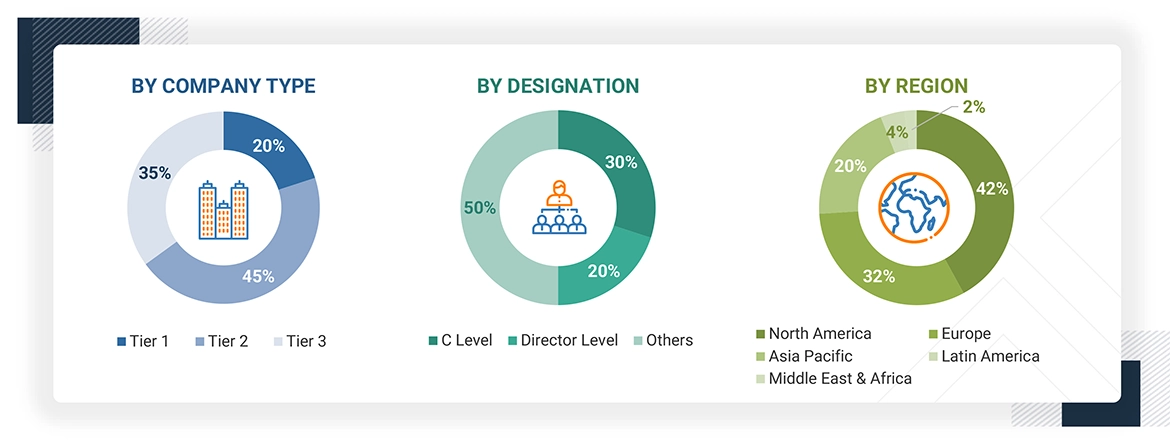
*C-level primaries include CEOs, CFOs, COOs, and VPs.
*Others include sales managers, marketing managers, business development managers, product managers, distributors, and suppliers.
Note: Companies are classified into tiers based on their total revenue. As of 2023, Tier 1 = >USD 10.00 billion, Tier 2 = USD 1.00 billion to USD 10.00 billion, and Tier 3 = < USD 1.00 billion.
To know about the assumptions considered for the study, download the pdf brochure
Market Size Estimation
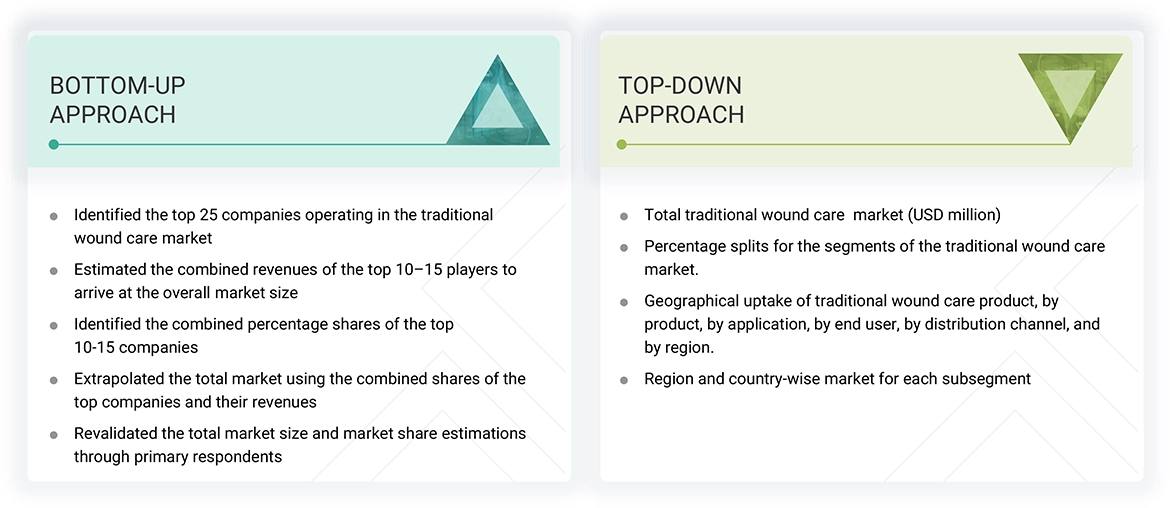
For the global market value, annual revenues were calculated based on the revenue mapping of major product manufacturers and OEMs active in the global traditional wound care market. All the major service providers were identified at the global and/or country/regional level. Revenue mapping for the respective business segments/sub-segments was done for the major players. Also, the global Traditional wound care market was split into various segments and sub-segments based on:
- List of major players operating in the products market at the regional and/or country level
- Product mapping of traditional wound care providers at the regional and/or country level
- Mapping of annual revenue generated by listed major players from traditional wound care (or the nearest reported business unit/product category)
- Extrapolation of the revenue mapping of the listed major players to derive the global market value of the respective segments/subsegments
- Summation of the market value of all segments/subsegments to arrive at the global traditional wound care market
The above-mentioned data was consolidated and added with detailed inputs and analysis from MarketsandMarkets and presented in this report.
Market Size Estimation Bottom Up approach & Top down approach
Data Triangulation
After arriving at the overall size of the global traditional wound care market through the above-mentioned methodology, this market was split into several segments and subsegments. The data triangulation and market breakdown procedures were employed, wherever applicable, to complete the overall market engineering process and arrive at the exact market value data for the key segments and subsegments. The extrapolated market data was triangulated by studying various macro indicators and regional trends from both demand- and supply-side participants.
Market Definition
Traditional wound care involves the use of dry dressing products such as gauze, lint, plasters, bandages (natural or synthetic), and cotton wool. These dressings serve as primary or secondary coverings to protect wounds from contamination and aid in the healing process.
Stakeholders
- Manufacturers & distributors of traditional wound care products
- Hospitals and clinics
- Ambulatory surgery centers (ASCs)
- Research & development companies
- Clinical research organizations
- Research laboratories and academic institutes
- Traditional wound care service providers
- Government associations
- Venture capitalists and investors
Report Objectives
- To define, describe, segment, and forecast the global traditional wound care market by product, application, end user, distribution channel and region
- To provide detailed information regarding the major factors influencing the market growth (such as drivers, restraints, opportunities, and trends)
- To analyze the micromarkets with respect to individual growth trends, prospects, and contributions to the overall traditional wound care market
- To analyze market opportunities for stakeholders and provide details of the competitive landscape for key players
- To forecast the size of the market segments with respect to five regions: North America, Europe, the Asia Pacific, Latin America, and the Middle East & Africa
- To profile the key players and comprehensively analyze their product portfolios, market positions, and core competencies
- To benchmark players within the market using the proprietary Company Evaluation Matrix framework, which analyzes market players on various parameters within the broad categories of business and product excellence
Get the Full Traditional Wound Care Market Report
Full forecast, segment splits, and company analysis for all Traditional Wound Care Market.
- US Traditional Wound Care Market
- Canada Traditional Wound Care Market
- Germany Traditional Wound Care Market
- UK Traditional Wound Care Market
- France Traditional Wound Care Market
- Italy Traditional Wound Care Market
- Spain Traditional Wound Care Market
- Switzerland Traditional Wound Care Market
- Poland Traditional Wound Care Market
- Austria Traditional Wound Care Market
- Czech Republic Traditional Wound Care Market
- China Traditional Wound Care Market
- Japan Traditional Wound Care Market
- India Traditional Wound Care Market
- Mexico Traditional Wound Care Market
- Rest Of Europe Traditional Wound Care Market
- Rest Of Asia Pacific Traditional Wound Care Market
- Rest Of Latin America Traditional Wound Care Market
Need a Tailored Report?
Customize this report to your needs
Get 10% FREE Customization
Customize This Report
