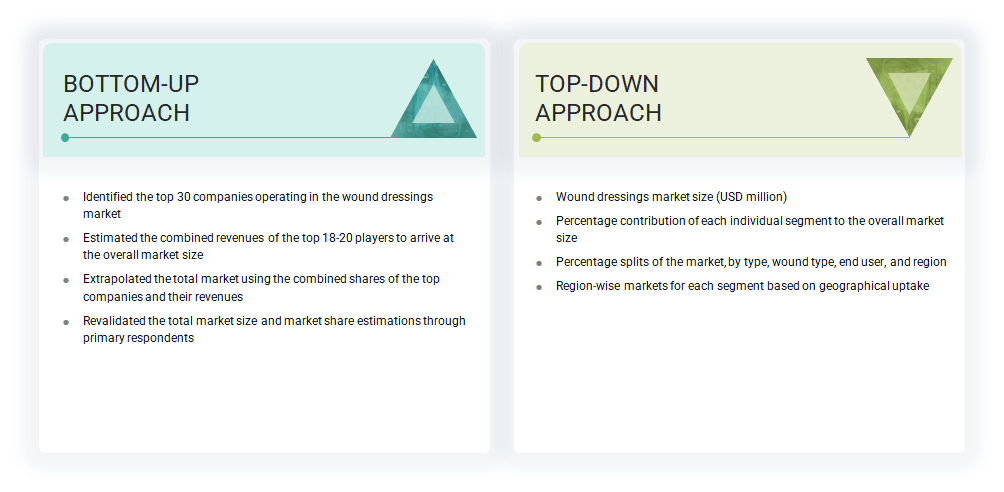
The study involved major activities in estimating the current market size for the wound dressings market. Exhaustive secondary research was done to collect information on the wound care industry. The next step was to validate these findings, assumptions, and sizing with industry experts across the value chain using primary research. Different approaches, such as top-down and bottom-up, were employed to estimate the total market size. After that, the market breakup and data triangulation procedures were used to estimate the market size of the segments and subsegments of the wound dressings market.
The four steps involved in estimating the market size are:
Secondary Research
The secondary research process involves the widespread use of secondary sources, directories, databases (such as Bloomberg Businessweek, Factiva, and D&B Hoovers), white papers, annual reports, investor presentations, SEC filings of companies and publications from government sources [such as National Institutes of Health (NIH), US FDA, US Census Bureau, World Health Organization (WHO), , Global Burden of Disease Study, and Centers for Medicare and Medicaid Services (CMS) were referred to identify and collect information for the global wound dressings market study. It was also used to obtain important information about the key players and market classification & segmentation according to industry trends, to the bottom-most level, and key developments related to market and technology perspectives. A database of the key industry leaders was also prepared using secondary research.
Primary Research
In the primary research process, various sources from both the supply and demand sides were interviewed to obtain qualitative and quantitative information for this report. The primary sources from the supply side include industry experts such as CEOs, vice presidents, marketing and sales directors, technology & innovation directors, and related key executives from various key companies and organizations in the wound dressings market. The primary sources from the demand side include hospitals and surgical centers, home healthcare settings, long-term care/nursing homes and research institutions and universities. Primary research was conducted to validate the market segmentation, identify key players in the market, and gather insights on key industry trends & key market dynamics.
The following is a breakdown of the primary respondents:

Note 1: Other designations include sales managers, marketing managers, and product managers.
Note 2: Companies are classified into tiers based on their total revenues. As of 2024, Tier 1 = >USD 100 million, Tier 2 = USD 10 million to USD 100 million, and Tier 3 = < USD 10 million.
To know about the assumptions considered for the study, download the pdf brochure
Market Size Estimation
For the global market value, annual revenues were calculated based on the revenue mapping of major wound dressings manufacturers and OEMs active in the global wound dressings market. All the major service providers were identified at the global and/or country/regional level. Revenue mapping for the respective business segments/sub-segments was done for the major players. The global wound dressings market was split into various segments and sub-segments based on:
-
List of major players operating in the product market at the regional and/or country level
-
Product mapping of wound dressing providers at the regional and/or country level
-
Mapping of annual revenue generated by listed major players from wound dressings (or the nearest reported business unit/product category)
-
Extrapolation of the revenue mapping of the listed major players to derive the global market value of the respective segments/subsegments
-
Summation of the market value of all segments/subsegments to arrive at the global wound dressings market
The above-mentioned data was consolidated and added with detailed inputs and analysis from MarketsandMarkets and presented in this report.
The research methodology used to estimate the market size includes the following:
Data Triangulation
After arriving at the overall market size by applying the process mentioned above, the total market was split into several segments. To complete the overall market engineering process and arrive at the exact statistics for all segments and subsegments, data triangulation and market breakdown procedures were employed, wherever applicable. The data was triangulated by studying various factors and trends from both the demand and supply sides.
Market Definition
A wound refers to an injury involving the dissection or rupture of tissues or membranes, typically caused by external trauma or involuntary actions. To ensure proper healing and protect the wound from further harm or infection.
Wound dressings serve a critical role in maintaining a protective barrier, supporting healing, managing exudate (fluid discharge), and preventing infection or complications. They are widely used by surgeons, physicians, caregivers, and patients to facilitate healing in a controlled and hygienic environment.
Wound dressings are available in various types, generally categorized into traditional wound dressings (such as gauze and bandages) and advanced wound dressings (including hydrocolloids, foams, alginates, and hydrogel dressings). The choice of dressing depends on the wound’s characteristics—its type, size, location, depth, and level of exudate.
Stakeholders
-
Wound Dressings Manufacturers
-
Wound Care Associations
-
Research and Consulting Firms
-
Distributors of Wound Dressings
-
Healthcare Institutes (Hospitals, Medical Schools, Diagnostic Centers, and Outpatient Clinics)
-
Research Institutes
-
Venture Capitalists
Report Objectives
-
To define, describe, segment, and forecast the global wound dressings market by type, wound type, end user, and region
-
To provide detailed information regarding the major factors influencing market growth (such as drivers, restraints, opportunities, and challenges)
-
To analyze the micromarkets with respect to individual growth trends, prospects, and contributions to the overall wound dressings market
-
To analyze market opportunities for stakeholders and provide details of the competitive landscape for key players
-
To forecast the size of the market segments with respect to five regions: North America, Europe, the Asia Pacific, Latin America, and the Middle East & Africa
-
To profile the key players and comprehensively analyze their product portfolios, market positions, and core competencies
-
To benchmark players within the market using the proprietary Company Evaluation Matrix framework, which analyzes market players on various parameters within the broad categories of business and product excellence
-
To study the impact of AI/Gen AI on the market, along with the macroeconomic outlook for each region


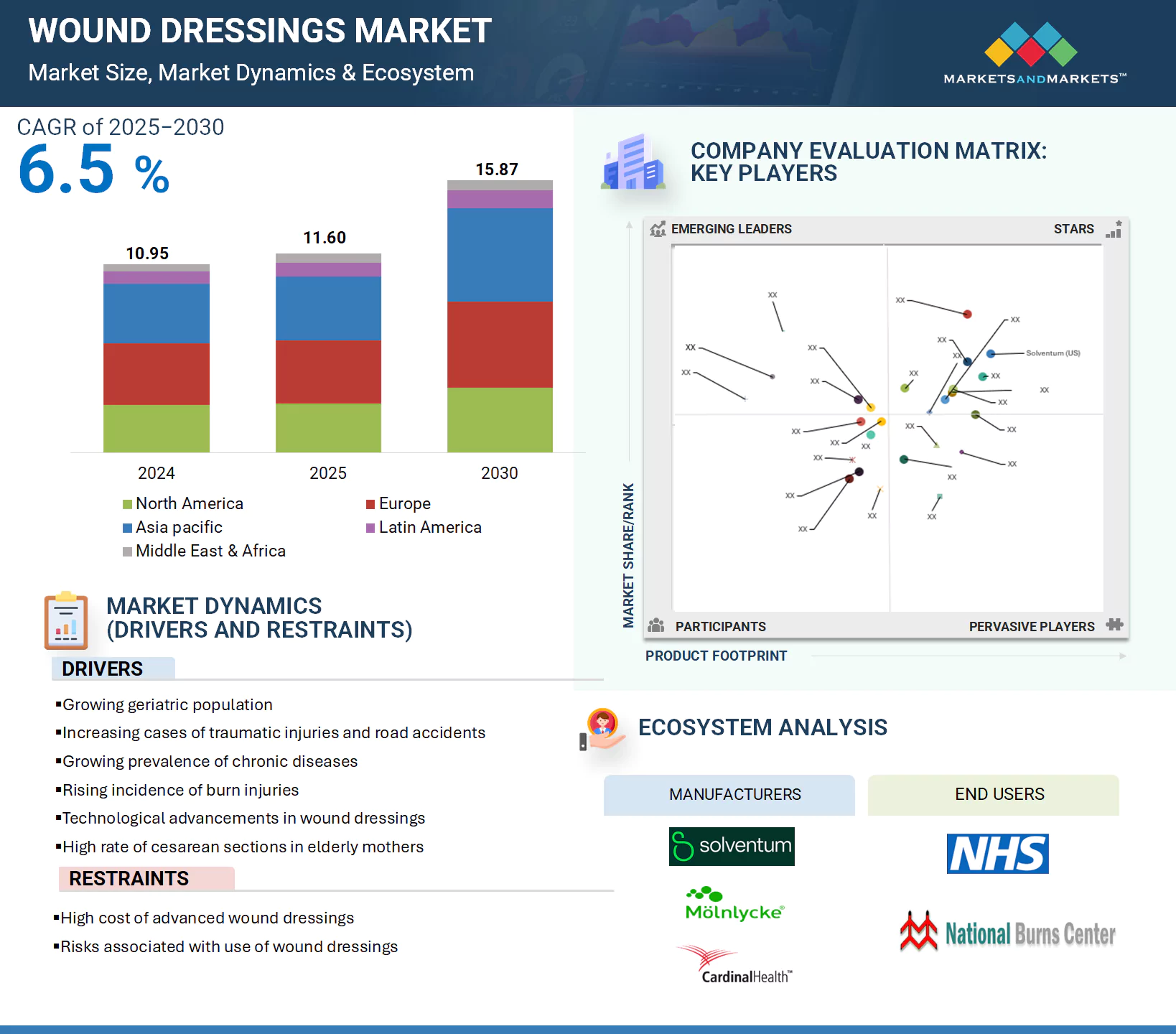


 HOSPITALS, ASCS, AND CLINICS: LARGEST MARKET SHARE IN EUROPE IN 2024
 GERMANY: FASTEST-GROWING MARKET IN REGION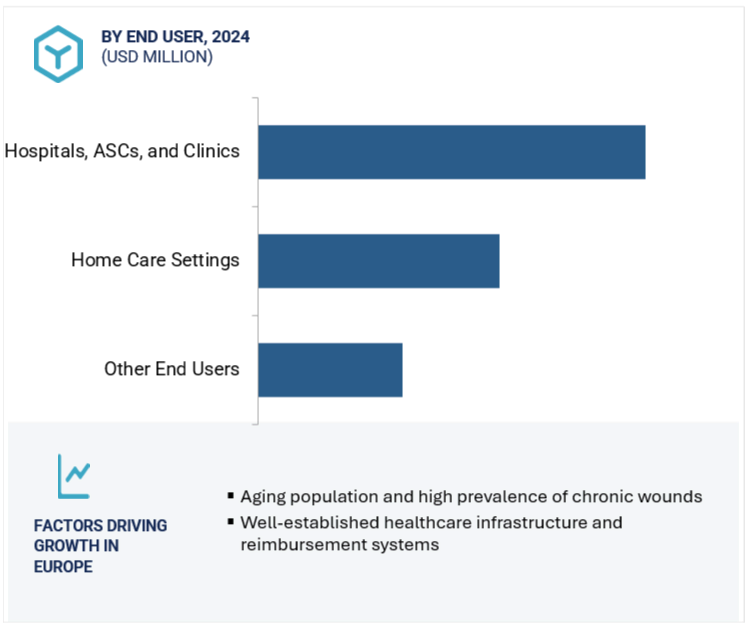














Growth opportunities and latent adjacency in Wound Dressings Market