
Japan Transformer Insulation Market (2025-2030)

The Japan Transformer Insulation Market was valued at $81 Million in 2025 and projected to reach to $105.7 Million by 2030, representing a compound annual growth rate of 5.5%. Japan's transformer insulation market is positioned for steady growth through 2030, driven by the imperative to modernize aging electrical infrastructure and integrate renewable energy sources.


| Market Size in | USD 26.32 MN |
| Market Forecast in | |
| CAGR | |
| Forecast Period | |
| Units Considered | Value (USD MN) |
Japan Transformer Insulation Market Trends and Insights
- Japan's market growth is driven by the country's aging electrical infrastructure, increasing demand for renewable energy integration, and stringent regulatory standards for grid reliability and safety.
- The Japanese transformer insulation sector benefits from advanced manufacturing capabilities and a strong focus on high-performance materials that meet international quality benchmarks. In Japan, the transformer insulation market is characterized by steady demand from utilities modernizing legacy power systems and industrial sectors requiring efficient energy distribution.
- Japan's commitment to carbon neutrality and grid modernization initiatives supports sustained investment in transformer technology and insulation materials through 2030.
- The market reflects Japan's position as a technology leader in the Asia Pacific region, with emphasis on durability, thermal performance, and environmental compliance driving product innovation and market expansion..
Key Market Statistics
- CAGR (2025-2030) 5.5% CAGR
- Market Size, 2025 ~USD 81 Million
- Forecast, 2030 ~USD 105.7 Million
- Country Japan
Japan Transformer Insulation Market Overview
Market Valuation :
Japan's transformer insulation market is valued at USD 81.0 million in 2025 and is projected to reach USD 105.7 million by 2030, reflecting steady growth in the region's electrical infrastructure sector.
Aging Infrastructure Modernization :
Japan's aging electrical grid infrastructure is driving significant demand for advanced transformer insulation materials as utilities prioritize grid modernization and replacement of legacy equipment to ensure reliability and safety.
Renewable Energy Integration :
The rapid expansion of renewable energy sources in Japan, including solar and wind power, necessitates enhanced transformer insulation solutions to manage variable power flows and maintain grid stability in the transition to clean energy.
Regulatory Compliance Standards :
Japan's stringent regulatory requirements for grid reliability, safety, and environmental protection are compelling manufacturers and utilities to adopt high-performance insulation materials that meet strict domestic and international standards.
Japan Transformer Insulation Market Dynamics
- The country's commitment to grid reliability and safety, coupled with strict regulatory frameworks, creates sustained demand for advanced insulation materials.
- Utilities are increasingly investing in transformer upgrades to enhance efficiency and reduce losses, while the transition to renewable energy requires robust insulation solutions capable of handling variable power conditions.
- This combination of infrastructure renewal and energy transition initiatives will support consistent market expansion at a 5.5% CAGR..
Market Ecosystem
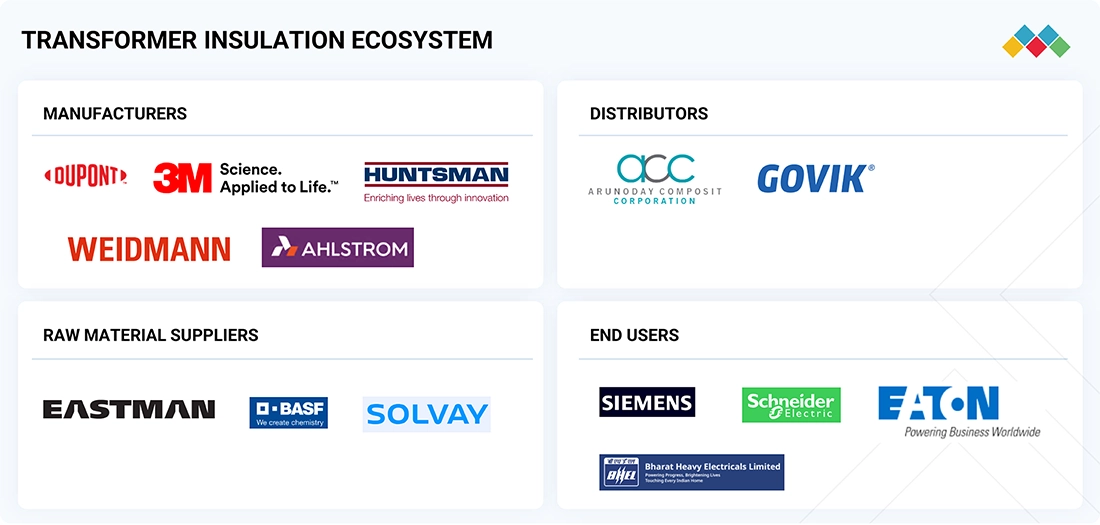
Transformer Insulation Market: COMMERCIAL USE CASES ACROSS INDUSTRIES
| COMPANY | USE CASE DESCRIPTION | BENEFITS |
|---|---|---|
 |
Provides aramid fibers (Nomex) and advanced insulation materials for transformers, ensuring thermal stability and electrical reliability | Superior thermal endurance | High dielectric strength | Extended transformer lifespan | Reduced maintenance needs |
 |
Develops advanced cellulose-based insulation papers and pressboards for power and distribution transformers | Excellent electrical insulation | Mechanical robustness | Optimized for high-voltage applications | Sustainability focus |
 |
Manufactures transformer board, insulation paper, and engineered insulation solutions for liquid-immersed and dry-type transformers | High mechanical strength | Precise dimensional stability | Reliability under stress | Proven global track record |
 |
Supplies epoxy resins, polyurethanes, and specialty materials used in transformer insulation systems | Strong adhesion | Chemical resistance | High thermal stability | Compatibility with advanced transformer designs. |
 |
Produces high-quality cellulose-based insulation papers and specialty fibrous materials tailored for transformers | High purity | Excellent impregnation properties | Electrical reliability | Eco-friendly solutions |
Logos and trademarks shown above are the property of their respective owners. Their use here is for informational and illustrative purposes only.
Related Ecosystem
Foam And Insulation
- Fiberglass
- Acoustic Insulation
- Elastomeric Foam
- HVAC System
- Flexible Foam
- Basf se
- Saint-gobain
- ARMACELL INTERNATIONAL
- THE WOODBRIDGE GROUP
- Huntsman Corporation
Key Takeaways
- Japan's transformer insulation market is valued at USD 81.0 million in 2025 and is forecast to reach USD 105.7 million by 2030, growing at a 5.5% CAGR.
- Japan's aging electrical infrastructure and grid modernization initiatives are primary drivers of transformer insulation demand through 2030.
- Japan's renewable energy integration and carbon neutrality goals are accelerating investment in advanced transformer insulation technologies.
- Japan maintains competitive advantage through high-performance materials, stringent quality standards, and technological innovation in the transformer insulation sector.
Transformer Insulation Market Report Scope
| Report Metric | Details |
|---|---|
| Base Year | 2025 |
| Fastest Growing Segment | DATA CENTERS (End-Use Industry) |
| Forecast Period | 2025–2030 |
| Growth Rate | CAGR of 6.8% from 2025 to 2030 |
| Largest Segment | LIQUID-FILLED TRANSFORMERS (Type) |
| Market Size Base Year (Billions) | ~USD 6.97 (2025) |
| Revenue Forecast (Billions) | ~USD 9.68 (2030) |
| Segments Covered | Material, Type, End-Use Industry, Type 2022–2024 |
Japan Transformer Insulation Market Report Segmentation
4 segment dimensions are covered across the global market.
By Material
- Liquid Insulation
- Solid Insulation
By Type
- Dry-Type Transformers
- Liquid-Filled Transformers
- –Cast Resin Transformers
- –Vpi Transformers
By End-Use Industry
- Data Centers
- Electrical Utilities
- Marine & Offshore
- Oil & Gas
- Other End-Use Industries
- Power
- Railways
- –Non-Renewable Energy
- –Renewable Energy
By Type 2022–2024
- Dry-Type Transformers
- Liquid-Filled Transformers
- –Cast Resin Transformers
- –Vpi Transformers
JAPAN: TRANSFORMER INSULATION MARKET, BY END-USE INDUSTRY, 2025–2030
| Segment | 2025 | 2026 | 2027 | 2028 | 2029 | 2030 | CAGR (%) |
|---|---|---|---|---|---|---|---|
| DATA CENTERS | 25 | 26.8 | 29.2 | 31.6 | 34.2 | 37 | 8.18 |
| ELECTRICAL UTILITIES | 78 | 83.3 | 89.2 | 95.3 | 101.7 | 108.3 | 6.78 |
| MARINE & OFFSHORE | 11.1 | 11.6 | 12.2 | 12.8 | 13.4 | 14 | 4.7 |
| OIL & GAS | 40.7 | 42.9 | 45.5 | 48.2 | 50.9 | 53.7 | 5.73 |
| OTHER END-USE INDUSTRIES | 46.2 | 49.7 | 53.4 | 57.3 | 61.3 | 65.5 | 7.24 |
| POWER | 101 | 107.3 | 114.2 | 121.3 | 128.7 | 136.3 | 6.17 |
| RAILWAYS | 28.5 | 29.9 | 31.5 | 33.2 | 34.9 | 36.6 | 5.09 |
| –NON-RENEWABLE ENERGY | 34.2 | 35.1 | 36.8 | 38.5 | 40.2 | 41.9 | 4.14 |
| –RENEWABLE ENERGY | 66.9 | 72.2 | 77.4 | 82.9 | 88.6 | 94.5 | 7.16 |
| TOTAL | 330.5 | 351.5 | 375.1 | 399.6 | 425.1 | 451.4 | 6.43 |
Target Audience
- Utility Companies & Grid Operators : Japanese utilities need market intelligence on insulation material innovations and infrastructure modernization trends to optimize transformer procurement strategies and ensure grid reliability compliance.
- Transformer Manufacturers : Equipment manufacturers require detailed market data and regulatory insights specific to Japan to develop compliant products, identify supply chain opportunities, and plan capacity investments.
- Insulation Material Suppliers : Chemical and material suppliers need Japan-specific market forecasts and application requirements to tailor product portfolios, establish distribution channels, and capture growth in the renewable energy segment.
- Investment & Private Equity Firms : Investors evaluating opportunities in Japan's electrical infrastructure and energy transition sectors require market sizing, growth projections, and regulatory context to assess investment viability and returns.
- Government & Policy Agencies : Japanese regulatory bodies and energy policy makers need market analysis to inform infrastructure investment decisions, renewable energy integration planning, and grid modernization initiatives.
Key Companies in the Japan Transformer Insulation Market
| Company | HQ | Ownership | Strongest segments |
|---|---|---|---|
| DUPONT | United States | Public Company | Healthcare & Water Technologies,Construction Materials (TYVEK, STYROFOAM, CORIAN),Engineered Industrial Components (Vespel, MOLYKOTE, BETAFORCE/BETASEAL, Cyrel), |
| 3M | United States | Public Company | Safety and Industrial,Transportation and Electronics,Consumer, |
| WEG | Brazil | Public Company | Electric motors, reducers, and gearmotors,Drives, frequency converters, and industrial automation,Transformers, substations, and power transmission equipment, |
| HUNTSMAN INTERNATIONAL LLC | United States | Private Company | MDI, polyols, and polyurethane systems,Amines, maleic anhydride, carbonates, and intermediates,Thermoplastic polyurethane and performance polymers, |
| AHLSTROM | Finland | Private Company | Filtration and Life Sciences,Food and Consumer Packaging,Protective Materials and Technical Substrates, |
| NORDIC PAPER | Sweden | Private Company | Sack and machine-finished kraft paper,Machine glazed and specialty kraft (absorbent, calendered, electrotechnical, spinning, interleaving),Natural greaseproof paper (baking, food packaging, barrier, bacon layout), |
| TOMOEGAWA CORPORATION | Japan | Public Company | Specialty and industrial paper (recording, insulating, industrial sheets),Fine particle materials and toners,Electronics parts and functional tapes, |
| ALTANA AG | Germany | Private Company | BYK additives and instruments,ECKART metallic and pearlescent pigments,ELANTAS electrical insulation materials, |
DUPONT
DuPont is a publicly traded United States-based company founded in 2015 with 15,000 employees.
3M
3M is a publicly traded United States company founded in 1902 with 60,500 employees, operating as a diversified multinational corporation.
WEG
WEG is a publicly traded Brazilian company founded in 1961 with 49,258 employees.
HUNTSMAN INTERNATIONAL LLC
Huntsman International LLC is a privately held United States company founded in 1970 with 6,000 employees.
AHLSTROM
Ahlstrom is a privately held Finnish company founded in 1851 with 6,883 employees.
NORDIC PAPER
Nordic Paper is a privately held Swedish company founded in 1871 with 702 employees.
TOMOEGAWA CORPORATION
Tomoegawa Corporation is a publicly traded Japanese company founded in 1914 with 1,346 employees.
ALTANA AG
Altana AG is a privately held German company founded in 1873 with 8,317 employees.
Reasons to Buy this Report
- Infrastructure Modernization Insights : Gain detailed understanding of Japan's aging electrical grid replacement cycle and the specific insulation material requirements driving market demand across utility companies and equipment manufacturers.
- Renewable Energy Opportunity Analysis : Identify growth opportunities in transformer insulation solutions tailored for renewable energy integration, including requirements for solar and wind power distribution networks across Japan's regions.
- Regulatory Compliance Framework : Access comprehensive analysis of Japan's stringent safety and reliability standards, enabling manufacturers to align product development with domestic regulatory requirements and gain competitive advantage.
- Market Sizing and Forecasting : Leverage precise market valuation data (USD 81M in 2025, USD 105.7M in 2030) and 5.5% CAGR projections to inform strategic planning, investment decisions, and resource allocation in the Japanese market.
- Competitive Landscape Assessment : Understand market dynamics, key players, and competitive positioning specific to Japan's transformer insulation sector to identify partnership opportunities and market entry strategies.
Frequently asked questions
What is the current size of Japan's transformer insulation market?
Japan's transformer insulation market is valued at USD 81.0 million in 2025 and is projected to grow to USD 105.7 million by 2030.
What is the growth rate of Japan's transformer insulation market?
Japan's transformer insulation market is expected to grow at a compound annual growth rate (CAGR) of 5.5% from 2025 to 2030.
What are the main drivers of growth in Japan's transformer insulation market?
Key drivers include Japan's aging electrical infrastructure, grid modernization initiatives, renewable energy integration, carbon neutrality commitments, and stringent regulatory standards for power system reliability.
Which sectors are driving demand for transformer insulation in Japan?
Primary demand comes from utilities modernizing legacy power systems, industrial sectors requiring efficient energy distribution, and renewable energy infrastructure development across Japan.
How does Japan's transformer insulation market compare to other Asia Pacific countries?
Japan leads the Asia Pacific region in transformer insulation technology and quality standards, leveraging advanced manufacturing capabilities and stringent regulatory compliance to maintain competitive advantage.
RESEARCH METHODOLOGY
The study involved four major activities to estimate the current size of the global transformer insulation market. Exhaustive secondary research was conducted to collect information on the market, the peer product market, and the parent product group market. The next step was to validate these findings, assumptions, and sizes with the industry experts across the value chain of transformer insulation through primary research. The top-down and bottom-up approaches were employed to estimate the overall size of the transformer insulation market. After that, market breakdown and data triangulation procedures were used to determine the size of different segments and sub-segments of the market.
Secondary Research
In the secondary research process, various secondary sources, such as Hoovers, Factiva, Bloomberg BusinessWeek, and Dun & Bradstreet, were referred to identify and collect information for this study on the transformer insulation market. These secondary sources included annual reports, press releases & investor presentations of companies; white papers; certified publications; articles by recognized authors; regulatory bodies, trade directories, and databases.
Primary Research
The transformer insulation market comprises several stakeholders in the supply chain, which include raw material suppliers, distributors, end-product manufacturers, buyers, and regulatory organizations. Various primary sources from the supply and demand sides of the markets have been interviewed to obtain qualitative and quantitative information. The primary participants from the demand side include key opinion leaders, executives, vice presidents, and CEOs of companies in the transformer insulation market. Primary sources from the supply side include associations and institutions involved in the transformer insulation market, key opinion leaders, and processing players.
The following is the breakdown of primary respondents:
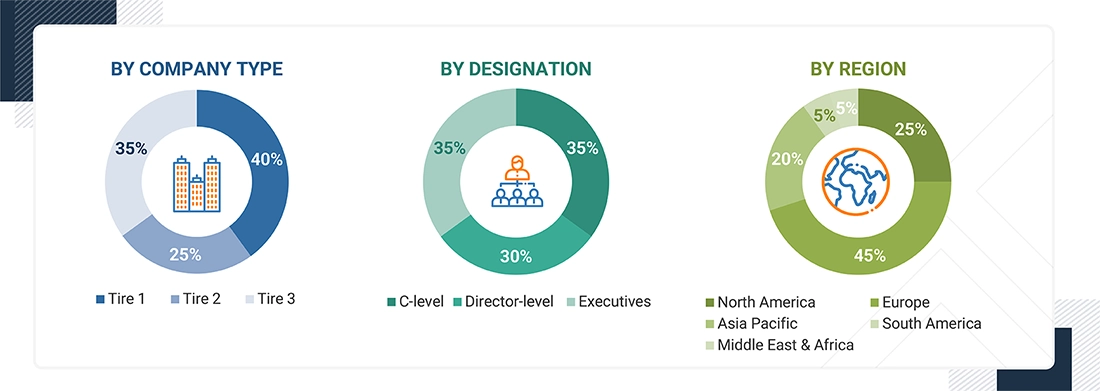
To know about the assumptions considered for the study, download the pdf brochure
Market Size Estimation
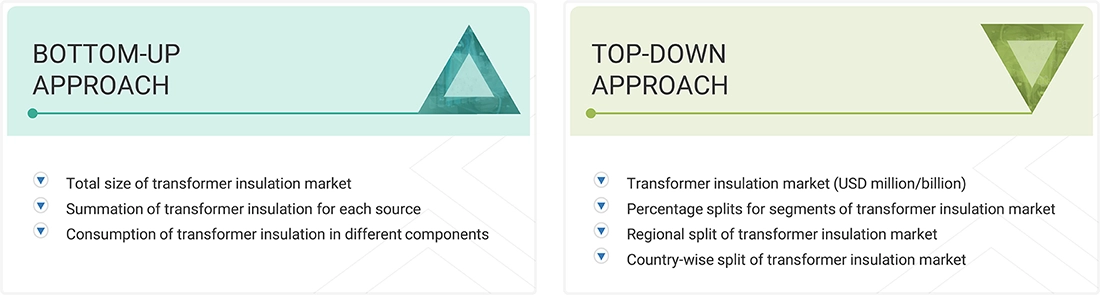
The bottom-up and top-down approaches have been used to estimate the transformer insulation market by material, type, end-use industry, and region. The research methodology used to calculate the market size includes the following steps:
- Key players in the industry and markets were identified through extensive secondary research.
- In terms of value, the industry’s supply chain and market size were determined through primary and secondary research processes.
- All percentage shares, splits, and breakdowns were determined using secondary sources and verified through primary sources.
- All possible parameters that affect the markets covered in this research study were accounted for, viewed in extensive detail, verified through primary research, and analyzed to obtain the final quantitative and qualitative data.
- The research included studying reports, reviews, and newsletters of top market players and extensive interviews with leaders, such as directors and marketing executives, to obtain opinions.
The following figure illustrates the overall market size estimation process employed for this study.
Data Triangulation
After arriving at the overall size of the transformer insulation market from the estimation process explained above, the total market was split into several segments and sub-segments. The data triangulation and market breakdown procedures were employed, wherever applicable, to complete the overall market engineering process and arrive at the exact statistics for all segments and subsegments. The data was triangulated by studying various factors and trends from both the demand and supply sides. Along with this, the market size was validated using both the top-down and bottom-up approaches.
Market Definition
The transformer insulation market includes materials and technologies that electrically, thermally, or mechanically isolate and protect components of transformers, and ensure safety under thermal, electrical, and mechanical stress over long periods. There are solid insulation materials, such as cellulose papers and pressboards, and solid-liquid combinations, of which cellulose is a natural product. Liquid insulation materials also provide dielectric protection to insulation while dissipating heat energy. Insulation systems serve a key function in transformers, providing efficiency, preventing short circuits, and prolonging life to independent users or owner-operators of transformers in transportation, industrial, and renewable energy applications. Infrastructure modernization, growing demand for electricity, and new high-performance and green insulation products drive the transformer insulation market, making it an important part of the electrical and power equipment market.
Stakeholders
- Transformer Insulation Manufacturers
- Raw Material Suppliers
- Regulatory Bodies and Government Agencies
- Distributors and Suppliers
- End-Use Industries
- Associations and Industrial Bodies
- Market Research and Consulting Firms
Report Objectives
- To define, describe, and forecast the size of the transformer insulation market, by material, type, and end-use industry, in terms of value and volume
- To forecast the market size for the five main regions—North America, Europe, Asia Pacific, South America, and the Middle East & Africa, along with their key countries, in terms of value
- To provide detailed information regarding the key factors influencing the growth of the market (drivers, restraints, opportunities, and challenges)
- To strategically analyze micro markets with respect to individual growth trends, prospects, and contributions to the total market
- To analyze the opportunities in the market for stakeholders and provide details of the competitive landscape for the market leaders
- To strategically profile leading players and comprehensively analyze their key developments, such as product launches, expansions, and deals, in the transformer insulation market
- To strategically profile key players and comprehensively analyze their market shares and core competencies
- To study the impact of AI/Gen AI and the 2025 US tariff on the market under study, along with the macroeconomic outlook for each region covered under the study
Get the Full Transformer Insulation Market Report
Full forecast, segment splits, and company analysis for all Transformer Insulation Market.
- Mexico Transformer Insulation Market
- Germany Transformer Insulation Market
- France Transformer Insulation Market
- UK Transformer Insulation Market
- Italy Transformer Insulation Market
- Spain Transformer Insulation Market
- China Transformer Insulation Market
- India Transformer Insulation Market
- Australia Transformer Insulation Market
- South Africa Transformer Insulation Market
- Brazil Transformer Insulation Market
- Argentina Transformer Insulation Market
- Rest Of Europe Transformer Insulation Market
- Rest Of Asia Pacific Transformer Insulation Market
- GCC Countries Transformer Insulation Market
- –Rest Of GCC Countries Transformer Insulation Market
- US Transformer Insulation Market
- Canada Transformer Insulation Market
Need a Tailored Report?
Customize this report to your needs
Get 10% FREE Customization
Customize This Report
