
US Transportation Management System Market (2025-2030)

The US Transportation Management System Market was valued at $5490.7 Million in 2025 and projected to reach to $10372.6 Million by 2030, representing a compound annual growth rate of 13.6%. The US Transportation Management System market is positioned for sustained growth through 2030, driven by the continued expansion of e-commerce, increasing supply chain complexity, and the need for digital visibility across logistics networks.


| Market Size in | USD 26.32 MN |
| Market Forecast in | |
| CAGR | |
| Forecast Period | |
| Units Considered | Value (USD MN) |
US Transportation Management System Market Trends and Insights
- This expansion reflects the US logistics and supply chain sector's increasing adoption of digital solutions to optimize fleet operations, reduce costs, and enhance visibility.
- The US market is driven by e-commerce growth, regulatory compliance requirements, and the need for real-time tracking capabilities across the transportation network. US enterprises are investing heavily in TMS platforms to streamline route optimization, carrier management, and freight billing processes.
- The 13.6% compound annual growth rate (CAGR) through 2030 underscores strong demand from mid-market and enterprise organizations seeking competitive advantages in an increasingly complex supply chain environment.
- The US market benefits from advanced technology infrastructure, high cloud adoption rates, and a mature logistics ecosystem that prioritizes operational efficiency and data-driven decision-making..
Key Market Statistics
- CAGR (2025-2030) 13.6% CAGR
- Market Size, 2025 ~USD 5490.7 Million
- Forecast, 2030 ~USD 10372.6 Million
- Country US
US Transportation Management System Market Overview
Market Valuation Growth :
The US TMS market is valued at $5,490.7 million in 2025 and is projected to reach $10,372.6 million by 2030, representing a robust 13.6% CAGR, significantly driven by digital transformation in logistics.
E-Commerce Acceleration :
Rapid e-commerce expansion across the US is fueling demand for advanced transportation management solutions to handle last-mile delivery, inventory visibility, and supply chain optimization.
Regulatory Compliance Drivers :
Increasing US regulatory requirements around emissions, driver hours, and safety standards are compelling logistics companies to adopt TMS platforms for automated compliance and reporting.
Fleet Optimization Focus :
US logistics operators are prioritizing cost reduction and operational efficiency through TMS adoption, leveraging real-time tracking, route optimization, and predictive analytics capabilities.
US Transportation Management System Market Dynamics
- Major US enterprises are investing heavily in cloud-based TMS solutions to streamline operations and reduce transportation costs.
- Regulatory pressures regarding emissions and driver compliance further accelerate adoption rates across the sector. The competitive landscape in the US is intensifying as both established software vendors and emerging startups develop innovative TMS solutions tailored to regional logistics challenges.
- Integration with IoT devices, AI-powered analytics, and autonomous vehicle readiness are becoming key differentiators.
- Mid-market and small logistics providers are increasingly adopting TMS platforms, expanding the addressable market beyond large enterprises and creating significant growth opportunities through 2030..
Market Ecosystem
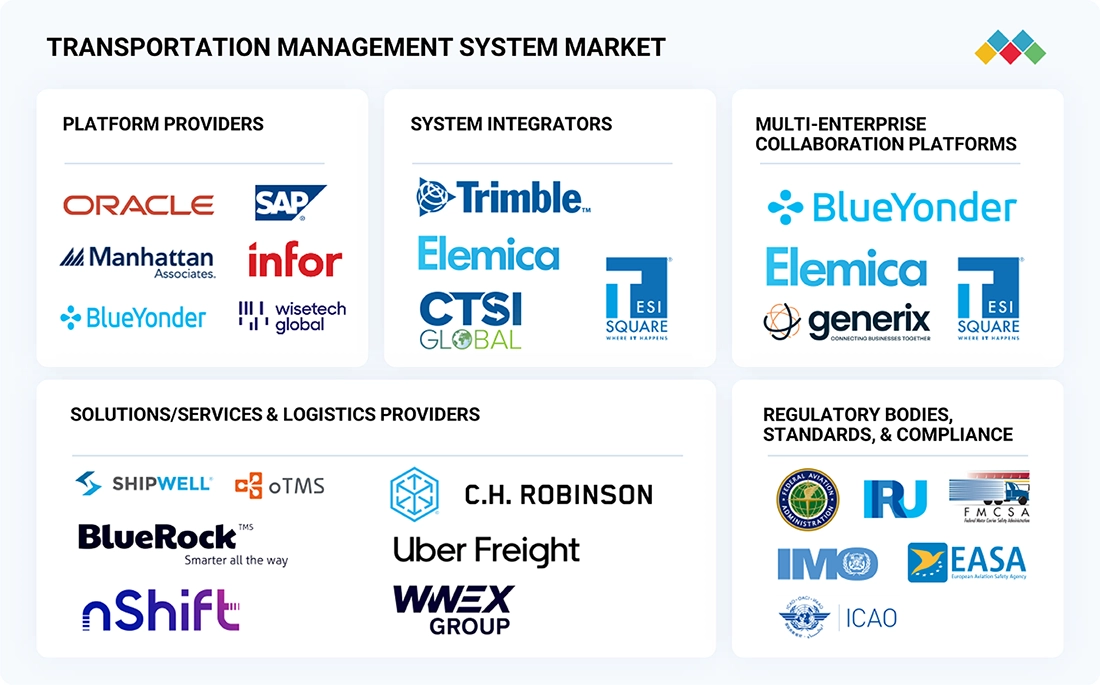
Transportation Management System Market: COMMERCIAL USE CASES ACROSS INDUSTRIES
| COMPANY | USE CASE DESCRIPTION | BENEFITS |
|---|---|---|
 |
A global technology provider unified various supply chain systems with Oracle Cloud SCM to address pandemic-driven demand increases while preparing for future growth. They integrated supply chain planning, inventory management, and transportation to improve visibility across departments and boost collaboration through better forecasting features. | Achieved nearly 100% improvement in forecast accuracy, automated 90% of orders saving 20,000 annual hours, saved USD 2 million in freight costs on single order through system integration, reduced IT maintenance costs, improved employee work-life balance scores, and gained scenario planning capabilities for better demand management and supply chain resilience |
 |
Major US food retailer with over 460 stores unified three separate transportation systems into Manhattan TMS to address fragmented routing, inconsistent delivery times, and operational inefficiencies. Implemented a single platform to optimize inbound and outbound orders, maximize cube utilization, reduce empty miles, and enhance service levels across four-state regional operations. | Reduced empty miles by 8% and total miles by 7.7%, improved cube utilization by 7%, filled available capacity with backhauls reducing inbound costs, achieved 25% reduction in idle time with significant fuel cost savings, decreased deadhead miles by 8%, and consolidated five systems into one platform improving operational efficiency |
 |
A rapidly growing power equipment manufacturer integrated C.H. Robinson's Navisphere TMS with SAP ERP to standardize global operations across acquisitions, manage a complex supply chain serving thousands of customers, and optimize multi-modal transportation, including ocean, air, customs brokerage, and trucking services, to support unprecedented business growth. | Reduced containerized freight from LA Long Beach to Wisconsin by 33%, saved multimillions on global freight spend, achieved real-time shipment visibility across multiple languages and regions, automated vendor communications reducing team workload, gained flexibility for expedited shipments, and standardized operations across business lines and geographies enabling scalable growth management |
 |
A global consumer packaged goods leader with 17 years of partnership leveraged Blue Yonder TMS for transportation optimization across a large North American CPG network, focusing on reducing costs and improving operations. Implemented transportation management and visibility solutions to optimize a complex global transportation network while managing market condition shifts and carrier rate negotiations in real-time. | Achieved USD 14 million annual savings in transportation costs, optimized carrier selection based on specific parameters and changing market conditions, gained real-time rate negotiation capabilities, improved transportation network visibility and collaboration, enhanced decision-making through constraint-based planning, and strengthened competitive advantage in global consumer packaged goods market through supply chain excellence |
Logos and trademarks shown above are the property of their respective owners. Their use here is for informational and illustrative purposes only.
Related Ecosystem
Airport Systems
Locomotives And Rolling Stock
Digitalization And Iot
Key Takeaways
- The US TMS market will nearly double from $5,490.7M (2025) to $10,372.6M (2030), representing a 13.6% CAGR.
- US organizations are prioritizing cloud-based TMS solutions to enhance supply chain visibility and reduce operational costs.
- E-commerce expansion and last-mile delivery complexity are primary growth catalysts driving US TMS adoption.
- The US market is characterized by increasing consolidation among vendors and rising demand for AI-powered optimization features.
Transportation Management System Market Report Scope
| Report Metric | Details |
|---|---|
| Base Year | 2025 |
| Fastest Growing Segment | INTEGRATION & IMPLEMENTATION (Professional Services) |
| Forecast Period | 2025–2030 |
| Growth Rate | CAGR of 14.9% from 2025 to 2030 |
| Largest Segment | SOLUTIONS (Offering) |
| Market Size Base Year (Billions) | ~USD 18.49 (2025) |
| Revenue Forecast (Billions) | ~USD 37.04 (2030) |
| Segments Covered | Offering, Solution, Service, Professional Services, Professional Service |
US Transportation Management System Market Report Segmentation
5 segment dimensions are covered across the global market.
By Offering
- Services
- Solutions
By Solution
- Analytics & Reporting
- Audit, Payment, & Claims
- Order Management
- Other Solutions
- Planning & Execution
- Routing & Tracking
By Service
- Managed Services
- Professional Services
By Professional Services
- Consulting
- Integration & Implementation
- Support & Maintenance
By Professional Service
- Consulting
- Integration & Implementation
- Support & Maintenance
US: TRANSPORTATION MANAGEMENT SYSTEM MARKET, BY END USER, 2025–2030
| Segment | 2025 | 2026 | 2027 | 2028 | 2029 | 2030 | CAGR (%) |
|---|---|---|---|---|---|---|---|
| 3PLS | 2122.2 | 2415.6 | 2737.6 | 3088.7 | 3469.3 | 3879.4 | 12.8 |
| FREIGHT FORWARDERS | 1232.1 | 1428.6 | 1649 | 1894.8 | 2167.3 | 2467.6 | 14.9 |
| OTHER END USERS | 629.2 | 724.1 | 829.5 | 946.2 | 1074.4 | 1214.6 | 14.1 |
| SHIPPERS | 1507.2 | 1722.4 | 1959.7 | 2219.9 | 2503.6 | 2811 | 13.3 |
| TOTAL | 5490.7 | 6290.7 | 7175.8 | 8149.5 | 9214.5 | 10372.6 | 13.6 |
Target Audience
- TMS Software Vendors : Validate market opportunity, benchmark competitive positioning, and identify US customer acquisition strategies to accelerate revenue growth in the rapidly expanding $10B+ market.
- Logistics & 3PL Companies : Evaluate TMS investment ROI, understand market best practices, and benchmark operational efficiency gains achieved by US peers to justify digital transformation initiatives.
- Private Equity & Investors : Assess market attractiveness, growth potential, and consolidation opportunities in the US TMS sector to inform acquisition strategies and portfolio company valuations.
- Supply Chain Consultants : Leverage US market data and insights to advise clients on TMS selection, implementation roadmaps, and digital transformation strategies aligned with industry trends.
- Enterprise Procurement Teams : Understand US market dynamics, vendor capabilities, and pricing benchmarks to make informed TMS purchasing decisions and negotiate optimal contracts with solution providers.
Key Companies in the US Transportation Management System Market
| Company | HQ | Ownership | Strongest segments |
|---|---|---|---|
| NEXTEER AUTOMOTIVE GROUP LIMITED | United States | Public Company | Electric Power Steering (EPS),Steering Columns & Intermediate Shafts,Driveline (Half Shafts and Related), |
| EXL | United States | Public Company | Insurance digital operations & platforms (LifePRO, Life Digital Suite, Subrosource),Healthcare & Life Sciences operations and analytics,Banking, Capital Markets & Diversified Industries, |
| JUNGHEINRICH AG | Germany | Public Company | Electric warehouse trucks (pallet trucks, stackers, order pickers, reach trucks, VNA),Electric counterbalance forklifts,Automation, AGVs, mobile robots, and warehouse systems, |
| SAMSUNG | South Korea | Public Company | Smartphones, tablets, wearables, and mobile accessories,TVs, audio, and digital signage,Home appliances and air solutions, |
| TECHNICOLOR SA | France | Public Company | Broadband CPE (fiber gateways, routers, extenders, Wi-Fi XL, FWA),Video CPE (set-top boxes, dongles, smart media devices),Software, Platforms, and Service Management (Navigate, HomeSight, professional services), |
| WNS GLOBAL SERVICES | India | Private Company | Banking, Financial Services and Insurance BPM,Travel, Shipping/Logistics, and Utilities BPM,Manufacturing/Retail/Consumer, Hi-tech/Professional Services, and Procurement, |
| ZENSAR TECHNOLOGIES LTD | India | Public Company | Digital and Application Services,Cloud Infrastructure and Security Services,Data Engineering, Analytics, and AI Solutions, |
| KNORR-BREMSE AG | Germany | Public Company | Rail Vehicle Systems,Commercial Vehicle Systems,Other services (leasing, logistics, IT, media), |
| MANHATTAN ASSOCIATES | United States | Public Company | Warehouse Management (on-prem and Manhattan Active Warehouse Management),Transportation Management,Manhattan Active Omni and Commerce Solutions, |
| C.H. ROBINSON | United States | Public Company | Truckload Brokerage,Less-than-Truckload (LTL) Brokerage,Intermodal & Surface Transportation Management, |
| TRIMBLE | United States | Public Company | Construction and owner software (BIM/VDC, project management, cost and visualization),Machine control and field systems for construction equipment,Positioning services (VRSNow, RTX portfolio, xFill), |
| WISETECH GLOBAL | Australia | Public Company | Forwarding and customs,Landside logistics and transport management,Digital documents and specialist WMS, |
| DESCARTES | Canada | Public Company | Transportation management (TMS) and routing/mobile/telematics,Ecommerce, shipping, and fulfillment,Customs, regulatory compliance, and global trade intelligence, |
| GENERIX GROUP | France | Private Company | Warehouse Management Systems (WMS),Transport Management Systems (TMS),Manufacturing Execution Systems (MES), |
| KöRBER AG | Germany | Private Company | Supply chain software, automation, voice, robotics, and material handling,Pharma machinery, equipment, and digital solutions,Technologies: machinery, measuring instruments, flavors, food & beverage solutions, |
| INFOR | United States | Private Company | Data Integration & Engineering,API & Application Integration,Data Quality & Observability, |
| KINAXIS | Canada | Public Company | RapidResponse core planning platform (SaaS subscriptions),Professional services and implementation,Support, training, and other recurring services, |
NEXTEER AUTOMOTIVE GROUP LIMITED
Nexteer Automotive Group Limited is a public company founded in 1906 with 12,500 employees, operating in the United States automotive sector.
EXL
EXL is a public company founded in 1999 in the United States with 65,000 employees, providing business process management and analytics services.
JUNGHEINRICH AG
Jungheinrich AG is a German public company founded in 1953 with 21,438 employees, specializing in material handling equipment and logistics solutions.
SAMSUNG
Samsung is a South Korean public company founded in 1969 with 128,735 employees, operating as a diversified conglomerate across electronics, semiconductors, and consumer goods.
TECHNICOLOR SA
Technicolor SA is a French public company founded in 1985 with 1,552 employees, providing media and entertainment technology services.
WNS GLOBAL SERVICES
WNS Global Services is a private company based in India with 66,085 employees, founded in 1998 and offering business process management and IT services.
ZENSAR TECHNOLOGIES LTD
Zensar Technologies Ltd is an Indian public company founded in 1963 with 10,066 employees, providing IT services and digital transformation solutions.
KNORR-BREMSE AG
Knorr-Bremse AG is a German public company founded in 1905 with 26,629 employees, specializing in braking systems and safety technology for rail and commercial vehicles.
MANHATTAN ASSOCIATES
Manhattan Associates is a public company founded in 1990 in the United States with 4,390 employees, providing supply chain and omnichannel commerce software solutions.
C.H. ROBINSON
C.H. Robinson is a public company founded in 1905 in the United States with 11,705 employees, operating as a global transportation and logistics provider.
TRIMBLE
Trimble is a public company founded in 1978 in the United States with 11,500 employees, specializing in positioning, modeling, and connectivity solutions.
WISETECH GLOBAL
WiseTech Global is an Australian public company founded in 1994 with 7,000 employees, providing cloud-based logistics software solutions.
DESCARTES
Descartes is a Canadian public company founded in 1981 with 2,384 employees, offering logistics software and supply chain management solutions.
GENERIX GROUP
Generix Group is a French private company founded in 1990 with 787 employees, specializing in supply chain and logistics software.
KöRBER AG
Körber AG is a German private company founded in 1946 with 10,665 employees, providing software and automation solutions for supply chain and logistics.
INFOR
Infor is a private company founded in 1993 in the United States with 5,200 employees, providing enterprise resource planning and business software solutions.
KINAXIS
Kinaxis is a Canadian public company founded in 1984, specializing in supply chain planning and response software solutions.
Reasons to Buy this Report
- Market Size & Growth Validation : Confirm the US TMS market opportunity with precise valuation data ($5.5B in 2025) and verified 13.6% CAGR projections through 2030, enabling confident investment and expansion decisions.
- Competitive Landscape Intelligence : Understand the US-specific competitive dynamics, key market players, and differentiation strategies to position your TMS solution effectively against regional competitors and emerging disruptors.
- Regulatory & Compliance Insights : Access detailed analysis of US regulatory drivers (emissions, safety, hours-of-service) that are accelerating TMS adoption, helping you align product development with compliance requirements.
- Customer Segmentation Data : Identify high-value US customer segments including e-commerce retailers, 3PL providers, and mid-market logistics operators with specific pain points and purchasing behaviors.
- Strategic Growth Opportunities : Discover emerging US market trends such as last-mile optimization, autonomous vehicle integration, and AI-powered analytics to guide product innovation and go-to-market strategies.
Frequently asked questions
What is the current size of the US Transportation Management System market?
The US TMS market is valued at $5,490.7 million in 2025 and is expected to grow to $10,372.6 million by 2030.
What is the projected growth rate for the US TMS market?
The US Transportation Management System market is projected to grow at a compound annual growth rate (CAGR) of 13.6% from 2025 to 2030.
What are the main drivers of growth in the US TMS market?
Key growth drivers include e-commerce expansion, regulatory compliance requirements, demand for real-time tracking, and the need for cost optimization in logistics operations.
Which segments are driving adoption of TMS solutions in the US?
Mid-market and enterprise organizations across retail, manufacturing, and third-party logistics (3PL) sectors are leading TMS adoption in the US.
What technology trends are shaping the US TMS market?
Cloud-based deployment, artificial intelligence for route optimization, real-time visibility platforms, and integration with IoT devices are key technology trends in the US market.
RESEARCH METHODOLOGY
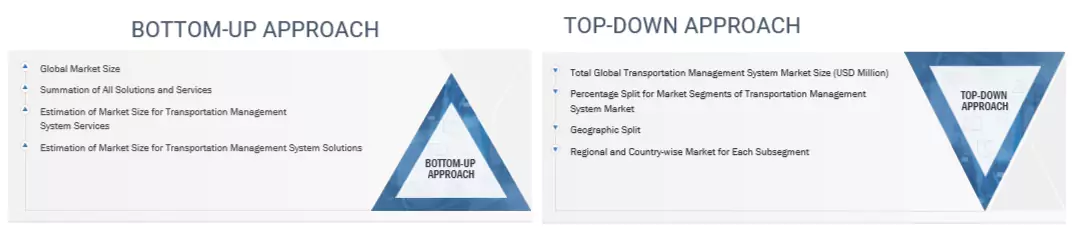
The research study involved four major activities in estimating the transportation management system market size. Exhaustive secondary research was done to collect important information about the market and peer markets. The next step was to validate these findings and assumptions and size them with the help of primary research with industry experts across the value chain. The top-down and bottom-up approaches were used to estimate the market size. The market breakdown and data triangulation were adopted to estimate the market sizes of segments and sub-segments.
Secondary Research
The market size of the companies offering transportation management system solutions to various end users was determined based on the secondary data available through paid and unpaid sources, and by analyzing the product portfolios of major companies in the ecosystem and rating the companies based on their performance and quality. In the secondary research process, various sources were referred to identify and collect information for the study. The secondary sources included annual reports, press releases, investor presentations of companies, white papers, certified publications, and articles from recognized associations and government publishing sources.
Secondary research was mainly used to obtain critical information about industry insights, the market’s monetary chain, the overall pool of key players, market classification, and segmentation according to industry trends to the bottom-most level, regional markets, and key developments from market- and technology-oriented perspectives.
Primary Research
In the primary research process, various sources from the supply and demand sides were interviewed to obtain qualitative and quantitative information for the report. The primary sources from the supply side included Chief Executive Officers (CEOs), Chief Technology Officers (CTOs), Chief Operating Officers (COOs), Vice Presidents (VPs), Managing Directors (MDs), technology and innovation directors, and related key executives from various key companies and organizations operating in the transportation management system market.
Primary interviews were conducted to gather insights, such as market statistics, data on revenue collected from software and services, market breakups, market size estimations, market forecasts, and data triangulation. Stakeholders from the demand side, such as Chief Information Officers (CIOs), Chief Finance Officers (CFOs), Chief Strategy Officers (CSOs), and the installation team of end users who use transportation management system, were interviewed to understand buyers’ perspectives on suppliers, products, service providers, and their current usage of transportation management system hardware, solutions and services, which is expected to affect the overall transportation management system market growth.
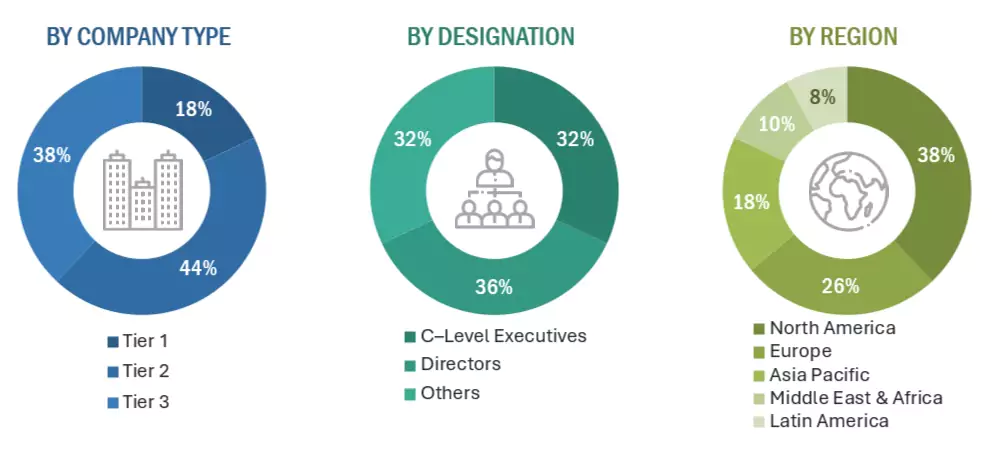
NNote 1: Tier 1 companies have revenues of more than USD 10 billion; tier 2 companies’ revenue ranges from USD
1 billion to USD 10 billion; and tier 3 companies’ revenue ranges from USD 500 million to USD 1 billion
Source: Secondary Literature, Interviews with Experts, and MarketsandMarkets Analysis
To know about the assumptions considered for the study, download the pdf brochure
Market Size Estimation
In the market engineering process, the top-down and bottom-up approaches were used along with multiple data triangulation methods to estimate and validate the size of the transportation management system market, as well as other dependent submarkets. The research methodology used to estimate the market sizes includes the following:
- MarketsandMarkets focuses on top-line investments and spending in the ecosystems. Significant developments in the critical market area were considered.
- The recent and upcoming developments in the transportation management system market that include investments, R&D activities, product launches, collaborations, mergers & acquisitions, and partnerships were tracked and the market size was projected based on these developments and other critical parameters.
- Multiple discussions were conducted with key opinion leaders to learn about the diverse types of authentications and brand protection offerings used and the applications for which they are used to analyze the breakdown of the scope of work carried out by major companies.
- The market was segmented based on technology types concerning applications, the types of which are to be used and deriving the size of the global application market.
- The overall market was segmented into various market segments.
- The estimates were validated at every level through discussions with key opinion leaders, such as chief executives (CXOs), directors, and operation managers, and finally with the domain experts at MarketsandMarkets.
Transportation Management System Market : Top-Down and Bottom-Up Approach
Data Triangulation
After arriving at the overall market size from the above estimation process, the transportation management system market was split into several segments and sub-segments. Data triangulation and market breakdown procedures were used, wherever applicable, to complete the overall market engineering process and arrive at the exact statistics for all segments and sub-segments. The data was triangulated by studying various factors and trends from the demand and supply sides.
The transportation management system market size was validated using top-down and bottom-up approaches.
Market Definition
Transportation management systems (TMS) are crucial tools for businesses to choose the most cost-efficient and effective carrier and mode of shipment. A strong TMS can optimize multi-leg carrier routes and provide visibility into every stage of the supply chain. It also offers global trade management functionality, including information on trade and tariffs, and potential delays due to customs and other regulations.
Stakeholders
- TMS vendors
- Technology partners
- Consulting firms
- Resellers and distributors of TMS
- Enterprise users
- Technology providers
- System integrators
- Support service providers
- Consulting service providers
- Logistics service providers
- Government and standardization bodies
Report Objectives
- To determine and forecast the global transportation management system market by offering, solutions, and services, transportation mode, end user, vertical, and region from 2025 to 2030, and analyze the various macroeconomic and microeconomic factors affecting market growth.
- To forecast the size of the market segments concerning five central regions: North America, Europe, Asia Pacific (APAC), Middle East & Africa (MEA), and Latin America
- To provide detailed information about the major factors (drivers, restraints, opportunities, and challenges) influencing the growth of the transportation management system market
- To analyze each submarket concerning individual growth trends, prospects, and contributions to the overall transportation management system market
- To analyze the opportunities in the market for stakeholders by identifying the high-growth segments of the transportation management system market
- To profile the key market players, provide a comparative analysis based on business overviews, regional presence, product offerings, business strategies, and key financials, and illustrate the market’s competitive landscape
- To track and analyze competitive developments in the market, such as mergers and acquisitions, product development, partnerships and collaborations, and research and development (R&D) activities
Available Customizations
With the given market data, MarketsandMarkets offers customizations per the company’s specific needs. The following customization options are available for the report:
Geographic Analysis as per Feasibility
- Further break-up of the Asia Pacific market into countries contributing 75% to the regional market size
- Further break-up of the North American market into countries contributing 75% to the regional market size
- Further break-up of the Latin American market into countries contributing 75% to the regional market size
- Further break-up of the Middle East African market into countries contributing 75% to the regional market size
- Further break-up of the European market into countries contributing 75% to the regional market size
Company Information
- Detailed analysis and profiling of additional market players (up to 5)
Get the Full Transportation Management System Market Report
Full forecast, segment splits, and company analysis for all Transportation Management System Market.
Need a Tailored Report?
Customize this report to your needs
Get 10% FREE Customization
Customize This Report
