
CHINA Transportation Management System Market (2025-2030)

The CHINA Transportation Management System Market was valued at $1831.7 Million in 2025 and projected to reach to $3720.4 Million by 2030, representing a compound annual growth rate of 15.2%. China's Transportation Management System market is positioned for exceptional growth, expanding from USD 1,831.7 million in 2025 to USD 3,720.4 million by 2030.


| Market Size in | USD 26.32 MN |
| Market Forecast in | |
| CAGR | |
| Forecast Period | |
| Units Considered | Value (USD MN) |
CHINA Transportation Management System Market Trends and Insights
- This expansion reflects China's accelerating digital transformation across logistics and supply chain operations, driven by e-commerce proliferation, urbanization, and regulatory pressures for fleet optimization.
- China's TMS adoption is increasingly critical as enterprises seek to enhance operational efficiency, reduce transportation costs, and meet sustainability mandates in an increasingly competitive market. The 15.2% compound annual growth rate (CAGR) positions China as a high-growth market within the Asia Pacific region, outpacing global benchmarks.
- China's TMS market benefits from substantial investments in smart logistics infrastructure, government initiatives supporting digital supply chains, and the rise of autonomous and connected vehicle technologies.
- By 2030, China is expected to consolidate its position as a leading TMS market, with enterprises across manufacturing, retail, and third-party logistics sectors leveraging advanced management solutions to optimize route planning, fleet utilization, and real-time visibility..
Key Market Statistics
- CAGR (2025-2030) 15.2% CAGR
- Market Size, 2025 ~USD 1831.7 Million
- Forecast, 2030 ~USD 3720.4 Million
- Country CHINA
CHINA Transportation Management System Market Overview
Rapid Market Expansion :
China's TMS market is growing at 15.2% CAGR, outpacing the global rate of 14.9%, driven by massive e-commerce logistics demands and last-mile delivery optimization requirements across major urban centers.
E-Commerce Logistics Catalyst :
The explosive growth of platforms like Alibaba and JD.com has created unprecedented demand for advanced transportation management solutions to handle complex multi-channel distribution networks and real-time tracking capabilities.
Regulatory Compliance Pressure :
China's stringent environmental regulations and fuel consumption standards are compelling logistics operators to adopt TMS solutions for fleet optimization, emissions reduction, and regulatory reporting compliance.
Urbanization & Infrastructure Investment :
Rapid urbanization and government infrastructure investments in smart cities and integrated logistics hubs are accelerating TMS adoption among regional and national logistics providers across China.
CHINA Transportation Management System Market Dynamics
- This trajectory reflects the country's digital transformation imperative within logistics and supply chain sectors, fueled by e-commerce dominance, urbanization acceleration, and regulatory mandates for operational efficiency. The market will be shaped by increasing adoption of AI-powered route optimization, IoT-enabled fleet tracking, and cloud-based TMS platforms among enterprises of all sizes.
- Government initiatives promoting smart logistics and carbon neutrality targets will further drive investment in advanced transportation management technologies, positioning China as a critical growth engine for global TMS vendors..
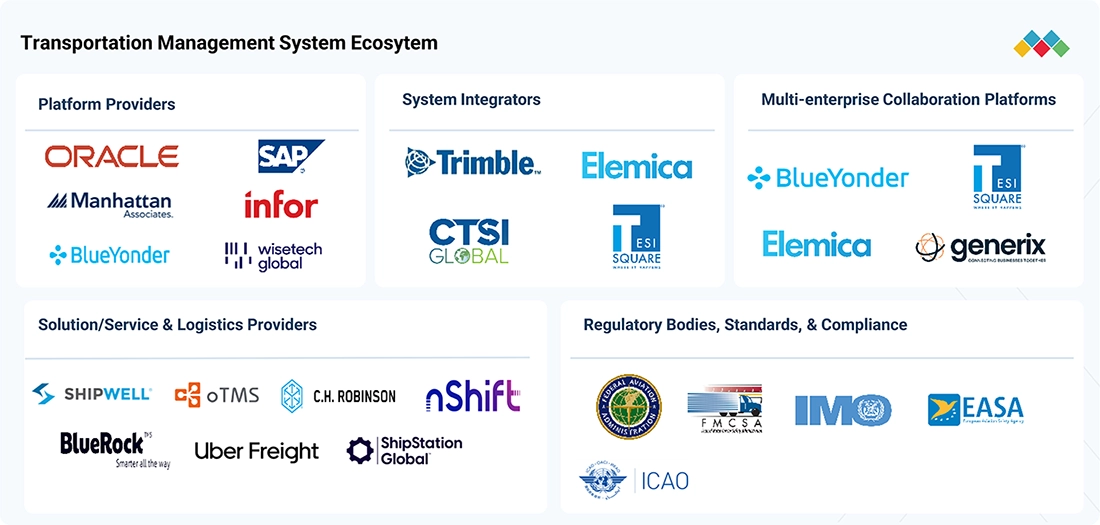
Market Ecosystem
TRANSPORTATION MANAGEMENT SYSTEM MARKET: COMMERCIAL USE CASES ACROSS INDUSTRIES
| COMPANY | USE CASE DESCRIPTION | BENEFITS |
|---|---|---|
 |
Uber Freight integrated its real-time pricing and carrier-capacity API with Oracle Transportation Management to enable shippers to access freight rates, compare transportation alternatives, and book available capacity. | Enabled rate visibility up to 21 days in advance. One large US consumer-products company managed 30% of its freight through the API and reduced total transportation costs by 5%. |
 |
Yellow Diamond Logistics implemented Descartes Aljex TMS with MacroPoint real-time freight visibility to automate shipment execution, connect logistics partners, and manage freight across multiple transportation modes. | Improved productivity, reduced manual tracking, enhanced shipment visibility, and supported business growth without a proportional increase in personnel. |
 |
Giant Eagle consolidated three disconnected transportation systems into Manhattan TMS to optimize inbound and outbound orders, delivery schedules, routes, and vehicle capacity across more than 460 stores. | Reduced empty miles by 8%, reduced total miles driven by 7.7%, and improved trailer utilization by 7%. |
Logos and trademarks shown above are the property of their respective owners. Their use here is for informational and illustrative purposes only.
Related Ecosystem
Airport Systems
Locomotives And Rolling Stock
Digitalization And Iot
Key Takeaways
- China's TMS market will more than double from USD 1,831.7M (2025) to USD 3,720.4M (2030), driven by e-commerce logistics demands and digital supply chain transformation.
- China's 15.2% CAGR outpaces the global average, reflecting accelerated adoption of cloud-based and AI-powered transportation solutions across enterprises.
- China's regulatory environment and sustainability initiatives are compelling logistics operators to invest in TMS platforms for fleet optimization and emissions reduction.
- China's competitive landscape is intensifying as domestic and international vendors expand offerings tailored to the country's unique logistics infrastructure and regulatory requirements.
Transportation Management System Market Report Scope
| Report Metric | Details |
|---|---|
| Base Year | 2025 |
| Fastest Growing Segment | INTEGRATION & IMPLEMENTATION (Professional Services) |
| Forecast Period | 2025–2030 |
| Growth Rate | CAGR of 14.9% from 2025 to 2030 |
| Largest Segment | SOLUTIONS (Offering) |
| Market Size Base Year (Billions) | ~USD 18.49 (2025) |
| Revenue Forecast (Billions) | ~USD 37.04 (2030) |
| Segments Covered | Offering, Solution, Service, Professional Services, Professional Service |
CHINA Transportation Management System Market Report Segmentation
5 segment dimensions are covered across the global market.
By Offering
- Services
- Solutions
By Solution
- Analytics & Reporting
- Audit, Payment, & Claims
- Order Management
- Other Solutions
- Planning & Execution
- Routing & Tracking
By Service
- Managed Services
- Professional Services
By Professional Services
- Consulting
- Integration & Implementation
- Support & Maintenance
By Professional Service
- Consulting
- Integration & Implementation
- Support & Maintenance
CHINA: TRANSPORTATION MANAGEMENT SYSTEM MARKET, BY END USER, 2025–2030
| Segment | 2025 | 2026 | 2027 | 2028 | 2029 | 2030 | CAGR (%) |
|---|---|---|---|---|---|---|---|
| 3PLS | 707.9 | 819.1 | 942.6 | 1079.1 | 1228.6 | 1391.4 | 14.5 |
| FREIGHT FORWARDERS | 411 | 484.4 | 567.8 | 662 | 767.5 | 885.1 | 16.6 |
| OTHER END USERS | 209.9 | 245.5 | 285.6 | 330.5 | 380.5 | 435.7 | 15.7 |
| SHIPPERS | 502.8 | 584 | 674.8 | 775.6 | 886.6 | 1008.2 | 14.9 |
| TOTAL | 1831.7 | 2133 | 2470.8 | 2847.1 | 3263.3 | 3720.4 | 15.2 |
Target Audience
- TMS Software Vendors : Global and regional TMS providers need China-specific market data to prioritize product development, localization efforts, and sales resource allocation in this high-growth market with unique regulatory requirements.
- Logistics & Supply Chain Enterprises : Chinese 3PL providers, e-commerce fulfillment operators, and fleet management companies require market insights to benchmark performance, justify technology investments, and plan digital transformation initiatives.
- Private Equity & Investment Firms : Investors evaluating logistics technology acquisitions or portfolio companies in China need validated market sizing and growth projections to assess investment returns and exit opportunities.
- Technology Consultants & Integrators : System integrators and management consultants serving Chinese enterprises need market data to advise clients on TMS adoption trends, vendor selection, and implementation best practices.
- Government & Policy Makers : Chinese government agencies and industry associations require market intelligence to inform smart logistics initiatives, regulatory frameworks, and infrastructure investments supporting digital supply chain transformation.
Key Companies in the CHINA Transportation Management System Market
| Company | HQ | Ownership | Strongest segments |
|---|---|---|---|
| NEXTEER AUTOMOTIVE GROUP LIMITED | United States | Public Company | Electric Power Steering (EPS),Steering Columns & Intermediate Shafts,Driveline (Half Shafts and Related), |
| EXL | United States | Public Company | Insurance digital operations & platforms (LifePRO, Life Digital Suite, Subrosource),Healthcare & Life Sciences operations and analytics,Banking, Capital Markets & Diversified Industries, |
| JUNGHEINRICH AG | Germany | Public Company | Electric warehouse trucks (pallet trucks, stackers, order pickers, reach trucks, VNA),Electric counterbalance forklifts,Automation, AGVs, mobile robots, and warehouse systems, |
| SAMSUNG | South Korea | Public Company | Smartphones, tablets, wearables, and mobile accessories,TVs, audio, and digital signage,Home appliances and air solutions, |
| TECHNICOLOR SA | France | Public Company | Broadband CPE (fiber gateways, routers, extenders, Wi-Fi XL, FWA),Video CPE (set-top boxes, dongles, smart media devices),Software, Platforms, and Service Management (Navigate, HomeSight, professional services), |
| WNS GLOBAL SERVICES | India | Private Company | Banking, Financial Services and Insurance BPM,Travel, Shipping/Logistics, and Utilities BPM,Manufacturing/Retail/Consumer, Hi-tech/Professional Services, and Procurement, |
| ZENSAR TECHNOLOGIES LTD | India | Public Company | Digital and Application Services,Cloud Infrastructure and Security Services,Data Engineering, Analytics, and AI Solutions, |
| KNORR-BREMSE AG | Germany | Public Company | Rail Vehicle Systems,Commercial Vehicle Systems,Other services (leasing, logistics, IT, media), |
| MANHATTAN ASSOCIATES | United States | Public Company | Warehouse Management (on-prem and Manhattan Active Warehouse Management),Transportation Management,Manhattan Active Omni and Commerce Solutions, |
| C.H. ROBINSON | United States | Public Company | Truckload Brokerage,Less-than-Truckload (LTL) Brokerage,Intermodal & Surface Transportation Management, |
| TRIMBLE | United States | Public Company | Construction and owner software (BIM/VDC, project management, cost and visualization),Machine control and field systems for construction equipment,Positioning services (VRSNow, RTX portfolio, xFill), |
| WISETECH GLOBAL | Australia | Public Company | Forwarding and customs,Landside logistics and transport management,Digital documents and specialist WMS, |
| DESCARTES | Canada | Public Company | Transportation management (TMS) and routing/mobile/telematics,Ecommerce, shipping, and fulfillment,Customs, regulatory compliance, and global trade intelligence, |
| GENERIX GROUP | France | Private Company | Warehouse Management Systems (WMS),Transport Management Systems (TMS),Manufacturing Execution Systems (MES), |
| KöRBER AG | Germany | Private Company | Supply chain software, automation, voice, robotics, and material handling,Pharma machinery, equipment, and digital solutions,Technologies: machinery, measuring instruments, flavors, food & beverage solutions, |
| INFOR | United States | Private Company | Data Integration & Engineering,API & Application Integration,Data Quality & Observability, |
| KINAXIS | Canada | Public Company | RapidResponse core planning platform (SaaS subscriptions),Professional services and implementation,Support, training, and other recurring services, |
NEXTEER AUTOMOTIVE GROUP LIMITED
Nexteer Automotive Group Limited is a public company founded in 1906 with 12,500 employees, operating in the United States automotive sector.
EXL
EXL is a public company founded in 1999 in the United States with 65,000 employees, providing business process management and analytics services.
JUNGHEINRICH AG
Jungheinrich AG is a German public company founded in 1953 with 21,438 employees, specializing in material handling equipment and logistics solutions.
SAMSUNG
Samsung is a South Korean public company founded in 1969 with 128,735 employees, operating as a diversified conglomerate across electronics, semiconductors, and consumer goods.
TECHNICOLOR SA
Technicolor SA is a French public company founded in 1985 with 1,552 employees, providing media and entertainment technology services.
WNS GLOBAL SERVICES
WNS Global Services is a private company based in India with 66,085 employees, founded in 1998 and offering business process management and IT services.
ZENSAR TECHNOLOGIES LTD
Zensar Technologies Ltd is an Indian public company founded in 1963 with 10,066 employees, providing IT services and digital transformation solutions.
KNORR-BREMSE AG
Knorr-Bremse AG is a German public company founded in 1905 with 26,629 employees, specializing in braking systems and safety technology for rail and commercial vehicles.
MANHATTAN ASSOCIATES
Manhattan Associates is a public company founded in 1990 in the United States with 4,390 employees, providing supply chain and omnichannel commerce software solutions.
C.H. ROBINSON
C.H. Robinson is a public company founded in 1905 in the United States with 11,705 employees, operating as a global transportation and logistics provider.
TRIMBLE
Trimble is a public company founded in 1978 in the United States with 11,500 employees, specializing in positioning, modeling, and connectivity solutions.
WISETECH GLOBAL
WiseTech Global is an Australian public company founded in 1994 with 7,000 employees, providing cloud-based logistics software solutions.
DESCARTES
Descartes is a Canadian public company founded in 1981 with 2,384 employees, offering logistics software and supply chain management solutions.
GENERIX GROUP
Generix Group is a French private company founded in 1990 with 787 employees, specializing in supply chain and logistics software.
KöRBER AG
Körber AG is a German private company founded in 1946 with 10,665 employees, providing software and automation solutions for supply chain and logistics.
INFOR
Infor is a private company founded in 1993 in the United States with 5,200 employees, providing enterprise resource planning and business software solutions.
KINAXIS
Kinaxis is a Canadian public company founded in 1984, specializing in supply chain planning and response software solutions.
Reasons to Buy this Report
- Market Size & Growth Validation : Obtain precise market valuation data for China's TMS sector with verified CAGR of 15.2%, enabling accurate investment decisions and competitive positioning strategies in Asia's largest logistics market.
- E-Commerce Opportunity Mapping : Understand how China's e-commerce explosion drives TMS adoption across distribution networks, identifying high-potential customer segments and market entry strategies for logistics technology providers.
- Regulatory & Compliance Insights : Gain intelligence on China's environmental regulations and fleet optimization mandates that are compelling enterprises to adopt TMS solutions, creating compliance-driven revenue opportunities.
- Competitive Landscape Intelligence : Benchmark against regional competitors and identify market gaps in China's TMS ecosystem, from SME-focused solutions to enterprise-grade platforms serving multinational logistics operators.
- Strategic Expansion Planning : Leverage detailed market forecasts through 2030 to develop go-to-market strategies, partnership models, and product localization roadmaps specifically tailored to China's unique logistics requirements.
Frequently asked questions
What is the current size of China's Transportation Management System market?
China's TMS market is valued at USD 1,831.7 million in 2025 and is projected to reach USD 3,720.4 million by 2030.
What is the expected growth rate for China's TMS market?
China's TMS market is expected to grow at a compound annual growth rate (CAGR) of 15.2% from 2025 to 2030.
What factors are driving growth in China's TMS market?
Key drivers include e-commerce expansion, digital supply chain transformation, government smart logistics initiatives, sustainability regulations, and adoption of AI and cloud-based solutions.
Which industries in China are adopting TMS solutions most rapidly?
Manufacturing, retail, third-party logistics (3PL), and e-commerce sectors are leading TMS adoption in China to optimize operations and reduce costs.
How does China's TMS market growth compare to global trends?
China's 15.2% CAGR exceeds the global average of 14.9%, positioning China as a high-growth market within the Asia Pacific region.
RESEARCH METHODOLOGY
The research study involved four major activities to estimate the transportation management system (TMS) market size. Exhaustive secondary research was conducted to collect relevant information about the TMS market and related logistics technology markets. The findings and assumptions were subsequently validated through primary research with industry experts across the transportation and logistics value chain. Top-down and bottom-up approaches were used to estimate the market size, followed by data triangulation to validate the estimates and determine the sizes of individual segments and subsegments.
Secondary Research
The market size of companies offering TMS solutions and services to various end users was determined using secondary data from paid and publicly available sources. The research involved analyzing the product portfolios, service offerings, geographic presence, and competitive positioning of major market participants. Various sources were consulted to identify and collect relevant information, including company annual reports, official websites, press releases, investor presentations, product announcements, white papers, industry publications, certified reports, and publications from recognized logistics associations and government agencies.
Secondary research was primarily used to obtain critical information about industry trends, market drivers and restraints, the market value chain, the competitive landscape, and the overall pool of key players. It also supported market classification and segmentation by offering, transportation mode, end user, and region, along with the identification of key developments from market-oriented and technology-oriented perspectives.
Primary Research
In the primary research process, various sources from the supply and demand sides were interviewed to obtain qualitative and quantitative information for the report, such as chief experience officers (CXOs), vice presidents (VPs), directors from business development, marketing, and product development/innovation teams, and related key executives from TMS solutions vendors, system integrators, professional and managed service providers, industry associations, independent consultants, and key opinion leaders.
Primary interviews were conducted to gather insights, such as market statistics, data on revenue collected from platforms and services, market breakdowns, market size estimations, market forecasts, and data triangulation. Stakeholders from the demand side, such as chief information officers (CIOs), chief finance officers (CFOs), chief strategy officers (CSOs), and the installation team of end users who use TMS solutions, were interviewed to understand buyers’ perspectives on suppliers, products, service providers, and their use of TMS solutions, which is expected to affect the overall TMS market growth.
BREAKDOWN OF PRIMARY INTERVIEWS
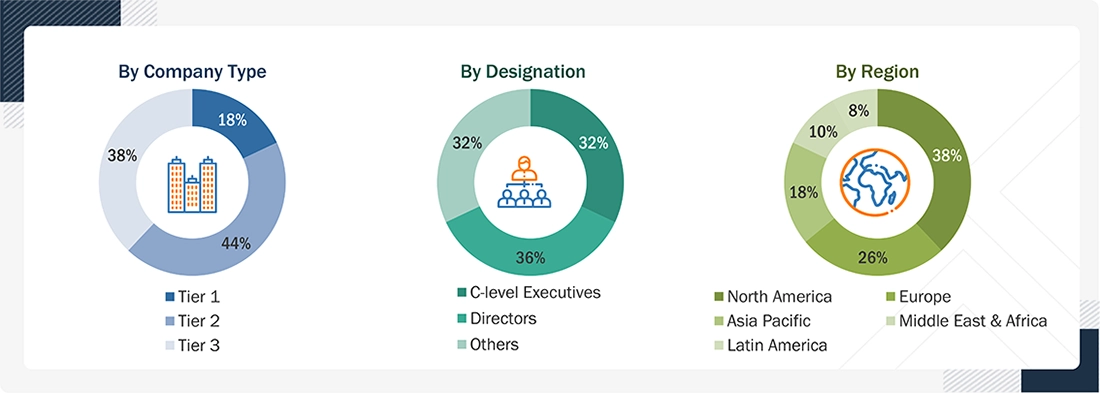
Note: Tier 1 companies have revenues over USD 1 billion, Tier 2 companies have revenues between USD 500 million and 1 billion, and Tier 3 companies have revenues less than USD 500 million.
Other designations include sales managers, marketing managers, and product managers.
Source: Industry Experts
To know about the assumptions considered for the study, download the pdf brochure
Market Size Estimation
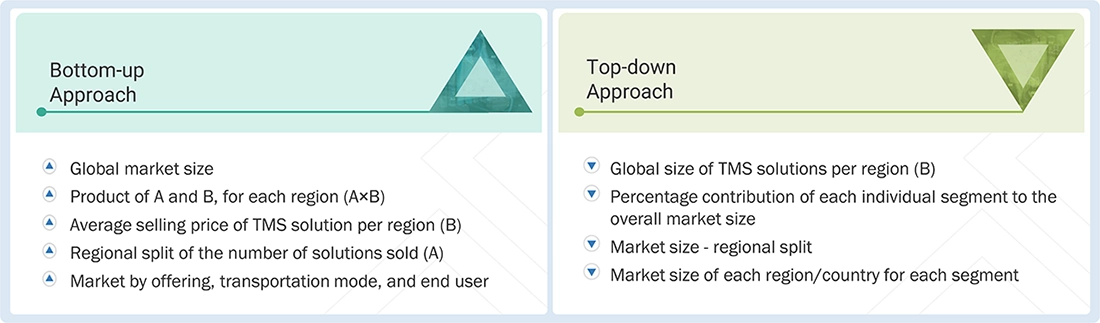
Both top-down and bottom-up approaches were used to estimate and validate the total size of the TMS market. These methods were also used extensively to estimate the size of various subsegments in the market.
Transportation Management System Market: Top-Down and Bottom-Up Approach
Data Triangulation
The TMS market was split into several segments and subsegments after determining the overall market size from the above estimation process. To complete the overall market engineering process and arrive at the exact statistics for all segments and subsegments, data triangulation and market breakdown procedures were used, wherever applicable. The data was triangulated by studying various factors and trends from the demand and supply sides. The TMS market size was validated using top-down and bottom-up approaches.
Market Definition
A transportation management system is a software system that helps companies manage logistics associated with the movement of physical goods - by land, air, sea, or a combination of transportation modes. As part of the larger supply chain management system, TMS logistics software helps ensure timely delivery by optimizing loads and delivery routes, tracking freight across local and global routes, and automating time-consuming tasks such as trade compliance documentation and freight billing. A TMS system reduces costs for both businesses and end customers.
Transportation management systems are crucial tools for businesses to choose the most cost-efficient and effective carrier and mode of shipment. A strong TMS can optimize multi-leg carrier routes and provide visibility into every stage of the supply chain. It also offers global trade management functionality, including information on trade and tariffs, as well as potential delays due to customs and other regulations. TMS execution features usually include load matching, shipment tracking and documentation, and assisting with freight billing and settlement.
By using TMS, businesses can gain valuable insights into their daily transportation operations, which includes access to trade compliance information and documentation, as well as the ability to ensure timely delivery of goods and freight. Additionally, transportation management systems streamline the shipping process, making it simpler for businesses to manage and optimize their transportation operations, whether by land, air, or sea.
Key Stakeholders
- TMS solution providers
- Transportation and logistics service providers
- Third-party logistics (3PL) providers
- Freight forwarders
- Shippers and manufacturers
- Carriers and fleet operators
- Freight brokers and transportation intermediaries
- Cloud service providers
- System integrators and IT consulting providers
- E-commerce and retail companies
- Warehouse and supply-chain management solution providers
- Government and transportation regulatory authorities
Report Objectives
- To determine, segment, and forecast the global TMS market by offering, transportation mode, end user, and region in terms of value
- To forecast the size of the market segments with respect to five main regions: North America, Europe, Asia Pacific, Latin America, and the Middle East and Africa
- To provide detailed information about the major factors (drivers, opportunities, restraints, and challenges) influencing the growth of the TMS market
- To study the complete value chain and related industry segments and perform a value chain analysis of the TMS market landscape
- To strategically analyze the macro and micromarkets with respect to individual growth trends, prospects, and contributions to the total TMS market
- To analyze the industry trends, pricing data, patents, and innovations related to the TMS market
- To analyze the opportunities for stakeholders by identifying the high-growth segments of the TMS market
- To profile the key players in the market and comprehensively analyze their market share/ranking and core competencies
- To track and analyze competitive developments, such as mergers and acquisitions, product launches and developments, partnerships, agreements, collaborations, business expansions, and research and development (R&D) activities
Available customizations:
With the given market data, MarketsandMarkets offers customizations based on the company’s specific needs. The following customization options are available for the report:
Geographic Analysis
- Further breakup of the Asia Pacific market into countries contributing 75% to the regional market size
- Further breakup of the North American market into countries contributing 75% to the regional market size
- Further breakdown of the Latin American market into countries contributing 75% to the regional market size
- Further breakup of the Middle East & African market into countries contributing 75% to the regional market size
- Further breakup of the European market into countries contributing 75% to the regional market size
Company Information
- Detailed analysis and profiling of additional market players (up to five)
Get the Full Transportation Management System Market Report
Full forecast, segment splits, and company analysis for all Transportation Management System Market.
Need a Tailored Report?
Customize this report to your needs
Get 10% FREE Customization
Customize This Report
