
Europe Triazine Market (2025-2030)

The Europe Triazine Market was valued at $53.1 Million in 2025 and projected to reach to $57.7 Million by 2030, representing a compound annual growth rate of 1.7%. Europe's triazine market is positioned for gradual expansion, constrained by regulatory frameworks and market maturity.


| Market Size in | USD 26.32 MN |
| Market Forecast in | |
| CAGR | |
| Forecast Period | |
| Units Considered | Value (USD MN) |
Europe Triazine Market Trends and Insights
- This modest expansion reflects Europe's mature chemical sector and stringent regulatory environment governing triazine applications across agriculture, water treatment, and industrial processes.
- Europe maintains a significant share of global triazine demand, driven by established end-use industries and ongoing innovation in herbicide formulations and specialty chemicals. The European triazine market's growth trajectory through 2030 is characterized by steady demand from legacy applications combined with emerging opportunities in sustainable and bio-based alternatives.
- Europe's commitment to environmental compliance and circular economy principles shapes market dynamics, with manufacturers increasingly focusing on product safety, regulatory approval, and reduced environmental footprint.
- Regional consolidation among chemical producers and investment in R&D for next-generation triazine compounds support Europe's market resilience during the forecast period..
Key Market Statistics
- CAGR (2025-2030) 1.7% CAGR
- Market Size, 2025 ~USD 53.1 Million
- Forecast, 2030 ~USD 57.7 Million
- Geography Europe
Europe Triazine Market Overview
Mature Market with Steady Growth :
Europe's triazine market is valued at $53.1 million in 2025, growing at a measured 1.7% CAGR through 2030. This modest growth reflects the region's established chemical infrastructure and saturated demand across traditional applications.
Regulatory Compliance Driving Innovation :
Stringent EU regulations on chemical safety and environmental protection are reshaping triazine applications. Manufacturers are investing in compliant formulations for agriculture, water treatment, and industrial processes to meet evolving standards.
Germany Leads European Market :
Germany dominates Europe's triazine sector with $1.51 million in market size, leveraging its advanced chemical manufacturing capabilities and strong industrial base for specialty chemical production.
Diversified Application Base :
European triazine demand spans agricultural herbicides, water disinfection, and industrial synthesis. The region's focus on sustainable practices is encouraging development of eco-friendly triazine derivatives and alternatives.
Europe Triazine Market Dynamics
- The region's chemical sector continues to prioritize sustainability and compliance, limiting aggressive growth but ensuring stable demand.
- Key drivers include ongoing water treatment infrastructure investments and agricultural modernization across Eastern European markets.
- However, the shift toward bio-based alternatives and stricter environmental policies may moderate traditional triazine consumption.
- By 2030, the market is expected to reach $57.7 million, reflecting Europe's transition toward higher-value, compliant chemical solutions rather than volume-driven growth..
Market Ecosystem
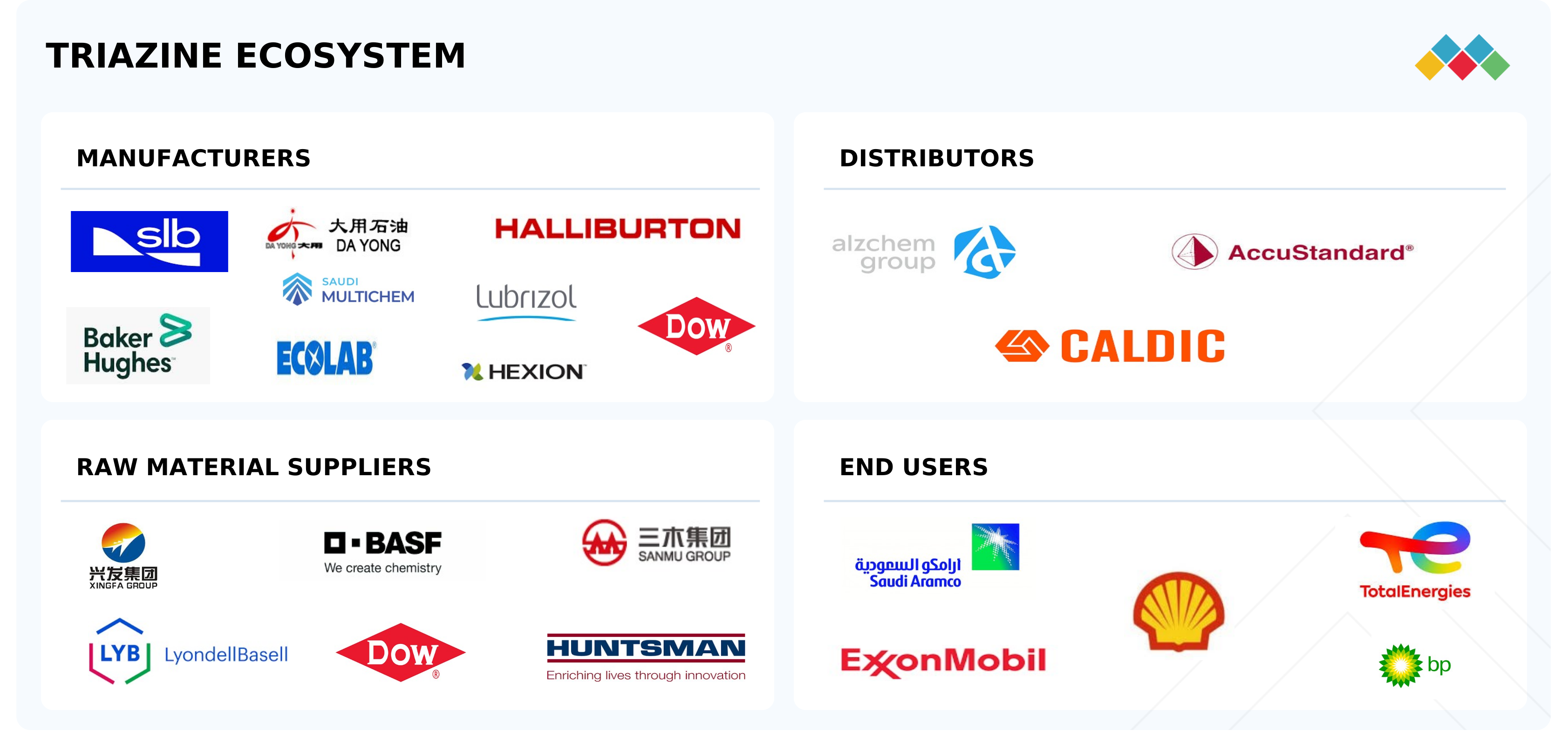
Triazine Market by: COMMERCIAL USE CASES ACROSS INDUSTRIES
| COMPANY | USE CASE DESCRIPTION | BENEFITS |
|---|---|---|
 |
A natural gas plant faced frequent scavenger change-outs every 7–25 days, causing downtime, high costs, and inefficiency. Q2 introduced its tailored Triazine H2S scavenger and ran three trials under real operating conditions. | The optimized triazine program boosted runtime by 35% over competitor solutions. This reduced change-outs, cut downtime and maintenance, and lowered chemical disposal costs, delivering major operational savings. |
 |
A 1,000-gallon contactor tower experienced frequent H2S scavenger change-outs. The 37% MEA-triazine-based scavenger was expected to last 30 days but broke through in 16–22 days, causing additional annual change-outs and increased costs. | OndaVia identified the actual triazine concentration as 32% (vs. labeled 37%), enabling corrective actions. This ensured accurate dosing, reduced change-outs, minimized downtime, lowered chemical costs by ~USD 25,000 annually, and improved operational efficiency. |
 |
EPA created a PBPK model to assess triazine herbicides’ endocrine disruption risks. Computational tools like ToxCast/Tox21, ICE, and HTTK-Pop were used to validate human-relevant toxicological benchmarks. | Predictions closely matched PBPK standards, ensuring reliable human health risk assessment. This approach enhanced regulatory confidence and supported safer chemical management. |
Logos and trademarks shown above are the property of their respective owners. Their use here is for informational and illustrative purposes only.
Related Ecosystem
Speciality Chemicals
- Corrosion Inhibitors
- Polyetheretherketone (PEEK)
- Acrylonitrile Butadiene Styrene (ABS)
- Epoxy Resin
- Polycarbonate
- Basf se
- DOW CHEMICAL COMPANY
- Evonik industries ag
- Clariant ag.
- Solvay sa
Key Takeaways
- Europe's triazine market is valued at $53.1 million in 2025 and will reach $57.7 million by 2030, growing at 1.7% CAGR.
- Europe's mature regulatory framework and environmental standards drive demand for compliant, sustainable triazine formulations.
- Agricultural herbicide applications remain the largest end-use segment in Europe, supported by established farming practices.
- European manufacturers are investing in R&D to develop bio-based and lower-toxicity triazine alternatives to meet evolving compliance requirements.
Triazine Market Report Scope
| Report Metric | Details |
|---|---|
| Base Year | 2025 |
| Fastest Growing Segment | MMA TRIAZINE (Product) |
| Forecast Period | 2025-2030 |
| Growth Rate | CAGR of 3.6% from 2025 to 2030 |
| Largest Segment | TRIAZINE (Chemistry) |
| Market Size Base Year (Billions) | ~USD 0.32 (2025) |
| Revenue Forecast (Billions) | ~USD 0.38 (2030) |
| Segments Covered | Type, Product, End-Use Industry, Chemistry, End Use |
Europe Triazine Market Report Segmentation
5 segment dimensions are covered across the global market.
By Type
- Gas Phase
- Gas-Phase
- Oil Soluble
- Oil-Soluble
- Water Soluble
- Water-Soluble
By Product
- Mea Triazine
- Mma Triazine
- Other Products
By End-Use Industry
- Crude Oil
- Geothermal Energy
- Industrial Processes
- Natural Gas
- Other End-Use Industries
By Chemistry
- Iron Sponge
- Nitrite
- Other Chemistries
- Triazine
By End Use
- Crude Oil
- Geothermal Energy
- Industrial Processes
- Natural Gas
- Other End Uses
- Other End-Uses
REST OF EUROPE: TRIAZINE MARKET, BY END-USE INDUSTRY, 2023–2030
| Segment | 2023 | 2024 | 2025 | 2026 | 2027 | 2028 | 2029 | 2030 | CAGR (%) |
|---|---|---|---|---|---|---|---|---|---|
| CRUDE OIL | 1.27 | 1.28 | 1.3 | 1.32 | 1.33 | 1.35 | 1.37 | 1.39 | 1.3 |
| GEOTHERMAL ENERGY | 0.35 | 0.36 | 0.36 | 0.36 | 0.37 | 0.37 | 0.38 | 0.38 | 1.1 |
| INDUSTRIAL PROCESSES | 0.26 | 0.26 | 0.27 | 0.27 | 0.27 | 0.28 | 0.28 | 0.28 | 1.2 |
| NATURAL GAS | 0.66 | 0.66 | 0.67 | 0.68 | 0.69 | 0.7 | 0.7 | 0.71 | 1.2 |
| OTHER END-USE INDUSTRIES | 0.09 | 0.1 | 0.1 | 0.1 | 0.1 | 0.1 | 0.1 | 0.1 | 1 |
| TOTAL | 2.63 | 2.66 | 2.69 | 2.73 | 2.76 | 2.79 | 2.83 | 2.87 | 1.2 |
EUROPE: TRIAZINE MARKET, BY END-USE INDUSTRY, 2023–2030
| Segment | 2023 | 2024 | 2025 | 2026 | 2027 | 2028 | 2029 | 2030 | CAGR (%) |
|---|---|---|---|---|---|---|---|---|---|
| CRUDE OIL | 31.1 | 31.66 | 32.22 | 32.8 | 33.38 | 33.98 | 34.58 | 35.2 | 1.8 |
| GEOTHERMAL ENERGY | 1.73 | 1.75 | 1.77 | 1.8 | 1.82 | 1.85 | 1.87 | 1.9 | 1.4 |
| INDUSTRIAL PROCESSES | 3.73 | 3.79 | 3.84 | 3.9 | 3.96 | 4.02 | 4.08 | 4.14 | 1.5 |
| NATURAL GAS | 13.85 | 14.07 | 14.29 | 14.52 | 14.75 | 14.99 | 15.22 | 15.47 | 1.6 |
| OTHER END-USE INDUSTRIES | 0.93 | 0.94 | 0.96 | 0.97 | 0.98 | 1 | 1.01 | 1.02 | 1.3 |
| TOTAL | 51.35 | 52.21 | 53.09 | 53.99 | 54.9 | 55.82 | 56.77 | 57.72 | 1.7 |
Target Audience
- Chemical Manufacturers & Producers : Optimize production strategies and market positioning in Europe. Understand regulatory compliance requirements, competitive dynamics, and demand forecasts to guide capacity planning and product development investments.
- Agricultural & Agrochemical Companies : Assess triazine herbicide market opportunities across European farming regions. Evaluate regulatory restrictions, adoption rates, and competitive pressures to inform product registration and commercialization strategies.
- Water Treatment & Utilities Operators : Evaluate triazine-based disinfection solutions for water treatment applications. Understand market demand, regulatory compliance pathways, and cost-benefit analysis for European water infrastructure projects.
- Investment & Private Equity Firms : Conduct due diligence on European chemical companies with triazine portfolios. Assess market growth potential, regulatory risks, and valuation benchmarks for M&A and investment decision-making.
- Regulatory & Compliance Consultants : Support clients navigating EU chemical regulations and market entry requirements. Leverage market data to advise on compliance strategies, product positioning, and risk mitigation in the European triazine sector.
Countries within Europe - compare and drill down
| Country | 2025 size (native) |
|---|---|
| Germany | USD 1.51 Million |
| UK | USD 3.06 Million |
| France | USD 0.56 Million |
| Italy | USD 0.86 Million |
| Netherlands | USD 0.57 Million |
| Norway | USD 7.42 Million |
| Rest Of Europe | USD 2.87 Million |
Country market size visualization
Reasons to Buy this Report
- Country-Level Market Breakdown : Access detailed market sizing for Germany, UK, France, Italy, Netherlands, Norway, and Rest of Europe. Understand regional variations in triazine demand and identify high-potential markets for expansion.
- Regulatory Landscape Insights : Comprehensive analysis of EU chemical regulations, REACH compliance requirements, and environmental policies affecting triazine production and usage across European markets.
- Competitive Positioning Strategy : Benchmark your operations against European market leaders. Identify gaps in the market, assess competitive intensity by country, and develop targeted go-to-market strategies for different European segments.
- Application-Specific Demand Trends : Detailed insights into triazine consumption patterns across agriculture, water treatment, and industrial sectors in Europe. Forecast demand shifts driven by sustainability initiatives and regulatory changes.
- Investment and Growth Opportunities : Identify emerging opportunities in Eastern European markets, sustainable triazine alternatives, and specialty applications. Strategic guidance for M&A, partnerships, and capacity expansion decisions.
Frequently asked questions
What is the current size of Europe's triazine market?
Europe's triazine market is estimated at $53.1 million in 2025, with verified data confirming this valuation across the region's chemical and agricultural sectors.
What is the projected growth rate for Europe's triazine market through 2030?
Europe's triazine market is expected to grow at a compound annual growth rate of 1.7% from 2025 to 2030, reaching $57.7 million by the forecast year.
Which industries drive triazine demand in Europe?
Europe's triazine demand is primarily driven by agriculture (herbicides), water treatment, industrial coatings, and specialty chemical applications, with agriculture representing the largest segment.
How do European regulations impact the triazine market?
Europe's stringent environmental and safety regulations require triazine manufacturers to invest in compliance, product reformulation, and sustainable alternatives, influencing market dynamics and product innovation.
What are the key challenges for Europe's triazine market?
Europe's triazine market faces challenges including regulatory restrictions on certain triazine compounds, competition from alternative herbicides, and pressure to develop environmentally sustainable formulations.
RESEARCH METHODOLOGY
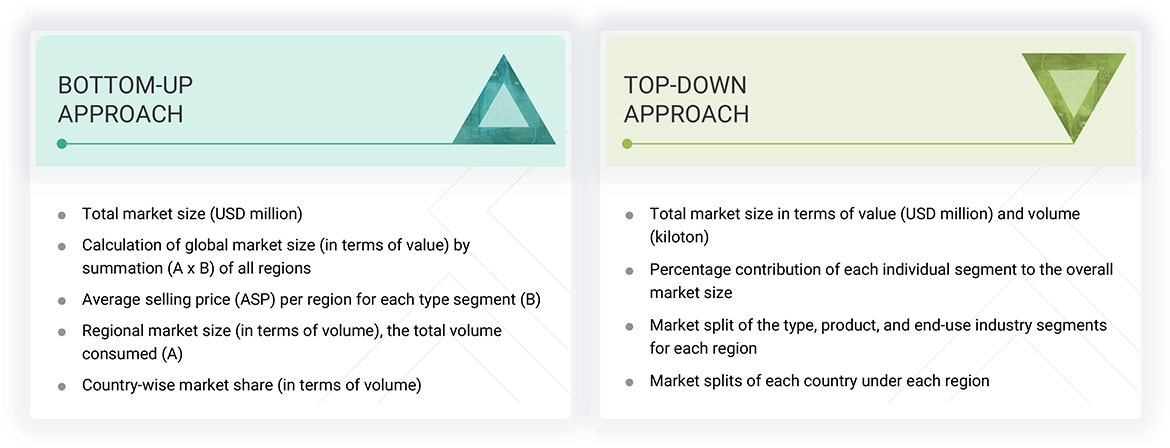
The study involved four major activities to estimate the current size of the global triazine market. Exhaustive secondary research was carried out to collect information on the market, the peer market, and the parent market. The next step was to validate these findings, assumptions, and sizes with the industry experts across the value chain through primary research. The top-down and bottom-up approaches were employed to estimate the overall size of the triazine market. After that, market breakdown and data triangulation procedures were used to determine the size of different segments and subsegments of the market.
Secondary Research
The market for companies offering triazine is arrived at by secondary data available through paid and unpaid sources, analyzing the product portfolios of the major companies in the ecosystem, and rating the companies by their performance and quality. Various secondary sources, such as Business Standard, Bloomberg, World Bank, and Factiva, were referred to identify and collect information for this study on the triazine market. In the secondary research process, various secondary sources were referred to identify and collect information related to the study. Secondary sources included annual reports, press releases, and investor presentations of vendors, forums, certified publications, and whitepapers. The secondary research was used to obtain critical information on the industry’s value chain, the total pool of key players, market classification, and segmentation from the market and technology-oriented perspectives.
Primary Research
In the primary research process, various primary sources from both the supply and demand sides were interviewed to obtain qualitative and quantitative information for this report. The primary sources from the supply side included industry experts, such as chief executive officers (CEOs), vice presidents (VPs), marketing directors, technology and innovation directors, and related key executives from several key companies and organizations operating in the triazine market. After the complete market engineering (calculations for market statistics, market breakdown, market size estimations, market forecasting, and data triangulation), extensive primary research was conducted to gather information and verify and validate the critical numbers arrived at. Primary research was also conducted to identify the segmentation types, industry trends, competitive landscape of triazine offered by various market players, and key market dynamics, such as drivers, restraints, opportunities, challenges, industry trends, and key player strategies. In the complete market engineering process, the top-down and bottom-up approaches and several data triangulation methods were extensively used to perform the market estimation and market forecasting for the overall market segments and subsegments listed in this report. Extensive qualitative and quantitative analysis was performed on the complete market engineering process to list the key information/insights throughout the report.
The following is the breakdown of primary respondents:
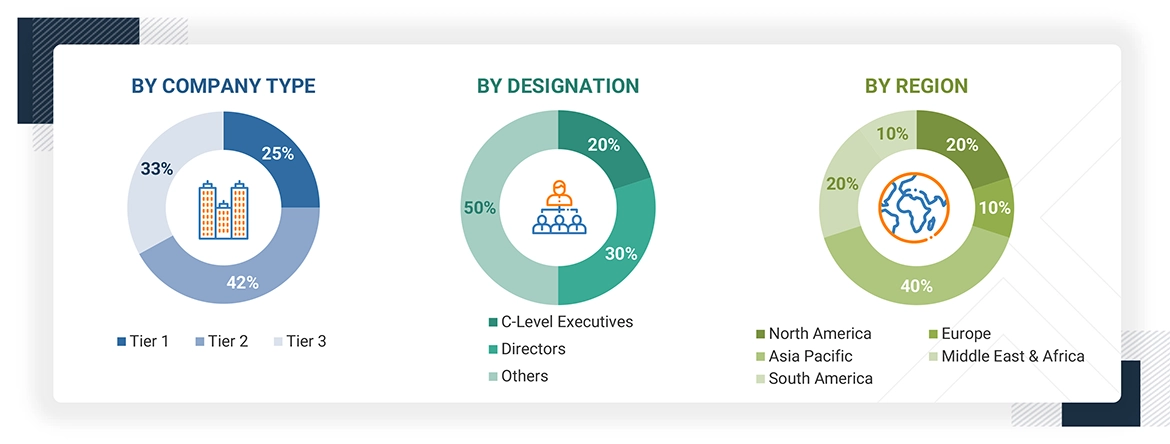
Notes: Other designations include sales, marketing, and product managers.
Tier 1: >USD 1 billion, Tier 2: USD 500 million–1 billion, and Tier 3: < USD 500 million.
To know about the assumptions considered for the study, download the pdf brochure
Market Size Estimation
The top-down and bottom-up approaches were used to estimate and validate the size of the global triazine market. These approaches were also used extensively to estimate the size of various dependent market segments. The research methodology used to estimate the market size included the following:
Data Triangulation
After arriving at the overall market size using the market size estimation processes, the market was split into several segments and subsegments. Wherever applicable, the data triangulation and market breakup procedures were employed to complete the overall market engineering process and arrive at the exact statistics of each market segment and subsegment. The data was triangulated by studying various factors and trends from both the demand and supply sides.
Market Definition
Triazine is a nitrogenous heterocyclic compound with the formula C3H3N3. Triazine has a number of isomeric forms (1,2,3-triazine, 1,2,4-triazine, and 1,3,5-triazine). Triazine can be found in many applications, including crude oil, natural gas, geothermal energy, and other industrial processes, especially as a hydrogen sulfide (H2S) scavenger. Its high level of reactivity with sulfur compounds makes it a valuable chemical in the oil & gas industry, creating safety, environmental compliance, and efficiency. In addition to any energy-type applications, triazines are precursors to the production of resins, agrochemicals, dyes, and specialty chemicals. Triazine is often formed by condensation reactions of amidines or nitriles, and is well known for its stability and breadth of chemical characteristics. Due to triazine’s classification as a hazardous substance under the Globally Harmonized System (GHS), regulatory agencies, such as the US Environmental Protection Agency (EPA) and the European Chemicals Agency (ECHA), monitor its use.
Stakeholders
- Triazine Manufacturers
- Raw Material Suppliers
- Converters & Processors
- Distributors and Traders
- Industry Associations and Regulatory Bodies
- End Users
Report Objectives
- To define, describe, and forecast the size of the global triazine market based on type, product, end-use industry, and region in terms of value and volume
- To provide detailed information on the significant drivers, restraints, opportunities, and challenges influencing the market
- To strategically analyze micromarkets concerning individual growth trends, prospects, and their contribution to the market
- To assess the growth opportunities in the market for stakeholders and provide details on the competitive landscape for market leaders
- To forecast the market size of segments and subsegments for North America, Europe, Asia Pacific, South America, and the Middle East & Africa
- To strategically profile the key players and comprehensively analyze their market shares and core competencies
- To analyze competitive developments such as acquisitions, expansions, partnerships, and agreements in the triazine market
- To provide the impact of AI/Gen AI on the market
Get the Full Triazine Market Report
Full forecast, segment splits, and company analysis for all Triazine Market.
- Saudi Arabia Triazine Market
- UAE Triazine Market
- Qatar Triazine Market
- South Africa Triazine Market
- Canada Triazine Market
- Mexico Triazine Market
- US Triazine Market
- Germany Triazine Market
- UK Triazine Market
- France Triazine Market
- Italy Triazine Market
- Netherlands Triazine Market
- Norway Triazine Market
- Russia Triazine Market
- China Triazine Market
- India Triazine Market
- Indonesia Triazine Market
- Malaysia Triazine Market
- Brazil Triazine Market
- Argentina Triazine Market
- Venezuela Triazine Market
- Rest Of Europe Triazine Market
- Kazakhstan Triazine Market
- Rest Of Asia Pacific Triazine Market
- GCC Countries Triazine Market
- -Rest Of GCC Countries Triazine Market
- Rest Of South America Triazine Market
Need a Tailored Report?
Customize this report to your needs
Get 10% FREE Customization
Customize This Report
