
South Korea Tumor Ablation Market (2026-2031)

The South Korea Tumor Ablation Market was valued at $22.7 Million in 2026 and projected to reach to $42.6 Million by 2031, representing a compound annual growth rate of 13.4%. South Korea's tumor ablation market is positioned for sustained growth through 2031, driven by increasing cancer incidence, aging demographics, and healthcare system investments in advanced treatment modalities.


| Market Size in | USD 26.32 MN |
| Market Forecast in | |
| CAGR | |
| Forecast Period | |
| Units Considered | Value (USD MN) |
South Korea Tumor Ablation Market Trends and Insights
- This 13.4% compound annual growth rate reflects South Korea's advanced healthcare infrastructure and increasing adoption of minimally invasive oncological procedures.
- South Korea's strong medical device sector and high healthcare spending per capita are driving demand for innovative ablation technologies across hospitals and specialized cancer centers. The South Korea tumor ablation market benefits from rising cancer incidence rates and growing patient preference for less invasive treatment options.
- South Korea's regulatory environment supports rapid adoption of cutting-edge medical technologies, positioning the country as a key market in the Asia Pacific region.
- Between 2026 and 2031, South Korea is expected to see accelerated penetration of radiofrequency, microwave, and cryoablation techniques across both primary and secondary tumor indications. South Korea's aging population and increased healthcare accessibility further support market expansion.
- The country's emphasis on precision medicine and interventional oncology creates favorable conditions for tumor ablation market growth through 2031..
Key Market Statistics
- CAGR (2026-2031) 13.4% CAGR
- Market Size, 2026 ~USD 22.7 Million
- Forecast, 2031 ~USD 42.6 Million
- Country South Korea
South Korea Tumor Ablation Market Overview
Rapid Market Expansion :
South Korea's tumor ablation market is projected to grow from $22.7 million in 2026 to $42.6 million by 2031, representing a robust 13.4% CAGR, outpacing the global growth rate of 11.4%.
Advanced Healthcare Infrastructure :
South Korea's state-of-the-art medical facilities and high healthcare spending per capita create an ideal environment for adoption of cutting-edge minimally invasive oncological technologies and procedures.
Strong Medical Device Sector :
South Korea's well-established medical device manufacturing and innovation ecosystem supports the development and commercialization of advanced tumor ablation systems and related technologies.
Minimally Invasive Procedure Adoption :
Growing preference among South Korean healthcare providers and patients for minimally invasive oncological treatments drives increased demand for tumor ablation procedures over traditional surgical interventions.
South Korea Tumor Ablation Market Dynamics
- The country's emphasis on precision medicine and technological innovation creates favorable conditions for market expansion.
- South Korean hospitals and clinics are actively integrating radiofrequency ablation, microwave ablation, and cryoablation technologies into their oncology departments.
- Government healthcare policies supporting minimally invasive procedures, combined with strong reimbursement frameworks, will further accelerate market penetration and procedural volumes across major metropolitan areas and regional medical centers..
Market Ecosystem
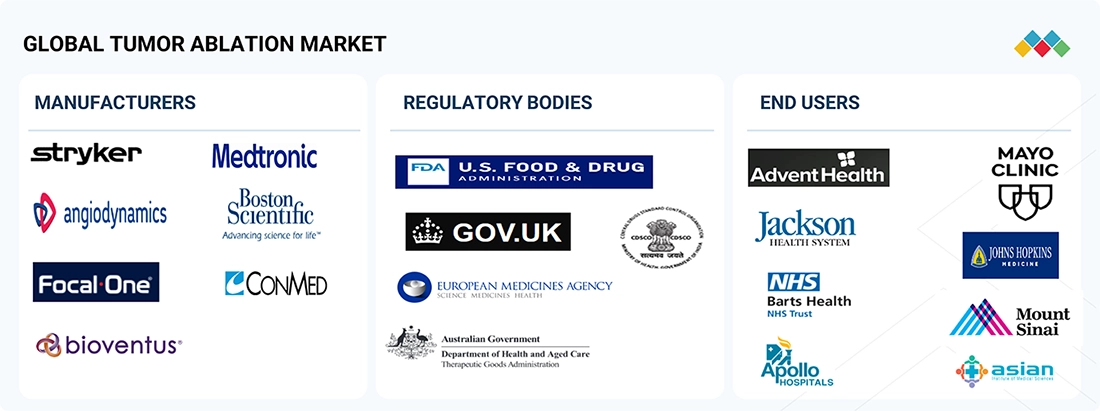
TUMOR ABLATION MARKET: COMMERCIAL USE CASES ACROSS INDUSTRIES
| COMPANY | USE CASE DESCRIPTION | BENEFITS |
|---|---|---|
 |
Provides radiofrequency (RF) ablation systems that use controlled thermal energy to destroy solid tumors by inducing localized coagulative necrosis. These systems are widely used for the minimally invasive treatment of liver, kidney, lung, bone, and soft tissue tumors through surgical, laparoscopic, or percutaneous procedures in hospitals and cancer centers. | Delivers precise and controlled tumor destruction while preserving surrounding healthy tissue, enables minimally invasive treatment, reduces blood loss and hospital stay, supports faster patient recovery, and provides reliable clinical outcomes across multiple tumor indications. |
 |
Provides cryoablation systems that utilize extremely low temperatures to freeze and destroy cancerous tissue. These systems are commonly used to treat kidney, liver, lung, bone, and soft tissue tumors through image-guided, minimally invasive procedures performed in interventional radiology and oncology departments. | Enables precise visualization of the ablation zone, minimizes damage to adjacent healthy tissue, reduces procedural pain, supports preservation of critical structures, shortens recovery time, and delivers effective local tumor control with predictable treatment outcomes. |
 |
Provides robotic high-intensity focused ultrasound (HIFU) systems for non-invasive focal treatment of localized prostate cancer. The platform combines robotic targeting, real-time imaging, and focused ultrasound energy to precisely ablate cancerous tissue without surgical incisions, making it suitable for urology and specialized cancer centers | Offers completely incision-free treatment, preserves surrounding healthy tissue and urinary/sexual function, improves targeting accuracy through robotic assistance, reduces procedure-related complications, shortens recovery time, and enhances patient quality of life following treatment |
 |
Provides radiofrequency ablation electrodes designed to accurately deliver RF energy from the generator to targeted tumor tissue during ablation procedures. These disposable electrodes are used in conjunction with RF ablation systems for treating liver, kidney, lung, bone, and other solid tumors in minimally invasive oncology procedures. | Ensures efficient and uniform energy delivery, improves ablation accuracy, supports consistent lesion formation, enhances procedural safety, minimizes collateral tissue damage, and contributes to successful local tumor destruction with reliable clinical performance |
 |
Provides radiofrequency ablation systems that generate controlled thermal energy for the treatment of solid tumors during open, laparoscopic, and percutaneous procedures. These systems are utilized in oncology, general surgery, and interventional radiology settings to perform minimally invasive tumor ablation across multiple cancer indications | Provides stable and precise energy delivery for effective tumor destruction, improves procedural efficiency, supports minimally invasive treatment, reduces post-operative complications and recovery time, and offers dependable performance for a broad range of tumor ablation procedures |
Logos and trademarks shown above are the property of their respective owners. Their use here is for informational and illustrative purposes only.
Related Ecosystem
Diagnostic Imaging
- Magnetic Resonance Imaging (MRI)
- Computed Tomography (CT)
- CT Scanners
- Nuclear Imaging
- Positron Emission Tomography
- Siemens healthineers
- PHILIPS HEALTHCARE
- CANON INC.
- FUJIFILM Holdings Corporation
- UNITED IMAGING HEALTHCARE CO., LTD.
Medical Devices
- Polymerase Chain Reaction (PCR)
- Magnetic Resonance Imaging (MRI)
- Disposable Autoinjectors
- Pulse Oximeters
- Blood Pressure Monitors
- Medtronic plc
- Abbott Laboratories
- Stryker Corporation
- Becton, Dickinson and Company
- CONMED Corporation
Key Takeaways
- South Korea's tumor ablation market is projected to nearly double from $22.7M (2026) to $42.6M (2031), representing a 13.4% CAGR.
- South Korea's advanced healthcare infrastructure and high medical device adoption rates position it as a leading Asia Pacific market for ablation technologies.
- Rising cancer incidence and patient demand for minimally invasive procedures are primary growth drivers in South Korea.
- South Korea's regulatory environment and emphasis on precision medicine support rapid commercialization of innovative tumor ablation solutions through 2031.
Tumor Ablation Market Report Scope
| Report Metric | Details |
|---|---|
| Base Year | 2026 |
| Fastest Growing Segment | CANCER CARE CENTERS (End User) |
| Forecast Period | 2026-2031 |
| Growth Rate | CAGR of 11.4% from 2026 to 2031 |
| Largest Segment | HOSPITALS & CLINICS (End User) |
| Market Size Base Year (Billions) | ~USD 1.1 (2026) |
| Revenue Forecast (Billions) | ~USD 1.89 (2031) |
| Segments Covered | Technology, Product Type, Type, Procedure, Application, End User |
South Korea Tumor Ablation Market Report Segmentation
6 segment dimensions are covered across the global market.
By Technology
- Cryoablation
- Ire
- Mwa
- Other Technologies
- Rfa
By Product Type
- Consumables & Accessories
- Systems
By Type
- Cryoablation Systems
- Ire Systems
- Mwa Probes
- Mwa Systems
- Other Consumables & Accessories
- Other Probes/ Electrodes
- Other Systems
- Probes/Electrodes
- Rfa Probes
- Rfa Systems
By Procedure
- Laparoscopic Ablation
- Percutaneous Ablation
- Surgical Ablation
By Application
- Bone Cancer
- Kidney Cancer
- Liver Cancer
- Lung Cancer
- Other Applications
By End User
- Ascs
- Cancer Care Centers
- Hospitals & Clinics
- Other End Users
Target Audience
- Medical Device Manufacturers : Manufacturers of tumor ablation systems need South Korea-specific market data to assess market size, growth potential, and competitive positioning for product launches and expansion strategies.
- Healthcare Investors & PE Firms : Investment professionals require detailed South Korea market analysis to evaluate acquisition targets, portfolio companies, and investment opportunities in the high-growth oncology device sector.
- Hospital & Clinic Administrators : Healthcare facility leaders need market insights to justify capital expenditures for tumor ablation equipment, benchmark against peer institutions, and plan oncology service expansion.
- Medical Device Distributors : Distributors and sales organizations require South Korea-specific market data to forecast demand, allocate resources, and develop effective sales strategies for regional market penetration.
- Healthcare Consultants & Analysts : Consulting firms and research analysts need comprehensive South Korea market data to support client advisory services, competitive analysis, and strategic planning recommendations.
Reasons to Buy this Report
- Market-Specific Growth Projections : Access detailed South Korea-specific forecasts showing 13.4% CAGR through 2031, enabling accurate business planning and investment decisions tailored to this high-growth Asian market.
- Competitive Landscape Intelligence : Understand South Korea's unique competitive dynamics, including local medical device manufacturers, hospital networks, and regulatory pathways specific to the Korean healthcare system.
- Healthcare Infrastructure Insights : Gain detailed analysis of South Korea's advanced medical facilities, reimbursement policies, and healthcare spending patterns that directly influence tumor ablation market adoption and pricing strategies.
- Regional Market Entry Strategy : Develop targeted go-to-market strategies for South Korea with insights into hospital procurement processes, physician preferences, and patient demographics driving procedure demand.
- Investment and Partnership Opportunities : Identify high-potential partnerships with South Korean healthcare providers, medical device distributors, and technology innovators positioned to capitalize on the market's 13.4% growth trajectory.
Frequently asked questions
What is the current size of South Korea's tumor ablation market?
South Korea's tumor ablation market was valued at $22.7 million in 2026 and is expected to reach $42.6 million by 2031.
What is the projected growth rate for South Korea's tumor ablation market?
South Korea's tumor ablation market is projected to grow at a compound annual growth rate (CAGR) of 13.4% between 2026 and 2031.
What factors are driving growth in South Korea's tumor ablation market?
Key drivers include rising cancer incidence, increasing adoption of minimally invasive procedures, advanced healthcare infrastructure, and South Korea's strong medical device sector.
Which ablation technologies are most prevalent in South Korea?
South Korea's market includes radiofrequency ablation, microwave ablation, and cryoablation techniques, with growing adoption across primary and secondary tumor indications.
How does South Korea's market compare to the global tumor ablation market?
South Korea's 13.4% CAGR exceeds the global average of 11.4%, reflecting the country's advanced healthcare system and rapid technology adoption rates.
RESEARCH METHODOLOGY
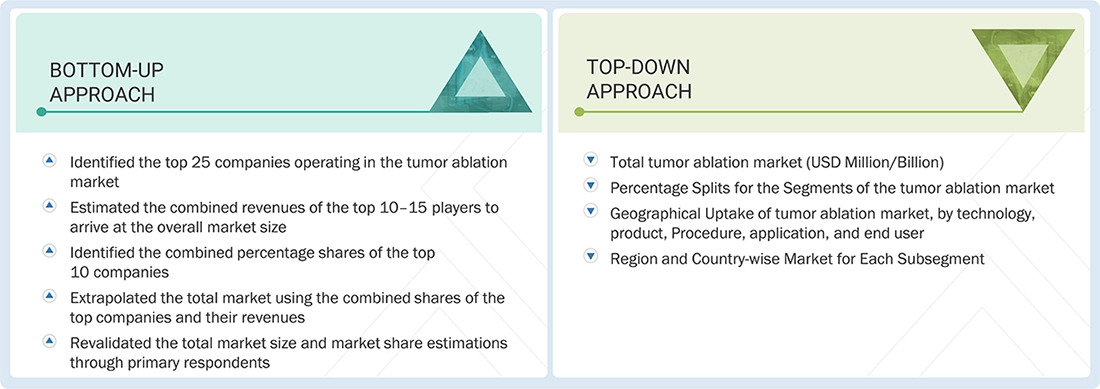
This study involved four major activities in estimating the current tumor ablation market size. First, extensive secondary research was conducted to gather information on the market, including related and parent markets. The next step was to validate these findings, assumptions, and sizing with industry experts across the value chain through primary research. Both top-down and bottom-up approaches were employed to estimate the complete market size. After that, market breakdown and data triangulation were used to estimate the market size of segments and subsegments.
Secondary Research
The secondary research process involved the widespread use of secondary sources, directories, databases (such as Bloomberg Businessweek, Factiva, and D&B Hoovers), white papers, annual reports, Companies House documents, investor presentations, and SEC filings. Secondary research was used to identify and collect information useful for the extensive, technical, market-oriented, and commercial study of the tumor ablation market. It was also used to obtain important information about key players and market classification and segmentation according to industry trends to the bottom-most level, as well as key developments related to market and technology perspectives. A database of the key industry leaders was also prepared using secondary research.
Primary Research
In the primary research process, various sources from both the supply and demand sides were interviewed to obtain qualitative and quantitative information for this report. The primary sources from the supply side include industry experts such as CEOs, vice presidents, marketing and sales directors, technology & innovation directors, and related key executives from various key companies and organizations operating in the tumor ablation market. The primary sources from the demand side included industry experts, purchase & sales managers, doctors, and personnel from research organizations. Primary research was conducted to validate the market segmentation, identify key players in the market, and gather insights on key industry trends and key market dynamics.
A breakdown of the primary respondents for the tumor ablation market is provided below:
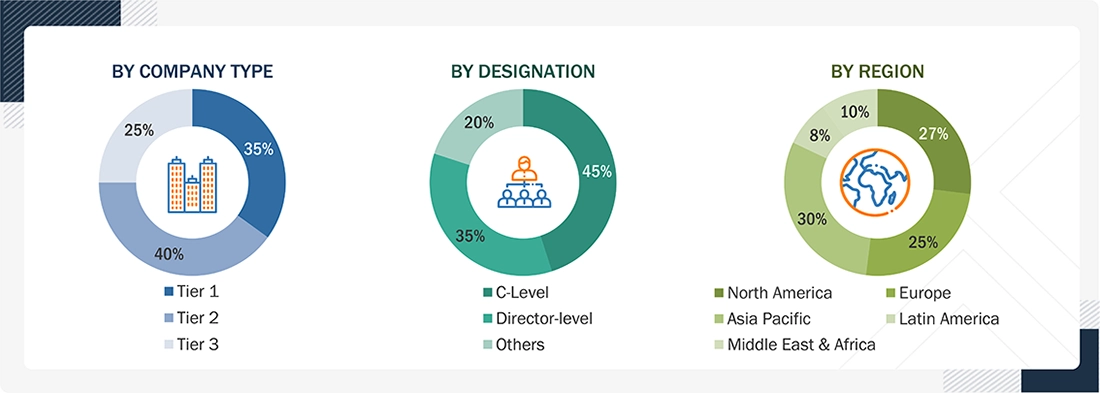
Note 1: C-level primaries include CEOs, CFOs, COOs, and VPs.
Note 2: Other designations include sales managers, marketing managers, business development managers, product managers, distributors, and suppliers.
Note 3: Companies are classified into tiers based on their total revenue. As of 2023, Tier 1 = >USD 10.00 billion, Tier 2 = USD 1.00 billion to USD 10.00 billion, and Tier 3 = <USD 1.00 billion.
To know about the assumptions considered for the study, download the pdf brochure
Market Size Estimation
For the global market value, annual revenues were calculated based on the revenue mapping of major product manufacturers and OEMs active in the global tumor ablation market. All the major product manufacturers were identified at the global and/or country/regional level. Revenue mapping for the respective business segments/sub-segments was done for the major players. Also, the global tumor ablation market was split into various segments and sub-segments based on:
- List of major players operating in the products market at the regional and/or country level
- Product mapping of various tumor ablation manufacturers at the regional and/or country level
- Mapping of annual revenue generated by listed major players from tumor ablation (or the nearest reported business unit/product category)
- Revenue mapping of major players
- Extrapolation of the revenue mapping of the listed major players to derive the global market value of the respective segments/subsegments
- Summation of the market value of all segments/subsegments to arrive at the global tumor ablation market.
Tumor Ablation Market : Top-Down and Bottom-Up Approach
Data Triangulation
After arriving at the overall size of the global tumor ablation market through the above-mentioned methodology, this market was split into several segments and subsegments. The data triangulation and market breakdown procedures were employed, wherever applicable, to complete the overall market engineering process and arrive at the exact market value data for the key segments and subsegments. The extrapolated market data was triangulated by studying various macro indicators and regional trends from both demand- and supply-side participants.
Market Definition
Tumor ablation is a minimally invasive surgical procedure used to remove or destroy cancerous tissue from the affected area as part of cancer management and treatment. The targeted tissue is subjected to ablating energy through surgical, laparoscopic, or percutaneous methods. This technique is commonly used for treating liver, bone, lung, kidney, prostate, and other types of cancer.
Key Stakeholders
- Tumor ablation system and electrode manufacturers, suppliers, and providers
- Contract research organizations (CROs)
- Research & development (R&D) companies
- Academic & research institutions
- Regulatory agencies
- Contract manufacturing organizations (CMOs)
- Environmental & safety regulatory bodies
- Hospitals & clinics
- Interventional radiologists
Report Objectives
- To define, describe, and forecast the tumor ablation market by technology, product, procedure, application, end user, and region
- To provide detailed information regarding the major factors influencing market growth (such as drivers, restraints, opportunities, and challenges)
- To analyze the micromarkets with respect to individual growth trends, prospects, and contributions in the market
- To analyze opportunities for stakeholders and provide details of the competitive landscape for market leaders
- To forecast the size of the market segments with respect to five regions: North America, Europe, Asia Pacific, Latin America, and the Middle East & Africa
- To profile key players and analyze their market shares
- To analyze competitive developments such as product launches, agreements, expansions, and acquisitions
- To benchmark players within the market using the proprietary “Company Evaluation Matrix” framework, which analyzes market players based on various parameters within the broad categories of business and product excellence strategy
Available customizations:
With the given market data, MarketsandMarkets offers customizations as per your company’s specific needs. The following customization options are available for the report:
Geographic Analysis
- Further breakdown of the Rest of Europe tumor ablation market into Russia, Switzerland, Denmark, Austria, and others
- Further breakdown of the Rest of Latin America tumor ablation market into Argentina, Colombia, Chile, Ecuador, and others
- Further breakdown of the Rest of Asia Pacific tumor ablation market into Malaysia, Singapore, New Zealand, and others
Competitive Landscape Assessment
- Market share analysis, by region (North America and Europe), which provides market shares of the top 3-5 key players in the tumor ablation market
- Competitive leadership mapping for established players in the US
Get the Full Tumor Ablation Market Report
Full forecast, segment splits, and company analysis for all Tumor Ablation Market.
- US Tumor Ablation Market
- Canada Tumor Ablation Market
- Germany Tumor Ablation Market
- France Tumor Ablation Market
- UK Tumor Ablation Market
- Italy Tumor Ablation Market
- Spain Tumor Ablation Market
- China Tumor Ablation Market
- Japan Tumor Ablation Market
- India Tumor Ablation Market
- Australia Tumor Ablation Market
- Brazil Tumor Ablation Market
- Mexico Tumor Ablation Market
- Rest Of Europe Tumor Ablation Market
- Rest Of Asia Pacific Tumor Ablation Market
- Rest Of Latin America Tumor Ablation Market
Need a Tailored Report?
Customize this report to your needs
Get 10% FREE Customization
Customize This Report
