
South Korea Automotive Turbocharger Market (2024-2029)

The South Korea Automotive Turbocharger Market was valued at $2051.2 Million in 2024 and projected to reach to $2771.5 Million by 2029, representing a compound annual growth rate of 5.1%. South Korea's automotive turbocharger market is poised for sustained growth through 2029, supported by the country's robust automotive manufacturing ecosystem and the strategic focus of leading OEMs on engine downsizing and efficiency technologies.


| Market Size in | USD 26.32 MN |
| Market Forecast in | |
| CAGR | |
| Forecast Period | |
| Units Considered | Value (USD MN) |
South Korea Automotive Turbocharger Market Trends and Insights
- This represents a compound annual growth rate (CAGR) of 5.1%, reflecting South Korea's strong automotive manufacturing base and increasing demand for fuel-efficient engine technologies.
- South Korea's position as a global automotive hub, driven by major OEMs and component suppliers, continues to support turbocharger adoption across passenger vehicles and commercial segments. The growth trajectory in South Korea is underpinned by stricter emissions regulations and consumer preference for downsized, turbocharged engines that deliver improved performance and fuel economy.
- South Korea's automotive industry is investing heavily in electrification and hybrid powertrains, which incorporate turbocharging technology to optimize efficiency.
- Between 2024 and 2029, South Korea's turbocharger market will benefit from rising vehicle production volumes and the integration of advanced turbo technologies in next-generation powertrains..
Key Market Statistics
- CAGR (2024-2029) 5.1% CAGR
- Market Size, 2024 ~USD 2051.2 Million
- Forecast, 2029 ~USD 2771.5 Million
- Country South Korea
South Korea Automotive Turbocharger Market Overview
Market Valuation Growth :
South Korea's automotive turbocharger market is valued at USD 2,051.2 million in 2024, with projected growth to USD 2,771.5 million by 2029, representing a steady 5.1% CAGR driven by domestic automotive manufacturing excellence.
Manufacturing Leadership :
South Korea hosts major automotive OEMs including Hyundai and Kia, creating substantial demand for turbocharger technologies and positioning the country as a critical hub for engine efficiency innovations.
Fuel Efficiency Demand :
Increasing regulatory pressure for emissions reduction and fuel economy standards in South Korea is accelerating adoption of turbocharger technologies across passenger vehicles and commercial segments.
Technology Integration :
South Korean manufacturers are investing heavily in advanced turbocharging systems, including variable geometry turbos and electric turbochargers, to meet stringent environmental regulations and consumer preferences.
South Korea Automotive Turbocharger Market Dynamics
- The 5.1% CAGR reflects moderate but consistent expansion as domestic manufacturers integrate turbocharging solutions across their vehicle portfolios to comply with increasingly stringent emissions standards and meet consumer demand for fuel-efficient vehicles. The market outlook remains positive as South Korea continues to strengthen its position in global automotive supply chains.
- Investment in R&D for next-generation turbocharging technologies, coupled with the transition toward hybrid and electrified powertrains, will create new opportunities for market participants.
- Additionally, South Korea's export-oriented automotive industry ensures sustained demand for turbocharger components in both domestic production and international markets..
Market Ecosystem
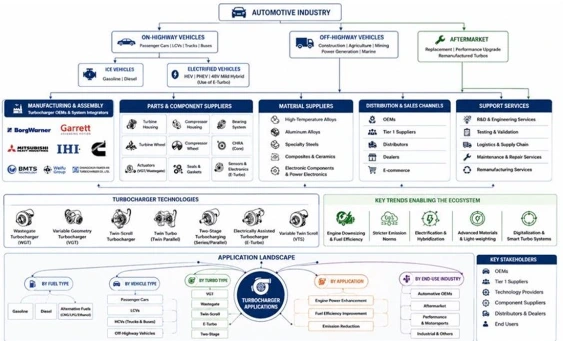
AUTOMOTIVE TURBOCHARGER MARKET: COMMERCIAL USE CASES ACROSS INDUSTRIES
| COMPANY | USE CASE DESCRIPTION | BENEFITS |
|---|---|---|
 |
Passenger car and van turbocharging across gasoline and diesel platforms. | Improved fuel economy | Performance | Emissions compliance |
 |
Turbocharging for light vehicles, commercial vehicles, and off-highway equipment. | Higher efficiency | Faster response | Reduced emissions |
 |
Turbochargers for passenger cars, trucks, and 48V mild-hybrid applications. | Higher torque | Improved acceleration | Fuel efficiency | Response |
 |
Variable-geometry and twin-scroll turbochargers for passenger-car engines. | Engine downsizing | Fuel-efficiency gains | Improved performance |
 |
Holset turbochargers for light-, medium-, and heavy-duty applications. | Higher low-speed boost | Durability | Fuel efficiency | Emission control |
Logos and trademarks shown above are the property of their respective owners. Their use here is for informational and illustrative purposes only.
Related Ecosystem
Automotive Materials
- Light Commercial Vehicles (LCVs)
- Battery Electric Vehicle (BEV)
- Hybrid Electric Vehicle (HEV)
- Fuel Cell Electric Vehicle (FCEV)
- Agricultural Tractors
- GORKOVSKY AVTOMOBILNY ZAVOD
- AISIN CORPORATION
- Continental ag
- Basf se
- BOSCH LIMITED
Automotive Systems
- Light Commercial Vehicles (LCVs)
- Battery Electric Vehicle (BEV)
- Hybrid Electric Vehicle (HEV)
- Agricultural Tractors
- Fuel Cell Electric Vehicle (FCEV)
- BOSCH LIMITED
- DENSO Corporation
- Continental ag
- ZF FRIEDRICHSHAFEN AG
- GORKOVSKY AVTOMOBILNY ZAVOD
Engine Engine System Exhaust
- Light Commercial Vehicles (LCVs)
- Agricultural Tractors
- Battery Electric Vehicle (BEV)
- Hybrid Electric Vehicle (HEV)
- Sensors
- TENNECO
- GORKOVSKY AVTOMOBILNY ZAVOD
- Titan Company Limited
- AISIN CORPORATION
- TI AUTOMOTIVE
Key Takeaways
- South Korea's turbocharger market is valued at USD 2,051.2 million in 2024 and will grow to USD 2,771.5 million by 2029 at a 5.1% CAGR.
- South Korea's stringent emissions standards and fuel efficiency mandates are driving adoption of turbocharged powertrains across OEM portfolios.
- South Korea's major automotive manufacturers are integrating turbocharging into hybrid and electrified vehicle platforms to enhance performance and efficiency.
- South Korea's established supply chain and component manufacturing expertise position the country as a key turbocharger production and export hub in Asia Pacific.
Automotive Turbocharger Market Report Scope
| Report Metric | Details |
|---|---|
| Base Year | 2024 |
| Fastest Growing Segment | ALTERNATIVE FUEL/CNG (Fuel Type) |
| Forecast Period | 2024–2029 |
| Growth Rate | CAGR of 7.1% from 2024 to 2029 |
| Largest Segment | GASOLINE (Fuel Type) |
| Market Size Base Year (Billions) | ~USD 15.17 (2024) |
| Revenue Forecast (Billions) | ~USD 21.38 (2029) |
| Segments Covered | Turbo Type, Vehicle Type, Fuel Type, Component, Material, Application |
South Korea Automotive Turbocharger Market Report Segmentation
6 segment dimensions are covered across the global market.
By Turbo Type
- E-Turbo
- Vgt
- Wastegate Turbocharger
By Vehicle Type
- Bus
- Hcv
- Hdv
- Lcv
- Ldv
- Passenger Car
- Truck
By Fuel Type
- Alternative Fuel/Cng
- Diesel
- Gasoline
By Component
- Compressor Wheel
- Housing
- Turbine Wheel
By Material
- Aluminum
- Cast Iron
By Application
- Agricultural Tractors
- Construction Equipment
- Mining Equipment
Target Audience
- Automotive OEMs : South Korean and international OEMs operating in South Korea need market intelligence to optimize turbocharger sourcing, technology selection, and compliance with local regulatory requirements.
- Turbocharger Manufacturers : Component suppliers and turbocharger manufacturers require detailed market data to identify growth opportunities, assess competitive positioning, and develop targeted strategies for the South Korean automotive sector.
- Tier-1 & Tier-2 Suppliers : Automotive suppliers need insights into South Korean OEM demand patterns, technology preferences, and supply chain requirements to secure contracts and optimize production planning.
- Investment & Private Equity : Investors evaluating opportunities in South Korea's automotive supply chain require comprehensive market analysis, growth projections, and competitive landscape data to support M&A and investment decisions.
- Market Consultants & Analysts : Industry consultants and research firms need country-specific market data and forecasts to provide clients with actionable insights on South Korea's turbocharger market dynamics and growth drivers.
Key Companies in the South Korea Automotive Turbocharger Market
| Company | HQ | Ownership | Strongest segments |
|---|---|---|---|
| GAZ | Russia | Public Company | Gas business (exploration, production, transport, sales),Oil and refined products,Electric power and heat, |
| LIEBHERR-INTERNATIONAL AG | Switzerland | Private Company | Earthmoving and Mining Equipment,Mobile, Crawler, and Tower Cranes,Maritime and Material Handling Cranes, |
| NEXTEER AUTOMOTIVE GROUP LIMITED | United States | Public Company | Electric Power Steering (EPS) and Steer-by-Wire,Steering Columns and Intermediate Shafts,Driveline (Half Shafts and Related Solutions), |
| ACTUANT | United States | Public Company | High-force hydraulic tools (cylinders, pumps, valves, specialty tools),Bolting and torque/tensioning solutions,Heavy lifting technology and engineered systems, |
| RHEINMETALL AG | Germany | Public Company | Vehicle Systems (combat, logistics, support, special vehicles),Weapon and Ammunition (weapons, ammo, protection, propellants),Electronic Solutions (sensors, C2, soldier systems, cyber, training), |
| FEDERAL-MOGUL CORPORATION | United States | Private Company | Engine components and powertrain systems,Sealing solutions,Friction products (braking and related), |
| RYOBI LIMITED | Japan | Public Company | Die Castings Business,Housing Equipment Business,Printing Equipment Business, |
| ALCOA INC | United States | Public Company | Alumina,Primary Aluminum (commodity ingot),Value-add Aluminum (billet, slab, foundry, wire-grade ingot), |
| AT&S | Canada | Public Company | Integrated automation systems (design, build, commissioning),Pre- and post-automation services,Software and digital solutions, |
| NORSK HYDRO ASA | Norway | Public Company | Hydro Bauxite & Alumina,Hydro Aluminium Metal,Hydro Metal Markets, |
| BORGWARNER INC. | United States | Public Company | Turbos & Thermal Technologies,Drivetrain & Morse Systems,PowerDrive Systems, |
| GARRETT MOTION INC. | United States | Public Company | Light-vehicle turbocharging (OEM),Commercial-vehicle and off-highway turbocharging,High-speed electric motors and e-boosting, |
| MITSUBISHI HEAVY INDUSTRIES LTD. | Japan | Public Company | Energy Systems (thermal, nuclear, wind, CO2 capture),Plants & Infrastructure Systems,Logistics, Thermal & Drive Systems, |
| IHI CORPORATION | Japan | Public Company | Resources, Energy and Environment,Social Infrastructure,Industrial Systems and General-Purpose Machinery, |
| CUMMINS INC. | United States | Public Company | Engine,Distribution,Components, |
| VITESCO TECHNOLOGIES GMBH | Germany | Private Company | Electrification Technology (48V, e-drives, power electronics),Electronic Controls,Sensing & Actuation (incl. turbochargers, hydraulic components, pumps), |
| CONTINENTAL AG | Germany | Public Company | Passenger car and light truck tires,Truck, bus, and specialty vehicle tires,Industrial rubber (hoses, conveyor and drive belts, air springs), |
GAZ
GAZ is a Russian public company founded in 1993 with 468,000 employees, operating as a major industrial enterprise in Russia.
LIEBHERR-INTERNATIONAL AG
Liebherr-International AG is a Swiss private company established in 1949 with 54,609 employees, operating across multiple industrial sectors.
NEXTEER AUTOMOTIVE GROUP LIMITED
Nexteer Automotive Group Limited is a United States public company founded in 1906 with 12,500 employees, specializing in automotive systems.
ACTUANT
Actuant is a United States public company founded in 1910 with 2,100 employees, operating in the industrial tools and equipment sector.
RHEINMETALL AG
Rheinmetall AG is a German public company founded in 1889 with 28,815 employees, operating in industrial and defense sectors.
FEDERAL-MOGUL CORPORATION
Federal-Mogul Corporation is a United States private company founded in 1899 with 44,275 employees, serving the automotive industry.
RYOBI LIMITED
Ryobi Limited is a Japanese public company founded in 1943 with 7,462 employees, operating in the power tools and equipment sector.
ALCOA INC
Alcoa Inc is a United States public company founded in 1886 with 14,900 employees, specializing in aluminum production and materials.
AT&S
AT&S is a Canadian public company founded in 1978 with 7,000 employees.
NORSK HYDRO ASA
Norsk Hydro ASA is a Norwegian public company founded in 1905 with 32,786 employees, operating in aluminum and energy production.
BORGWARNER INC.
BorgWarner Inc. is a United States public company founded in 1928 with 37,500 employees, specializing in automotive propulsion systems.
GARRETT MOTION INC.
Garrett Motion Inc. is a United States public company founded in 2018 with 6,300 employees, operating in the automotive technology sector.
MITSUBISHI HEAVY INDUSTRIES LTD.
Mitsubishi Heavy Industries Ltd. is a Japanese public company founded in 1884 with 78,793 employees, operating across multiple industrial sectors.
IHI CORPORATION
IHI Corporation is a Japanese public company founded in 1853 with 26,224 employees, specializing in industrial machinery and equipment.
CUMMINS INC.
Cummins Inc. is a United States public company founded in 1919 with 67,400 employees, specializing in engines and power generation systems.
VITESCO TECHNOLOGIES GMBH
Vitesco Technologies GmbH is a German private company founded in 2019 with 34,604 employees, operating in the automotive technology sector.
CONTINENTAL AG
Continental AG is a German public company founded in 1871 with 22,076 employees, operating in automotive and industrial sectors.
Reasons to Buy this Report
- OEM-Specific Insights : Gain detailed understanding of turbocharger adoption strategies by Hyundai, Kia, and other South Korean manufacturers, including product roadmaps and technology preferences specific to the domestic market.
- Regulatory Compliance Data : Access comprehensive analysis of South Korea's emissions standards and fuel economy regulations driving turbocharger adoption, enabling suppliers to align products with local compliance requirements.
- Supply Chain Intelligence : Understand South Korea's automotive supply chain dynamics, including tier-1 and tier-2 supplier landscapes, competitive positioning, and partnership opportunities within the turbocharger ecosystem.
- Market Sizing & Forecasting : Leverage accurate market valuation data (USD 2,051.2M in 2024) and 5-year forecasts to support investment decisions, capacity planning, and strategic expansion initiatives in South Korea.
- Technology Trend Analysis : Identify emerging turbocharging technologies gaining traction in South Korea, including variable geometry turbos and electric turbochargers, to inform product development and competitive strategy.
Frequently asked questions
What is the current size of South Korea's automotive turbocharger market?
South Korea's automotive turbocharger market was valued at USD 2,051.2 million in 2024 and is expected to reach USD 2,771.5 million by 2029.
What is the projected growth rate for South Korea's turbocharger market?
South Korea's turbocharger market is projected to grow at a compound annual growth rate (CAGR) of 5.1% from 2024 to 2029.
What factors are driving turbocharger demand in South Korea?
South Korea's turbocharger demand is driven by stringent emissions regulations, fuel efficiency requirements, and the integration of turbocharging technology into hybrid and electrified vehicle platforms.
Which vehicle segments are adopting turbochargers in South Korea?
In South Korea, turbochargers are being adopted across passenger vehicles, commercial vehicles, and hybrid/electric powertrains as manufacturers seek to improve engine efficiency and performance.
How does South Korea's turbocharger market compare to the global market?
South Korea's turbocharger market is growing at 5.1% CAGR, slightly below the global average of 7.1%, reflecting the mature automotive market and shift toward electrification in South Korea.
RESEARCH METHODOLOGY
The research study involved various secondary sources, such as company annual reports/presentations, industry association publications, automotive turbocharger magazine articles, directories, technical handbooks, World Economic Outlook, trade websites, technical articles, and databases, which were used to identify and collect information for an extensive study of the automotive turbocharger market. Primary sources: Experts from related industries, automobile OEMs, and suppliers were interviewed to obtain and verify critical information and assess growth prospects.
Secondary Research
The automotive turbocharger market is directly dependent on vehicle production. Vehicle production is derived from various secondary sources such as automotive industry organizations, corporate filings (such as annual reports, investor presentations, and financial statements), trade analysis, paid repositories, and automotive associations such as Organisation Internationale des Constructeurs d'Automobiles (OICA), ACEA, CAAM, JAMA, etc. Historical production data was collected and analyzed, and the industry trend is considered to arrive at the forecast, further validated by primary research. All the data was collected and analyzed to determine the overall market size, further validated by primary research.
Primary Research
In the primary research process, various sources from both the supply and demand sides were interviewed to obtain qualitative and quantitative information on the market. Primary sources from the supply side included various industry experts, such as CXOs, vice presidents, directors from business development, marketing, product development/innovation teams, and related key executives from various key companies. Various system integrators, industry associations, independent consultants/industry veterans, and key opinion leaders were also interviewed.
After interacting with industry experts, brief sessions with highly experienced independent consultants were conducted to reinforce the findings from the primaries. These and the in-house subject matter experts’ opinions have led to the findings described in the remainder of this report.
BREAKDOWN OF PRIMARY INTERVIEWS: BY COMPANY TYPE & DESIGNATION
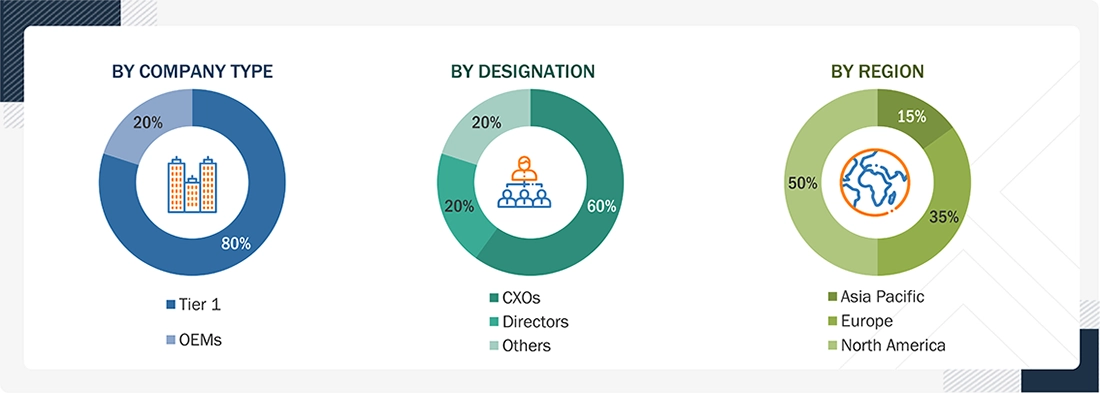
Note: Company tiers are based on the supply chain (OEMs: turbocharger manufacturers, Tier 1: turbocharger component manufacturers). Other designations include sales, marketing, and product managers.
To know about the assumptions considered for the study, download the pdf brochure
Market Size Estimation
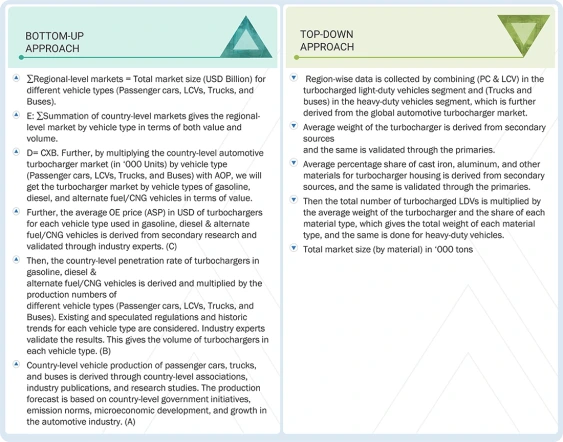
The bottom-up approach was used to estimate and validate the size of the automotive turbocharger market. In this approach, the country-level production of each vehicle type (passenger cars, LCVs, trucks, and buses) was identified using country-level associations and OICA data. Further, country-level fuel type penetration for each vehicle type was derived from country-level associations and validated by primary experts. The vehicle production forecast for each country and each fuel type was based on multiple factors, including country-specific macroeconomic indicators, emission regulations, automotive industry growth, GDP growth, and government initiatives.
Further, to determine the automotive turbocharger market in terms of volume, for gasoline vehicles by technology (VGT, WGT, and E-turbo), the penetration of GDI Vs. MPFI/PFI has been derived through model mapping for each vehicle type and each country. Further, country-level penetration of turbochargers in gasoline GDI engines has been derived through model mapping for each vehicle type (Passenger cars, LCVs, Trucks, and Buses). For Diesel engines and alternate fuel engine turbocharger market by technology, same as Gasoline GDI engines, the country-level penetration of turbochargers in diesel and alternate fuel engines is derived through model mapping for each vehicle type (Passenger cars, LCVs, Trucks, and Buses). The penetration of turbochargers in gasoline GDI engines, diesel engines, and alternate fuel engines is then multiplied by vehicle production of each fuel type for each vehicle type. This gives the country-level gasoline, diesel, and alternate fuel turbocharger market by vehicle type in terms of volume. Further, it has been segmented at the regional level in terms of turbocharger type (wastegate, VGT/VNT, and electric turbocharger).
Further, the country-level market size by vehicle type for different fuel types (Gasoline, Diesel, and Alternate fuel), in volume, is then multiplied by the country-level Average OE Price (AOP) for each vehicle type (Passenger cars, LCVs, Trucks, and Buses). This gives the country-level gasoline, diesel, and alternate fuel turbocharger market by vehicle type in terms of value. The summation of the country-level markets gives the regional market, and further summation of the regional markets provides the global on-highway turbocharger market. A similar methodology has been followed to estimate the automotive turbocharger market for off-highway vehicles (construction equipment, agricultural tractors, and mining equipment).
The market is then forecasted based on various parameters such as analysis of historical data, market trends, and growth of drivers such as stringent emission norms and an increase in vehicle production. Additionally, factors such as technological advancements, growing demand for more fuel-efficient vehicles, emerging market opportunities, and competitive landscape assessments are also considered to arrive at the country-wise forecast of the turbocharger market.
The top-down approach has been followed to determine the automotive turbocharger market size in terms of volume by material. The region-wise volume of turbocharged passenger cars and LDVs has been derived from the global automotive turbocharger market. The average weight of the turbocharger has been derived from secondary sources and validated through primary interviews. The average percentage of cast iron, aluminum, and other materials for turbocharger components has been derived from secondary sources. Then, the total number of turbocharged LDVs has been multiplied by the average weight of the turbocharger and the share of each material type. This gives the total weight of each material type. This calculation has been repeated for HDVs as well.
Automotive Turbocharger Market : Top-Down and Bottom-Up Approach
Data Triangulation
All percentage shares, splits, and breakdowns have been determined using secondary sources and verified by the primary sources. All parameters that affect the markets covered in this research study have been accounted for, viewed in extensive detail, and analyzed to obtain the final quantitative and qualitative data. This data has been consolidated and enhanced with detailed inputs and analysis from MarketsandMarkets and presented in the report. The following figure is an illustrative representation of the overall market size estimation process employed for this study.
Market Definition
A turbocharger can compress more air into the engine’s cylinder. The oxygen molecules are packed closer together when the air is compressed. This increase in the air means more fuel can be added to a naturally aspirated engine of the same size. The same engine then generates increased mechanical power and improves the overall efficiency of the combustion process. Therefore, the engine size can be reduced in a turbocharged engine, leading to better packaging, weight-saving benefits, and improved fuel economy.
Key Stakeholders
- On-highway vehicles and off-highway Equipment Manufacturers
- Automotive Turbocharger and Component Manufacturers
- Engine Manufacturers and Powertrain System Suppliers
- Raw material Suppliers
- Regulatory and Emission Standard Bodies
- Automotive Aftermarket and Replacement Parts Players
- Automotive Distributors, Dealers, and Service Providers
Report Objectives
-
To define, describe, and forecast the size of the global automotive turbocharger market in terms of value (USD million) and volume (Thousand units)
- By Vehicle Type (Passenger cars, LCVs, HCVs, Trucks, Buses) at the regional level
- By Fuel Type (Gasoline, Diesel, Alternate fuel/CNG) at the regional level
- Diesel Turbocharger Market, By Turbo Type (VGT, Wastegate, E-Turbocharger) at the regional level
- Gasoline Turbocharger Market, By Turbo Type (VGT, Wastegate, E-Turbocharger) at the regional level
- Gasoline Turbocharger Market, By Vehicle Type (Passenger cars, LCVs, HCVs, Trucks, Buses) at the regional level
- By Material (Cast Iron, Aluminum, Others) at the regional level
- By Component (Turbine wheel, Compressor wheel, Housing) at the regional level
- Off-highway automotive turbocharger Market, By Application (Agriculture Tractors, Construction Equipment, and Mining Equipment) at a regional level
- Aftermarket, by vehicle type (LCV and HCV) at a regional level.
- By Region (Asia Pacific, Europe, North America, and the Rest of the World) by turbo type and vehicle type
- Country-level analysis of class-wise and usage-wise segments (Asia Pacific, Europe, and North America)
- To understand the market dynamics (drivers, restraints, opportunities, and challenges) of the market
- To analyze the competitive landscape of the global players in the market, along with their market share/ranking
- To analyze the competitive leadership mapping of the global automotive turbocharger manufacturers and automotive turbocharger component suppliers in the market.
- To analyze recent developments, including expansions and new product launches, undertaken by key industry participants in the market
- To strategically analyze the market with trade analysis, case studies, patent analysis, supply chain analysis, market ecosystem, pricing analysis, and the impact of the recession.
Available customizations:
Along with the market data, MarketsandMarkets offers customizations in accordance with company-specific needs.
The following customization options are available for the report:
AUTOMOTIVE TURBOCHARGER MARKET, BY SALES CHANNEL
- Original Equipment Manufacturer
- Aftermarket
Off-highway TURBOCHARGER MARKET, BY TECHNOLOGY
- Wastegate
- Variable Geometry Turbochargers (VGT)
- Electric Actuator
Get the Full Automotive Turbocharger Market Report
Full forecast, segment splits, and company analysis for all Automotive Turbocharger Market.
- China Automotive Turbocharger Market
- India Automotive Turbocharger Market
- Japan Automotive Turbocharger Market
- Thailand Automotive Turbocharger Market
- Indonesia Automotive Turbocharger Market
- Germany Automotive Turbocharger Market
- France Automotive Turbocharger Market
- UK Automotive Turbocharger Market
- Spain Automotive Turbocharger Market
- Italy Automotive Turbocharger Market
- Russia Automotive Turbocharger Market
- Turkey Automotive Turbocharger Market
- Canada Automotive Turbocharger Market
- Mexico Automotive Turbocharger Market
- US Automotive Turbocharger Market
- Brazil Automotive Turbocharger Market
- Argentina Automotive Turbocharger Market
- Iran Automotive Turbocharger Market
- South Africa Automotive Turbocharger Market
Need a Tailored Report?
Customize this report to your needs
Get 10% FREE Customization
Customize This Report
