
Rest Of Asia Pacific UAV (Drone) Propulsion Market (2025-2030)

The Rest Of Asia Pacific UAV (Drone) Propulsion Market was valued at $66.2 Million in 2025 and projected to reach to $116.7 Million by 2030, representing a compound annual growth rate of 12.0%. Rest Of Asia Pacific represents a high-growth segment within the broader Asia Pacific UAV propulsion market, characterized by increasing defense spending and rapid commercialization of drone technologies.


| Market Size in | USD 26.32 MN |
| Market Forecast in | |
| CAGR | |
| Forecast Period | |
| Units Considered | Value (USD MN) |
Rest Of Asia Pacific UAV (Drone) Propulsion Market Trends and Insights
- The region is projected to expand significantly, reaching USD 116.7 million by 2030, driven by increasing defense modernization initiatives, commercial drone adoption, and rising investment in autonomous systems across emerging economies.
- Rest Of Asia Pacific's 12.0% compound annual growth rate outpaces the global average, reflecting accelerating demand for advanced propulsion technologies in military and civilian applications. The Rest Of Asia Pacific market benefits from growing geopolitical tensions, infrastructure development projects requiring aerial surveillance, and the emergence of local drone manufacturers.
- Rest Of Asia Pacific countries are increasingly investing in indigenous UAV capabilities, spurring demand for efficient electric, hybrid, and fuel-cell propulsion systems.
- The forecast period (2025-2030) will see Rest Of Asia Pacific consolidate its position as a critical growth engine, supported by regulatory frameworks becoming more favorable toward commercial drone operations and defense spending increases across the region..
Key Market Statistics
- CAGR (2025-2030) 12.0% CAGR
- Market Size, 2025 ~USD 66.2 Million
- Forecast, 2030 ~USD 116.7 Million
- Country Rest Of Asia Pacific
Rest Of Asia Pacific UAV (Drone) Propulsion Market Overview
Rapid Market Expansion :
Rest Of Asia Pacific UAV propulsion market is experiencing robust growth at 12% CAGR, outpacing the global average of 10%, driven by accelerating defense modernization across emerging economies in the region.
Significant Value Growth :
Market valuation is projected to nearly double from USD 66.2 million in 2025 to USD 116.7 million by 2030, reflecting strong regional demand for advanced propulsion systems in military and commercial applications.
Defense Modernization Driver :
Increasing defense budgets and modernization initiatives across Rest Of Asia Pacific nations are fueling adoption of advanced UAV propulsion technologies for surveillance, reconnaissance, and tactical operations.
Commercial Drone Adoption :
Rising commercial drone deployment in agriculture, logistics, and infrastructure inspection sectors across emerging Asia Pacific economies is creating substantial demand for efficient and reliable propulsion systems.
Rest Of Asia Pacific UAV (Drone) Propulsion Market Dynamics
- Emerging economies in the region are investing heavily in autonomous systems and unmanned aerial capabilities, creating substantial opportunities for propulsion system manufacturers.
- The region's growth trajectory is supported by favorable regulatory environments and rising government initiatives to develop indigenous UAV capabilities. The forecast period through 2030 will witness accelerated adoption driven by infrastructure development projects, agricultural modernization, and border security applications.
- Strategic partnerships between regional manufacturers and international technology providers are expected to enhance local production capabilities.
- Additionally, growing private sector investment in drone logistics and delivery services will further expand the addressable market for advanced propulsion solutions across Rest Of Asia Pacific..
Market Ecosystem
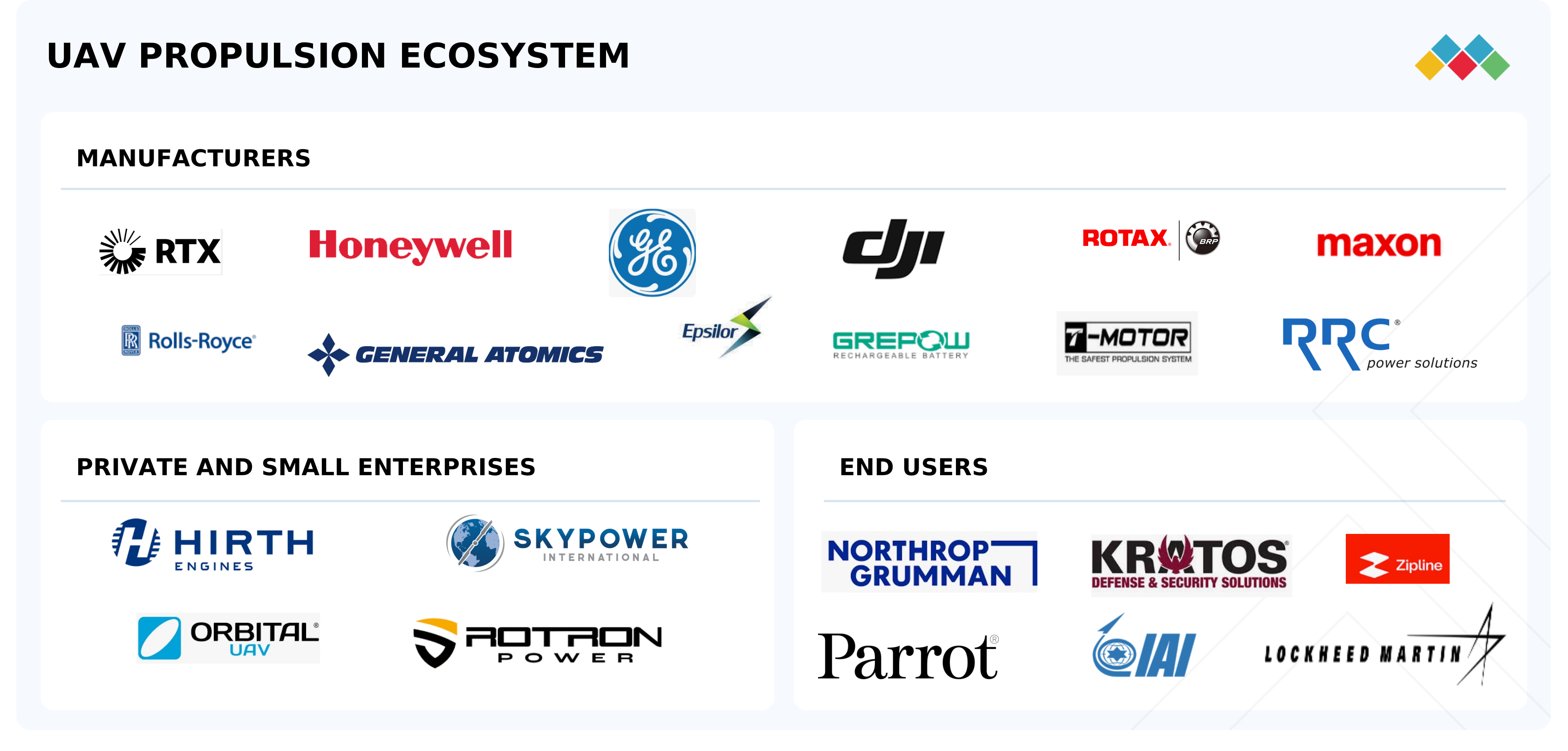
UAV (Drone) Propulsion Market: COMMERCIAL USE CASES ACROSS INDUSTRIES
| COMPANY | USE CASE DESCRIPTION | BENEFITS |
|---|---|---|
 |
Honeywell Aerospace and HAL are jointly manufacturing high-power turbogenerators in India to power hybrid-electric UAVs, unmanned helicopters, and next-generation eVTOLs. | This initiative enables longer endurance, improved payload capacity, reduced foreign dependence, and greater operational flexibility. |
 |
GE Aerospace and Kratos are co-developing small, low-cost turbojet and turbofan engines optimized for tactical UAVs used in ISR, electronic warfare, and combat support. | The program delivers affordable jet-powered UAVs, scalable mass production, and high-speed quick-launch mission capability. |
 |
Pratt & Whitney’s F100 turbofan engine, originally designed for the F-15/F-16, is being used in a hypersonic UAV prototype by Hermeus, integrated into a turbine-based combined cycle (TBCC) propulsion system. | The solution provides high thrust, temperature tolerance, and sub- to hypersonic flight, enabling reusable hypersonic UAVs. |
 |
Ascendance Flight Technologies is developing Atea, a 5-seater hybrid-electric VTOL aircraft powered by its proprietary Sterna propulsion system and supported by Dassault’s 3DEXPERIENCE platform. | The aircraft offers a 400 km range, 200 km/h cruise speed, up to 80% fewer emissions, four times quieter operation than helicopters, and scalability to hydrogen power. |
 |
Intelligent Energy is deploying its IE-SOAR hydrogen fuel cell systems for UAV applications in parcel delivery, inspection, cinematography, agriculture, surveillance, and LiDAR/mapping. | These systems deliver three times longer endurance compared to batteries, fast refueling, lower total cost of ownership, near-silent operation, and improved efficiency. |
 |
Elroy Air has conducted the flight of its Chaparral C1 hVTOL cargo drone powered by a turbogenerator-hybrid electric propulsion system, capable of autonomous cargo handling and long-range flights. | The drone achieves a range of over 300 miles, carries a payload of 300 lbs, operates runway-independently, serves both defense resupply and cargo logistics. |
Logos and trademarks shown above are the property of their respective owners. Their use here is for informational and illustrative purposes only.
Related Ecosystem
Aviation
- Narrow Body Aircraft
- Wide Body Aircraft
- Military Helicopters
- Special Mission Aircraft
- Fighter Aircraft
- HONEYWELL INTERNATIONAL INC.
- COLLINS AEROSPACE
- Thales group
- Safran group
- HEICO Corporation
Defence Platforms And Systems
- Sensors
- Unmanned Ground Vehicles (UGV)
- Fighter Aircraft
- Special Mission Aircraft
- Antennas
- BAE Systems plc
- Thales group
- LOCKHEED MARTIN CORPORATION
- Northrop Grumman Corporation
- L3Harris Technologies, Inc.
Unmanned Systems
- Rotary Wing Aircraft
- Fixed-Wing Drones
- Sensors
- Fuel Cell
- Fixed Wing Aircraft
- LOCKHEED MARTIN CORPORATION
- Northrop Grumman Corporation
- ISRAEL AEROSPACE INDUSTRIES LTD
- Thales group
- BAE Systems plc
Key Takeaways
- Rest Of Asia Pacific UAV propulsion market valued at USD 66.2 million in 2025, expanding to USD 116.7 million by 2030.
- Rest Of Asia Pacific demonstrates a 12.0% CAGR, outperforming the global market growth rate of 10.0%.
- Rest Of Asia Pacific is driven by defense modernization, commercial drone adoption, and indigenous UAV development initiatives.
- Rest Of Asia Pacific will benefit from improving regulatory environments and increased government defense spending through 2030.
UAV (Drone) Propulsion Market Report Scope
| Report Metric | Details |
|---|---|
| Base Year | 2025 |
| Fastest Growing Segment | LARGE (Commercial Platform) |
| Forecast Period | 2025-2030 |
| Growth Rate | CAGR of 10% from 2025 to 2030 |
| Largest Segment | MILITARY (Platform) |
| Market Size Base Year (Billions) | ~USD 7.02 (2025) |
| Revenue Forecast (Billions) | ~USD 11.3 (2030) |
| Segments Covered | Technology, Component, Ic Engine, Electric Motor, Power Source, Propeller, Platform, Military Platform, Commercial Platform, Mtow |
Rest Of Asia Pacific UAV (Drone) Propulsion Market Report Segmentation
10 segment dimensions are covered across the global market.
By Technology
- Electric
- Hybrid
- Thermal
By Component
- Electric Motor
- Electronic Speed Controller
- Ic Engine
- Power Source
- Propeller
By Ic Engine
- Piston Engine
- Turbofan Engine
- Turbojet Engine
- Turboprop Engine
- Wankel Engine
By Electric Motor
- Brushed Motor
- Brushless Motor
By Power Source
- Battery
- Fuel Cell
- Generator Set
- Solar Cell
By Propeller
- Composite
- Plastic
- Wood
By Platform
- Commercial
- Consumer
- Government & Law Enforcement
- Military
By Military Platform
- Small
- Strategic
- Tactical
By Commercial Platform
- Large
- Medium
- Small
By Mtow
- 150-600 Kg
- 25-150 Kg
- 2-25 Kg
- 600-2000 Kg
- < 2 Kg
- > 2000 Kg
Target Audience
- Defense Contractors & OEMs : Need regional market intelligence to develop UAV propulsion systems aligned with emerging Asia Pacific military requirements and procurement specifications for competitive bidding.
- Propulsion System Manufacturers : Require detailed market segmentation and growth forecasts for Rest Of Asia Pacific to optimize production capacity, supply chain planning, and regional distribution strategies.
- Commercial Drone Operators : Seek insights into regional demand for advanced propulsion solutions to enhance operational efficiency in agriculture, logistics, and infrastructure applications across emerging markets.
- Investment & Private Equity Firms : Need comprehensive market analysis and growth projections for Rest Of Asia Pacific to evaluate investment opportunities in UAV propulsion technology companies and regional startups.
- Government & Policy Makers : Require market data and trend analysis to inform defense procurement policies, technology development initiatives, and regulatory frameworks for UAV propulsion systems in the region.
Reasons to Buy this Report
- Regional Growth Opportunity : Capture insights into the fastest-growing UAV propulsion segment in Asia Pacific with 12% CAGR, enabling strategic market entry and expansion planning in high-potential emerging economies.
- Defense Sector Intelligence : Understand defense modernization trends and military UAV procurement patterns specific to Rest Of Asia Pacific nations, informing product development and sales strategies for defense contractors.
- Commercial Market Dynamics : Access detailed analysis of commercial drone adoption across agriculture, logistics, and infrastructure sectors in the region, identifying untapped market segments and customer opportunities.
- Competitive Positioning : Benchmark your propulsion technology offerings against regional competitors and identify gaps in the Rest Of Asia Pacific market to establish competitive advantages and market differentiation.
- Investment Decision Support : Make informed investment and partnership decisions with comprehensive market sizing, growth projections, and trend analysis specific to Rest Of Asia Pacific UAV propulsion ecosystem.
Frequently asked questions
What is the current market size of UAV propulsion in Rest Of Asia Pacific?
Rest Of Asia Pacific's UAV propulsion market is valued at USD 66.2 million in 2025 and is expected to grow to USD 116.7 million by 2030.
What is the projected growth rate for Rest Of Asia Pacific UAV propulsion market?
Rest Of Asia Pacific is projected to grow at a compound annual growth rate (CAGR) of 12.0% from 2025 to 2030.
What factors are driving growth in Rest Of Asia Pacific's UAV propulsion market?
Rest Of Asia Pacific's growth is driven by defense modernization, commercial drone adoption, indigenous UAV development, geopolitical tensions, and infrastructure projects requiring aerial surveillance.
How does Rest Of Asia Pacific's growth compare to the global UAV propulsion market?
Rest Of Asia Pacific's 12.0% CAGR outpaces the global market CAGR of 10.0%, indicating faster regional expansion and increasing market importance.
What propulsion technologies are most relevant to Rest Of Asia Pacific?
Rest Of Asia Pacific demand focuses on electric, hybrid, and fuel-cell propulsion systems, driven by efficiency requirements and emerging regulatory standards for commercial and military UAV operations.
RESEARCH METHODOLOGY
This research study involves the use of extensive secondary sources, directories, and databases (e.g., Hoovers, Bloomberg Business, Factiva, and OneSource) to identify and collect information useful for this technical, market-oriented, and commercial study on the UAV (drone) propulsion market. Primary sources include several industry experts from the core and related industries and preferred suppliers, manufacturers, distributors, technology developers, IP vendors, standards, and organizations related to all the segments of this industry’s value chain. In-depth interviews were conducted with various primary respondents, including key industry participants, subject matter experts (SMEs), C-level executives of key market players, and industry consultants, to obtain and verify critical qualitative and quantitative information and assess the prospects.
Secondary Research
In the secondary research process, various secondary sources were referred to, for identifying and collecting information for this study. The secondary sources include annual reports, press releases, and investor presentations of companies; white papers, journals and certified publications, and articles from recognized authors; and websites, directories, and databases. Secondary research has mainly been used to obtain key information about the industry’s supply chain, the market’s value chain, major players, market classification, and segmentation according to the industry trends to the bottommost level, geographic markets, and key developments from market- and technology-oriented perspectives. The secondary data has been collected and analyzed to determine the overall market size, further validated by primary research.
Primary Research
Extensive primary research has been conducted after obtaining information about the current scenario of the UAV (Drone) propulsion market through secondary research. Several primary interviews were conducted with market experts from the demand and supply sides across North America, Europe, Asia Pacific, the Middle East, and the Rest of the World. This primary data was collected through questionnaires, emails, and telephonic interviews.
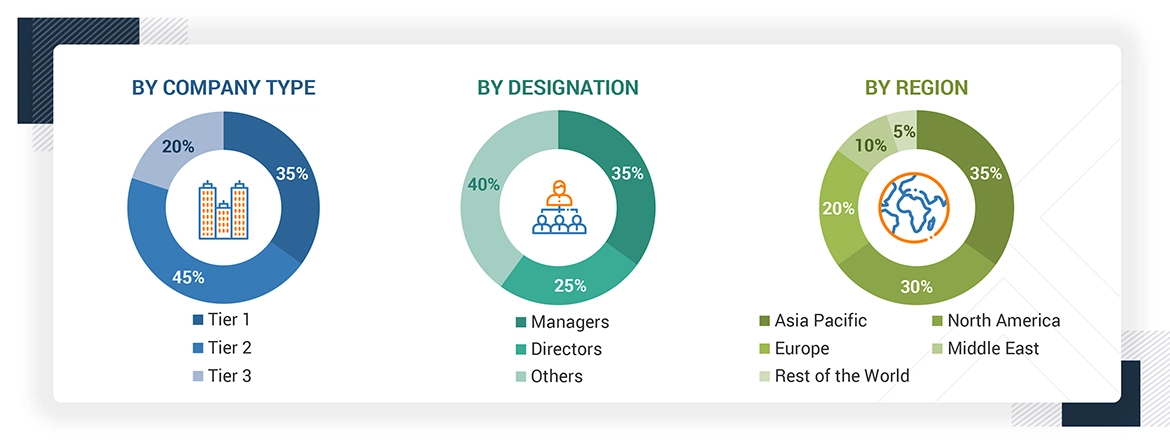
Notes: The tiers of companies are based on their revenue as of 2024.
Tier 1: company revenue greater than USD 1 billion; tier 2: company revenue between USD 100 million and USD 1 billion; and tier 3: company revenue less than USD 100 million
To know about the assumptions considered for the study, download the pdf brochure
Market Size Estimation
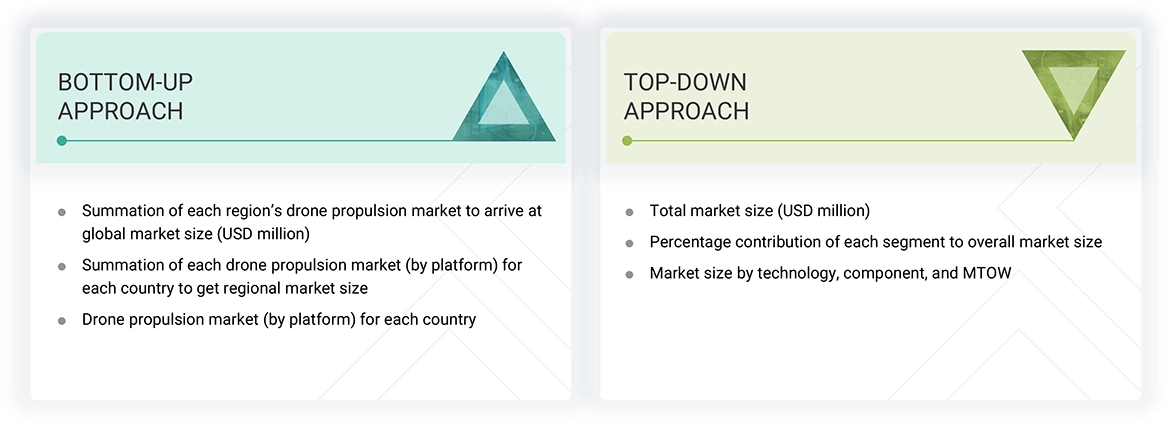
Both the top-down and bottom-up approaches have been used to estimate and validate the size of the UAV (drone) propulsion market.
The research methodology used to estimate the market size includes the following details:
- Key players in the market have been identified through secondary research, and their market ranking has been determined through primary and secondary research. This includes a study of annual and financial reports of the top market players and extensive interviews with industry experts knowledgeable about UAV (drone) propulsion systems.
- The top-down and bottom-up approaches were used to estimate and validate the size of the global market and the dependent submarkets in the overall market.
UAV (Drone) Propulsion Market : Top-Down and Bottom-Up Approach
Data Triangulation
After arriving at the overall size of the UAV (drone) propulsion market from the estimation process explained above, the total market was split into several segments and subsegments. Where applicable, the data triangulation and market breakdown procedures described below were implemented to complete the overall market engineering process and arrive at the exact statistics for various market segments and subsegments. The data was triangulated by studying various factors and trends from the demand and supply sides. The UAV (drone) propulsion market size was also validated using the top-down and bottom-up approaches.
Market Definition
The UAV (drone) propulsion comprises the power-generation and thrust-producing systems that keep unmanned aerial vehicles (UAVs) airborne across the military, commercial, government, law enforcement, and consumer segments. It covers electric drivetrains built around brushless DC motors, electronic speed controllers, lithium-ion and fuel-cell power packs; hybrid-electric propulsion that pairs batteries with piston or rotary engines; and conventional internal-combustion and micro-turbine solutions for long-range or heavy-lift missions. These technologies aim to extend endurance, improve thrust-to-weight ratios, lower acoustic signatures, and enhance platform modularity and reliability, enabling diverse applications from last-mile delivery and aerial mapping to ISR (intelligence, surveillance, reconnaissance) and precision-strike missions.
In addition to their applications in various industries, 3D cameras have become increasingly popular in recent years in the consumer market. They are used by hobbyists, enthusiasts, and professionals alike to capture 3D photos and videos of landscapes, people, animals, and more.
Key Stakeholders
- UAV (drone) propulsion manufacturers >
- Raw material suppliers
- Government agencies
- Technology support providers
- Military organizations
- Commercial organizations
- Government agencies
- Research institutions
- Emergency response and law enforcement agencies
Report Objectives
- To define, describe, segment, and forecast the size of the UAV (drone) propulsion market by component, technology, MTOW, platform, and region
- To forecast the size of various segments with respect to five major regions: North America, Europe, Asia Pacific, Middle East, and the Rest of World
- To identify and analyze key drivers, restraints, opportunities, and challenges influencing the growth of the market across the globe
- To identify industry trends, market trends, and technology trends that are currently prevailing in the market
- To provide an overview of the regulatory landscape with respect to UAV (drone) propulsion regulations across regions
- To analyze micro markets with respect to individual growth trends, prospects, and their contribution to the overall market
- To analyze opportunities in the market for stakeholders by identifying key market trends
- To profile key market players and comprehensively analyze their market share and core competencies
- To analyze the degree of competition in the market by identifying key growth strategies, such as acquisitions, product launches, contracts, and partnerships, adopted by leading market players
- To identify detailed financial positions, key products, and unique selling points of leading companies in the market
- To provide a detailed competitive landscape of the market, along with market ranking analysis, market share analysis, and revenue analysis of key players
Customization Options
Along with the market data, MarketsandMarkets offers customizations as per the specific needs of companies. The following customization options are available for the report:
Product Analysis
- Product matrix, which gives a detailed comparison of the product portfolio of each company
Regional Analysis
- Further breakdown of the market segments at the country level
Company Information
- Detailed analysis and profiling of additional market players (up to 5)
Get the Full UAV (Drone) Propulsion Market Report
Full forecast, segment splits, and company analysis for all UAV (Drone) Propulsion Market.
- Canada UAV (Drone) Propulsion Market
- US UAV (Drone) Propulsion Market
- Germany UAV (Drone) Propulsion Market
- UK UAV (Drone) Propulsion Market
- France UAV (Drone) Propulsion Market
- Italy UAV (Drone) Propulsion Market
- Russia UAV (Drone) Propulsion Market
- Sweden UAV (Drone) Propulsion Market
- Australia UAV (Drone) Propulsion Market
- China UAV (Drone) Propulsion Market
- India UAV (Drone) Propulsion Market
- Japan UAV (Drone) Propulsion Market
- South Korea UAV (Drone) Propulsion Market
- Saudi Arabia UAV (Drone) Propulsion Market
- UAE UAV (Drone) Propulsion Market
- Israel UAV (Drone) Propulsion Market
- Turkey UAV (Drone) Propulsion Market
- Rest Of Europe UAV (Drone) Propulsion Market
- Rest Of Middle East UAV (Drone) Propulsion Market
Need a Tailored Report?
Customize this report to your needs
Get 10% FREE Customization
Customize This Report
