
Asia Pacific Udder Health Market (2024-2029)

The Asia Pacific Udder Health Market was valued at $259.4 Million in 2024 and projected to reach to $370.7 Million by 2029, representing a compound annual growth rate of 7.4%. The Asia Pacific udder health market is poised for sustained expansion through 2029, supported by growing dairy production volumes across China, India, and Australia.


| Market Size in | USD 26.32 MN |
| Market Forecast in | |
| CAGR | |
| Forecast Period | |
| Units Considered | Value (USD MN) |
Asia Pacific Udder Health Market Trends and Insights
- Asia Pacific's 7.4% compound annual growth rate outpaces global trends, driven by increasing dairy production, rising livestock disease awareness, and expanding veterinary healthcare infrastructure across the region.
- The market in Asia Pacific reflects growing investments in animal health solutions and preventive care practices among dairy farmers seeking to improve herd productivity and milk quality standards. Asia Pacific's udder health sector is characterized by rising adoption of diagnostic technologies and therapeutic interventions tailored to regional farming practices.
- Between 2024 and 2029, Asia Pacific is expected to see accelerated demand for mastitis prevention products, milking hygiene solutions, and veterinary services.
- The region's expanding middle-class consumption of dairy products and stricter food safety regulations are compelling producers across Asia Pacific to prioritize udder health management, positioning the market for sustained expansion through the forecast period..
Key Market Statistics
- CAGR (2024-2029) 7.4% CAGR
- Market Size, 2024 ~USD 259.4 Million
- Forecast, 2029 ~USD 370.7 Million
- Geography Asia Pacific
Asia Pacific Udder Health Market Overview
Rapid Regional Growth :
Asia Pacific's udder health market is expanding at 7.4% CAGR, significantly outpacing the global growth rate of 5.9%, driven by intensifying dairy production across emerging economies.
Market Valuation Trajectory :
The region's market is valued at USD 259.4 million in 2024 and is projected to reach USD 370.7 million by 2029, representing a USD 111.3 million increase over five years.
Infrastructure Expansion :
Expanding veterinary healthcare infrastructure and increasing adoption of modern dairy farming practices across Asia Pacific are creating substantial opportunities for udder health solutions.
Disease Awareness Surge :
Rising livestock disease awareness among dairy farmers in Asia Pacific is driving demand for preventive udder health management products and veterinary services.
Asia Pacific Udder Health Market Dynamics
- Increasing investments in veterinary infrastructure and heightened farmer awareness of mastitis and related udder diseases are accelerating market penetration.
- Government initiatives promoting livestock health standards and modernization of dairy operations further strengthen market fundamentals. Key growth drivers include rising per capita dairy consumption, expanding commercial dairy farms, and integration of advanced diagnostic and treatment technologies.
- The region's competitive advantage lies in cost-effective solutions tailored to emerging market needs.
- Strategic partnerships between international veterinary companies and regional distributors are expected to enhance market accessibility, positioning Asia Pacific as a high-growth region within the global udder health market landscape..
Market Ecosystem
Related Ecosystem
Animal Health
- Polymerase Chain Reaction (PCR) Tests
- Porcine
- Immunodiagnostics
- Lateral Flow Assays
- Microarrays
- Zoetis Inc.
- Patterson Companies, Inc.
- Virbac
- Elanco Animal Health Incorporated
- BOEHRINGER INGELHEIM GMBH
Medical Devices
- Polymerase Chain Reaction (PCR)
- Magnetic Resonance Imaging (MRI)
- Disposable Autoinjectors
- Pulse Oximeters
- Blood Pressure Monitors
- Medtronic plc
- Abbott Laboratories
- Stryker Corporation
- Becton, Dickinson and Company
- CONMED Corporation
Key Takeaways
- Asia Pacific udder health market grows from $259.4M (2024) to $370.7M (2029) at 7.4% CAGR, outpacing global growth.
- Rising dairy production and livestock disease awareness across Asia Pacific drive demand for preventive udder health solutions.
- Asia Pacific's expanding veterinary infrastructure and food safety regulations accelerate adoption of diagnostic and therapeutic technologies.
- Mastitis prevention, milking hygiene, and veterinary services represent key growth segments in the Asia Pacific market through 2029.
Udder Health Market Report Scope
| Report Metric | Details |
|---|---|
| Base Year | 2024 |
| Fastest Growing Segment | OTHER UDDER HEALTH DIAGNOSTIC & TREATMENT DEVICES (Devices) |
| Forecast Period | 2024-2029 |
| Growth Rate | CAGR of 5.9% from 2024 to 2029 |
| Largest Segment | DAIRY CATTLE (Animal Type) |
| Market Size Base Year (Billions) | ~USD 1.2 (2024) |
| Revenue Forecast (Billions) | ~USD 1.6 (2029) |
| Segments Covered | Product, Devices, Type, Veterinary Care Setting, Animal Type, Disease Type, Disease Type 2022-2029, Pharmaceuticals 2022-2029 |
Asia Pacific Udder Health Market Report Segmentation
8 segment dimensions are covered across the global market.
By Product
- Devices
- Pharmaceuticals
- Supplements
By Devices
- Milk Management Systems
- Milk Quality Analysers
- Milk Quality Analyzers
- Milk Sampling Equipment
- Other Devices
- Other Udder Health Diagnostic & Treatment Devices
By Type
- Anti-Inflammatory Drugs
- Antibiotics
- Automated Sampling Systems
- Conductivity/Chemical Analyzers
- Hardware Modules (Inline & Parlor Sensors)
- Integrated Management Systems
- Intramammary Infusions
- Manual & Basic Sampling Tools
- Mastitis/Bacterial Detection Analyzers
- Milk Management Systems
- Milk Quality Analyzers
- Milk Sampling Equipment
- Other Devices
- Other Pharmaceuticals
- Other Supplements
- Probiotics & Prebiotics
- Scc & Multi-Parameter Analyzers
- Software & Analytics Platforms
- Teat Sealants
- Treatment & Prevention Devices
- Udder Diagnostic Tools
- Vaccines
- Vitamins & Minerals
By Veterinary Care Setting
- Dairy Farms
- Veterinary Hospitals And Clinics
By Animal Type
- Dairy Cattle
- Other Animal Types
By Disease Type
- Clinical Mastitis
- Other Disease Types
By Disease Type 2022-2029
- Clinical Mastitis
- Other Disease Types
By Pharmaceuticals 2022-2029
- Anti-Inflammatory Drugs
- Antibiotics
- Intramammary Infusions
- Other Pharmaceuticals
- Teat Sealants
- Vaccines
Target Audience
- Dairy Farm Operators : Need market data to understand udder health solution options, pricing trends, and technology adoption rates to optimize herd health management and operational efficiency.
- Veterinary Healthcare Providers : Require regional market insights to identify service demand patterns, competitive offerings, and growth opportunities in Asia Pacific's expanding livestock healthcare sector.
- Animal Health Product Manufacturers : Seek detailed market analysis to guide product development, regional expansion strategies, and distribution channel optimization across Asia Pacific markets.
- Investment & Private Equity Firms : Need comprehensive market sizing and growth forecasts to evaluate investment opportunities in Asia Pacific dairy health companies and veterinary service providers.
- Government & Agricultural Agencies : Require market intelligence to develop livestock health policies, infrastructure investment plans, and disease prevention programs aligned with regional dairy industry growth.
Countries within Asia Pacific - compare and drill down
| Country | 2025 size (native) |
|---|---|
| China | USD 54.9 Million |
| India | USD 48.3 Million |
| Japan | USD 27.6 Million |
| Australia | USD 23.6 Million |
| South Korea | USD 6.6 Million |
| Rest Of Asia Pacific | USD 6.1 Million |
Country market size visualization
Reasons to Buy this Report
- Regional Growth Outperformance : Gain insights into Asia Pacific's 7.4% CAGR, which exceeds global benchmarks, enabling strategic positioning in the fastest-growing udder health market segment.
- Country-Level Market Intelligence : Access detailed market sizing for key Asia Pacific countries including China, India, Japan, and Australia to identify high-potential investment and expansion opportunities.
- Infrastructure & Adoption Trends : Understand veterinary healthcare infrastructure expansion and modern dairy farming adoption patterns specific to Asia Pacific, critical for product development and market entry strategies.
- Competitive Landscape Analysis : Identify regional competitors, market gaps, and emerging players in Asia Pacific's udder health sector to inform competitive positioning and partnership strategies.
- Forecast-Driven Planning : Leverage 2024-2029 market projections to develop long-term business strategies, resource allocation plans, and revenue forecasts tailored to Asia Pacific dynamics.
Frequently asked questions
What is the current size of the Asia Pacific udder health market?
The Asia Pacific udder health market was valued at USD 259.4 million in 2024 and is projected to reach USD 370.7 million by 2029.
What is the growth rate for the Asia Pacific udder health market?
Asia Pacific's udder health market is expected to grow at a compound annual growth rate (CAGR) of 7.4% from 2024 to 2029.
What are the main drivers of growth in Asia Pacific's udder health market?
Key drivers include increasing dairy production, rising livestock disease awareness, expanding veterinary healthcare infrastructure, and stricter food safety regulations across Asia Pacific.
Which products are driving demand in the Asia Pacific udder health market?
Mastitis prevention products, milking hygiene solutions, diagnostic technologies, and veterinary services are the primary growth drivers in Asia Pacific.
How does Asia Pacific's udder health market compare to global trends?
Asia Pacific's 7.4% CAGR exceeds the global market CAGR of 5.9%, indicating faster regional growth and increasing market opportunity.
RESEARCH METHODOLOGY
This study involved four major activities in estimating the current udder health market size. Extensive research was conducted to collect information on the market as well as its peer and parent markets. The next step was to validate these findings, assumptions, and sizing with industry experts across the value chain through primary research. Both top-down and bottom-up approaches were employed to estimate the value market. After that, market breakdown and data triangulation procedures were used to estimate the market size of segments and subsegments.
Secondary Research
The secondary research process involves the widespread use of secondary sources, directories, databases (such as Bloomberg Business, Factiva, and D&B Hoovers), white papers, annual reports, companies house documents, investor presentations, and SEC filings of companies. Secondary research was used to identify and collect information useful for the extensive, technical, market-oriented, and commercial study of the udder health market. It was also used to obtain important information about the key players and market classification & segmentation according to industry trends to the bottom-most level, and key developments related to market and technology perspectives. A database of the key industry leaders was also prepared using secondary research.
Primary Research
In the primary research process, various sources from both the supply and demand sides were interviewed to obtain qualitative and quantitative information for this report. Primary sources from the supply side include CEOs, consultants, subject-matter experts, directors, general managers, developers, and other key opinion leaders of the various companies that offer udder health products. Primary sources from the demand side include industry experts such as doctors, hospital directors and managers, and other medical professionals.
Primary research was conducted to identify segmentation types; industry trends; technology trends; key players; and key market dynamics such as drivers, restraints, opportunities, challenges, and key player strategies.
Breakdown of Primary Interviews (Supply Side): By Company Type, Designation, and Region
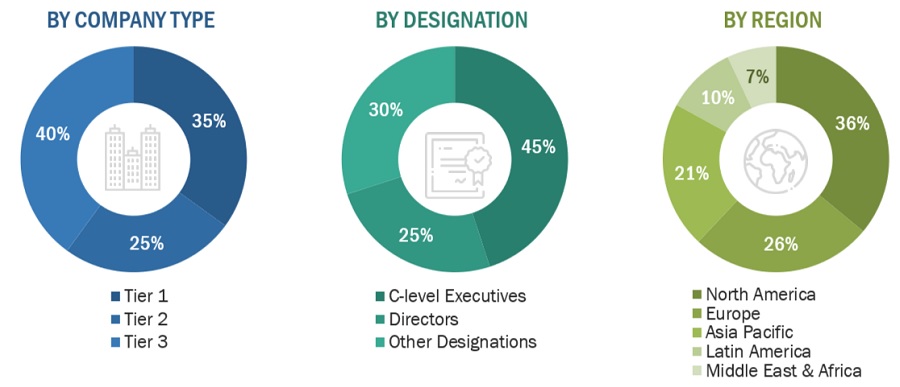
Note 1: Others include sales, marketing, and product managers.
Note 2: Their total revenues define the tiers of companies as of 2021, tier 1 = >USD 500 million, tier 2 = USD 200 million to USD 500 million, and tier 3 = <USD 200 million.
Breakdown of Primary Interviews (Demand Side): By Veterinary Care Setting Type, Designation, and Region
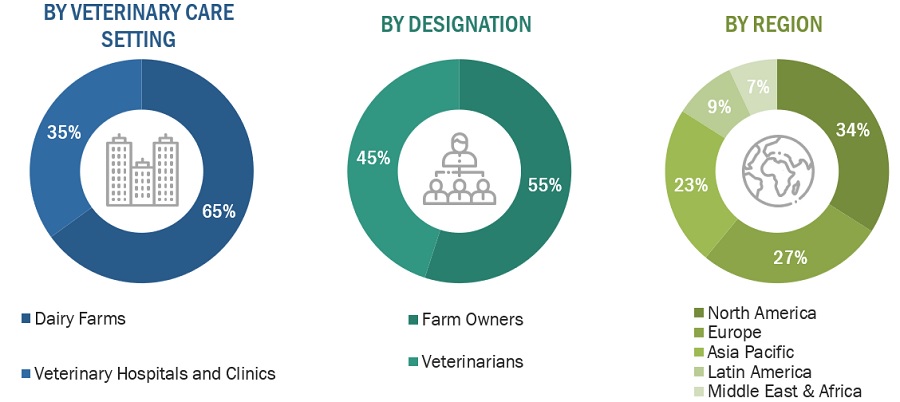
To know about the assumptions considered for the study, download the pdf brochure
Market Size Estimation
The total size of the udder health market was arrived at after data triangulation from four different approaches, as mentioned below.
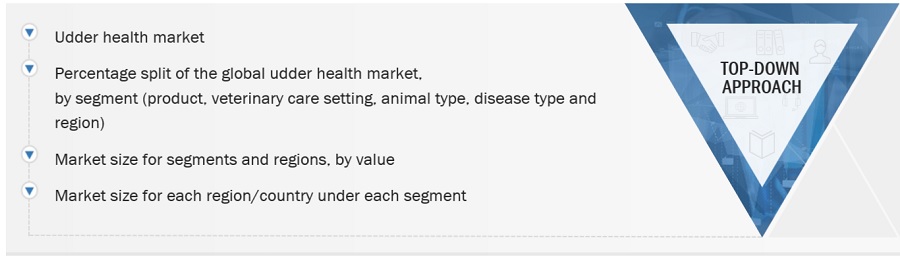
Bottom-up Approach: Revenues of individual companies were gathered from public sources and databases. Shares of the medical device cleaning businesses of leading players were gathered from secondary sources to the extent available. In certain cases, the share of the business unit was ascertained after a detailed analysis of various parameters, including product portfolio, market positioning, selling price, and geographic reach and strength. Individual shares or revenue estimates were validated through expert interviews.
Country level Analysis: The size of the udder health market was obtained from the annual presentations of leading players and secondary data available in the public domain. The share of udder health products in the overall udder health market was obtained from secondary data and validated by primary participants to arrive at the total udder health market. Primary participants further validated the numbers.
Primary Interviews: As a part of the primary research process, individual respondent insights on the market size and growth were taken during the interview (regional and global, as applicable). All the responses were collated, and a weighted average was taken to derive a probabilistic estimate of the market size and growth rate.
Geographic market assessment (by region & country): The geographic assessment was done using the following approaches:
Approach 1: Geographic revenue contributions/splits of leading players in the market (wherever available) and respective growth trends
Approach 2: Geographic adoption trends for individual product segments by end users and growth prospects for each of the segments (assumptions and indicative estimates validated from primary interviews)
At each point, the assumptions and approaches were validated through industry experts contacted during primary research. Considering the limitations of data available from secondary research, revenue estimates for individual companies (for the overall udder health market and geographic market assessment) were ascertained based on a detailed analysis of their respective product offerings, geographic reach/strength (direct or through distributors or suppliers), and the shares of the leading players in a particular region or country.
After complete market engineering with calculations for market statistics, market size estimations, market forecasting, market breakdown, and data triangulation, extensive primary research was conducted to gather information and verify and validate the critical numbers arrived at. In the complete market engineering process, both top-down and bottom-up approaches were extensively used, along with several data triangulation methods to perform market estimation and market forecasting for the overall market segments and subsegments listed in this report. Extensive qualitative and further quantitative analysis was also done from all the numbers arrived at in the complete market engineering process to list key information throughout the report.
Global Udder health market Size: Top-Down Approach
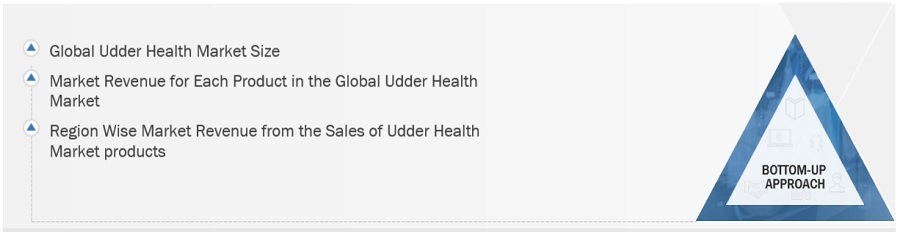
To know about the assumptions considered for the study, Request for Free Sample Report
Global Udder health market Size: Bottom-Up Approach
Data Triangulation
After arriving at the market size, the total market was divided into several segments and subsegments. To complete the overall market engineering process and arrive at the exact statistics for all segments and subsegments, data triangulation and market breakdown procedures were employed wherever applicable.
Approach to derive the market size and estimate market growth
The market rankings for leading players were ascertained after a detailed assessment of their revenues from the udder health business using secondary data available through paid and unpaid sources. Owing to data limitations, in certain cases, the revenue share was arrived at after a detailed assessment of the product portfolios of major companies and their respective sales performance. At each point, this data was validated through primary interviews with industry experts.
Market Definition
The Udder Health Market focuses on products and solutions to maintain and improve the udder health of dairy cattle. This market includes devices for udder care, pharmaceuticals to treat infections like mastitis, and supplements to boost udder health and milk production rate. The devices segment includes tools for sampling milk, checking milk quality, analyzing somatic cell count, while the pharmaceutical segment covers medicines like antibiotics, vaccines and intra-mammary infusions and the supplement segment offers vitamins, minerals, and other health products for lactating animals.
Key Stakeholders
- Manufacturing companies of udder health products
- Dairy Farms
- Veterinary hospitals and clinics
- Hospitals and clinics
- Dairy Farmers
- Veterinary practitioners
- Market research and consulting firms
- Venture capitalists and investors
- Regulatory agencies and government bodies
- Distributors of udder health products
Objectives of the Study
- To define, describe, and forecast the udder health market, by product, veterinary care setting, animal type, disease type, and region.
- To provide detailed information about the key factors influencing the market growth, such as drivers, restraints, opportunities, challenges, and industry trends
- To strategically analyze the regulatory scenario, pricing trends, value chain, supply chain, ecosystem analysis, key stakeholders and buying criteria, technology scenario, patent scenario, and key conferences and events in the market
- To analyze the micro markets with respect to individual growth trends, prospects, and contributions to the overall udder health market
- To analyze market opportunities for stakeholders and provide details of the competitive landscape for key players.
- To strategically profile the key players in this market and comprehensively analyze their market shares and core competencies.
- To strategically analyze the udder health market in five regions, namely, North America, Europe, the Asia Pacific, Latin America, and the Middle East & Africa and GCC countries
- To track and analyze competitive developments such as acquisitions, partnerships, and expansions in the udder health market.
Available Customizations
With the given market data, MarketsandMarkets offers customizations as per the company’s specific needs. The following customization options are available for the report:
Company Information
- Detailed analysis and profiling of additional market players
Geographic Analysis
- Further breakdown of the Rest of Asia Pacific udder health market into China, Japan, India, South Korea, and other countries.
Get the Full Udder Health Market Report
Full forecast, segment splits, and company analysis for all Udder Health Market.
- Canada Udder Health Market
- US Udder Health Market
- Germany Udder Health Market
- UK Udder Health Market
- France Udder Health Market
- Italy Udder Health Market
- Switzerland Udder Health Market
- Spain Udder Health Market
- Japan Udder Health Market
- China Udder Health Market
- India Udder Health Market
- Australia Udder Health Market
- South Korea Udder Health Market
- Brazil Udder Health Market
- Mexico Udder Health Market
- Rest Of Europe Udder Health Market
- Rest Of Asia Pacific Udder Health Market
- Rest Of Latin America Udder Health Market
Need a Tailored Report?
Customize this report to your needs
Get 10% FREE Customization
Customize This Report
