
Australia Vacuum Evaporators Market (2025-2030)

The Australia Vacuum Evaporators Market was valued at $33.2 Million in 2025 and projected to reach to $46.3 Million by 2030, representing a compound annual growth rate of 6.9%. Australia's vacuum evaporators market is poised for steady expansion, driven by robust demand from pharmaceutical, food processing, and waste management industries.


| Market Size in | USD 26.32 MN |
| Market Forecast in | |
| CAGR | |
| Forecast Period | |
| Units Considered | Value (USD MN) |
Australia Vacuum Evaporators Market Trends and Insights
- Australia's chemical and materials processing sectors are driving demand for efficient evaporation technologies, particularly in pharmaceutical manufacturing, food processing, and waste management applications.
- The market in Australia is benefiting from increased industrial automation and stricter environmental regulations that favor vacuum evaporation systems for their energy efficiency and reduced emissions. The 6.9% compound annual growth rate reflects Australia's commitment to sustainable industrial practices and technological advancement.
- Australia's geographic isolation and strong manufacturing base create unique opportunities for specialized vacuum evaporator solutions tailored to local industry needs.
- Between 2025 and 2030, Australia is expected to see increased adoption of advanced vacuum evaporation technologies across multiple sectors, supported by rising capital investments in process optimization and environmental compliance infrastructure..
Key Market Statistics
- CAGR (2025-2030) 6.9% CAGR
- Market Size, 2025 ~USD 33.2 Million
- Forecast, 2030 ~USD 46.3 Million
- Country Australia
Australia Vacuum Evaporators Market Overview
Market Valuation :
Australia's vacuum evaporators market is valued at USD 33.2 million in 2025, with a projected compound annual growth rate of 6.9% through 2030, reaching USD 46.3 million.
Key Application Sectors :
Pharmaceutical manufacturing, food processing, and waste management are the primary drivers of vacuum evaporator demand in Australia, leveraging advanced evaporation technologies for efficiency and compliance.
Growth Drivers :
Australia's chemical and materials processing sectors are expanding, supported by stringent environmental regulations, increasing demand for sustainable processing solutions, and technological advancements in evaporation systems.
Regional Competitive Advantage :
Australia's strong manufacturing base, coupled with investment in R&D and adoption of Industry 4.0 technologies, positions local operators to capture growing market opportunities in vacuum evaporation solutions.
Australia Vacuum Evaporators Market Dynamics
- The 6.9% CAGR reflects increasing adoption of efficient evaporation technologies to meet stringent environmental standards and operational efficiency requirements.
- Investment in advanced manufacturing capabilities and sustainability initiatives across Australian chemical and materials sectors will continue to fuel market growth through 2030. The market outlook remains positive as Australian industries prioritize waste reduction, energy efficiency, and regulatory compliance.
- Growing awareness of circular economy principles and the need for advanced separation technologies in specialty chemicals production will create sustained demand for vacuum evaporators.
- Strategic partnerships between equipment manufacturers and end-users, combined with technological innovations, are expected to enhance market penetration and drive revenue growth in the Australian market..
Market Ecosystem
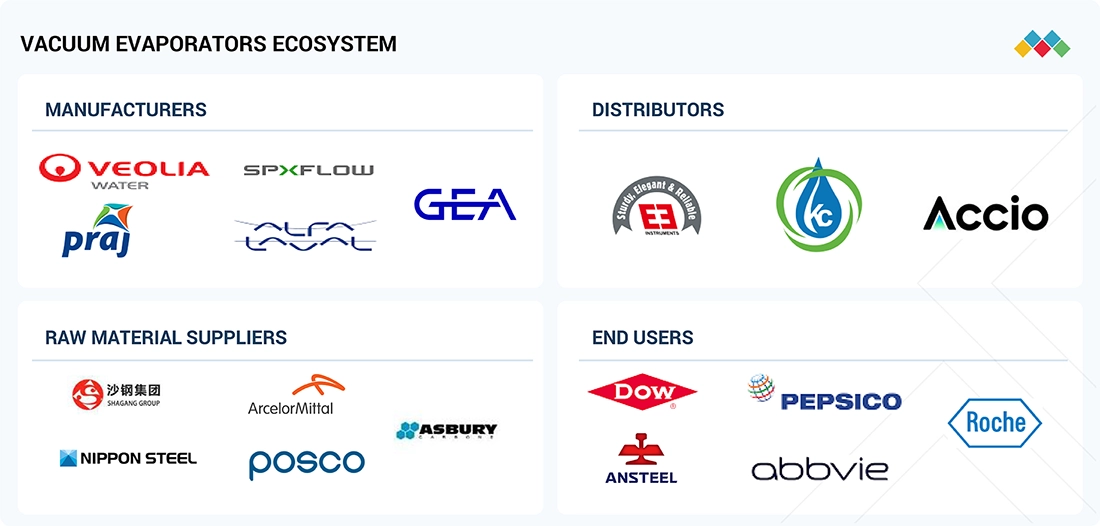
Vacuum Evaporators Market: COMMERCIAL USE CASES ACROSS INDUSTRIES
| COMPANY | USE CASE DESCRIPTION | BENEFITS |
|---|---|---|
 |
Treat and concentrate industrial effluents (chemical, pharma, textile, brine) to recover clean condensate for reuse and reduce or eliminate liquid discharge | Large reduction in hazardous/regulated wastewater volumes (lower disposal and permitting risk) |
 |
Gentle vacuum evaporation (often falling-film or plate evaporators) to concentrate heat-sensitive liquids like fruit juices, herbal extracts, flavors, and aroma fractions while preserving quality and aroma | Improved product quality (less thermal damage) and higher organoleptic retention |
 |
Concentrate milk, whey, or lactose feedstocks to the desired solids before spray-drying or crystallization using falling-film/plate evaporators in a vacuum to avoid scorching | Higher solids result in more efficient spray-drying and lower per-kg energy/drying cost, controlled product quality (viscosity and heat exposure managed) |
 |
Concentration of active pharmaceutical ingredient (API) slurries, removal/recovery of solvents, and final concentration steps using vacuum evaporators designed for sanitary/ATEX environments | Solvent recovery for cost savings and regulatory compliance, precise thermal control for product purity and potency |
 |
Concentrate process brines or leachates to recover salts, reduce tailings liquid, or prepare feeds for salt crystallizers. Hybrid ZLD/thermal trains are used in critical minerals and potash | Valuable salt/mineral recovery and fewer disposal liabilities, water recovery for reuse in the mine/process, lowering freshwater intake |
Logos and trademarks shown above are the property of their respective owners. Their use here is for informational and illustrative purposes only.
Related Ecosystem
Equipment Machine And Tooling
- Wastewater Treatment
- Air Cooled Heat Exchangers
- Diaphragm Pumps
- Fiberglass
- HVAC System
- Alfa Laval Corporate AB
- Veolia
- Johnson Controls International plc
- Daikin Industries,Ltd.
- Parker-Hannifin Corporation
Key Takeaways
- Australia's vacuum evaporators market is valued at USD 33.2 million in 2025 and will grow to USD 46.3 million by 2030, representing a 6.9% CAGR.
- Australia's pharmaceutical and food processing industries are primary drivers of vacuum evaporator demand due to stringent quality and environmental standards.
- Energy efficiency and environmental compliance regulations in Australia are accelerating adoption of advanced vacuum evaporation technologies.
- Australia's industrial base supports specialized vacuum evaporator applications, creating differentiated market opportunities distinct from global trends.
Vacuum Evaporators Market Report Scope
| Report Metric | Details |
|---|---|
| Base Year | 2025 |
| Fastest Growing Segment | HYBRID ZLD SYSTEMS (System) |
| Forecast Period | 2025–2030 |
| Growth Rate | CAGR of 7% from 2025 to 2030 |
| Largest Segment | CONVENTIONAL ZLD SYSTEMS (System) |
| Market Size Base Year (Billions) | ~USD 3.5 (2025) |
| Revenue Forecast (Billions) | ~USD 4.91 (2030) |
| Segments Covered | Type Of Technology, Application, End-Use Industry, Technology, System |
Australia Vacuum Evaporators Market Report Segmentation
5 segment dimensions are covered across the global market.
By Type Of Technology
- Heat Pump Vacuum Evaporators
- Mechanical Vapor Recompression Vacuum Evaporators
- Thermal Vacuum Evaporators
By Application
- Other Applications
- Product Processing
- Wastewater Treatment
By End-Use Industry
- Automotive
- Chemicals & Petrochemicals
- Electronics & Semiconductors
- Energy & Power
- Food & Beverages
- Other End-Use Industries
- Pharmaceuticals
By Technology
- Heat Pump Vacuum Evaporators
- Mechanical Vapor Recompression Vacuum Evaporators
- Thermal Vacuum Evaporators
By System
- Conventional Zld Systems
- Hybrid Zld Systems
AUSTRALIA: VACUUM EVAPORATORS MARKET, BY END-USE INDUSTRY, 2025–2030
| Segment | 2025 | 2026 | 2027 | 2028 | 2029 | 2030 | CAGR (%) |
|---|---|---|---|---|---|---|---|
| AUTOMOTIVE | 8.1 | 8.6 | 9.2 | 9.8 | 10.4 | 11.1 | 6.5 |
| CHEMICALS & PETROCHEMICALS | 7.7 | 8.3 | 8.9 | 9.6 | 10.4 | 11.2 | 7.7 |
| ELECTRONICS & SEMICONDUCTORS | 1.3 | 1.4 | 1.5 | 1.5 | 1.6 | 1.8 | 6.4 |
| ENERGY & POWER | 3.7 | 3.9 | 4.1 | 4.3 | 4.6 | 4.8 | 5.6 |
| FOOD & BEVERAGES | 5.2 | 5.6 | 6 | 6.4 | 6.9 | 7.4 | 7.5 |
| OTHER END-USE INDUSTRIES | 3.8 | 4 | 4.2 | 4.5 | 4.7 | 5 | 6 |
| PHARMACEUTICALS | 3.5 | 3.7 | 4 | 4.3 | 4.7 | 5 | 7.6 |
| TOTAL | 33.2 | 35.4 | 37.9 | 40.5 | 43.3 | 46.3 | 6.9 |
Target Audience
- Equipment Manufacturers & Suppliers : Manufacturers need Australia-specific market data to identify growth opportunities, assess competitive positioning, develop localized product strategies, and optimize distribution channels for the expanding Australian vacuum evaporators market.
- Pharmaceutical & Chemical Companies : End-users in Australia's pharmaceutical and chemical sectors require market intelligence to evaluate technology investments, benchmark operational efficiency, and make informed procurement decisions for evaporation equipment.
- Investment & Private Equity Firms : Investors targeting Australia's chemical and materials processing sectors need detailed market analysis to identify acquisition targets, assess growth potential, and evaluate investment returns in the vacuum evaporators space.
- Food & Beverage Processors : Australian food processing companies need market insights to understand technology trends, evaluate equipment upgrades, and assess competitive advantages of modern vacuum evaporation solutions for their operations.
- Waste Management & Environmental Services : Waste management operators in Australia require market data to evaluate evaporation technologies for waste treatment, understand regulatory drivers, and plan capital investments in sustainable processing solutions.
Key Companies in the Australia Vacuum Evaporators Market
| Company | HQ | Ownership | Strongest segments |
|---|---|---|---|
| ALFA LAVAL | Sweden | Public Company | Mechanical Vapor Recompression (MVR) Evaporators,Heat Pump Vacuum Evaporators,Thermal Vacuum Evaporators, |
| GEA GROUP AKTIENGESELLSCHAFT | United States | Public Company | Heat Pump Vacuum Evaporators,Mechanical Vapor Recompression (MVR) Vacuum Evaporators,Thermal Vacuum Evaporators, |
| SPX FLOW, INC. | United States | Private Company | Heat Pump Vacuum Evaporators,Mechanical Vapor Recompression (MVR) Vacuum Evaporators,Thermal Vacuum Evaporators, |
| H2O GMBH | Romania | Public Company | Mechanical Vapor Recompression,Thermal,Heat Pump, |
| DE DIETRICH | France | Private Company | Thermal Vacuum Evaporators,Mechanical Vapor Recompression (MVR) Evaporators,Heat Pump Vacuum Evaporators, |
| SASAKURA ENGINEERING CO, LTD. | Japan | Private Company | Thermal Vacuum Evaporators,Mechanical Vapor Recompression (MVR) Evaporators,Heat Pump Vacuum Evaporators, |
| PRAJ INDUSTRIES | India | Public Company | Heat Pump Vacuum Evaporators,Mechanical Vapor Recompression (MVR) Vacuum Evaporators,Thermal Vacuum Evaporators, |
ALFA LAVAL
Alfa Laval is a Swedish public company founded in 1883 with 24,399 employees, providing heat transfer, separation, and fluid handling technologies.
GEA GROUP AKTIENGESELLSCHAFT
GEA Group Aktiengesellschaft is a publicly traded German company established in 1881 with 19,670 employees, specializing in process technology and equipment for various industries.
SPX FLOW, INC.
SPX Flow, Inc. is a private company founded in 2015 with 4,900 employees, operating in the United States in fluid handling and processing equipment.
H2O GMBH
H2O GmbH is a Romanian public company founded in 2000 with 5,249 employees, operating in water treatment and related sectors.
DE DIETRICH
De Dietrich is a French private company with roots dating back to 1684, specializing in industrial equipment and solutions.
SASAKURA ENGINEERING CO, LTD.
Sasakura Engineering Co, Ltd. is a Japanese private company established in 1949 with 473 employees, specializing in marine and industrial engineering.
PRAJ INDUSTRIES
Praj Industries is an Indian public company founded in 1985 with 1,844 employees, providing engineering and technology solutions.
Reasons to Buy this Report
- Market Size & Growth Trajectory : Access precise valuation data for Australia's vacuum evaporators market (USD 33.2M in 2025) with detailed 5-year forecasts to USD 46.3M, enabling accurate investment planning and revenue projections specific to the Australian region.
- Sector-Specific Insights : Gain detailed intelligence on pharmaceutical manufacturing, food processing, and waste management applications driving demand in Australia, with actionable insights for targeting high-growth segments and customer segments.
- Competitive Landscape Analysis : Understand Australia's competitive dynamics, local market players, and regional advantages to develop effective market entry strategies, partnership opportunities, and differentiation approaches tailored to Australian conditions.
- Regulatory & Compliance Framework : Identify Australia-specific environmental regulations, sustainability requirements, and compliance standards influencing vacuum evaporator adoption, helping businesses align products and strategies with local market demands.
- Strategic Decision Support : Leverage comprehensive Australia market data to support capital allocation decisions, expansion planning, product development priorities, and go-to-market strategies with confidence in regional market fundamentals.
Frequently asked questions
What is the current size of Australia's vacuum evaporators market?
Australia's vacuum evaporators market is valued at USD 33.2 million in 2025 and is projected to reach USD 46.3 million by 2030.
What is the growth rate of Australia's vacuum evaporators market?
Australia's vacuum evaporators market is growing at a compound annual growth rate (CAGR) of 6.9% from 2025 to 2030.
Which industries in Australia drive vacuum evaporator demand?
Australia's pharmaceutical manufacturing, food processing, chemical production, and waste management sectors are the primary drivers of vacuum evaporator demand.
What factors are accelerating vacuum evaporator adoption in Australia?
Australia's strict environmental regulations, energy efficiency requirements, industrial automation trends, and capital investments in process optimization are key growth factors.
How does Australia's market compare to global vacuum evaporator trends?
Australia's 6.9% CAGR is slightly below the global 7% CAGR, reflecting Australia's mature industrial base and localized market dynamics distinct from emerging markets.
RESEARCH METHODOLOGY
The study involved four main activities to estimate the current size of the Vacuum evaporators market: detailed secondary research gathered information on the market, related markets, and parent markets. The next step was to confirm these findings, assumptions, and size estimates with industry experts across the Vacuum evaporators value chain through primary research. Both top-down and bottom-up methods were used to determine the overall market size. Afterward, market segmentation and data triangulation helped estimate the sizes of segments and subsegments.
Secondary Research
Secondary sources for this research include annual reports, press releases, and investor presentations of companies; white papers; certified publications; articles by recognized authors; gold- and silver-standard websites; Vacuum evaporators manufacturing companies, regulatory bodies, trade directories, and databases. The secondary research was mainly used to gather key information about the industry’s supply chain, the main players, market classification, and segmentation based on industry trends down to the regional level. It also helped obtain information about important developments from a market-focused perspective.
Primary Research
The Vacuum evaporators market includes various stakeholders, such as raw material suppliers, technology support providers, Vacuum evaporator manufacturers, and regulatory agencies within the supply chain. To gather both qualitative and quantitative data, interviews were conducted with key sources from the market’s supply and demand sides. On the supply side, industry experts like CEOs, vice presidents, marketing directors, technology and innovation directors, and other senior executives from different companies and organizations involved in the Vacuum Evaporators Market were interviewed. On the demand side, directors, marketing heads, and purchasing managers from diverse sourcing industries were also included. The following is the breakdown of the primary respondents:
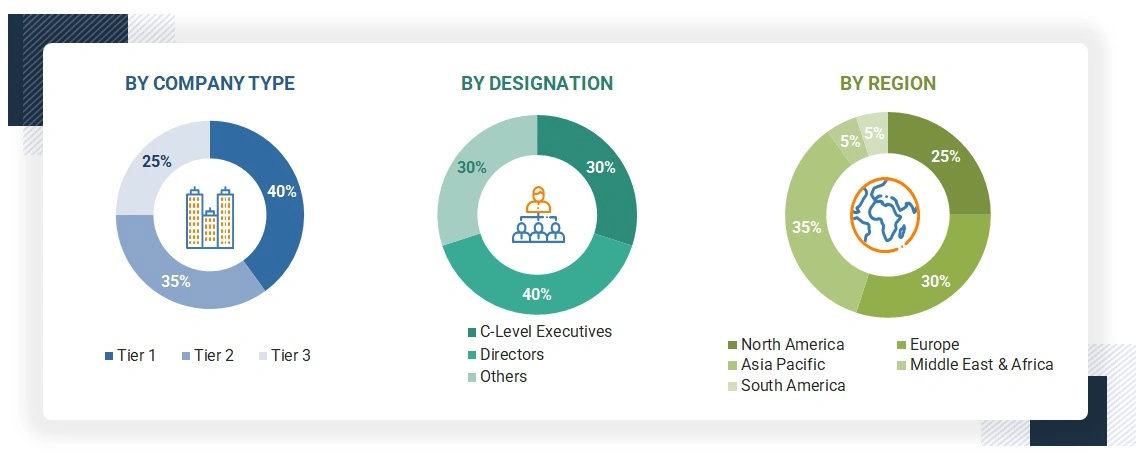
To know about the assumptions considered for the study, download the pdf brochure
Market Size Estimation
The top-down and bottom-up approaches have been used to estimate and validate the total size of the Vacuum evaporators market. These methods have also been widely applied to determine the size of various related market subsegments. The research methodology used to estimate the market size included the following:
The following segments provide details about the overall market size estimation process employed in this study:
- The key players in the market were identified through secondary research.
- The market shares in the relevant regions were determined through both primary and secondary research.
- The value chain and market size of the Vacuum evaporators market, in terms of both value and volume, were established through primary and secondary research.
- All percentage shares, splits, and breakdowns were determined using secondary sources and verified through primary sources.
- All parameters that could influence the market, covered in this study, were examined thoroughly, verified through primary research, and analyzed to produce the final quantitative and qualitative data.
- The research included studying the annual and financial reports of the top market players and interviewing industry experts, such as CEOs, VPs, directors, sales managers, and marketing executives, for key quantitative and qualitative insights.
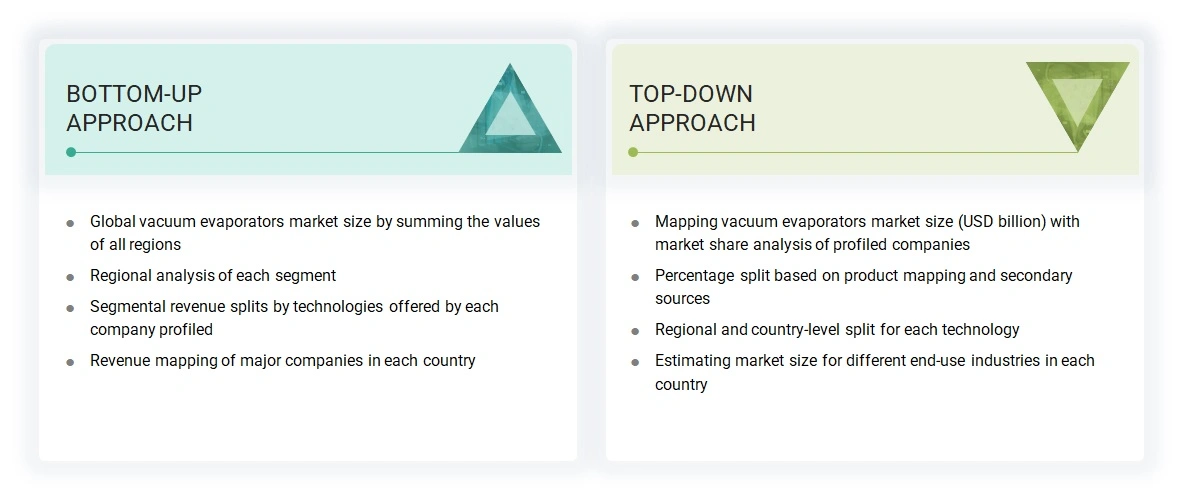
Data Triangulation
The market was divided into several segments and sub-segments after determining the overall market size using the estimation methods described above. Data triangulation and market breakdown techniques were used wherever applicable to complete the overall market analysis and obtain precise statistics for each segment and subsegment. The data was triangulated by examining various factors and trends from both the demand and supply sides.
Market Definition
Vacuum evaporation is a competitive and efficient method used to treat aqueous effluents. The method is chosen when traditional wastewater treatment approaches are ineffective or impractical. Vacuum evaporators are among the most effective technologies for reducing and treating industrial wastewater. They are clean, safe, versatile, and have extremely low management costs. They are often a key component of zero liquid discharge systems.
The Vacuum evaporator converts wastewater into two streams: concentrated waste and high-quality water. It operates under a Vacuum, lowering the liquid effluent’s boiling point, saving energy, and boosting efficiency. There are different types of Vacuum evaporators, such as thermal Vacuum evaporators, heat pump Vacuum evaporators, and mechanical vapor recompression Vacuum evaporators. Key applications include wastewater treatment, product processing, and electroplating. Due to their various uses across different regions, Vacuum evaporators are known by different names, including Vacuum concentrators, water evaporators, Vacuum distillers, and industrial evaporators.
Stakeholders
- Raw material manufacturers
- Technology support providers<
- Manufacturers of Vacuum evaporators
- Traders, distributors, and suppliers
- Regulatory bodies and government agencies
- Research & development (R&D) institutions
- End-use industries
- Consulting firms, trade associations, and industry bodies
- Investment banks and private equity firms
Report Objectives
- To analyze and forecast the market size of the Vacuum evaporators market in terms of value and volume
- To provide detailed information regarding the major factors (drivers, restraints, challenges, and opportunities) influencing the regional market
- To analyze and forecast the global Vacuum evaporators market based on technology, application, capacity, installation type, end-use industry, and region
- To analyze the opportunities in the market for stakeholders and provide details of a competitive landscape for market leaders
- To forecast the size of various market segments based on five major regions: Asia Pacific, Europe, North America, South America, and Middle East & Africa, along with their respective key countries
- To track and analyze the competitive developments, such as acquisitions, partnerships, collaborations, agreements, and expansions in the market
- To strategically profile the key players and comprehensively analyze their market shares and core competencies
Available customizations:
With the given market data, MarketsandMarkets offers customizations according to the client-specific needs.
The following customization options are available for the report:
- Additional country-level analysis of the Vacuum evaporators market
- Profiling of additional market players (up to 5)
Product Analysis
- Product matrix, which gives a detailed comparison of the product portfolio of each company.
Get the Full Vacuum Evaporators Market Report
Full forecast, segment splits, and company analysis for all Vacuum Evaporators Market.
- Japan Vacuum Evaporators Market
- India Vacuum Evaporators Market
- Malaysia Vacuum Evaporators Market
- Canada Vacuum Evaporators Market
- Mexico Vacuum Evaporators Market
- US Vacuum Evaporators Market
- Germany Vacuum Evaporators Market
- UK Vacuum Evaporators Market
- Russia Vacuum Evaporators Market
- France Vacuum Evaporators Market
- Italy Vacuum Evaporators Market
- Spain Vacuum Evaporators Market
- Saudi Arabia Vacuum Evaporators Market
- UAE Vacuum Evaporators Market
- Qatar Vacuum Evaporators Market
- Israel Vacuum Evaporators Market
- South Africa Vacuum Evaporators Market
- Argentina Vacuum Evaporators Market
- Brazil Vacuum Evaporators Market
- Chile Vacuum Evaporators Market
- Rest Of Europe Vacuum Evaporators Market
- Rest Of Asia Pacific Vacuum Evaporators Market
- Rest Of GCC Countries Vacuum Evaporators Market
- Rest Of South America Vacuum Evaporators Market
- China Vacuum Evaporators Market
- South Korea Vacuum Evaporators Market
Need a Tailored Report?
Customize this report to your needs
Get 10% FREE Customization
Customize This Report
