
Middle East VSAT Market (2025-2030)

The Middle East VSAT Market was valued at $996.2 Million in 2025 and projected to reach to $1292.4 Million by 2030, representing a compound annual growth rate of 5.3%. The Middle East VSAT market is positioned for sustained growth driven by regional geopolitical dynamics and substantial defence spending.


| Market Size in | USD 26.32 MN |
| Market Forecast in | |
| CAGR | |
| Forecast Period | |
| Units Considered | Value (USD MN) |
Middle East VSAT Market Trends and Insights
- The Middle East's strategic geopolitical position and expanding defence infrastructure investments are driving demand for satellite communication solutions across military and commercial aerospace applications.
- The Middle East continues to modernize its communication networks to support critical defence operations and remote connectivity requirements. Growth in the Middle East VSAT market is underpinned by increased government spending on defence modernization, rising adoption of satellite-based communication systems for border security and maritime surveillance, and expanding commercial aviation connectivity needs.
- The Middle East's focus on digital transformation and secure communication channels is accelerating VSAT deployment across both public and private sectors.
- By 2030, the Middle East is expected to solidify its position as a key regional hub for advanced satellite communication technologies..
Key Market Statistics
- CAGR (2025-2030) 5.3% CAGR
- Market Size, 2025 ~USD 996.2 Million
- Forecast, 2030 ~USD 1292.4 Million
- Geography Middle East
Middle East VSAT Market Overview
Strategic Geopolitical Advantage :
The Middle East's critical geographic position between Europe, Asia, and Africa drives substantial demand for VSAT connectivity in military operations, border surveillance, and secure communications across defence infrastructure.
Defence Infrastructure Expansion :
Increasing defence budgets and modernization initiatives across Saudi Arabia, UAE, and other regional nations are accelerating adoption of advanced satellite communication systems for aerospace and military applications.
Commercial Aerospace Growth :
Expanding commercial aviation sectors and airline operations throughout the Middle East require reliable VSAT solutions for in-flight connectivity, aircraft tracking, and operational communications.
5.3% CAGR Through 2030 :
The Middle East VSAT market is projected to grow from USD 996.2 million in 2025 to USD 1,292.4 million by 2030, demonstrating steady regional demand despite global market growth of 6.4%.
Middle East VSAT Market Dynamics
- Key markets including Saudi Arabia and the UAE are investing heavily in satellite communication infrastructure to support military modernization, border security operations, and secure government communications.
- The region's strategic importance in global aerospace and defence operations ensures continued demand for reliable, redundant satellite connectivity solutions. Commercial aerospace expansion, coupled with increasing airline operations and cargo services, further supports market growth.
- Regional governments are prioritizing indigenous satellite capabilities and partnerships with international providers to enhance operational resilience.
- As cyber threats and communication security concerns intensify, VSAT systems offering encrypted, secure channels will see accelerated adoption across both military and commercial sectors through 2030..
Market Ecosystem
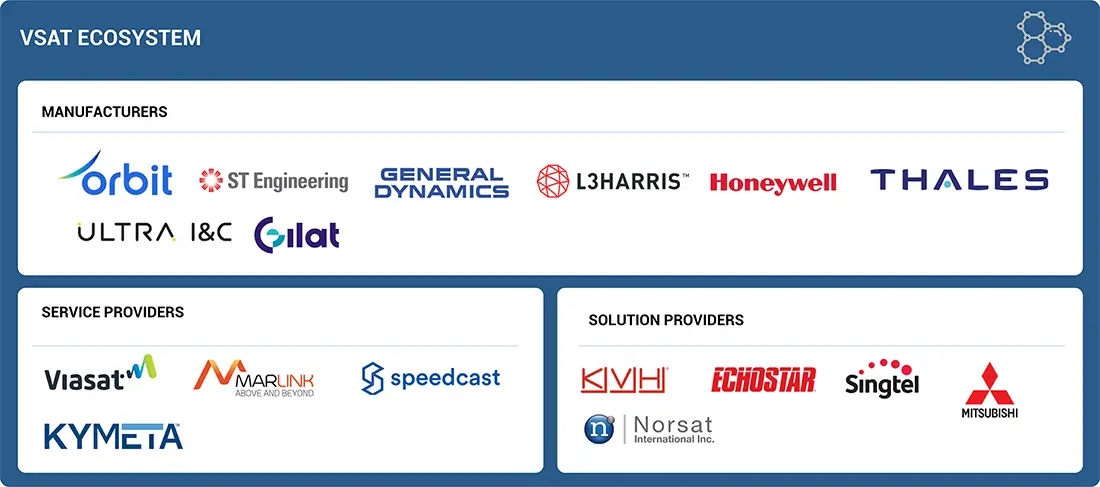
VSAT Market: COMMERCIAL USE CASES ACROSS INDUSTRIES
| COMPANY | USE CASE DESCRIPTION | BENEFITS |
|---|---|---|
 |
Ruggedized Tactical SATCOM terminals for defense | Enables secure, rapid-deployment, multi-band VSAT in contested environments |
 |
Peregrine u8 flat-panel maritime VSAT with OneWeb | Provides compact, high-speed, low-latency connectivity at sea |
 |
Metamaterial-based lightweight antennas | Reduces drag and fuel burn while ensuring resilient multi-band performance |
 |
VSAT platforms for broadband, mobility, and backhaul | Offers GEO/LEO compatibility and lowers deployment costs |
 |
JUPITER VSAT systems for enterprise and community | Expands broadband access in underserved regions with high capacity |
 |
O3b mPOWER VSAT-enabled constellation | Delivers fiber-like, low-latency connectivity for maritime, aviation, and government |
Logos and trademarks shown above are the property of their respective owners. Their use here is for informational and illustrative purposes only.
Related Ecosystem
Cns Systems
- C-Band
- Ka-Band
- Antennas
- Unmanned Ground Vehicles (UGV)
- Rotary Wing Aircraft
- L3Harris Technologies, Inc.
- Thales group
- HONEYWELL INTERNATIONAL INC.
- Northrop Grumman Corporation
- LOCKHEED MARTIN CORPORATION
Space
- C-Band
- Small Satellite
- Antennas
- Ka-Band
- Microsatellite
- AIRBUS
- L3Harris Technologies, Inc.
- Thales group
- Northrop Grumman Corporation
- LOCKHEED MARTIN CORPORATION
Key Takeaways
- The Middle East VSAT market is valued at USD 996.2 million in 2025 and will reach USD 1,292.4 million by 2030, growing at a 5.3% CAGR.
- Defence modernization and border security initiatives in the Middle East are primary drivers of VSAT adoption and market expansion.
- The Middle East's strategic location and increasing investment in secure satellite communications are attracting major aerospace and defence players.
- The Middle East market is expected to benefit from rising demand for remote connectivity and advanced communication infrastructure through 2030.
VSAT Market Report Scope
| Report Metric | Details |
|---|---|
| Base Year | 2025 |
| Fastest Growing Segment | UNMANNED AERIAL VEHICLES (Airborne Vsat) |
| Forecast Period | 2025–2030 |
| Growth Rate | CAGR of 6.4% from 2025 to 2030 |
| Largest Segment | STANDARD VSAT (Type) |
| Market Size Base Year (Billions) | ~USD 14.15 (2025) |
| Revenue Forecast (Billions) | ~USD 19.29 (2030) |
| Segments Covered | Type, Design, Frequency, Network, Solution, Equipment, Outdoor Units, Antennas, Support Services, Platform, Land Vsat, Fixed Segment, Mobile Segment, Maritime Vsat, Airborne Vsat, End Use, Application |
Middle East VSAT Market Report Segmentation
17 segment dimensions are covered across the global market.
By Type
- Standard Vsat
- Usat
By Design
- Non-Rugged Vsat
- Rugged Vsat
By Frequency
- C-Band
- Ka-Band
- Ku-Band
- L-Band
- Multiband
- S-Band
- X-Band
By Network
- Hybrid Topology
- Mesh Topology
- Point-To-Point Links
- Star Topology
By Solution
- Connectivity Services
- Equipment
- Support Services
By Equipment
- Antenna Control Units
- Indoor Units
- Mounts
- Outdoor Units
By Outdoor Units
- Amplifiers
- Antennas
- Block Upconverters
- Diplexers
- Low Noise Block Downconverters
By Antennas
- Electronically Scanned Array (Esa) Antennas
- Mechanically Augmented Phased Array (Mapa) Antennas
By Support Services
- Managed Services
- Professional Services
By Platform
- Airborne Vsat
- Airborne Vsat (Very Small Aperture Terminal)
- Land Vsat
- Land Vsat (Very Small Aperture Terminal)
- Maritime Vsat
- Maritime Vsat (Very Small Aperture Terminal)
By Land Vsat
- Fixed
- Mobile
- Portable/Manpacks
By Fixed Segment
- Command & Control Centers
- Commercial Buildings
- Earth Stations
By Mobile Segment
- Commercial Vehicles
- Emergency Vehicles
- High-Speed Trains
- Military Vehicles
- Unmanned Ground Vehicles
By Maritime Vsat
- Commercial Ships
- Military Ships
- Unmanned Marine Vehicles
By Airborne Vsat
- Commercial Aircraft
- Military Aircraft
- Unmanned Aerial Vehicles
By End Use
- Broadband/Data Network Services
- Broadcast
- Broadcast Services
- Private Network Services
- Voice Communications
- Voice Communications Services
By Application
- Agriculture & Forestry
- Automotive
- Aviation
- Bfsi
- Education
- Energy & Power
- Government & Defense
- Healthcare
- Manufacturing
- Maritime
- Media & Entertainment
- Mining & Construction
- Retail
- Telecommunications
- Transportation & Logistics
Target Audience
- Defence & Aerospace Manufacturers : Manufacturers require detailed Middle East market insights to develop region-specific VSAT solutions aligned with military modernization programs and aerospace platform requirements.
- Satellite Communication Providers : Service providers need comprehensive regional market data to identify growth opportunities, optimize network coverage, and develop competitive offerings for Middle Eastern defence and commercial customers.
- Government & Military Procurement : Regional defence ministries and military organizations use market intelligence to evaluate VSAT technologies, benchmark international solutions, and plan satellite communication infrastructure investments.
- Commercial Airlines & Operators : Airlines and aviation operators require market analysis to assess VSAT connectivity options for in-flight services, aircraft management, and operational communications across Middle Eastern airspace.
- Investment & Strategy Consultants : Consultants advising on Middle East aerospace and defence investments need regional VSAT market data to support due diligence, valuation models, and strategic recommendations for clients.
Key Companies in the Middle East VSAT Market
| Company | HQ | Ownership | Strongest segments |
|---|---|---|---|
| L3HARRIS TECHNOLOGIES INC. | United States | Public Company | End Use – Broadband,End Use – Voice Communication,End Use – Private Network, |
| VIASAT INC. | United States | Public Company | Broadband End Use (fixed and mobile),Government & Defense Applications,Aviation Applications (IFC and safety services), |
| GILAT SATELLITE NETWORKS LTD. | Israel | Public Company | Broadband End Use,Voice Communication End Use,Private Network End Use, |
| ECHOSTAR CORPORATION (US) | United States | ||
| COMTECH TELECOMMUNICATIONS CORPORATION | United States | Public Company | Broadband End Use (backhaul and enterprise access),Private Network End Use (government, defense, critical infrastructure),Voice Communication End Use, |
| KVH INDUSTRIES, INC. | United States | Public Company | Broadband (VSAT airtime and data services, including KVH ONE, AgilePlans, OpenNet),Voice Communication (VoIP and related services over VSAT),Private Network / Managed Services (CommBox, CommBox Edge, KVH Link, KVH OneCare), |
| GENERAL DYNAMICS CORPORATION | United States | Public Company | Government & Defense – Multi-band VSAT networks,Government & Defense – Standard VSAT (fixed and transportable),Maritime VSAT (naval and government fleets), |
| HONEYWELL INTERNATIONAL INC. | United States | Public Company | End Use – Broadband,End Use – Voice Communication,End Use – Private Network, |
| SINGTEL | Singapore | Public Company | Broadband VSAT (enterprise and remote site connectivity),Private Network VSAT (government & defense, critical infrastructure),Voice Communication VSAT, |
| MITSUBISHI ELECTRIC CORPORATION | Japan | Public Company | End Use – Broadband,End Use – Private Network,End Use – Voice Communication, |
| ULTRA ELECTRONICS | United Kingdom | Private Company | End Use - Government & Defense Private Networks,End Use - Government & Defense Voice/Data Communications,Application - Maritime, |
| SATIXFY COMMUNICATIONS LTD | Israel | Private Company | Broadband End Use (fixed & mobility),Government & Defense Applications,Aviation / Aero IFC, |
L3HARRIS TECHNOLOGIES INC.
L3Harris Technologies Inc. is a major U.S. public company founded in 1895 with 45,000 employees, operating across defense, aerospace, and technology sectors.
VIASAT INC.
ViaSat Inc. is a U.S. public company founded in 1986 with 7,000 employees, providing satellite communications and networking solutions.
GILAT SATELLITE NETWORKS LTD.
Gilat Satellite Networks Ltd. is an Israeli public company founded in 1987 with 1,159 employees, specializing in satellite-based broadband and communications technology.
ECHOSTAR CORPORATION (US)
EchoStar Corporation is a U.S.-based company operating in the satellite communications and digital television industry.
COMTECH TELECOMMUNICATIONS CORPORATION
Comtech Telecommunications Corporation is a U.S. public company founded in 1967 with 1,282 employees, providing telecommunications and technology solutions.
KVH INDUSTRIES, INC.
KVH Industries, Inc. is a U.S. public company founded in 1982 with 272 employees, providing mobile connectivity and navigation solutions.
GENERAL DYNAMICS CORPORATION
General Dynamics Corporation is a major U.S. public company founded in 1899 with 117,000 employees, operating in aerospace, defense, and technology sectors.
HONEYWELL INTERNATIONAL INC.
Honeywell International Inc. is a U.S. public company founded in 1885 with 101,000 employees, providing diversified technology and manufacturing solutions.
SINGTEL
Singtel is a Singapore-based public company founded in 1992 with 24,233 employees, operating as a major telecommunications and digital services provider.
MITSUBISHI ELECTRIC CORPORATION
Mitsubishi Electric Corporation is a Japanese public company founded in 1921 with 150,386 employees, manufacturing electronics, industrial systems, and technology products.
ULTRA ELECTRONICS
Ultra Electronics is a United Kingdom-based private company founded in 1920 with 4,531 employees, specializing in defense and aerospace technology.
SATIXFY COMMUNICATIONS LTD
Satixfy Communications Ltd. is an Israeli private company founded in 2012 with 162 employees, developing satellite communications technology and solutions.
Countries within Middle East - compare and drill down
| Country | 2025 size (native) |
|---|---|
| Saudi Arabia | USD 665.4 Million |
| UAE | USD 324.8 Million |
| Rest Of Middle East | USD 302.2 Million |
Country market size visualization
Reasons to Buy this Report
- Regional Market Sizing & Forecasts : Obtain precise market valuations for the Middle East VSAT sector with detailed 2025-2030 projections, enabling accurate budget allocation and investment planning specific to regional growth trajectories.
- Defence Spending Intelligence : Understand how Middle Eastern defence modernization initiatives and military infrastructure investments directly influence VSAT adoption rates, competitive dynamics, and technology requirements across the region.
- Country-Level Market Breakdown : Access granular market data for Saudi Arabia, UAE, and other key Middle Eastern nations, identifying high-opportunity markets and tailoring go-to-market strategies for specific regional players.
- Competitive Landscape Analysis : Benchmark your VSAT solutions against regional competitors and global providers operating in the Middle East, understanding market positioning, pricing strategies, and customer preferences.
- Strategic Growth Opportunities : Identify emerging segments within commercial aviation, government communications, and border security where VSAT demand is accelerating, supporting product development and partnership strategies.
Frequently asked questions
What is the current size of the Middle East VSAT market?
The Middle East VSAT market is estimated at USD 996.2 million in 2025.
What is the projected size of the Middle East VSAT market by 2030?
The Middle East VSAT market is forecast to reach USD 1,292.4 million by 2030.
What is the CAGR for the Middle East VSAT market?
The Middle East VSAT market is expected to grow at a compound annual growth rate (CAGR) of 5.3% from 2025 to 2030.
What are the main drivers of growth in the Middle East VSAT market?
Key drivers include defence modernization, border security initiatives, maritime surveillance requirements, and increased investment in secure satellite communication infrastructure across the Middle East.
Which sectors are driving VSAT demand in the Middle East?
The Middle East VSAT market is primarily driven by military and defence applications, commercial aviation connectivity, government communications, and critical infrastructure security.
RESEARCH METHODOLOGY
This research study involved the use of extensive secondary sources, directories, and databases (e.g., Hoovers, Bloomberg Business, Factiva, and OneSource) to identify and collect information useful for this technical, market-oriented, and commercial study of the VSAT (Very Small Aperture Terminal) market. Primary sources included several industry experts from the core and related industries and preferred suppliers, manufacturers, distributors, technology developers, IP vendors, standards, and organizations related to all the segments of this industry’s value chain. In-depth interviews were conducted with various primary respondents, including key industry participants, subject matter experts (SMEs), C-level executives of key market players, and industry consultants to obtain and verify critical qualitative and quantitative information, as well as to assess the prospects.
Secondary Research
In the secondary research process, various secondary sources were referred to for identifying and collecting information for this study. The secondary sources included annual reports, press releases, and investor presentations of companies; white papers, journals, certified publications, and articles from recognized authors; and websites, directories, and databases. Secondary research was used to obtain key information about the industry’s supply chain, the market’s value chain, major players, market classification, and segmentation according to the industry trends to the bottommost level, geographic markets, and key developments from both market- and technology-oriented perspectives. The secondary data was collected and analyzed to arrive at the overall market size, which has further been validated by primary research.
Primary Research
Extensive primary research was conducted after obtaining information about the current scenario of the VSAT market through secondary research. Several primary interviews were conducted with market experts from the demand and supply sides across North America, Europe, Asia Pacific, the Middle East, Latin America, and Africa. This primary data was collected through questionnaires, emails, and telephonic interviews.
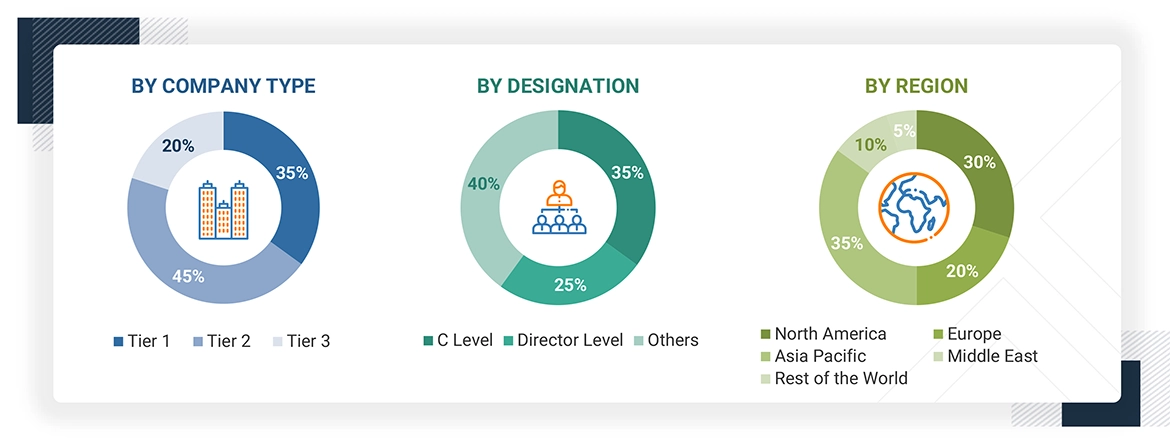
Note: Tiers of companies are based on their revenue in 2024. Tier 1: company revenue greater than USD 1 billion; Tier 2: company revenue between USD 100 million and USD 1 billion; and Tier 3: company revenue less than USD 100 million.
To know about the assumptions considered for the study, download the pdf brochure
Market Size Estimation
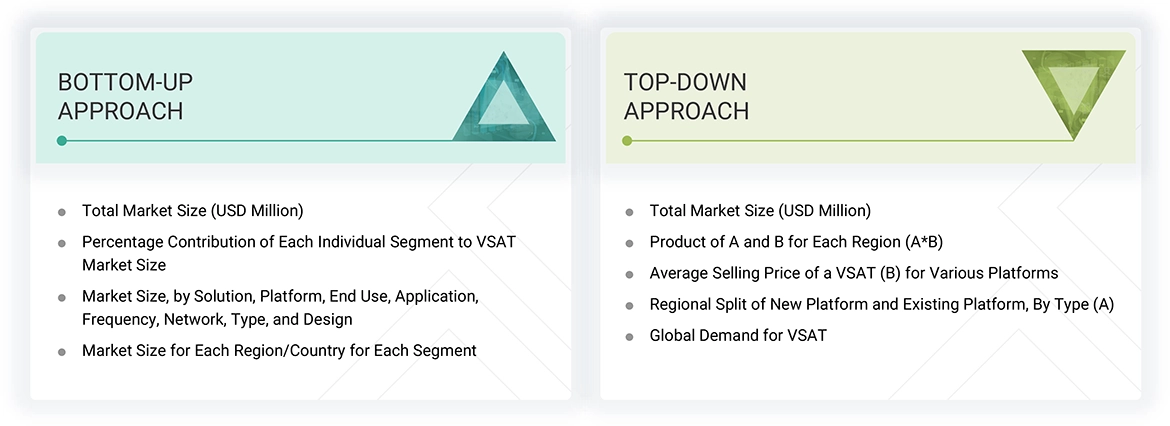
Both the top-down and bottom-up approaches were used to estimate and validate the size of the VSAT market. The research methodology used to estimate the market size also includes the following details:
- Key players in the market were identified through secondary research, and their market ranking was determined through primary and secondary research. This included a study of annual and financial reports of the top market players and extensive interviews with industry experts who are knowledgeable about VSAT.
- The top-down and bottom-up approaches were used to estimate and validate the size of the global market and the dependent submarkets in the overall market.
VSAT Market : Top-Down and Bottom-Up Approach
Data Triangulation
After arriving at the overall size of the VSAT market from the estimation process explained above, the total market was split into several segments and subsegments. The data triangulation and market breakdown procedures explained below were implemented, wherever applicable, to complete the overall market engineering process and arrive at the exact statistics for various market segments and subsegments. The data was triangulated by studying various factors and trends from the demand and supply sides. Along with this, the VSAT market size was validated using the top-down and bottom-up approaches.
Market Definition
A VSAT (very small aperture terminal) is a two-way satellite ground station that uses antennas smaller than 3 meters. VSATs access high-throughput satellites (HTS), geosynchronous orbit (GEO) satellites, and low Earth orbit (LEO) and medium Earth orbit (MEO) satellites to relay data to other VSATs across the globe, transfer data from one Earth station to another, or access the internet. VSATs are also used for on-the-move (utilizing phased array antennas) or mobile maritime communications.
Key Stakeholders
- VSAT Service Providers
- VSAT Solution Providers
- VSAT Manufacturers
- Defense Procurement Agencies
- Regulatory Bodies
- R&D Companies
- System/Component Manufacturers
- System Integrators
Report Objectives
- To define, describe, segment, and forecast the size of the VSAT (Very Small Aperture Terminal) market based on solution, platform, end-use, application, frequency, network, type, design, and region
- To forecast sizes of various segments of the market with respect to four major regions: North America, Europe, Asia Pacific, the Middle East, and the Rest of the World, along with major countries in each of these regions
- To identify and analyze key drivers, restraints, opportunities, and challenges influencing the growth of the market across the globe
- To identify industry trends, market trends, and technology trends that are currently prevailing in the market
- To provide an overview of the regulatory landscape with respect to VSAT (regulations across regions
- To analyze micromarkets with respect to individual growth trends, prospects, and their contribution to the overall market
- To analyze opportunities in the market for stakeholders by identifying key market trends
- To profile key market players and comprehensively analyze their market shares and core competencies
- To analyze the degree of competition in the market by identifying key growth strategies, such as acquisitions, product launches, contracts, and partnerships, adopted by leading market players
- To identify detailed financial positions, key products, and unique selling points of leading companies in the market
- To provide a detailed competitive landscape of the market, along with market ranking analysis, market share analysis, and revenue analysis of key players
Available customizations:
Along with the market data, MarketsandMarkets offers customizations to meet the specific needs of companies. The following customization options are available for the report:
Product Analysis
- Product matrix, which gives a detailed comparison of the product portfolio of each company
Regional Analysis
- Further breakdown of the market segments at the country level
Company Information
- Detailed analysis and profiling of additional market players (up to 5)
Get the Full VSAT Market Report
Full forecast, segment splits, and company analysis for all VSAT Market.
- Canada VSAT Market
- US VSAT Market
- UK VSAT Market
- France VSAT Market
- Germany VSAT Market
- China VSAT Market
- India VSAT Market
- Japan VSAT Market
- South Korea VSAT Market
- Brazil VSAT Market
- Mexico VSAT Market
- Saudi Arabia VSAT Market
- UAE VSAT Market
- South Africa VSAT Market
- Nigeria VSAT Market
- Rest Of Europe VSAT Market
- Rest Of Asia Pacific VSAT Market
- Rest Of Latin America VSAT Market
- Rest Of Middle East VSAT Market
- Rest Of Africa VSAT Market
Need a Tailored Report?
Customize this report to your needs
Get 10% FREE Customization
Customize This Report
