
Japan Veterinary Implants Devices Market (2026-2031)

The Japan Veterinary Implants Devices Market was valued at $10.27 Million in 2026 and projected to reach to $13.86 Million by 2031, representing a compound annual growth rate of 6.2%. Japan's veterinary implants devices market is poised for robust expansion through 2031, driven by rising pet ownership, increasing pet healthcare spending, and a growing geriatric animal population requiring advanced surgical interventions.


| Market Size in | USD 26.32 MN |
| Market Forecast in | |
| CAGR | |
| Forecast Period | |
| Units Considered | Value (USD MN) |
Japan Veterinary Implants Devices Market Trends and Insights
- Japan's advanced veterinary healthcare infrastructure and rising pet ownership drive demand for orthopedic and dental implants across companion and production animals.
- Japan's aging pet population and increased willingness of pet owners to invest in surgical interventions support market expansion through 2031. The Japanese market benefits from strong regulatory frameworks and established veterinary medical standards that facilitate adoption of implant technologies.
- Japan's focus on animal welfare and premium pet care services creates a favorable environment for high-value implant procedures.
- Between 2026 and 2031, Japan is expected to see sustained growth driven by technological innovation and expanding veterinary surgical capabilities across urban and rural regions..
Key Market Statistics
- CAGR (2026-2031) 6.2% CAGR
- Market Size, 2026 ~USD 10.27 Million
- Forecast, 2031 ~USD 13.86 Million
- Country Japan
Japan Veterinary Implants Devices Market Overview
Market Valuation :
Japan's veterinary implants devices market is valued at USD 10.27 million in 2026 and is projected to reach USD 13.86 million by 2031, demonstrating steady growth in the region's pet healthcare sector.
Strong Growth Trajectory :
With a CAGR of 6.2% from 2026 to 2031, Japan's market growth outpaces the global average of 5.7%, reflecting increasing investment in advanced veterinary care and pet wellness.
Advanced Healthcare Infrastructure :
Japan's sophisticated veterinary healthcare system and high pet ownership rates drive demand for premium orthopedic and dental implants, positioning the country as a key market for innovative implant solutions.
Aging Pet Population Dynamics :
Japan's growing elderly pet demographic creates sustained demand for joint replacement, spinal implants, and dental restoration procedures, supporting long-term market expansion.
Japan Veterinary Implants Devices Market Dynamics
- The country's well-established veterinary infrastructure and consumer willingness to invest in premium pet care create favorable conditions for orthopedic and dental implant adoption.
- Additionally, technological advancements in minimally invasive implant procedures and growing awareness of companion animal health are expected to accelerate market penetration across urban and suburban regions..
Market Ecosystem

VETERINARY IMPLANT DEVICES MARKET: COMMERCIAL USE CASES ACROSS INDUSTRIES
| COMPANY | USE CASE DESCRIPTION | BENEFITS |
|---|---|---|
 |
Enables controlled delivery of growth-promoting hormones through veterinary cattle implants, including the Synovex portfolio, across different stages of beef production | Supports improved weight gain, feed efficiency, and production performance through sustained implant-based hormone delivery |
 |
Provides sustained-release veterinary implants, including Suprelorin, for controlled hormonal and reproductive management in dogs and ferrets | Enables reversible and long-duration reproductive management while reducing the need for repeated treatments or surgical intervention |
 |
Develops veterinary orthopedic implant systems, including total hip replacement, knee, elbow, and fracture fixation systems, designed for companion-animal orthopedic procedures | Improves joint reconstruction, skeletal stabilization, and mobility in dogs and other companion animals while supporting treatment of complex orthopedic conditions |
 |
Develops growth-promoting implant technologies, including Revalor implants, for controlled hormone delivery in beef cattle | Improves cattle growth and feed efficiency while supporting production-performance management across different livestock production stages |
 |
Develops veterinary orthopedic implant systems, including plates, screws, fracture-fixation systems, and TPLO/TTA solutions for companion animals | IImproves cattle growth and feed efficiency while supporting production-performance management across different livestock production stages |
Logos and trademarks shown above are the property of their respective owners. Their use here is for informational and illustrative purposes only.
Related Ecosystem
Animal Health
- Polymerase Chain Reaction (PCR) Tests
- Porcine
- Immunodiagnostics
- Lateral Flow Assays
- Microarrays
- Virbac
- Zoetis Inc.
- Patterson Companies, Inc.
- Elanco Animal Health Incorporated
- Merck & Co., Inc.
Key Takeaways
- Japan's veterinary implants devices market reaches USD 10.27 million in 2026 with projected growth to USD 13.86 million by 2031.
- Japan demonstrates a 6.2% CAGR, outpacing the global average of 5.7%, reflecting strong regional demand.
- Japan's advanced veterinary infrastructure and high pet ownership rates drive adoption of orthopedic and dental implants.
- Japan's regulatory environment and premium pet care culture support sustained market expansion through 2031.
Veterinary Implants Devices Market Report Scope
| Report Metric | Details |
|---|---|
| Base Year | 2026 |
| Fastest Growing Segment | ASIA PACIFIC (Volume) |
| Forecast Period | 2026-2030 |
| Growth Rate | CAGR of 5.7% from 2026 to 2030 |
| Largest Segment | NORTH AMERICA (Volume) |
| Market Size Base Year (Billions) | ~USD 0.74 (2026) |
| Revenue Forecast (Billions) | ~USD 0.93 (2030) |
| Segments Covered | Implant Device, Type, Animal Type, Application, End User, Volume, Implant Device By Volume |
Japan Veterinary Implants Devices Market Report Segmentation
7 segment dimensions are covered across the global market.
By Implant Device
- Active Electronic Implants
- Cardiovascular & Interventional Implants
- Monitoring, Sensing, And Diagnostic Implants
- Orthopedic & Skeletal Implants
- Other Implant Devices
- Therapeutic & Drug Delivery Implants
- Urinary & Soft Tissue Implants
By Type
- Activity & Motion Sensing Implants
- Artificial Urethral Sphincter Systems
- Cardiac Rhythm Management Implants
- Cats
- Cattle (Dairy & Beef)
- Dogs
- Fracture Fixation Plates, Screws, And Pins
- Growth-Promotant & Production Performance Implants
- High-Value Breeding Camels
- Implantable Biosensors & Diagnostic Implants
- Implantable Drug Delivery Devices
- Intraruminal Boluses (Indwelling Monitoring Devices)
- Joint Replacement Systems
- Neurostimulation Implants
- Occluders & Closure Devices
- Other Active Electronic Implants
- Other Cardiovascular & Interventional Implants
- Other Companion Animals
- Other Livestock
- Other Monitoring & Sensing Implants
- Other Orthopedic & Skeletal Implants
- Other Therapeutic & Drug Delivery Implants
- Other Urinary & Soft Tissue Implants
- Pain Management Implants
- Racehorses
- Racing Camels
- Reproductive & Fertility Management Implants
- Sheep & Goats
- Sport & Competition Horses
- Stents
- Subcutaneous Ureteral Bypass Systems
- Swine
- Temperature Monitoring Implants
- Tplo & Tta Implants
- Transcatheter Valve Repair Devices
- Vital Sign Monitoring Implants
- Working Dogs
By Animal Type
- Companion Animals
- Livestock Animals
- Other Animals
- Performance & Sport Animals
- Research Animals
- Wildlife & Conservation Animals
- Zoo Animals
By Application
- Activity, Behavior, And Performance Monitoring
- Cardiovascular & Interventional Treatment
- Health & Wellness Monitoring
- Orthopedic & Fracture Repair
- Other Applications
- Production Performance Enhancement
- Treatment, Drug Delivery, And Reproductive Management
By End User
- Livestock Farms & Production Operations
- Other End Users
- Pharmaceutical & Biotechnology Companies And Cros
- Veterinary Clinics & Hospitals
- Veterinary Research Institutes & Academic Institutions
- Wildlife & Conservation Organizations
By Volume
- Cardiac Rhythm Management Implants
- Growth-Promotant Implants
- Vital Sign Monitoring Implants
By Implant Device By Volume
- Cardiac Rhythm Management Implants
- Growth-Promotant Implants
- Vital Sign Monitoring Implants
Target Audience
- Veterinary Device Manufacturers : Manufacturers need Japan-specific market data to develop localized product portfolios, understand regulatory requirements, and identify distribution channels for orthopedic and dental implants in this high-value market.
- Private Equity & Investment Firms : Investors require detailed Japan market analysis to evaluate acquisition targets, assess growth potential, and make informed capital allocation decisions in the veterinary healthcare sector.
- Veterinary Clinic Operators : Clinic owners and managers need market insights to guide implant procurement decisions, understand patient demand trends, and plan service expansion in Japan's competitive pet healthcare landscape.
- Healthcare Consultants & Advisors : Consultants advising veterinary businesses require Japan-specific market intelligence to develop strategic recommendations, competitive positioning strategies, and market entry plans for regional clients.
- Regulatory & Compliance Professionals : Regulatory specialists need Japan market data to understand device approval pathways, compliance requirements, and market access strategies specific to Japanese veterinary implant regulations.
Reasons to Buy this Report
- Market-Specific Sizing & Forecasts : Access precise valuation data for Japan's veterinary implants market with detailed projections through 2031, enabling accurate budgeting and revenue forecasting for regional expansion strategies.
- Competitive Landscape Intelligence : Understand Japan-specific market dynamics, key players, and competitive positioning to identify partnership opportunities and market entry strategies tailored to the Japanese veterinary sector.
- Growth Driver Analysis : Gain insights into Japan's unique market drivers including aging pet demographics, rising pet healthcare spending, and advanced veterinary infrastructure to capitalize on emerging opportunities.
- Segment Performance Breakdown : Analyze orthopedic and dental implant segments specific to Japan's companion and production animal markets, identifying high-growth categories for targeted product development and marketing.
- Strategic Decision Support : Leverage Japan-focused market intelligence to support investment decisions, product launches, and go-to-market strategies with confidence in regional demand and growth potential.
Frequently asked questions
What is the market size of veterinary implants devices in Japan in 2026?
Japan's veterinary implants devices market is valued at USD 10.27 million in 2026.
What is the projected market size for Japan by 2031?
Japan's veterinary implants devices market is projected to reach USD 13.86 million by 2031.
What is the CAGR for Japan's veterinary implants devices market?
Japan's market is expected to grow at a compound annual growth rate of 6.2% from 2026 to 2031.
What factors drive growth in Japan's veterinary implants market?
Japan's growth is driven by advanced veterinary infrastructure, rising pet ownership, aging pet populations, and strong regulatory frameworks supporting implant adoption.
How does Japan's market growth compare to global trends?
Japan's 6.2% CAGR exceeds the global average of 5.7%, indicating stronger regional market momentum and demand for veterinary implant devices.
RESEARCH METHODOLOGY
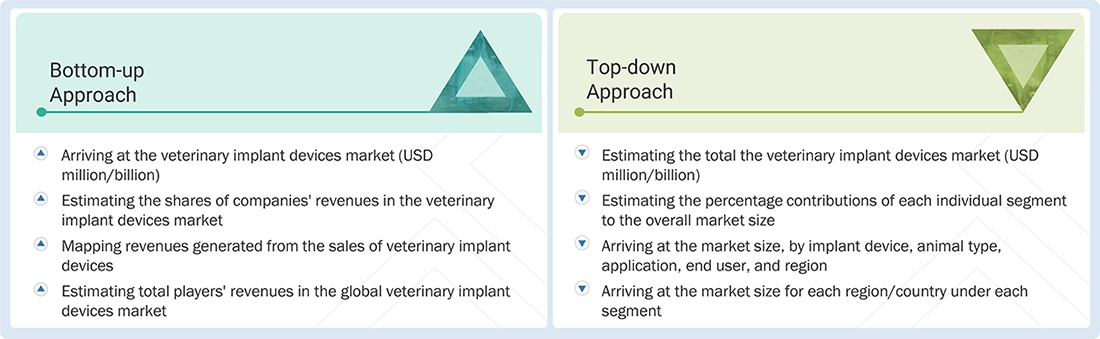
This study involved four major activities in estimating the size of the veterinary implant devices market. Exhaustive secondary research was done to collect information on the market, peer market, and parent market. The next step was to validate these findings, assumptions, and sizing with industry experts across value chains through primary research. The bottom-up approach was employed to estimate the overall market size. After that, market breakdown and data triangulation were used to estimate the market size of segments and sub-segments.
Secondary Research
The secondary research process involved the widespread use of secondary sources, directories, databases (Bloomberg Businessweek, Factiva, and D&B Hoovers), white papers, annual reports, company house documents, investor presentations, and SEC filings of companies. Secondary research was used to identify and collect information useful for the extensive, technical, market-oriented, and commercial study of the veterinary implant devices market. It was also used to obtain important information about the key players and market classification and segmentation according to industry trends to the bottom-most level, and key developments related to market and technology perspectives. A database of the key industry leaders was also prepared using secondary research.
Primary Research
In the primary research process, various sources from the supply and demand sides were interviewed to obtain qualitative and quantitative information for this report. The primary sources from the supply side include industry experts such as CEOs, vice presidents, marketing and sales directors, product managers, R&D and regulatory affairs heads, and business development managers from companies manufacturing veterinary orthopedic, cardiovascular, drug delivery, and monitoring implants, as well as distributors of veterinary surgical products. The primary sources from the demand side include board-certified veterinary surgeons, veterinary cardiologists, hospital and practice owners, procurement and purchase managers of veterinary hospital groups, livestock veterinarians and farm managers, researchers at veterinary schools and contract research organizations, and wildlife and zoo veterinarians. Primary research was conducted to validate the market segmentation, identify key players in the market, and gather insights on key industry trends and key market dynamics.
A breakdown of the primary respondents is provided below:
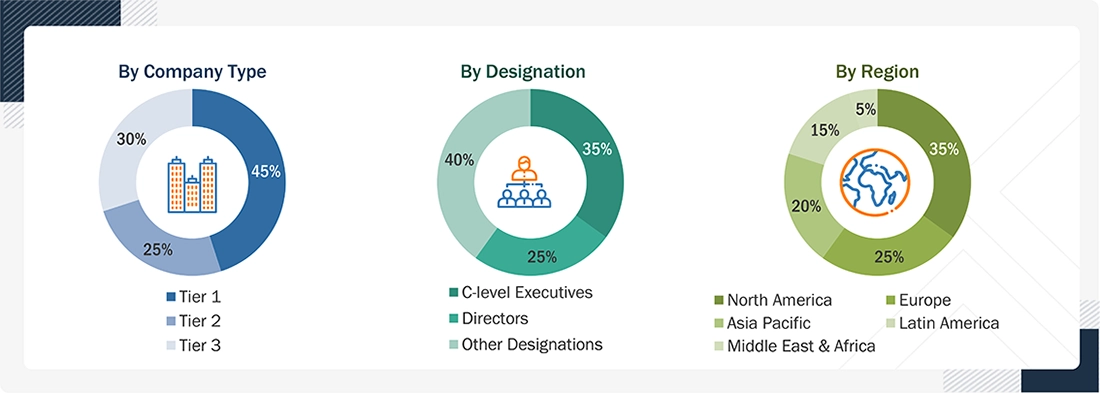
*C-level primaries include CEOs, CFOs, COOs, and VPs.
*Other designations include sales managers, marketing managers, business development managers, product managers, distributors, and suppliers.
Note: Companies are classified into tiers based on their total revenue. As of 2025, Tier 1 = >USD 10.00 billion, Tier 2 = USD 1.00 billion to USD 10.00 billion, and Tier 3 = <USD 1.00 billion.
Source: MarketsandMarkets Analysis
To know about the assumptions considered for the study, download the pdf brochure
Market Size Estimation
The research methodology used to estimate the size of the veterinary implant devices market includes the following details.
The market sizing was undertaken from the global side.
Country-level Analysis: The size of the veterinary implant devices market was obtained from the annual presentations of leading players and secondary data available in the public domain. The share of implant devices in the overall veterinary medical devices market was obtained from secondary data and validated by primary participants to arrive at the total market. Primary participants further validated the numbers.
Geographic Market Assessment (By Region and Country): The geographic assessment was done using the following approaches:
Approach 1: Geographic revenue contributions/splits of leading players in the market (wherever available) and respective growth trends
Approach 2: Geographic adoption trends for individual implant device segments by end user and growth prospects for each of the segments (assumptions and indicative estimates validated from primary interviews)
At each point, the assumptions and approaches were validated through industry experts contacted during primary research. Considering the limitations of data available from secondary research, revenue estimates for individual companies (for the overall veterinary implant devices market and geographic market assessment) were ascertained based on a detailed analysis of their respective product offerings, geographic reach/strength (direct or through distributors or suppliers), and the shares of the leading players in a particular region or country.
The above-mentioned data was consolidated and added with detailed input and analysis from MarketsandMarkets and presented in this report.
Veterinary Implant Devices Market: Top-Down and Bottom-Up Approach
Data Triangulation
After arriving at the overall size of the global veterinary implant devices market through the above-mentioned methodology, this market was split into several segments and subsegments. The data triangulation and market breakdown procedures were employed, wherever applicable, to complete the overall market engineering process and arrive at the exact market value data for the key segments and subsegments. The extrapolated market data was triangulated by studying various macro indicators and regional trends from both demand- and supply-side participants.
Market Definition
Veterinary implant devices are medical devices placed fully or partially inside an animal's body, surgically, by injection, or orally in the case of intraruminal boluses, and left in place to repair or replace anatomical structures, support organ function, deliver drugs or hormones over time, or monitor physiological and behavioral parameters.
Key Stakeholders
- Veterinary implant device manufacturers and suppliers
- Animal health pharmaceutical companies
- Veterinarians and veterinary surgeons
- Livestock farms, feedlots, and dairy production operators
- Contract research organizations and biotechnology companies
- Veterinary research institutes and academic institutions
- Wildlife and conservation organizations, zoos, and aquarium personnel
- Regulatory bodies
- Government animal health agencies
- Venture capitalists and investors
- Market research and consulting firms
- Corporate entities
Report Objectives
- To describe, analyze, and forecast the veterinary implant devices market, by implant device, application, animal type, end user, and region, in terms of value
- To forecast the market size, by implant device, in terms of value
- To describe and forecast the veterinary implant devices market in key regions, namely North America, Europe, Asia Pacific, Latin America, and the Middle East and Africa, in terms of value
- To provide detailed information regarding drivers, restraints, opportunities, and challenges influencing the market growth
- To strategically analyze micromarkets with respect to individual growth trends, prospects, and contributions to the overall market
- To analyze market opportunities for stakeholders and provide details of the competitive landscape for market players
- To profile key players and comprehensively analyze their market shares and core competencies in the market
- To analyze competitive developments, such as partnerships, collaborations, agreements, acquisitions, product launches, expansions, and research and development activities, in the market
- To analyze the impact of AI and Gen AI on the market in terms of capabilities, potential applications, use cases, and future opportunities
Available customizations:
With the given market data, MarketsandMarkets offers customizations as per the company's specific needs. The following customization options are available for the report:
Geographic Analysis
- Further breakdown of the Rest of Europe veterinary implant devices market into the Netherlands, Switzerland, Russia, Poland, and other countries
- Further breakdown of the Rest of Asia Pacific veterinary implant devices market into Thailand, Vietnam, Indonesia, Taiwan, and other countries
- Further breakdown of the Rest of Latin America veterinary implant devices market into Colombia, Chile, Peru, and other countries
- Further breakdown of the Rest of Middle East & Africa veterinary implant devices market into Israel, Iran, Iraq, Jordan, and other countries
Company Information
- Detailed analysis and profiling of up to five additional market players
Product Analysis
-
Product matrix providing a detailed comparison of the implant device portfolios of the top five companies
Get the Full Veterinary Implants Devices Market Report
Full forecast, segment splits, and company analysis for all Veterinary Implants Devices Market.
- India Veterinary Implants Devices Market
- Australia Veterinary Implants Devices Market
- South Korea Veterinary Implants Devices Market
- Brazil Veterinary Implants Devices Market
- Mexico Veterinary Implants Devices Market
- UAE Veterinary Implants Devices Market
- Rest Of Europe Veterinary Implants Devices Market
- Rest Of Asia Pacific Veterinary Implants Devices Market
- Kingdom Of Saudi Arabia Veterinary Implants Devices Market
- Rest Of GCC Countries Veterinary Implants Devices Market
- Rest Of Latin America Veterinary Implants Devices Market
- Canada Veterinary Implants Devices Market
- US Veterinary Implants Devices Market
- Germany Veterinary Implants Devices Market
- UK Veterinary Implants Devices Market
- France Veterinary Implants Devices Market
- Italy Veterinary Implants Devices Market
- Spain Veterinary Implants Devices Market
- China Veterinary Implants Devices Market
Need a Tailored Report?
Customize this report to your needs
Get 10% FREE Customization
Customize This Report