
France Wastewater Surveillance Market (2025-2030)

The France Wastewater Surveillance Market was valued at $41.4 Million in 2025 and projected to reach to $55.3 Million by 2030, representing a compound annual growth rate of 6.0%. France's wastewater surveillance market is poised for steady expansion as the country strengthens its commitment to public health infrastructure and disease detection capabilities.


| Market Size in | USD 26.32 MN |
| Market Forecast in | |
| CAGR | |
| Forecast Period | |
| Units Considered | Value (USD MN) |
France Wastewater Surveillance Market Trends and Insights
- This growth reflects France's increasing investment in public health infrastructure and environmental monitoring capabilities.
- France is leveraging wastewater surveillance as a critical tool for disease detection and epidemiological tracking, particularly following heightened awareness from recent global health events. The French market benefits from strong regulatory frameworks and government support for water quality monitoring initiatives.
- France's commitment to the European Union's environmental directives and public health standards drives adoption of advanced wastewater surveillance technologies.
- Between 2025 and 2030, France is expected to expand its surveillance networks across major urban centers and treatment facilities, supporting both infectious disease monitoring and antimicrobial resistance tracking. France's healthcare sector continues to recognize wastewater surveillance as a cost-effective complement to traditional epidemiological methods.
- The market growth reflects increased collaboration between French public health agencies, water utilities, and research institutions to implement comprehensive surveillance systems..
Key Market Statistics
- CAGR (2025-2030) 6.0% CAGR
- Market Size, 2025 ~USD 41.4 Million
- Forecast, 2030 ~USD 55.3 Million
- Country France
France Wastewater Surveillance Market Overview
Market Size & Growth :
France's wastewater surveillance market is valued at $41.4 million in 2025, with projected growth to $55.3 million by 2030, representing a steady 6.0% CAGR driven by enhanced public health initiatives.
Public Health Infrastructure Investment :
France is significantly investing in modernizing its public health infrastructure, positioning wastewater surveillance as a cornerstone technology for early disease detection and epidemiological monitoring across urban and rural regions.
Environmental Monitoring Integration :
French authorities are integrating wastewater surveillance with environmental monitoring systems, creating synergies between water quality management and disease surveillance to support EU compliance and national health objectives.
Strategic Health Security Focus :
Post-pandemic, France has prioritized wastewater-based epidemiology as a critical component of its disease surveillance strategy, supporting real-time monitoring of pathogens and public health decision-making at national and regional levels.
France Wastewater Surveillance Market Dynamics
- The 6.0% CAGR reflects growing adoption of wastewater-based epidemiology among French health authorities, water utilities, and research institutions seeking to enhance surveillance systems beyond traditional methods. Key drivers include increased government funding for environmental health monitoring, EU regulatory requirements for water quality and disease surveillance, and France's leadership in implementing advanced analytical technologies.
- The market will benefit from collaborations between public health agencies, academic institutions, and private sector providers, positioning France as a regional hub for wastewater surveillance innovation and best practices..
Market Ecosystem
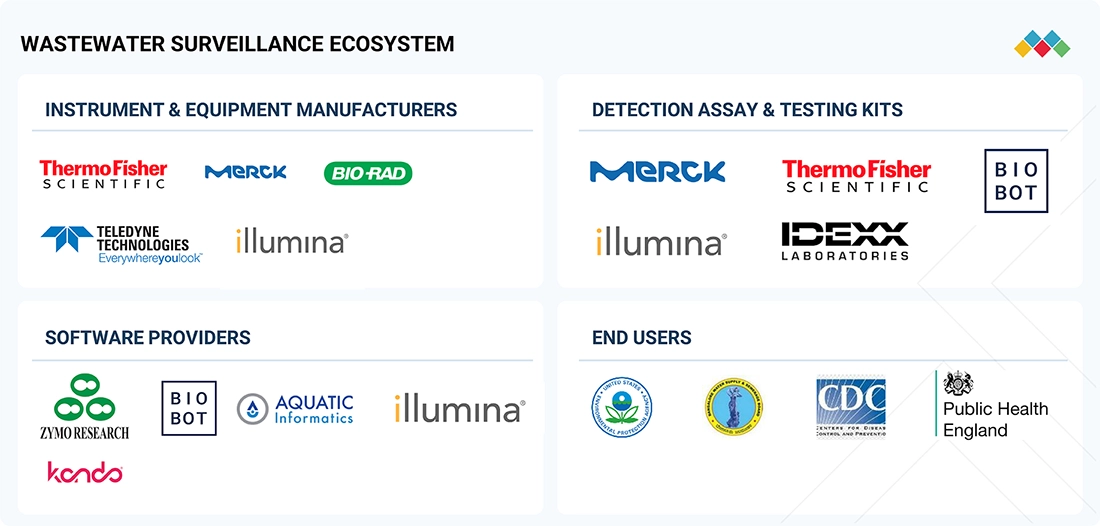
Wastewater Surveillance Market: COMMERCIAL USE CASES ACROSS INDUSTRIES
| COMPANY | USE CASE DESCRIPTION | BENEFITS |
|---|---|---|
 |
Provides wastewater-based epidemiology for SARS-CoV-2, opioids, and other health indicators across hundreds of U.S. municipalities. | • Early outbreak detection and trend tracking |
 |
Laboratory network offering turnkey sampling, molecular analysis (RT-qPCR/NGS), and reporting for pathogens and chemical biomarkers. | • Nationwide scalability through accredited labs |
 |
IoT-enabled sewer monitoring platform using AI to pinpoint infection clusters down to neighbourhood level. | • High-resolution “street-level” surveillance |
 |
Federally coordinated network collecting data from >1,000 U.S. sites for COVID-19, influenza, and RSV. | • Standardized national database for policy decisions |
Logos and trademarks shown above are the property of their respective owners. Their use here is for informational and illustrative purposes only.
Related Ecosystem
Analytical And Scientific Instrumentation
- Environmental Testing
- Gas Chromatography
- Polymerase Chain Reaction (PCR)
- Automated Liquid Handling Systems
- Flow Cytometry
- Thermo Fisher Scientific Inc.
- Danaher Corporation
- Agilent Technologies, Inc.
- Merck KGaA
- Shimadzu Corporation
Key Takeaways
- France's wastewater surveillance market is valued at $41.4 million in 2025 and will reach $55.3 million by 2030, growing at 6.0% CAGR.
- France's strong regulatory environment and EU compliance requirements are primary drivers of market expansion and technology adoption.
- France is integrating wastewater surveillance into national public health strategies for disease monitoring and antimicrobial resistance tracking.
- Collaboration between French public health agencies, water utilities, and research institutions is accelerating market growth and infrastructure development.
Wastewater Surveillance Market Report Scope
| Report Metric | Details |
|---|---|
| Base Year | 2025 |
| Fastest Growing Segment | SAMPLE FILTRATION & CENTRIFUGATION (Type) |
| Forecast Period | 2025–2030 |
| Growth Rate | CAGR of 6.7% from 2025 to 2030 |
| Largest Segment | INFECTIOUS DISEASE SURVEILLANCE (Application) |
| Market Size Base Year (Billions) | ~USD 0.88 (2025) |
| Revenue Forecast (Billions) | ~USD 1.22 (2030) |
| Segments Covered | Product, Application, End User, Type |
France Wastewater Surveillance Market Report Segmentation
4 segment dimensions are covered across the global market.
By Product
- Consumables & Accessories
- Detection Assay & Testing Kits
- Instruments & Equipment
- Software
By Application
- Antimicrobial Resistance (Amr) Monitoring
- Industrial & Environmental Pollution Detection
- Infectious Disease Surveillance
- Other Applications
By End User
- Contract Testing & Analytical Laboratories
- Government & Regulatory Agencies
- Other End Users
- Public Health Authorities
- Research & Academic Institutes
- Wastewater Treatment Plants
By Type
- Amr Gene Panels
- Automated Wastewater Samplers
- Bacterial Detection Kits
- Ngs Sequencers
- Other Assay Kits & Panels
- Pcr & Qpcr
- Portable Field-Testing Devices
- Sample Filtration & Centrifugation
- Substance & Pharmaceutical Residue Detection Kits
- Viral Pathogen Detection Kits
Target Audience
- French Public Health Authorities : Need market data to justify budget allocations for wastewater surveillance infrastructure, benchmark against national health objectives, and plan disease detection capabilities aligned with EU standards.
- Water Utilities & Environmental Agencies : Require France-specific market insights to evaluate wastewater surveillance integration opportunities, assess technology investments, and align water quality monitoring with public health surveillance mandates.
- Medical Device & Diagnostics Companies : Seek France market intelligence to identify growth opportunities, understand procurement processes, develop localized solutions, and establish partnerships with French health institutions and laboratories.
- Research Institutions & Universities : Need market data to secure funding for wastewater epidemiology research, understand commercialization pathways, and collaborate with French health authorities on surveillance innovation projects.
- Investment & Consulting Firms : Require France-specific market analysis to evaluate investment opportunities, advise clients on market entry strategies, and assess growth potential in the French wastewater surveillance sector.
Key Companies in the France Wastewater Surveillance Market
| Company | HQ | Ownership | Strongest segments |
|---|---|---|---|
| MERCK KGAA | Germany | Public Company | Life Science tools, reagents, and consumables,Healthcare prescription drugs and biopharmaceuticals,Electronics and semiconductor materials, |
| THERMO FISHER SCIENTIFIC INC. | United States | Public Company | Life Sciences Solutions,Analytical Instruments,Specialty Diagnostics, |
| ILLUMINA, INC. | United States | Public Company | Sequencing instruments,Sequencing consumables (reagents, flow cells, library prep, WGS and targeted kits),Array-based instruments and consumables, |
| IDEXX LABORATORIES | United States | Public Company | Companion Animal Group (in-clinic analyzers, SNAP assays, reference labs, telemedicine, software),Water Quality Products,Livestock, Poultry, Dairy and Human Diagnostics, |
| TELEDYNE TECHNOLOGIES INCORPORATED | United States | Public Company | Digital Imaging (visible, IR, X-ray, multispectral, MEMS, semiconductors),Instrumentation (monitoring, control, test and measurement, connectivity),Aerospace and Defense Electronics (avionics, interconnects, data and connectivity), |
| EUROFINS SCIENTIFIC | Luxembourg | Public Company | Food and Feed Testing,Environmental Testing,Biopharma Services, |
| BIO-RAD LABORATORIES, INC. | United States | Public Company | Clinical Diagnostics,Life Science Research Instruments and Reagents,Other / Software and Services, |
| QIAGEN | Netherlands | Public Company | Sample technology consumables and instruments,Molecular diagnostics assays (TB, oncology, SRH, transplant, viral load),PCR and digital PCR instruments and consumables, |
MERCK KGAA
Merck KGaA is a German multinational pharmaceutical, chemical, and life sciences company founded in 1668 with approximately 59,077 employees, operating as a public company.
THERMO FISHER SCIENTIFIC INC.
Thermo Fisher Scientific Inc. is a United States-based public company founded in 1956 that provides laboratory equipment, reagents, and services to the life sciences and diagnostics industries, employing approximately 125,000 people.
ILLUMINA, INC.
Illumina, Inc. is a United States public company founded in 1998 that develops and manufactures DNA sequencing and genetic analysis systems for research, clinical diagnostics, and genomics applications, with approximately 8,625 employees.
IDEXX LABORATORIES
IDEXX Laboratories is a United States public company founded in 1983 that develops and manufactures diagnostic equipment and software for veterinary, water, and environmental testing, employing approximately 11,000 people.
TELEDYNE TECHNOLOGIES INCORPORATED
Teledyne Technologies Incorporated is a United States public company founded in 1960 that manufactures electronic test and measurement instruments, digital imaging products, and aerospace and defense systems, with approximately 15,800 employees.
EUROFINS SCIENTIFIC
Eurofins Scientific is a Luxembourg-based public company founded in 1987 that provides laboratory testing services for food, pharmaceuticals, cosmetics, and environmental analysis, employing approximately 65,694 people.
BIO-RAD LABORATORIES, INC.
Bio-Rad Laboratories, Inc. is a United States public company founded in 1952 that manufactures and distributes life science research products and clinical diagnostics instruments, with approximately 7,450 employees.
QIAGEN
QIAGEN is a Netherlands-based public company founded in 1984 with approximately 5,500 employees that develops and manufactures sample preparation and molecular diagnostics products.
Reasons to Buy this Report
- Market-Specific Sizing & Forecasts : Access precise France market valuations ($41.4M in 2025, $55.3M in 2030) with country-specific CAGR analysis to support accurate business planning, investment decisions, and competitive positioning in the French market.
- Regulatory & Infrastructure Insights : Understand France's unique public health infrastructure investments, EU compliance requirements, and national health security priorities that shape wastewater surveillance adoption and create market opportunities.
- Growth Driver Analysis : Identify key factors driving France's 6.0% CAGR including government funding trends, technological adoption rates, and integration with environmental monitoring systems specific to the French market landscape.
- Competitive Landscape Intelligence : Gain insights into France-specific competitive dynamics, key stakeholders, public-private partnerships, and regional health authority procurement patterns to inform market entry and expansion strategies.
- Strategic Decision Support : Leverage France-focused market intelligence to guide product development, partnership strategies, and go-to-market approaches aligned with French health authorities, water utilities, and research institutions.
Frequently asked questions
What is the current size of France's wastewater surveillance market?
France's wastewater surveillance market is estimated at $41.4 million in 2025.
What is the projected market size for France by 2030?
France's wastewater surveillance market is projected to reach $55.3 million by 2030.
What is the growth rate of France's wastewater surveillance market?
France's wastewater surveillance market is expected to grow at a compound annual growth rate of 6.0% from 2025 to 2030.
What factors are driving growth in France's wastewater surveillance market?
Growth in France is driven by strong regulatory frameworks, EU environmental directives, increased public health investment, and collaboration between government agencies and water utilities.
How is France using wastewater surveillance in its public health strategy?
France is leveraging wastewater surveillance for disease detection, epidemiological tracking, and antimicrobial resistance monitoring across major urban centers and treatment facilities.
RESEARCH METHODOLOGY
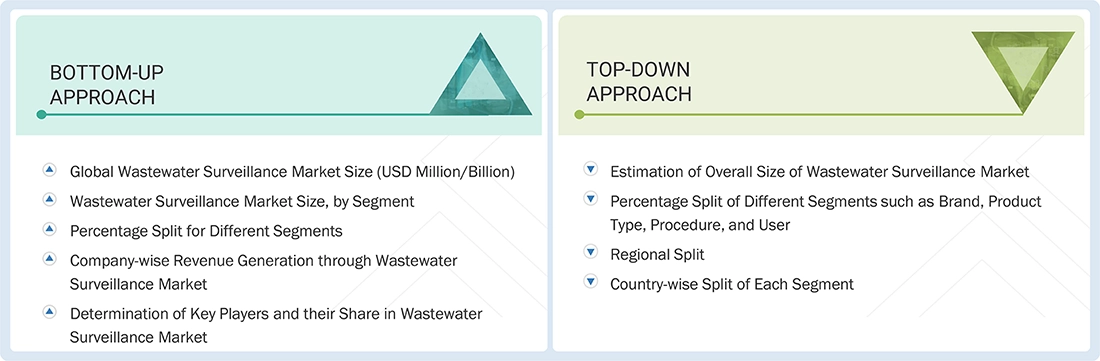
The size of the wastewater surveillance market was determined based on four primary studies to ensure accuracy. Initial data for the wastewater surveillance market and related sectors were collected from 3 to 5 secondary sources. This information was then validated through primary research to confirm the assumptions and overall market sizing. Both top-down and bottom-up approaches were used to estimate the total market size, which was subsequently broken down into segment and subsegment sizes. Finally, data triangulation was performed to verify the accuracy of the findings.
Secondary Research
Secondary research sources included directories, Factiva, white papers, Bloomberg Business, annual reports, SEC filings, business filings, and investor presentations. These sources provided valuable insights into market leaders, sector divisions, and technological differences within various segments of the wastewater surveillance industry.
Primary Research
Primary research involved gathering both quantitative and qualitative insights through interviews with key stakeholders. On the demand side, participants included public health officers, researchers, department heads, epidemiologists, hospitals, and research institutes. On the supply side, interviews were conducted with CEOs, product managers, sales leaders, and other top executives from relevant companies. These direct conversations helped confirm the findings from secondary research and provided an opportunity to directly ask questions and verify information assumptions.
A breakdown of the primary respondents is provided below.
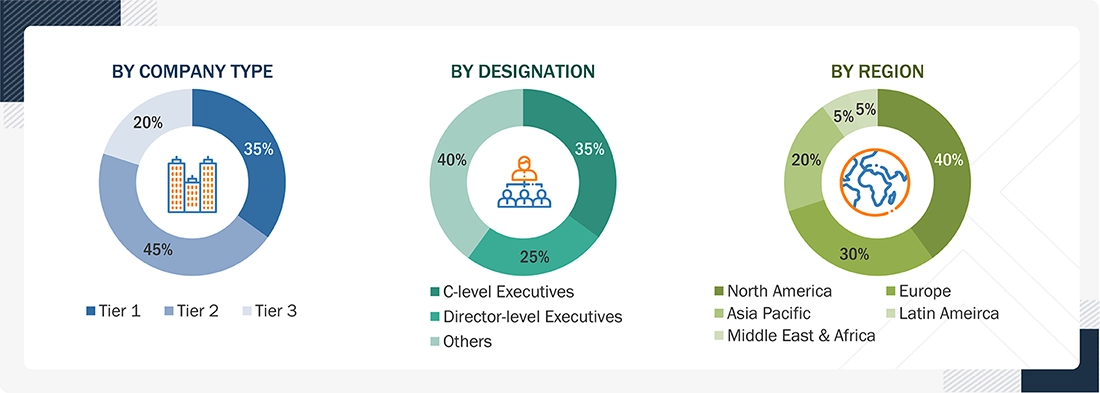
Note q: Others include sales managers, marketing managers, business development managers, product managers, distributors, and suppliers.
Note 2: Companies are classified into tiers based on their total revenue. As of 2024, Tier 1 = >USD 1 billion, Tier 2 = < USD 500 million, and Tier 3 = < USD 100 million.
To know about the assumptions considered for the study, download the pdf brochure
Market Size Estimation
This report uses revenue share analysis of major companies to assess the size of the global wastewater surveillance market. This analysis involves identifying key market participants and calculating their revenue from wastewater surveillance based on data collected during both primary and secondary research phases. Secondary research included reviewing the annual and financial reports of leading market players. Meanwhile, primary research comprised detailed interviews with influential thought leaders, including directors, CEOs, and key marketing executives.
To determine the overall market value, the segmental revenue was calculated by mapping the revenue of the leading solution and service providers. The process involved several steps.
Making a list of leading international companies in the wastewater surveillance industry
Charting annual profits made by leading companies in the wastewater surveillance sector (or the closest stated business unit/product category)
2024 revenue mapping of leading companies to cover a significant portion of the global market
Calculating the global value of the wastewater surveillance industry
Global Wastewater Surveillance Market: Bottom-up and Top-down Approach
Data Triangulation
The wastewater surveillance market includes a range of technologies, products, and services used to detect, monitor, and analyze biological or chemical targets in wastewater systems. Its purpose is to evaluate public health trends, detect environmental contamination, and ensure regulatory compliance. This involves collecting sewage samples, testing for pathogens (such as viruses like SARS-CoV-2, bacteria, and antimicrobial resistance genes), and identifying pharmaceutical residues, narcotics, or industrial pollutants. The insights gained are then used to inform government agencies, utilities, healthcare organizations, and industries. The market features a wide array of products, including instruments and equipment like automated samplers, filtration systems, PCR/qPCR platforms, sequencers, and portable analyzers, along with detection assays and testing kits aimed at pathogens, resistance genes, and contaminants. Additionally, it is supported by software solutions for data analysis and by consumables and accessories needed for sample collection and testing workflows.
Market Definition
To ensure accurate data, the wastewater surveillance market was divided into various segments and subsegments. A data triangulation process using both top-down and bottom-up approaches was employed. This involved analyzing factors and trends from both the demand and supply sides to validate the findings for each segment. The combination of this segmentation with the triangulation process helps ensure that the market data is both accurate and reliable.
Stakeholders
- Manufacturers of wastewater surveillance.
- Healthcare providers such as hospitals, public health labs, diagnostic centers, and community clinics
- Public health authorities and environmental agencies, using wastewater surveillance insights for outbreak detection and antimicrobial resistance tracking
- Public health funding agencies
- Healthcare professionals, including epidemiologists, microbiologists, environmental scientists, and lab technicians, are involved in sample analysis and interpretation
- Regulatory bodies overseeing standards and safety
- Suppliers and distributors of wastewater surveillance products
- Research & development firms focusing on innovation and technology in wastewater surveillance
Report Objectives
- To define, describe, and forecast the wastewater surveillance market based on product type, application, end user, and region
- To provide detailed information regarding the major factors influencing the growth of the market (drivers, restraints, opportunities, and industry-specific challenges)
- To strategically analyze micromarkets with respect to individual growth trends, prospects, and contributions to the total market
- To analyze opportunities in the market for stakeholders and provide details of the competitive landscape for market leaders
- To forecast the revenue of the market segments with respect to five regions: North America, Europe, the Asia Pacific, Latin America, and the Middle East & Africa
- To profile the key players and comprehensively analyze their market ranking and core competencies
- To benchmark players within the market using a proprietary Company Evaluation Matrix framework, which analyzes market players on various parameters within the broad categories of business strategy excellence and strength of product portfolio
- To analyze competitive developments such as product launches, agreements, expansions, collaborations, and acquisitions in the wastewater surveillance market
Get the Full Wastewater Surveillance Market Report
Full forecast, segment splits, and company analysis for all Wastewater Surveillance Market.
- US Wastewater Surveillance Market
- Canada Wastewater Surveillance Market
- Germany Wastewater Surveillance Market
- UK Wastewater Surveillance Market
- Italy Wastewater Surveillance Market
- Spain Wastewater Surveillance Market
- China Wastewater Surveillance Market
- Japan Wastewater Surveillance Market
- India Wastewater Surveillance Market
- Australia Wastewater Surveillance Market
- South Korea Wastewater Surveillance Market
- Brazil Wastewater Surveillance Market
- Mexico Wastewater Surveillance Market
Need a Tailored Report?
Customize this report to your needs
Get 10% FREE Customization
Customize This Report
