
South Korea Water Recycle and Reuse Market (2025-2030)

The South Korea Water Recycle and Reuse Market was valued at $674.3 Million in 2025 and projected to reach to $1110.2 Million by 2030, representing a compound annual growth rate of 10.5%. South Korea's water recycle and reuse market is positioned for accelerated growth through 2030, supported by the nation's advanced industrial base and commitment to sustainable resource management.


| Market Size in | USD 26.32 MN |
| Market Forecast in | |
| CAGR | |
| Forecast Period | |
| Units Considered | Value (USD MN) |
South Korea Water Recycle and Reuse Market Trends and Insights
- This expansion reflects South Korea's commitment to sustainable water management and circular economy principles amid increasing water scarcity pressures.
- South Korea's advanced industrial base and stringent environmental regulations are driving adoption of water recycling technologies across manufacturing, municipal, and agricultural sectors. The 10.5% compound annual growth rate underscores South Korea's strategic focus on resource efficiency and environmental stewardship.
- South Korea's investments in wastewater treatment infrastructure and reclaimed water systems are accelerating market penetration.
- By 2030, South Korea is expected to solidify its position as a regional leader in water recycling innovation, supported by government incentives and corporate sustainability initiatives. South Korea's market growth is underpinned by rising industrial water demand, regulatory compliance requirements, and technological advancements in membrane filtration and advanced oxidation processes.
- South Korea's water-stressed geography and dense population centers create compelling economic drivers for recycled water adoption across diverse end-use applications..
Key Market Statistics
- CAGR (2025-2030) 10.5% CAGR
- Market Size, 2025 ~USD 674.3 Million
- Forecast, 2030 ~USD 1110.2 Million
- Country South Korea
South Korea Water Recycle and Reuse Market Overview
Strong CAGR Growth :
South Korea's water recycle and reuse market is projected to grow at 10.5% CAGR from 2025 to 2030, slightly outpacing the global average of 10.6%, driven by industrial demand and regulatory compliance.
Substantial Market Expansion :
Market valuation is expected to increase from $674.3 million in 2025 to $1,110.2 million by 2030, representing a 64.7% growth over five years as water scarcity concerns intensify.
Advanced Industrial Infrastructure :
South Korea's sophisticated manufacturing and semiconductor sectors are major drivers of water recycling adoption, requiring high-quality reclaimed water for production processes and cooling systems.
Stringent Environmental Regulations :
Government mandates on water conservation and circular economy initiatives are compelling industries to invest in recycling technologies, creating sustained market demand and competitive opportunities.
South Korea Water Recycle and Reuse Market Dynamics
- The semiconductor, chemical, and manufacturing sectors are increasingly adopting water recycling solutions to meet production demands while adhering to strict environmental standards.
- Government incentives and circular economy policies are expected to further stimulate investment in innovative treatment technologies and infrastructure development. The market will benefit from technological advancements in membrane filtration, reverse osmosis, and IoT-enabled monitoring systems tailored to South Korea's industrial needs.
- Rising water stress, coupled with aging water infrastructure in urban areas, presents significant opportunities for integrated water management solutions.
- Strategic partnerships between technology providers and industrial end-users will drive market penetration and create competitive advantages in this rapidly expanding sector..
Market Ecosystem
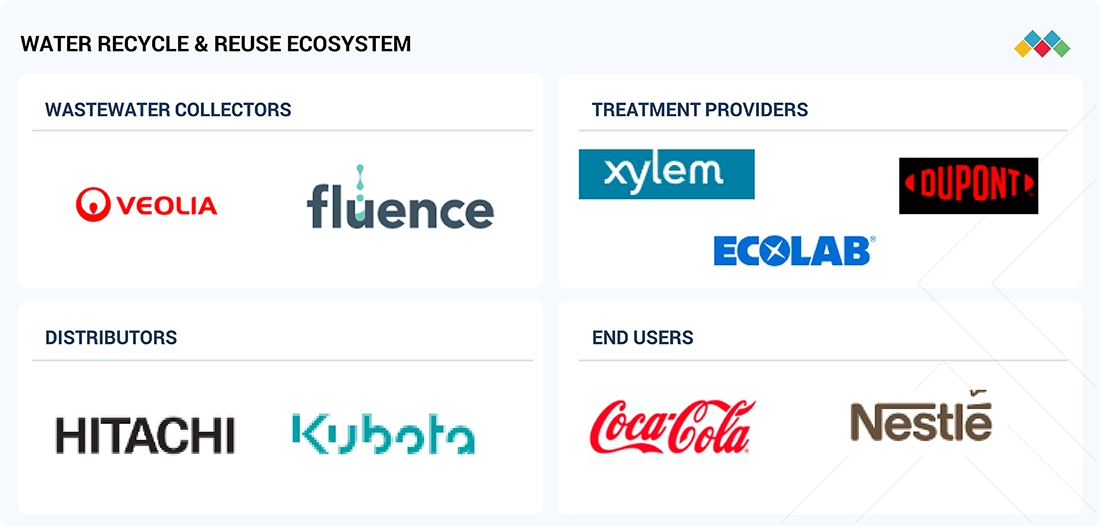
Water Recycle and Reuse Market: COMMERCIAL USE CASES ACROSS INDUSTRIES
| COMPANY | USE CASE DESCRIPTION | BENEFITS |
|---|---|---|
 |
Zero-water beverage plants with closed-loop process water recycling | Reduced freshwater withdrawal, sustainability leadership, improved community relations |
 |
Partnership with Ecolab to integrate smart water monitoring & reuse in campuses/data centers | Enhanced water visibility, data-driven efficiency, circular water use |
|
|
Wastewater recycling in dairy & food processing plants | Lower operational costs, water neutrality goals, regulatory compliance |
 |
Ultrapure water recycling in semiconductor fabs | Stable chip production, reduced discharge, sustainable manufacturing |
 |
Recycles greywater at corporate campuses and integrates circular water use across its supply chain | Lower freshwater dependency, improved supply chain sustainability, stronger ESG performance |
Logos and trademarks shown above are the property of their respective owners. Their use here is for informational and illustrative purposes only.
Related Ecosystem
Equipment Machine And Tooling
- Wastewater Treatment
- Air Cooled Heat Exchangers
- Diaphragm Pumps
- Fiberglass
- HVAC System
- Alfa Laval Corporate AB
- Veolia
- Johnson Controls International plc
- Daikin Industries,Ltd.
- Parker-Hannifin Corporation
Water Purification
- Corrosion Inhibitors
- Cartridge Filters
- Fiberglass
- Reverse Osmosis
- Acetone
- Veolia
- Kemira oyj
- SOLENIS
- Basf se
- CALGON CARBON CORPORATION
Key Takeaways
- South Korea's water recycle and reuse market will grow from $674.3M (2025) to $1,110.2M (2030) at a 10.5% CAGR.
- South Korea's stringent environmental regulations and water scarcity drive industrial and municipal water recycling adoption.
- South Korea's advanced technology infrastructure positions the country as a regional innovation leader in water treatment solutions.
- South Korea's government incentives and corporate sustainability commitments accelerate market expansion through 2030.
Water Recycle and Reuse Market Report Scope
| Report Metric | Details |
|---|---|
| Base Year | 2025 |
| Fastest Growing Segment | TERTIARY EQUIPMENT (Equipment) |
| Forecast Period | 2025–2030 |
| Growth Rate | CAGR of 10.6% from 2025 to 2030 |
| Largest Segment | TERTIARY EQUIPMENT (Equipment) |
| Market Size Base Year (Billions) | ~USD 17.89 (2025) |
| Revenue Forecast (Billions) | ~USD 29.61 (2030) |
| Segments Covered | Water Source, Equipment, Capacity, End Use |
South Korea Water Recycle and Reuse Market Report Segmentation
4 segment dimensions are covered across the global market.
By Water Source
- Agricultural Drainage
- Industrial Wastewater
- Municipal Wastewater
- Stormwater Runoff
By Equipment
- Primary Equipment
- Secondary Equipment
- Tertiary Equipment
By Capacity
- 25,001–50,000 Liters
- 50,001–100,000 Liters
- <25,000 Liters
- Above 100,000 Liters
By End Use
- Commercial
- Industrial
- Residential
Target Audience
- Industrial Manufacturers : South Korean manufacturers require detailed market insights to evaluate water recycling investments, benchmark against competitors, and optimize production efficiency amid water scarcity challenges.
- Technology & Equipment Providers : Water treatment technology vendors need South Korea-specific market data to identify growth opportunities, understand customer requirements, and develop competitive product strategies.
- Government & Policy Makers : South Korean environmental agencies and policymakers use market research to design effective water conservation policies, allocate resources, and track circular economy progress.
- Investment & Private Equity Firms : Investors targeting South Korea's water sector require comprehensive market analysis to identify acquisition targets, assess growth potential, and make informed capital allocation decisions.
- Consulting & Engineering Firms : Professional services firms advising South Korean clients need market intelligence to support feasibility studies, project valuations, and strategic recommendations for water infrastructure projects.
Key Companies in the South Korea Water Recycle and Reuse Market
| Company | HQ | Ownership | Strongest segments |
|---|---|---|---|
| AQUAVENTURE HOLDINGS LTD. | United States | Private Company | Primary Equipment,Secondary Equipment,Tertiary Equipment, |
| MELBOURNE WATER | Australia | Government Institution | Primary Equipment-linked services (screening, sedimentation, bulk conveyance),Secondary Equipment-linked services (biological treatment, clarification),Tertiary Equipment-linked services (filtration, disinfection, advanced treatment), |
| SIEMENS AG | Germany | Public Company | Primary Equipment-linked automation and electrification,Secondary Equipment process control and digitalization,Tertiary and advanced treatment automation, analytics, and services, |
| DOW CHEMICAL COMPANY | United States | Private Company | Primary Equipment,Secondary Equipment,Tertiary Equipment, |
| EVOQUA WATER TECHNOLOGIES LLC | United States | Subsidiary | Primary Equipment,Secondary Equipment,Tertiary Equipment, |
| VEOLIA | France | Public Company | Primary Equipment,Secondary Equipment,Tertiary Equipment, |
| ECOLAB INC. | United States | Public Company | Primary Equipment,Secondary Equipment,Tertiary Equipment, |
| XYLEM | United States | Public Company | Primary Equipment,Secondary Equipment,Tertiary Equipment, |
| DUPONT | United States | Public Company | Secondary Equipment (RO/NF membranes, UF modules),Tertiary Equipment (polishing, high-purity reuse),Primary Equipment / Pretreatment Integration, |
| HITACHI, LTD. | Japan | Public Company | Primary Equipment,Secondary Equipment,Tertiary Equipment, |
| KUBOTA CORPORATION | Japan | Public Company | Primary equipment (screens, clarifiers, basic treatment),Secondary equipment (biological treatment, membranes, reactors),Tertiary equipment (advanced polishing, disinfection, reuse systems), |
| ALFA LAVAL | Sweden | Public Company | Primary equipment (screening, primary clarification, basic fluid handling),Secondary equipment (biological support systems, decanters, separators, core fluid handling),Tertiary equipment (polishing, advanced separation, heat exchangers for reuse quality control), |
| THERMAX LIMITED | India | Public Company | Primary equipment (screens, clarifiers, equalization),Secondary equipment (biological treatment, MBR/ASP, aeration),Tertiary equipment (filtration, UF/RO, disinfection, polishing), |
| PENTAIR | United Kingdom | Public Company | Primary Equipment,Secondary Equipment,Tertiary Equipment, |
| ION EXCHANGE | India | Public Company | Primary Equipment (screening, clarification, sludge handling),Secondary Equipment (biological treatment, MBR, conventional systems),Tertiary Equipment (RO, UF, NF, polishing, ZLD systems), |
| PRAJ INDUSTRIES | India | Public Company | Primary Equipment,Secondary Equipment,Tertiary Equipment, |
| FLUENCE CORPORATION LIMITED | United States | Public Company | Gridstack / Gridstack Pro (front-of-the-meter storage supporting water reuse grids),Ultrastack (critical system storage for transmission/distribution near major plants),Smartstack and C&I-focused systems, |
AQUAVENTURE HOLDINGS LTD.
AQUAVENTURE HOLDINGS LTD. is a private company founded in 2006 and based in the United States. The company operates in the water and environmental solutions sector.
MELBOURNE WATER
MELBOURNE WATER is a government institution based in Australia with 1,161 employees. The organization provides water services and management.
SIEMENS AG
SIEMENS AG is a public company founded in 1847 with 310,312 employees, headquartered in Germany. The company is a global leader in industrial technology and infrastructure.
DOW CHEMICAL COMPANY
The DOW CHEMICAL COMPANY is a private company founded in 1897 with 34,600 employees, based in the United States. The company is a major producer of chemicals and materials.
EVOQUA WATER TECHNOLOGIES LLC
EVOQUA WATER TECHNOLOGIES LLC is a subsidiary company founded in 2013 and based in the United States. The company specializes in water treatment and purification solutions.
VEOLIA
VEOLIA is a public company founded in 1853 with 203,100 employees, headquartered in France. The company is a global leader in environmental services and water management.
ECOLAB INC.
ECOLAB INC. is a public company founded in 1923 with 48,000 employees, based in the United States. The company provides cleaning, sanitizing, and water treatment solutions.
XYLEM
XYLEM is a public company founded in 2011 with 22,000 employees, based in the United States. The company specializes in water technology and infrastructure solutions.
DUPONT
DUPONT is a public company founded in 2015 with 15,000 employees, based in the United States. The company operates in specialty chemicals and materials.
HITACHI, LTD.
HITACHI, LTD. is a public company founded in 1910 with 287,901 employees, headquartered in Japan. The company is a diversified global conglomerate with operations across multiple industries.
KUBOTA CORPORATION
KUBOTA CORPORATION is a public company founded in 1890 with 52,503 employees, based in Japan. The company manufactures industrial equipment and machinery.
ALFA LAVAL
ALFA LAVAL is a public company founded in 1883 with 24,399 employees, headquartered in Sweden. The company specializes in heat transfer, separation, and fluid handling technologies.
THERMAX LIMITED
THERMAX LIMITED is a public company founded in 1966 with 5,601 employees, based in India. The company provides energy and environmental solutions.
PENTAIR
PENTAIR is a public company founded in 1966 with 9,000 employees, based in the United Kingdom. The company manufactures water and fluid solutions.
ION EXCHANGE
ION EXCHANGE is a public company founded in 1964 with 2,521 employees, based in India. The company provides water treatment and environmental solutions.
PRAJ INDUSTRIES
PRAJ INDUSTRIES is a public company founded in 1985 with 1,844 employees, based in India. The company specializes in engineering and technology solutions.
FLUENCE CORPORATION LIMITED
FLUENCE CORPORATION LIMITED is a public company founded in 2018 with 1,670 employees, based in the United States. The company provides water and wastewater treatment solutions.
Reasons to Buy this Report
- Market Size & Growth Validation : Obtain precise valuation data for South Korea's water recycle market ($674.3M in 2025) with verified 10.5% CAGR forecasts through 2030, enabling accurate business planning and investment decisions.
- Competitive Landscape Intelligence : Understand South Korea-specific market dynamics, key players, and competitive positioning within the advanced industrial and semiconductor sectors driving water recycling adoption.
- Regulatory & Policy Insights : Access detailed analysis of South Korean environmental regulations, government incentives, and circular economy mandates shaping market opportunities and compliance requirements.
- Sector-Specific Opportunity Mapping : Identify high-growth segments within South Korea's manufacturing, semiconductor, and chemical industries with tailored water recycling needs and investment potential.
- Strategic Market Entry Planning : Leverage South Korea-focused market data to develop localized go-to-market strategies, partnership opportunities, and technology positioning for maximum market penetration.
Frequently asked questions
What is the current size of South Korea's water recycle and reuse market?
South Korea's water recycle and reuse market is valued at $674.3 million in 2025, with verified data confirming this baseline for market analysis and forecasting.
What is the projected market size for South Korea by 2030?
South Korea's water recycle and reuse market is forecast to reach $1,110.2 million by 2030, representing significant expansion over the five-year forecast period.
What is the CAGR for South Korea's water recycle and reuse market?
South Korea's water recycle and reuse market is expected to grow at a compound annual growth rate of 10.5% from 2025 to 2030.
What factors are driving growth in South Korea's water recycling market?
South Korea's market growth is driven by water scarcity, stringent environmental regulations, industrial water demand, technological innovation, and government sustainability initiatives.
Which sectors are the primary consumers of recycled water in South Korea?
South Korea's primary recycled water consumers include manufacturing industries, municipal water systems, agricultural operations, and commercial facilities seeking sustainable water solutions.
RESEARCH METHODOLOGY
The study involved four major activities in estimating the size of the water recycle and reuse market. Exhaustive secondary research was done to collect information on the market, the peer market, and the parent market. The next step was to validate these findings, assumptions, and sizing with industry experts across the value chain through primary research. Both top-down and bottom-up approaches were employed to estimate the complete market size. Thereafter, the market breakdown and data triangulation procedures were used to estimate the market size of the segments and subsegments.
Secondary Research
In the secondary research process, various secondary sources have been referred to for identifying and collecting information for this study. These secondary sources include annual reports, press releases, investor presentations of companies, white papers, certified publications, trade directories, certified publications, articles from recognized authors, gold standard and silver standard websites, and databases.
Secondary research has been used to obtain key information about the value chain of the industry, monetary chain of the market, the total pool of key water recycle and reuse, market classification and segmentation according to industry trends to the bottom-most level, and regional markets. It was also used to obtain information about the key developments from a market-oriented perspective.
Primary Research
The water recycle and reuse market comprises several stakeholders in the value chain, which include raw material suppliers, equipment manufacturers, recyclers, and end users. Various primary sources from the supply and demand sides of the water recycle and reuse market have been interviewed to obtain qualitative and quantitative information. The primary interviewees from the demand side include key opinion leaders in end-use sectors. The primary sources from the supply side include manufacturers, associations, and institutions involved in the water recycle and reuse industry.
Primary interviews were conducted to gather insights such as market statistics, data of revenue collected from the products and services, market breakdowns, market size estimations, market forecasting, and data triangulation. Primary research also helped in understanding the various trends related to equipment, capacity, end-use, water sources, and region. Stakeholders from the demand side, such as CIOs, CTOs, and CSOs, were interviewed to understand the buyer’s perspective on the suppliers, products, component providers, and their current usage of water recycling and reuse, and future outlook of their business, which will affect the overall market.
The breakdown of profiles of the primary interviewees is illustrated in the figure below:
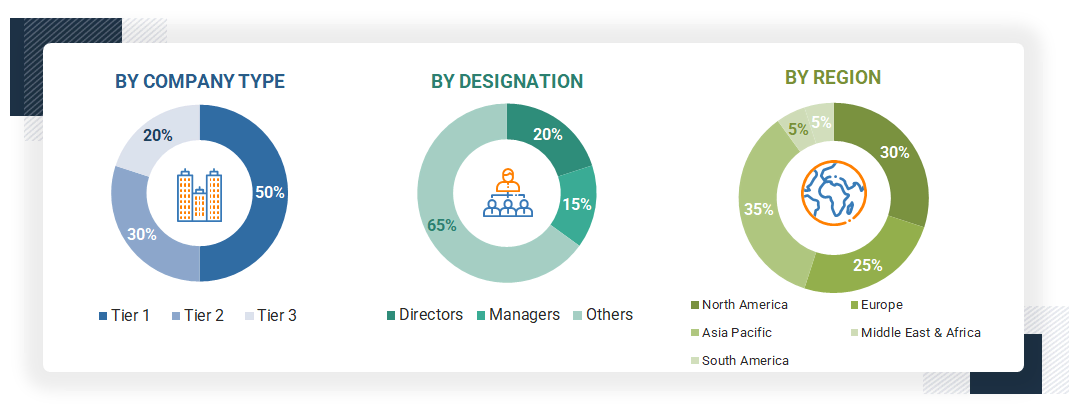
Note: Tier 1, Tier 2, and Tier 3 companies are classified based on their market revenue in 2024 available in the public domain, product portfolios, and geographical presence.
Other designations include sales representatives, production heads, and technicians.
To know about the assumptions considered for the study, download the pdf brochure
Market Size Estimation
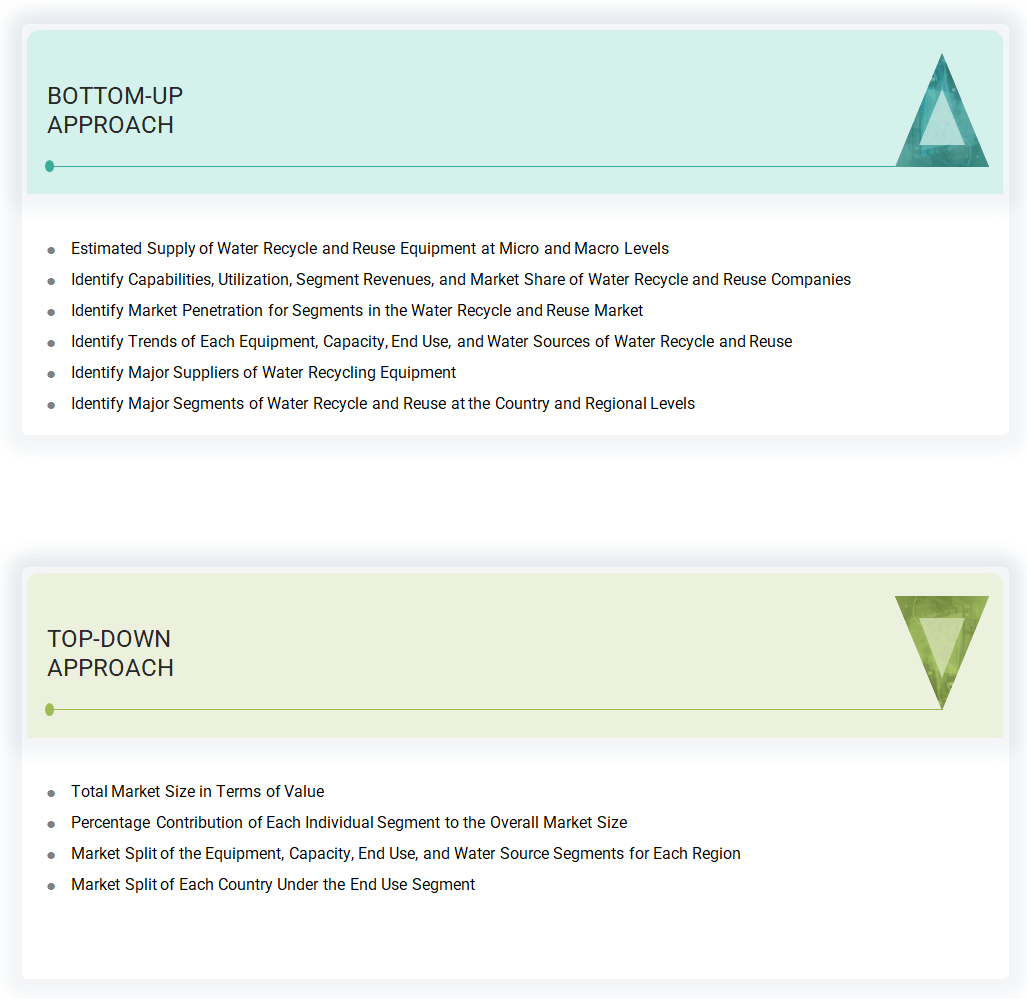
The top-down approach was used to estimate and validate the size of various submarkets for water recycle and reuse for each region. The research methodology used to estimate the market size included the following steps:
- The key players in the industry have been identified through extensive secondary research.
- The supply chain of the industry has been determined through primary and secondary research.
- The global market was then segmented into five major regions and validated by industry experts.
- All percentage shares, splits, and breakdowns based on equipment, capacity, end-use, water sources, and regions were determined using secondary sources and verified through primary sources.
- All possible parameters that affect the markets covered in this research study were accounted for, viewed in extensive detail, verified through primary research, and analyzed to get the final quantitative and qualitative data. This data was consolidated and added with detailed inputs and analysis, and presented in this report.
Data Triangulation
After arriving at the total market size from the estimation process above, the overall market has been split into several segments and subsegments. To complete the overall market engineering process and arrive at the exact statistics for all the segments and subsegments, the data triangulation and market breakdown procedures have been employed, wherever applicable. The data has been triangulated by studying various factors and trends from both the demand and supply sides. Along with this, the market size has been validated by using both the top-down and bottom-up approaches and primary interviews. Hence, for every data segment, there have been three sources—top-down approach, bottom-up approach, and expert interviews. The data was assumed correct when the values arrived from the three sources matched.
Market Definition
The water reuse and recycle involves systems, technologies, and infrastructure that cover the treatment of wastewater that is reused across municipal, industrial, agricultural, and commercial sectors. A large component of this market includes all the different treatment equipment that treats and reuses wastewater. This includes treating equipment categories such as primary treatment, including screens, grit chambers, and clarifiers; secondary treatment, such as aeration tanks, bioreactors, and diffusers; and tertiary treatment/technologies, like membrane filtration systems, disinfection, activated carbon, and ion exchange units. Treatment equipment is designed to provide different levels of water treatment, ranging from basic solid removal to advanced treatment processes that eliminate contaminants, making the water safe for reuse. Increasing water shortages, stricter environmental regulations, and the push for sustainable infrastructure have driven the growth of this market. Additionally, there is a rising need for public and private partnerships to develop modular and decentralized treatment solutions that enhance treatment efficiency.
Stakeholders
- Water Recycle and Reuse Equipment Manufacturers
- Water Recycle and Reuse Equipment Traders, Distributors, and Suppliers
- Wastewater Recycling Companies
- Government and Private Research Organizations
- Associations and Industrial Bodies
- R&D Institutions
- Environmental Support Agencies
Report Objectives
- To define, describe, and forecast the size of the water recycle and reuse market, in terms of value
- To provide detailed information regarding the major factors (drivers, opportunities, restraints, and challenges) influencing the growth of the market
- To estimate and forecast the market size based on equipment, capacity, end use, water source, and region
- To forecast the size of the market with respect to major regions, namely, Europe, North America, Asia Pacific, Middle East & Africa, and South America, along with their key countries
- To strategically analyze micromarkets with respect to individual growth trends, prospects, and their contribution to the overall market
- To analyze opportunities in the market for stakeholders and provide a competitive landscape of market leaders
- To track and analyze recent developments such as product launches, partnerships, collaborations, acquisitions, and expansions in the market
- To strategically profile the key market players and comprehensively analyze their core competencies
Get the Full Water Recycle and Reuse Market Report
Full forecast, segment splits, and company analysis for all Water Recycle and Reuse Market.
- China Water Recycle and Reuse Market
- Japan Water Recycle and Reuse Market
- India Water Recycle and Reuse Market
- Canada Water Recycle and Reuse Market
- Mexico Water Recycle and Reuse Market
- US Water Recycle and Reuse Market
- Germany Water Recycle and Reuse Market
- Italy Water Recycle and Reuse Market
- France Water Recycle and Reuse Market
- UK Water Recycle and Reuse Market
- Spain Water Recycle and Reuse Market
- South Africa Water Recycle and Reuse Market
- Argentina Water Recycle and Reuse Market
- Brazil Water Recycle and Reuse Market
- Rest Of Europe Water Recycle and Reuse Market
- Rest Of Asia-Pacific Water Recycle and Reuse Market
- GCC Countries Water Recycle and Reuse Market
- –Rest Of GCC Water Recycle and Reuse Market
- Rest Of South America Water Recycle and Reuse Market
Need a Tailored Report?
Customize this report to your needs
Get 10% FREE Customization
Customize This Report
