
Brazil Welding Equipment, Accessories, and Consumables Market (2025-2030)

The Brazil Welding Equipment, Accessories, and Consumables Market was valued at $1341.2 Million in 2025 and projected to reach to $1547.6 Million by 2030, representing a compound annual growth rate of 2.9%. Brazil's welding equipment market demonstrates steady growth driven by continued infrastructure development and mining sector expansion.


| Market Size in | USD 26.32 MN |
| Market Forecast in | |
| CAGR | |
| Forecast Period | |
| Units Considered | Value (USD MN) |
Brazil Welding Equipment, Accessories, and Consumables Market Trends and Insights
- Brazil's market is driven by robust demand from the construction, mining, and packaging sectors, which rely heavily on welding technologies for infrastructure development and industrial production.
- The country's strategic position in South America and its industrial base position Brazil as a key market for welding solutions across multiple end-use industries. During the 2025-2030 forecast period, Brazil's welding market will benefit from increased capital investment in infrastructure projects, mining operations, and manufacturing modernization.
- Brazil's growing emphasis on energy sector development, particularly in oil and gas, further supports demand for high-quality welding equipment and consumables.
- Market participants in Brazil are adapting to local regulatory standards and cost-conscious buyer preferences, creating opportunities for both established suppliers and emerging competitors..
Key Market Statistics
- CAGR (2025-2030) 2.9% CAGR
- Market Size, 2025 ~USD 1341.2 Million
- Forecast, 2030 ~USD 1547.6 Million
- Country Brazil
Brazil Welding Equipment, Accessories, and Consumables Market Overview
Market Size & Growth :
Brazil's welding equipment, accessories, and consumables market is valued at USD 1,341.2 million in 2025, with projected growth to USD 1,547.6 million by 2030, representing a steady CAGR of 2.9%.
Key Driving Sectors :
Construction, mining, and packaging industries in Brazil are primary demand drivers, leveraging welding technologies for infrastructure development, resource extraction, and industrial manufacturing operations.
Regional Performance :
Brazil's 2.9% CAGR is slightly below the global average of 3.29%, indicating a mature but stable market with consistent demand from established industrial sectors.
Industrial Infrastructure Focus :
The market is supported by Brazil's ongoing investments in infrastructure modernization, mining expansion, and manufacturing capacity, creating sustained demand for welding solutions.
Brazil Welding Equipment, Accessories, and Consumables Market Dynamics
- The construction industry's recovery and modernization initiatives are expected to sustain demand for welding consumables and equipment throughout the forecast period.
- Manufacturing sectors, particularly in packaging and automotive, will continue to rely on advanced welding technologies for production efficiency. The market's 2.9% CAGR reflects a mature industrial base with consistent, predictable demand rather than explosive growth.
- Investment in industrial automation and adoption of advanced welding techniques will support market expansion.
- However, economic volatility and currency fluctuations may present challenges to market growth, requiring strategic positioning by suppliers to maintain competitiveness in Brazil's dynamic industrial landscape..
Market Ecosystem
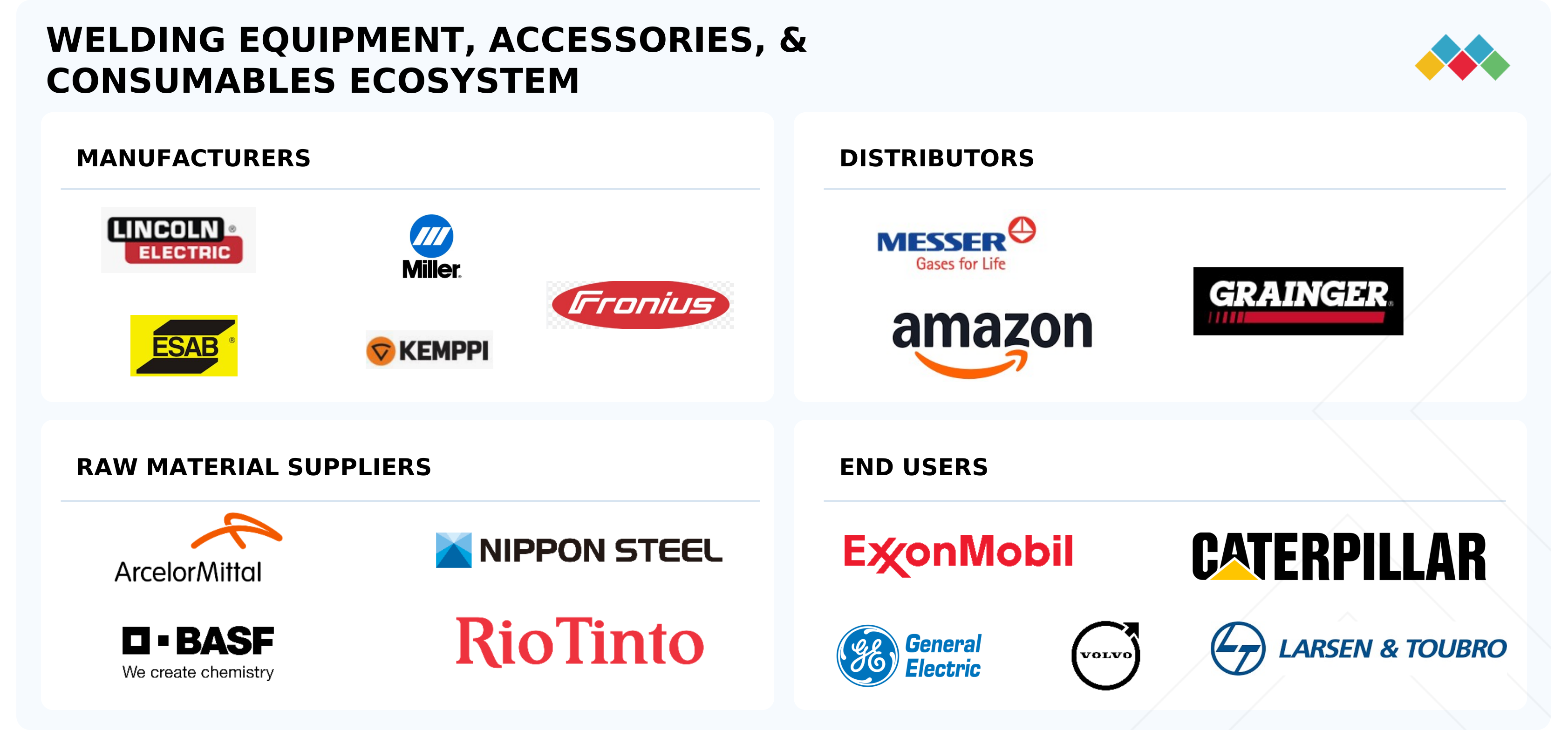
Welding Equipment, Accessories, and Consumables Market: COMMERCIAL USE CASES ACROSS INDUSTRIES
| COMPANY | USE CASE DESCRIPTION | BENEFITS |
|---|---|---|
 |
Lou-Rich deployed a series of automated robotic welding cells at its fabrication facilities to streamline its welding operations. The cells integrate robotic arms, precision positioners, automated wire feeders, and motion control to weld repetitive assemblies (such as structural frames, chassis components, and sheet-metal subassemblies). This mechanized setup enables continuous operation across shifts and ensures consistent weld quality across high volume runs. | The robotic welding cells enabled Lou-Rich to achieve higher throughput through continuous, unattended operation. They ensured uniform weld quality and reduced variability across production batches. By automating repetitive welds, the company reduced dependency on skilled manual welders, addressed labor shortages, and minimized scrap and rework. Overall, the solution improved production efficiency while delivering long-term cost savings and return on investment. |
 |
Kawasaki Motors Manufacturing (KMM) implemented multiple robotic arc welding systems across its ATV and utility vehicle frame production lines. These included dedicated cells handling small to large components and feeding into a centralized robotic welding station. The goal was maintaining high production volumes while enhancing consistency and minimizing reliance on manual welding. | By automating approximately 80% of its arc welding operations, KMM significantly reduced weld inconsistency and frame distortion. The robots delivered high repeatability, enabling precise and consistent welds without requiring advanced vision systems. The cells' flexibility allowed the company to handle different part geometries with minimal setup changes. This improved product quality and allowed skilled welders to shift focus to critical inspections and complex welds, improving overall workflow efficiency. |
 |
McCorvey Sheet Metal evaluated WeldComputer’s adaptive welding control system by integrating it into existing resistance seam welders. This temporary, noninvasive installation enabled real-world testing of the technology's impact on performance and energy efficiency within the company’s production environment. | The evaluation showed significant improvements in electrical efficiency, with power factor consistently maintained between 85–90% and peak energy demand reduced by up to 74%. The RMS current draw dropped significantly, cutting overall energy consumption. In addition to energy savings, the adaptive controls enhanced weld consistency and stability, improving product quality. The low-risk evaluation approach allowed McCorvey to validate the technology's benefits before committing to a full-scale rollout. |
Logos and trademarks shown above are the property of their respective owners. Their use here is for informational and illustrative purposes only.
Related Ecosystem
Mining Minerals And Metals
- Wastewater Treatment
- Fiberglass
- Light Commercial Vehicles (LCVs)
- Nitrogen
- Acetic Acid
- LHOIST S.A
- SEVERSTAL JSC
- ArcelorMittal S.A.
- TW METALS, INC.
- Linde plc
Key Takeaways
- Brazil's welding market is valued at USD 1,341.2 million in 2025 and will reach USD 1,547.6 million by 2030.
- Brazil's market growth is supported by construction, mining, and packaging industries requiring advanced welding solutions.
- Brazil's 2.9% CAGR reflects steady but moderate expansion driven by infrastructure and energy sector investments.
- Brazil's market dynamics favor suppliers offering cost-effective, locally-adapted welding equipment and consumables.
Welding Equipment, Accessories, and Consumables Market Report Scope
| Report Metric | Details |
|---|---|
| Base Year | 2025 |
| Fastest Growing Segment | 50-150 KILOGRAM PAYLOAD (Payload) |
| Forecast Period | 2025-2030 |
| Growth Rate | CAGR of 3.29% from 2025 to 2030 |
| Largest Segment | ARC WELDING (Technology) |
| Market Size Base Year (Billions) | ~USD 35.84 (2025) |
| Revenue Forecast (Billions) | ~USD 42.14 (2030) |
| Segments Covered | Equipment, Accessory, Consumable, Technology, End-Use Industry, Type, Payload, End User |
Brazil Welding Equipment, Accessories, and Consumables Market Report Segmentation
8 segment dimensions are covered across the global market.
By Equipment
- Electrode & Filler Material Equipment
- Laser Equipment
- Other Equipment
- Oxy- Fuel Gas Equipment
- Oxy-Fuel Gas Equipment
- Welding Electrode & Filler Material Equipment
By Accessory
- Flow Controllers
- Fume Extraction Equipment
- Gas Cabinets
- Gas Filters
- Gas Flow Meters
- Gas Manifolds
- Gas Panels
- Gas Regulators
- Gas Valves
- Protective Gear
By Consumable
- Electrode & Filler Materials
- Electrodes & Filler Materials
- Fluxes & Wires
- Gases
- Laser Equipment
- Other Equipment
- Oxy-Fuel Gas Equipment
- Welding Electrode & Filler Material Equipment
By Technology
- Arc Welding
- Other Technologies
- Oxy-Fuel Welding
By End-Use Industry
- Aerospace
- Automotive
- Construction & Infrastructure
- General Manufacturing
- Heavy Equipment/Earth Moving Equipment
- Maintenance & Repair
- Marine & Shipbuilding
- Oil & Gas
- Pipelines
- Power Generation
- Rail
- Tanks & Pressure Vessels
- Trucks & Trailers
By Type
- Arc Welding Robots
- Spot Welding Robots
- Welding Accessories
- Welding Consumables
- Welding Equipment
By Payload
- 50-150 Kilogram Payload
- <50 Kilogram Payload
- >150 Kilogram Payload
By End User
- Aerospace & Defense
- Automotive & Transportation
- Electrical & Electronics
- Metals & Machinery
Target Audience
- Welding Equipment Manufacturers : Manufacturers need Brazil-specific market data to identify growth opportunities, assess competitive positioning, and develop localized product strategies for construction and mining sectors.
- Industrial Distributors & Suppliers : Distributors require detailed market insights to optimize inventory management, forecast demand across sectors, and identify high-growth segments within Brazil's welding market.
- Construction & Mining Companies : Industry operators need market intelligence to benchmark welding equipment costs, evaluate supplier options, and plan capital expenditures for equipment and consumables procurement.
- Investment & Private Equity Firms : Investors need comprehensive Brazil market data to evaluate acquisition targets, assess market growth potential, and make informed decisions on welding sector investments.
- Market Consultants & Analysts : Consultants require Brazil-specific market metrics and forecasts to support client advisory services, competitive analysis, and strategic planning recommendations in the welding industry.
Reasons to Buy this Report
- Sector-Specific Insights : Gain detailed understanding of how construction, mining, and packaging sectors in Brazil drive welding equipment demand, enabling targeted market entry and product positioning strategies.
- Accurate Market Sizing : Access precise market valuation data for Brazil (USD 1,341.2M in 2025) with reliable 5-year forecasts to support investment decisions and revenue projections.
- Competitive Benchmarking : Compare Brazil's 2.9% CAGR against global performance (3.29%) to identify growth opportunities and assess market maturity relative to other regions.
- Infrastructure Development Trends : Understand how Brazil's ongoing infrastructure modernization and industrial expansion create sustained demand for welding technologies and consumables through 2030.
- Strategic Market Planning : Develop informed go-to-market strategies for Brazil with comprehensive data on market dynamics, growth drivers, and sector-specific opportunities for welding solutions.
Frequently asked questions
What is the current size of Brazil's welding equipment market?
Brazil's welding equipment, accessories, and consumables market is estimated at USD 1,341.2 million in 2025.
What is the projected market size for Brazil by 2030?
Brazil's welding market is forecast to reach USD 1,547.6 million by 2030, representing growth of USD 206.4 million over the forecast period.
What is the CAGR for Brazil's welding market?
Brazil's welding equipment market is expected to grow at a compound annual growth rate of 2.9% from 2025 to 2030.
Which industries drive demand for welding equipment in Brazil?
Brazil's primary demand drivers include construction, mining, packaging, and the oil and gas energy sector, all of which require welding equipment and consumables.
What factors influence the welding market outlook in Brazil?
Brazil's market outlook is shaped by infrastructure investment, mining activity, manufacturing modernization, energy sector development, and local regulatory compliance requirements.
RESEARCH METHODOLOGY
The study involved four main activities to estimate the current size of the global market for welding equipment, accessories, and consumables. Comprehensive secondary research was conducted to gather information on the market, the related product markets, and the parent product group market. The next step was to validate these findings, assumptions, and estimates with industry experts across the value chain of welding equipment, accessories, and consumables through primary research. Both top-down and bottom-up approaches were used to determine the overall market size. Subsequently, market breakdown and data triangulation procedures helped identify the sizes of various segments and sub-segments of the market.
Secondary Research
The market for companies offering welding equipment, accessories, and consumables is determined using secondary data from both paid and unpaid sources. This involves analyzing the product portfolios of major companies in the industry and rating them based on their performance and quality. Various secondary sources, such as Business Standard, Bloomberg, World Bank, and Factiva, were consulted to gather information for this study on the welding equipment, accessories, and consumables market. Multiple sources were reviewed during the secondary research process to collect relevant data. These sources included annual reports, press releases, investor presentations from welding manufacturers, forums, certified publications, and whitepapers. This secondary research provided essential information on the industry’s value chain, the key players, market classifications, and segmentation from both market and technology perspectives.
Primary Research
During the primary research process, various primary sources from both the supply and demand sides were interviewed to gather qualitative and quantitative information for this report. The supply-side sources included industry experts such as Chief Executive Officers (CEOs), Vice Presidents (VPs), marketing directors, technology and innovation directors, and other key executives from several leading companies and organizations operating in the welding equipment, accessories, and consumables market. After completing the market engineering calculations—covering market statistics, market breakdown, size estimations, forecasting, and data triangulation—extensive primary research was conducted to verify and validate the critical data points. This research also aimed to identify segmentation types, industry trends, the competitive landscape of welding equipment, accessories, and consumables offered by various market players, as well as key market dynamics like drivers, restraints, opportunities, challenges, industry trends, and strategies of major players. Throughout the entire market engineering process, top-down and bottom-up approaches and multiple data triangulation methods were extensively employed to perform market estimations and forecasts for the overall market segments and subsegments outlined in this report. A comprehensive blend of qualitative and quantitative analysis was conducted to generate key insights and information throughout the report.
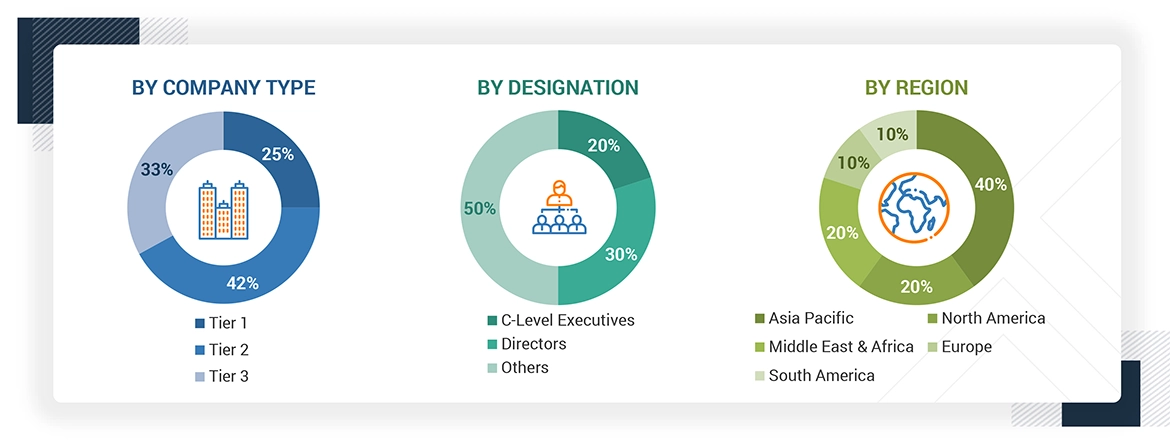
Notes: Other designations include sales, marketing, and product managers.
Tier 1: >USD 1 Billion; Tier 2: USD 500 million–1 Billion; and Tier 3: < USD 500 million
To know about the assumptions considered for the study, download the pdf brochure
Market Size Estimation
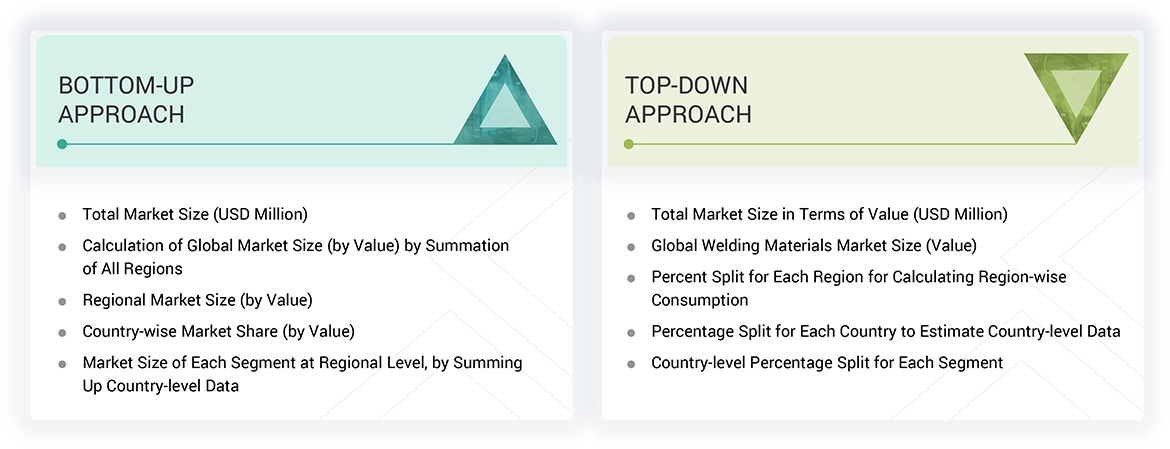
The top-down and bottom-up approaches were used to estimate and validate the global welding equipment, accessories, and consumables market. size These approaches were also extensively used to estimate the size of various related market segments. The research methodology used to estimate the market size included the following:
Data Triangulation
After estimating the overall market size using the appropriate processes, the market was divided into various segments and subsegments. Data triangulation and market breakup methods were used, where applicable, to complete the entire market analysis and obtain accurate statistics for each segment and subsegment. The data was triangulated by examining different factors and trends from both the demand and supply sides.
Market Definition
Welding is the process of joining two materials through mechanical force, friction, or heat caused by sparks or fluxes produced by a torch tip. There are three basic types of welding processes — gas welding, arc welding, and oxy-fuel welding. Machines, jigs, and other devices are called welding equipment for fabricating welding articles from semi-finished stock to final products.
Stakeholders
- Welding equipment, accessory, and consumable manufacturers
- Raw material suppliers
- Traders and distributors
- Industry associations
- Research organizations, trade associations, and government agencies
- R&D institutes
- Regulatory bodies
- End-use industries
Report Objectives
- To define, describe, and forecast the size of the global welding equipment, accessories, and consumables market based on equipment, consumable, accessory, technology, end-use industry, and region in terms of value
- To provide detailed information on the significant drivers, restraints, opportunities, and challenges influencing the market
- To strategically analyze micromarkets concerning individual growth trends, prospects, and their contribution to the market
- To assess the growth opportunities in the market for stakeholders and provide details on the competitive landscape for market leaders
- To forecast the market size of segments and subsegments for North America, Europe, Asia Pacific, South America, and the Middle East & Africa
- To strategically profile key players and comprehensively analyze their market shares and core competencies
- To analyze competitive developments such as product launches, acquisitions, expansions, partnerships, and agreements in the welding equipment, accessories, and consumables market
- To provide the impact of AI/Gen AI on the market
Get the Full Welding Equipment, Accessories, and Consumables Market Report
Full forecast, segment splits, and company analysis for all Welding Equipment, Accessories, and Consumables Market.
- China Welding Equipment, Accessories, and Consumables Market
- Japan Welding Equipment, Accessories, and Consumables Market
- India Welding Equipment, Accessories, and Consumables Market
- Australia Welding Equipment, Accessories, and Consumables Market
- Canada Welding Equipment, Accessories, and Consumables Market
- Mexico Welding Equipment, Accessories, and Consumables Market
- US Welding Equipment, Accessories, and Consumables Market
- Germany Welding Equipment, Accessories, and Consumables Market
- UK Welding Equipment, Accessories, and Consumables Market
- France Welding Equipment, Accessories, and Consumables Market
- Italy Welding Equipment, Accessories, and Consumables Market
- South Africa Welding Equipment, Accessories, and Consumables Market
- Argentina Welding Equipment, Accessories, and Consumables Market
- Rest Of Europe Welding Equipment, Accessories, and Consumables Market
- Rest Of Asia Pacific Welding Equipment, Accessories, and Consumables Market
- GCC Countries Welding Equipment, Accessories, and Consumables Market
- -Rest Of GCC Countries Welding Equipment, Accessories, and Consumables Market
- Rest Of South America Welding Equipment, Accessories, and Consumables Market
Need a Tailored Report?
Customize this report to your needs
Get 10% FREE Customization
Customize This Report
