
Asia Pacific Wind Turbine Composites Market (2025-2030)

The Asia Pacific Wind Turbine Composites Market was valued at $13839.8 Million in 2025 and projected to reach to $22698.9 Million by 2030, representing a compound annual growth rate of 10.4%. Asia Pacific is positioned as the fastest-growing region for wind turbine composites, driven by massive renewable energy investments across China, India, and Southeast Asia.


| Market Size in | USD 26.32 MN |
| Market Forecast in | |
| CAGR | |
| Forecast Period | |
| Units Considered | Value (USD MN) |
Asia Pacific Wind Turbine Composites Market Trends and Insights
- This 10.4% compound annual growth rate reflects Asia Pacific's accelerating renewable energy transition and rising demand for lightweight, durable composite materials in wind blade manufacturing.
- Asia Pacific's dominance is driven by substantial investments in offshore and onshore wind capacity, particularly across China, India, and Southeast Asia, where governments are prioritizing clean energy infrastructure. The Asia Pacific wind turbine composites market is benefiting from technological advancements in fiber-reinforced polymers and increasing cost competitiveness of composite solutions.
- Asia Pacific manufacturers are scaling production capabilities to meet surging turbine demand, supported by favorable regulatory frameworks and supply chain consolidation.
- Between 2025 and 2030, Asia Pacific is expected to capture significant market share as regional players innovate in resin systems, carbon fiber integration, and recycling technologies, positioning the region as both a manufacturing and consumption powerhouse in the global composites sector..
Key Market Statistics
- CAGR (2025-2030) 10.4% CAGR
- Market Size, 2025 ~USD 13839.8 Million
- Forecast, 2030 ~USD 22698.9 Million
- Geography Asia Pacific
Asia Pacific Wind Turbine Composites Market Overview
Market Valuation & Growth :
Asia Pacific wind turbine composites market valued at USD 13,839.8 million in 2025, expanding to USD 22,698.9 million by 2030 at a robust 10.4% CAGR, outpacing global growth of 10.3%.
China's Market Dominance :
China leads the region with USD 20,985.9 million market size, representing the largest wind turbine composites market globally and driving Asia Pacific's accelerated renewable energy infrastructure development.
Renewable Energy Transition :
Asia Pacific's accelerating shift toward renewable energy and net-zero commitments is fueling unprecedented demand for lightweight, high-performance composite materials in wind blade manufacturing and turbine components.
Emerging Market Opportunities :
India (USD 860.3 million) and Australia (USD 193 million) represent high-growth opportunities as regional governments expand wind capacity and domestic composite manufacturing capabilities strengthen.
Asia Pacific Wind Turbine Composites Market Dynamics
- Government incentives, declining wind energy costs, and ambitious carbon neutrality targets are accelerating wind farm deployments, creating sustained demand for advanced composite materials that reduce turbine weight and improve efficiency.
- The region's manufacturing expertise and cost competitiveness further strengthen its market position. By 2030, Asia Pacific's market is expected to reach USD 22.7 billion, supported by technological innovations in fiber-reinforced polymers and expanding domestic supply chains.
- Strategic partnerships between composite manufacturers and turbine OEMs, coupled with increasing localization of production, will enhance market penetration.
- Rising environmental regulations and corporate sustainability commitments will continue to propel composite adoption across the region's wind energy sector..
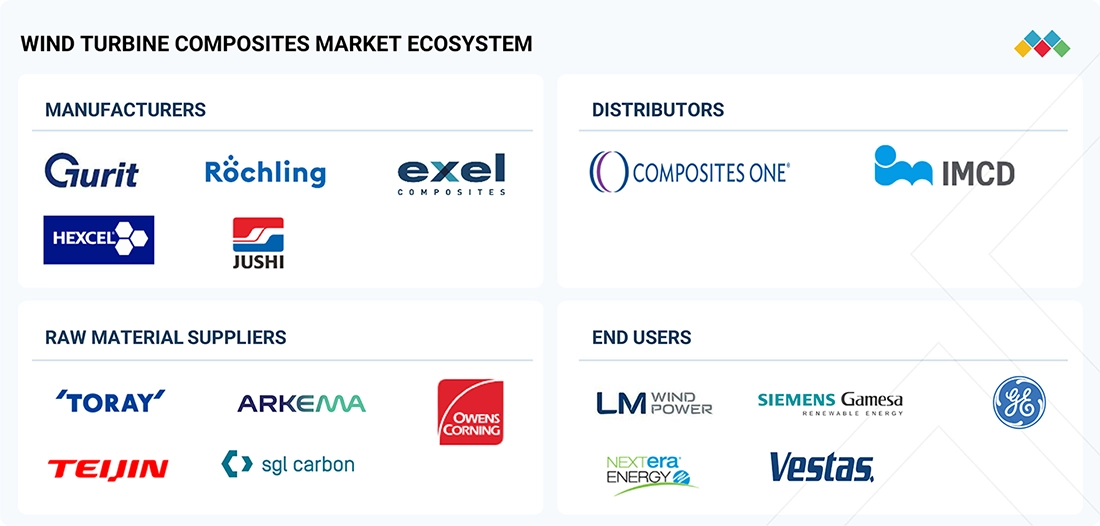
Market Ecosystem
WIND TURBINE COMPOSITES MARKET: COMMERCIAL USE CASES ACROSS INDUSTRIES
| COMPANY | USE CASE DESCRIPTION | BENEFITS |
|---|---|---|
 |
Uses glass fiber, carbon fiber, and core materials in large offshore and onshore turbine blades | Increased blade length | Higher energy capture efficiency | Reduced weight | Improved fatigue resistance |
 |
Integrates advanced composite sandwich structures in rotor blades and nacelle covers | Enhanced durability | Optimized aerodynamics | Improved lifecycle performance |
 |
Deploys composite-intensive designs in large-scale wind turbine blades and structures | Lightweight blades | Higher power output | Reduced maintenance requirements |
Logos and trademarks shown above are the property of their respective owners. Their use here is for informational and illustrative purposes only.
Related Ecosystem
Fibers And Composites
- Polyetheretherketone (PEEK)
- Polyphenylene Sulfide (PPS)
- Epoxy Resin
- Polycarbonate
- Polyester Resin
- Toray Industries, Inc.
- Teijin Limited
- Sgl carbon se
- Hexcel Corporation
- Solvay sa
Key Takeaways
- Asia Pacific wind turbine composites market is valued at USD 13,839.8 million in 2025 and will reach USD 22,698.9 million by 2030, representing a 10.4% CAGR.
- Asia Pacific's growth is fueled by massive renewable energy investments in China, India, and Southeast Asia, driving demand for advanced composite materials in blade manufacturing.
- Asia Pacific manufacturers are scaling production and innovating in fiber-reinforced polymers, carbon fiber, and sustainable recycling technologies to meet regional turbine demand.
- Asia Pacific's favorable regulatory environment and supply chain maturity position the region as a global leader in wind turbine composites manufacturing and consumption through 2030.
Wind Turbine Composites Market Report Scope
| Report Metric | Details |
|---|---|
| Base Year | 2025 |
| Fastest Growing Segment | OFFSHORE WIND TURBINES (Application) |
| Forecast Period | 2025–2030 |
| Growth Rate | CAGR of 10.3% from 2025 to 2030 |
| Largest Segment | ONSHORE WIND TURBINES (Application) |
| Market Size Base Year (Billions) | ~USD 17.67 (2025) |
| Revenue Forecast (Billions) | ~USD 28.85 (2030) |
| Segments Covered | Resin Type, Fiber Type, Manufacturing Process, Component, Application |
Asia Pacific Wind Turbine Composites Market Report Segmentation
5 segment dimensions are covered across the global market.
By Resin Type
- Epoxy
- Other Resin Types
- Polyurethane
By Fiber Type
- Carbon Fiber
- Glass Fiber
- Other Fiber Types
By Manufacturing Process
- Filament Winding
- Other Manufacturing Processes
- Vartm/Vi
By Component
- Blades
- Nacelles
- Other Components
By Application
- Offshore Wind Turbines
- Onshore Wind Turbines
Target Audience
- Composite Material Manufacturers : Need regional market data to identify growth opportunities, optimize production capacity, and develop Asia Pacific-specific product portfolios for wind blade and turbine component applications.
- Wind Turbine OEMs : Require market intelligence on composite material availability, pricing trends, and supplier capabilities across Asia Pacific to secure supply chains and reduce turbine manufacturing costs.
- Investment & Private Equity Firms : Seek detailed market sizing and growth forecasts to evaluate investment opportunities in composite manufacturers, wind energy companies, and renewable energy infrastructure projects across the region.
- Government & Policy Makers : Need comprehensive market data to inform renewable energy policies, manufacturing incentives, and infrastructure investments aligned with Asia Pacific's net-zero transition goals.
- Supply Chain & Procurement Professionals : Require country-level market insights and supplier landscape analysis to optimize sourcing strategies, negotiate contracts, and manage supply chain risks in Asia Pacific's wind composites sector.
Key Companies in the Asia Pacific Wind Turbine Composites Market
| Company | HQ | Ownership | Strongest segments |
|---|---|---|---|
| CHINA NATIONAL BUILDING MATERIAL GROUP CORPORATION | China | Private Company | Cement & Clinker,Commercial Concrete & Aggregates,Gypsum Boards & Building Products, |
| HEXCEL CORPORATION | United States | Public Company | Composite Materials,Engineered Products, |
| TORAY INDUSTRIES, INC. | Japan | Public Company | Fibers and Textiles,Performance Chemicals (Resins, Films, Fine Chemicals, Electronic Materials),Carbon Fiber Composite Materials, |
| CHINA JUSHI CO., LTD. | China | Public Company | Fiberglass rovings, mats, and woven rovings,Glass yarns and electronic fabrics,Composite materials and engineered plastics, |
| SGL CARBON | Germany | Public Company | Graphite Solutions,Process Technology,Carbon Fibers, |
| EXEL COMPOSITES | Finland | Public Company | Transportation profiles (bus, coach, rail, truck, trailer, automotive),Building and structural profiles (windows, doors, sunshades, awnings, standard profiles),Telecoms composites (4G, 5G macro, MIMO, small cell mmWave), |
| EVONIK | Germany | Public Company | Advanced Technologies,Custom Solutions,Infrastructure, |
| ARKEMA | France | Public Company | Advanced Materials (high-performance polymers, fluorospecialties, PEKK, polyimides),Adhesive Solutions (construction, renovation, DIY, packaging, non-wovens, durable goods),Coating Solutions (acrylics, coating resins, photocure resins, rheology additives, decorative paints), |
| TEIJIN LIMITED | Japan | Public Company | Aramid and High-Performance Fibers,Carbon/Glass Fiber Composites and Resins,Films and Engineered Plastics (PC, PPS, Microporous), |
| OWENS CORNING | United States | Public Company | Roofing (laminate and strip asphalt shingles, roofing components, oxidized asphalt),Insulation (PINK, Next Gen, FIBERGLAS, FOAMULAR, FOAMGLAS, Paroc),Doors (residential interior and exterior doors and components), |
| EXXONMOBIL CORPORATION | United States | Public Company | Upstream (crude oil and natural gas),Energy Products (fuels, aromatics, catalysts, licensing),Chemical Products (olefins, polyolefins, intermediates), |
| HUNTSMAN INTERNATIONAL LLC | United States | Private Company | MDI, polyols, and polyurethane systems,Thermoplastic polyurethane and related intermediates (aniline, benzene, nitrobenzene),Amines, maleic anhydride, and carbonates, |
CHINA NATIONAL BUILDING MATERIAL GROUP CORPORATION
China National Building Material Group Corporation is a large Chinese private company established in 1981, employing approximately 170,000 people.
HEXCEL CORPORATION
Hexcel Corporation is a publicly traded American manufacturer founded in 1946 with 5,563 employees.
TORAY INDUSTRIES, INC.
Toray Industries, Inc. is a Japanese public company established in 1926 with a workforce of 46,294 employees.
CHINA JUSHI CO., LTD.
China Jushi Co., Ltd. is a publicly listed Chinese company founded in 1998 with 14,341 employees.
SGL CARBON
SGL Carbon is a publicly traded German company founded in 1878 with 3,577 employees.
EXEL COMPOSITES
Exel Composites is a Finnish public company founded in 1960 with 656 employees.
EVONIK
Evonik is a publicly traded German company with roots dating back to 1847, employing 30,643 people.
ARKEMA
Arkema is a French public company founded in 2003 with 20,700 employees.
TEIJIN LIMITED
Teijin Limited is a Japanese public company established in 1918 with 15,689 employees.
OWENS CORNING
Owens Corning is a publicly traded American company founded in 1938 with 25,000 employees.
EXXONMOBIL CORPORATION
ExxonMobil Corporation is a large publicly traded American company established in 1870 with 57,900 employees.
HUNTSMAN INTERNATIONAL LLC
Huntsman International LLC is an American private company founded in 1970 with 6,000 employees.
Countries within Asia Pacific - compare and drill down
| Country | 2025 size (native) |
|---|---|
| CHINA | USD 20985.9 Million |
| INDIA | USD 860.3 Million |
| JAPAN | USD 140.1 Million |
| AUSTRALIA | USD 193 Million |
| SOUTH KOREA | USD 44.1 Million |
Country market size visualization
Reasons to Buy this Report
- Regional Market Intelligence : Gain comprehensive insights into Asia Pacific's USD 13.8 billion wind turbine composites market with country-level breakdowns, growth drivers, and competitive dynamics specific to the region's renewable energy landscape.
- China Market Dominance Analysis : Understand China's USD 21 billion market leadership, manufacturing capabilities, and supply chain structure to identify partnership and investment opportunities in the world's largest wind composites market.
- Emerging Market Opportunities : Identify high-growth opportunities in India, Australia, and Southeast Asia with detailed market sizing, regulatory frameworks, and localization strategies for composite manufacturers and turbine suppliers.
- Growth Trajectory & Forecasting : Access 5-year forecasts projecting 10.4% CAGR growth through 2030, enabling strategic planning for capacity expansion, R&D investments, and market entry strategies in Asia Pacific's accelerating renewable sector.
- Competitive Positioning : Benchmark your organization against regional competitors, understand market consolidation trends, and identify white-space opportunities in lightweight composite materials and advanced manufacturing technologies.
Frequently asked questions
What is the current size of the Asia Pacific wind turbine composites market in 2025?
The Asia Pacific wind turbine composites market is valued at USD 13,839.8 million in 2025, reflecting strong regional demand for composite materials in renewable energy infrastructure.
What is the projected market size for Asia Pacific wind turbine composites by 2030?
Asia Pacific's wind turbine composites market is forecast to reach USD 22,698.9 million by 2030, growing at a 10.4% CAGR from 2025 to 2030.
Which countries are driving growth in Asia Pacific's wind turbine composites market?
China, India, and Southeast Asian nations are primary growth drivers in Asia Pacific, supported by government renewable energy targets and substantial investments in onshore and offshore wind capacity.
What materials are most commonly used in Asia Pacific wind turbine composites?
Asia Pacific manufacturers primarily utilize fiber-reinforced polymers, carbon fiber composites, and advanced resin systems to produce lightweight, durable wind turbine blades and components.
How is Asia Pacific addressing sustainability in wind turbine composites?
Asia Pacific is increasingly adopting recycling technologies, bio-based resins, and circular economy practices to reduce environmental impact and improve the sustainability profile of wind turbine composite manufacturing.
RESEARCH METHODOLOGY
The study involves two major activities in estimating the current market size for the wind turbine composites market. Exhaustive secondary research was done to collect information on the market, peer market, and parent market. The next step was to validate these findings, assumptions, and sizing with industry experts across the value chain through primary research. Both top-down and bottom-up approaches were employed to estimate the complete market size. After that, data triangulation was used to estimate the market size of segments and subsegments.
Secondary Research
Secondary sources referred to for this research study include financial statements of companies offering wind turbine composites and information from various trade, business, and professional associations. Secondary research has been used to obtain critical information about the industry’s value chain, the total pool of key players, market classification, and segmentation according to industry trends to the bottom-most level and regional markets. The secondary data was collected and analyzed to arrive at the overall size of the wind turbine composites market, which was validated by primary respondents.
Primary Research
Extensive primary research was conducted after obtaining information regarding the wind turbine composites market scenario through secondary research. Several primary interviews were conducted with market experts from both the demand and supply sides across major countries of North America, Europe, Asia Pacific, the Middle East & Africa, and South America. Primary data was collected through questionnaires, emails, and telephonic interviews. The primary sources from the supply side included various industry experts, such as Chief X Officers (CXOs), Vice Presidents (VPs), Directors from business development, marketing, product development/innovation teams, and related key executives from wind turbine composites industry vendors; system integrators; component providers; distributors; and key opinion leaders.
Primary interviews were conducted to gather insights such as market statistics, data on revenue collected from the products and services, market breakdowns, market size estimations, market forecasting, and data triangulation. Primary research also helped in understanding the various trends related to fiber type, resin type, manufacturing process, component, application, and region.
Stakeholders from the demand side, such as CIOs, CTOs, CSOs, and installation teams of the customers/end users who are using wind turbine composites, were interviewed to understand the buyer’s perspective on the suppliers, products, component providers, and their current usage of wind turbine composites and future outlook of their business, which will affect the overall market.
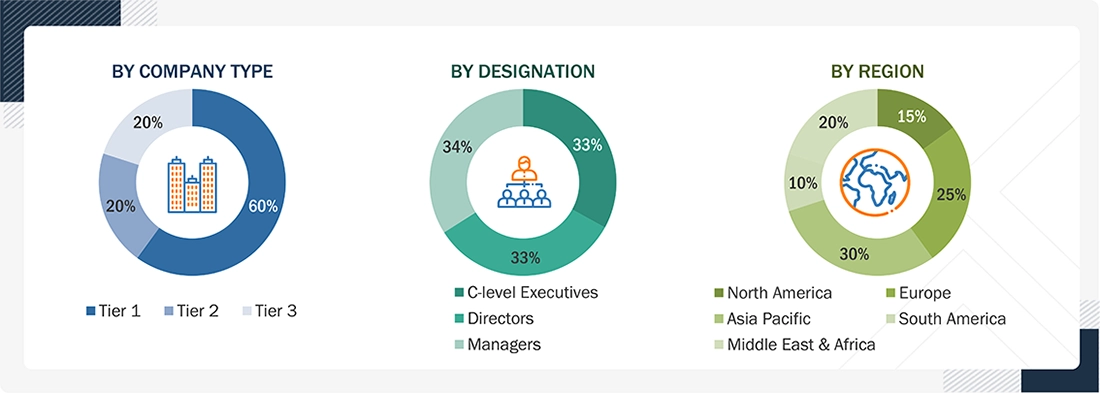
The following is the breakdown of primary respondents:
To know about the assumptions considered for the study, download the pdf brochure
Market Size Estimation
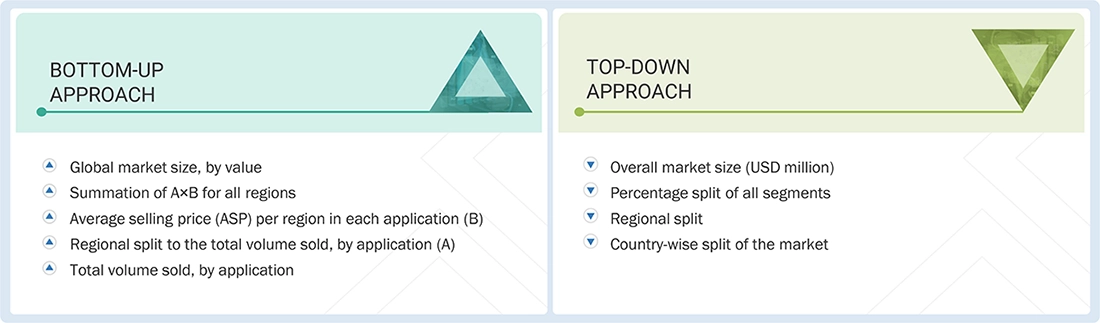
The research methodology used to estimate the size of the wind turbine composites market includes the following details. The market sizing was undertaken from the demand side. The market was upsized based on procurements and modernizations in wind turbine composites in different applications at a regional level. Such procurements provide information on the demand aspects of the wind turbine composites industry for each application. For each application, all possible segments of the wind turbine composites market were integrated and mapped.
Data Triangulation
After arriving at the overall size from the market size estimation process explained above, the total market was split into several segments and subsegments. The data triangulation and market breakdown procedures explained below were implemented, wherever applicable, to complete the overall market engineering process and arrive at the exact statistics for various market segments and subsegments. The data was triangulated by studying various factors and trends from the demand and supply sides. Along with this, the market size was validated using both the top-down and bottom-up approaches.
Market Definition
Wind turbine composites are advanced engineered materials made by reinforcing polymers with fibers such as glass or carbon, used in the construction of wind turbine components. These composites provide a high strength-to-weight ratio, durability, and resistance to environmental stresses like corrosion and fatigue. They are most commonly used in blades, nacelles, and other structural parts to enhance efficiency and longevity. Their lightweight nature allows for longer blades, which improves energy capture and overall turbine performance.
Key Stakeholders
- Wind turbine composite manufacturers
- Raw material manufacturers
- Government and research organizations
- R&D institutions
- National and local government organizations
- Institutional investors
- Wind turbine composite suppliers
- End users
Report Objectives
- To define, describe, and forecast the wind turbine composites market size in terms of volume and value
- To provide detailed information regarding the key factors, such as drivers, restraints, opportunities, and challenges influencing market growth
- To analyze and project the global wind turbine composites market by fiber type, resin type, manufacturing process, component, application, and region
- To forecast the market size concerning five main regions (along with country-level data), namely, North America, Europe, Asia Pacific, the Middle East & Africa, and South America, and analyze the significant region-specific trends
- To strategically analyze micromarkets with respect to individual growth trends, prospects, and contributions of the submarkets to the overall market
- To analyze the market opportunities and the competitive landscape for stakeholders and market leaders
- To assess recent market developments and competitive strategies, such as agreements, contracts, acquisitions, and product developments/product launches, to draw the competitive landscape
- To strategically profile the key market players and comprehensively analyze their core competencies
Available customizations:
MarketsandMarkets offers the following customizations for this market report:
- Additional country-level analysis of the wind turbine composites market
Product Analysis
- Product matrix, which provides a detailed comparison of the product portfolio of each company’s market.
Get the Full Wind Turbine Composites Market Report
Full forecast, segment splits, and company analysis for all Wind Turbine Composites Market.
- US Wind Turbine Composites Market
- CANADA Wind Turbine Composites Market
- MEXICO Wind Turbine Composites Market
- GERMANY Wind Turbine Composites Market
- FRANCE Wind Turbine Composites Market
- SWEDEN Wind Turbine Composites Market
- SPAIN Wind Turbine Composites Market
- FINLAND Wind Turbine Composites Market
- NETHERLANDS Wind Turbine Composites Market
- UK Wind Turbine Composites Market
- CHINA Wind Turbine Composites Market
- INDIA Wind Turbine Composites Market
- JAPAN Wind Turbine Composites Market
- AUSTRALIA Wind Turbine Composites Market
- SOUTH KOREA Wind Turbine Composites Market
- BRAZIL Wind Turbine Composites Market
- ARGENTINA Wind Turbine Composites Market
- EGYPT Wind Turbine Composites Market
Need a Tailored Report?
Customize this report to your needs
Get 10% FREE Customization
Customize This Report
