
South Africa Wind Turbine Operations and Maintenance Market (2025-2030)

The South Africa Wind Turbine Operations and Maintenance Market was valued at $137.07 Million in 2025 and projected to reach to $260.51 Million by 2030, representing a compound annual growth rate of 13.7%. South Africa's wind turbine operations and maintenance market is positioned for accelerated growth through 2030, supported by the country's renewable energy expansion strategy and commitment to reducing carbon emissions.


| Market Size in | USD 26.32 MN |
| Market Forecast in | |
| CAGR | |
| Forecast Period | |
| Units Considered | Value (USD MN) |
South Africa Wind Turbine Operations and Maintenance Market Trends and Insights
- This 13.7% compound annual growth rate significantly outpaces the global average of 8.5%, reflecting South Africa's strategic focus on renewable energy infrastructure and grid modernization.
- South Africa's expanding wind capacity and aging turbine fleet are driving sustained demand for specialized maintenance services, predictive analytics, and spare parts logistics across the country's growing wind farms. The market dynamics in South Africa are shaped by the nation's commitment to renewable energy targets and the need to optimize operational efficiency across existing installations.
- South Africa's wind sector benefits from favorable wind resources, particularly in coastal and inland regions, which support both new deployments and intensive maintenance operations.
- Between 2025 and 2030, South Africa will require increased investment in skilled technician training, digital monitoring systems, and supply chain resilience to support the accelerating transition away from coal-dependent energy generation..
Key Market Statistics
- CAGR (2025-2030) 13.7% CAGR
- Market Size, 2025 ~USD 137.07 Million
- Forecast, 2030 ~USD 260.51 Million
- Country South Africa
South Africa Wind Turbine Operations and Maintenance Market Overview
Outpacing Global Growth :
South Africa's wind turbine O&M market grows at 13.7% CAGR, significantly exceeding the global average of 8.5%, driven by aggressive renewable energy targets and government incentives.
Substantial Market Expansion :
Market valuation nearly doubles from $137.07 million in 2025 to $260.51 million by 2030, reflecting increased wind farm installations and aging asset maintenance requirements across the country.
Renewable Energy Commitment :
South Africa's strategic pivot toward renewable energy infrastructure and grid modernization creates sustained demand for specialized O&M services and skilled technical workforce development.
Infrastructure Investment Surge :
Growing wind capacity additions in provinces like the Western Cape and Northern Cape drive demand for preventive maintenance, spare parts supply chains, and remote monitoring technologies.
South Africa Wind Turbine Operations and Maintenance Market Dynamics
- The 13.7% CAGR reflects increasing wind farm deployments, particularly in high-potential coastal and inland regions, coupled with the need for comprehensive maintenance of existing installations. Key growth drivers include government support through renewable energy procurement programs, private sector investment in wind projects, and the critical need for skilled O&M service providers.
- As South Africa's wind capacity expands, demand for predictive maintenance, spare parts logistics, and digital monitoring solutions will intensify, creating opportunities for both local and international service providers to establish operations and partnerships..
Market Ecosystem
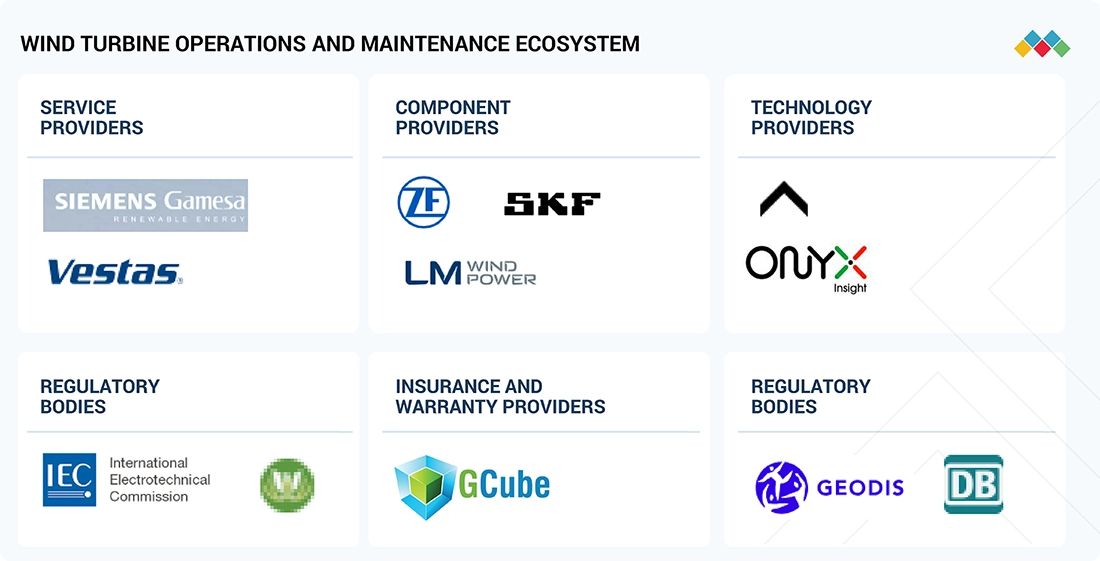
Wind Turbine Operations Maintenance Market: COMMERCIAL USE CASES ACROSS INDUSTRIES
| COMPANY | USE CASE DESCRIPTION | BENEFITS |
|---|---|---|
 |
The maintenance of wind infrastructures, particularly offshore wind turbines, poses significant challenges due to their remote location and complex operational environments. It is critical to monitor and understand the behavior of wind turbines in real time to predict potential failures, avoid unplanned outages, optimize maintenance schedules, and reduce operational costs. Traditional maintenance practices often fall short in providing timely diagnostics and predictive capabilities, resulting in inefficient operations and increased costs. | To address these challenges, Tekniker, in collaboration with its spin-off ATTEN2, developed a comprehensive monitoring solution for deployment at the Los Monteros wind farm. This solution combines advanced technologies to enable real-time diagnostics and predictive maintenance. It leverages data from the SCADA (Supervisory Control and Data Acquisition) system—tracking key operational parameters such as wind speed, generator speed, pitch angle, active force, gearbox oil temperature, and operational status—along with additional sensors that monitor the degradation and particle count in gearbox oil. Central to the system is Tekniker's proprietary Fingerprint methodology, which analyzes turbine behavior over time, allowing for early detection of anomalies through historical data comparison. These insights are processed using the SAM (Smart Asset Management) platform, which employs intelligent algorithms to optimize equipment performance, extend its operational life, and reduce operating expenses. At Los Monteros, SAM acts as the primary tool for analyzing SCADA and sensor inputs, enabling ATTEN2 to efficiently manage servicing and monitor system alarms. This integrated approach has significantly improved the reliability and availability of the wind turbines, enhanced maintenance efficiency, and lowered operational costs. |
 |
Offshore wind farms, such as those operated by Ørsted, face significant challenges in operations and maintenance due to the remote and often inaccessible nature of turbine structures. Traditional maintenance approaches require physical inspections, which can be time-consuming, costly, and pose safety risks to personnel. The need arises for innovative solutions that can reduce manual interventions, enhance safety, and improve the efficiency of O&M activities. | Ørsted has pioneered the integration of 3D laser scanning technology to address these challenges. By employing laser scanners capable of capturing up to two million data points per second, Ørsted creates detailed 3D models of turbine environments. This technology allows for the visualization of hard-to-reach internal structures without the need for physical presence. The high-resolution scans are combined with additional data to form comprehensive digital twins—accurate virtual representations of the turbines. These digital twins enable engineers to conduct assessments, plan maintenance, and simulate interventions remotely from their desktops. This approach not only enhances safety by reducing the need for on-site visits but also improves the quality and effectiveness of maintenance operations. |
Logos and trademarks shown above are the property of their respective owners. Their use here is for informational and illustrative purposes only.
Related Ecosystem
Decarbonization
- Battery Electric Vehicle (BEV)
- Energy Management Systems
- Fuel Cell
- Fuel Cell Electric Vehicle (FCEV)
- Geographical Information System (GIS)
- TotalEnergies SE
- Siemens ag
- Mitsui & Co., Ltd.
- General Electric Company
- Thyssenkrupp ag
Key Takeaways
- South Africa's wind turbine O&M market will nearly double from $137.07M (2025) to $260.51M (2030), driven by 13.7% CAGR growth.
- South Africa's renewable energy commitments and expanding wind capacity create sustained demand for preventive maintenance and digital monitoring solutions.
- South Africa faces critical skills gaps and supply chain challenges that will shape O&M service delivery and technology adoption through 2030.
- South Africa's coastal and inland wind resources position the country as a regional leader, attracting international O&M service providers and investment.
Wind Turbine Operations and Maintenance Market Report Scope
| Report Metric | Details |
|---|---|
| Base Year | 2025 |
| Fastest Growing Segment | STANDALONE (Turbine Connectivity) |
| Forecast Period | 2025-2030 |
| Growth Rate | CAGR of 8.5% from 2025 to 2030 |
| Largest Segment | GRID-CONNECTED (Turbine Connectivity) |
| Market Size Base Year (Billions) | ~USD 39.68 (2025) |
| Revenue Forecast (Billions) | ~USD 59.67 (2030) |
| Segments Covered | Type, Turbine Connectivity |
South Africa Wind Turbine Operations and Maintenance Market Report Segmentation
2 segment dimensions are covered across the global market.
By Type
- Scheduled
- Unscheduled
By Turbine Connectivity
- Grid-Connected
- Standalone
Target Audience
- Wind Energy Operators : South African wind farm owners and operators need market intelligence to optimize maintenance strategies, benchmark costs, and plan capital expenditures for aging asset management.
- O&M Service Providers : Local and international maintenance service companies require detailed market data to identify growth opportunities, assess competitive positioning, and develop service expansion plans in South Africa.
- Equipment Manufacturers : Turbine and component manufacturers need market insights to understand aftermarket service demand, spare parts requirements, and service network development opportunities in South Africa.
- Investment & Financial Firms : Private equity, venture capital, and infrastructure investors require comprehensive market analysis to evaluate investment opportunities and returns in South Africa's wind O&M sector.
- Government & Policy Makers : South African energy regulators and government agencies need market data to inform renewable energy policy, workforce development initiatives, and infrastructure investment priorities.
Reasons to Buy this Report
- Market Entry Strategy : Identify high-growth opportunities in South Africa's wind sector with detailed regional analysis, competitive landscape assessment, and strategic entry points for O&M service providers.
- Investment Decision Support : Access comprehensive financial projections and market sizing data to support capital allocation decisions for wind energy infrastructure investments and service business expansion in South Africa.
- Competitive Intelligence : Understand South Africa's unique market dynamics, regulatory environment, and competitive positioning to develop targeted strategies against local and international competitors.
- Technology & Service Planning : Leverage market insights to align product development and service offerings with South Africa's specific needs for predictive maintenance, digital solutions, and workforce training.
- Risk Mitigation : Evaluate market trends, growth drivers, and potential challenges specific to South Africa's renewable energy sector to inform risk management and long-term business planning.
Frequently asked questions
What is the current size of South Africa's wind turbine operations and maintenance market?
South Africa's wind turbine O&M market is valued at $137.07 million in 2025 and is expected to grow to $260.51 million by 2030.
What is the projected growth rate for South Africa's wind turbine O&M market?
South Africa's wind turbine O&M market is projected to grow at a compound annual growth rate (CAGR) of 13.7% from 2025 to 2030.
What factors are driving growth in South Africa's wind turbine maintenance sector?
South Africa's growth is driven by expanding wind capacity, renewable energy policy targets, aging turbine fleets requiring intensive maintenance, and increasing adoption of predictive analytics and digital monitoring technologies.
How does South Africa's wind O&M market growth compare to global trends?
South Africa's 13.7% CAGR significantly exceeds the global average of 8.5%, reflecting the country's accelerated renewable energy transition and strategic infrastructure investments.
What are the main challenges for wind turbine O&M service providers in South Africa?
South Africa's O&M sector faces skilled technician shortages, supply chain vulnerabilities, remote turbine locations, and the need for localized spare parts inventory and service infrastructure.
RESEARCH METHODOLOGY
The study involved major activities in estimating the current size of the wind turbine operations and maintenance market. Exhaustive secondary research was done to collect information on the peer and parent markets. The next step was to validate these findings, assumptions, and sizing with industry experts across the value chain through primary research. Both the top-down and bottom-up approaches were employed to estimate the total market size. Thereafter, market breakdown and data triangulation were used to estimate the market size of the segments and subsegments.
Secondary Research
This research study on the wind turbine o&m market involved the use of extensive secondary sources, directories, and databases, such as Hoover’s, Bloomberg, Factiva, IRENA, International Energy Agency, and Statista Industry Journal, to collect and identify information useful for a technical, market-oriented, and commercial study of the market. The other secondary sources included annual reports, press releases & investor presentations of companies, white papers, certified publications, articles by recognized authors, manufacturer associations, trade directories, and databases.
Primary Research
The wind turbine operations and maintenance market comprises several stakeholders, such as equipment providers, service providers, and technology providers in the supply chain. The demand side of this market is characterized by the rising demand for operations and maintenance solutions in various location types, such as onshore and offshore. The supply side is characterized by rising demand for contracts from the industrial sector and mergers & acquisitions among big players. Various primary sources from both the supply and demand sides of the market were interviewed to obtain qualitative and quantitative information. Following is the breakdown of primary respondents.
In the complete market engineering process, the top-down and bottom-up approaches and several data triangulation methods were extensively used to perform the market size estimations and forecasts for all segments and subsegments listed in this report. Extensive qualitative and quantitative analyses were conducted to complete the market engineering process and list key information/insights throughout the report.
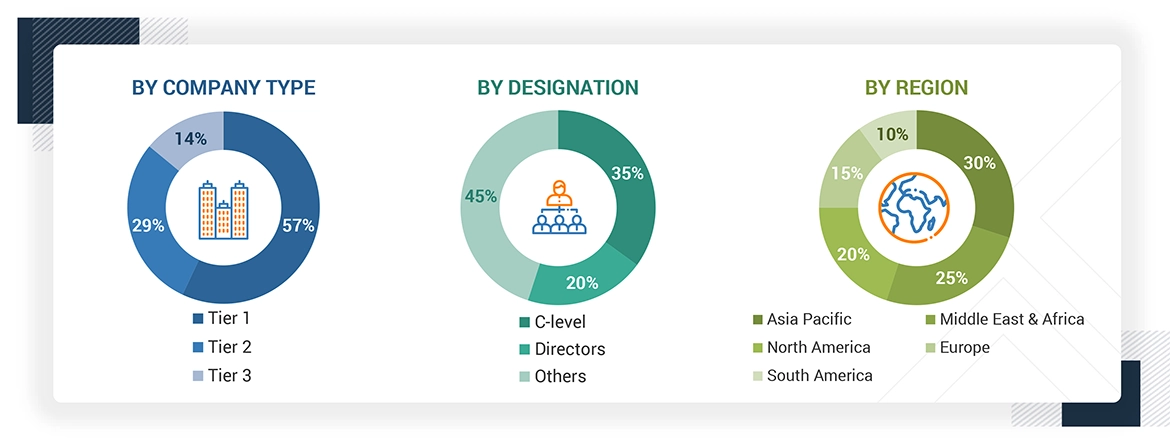
Note 1: Others include sales managers, marketing managers, and product managers.
Note 2: Tier 1 companies’ revenues are more than USD 10 billion; tier 2 companies’ revenues range between USD 1 and 10 billion; and tier 3 companies’ revenues range between USD 500 million and USD 1 billion.
Source: Industry Experts
To know about the assumptions considered for the study, download the pdf brochure
Market Size Estimation
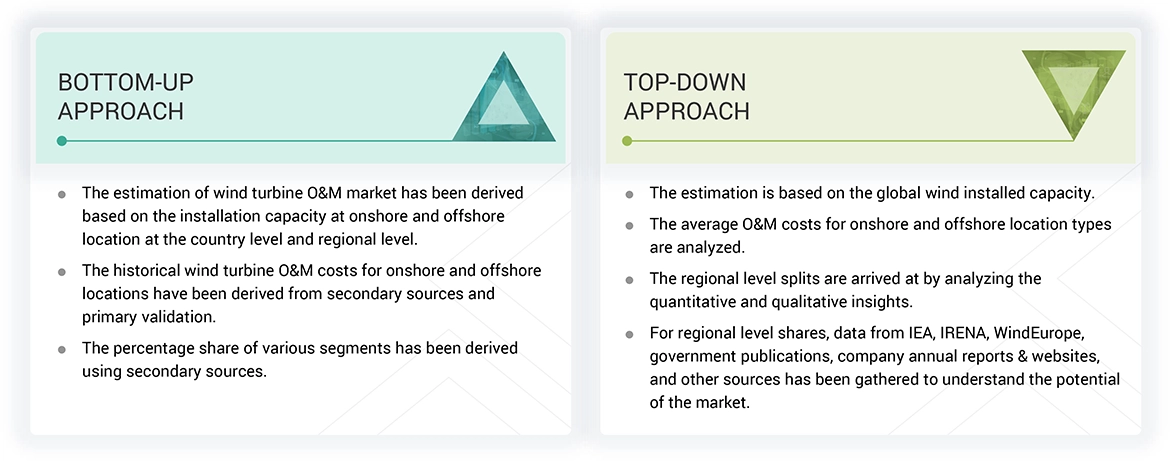
Both the top-down and bottom-up approaches were used to estimate and validate the total size of the market. These methods were also used extensively to estimate the size of various subsegments in the market. The research methodology used to estimate the market size includes the following.
Wind Turbine Operations and Maintenance Market : Top-Down and Bottom-Up Approach
Data Triangulation
After arriving at the overall market size from the above estimation process, the total market has been split into several segments and subsegments. Data triangulation and market breakdown processes have been employed to complete the overall market engineering process and arrive at the exact statistics for all the segments and sub-segments, wherever applicable. The data has been triangulated by studying various factors and trends from both the demand and supply sides. Along with this, the market has been validated using both the top-down and bottom-up approaches.
Market Definition
Wind energy is generated with wind turbines, which harvest the kinetic energy from the wind through blades. The blades rotate to form a spinning rotor to which the generator is attached, and the generator converts this energy into electricity. Wind turbine operations and maintenance (O&M) is comprised of all maintenance and service tasks (including functional checks, repair, and/or replacement of equipment) that are needed to ensure that wind turbines operate efficiently, reliably, and safely throughout their operational life of 20-25 years. O&M can also include both scheduled (preventive) and unscheduled (corrective) maintenance tasks. The market is assessed based on the revenue generated from O&M activities for wind turbines located in both onshore and offshore wind farms.
Stakeholders
- Government and Research Organizations
- Energy Service Providers (private/government)
- Utilities & Retail Electricity Suppliers
- Original Equipment Manufacturers (OEMs)
- Independent Service Providers (ISPs)
- Asset Owners/Operators
- Technology Providers
- Spare Parts Suppliers & Logistics
- Consultants/Consultancies/Advisory Firms
- Environmental Research Institutes
- Private or Investor-owned Utilities
- State and National Regulatory Authorities
- Investors/Shareholders
Report Objectives
- To define, describe, and forecast the wind turbine operations and maintenance market based on type, location type, turbine connectivity, and region, in terms of value
- To forecast the market size across five key regions, namely, North America, Europe, Asia Pacific, the Middle East & Africa, and South America, in terms of value
- To provide detailed information about the key drivers, restraints, opportunities, and industry-specific challenges influencing the growth of the market
- To strategically analyze the market with respect to individual growth trends, prospects, and contributions of each segment to the market
- To provide information pertaining to the supply chain, trends/disruptions impacting customer business, market maps, pricing of hardware solutions, and regulatory landscape pertaining to the market
- To strategically analyze the micromarkets with respect to individual growth trends, upcoming expansions, and their contributions to the overall market
- To analyze opportunities for stakeholders in the market and draw a competitive landscape for market players
- To benchmark players within the market using the company evaluation quadrant, which analyzes market players on various parameters within the broad categories of business and product strategies
- To strategically profile key players and comprehensively analyze their market ranking and core competencies
- To track and analyze competitive developments in the market, such as sales contracts, agreements, investments, expansions, alliances, mergers, partnerships, joint ventures, collaborations, and acquisitions
Available Customizations
MarketsandMarkets offers customizations according to the specific needs of the companies with the given market data.
The following customization options are available for the report:
Product Analysis
- Product matrix, which gives a detailed comparison of the product portfolio of each company
Geographic Analysis as per Feasibility
- Further breakdown of the wind turbine operations and maintenance market, by country
Company Information
- Detailed analysis and profiling of additional market players (up to five)
Get the Full Wind Turbine Operations and Maintenance Market Report
Full forecast, segment splits, and company analysis for all Wind Turbine Operations and Maintenance Market.
- China Wind Turbine Operations and Maintenance Market
- Japan Wind Turbine Operations and Maintenance Market
- South Korea Wind Turbine Operations and Maintenance Market
- India Wind Turbine Operations and Maintenance Market
- Australia Wind Turbine Operations and Maintenance Market
- Germany Wind Turbine Operations and Maintenance Market
- UK Wind Turbine Operations and Maintenance Market
- Italy Wind Turbine Operations and Maintenance Market
- France Wind Turbine Operations and Maintenance Market
- Sweden Wind Turbine Operations and Maintenance Market
- Spain Wind Turbine Operations and Maintenance Market
- US Wind Turbine Operations and Maintenance Market
- Canada Wind Turbine Operations and Maintenance Market
- Mexico Wind Turbine Operations and Maintenance Market
- Brazil Wind Turbine Operations and Maintenance Market
- Argentina Wind Turbine Operations and Maintenance Market
- Saudi Arabia Wind Turbine Operations and Maintenance Market
- Egypt Wind Turbine Operations and Maintenance Market
- Rest Of Europe Wind Turbine Operations and Maintenance Market
- Rest Of Asia Pacific Wind Turbine Operations and Maintenance Market
- Rest Of South America Wind Turbine Operations and Maintenance Market
Need a Tailored Report?
Customize this report to your needs
Get 10% FREE Customization
Customize This Report
