
Sweden Wireless Charging Market (2026-2031)

The Sweden Wireless Charging Market was valued at $316 Million in 2026 and projected to reach to $2097 Million by 2031, representing a compound annual growth rate of 37.1%. Sweden's wireless charging market is poised for exceptional growth through 2031, driven by the country's advanced automotive sector and strong commitment to electrification.


| Market Size in | USD 26.32 MN |
| Market Forecast in | |
| CAGR | |
| Forecast Period | |
| Units Considered | Value (USD MN) |
Sweden Wireless Charging Market Trends and Insights
- Valued at $316.0 million in 2026, Sweden's market is forecast to grow substantially to $2,097.0 million by 2031, reflecting a compound annual growth rate of 37.1%.
- This accelerated growth trajectory positions Sweden as a key market for wireless charging adoption in Northern Europe, driven by strong automotive electrification trends and consumer demand for advanced vehicle technologies. The Swedish wireless charging market benefits from the country's leadership in electric vehicle adoption and technological innovation.
- Sweden's commitment to sustainability and its robust automotive manufacturing base create favorable conditions for wireless charging infrastructure development.
- Between 2026 and 2031, Sweden is expected to see significant investments in both passenger vehicle and commercial transportation wireless charging solutions, supporting the broader European transition toward seamless, cable-free charging ecosystems..
Key Market Statistics
- CAGR (2026-2031) 37.1% CAGR
- Market Size, 2026 ~USD 316 Million
- Forecast, 2031 ~USD 2097 Million
- Country Sweden
Sweden Wireless Charging Market Overview
Rapid Market Expansion :
Sweden's wireless charging market is projected to grow from $316.0 million in 2026 to $2,097.0 million by 2031, representing a 37.1% CAGR and positioning the country as a leader in Northern European adoption.
EV Infrastructure Leadership :
Sweden's strong electric vehicle penetration and commitment to sustainable transportation create ideal conditions for wireless charging integration in automotive applications across the country.
Technology Innovation Hub :
Swedish automotive manufacturers and tech companies are actively investing in wireless charging solutions, driving local innovation and creating competitive advantages in the regional market.
Government Support & Incentives :
Sweden's progressive environmental policies and infrastructure investments support the deployment of wireless charging systems in both public and private transportation networks.
Sweden Wireless Charging Market Dynamics
- The 37.1% CAGR reflects increasing adoption of wireless charging technology in passenger vehicles, commercial fleets, and public transportation infrastructure.
- Sweden's position as a technology innovator and EV leader in Northern Europe accelerates market penetration. The forecast growth to $2,097.0 million by 2031 is supported by rising consumer demand for convenient charging solutions, manufacturer investments in wireless technology, and supportive regulatory frameworks.
- Strategic partnerships between automotive OEMs and charging infrastructure providers will further expand market opportunities across Sweden's transportation ecosystem..
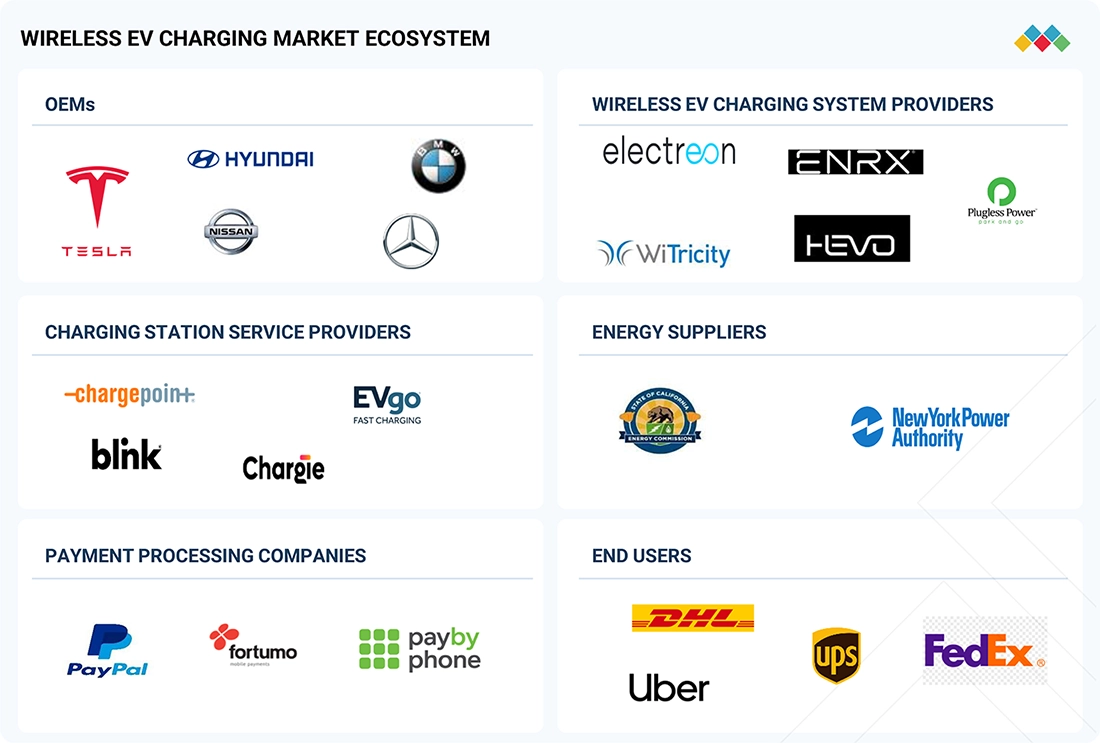
Market Ecosystem
WIRELESS EV CHARGING MARKET: COMMERCIAL USE CASES ACROSS INDUSTRIES
| COMPANY | USE CASE DESCRIPTION | BENEFITS |
|---|---|---|
 |
Road-embedded wireless charging systems for public transport and logistics vehicles | Continuous energy supply during travel, smaller onboard battery requirement, lower vehicle weight and cost |
 |
Magnetic resonance-based wireless charging solutions for passenger cars and light commercial vehicles | Convenient hands-free charging, high efficiency transfer up to 11 kW, supports interoperability across multiple EV models |
 |
Inductive wireless charging systems for public transport, industrial vehicles, and high-power applications | High power transfer for heavy duty vehicles, reliable in harsh environments, reduced maintenance, supports opportunity charging for fleets |
 |
Smart wireless charging platforms integrated with mobile apps and grid services | Compact design for urban environments, enhanced user experience with app-based monitoring, potential for V2G integration |
 |
Aftermarket wireless charging kits for popular EV models | Easy retrofit installation, improved user convenience, reduced wear and tear on charging connectors |
Logos and trademarks shown above are the property of their respective owners. Their use here is for informational and illustrative purposes only.
Related Ecosystem
Automotive Electronics And Electrical Equipment
- Battery Electric Vehicle (BEV)
- Light Commercial Vehicles (LCVs)
- Fuel Cell Electric Vehicle (FCEV)
- Sensors
- Hybrid Electric Vehicle (HEV)
- BOSCH LIMITED
- Continental ag
- DENSO Corporation
- Texas Instruments Incorporated
- Panasonic Holdings Corporation
Key Takeaways
- Sweden's wireless charging market is projected to grow from $316.0 million in 2026 to $2,097.0 million by 2031, representing a 37.1% CAGR.
- Sweden's strong EV adoption rates and sustainability focus position the country as a leading market for wireless charging technology in Northern Europe.
- The forecast period (2026–2031) will see accelerated infrastructure investment across Sweden's automotive and transportation sectors.
- Sweden's wireless charging market growth is driven by consumer demand for advanced vehicle technologies and OEM commitments to electrification.
Wireless Charging Market Report Scope
| Report Metric | Details |
|---|---|
| Base Year | 2026 |
| Fastest Growing Segment | >11 KW (Power Supply Range) |
| Forecast Period | 2026–2031 |
| Growth Rate | CAGR of 38.7% from 2026 to 2031 |
| Largest Segment | 7.8–11 KW (Power Supply Range) |
| Market Size Base Year (Billions) | ~USD 0.12 (2026) |
| Revenue Forecast (Billions) | ~USD 0.59 (2031) |
| Segments Covered | Charging System, Application, Component, Power Supply Range |
Sweden Wireless Charging Market Report Segmentation
4 segment dimensions are covered across the global market.
By Charging System
- Inductive Power Transfer
- Magnetic Power Transfer
By Application
- Home Charging Units
By Component
- Base Charging Pads
- Power Control Units
- Vehicle Charging Pads
By Power Supply Range
- 3.7–7.7 Kw
- 7.8–11 Kw
- <3.7 Kw
- >11 Kw
Target Audience
- Automotive OEMs & Suppliers : Swedish and international automotive manufacturers need market intelligence to develop wireless charging-enabled vehicles and integrate technology into production roadmaps for the Nordic market.
- Charging Infrastructure Providers : Companies planning to deploy wireless charging networks in Sweden require detailed market forecasts and adoption data to optimize infrastructure investment and site selection strategies.
- Investment & Private Equity Firms : Investors evaluating opportunities in Sweden's transportation technology sector need comprehensive market sizing and growth projections to assess portfolio companies and funding decisions.
- Government & Policy Makers : Swedish government agencies and transportation authorities require market data to inform infrastructure planning, incentive programs, and regulatory frameworks supporting wireless charging adoption.
- Technology & Innovation Companies : Tech firms developing wireless charging solutions need Sweden-specific market insights to validate business models, identify customer segments, and prioritize market entry strategies.
Key Companies in the Sweden Wireless Charging Market
| Company | HQ | Ownership | Strongest segments |
|---|---|---|---|
| OLEV TECHNOLOGIES | Core hardware / platform solutions,Software, analytics, and control layers,Services, integration, and support, | ||
| GAZ | Russia | Public Company | Pipeline natural gas,Oil and refined products,Electric power and heat, |
| ALTEN | France | Public Company | Engineering & R&D Services,Digital & IT Services,Life Sciences & Health Consulting, |
| METHODE ELECTRONICS | United States | Public Company | Automotive HMI (switches, touch systems, interface modules),Power distribution and power conversion,Sensors and actuators, |
| ENERSYS | United States | Public Company | Network & Infrastructure Solutions,Industrial Mobility Solutions,Precision Power Solutions, |
| RHEINMETALL AG | Germany | Public Company | Vehicle Systems,Weapon and Ammunition,Electronic Solutions, |
| ELRINGKLINGER AG | Germany | Public Company | Original Equipment,Aftermarket,Engineered Plastics, |
| ALTRAN | France | Private Company | Engineering and R&D Services,Organization and IT Systems Consulting,Other and Corporate, |
| MOL GROUP | Hungary | Public Company | Refined fuels (gasoline, diesel, heating oil, bunker, JET A-1, LPG/autogas),Retail convenience and mobility (Fresh Corner, e-mobility, car/bike sharing, fleet),Petrochemicals and black products (bitumen, HFO, petrolcoke, residues), |
| LEONI AG | Germany | Private Company | Complete wiring systems and cable harnesses (ICE platforms),High-voltage wiring systems for hybrid and electric vehicles,Standard and special automotive cables, |
| EDF ENERGY | United Kingdom | Private Company | Electricity generation and retail supply,Gas supply and gas boiler heating solutions,EV charging infrastructure and electric vehicles, |
| ELECTREON | Israel | Public Company | Dynamic wireless road charging,Stationary and semi-dynamic charging,Engineering services, pilots, and integration, |
| MITSUBISHI ELECTRIC CORPORATION | Japan | Public Company | Factory Automation (FA) systems and Industry & Mobility,Building systems (elevators, escalators, building management),Air conditioning, refrigeration, lighting, and home equipment, |
| TOYOTA MOTOR CORPORATION | Japan | Public Company | Conventional ICE passenger vehicles,Hybrid and battery electric vehicles,Commercial vehicles (trucks, buses, pickups), |
| ROBERT BOSCH GMBH | Germany | Private Company | Mobility (powertrain, chassis, electronics, aftermarket, steering),Industrial Technology (drive, control, actuators, process and packaging),Consumer Goods (power tools, garden tools, home appliances), |
| CONTINENTAL AG | Germany | Public Company | Passenger car and light truck tires,Truck, bus, and specialty vehicle tires,Industrial rubber products (hoses, conveyor belts, air and drive belts), |
| TOSHIBA CORPORATION | Japan | Private Company | Energy Systems & Solutions,Infrastructure Systems & Solutions,Building Solutions, |
| HELLA GMBH & CO. KGAA | Germany | Public Company | Lighting,Electronics,Lifecycle Solutions, |
| IDEANOMICS INC. | United States | Private Company | Commercial EV fleet solutions (procurement, financing, energy management),High-power inductive charging for medium and heavy-duty EVs,Fintech / Ideanomics Capital solutions, |
OLEV TECHNOLOGIES
OLEV Technologies specializes in wireless power transfer technology for vehicle electrification.
GAZ
GAZ is a Russian public company founded in 1993 with 468,000 employees, operating as a major automotive manufacturer.
ALTEN
ALTEN is a French public company founded in 1988 with 56,376 employees, providing engineering and IT consulting services.
METHODE ELECTRONICS
Methode Electronics, founded in 1946, is a United States-based public company with 6,650 employees manufacturing electronic components and assemblies.
ENERSYS
EnerSys, founded in 1991, is a United States-based public company with 9,682 employees specializing in energy storage and power conversion solutions.
RHEINMETALL AG
Rheinmetall AG is a German public company founded in 1889 with 28,815 employees, operating in automotive and defense technology sectors.
ELRINGKLINGER AG
ElringKlinger AG, founded in 1879, is a German public company with 8,542 employees manufacturing automotive components and sealing technologies.
ALTRAN
ALTRAN is a French private company founded in 1970 with 50,124 employees providing engineering and digital transformation services.
MOL GROUP
MOL Group is a Hungarian public company founded in 1991 with 24,744 employees operating in the oil, gas, and petrochemical industries.
LEONI AG
LEONI AG, founded in 1569, is a German private company with 95,090 employees manufacturing cables, wiring systems, and related products.
EDF ENERGY
EDF Energy is a United Kingdom-based private company founded in 1989 with 819 employees operating in the energy sector.
ELECTREON
Electreon, founded in 1992, is an Israeli public company with 109 employees developing wireless electric road technology.
MITSUBISHI ELECTRIC CORPORATION
Mitsubishi Electric Corporation, founded in 1921, is a Japanese public company with 150,386 employees manufacturing electrical and electronic equipment.
TOYOTA MOTOR CORPORATION
Toyota Motor Corporation, founded in 1933, is a Japanese public company with 390,927 employees and a leading global automotive manufacturer.
ROBERT BOSCH GMBH
Robert Bosch GmbH, founded in 1886, is a German private company with 412,774 employees manufacturing automotive components and industrial technology.
CONTINENTAL AG
Continental AG, founded in 1871, is a German public company with 22,076 employees specializing in automotive technology and components.
TOSHIBA CORPORATION
Toshiba Corporation, founded in 1875, is a Japanese private company with 106,648 employees manufacturing electronics, semiconductors, and industrial equipment.
HELLA GMBH & CO. KGAA
HELLA GmbH & Co. KGaA, founded in 1899, is a German public company with 33,639 employees manufacturing automotive lighting and electronics.
IDEANOMICS INC.
Ideanomics Inc., founded in 2004, is a United States-based private company with 295 employees operating in financial technology and digital commerce.
Reasons to Buy this Report
- Market Size & Growth Data : Access precise valuation of Sweden's wireless charging market with detailed CAGR analysis, enabling accurate financial forecasting and investment decision-making specific to the Swedish automotive sector.
- Competitive Landscape Intelligence : Understand key players, market share distribution, and competitive positioning within Sweden's wireless charging ecosystem to identify partnership and acquisition opportunities.
- Regional Market Dynamics : Gain insights into Sweden-specific drivers including regulatory environment, consumer preferences, and infrastructure development that differentiate this market from broader European trends.
- Strategic Investment Guidance : Make informed decisions on market entry, expansion, or product development in Sweden with comprehensive analysis of growth catalysts and market maturity indicators through 2031.
- Technology Adoption Trends : Track wireless charging technology adoption patterns specific to Swedish automotive manufacturers and transportation operators to align product development and marketing strategies.
Frequently asked questions
What is the current size of Sweden's wireless charging market?
Sweden's wireless charging market was valued at $316.0 million in 2026 and is forecast to reach $2,097.0 million by 2031.
What is the expected growth rate for wireless charging in Sweden?
Sweden's wireless charging market is expected to grow at a compound annual growth rate (CAGR) of 37.1% between 2026 and 2031.
Why is Sweden a significant market for wireless charging technology?
Sweden leads in electric vehicle adoption, has strong sustainability commitments, and possesses a robust automotive manufacturing base that supports wireless charging infrastructure development.
Which sectors in Sweden are driving wireless charging adoption?
Sweden's automotive and transportation sectors are the primary drivers, including both passenger vehicles and commercial transportation applications.
What market value is expected for Sweden's wireless charging sector by 2031?
Sweden's wireless charging market is projected to reach $2,097.0 million by 2031, up from $316.0 million in 2026.
RESEARCH METHODOLOGY
This research study involved the extensive use of secondary sources, such as company annual reports/presentations, industry association publications, automotive magazine articles, directories, technical handbooks, the World Economic Outlook, trade websites, technical articles, and databases, to identify and collect information on the Wireless EV Charging Market. In-depth interviews were conducted with various primary respondents, including key industry participants, subject-matter experts, C-level executives of key market players, and industry consultants, among others, to obtain and verify critical qualitative and quantitative information and assess market prospects.
Secondary Research
In the secondary research process, various secondary sources were used to identify and collect information for this study on the Wireless EV Charging Market. Secondary sources included annual reports, press releases, and investor presentations of companies; whitepapers, certified publications, and articles from recognized authors; directories; databases; and articles from recognized associations and government publishing sources.
Primary Research
After understanding the Wireless EV Charging Market through secondary research, extensive primary research was conducted. Primary interviews were conducted with market experts from both demand and supply sides across North America, Europe, and Asia Pacific. Approximately 35% of interviews were conducted from the demand side, while 65% of primary interviews were conducted from the supply side. The primary data was collected through questionnaires, emails, and telephonic interviews.
In the canvassing of primaries, various departments within organizations, such as sales and operations, were covered to provide a holistic viewpoint in this report. Primary sources from the supply side include industry experts, such as CXOs, VPs, directors from business development, marketing, product development/innovation teams, and related key executives from various companies.
Note: Tiers of companies are based on the value chain of the Wireless EV Charging Market; the revenues of companies were not considered. Tier 1 companies include wireless charging providers and wired EV charging station manufacturers. Others include charging network providers, software solution providers, and charging component providers.
To know about the assumptions considered for the study, download the pdf brochure
Market Size Estimation
The bottom-up and top-down approaches were used to estimate and validate the size of the Wireless EV Charging Market. In these approaches, the penetration of EVs equipped with wireless charging at a country level was considered.
Data Triangulation
After arriving at the overall size of the market through the above-mentioned methodology, this market was split into several segments and subsegments. The data triangulation and market breakdown procedures were employed, wherever applicable, to complete the overall market engineering process and arrive at the exact market value data for the key segments and subsegments. The extrapolated market data was triangulated by studying various macro indicators and regional trends from both the demand- and supply-side participants.
Market Definition
Wireless charging encompasses technologies that enable the transfer of electrical power without physical connectors, using methods such as inductive, resonant, or radio frequency charging. It includes hardware, systems, and integration charging solutions.
Key Stakeholders
- Associations, Forums, and Alliances related to Wireless Charging for Electric Vehicles
- Automobile Manufacturers
- Battery Distributors
- Battery Manufacturers
- Charging Infrastructure Providers
- Charging Services Providers
- EV Charging Pole Manufacturers
- EV Charging Station Service Providers
- EV Distributors and Retailers
- EV Manufacturers
- Government Agencies and Policymakers
- Oil & Gas Companies
- Utility Companies
- Wireless EV Charging Providers
- Wireless EV Component Manufacturers
Report Objectives
-
To define and forecast the Wireless EV Charging Market
(2026–2032), in terms of volume and value - To segment the market and forecast its size based on charging type, component, application, charging system, propulsion, power supply range, vehicle type, and region
- To segment the market based on application and estimate the home charging units subsegment by volume and value, and the commercial charging stations subsegment by qualitative insights
- To segment the market based on charging type and estimate the stationary and dynamic wireless charging subsegments by qualitative insights
- To segment the market and forecast its size, by volume and value, based on vehicle type—passenger cars and commercial vehicles
- To segment the market and forecast its size, by value, based on component—base charging pads, power control units, and vehicle charging pads
- To segment the market and forecast its size, by volume and value, based on power supply range—<3.7 kW, 3.8–7.7 kW, 7.8–11 kW, and >11 kW
- To segment the market and forecast its size, by volume, based on propulsion—BEV and PHEV
- To segment the market and forecast its size, by volume, based on charging system—inductive power transfer, magnetic power transfer, and capacitive power transfer
- To forecast the market size with respect to key regions, namely North America, Europe, and Asia Pacific
- To provide detailed information regarding the major factors influencing market growth (drivers, challenges, restraints, and opportunities)
- To strategically analyze the market with respect to individual growth trends, prospects, and contribution to the total market
- To strategically profile key players and comprehensively analyze their market shares and core competencies
- To analyze the opportunities for stakeholders and the competitive landscape for market leaders
- To track and analyze competitive developments such as joint ventures, mergers & acquisitions, product launches, expansions, and other activities carried out by key industry participants
Available customizations:
With the given market data, MarketsandMarkets offers customizations in accordance with a company’s specific needs.
-
Wireless EV Charging Market, by Power Supply, at Country Level
(For countries covered in the report) -
Wireless EV Charging Market, by Vehicle Type, at Country Level
(For countries covered in the report) -
Wireless EV Charging Market, by component, at Country Level (For countries covered
in report) -
Wireless EV Charging Market, by Charging Type, at Country Level (For countries covered
in report)
- Profiling of Additional Market Players
Get the Full Wireless Charging Market Report
Full forecast, segment splits, and company analysis for all Wireless Charging Market.
- China Wireless Charging Market
- India Wireless Charging Market
- Japan Wireless Charging Market
- South Korea Wireless Charging Market
- France Wireless Charging Market
- Germany Wireless Charging Market
- Netherlands Wireless Charging Market
- Norway Wireless Charging Market
- Spain Wireless Charging Market
- Switzerland Wireless Charging Market
- UK Wireless Charging Market
- Canada Wireless Charging Market
- US Wireless Charging Market
Need a Tailored Report?
Customize this report to your needs
Get 10% FREE Customization
Customize This Report
