
UK Wireless Testing Market (2024-2029)

The UK Wireless Testing Market was valued at $945.6 Million in 2024 and projected to reach to $1429.6 Million by 2029, representing a compound annual growth rate of 8.6%. The UK wireless testing market is positioned for sustained growth as telecommunications operators and device manufacturers invest heavily in 5G infrastructure validation and next-generation network deployment.


| Market Size in | USD 26.32 MN |
| Market Forecast in | |
| CAGR | |
| Forecast Period | |
| Units Considered | Value (USD MN) |
UK Wireless Testing Market Trends and Insights
- The UK market is driven by increasing demand for 5G infrastructure validation, IoT device proliferation, and stringent regulatory compliance requirements across telecommunications and consumer electronics sectors.
- The UK's position as a leading technology hub in Europe accelerates adoption of advanced testing solutions among semiconductor manufacturers and network operators. Key growth catalysts in the UK include the rollout of next-generation wireless networks, rising complexity of device certification, and substantial investment in R&D by major electronics manufacturers.
- The UK wireless testing market benefits from strong government support for digital infrastructure and the presence of major global testing service providers.
- Between 2024 and 2029, the UK market is expected to maintain steady momentum as enterprises prioritize quality assurance and regulatory compliance in wireless product development..
Key Market Statistics
- CAGR (2024-2029) 8.6% CAGR
- Market Size, 2024 ~USD 945.6 Million
- Forecast, 2029 ~USD 1429.6 Million
- Country UK
UK Wireless Testing Market Overview
Market Valuation :
The UK wireless testing market is valued at $945.6 million in 2024, with a projected CAGR of 8.6% through 2029, reaching $1,429.6 million by forecast end.
5G Infrastructure Expansion :
UK operators are accelerating 5G rollout across urban and rural areas, driving demand for comprehensive wireless testing solutions to ensure network reliability and performance standards.
Regulatory Compliance Pressure :
Stringent UK and EU regulatory frameworks for telecommunications and consumer electronics mandate rigorous testing protocols, creating sustained demand for certified testing services and equipment.
IoT Device Proliferation :
The UK's growing IoT ecosystem across smart cities, healthcare, and industrial sectors requires extensive wireless validation testing to ensure device interoperability and connectivity standards.
UK Wireless Testing Market Dynamics
- Regulatory compliance requirements from Ofcom and UK government initiatives supporting digital infrastructure modernization will continue driving testing demand.
- The convergence of 5G, IoT, and emerging technologies like edge computing creates opportunities for advanced testing solutions.
- Additionally, the UK's role as a technology hub attracts international manufacturers requiring local testing capabilities, further supporting market expansion through 2029..
Market Ecosystem
Related Ecosystem
Testing Inspection And Certification
- Eddy Current Testing (ECT)
- Safety Testing
- Signal Generators
- Acoustic Emission Testing (AET)
- Automated Test Equipment
- Sgs s.a.
- Intertek Group plc
- Bureau veritas s.a.
- TUV RHEINLAND AG
- TUV SUD AG
Communication And Connectivity Technology
- Sensors
- Smart Card & Readers
- Cellular Network
- Femtocell
- Image Sensors
- Cisco Systems, Inc.
- HUAWEI TECHNOLOGIES CO LTD
- Lenovo
- CommScope Holding Company, Inc.
- Texas Instruments Incorporated
Key Takeaways
- The UK wireless testing market will grow from $945.6M (2024) to $1,429.6M (2029), representing 8.6% CAGR.
- The UK market is propelled by 5G deployment, IoT expansion, and regulatory compliance demands in telecommunications.
- The UK benefits from its status as a European technology leader with strong R&D investment and infrastructure support.
- The UK wireless testing sector will see increased demand for advanced certification and quality assurance solutions through 2029.
Wireless Testing Market Report Scope
| Report Metric | Details |
|---|---|
| Base Year | 2024 |
| Fastest Growing Segment | OTHER CONNECTIVITY TECHNOLOGIES (Connectivity Technology) |
| Forecast Period | 2024-2029 |
| Growth Rate | CAGR of 8.6% from 2024 to 2029 |
| Largest Segment | SERVICES (Offering) |
| Market Size Base Year (Billions) | ~USD 22.57 (2024) |
| Revenue Forecast (Billions) | ~USD 34.1 (2029) |
| Segments Covered | Offering, Equipment Type, Type, Application, Sub-Type, Connectivity Technology, Use Case |
UK Wireless Testing Market Report Segmentation
7 segment dimensions are covered across the global market.
By Offering
- Equipment
- Services
By Equipment Type
- Wireless Device Testing
- Wireless Ic Testing
- Wireless Module Testing
- Wireless Network Testing
By Type
- In-House
- Outsourced
- Wireless Device Testing
- Wireless Ic Testing
- Wireless Module Testing
- Wireless Network Testing
By Application
- Aerospace & Defense
- Automotive
- Consumer Electronics
- Energy & Power
- Industrial
- It & Telecommunication
- It & Telecommunications
- Medical Devices
- Other Applications
By Sub-Type
- Emi Test Receivers
- Network Analyzers
- Network Scanners
- Network Testers
- Oscilloscopes
- Ota Testers
- Other Wireless Network Testing Equipment
- Other Wireless Testing Equipment
- Signal Generators
- Spectrum Analyzers
By Connectivity Technology
- 2G/3G
- 2G/3G & 4G/5G
- 2G/3G/5G
- 4G/Lte
- 5G
- Bluetooth/Bluetooth Smart/Ble/Wlan
- Gps/Gnss Module
- Other Connectivity Technologies
- Wi-Fi
By Use Case
- Other Use Cases
- Production
- Research And Development (R&D)
- Return Merchandise Authorization (Rma)
UK: WIRELESS TESTING MARKET, BY APPLICATION, 2024–2029
| Segment | 2024 | 2025 | 2026 | 2027 | 2028 | 2029 | CAGR (%) |
|---|---|---|---|---|---|---|---|
| AEROSPACE & DEFENSE | 50.3 | 54.1 | 58.2 | 62.6 | 67.3 | 72.2 | 7.5 |
| AUTOMOTIVE | 83.6 | 92.5 | 102.4 | 113.3 | 125.2 | 137.9 | 10.5 |
| CONSUMER ELECTRONICS | 210 | 230.6 | 253.4 | 278.4 | 305.3 | 334.1 | 9.7 |
| ENERGY & POWER | 21 | 22.4 | 23.8 | 25.3 | 26.9 | 28.5 | 6.2 |
| INDUSTRIAL | 35.3 | 36.7 | 38.1 | 39.4 | 40.6 | 41.7 | 3.4 |
| IT & TELECOMMUNICATION | 399.9 | 431.7 | 466.4 | 504.1 | 544.2 | 586.2 | 7.9 |
| MEDICAL DEVICES | 100.7 | 111.7 | 123.9 | 137.5 | 152.4 | 168.4 | 10.8 |
| OTHER APPLICATIONS | 44.6 | 47.4 | 50.4 | 53.7 | 57.1 | 60.6 | 6.3 |
| TOTAL | 945.6 | 1027.1 | 1116.6 | 1214.3 | 1319 | 1429.6 | 8.6 |
Target Audience
- UK Telecommunications Operators : Need comprehensive wireless testing data to validate 5G network deployments, ensure service quality, and meet Ofcom regulatory compliance requirements across their infrastructure.
- Electronics Manufacturers : Require UK market insights to understand local testing standards, certification requirements, and demand patterns for wireless-enabled devices targeting British consumers and enterprises.
- Testing Service Providers : Depend on UK-specific market analysis to identify service gaps, pricing strategies, and growth opportunities within the regional wireless testing and validation sector.
- IoT Solution Developers : Need UK market data to understand connectivity testing requirements, regulatory compliance pathways, and customer demand for IoT devices in smart city and industrial applications.
- Investment & Strategy Teams : Utilize UK market forecasts and growth metrics to evaluate investment opportunities, assess market entry strategies, and make informed decisions on acquisitions and partnerships.
Reasons to Buy this Report
- UK-Specific Market Sizing : Obtain precise market valuation data exclusive to the UK market, enabling accurate budget allocation and investment decisions tailored to regional market dynamics and growth trajectories.
- Regulatory Landscape Intelligence : Understand UK-specific regulatory requirements from Ofcom and government bodies that directly impact testing protocols, compliance standards, and market opportunities for service providers.
- 5G Deployment Insights : Access detailed analysis of UK 5G infrastructure rollout timelines, operator strategies, and testing requirements to identify market entry points and partnership opportunities.
- Competitive Positioning : Benchmark your testing capabilities against UK market leaders and identify gaps in service offerings to strengthen competitive positioning within the regional market.
- Growth Opportunity Identification : Leverage UK-focused forecasts and trend analysis to identify high-growth segments within IoT, telecommunications, and consumer electronics requiring specialized testing solutions.
Frequently asked questions
What is the current size of the UK wireless testing market?
The UK wireless testing market was valued at $945.6 million in 2024 and is projected to reach $1,429.6 million by 2029.
What is the expected growth rate for the UK wireless testing market?
The UK wireless testing market is expected to grow at a compound annual growth rate (CAGR) of 8.6% from 2024 to 2029.
What are the primary drivers of growth in the UK wireless testing market?
Key drivers include 5G infrastructure rollout, IoT device proliferation, regulatory compliance requirements, and increased R&D investment by electronics manufacturers in the UK.
Which sectors are driving demand for wireless testing in the UK?
Telecommunications, consumer electronics, semiconductor manufacturing, and IoT device development sectors are primary drivers of wireless testing demand in the UK.
How does the UK market compare to other European markets?
The UK is a leading European technology hub with strong government support for digital infrastructure, positioning it as a significant market for wireless testing solutions alongside other major European economies.
RESEARCH METHODOLOGY
The research process for this study included systematic gathering, recording, and analysis of data about customers and companies operating in the wireless testing market. This process involved the extensive use of secondary sources, directories, and databases (Factiva, Oanda, and OneSource) for identifying and collecting valuable information for the comprehensive, technical, market-oriented, and commercial study of the wireless testing market. In-depth interviews were conducted with primary respondents, including experts from core and related industries and preferred manufacturers, to obtain and verify critical qualitative and quantitative information as well as to assess growth prospects. Key players in the wireless testing market were identified through secondary research, and their market rankings were determined through primary and secondary research. This research included studying annual reports of top players and interviewing key industry experts such as CEOs, directors, and marketing executives.
Secondary Research
In the secondary research process, various secondary sources were referred to for identifying and collecting information important for this study. Secondary sources included corporate filings, such as annual reports, investor presentations, and financial statements; trade, business, and professional associations; white papers; wireless testing products-related journals; certified publications; articles by recognized authors; directories; and databases.
Secondary research was conducted to obtain key information about the industry supply chain, market value chain, key players, market classification and segmentation as per industry trends to the bottom-most level, geographic markets, and key developments from both market- and technology-oriented perspectives. Data from secondary research was collected and analyzed to determine the overall market size, which was further validated by primary research.
Primary Research
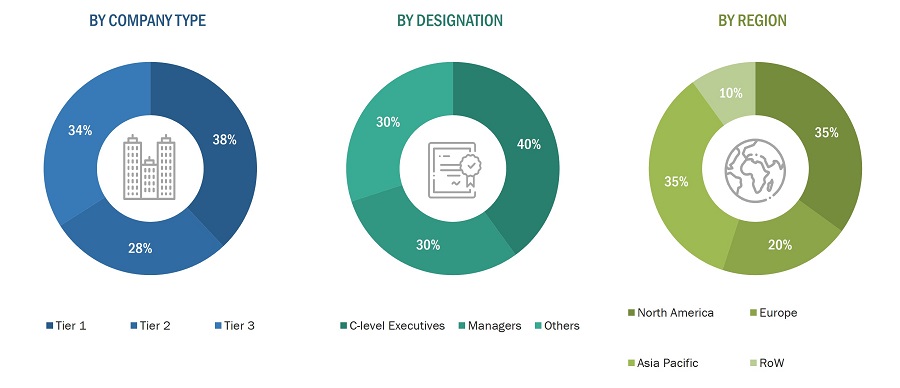
In the primary research process, various primary sources from the supply and demand sides were interviewed to obtain qualitative and quantitative information for this report. Primary sources from the supply side included industry experts such as CEOs, VPs, marketing directors, technology & innovation directors, and key executives from major companies in the wireless testing market.
After going through market engineering (which includes calculations for market statistics, market breakdown, market size estimations, market forecasting, and data triangulation), extensive primary research was conducted to gather information and verify and validate the critical numbers obtained. Primary research was conducted to identify segmentation types, industry trends, key players, competitive landscape, and key market dynamics such as drivers, restraints, opportunities, and challenges, along with the key strategies adopted by players operating in the market.
To know about the assumptions considered for the study, download the pdf brochure
Market size Estimation
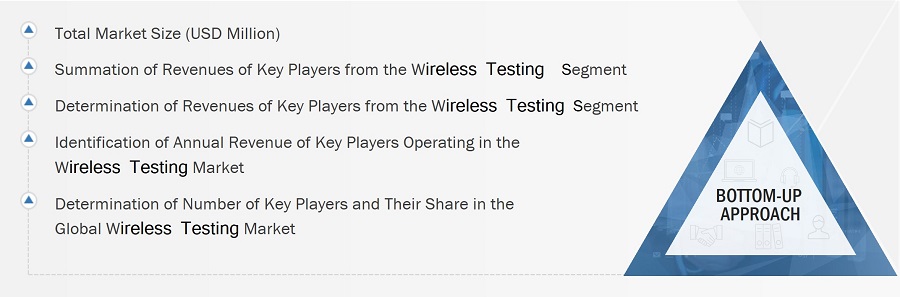
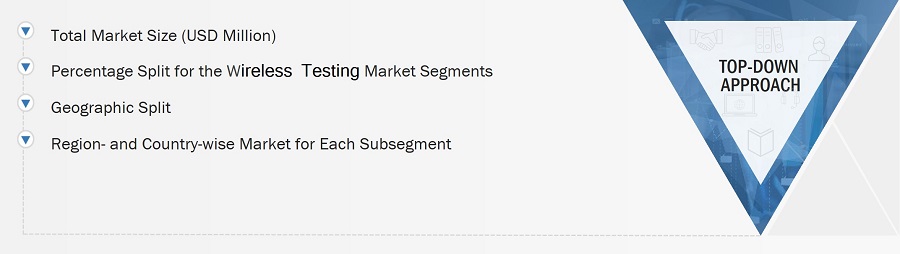
In the complete market engineering process, both top-down and bottom-up approaches were used, along with several data triangulation methods, to estimate and forecast the size of the market and its segments and subsegments listed in the report. Extensive qualitative and quantitative analyses were carried out on the complete market engineering process to list the key information/insights pertaining to the wireless testing market.
The key players in the market were identified through secondary research, and their rankings in the respective regions were determined through primary and secondary research. This entire procedure involved the study of the annual and financial reports of top players, as well as interviews with industry experts such as chief executive officers, vice presidents, directors, and marketing executives for quantitative and qualitative key insights. All percentage shares, splits, and breakdowns were determined using secondary sources and verified through primary sources. All parameters that affect the markets covered in this research study were accounted for, viewed in extensive detail, verified through primary research, and analyzed to obtain the final quantitative and qualitative data. This data was consolidated and enhanced with detailed inputs and analysis from MarketsandMarkets and presented in this report.
Wireless Testing Market: Bottom-up Approach
Wireless testing market: Top-Down Approach
Data Triangulation
After arriving at the overall size of the wireless testing market from the market size estimation process explained above, the total market was split into several segments and subsegments. Where applicable, the market breakdown and data triangulation procedures were employed to complete the overall market engineering process and arrive at the exact statistics for all segments and subsegments. The data was triangulated by studying various factors and trends from both the demand and supply sides. Along with this, the market size was validated using top-down and bottom-up approaches.
Market Definition
The market for wireless testing has been broadly classified into equipment and services required for testing, inspecting, and certifying wireless devices and network infrastructures. The wireless testing services market is expected to grow at a higher rate as compared to the wireless equipment market, owing to the recurrent requirement for wireless testing services, while wireless testing equipment have a long replacement cycle Recent advancements in wireless technologies such as 4G and 5G have increased the scope for wireless testing in a wide range of applications in the industrial and commercial sectors. Increased demand for low power consumption devices to carry out machine-to-machine communication is expected to fuel the demand for wireless devices.
Key Stakeholders
- Semiconductor product designers and fabricators
- Developers of wireless testing-related applications
- Providers of wireless testing-related components and solutions
- Technology standard organizations, forums, alliances, and associations
- Technology investors
- Universities and research organizations
- Government bodies
- Technology standard organizations, forums, alliances, and associations
- Technology investors
Report Objectives
- To define, describe, and forecast the wireless testing market based on offering, connectivity technology, application, use cases, and region.
- To describe, analyze, and forecast the wireless testing market, in terms of value, based on offering, connectivity technology, application, use cases, and region.
- To estimate and forecast the size of the offering segment, in terms of volume, based on equipment.
-
To forecast the sizes of various segments with respect to four major regions—
North America, Europe, Asia Pacific, and Rest of the World (RoW) - To provide a detailed analysis of the wireless testing supply chain.
- To analyze the impact of the recession on wireless testing market
- To strategically analyze the micromarkets1 with respect to individual growth trends and prospects, and their contributions to the total market
- To analyze competitive developments such as expansions, agreements, partnerships, acquisitions, product developments, and research and development (R&D) in the wireless testing market
- To analyze the opportunities for market players and provide details of the competitive landscape of the market.
- To benchmark the market players using the proprietary, company evaluation matrix framework, which analyzes the market players on various parameters within the broad categories of business strategy excellence and strength of product portfolios.
- To strategically profile the key players and comprehensively analyze their market positions in terms of ranking and core competencies2, along with a detailed competitive landscape of the market.
Available customizations
With the given market data, MarketsandMarkets offers customizations according to the specific requirements of companies.
Product analysis
- Detailed analysis and profiling of additional market players
The following customization options are available for the report:
- Market sizing and forecast for additional countries
- Additional five companies profiling
Get the Full Wireless Testing Market Report
Full forecast, segment splits, and company analysis for all Wireless Testing Market.
- US Wireless Testing Market
- Canada Wireless Testing Market
- Mexico Wireless Testing Market
- Germany Wireless Testing Market
- France Wireless Testing Market
- Spain Wireless Testing Market
- Italy Wireless Testing Market
- Switzerland Wireless Testing Market
- China Wireless Testing Market
- Japan Wireless Testing Market
- India Wireless Testing Market
- South Korea Wireless Testing Market
- Taiwan Wireless Testing Market
- Australia Wireless Testing Market
- Singapore Wireless Testing Market
- Rest Of Europe Wireless Testing Market
- Rest Of Asia Pacific Wireless Testing Market
- GCC Wireless Testing Market
- Rest Of The Middle East Wireless Testing Market
- South America Wireless Testing Market
Need a Tailored Report?
Customize this report to your needs
Get 10% FREE Customization
Customize This Report
