Building Thermal Insulation Market

Building Thermal Insulation Market by Material Type (Glass Wool, Stone Wool, Plastic Foam), Application (Roof Insulation, Wall Insulation, Floor Insulation), Building Type (Residential, Non-Residential), and Region - Global Forecast to 2031




OVERVIEW
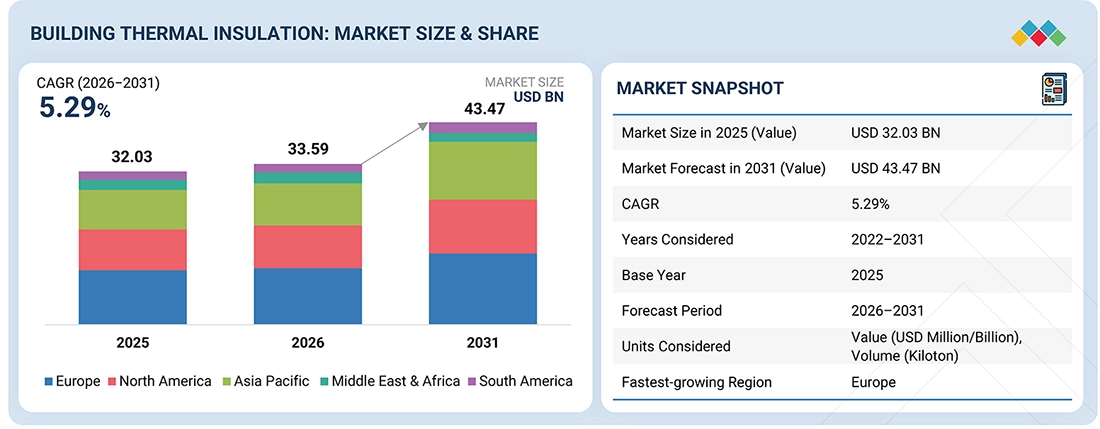
Source: Secondary Research, Interviews with Experts, MarketsandMarkets Analysis
The building thermal insulation market is estimated to rise from USD 33.59 billion in 2025 to USD 43.47 billion by 2031 at a CAGR of 5.29%; it is anticipated to witness steady growth owing to the growing construction industry and the need for energy-efficient buildings. The presence of stringent building codes also contribute to the growth of the market.
KEY TAKEAWAYS
-
BY REGIONEurope dominated the global building thermal insulation market in 2025, accounting for a market share of 35.4%, in terms of value.
-
BY MATERIALThe plastic foam segment is projected to be the fastest-growing material for building thermal, with a CAGR of 5.42% in value, between 2026 and 2031
-
BY BUILDING TYPE INDUSTRYIn 2025, the residential building segment dominated the global building thermal insulation market by value, with a market share of 52.9%.
-
COMPETITIVE LANDSCAPE - KEY PLAYERSKingspan Group PLC, Knauf Insulation, Owens Corning, Rockwool A/S, and Saint-Gobain SA are identified as key players in the global building thermal insulation market. These companies have a strong market presence and extensive product portfolios.
-
COMPETITIVE LANDSCAPE - STARTUPSURSA Insulation, Fibran S.A., and SIKA Group, among other emerging players, have carved out solid positions within specialized niche segments, highlighting their potential to evolve into future market leaders.
The growth potential for the building thermal insulation market is moderate in the coming years, owing to rising construction activity in major economies and the need to renovate older buildings. Stringent building codes and rising energy bills are additional factors driving the growth of building thermal insulation materials. The development of green buildings is another factor that influences the growth of the building thermal insulation market.
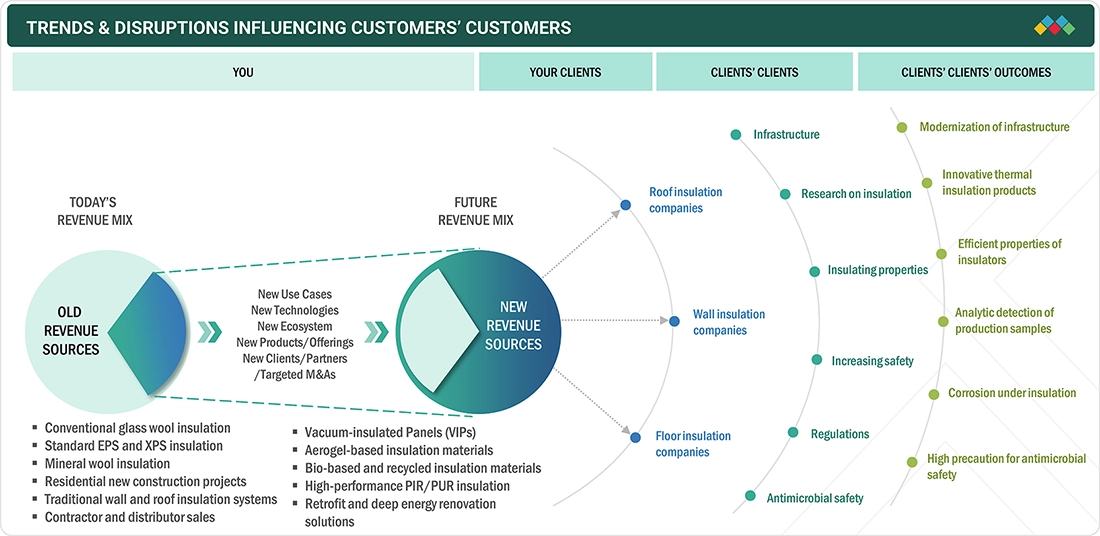
TRENDS & DISRUPTIONS IMPACTING CUSTOMERS' CUSTOMERS
The impact on the consumer’s business depends on changes in demand and disruptions in key applications. Key applications of building thermal insulation include wall, roof, and floor insulation, where key manufacturers are involved. Disruption in the form of shifting preferences toward antimicrobial insulation and corrosion under insulation would affect end users’ revenue. The revenue impact on end users would, in turn, reflect in the building thermal insulation market and ultimately on manufacturers.
Source: Secondary Research, Interviews with Experts, MarketsandMarkets Analysis
MARKET DYNAMICS

Level
-
Stringent regulations to reduce greenhouse gas emissions

-
Growing construction of green buildings


Level
-
Fluctuation in prices of plastic foam

-
Availability of green insulation materials


Level
-
High energy requirements


Level
-
Lack of awareness about building thermal insulation

-
Geopolitical instability disrupting supply chain continuously

Source: Secondary Research, Interviews with Experts, MarketsandMarkets Analysis
Driver: Growing construction of green budlings
There is a global increase in the construction of green buildings due to volatile and high energy prices, concerns about environmental impact, and the health and comfort of occupants. Green building rating systems, such as the Building Research Establishment Environment Assessment Methodology (BREEAM) in the UK, Leadership in Energy and Environmental Design (LEED) in the US and Canada, Deutsche Gesellschaft für Nachhaltiges Bauen (DGNB) in Germany, and the Comprehensive Assessment System for Building Environmental Efficiency (CASBEE) in Japan, are driving this growth.
Restraint: Fluctuation in prices of plastic foam
There is a lack of awareness among consumers and building professionals about building thermal insulation materials. The most significant gap between regulations and recommended energy performance is found in Southern Europe. A major initiative is needed to raise awareness and bring building regulations in line with the findings of Ecofys VII (Ecofys is an innovative and creative company, creating smart, effective, and practically sustainable solutions across renewable energy, energy, and carbon efficiency).
Opportunity: High energy requirement
The energy cost is rising due to high demand in Europe and North America. Building thermal insulation is used to mitigate the high energy requirement, as buildings account for 40% of total energy consumption. The significant factors that increase the use of building thermal insulation are the scarcity of energy, the high cost of energy, and increasing pressure to reduce global warming caused by the use of fossil fuels. Europe and North America depend on imported energy due to their increased consumption. Currently, technology and awareness have significantly reduced energy consumption in buildings through better insulation while improving comfort levels. These factors have led different countries to place energy very high on the political agenda.
Challenge: Lack of awareness about building thermal insulation
There is limited awareness among consumers and building professionals about building thermal insulation materials. The most significant gap between regulations and recommended energy performance is in Southern Europe. A major initiative is needed to raise awareness and align building regulations with the findings of Ecofys VII (Ecofys is an innovative and creative company, creating smart, effective, and practically sustainable solutions across renewable energy, energy, and carbon efficiency).
BUILDING THERMAL INSULATION MARKET: COMMERCIAL USE CASES ACROSS INDUSTRIES
| COMPANY | USE CASE DESCRIPTION | BENEFITS |
|---|---|---|
 |
Many residents in the Wilmcote House building could not afford to heat their homes adequately. This is a severe issue in Europe, where 10.8% of people cannot afford to keep their homes warm. At Wilmcote House, poor energy performance was a major issue. It led to high heating bills and mold, dampness, and condensation, which can adversely affect health. Its product, REDArt and Rockpanel, provided external wall insulation for its new constructions. This helped residents save fuel and made Wilmcote House a more pleasant place to live. | Improved conditions within all properties, making the residents feel much warmer and substantially reducing fuel bills |
 |
ISOVER glass wool insulation was used in the Grand Paris Express metro stations and associated public infrastructure in France to improve thermal efficiency and acoustic performance in underground stations and service buildings while meeting stringent fire safety standards. | Reduced energy consumption, superior acoustic insulation, excellent fire resistance, enhanced occupant comfort |
 |
Kingspan's Kooltherm insulation boards were installed at The Edge office building (Amsterdam, Netherlands) to achieve exceptional building energy performance. The thin, high-performance insulation maximized usable floor space while meeting stringent sustainability requirements. | Very low thermal conductivity, reduced operational energy costs, increased floor area, support for green building certification |
 |
Knauf Insulation supplied mineral wool insulation for the Heathrow Airport Terminal 2 (UK) redevelopment, delivering thermal and acoustic insulation across walls, roofs, and service areas to enhance passenger comfort and building efficiency. | Improved thermal efficiency, sound absorption, fire protection, lower lifecycle operating costs |
Logos and trademarks shown above are the property of their respective owners. Their use here is for informational and illustrative purposes only.
MARKET ECOSYSTEM
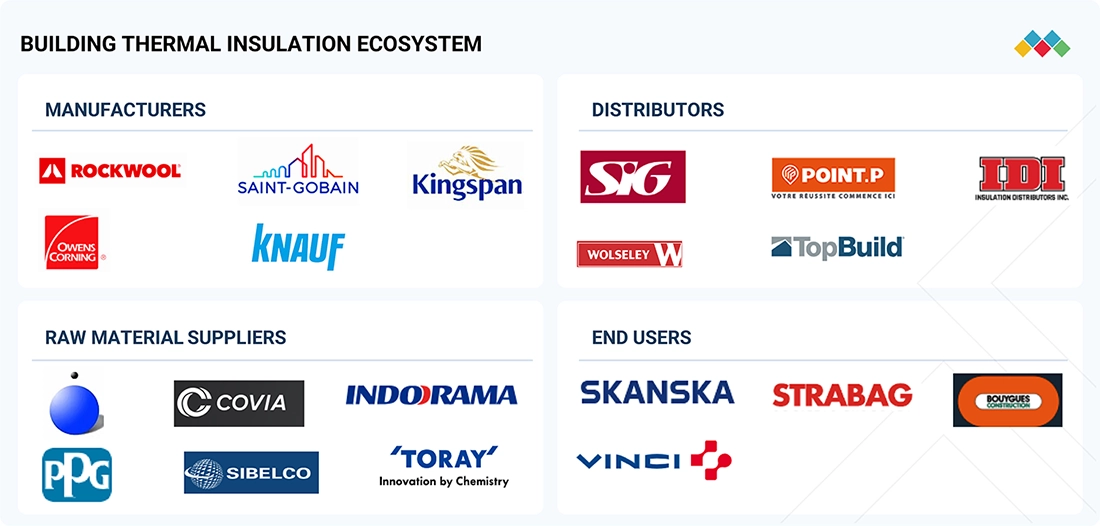
The business ecosystem of building thermal insulation consists of raw material suppliers, insulation producers, distributors, and end-users. The building thermal insulation market is driven by stringent building codes and the need for energy-efficient buildings that provide thermal comfort. Other factors, such as the growth of green buildings and rebates and tax credits, are also driving the market.
Logos and trademarks shown above are the property of their respective owners. Their use here is for informational and illustrative purposes only.
MARKET SEGMENTS
Source: Secondary Research, Interviews with Experts, MarketsandMarkets Analysis
Building Thermal Insulation Market, By Material Type
Plastic foam held the largest share of value among material types in the global building thermal insulation market in 2025. This is primarily because it offers an optimal combination of high thermal performance, lightweight construction, cost-effectiveness, moisture resistance, and ease of installation. Its widespread use across residential, commercial, and industrial buildings, particularly in roofs, walls, and foundations, has made it the largest insulation material category in many countries.
Building Thermal Insulation Market, By Building Type
In 2025, the residential building segment held the largest share of the building thermal insulation market. This is due to housing making up the biggest part of the global building stock and ongoing new construction. Additionally, homeowners and governments are increasingly focusing on energy efficiency, reducing utility costs, and enhancing indoor comfort. Residential buildings need insulation for walls, roofs, and floors, which continues to drive the demand for thermal insulation materials.
Building Thermal Insulation Market, By Application
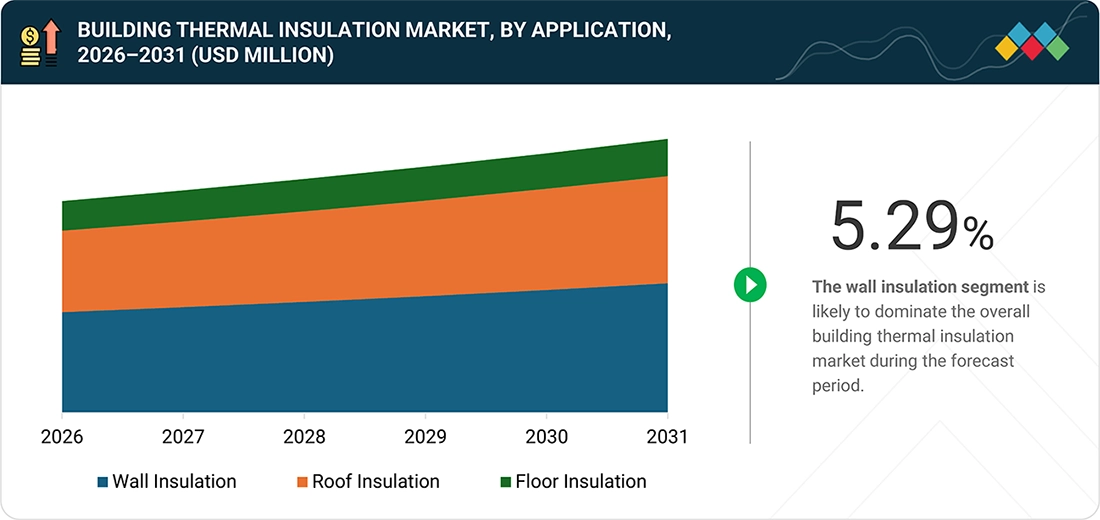
The market share of wall insulation was largest in 2025. This is because walls constitute the largest surface area of a building envelope and are responsible for a significant share of heat transfer between indoor and outdoor environments. Insulating walls substantially reduce heating and cooling energy consumption, improve occupant comfort, and help buildings comply with increasingly stringent energy-efficiency regulations.
REGION
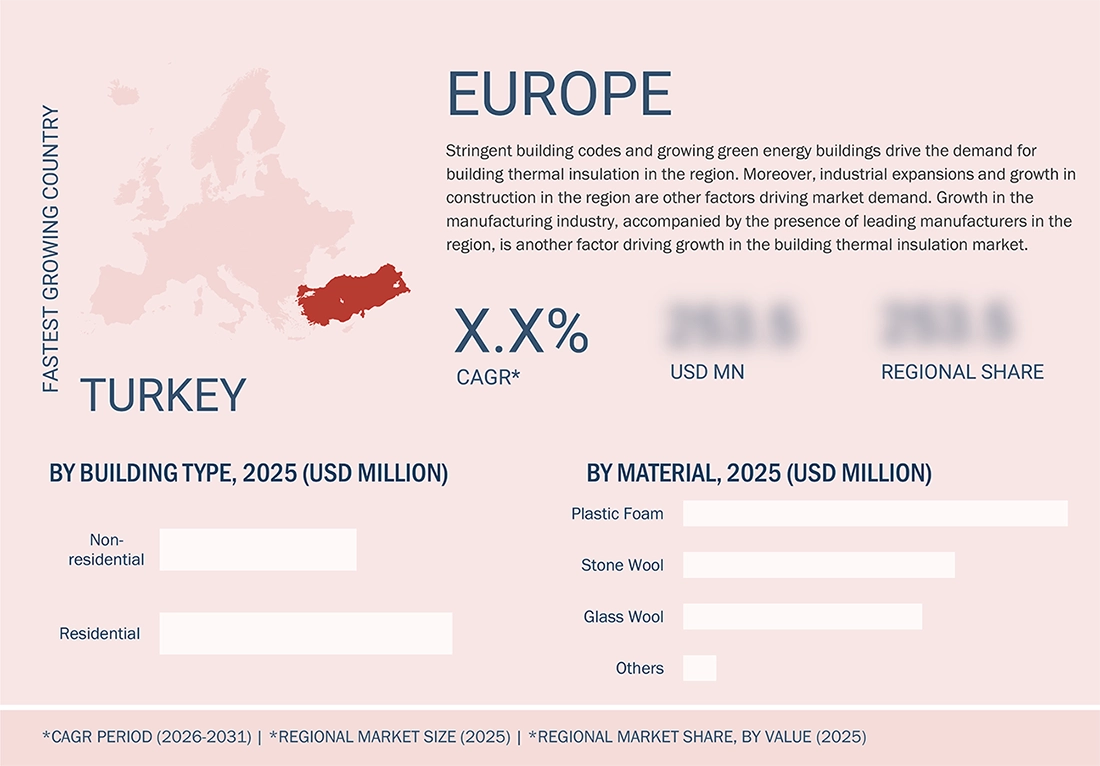
Europe accounted for the largest share of the global building thermal insulation market in 2025
Europe led the global building thermal insulation market in 2025 due to strict building codes and the development of green energy buildings. This leadership is attributed to industrial expansion, growth in the construction industry, and favorable government policies supporting insulation-related activities. The presence of leading manufacturers and large production plants also contributed to this market dominance.
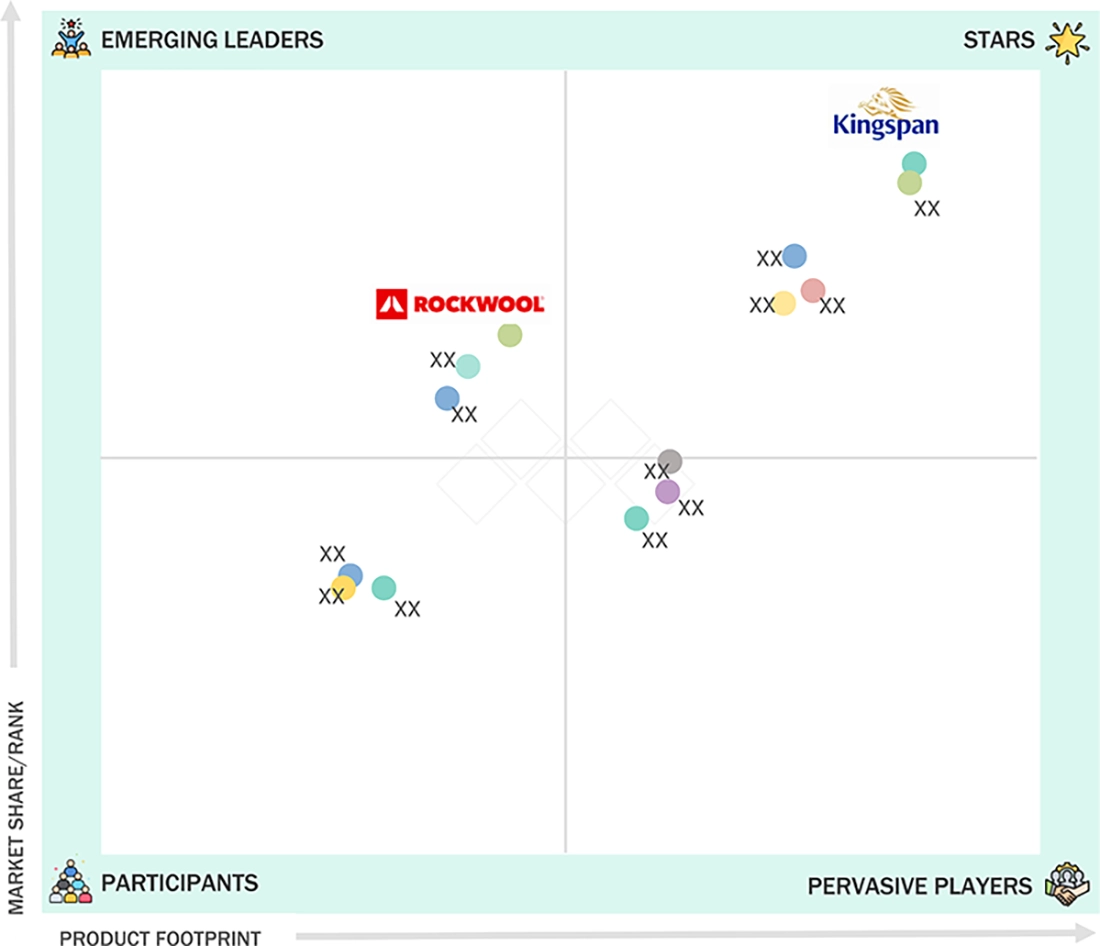
BUILDING THERMAL INSULATION MARKET: COMPANY EVALUATION MATRIX
Kingspan (Star) leads the building thermal insulation market due to its large-scale production capabilities and a strong customer base in the building & construction sector. Rockwool A/S (Emerging) continues to strengthen its position through improved production capabilities. The company will gain a competitive advantage in the future because of rising demand for stone wool products.
Source: Secondary Research, Interviews with Experts, MarketsandMarkets Analysis
KEY MARKET PLAYERS
- Kingspan Group PLC (Ireland)
- Saint-Gobain SA (France)
- Owens Corning (US)
- Rockwool A/S (Denmark)
- Kingspan Insulation (UK)
- Johns Manville Corporation (US)
- CNBM (China)
- BASF (Germany)
- Dow Inc. (US)
- Soprema Group (France)
- Carlisle Companies Inc. (US)
- GAF Materials (US)
- Aspen Aerogels Inc (US)
- Atlas Roofing Corporation (US)
- Holcim Ltd. (Switzerland)
- Huntsman International LLC (US)
- Recticel SA (Belgium)
- URSA Insulation (Spain)
- KCC Corporation (South Korea)
- SIKA Group (Switzerland)
- NICHIAS (Japan)
- Fibran SA (Greece)
- ODE Insulation (Turkey)
- Trocellen GmbH (Germany)
- Cellofoam North America (US)
MARKET SCOPE
| REPORT METRIC | DETAILS |
|---|---|
| Market Size in 2025 (Value) | USD 32.03 Billion |
| Market Size in 2026 (Value) | USD 33.59 Billion |
| Revenue Forecast in 2031 (Value) | USD 43.47 Billion |
| Growth Rate | CAGR of 5.29% from 2026 to 2031 |
| Years Considered | 2022–2031 |
| Base Year | 2025 |
| Forecast Period | 2026–2031 |
| Units Considered | Value (USD Million/Billion), Volume (Kiloton) |
| Report Coverage | Revenue forecast, company ranking, competitive landscape, growth factors, and trends |
| Segments Covered |
|
| Regional Scope | Asia Pacific, Europe, North America, Middle East & Africa, South America |
WHAT IS IN IT FOR YOU: BUILDING THERMAL INSULATION MARKET REPORT CONTENT GUIDE
RECENT DEVELOPMENTS
- May 2026 : BASF launched ELASTOSPRAY BMB, a sustainable, low-carbon raw material used to produce spray PU foam (SPF) insulation systems. It is a biomass-balanced isocyanate product.
- April 2026 : Rockwool A/S broke ground on a new manufacturing facility in Walla County, Washington, US, with an investment of USD 175 million. This is Rockwool's fifth manufacturing plant in the US.
- June 2025 : Carlisle completed the acquisition of Bonded Logic, Inc. and Phoenix Fibers, LLC, collectively known as “Bonded Logic.” The acquisition supports the growth of high-performance Henry UltraTouch recycled denim insulation, a unique, eco-friendly insulation that is easier to install than conventional insulation materials.
- September 2024 : CNBM and Saudi Aramco signed a five-year Cooperation Framework Agreement (CFA) to develop advanced materials, including green building materials.
- October 2025 : In the wake of ISOVER’s factory transition to biogas in Vamdrup, Denmark, the company has launched new, third-party-verified EPDs as of 1 July, documenting an average carbon dioxide reduction of more than 20% across all its important products.
Table of Contents
 Exclusive indicates content/data unique to MarketsandMarkets and not available with any competitors.
Methodology
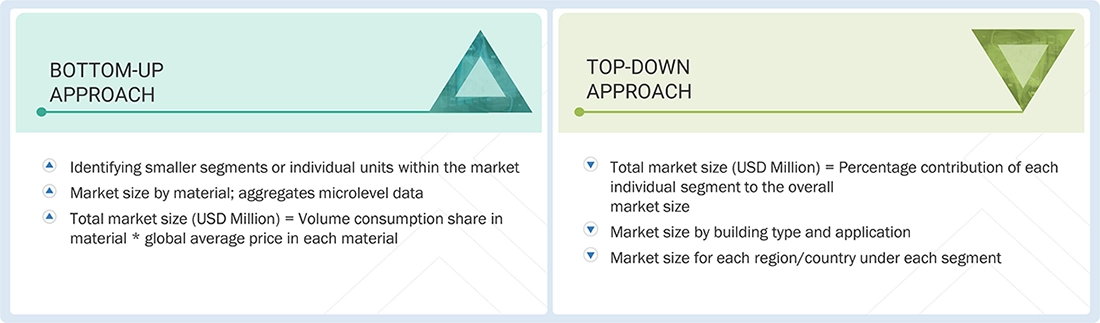
The study involved four major activities to estimate the market size for building thermal insulation. Exhaustive secondary research was conducted to collect information on the market, the peer market, and the parent market. The next step was to validate these findings, assumptions, and sizing with industry experts across the value chain through primary research. Both top-down and bottom-up approaches were employed to estimate the total market size. After that, the market breakdown and data triangulation procedures were used to estimate the market size of the segments and subsegments.
Secondary Research
Secondary sources used in this study included annual reports, press releases, and investor presentations from companies; white papers; certified publications; articles by recognized authors; and gold- and silver-standard websites, such as Factiva, ICIS, Bloomberg, and others. The findings of this study were verified through primary research, which involved extensive interviews with key officials, including CEOs, VPs, directors, and other executives. The breakdown of the primary interviewees' profiles is illustrated in the figure below:
Primary Research
The building thermal insulation market comprises several stakeholders, including raw material suppliers, end-product manufacturers, and regulatory organizations across the supply chain. Primary sources from both the supply and demand sides of the market were interviewed to gather qualitative and quantitative information.
BREAKDOWN OF PRIMARY PARTICIPANTS
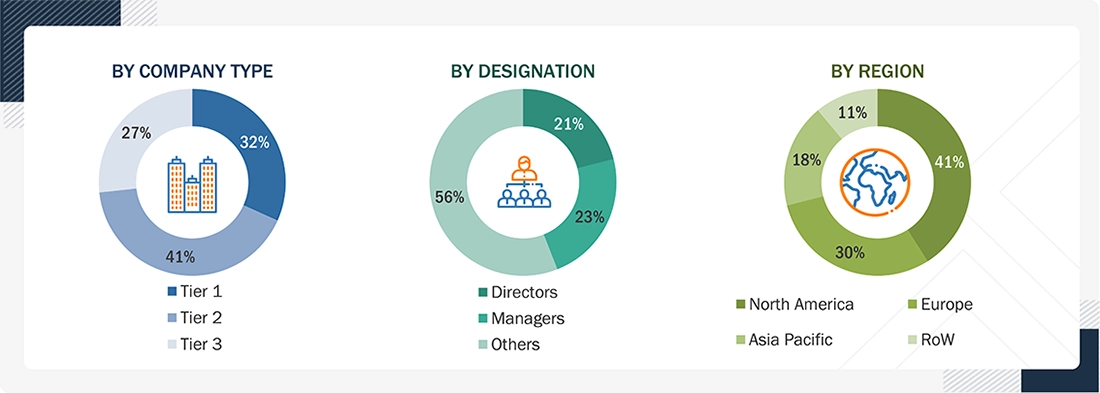
Notes: Tier 1, Tier 2, and Tier 3 companies are classified based on their market revenue in 2024/2025, available in the public domain, product portfolios, and geographical presence.
Other designations include consultants and sales, marketing, and procurement managers.
|
COMPANY NAME |
DESIGNATION |
|
Saint-Gobain S.A. |
Production Manager |
|
BASF SE |
Business Development Manager |
|
Johns Manville Corporation |
Innovation Manager |
|
Rockwool A/S |
Vice President |
|
Owens Corning |
Global Strategy and Innovation Manager |
To know about the assumptions considered for the study, download the pdf brochure
Market Size Estimation
Both top-down and bottom-up approaches were used to estimate and validate the total size of the building thermal insulation market. These methods were also used extensively to estimate the size of various market subsegments. The research methodology used to estimate the market size includes the following:
- The key players in the industry have been identified through extensive secondary research.
- The supply chain of the industry has been determined through primary and secondary research.
- All percentage shares, splits, and breakdowns have been determined using secondary sources and verified through primary sources.
- All possible parameters that affect the markets covered in this research study have been accounted for, viewed in extensive detail, verified through primary research, and analyzed to obtain the final quantitative and qualitative data
Building Thermal Insulation Market: Top-Down and Bottom-Up Approach
Data Triangulation
After determining the overall market size using the market size estimation processes explained above, the market was divided into several segments and subsegments. To complete the overall market engineering process and determine the exact statistics for each market segment and subsegment, data triangulation and market breakdown procedures were employed, as applicable. The data was triangulated by analyzing various factors and trends from both the demand and supply sides in the building thermal insulation industry.
Market Definition
According to the Climate Technology Centre and Network (CTCN), building thermal insulation is an important technology that reduces energy consumption in buildings by preventing heat gain or loss. It is used to reduce the amount of power required to heat or cool homes and to minimize heat loss in winter and hot-air penetration in summer. Building insulation tends to be the most cost-effective measure in climates with wide temperature ranges. The impact of additional insulation is significant in buildings with thin walls or timber construction. The insulation’s resistance to heat flow is measured or rated by its thermal resistance, or R-value. The higher the R-value, the greater the heat resistance and the less the heat flow.
Key Stakeholders
- Building Thermal Insulation Manufacturers
- Building Thermal Insulation Distributors
- Raw Material Suppliers
- End-use Industries
- Government and Research Organizations
Report Objectives
- To analyze and forecast the size of the global building thermal insulation market in terms of value and volume
- To provide detailed information about the major drivers, restraints, challenges, and opportunities influencing market growth
- To define, describe, and segment the market based on material, building type, application, and region
- To forecast the size of the market segments based on regions such as Asia Pacific, North America, Europe, the Middle East & Africa, and South America
- To strategically analyze micromarkets1 with respect to individual growth trends, prospects, and their contribution to the overall market
- To strategically analyze the segmented markets with respect to individual growth trends, prospects, and contributions to the overall market
- To identify and analyze opportunities for stakeholders in the market
- To analyze competitive developments such as mergers, acquisitions, collaborations, expansions, partnerships in the market
- To strategically profile the key companies and comprehensively analyze their core competencies
Available customizations:
Along with the given market data, MarketsandMarkets offers customizations according to the company’s specific needs. The following customization options are available for the report:
Regional Analysis
- Further breakdown of a region with respect to a particular country or additional end-use industry
Company Information
- Detailed analysis and profiles of additional market players (up to five)


Personalize This Research
- Triangulate with your Own Data
- Get Data as per your Format and Definition
- Gain a Deeper Dive on a Specific Application, Geography, Customer or Competitor
- Any level of Personalization
Let Us Help You
- What are the Known and Unknown Adjacencies Impacting the Building Thermal Insulation Market
- What will your New Revenue Sources be?
- Who will be your Top Customer; what will make them switch?
- Defend your Market Share or Win Competitors
- Get a Scorecard for Target Partners

Custom Market Research Services
We Will Customise The Research For You, In Case The Report Listed Above Does Not Meet With Your Requirements
Get 10% Free CustomisationTESTIMONIALS

We at Nissan Chemicals Corporation have been clients of MarketsandMarkets for more than a year now. We recently consulted MarketsandMarkets for a study, the team at MarketsandMarkets was extremely professional and organized. The business insights were very detailed and aligned well with our expectations that really helped us formulate the Business Plans and device new strategies for development themes. MarketsandMarkets offers a unique combination of expertise and dedicated engagement model. Their research findings have helped us in designing our Pricing Strategy which will make it easier for us to predict the future sales and profits for the next ten years. We look forward to working with MarketsandMarkets in the future.
VP of Strategy & New Business Development
Leading Specialty Chemical Company
The MarketsandMarkets Engagement Model, composed of both the Knowledge Store and advisory custom research, has greatly helped us in understanding our markets and making strategic decisions. The Knowledge Store is a fast way to allow everyone in our organization to understand more about most any market they are interested in. The ability to then get custom research done and get answers to specific strategic questions and market insight has been spectacular. The Markets and Markets team feel more like colleagues than vendors and their services have helped us change our culture where statements of things like growth opportunities and competitive position are always backed by industry research.

Rich Gibson,
Director, Corporate Strategy
Milliken & Company,
Leading Industrial Manufacturer of specialty chemical, floor covering, performance and protective textile materials, and healthcaremilliken.com
MarketsandMarkets is a trusted resource that helps us to better understand markets that are near-adjacencies-whether its technology, value chain or geography. Their Knowledge Store platform provides a dashboard of markets and their characteristics which is easy to use and saves us time.
Adam Shaw,
Market Development and Strategy Manager
AdvanSix Inc. USA,
An American Leader in Chemicalswww.advansix.com
The Knowledge Store from MarketsandMarkets is a valuable tool which has helped my team acquire greater insight in to the end markets that our business serves. This has enabled us to help our company build stronger strategies throughout our planning process.
TOSHIO KINOSHITA
Senior Chif Consultion Research & Consulting Division
Mitsubishi Chemical Research Corporation,
Leading Manufacturer of Chemical Productswww.mitsubishichem-res.co.jp/en/

We recently engaged with MarketsandMarkets for a study, the team not only clearly understood our business objectives but was also extremely professional in the way they handled the entire project. The study was efficiently conducted in a phase-wise manner, and the engagement model furnished us with high-quality business insights that far exceeded our expectations at each phase. We were especially happy that MarketsandMarkets could provide us with both, an English as well as a Japanese version of the study. A special thanks to the Analyst Team and Client Services Team, whose fluency in Japanese enhanced our comfort level, as we could converse with them in our preferred language.
Independent entrepreneurs
Arrow Precision
We approached MarketsandMarkets for study on Proppants Market, and their work exceeded our expectations. The study conducted was comprehensive and enabled us to view the market through the various dimensions. In addition, the team was extraordinarily responsive throughout the process and resolved our queries on time. I strongly recommend MarketsandMarkets and will certainly consider them for additional market assessments we will need in the future.
Global engineering company, Japan
Deputy Manager,
Strategic Planning OfficeThe high-quality insights shared by the MarketsandMarkets team helped us understand the pharmaceutical plant designers in a specific geography. It also captured the risks that we may likely face in communicating with our potential partners. The study would enable us identify partners, which would impact our future growth.
- Poland Building Thermal Insulation Market
- UK Building Thermal Insulation Market
- Italy Building Thermal Insulation Market
- Russia Building Thermal Insulation Market
- Spain Building Thermal Insulation Market
- Mexico Building Thermal Insulation Market
- US Building Thermal Insulation Market
- China Building Thermal Insulation Market
- Japan Building Thermal Insulation Market
- India Building Thermal Insulation Market
- South Korea Building Thermal Insulation Market
- Thailand Building Thermal Insulation Market
- Malaysia Building Thermal Insulation Market
- Indonesia Building Thermal Insulation Market
- Saudi Arabia Building Thermal Insulation Market
- UAE Building Thermal Insulation Market
- Qatar Building Thermal Insulation Market
- South Africa Building Thermal Insulation Market
- Brazil Building Thermal Insulation Market
- Argentina Building Thermal Insulation Market
- Canda Building Thermal Insulation Market
- Rest Of Europe Building Thermal Insulation Market
- Turkey Building Thermal Insulation Market
- Rest Of Apac Building Thermal Insulation Market
- Rest Of South America Building Thermal Insulation Market
- Germany Building Thermal Insulation Market
- France Building Thermal Insulation Market






Growth opportunities and latent adjacency in Building Thermal Insulation Market