Latin America Cloud Computing Market

Latin America Cloud Computing Market by Service Model [IaaS (Compute, Storage, Networking), PaaS (Application Development & Integration, Database & Data Analytics & Reporting), SaaS (CRM, SCM, Collaboration & Productivity)], Impact of AI-Forecast to 2030




OVERVIEW
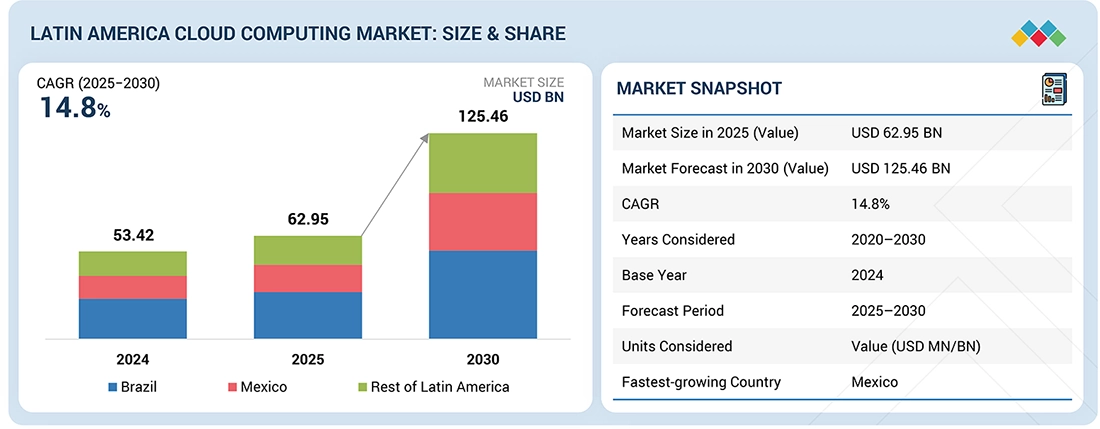
Source: Secondary Research, Interviews with Experts, MarketsandMarkets Analysis
The Latin America cloud computing market is on a strong growth path. Market value is projected to rise from USD 62.95 billion in 2025 to USD 125.46 billion by 2030, reflecting a CAGR of 14.8%. Growth is largely driven by rising digital adoption across banking, retail, logistics, and public services, as more users shift to online payments, e-commerce, and mobile platforms. Governments in Brazil, Mexico, Chile, and Colombia are also upgrading public IT systems. Cloud-first policies and clearer data protection rules are helping public agencies and enterprises feel more comfortable using cloud platforms. Further global cloud providers are investing in new data centers across the region, reducing latency and improving service reliability.
KEY TAKEAWAYS
-
BY COUNTRYBrail is expected to hold largest market value of USD 28.68 billion in 2025.
-
BY SEVICE MODELThe SaaS segment is expected to hold largest market share of USD 37.49 billion in 2025.
-
BY DEPLOYMENT MODELThe hybrid cloud segment is expected to grow at highest CAGR of 21.1% during the forecast period.
-
BY ORGANIZATION SIZEThe large enterprises segement is expected to hold largest market valur in 2025.
-
BY VERTICALThe healthcare & life scineces segment is expected to grow at highest CAGR during forecast period.
-
COMPETITIVE LANDSCAPEMajor market players in the Latin America cloud computing market have pursued both organic and inorganic strategies, including partnerships, technology integrations, and strategic investments. For instance, Microsoft (US), Google (US), AWS (US), IBM (US), and Oracle (US) have strengthened their cloud portfolios to meet rising demand for AI-enabled services, hybrid deployments, and secure, scalable platforms supporting digital transformation across diverse industries.
-
COMPETITIVE LANDSCAPEThe competitive landscape of the Latin America cloud computing market includes a mix of hyperscalers, cloud providers, and agile SMEs such as EdgeUno, Zenlayer, Ascenty. As an SME, Tudip strengthens the market by offering tailored cloud integration, application modernization, and managed services suited to local business needs.
Enterprises in Latin America are moving to cloud platforms as they modernize existing business systems. Many organizations seek more flexible systems and lower infrastructure costs, especially as business needs evolve faster than before. Large hyperscaler investments and improved regional connectivity are making cloud deployment easier across industries. Demand for AI tools, data analytics, and secure digital services is also growing steadily, supporting long-term cloud adoption rather than short-term experimentation.
TRENDS & DISRUPTIONS IMPACTING CUSTOMERS' CUSTOMERS
Cloud adoption in Latin America is growing as businesses look for flexible and cost-effective solutions. Many organizations are using hybrid and multi-cloud setups to balance cost, performance, and regulatory needs. AI-based cloud tools, such as analytics and automation, are now being used in daily operations. Edge computing is gaining attention, especially for IoT applications, smart city projects, and workloads that require low latency. Growth in fintech, e-commerce, and digital-first startups continues to push cloud providers to offer localized, compliant solutions. At the same time, rising cybersecurity risks, interest in sovereign cloud models, shifts toward usage-based pricing, and stronger competition among providers are changing how cloud services are procured and managed.
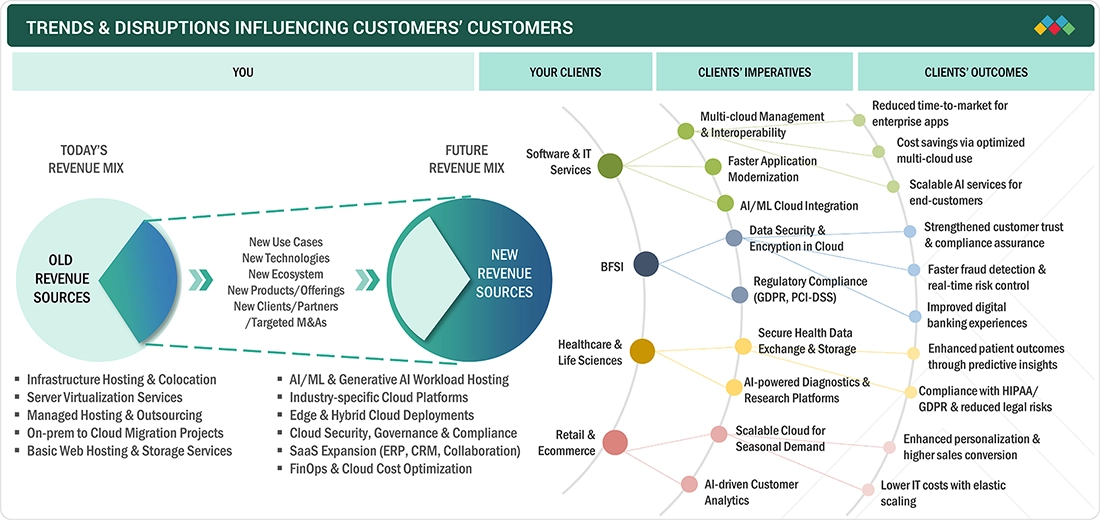
Source: Secondary Research, Interviews with Experts, MarketsandMarkets Analysis
MARKET DYNAMICS

Level
-
Rapid Expansion of Digital Financial Services

-
Government Digital Sovereignty Frameworks


Level
-
Data Security & Privacy Concerns

-
High Migration and Implementation Costs


Level
-
“Green” Data Centers & AI Training

-
Edge Computing for Rural Industries


Level
-
Managing Multi-Cloud Environments

-
Skills Shortage

Source: Secondary Research, Interviews with Experts, MarketsandMarkets Analysis
Driver: Rapid Expansion of Digital Financial Services
The rapid growth of digital financial services is a major factor driving cloud adoption in the target region. A significant portion of the population still does not use traditional banks, creating opportunities for digital banks and payment apps. Fintech firms need systems that can launch quickly and handle high daily transaction volumes. Cloud platforms help manage sudden traffic spikes during salary periods or major sales events. Many fintech companies also operate across borders, making centralized cloud systems more practical than maintaining local infrastructure. As mobile payments, digital wallets, and online lending expand, cloud usage continues to rise.
Restraint: Data Privacy and Security Concerns
Data privacy and security concerns remain a major barrier. Regulations vary widely across countries, making it difficult for companies to ensure compliance while operating in multiple markets. Some organizations feel uneasy about moving sensitive customer or financial data off-site. Past cybersecurity incidents have heightened this caution, especially in regulated sectors such as banking and public services. Smaller companies often do not have dedicated security teams, which slows down adoption in certain areas.
Opportunity: Edge Computing for Rural Industries
The implementation of edge computing offers significant advantages for operations in regions without access to major urban centers. The essential economic sectors of Latin America include agriculture, mining, and energy generation, which mainly take place in remote areas. The region faces challenges with internet access because providers offer services that operate at limited capacity or experience frequent interruptions. The integration of edge systems with central cloud platforms enables service providers to expand their offerings into new markets that extend beyond urban areas.
Challenge: Managing Multi-cloud Environments
Organizations face challenges managing their diverse cloud environments. To achieve their financial objectives and ensure system performance, and comply with required standards, businesses adopt multiple cloud services. The existence of multiple platforms requires different management tools, which creates additional operational complexity. IT personnel need to monitor system performance while restricting user access and tracking financial expenditures throughout various platforms. The process demands additional resources, increasing the risk of mistakes. The expanding operational needs of smaller teams become unmanageable because operational costs exceed initial budget forecasts.
LATIN AMERICA CLOUD COMPUTING MARKET: COMMERCIAL USE CASES ACROSS INDUSTRIES
| COMPANY | USE CASE DESCRIPTION | BENEFITS |
|---|---|---|
 |
Zeotap adopted a DevOps architecture powered by big data automation to streamline operations and enhance compliance. | DevOps architecture and documentation were transformed by Rackspace Technology using its big data and automation expertise, Zeotap can use its multiple SKUs and implement best practices for privacy and compliance |
 |
Ghost Team leveraged DigitalOcean’s cloud platform to scale its app infrastructure while maintaining performance. | Achieved high growth, uptime SLAs, and customer scalability with minimal overhead. |
 |
Autodesk enhanced its SaaS delivery model and remote access capabilities using Citrix Cloud. | Enabled device-agnostic access, network-independent productivity, and hassle-free user experience. |
 |
SimScale used AWS to run cloud-based simulations, reducing reliance on physical infrastructure. | Saved thousands in hardware, IT maintenance, and personnel costs, while improving design decision-making. |
 |
Minna Bank implemented the Zero Bank Core Solution on Google Cloud, supported by Accenture’s digital experience strategy. | Delivered a cloud-native core banking system, connected services, and data-driven customer engagement. |
Logos and trademarks shown above are the property of their respective owners. Their use here is for informational and illustrative purposes only.
MARKET ECOSYSTEM
The Latin America cloud computing ecosystem comprises a wide range of participants, including network providers, hardware vendors, cloud platform companies, and system integrators. These stakeholders collaborate to deliver cloud services and support adoption across industries.
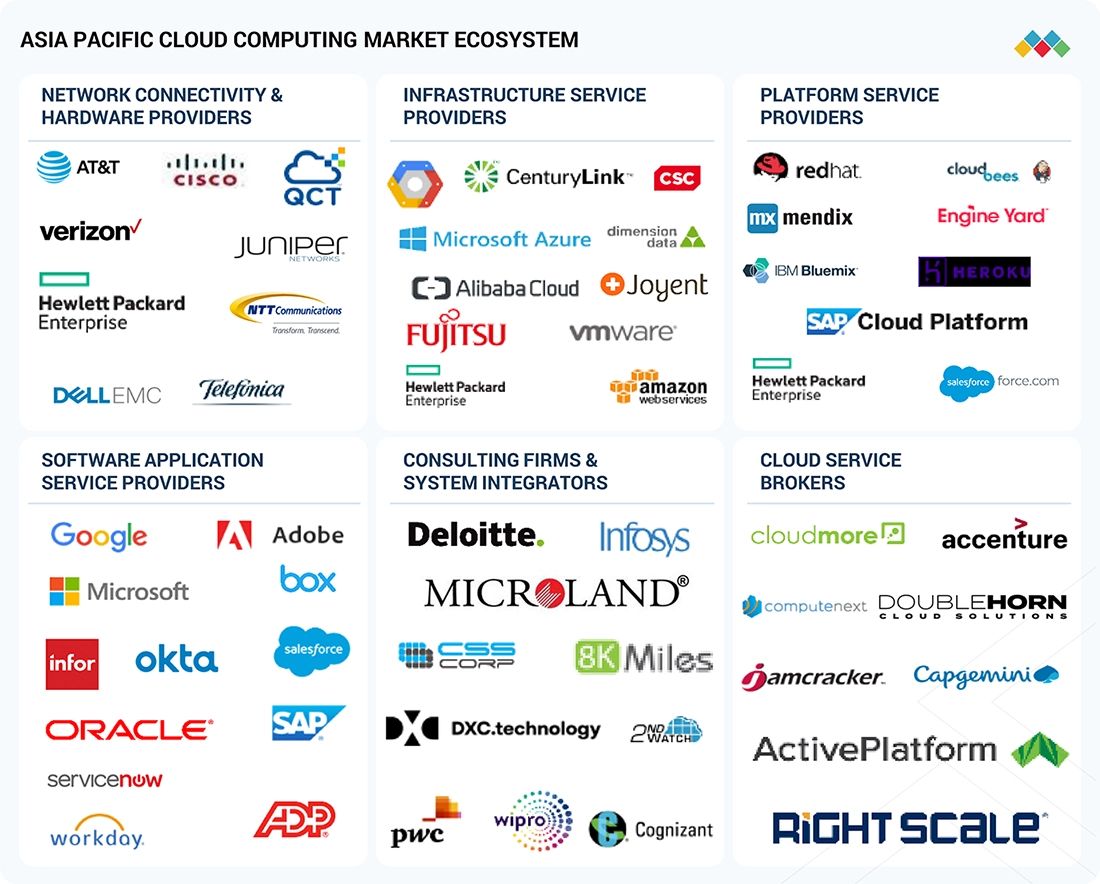
Logos and trademarks shown above are the property of their respective owners. Their use here is for informational and illustrative purposes only.
MARKET SEGMENTS
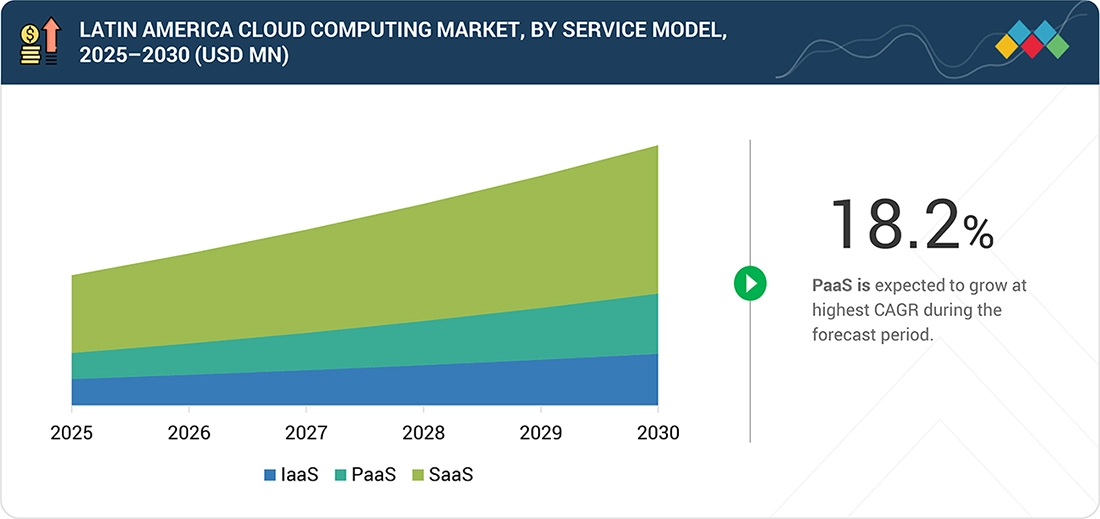
Source: Secondary Research, Interviews with Experts, MarketsandMarkets Analysis
Cloud Computing Market, By Service Model
By service model, SaaS dominates the market because organizations prefer ready-to-use applications for core functions. Many companies still rely on legacy systems that are costly to maintain. Cloud-based tools for HR, finance, customer management, and collaboration are easier to deploy and cheaper to run. The growth of remote work and digital operations continues to support SaaS adoption.
Cloud Computing Market, By IaaS
Cloud networking under IaaS is growing as digital usage increases across Latin America. More users and applications are creating higher network traffic, and companies need stable and reliable connections to keep their services running smoothly. Cloud networking tools, such as virtual networks and traffic management controls, help handle this growing demand. In addition, the development of new data centers closer to users has improved connection speed and reliability, making cloud networking a more practical and effective choice for organizations.
Cloud Computing Market, By PaaS
Database and data management services account for the largest share of PaaS usage in the region. Businesses are collecting more data from customers, transactions, and digital platforms. Managing this data on local systems often slows operations and increases costs. Cloud-based databases are easier to maintain and support daily reporting and analysis. As data plays a significant role in business decisions, demand for these services continues to grow.
Cloud Computing Market, By SaaS
Supply chain software delivered through SaaS is seeing rising adoption in Latin America. Logistics operations across the region can be slow and unpredictable difficult to predict. Companies need better visibility into inventory levels and shipment status. Cloud-based SaaS solutions make it easier to monitor changes and take action when delays occur. Growth in online shopping has increased pressure on delivery timelines, pushing more firms to adopt cloud-based supply chain solutions.
Cloud Computing Market, By Deployment Model
Public cloud remains the most common deployment model, especially for workloads that do not involve sensitive data. Many organizations avoid heavy investment in their own infrastructure. Usage-based pricing helps manage budgets during uncertain economic conditions. Public cloud is widely used for application hosting, development, and routine data processing.
Cloud Computing Market, By Organization Size
Small and medium-sized businesses are adopting cloud services faster than large enterprises. Maintaining in-house servers is costly for smaller firms, while cloud platforms provide access to modern tools without large upfront costs. Growth in online sales, digital payments, and remote work has made cloud services more relevant. Support from local providers has also eased adoption.
Cloud Computing Market, By Vertical
Software and IT services account for a major share of cloud usage. Most workloads in this sector are already digital, making cloud migration easier. Cloud platforms are widely used for development, testing, and data management. Startups and technology firms rely on cloud services to scale quickly, keeping this vertical closely tied to overall cloud growth.
REGION
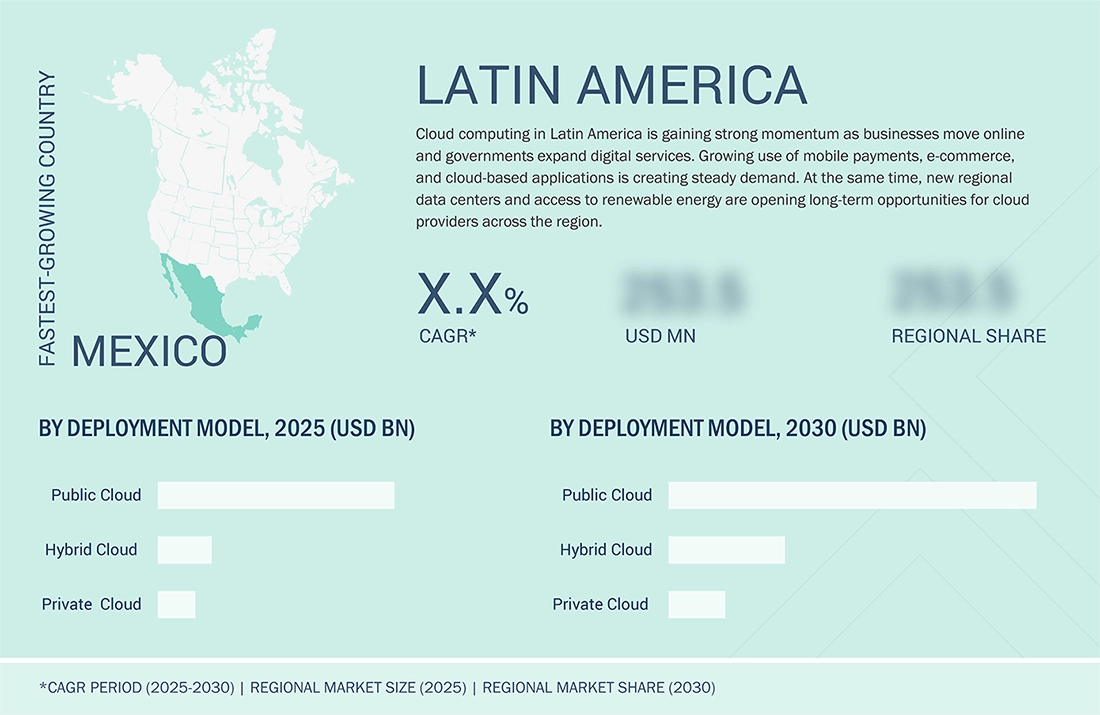
Mexico to be the fastest-growing country in the Latin America cloud computing market during the forecast period
Mexico is expected to show the highest growth rate in the Latin America cloud computing market. Government digitalization programs and strong business adoption are major factors driving this trend. New investments in data centers by key cloud providers are improving service availability and reducing lag time. Companies in banking, retail, manufacturing, and telecom sectors are shifting workloads to the cloud to support AI, analytics, and modern applications. A growing startup and fintech community is also increasing demand. Better connectivity, the ongoing rollout of 5G, and stronger cybersecurity measures are boosting the outlook for cloud adoption in Mexico.
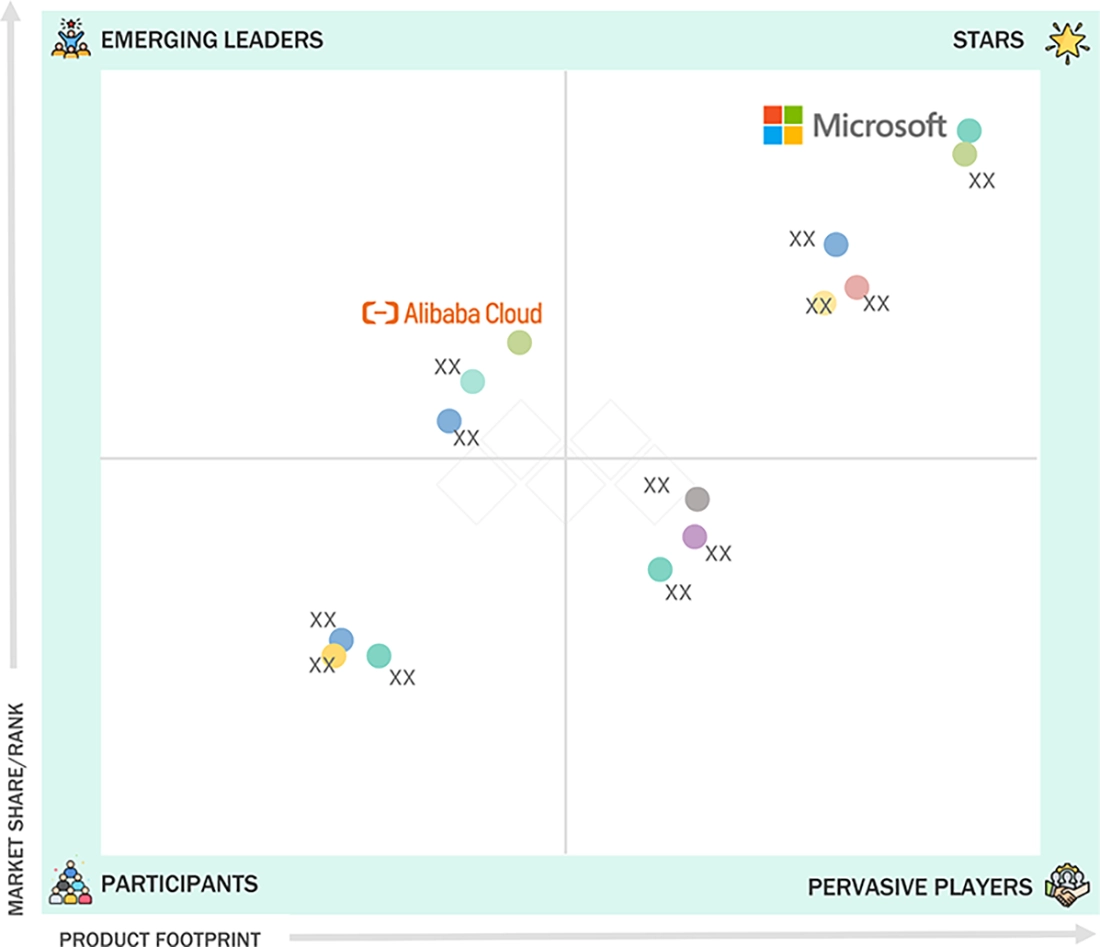
LATIN AMERICA CLOUD COMPUTING MARKET: COMPANY EVALUATION MATRIX
In the Latin America cloud computing market, Microsoft (Star) leads with a commanding market share and an expansive service portfolio, bolstered by its enterprise-grade Azure platform, advanced AI integration, and deep penetration across sectors such as finance, healthcare, and government. Alibaba Cloud (Emerging Leader) is rapidly gaining ground in Latin America, offering localized, compliance-ready, and AI-driven cloud services.
Source: Secondary Research, Interviews with Experts, MarketsandMarkets Analysis
KEY MARKET PLAYERS
- Microsoft (US)
- Google (US)
- AWS (US)
- IBM (US)
- Oracle (US)
- Salesforce (US)
- Tencent Cloud (China)
- SAP (Germany)
- Alibaba Cloud (China)
- Huawei (China)
- EdgeUno (Brazil)
- Zenlayer (US)
- Ascenty (Brazil)
- TIVIT (Brazil)
- Claro Cloud (Brazil)
MARKET SCOPE
| REPORT METRIC | DETAILS |
|---|---|
| Market Size in 2024 (Value) | USD 62.95 Billion |
| Market Forecast in 2030 (value) | USD 125.46 Billion |
| Growth Rate | CAGR of 14.8% from 2025-2030 |
| Years Considered | 2020-2030 |
| Base Year | 2024 |
| Forecast Period | 2025-2030 |
| Units Considered | Value (USD Billion) |
| Report Coverage | Revenue forecast, company ranking, competitive landscape, growth factors, and trends. |
| Segments Covered |
|
| Countries Covered |
|
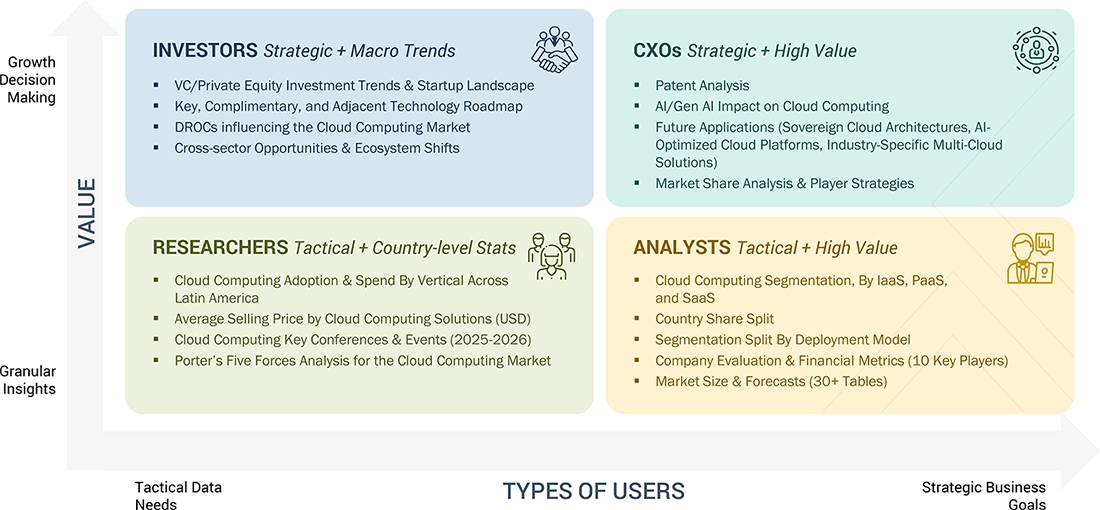
WHAT IS IN IT FOR YOU: LATIN AMERICA CLOUD COMPUTING MARKET REPORT CONTENT GUIDE
DELIVERED CUSTOMIZATIONS
We have successfully delivered the following deep-dive customizations:
| CLIENT REQUEST | CUSTOMIZATION DELIVERED | VALUE ADDS |
|---|---|---|
| Cloud Service Provider |
|
|
| Telecom Operator |
|
|
| Enterprise |
|
|
RECENT DEVELOPMENTS
- May 2025 : Microsoft and SAP launched the SAP Business Suite Acceleration Program, delivering a 99.95% SLA for SAP Cloud ERP on Azure and expanding SAP ERP and BTP availability on the Azure Marketplace. The integration of SAP Databricks and Microsoft 365 Copilot’s Joule highlights a commitment to AI-enhanced enterprise productivity, reinforced by a strategic focus on sovereign cloud expansion, European data center capacity, and AI-native ERP modernization.
- March 2025 : Oracle and NVIDIA partnered to integrate NVIDIA AI tools and NIM microservices into Oracle Cloud Infrastructure, enabling scalable agentic AI deployment. This supports inference, vector search, and no-code AI blueprints across data centers, public clouds, and edge environments, underpinned by a strategic focus on AI-native cloud infrastructure, enterprise-grade inference, and multi-environment deployment.
- February 2025 : Salesforce and Google Cloud expanded their collaboration to embed Gemini models into Agentforce, strengthening multi-modal AI agents with real-time insights and seamless deployment. With model flexibility, secure data access, and unified decision-making platforms, the partnership advances a strategic focus on AI agent orchestration, cross-platform intelligence, and customer service automation.
Table of Contents
 Exclusive indicates content/data unique to MarketsandMarkets and not available with any competitors.
Methodology
This research study on the Latin America Cloud Computing Market involved extensive secondary sources, directories, IEEE Communication-Efficient: Algorithms and Systems, International Journal of Innovation and Technology Management, and paid databases. Primary sources were mainly industry experts from the core and related industries, preferred cloud service providers, third-party service providers, consulting service providers, end users, and other commercial enterprises. In-depth interviews were conducted with various primary respondents, including key industry participants and subject matter experts, to obtain and verify critical qualitative and quantitative information and assess the market’s prospects.
Secondary Research
In the secondary research process, various sources were referred to identify and collect information for this study. Secondary sources included annual reports, press releases, and investor presentations of companies; white papers, journals, and certified publications; and articles from recognized authors, directories, and databases. The data was also collected from other secondary sources, such as journals, government websites, blogs, and vendors' websites. Additionally, the cloud computing spending of various countries was extracted from the respective sources.
Primary Research
In the primary research process, various primary sources from both the supply and demand sides were interviewed to obtain qualitative and quantitative information on the market. The primary sources from the supply side included various industry experts, such as Chief Experience Officers (CXOs), Vice Presidents (VPs), and directors specializing in business development, marketing, and cloud service providers. It also included key executives from cloud computing solution vendors, system integrators (SIs), professional service providers, industry associations, and other key opinion leaders.
Market Size Estimation
Multiple approaches were adopted to estimate and forecast the Latin America Cloud Computing Market. The first approach involved estimating the market size by companies’ revenue generated through the sale of cloud computing services.
Market Size Estimation Methodology- Top-down approach
In the top-down approach, an exhaustive list of all the vendors offering products in the Latin America Cloud Computing Market was prepared. The revenue contribution of the market vendors was estimated through annual reports, press releases, funding, investor presentations, paid databases, and primary interviews. Each vendor's offerings were evaluated based on platform, degree of customization, type, application, end user, and region. The markets were triangulated through both primary and secondary research. The primary procedure included extensive interviews for key insights from industry leaders, such as CIOs, CEOs, VPs, directors, and marketing executives. The market numbers were further triangulated with the existing MarketsandMarkets’ repository for validation.
Market Size Estimation Methodology-Bottom-up approach
In the bottom-up approach, the adoption rate of cloud computing services among different verticals in key countries with respect to their regions contributing the most to the market share was identified. For cross-validation, the adoption of cloud computing services among enterprises, along with different use cases with respect to their regions, was identified and extrapolated. Weightage was given to use cases identified in different regions for the market size calculation.
Based on market numbers, the regional split was determined by primary and secondary sources. The procedure included an analysis of the Latin America Cloud Computing Market’s regional penetration. Based on secondary research, the regional spending on Information and Communications Technology (ICT), socio-economic analysis of each country, strategic vendor analysis of major cloud computing providers, and organic and inorganic business development activities of regional and global players were estimated.
Data Triangulation
After arriving at the overall market size using the market size estimation processes as explained above, the market was split into several segments and subsegments. To complete the overall market engineering process and arrive at the exact statistics of each market segment and subsegment, data triangulation and market breakup procedures were employed, wherever applicable. The overall market size was then used in the top-down procedure to estimate the size of other individual markets via percentage splits of the market segmentation.
Market Definition
The Latin America Cloud Computing Market involves delivering computing services such as servers, storage, databases, networking, software, and analytics over the internet, enabling organizations to access and manage data and applications remotely. It includes public, private, and hybrid cloud deployment models and supports various service models such as Infrastructure as a Service (IaaS), Platform as a Service (PaaS), and Software as a Service (SaaS). Cloud computing helps businesses reduce capital expenditure, improve scalability, enhance collaboration, and accelerate innovation. It plays a vital role in digital transformation, supporting emerging technologies such as AI, IoT, big data, and machine learning across industries.
Stakeholders
- Cloud Service Providers (CSPs)
- Networking companies
- Information Technology (IT) infrastructure providers
- Consultants/Consultancies/Advisory firms
- Component providers
- Telecom service providers
- System Integrators (SIs)
- Support and maintenance service providers
- Support service providers
- Third-party providers
- Government organizations and standardization bodies
- Datacenter providers
- Regional associations
- Independent hardware and software vendors
- Value-added resellers and distributors
Report Objectives
- To define, describe, and forecast the global Latin America Cloud Computing Market based on service model, Infrastructure as a Service (IaaS), Platform as a Service (PaaS), Software as a Service (SaaS), deployment model, organization size, vertical, and region
- To provide detailed information about the major factors (drivers, opportunities, restraints, and challenges) influencing the growth of the Latin America Cloud Computing Market
- To analyze the opportunities in the market for stakeholders by identifying the high-growth segments of the Latin America Cloud Computing Market
- To forecast the market size with respect to five main regions—North America, Europe, Asia Pacific, the Middle East & Africa, and Latin America
- To analyze the subsegments of the market with respect to individual growth trends, prospects, and contributions to the overall market
- To profile the key players of the Latin America Cloud Computing Market and comprehensively analyze their market size and core competencies
- To track and analyze the competitive developments, such as product enhancements and product launches, acquisitions, and partnerships & collaborations, in the Latin America Cloud Computing Market globally
Available Customizations
With the given market data, MarketsandMarkets offers customizations as per the company’s specific needs. The following customization options are available for the report:
Product Analysis
- The product matrix provides a detailed comparison of the product portfolio of each company.
Geographic Analysis as per Feasibility
- Further breakup of the Latin America Cloud Computing Market
- Further breakup of the European market
- Further breakup of the Asia Pacific market
- Further breakup of the Middle East & African market
- Further breakup of the Latin America Cloud Computing Market
Company Information
- Detailed analysis and profiling of additional market players (up to five)
Key Questions Addressed by the Report
What is the projected size of the Latin America Cloud Computing Market by 2030?
According to MarketsandMarkets, the Latin America Cloud Computing Market is projected to grow from USD 62.95 billion in 2025 to USD 125.46 billion by 2030, at a CAGR of 14.8%.
What factors are driving the growth of the Latin America Cloud Computing Market?
Market growth is driven by increasing digital adoption across banking, retail, logistics, and public services, expanding cloud-first government initiatives, stronger data protection regulations, and investments in regional data centers.
Which cloud service model holds the largest share in the Latin America Cloud Computing Market?
The Software-as-a-Service (SaaS) segment is expected to account for the largest market share, reaching USD 37.49 billion in 2025.
Which country leads the Latin America Cloud Computing Market?
Brazil is expected to lead the market, with an estimated market value of USD 28.68 billion in 2025, supported by accelerating enterprise digital transformation and cloud adoption.
Which industries are adopting cloud computing most rapidly in Latin America?
Key adopting industries include software & IT services, BFSI, retail & eCommerce, telecommunications, healthcare & life sciences, manufacturing, government, transportation & logistics, and energy & utilities.
Why is cloud computing becoming strategically important for organizations in Latin America?
Cloud computing enables organizations to reduce capital expenditure, improve scalability, strengthen collaboration, and accelerate digital transformation while supporting AI, IoT, big data, and machine learning initiatives.


Personalize This Research
- Triangulate with your Own Data
- Get Data as per your Format and Definition
- Gain a Deeper Dive on a Specific Application, Geography, Customer or Competitor
- Any level of Personalization
Let Us Help You
- What are the Known and Unknown Adjacencies Impacting the Latin America Cloud Computing Market
- What will your New Revenue Sources be?
- Who will be your Top Customer; what will make them switch?
- Defend your Market Share or Win Competitors
- Get a Scorecard for Target Partners

Custom Market Research Services
We Will Customise The Research For You, In Case The Report Listed Above Does Not Meet With Your Requirements
Get 10% Free CustomisationTESTIMONIALS






Growth opportunities and latent adjacency in Latin America Cloud Computing Market