Automotive LiDAR Market Size, Share & Analysis

Automotive LiDAR Market by Technology (Mechanical LiDAR, Solid state LiDAR), Image Type, ICE Vehicle Type (PC, LCV, HCV), Location, Electric Vehicle, Range, Laser Wavelength, Measurement Process, Level of Autonomy, and Region - Global Forecast to 2033




OVERVIEW
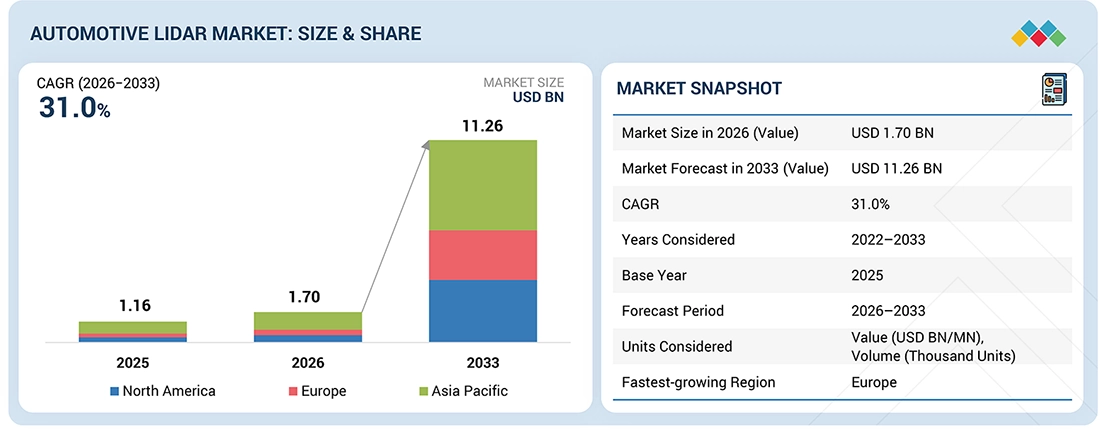
Source: Secondary Research, Interviews with Experts, MarketsandMarkets Analysis
The automotive LiDAR market is projected to reach USD 11.26 billion by 2033, from USD 1.70 billion in 2026, with a CAGR of 31.0%. Automotive LiDAR adoption is led primarily by China, where OEMs such as BYD, NIO, XPENG, Li Auto, Geely, and SAIC Motor are expanding LiDAR deployment from premium models into broader intelligent EV portfolios. The market is shifting from mechanical systems toward hybrid and solid-state LiDAR architectures that offer higher-resolution perception, longer detection range, lower power consumption, and improved cost efficiency for production vehicles. Chinese suppliers, including Hesai Group, RoboSense, Seyond, and Huawei Technologies Co., Ltd., are strengthening capabilities across sensing hardware, optics, chips, and perception software, accelerating commercialization and improving affordability. At the same time, OEM priorities are moving beyond hardware specifications toward better perception quality, AI-based sensor fusion, and more reliable environmental understanding, with LiDAR increasingly used to improve vehicle intelligence, safety performance, and driving reliability across complex urban environments.
Automotive LiDAR Market Size and Forecast:
- Market Size Value in 2025: USD 1.16 Billion
- Market Size Value in 2026: USD 1.70 Billion
- Revenue Forecast in 2033: USD 11.26 Billion
- Growth Rate: CAGR of 10.6% from 2026 to 2031
- Data available from 2022 to 2033
- Base year: 2025
- Forecast period: 2026–2033
Key Market Trends and Insights
- Market Growth: Growth is driven by rising EV adoption, solid-state LiDAR advancements, and increasing demand for autonomous driving technologies.
-
IoT Impact: IoT-enabled connectivity enhances LiDAR data processing, real-time perception, and sensor integration for advanced vehicle intelligence.
- Growing Trends: The market is shifting toward integrated perception systems, sensor fusion, and software-enabled LiDAR solutions driven by autonomous driving advancements.
- Growth Opportunities: Growth opportunities are driven by the expansion of sensor fusion platforms integrating LiDAR, radar, cameras, and vehicle computing systems.
KEY TAKEAWAYS
-
By RegionThe Asia Pacific region dominated the automotive LiDAR market, with a share of 38.3%, in 2025.
-
By ICE Vehicle TypeThe heavy commercial vehicle segment is projected to grow at the highest CAGR of 147.3% during the forecast period.
-
By Electric Vehicle TypeThe BEV segment is expected to record the fastest growth during the forecast period.
-
By Image TypeThe 3D segment is expected to lead the market during the forecast period.
-
By Laser WavelengthThe short-wave infrared segment is expected to grow at the highest rate during the forecast period.
-
By Level of AutonomyThe semi-autonomous segment is expected to register a higher CAGR of 24.3% during the forecast period.
-
By LocationThe bumper & grille segment is expected to lead the market during the forecast period.
-
By Measurement ProcessThe time of flight (ToF) segment is expected to dominate the market during the forecast period.
-
By TechnologyThe solid-state LiDAR segment is expected to grow faster than the mechanical LiDAR segment during the forecast period.
-
By RangeThe long-range segment is expected to grow at a higher rate than the short & mid-range segment during the forecast period.
-
Competitive LandscapeHesai Group (China), RoboSense (China), Huawei Technologies Co., Ltd. (China), Seyond (US), and Luminar Technologies, Inc. (US) were identified as leading players in the automotive LiDAR market due to their strong focus on automotive-grade product development, expanding OEM partnerships, advanced sensing and perception capabilities, and growing commercialization across production vehicle programs.
-
Competitive LandscapeAeva (US), Cepton (US), Leishen Intelligent Systems (China), Benewake (China), Opsys Tech (Israel), PreAct Technologies (US), and Voyant Photonics (US) have distinguished themselves among startups and SMEs due to their strong product portfolio and business strategy.
The automotive LiDAR market is moving from early autonomous driving programs toward broader deployment across production vehicles as automakers increasingly focus on improving real-world driving performance rather than adding standalone premium features. Growth is driven by the expanding adoption of Level 2+ and Level 3 driving functions, where LiDAR enhances object detection, free-space recognition, and environmental understanding in complex urban and highway conditions. The market is also shifting toward solid-state and semiconductor-integrated architectures, which help reduce sensor size, simplify vehicle integration, and improve commercial viability for larger production volumes. At the same time, LiDAR is increasingly deployed as part of sensor fusion systems alongside cameras and imaging radar to improve perception reliability and reduce sensing blind spots. As intelligent driving capabilities expand across passenger vehicles, LiDAR is becoming an important sensing layer that enables safer, more reliable, and scalable vehicle automation.
TRENDS & DISRUPTIONS IMPACTING CUSTOMERS' CUSTOMERS
The automotive LiDAR market is evolving from standalone sensing hardware toward integrated perception and intelligent vehicle sensing platforms. Current revenues are largely generated through LiDAR sensor supply, vehicle production programs, engineering integration, and development partnerships, while future growth is expected to come from perception software, sensor fusion solutions, validation services, and software-enabled vehicle functions. The increasing deployment of Level 2+ and Level 3 driving capabilities is strengthening collaboration among automotive OEMs, Tier-1 suppliers, semiconductor companies, and autonomous technology developers. This transition is enabling higher detection accuracy, improved vehicle safety, optimized system costs, stronger environmental awareness, and more scalable deployment of automated driving technologies across passenger and commercial vehicle platforms.
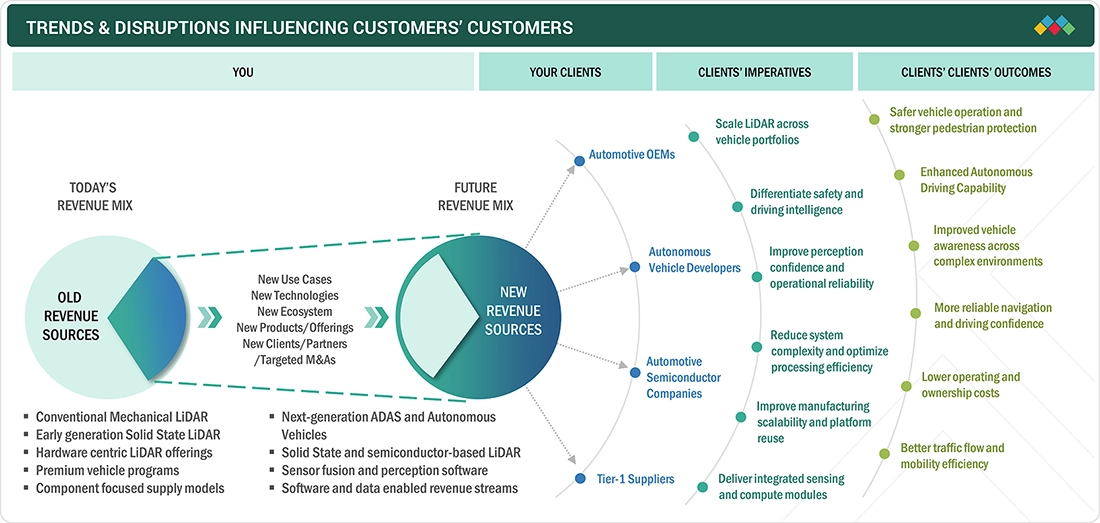
Source: Secondary Research, Interviews with Experts, MarketsandMarkets Analysis
MARKET DYNAMICS

Level
-
Rising deployment of Level 2+ and Level 3 automated driving systems

-
Transition toward solid-state and semiconductor-integrated LiDAR


Level
-
Growing adoption of alternative sensing technologies

-
Competition from advanced camera and imaging radar solutions


Level
-
Expansion of sensor fusion platforms

-
Premium ADAS feature monetization


Level
-
Sensor cost and vehicle integration complexity

-
Maintaining LiDAR performance across operating conditions

Source: Secondary Research, Interviews with Experts, MarketsandMarkets Analysis
Driver: Rising deployment of Level 2+ and Level 3 automated driving systems
Increasing deployment of Level 2+ and Level 3 driving capabilities is accelerating demand for automotive LiDAR as OEMs require higher perception accuracy and stronger environmental awareness beyond camera-only systems. LiDAR is increasingly adopted to support functions such as highway pilot, automated lane change, and hands-free driving in complex traffic conditions. Commercial deployment is becoming more visible in production vehicle programs, including the Mercedes-Benz S-Class with DRIVE PILOT using Valeo LiDAR, the Volvo EX90 integrating LiDAR from Luminar Technologies, Inc. (US), and the NIO ET7 using LiDAR for intelligent driving functions, reflecting the growing use of LiDAR to support higher sensing confidence and safer driving performance.
Restraint: Growing adoption of alternative sensing technologies
Advances in imaging radar, high-resolution cameras, and AI-based perception software are reducing reliance on LiDAR in selected vehicle programs, particularly in cost-sensitive segments. Instead of adding LiDAR, some OEMs are improving perception capabilities through stronger camera-radar fusion and centralized computing architectures to reduce hardware costs and simplify vehicle integration. This trend is increasing pressure on LiDAR suppliers to improve cost efficiency, reduce packaging complexity, and demonstrate clear performance advantages in advanced driving applications where higher sensing precision justifies additional system cost.
Opportunity: Expansion of sensor fusion platforms
Increasing adoption of sensor fusion platforms that combine LiDAR, radar, cameras, and centralized vehicle compute is creating new growth opportunities for automotive LiDAR suppliers. Sensor fusion improves object recognition, perception redundancy, and vehicle decision-making, making it a preferred architecture for next-generation intelligent vehicles.
Challenge: Sensor cost and vehicle integration complexity
Automotive LiDAR adoption continues to face challenges stemming from sensor costs and integration requirements across vehicle platforms. Integrating LiDAR requires changes to vehicle architecture, thermal management, calibration, perception software, and validation cycles, which increase development timelines and slow commercialization in volume vehicle programs.
AUTOMOTIVE LIDAR MARKET SIZE, SHARE & ANALYSIS: COMMERCIAL USE CASES ACROSS INDUSTRIES
| COMPANY | USE CASE DESCRIPTION | BENEFITS |
|---|---|---|
 |
Long-range and high-resolution LiDAR solutions for ADAS, autonomous driving, and intelligent vehicle platforms supporting highway and complex road perception | Extended detection range, improved obstacle recognition, stronger driving confidence, reduced perception blind spots |
 |
Automotive-grade solid-state LiDAR and perception solutions for passenger cars, robotaxis, and ADAS to support object detection, lane understanding, and vehicle environment perception | Improved vehicle sensing accuracy, stronger urban driving capability, enhanced safety performance, scalable deployment across vehicle platforms |
 |
Integrated automotive LiDAR and intelligent vehicle sensing solutions combined with compute and software platforms for smart vehicle architectures | Better sensor integration, optimized system performance, improved automated driving response, accelerated intellige |
 |
High-resolution LiDAR sensing platforms for autonomous mobility, vehicle perception, and intelligent transportation applications | Greater environmental awareness, reliable detection in complex conditions, improved operational safety, higher perception consistency |
 |
Automotive-grade LiDAR and ADAS sensing solutions for Level 3 driving, production vehicle integration, and intelligent perception across premium passenger vehicle platforms | Improved long-range perception accuracy, enhanced automated driving safety, better vehicle integration, and scalable deployment across production vehicle programs |
Logos and trademarks shown above are the property of their respective owners. Their use here is for informational and illustrative purposes only.
MARKET ECOSYSTEM
The automotive LiDAR market ecosystem is a connected network of component manufacturers, LiDAR system providers, software companies, and automotive OEMs working together to advance vehicle perception and automated driving capabilities. It includes component manufacturers such as Coherent Corp., which supplies photonics and laser technologies; Hamamatsu Photonics, which provides photodetectors and optical sensing components; and Lumentum Holdings, which develops laser and optical technologies for LiDAR systems. The ecosystem also includes LiDAR system providers such as Huawei, Hesai Technology, and RoboSense, which design and deliver integrated LiDAR platforms for environmental sensing, object detection, and ADAS applications. It further includes software providers such as Aeva Technologies, AEye, Inc., and Seyond, which develop perception software and sensing intelligence to improve real-time driving decisions. OEMs such as Volkswagen, Ford, BMW, and Mercedes-Benz integrate these technologies into vehicle platforms to enhance safety, driving automation, and intelligent mobility functions.
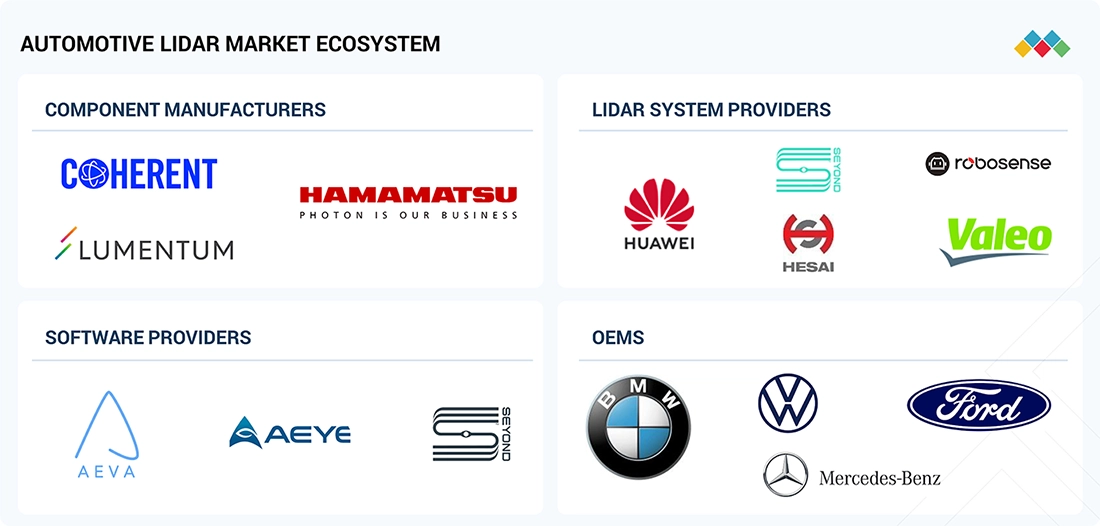
Logos and trademarks shown above are the property of their respective owners. Their use here is for informational and illustrative purposes only.
MARKET SEGMENTS
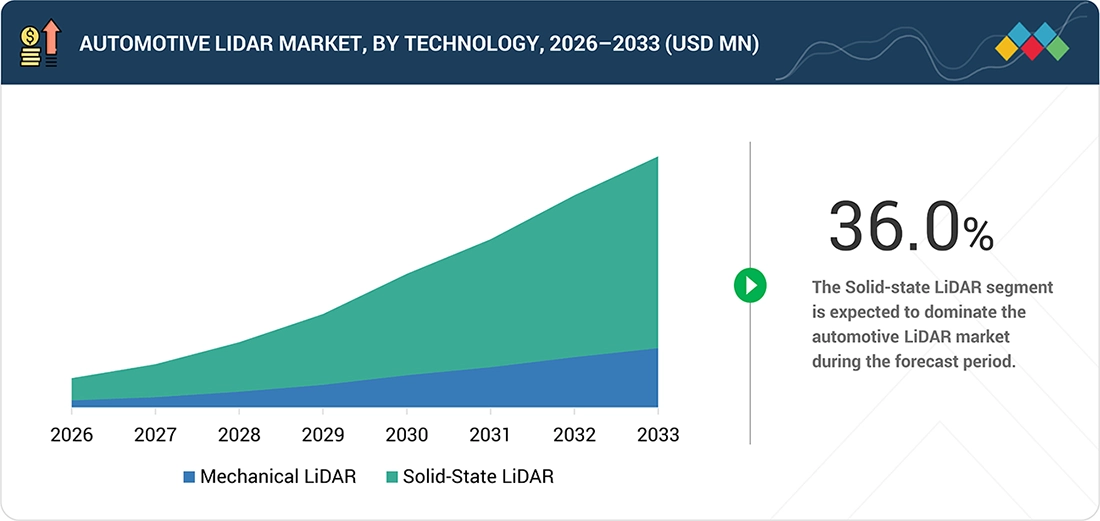
Source: Secondary Research, Interviews with Experts, MarketsandMarkets Analysis
By ICE Vehicle Type
The heavy commercial vehicle segment is projected to register the highest CAGR during the forecast period, driven by rising demand for enhanced sensing capabilities for long-distance freight movement, fleet safety, and automated logistics applications. HCV platforms require stronger environmental perception and reliable object detection because of larger vehicle dimensions and complex operating conditions.
By Electric Vehicle Type
The BEV segment is projected to grow at the fastest rate over the forecast period, driven by greater integration of intelligent driving technologies and vehicle architectures that simplify LiDAR deployment. BEVs are increasingly the preferred platform for introducing and scaling advanced sensing capabilities.
By Image Type
The 3D LiDAR segment is projected to dominate the market during the forecast period due to its ability to deliver richer spatial perception and greater depth accuracy required for advanced driving functions. Greater environmental understanding continues to support wider deployment across production vehicle programs.
By Laser Wavelength
The short-wave infrared segment is projected to grow at the highest rate during the forecast period due to its ability to support longer sensing ranges and improved detection performance under demanding operating conditions. The technology is gaining attention for applications requiring stronger perception capabilities.
By Level of Autonomy
The semi-autonomous segment is projected to record the highest CAGR during the forecast period, driven by the faster commercialization of Level 2+ and Level 3 driving functions across production vehicles. OEMs continue to prioritize scalable intelligent driving features over full vehicle autonomy.
REGION
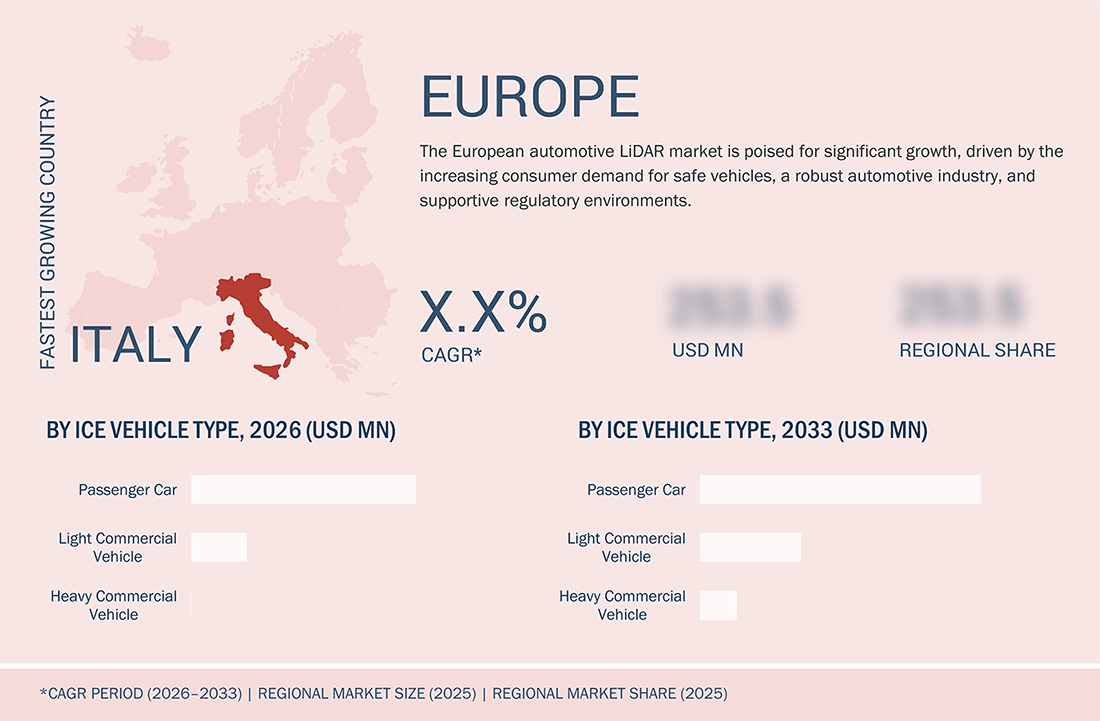
Europe to be fastest-growing region forecast period
The European automotive LiDAR market is expected to post the highest CAGR over the forecast period, supported by robust premium vehicle manufacturing, rising investment in intelligent driving technologies, and the growing integration of advanced sensing systems into next-generation vehicle platforms. Automotive OEMs and suppliers across Germany, France, and Sweden are accelerating the deployment of solid-state LiDAR to improve vehicle perception, driving performance, and intelligent driving capabilities. Growth is also supported by Europe’s strong concentration of premium OEMs commercializing Level 2+ and Level 3 driving functions, which is creating greater demand for high-performance sensing solutions in production vehicles. Production programs and technology initiatives from Mercedes-Benz (Germany), BMW (Germany), Volvo Cars (Sweden), and Valeo (France) continue to strengthen Europe’s position as the fastest-growing market.
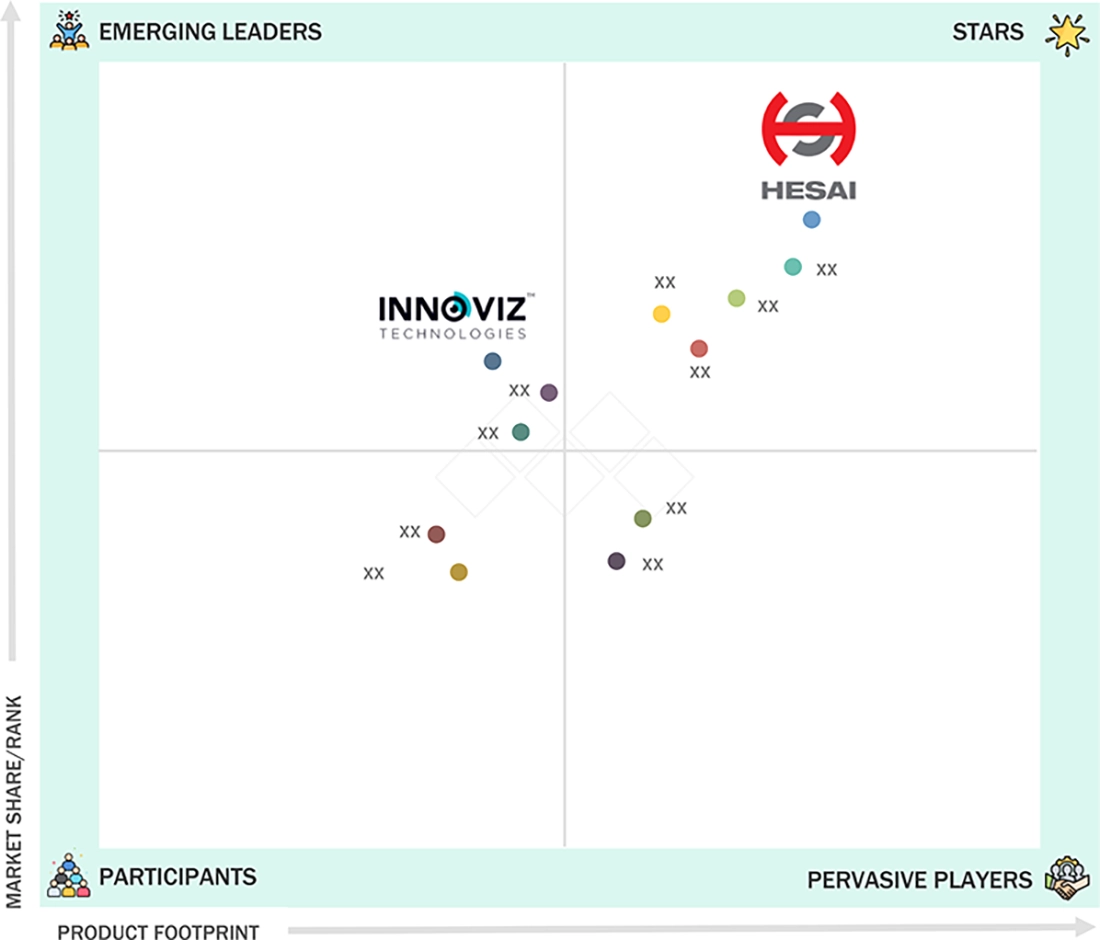
AUTOMOTIVE LIDAR MARKET SIZE, SHARE & ANALYSIS: COMPANY EVALUATION MATRIX
In the automotive LiDAR market matrix, Hesai Group (Star) leads with a strong market position, supported by high-volume production capabilities, a broad automotive LiDAR portfolio, and growing commercialization across passenger vehicles, ADAS, and intelligent driving applications. The company has strengthened its position through production programs and partnerships with global automotive manufacturers, including BYD and Geely, enabled by its scalable solid-state and hybrid LiDAR offerings. Livox (China) (Emerging Leader) is strengthening its position through compact automotive LiDAR solutions and cost-optimized sensing architectures that improve the accessibility of intelligent driving technologies. The company’s focus on simplified sensor design, production scalability, and integration efficiency positions it to expand further as demand increases for intelligent mobility, advanced vehicle perception, and wider deployment of LiDAR-enabled driving functions.
Source: Secondary Research, Interviews with Experts, MarketsandMarkets Analysis
KEY MARKET PLAYERS
- Hesai Group (China)
- Huawei Technologies Co., Ltd. (China)
- RoboSense (China)
- Seyond (US)
- Valeo (France)
- Innoviz Technologies Ltd (Israel)
- Ouster Inc. (US)
- Denso Corporation (Japan)
- ZF Friedrichshafen AG (Germany)
- Aptiv (Ireland)
- Continental AG (Germany)
- LIVOX (China)
MARKET SCOPE
| REPORT METRIC | DETAILS |
|---|---|
| Market Size in 2025 (Value) | USD 1.16 BN |
| Market Forecast in 2033 (Value) | USD 11.26 BN |
| Growth Rate | CAGR of 31.0% from 2026 to 2033 |
| Years Considered | 2022–2033 |
| Base Year | 2025 |
| Forecast Period | 2026–2033 |
| Units Considered | Value (USD BN/MN) and Volume (Thousand Units) |
| Report Coverage | Revenue forecast, market share, competitive landscape, growth factors, and trends |
| Segments Covered |
|
| Regions Covered | Asia Pacific, Europe, North America |
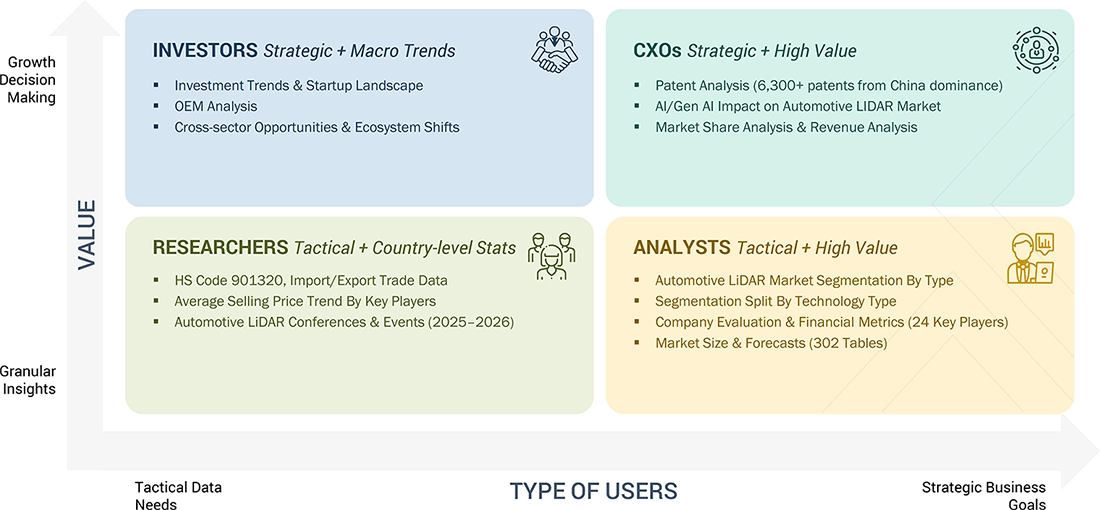
WHAT IS IN IT FOR YOU: AUTOMOTIVE LIDAR MARKET SIZE, SHARE & ANALYSIS REPORT CONTENT GUIDE
DELIVERED CUSTOMIZATIONS
We have successfully delivered the following deep-dive customizations:
| CLIENT REQUEST | CUSTOMIZATION DELIVERED | VALUE ADDS |
|---|---|---|
| Automotive OEM |
|
|
| LiDAR System Provider |
|
|
| Tier 1 Supplier / System Integrator |
|
|
| Semiconductor / Photonics Supplier |
|
|
| Autonomous Mobility & Fleet Operator |
|
|
RECENT DEVELOPMENTS
- April 2026 : RoboSense launched Phoenix and Peacock chipsets based on its EOCENE SPAD SoC architecture, introducing image-grade 3D perception capability for automotive LiDAR applications. The architecture improves point cloud density and supports higher-performance sensing for intelligent driving systems.
- April 2026 : Huawei expanded its intelligent driving business through additional investment in smart driving and vehicle computing infrastructure, supporting the deployment of LiDAR-integrated Qiankun ADS architectures across next-generation vehicle programs and strengthening vehicle perception capability.
- March 2026 : RoboSense partnered with WeRide to supply EM4 long-range digital LiDAR and E1 blind spot LiDAR for Robotaxi GXR deployment, supporting the planned delivery of approximately 2,000 autonomous vehicles and improving multi-sensor perception capability.
- January 2026 : Huawei expanded deployment of its Qiankun intelligent driving platform with automotive LiDAR integration across multiple OEM programs, strengthening sensor fusion capability and automated driving performance in production vehicles.
- January 2026 : Hesai was selected as LiDAR partner for NVIDIA DRIVE Hyperion 10, supplying ETX long-range automotive LiDAR for Level 3 and Level 4 automated driving architectures and supporting scalable deployment of intelligent vehicle platforms.
Table of Contents
 Exclusive indicates content/data unique to MarketsandMarkets and not available with any competitors.
Methodology
The research uses extensive secondary sources, such as company annual reports/presentations, industry association publications, magazine articles, directories, technical handbooks, World Economic Outlook, trade websites, technical articles, and databases, to identify and collect information on the automotive LiDAR market. Primary sources, such as experts from related industries, OEMs, and suppliers, have been interviewed to obtain and verify critical information and assess the growth prospects and market estimations.
Secondary Research
Secondary sources for this research study include corporate filings, such as annual reports, investor presentations, and financial statements; trade, business, and professional associations; whitepapers and autonomous vehicles and ADAS-related journals; certified publications; articles by recognized authors; directories; and databases. Secondary data has been collected and analyzed to determine the overall market size, further validated by primary research.
Primary Research
After understanding the automotive LiDAR market scenario through secondary research, extensive primary research has been conducted. Primary interviews have been conducted with market experts from both demand and supply sides across North America, Europe, and Asia Pacific. Approximately 35% of interviews have been conducted from the demand side, while 65% of primary interviews have been conducted from the supply side. The primary data has been collected through questionnaires, emails, and telephone interviews.
In the canvassing of primaries, various departments within organizations, such as sales and operations, have been covered to provide a holistic viewpoint in this report. Primary sources from the supply side include various industry experts, such as CXOs, vice presidents, directors from business development, marketing, product development/innovation teams, and related key executives from various key companies. Various system integrators, industry associations, independent consultants/industry veterans, and key opinion leaders have also been interviewed.
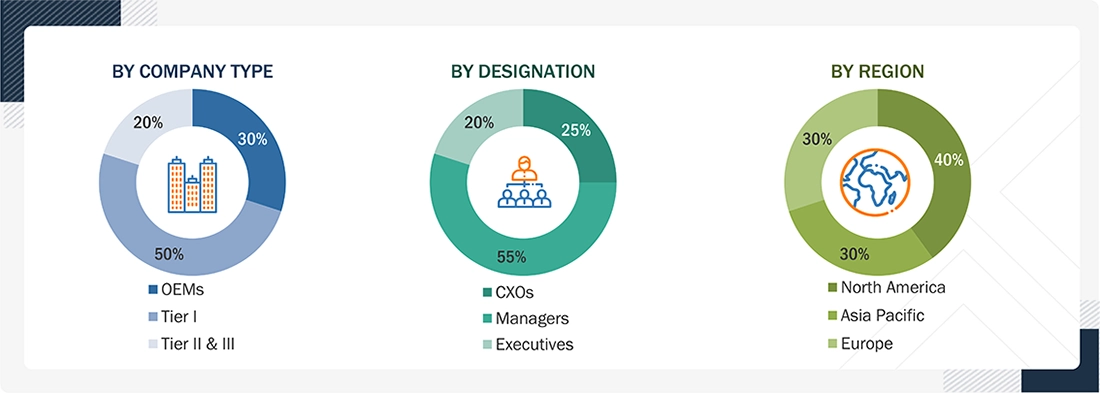
Note: Others include sales, managers, and product managers.
To know about the assumptions considered for the study, download the pdf brochure
Market Size Estimation
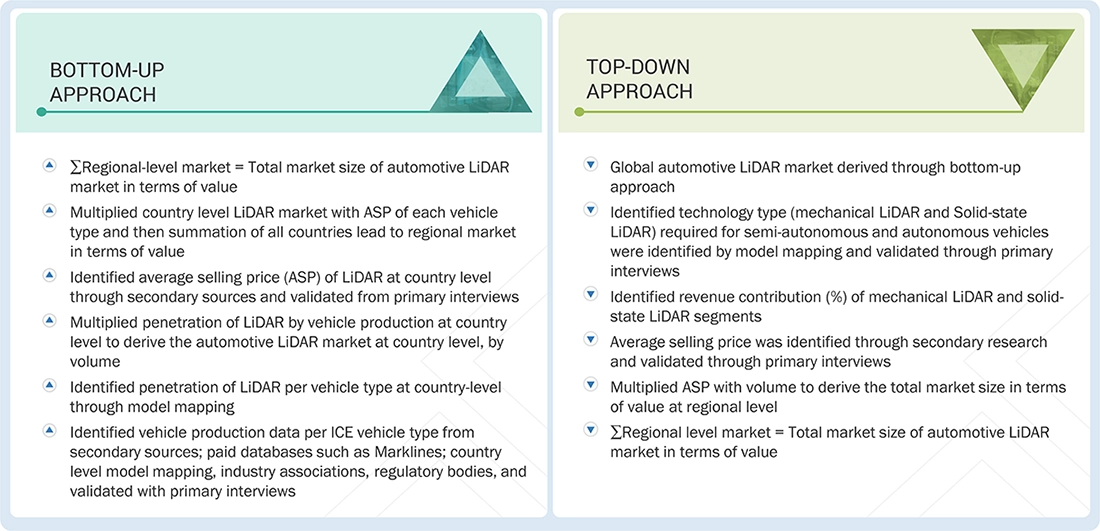
Both top-down and bottom-up approaches were used to estimate and validate the total size of the automotive LiDAR market. These methods were also used extensively to estimate the size of various subsegments in the market. The research methodology used to estimate the market size includes the following:
Data Triangulation
After arriving at the overall market size of the global market through the methodology mentioned above, this market was split into several segments and subsegments. The data triangulation and market breakdown procedures were employed to complete the overall market engineering process and arrive at the exact market value data for the key segments and sub-segments, wherever applicable. The extrapolated market data was triangulated by studying various macro indicators and regional trends from both the demand and supply-side participants.
Market Definition
According to Texas Instruments, LiDAR is a sensing technology that detects objects and maps their distances. The technology works by illuminating a target with an optical pulse and measuring the characteristics of the reflected return signal.
Key Stakeholders
- ADAS System Manufacturers
- Automobile Original Equipment Manufacturers (OEMs)
- Automotive Parts Manufacturers’ Association (APMA)
- Automotive Component Manufacturers
- Governments, Financial Institutions, and Investment Communities
- European Automobile Manufacturers Association (ACEA)
- LiDAR Hardware Suppliers
- LiDAR Software Suppliers
- LiDAR System Integrators
- Manufacturers of Automotive LiDAR Microprocessors
- Original Device Manufacturer (ODM) and OEM Technology Solution Providers
- National Highway Traffic Safety Administration (NHTSA)
- Raw Material and Manufacturing Equipment Suppliers
- Research Institutes and Organizations
- Semiconductor Foundries
- Technology Investors
- Technology Standards Organizations, Forums, Alliances, and Associations
- Vehicle Safety Regulatory Bodies
Report Objectives
- To analyze and forecast the automotive LiDAR market in terms of volume (thousand units) and value (USD million) from 2026 to 2033
- To segment the market by Technology, Image Type, ICE Vehicle Type, Location, Electric Vehicle, Range, Laser Wavelength, Measurement Process, Level of Autonomy, and region
- To segment and forecast the market by Technology (Mechanical LiDAR and Solid-state LiDAR)
- To segment and forecast the market by Image Type (2D and 3D)
- To segment and forecast the market by ICE Vehicle Type (Passenger Car, Light Commercial Vehicle, and Heavy Commercial Vehicle)
- To segment and forecast the market by Location (Bumper & Grille, Headlight & Taillight, Roof & Upper Pillar, and Others)
- To segment and forecast the market by Electric Vehicle Type (BEV, PHEV, FCEV, and HEV)
- To segment and forecast the market by Range (Short & Mid-range and Long-range)
- To segment and forecast the market by Laser Wavelength (Near Infrared, Short-wave Infrared, and Long-wave Infrared)
- To segment and forecast the market by Measurement Process (Frequency Modulated Continuous Process and Time of Flight)
- To segment and forecast the market by Level of Autonomy (Semi-autonomous and Autonomous)
- To forecast the market by region (North America, Europe, and Asia Pacific)
- To identify and analyze key drivers, challenges, restraints, and opportunities influencing the market growth
- To strategically analyze the market for individual growth trends, prospects, and contributions to the total market
- To study the following with respect to the market
- Pricing Analysis
- Investment and Funding Scenario
- Value Chain Analysis
- Ecosystem Analysis
- Technology Analysis
- HS Code
- Case Study Analysis
- Patent Analysis
- Regulatory Landscape
- Key Stakeholders and Buying Criteria
- Key Conferences and Events
- To strategically profile the key players and comprehensively analyze their market share and core competencies
- To analyze the impact of AI on the market
- To track and analyze competitive developments such as deals, product launches/developments, expansions, and other activities undertaken by the key industry participants
Available customizations:
With the given market data, MarketsandMarkets offers customizations in accordance with the company’s specific needs.
- Additional Company Profiles (Up to Five)
- Global Automotive LiDAR market, by Level of Autonomy, at Country Level
- Global Automotive LiDAR market, by BEV Type, at Country Level
Key Questions Addressed by the Report


Personalize This Research
- Triangulate with your Own Data
- Get Data as per your Format and Definition
- Gain a Deeper Dive on a Specific Application, Geography, Customer or Competitor
- Any level of Personalization
Let Us Help You
- What are the Known and Unknown Adjacencies Impacting the Automotive LiDAR Market
- What will your New Revenue Sources be?
- Who will be your Top Customer; what will make them switch?
- Defend your Market Share or Win Competitors
- Get a Scorecard for Target Partners

Custom Market Research Services
We Will Customise The Research For You, In Case The Report Listed Above Does Not Meet With Your Requirements
Get 10% Free CustomisationTESTIMONIALS

JIM NAAS
PRODUCT DIRECTOR, WEASLER
Weasler Engineering, a CentroMotion organization
Global Provider of Industrial Actuation & Control Solutionswww.weasler.com
Our organization was interested in learning more about the attractiveness of a particular market space. We contacted MarketsandMarkets to help us based on previous positive experiences we had with them. The results did not disappoint! We discussed our objectives with them, and the team at MarketsandMarkets developed and executed a proposal that met our needs precisely. We were very impressed by their level of expertise, the quality of the analysis and their insightful recommendations. We would not hesitate in working with them again in the future.

Matt Kardel,
Vice President
Aptiv,
A global technology company that develops safer, greener and more connected solutions.www.aptiv.com
We contracted with
MarketsandMarkets to evaluate the value chain and potential go-to-market partners related to our
interest in the Fleet Management space. The team successfully completed the work on time and at the
pricing agreed. MarketsandMarkets listened and understood our objectives and collaborated well with
us to help us get the visibility we needed to make an investment.
We have subsequently used
MarketsandMarkets again related to Smart Cities to good results.
- China Automotive LiDAR Market
- India Automotive LiDAR Market
- Japan Automotive LiDAR Market
- South Korea Automotive LiDAR Market
- Germany Automotive LiDAR Market
- France Automotive LiDAR Market
- Italy Automotive LiDAR Market
- UK Automotive LiDAR Market
- Spain Automotive LiDAR Market
- Canada Automotive LiDAR Market
- US Automotive LiDAR Market




Growth opportunities and latent adjacency in Automotive LiDAR Market