Automotive RADAR Market Size, Share & Analysis

Automotive Radar Market by Range (Short Range, Medium Range, Long Range), Vehicle Type (PC, LCV, HCV), Frequency (2X-GHz and 7X-GHz), EV Type (BEV, PHEV, FCEV, HEV), Mounting (In-cabin, Exterior), Application, and Region - Global Forecast to 2033




OVERVIEW
Source: Secondary Research, Interviews with Experts, MarketsandMarkets Analysis
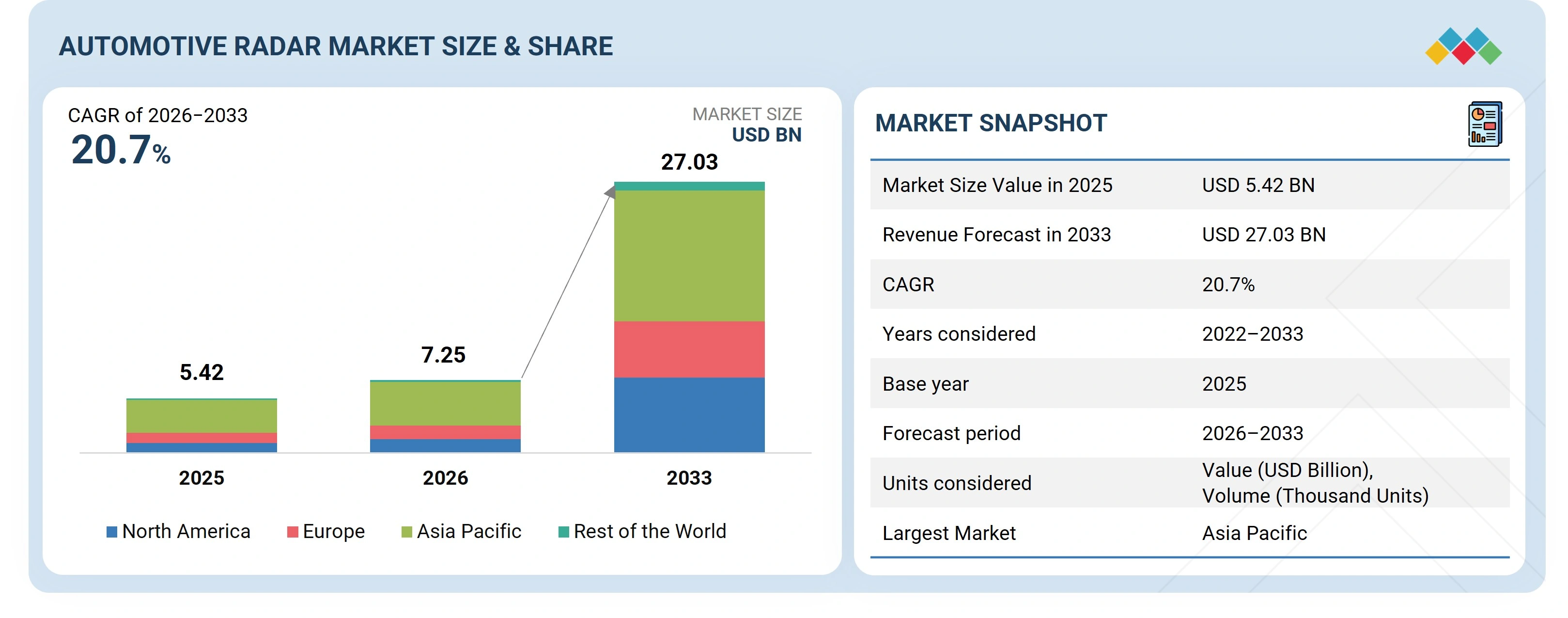
The automotive radar market is projected to grow from USD 7.25 billion in 2026 to USD 27.03 billion by 2033 at a CAGR of 20.7%. This growth is mainly driven by the increasing adoption of 4D imaging radar by OEMs to support Level 2 and higher ADAS features. In addition, supportive government regulations across key regions are accelerating the adoption of radar-based safety systems. For instance, Europe’s GSR II mandates features such as automatic emergency braking, lane-keeping assistance, and pedestrian or cyclist detection. China’s NCAP emphasizes AEB and blind spot detection, while in the US, NHTSA is mandating AEB and forward collision warning in new vehicles. These regulations are making radar a standard safety feature across vehicle segments. Further, interior radar is gaining traction for occupant monitoring and in-cabin safety applications. Continuous advancements in radar technology, combined with stringent global safety regulations, are expected to drive strong market growth in the coming years.
Automotive RADAR Market Size and Forecast:
- Market Size Value in 2025: USD 5.42 Billion
- Market Size Value in 2026: USD 7.25 Billion
- Revenue Forecast in 2033: USD 27.03 Billion
- Growth Rate: CAGR of 20.7% from 2026 to 2033
- Data available from 2022 to 2033
- Base year: 2025
- Forecast period: 2026–2033
Key Market Trends and Insights
- Market Growth: Growth is driven by increasing adoption of 4D imaging radar, rising ADAS deployment, and stringent vehicle safety regulations worldwide.
-
IoT Impact: Advancements in ADAS and 77–79 GHz radar technologies are improving object detection accuracy and accelerating radar adoption across vehicle segments.
- Growing Trends: The market is shifting toward AI-powered, sensor-fusion, and 4D imaging radar solutions to support advanced safety and autonomous driving applications.
- Growth Opportunities: Opportunities are emerging from the increasing adoption of Level 2+ and Level 3 autonomous vehicles.
KEY TAKEAWAYS
-
BY REGIONThe Asia Pacific automotive radar market dominated with a share of 60.3% in 2025.
-
BY VEHICLE TYPEHeavy commercial vehicles are expected to register the highest CAGR of 47.8% from 2026 to 2033.
-
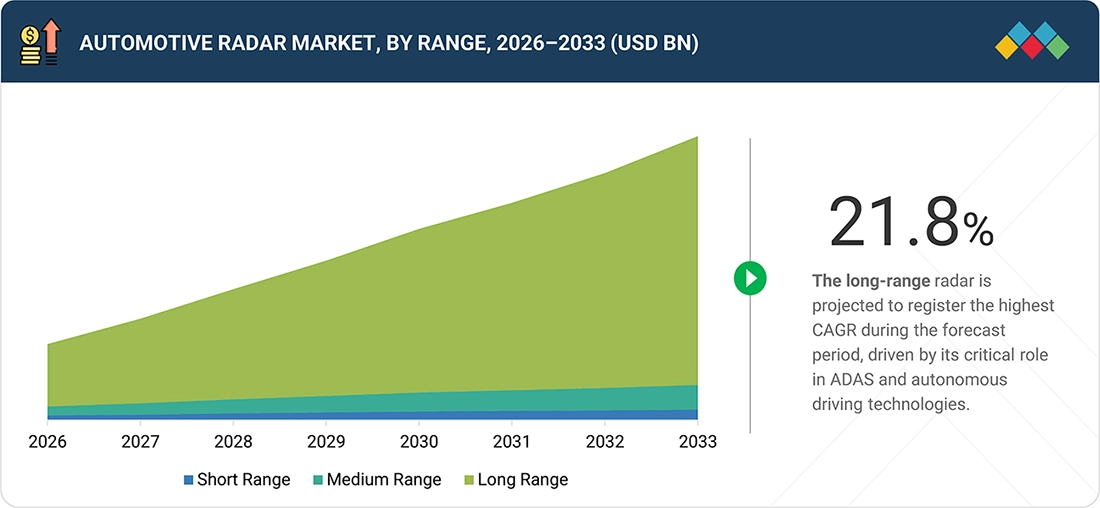
BY RANGEThe long-range radar segment is projected to grow at the fastest rate of 21.8% from 2026 to 2033.
-
BY FREQUENCYThe 7X-GHz segment is expected to dominate the market from 2026 to 2033.
-
BY MOUNTINGThe exterior segment is projected to hold the largest market share during the forecast period.
-
BY APPLICATIONThe automatic emergency braking segment is projected to grow at a high CAGR during the forecast period.
-
BY EV TYPEThe BEV segment holds the largest market share.
-
Competitive Landscape: Key PlayersAUMOVIO SE, HELLA GmbH & Co. KGaA, and Robert Bosch GmbH were identified as some of the star players in the automotive radar market, given their strong market share and product footprint.
-
Competitive Landscape:StartupsSpartan Radar, Inc., Altos Radar, and Lunewave Inc., among others, have distinguished themselves among startups and SMEs by securing strong footholds in specialized niche areas, underscoring their potential as emerging market leaders
The market is shifting toward higher sensor density per vehicle, with 4–6 radar units becoming standard in vehicles offering Level 2+ features, significantly increasing unit volumes. There is a transition from conventional radar to high-resolution and imaging radar, enabling better object classification and supporting complex urban driving scenarios. Additionally, OEMs are prioritizing radar as a cost-effective and weather-resilient sensor within sensor fusion stacks, ensuring consistent performance where camera-only systems face limitations. Further, platform-level standardization is driving the adoption of modular radar architectures that can be scaled across multiple vehicle models.
TRENDS & DISRUPTIONS IMPACTING CUSTOMERS' CUSTOMERS
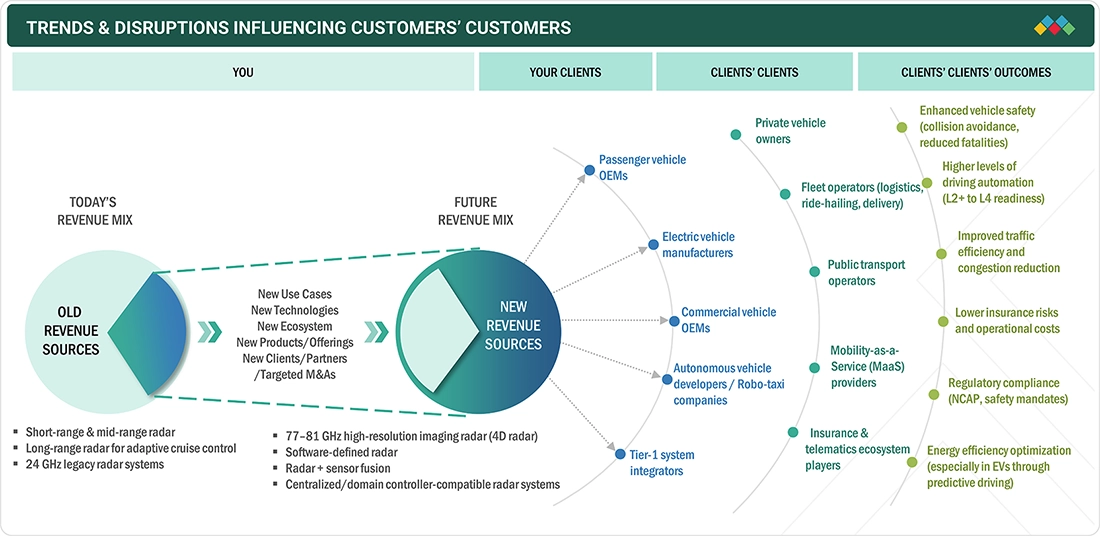
The automotive radar market is growing from basic systems to advanced technologies, driven by AI, sensor fusion, and 4D imaging. Automakers and fleet operators are increasingly looking for smarter, long-range, and reliable radar solutions to support features such as collision avoidance, asset protection, and readiness for autonomous driving. This shift is pushing suppliers to innovate, form new partnerships, and expand their product offerings to remain competitive in a rapidly evolving mobility market.
Source: Secondary Research, Interviews with Experts, MarketsandMarkets Analysis
MARKET DYNAMICS

Level
-
Rising demand for ADAS and ongoing technological advancements supporting market growth

-
Increasing dependence on Doppler frequency shift–based technology


Level
-
Limited ability to distinguish between multiple targets

-
Impact of changing weather conditions on radar performance and reliability


Level
-
Increasing demand for autonomous vehicles

-
Emergence of new business models and smart mobility solutions enabled by automotive radar technology


Level
-
Competition from alternative technologies

-
Fluctuations in raw material prices and supply chain disruptions

Source: Secondary Research, Interviews with Experts, MarketsandMarkets Analysis
Driver: Rising demand for ADAS and ongoing technological advancements supporting market growth
The increasing adoption of ADAS features such as AEB, ACC, and blind spot detection is directly driving radar demand, as these functions rely heavily on precise object detection and tracking. Advancements in 77–79 GHz radar and imaging capabilities are further enabling higher accuracy and multi-object detection, supporting wider deployment across vehicle segments.
Restraint: Impact of changing weather conditions on radar performance and reliability
Although radar performs better than cameras in adverse weather, heavy rain, snow accumulation, and road spray can still degrade signal quality and reduce detection accuracy. Additionally, multipath reflections and interference in dense traffic environments can impact reliability, requiring advanced signal processing to maintain performance.
Opportunity: Increasing demand for autonomous vehicles
The transition toward Level 2+ and Level 3 autonomy is increasing the need for multiple radar sensors per vehicle, especially for 360-degree perception and redundancy. Radar is being increasingly preferred as a core sensor due to its cost advantage and consistent performance, creating opportunities for high-resolution and imaging radar solutions.
Challenge: Competition from alternative technologies
Technologies such as cameras and LiDAR are competing with radar in perception systems, particularly in object classification and high-resolution mapping. As camera-based systems improve with AI and LiDAR costs gradually decline, radar suppliers must enhance resolution and integrate with sensor fusion platforms to remain competitive.
AUTOMOTIVE RADAR MARKET SIZE, SHARE, FORECAST, REPORT: COMMERCIAL USE CASES ACROSS INDUSTRIES
| COMPANY | USE CASE DESCRIPTION | BENEFITS |
|---|---|---|
 |
Develops short-, mid-, and long-range radar sensors for ADAS features such as adaptive cruise control (ACC), automatic emergency braking (AEB), and blind-spot detection in passenger vehicles | Improves vehicle safety, enables collision avoidance, and supports higher levels of driving automation |
 |
Provides 77 GHz radar systems for autonomous driving and cross-traffic alert in both passenger and commercial vehicles | Enhances object detection accuracy, supports all-weather sensing, and improves road safety |
 |
Supplies high-resolution imaging radar for Level 2+ to Level 3 autonomous driving systems, including highway pilot functions | Enables precise environment mapping, improves decision-making capability, and supports semi-autonomous driving |
 |
Integrates radar sensors into centralized ADAS platforms for sensor fusion with cameras and LiDAR | Enhances perception reliability, reduces system redundancy, and supports scalable autonomous architectures |
 |
Develops compact radar modules for parking assistance, blind spot monitoring, and urban driving assistance systems | Improves low-speed maneuvering safety, reduces parking-related accidents, and enhances driver convenience |
Logos and trademarks shown above are the property of their respective owners. Their use here is for informational and illustrative purposes only.
MARKET ECOSYSTEM
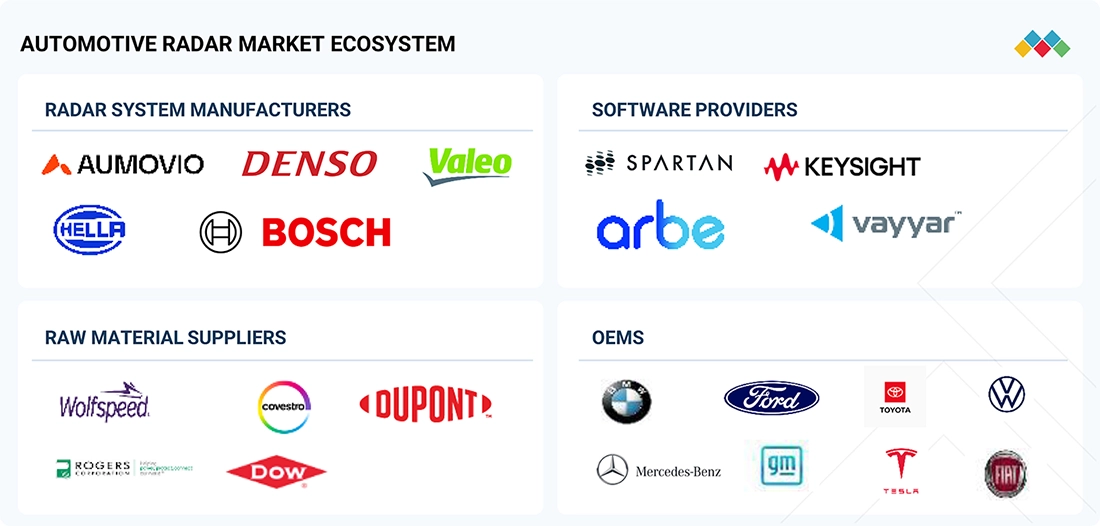
The automotive radar market ecosystem consists of radar system manufacturers, software providers, raw material suppliers, and OEMs. Some of the major automotive radar providers include AUMOVIO SE (Germany), HELLA GmbH & Co. KGaA (Germany), Robert Bosch GmbH (Germany), Magna International Inc. (Canada), and Denso Corporation (Japan).
Logos and trademarks shown above are the property of their respective owners. Their use here is for informational and illustrative purposes only.
MARKET SEGMENTS
Source: Secondary Research, Interviews with Experts, MarketsandMarkets Analysis
Automotive radar market, by vehicle type
Passenger cars are leading in RADAR adoption as high production volumes make it feasible for automakers to scale multi-RADAR integration across models. This segment is also the primary focus of regulatory safety mandates and NCAP assessments, pushing manufacturers to embed 77 GHz systems that enable functions like AEB, ACC, and blind spot detection, making RADAR a standard rather than optional feature.
Automotive radar market, by frequency
7X-GHz RADAR systems are dominating the market due to their longer detection range, higher resolution, and ability to support advanced functions like highway pilot and cross-traffic detection, along with regulatory phase-out of 24 GHz systems in key regions.
Automotive radar market, by range
Long-range radar is projected to be the fastest-growing segment due to its capability to detect vehicles and obstacles at greater distances, enabling adaptive cruise control, highway assist, and collision avoidance in high-speed driving conditions. In addition, regulatory mandates in markets such as the US and Europe that require advanced safety features like automatic emergency braking and forward collision warning are accelerating the adoption of long-range radar systems.
Automotive radar market, by EV type
BEVs are set to dominate the radar market as they adopt ADAS and autonomous features faster than conventional vehicles. Radar is favored in EVs because it is reliable in all weather, energy-efficient compared to cameras and LiDAR, and critical for functions like adaptive cruise control, lane change assist, and automated parking. 77 GHz long-range radar leads adoption, offering the precision and range needed for higher autonomy.
Automotive radar market, By Application
The automotive radar market is driven by applications that enhance vehicle safety and automation. Adaptive cruise control and automatic emergency braking are boosting demand as they require precise long- and mid-range detection. Blind spot detection and lane departure warning systems are increasing radar adoption for side and corner coverage. Forward collision warning systems, intelligent parking assist, and cross-traffic alert are further supporting growth by relying on accurate, real-time object detection in complex driving environments.
REGION
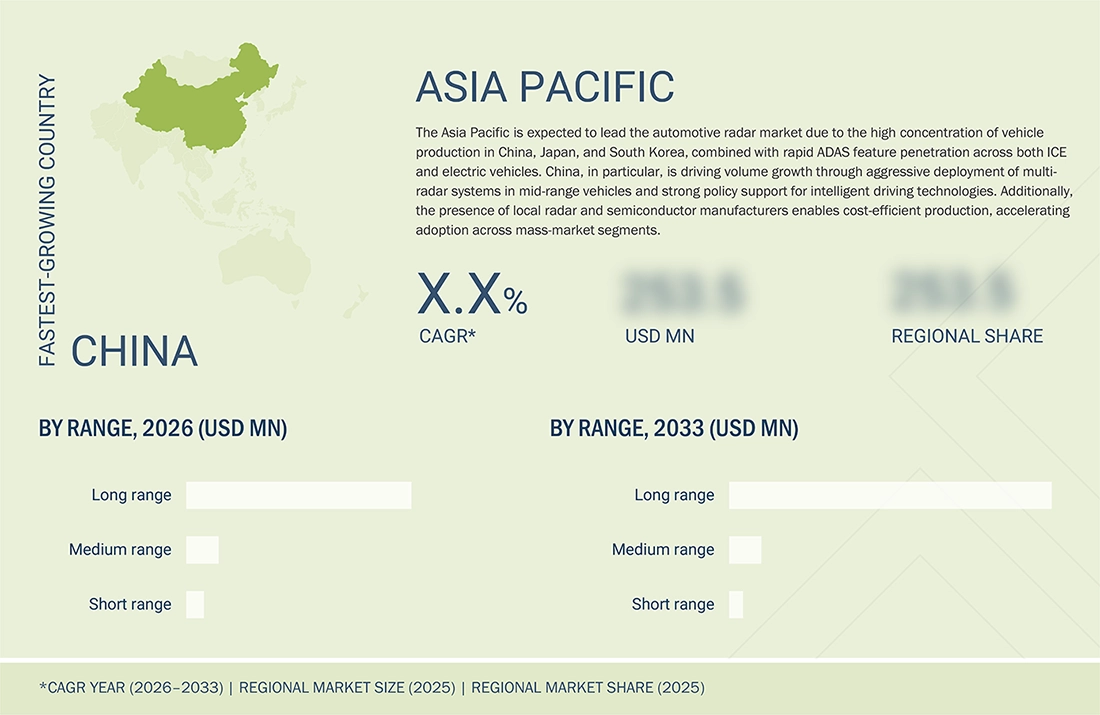
The Asia Pacific is projected to lead the global automotive radar market during the forecast period
The Asia Pacific is expected to lead the automotive radar market due to the high concentration of vehicle production in China, Japan, and South Korea, combined with rapid ADAS feature penetration across both ICE and electric vehicles. China, in particular, is driving volume growth through aggressive deployment of multi-radar systems in mid-range vehicles and strong policy support for intelligent driving technologies. Additionally, the presence of local radar and semiconductor manufacturers enables cost-efficient production, accelerating adoption across mass-market segments.
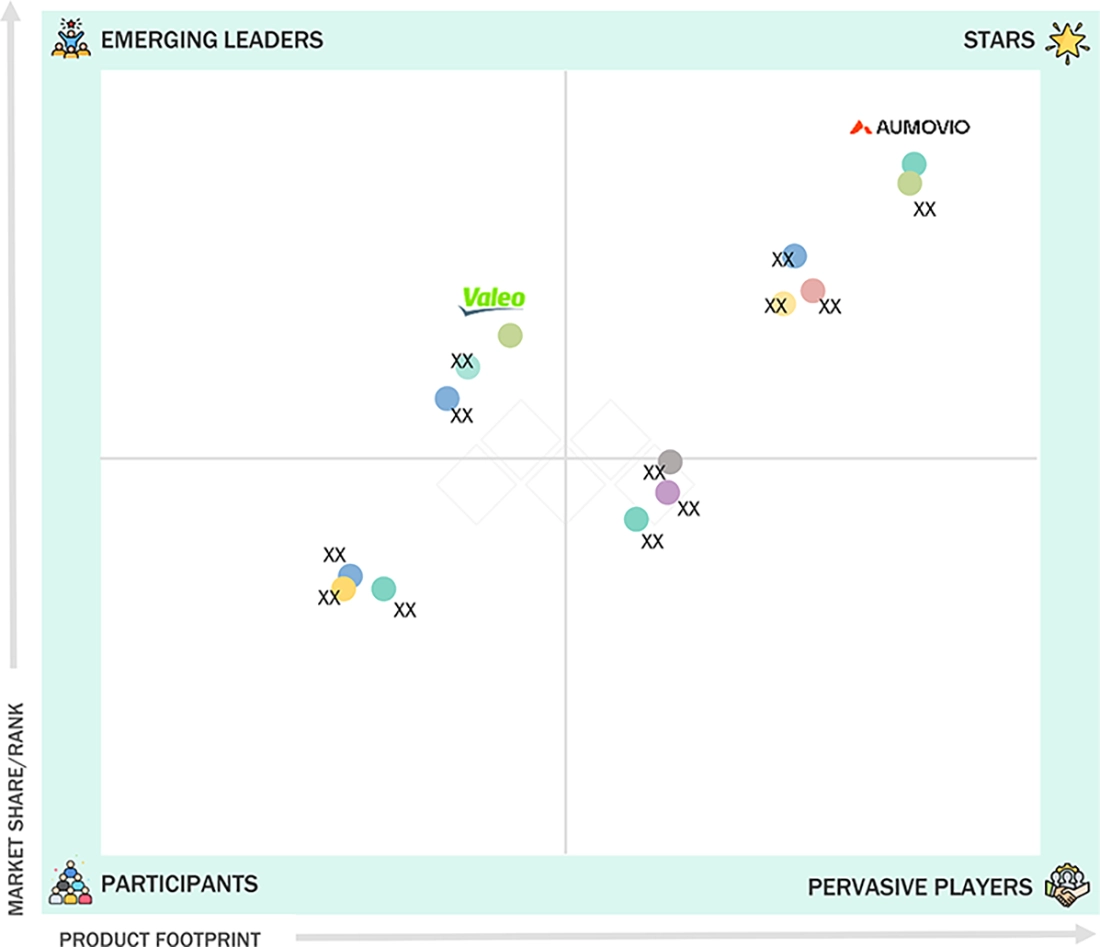
AUTOMOTIVE RADAR MARKET SIZE, SHARE, FORECAST, REPORT: COMPANY EVALUATION MATRIX
In the automotive radar market matrix, Aumovio (Star) leads with a strong market share and extensive product footprint, driven by its advanced 77–79 GHz radar portfolio, early deployment of high-resolution imaging radar, and deep integration across global OEM platforms. Valeo (Emerging Leader) is gaining visibility with its compact and cost-optimized radar solutions, strengthening its position through strong OEM partnerships and increasing penetration in mid- and high-volume vehicle segments. While Aumovio dominates through its technology leadership and broad multi-range radar offerings across premium and mass-market vehicles, Valeo shows significant potential to move toward the leaders' quadrant as it scales production, expands its radar portfolio, and accelerates adoption of next-generation imaging radar technologies.
Source: Secondary Research, Interviews with Experts, MarketsandMarkets Analysis
KEY MARKET PLAYERS
- AUMOVIO SE (Germany)
- HELLA GmbH & Co. KGaA (Germany)
- Robert Bosch GmbH (Germany)
- Magna International Inc. (Canada)
- Denso Corporation (Japan)
- Valeo (France)
- Aptiv (Switzerland)
- Denso Corporation (Japan)
- NXP Semiconductors (Netherlands)
- Infineon Technologies AG (Germany)
- Renesas Electronics Corporation (Japan)
- ZF friedrichshafen AG (Germany)
MARKET SCOPE
| REPORT METRIC | DETAILS |
|---|---|
| Market Size Value in 2025 | USD 5.42 Billion |
| Revenue Forecast in 2033 | USD 27.03 Billion |
| Growth Rate | CAGR of 20.7% from 2026-2033 |
| Years Considered | 2022-2033 |
| Base year | 2025 |
| Forecast period | 2026-2033 |
| Units considered | Volume (Thousand Units), Value (USD Million/Billion) |
| Report Coverage | Revenue forecast, company ranking, competitive landscape, growth factors, and trends |
| Segments Covered |
|
| Regional Scope | Asia Pacific, Europe, North America, and Rest of the World |
WHAT IS IN IT FOR YOU: AUTOMOTIVE RADAR MARKET SIZE, SHARE, FORECAST, REPORT REPORT CONTENT GUIDE
DELIVERED CUSTOMIZATIONS
We have successfully delivered the following deep-dive customizations:
| CLIENT REQUEST | CUSTOMIZATION DELIVERED | VALUE ADDS |
|---|---|---|
| Global Tier-1 Supplier (Germany) |
|
|
| Automotive OEM (US) |
|
|
| Semiconductor Company (Asia Pacific) |
|
|
| Autonomous Driving Startup (China) |
|
|
| Tier 2 Component Supplier (Europe) |
|
|
RECENT DEVELOPMENTS
- March 2026 : NXP Semiconductors (Netherlands) launched its third-generation RFCMOS automotive radar transceiver, the TEF8388. It is designed to support high-resolution imaging radar for Level 2+ to Level 4 ADAS and automated driving systems. The device integrates 8 transmit and 8 receive channels on a single chip and can support up to 576 antenna channels. It offers improved resolution, dynamic range, and detection range while being suitable for mass production.
- February 2026 : Socionext and Innatera jointly developed a human presence detection solution that combines 60 GHz FMCW radar with neuromorphic edge AI. The system provides reliable, always-on detection while significantly reducing power consumption. The solution integrates Socionext’s compact 60 GHz radar, which captures detailed 3D environmental data in all lighting and weather conditions, with Innatera’s ultra-low-power spiking neural processor, which processes radar data directly at the sensor level.
- February 2026 : Huizhou Desay SV Automotive Co., Ltd. (China) launched 8T8R 4D millimeter-wave radar designed for central computing satellite architectures. The product uses an 8T8R waveguide antenna, providing about 30% higher angular accuracy compared to standard 6T8R systems, which improves the detection of nearby objects in adjacent lanes. It also offers 1.5 times higher point cloud density than 6T8R solutions. With improved signal gain, the radar extends weak target detection range by around 50%, helping reduce false AEB activations.
- January 2026 : HELLA GmbH & Co. KGaA (Germany) partnered with NXP Semiconductors (Netherlands) to develop and industrialize ForWave7HD high-resolution radar sensors, featuring up to 32 transmit and receive channels each. The sensors use NXP’s third-generation imaging radar chipset, with the S32R47 radar processor as a key component. These radar systems support automated driving at SAE Level 2+ and Level 3. Series production is expected to begin in mid-2028 for a global premium automaker, with an order value in the hundreds of millions of euros.
- January 2026 : Acconeer (Sweden) announced that its A121 pulsed coherent radar sensor is used in the newly launched Toyota RAV4 2026. The sensor enables a kick-based trunk access system for hands-free operation. It offers high accuracy and reliability, reducing false activations from nearby people or objects and working only when intended.
Table of Contents
 Exclusive indicates content/data unique to MarketsandMarkets and not available with any competitors.
Methodology
This research study involved the extensive use of secondary sources, such as company annual reports/presentations, industry association publications, automotive magazine articles, directories, technical handbooks, the World Economic Outlook, trade websites, technical articles, and databases, to identify and collect information on the automotive radar market. In-depth interviews were conducted with various primary respondents, including key industry participants, subject-matter experts (SMEs), C-level executives of key market players (automotive radar provider), and industry consultants, among other experts, to obtain and verify critical qualitative and quantitative information and assess market prospects.
Secondary Research
During the secondary research process, various secondary sources were consulted to gather information for the study. These sources included annual reports, press releases, investor presentations, white papers, and certified publications. Secondary research was used to obtain key details about the industry’s value chain, the market’s monetary flow, the major players, market classification, and segmentation based on industry trends, regional markets, and key developments from both market- and technology-oriented perspectives.
Primary Research
Extensive primary research was conducted after understanding the automotive radar market scenario through secondary research. Several primary interviews were conducted with market experts from both demand-side vehicle manufacturers (in terms of component supply), country-level government associations, trade associations, and supply-side OEMs and component manufacturers across three major regions: North America, Europe, the Asia Pacific, and the Rest of the World. Approximately 35% and 65% of primary interviews were conducted from the demand and supply sides, respectively. Primary data was collected through questionnaires, emails, and telephonic interviews. In the canvassing of primaries, various departments within organizations, such as sales, operations, and administration, were covered to provide a holistic viewpoint in the report.
In the canvassing of primaries, various departments within organizations, such as sales, operations, and marketing, were covered to provide a holistic viewpoint in the report. After interacting with industry experts, brief sessions were conducted with experienced independent consultants to reinforce the findings from the primaries. This, along with the opinions of in-house subject matter experts, led to the findings, as described in the remainder of this report.
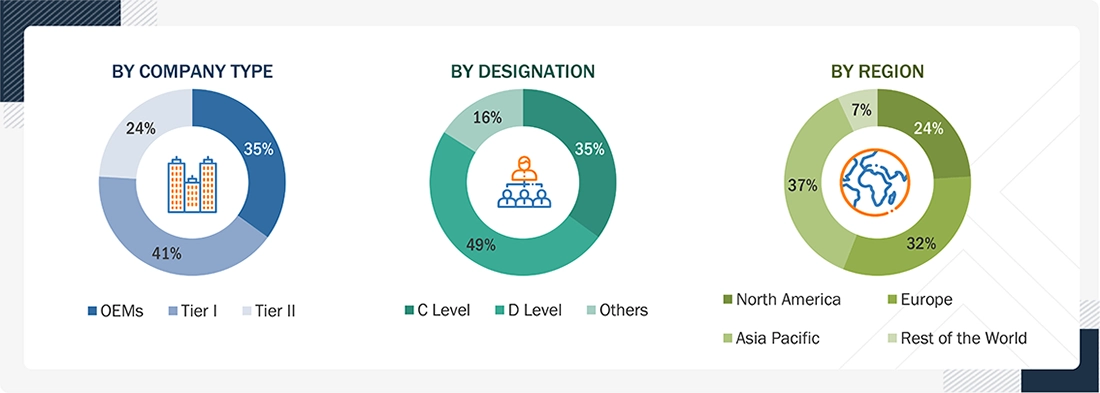
Note: The tiers of companies are based on the supply chain of the automotive radar market. Tier I companies are automotive radar providers.
To know about the assumptions considered for the study, download the pdf brochure
Market Size Estimation
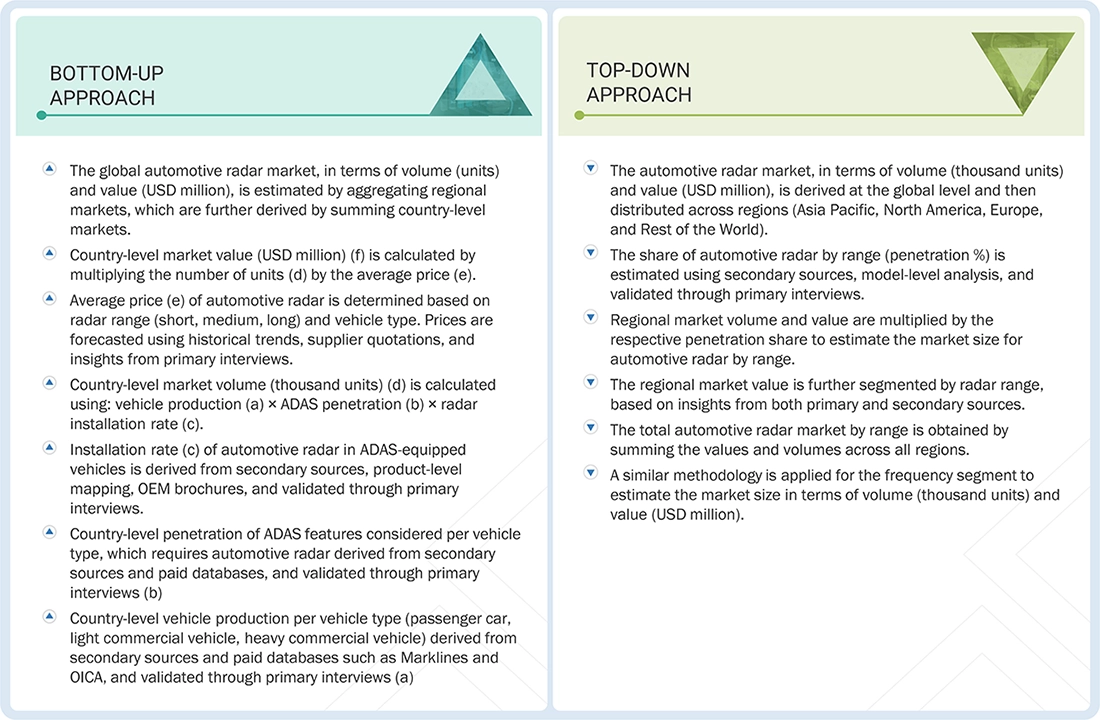
The bottom-up and top-down approaches were used to estimate and validate the total size of the automotive radar market. This method was also used extensively to estimate the size of various subsegments in the market. The research methodology used to estimate the market size includes the following:
Data Triangulation
After arriving at the overall market size using the market size estimation processes as explained above, the market was split into several segments and subsegments. To complete the overall market engineering process and arrive at the exact statistics of each market segment and subsegment, data triangulation and market breakdown procedures were employed, wherever applicable. The data was triangulated by studying various factors and trends from both the demand and supply sides.
Market Definition
The word radar is an acronym derived from ‘radio detection and ranging.’ It is a device or an electronic system that detects and tracks objects at certain distances. A radar can detect any change within its covered range with the help of radio energy traveling at the speed of light. Whenever an object travels through the observed range, short bursts of radio energy are transmitted, reflected off a target or an object, and returned as an echo. The form of the electromagnetic signal radiated by the radar depends on the type of information required for the target.
According to Renesas Electronics Corporation, radar is a well-known technology that relies on sending and receiving electromagnetic waves to measure, detect, and locate obstacles in the environment. Radar is specially indicated for automotive applications, as vehicles are good reflectors for electromagnetic waves, and thus, their distance, position, and velocity can be determined accurately.
The automotive radar sensor is an object-detection device that uses radio waves to determine the range, altitude, direction, and speed of objects within the range of the vehicle. It provides long to short-range functionality, allowing automotive systems to monitor the environment around the vehicle to help prevent crashes. It can be used to detect, search, and track pedestrians, obstacles, motor vehicles, and terrain. The automotive radar is applicable for blind spot detection, adaptive cruise control, lane change assist, and crash avoidance, among others.
Key Stakeholders
- ADAS Integrators
- ADAS/Occupant Safety Solution Suppliers
- American Automobile Association (AAA)
- Automobile Original Equipment Manufacturers (OEMs)
- Automotive Radar Manufacturers
- Automotive Radar Component Manufacturers
- Automotive Software and Platform Providers
- Autonomous Driving Platform Providers
- Brazilian Association of Automotive Vehicle Manufacturers
- Comité des Constructeurs Français d'Automobiles (CCFA)
- China Association of Automobile Manufacturers (CAAM)
- Canadian Automobile Association
- Canadian Automobile Dealers Association (CADA)
- EV and EV Component Manufacturers
- Government & Research Organizations
- Japan Automobile Manufacturers Association (JAMA)
- Korea Automobile Manufacturers Association (KAMA)
- National Highway Traffic Safety Administration (NHTSA)
- Vehicle Safety Regulatory Bodies
- Verband der Automobilindustrie (VDA)
Report Objectives
- To segment and forecast the automotive radar market in terms of volume (thousand units) and value (USD Million)
- To define, describe, and forecast the market based on vehicle type, range, frequency, electric vehicle (EV) type, application, mounting, and region
- To segment and forecast the market by vehicle type (passenger car, light commercial vehicle, and heavy commercial vehicle)
- To segment and forecast the market by range (short-range radar, medium-range radar, long-range radar)
- To segment and forecast the market by frequency (2X-GHz and 7X-GHz)
- To segment and forecast the market by EV type [battery electric vehicle (BEV), plug-in electric vehicle (PHEV), fuel cell electric vehicle (FCEV), and hybrid electric vehicle (HEV)]
- To segment and forecast the market by mounting (in-cabin and exterior)
- To provide qualitative insights on the market based on application [adaptive cruise control (ACC), autonomous emergency braking (AEB), blind spot detection (BSD), forward collision warning (FCW), intelligent parking assistance (IPA), cross traffic alert (CTA), lane departure warning system (LDW), and traffic jam assist (TJA)]
- To forecast the market by region (North America, Europe, the Asia Pacific, and the Rest of the World)
- To analyze technological developments impacting the market
- To provide detailed information about the major factors influencing market growth (drivers, challenges, restraints, and opportunities)
- To strategically analyze the market, considering individual growth trends, prospects, and contributions to the total market
- To study the following concerning the market
- Supply chain analysis
- Ecosystem analysis
- Technology analysis
- HS code
- Case study analysis
- Patent analysis
- Regulatory landscape
- Key stakeholders and buying criteria
- Key conferences and events
- To estimate the following with respect to the market:
- Pricing Analysis
- By Range
- By Region
- Market Share Analysis
- To strategically profile key players and comprehensively analyze their market share and core competencies
- To analyze the impact of the 2025 US tariffs on the market
- To provide technological advancements, AI-driven impact, patents, innovations, and future applications
- To provide the impact of Generative AI (GenAI) on the market
- To track and analyze competitive developments, such as deals, product developments, and expansions, carried out by key industry participants
Available customizations:
With the given market data, MarketsandMarkets offers customizations in accordance with the company’s specific needs.
- Automotive Radar Market, By Range, at THE Country Level
- Automotive Radar Market, By Frequency, at THE Country Level
- Company Information :
- Profiling of additional market players (up to 5)
Key Questions Addressed by the Report
What is the current size of the automotive radar market by value?
The current size of the automotive radar market is estimated to be USD 5.36 billion in 2025.
Who are the winners in the automotive radar market?
The automotive radar market is dominated by established players such as Robert Bosch GmbH (Germany), Continental AG (Germany), Aptiv (Ireland), Denso Corporation (Japan), and NXP Semiconductors (Netherlands). These companies have introduced products and formed strategic alliances to enhance their position in the market.
Which region will have the fastest-growing market for automotive radar market?
North America is expected to grow at a higher CAGR in the automotive radar market during the forecast period due to increasing demand for ADAS, rising adoption of autonomous driving technologies, and strong regulatory support for vehicle safety. The presence of major automotive OEMs and radar technology providers, coupled with growing investments in R&D and innovation, further accelerates market expansion. Additionally, consumer preference for high-end vehicles equipped with radar-based features like adaptive cruise control and collision avoidance systems is driving regional market growth.
What are the new trends impacting the growth of the automotive radar market?
The key trends impacting the growth of the automotive radar market are increased adoption of ADAS, shift towards 77 GHz and 79 GHz radar systems, enhanced signal processing, and AI, which are some of the trends in the automotive radar market.
Which countries are covered in the Asia Pacific region for the automotive radar market?
The countries covered in the report for the automotive radar market are China, Japan, South Korea, India, Thailand, Indonesia, and the Rest of Asia Pacific (Taiwan and Singapore).


Personalize This Research
- Triangulate with your Own Data
- Get Data as per your Format and Definition
- Gain a Deeper Dive on a Specific Application, Geography, Customer or Competitor
- Any level of Personalization
Let Us Help You
- What are the Known and Unknown Adjacencies Impacting the Automotive Radar Market
- What will your New Revenue Sources be?
- Who will be your Top Customer; what will make them switch?
- Defend your Market Share or Win Competitors
- Get a Scorecard for Target Partners

Custom Market Research Services
We Will Customise The Research For You, In Case The Report Listed Above Does Not Meet With Your Requirements
Get 10% Free CustomisationTESTIMONIALS

JIM NAAS
PRODUCT DIRECTOR, WEASLER
Weasler Engineering, a CentroMotion organization
Global Provider of Industrial Actuation & Control Solutionswww.weasler.com
Our organization was interested in learning more about the attractiveness of a particular market space. We contacted MarketsandMarkets to help us based on previous positive experiences we had with them. The results did not disappoint! We discussed our objectives with them, and the team at MarketsandMarkets developed and executed a proposal that met our needs precisely. We were very impressed by their level of expertise, the quality of the analysis and their insightful recommendations. We would not hesitate in working with them again in the future.

Matt Kardel,
Vice President
Aptiv,
A global technology company that develops safer, greener and more connected solutions.www.aptiv.com
We contracted with
MarketsandMarkets to evaluate the value chain and potential go-to-market partners related to our
interest in the Fleet Management space. The team successfully completed the work on time and at the
pricing agreed. MarketsandMarkets listened and understood our objectives and collaborated well with
us to help us get the visibility we needed to make an investment.
We have subsequently used
MarketsandMarkets again related to Smart Cities to good results.
- China Automotive Radar Market
- Japan Automotive Radar Market
- India Automotive Radar Market
- South Korea Automotive Radar Market
- Thailand Automotive Radar Market
- Indonesia Automotive Radar Market
- France Automotive Radar Market
- Germany Automotive Radar Market
- Spain Automotive Radar Market
- UK Automotive Radar Market
- Russia Automotive Radar Market
- Turkey Automotive Radar Market
- Canada Automotive Radar Market
- Mexico Automotive Radar Market
- US Automotive Radar Market
- Brazil Automotive Radar Market
- South Africa Automotive Radar Market
- Rest Of Europe Automotive Radar Market
- Rest Of Asia Pacific Automotive Radar Market






Growth opportunities and latent adjacency in Automotive Radar Market