



Medical Equipment Maintenance Market Size, Growth, Share & Trends Analysis
Report Code
MD 4027
Published in
Jul, 2025, By MarketsandMarkets™
Medical Equipment Maintenance Market by Device (MRI, X-ray, CT, Ultrasound, Patient Monitoring, Dental Equipment), Provider (OEM, ISO), Service (Preventive, Corrective), Contract Service (Customized, Add-on), End User (Hospital, ASCs) - Forecast to 2030

USD 101.52 BN
MARKET SIZE, 2030

CAGR 10.8%
(2025-2030)

374
REPORT PAGES

298
MARKET TABLES
OVERVIEW
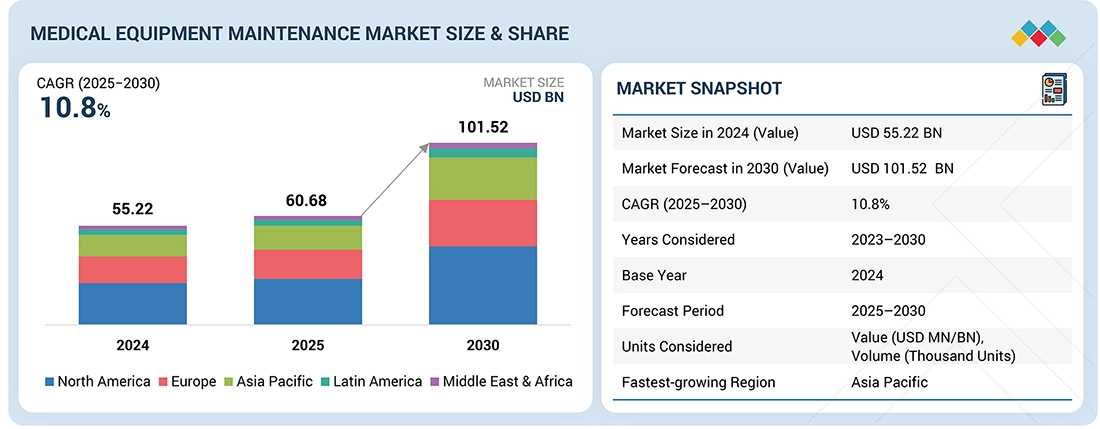
Source: Secondary Research, Interviews with Experts, MarketsandMarkets Analysis
The global medical equipment maintenance market is projected to reach USD 101.52 billion by 2030 from USD 60.68 billion in 2025, growing at a CAGR of 10.8% during the forecast period. The medical equipment maintenance market expansion is driven by the increasing demand for appropriate and accurately functioning medical devices, higher healthcare investments, and increased attention to patient safety and equipment uptime. With an increase in the aging population and chronic disease burden, the extent of medical equipment utilization has increased; thus, medical equipment maintenance is now required on a regular basis.
KEY TAKEAWAYS
-
BY DEVICE TYPEBy device type, the medical equipment maintenance market is segmented into diagnostic imaging equipment, surgical equipment, dental equipment, radiotherapy devices, patient monitoring & life support devices, endoscopic devices, laboratory equipment, ophthalmology equipment, medical lasers, electrosurgical equipment, radiotherapy devices, and durable medical equipment. The diagnostic imaging equipment segment accounted for the largest share of the market, owing to the rising technological advancements in MRI, CT, and PET/SPECT, with frequent upgrades and expert servicing to ensure peak performance.
-
BY SERVICE PROVIDERThe medical equipment maintenance market is segmented by service provider into single-vendor OEMs, multi-vendor OEMs, ISOs, and in-house maintenance. The multi-vendor OEMs segment accounted for the largest share of the market in 2024. These service providers deliver custom maintenance solutions formulated to consider healthcare institutions' distinct requirements and financial limitations. Multi-vendor OEMs implement higher-end diagnostic tools and remote monitoring, allowing for predictive maintenance to guard against impending equipment failures.
-
BY SERVICE TYPEThe medical equipment maintenance market is segmented by service type into operational, corrective, and preventive maintenance. Preventive maintenance is expected to represent the highest CAGR during the forecast period. As diagnostic imaging systems grow more advanced and complex, proactive upkeep is essential to minimize breakdowns and maintain seamless operation. Ongoing technological innovations continue to introduce sophisticated components and subsystems that require specialized maintenance expertise and procedures.
-
BY CONTRACT TYPEBased on the contract type, the medical equipment maintenance market is segmented into basic contract, premium contract, customized contract, and add-on contract. The premium contract is projected to register the largest share in the medical equipment maintenance market. Premium contracts in the medical equipment maintenance market offer customizable service-level agreements tailored to the specific needs of healthcare facilities. This customization allows facilities to prioritize equipment, set response times, schedule maintenance, define performance metrics, manage spare parts, receive training, and adhere to budget constraints.
-
BY END USERThe medical equipment maintenance market is divided by end user into hospitals & clinics, diagnostic imaging centers, dialysis centers, ambulatory surgery centers, dental clinics, and other end users. Hospitals and clinics focus on enhancing operational efficiency and reducing costs to improve nursing services and patient satisfaction.To ensure equipment uptime and proper lifecycle management, many have established in-house biomedical engineering departments or long-term contracts with third-party service providers.
-
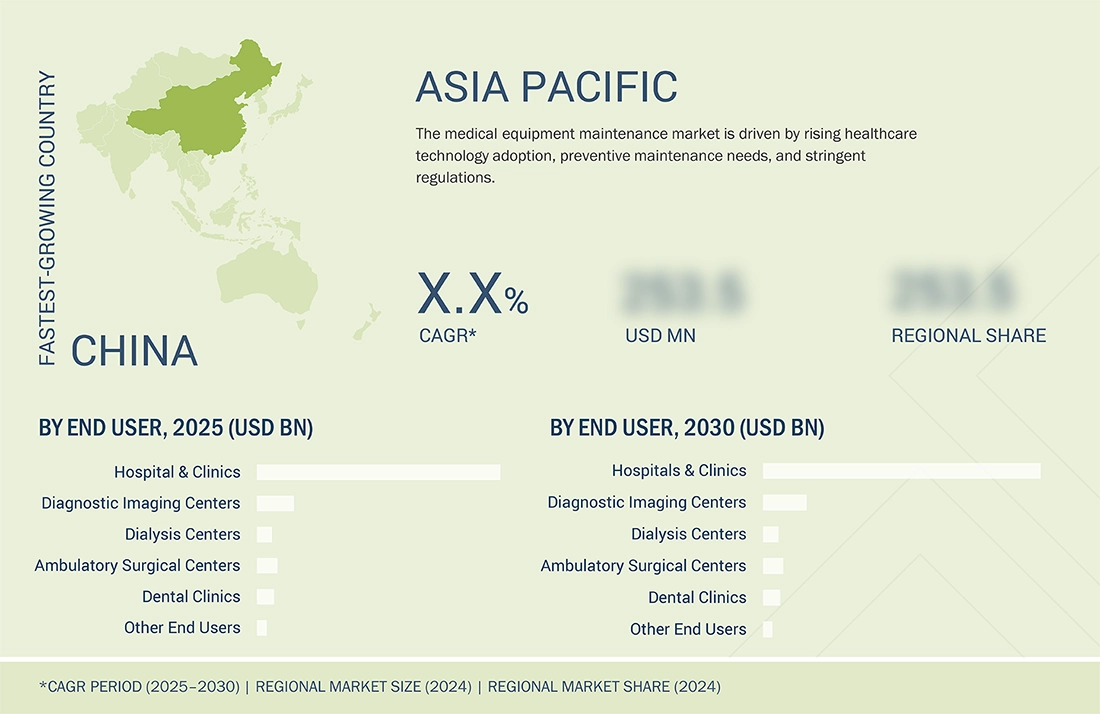
BY REGIONThe Asia-Pacific medical equipment maintenance market is growing rapidly due to the region’s expanding healthcare infrastructure, rising chronic disease burden, aging population, and adoption of advanced medical technologies that require regular servicing. Governments are increasing healthcare investments, while medical tourism drives demand for high-quality, reliable equipment. Hospitals also seek cost-effective ways to extend device lifespan, boosting preventive and predictive maintenance. These factors make Asia Pacific one of the fastest-growing regions in this market.
-
COMPETITIVE LANDSCAPEThe major market players have adopted both organic and inorganic strategies, including partnerships and collaborations. For instance, in April 2024, Canon Inc. (Japan) launched Canon NorthStar, an all-in-one solution platform that provides end-to-end advisory, equipment, and associated services for setting up complete studio operations. This innovative platform combines the best technology companies and industry experts to assist customers.
The medical equipment maintenance market is projected to experience robust growth in the coming years, fueled by the rapid expansion of healthcare infrastructure and the rising demand for advanced medical technologies. With the increasing prevalence of chronic diseases and aging populations, hospitals and clinics are relying more heavily on sophisticated devices that require regular servicing, calibration, and preventive care to ensure patient safety and operational efficiency. Growing government investment, stricter regulatory standards, and the emphasis on cost-effective healthcare delivery further strengthen the market, positioning maintenance services as a critical component of the evolving connected healthcare ecosystem.
TRENDS & DISRUPTIONS IMPACTING CUSTOMERS' CUSTOMERS
The medical equipment maintenance market is transitioning from reactive, OEM-driven service contracts and basic preventive maintenance to predictive, IoT- and AI-powered solutions. Key trends include real-time equipment monitoring, remote diagnostics, and integration with hospital asset management platforms. These innovations enable minimized equipment downtime, extended device lifecycles, faster access to functional equipment, improved quality and safety of care, regulatory compliance, and lower overall treatment costs, while creating opportunities for new service models, multi-vendor ecosystems, and subscription-based offerings.
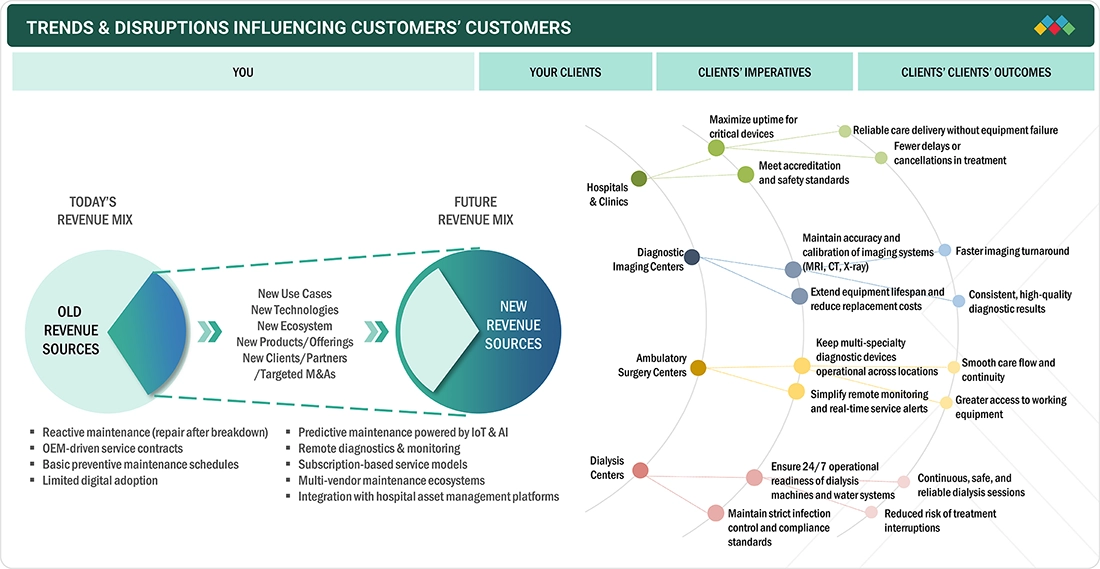
Source: Secondary Research, Interviews with Experts, MarketsandMarkets Analysis
MARKET DYNAMICS

Drivers
Impact
Level
Level
-
Growth in medical equipment market

-
Rising focus on preventive medical equipment maintenance


RESTRAINTS
Impact
Level
Level
-
High initial cost and significant maintenance expenditure


OPPORTUNITIES
Impact
Level
Level
-
Innovation in service offerings and use of IoT

-
Emergence of independent service organizations


CHALLENGES
Impact
Level
Level
-
Survival of small players in highly fragmented and competitive market

-
Shortage of skilled biomedical engineers and technicians

Source: Secondary Research, Interviews with Experts, MarketsandMarkets Analysis
Medical Equipment Maintenance Market: COMMERCIAL USE CASES ACROSS INDUSTRIES
| COMPANY | USE CASE DESCRIPTION | BENEFITS |
|---|---|---|
 |
Preventive and corrective maintenance for imaging systems (MRI, CT, ultrasound) | Maximizes uptime, predictive service reduces unexpected failures, and extends equipment lifecycle |
 |
Asset management and maintenance services for multi-vendor medical devices | Improves reliability, reduces downtime, cost-efficient lifecycle management |
 |
Comprehensive maintenance for diagnostic and therapeutic devices with remote monitoring | Data-driven predictive maintenance, faster issue resolution, improved performance |
 |
Service and lifecycle support for imaging systems and endoscopy equipment | Boosts clinical productivity, reduces total cost of ownership, and ensures regulatory compliance |
 |
Maintenance and technical support for critical care equipment (ventilators, anesthesia machines, monitors) | Enhances patient safety, ensures continuous availability of life-support systems, extends device lifetime |
Logos and trademarks shown above are the property of their respective owners. Their use here is for informational and illustrative purposes only.
MARKET ECOSYSTEM
The medical equipment maintenance market operates within a complex ecosystem of OEMs, third-party service providers, healthcare institutions, regulators, and technology vendors. OEMs lead by bundling maintenance with equipment sales, while independent service organizations (ISOs) offer cost-effective alternatives, especially in emerging markets. Hospitals and clinics, key end-users, demand preventive and corrective services to ensure compliance, safety, and reliability. Regulatory frameworks (e.g., FDA, ISO) shape service quality standards, while emerging digital technologies such as AI, IoT, and predictive maintenance are transforming service models with real-time monitoring and remote troubleshooting. The ecosystem is increasingly focused on cost efficiency, uptime optimization, and digital integration, driving competition and innovation.
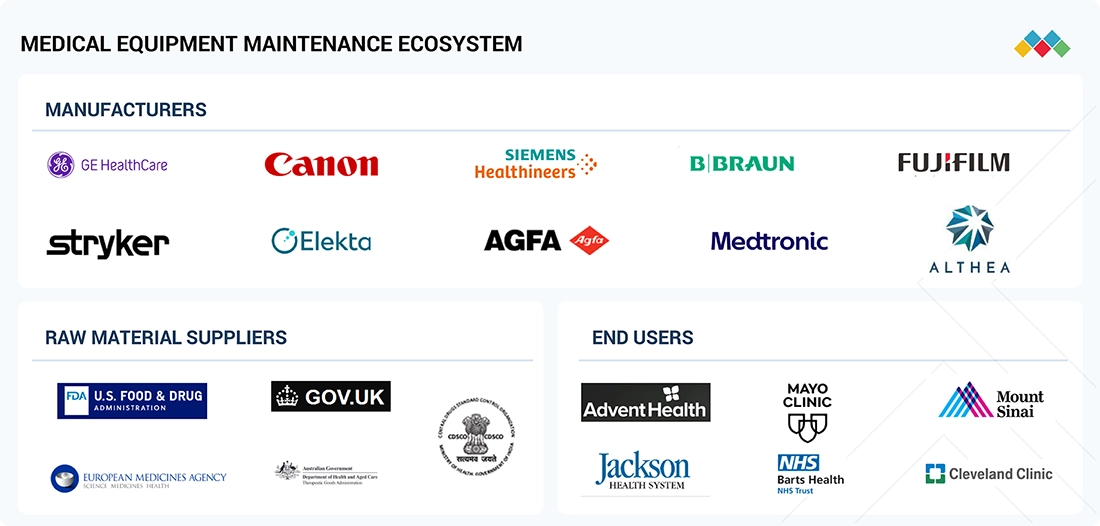
Logos and trademarks shown above are the property of their respective owners. Their use here is for informational and illustrative purposes only.
MARKET SEGMENTS
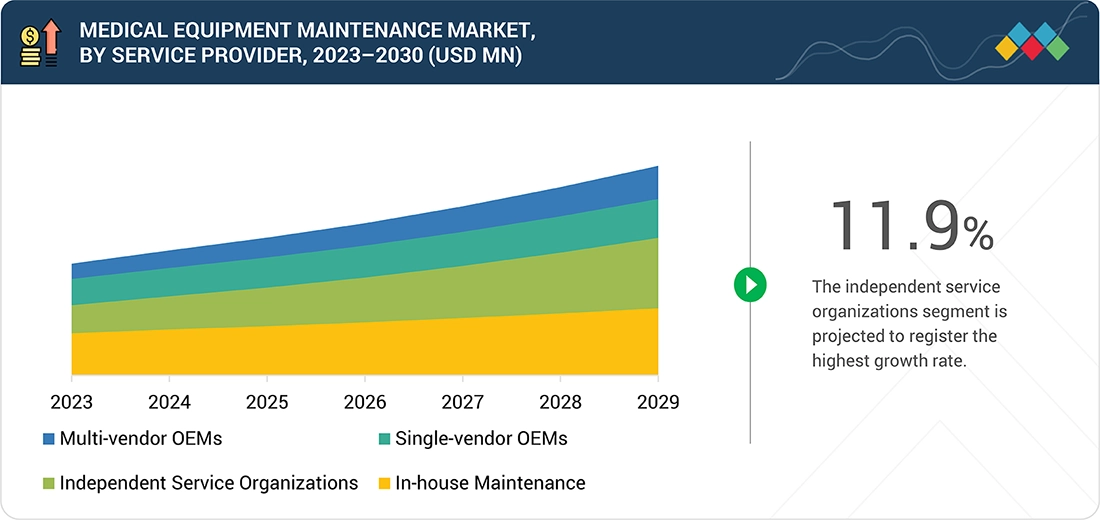
Source: Secondary Research, Interviews with Experts, MarketsandMarkets Analysis
Medical Equipment Maintenance Market, By Service provider
In 2024, the multi-vendor OEMs segment held the largest share of the medical equipment maintenance market, reflecting the growing preference for flexible, comprehensive service solutions. These providers offer customized maintenance programs tailored to the diverse needs and budget constraints of healthcare institutions, while leveraging advanced diagnostic tools and remote monitoring technologies. By enabling predictive maintenance and reducing the risk of unexpected equipment failures, multi-vendor OEMs help hospitals and clinics optimize uptime, extend device lifecycles, and improve overall cost-efficiency.
Medical Equipment Maintenance Market, By Service Type
Preventive maintenance accounts for the largest share by service type in the medical equipment maintenance market. This dominance is driven by its proactive advantages, including minimizing unexpected equipment failures and extending the lifespan of critical assets. By implementing preventive maintenance protocols, healthcare facilities foster a culture of continuous improvement through early issue detection and ongoing enhancement of maintenance strategies. This approach ensures higher operational efficiency, reduced equipment downtime, and improved long-term reliability and performance of essential medical devices.
Medical Equipment Maintenance Market, By End User
Hospitals and clinics represent the leading end-user segment in the medical equipment maintenance market, driven by their need to enhance operational efficiency, reduce costs, and improve patient satisfaction. To ensure maximum equipment uptime and effective lifecycle management, many facilities rely on in-house biomedical engineering teams or enter long-term partnerships with third-party service providers. With the growing complexity and volume of devices such as diagnostic imaging systems and patient monitors, regular, high-quality maintenance has become essential to prevent service disruptions and safeguard continuity of care.
REGION
Asia Pacific to be the fastest-growing region in the global medical equipment maintenance market during the forecast period
The Asia Pacific medical equipment maintenance market is projected to record the fastest growth globally over the forecast period. This expansion is fueled by the rising prevalence of chronic diseases, the growing demand for advanced diagnostic and therapeutic devices, and the rapidly aging population across the region. Substantial investments in healthcare infrastructure in countries such as China and India are leading to the establishment of new hospitals, diagnostic centers, and specialty clinics, which significantly increase the need for reliable maintenance services. In addition, supportive government policies, rising healthcare expenditure, and initiatives to improve equipment safety and compliance further drive the adoption of preventive and predictive maintenance solutions. Together, these factors are positioning the Asia Pacific as a high-growth market.
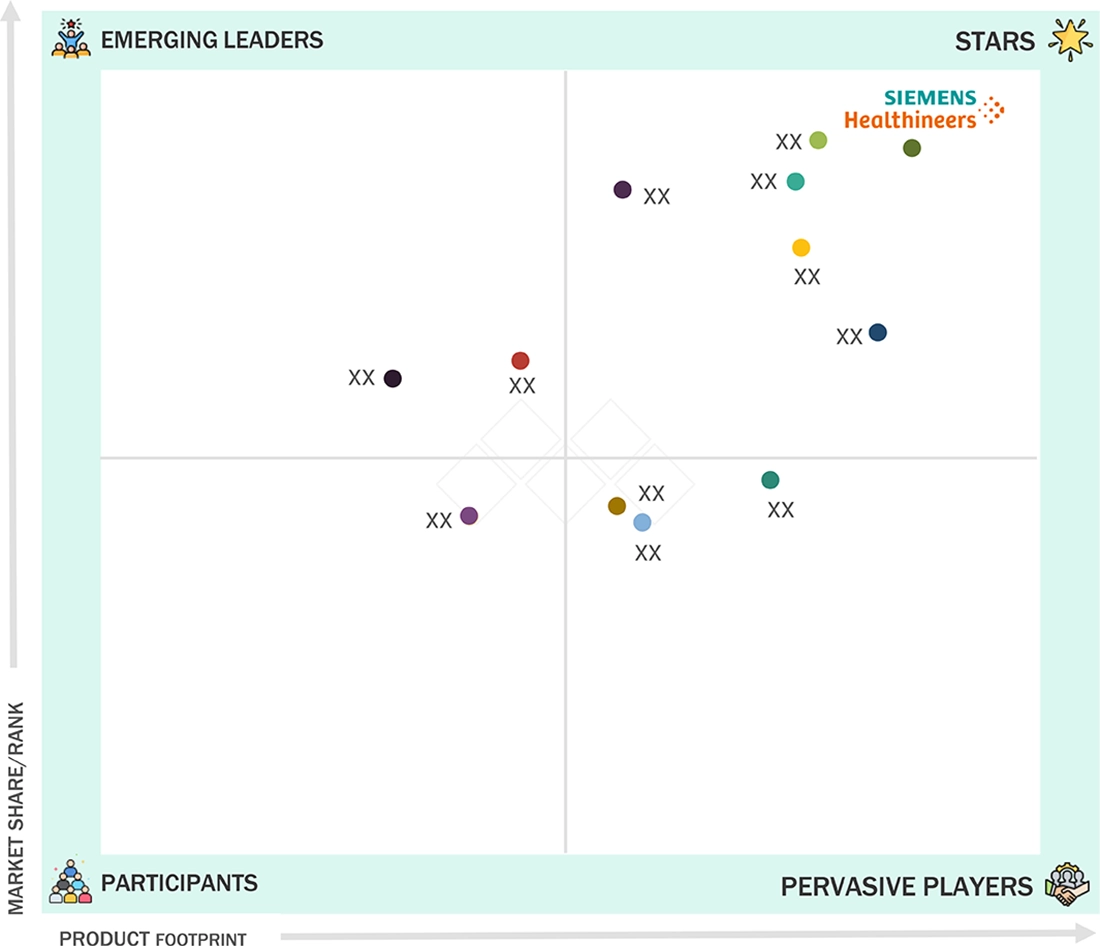
Medical Equipment Maintenance Market: COMPANY EVALUATION MATRIX
In the Medical Equipment Maintenance market matrix, Siemens Healthineers (Star) leads the medical equipment maintenance market with a strong global presence, a comprehensive service portfolio, and advanced maintenance solutions for diagnostic imaging, laboratory, and therapeutic equipment, driving widespread adoption across hospitals and healthcare facilities. Canon (Pervasive Player) provides reliable and cost-effective maintenance services, focusing on emerging markets and smaller healthcare facilities, ensuring consistent service coverage and steady growth. While Siemens dominates with scale and technological leadership, Canon maintains broad market penetration across diverse regions.
Source: Secondary Research, Interviews with Experts, MarketsandMarkets Analysis
KEY MARKET PLAYERS
MARKET SCOPE
| REPORT METRIC | DETAILS |
|---|---|
| Market Size in 2024 (Value) | USD 55.22 Billion |
| Market Forecast in 2030 (Value) | USD 101.52 Billion |
| Growth Rate | CAGR of 10.8% from 2025-2030 |
| Years Considered | 2023–2030 |
| Base Year | 2024 |
| Forecast Period | 2025–2030 |
| Units Considered | Value (USD million/billion), Volume (Thousand units) |
| Report Coverage | Revenue forecast, company ranking, competitive landscape, growth factors, and trends |
| Segments Covered |
|
| Regions Covered | North America, Asia Pacific, Europe, Latin America, the Middle East & Africa |
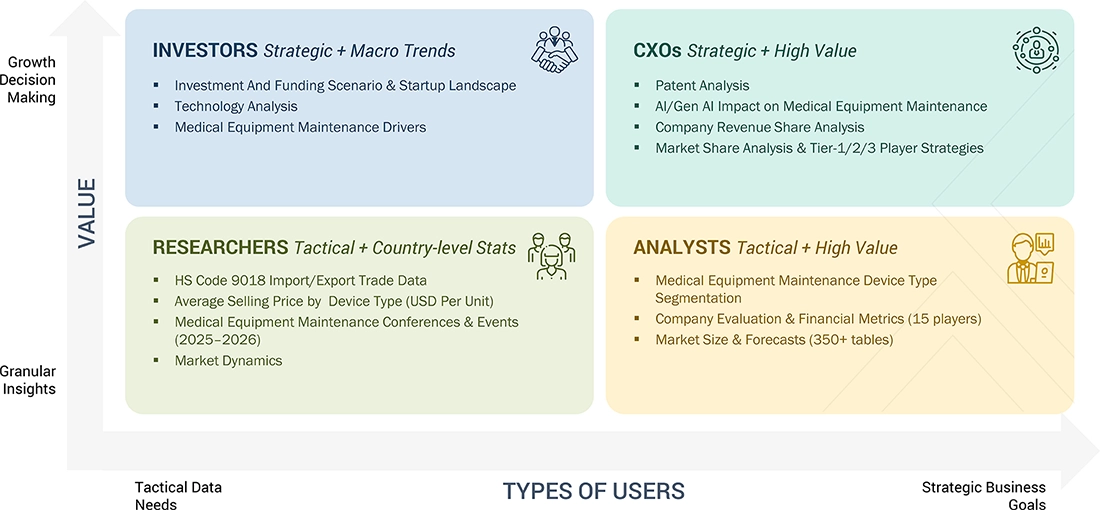
WHAT IS IN IT FOR YOU: Medical Equipment Maintenance Market REPORT CONTENT GUIDE
DELIVERED CUSTOMIZATIONS
We have successfully delivered the following deep-dive customizations:
| CLIENT REQUEST | CUSTOMIZATION DELIVERED | VALUE ADDS |
|---|---|---|
| Product Analysis | Comparison of key maintenance types: Preventive Maintenance, Corrective Maintenance, and Operational Maintenance | Identify interconnections and supply chain blind spots; detect outsourcing trends among hospitals, clinics, and diagnostic centers |
| Company Information | GE Healthcare, Siemens Healthineers, Philips Healthcare, Drägerwerk, and Aramark Healthcare Technologies. Market share analysis of the top 3–5 players in Asia Pacific and Europe at country level | Insights on revenue shifts toward multi-vendor services, managed equipment services, and predictive maintenance solutions |
| Geographic Analysis | Detailed analysis for Rest of Asia Pacific; client focus on ASEAN countries for country-level medical equipment maintenance market insights | Country-level demand mapping for new service models, partnerships, and localization strategy planning |
RECENT DEVELOPMENTS
- June 2026 : GE Healthcare (US) — GE Healthcare Finland Oy was named the sole-source provider for ultrasonic medical equipment maintenance in a Finnish public procurement decision dated June 12, 2026. The contract covers maintenance services for the equipment, with a planned initial service period from October 1 through December 31, 2026, followed by an indefinite continuation. The reported contract value was €367,111 excluding VAT.
- January 2025 : GE Healthcare (US) and Sutter Health (US) entered a seven-year “Care?Alliance” in California to deploy GE’s latest AI-powered imaging systems, such as Omni Legend PET/CT, StarGuide SPECT/CT, Vscan Air SL ultrasound, and AIR Recon?DL MR software across over 300 facilities.
- October 2024 : Siemens?Healthineers AG (Germany) signed a 12-year Value Partnership with University Hospital Nantes (France) to modernize diagnostic and interventional imaging across 13 hospitals in the Loire-Atlantique region.
- October 2023 : GE Healthcare (US) and reLink Medical (US) collaborated to deliver asset management solutions aimed at helping healthcare providers minimize medical device waste, increase operational efficiency, and maximize equipment utilization.
- May 2023 : Siemens Healthineers AG (Germany) and CommonSpirit Health (US) acquired Block Imaging (US). This acquisition aims to offer more sustainable options and meet the growing demand from US hospitals, health systems, and other care sites for multi-vendor imaging parts and services.
Table of Contents
 Exclusive indicates content/data unique to MarketsandMarkets and not available with any competitors.
TITLE
PAGE NO
1
INTRODUCTION
31
2
RESEARCH METHODOLOGY
37
3
EXECUTIVE SUMMARY
53
4
PREMIUM INSIGHTS
58
5
MARKET OVERVIEW
Emerging economies drive growth in medical equipment market with IoT innovations and refurbished systems.
62
5.1
INTRODUCTION
5.2
MARKET DYNAMICS
5.2.1
DRIVERS
5.2.1.1
Growth in medical equipment market
5.2.1.2
Rising focus on preventive medical equipment maintenance
5.2.1.3
Adoption of innovative funding mechanisms
5.2.1.4
Increasing purchase of refurbished medical systems
5.2.2
RESTRAINTS
5.2.2.1
High initial cost and significant maintenance expenditure
5.2.3
OPPORTUNITIES
5.2.3.1
Innovations in service offerings and use of IoT
5.2.3.2
Emergence of independent service organizations
5.2.3.3
Growth potential of medical devices sector in emerging economies
5.2.4
CHALLENGES
5.2.4.1
Highly fragmented and competitive market
5.2.4.2
Issues regarding regulatory compliance
5.2.4.3
Shortage of skilled biomedical engineers and technicians
5.3
INDUSTRY TRENDS
5.3.1
PREFERENCE FOR MULTI-VENDOR CONTRACTS
5.3.2
CONSOLIDATION OF DIALYSIS CENTERS AND HOSPITALS
5.3.3
EQUIPMENT SERVICE PROVIDERS AND GROUP PURCHASING
5.4
TECHNOLOGY ANALYSIS
5.4.1
KEY TECHNOLOGIES
5.4.1.1
Predictive and prescriptive maintenance
5.4.1.2
Intelligent maintenance systems
5.4.2
COMPLEMENTARY TECHNOLOGIES
5.4.2.1
Real-time Location Systems (RTLS)
5.4.2.2
IoT and sensor networks
5.4.3
ADJACENT TECHNOLOGIES
5.4.3.1
Digital twins
5.5
PORTER’S FIVE FORCES ANALYSIS
5.5.1
THREAT OF NEW ENTRANTS
5.5.2
THREAT OF SUBSTITUTES
5.5.3
BARGAINING POWER OF SUPPLIERS
5.5.4
BARGAINING POWER OF BUYERS
5.5.5
INTENSITY OF COMPETITIVE RIVALRY
5.6
REGULATORY LANDSCAPE
5.6.1
REGULATORY FRAMEWORK
5.6.1.1
North America
5.6.1.2
Europe
5.6.1.3
Asia Pacific
5.6.1.4
Latin America
5.6.1.5
Middle East & Africa
5.6.2
REGULATORY BODIES, GOVERNMENT AGENCIES, AND OTHER ORGANIZATIONS
5.7
PATENT ANALYSIS
5.7.1
JURISDICTION AND TOP APPLICANT ANALYSIS
5.8
REGULATORY ANALYSIS
5.8.1
IMPORT DATA FOR HS CODE 9018
5.8.2
EXPORT DATA FOR HS CODE 9018
5.9
KEY CONFERENCES AND EVENTS, 2025–2026
5.10
KEY STAKEHOLDERS AND BUYING CRITERIA
5.10.1
KEY STAKEHOLDERS IN BUYING PROCESS, BY END USER
5.10.2
BUYING CRITERIA
5.11
VALUE CHAIN ANALYSIS
5.12
SUPPLY CHAIN ANALYSIS
5.13
ECOSYSTEM ANALYSIS
5.14
PRICING ANALYSIS
5.14.1
AVERAGE SELLING PRICE, BY KEY PLAYER
5.14.1.1
Average selling price of maintenance services for CT scanners, by key player
5.14.1.2
Average selling price of maintenance services for mammography machines, by key player
5.14.1.3
Average selling price of maintenance services for C-Arm/X-ray imaging systems, by key player
5.14.2
AVERAGE SELLING PRICE TREND, BY REGION
5.14.2.1
Average selling price trend of maintenance services for CT scanners, by region
5.14.2.2
Average selling price trend of maintenance services for mammography machines, by region
5.14.2.3
Average selling price trend of maintenance services for C-Arm/X-ray imaging systems, by region
5.15
INVESTMENT AND FUNDING SCENARIO
5.16
UNMET NEEDS/END-USER EXPECTATIONS
5.17
TRENDS/DISRUPTIONS IMPACTING CUSTOMER BUSINESS
5.18
IMPACT OF AI/GEN AI ON MEDICAL EQUIPMENT MAINTENANCE MARKET
5.18.1
INTRODUCTION
5.18.2
MARKET POTENTIAL OF AI IN MEDICAL EQUIPMENT MAINTENANCE
5.18.3
AI USE CASES
5.18.4
KEY COMPANIES IMPLEMENTING AI
5.19
TRUMP TARIFF IMPACT ON MEDICAL EQUIPMENT MAINTENANCE MARKET
5.19.1
INTRODUCTION
5.19.2
KEY TARIFF RATES
5.19.3
PRICE IMPACT ANALYSIS
5.19.4
IMPACT ON COUNTRY/REGION
5.19.5
IMPACT ON END-USE SEGMENTS
6
MEDICAL EQUIPMENT MAINTENANCE MARKET, BY DEVICE TYPE
Market Size & Growth Rate Forecast Analysis to 2030 in USD Million | 36 Data Tables
108
6.1
INTRODUCTION
6.2
DIAGNOSTIC IMAGING EQUIPMENT
6.2.1
MRI SYSTEMS
6.2.1.1
Increasing use of MRI in diagnostics and research to expedite growth
6.2.2
CT SCANNERS
6.2.2.1
Growing emphasis on maintaining state-of-the-art CT systems to drive market
6.2.3
X-RAY SYSTEMS
6.2.3.1
Growing demand for OEM-based X-ray maintenance services to boost market
6.2.4
ULTRASOUND SYSTEMS
6.2.4.1
Cost-effective and easy preventive maintenance measures to promote growth
6.2.5
ANGIOGRAPHY SYSTEMS
6.2.5.1
Increasing obsolescence of angiography systems to amplify growth
6.2.6
MAMMOGRAPHY SYSTEMS
6.2.6.1
Preference for mammography over general breast ultrasound to accelerate growth
6.2.7
NUCLEAR IMAGING SYSTEMS
6.2.7.1
Growing prevalence of cancer and increasing development of novel radiotracers to propel market
6.2.8
FLUOROSCOPY SYSTEMS
6.2.8.1
Increasing adoption of refurbished fluoroscopy equipment to spur growth
6.3
PATIENT MONITORING & LIFE SUPPORT DEVICES
6.3.1
VENTILATORS
6.3.1.1
Rising prevalence of chronic respiratory diseases to encourage growth
6.3.2
ANESTHESIA MONITORING EQUIPMENT
6.3.2.1
Need for optimal performance and minimized risk to contribute to growth
6.3.3
DIALYSIS EQUIPMENT
6.3.3.1
Growing number of renal care centers to drive market
6.3.4
INFUSION PUMPS
6.3.4.1
Growing adoption of infusion pumps on rental basis to propel market
6.3.5
OTHER PATIENT MONITORING & LIFE SUPPORT DEVICES
6.4
ENDOSCOPIC DEVICES
6.4.1
INCREASING OFFERINGS FOR AFFORDABLE AND BUNDLED SERVICES TO ADVANCE GROWTH
6.5
SURGICAL EQUIPMENT
6.5.1
INCREASING NUMBER OF SURGERIES AND RISING GERIATRIC POPULATION TO BOOST MARKET
6.6
OPHTHALMOLOGY EQUIPMENT
6.6.1
RISING TECHNOLOGICAL ADVANCEMENTS IN OPHTHALMIC LASERS TO AUGMENT GROWTH
6.7
MEDICAL LASERS
6.7.1
GROWING ADOPTION OF MINIMALLY AND NON-INVASIVE AESTHETIC PROCEDURES TO DRIVE MARKET
6.8
ELECTROSURGICAL EQUIPMENT
6.8.1
RISING DEMAND FOR MAINTENANCE DUE TO SAFETY AND PERFORMANCE NEEDS TO AID GROWTH
6.9
RADIOTHERAPY DEVICES
6.9.1
STRINGENT REGULATORY GUIDELINES TO SUPPORT GROWTH
6.10
DENTAL EQUIPMENT
6.10.1
DENTAL RADIOLOGY EQUIPMENT
6.10.1.1
Reduced technological complexity and ease of utilization to bolster growth
6.10.2
DENTAL LASER DEVICES
6.10.2.1
Growing adoption of dental lasers due to shorter and painless operations to drive market
6.10.3
OTHER DENTAL EQUIPMENT
6.11
LABORATORY EQUIPMENT
6.11.1
INCREASING ADOPTION OF AUTOMATED SYSTEMS TO FAVOR GROWTH
6.12
DURABLE MEDICAL EQUIPMENT
6.12.1
GROWING AWARENESS ABOUT IN-HOUSE MAINTENANCE SERVICES TO BOOST MARKET
7
MEDICAL EQUIPMENT MAINTENANCE MARKET, BY SERVICE TYPE
Market Size & Growth Rate Forecast Analysis to 2030 in USD Million | 4 Data Tables
137
7.1
INTRODUCTION
7.2
PREVENTIVE MAINTENANCE
7.2.1
NEED FOR IMPROVED SAFETY FOR PATIENTS AND OPERATORS TO AID GROWTH
7.3
CORRECTIVE MAINTENANCE
7.3.1
INCREASED ADOPTION OF REFURBISHED EQUIPMENT TO FOSTER GROWTH
7.4
OPERATIONAL MAINTENANCE
7.4.1
REDUCED EQUIPMENT DOWNTIME AND DECREASED MAINTENANCE COSTS TO SPUR GROWTH
8
MEDICAL EQUIPMENT MAINTENANCE MARKET, BY SERVICE PROVIDER
Market Size & Growth Rate Forecast Analysis to 2030 in USD Million | 6 Data Tables
142
8.1
INTRODUCTION
8.2
MULTI-VENDOR OEMS
8.2.1
AVAILABILITY OF 24/7 TECHNICAL ASSISTANCE AND STRONG TECHNICAL KNOWLEDGE TO STIMULATE GROWTH
8.3
SINGLE-VENDOR OEMS
8.3.1
PREFERENCE OF HEALTHCARE PROVIDERS FOR CONSISTENT STYLE, USABILITY, AND FUNCTIONS TO DRIVE MARKET
8.4
INDEPENDENT SERVICE ORGANIZATIONS
8.4.1
REDUCED OPERATING EXPENSES AND EXPERTISE IN HANDLING DIFFERENT BRANDS TO PROMOTE GROWTH
8.5
IN-HOUSE MAINTENANCE
8.5.1
GROWING NEED TO CURTAIL HEALTHCARE COSTS TO FUEL MARKET
9
MEDICAL EQUIPMENT MAINTENANCE MARKET, BY CONTRACT TYPE
Market Size & Growth Rate Forecast Analysis to 2030 in USD Million | 5 Data Tables
149
9.1
INTRODUCTION
9.2
PREMIUM CONTRACTS
9.2.1
BETTER RETURNS ON INVESTMENT AND REDUCED COMPLEXITY TO BOLSTER GROWTH
9.3
BASIC CONTRACTS
9.3.1
AFFORDABLE PRICING OF BASIC MEDICAL DEVICE MAINTENANCE CONTRACTS TO FAVOR GROWTH
9.4
CUSTOMIZED CONTRACTS
9.4.1
INCREASED POPULARITY OF TAILOR-MADE MAINTENANCE SERVICES FOR MEDICAL DEVICES TO FACILITATE GROWTH
9.5
ADD-ON CONTRACTS
9.5.1
EASY INTRODUCTION OF NEW SERVICES FOR CLIENTS TO PROPEL MARKET
10
MEDICAL EQUIPMENT MAINTENANCE MARKET, BY END USER
Market Size & Growth Rate Forecast Analysis to 2030 in USD Million | 7 Data Tables
155
10.1
INTRODUCTION
10.2
HOSPITALS & CLINICS
10.2.1
INCREASING NUMBER OF SURGERIES AND DIAGNOSTIC IMAGING PROCEDURES TO FACILITATE GROWTH
10.3
AMBULATORY SURGICAL CENTERS
10.3.1
LESS TIME-CONSUMING TREATMENTS AND COST-EFFECTIVE DIAGNOSIS TO CONTRIBUTE TO GROWTH
10.4
DENTAL CLINICS
10.4.1
LOWER COST REQUIREMENTS AND HIGHER PATIENT PREFERENCE FOR OUTPATIENT CARE TO AID GROWTH
10.5
DIAGNOSTIC IMAGING CENTERS
10.5.1
RISING SHIFT TOWARD OUTSOURCING TO SPECIALIZED IMAGING FACILITIES TO FAVOR GROWTH
10.6
DIALYSIS CENTERS
10.6.1
INCREASING NUMBER OF PRIVATE AND PUBLIC DIALYSIS CENTERS IN EMERGING ECONOMIES TO BOOST MARKET
10.7
OTHER END USERS
11
MEDICAL EQUIPMENT MAINTENANCE MARKET, BY REGION
Market Size & Growth Rate Forecast Analysis to 2030 in USD Million | 137 Data Tables
163
11.1
INTRODUCTION
11.2
NORTH AMERICA
11.2.1
MACROECONOMIC OUTLOOK FOR NORTH AMERICA
11.2.2
US
11.2.2.1
Increasing incidence of lifestyle diseases and adoption of advanced imaging equipment to aid growth
11.2.3
CANADA
11.2.3.1
Growing shift toward value-based healthcare to drive market
11.3
EUROPE
11.3.1
MACROECONOMIC OUTLOOK FOR EUROPE
11.3.2
GERMANY
11.3.2.1
Robust infrastructure for manufacturing medical imaging technologies and high-quality medical equipment to aid growth
11.3.3
UK
11.3.3.1
Rising emphasis on public-private partnerships and strong government healthcare initiatives to promote growth
11.3.4
FRANCE
11.3.4.1
Growing adoption of cost-effective in-house maintenance strategies to boost market
11.3.5
ITALY
11.3.5.1
Increasing demand for preventive care and remote monitoring to augment growth
11.3.6
SPAIN
11.3.6.1
Growing investments in advanced technologies to propel market
11.3.7
REST OF EUROPE
11.4
ASIA PACIFIC
11.4.1
MACROECONOMIC OUTLOOK FOR ASIA PACIFIC
11.4.2
JAPAN
11.4.2.1
Aging population and favorable government policies to promote growth
11.4.3
CHINA
11.4.3.1
Growing demand for advanced and premium-priced medical equipment to fuel market
11.4.4
INDIA
11.4.4.1
Increasing healthcare expenditure and public healthcare investment to expedite growth
11.4.5
AUSTRALIA
11.4.5.1
Growing reliance on complex medical technologies to boost market
11.4.6
SOUTH KOREA
11.4.6.1
Increasing focus on improved healthcare structure to spur growth
11.4.7
REST OF ASIA PACIFIC
11.5
LATIN AMERICA
11.5.1
MACROECONOMIC OUTLOOK FOR LATIN AMERICA
11.5.2
BRAZIL
11.5.2.1
Rising awareness about advanced diagnostic and treatment procedures to bolster growth
11.5.3
MEXICO
11.5.3.1
Growing focus on improved diagnostic access to drive market
11.5.4
REST OF LATIN AMERICA
11.6
MIDDLE EAST & AFRICA
11.6.1
MACROECONOMIC OUTLOOK FOR MIDDLE EAST & AFRICA
11.6.2
GCC COUNTRIES
11.6.2.1
Kingdom of Saudi Arabia (KSA)
11.6.2.2
United Arab Emirates (UAE)
11.6.2.3
Rest of GCC Countries
11.6.3
REST OF MIDDLE EAST & AFRICA
12
COMPETITIVE LANDSCAPE
Discover strategic insights and market dominance tactics of key players in medical equipment maintenance.
260
12.1
INTRODUCTION
12.2
KEY PLAYER STRATEGIES/RIGHT TO WIN
12.2.1
OVERVIEW OF STRATEGIES ADOPTED BY KEY PLAYERS IN MEDICAL EQUIPMENT MAINTENANCE MARKET
12.3
REVENUE SHARE ANALYSIS, 2022–2024
12.4
MARKET SHARE ANALYSIS, 2024
12.5
COMPANY EVALUATION MATRIX: KEY PLAYERS, 2024
12.5.1
STARS
12.5.2
EMERGING LEADERS
12.5.3
PERVASIVE PLAYERS
12.5.4
PARTICIPANTS
12.5.5
COMPANY FOOTPRINT: KEY PLAYERS, 2024
12.5.5.1
Company footprint
12.5.5.2
Region footprint
12.5.5.3
Device type footprint
12.5.5.4
Service type footprint
12.5.5.5
Contract type footprint
12.6
COMPANY EVALUATION MATRIX: STARTUPS/SMES, 2024
12.6.1
PROGRESSIVE COMPANIES
12.6.2
RESPONSIVE COMPANIES
12.6.3
DYNAMIC COMPANIES
12.6.4
STARTING BLOCKS
12.6.5
COMPETITIVE BENCHMARKING: STARTUPS/SMES, 2024
12.6.5.1
Detailed list of key startups/SMEs
12.6.5.2
Competitive benchmarking of key startups/SMEs
12.7
BRAND/SERVICE COMPARISON
12.8
COMPANY VALUATION AND FINANCIAL METRICS
12.8.1
FINANCIAL METRICS
12.8.2
COMPANY VALUATION
12.9
COMPETITIVE SCENARIO
12.9.1
SERVICE LAUNCHES
12.9.2
DEALS
12.9.3
EXPANSIONS
13
COMPANY PROFILES
In-depth Company Profiles of Leading Market Players with detailed Business Overview, Product and Service Portfolio, Recent Developments, and Unique Analyst Perspective (MnM View)
285
13.1
KEY PLAYERS
13.1.1
GE HEALTHCARE
13.1.1.1
Business overview
13.1.1.2
Services offered
13.1.1.3
Recent developments
13.1.1.4
MnM view
13.1.2
SIEMENS HEALTHINEERS AG
13.1.3
KONINKLIJKE PHILIPS N.V.
13.1.4
MEDTRONIC
13.1.5
FUJIFILM HOLDINGS CORPORATION
13.1.6
OLYMPUS CORPORATION
13.1.7
STRYKER
13.1.8
CANON INC.
13.1.9
DRÄGERWERK AG & CO. KGAA
13.1.10
HITACHI, LTD.
13.1.11
B. BRAUN SE
13.1.12
ELEKTA
13.1.13
SHIMADZU CORPORATION
13.1.14
AGFA-GEVAERT GROUP
13.1.15
STERIS
13.2
OTHER PLAYERS
13.2.1
ALTHEA GROUP
13.2.2
BCAS BIO-MEDICAL SERVICES LTD.
13.2.3
AGENOR
13.2.4
GRUPO EMPRESARIAL ELECTROMÉDICO
13.2.5
CARESTREAM HEALTH
13.2.6
KARL STORZ GMBH & CO. KG
13.2.7
AVENSYS UK LTD.
13.2.8
THE INTERMED GROUP
13.2.9
CROTHALL HEALTHCARE
13.2.10
TRIMEDX HOLDINGS LLC
14
APPENDIX
343
14.1
DISCUSSION GUIDE
14.2
SUPPLY-SIDE DISCUSSION GUIDE
14.3
KNOWLEDGESTORE: MARKETSANDMARKETS’ SUBSCRIPTION PORTAL
14.4
CUSTOMIZATION OPTIONS
14.5
RELATED REPORTS
14.6
AUTHOR DETAILS
LIST OF TABLES
TABLE 1
MEDICAL EQUIPMENT MAINTENANCE MARKET: INCLUSIONS AND EXCLUSIONS
TABLE 2
EXCHANGE RATES UTILIZED FOR CONVERSION TO USD, 2022–2024
TABLE 3
MEDICAL EQUIPMENT MAINTENANCE MARKET: RISK ASSESSMENT
TABLE 4
PROMINENT ACQUISITIONS IN DIALYSIS SERVICES INDUSTRY, 2022–2024
TABLE 5
MEDICAL EQUIPMENT MAINTENANCE MARKET: PORTER’S FIVE FORCES ANALYSIS
TABLE 6
NORTH AMERICA: REGULATORY BODIES, GOVERNMENT AGENCIES, AND OTHER ORGANIZATIONS
TABLE 7
EUROPE: REGULATORY BODIES, GOVERNMENT AGENCIES, AND OTHER ORGANIZATIONS
TABLE 8
ASIA PACIFIC: REGULATORY BODIES, GOVERNMENT AGENCIES, AND OTHER ORGANIZATIONS
TABLE 9
LATIN AMERICA: REGULATORY BODIES, GOVERNMENT AGENCIES, AND OTHER ORGANIZATIONS
TABLE 10
MIDDLE EAST & AFRICA: REGULATORY BODIES, GOVERNMENT AGENCIES, AND OTHER ORGANIZATIONS
TABLE 11
MEDICAL EQUIPMENT MAINTENANCE MARKET: KEY PATENTS, 2023–2025
TABLE 12
IMPORT DATA FOR INSTRUMENTS & APPLIANCES USED IN MEDICAL, SURGICAL, DENTAL, OR VETERINARY SCIENCES (HS CODE 9018), BY COUNTRY, 2020–2024 (USD THOUSANDS)
TABLE 13
EXPORT DATA FOR INSTRUMENTS & APPLIANCES USED IN MEDICAL, SURGICAL, DENTAL, OR VETERINARY SCIENCES (HS CODE 9018), BY COUNTRY, 2020–2024 (USD THOUSAND)
TABLE 14
MEDICAL EQUIPMENT MAINTENANCE MARKET: KEY CONFERENCES AND EVENTS, 2025–2026
TABLE 15
INFLUENCE OF STAKEHOLDERS ON BUYING PROCESS, BY END USER
TABLE 16
KEY BUYING CRITERIA, BY END USER
TABLE 17
MEDICAL EQUIPMENT MAINTENANCE MARKET: ROLE OF COMPANIES IN ECOSYSTEM
TABLE 18
AVERAGE SELLING PRICE OF MAINTENANCE SERVICES FOR CT SCANNERS, BY KEY PLAYER, 2024 (USD)
TABLE 19
AVERAGE SELLING PRICE OF MAINTENANCE SERVICES FOR MAMMOGRAPHY MACHINES, BY KEY PLAYER, 2024 (USD)
TABLE 20
AVERAGE SELLING PRICE OF MAINTENANCE SERVICES FOR C-ARM/X-RAY IMAGING SYSTEMS, BY KEY PLAYER, 2024 (USD)
TABLE 21
AVERAGE SELLING PRICE TREND OF MAINTENANCE SERVICES FOR CT SCANNERS, BY REGION, 2022–2024 (USD)
TABLE 22
AVERAGE SELLING PRICE TREND OF MAINTENANCE SERVICES FOR MAMMOGRAPHY MACHINES, BY REGION, 2022–2024 (USD)
TABLE 23
AVERAGE SELLING PRICE TREND OF MAINTENANCE SERVICES FOR C-ARM/X-RAY IMAGING SYSTEMS, BY REGION, 2022–2024 (USD)
TABLE 24
MEDICAL EQUIPMENT MAINTENANCE MARKET: UNMET NEEDS/END USER EXPECTATIONS
TABLE 25
KEY COMPANIES IMPLEMENTING AI IN MEDICAL EQUIPMENT MAINTENANCE MARKET
TABLE 26
US-ADJUSTED RECIPROCAL TARIFF RATES, 2024
TABLE 27
KEY PRODUCT-RELATED TARIFF EFFECTIVE MEDICAL EQUIPMENT MAINTENANCE
TABLE 28
NORTH AMERICA: IMPACT OF US TARIFF ON CANADA
TABLE 29
ASIA PACIFIC: IMPACT OF US TARIFF ON CHINA, JAPAN, AND INDIA
TABLE 30
EUROPE: IMPACT OF US TARIFF ON GERMANY AND UK
TABLE 31
LATIN AMERICA: IMPACT OF US TARIFF ON MEXICO
TABLE 32
MEDICAL EQUIPMENT MAINTENANCE MARKET, BY DEVICE TYPE, 2023–2030 (USD MILLION)
TABLE 33
LEADING VENDORS OFFERING MAINTENANCE SERVICES FOR DIAGNOSTIC IMAGING EQUIPMENT
TABLE 34
MEDICAL EQUIPMENT MAINTENANCE MARKET FOR DIAGNOSTIC IMAGING EQUIPMENT, BY TYPE, 2023–2030 (USD MILLION)
TABLE 35
MEDICAL EQUIPMENT MAINTENANCE MARKET FOR DIAGNOSTIC IMAGING EQUIPMENT, BY REGION, 2023–2030 (USD MILLION)
TABLE 36
MEDICAL EQUIPMENT MAINTENANCE MARKET FOR MRI SYSTEMS, BY REGION, 2023–2030 (USD MILLION)
TABLE 37
MEDICAL EQUIPMENT MAINTENANCE MARKET FOR CT SCANNERS, BY REGION, 2023–2030 (USD MILLION)
TABLE 38
MEDICAL EQUIPMENT MAINTENANCE MARKET FOR X-RAY SYSTEMS, BY REGION, 2023–2030 (USD MILLION)
TABLE 39
MEDICAL EQUIPMENT MAINTENANCE MARKET FOR ULTRASOUND SYSTEMS, BY REGION, 2023–2030 (USD MILLION)
TABLE 40
MEDICAL EQUIPMENT MAINTENANCE MARKET FOR ANGIOGRAPHY SYSTEMS, BY REGION, 2023–2030 (USD MILLION)
TABLE 41
MEDICAL EQUIPMENT MAINTENANCE MARKET FOR MAMMOGRAPHY SYSTEMS, BY REGION, 2023–2030 (USD MILLION)
TABLE 42
MEDICAL EQUIPMENT MAINTENANCE MARKET FOR NUCLEAR IMAGING SYSTEMS, BY REGION, 2023–2030 (USD MILLION)
TABLE 43
MEDICAL EQUIPMENT MAINTENANCE MARKET FOR FLUOROSCOPY SYSTEMS, BY REGION, 2023–2030 (USD MILLION)
TABLE 44
LEADING VENDORS OFFERING MAINTENANCE SERVICES FOR PATIENT MONITORING & LIFE SUPPORT DEVICES
TABLE 45
MEDICAL EQUIPMENT MAINTENANCE MARKET FOR PATIENT MONITORING & LIFE SUPPORT DEVICES, BY TYPE, 2023–2030 (USD MILLION)
TABLE 46
MEDICAL EQUIPMENT MAINTENANCE MARKET FOR PATIENT MONITORING & LIFE SUPPORT DEVICES, BY REGION, 2023–2030 (USD MILLION)
TABLE 47
MEDICAL EQUIPMENT MAINTENANCE MARKET FOR VENTILATORS, BY REGION, 2023–2030 (USD MILLION)
TABLE 48
MEDICAL EQUIPMENT MAINTENANCE MARKET FOR ANESTHESIA MONITORING EQUIPMENT, BY REGION, 2023–2030 (USD MILLION)
TABLE 49
MEDICAL EQUIPMENT MAINTENANCE MARKET FOR DIALYSIS EQUIPMENT, BY REGION, 2023–2030 (USD MILLION)
TABLE 50
MEDICAL EQUIPMENT MAINTENANCE MARKET FOR INFUSION PUMPS, BY REGION, 2023–2030 (USD MILLION)
TABLE 51
LEADING VENDORS OFFERING MAINTENANCE SERVICES FOR LIFE SUPPORT DEVICES
TABLE 52
MEDICAL EQUIPMENT MAINTENANCE MARKET FOR OTHER PATIENT MONITORING & LIFE SUPPORT DEVICES, BY REGION, 2023–2030 (USD MILLION)
TABLE 53
LEADING VENDORS OFFERING MAINTENANCE SERVICES FOR ENDOSCOPIC DEVICES
TABLE 54
MEDICAL EQUIPMENT MAINTENANCE MARKET FOR ENDOSCOPIC DEVICES, BY REGION, 2023–2030 (USD MILLION)
TABLE 55
LEADING VENDORS OFFERING MAINTENANCE SERVICES FOR SURGICAL EQUIPMENT
TABLE 56
MEDICAL EQUIPMENT MAINTENANCE MARKET FOR SURGICAL EQUIPMENT, BY REGION, 2023–2030 (USD MILLION)
TABLE 57
MEDICAL EQUIPMENT MAINTENANCE MARKET FOR OPHTHALMOLOGY EQUIPMENT, BY REGION, 2023–2030 (USD MILLION)
TABLE 58
MEDICAL EQUIPMENT MAINTENANCE MARKET FOR MEDICAL LASERS, BY REGION, 2023–2030 (USD MILLION)
TABLE 59
MEDICAL EQUIPMENT MAINTENANCE MARKET FOR ELECTROSURGICAL EQUIPMENT, BY REGION, 2023–2030 (USD MILLION)
TABLE 60
MEDICAL EQUIPMENT MAINTENANCE MARKET FOR RADIOTHERAPY DEVICES, BY REGION, 2023–2030 (USD MILLION)
TABLE 61
MEDICAL EQUIPMENT MAINTENANCE MARKET FOR DENTAL EQUIPMENT, BY TYPE, 2023–2030 (USD MILLION)
TABLE 62
MEDICAL EQUIPMENT MAINTENANCE MARKET FOR DENTAL EQUIPMENT, BY REGION, 2023–2030 (USD MILLION)
TABLE 63
MEDICAL EQUIPMENT MAINTENANCE MARKET FOR DENTAL RADIOLOGY EQUIPMENT, BY REGION, 2023–2030 (USD MILLION)
TABLE 64
MEDICAL EQUIPMENT MAINTENANCE MARKET FOR DENTAL LASER DEVICES, BY REGION, 2023–2030 (USD MILLION)
TABLE 65
MEDICAL EQUIPMENT MAINTENANCE MARKET FOR OTHER DENTAL EQUIPMENT, BY REGION, 2023–2030 (USD MILLION)
TABLE 66
MEDICAL EQUIPMENT MAINTENANCE MARKET FOR LABORATORY EQUIPMENT, BY REGION, 2023–2030 (USD MILLION)
TABLE 67
MEDICAL EQUIPMENT MAINTENANCE MARKET FOR DURABLE MEDICAL EQUIPMENT, BY REGION, 2023–2030 (USD MILLION)
TABLE 68
MEDICAL EQUIPMENT MAINTENANCE MARKET, BY SERVICE TYPE, 2023–2030 (USD MILLION)
TABLE 69
MEDICAL EQUIPMENT MAINTENANCE MARKET FOR PREVENTIVE MAINTENANCE, BY REGION, 2023–2030 (USD MILLION)
TABLE 70
MEDICAL EQUIPMENT MAINTENANCE MARKET FOR CORRECTIVE MAINTENANCE, BY REGION, 2023–2030 (USD MILLION)
TABLE 71
MEDICAL EQUIPMENT MAINTENANCE MARKET FOR OPERATIONAL MAINTENANCE, BY REGION, 2023–2030 (USD MILLION)
TABLE 72
COST OF CONTRACTS FROM DIFFERENT TYPES OF SERVICE PROVIDERS
TABLE 73
MEDICAL EQUIPMENT MAINTENANCE MARKET, BY SERVICE PROVIDER, 2023–2030 (USD MILLION)
TABLE 74
MEDICAL EQUIPMENT MAINTENANCE MARKET FOR MULTI-VENDOR OEMS, BY REGION, 2023–2030 (USD MILLION)
TABLE 75
MEDICAL EQUIPMENT MAINTENANCE MARKET FOR SINGLE-VENDOR OEMS, BY REGION, 2023–2030 (USD MILLION)
TABLE 76
MEDICAL EQUIPMENT MAINTENANCE MARKET FOR INDEPENDENT SERVICE ORGANIZATIONS, BY REGION, 2023–2030 (USD MILLION)
TABLE 77
MEDICAL EQUIPMENT MAINTENANCE MARKET FOR IN-HOUSE MAINTENANCE, BY REGION, 2023–2030 (USD MILLION)
TABLE 78
MEDICAL EQUIPMENT MAINTENANCE MARKET, BY CONTRACT TYPE, 2023–2030 (USD MILLION)
TABLE 79
MEDICAL EQUIPMENT MAINTENANCE MARKET FOR PREMIUM CONTRACTS, BY REGION, 2023–2030 (USD MILLION)
TABLE 80
MEDICAL EQUIPMENT MAINTENANCE MARKET FOR BASIC CONTRACTS, BY REGION, 2023–2030 (USD MILLION)
TABLE 81
MEDICAL EQUIPMENT MAINTENANCE MARKET FOR CUSTOMIZED CONTRACTS, BY REGION, 2023–2030 (USD MILLION)
TABLE 82
MEDICAL EQUIPMENT MAINTENANCE MARKET FOR ADD-ON CONTRACTS, BY REGION, 2023–2030 (USD MILLION)
TABLE 83
MEDICAL EQUIPMENT MAINTENANCE MARKET, BY END USER, 2023–2030 (USD MILLION)
TABLE 84
MEDICAL EQUIPMENT MAINTENANCE MARKET FOR HOSPITALS & CLINICS, BY REGION, 2023–2030 (USD MILLION)
TABLE 85
MEDICAL EQUIPMENT MAINTENANCE MARKET FOR AMBULATORY SURGICAL CENTERS, BY REGION, 2023–2030 (USD MILLION)
TABLE 86
MEDICAL EQUIPMENT MAINTENANCE MARKET FOR DENTAL CLINICS, BY REGION, 2023–2030 (USD MILLION)
TABLE 87
MEDICAL EQUIPMENT MAINTENANCE MARKET FOR DIAGNOSTIC IMAGING CENTERS, BY REGION, 2023–2030 (USD MILLION)
TABLE 88
MEDICAL EQUIPMENT MAINTENANCE MARKET FOR DIALYSIS CENTERS, BY REGION, 2023–2030 (USD MILLION)
TABLE 89
MEDICAL EQUIPMENT MAINTENANCE MARKET FOR OTHER END USERS, BY REGION, 2023–2030 (USD MILLION)
TABLE 90
MEDICAL EQUIPMENT MAINTENANCE MARKET, BY REGION, 2023–2030 (USD MILLION)
TABLE 91
NORTH AMERICA: MEDICAL EQUIPMENT MAINTENANCE MARKET, BY COUNTRY, 2023–2030 (USD MILLION)
TABLE 92
NORTH AMERICA: MEDICAL EQUIPMENT MAINTENANCE MARKET, BY DEVICE TYPE, 2023–2030 (USD MILLION)
TABLE 93
NORTH AMERICA: MEDICAL EQUIPMENT MAINTENANCE MARKET FOR DIAGNOSTIC IMAGING EQUIPMENT, BY TYPE, 2023–2030 (USD MILLION)
TABLE 94
NORTH AMERICA: MEDICAL EQUIPMENT MAINTENANCE MARKET FOR PATIENT MONITORING & LIFE SUPPORT DEVICES, BY TYPE, 2023–2030 (USD MILLION)
TABLE 95
NORTH AMERICA: MEDICAL EQUIPMENT MAINTENANCE MARKET FOR DENTAL EQUIPMENT, BY TYPE, 2023–2030 (USD MILLION)
TABLE 96
NORTH AMERICA: MEDICAL EQUIPMENT MAINTENANCE MARKET, BY SERVICE PROVIDER, 2023–2030 (USD MILLION)
TABLE 97
NORTH AMERICA: MEDICAL EQUIPMENT MAINTENANCE MARKET, BY SERVICE TYPE, 2023–2030 (USD MILLION)
TABLE 98
NORTH AMERICA: MEDICAL EQUIPMENT MAINTENANCE MARKET, BY CONTRACT TYPE, 2023–2030 (USD MILLION)
TABLE 99
NORTH AMERICA: MEDICAL EQUIPMENT MAINTENANCE MARKET, BY END USER, 2023–2030 (USD MILLION)
TABLE 100
US: MEDICAL EQUIPMENT MAINTENANCE MARKET, BY DEVICE TYPE, 2023–2030 (USD MILLION)
TABLE 101
US: MEDICAL EQUIPMENT MAINTENANCE MARKET FOR DIAGNOSTIC IMAGING EQUIPMENT, BY TYPE, 2023–2030 (USD MILLION)
TABLE 102
US: MEDICAL EQUIPMENT MAINTENANCE MARKET FOR PATIENT MONITORING & LIFE SUPPORT DEVICES, BY TYPE, 2023–2030 (USD MILLION)
TABLE 103
US: MEDICAL EQUIPMENT MAINTENANCE MARKET FOR DENTAL EQUIPMENT, BY TYPE, 2023–2030 (USD MILLION)
TABLE 104
CANADA: MEDICAL EQUIPMENT MAINTENANCE MARKET, BY DEVICE TYPE, 2023–2030 (USD MILLION)
TABLE 105
CANADA: MEDICAL EQUIPMENT MAINTENANCE MARKET FOR DIAGNOSTIC IMAGING EQUIPMENT, BY TYPE, 2023–2030 (USD MILLION)
TABLE 106
CANADA: MEDICAL EQUIPMENT MAINTENANCE MARKET FOR PATIENT MONITORING & LIFE SUPPORT DEVICES, BY TYPE, 2023–2030 (USD MILLION)
TABLE 107
CANADA: MEDICAL EQUIPMENT MAINTENANCE MARKET FOR DENTAL EQUIPMENT, BY TYPE, 2023–2030 (USD MILLION)
TABLE 108
EUROPE: MEDICAL EQUIPMENT MAINTENANCE MARKET, BY COUNTRY,2023–2030 (USD MILLION)
TABLE 109
EUROPE: MEDICAL EQUIPMENT MAINTENANCE MARKET, BY DEVICE TYPE,2023–2030 (USD MILLION)
TABLE 110
EUROPE: MEDICAL EQUIPMENT MAINTENANCE MARKET FOR DIAGNOSTIC IMAGING EQUIPMENT, BY TYPE, 2023–2030 (USD MILLION)
TABLE 111
EUROPE: MEDICAL EQUIPMENT MAINTENANCE MARKET FOR PATIENT MONITORING & LIFE SUPPORT DEVICES, BY TYPE, 2023–2030 (USD MILLION)
TABLE 112
EUROPE: MEDICAL EQUIPMENT MAINTENANCE MARKET FOR DENTAL EQUIPMENT, BY TYPE, 2023–2030 (USD MILLION)
TABLE 113
EUROPE: MEDICAL EQUIPMENT MAINTENANCE MARKET, BY SERVICE PROVIDER, 2023–2030 (USD MILLION)
TABLE 114
EUROPE: MEDICAL EQUIPMENT MAINTENANCE MARKET, BY SERVICE TYPE, 2023–2030 (USD MILLION)
TABLE 115
EUROPE: MEDICAL EQUIPMENT MAINTENANCE MARKET, BY CONTRACT TYPE, 2023–2030 (USD MILLION)
TABLE 116
EUROPE: MEDICAL EQUIPMENT MAINTENANCE MARKET, BY END USER, 2023–2030 (USD MILLION)
TABLE 117
GERMANY: MEDICAL EQUIPMENT MAINTENANCE MARKET, BY DEVICE TYPE, 2023–2030 (USD MILLION)
TABLE 118
GERMANY: MEDICAL EQUIPMENT MAINTENANCE MARKET FOR DIAGNOSTIC IMAGING EQUIPMENT, BY TYPE, 2023–2030 (USD MILLION)
TABLE 119
GERMANY: MEDICAL EQUIPMENT MAINTENANCE MARKET FOR PATIENT MONITORING & LIFE SUPPORT DEVICES, BY TYPE, 2023–2030 (USD MILLION)
TABLE 120
GERMANY: MEDICAL EQUIPMENT MAINTENANCE MARKET FOR DENTAL EQUIPMENT, BY TYPE, 2023–2030 (USD MILLION)
TABLE 121
UK: MEDICAL EQUIPMENT MAINTENANCE MARKET, BY DEVICE TYPE, 2023–2030 (USD MILLION)
TABLE 122
UK: MEDICAL EQUIPMENT MAINTENANCE MARKET FOR DIAGNOSTIC IMAGING EQUIPMENT, BY TYPE, 2023–2030 (USD MILLION)
TABLE 123
UK: MEDICAL EQUIPMENT MAINTENANCE MARKET FOR PATIENT MONITORING & LIFE SUPPORT DEVICES, BY TYPE, 2023–2030 (USD MILLION)
TABLE 124
UK: MEDICAL EQUIPMENT MAINTENANCE MARKET FOR DENTAL EQUIPMENT, BY TYPE, 2023–2030 (USD MILLION)
TABLE 125
FRANCE: MEDICAL EQUIPMENT MAINTENANCE MARKET, BY DEVICE TYPE, 2023–2030 (USD MILLION)
TABLE 126
FRANCE: MEDICAL EQUIPMENT MAINTENANCE MARKET FOR DIAGNOSTIC IMAGING EQUIPMENT, BY TYPE, 2023–2030 (USD MILLION)
TABLE 127
FRANCE: MEDICAL EQUIPMENT MAINTENANCE MARKET FOR PATIENT MONITORING & LIFE SUPPORT DEVICES, BY TYPE, 2023–2030 (USD MILLION)
TABLE 128
FRANCE: MEDICAL EQUIPMENT MAINTENANCE MARKET FOR DENTAL EQUIPMENT, BY TYPE, 2023–2030 (USD MILLION)
TABLE 129
ITALY: MEDICAL EQUIPMENT MAINTENANCE MARKET, BY DEVICE TYPE, 2023–2030 (USD MILLION)
TABLE 130
ITALY: MEDICAL EQUIPMENT MAINTENANCE MARKET FOR DIAGNOSTIC IMAGING EQUIPMENT, BY TYPE, 2023–2030 (USD MILLION)
TABLE 131
ITALY: MEDICAL EQUIPMENT MAINTENANCE MARKET FOR PATIENT MONITORING & LIFE SUPPORT DEVICES, BY TYPE, 2023–2030 (USD MILLION)
TABLE 132
ITALY: MEDICAL EQUIPMENT MAINTENANCE MARKET FOR DENTAL EQUIPMENT, BY TYPE, 2023–2030 (USD MILLION)
TABLE 133
SPAIN: MEDICAL EQUIPMENT MAINTENANCE MARKET, BY DEVICE TYPE, 2023–2030 (USD MILLION)
TABLE 134
SPAIN: MEDICAL EQUIPMENT MAINTENANCE MARKET FOR DIAGNOSTIC IMAGING EQUIPMENT, BY TYPE, 2023–2030 (USD MILLION)
TABLE 135
SPAIN: MEDICAL EQUIPMENT MAINTENANCE MARKET FOR PATIENT MONITORING & LIFE SUPPORT DEVICES, BY TYPE, 2023–2030 (USD MILLION)
TABLE 136
SPAIN: MEDICAL EQUIPMENT MAINTENANCE MARKET FOR DENTAL EQUIPMENT, BY TYPE, 2023–2030 (USD MILLION)
TABLE 137
REST OF EUROPE: MEDICAL EQUIPMENT MAINTENANCE MARKET, BY DEVICE TYPE, 2023–2030 (USD MILLION)
TABLE 138
REST OF EUROPE: MEDICAL EQUIPMENT MAINTENANCE MARKET FOR DIAGNOSTIC IMAGING EQUIPMENT, BY TYPE, 2023–2030 (USD MILLION)
TABLE 139
REST OF EUROPE: MEDICAL EQUIPMENT MAINTENANCE MARKET FOR PATIENT MONITORING & LIFE SUPPORT DEVICES, BY TYPE, 2023–2030 (USD MILLION)
TABLE 140
REST OF EUROPE: MEDICAL EQUIPMENT MAINTENANCE MARKET FOR DENTAL EQUIPMENT, BY TYPE, 2023–2030 (USD MILLION)
TABLE 141
ASIA PACIFIC: MEDICAL EQUIPMENT MAINTENANCE MARKET, BY COUNTRY, 2023–2030 (USD MILLION)
TABLE 142
ASIA PACIFIC: MEDICAL EQUIPMENT MAINTENANCE MARKET, BY DEVICE TYPE, 2023–2030 (USD MILLION)
TABLE 143
ASIA PACIFIC: MEDICAL EQUIPMENT MAINTENANCE MARKET FOR DIAGNOSTIC IMAGING EQUIPMENT, BY TYPE, 2023–2030 (USD MILLION)
TABLE 144
ASIA PACIFIC: MEDICAL EQUIPMENT MAINTENANCE MARKET FOR PATIENT MONITORING & LIFE SUPPORT DEVICES, BY TYPE, 2023–2030 (USD MILLION)
TABLE 145
ASIA PACIFIC: MEDICAL EQUIPMENT MAINTENANCE MARKET FOR DENTAL EQUIPMENT, BY TYPE, 2023–2030 (USD MILLION)
TABLE 146
ASIA PACIFIC: MEDICAL EQUIPMENT MAINTENANCE MARKET, BY SERVICE PROVIDER, 2023–2030 (USD MILLION)
TABLE 147
ASIA PACIFIC: MEDICAL EQUIPMENT MAINTENANCE MARKET, BY SERVICE TYPE, 2023–2030 (USD MILLION)
TABLE 148
ASIA PACIFIC: MEDICAL EQUIPMENT MAINTENANCE MARKET, BY CONTRACT TYPE, 2023–2030 (USD MILLION)
TABLE 149
ASIA PACIFIC: MEDICAL EQUIPMENT MAINTENANCE MARKET, BY END USER, 2023–2030 (USD MILLION)
TABLE 150
JAPAN: MEDICAL EQUIPMENT MAINTENANCE MARKET, BY DEVICE TYPE, 2023–2030 (USD MILLION)
TABLE 151
JAPAN: MEDICAL EQUIPMENT MAINTENANCE MARKET FOR DIAGNOSTIC IMAGING EQUIPMENT, BY TYPE, 2023–2030 (USD MILLION)
TABLE 152
JAPAN: MEDICAL EQUIPMENT MAINTENANCE MARKET FOR PATIENT MONITORING & LIFE SUPPORT DEVICES, BY TYPE, 2023–2030 (USD MILLION)
TABLE 153
JAPAN: MEDICAL EQUIPMENT MAINTENANCE MARKET FOR DENTAL EQUIPMENT, BY TYPE, 2023–2030 (USD MILLION)
TABLE 154
CHINA: MEDICAL EQUIPMENT MAINTENANCE MARKET, BY DEVICE TYPE,2023–2030 (USD MILLION)
TABLE 155
CHINA: MEDICAL EQUIPMENT MAINTENANCE MARKET FOR DIAGNOSTIC IMAGING EQUIPMENT, BY TYPE, 2023–2030 (USD MILLION)
TABLE 156
CHINA: MEDICAL EQUIPMENT MAINTENANCE MARKET FOR PATIENT MONITORING & LIFE SUPPORT DEVICES, BY TYPE, 2023–2030 (USD MILLION)
TABLE 157
CHINA: MEDICAL EQUIPMENT MAINTENANCE MARKET FOR DENTAL EQUIPMENT, BY TYPE, 2023–2030 (USD MILLION)
TABLE 158
INDIA: MEDICAL EQUIPMENT MAINTENANCE MARKET, BY DEVICE TYPE, 2023–2030 (USD MILLION)
TABLE 159
INDIA: MEDICAL EQUIPMENT MAINTENANCE MARKET FOR DIAGNOSTIC IMAGING EQUIPMENT, BY TYPE, 2023–2030 (USD MILLION)
TABLE 160
INDIA: MEDICAL EQUIPMENT MAINTENANCE MARKET FOR PATIENT MONITORING & LIFE SUPPORT DEVICES, BY TYPE, 2023–2030 (USD MILLION)
TABLE 161
INDIA: MEDICAL EQUIPMENT MAINTENANCE MARKET FOR DENTAL EQUIPMENT, BY TYPE, 2023–2030 (USD MILLION)
TABLE 162
AUSTRALIA: MEDICAL EQUIPMENT MAINTENANCE MARKET, BY DEVICE TYPE, 2023–2030 (USD MILLION)
TABLE 163
AUSTRALIA: MEDICAL EQUIPMENT MAINTENANCE MARKET FOR DIAGNOSTIC IMAGING EQUIPMENT, BY TYPE, 2023–2030 (USD MILLION)
TABLE 164
AUSTRALIA: MEDICAL EQUIPMENT MAINTENANCE MARKET FOR PATIENT MONITORING & LIFE SUPPORT DEVICES, BY TYPE, 2023–2030 (USD MILLION)
TABLE 165
AUSTRALIA: MEDICAL EQUIPMENT MAINTENANCE MARKET FOR DENTAL EQUIPMENT, BY TYPE, 2023–2030 (USD MILLION)
TABLE 166
SOUTH KOREA: MEDICAL EQUIPMENT MAINTENANCE MARKET, BY DEVICE TYPE, 2023–2030 (USD MILLION)
TABLE 167
SOUTH KOREA: MEDICAL EQUIPMENT MAINTENANCE MARKET FOR DIAGNOSTIC IMAGING EQUIPMENT, BY TYPE, 2023–2030 (USD MILLION)
TABLE 168
SOUTH KOREA: MEDICAL EQUIPMENT MAINTENANCE MARKET FOR PATIENT MONITORING & LIFE SUPPORT DEVICES, BY TYPE, 2023–2030 (USD MILLION)
TABLE 169
SOUTH KOREA: MEDICAL EQUIPMENT MAINTENANCE MARKET FOR DENTAL EQUIPMENT, BY TYPE, 2023–2030 (USD MILLION)
TABLE 170
REST OF ASIA PACIFIC: MEDICAL EQUIPMENT MAINTENANCE MARKET, BY DEVICE TYPE, 2023–2030 (USD MILLION)
TABLE 171
REST OF ASIA PACIFIC: MEDICAL EQUIPMENT MAINTENANCE MARKET FOR DIAGNOSTIC IMAGING EQUIPMENT, BY TYPE, 2023–2030 (USD MILLION)
TABLE 172
REST OF ASIA PACIFIC: MEDICAL EQUIPMENT MAINTENANCE MARKET FOR PATIENT MONITORING & LIFE SUPPORT DEVICES, BY TYPE, 2023–2030 (USD MILLION)
TABLE 173
REST OF ASIA PACIFIC: MEDICAL EQUIPMENT MAINTENANCE MARKET FOR DENTAL EQUIPMENT, BY TYPE, 2023–2030 (USD MILLION)
TABLE 174
LATIN AMERICA: MEDICAL EQUIPMENT MAINTENANCE MARKET, BY COUNTRY, 2023–2030 (USD MILLION)
TABLE 175
LATIN AMERICA: MEDICAL EQUIPMENT MAINTENANCE MARKET, BY DEVICE TYPE, 2023–2030 (USD MILLION)
TABLE 176
LATIN AMERICA: MEDICAL EQUIPMENT MAINTENANCE MARKET FOR DIAGNOSTIC IMAGING EQUIPMENT, BY TYPE, 2023–2030 (USD MILLION)
TABLE 177
LATIN AMERICA: MEDICAL EQUIPMENT MAINTENANCE MARKET FOR PATIENT MONITORING & LIFE SUPPORT DEVICES, BY TYPE, 2023–2030 (USD MILLION)
TABLE 178
LATIN AMERICA: MEDICAL EQUIPMENT MAINTENANCE MARKET FOR DENTAL EQUIPMENT, BY TYPE, 2023–2030 (USD MILLION)
TABLE 179
LATIN AMERICA: MEDICAL EQUIPMENT MAINTENANCE MARKET, BY SERVICE PROVIDER, 2023–2030 (USD MILLION)
TABLE 180
LATIN AMERICA: MEDICAL EQUIPMENT MAINTENANCE MARKET, BY SERVICE TYPE, 2023–2030 (USD MILLION)
TABLE 181
LATIN AMERICA: MEDICAL EQUIPMENT MAINTENANCE MARKET, BY CONTRACT TYPE, 2023–2030 (USD MILLION)
TABLE 182
LATIN AMERICA: MEDICAL EQUIPMENT MAINTENANCE MARKET, BY END USER, 2023–2030 (USD MILLION)
TABLE 183
BRAZIL: MACROECONOMIC INDICATORS
TABLE 184
BRAZIL: MEDICAL EQUIPMENT MAINTENANCE MARKET, BY DEVICE TYPE, 2023–2030 (USD MILLION)
TABLE 185
BRAZIL: MEDICAL EQUIPMENT MAINTENANCE MARKET FOR DIAGNOSTIC IMAGING EQUIPMENT, BY TYPE, 2023–2030 (USD MILLION)
TABLE 186
BRAZIL: MEDICAL EQUIPMENT MAINTENANCE MARKET FOR PATIENT MONITORING & LIFE SUPPORT DEVICES, BY TYPE, 2023–2030 (USD MILLION)
TABLE 187
BRAZIL: MEDICAL EQUIPMENT MAINTENANCE MARKET FOR DENTAL EQUIPMENT, BY TYPE, 2023–2030 (USD MILLION)
TABLE 188
MEXICO: MACROECONOMIC INDICATORS
TABLE 189
MEXICO: MEDICAL EQUIPMENT MAINTENANCE MARKET, BY DEVICE TYPE, 2023–2030 (USD MILLION)
TABLE 190
MEXICO: MEDICAL EQUIPMENT MAINTENANCE MARKET FOR DIAGNOSTIC IMAGING EQUIPMENT, BY TYPE, 2023–2030 (USD MILLION)
TABLE 191
MEXICO: MEDICAL EQUIPMENT MAINTENANCE MARKET FOR PATIENT MONITORING & LIFE SUPPORT DEVICES, BY TYPE, 2023–2030 (USD MILLION)
TABLE 192
MEXICO: MEDICAL EQUIPMENT MAINTENANCE MARKET FOR DENTAL EQUIPMENT, BY TYPE, 2023–2030 (USD MILLION)
TABLE 193
REST OF LATIN AMERICA: MEDICAL EQUIPMENT MAINTENANCE MARKET, BY DEVICE TYPE, 2023–2030 (USD MILLION)
TABLE 194
REST OF LATIN AMERICA: MEDICAL EQUIPMENT MAINTENANCE MARKET FOR DIAGNOSTIC IMAGING EQUIPMENT, BY TYPE, 2023–2030 (USD MILLION)
TABLE 195
REST OF LATIN AMERICA: MEDICAL EQUIPMENT MAINTENANCE MARKET FOR PATIENT MONITORING & LIFE SUPPORT DEVICES, BY TYPE, 2023–2030 (USD MILLION)
TABLE 196
REST OF LATIN AMERICA: MEDICAL EQUIPMENT MAINTENANCE MARKET FOR DENTAL EQUIPMENT, BY TYPE, 2023–2030 (USD MILLION)
TABLE 197
MIDDLE EAST & AFRICA: MEDICAL EQUIPMENT MAINTENANCE MARKET, BY REGION, 2023–2030 (USD MILLION)
TABLE 198
MIDDLE EAST & AFRICA: MEDICAL EQUIPMENT MAINTENANCE MARKET, BY DEVICE TYPE, 2023–2030 (USD MILLION)
TABLE 199
MIDDLE EAST & AFRICA: MEDICAL EQUIPMENT MAINTENANCE MARKET FOR DIAGNOSTIC IMAGING EQUIPMENT, BY TYPE, 2023–2030 (USD MILLION)
TABLE 200
MIDDLE EAST & AFRICA: MEDICAL EQUIPMENT MAINTENANCE MARKET FOR PATIENT MONITORING & LIFE SUPPORT DEVICES, BY TYPE, 2023–2030 (USD MILLION)
TABLE 201
MIDDLE EAST & AFRICA: MEDICAL EQUIPMENT MAINTENANCE MARKET FOR DENTAL EQUIPMENT, BY TYPE, 2023–2030 (USD MILLION)
TABLE 202
MIDDLE EAST & AFRICA: MEDICAL EQUIPMENT MAINTENANCE MARKET, BY SERVICE PROVIDER, 2023–2030 (USD MILLION)
TABLE 203
MIDDLE EAST & AFRICA: MEDICAL EQUIPMENT MAINTENANCE MARKET, BY SERVICE TYPE, 2023–2030 (USD MILLION)
TABLE 204
MIDDLE EAST & AFRICA: MEDICAL EQUIPMENT MAINTENANCE MARKET, BY CONTRACT TYPE, 2023–2030 (USD MILLION)
TABLE 205
MIDDLE EAST & AFRICA: MEDICAL EQUIPMENT MAINTENANCE MARKET, BY END USER, 2023–2030 (USD MILLION)
TABLE 206
GCC COUNTRIES: MEDICAL EQUIPMENT MAINTENANCE MARKET, BY COUNTRY, 2023–2030 (USD MILLION)
TABLE 207
GCC COUNTRIES: MEDICAL EQUIPMENT MAINTENANCE MARKET, BY DEVICE TYPE, 2023–2030 (USD MILLION)
TABLE 208
GCC COUNTRIES: MEDICAL EQUIPMENT MAINTENANCE MARKET FOR DIAGNOSTIC IMAGING EQUIPMENT, BY TYPE, 2023–2030 (USD MILLION)
TABLE 209
GCC COUNTRIES: MEDICAL EQUIPMENT MAINTENANCE MARKET FOR PATIENT MONITORING & LIFE SUPPORT DEVICES, BY TYPE, 2023–2030 (USD MILLION)
TABLE 210
GCC COUNTRIES: MEDICAL EQUIPMENT MAINTENANCE MARKET FOR DENTAL EQUIPMENT, BY TYPE, 2023–2030 (USD MILLION)
TABLE 211
KINGDOM OF SAUDI ARABIA (KSA): MEDICAL EQUIPMENT MAINTENANCE MARKET, BY DEVICE TYPE, 2023–2030 (USD MILLION)
TABLE 212
KINGDOM OF SAUDI ARABIA (KSA): MEDICAL EQUIPMENT MAINTENANCE MARKET FOR DIAGNOSTIC IMAGING EQUIPMENT, BY TYPE, 2023–2030 (USD MILLION)
TABLE 213
KINGDOM OF SAUDI ARABIA (KSA): MEDICAL EQUIPMENT MAINTENANCE MARKET FOR PATIENT MONITORING & LIFE SUPPORT DEVICES, BY TYPE, 2023–2030 (USD MILLION)
TABLE 214
KINGDOM OF SAUDI ARABIA (KSA): MEDICAL EQUIPMENT MAINTENANCE MARKET FOR DENTAL EQUIPMENT, BY TYPE, 2023–2030 (USD MILLION)
TABLE 215
UAE: MEDICAL EQUIPMENT MAINTENANCE MARKET, BY DEVICE TYPE, 2023–2030 (USD MILLION)
TABLE 216
UAE: MEDICAL EQUIPMENT MAINTENANCE MARKET FOR DIAGNOSTIC IMAGING EQUIPMENT, BY TYPE, 2023–2030 (USD MILLION)
TABLE 217
UAE: MEDICAL EQUIPMENT MAINTENANCE MARKET FOR PATIENT MONITORING & LIFE SUPPORT DEVICES, BY TYPE, 2023–2030 (USD MILLION)
TABLE 218
UAE: MEDICAL EQUIPMENT MAINTENANCE MARKET FOR DENTAL EQUIPMENT, BY TYPE, 2023–2030 (USD MILLION)
TABLE 219
REST OF GCC COUNTRIES: MEDICAL EQUIPMENT MAINTENANCE MARKET, BY DEVICE TYPE, 2023–2030 (USD MILLION)
TABLE 220
REST OF GCC COUNTRIES: MEDICAL EQUIPMENT MAINTENANCE MARKET FOR DIAGNOSTIC IMAGING EQUIPMENT, BY TYPE, 2023–2030 (USD MILLION)
TABLE 221
REST OF GCC COUNTRIES: MEDICAL EQUIPMENT MAINTENANCE MARKET FOR PATIENT MONITORING & LIFE SUPPORT DEVICES, BY TYPE, 2023–2030 (USD MILLION)
TABLE 222
REST OF GCC COUNTRIES: MEDICAL EQUIPMENT MAINTENANCE MARKET FOR DENTAL EQUIPMENT, BY TYPE, 2023–2030 (USD MILLION)
TABLE 223
REST OF MIDDLE EAST & AFRICA: MEDICAL EQUIPMENT MAINTENANCE MARKET, BY DEVICE TYPE, 2023–2030 (USD MILLION)
TABLE 224
REST OF MIDDLE EAST & AFRICA: MEDICAL EQUIPMENT MAINTENANCE MARKET FOR DIAGNOSTIC IMAGING EQUIPMENT, BY TYPE, 2023–2030 (USD MILLION)
TABLE 225
REST OF MIDDLE EAST & AFRICA: MEDICAL EQUIPMENT MAINTENANCE MARKET FOR PATIENT MONITORING & LIFE SUPPORT DEVICES, BY TYPE, 2023–2030 (USD MILLION)
TABLE 226
REST OF MIDDLE EAST & AFRICA: MEDICAL EQUIPMENT MAINTENANCE MARKET FOR DENTAL EQUIPMENT, BY TYPE, 2023–2030 (USD MILLION)
TABLE 227
OVERVIEW OF STRATEGIES DEPLOYED BY KEY PLAYERS IN MEDICAL EQUIPMENT MAINTENANCE MARKET
TABLE 228
MEDICAL EQUIPMENT MAINTENANCE MARKET: DEGREE OF COMPETITION
TABLE 229
MEDICAL EQUIPMENT MAINTENANCE MARKET: REGION FOOTPRINT
TABLE 230
MEDICAL EQUIPMENT MAINTENANCE MARKET: DEVICE TYPE FOOTPRINT
TABLE 231
MEDICAL EQUIPMENT MAINTENANCE MARKET: SERVICE TYPE FOOTPRINT
TABLE 232
MEDICAL EQUIPMENT MAINTENANCE MARKET: CONTRACT TYPE FOOTPRINT
TABLE 233
MEDICAL EQUIPMENT MAINTENANCE MARKET: DETAILED LIST OF KEY STARTUPS/SMES
TABLE 234
MEDICAL EQUIPMENT MAINTENANCE MARKET: COMPETITIVE BENCHMARKING OF KEY STARTUPS/SMES
TABLE 235
MEDICAL EQUIPMENT MAINTENANCE MARKET: SERVICE LAUNCHES, JANUARY 2022–JUNE 2025
TABLE 236
MEDICAL EQUIPMENT MAINTENANCE MARKET: DEALS, JANUARY 2022–JUNE 2025
TABLE 237
MEDICAL EQUIPMENT MAINTENANCE MARKET: EXPANSIONS, JANUARY 2022–JUNE 2025
TABLE 238
GE HEALTHCARE: COMPANY OVERVIEW
TABLE 239
GE HEALTHCARE: SERVICES OFFERED
TABLE 240
GE HEALTHCARE: DEALS, JANUARY 2022–JUNE 2025
TABLE 241
GE HEALTHCARE: EXPANSIONS, JANUARY 2022–JUNE 2025
TABLE 242
GE HEALTHCARE: OTHER DEVELOPMENTS, JANUARY 2022–JUNE 2025
TABLE 243
SIEMENS HEALTHINEERS AG: COMPANY OVERVIEW
TABLE 244
SIEMENS HEALTHINEERS AG: SERVICES OFFERED
TABLE 245
SIEMENS HEALTHINEERS AG: DEALS, JANUARY 2022–JUNE 2025
TABLE 246
SIEMENS HEALTHINEERS AG: EXPANSIONS, JANUARY 2022–JUNE 2025
TABLE 247
KONINKLIJKE PHILIPS N.V.: COMPANY OVERVIEW
TABLE 248
KONINKLIJKE PHILIPS N.V.: SERVICES OFFERED
TABLE 249
KONINKLIJKE PHILIPS N.V.: DEALS, JANUARY 2022–JUNE 2025
TABLE 250
KONINKLIJKE PHILIPS N.V.: EXPANSIONS, JANUARY 2022–JUNE 2025
TABLE 251
MEDTRONIC: COMPANY OVERVIEW
TABLE 252
MEDTRONIC: SERVICES OFFERED
TABLE 253
MEDTRONIC: DEALS, JANUARY 2022–JUNE 2025
TABLE 254
FUJIFILM HOLDINGS CORPORATION: COMPANY OVERVIEW
TABLE 255
FUJIFILM HOLDINGS CORPORATION: SERVICES OFFERED
TABLE 256
FUJIFILM HOLDINGS CORPORATION: DEALS, JANUARY 2022–JUNE 2025
TABLE 257
OLYMPUS CORPORATION: COMPANY OVERVIEW
TABLE 258
OLYMPUS CORPORATION: SERVICES OFFERED
TABLE 259
OLYMPUS CORPORATION: DEALS, JANUARY 2022–JUNE 2025
TABLE 260
OLYMPUS CORPORATION: EXPANSIONS, JANUARY 2022–JUNE 2025
TABLE 261
STRYKER: COMPANY OVERVIEW
TABLE 262
STRYKER: SERVICES OFFERED
TABLE 263
STRYKER: EXPANSIONS, JANUARY 2022–JUNE 2025
TABLE 264
CANON INC.: COMPANY OVERVIEW
TABLE 265
CANON INC.: SERVICES OFFERED
TABLE 266
CANON INC.: SERVICE LAUNCHES, JANUARY 2022–JUNE 2025
TABLE 267
CANON INC.: DEALS, JANUARY 2022–JUNE 2025
TABLE 268
CANON INC.: EXPANSIONS, JANUARY 2022–JUNE 2025
TABLE 269
DRÄGERWERK AG & CO. KGAA: COMPANY OVERVIEW
TABLE 270
DRÄGERWERK AG & CO. KGAA: SERVICES OFFERED
TABLE 271
HITACHI LTD.: COMPANY OVERVIEW
TABLE 272
HITACHI LTD.: SERVICES OFFERED
TABLE 273
B. BRAUN SE: COMPANY OVERVIEW
TABLE 274
B. BRAUN SE: SERVICES OFFERED
TABLE 275
B. BRAUN SE: EXPANSIONS, JANUARY 2022–JUNE 2025
TABLE 276
ELEKTA: COMPANY OVERVIEW
TABLE 277
ELEKTA: SERVICES OFFERED
TABLE 278
ELEKTA: SERVICE LAUNCHES, JANUARY 2022–JUNE 2025
TABLE 279
ELEKTA: DEALS, JANUARY 2022–JUNE 2025
TABLE 280
SHIMADZU CORPORATION: COMPANY OVERVIEW
TABLE 281
SHIMADZU CORPORATION: SERVICES OFFERED
TABLE 282
SHIMADZU CORPORATION: SERVICE LAUNCHES
TABLE 283
SHIMADZU CORPORATION: DEALS, JANUARY 2022–JUNE 2025
TABLE 284
AGFA-GEVAERT GROUP: COMPANY OVERVIEW
TABLE 285
AGFA-GEVAERT GROUP: SERVICES OFFERED
TABLE 286
STERIS: COMPANY OVERVIEW
TABLE 287
STERIS: SERVICES OFFERED
TABLE 288
STERIS: EXPANSIONS, JANUARY 2022–JUNE 2025
TABLE 289
ALTHEA GROUP: COMPANY OVERVIEW
TABLE 290
BCAS BIO-MEDICAL SERVICES LTD.: COMPANY OVERVIEW
TABLE 291
AGENOR: COMPANY OVERVIEW
TABLE 292
GRUPO EMPRESARIAL ELECTROMÉDICO: COMPANY OVERVIEW
TABLE 293
CARESTREAM HEALTH: COMPANY OVERVIEW
TABLE 294
KARL STORZ GMBH & CO. KG: COMPANY OVERVIEW
TABLE 295
AVENSYS UK LTD.: COMPANY OVERVIEW
TABLE 296
THE INTERMED GROUP: COMPANY OVERVIEW
TABLE 297
CROTHALL HEALTHCARE: COMPANY OVERVIEW
TABLE 298
TRIMEDX HOLDINGS LLC: COMPANY OVERVIEW
LIST OF FIGURES
FIGURE 1
MEDICAL EQUIPMENT MAINTENANCE MARKET SEGMENTATION AND REGIONAL SCOPE
FIGURE 2
MEDICAL EQUIPMENT MAINTENANCE MARKET: YEARS CONSIDERED
FIGURE 3
MEDICAL EQUIPMENT MAINTENANCE MARKET: RESEARCH DESIGN
FIGURE 4
BREAKDOWN OF PRIMARY INTERVIEWS: BY COMPANY TYPE, DESIGNATION, AND REGION
FIGURE 5
PRIMARY RESPONDENTS
FIGURE 6
MEDICAL EQUIPMENT MAINTENANCE MARKET: INSIGHTS FROM PRIMARIES
FIGURE 7
MEDICAL EQUIPMENT MAINTENANCE MARKET: BREAKDOWN OF PRIMARY INTERVIEWS (SUPPLY-SIDE AND DEMAND-SIDE PARTICIPANTS)
FIGURE 8
RESEARCH METHODOLOGY: HYPOTHESIS BUILDING
FIGURE 9
MARKET SIZE ESTIMATION: REVENUE SHARE ANALYSIS, 2024
FIGURE 10
MARKET SIZE ESTIMATION METHODOLOGY
FIGURE 11
MEDICAL EQUIPMENT MAINTENANCE MARKET SIZE ESTIMATION: SUPPLY-SIDE ANALYSIS, 2024
FIGURE 12
MEDICAL EQUIPMENT MAINTENANCE MARKET: TOP-DOWN APPROACH
FIGURE 13
CAGR PROJECTIONS FROM ANALYSIS OF MARKET DYNAMICS
FIGURE 14
DATA TRIANGULATION METHODOLOGY
FIGURE 15
MEDICAL EQUIPMENT MAINTENANCE MARKET, BY DEVICE TYPE, 2025 VS. 2030 (USD MILLION)
FIGURE 16
MEDICAL EQUIPMENT MAINTENANCE MARKET, BY SERVICE TYPE, 2025 VS. 2030 (USD MILLION)
FIGURE 17
MEDICAL EQUIPMENT MAINTENANCE MARKET, BY SERVICE PROVIDER, 2025 VS. 2030 (USD MILLION)
FIGURE 18
MEDICAL EQUIPMENT MAINTENANCE MARKET, BY CONTRACT TYPE, 2025 VS. 2030 (USD MILLION)
FIGURE 19
MEDICAL EQUIPMENT MAINTENANCE MARKET, BY END USER, 2025 VS. 2030 (USD MILLION)
FIGURE 20
GEOGRAPHICAL SNAPSHOT OF MEDICAL EQUIPMENT MAINTENANCE MARKET
FIGURE 21
GROWING TREND OF PREVENTIVE MAINTENANCE TO DRIVE MARKET
FIGURE 22
PREVENTIVE MAINTENANCE SEGMENT AND GERMANY LED EUROPEAN MARKET IN 2024
FIGURE 23
MULTI-VENDOR OEMS SEGMENT TO DOMINATE MARKET DURING FORECAST PERIOD
FIGURE 24
HOSPITALS & CLINICS SEGMENT TO HAVE LARGEST MARKET SHARE DURING FORECAST PERIOD
FIGURE 25
CHINA TO REGISTER HIGHEST CAGR DURING FORECAST PERIOD
FIGURE 26
MEDICAL EQUIPMENT MAINTENANCE MARKET: DRIVERS, RESTRAINTS, OPPORTUNITIES, AND CHALLENGES
FIGURE 27
EU: DISTRIBUTION OF POPULATION, BY AGE, 2010 VS. 2020 VS. 2030
FIGURE 28
MEDICAL EQUIPMENT MAINTENANCE MARKET: PORTER'S FIVE FORCES ANALYSIS
FIGURE 29
MEDICAL EQUIPMENT MAINTENANCE MARKET: PATENT ANALYSIS, JANUARY 2014–JUNE 2025
FIGURE 30
INFLUENCE OF STAKEHOLDERS ON BUYING PROCESS, BY END USER
FIGURE 31
KEY BUYING CRITERIA, BY END USER
FIGURE 32
VALUE CHAIN ANALYSIS: MAXIMUM VALUE ADDITION DURING MANUFACTURING PHASE
FIGURE 33
MEDICAL EQUIPMENT MAINTENANCE WORKFLOW: VALUE CHAIN ANALYSIS
FIGURE 34
MEDICAL EQUIPMENT MAINTENANCE MARKET: SUPPLY CHAIN ANALYSIS
FIGURE 35
MEDICAL EQUIPMENT MAINTENANCE MARKET: ECOSYSTEM ANALYSIS
FIGURE 36
MEDICAL EQUIPMENT MAINTENANCE MARKET: INVESTMENT AND FUNDING SCENARIO, 2019–2023
FIGURE 37
REVENUE SHIFT AND NEW REVENUE POCKETS FOR PLAYERS IN MEDICAL EQUIPMENT MAINTENANCE MARKET
FIGURE 38
MEDICAL EQUIPMENT MAINTENANCE MARKET: AI USE CASES
FIGURE 39
NORTH AMERICA: MEDICAL EQUIPMENT MAINTENANCE MARKET SNAPSHOT
FIGURE 40
ASIA PACIFIC: MEDICAL EQUIPMENT MAINTENANCE MARKET SNAPSHOT
FIGURE 41
REVENUE ANALYSIS OF KEY PLAYERS IN MEDICAL EQUIPMENT MAINTENANCE MARKET, 2022–2024
FIGURE 42
MEDICAL EQUIPMENT MAINTENANCE MARKET SHARE ANALYSIS OF KEY PLAYERS, 2024
FIGURE 43
RANKING OF KEY PLAYERS IN MEDICAL EQUIPMENT MAINTENANCE MARKET, 2024
FIGURE 44
MEDICAL EQUIPMENT MAINTENANCE MARKET: COMPANY EVALUATION MATRIX (KEY PLAYERS), 2024
FIGURE 45
MEDICAL EQUIPMENT MAINTENANCE MARKET: COMPANY FOOTPRINT
FIGURE 46
MEDICAL EQUIPMENT MAINTENANCE MARKET: COMPANY EVALUATION MATRIX (STARTUPS/SMES), 2024
FIGURE 47
MEDICAL EQUIPMENT MAINTENANCE MARKET: BRAND/SERVICE COMPARATIVE ANALYSIS
FIGURE 48
EV/EBITDA OF KEY VENDORS
FIGURE 49
YEAR-TO-DATE (YTD) PRICE TOTAL RETURN AND 5-YEAR STOCK BETA OF KEY VENDORS
FIGURE 50
GE HEALTHCARE: COMPANY SNAPSHOT (2024)
FIGURE 51
SIEMENS HEALTHINEERS AG: COMPANY SNAPSHOT (2024)
FIGURE 52
KONINKLIJKE PHILIPS N.V.: COMPANY SNAPSHOT (2024)
FIGURE 53
MEDTRONIC: COMPANY SNAPSHOT (2024)
FIGURE 54
FUJIFILM HOLDINGS CORPORATION: COMPANY SNAPSHOT (2024)
FIGURE 55
OLYMPUS CORPORATION: COMPANY SNAPSHOT (2024)
FIGURE 56
STRYKER: COMPANY SNAPSHOT (2024)
FIGURE 57
CANON INC.: COMPANY SNAPSHOT (2024)
FIGURE 58
DRÄGERWERK AG & CO. KGAA: COMPANY SNAPSHOT (2024)
FIGURE 59
HITACHI, LTD.: COMPANY SNAPSHOT (2024)
FIGURE 60
B. BRAUN SE: COMPANY SNAPSHOT (2024)
FIGURE 61
ELEKTA: COMPANY SNAPSHOT (2024)
FIGURE 62
SHIMADZU CORPORATION: COMPANY SNAPSHOT (2024)
FIGURE 63
AGFA-GEVAERT GROUP: COMPANY SNAPSHOT (2024)
FIGURE 64
STERIS: COMPANY SNAPSHOT (2024)
Methodology
This study involved the extensive use of both primary and secondary sources. The research process involved the study of various factors affecting the industry to identify segmentation types, industry trends, key players, competitive landscape, key market dynamics, and key player strategies.
Secondary Research
The secondary research process involves the widespread use of secondary sources, directories, databases (such as Bloomberg Businessweek, Factiva, and D&B Hoovers), white papers, annual reports, company house documents, investor presentations, and SEC filings of companies. Secondary research was used to identify and collect information useful for the extensive, technical, market-oriented, and commercial medical equipment maintenance market study. It was also used to obtain important information about the key players and market classification & segmentation according to industry trends, to the bottom-most level, and key developments related to market and technology perspectives. A database of the key industry leaders was also prepared using secondary research.
Primary Research
In the primary research process, various sources from both the supply & demand sides were interviewed to obtain qualitative and quantitative information for this report. The primary sources from the supply side include industry experts such as CEOs, vice presidents, marketing and sales directors, technology & innovation directors, and related key executives from various companies and organizations in the medical equipment maintenance market. The primary sources from the demand side include medical OEMs, medical device ISOs, and service providers. Primary research was conducted to validate the market segmentation, identify key players, and gather insights into key industry trends & key market dynamics.
A breakdown of the primary respondents for the medical equipment maintenance market (supply side) is provided below:
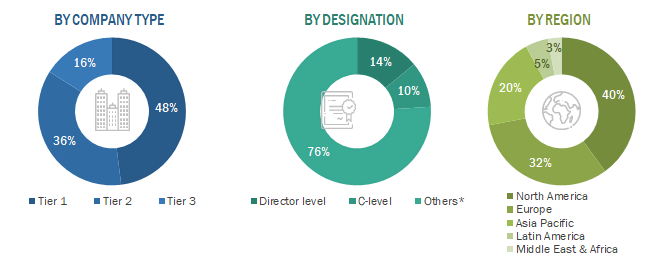
Note 1: C-level primaries include CEOs, COOs, CTOs, and VPs.
Note 2: Others include sales, marketing, and product managers.
Note 3: Companies are classified into tiers based on their total revenue. As of 2024, Tier 1 = >USD 2 billion, Tier 2 = USD 50 million to USD 2 billion, and Tier 3 = < USD 50 million.
To know about the assumptions considered for the study, download the pdf brochure
Market Size Estimation
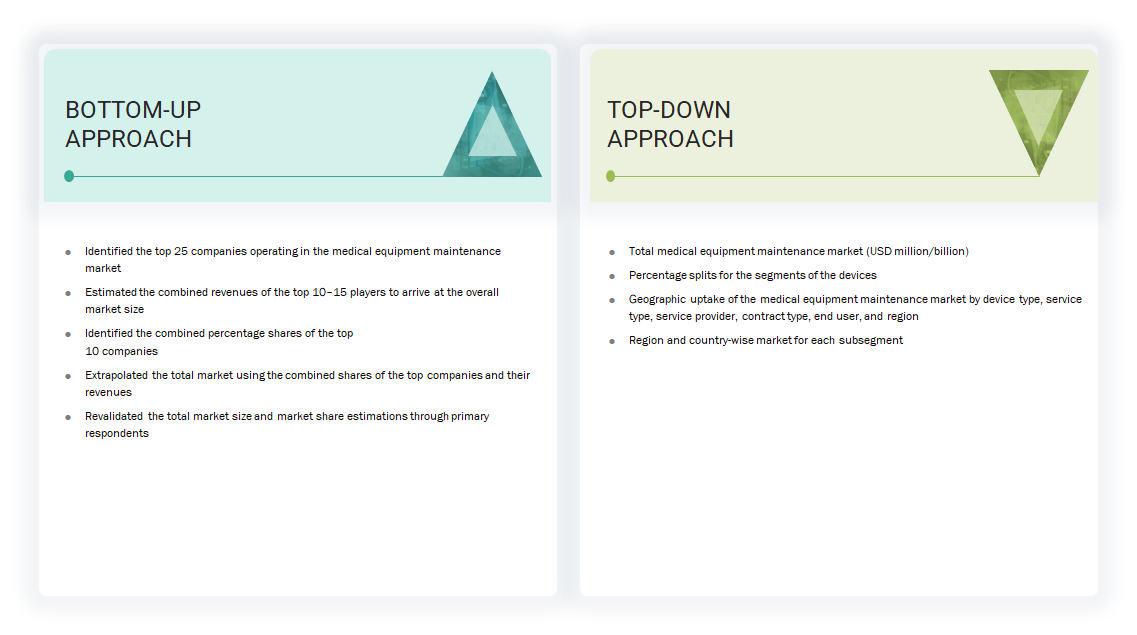
This report determined the global medical equipment maintenance market size using the revenue share analysis of leading players. For this purpose, key players in the market were identified, and their revenues from the medical equipment maintenance business were determined through various insights gathered during the primary and secondary research phases. Secondary research included the study of the annual and financial reports of the top market players. In contrast, primary research included extensive interviews with key opinion leaders, such as CEOs, directors, and marketing executives.
Segmental revenues were calculated based on the revenue mapping of major solution/service providers to calculate the global market value. This process involved the following steps:
- Generating a list of major global players operating in the medical equipment maintenance market
- Mapping annual revenues generated by major global players from the medical equipment maintenance segment (or nearest reported business unit/service category)
- Revenue mapping of key players to cover a significant share of the global market as of 2024
- Extrapolating the global value of the medical equipment maintenance industry
Global Medical Equipment Maintenance Market Size: Top-down & Bottom-up Approach
Data Triangulation
After arriving at the overall market size from the market size estimation process explained above, the global medical equipment maintenance market was split into segments and subsegments. Data triangulation and market breakdown procedures were employed to complete the overall market engineering process and arrive at the exact statistics for all segments and subsegments. The data was triangulated by studying various factors and trends from both the demand and supply sides. Additionally, top-down and bottom-up approaches validated the medical equipment maintenance market.
Market Definition
Medical equipment maintenance encompasses a comprehensive suite of services including monitoring, diagnosing failures, supplying spare parts, corrective maintenance, preventive maintenance, automation and upgrades, inventory management and testing, consulting, planning equipment renewal, and user training. It is indispensable for identifying and preempting potential performance issues before they escalate, thus optimizing equipment performance and curtailing operational costs. These critical services are typically executed internally or outsourced to Original Equipment Manufacturers (OEMs) or Independent Service Organizations (ISOs), ensuring the sustained reliability & efficiency of healthcare equipment.
Stakeholders
- Original equipment manufacturers
- Independent service providers
- Independent service organizations
- Product distributors and channel partners
- Hospitals & surgery centers
- Dental hospitals, laboratories, and clinics
- Dental academic & research institutes
- Ambulatory care centers & physician-operated laboratories
- Contract manufacturers & third-party suppliers
- Research laboratories & academic institutes
- Clinical research organizations
- Contract manufacturing organizations
- Government & non-governmental regulatory authorities
- Venture capitalists & investors
- Trade associations & industry bodies
- Insurance companies
- Market research & consulting firms
Report Objectives
- To define, describe, and forecast the medical equipment maintenance market based on device type, service type, service provider, contract type, end user, and region
- To provide detailed information regarding the major factors influencing the growth potential of the global medical equipment maintenance market (drivers, restraints, opportunities, challenges, and trends).
- To analyze the micro markets with respect to individual growth trends, prospects, and contributions to the global medical equipment maintenance market.
- To analyze key growth opportunities in the global medical equipment maintenance market for key stakeholders and provide details of the competitive landscape for market leaders.
- To forecast the size of the global medical equipment maintenance market in North America, Europe, the Asia Pacific, Latin America, and the Middle East & Africa.
- To profile the key players in the global medical equipment maintenance market and comprehensively analyze their market shares and core competencies.
- To track and analyze the competitive developments undertaken in the global medical equipment maintenance market, such as agreements, collaborations, partnerships, expansions, and acquisitions.
Key Questions Addressed by the Report
What are the drivers for the medical equipment maintenance market?
The key drivers include the growing demand for advanced and reliable medical devices, increasing focus on patient safety, and the rising need to reduce equipment downtime in healthcare settings. The expansion of healthcare infrastructure, especially in emerging markets, and the aging population fuel demand for timely maintenance services.
Which device segment in the medical equipment maintenance market provides lucrative growth opportunities?
The diagnostic imaging equipment segment offers the highest growth potential. This is due to rapid technological advancements and the high value and complexity of imaging systems such as MRI, CT, and PET scanners.
What are the key medical equipment maintenance market opportunities?
The key opportunities include the shift towards multi-vendor services, increasing adoption of predictive maintenance powered by AI and IoT, and growing investments in digital health infrastructure.
What are the key challenges in the medical equipment maintenance market?
Challenges include high service costs, a shortage of skilled technicians, limited access to OEM parts, rapid technological changes, and strict regulatory requirements.
Which region is expected to witness the highest growth rate during the forecast period?
The Asia Pacific region is expected to grow at the highest CAGR during the forecast period (2025−2030).
Ask ChatGPT
Fact checked
Personalize This Research
- Triangulate with your Own Data
- Get Data as per your Format and Definition
- Gain a Deeper Dive on a Specific Application, Geography, Customer or Competitor
- Any level of Personalization
Let Us Help You
- What are the Known and Unknown Adjacencies Impacting the Medical Equipment Maintenance Market
- What will your New Revenue Sources be?
- Who will be your Top Customer; what will make them switch?
- Defend your Market Share or Win Competitors
- Get a Scorecard for Target Partners

Custom Market Research Services
We Will Customise The Research For You, In Case The Report Listed Above Does Not Meet With Your Requirements
Get 10% Free CustomisationTESTIMONIALS

JAYANT RAJPUROHIT
Director of Market Insights, Data and Analytics
SFI Health,
Leading Pharmaceutical Companywww.sfihealth.com/

We at SFI Health approached MarketsandMarkets for an Opportunity Assessment on "Incidence and Prevalence of Focus Indications" as we wanted to know the most attractive HCPs like Physician, Functional MD, Naturopath and Pharmacist. The project was critical for us to ensure our focus on the right target which would enable sustainable growth and profitability for SFI Health. The business insights provided exceeded our expectations and we were extremely impressed. The team at MarketsandMarkets is highly professional and detail oriented and very well understood our business needs. MarketsandMarkets offers a unique combination of expertise and dedicated engagement model. We identified 2 new products to be launched in coming months, based on the research findings provided by MarketsandMarkets. We are happy with the services and would strongly recommend MarketsandMarkets to my peers in the industry.

BEATRIZ DE LA CALLE
Head of Commercial Analytics
Qualicaps,
Leading Pharmaceutical Companywww.qualicaps.com/

We partnered with MarketsandMarkets for an assessment study on hard empty capsules. The team was extremely professional in understanding our business requirements and we received timely responses to all our queries. The market intelligence and the recommendations has met our business requirements. We were extremely impressed to see the final study results; it really exceeded our expectations. The market intelligence offered by MarketsandMarkets, and clarity on next steps will help us achieve our business objective for the Year 2021. We are happy with the services and would strongly recommend MarketsandMarkets to my peers in the industry.

Bob Williams,
Senior Director Business Development & Innovation
Bracco Diagnostics Inc.,
Italian Multinational in life sciences sector and a World Leader in imaging diagnosticsimaging.bracco.com/us-en
We were pleased with targeted insights that MarketsandMarkets identified from a custom study on the 'Radiation Dose Management Solutions Market'. Your team identified and characterized the market participants as well as underlying trends accurately. This study was useful to Bracco in formulating business strategies for our dose monitoring product lines and we thank MarketsandMarkets for the job well done.
Cody Coonradt,
Market Development and Strategy Manager
3M Health Information Systems,
Leader in Health care Coding, Payment & Analytics Solutions.www.3m.com/3M/en_US/health-information-systems-us
The value for our organization comes from three things: depth of research, specificity of segments and being easy to work with. As important as the first two are, the third can't be underestimated. MarketsandMarkets, maybe more than any other research vendor, wants to know what is top of mind for our team and what big questions we are grappling to answer.
Their customer first approach and high value engagement model, have given us great analysis and excellent value for money
- Canada Medical Equipment Maintenance Market
- US Medical Equipment Maintenance Market
- Germany Medical Equipment Maintenance Market
- UK Medical Equipment Maintenance Market
- France Medical Equipment Maintenance Market
- Italy Medical Equipment Maintenance Market
- Spain Medical Equipment Maintenance Market
- Japan Medical Equipment Maintenance Market
- China Medical Equipment Maintenance Market
- India Medical Equipment Maintenance Market
- Australia Medical Equipment Maintenance Market
- South Korea Medical Equipment Maintenance Market
- Brazil Medical Equipment Maintenance Market
- Mexico Medical Equipment Maintenance Market
- UAE Medical Equipment Maintenance Market
- Rest Of Europe Medical Equipment Maintenance Market
Growth opportunities and latent adjacency in Medical Equipment Maintenance Market






Walter
Jul, 2026
I reviewed the Medical Equipment Maintenance Market report to understand how service outsourcing and preventive maintenance trends are influencing long-term cost efficiency across hospitals and diagnostic centers..
Harold
Jul, 2026
After going through the Medical Equipment Maintenance Market analysis, I found the breakdown of OEM versus independent service providers especially useful for evaluating competitive positioning and regional service demand..
Jeremy
Jul, 2026
I checked the Medical Equipment Maintenance Market report while assessing healthcare infrastructure investments, and the insights on equipment lifecycle management and uptime optimization added practical value to my research..
Gerald
Mar, 2022
Can you share the detailed information on technological advancements in the Medical Equipment Maintenance Market?.
Harold
Mar, 2022
In what way COVID19 is Impacting the global growth of the Medical Equipment Maintenance Market?.
Sean
Mar, 2022
Can you enlighten us about the key players operating in the global Medical Equipment Maintenance Market?.