
Natural Language Processing (NLP) Market

Natural Language Processing Market by Capability (Text Classification, Sentiment Analysis, Named Entity Recognition, Natural Language, Content Generation, Dialogue System, Conversational Agents, Neural Machine Translation) - Global Forecast to 2031




OVERVIEW
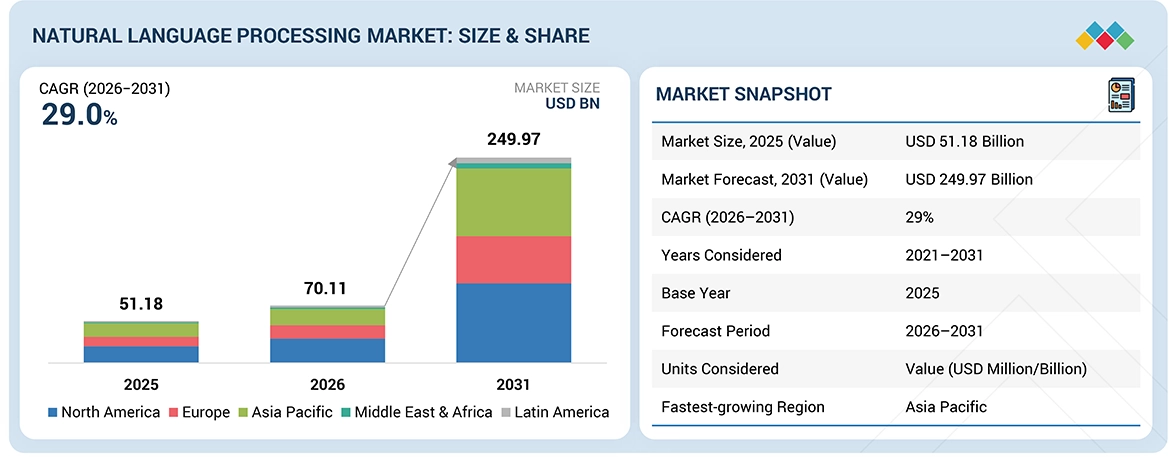
Source: Secondary Research, Interviews with Experts, MarketsandMarkets Analysis
The global natural language processing market is projected to grow from USD 70.11 billion in 2026 to USD 249.97 billion by 2031, at a CAGR of 29%. This growth is mainly driven by the rising use of AI to work with text and voice data. Organizations are turning to cloud-based NLP tools to handle unstructured data and make quicker decisions. Industries such as banking, healthcare, and retail are using NLP for chatbots, sentiment analysis, and document processing.
KEY TAKEAWAYS
-
BY REGIONNorth America is estimated to account for the largest market share of 42.34% in 2026.
-
BY OFFERINGBy offering, the services segment is projected to showcase the fastest growth rate of CAGR 30.8% during the forecast period.
-
BY DEPLOYMENT MODEBy deployment mode, the edge/on-device segment is projected to showcase the fastest growth rate of CAGR 31.2% during the forecast period.
-
BY CAPABILITYBy capability, text analytics is projected to hold the largest market share during the forecast period.
-
BY VERTICALBy vertical, BFSI is positioned to showcase the largest market share during the forecast period.
-
BY COMPETITIVE LANDSCAPE - Key PlayersIBM, Microsoft, Google, and AWS are identified as some of the leading players in natural language processing, given their strong market share and product footprint.
-
BY COMPETITIVE LANDSCAPE - Startups/SMEsRASA, Textrazor and Deepset, among others, have distinguished themselves among other players by securing strong footholds in specialized niche areas, underscoring their potential as emerging leaders.
Technology vendors are actively shaping the NLP market through platform improvements and partnerships. Many vendors are adding features to improve usability and performance. Data privacy and security requirements are also affecting how these solutions are designed. Vendors are focusing on governance and control features to support safe data usage. Organizations are also using real-time NLP tools to improve response time and daily operations.
TRENDS & DISRUPTIONS IMPACTING CUSTOMERS' CUSTOMERS
The NLP landscape is gradually moving from traditional rule-based approaches to more advanced AI-driven and cloud-based solutions. This shift is impacted by changing business needs, new technologies, and the growing need for more flexible and scalable systems. As a result, organizations are focusing more on improving customer experience, streamlining operations, and delivering faster and more efficient outcomes.
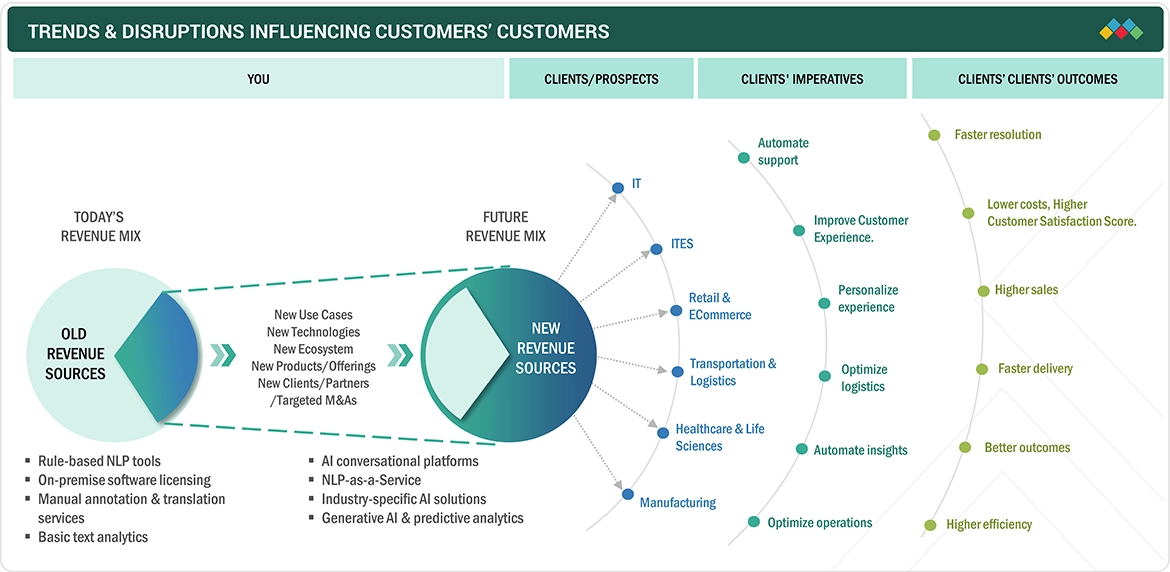
Source: Secondary Research, Interviews with Experts, MarketsandMarkets Analysis
MARKET DYNAMICS

Level
-
Automation of repetitive workflows and customer interactions through NLP-powered systems

-
Extraction of actionable insights from large volumes of unstructured text and speech data


Level
-
Complexity of human language, including ambiguity, tone, and context, limits accuracy of NLP models

-
Bias in training data leading to inconsistent or unfair outcomes in AI-driven language processing


Level
-
Expansion of generative AI and conversational interfaces enhancing business automation and user engagement

-
Increasing adoption of NLP for advanced data analytics, knowledge extraction, and enterprise decision-making


Level
-
Difficulty in handling diverse languages, dialects, and evolving vocabulary across global datasets

-
Data privacy concerns and need for secure processing of sensitive textual and speech data

Source: Secondary Research, Interviews with Experts, MarketsandMarkets Analysis
Driver: Automation of repetitive workflows and customer interactions through NLP-powered systems
NLP is being used by many organizations in daily tasks like handling customer queries and document handling. It can work with both text and voice inputs, which helps save time and improve response speed. As a result, its use is growing across different business needs.
Restraint: Complexity of human language, including ambiguity, tone, and context, limits accuracy of NLP models
Human language is a very complex entity that depends on context, tone, and intent. The same word could have different meanings depending on the context in which it is used. Therefore, it becomes difficult to interpret the word in the right context. NLP faces challenges in understanding sarcasm, slang, and technical vocabulary. Therefore, it requires constant improvement. Such challenges are affecting the adoption of NLP in some areas.
Opportunity: Expansion of generative AI and conversational interfaces enhancing business automation and user engagement
Generative AI and conversational tools are opening up new opportunities for NLP. Businesses are using chatbots and virtual assistants to handle tasks and interact with customers more effectively. This helps to cut down manual work, respond faster, and improve the overall user experience.
Challenge: Data privacy concerns and need for secure processing of sensitive textual and speech data
NLP systems handle text and voice-based information, and this information may be sensitive at times. This raises concerns about privacy and compliance. Organizations should be concerned about how the data is stored and who has access to the data. The risk increases when large amounts of data are processed in real time. To handle this, many companies use encryption and follow clear data handling practices.
NATURAL LANGUAGE PROCESSING (NLP) MARKET: COMMERCIAL USE CASES ACROSS INDUSTRIES
| COMPANY | USE CASE DESCRIPTION | BENEFITS |
|---|---|---|
 |
Upgraded its analytics capabilities by moving to cloud-based data and AI platforms, allowing more scalable processing and better support for customer-focused operations and digital initiatives | Enabled faster decision-making and improved overall efficiency, while helping the organization respond more quickly and make better use of its data |
 |
Adopted an NLP-based conversational AI solution to analyze call recordings, which can provide deeper insights into customer interactions and support sales and engagement efforts | Provided clearer visibility into customer sentiment and improved sales coaching, while also strengthening compliance and enhancing the overall customer experience |
 |
Implemented NLP to work with unstructured clinical data from EHRs, making it easier to search and use free-text information for reporting and documentation | Enabled better identification of at-risk patients and improved clinical insights, supporting stronger care outcomes and greater operational efficiency |
Logos and trademarks shown above are the property of their respective owners. Their use here is for informational and illustrative purposes only.
MARKET ECOSYSTEM
The natural language processing ecosystem mainly consists of solution providers and service providers. Solution providers build tools and platforms to work with text and speech data. These include chatbots, document processing, and sentiment analysis applications. Service providers help with deployment, integration, and ongoing support. They also assist in improving model performance over time.
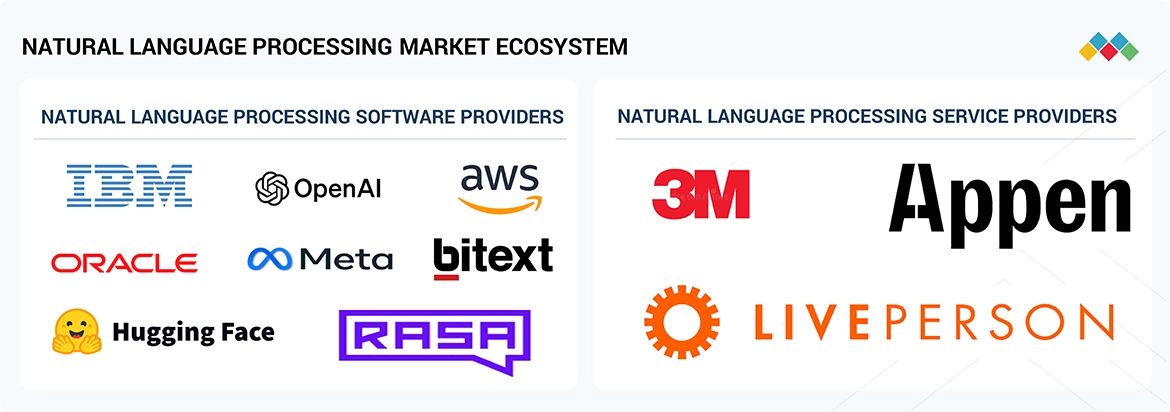
Logos and trademarks shown above are the property of their respective owners. Their use here is for informational and illustrative purposes only.
MARKET SEGMENTS
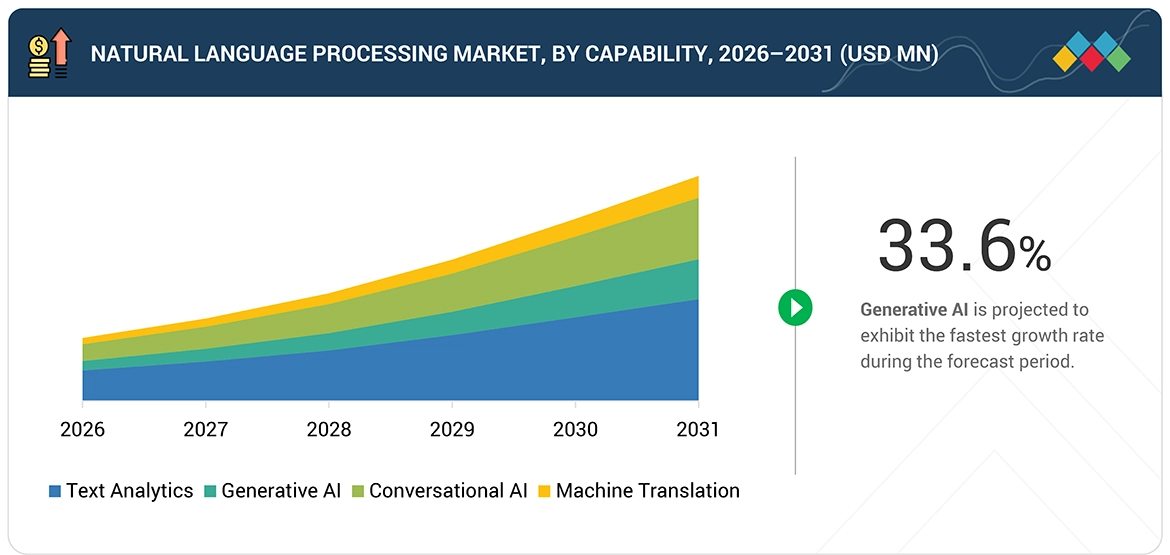
Source: Secondary Research, Interviews with Experts, MarketsandMarkets Analysis
Natural Language Processing Market, By Offering
NLP software is estimated to account for a significant share of the market. These solutions are used to process large amounts of text and speech data and generate useful insights for business decisions. Organizations are expanding their use beyond basic automation to more advanced applications. Growing adoption of cloud and AI technologies continues to support demand for NLP software solutions.
Natural Language Processing Market, By Deployment Mode
Edge or on-device deployment is becoming most common as organizations prefer to process sensitive data locally rather than depend entirely on the cloud. This allows for real-time language processing with quicker response times and lower latency. It also gives better control over data, improves security, and enhances performance across devices like smartphones and IoT systems.
Natural Language Processing Market, By Capability
Text analytics is widely used to structure large volumes of text and highlight important insights. This makes it easier for organizations to manage content and make quicker decisions. It also helps improve efficiency in everyday business activities.
Natural Language Processing Market, By Vertical
Healthcare and life sciences form one of the fastest-growing areas where NLP is being used. It helps in working with clinical records, notes, and research data. This supports more informed decisions and better patient care. Usage is growing as the volume of healthcare data continues to increase.
REGION
Asia Pacific is projected to be the fastest growing region in Natural Language Processing Market
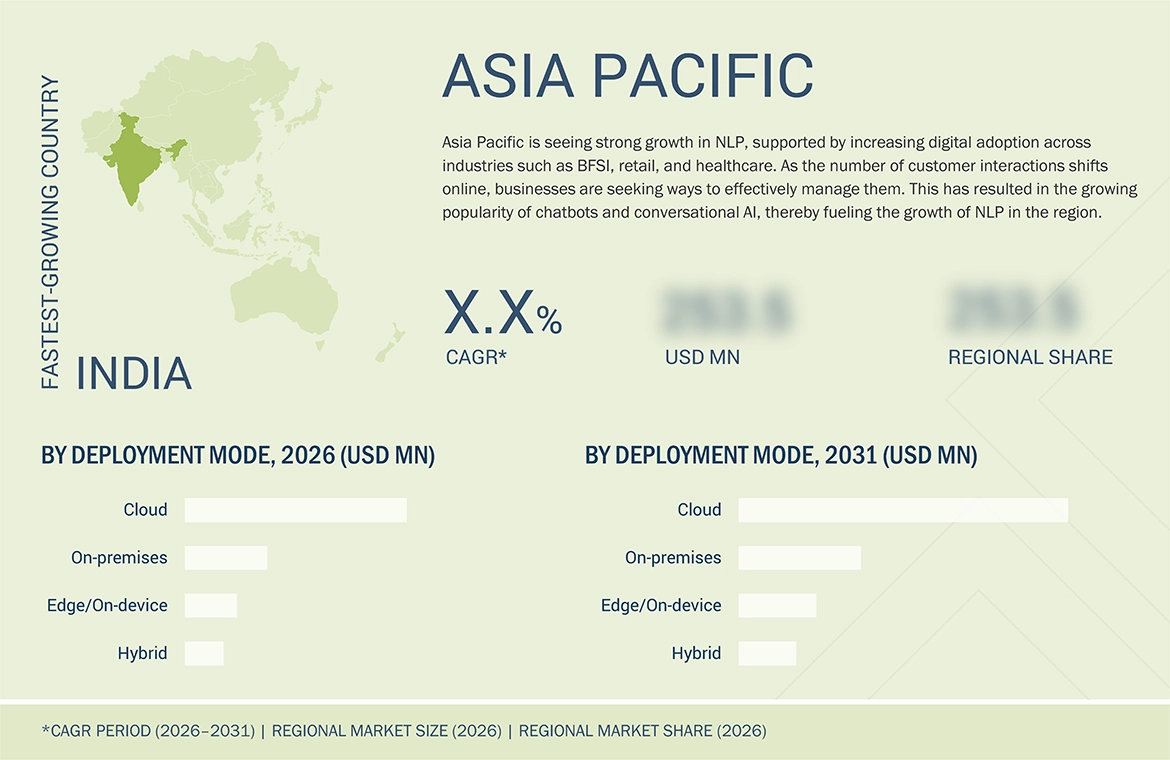
Asia Pacific is set to witness strong growth in NLP, supported by increasing digital adoption across industries like BFSI, retail, and healthcare. As the number of customer interactions shifts online, businesses are seeking ways to effectively manage them. This has resulted in the growing popularity of chatbots and conversational AI, thereby fueling the growth of NLP in the region.
NATURAL LANGUAGE PROCESSING (NLP) MARKET: COMPANY EVALUATION MATRIX
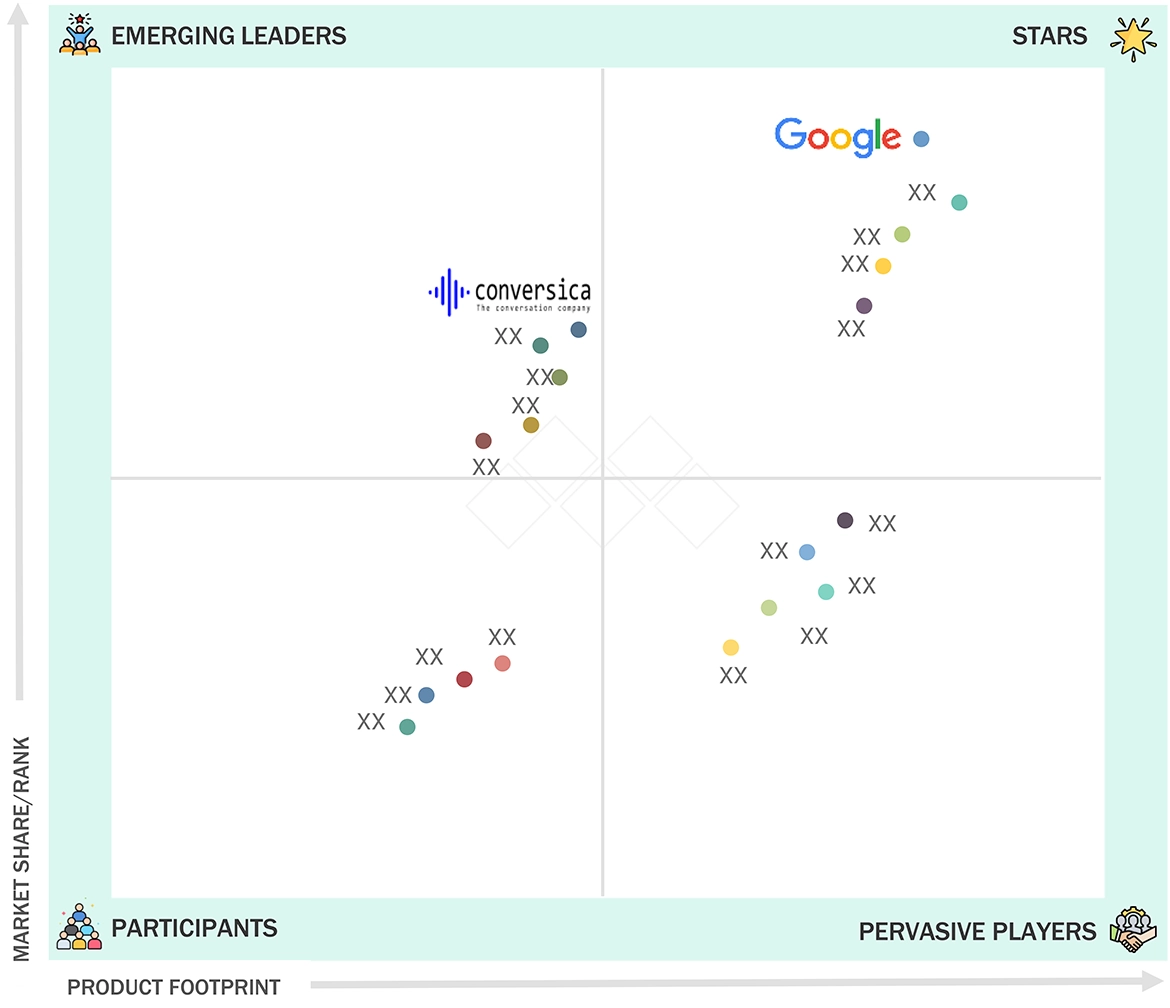
In the NLP vendor landscape, Google is a star, driven by strong NLU, large-scale language models, and cloud integration. Conversica is an emerging leader, expanding its conversational AI with improved intent recognition, dialogue management, and NLP-based customer engagement.
Source: Secondary Research, Interviews with Experts, MarketsandMarkets Analysis
KEY MARKET PLAYERS
- IBM (US)
- Microsoft (US)
- Google (US)
- AWS (US)
- Meta (US)
- 3M (US)
- Baidu (China)
- Apple (US)
- SAS Institute (US)
- IQVIA (UK)
- Oracle (US)
- Salesforce (US)
- OpenAI (US)
- Inbenta (US)
- Conversica (US)
- Crayon Dta (Singapore)
- Rasa (US)
- TextRazor (UK)
MARKET SCOPE
| REPORT METRIC | DETAILS |
|---|---|
| Market Size, 2025 (Value) | USD 51.18 Billion |
| Market Forecast, 2031 (Value) | USD 249.97 Billion |
| CAGR | 29.0% |
| Years Considered | 2021–2031 |
| Base Year | 2025 |
| Forecast Period | 2026–2031 |
| Units Considered | Value (USD Million/Billion) |
| Report Coverage | Revenue forecast, company ranking, competitive landscape, growth factors, and trends |
| Segments Covered |
|
| Regions Covered | North America, Asia Pacific, Europe, the Middle East & Africa, Latin America |
DELIVERED CUSTOMIZATIONS
We have successfully delivered the following deep-dive customizations:
| CLIENT REQUEST | CUSTOMIZATION DELIVERED | VALUE ADDS |
|---|---|---|
| Conversational AI and Chatbot Strategy | Assessment of NLP-based conversational systems, including chatbots, intent detection, features, and multilingual support |
|
| Speech Analytics and Voice Data Processing | Evaluation of NLP-based speech-to-text and voice analytics, including transcription, multilingual capabilities, and processing |
|
RECENT DEVELOPMENTS
- March 2026 : Meta improved its NLP models with better performance and usability for developing and using language-based applications for various use cases.
- February 2026 : IBM improved its NLP capabilities for Watson with better accuracy and more domain-specific models for better business document processing and accurate insights.
- February 2025 : Google improved its NLP capabilities for Google Cloud with a better understanding of languages for developing accurate solutions for organizations.
- January 2025 : Microsoft improved its Azure AI capabilities with better NLP features such as text analytics, summarization, and conversational AI for better business automation and customer engagement.
Table of Contents
 Exclusive indicates content/data unique to MarketsandMarkets and not available with any competitors.
Methodology
The research methodology for the Natural Language Processing market report involved extensive secondary sources and company publications, as well as various reputable open-source corporate technology portals, to identify and collect relevant information for this technical and market-oriented study. In-depth interviews were conducted with various primary respondents, including AI platform providers, cloud service vendors, enterprise users, and senior executives from multiple companies offering natural language processing software, language AI platforms, and related services, along with industry consultants, to obtain and verify critical qualitative and quantitative information and assess market developments and technology adoption trends.
Secondary Research
During the secondary research process, various secondary sources were consulted to identify and collect information for the study. The secondary sources included annual reports, press releases, and investor presentations of companies, white papers, and certified publications.
Secondary research was used to gather key information on the industry’s value chain, the market’s monetary chain, the overall pool of key players, market classification, and segmentation based on industry trends, regional markets, and key developments from both market- and technology-oriented perspectives.
Primary Research
In the primary research process, a diverse range of stakeholders from both the supply and demand sides of the Natural Language Processing ecosystem were interviewed to gather qualitative and quantitative insights specific to this market. From the supply side, key industry experts, such as chief executive officers (CEOs), vice presidents (VPs), marketing directors, technology & innovation directors, and technical leads from vendors offering natural language processing platforms, AI software, and language analytics services, were consulted. Additionally, system integrators, cloud service providers, and IT service firms that implement and support NLP solutions were included in the study. On the demand side, input from IT decision-makers, data science leaders, and business heads from prominent industry verticals was collected to understand enterprise adoption patterns and deployment challenges within targeted industries.
The primary research ensured that all crucial parameters affecting the Natural Processing Language market, including technological advancements and evolving use cases, as well as regulatory and compliance needs, were considered. Each factor was thoroughly analyzed, verified through primary research, and evaluated to obtain precise quantitative and qualitative data for this market.
Once the initial phase of market engineering was completed, including detailed calculations for market statistics, segment-specific growth forecasts, and data triangulation, a second round of primary research was conducted. This step was crucial for refining and validating critical data points, such as Natural Processing Language solutions (platforms and software tools), industry adoption trends, the competitive landscape, and key market dynamics like demand drivers (automation of repetitive workflows and customer interactions through NLP-powered systems, extraction of actionable insights from large volumes of unstructured text and speech data), challenges (difficulty in handling diverse languages, dialects, and evolving vocabulary across global datasets, data privacy concerns and need for secure processing of sensitive textual and speech data), opportunities (expansion of generative AI and conversational interfaces enhancing business automation and user engagement, increasing adoption of NLP for advanced data analytics, knowledge extraction, and enterprise decision-making), and restraints (complexity of human language, including ambiguity, tone, and context, limits accuracy of NLP models, bias in training data leading to inconsistent or unfair outcomes in AI-driven language processing).
In the comprehensive market engineering process, the top-down and bottom-up approaches, along with several data triangulation methods, were extensively employed to estimate and forecast the overall market segments and subsegments listed in this report. Extensive qualitative and quantitative analysis was conducted across the complete market engineering process to capture critical information/insights throughout the report.
BREAKDOWN OF PRIMARY INTERVIEW PARTICIPANTS
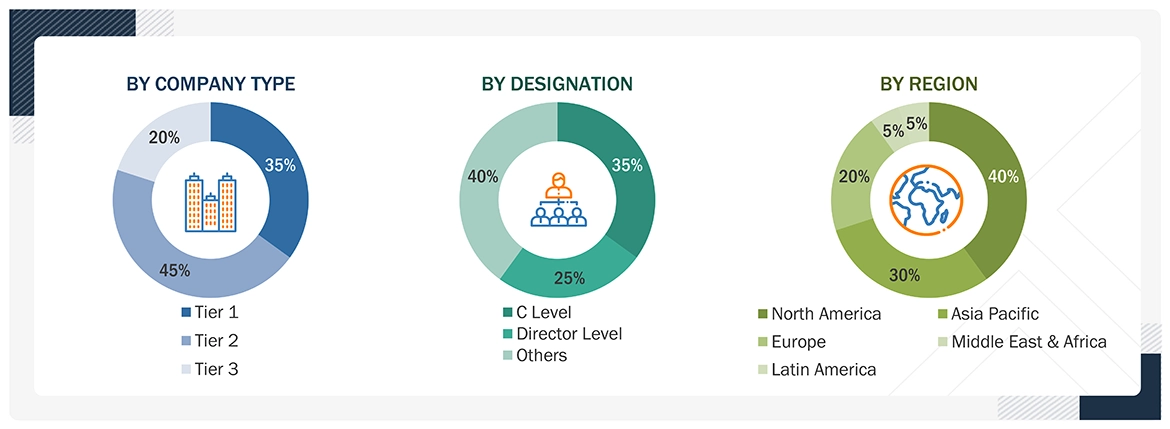
Note 1: Others include sales managers, marketing managers, and product managers.
Note 3: Tier 1 companies’ revenues are more than USD 10 billion, tier 2 companies’ revenues range between USD 1 and 10 billion, and tier 3 companies’ revenues range between USD 500 million and USD 1 billion.
Source: Industry Experts
To know about the assumptions considered for the study, download the pdf brochure
Market Size Estimation
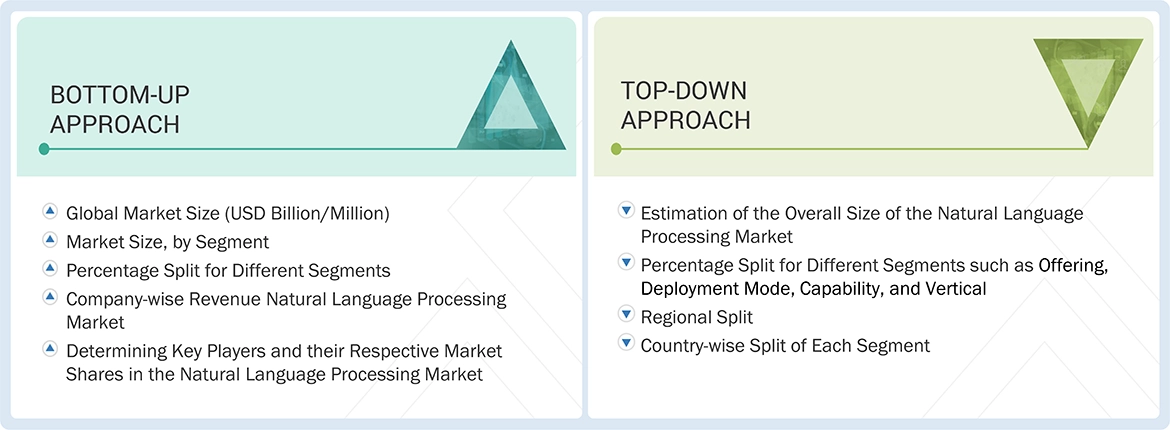
The top-down and bottom-up approaches were employed to estimate and forecast the Natural Processing Language market, as well as its dependent submarkets. This multi-layered analysis was further reinforced through data triangulation, which incorporated primary and secondary research inputs. The market figures were also validated against the existing MarketsandMarkets repository for accuracy.
Data Triangulation
The market was divided into several segments and subsegments after determining the overall market size using the market size estimation processes described above. To complete the overall market engineering process and determine the exact statistics for each market segment and subsegment, data triangulation and market segmentation procedures were employed, wherever applicable. The overall market size was then used in the top-down approach to estimate the size of other individual markets by applying percentage splits to the market segmentation.
Market Definition
According to According to IBM, Natural Language Processing (NLP) refers to the branch of computer science—and more specifically, the branch of artificial intelligence (AI) concerned with giving computers the ability to understand text and spoken words in much the same way human beings can. NLP combines computational linguistics rule-based modeling of human language with statistical, machine learning, and deep learning models.
Key Stakeholders
- NLP Vendors
- NLP Solution Vendors
- Managed Service Providers
- Support And Maintenance Service Providers
- System Integrators (SIs)/Migration Service Providers
- Value-added Resellers (VARs) and Distributors,
- System Integrators (SIs)
- Independent Software Vendors (ISV)
- Third-party Providers
- Technology Providers.
Report Objectives
- To define, describe, and predict the Natural Language Processing market by offering (software and services), deployment mode, capability, and region
- To provide detailed information related to major factors (drivers, restraints, opportunities, and industry-specific challenges) influencing market growth
- To analyze opportunities in the market and provide details of the competitive landscape for stakeholders and market leaders
- To forecast the market size of segments with respect to five main regions: North America, Europe, Asia Pacific, Middle East & Africa, and Latin America
- To analyze each submarket with respect to individual growth trends, prospects, and contributions to the overall Natural Language Processing market
- To analyze competitive developments, such as partnerships, new product launches, mergers & acquisitions, in the Natural Language Processing market
- To analyze the competitive developments, such as partnerships, product launches, mergers and acquisitions, in the Natural Language Processing market
- To analyze the impact of macroeconomic factors on Natural Language Processing market across all regions.
Available customizations:
Using the provided market data, MarketsandMarkets offers customizations tailored to the company’s specific needs. The following customization options are available for the report.
Product analysis
- Product comparative analysis, which gives a detailed comparison of innovative products being offered by prominent vendors
Geographic analysis
- Further breakup of additional European countries by offering, deployment mode, capability, and vertical
- Further breakup of additional Asia Pacific countries by offering, deployment mode, capability, and vertical
- Further breakup of additional Middle East & African countries by offering, deployment mode, capability, and vertical
- Further breakup of additional Latin American countries by offering, deployment mode, capability, and vertical
Company information
- Detailed analysis and profiling of additional market players (up to five)
Need a Tailored Report?
Customize this report to your needs
Get 10% FREE Customization
Customize This ReportPersonalize This Research
- Triangulate with your Own Data
- Get Data as per your Format and Definition
- Gain a Deeper Dive on a Specific Application, Geography, Customer or Competitor
- Any level of Personalization
Let Us Help You
- What are the Known and Unknown Adjacencies Impacting the Natural Language Processing Market
- What will your New Revenue Sources be?
- Who will be your Top Customer; what will make them switch?
- Defend your Market Share or Win Competitors
- Get a Scorecard for Target Partners

Custom Market Research Services
We Will Customise The Research For You, In Case The Report Listed Above Does Not Meet With Your Requirements
Get 10% Free CustomisationTESTIMONIALS

Still Researching the
Natural Language Processing Ecosystem?
See the competitors, opportunity evaluation, and growth signals shaping it - Instantly!
Generate 15+ consulting-grade strategic intelligence outputs - from competitor analysis to board-ready strategy decks, tailored to your Natural Language Processing growth question.






Growth opportunities and latent adjacency in Natural Language Processing Market