North America Manufacturing Execution System Market

North America Manufacturing Execution System (MES) Market by Offering (Software, Services), Deployment (On-premises, Cloud, Hybrid), Application (Production Management, Quality Management, Performance Analytics, Predictive Maintenance) - Forecast to 2030




OVERVIEW
Source: Secondary Research, Interviews with Experts, MarketsandMarkets Analysis
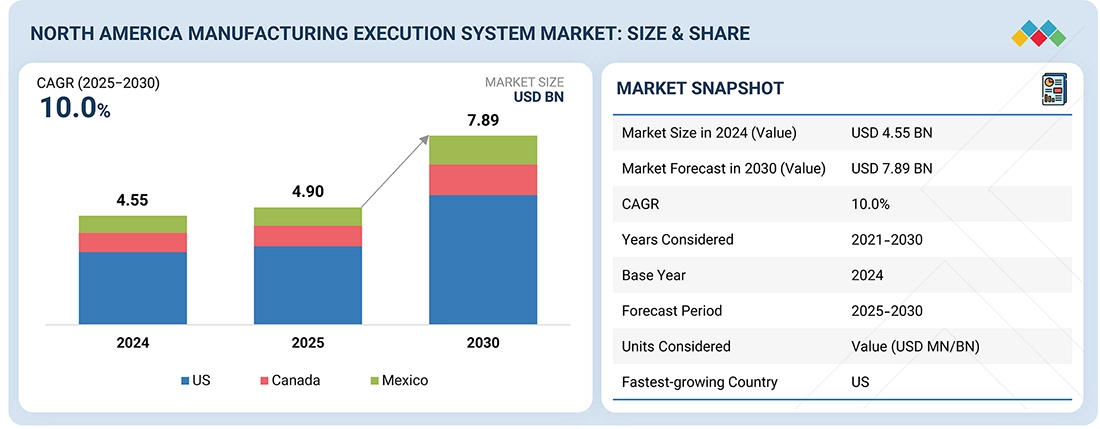
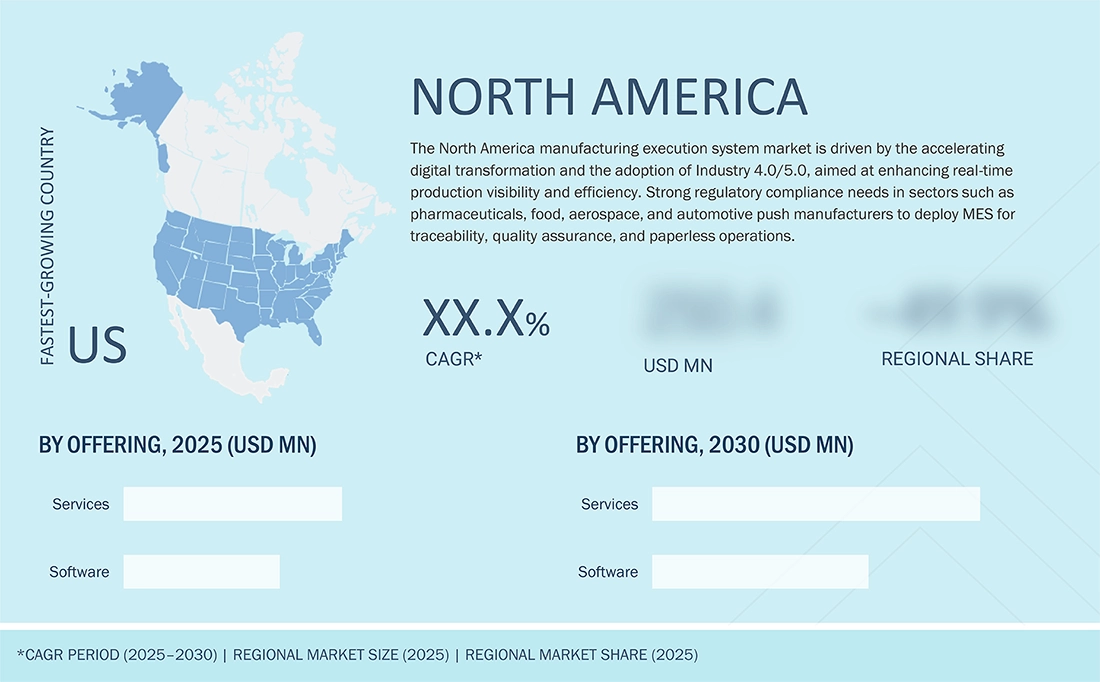
The North America manufacturing execution system market is projected to reach USD 7.89 billion by 2030 from USD 4.90 billion in 2025, at a CAGR of 10.0% from 2025 to 2030. The market in North America is driven by the rapid digital transformation and Industry 4.0 adoption. The adoption of MES is aimed at improving shop-floor visibility, asset performance, and real-time decision-making. Additionally, strong regulatory compliance needs in sectors such as pharmaceuticals, food, aerospace, and automotive push manufacturers to deploy MES for traceability, quality assurance, and paperless operations.
Market Size & Forecast
• 2025 Market Size: USD 4.90 Billion
• 2030 Projected Market Size: USD 7.89 Billion
• CAGR (2025-2030): 10.0%
• Pharmaceuticals & life sciences: Fastest-growing Market
• US: Highest CAGR
KEY TAKEAWAYS
-
BY COUNTRYBy country, the US is expected to record a CAGR of 10.6% between 2025 and 2030.
-
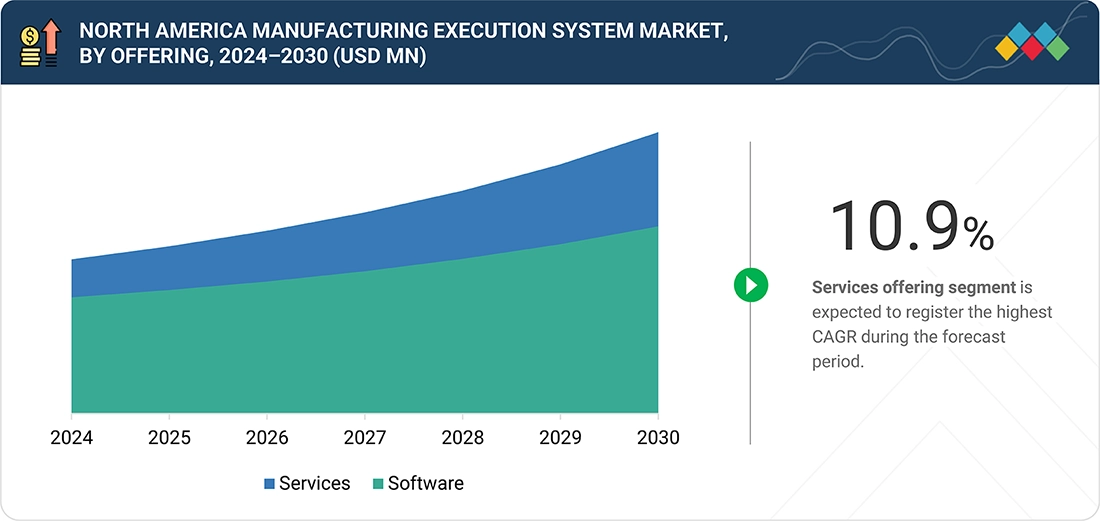
BY OFFERINGThe services segment is likely to exhibit a growth rate of 10.9% during the forecast period.
-
BY DEPLOYMENTBy deployment, the on-premises segment is expected to dominate the market in terms of market share.
-
BY INDUSTRYThe pharmaceuticals & life sciences segment is projected to grow the fastest during the forecast period.
-
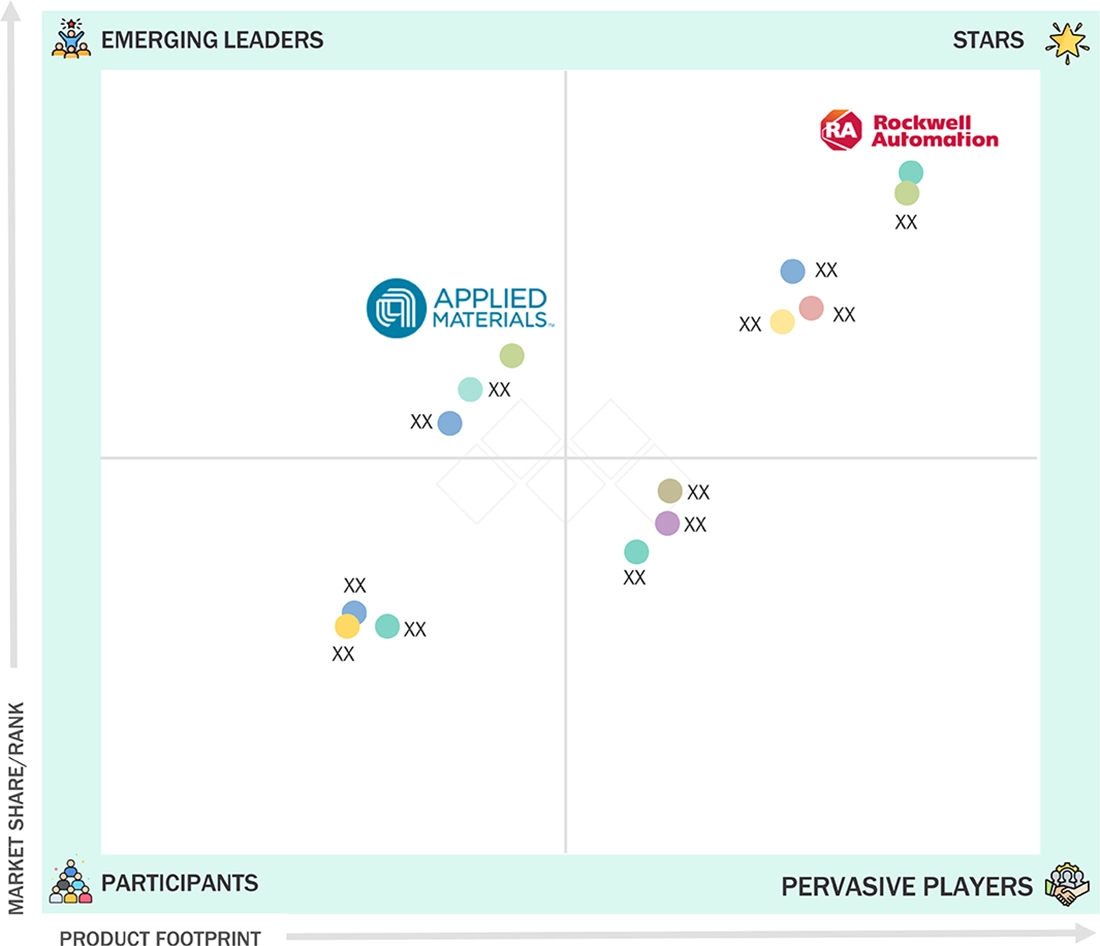
COMPETITIVE LANDSCAPE - KEY PLAYERSRockwell Automation, Honeywell International Inc., and Emerson Electric Co. were identified as star players in the North America manufacturing execution system market, given their strong market share and product footprint.
-
COMPETITIVE LANDSCAPE - STARTUPS/SMESApplied Materials Inc., Infor, 42Q, and Aegis Industrial Software Corporation have distinguished themselves among SMEs by securing strong footholds in specialized niche areas, underscoring their potential as emerging market leaders.
The US, Canada, and Mexico are major contributors to the North America manufacturing execution system market growth. The mounting Industry 4.0 adoption, large-scale automation investments, and strong demand for real-time production intelligence across discrete and process industries drive the market for MES in the US and Canada. High compliance requirements in the pharmaceuticals, aerospace, and food industries further accelerate the deployment of MES for traceability and paperless operations.
TRENDS & DISRUPTIONS IMPACTING CUSTOMERS' CUSTOMERS
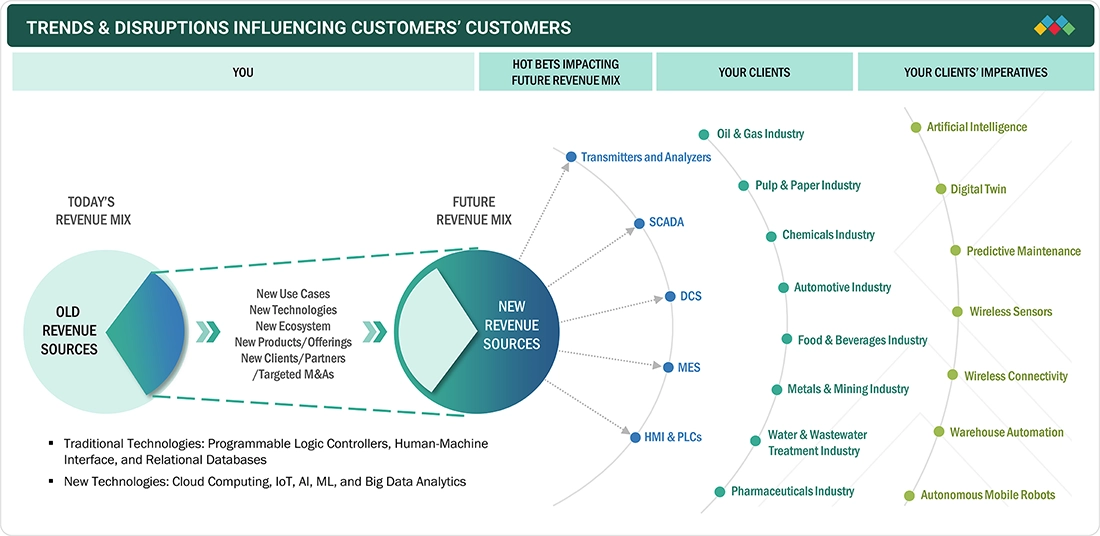
The North America manufacturing execution system market is being reshaped by the rapid adoption of Industry 4.0, with manufacturers shifting toward cloud-native and hybrid MES platforms. This improves real-time visibility, agility, and multi-site scalability. AI, IIoT, edge computing, and digital-twin integrations are transforming MES from a production monitoring system into an intelligence-driven decision engine. Strong compliance and traceability requirements in regulated sectors, along with the reshoring and near-shoring of manufacturing, further accelerate deployments. At the same time, cybersecurity risks, legacy system integration challenges, and rising vendor competition create disruption and force MES providers to innovate faster.
Source: Secondary Research, Interviews with Experts, MarketsandMarkets Analysis
MARKET DYNAMICS

Level
-
Accelerating Industry 4.0/5.0 adoption

-
Rapid shift toward cloud-based hybrid MES for multi-site scalability


Level
-
High legacy system integration and migration costs in US brownfield plants

-
Persistent workforce skills gap and MES change-management resistance across factories


Level
-
Development of AI-driven MES for pharmaceuticals, food, and electronics industries

-
Growing usage of MES in multi-site manufacturing


Level
-
Rising cybersecurity risk with IT/OT convergence across industrial networks

-
Vendor fragmentation

Source: Secondary Research, Interviews with Experts, MarketsandMarkets Analysis
Driver: Accelerating Industry 4.0/5.0 adoption
Accelerating Industry 4.0/ 5.0 adoption in the US and Canada is significantly propelling the North America manufacturing execution system market. Manufacturers shift toward smart, connected, and data-driven production environments. Companies are increasingly integrating AI, IIoT, robotics, additive manufacturing, and edge analytics to optimize workflows. This improves real-time decision-making. MES has become central to orchestrating digital factories. This stimulates visibility, traceability, and predictive performance across the shop floor. As a result, both discrete and process industries are modernizing legacy automation with scalable, cloud-enabled MES platforms.
Restraint: High legacy system integration and migration costs in US brownfield plants
High legacy system integration and migration costs in US brownfield manufacturing plants act as a major restraint for the North America manufacturing execution system market. Many facilities operate decades-old automation systems and proprietary equipment, making MES deployment complex, time-consuming, and expensive. Custom interfaces, data harmonization, and phased implementation add to capital and operational costs. In several cases, manufacturers hesitate to replace functioning legacy systems due to production downtime risks and limited internal IT–OT expertise. This slows down the MES adoption despite clear long-term benefits.
Opportunity: Development of AI-driven MES for pharmaceuticals, food, and electronics industries
AI-driven MES presents a strong opportunity in the pharmaceuticals, food, and electronics sectors as manufacturers increasingly seek intelligent, closed-loop production control and faster quality assurance. By integrating AI with MES, companies can automate root-cause analysis, predict deviations, optimize recipes and batch outcomes, and ensure end-to-end traceability. In tightly regulated industries like pharma and food, AI-enabled compliance monitoring and digital batch records reduce release times and human error. In electronics, AI supports high-mix, high-volume production with dynamic scheduling and yield optimization.
Challenge: Rising cybersecurity risk with IT/OT convergence across industrial networks
The convergence of IT and OT across industrial networks leads to increased cybersecurity risks in the North America manufacturing execution system market. As manufacturing systems become more interconnected, vulnerabilities in legacy OT devices and networked IT systems expose operations to potential cyberattacks. This raises concerns around data integrity, system downtime, and operational safety. Manufacturers are increasingly prioritizing secure MES deployments with robust network monitoring, threat detection, and risk mitigation strategies to safeguard industrial operations.
NORTH AMERICA MANUFACTURING EXECUTION SYSTEM MARKET: COMMERCIAL USE CASES ACROSS INDUSTRIES
| COMPANY | USE CASE DESCRIPTION | BENEFITS |
|---|---|---|
 |
Real-time production monitoring and line performance analytics | Digital quality management and defect traceability for discrete & hybrid manufacturing | Cloud-enabled multi-site MES deployment via Plex for flexible scaling | Reduces downtime and scrap using predictive insights and closed-loop quality control | Improves OEE and throughput with real-time bottleneck visibility | Ensures compliance and complete genealogy for regulated sectors such as automotive and electronics |
 |
Digital work instructions and workflow orchestration for process industries | Plant-wide batch continuous process synchronization with Enterprise OT integration | Predictive MES using advanced analytics from Honeywell Forge | Enhances yield and reduces variability through standardized workflows | Improves asset utilization and operational reliability in critical sectors, including chemicals and oil & gas | Lowers operating cost via energy-optimized and data-driven manufacturing execution |
 |
Streamlined batch execution, electronic batch records (EBR), and recipe management for pharma, biotech, and specialty chemicals | Paperless documentation and workflow enforcement to ensure regulatory compliance | Integration of MES with automation (DeltaV) for continuous quality and real-time asset performance visibility | Shortens batch release times and reduces human error through digital batch records and electronic workflows | Supports faster FDA / cGMP compliance and audit readiness | Improves operational reliability and reduces waste via synchronized MES + process control automation |
 |
End-to-end wafer fabrication MES for fully automated semiconductor fabs | Advanced scheduling, dispatch, and recipe management for high-precision microelectronics production | AI-based defect inspection + closed-loop yield optimization integrating metrology and manufacturing tools | Maximizes wafer yield and uptime in highly capital-intensive fabs through automated decision-making | Reduces cycle time and variability, improving throughput and speed to market | Ensures process repeatability and traceability to meet strict semiconductor quality and regulatory expectations |
Logos and trademarks shown above are the property of their respective owners. Their use here is for informational and illustrative purposes only.
MARKET ECOSYSTEM
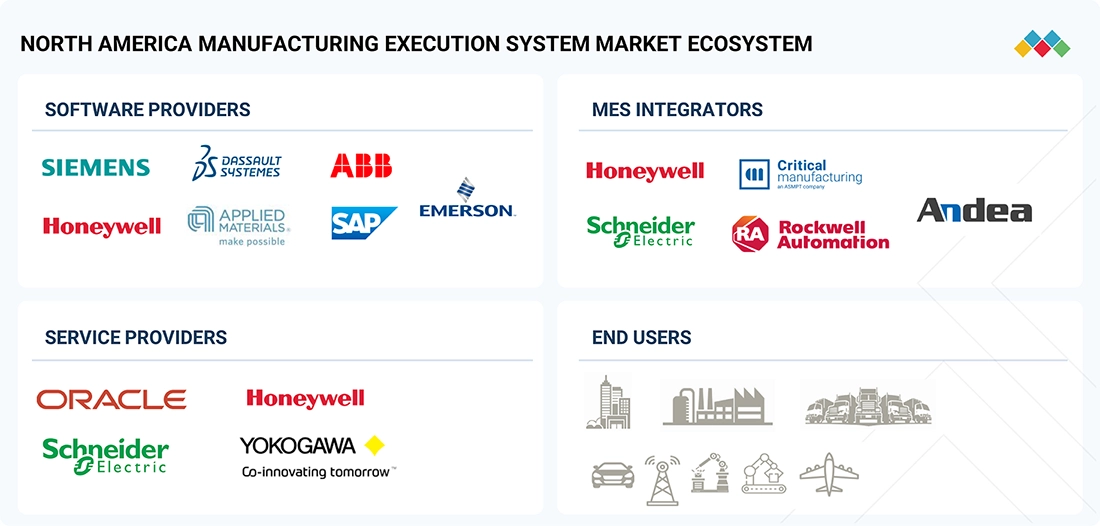
The North America manufacturing execution system ecosystem comprises software providers, MES integrators, service providers, and end users, supporting technologies, and regulatory frameworks. Leading MES providers such as Siemens, Rockwell Automation, Honeywell, Schneider Electric, ABB, Emerson, GE Vernova, and Dassault Systèmes offer platforms that integrate OT and IT systems. Integrators implement and customize solutions for diverse industries, including automotive, aerospace, electronics, pharmaceuticals, and food & beverage.
Logos and trademarks shown above are the property of their respective owners. Their use here is for informational and illustrative purposes only.
MARKET SEGMENTS
Source: Secondary Research, Interviews with Experts, MarketsandMarkets Analysis
North America Manufacturing Execution System Market, By Offering
Services are expected to dominate the North America manufacturing execution system market share. Manufacturers increasingly rely on consulting, integration, deployment, and maintenance support to modernize complex production environments. The need to integrate MES with legacy OT systems, ERP platforms, IIoT networks, and cloud infrastructure drives higher service spending. Additionally, ongoing upgrades, cybersecurity support, and training further accelerate the growth of MES services compared with standalone software licenses.
North America Manufacturing Execution System Market, By Deployment Mode
On-premises deployment continues to dominate the North America manufacturing execution system market due to the region’s highly regulated and data-sensitive industries. These sectors include pharmaceuticals, aerospace, medical devices, and defense manufacturing. These sectors prioritize full control over production data, low-latency machine connectivity, and protection of proprietary IP within plant boundaries. Additionally, US and Canadian brownfield factories have complex legacy OT infrastructure that integrates more seamlessly with on-premises MES. This enhances the on-premise deployment, making it localized, secure, and effectively the preferred model across the region.
North America Manufacturing Execution System Market, By Industry
Pharmaceutical & life sciences are projected to be the fastest-growing segment in the North America manufacturing execution system market. It is driven by stringent FDA/Health Canada compliance needs, digital batch records, and end-to-end traceability across drug and biologics production. MES enables real-time quality control, electronic batch release, GMP compliance, and serialization for clinical and commercial manufacturing. The surge in personalized therapies, biologics, and vaccine production further accelerates MES adoption across pharma plants, CDMOs, biotech facilities, and laboratories in the region.
REGION
US to be fastest-growing country in North America manufacturing execution system market during forecast period
The US manufacturing execution system market is witnessing strong growth. Factors such as rapid digital transformation and rising investments in smart manufacturing across automotive, aerospace, pharmaceuticals, and electronics sectors stimulate the market growth. Manufacturers are increasingly adopting MES to enable real-time production visibility, electronic batch records, predictive maintenance, and supply-chain traceability. Use cases such as automated quality control in automotive plants and GMP-compliant batch execution in pharma facilities are further accelerating MES deployment to improve efficiency and regulatory adherence.
NORTH AMERICA MANUFACTURING EXECUTION SYSTEM MARKET: COMPANY EVALUATION MATRIX
In the North America manufacturing execution system market matrix, Rockwell Automation, Honeywell International Inc., and Emerson Electric Co. (Star) lead with a strong market presence and a wide product portfolio, driving large-scale adoption across various industries, including automotive, chemicals, and pharmaceuticals, among others.
Source: Secondary Research, Interviews with Experts, MarketsandMarkets Analysis
KEY MARKET PLAYERS
- Rockwell Automation (US)
- Honeywell International Inc.(US)
- Emerson Electric Co (US)
- ABB (Switzerland)
- Siemens (Germany)
- SAP SE (Germany)
- Dassault Systèmes (France)
- Oracle (US)
- Schneider Electric (France)
- Applied Materials Inc (US)
- GE Vernova (US)
MARKET SCOPE
| REPORT METRIC | DETAILS |
|---|---|
| Market Size in 2024 (Value) | USD 4.55 Billion |
| Market Forecast in 2030 (Value) | USD 7.89 Billion |
| Growth Rate | CAGR of 10.0% from 2025–2030 |
| Years Considered | 2021–2030 |
| Base Year | 2024 |
| Forecast Period | 2025–2030 |
| Units Considered | Value (USD Million/Billion) |
| Report Coverage | Revenue forecast, company ranking, competitive landscape, growth factors, and trends |
| Segments Covered |
|
| Countries Covered | US, Canada, and Mexico |
WHAT IS IN IT FOR YOU: NORTH AMERICA MANUFACTURING EXECUTION SYSTEM MARKET REPORT CONTENT GUIDE
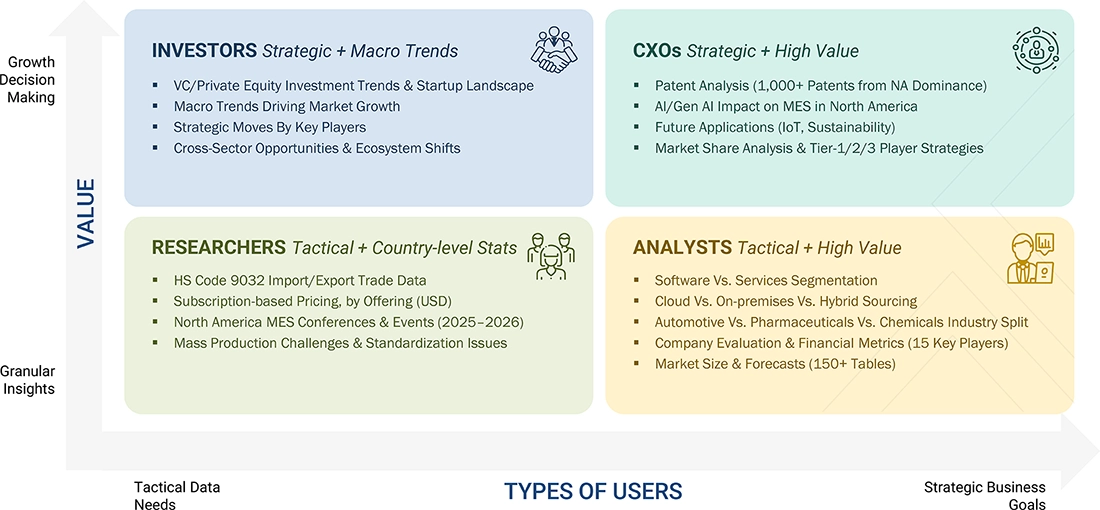
DELIVERED CUSTOMIZATIONS
We have successfully delivered the following deep-dive customizations:
| CLIENT REQUEST | CUSTOMIZATION DELIVERED | VALUE ADDS |
|---|---|---|
| US-based MES Software Vendor |
|
|
| Europe-Based MES Integration Consulting Firm |
|
|
| Manufacturing Technology Startup |
|
|
| Canada and Mexico-based Automotive Component Manufacturer |
|
|
| Pharmaceutical MES Customer |
|
|
RECENT DEVELOPMENTS
- May 2025: Rockwell Automation, Inc. announced the launch of FactoryTalk PharmaSuite 12.00. The latest release of its manufacturing execution system (MES) is designed to support the unique needs of regulated pharmaceutical and biopharmaceutical manufacturing environments, helping companies simplify system management, accelerate deployments, and scale production more efficiently.
- April 2024: Emerson Electric Co. introduced DeltaV Workflow Management, a next-generation software designed for life sciences companies in early-stage development. The new software will help evolve the DeltaV automation platform to provide more scalable options for life sciences innovators.
- October 2023: Siemens Digital Industries Software of Siemens and CEA-List, a technological research institute focused on smart digital systems research, announced the signing of a memorandum of understanding to collaborate on research to further extend and enhance digital twin capabilities with artificial intelligence (AI) and explore greater integration of embedded software on virtual and hybrid platforms.
Table of Contents
 Exclusive indicates content/data unique to MarketsandMarkets and not available with any competitors.
Methodology
The study involved four major activities in estimating the current size of the North America Manufacturing Execution Systems Market. Exhaustive secondary research has been done to collect information on the market, peer market, and parent market. To validate these findings, assumptions, and sizing with industry experts across the value chain through primary research has been the next step. Both top-down and bottom-up approaches have been employed to estimate the complete market size. After that, market breakdown and data triangulation methods have been used to estimate the market size of segments and subsegments. Two sources of information—secondary and primary—have been used to identify and collect information for an extensive technical and commercial study of the North America Manufacturing Execution Systems Market.
Secondary Research
Various secondary sources have been referred to in the secondary research process to identify and collect information important for this study. The secondary sources include annual reports, press releases, and investor presentations of companies; white papers; journals and certified publications; and articles from recognized authors, websites, directories, and databases. Secondary research has been conducted to obtain key information about the industry’s supply chain, the market’s value chain, the total pool of key players, market segmentation according to the industry trends (to the bottom-most level), regional markets, and key developments from market- and technology-oriented perspectives. The secondary data has been collected and analyzed to determine the overall market size, further validated by primary research.
Primary Research
Extensive primary research was conducted after gaining knowledge about the current scenario of the North America Manufacturing Execution Systems Market through secondary research. Several primary interviews were conducted with experts from the demand and supply sides across North America. This primary data was collected through questionnaires, emails, and telephonic interviews.
Market Size Estimation
Both top-down and bottom-up approaches have been used to estimate and validate the total size of the North America Manufacturing Execution Systems Market. These methods have also been used extensively to estimate the size of various subsegments in the market. The following research methodology has been used to estimate the market size:
- Major players in the industry and markets have been identified through extensive secondary research.
- The industry’s value chain and market size (in terms of value) have been determined through primary and secondary research processes.
- All percentage shares, splits, and breakdowns have been determined using secondary sources and verified through primary sources.
Data Triangulation
After arriving at the overall size of the North America Manufacturing Execution Systems Market from the market size estimation process explained above, the total market has been split into several segments and subsegments. Data triangulation and market breakdown procedures have been employed, wherever applicable, to complete the overall market engineering process and arrive at the exact statistics for all segments and subsegments of the market. The data has been triangulated by studying various factors and trends from both the demand and supply sides. Along with this, the market size has been validated using both top-down and bottom-up approaches..
Market Definition
The Manufacturing Execution Systems (MES) market refers to software designed to maximize real-time factory production management by integrating operational technology (OT) with information technology (IT). Unlike enterprise resource planning (ERP) systems, MES offers granular visibility, control, and coordination of the manufacturing process at the shop floor level. These systems maximize production efficiency through optimized monitoring, quality assurance, workflow automation, and compliance with regulatory requirements.
Propelled by Industry 4.0, smart manufacturing, and real-time analytics needs, MES solutions assist manufacturers in minimizing downtime, enhancing agility, and maximizing the use of resources. Industries such as automotive, electronics, pharmaceuticals, aerospace, and food & beverage depends on MES for smooth production, supply chain synchronization, and improved decision-making.
Key Stakeholders
- Associations and regulatory authorities (especially responsible for developing standards related to plant maintenance)
- Government bodies, venture capitalists, and private equity firms
- Automation consultants
- Automation system integrators
- ERP developers
- MES distributors and providers
- Process and discrete industries
- Research organizations and consulting companies
- Technology providers
- Technology investors, standards organizations, forums, alliances, and associations
Report Objectives
- To describe, segment, and forecast the overall North America Manufacturing Execution Systems Market, by deployment mode, offering, application, and industry, in terms of value.
- To describe the applications and leveraging entities of manufacturing execution systems and software.
- To provide an overview of the recent trends in the market.
- To provide detailed information regarding the drivers, restraints, opportunities, and challenges influencing the growth of the market.
- To analyze the supply chain, trends/disruptions impacting customers’ business, market/ecosystem map, pricing analysis, and regulatory landscape pertaining to North America Manufacturing Execution Systems Market.
- To strategically analyze micromarkets with respect to individual growth trends, prospects, and contributions to the overall market size.
- To analyze opportunities in the market for stakeholders and provide a competitive landscape of the market.
- To strategically profile the key players and comprehensively analyze their market positions in terms of their ranking and core competencies, along with detailing the competitive landscape for market leaders,
- To analyze competitive developments, such as product launches, acquisitions, collaborations, agreements, and partnerships, in the North America Manufacturing Execution Systems Market.
- To provide ecosystem analysis, case study analysis, patent analysis, technology analysis, value chain analysis, trends/disruptions impacting customer business, the impact of AI/Gen AI, key conferences and events, pricing analysis, Porter’s five forces analysis, and regulations pertaining to the market under study.
- To provide a macroeconomic outlook based on all the regions in the region chapter.
Available Customizations
With the given market data, MarketsandMarkets offers customizations according to the company’s specific needs. The following customization options are available for the report:
Company Information:
- Detailed analysis and profiling of additional market players (up to 5)


Personalize This Research
- Triangulate with your Own Data
- Get Data as per your Format and Definition
- Gain a Deeper Dive on a Specific Application, Geography, Customer or Competitor
- Any level of Personalization
Let Us Help You
- What are the Known and Unknown Adjacencies Impacting the North America Manufacturing Execution System (MES) Market
- What will your New Revenue Sources be?
- Who will be your Top Customer; what will make them switch?
- Defend your Market Share or Win Competitors
- Get a Scorecard for Target Partners

Custom Market Research Services
We Will Customise The Research For You, In Case The Report Listed Above Does Not Meet With Your Requirements
Get 10% Free CustomisationTESTIMONIALS

Tetsuya Ohhira
Business Development Manager-Technology Business
Nikon Corporation,
Leading Japanese MNC specializing in optics and imaging productswww.nikon.com
MarketsandMarkets™ response
is quick. Their attitude is flexible and positive. Analyst Insights are globally considered and
significant. Client Services quickly respond to our inquiry and demand. Their wide range of global
surveys help us make our strategic plan.
We hope Knowledge Store will be easier to search
for a report.
VP - Marketing & Business Development
Leading Provider of Process Control Solutions
We engaged with MarketsandMarkets on a study to perform an analysis and recommend a Go-To-Market strategy for metrology and process control in the semiconductor market. The study was tailored to our targets and needs with well-defined milestones. Our overall experience with the MarketsandMarkets team was very good throughout the project in all aspects including the analysis methodologies used, the quality and depth of primary and secondary data sets, the professionalism and flexibility of the team and the ability to meet the target schedule and milestones. We want to thank MarketsandMarkets team for a job well done.






Growth opportunities and latent adjacency in North America Manufacturing Execution System (MES) Market