North America Silicon Photonics Market

North America Silicon Photonics Market by Product (Transceivers, Variable Optical Attenuators, Switches, Sensors, and Cables), Component (Lasers, Modulators, Optical Waveguides, Optical Interconnects, Other Components) - Forecast to 2030




OVERVIEW
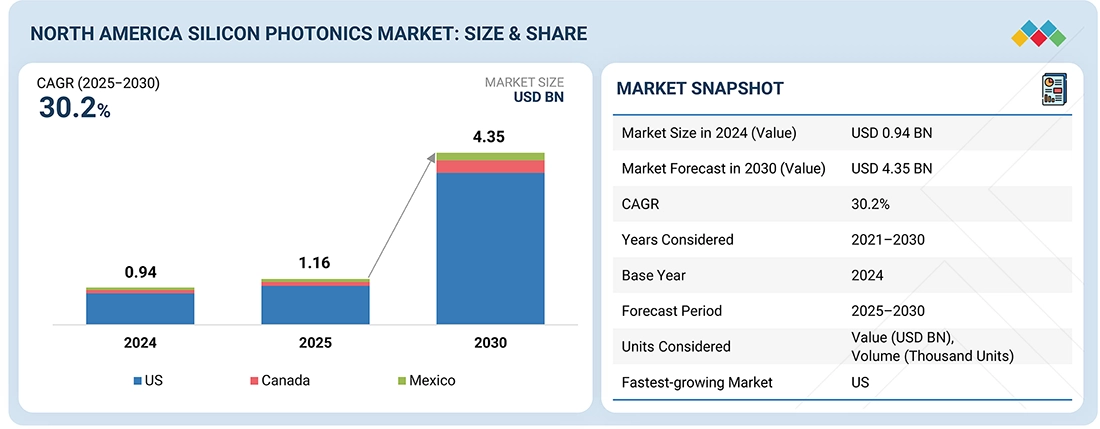
Source: Secondary Research, Interviews with Experts, MarketsandMarkets Analysis
The silicon photonics market in North America is projected to reach USD 4.35 billion by 2030, up from USD 1.16 billion in 2030, at a CAGR of 30.2% from 2025 to 2030. Silicon photonics is gaining significant momentum in North America as technology companies and data-center operators increasingly adopt high-speed, low-power optical connectivity. The region benefits from a mature semiconductor ecosystem, substantial R&D investments, and early adoption of AI and cloud computing workloads. Its expanding integration into applications like telecom networks, HPC systems, and advanced sensing further drives market growth.
Market Size & Forecast
KEY TAKEAWAYS
-
By CountryThe North America US accounted for a 84.6% revenue share in 2024.
-
By End UserBy end user, the data centers and HPC segment is expected to register the highest CAGR of 32.3%.
-
By ComponentThe lasers segment accounted for a 43.9% revenue share in 2024.
-
By ProductBy product type, the transceivers are expected to dominate the market.
-
Competitive Landscape - Key PlayersCisco Systems, Inc. (US) and Intel Corporation (US) were identified as some of the star players in the silicon photonics market in North America, given their strong market share and product footprint.
-
Competitive Landscape - Startups/SMEsSource Photonics (US) has distinguished itself among startups and SMEs by securing strong footholds in specialized niche areas, underscoring its potential as an emerging market leader.
Silicon photonics is rapidly expanding in North America as the demand for high-bandwidth, energy-efficient data transmission grows across cloud services, AI, and hyperscale data centers. Leading semiconductor firms, research institutions, and government-supported innovation programs are fueling this expansion, accelerating technological progress. Its wider application in telecom, HPC, and advanced sensing is also driving its broad adoption across the region.
TRENDS & DISRUPTIONS IMPACTING CUSTOMERS' CUSTOMERS
The figure illustrates the expected revenue shift in the North American silicon photonics market. Communication relies on electronic components, and electronic technology currently dominates the value in this market. However, advances in technology are increasing the demand for high-speed data transmission in data centers and other applications, which is likely to drive the growth of silicon photonics technology. Industries such as data centers, telecommunications, and medical and life sciences are set to see market growth. Demand for silicon photonics transceivers, biosensors, and LIDAR will also rise soon.
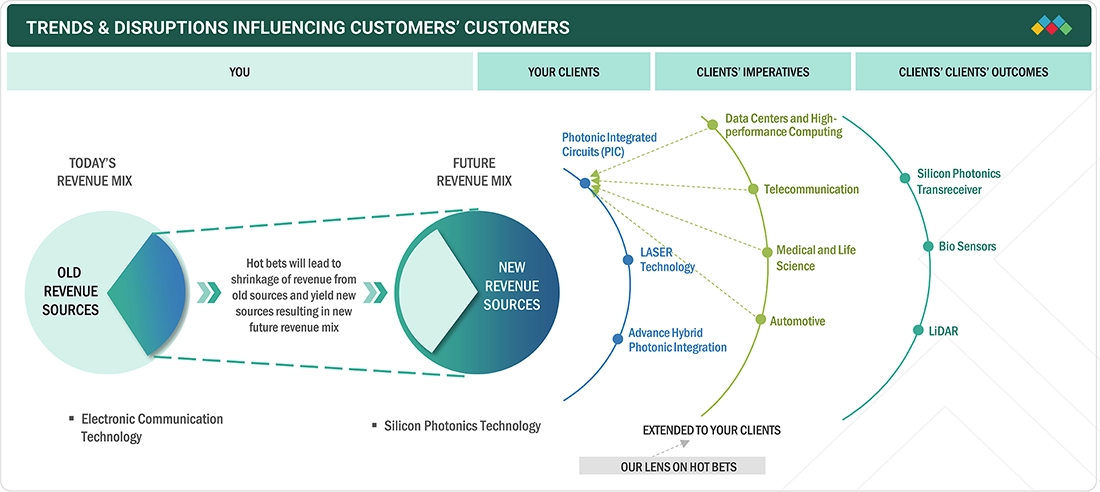
Source: Secondary Research, Interviews with Experts, MarketsandMarkets Analysis
MARKET DYNAMICS

Level
-
Rapid growth of hyperscale data centers and AI-driven workloads accelerating demand for high-speed, low-power optical interconnects


Level
-
High initial manufacturing and integration costs limit broader adoption across smaller data centers and enterprises


Level
-
Expanding use of silicon photonics in telecom, cloud infrastructure, medical diagnostics, and LiDAR presents new revenue streams


Level
-
Supply chain bottlenecks and dependency on advanced semiconductor fabrication capabilities create scalability and deployment hurdles

Source: Secondary Research, Interviews with Experts, MarketsandMarkets Analysis
Driver: Rapid growth of hyperscale data centers and AI-driven workloads is accelerating the demand for high-speed, low-power optical interconnects.
The North American silicon photonics market is driven by the rapid expansion of hyperscale data centers and AI workloads that require faster, energy-efficient data transmission. Companies are upgrading their infrastructure to handle increasing bandwidth demands. As a result, silicon photonics is becoming a preferred technology for high-performance optical interconnects.
Restraint: High initial manufacturing and integration costs limit broader adoption across smaller data centers and enterprises.
Despite strong demand, high manufacturing and integration costs continue to hinder widespread adoption in North America. Smaller businesses face obstacles when transitioning from traditional electronic components to silicon photonics. These cost pressures slow down commercial deployment across various end-use sectors.
Opportunity: Expanding use of silicon photonics in telecom, cloud infrastructure, medical diagnostics, and LiDAR opens new revenue streams.
There are significant opportunities in the growing use of silicon photonics across telecom networks, cloud platforms, medical diagnostics, and LiDAR applications. Advances in photonic integration and packaging are enabling new product development. This diversification beyond data centers is expected to drive strong revenue growth in the region.
Challenge: Supply chain bottlenecks and dependency on advanced semiconductor fabrication capabilities create scalability and deployment hurdles.
The market faces difficulties due to supply chain limitations and dependence on advanced semiconductor manufacturing capabilities. Limited access to high-precision production resources impacts scalability and timelines. These challenges hinder companies trying to speed up the commercialization of silicon photonics solutions in North America.
north-america-silicon-photonics-market: COMMERCIAL USE CASES ACROSS INDUSTRIES
| COMPANY | USE CASE DESCRIPTION | BENEFITS |
|---|---|---|
 |
Silicon photonics transceivers for data center interconnects and high-performance computing clusters | Delivers high-speed, low-latency data transmission, lower power consumption, and improved scalability for AI and cloud workloads |
 |
Integration of silicon photonics in networking switches for next-gen optical connectivity | Enhances bandwidth capacity, reduces energy usage, and enables faster, more efficient network architectures |
Logos and trademarks shown above are the property of their respective owners. Their use here is for informational and illustrative purposes only.
MARKET ECOSYSTEM
The figure illustrates the comprehensive ecosystem of the silicon photonics market in North America, showcasing key players across the value chain—from substrate and epitaxial wafer suppliers to PIC designers and foundries. It highlights the strong presence of global tech leaders and regional innovators driving advancements in photonic integration, transceivers, and fabrication. The inclusion of major cloud providers and telecom operators as end users reflects the growing adoption of silicon photonics in data centers, AI infrastructure, and high-speed communication networks.
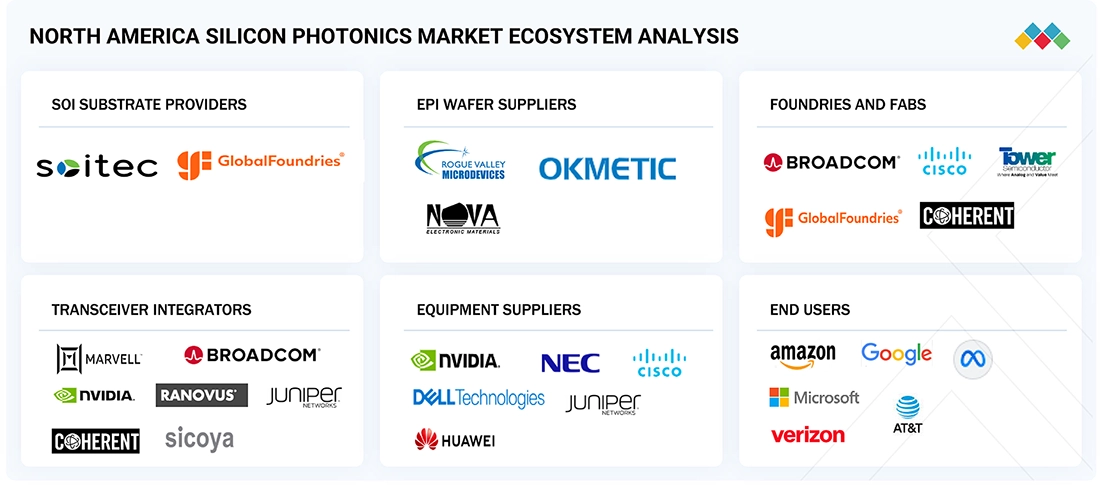
Logos and trademarks shown above are the property of their respective owners. Their use here is for informational and illustrative purposes only.
MARKET SEGMENTS
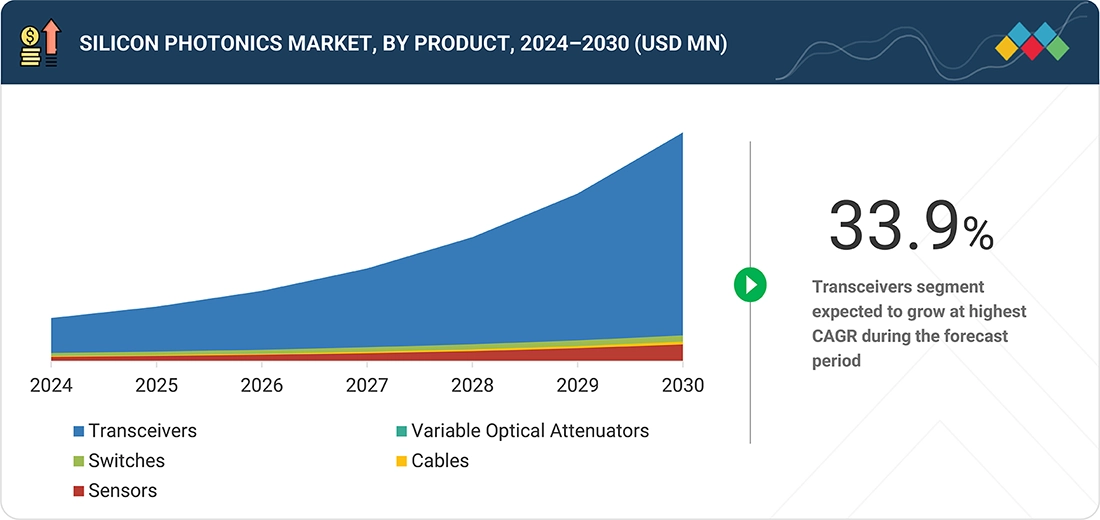
Source: Secondary Research, Interviews with Experts, MarketsandMarkets Analysis
Silicon Photonics Market, By Product Type
The transceiver segment in North America is projected to retain the largest market share throughout the forecast period. This leadership is propelled by the region’s substantial demand for high-speed data transmission across hyperscale data centers, cloud platforms, high-performance computing, and advanced telecommunications networks. Silicon photonic transceivers offer considerable advantages over traditional electronic transceivers—such as increased bandwidth, decreased latency, and lower power consumption—rendering them indispensable for supporting North America’s rapidly expanding digital infrastructure and artificial intelligence workloads.
Silicon Photonics Market, By Component
Laser components are projected to capture the largest market share in North America because of their essential role in enabling high-speed optical communication across data centers and telecom networks. The region’s quick growth in AI workloads and cloud infrastructure is boosting the adoption of advanced laser sources for efficient photonic transmission. Furthermore, widespread investments in integrated photonics and next-generation optical modules further increase demand for high-performance laser components.
Silicon Photonics Market, By End User
In North America, data centers and HPC are expected to experience the highest growth rate during the forecast period. This segment includes key end users such as data center and HPC transceivers, 5G optical modules, photonic processors, co-packaged optics (CPO), and advanced optical interconnects. As US and Canadian companies become more reliant on large-scale data storage, processing, and AI-driven workloads, data centers have become essential infrastructure supporting daily business activities and digital transformation across the region.
REGION
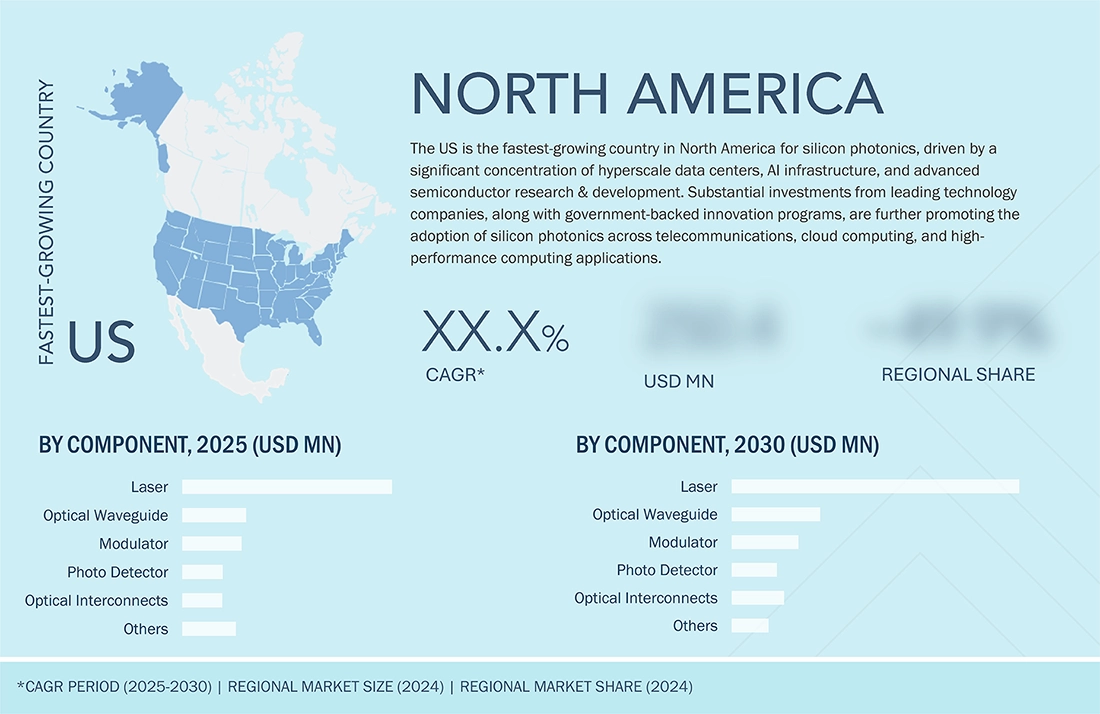
US to be fastest-growing country in silicon photonics market in North America during forecast period
The US is projected to experience the highest growth in silicon photonics because of its leadership in hyperscale data centers, AI infrastructure, and cloud computing growth. Strong federal and private investments in advanced semiconductor and photonic technologies further boost market adoption. Moreover, the presence of major tech companies, research institutions, and fabrication facilities positions the US as a leader in silicon photonics innovation and commercialization.
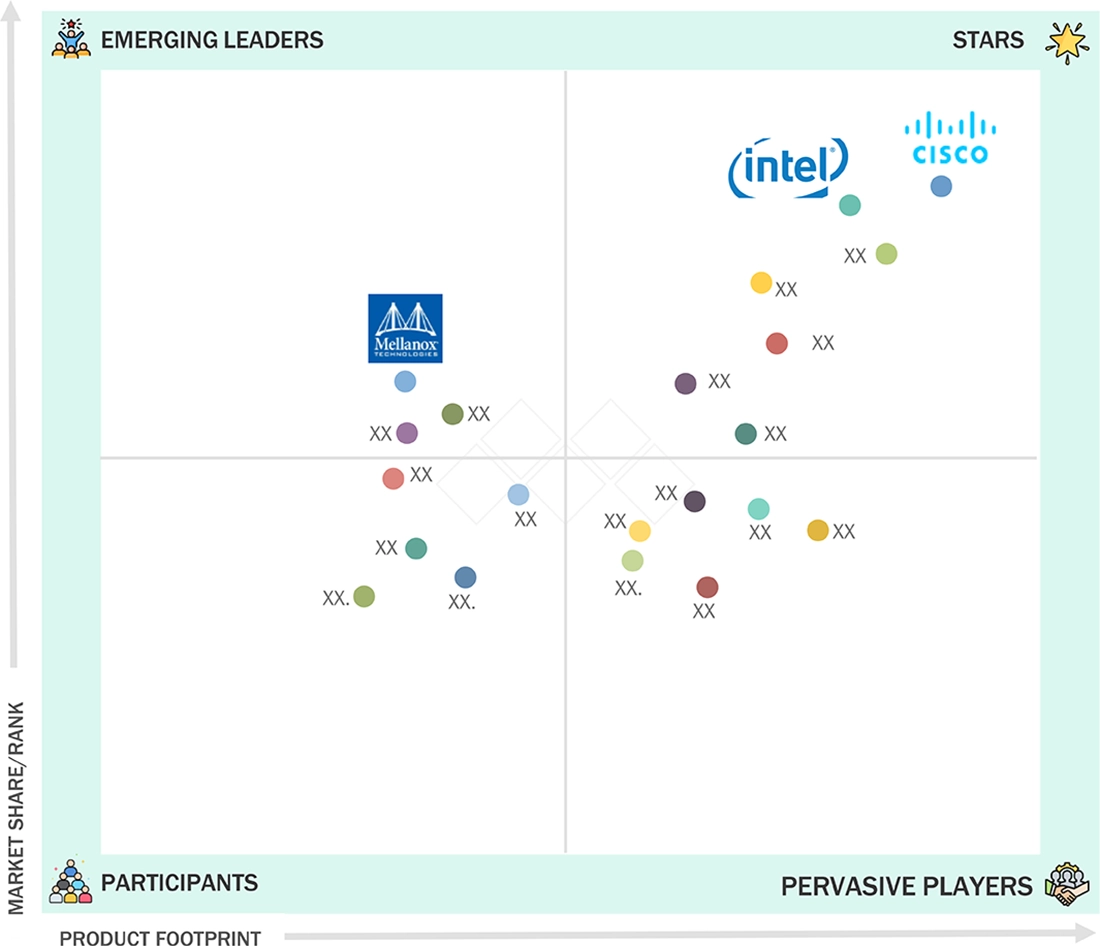
north-america-silicon-photonics-market: COMPANY EVALUATION MATRIX
In the North American silicon photonics market matrix, Cisco Systems, Inc. (US) and Intel Corporation (US) lead with a strong regional presence and a broad product portfolio, driven by their high-performance optical interconnects and next-generation networking solutions widely deployed across data centers and telecommunications networks in the US and Canada. Meanwhile, Mellanox Technologies (US) is recognized as an Emerging Leader, steadily gaining momentum through its high-speed interconnect solutions and the growing adoption of photonics-enabled architectures. This positions it to move into the leaders’ quadrant as the demand for ultra-fast, energy-efficient data transmission accelerates across the region.
Source: Secondary Research, Interviews with Experts, MarketsandMarkets Analysis
KEY MARKET PLAYERS
- Cisco Systems, Inc. (US)
- Intel Corporation (US)
- MACOM (US)
- GlobalFoundries Inc. (US)
- Lumentum Operations LLC (US)
- Marvell. (US)
- Coherent Corporation (US)
- IBM (US)
- Mellanox Technologies Ltd. (US)
- Ranovus (US)
MARKET SCOPE
| REPORT METRIC | DETAILS |
|---|---|
| Market Size in 2024 (Value) | USD 0.94 Billion |
| Market Forecast in 2030 (Value) | USD 4.35 Billion |
| Growth Rate | CAGR of 30.2% from 2025-2030 |
| Years Considered | 2021-2030 |
| Base Year | 2024 |
| Forecast Period | 2025-2030 |
| Units Considered | Value (USD Million/Billion), Volume (Thousand Units) |
| Report Coverage | Revenue forecast, company ranking, competitive landscape, growth factors, and trends |
| Segments Covered |
|
| Regions Covered | North America (US, Canada, Mexico) |
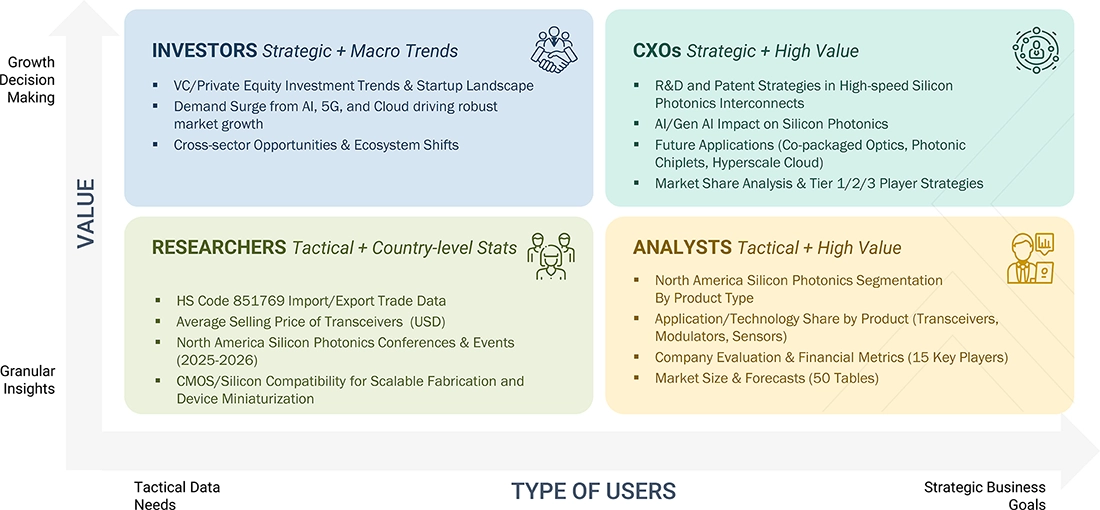
WHAT IS IN IT FOR YOU: north-america-silicon-photonics-market REPORT CONTENT GUIDE
DELIVERED CUSTOMIZATIONS
We have successfully delivered the following deep-dive customizations:
| CLIENT REQUEST | CUSTOMIZATION DELIVERED | VALUE ADDS |
|---|---|---|
| Data Center / Hyperscale OEM |
|
|
| Photonics Component Manufacturer |
|
Pinpoint highest-growth applications, address integration |
| Defense & Government Programs |
|
|
RECENT DEVELOPMENTS
- December 2024 : IBM (US) introduced a new process for CPO that improves data center connectivity by combining optical waveguides with silicon photonics. This technology aims to replace traditional electrical interconnects, possibly accelerating data center training for generative AI models by up to five times. Using polymer optical waveguides (PWGs) enables a higher density of optical fibers—up to six times more at the chip edge—significantly increasing bandwidth and extending cable lengths from one meter to hundreds of meters.
- November 2024 : Celestial AI (US) acquired the silicon photonics intellectual property (IP) portfolio of Rockley Photonics (US) for a total consideration of USD 20 million. This acquisition included both, issued and pending patents on a global scale, pertaining to optoelectronic systems-in-package, electro-absorption modulators (EAMs), and optical switch technology. The integration of Rockley's IP portfolio significantly augments the capabilities of Celestial AI's Photonic Fabric technology platform, which is designed to serve applications within AI data center infrastructure.
- October 2024 : Lumentum (US) participated in the European Conference on Optical Communication (ECOC) 2024, showcasing its upgraded 800G ZR+ coherent pluggable transceivers. These transceivers are designed for longer reach and increased optical power applications, meeting the rising demands of AI infrastructure and long-distance data center interconnects. They utilize Lumentum's proprietary indium phosphide technology for enhanced performance.
- March 2024 : MACOM (US) launched the MACOM PURE DRIVE 200 Gbps per lane Linear Drive to enable the development of 1.6 TB linear pluggable optical ("LPO") modules.
Table of Contents
 Exclusive indicates content/data unique to MarketsandMarkets and not available with any competitors.
Methodology
The study involved four major activities in estimating the current size of the North America silicon photonics market—exhaustive secondary research collected information on the market and its peer and parent markets. The next step was to validate these findings, assumptions, and sizing with industry experts across the value chain through primary research. Both top-down and bottom-up approaches were employed to estimate the total market size. After that, market breakdown and data triangulation were used to estimate the market size of segments and subsegments.
Secondary Research
Various secondary sources have been referred to in the secondary research process to identify and collect important information for this study. These secondary sources include silicon photonics technology journals and magazines, annual reports, press releases, investor presentations of companies, white papers, certified publications and articles from recognized authors, and directories and databases such as Factiva, Hoovers, and OneSource.
Primary Research
Various primary sources from the supply and demand sides have been interviewed in the primary research process to obtain qualitative and quantitative information important for this report. The primary sources from the supply side included industry experts such as CEOs, VPs, marketing directors, technology and innovation directors, and related executives from key companies and organizations operating in the North America silicon photonics market. After complete market engineering (including calculations regarding market statistics, market breakdown, market size estimations, market forecasting, and data triangulation), extensive primary research was conducted to gather information as well as to verify and validate the critical numbers arrived at.
Market Size Estimation
In the complete market engineering process, top-down and bottom-up approaches and several data triangulation methods have been implemented to estimate and validate the size of the North America silicon photonics market and other dependent submarkets listed in this report.
- Extensive secondary research has identified key players in the industry and market.
- In terms of value, the industry’s supply chain and market size have been determined through primary and secondary research processes.
- All percentage shares, splits, and breakdowns have been determined using secondary sources and verified through primary sources.
Data Triangulation
After arriving at the overall market size from the estimation process explained above, the North America market has been split into several segments and subsegments. Market breakdown and data triangulation procedures have been employed wherever applicable to complete the overall market engineering process and arrive at exact statistics for all segments and subsegments. The data has been triangulated by studying various factors and trends identified from both the demand and supply sides.
Market Definition
Silicon photonics is a technique that employs semiconductor-grade silicon to integrate photonic circuits and electronic components on a single microchip. This method minimizes system power consumption while increasing transmission bandwidth by employing silicon as an optical medium. Instead of electrical impulses, the technology transfers data using optical beams, which may send enormous amounts of data at a faster rate than electrical signals.
Key Stakeholders
- Component and material providers
- Semiconductor foundries
- North america silicon photonics platform developers
- North america silicon photonics product manufacturers and suppliers
- Assembly and testing vendors
- Original equipment manufacturers
- Research organizations and consulting companies
- Technology investors
- Associations, alliances, and organizations related to North America silicon photonics
- Analysts and strategic business planners
- End users
Report Objectives
- To describe and forecast the North America silicon photonics market size, in terms of value, by product, component, end user, and region
- To provide details regarding the silicon photonic waveguide range
- To provide detailed information regarding the drivers, restraints, opportunities, and challenges of the North America silicon photonics market
- To strategically analyze the micromarkets1 concerning the individual growth trends, prospects, and their contribution to the North America silicon photonics market
- To map competitive intelligence based on company profiles, key player strategies, and key developments
- To provide a detailed overview of the North America silicon photonics value chain and ecosystem
- To provide information about the key technology trends and patents related to the North America silicon photonics market
- To provide information regarding trade data related to the North America silicon photonics market
- To analyze opportunities in the market for stakeholders by identifying high-growth segments of the North America silicon photonics ecosystem
- To benchmark the market players using the proprietary company evaluation matrix framework, which analyzes them on various parameters within the broad categories of market ranking/share and product portfolio
- To analyze competitive developments such as contracts, acquisitions, product launches and developments, collaborations, and partnerships, along with research & development (R&D), in the North America silicon photonics market
- To analyze the impact of the recession on the growth of the North America silicon photonics market
Available Customizations
With the given market data, MarketsandMarkets offers customizations according to a company’s specific needs. The following customization options are available for the report:
Company Information:
- Detailed analysis and profiling of additional market players (up to 5)
Key Questions Addressed by the Report
What is the projected size of the North America silicon photonics market?
The market is projected to grow from USD 1.16 billion in 2025 to USD 4.35 billion by 2030, at a CAGR of 30.2%, driven by rising demand for high-speed optical connectivity.
What are the key drivers of the silicon photonics market in North America?
Growth is driven by hyperscale data centers, AI workloads, and the need for high-bandwidth, low-power optical interconnects across cloud and telecom infrastructure.
Which product segment dominates the market?
Transceivers hold the largest share due to their critical role in enabling high-speed data transmission in data centers and communication networks.
Which component segment leads the market?
The lasers segment dominates the component category, supported by its essential function in optical signal generation and transmission systems.
What are the major opportunities in the silicon photonics market?
Opportunities include expanding applications in telecom, medical diagnostics, LiDAR, and cloud infrastructure, enabling new revenue streams and technological innovation.


Personalize This Research
- Triangulate with your Own Data
- Get Data as per your Format and Definition
- Gain a Deeper Dive on a Specific Application, Geography, Customer or Competitor
- Any level of Personalization
Let Us Help You
- What are the Known and Unknown Adjacencies Impacting the North America Silicon Photonics Market
- What will your New Revenue Sources be?
- Who will be your Top Customer; what will make them switch?
- Defend your Market Share or Win Competitors
- Get a Scorecard for Target Partners

Custom Market Research Services
We Will Customise The Research For You, In Case The Report Listed Above Does Not Meet With Your Requirements
Get 10% Free CustomisationTESTIMONIALS

Tetsuya Ohhira
Business Development Manager-Technology Business
Nikon Corporation,
Leading Japanese MNC specializing in optics and imaging productswww.nikon.com
MarketsandMarkets™ response
is quick. Their attitude is flexible and positive. Analyst Insights are globally considered and
significant. Client Services quickly respond to our inquiry and demand. Their wide range of global
surveys help us make our strategic plan.
We hope Knowledge Store will be easier to search
for a report.
VP - Marketing & Business Development
Leading Provider of Process Control Solutions
We engaged with MarketsandMarkets on a study to perform an analysis and recommend a Go-To-Market strategy for metrology and process control in the semiconductor market. The study was tailored to our targets and needs with well-defined milestones. Our overall experience with the MarketsandMarkets team was very good throughout the project in all aspects including the analysis methodologies used, the quality and depth of primary and secondary data sets, the professionalism and flexibility of the team and the ability to meet the target schedule and milestones. We want to thank MarketsandMarkets team for a job well done.






Growth opportunities and latent adjacency in North America Silicon Photonics Market