



Silicon Photonics Market Size, Share and Trends
Report Code
SE 3137
Published in
Apr, 2025, By MarketsandMarkets™
Silicon Photonics Market Size, Share and Trends by Product (Transceivers, Variable Optical Attenuators, Switches, Sensors and Cables), Components (Lasers, Modulators, Optical Waveguides, Optical Interconnects, Photodetectors) - Global Forecast to 2030

USD 9.65
MARKET SIZE,2030

CAGR 29.5%
(2025-2030)

300
REPORT PAGES

221
MARKET TABLES
Silicon Photonics Market Overview
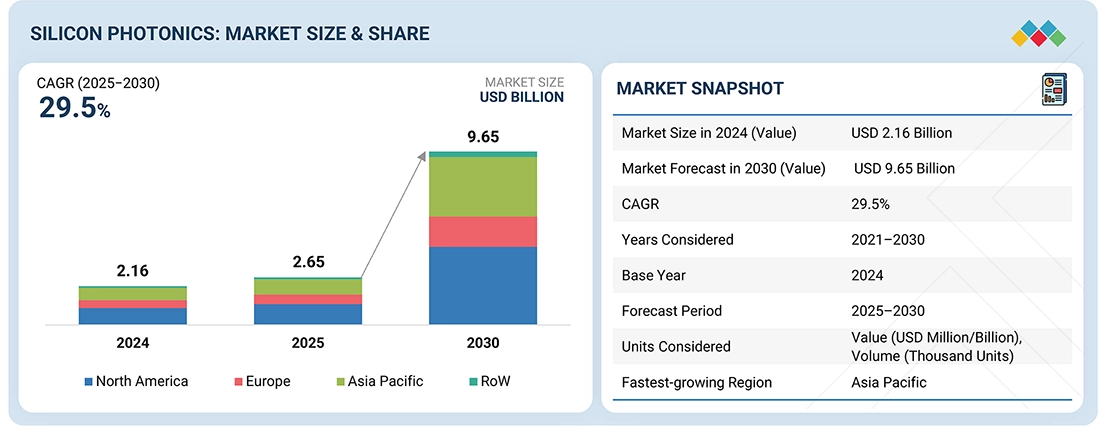
According to Marketsandmarkets, the silicon photonics market size was valued at USD 2.16 billion in 2024 and is projected to reach USD 9.65 billion by 2030, growing at a CAGR of 29.5% from 2025 to 2030. Silicon photonics is experiencing strong growth due to the increasing demand for high-speed data transmission in AI, cloud computing, and quantum technologies. Trends indicate data centres, telecommunication, and healthcare are driving the adoption in a boom, and transceivers and high-performance computing (HPC) are the most positively affected positively. The silicon photonics market size 2026 forecast reflects the expanding adoption of silicon photonics across high-bandwidth applications.
REPORT SCOPE
| REPORT METRIC | DETAILS |
|---|---|
| Market Size, 2025 (Value) | USD 2.65 Billion |
| Market Forecast, 2030 (Value) | USD 9.65 Billion |
| Growth Rate | CAGR of 29.5% from 2025 to 2030 |
| Years Considered | 2022–2030 |
| Base Year | 2024 |
| Forecast Period | 2025–2030 |
| Units Considered | Value (USD Million/Billion), Volume (Thousand Units) |
| Report Coverage | Revenue Forecast, Company Ranking, Competitive Landscape, Growth Factors, and Trends |
| Top Companies |
|
| Growth Driver |
|
| Segments Covered |
|
| Regions Covered | North America, Asia Pacific, Europe, Rest of the World (RoW) |
Silicon Photonics Market Size & Forecast
• 2024 Market Size: USD 2.16 Billion
• 2030 Projected Market Size: USD 9.65 Billion
• CAGR (2024-2030): 29.5%
• Data Centers and HPC segment: Highest CAGR
• Asia Pacific: Fastest Growing Region
SILICON PHOTONICS MARKET KEY TAKEAWAYS
-
BY PRODUCTTransceivers are expected to have the largest market size during the forecast period. Transceivers are used in various end users, such as data centres and HPC, and telecommunications, owing to the growing need for high-speed data transmission in data center.
-
BY COMPONENTThe market for lasers is expected to grow at the highest CAGR during the forecast period. Lasers are an essential component in silicon photonics as they are used to generate and transmit light signals over long distances. The demand for high-speed data transmission and communication is expected to drive silicon photonics market growth, and lasers will play a critical role in enabling this technology
-
BY END USERThe data centers and HPC segment is projected to grow at the highest CAGR during the forecast period. WAN and LAN are used for metro and long-haul applications in telecommunications, and LAN is used in the data communication end-use segment.
-
BY REGIONNorth America is dominating the silicon photonics market by capturing the largest market share owing to the presence of major players providing silicon photonics technology-based devices in the US and the high adoption of electronic products.
-
COMPETITIVE LANDSCAPECisco Systems, Inc. (US), Intel Corporation (US), MACOM (US), GlobalFoundries Inc. (US), and Lumentum Operations LLC (US) are major players in the market. Major market players have adopted both organic and inorganic strategies, including partnerships and investments.
The silicon photonics market share has been growing strongly as demands for high-bandwidth, low-latency and energy-efficient data communication increase. It is gradually shifting from niche applications into mainstream infrastructure, especially in data center, telecommunications, and AI/ML workloads where traditional copper interconnects are facing power, heat and speed limitations.
Source: Secondary Research, Interviews with Experts, MarketsandMarkets Analysis
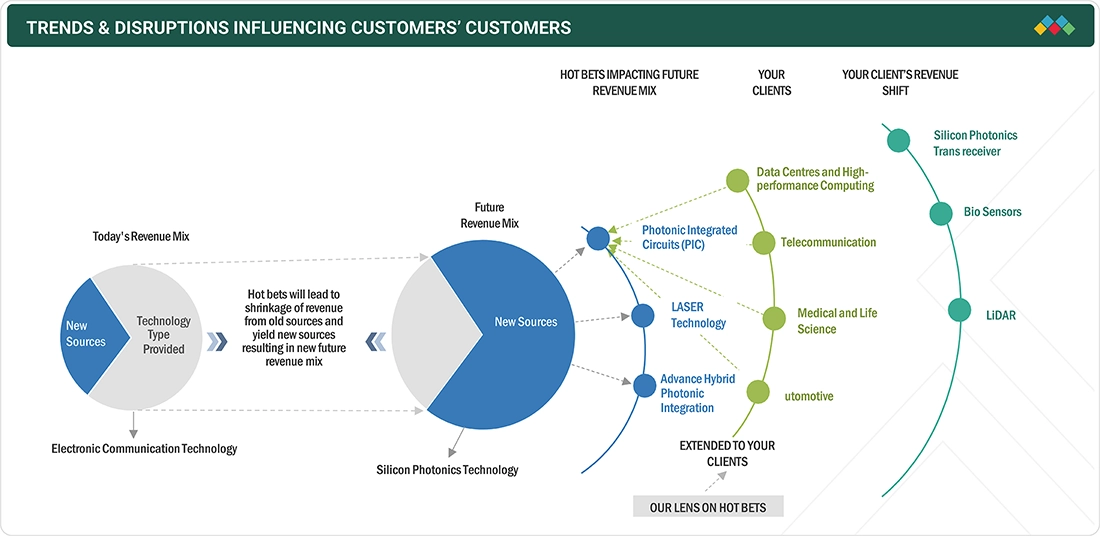
TRENDS & DISRUPTIONS IMPACTING CUSTOMERS' CUSTOMERS
The fig represents the revenue shift expected in the silicon photonics market trends. Communication is happening with electronic components, and electronic technology dominates in terms of value in the silicon photonics market. However, due to technological advancements, there is an increasing demand for high-speed data transmission in data centers and other applications, which is expected to lead to the rise of silicon photonics technology. Data centers, telecommunications, and medical and life sciences are a few industries that will experience a boost in market size. Silicon photonics transceivers, biosensors, and LIDAR demand will increase soon.
Source: Secondary Research, Interviews with Experts, MarketsandMarkets Analysis
SILICON PHOTONICS MARKET DYNAMICS

Drivers
Impact
Level
Level
-
Growing need for high bandwidth and fast data transfer

-
Growing focus on energy efficiency and lower power costs


RESTRAINTS
Impact
Level
Level
-
Complexities associated with integrating on-chip lasers


OPPORTUNITIES
Impact
Level
Level
-
Ongoing advancements in quantum photonics

-
Expansion of 5G networks


CHALLENGES
Impact
Level
Level
-
Rising thermal effects due to miniaturization of devices

-
Inefficient electroluminescence of bulk crystalline silicon

Source: Secondary Research, Interviews with Experts, MarketsandMarkets Analysis
Driver: Growing need for high bandwidth and fast data transfer
Rising volumes of streaming, cloud computing and AI workloads are pushing demand for data transfer capacities that far exceed what traditional copper interconnects can efficiently support. Silicon photonics offers a way out of this bottleneck by embedding optical components into silicon chips, enabling much faster and more energy-efficient data exchange, especially in hyperscale data centers and telecom networks. With roll-outs of 5G/6G, advances in photonic integration and economies of scale, the market for silicon photonics is accelerating rapidly as more sectors embrace high-speed, low-latency digital infrastructure.
Restraint: Ongoing advancements in quantum photonics
The integration of on-chip lasers remains a thorny technical hurdle for silicon photonics. Because silicon itself is an indirect bandgap material, it emits light poorly, so achieving efficient, reliable lasers on silicon requires incorporation of III-V semiconductors or complex hybrid techniques—with wafer bonding, flip-chip assembly or epitaxial growth—that complicate fabrication, raise costs and reduce yield. Further challenges like controlling thermal effects, managing reflections, ensuring accurate alignment, and keeping the process CMOS compatible all deepen the difficulty, so many commercial systems still rely on external lasers despite the loss of compactness, power savings, and full integration.
Opportunity: Rising thermal effects due to miniaturization of devices
Quantum photonics presents a powerful frontier for silicon photonics by enabling the generation, control, and manipulation of individual photons on a chip — critical for ultra-secure communications, quantum cryptography, and information processing. Researchers have recently shown progress in creating single-photon emitters in silicon (such as G and W centers) and designing microring or resonator-based sources with high spectral purity, which are steps toward integrating complex quantum circuits. Coupled with the use of mature CMOS-compatible manufacturing and foundry-scale production, these advances promise to bring quantum photonic systems out of the laboratory and into practical, scalable, high-performance applications.
Challenge: Rising thermal effects due to miniaturization of devices
As silicon photonics technology advances towards miniaturization and integration, thermal effects have become a significant challenge. The dense integration of components like modulators, waveguides, and detectors on a single chip leads to localized heating, which can alter the refractive index of silicon, resulting in signal drift, phase errors, or data loss. Unlike electronics, photonic devices are temperature-sensitive and require precise thermal management to maintain control and stability.
SILICON PHOTONICS MARKET SIZE, SHARE & GROWTH: COMMERCIAL USE CASES ACROSS INDUSTRIES
| COMPANY | USE CASE DESCRIPTION | BENEFITS |
|---|---|---|
 |
Data center optical transceivers and integrated optical interconnects for AI workloads | High-speed data transfer, reduced latency, improved energy efficiency, scalable optical I/O closer to CPU |
 |
High-speed optical interconnects integrated into networking equipment, enabled by Luxtera acquisition | Enhanced bandwidth for data centers and internet infrastructure, faster network speeds, improved network scalability |
 |
Silicon photonics-based optical components for telecom and hyperscale data communications | Enables high-capacity optical networking, lower power consumption, increased network reliability |
 |
Advanced silicon photonics in software-defined networking and high-speed switches | Improved network performance, efficient bandwidth management, agile data routing |
Logos and trademarks shown above are the property of their respective owners. Their use here is for informational and illustrative purposes only.
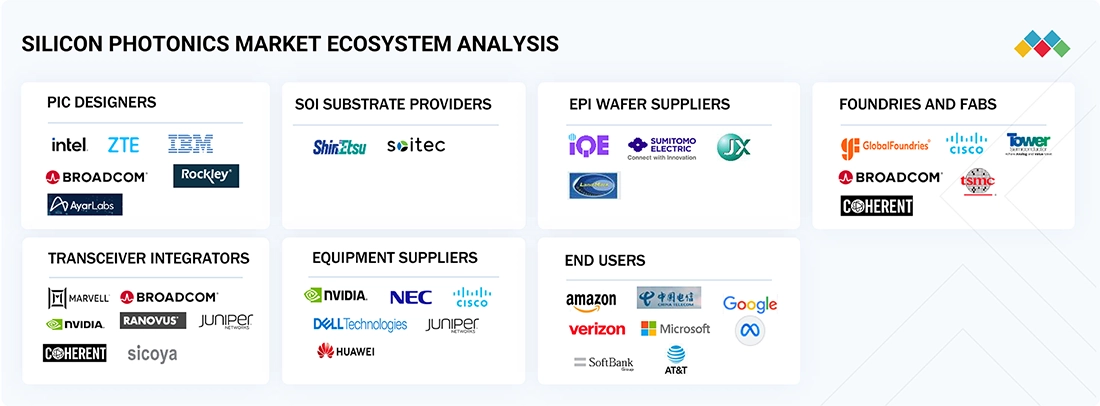
SILICON PHOTONICS MARKET ECOSYSTEM
The silicon photonics market growth ecosystem is characterized by photonic-integrated circuit (PIC) designers, silicon-on-insulator (SOI) substrate providers, epi wafer suppliers, foundries and fabs, transceiver integrators, equipment providers, and end users. PIC designers leverage SOI substrates and epi wafer technologies to integrate optical and electronic functions on a single chip. Foundries and fabs, such as GlobalFoundries and TSMC, play a crucial role by utilizing established semiconductor manufacturing processes to produce advanced PICS. Transceiver integrators incorporate essential optical components, such as modulators, detectors, and waveguides, onto a single silicon substrate. End users are from telecommunications, data centers, and HPC medical & life sciences fields.
Logos and trademarks shown above are the property of their respective owners. Their use here is for informational and illustrative purposes only.
SILICON PHOTONICS MARKET SEGMENTS
Source: Secondary Research, Interviews with Experts, MarketsandMarkets Analysis
Silicon Photonics Market, By Produt Type
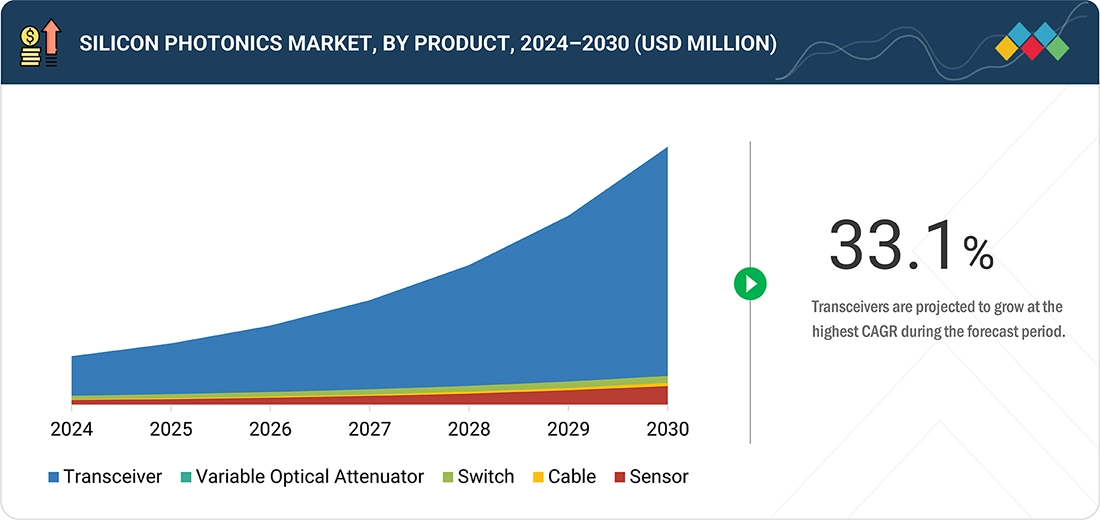
Transceiver in the product segment to hold largest market share throughout the forecast period.The transceiver industry is the largest in the silicon photonics industry primarily due to its inherent role in delivering high-speed data transmission in high-performance computing, telecommunications, and data centers. Silicon photonic transceivers offer several benefits over traditional electronic transceivers, including higher bandwidth, lower latency, and lower power consumption, that are critical in meeting the rising demand for higher speed and efficient data transmission
Silicon Photonics Market, By Component
Optical interconnects to have the highest CAGR during the forecast period. An optical interconnect is a technology that uses light (photons) transmitted through silicon-based waveguides to transfer data between different parts of an electronic system, such as between chips, servers, or data centers. Unlike traditional electrical interconnects that rely on copper wires to transmit electrical signals, optical interconnects use light, enabling faster and more energy-efficient data transfer with minimal signal loss over long distances.
Silicon Photonics Market, By End User
Data Centers and HPC are expected to have the highest growth rate during the forecast period.Data Centers and HPC include end users such as data centers and HPC Trans receivers, 5G trans receivers, photo processing, CPO, and optical interconnect. A data center and HPC is a facility consisting of networked computers and storage systems that many organizations use to organize, process, store, and disseminate large volumes of data. Businesses rely heavily on services, end users, and data in data centers, making it a critical asset for day-to-day operations.
SILICON PHOTONICS MARKET REGION
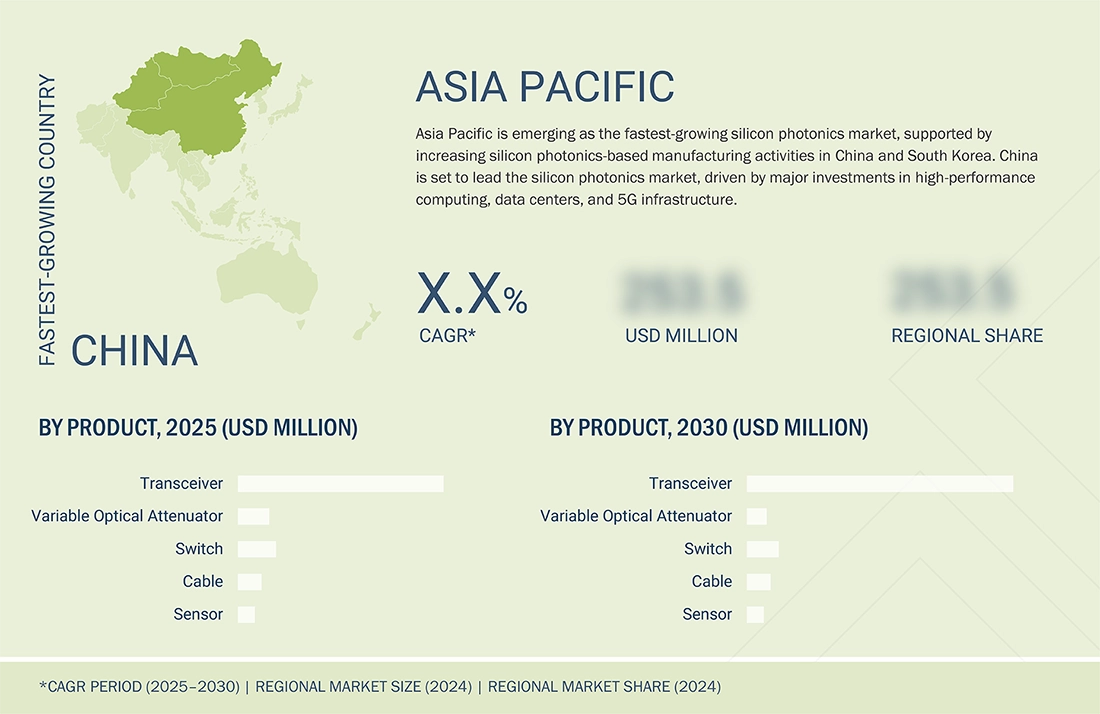
Asia Pacific to be fastest-growing region in global silicon photonics market during forecast period
The silicon photonics industry in Asia Pacific is expected to grow at the highest rate during the forecast period. The market in Asia Pacific has been segmented into China, Japan, South Korea, and Rest of Asia Pacific. The Rest of Asia Pacific mainly includes India, Australia, New Zealand, Singapore, Malaysia, the Philippines, and Taiwan. China is to record the largest market size within the silicon photonics industry, with revenue forecast to The fast-paced growth is powered by China's aggressive investment in high-performance computing, data centers, and 5G infrastructure, which represent key applications of silicon photonics technology.
The silicon photonics market in North America is projected to reach USD 4.35 billion by 2030, up from USD 1.16 billion in 2030, at a CAGR of 30.2% from 2025 to 2030. Silicon photonics is gaining significant momentum in North America as technology companies and data-center operators increasingly adopt high-speed, low-power optical connectivity. The region benefits from a mature semiconductor ecosystem, substantial R&D investments, and early adoption of AI and cloud computing workloads. Its expanding integration into applications like telecom networks, HPC systems, and advanced sensing further drives market growth.
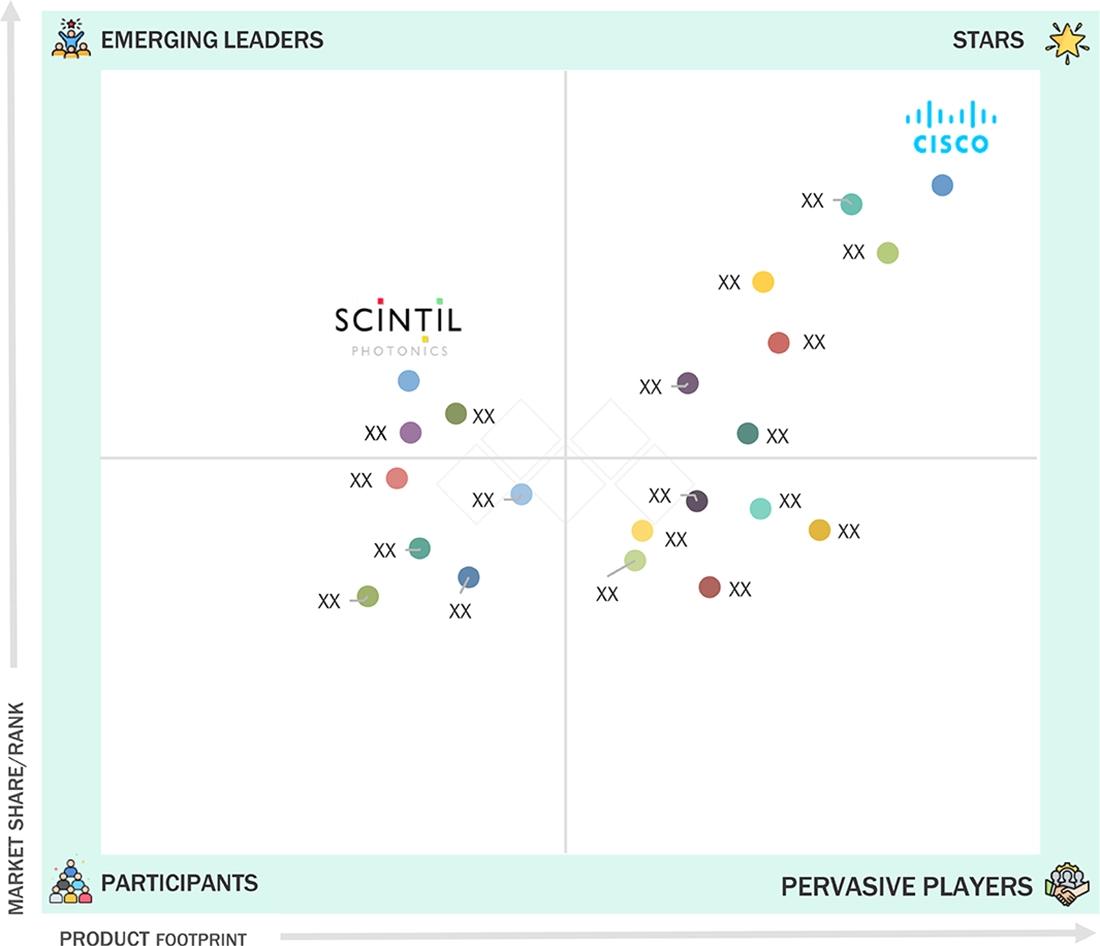
SILICON PHOTONICS MARKET SIZE, SHARE & GROWTH: COMPANY EVALUATION MATRIX
Star companies generally receive high scores for most evaluation criteria. They have a robust product portfolio, strong market presence, high market share, and effective business strategies. Major star companies in the silicon photonics companies are Cisco Systems, Inc. (US). Players categorized as emerging leaders are the vendors who have demonstrated substantial product innovations compared to their competitors. These players mainly depend on investments and funding from other companies. SCINTIL Photonics (France) falls under this category.
Source: Secondary Research, Interviews with Experts, MarketsandMarkets Analysis
SILICON PHOTONICS MARKET KEY PLAYERS
WHAT IS IN IT FOR YOU: Silicon Photonics Market REPORT CONTENT GUIDE
DELIVERED CUSTOMIZATIONS
We have successfully delivered the following deep-dive customizations:
| CLIENT REQUEST | CUSTOMIZATION DELIVERED | VALUE ADDS |
|---|---|---|
| Data Center/Hyperscale OEM |
|
|
| Photonics Component Manufacturer |
|
Pinpoint highest-growth applications, address integration |
| Defense & Government Programs |
|
|
RECENT DEVELOPMENTS
- July 2026: GlobalFoundries entered into a letter of intent with the U.S. Department of Commerce for an expected $300 million CHIPS R&D award to accelerate next-generation silicon photonics. The program covers next-generation optical materials, wafer technologies and advanced packaging, including 3D hybrid bonding, to support near-packaged optics and co-packaged optics for AI and high-performance computing.
- March 2026: STMicroelectronics entered high-volume production of its PIC100 silicon photonics platform on 300 mm wafers for hyperscale customers. The platform supports 800G and 1.6T optical transceivers for data centers and AI clusters, with ST planning to more than quadruple production capacity by 2027; the company also unveiled its roadmap for PIC100 TSV technology for higher-density optical connectivity and future CPO applications.
- November 2025: GlobalFoundries acquired Advanced Micro Foundry (AMF), a Singapore-based silicon photonics foundry. The acquisition expanded GF's silicon photonics technology portfolio, manufacturing capacity and R&D capabilities, including AMF's 200 mm platform and plans to scale toward 300 mm production. GF stated that the transaction made it the largest pure-play silicon photonics foundry by revenue.
- March 2025: MACOM launched four new 200G-per-lane solutions for 1.6T optical connectivity, including 100 mW and 75 mW continuous-wave lasers specifically designed for 1.6T silicon photonics solutions. The lasers are available individually and in 8-channel and 16-channel arrays for DR4 and DR8 optical modules.
- March 2025: Coherent Corporation launched its 2x400G-FR4 Lite silicon-photonics-based optical transceiver, designed for AI data centers and high-speed Ethernet networks. The module provides 500-meter reach, reduces power consumption, integrates a silicon photonics PIC, and is scheduled for general availability from April 1, 2025.
Table of Contents
 Exclusive indicates content/data unique to MarketsandMarkets and not available with any competitors.
TITLE
PAGE NO
1
INTRODUCTION
23
2
RESEARCH METHODOLOGY
27
3
EXECUTIVE SUMMARY
38
4
PREMIUM INSIGHTS
41
5
MARKET OVERVIEW
Silicon photonics market growth fueled by 5G expansion and energy-efficient high-bandwidth solutions.
44
5.1
INTRODUCTION
5.2
MARKET DYNAMICS
5.2.1
DRIVERS
5.2.1.1
SURGING DEMAND FOR CMOS-INTEGRATED SILICON PHOTONICS
5.2.1.2
GROWING FOCUS ON ENERGY EFFICIENCY AND LOWER POWER COSTS
5.2.1.3
RISING DEMAND FOR HIGH BANDWIDTH AND FAST DATA TRANSFER
5.2.1.4
EXPANSION OF BROADBAND SERVICES
5.2.2
RESTRAINTS
5.2.2.1
COMPLEXITIES OF INTEGRATING LASER SOURCES ON SILICON CHIPS
5.2.3
OPPORTUNITIES
5.2.3.1
GOVERNMENT FUNDING FOR DEVELOPING ADVANCED SILICON PHOTONICS-BASED PRODUCTS
5.2.3.2
EXPANSION OF 5G NETWORKS
5.2.3.3
EXPANDING APPLICATIONS OF SILICON PHOTONICS
5.2.3.4
INCREASING USE OF SILICON PHOTONICS IN SHORT-DISTANCE COMMUNICATION
5.2.4
CHALLENGES
5.2.4.1
INEFFICIENT ELECTROLUMINESCENCE OF BULK CRYSTALLINE SILICON
5.2.4.2
THERMAL CHALLENGES IN DEVICE MINIATURIZATION AND COMPLEXITY
5.3
TECHNOLOGY ANALYSIS
5.3.1
KEY TECHNOLOGIES
5.3.1.1
SILICON PHOTONICS TECHNOLOGY
5.3.2
COMPLEMENTARY TECHNOLOGIES
5.3.2.1
AI- AND IOT-INTEGRATED 5G NETWORKS
5.3.3
ADJACENT TECHNOLOGIES
5.3.3.1
LASER TECHNOLOGIES
5.4
TRENDS/DISRUPTIONS IMPACTING CUSTOMER BUSINESS
5.5
PRICING ANALYSIS
5.5.1
AVERAGE SELLING PRICE TREND OF TRANSCEIVERS, BY DATA RATE, 2018–2024
5.5.2
AVERAGE SELLING PRICE TREND OF TRANSCEIVERS, BY REGION, 2018–2024
5.6
VALUE CHAIN ANALYSIS
5.7
ECOSYSTEM ANALYSIS
5.8
INVESTMENT AND FUNDING SCENARIO
5.9
PATENT ANALYSIS
5.10
TRADE ANALYSIS
5.10.1
IMPORT SCENARIO (HS CODE 851769)
5.10.2
EXPORT SCENARIO (HS CODE 851769)
5.11
TARIFF AND REGULATORY LANDSCAPE
5.11.1
TARIFF ANALYSIS
5.11.2
REGULATORY BODIES, GOVERNMENT AGENCIES, AND OTHER ORGANIZATIONS
5.11.3
STANDARDS
5.11.3.1
INTERNATIONAL ORGANIZATION FOR STANDARDIZATION STANDARDS
5.11.3.2
EUROPEAN UNION DIRECTIVES
5.11.3.3
FEDERAL COMMUNICATION COMMISSION (FCC)
5.11.3.4
NATIONAL INSTITUTE OF STANDARDS AND TECHNOLOGY GUIDELINES
5.12
KEY CONFERENCES AND EVENTS, 2025–2026
5.13
CASE STUDY ANALYSIS
5.13.1
COHERENT PLUGGABLE TRANSCEIVER HELPS TELIA CARRIER (SWEDEN) ACHIEVE HIGH-SPEED TRANSMISSION
5.13.2
MOLEX DATA CABLES SOLUTION IMPROVES DATA TRANSMISSION ISSUES OF KALINGA GROUP
5.13.3
QSFPTEK'S 100G QSFP28 TRANSCEIVERS HELP EMPOWER CRITICAL BUSINESSES
5.14
PORTER'S FIVE FORCES ANALYSIS
5.14.1
INTENSITY OF COMPETITIVE RIVALRY
5.14.2
BARGAINING POWER OF SUPPLIERS
5.14.3
BARGAINING POWER OF BUYERS
5.14.4
THREAT OF SUBSTITUTES
5.14.5
THREAT OF NEW ENTRANTS
5.15
KEY STAKEHOLDERS AND BUYING CRITERIA
5.15.1
KEY STAKEHOLDERS IN BUYING PROCESS
5.15.2
BUYING CRITERIA
5.16
IMPACT OF AI ON SILICON PHOTONICS MARKET
5.17
IMPACT OF 2025 US TARIFF ON MARKET
5.17.1
INTRODUCTION
5.17.2
KEY TARIFF RATES
5.17.3
PRICE IMPACT ANALYSIS
5.17.4
KEY IMPACTS ON VARIOUS REGIONS
5.17.4.1
US
5.17.4.2
EUROPE
5.17.4.3
ASIA PACIFIC
5.17.5
IMPACT ON END-USE INDUSTRIES
6
WAVEGUIDES IN SILICON PHOTONICS
Silicon photonics waveguides revolutionize healthcare, telecom, and LIDAR with expansive wavelength applications.
80
6.1
INTRODUCTION
6.2
400–1,500 NM
6.2.1
USE IN HEALTHCARE DIAGNOSTICS TO DRIVE MARKET
6.3
1,310–1,550 NM
6.3.1
DEPLOYMENT IN DATA CENTERS AND TELECOMMUNICATIONS TO BOOST MARKET
6.4
900–7,000 NM
6.4.1
UTILIZATION IN LIDAR AND GAS SENSORS TO FUEL MARKET GROWTH
7
SILICON PHOTONICS MARKET, BY COMPONENT
Market Size & Growth Rate Forecast Analysis to 2030 in USD Million | 14 Data Tables
82
7.1
INTRODUCTION
7.2
LASERS
7.2.1
SURGING UTILIZATION IN PHOTONIC DEVICES TO ENSURE HIGH-SPEED DATA TRANSMISSION TO SPUR DEMAND
7.3
MODULATORS
7.3.1
GROWING REQUIREMENT FOR HIGH-SPEED NETWORKS TO ACCELERATE MARKET GROWTH
7.4
PHOTODETECTORS
7.4.1
STRONG ABSORPTION IN NIR WAVELENGTH RANGE TO SUPPORT MARKET GROWTH
7.5
OPTICAL WAVEGUIDES
7.5.1
INCREASING STRATEGIC DEVELOPMENT BY KEY PLAYERS TO FAVOR MARKET GROWTH
7.6
OPTICAL INTERCONNECTS
7.6.1
HIGH AND MORE EFFICIENT DATA TRANSFER RATES AND HIGH INTERCONNECTION DENSITIES TO AUGMENT MARKET GROWTH
7.7
OTHER COMPONENTS
8
SILICON PHOTONICS MARKET, BY PRODUCT
Market Size & Growth Rate Forecast Analysis to 2030 in USD Million and Units | 56 Data Tables
92
8.1
INTRODUCTION
8.2
TRANSCEIVERS
8.2.1
DATA RATES
8.2.1.1
LESS THAN 10 GBPS
8.2.1.2
UP TO 100 GBPS
8.2.1.3
MORE THAN 100 GBPS
8.3
VARIABLE OPTICAL ATTENUATORS
8.3.1
GROWING ADOPTION OF BROADBAND INTERNET AND DEPLOYMENT OF 5G TO FUEL MARKET GROWTH
8.4
SWITCHES
8.4.1
SURGING USE OF OPTICAL SWITCHES TO ENSURE TRANSMISSION OF LARGE VOLUMES OF DATA IN MINIMAL TIME TO PROPEL MARKET
8.5
CABLES
8.5.1
RISING DEMAND FOR HIGHER BANDWIDTH CAPACITY TO AUGMENT MARKET GROWTH
8.6
SENSORS
8.6.1
ELEVATING DEMAND FOR PORTABLE AND WEARABLE DEVICES TO PROPEL MARKET GROWTH
9
SILICON PHOTONICS MARKET, BY END USER
Market Size & Growth Rate Forecast Analysis to 2030 in USD Million | 22 Data Tables
117
9.1
INTRODUCTION
9.2
DATA CENTERS AND HPC
9.2.1
RAPID GROWTH OF AI AND OTHER MODERN TECHNOLOGIES TO BOOST DEMAND
9.3
TELECOMMUNICATIONS
9.3.1
GROWING NEED TO ACCOMMODATE BANDWIDTH-INTENSIVE PRODUCTS AND SERVICES TO FUEL SEGMENTAL GROWTH
9.4
MILITARY, DEFENSE, AND AEROSPACE
9.4.1
BOOSTING DEFENSE CAPABILITIES WITH CO-PACKAGED OPTICAL INTERCONNECTS TO AUGMENT MARKET GROWTH
9.5
MEDICAL AND LIFE SCIENCES
9.5.1
RISING DEPLOYMENT OF SILICON PHOTONICS IN LAB-ON-CHIP SOLUTIONS TO FUEL DEMAND
9.6
OTHER END USERS
10
SILICON PHOTONICS MARKET, BY REGION
Comprehensive coverage of 10 Regions with country-level deep-dive of 10 Countries | 56 Data Tables.
131
10.1
INTRODUCTION
10.2
NORTH AMERICA
10.2.1
MACROECONOMIC OUTLOOK FOR NORTH AMERICA
10.2.2
US
10.2.2.1
RIGOROUS R&D ACTIVITIES BY KEY INDUSTRY PLAYERS TO DRIVE MARKET
10.2.3
CANADA
10.2.3.1
ACCELERATED DEMAND FOR HIGH-SPEED NETWORKING TO FUEL MARKET GROWTH
10.2.4
MEXICO
10.2.4.1
GOVERNMENT-LED INITIATIVES TO ENSURE CONNECTIVITY WITHIN URBAN CENTERS TO BOOST DEMAND
10.3
EUROPE
10.3.1
MACROECONOMIC OUTLOOK FOR EUROPE
10.3.2
GERMANY
10.3.2.1
GOVERNMENT-LED FUNDING AND INITIATIVES BY VARIOUS RESEARCH INSTITUTES TO FUEL MARKET GROWTH
10.3.3
UK
10.3.3.1
GROWING ADOPTION OF DATA CENTERS AND HPC BY VARIOUS VERTICALS TO FAVOR MARKET GROWTH
10.3.4
FRANCE
10.3.4.1
FEDERAL SUPPORT TO PROMOTE USE OF SILICON PHOTONICS TO AUGMENT MARKET GROWTH
10.3.5
ITALY
10.3.5.1
RISING NUMBER OF DATA CENTERS TO SUPPORT MARKET GROWTH
10.3.6
REST OF EUROPE
10.4
ASIA PACIFIC
10.4.1
MACROECONOMIC OUTLOOK FOR ASIA PACIFIC
10.4.2
CHINA
10.4.2.1
RISING DEMAND FOR SMARTPHONES AND INTERNET USERS TO ACCELERATE MARKET GROWTH
10.4.3
JAPAN
10.4.3.1
EARLY ADOPTION OF SILICON PHOTONICS IN MEDICAL EQUIPMENT TO SUPPORT MARKET GROWTH
10.4.4
SOUTH KOREA
10.4.4.1
TECHNOLOGICAL INNOVATIONS IN SILICON PHOTONICS TO SPUR MARKET GROWTH
10.4.5
REST OF ASIA PACIFIC
10.5
ROW
10.5.1
MACROECONOMIC OUTLOOK FOR ROW
10.5.2
SOUTH AMERICA
10.5.2.1
STRONG GOVERNMENT SUPPORT TO DEVELOP NETWORK INFRASTRUCTURE TO BOOST DEMAND
10.5.3
GCC
10.5.3.1
INCREASING NEED FOR ADVANCED SILICON PHOTONICS-BASED TRANSCEIVERS TO FUEL MARKET GROWTH
10.5.4
REST OF MIDDLE EAST & AFRICA
10.5.4.1
ADOPTION OF 4G IN THE REGION TO DRIVE THE MARKET
11
COMPETITIVE LANDSCAPE
Discover market leaders and emerging contenders reshaping competitive dynamics through strategic growth and innovation.
166
11.1
OVERVIEW
11.2
KEY STRENGTHS/RIGHT TO WIN, 2021–2024
11.3
REVENUE ANALYSIS, 2019–2023
11.4
MARKET SHARE ANALYSIS, 2024
11.5
COMPANY VALUATION AND FINANCIAL METRICS
11.6
PRODUCT/APPLICATION COMPARISON
11.7
COMPANY EVALUATION MATRIX: KEY PLAYERS, 2023
11.7.1
STARS
11.7.2
EMERGING LEADERS
11.7.3
PERVASIVE PLAYERS
11.7.4
PARTICIPANTS
11.7.5
COMPANY FOOTPRINT: KEY PLAYERS, 2024
11.7.5.1
COMPANY FOOTPRINT
11.7.5.2
REGION FOOTPRINT
11.7.5.3
COMPONENT FOOTPRINT
11.7.5.4
PRODUCT FOOTPRINT
11.7.5.5
END USER FOOTPRINT
11.8
COMPANY EVALUATION MATRIX: STARTUPS/SMES, 2024
11.8.1
PROGRESSIVE COMPANIES
11.8.2
RESPONSIVE COMPANIES
11.8.3
DYNAMIC COMPANIES
11.8.4
STARTING BLOCKS
11.8.5
COMPETITIVE BENCHMARKING: STARTUPS/SMES, 2024
11.8.5.1
DETAILED LIST OF KEY STARTUPS/SMES
11.8.5.2
COMPETITIVE BENCHMARKING OF KEY STARTUPS/SMES
11.9
COMPETITIVE SCENARIO
11.9.1
PRODUCT LAUNCHES
11.9.2
DEALS
11.9.3
EXPANSIONS
11.9.4
OTHER DEVELOPMENTS
12
COMPANY PROFILES
In-depth Company Profiles of Leading Market Players with detailed Business Overview, Product and Service Portfolio, Recent Developments, and Unique Analyst Perspective (MnM View)
188
12.1
KEY PLAYERS
12.1.1
CISCO SYSTEMS, INC.
12.1.1.1
BUSINESS OVERVIEW
12.1.1.2
PRODUCTS OFFERED
12.1.1.3
RECENT DEVELOPMENTS
12.1.1.4
MNM VIEW
12.1.2
INTEL CORPORATION
12.1.3
MACOM
12.1.4
GLOBAL FOUNDRIES INC.
12.1.5
LUMENTUM HOLDINGS, INC.
12.1.6
MARVELL
12.1.7
COHERENT CORPORATION
12.1.8
IBM
12.1.9
STMICROELECTRONICS
12.1.10
ROCKLEY PHOTONICS HOLDINGS LIMITED
12.2
OTHER PLAYERS
12.2.1
MELLANOX TECHNOLOGIES LTD.
12.2.2
SICOYA GMBH
12.2.3
RANOVUS
12.2.4
BROADCOM INC.
12.2.5
HAMAMATSU PHOTONICS K.K.
12.2.6
MOLEX LLC
12.2.7
FUJITSU LIMITED
12.2.8
CHIRAL PHOTONICS, INC.
12.2.9
EFFECT PHOTONICS
12.2.10
AIO CORE CO., LTD.
12.2.11
NKT PHOTONICS
12.2.12
IPG PHOTONICS CORPORATION
12.2.13
DAS PHOTONICS
12.2.14
TDK CORPORATION
12.2.15
SCINTIL PHOTONICS
12.2.16
TEEM PHOTONICS
12.2.17
LIGHTWAVE LOGIC, INC.
12.2.18
SOURCE PHOTONICS
13
APPENDIX
245
13.1
DISCUSSION GUIDE
13.2
KNOWLEDGESTORE: MARKETSANDMARKETS’ SUBSCRIPTION PORTAL
13.3
CUSTOMIZATION OPTIONS
13.4
RELATED REPORTS
13.5
AUTHOR DETAILS
LIST OF TABLES
TABLE 1
RESEARCH ASSUMPTIONS
TABLE 2
RISK ANALYSIS
TABLE 3
AVERAGE SELLING PRICE TREND OF TRANSCEIVERS, BY DATA RATE, 2018–2023 (USD)
TABLE 4
ROLE OF COMPANIES IN ECOSYSTEM
TABLE 5
SILICON PHOTONICS MARKET: KEY PATENTS, 2020–2024
TABLE 6
IMPORT SCENARIO FOR HS CODE 851769-COMPLIANT PRODUCTS, BY COUNTRY, 2019–2023 (USD THOUSAND)
TABLE 7
EXPORT SCENARIO FOR HS CODE 851769-COMPLIANT PRODUCTS, BY COUNTRY, 2019–2023 (USD THOUSAND)
TABLE 8
TARIFF IMPOSED BY US ON IMPORTS OF TRANSMISSION OR RECEPTION APPARATUS, 2023
TABLE 9
TARIFFS IMPOSED BY UK ON IMPORTS OF TRANSMISSION OR RECEPTION APPARATUS, 2023
TABLE 10
NORTH AMERICA: LIST OF REGULATORY BODIES, GOVERNMENT AGENCIES, AND OTHER ORGANIZATIONS
TABLE 11
EUROPE: LIST OF REGULATORY BODIES, GOVERNMENT AGENCIES, AND OTHER ORGANIZATIONS
TABLE 12
ASIA PACIFIC: LIST OF REGULATORY BODIES, GOVERNMENT AGENCIES, AND OTHER ORGANIZATIONS
TABLE 13
ROW: LIST OF REGULATORY BODIES, GOVERNMENT AGENCIES, AND OTHER ORGANIZATIONS
TABLE 14
KEY CONFERENCES AND EVENTS, 2025–2026
TABLE 15
SILICON PHOTONICS MARKET: PORTER'S FIVE FORCES ANALYSIS
TABLE 16
INFLUENCE OF STAKEHOLDERS IN BUYING PROCESS FOR TOP THREE END USERS (%)
TABLE 17
KEY BUYING CRITERIA FOR TOP THREE END USERS
TABLE 18
US ADJUSTED RECIPROCAL TARIFF RATES
TABLE 19
SILICON PHOTONICS MARKET, BY COMPONENT, 2021–2024 (USD MILLION)
TABLE 20
MARKET, BY COMPONENT, 2025–2030 (USD MILLION)
TABLE 21
LASERS: MARKET, BY REGION, 2021–2024 (USD MILLION)
TABLE 22
LASERS: MARKET, BY REGION, 2025–2030 (USD MILLION)
TABLE 23
MODULATORS: MARKET, BY REGION, 2021–2024 (USD MILLION)
TABLE 24
MODULATORS: MARKET, BY REGION, 2025–2030 (USD MILLION)
TABLE 25
PHOTODETECTORS: MARKET, BY REGION, 2021–2024 (USD MILLION)
TABLE 26
PHOTODETECTORS: SILICON PHOTONICS MARKET, BY REGION, 2025–2030 (USD MILLION)
TABLE 27
OPTICAL WAVEGUIDES: MARKET, BY REGION, 2021–2024 (USD MILLION)
TABLE 28
OPTICAL WAVEGUIDES: MARKET, BY REGION, 2025–2030 (USD MILLION)
TABLE 29
OPTICAL INTERCONNECTS: MARKET, BY REGION, 2021–2024 (USD MILLION)
TABLE 30
OPTICAL INTERCONNECTS: MARKET, BY REGION, 2025–2030 (USD MILLION)
TABLE 31
OTHER COMPONENTS: MARKET, BY REGION, 2021–2024 (USD MILLION)
TABLE 32
OTHER COMPONENTS: MARKET, BY REGION, 2025–2030 (USD MILLION)
TABLE 33
SILICON PHOTONICS MARKET, BY PRODUCT, 2021–2024 (USD MILLION)
TABLE 34
MARKET, BY PRODUCT, 2025–2030 (USD MILLION)
TABLE 35
TRANSCEIVERS: MARKET, BY DATA RATE, 2021–2024 (USD MILLION)
TABLE 36
TRANSCEIVERS: MARKET, BY DATA RATE, 2025–2030 (USD MILLION)
TABLE 37
TRANSCEIVERS: MARKET, BY DATA RATE, 2021–2024 (THOUSAND UNITS)
TABLE 38
TRANSCEIVERS: MARKET, BY DATA RATE, 2025–2030 (THOUSAND UNITS)
TABLE 39
TRANSCEIVERS: SILICON PHOTONICS MARKET, BY END USER, 2021–2024 (USD MILLION)
TABLE 40
TRANSCEIVERS: MARKET, BY END USER, 2025–2030 (USD MILLION)
TABLE 41
TRANSCEIVERS: MARKET, BY REGION, 2021–2024 (USD MILLION)
TABLE 42
TRANSCEIVERS: MARKET, BY REGION, 2025–2030 (USD MILLION)
TABLE 43
TRANSCEIVERS: MARKET IN DATA CENTERS AND HPC, BY REGION, 2021–2024 (USD MILLION)
TABLE 44
TRANSCEIVERS: MARKET IN DATA CENTERS AND HPC, BY REGION, 2025–2030 (USD MILLION)
TABLE 45
TRANSCEIVERS: SILICON PHOTONICS MARKET IN TELECOMMUNICATIONS, BY REGION, 2021–2024 (USD MILLION)
TABLE 46
TRANSCEIVERS: MARKET IN TELECOMMUNICATIONS, BY REGION, 2025–2030 (USD MILLION)
TABLE 47
TRANSCEIVERS: MARKET IN MILITARY, DEFENSE, AND AEROSPACE, BY REGION, 2021–2024 (USD MILLION)
TABLE 48
TRANSCEIVERS: MARKET IN MILITARY, DEFENSE, AND AEROSPACE, BY REGION, 2025–2030 (USD MILLION)
TABLE 49
VARIABLE OPTICAL ATTENUATORS: MARKET, BY END USER, 2021–2024 (USD MILLION)
TABLE 50
VARIABLE OPTICAL ATTENUATORS: MARKET, BY END USER, 2025–2030 (USD MILLION)
TABLE 51
VARIABLE OPTICAL ATTENUATORS: SILICON PHOTONICS MARKET, BY REGION, 2021–2024 (USD MILLION)
TABLE 52
VARIABLE OPTICAL ATTENUATORS: MARKET, BY REGION, 2025–2030 (USD MILLION)
TABLE 53
VARIABLE OPTICAL ATTENUATORS: MARKET IN DATA CENTERS AND HPC, BY REGION, 2021–2024 (USD MILLION)
TABLE 54
VARIABLE OPTICAL ATTENUATORS: SILICON PHOTONICS MARKET IN DATA CENTERS AND HPC, BY REGION, 2025–2030 (USD MILLION)
TABLE 55
VARIABLE OPTICAL ATTENUATORS: MARKET IN TELECOMMUNICATIONS, BY REGION, 2021–2024 (USD MILLION)
TABLE 56
VARIABLE OPTICAL ATTENUATORS: MARKET IN TELECOMMUNICATIONS, BY REGION, 2025–2030 (USD MILLION)
TABLE 57
VARIABLE OPTICAL ATTENUATORS: MARKET IN MILITARY, DEFENSE, AND AEROSPACE, BY REGION, 2021–2024 (USD MILLION)
TABLE 58
VARIABLE OPTICAL ATTENUATORS: MARKET IN MILITARY, DEFENSE, AND AEROSPACE, BY REGION, 2025–2030 (USD MILLION)
TABLE 59
SWITCHES: SILICON PHOTONICS MARKET, BY END USER, 2021–2024 (USD MILLION)
TABLE 60
SWITCHES: MARKET, BY END USER, 2025–2030 (USD MILLION)
TABLE 61
SWITCHES: MARKET, BY REGION, 2021–2024 (USD MILLION)
TABLE 62
SWITCHES: MARKET, BY REGION, 2025–2030 (USD MILLION)
TABLE 63
SWITCHES: MARKET IN DATA CENTERS AND HPC, BY REGION, 2021–2024 (USD MILLION)
TABLE 64
SWITCHES: MARKET IN DATA CENTERS AND HPC, BY REGION, 2025–2030 (USD MILLION)
TABLE 65
SWITCHES: MARKET IN TELECOMMUNICATIONS, BY REGION, 2021–2024 (USD MILLION)
TABLE 66
SWITCHES: SILICON PHOTONICS MARKET IN TELECOMMUNICATIONS, BY REGION, 2025–2030 (USD MILLION)
TABLE 67
SWITCHES: MARKET IN MILITARY, DEFENSE, AND AEROSPACE, BY REGION, 2021–2024 (USD MILLION)
TABLE 68
SWITCHES: MARKET IN MILITARY, DEFENSE, AND AEROSPACE, BY REGION, 2025–2030 (USD MILLION)
TABLE 69
CABLES: MARKET, BY END USER, 2021–2024 (USD MILLION)
TABLE 70
CABLES: MARKET, BY END USER, 2025–2030 (USD MILLION)
TABLE 71
CABLES: MARKET, BY REGION, 2021–2024 (USD MILLION)
TABLE 72
CABLES: MARKET, BY REGION, 2025–2030 (USD MILLION)
TABLE 73
CABLES: SILICON PHOTONICS MARKET IN DATA CENTERS AND HPC, BY REGION, 2021–2024 (USD MILLION)
TABLE 74
CABLES: MARKET IN DATA CENTERS AND HPC, BY REGION, 2025–2030 (USD MILLION)
TABLE 75
CABLES: MARKET IN TELECOMMUNICATIONS, BY REGION, 2021–2024 (USD MILLION)
TABLE 76
CABLES: MARKET IN TELECOMMUNICATIONS, BY REGION, 2025–2030 (USD MILLION)
TABLE 77
CABLES: MARKET IN MILITARY, DEFENSE, AND AEROSPACE, BY REGION, 2021–2024 (USD MILLION)
TABLE 78
CABLES: MARKET IN MILITARY, DEFENSE, AND AEROSPACE, BY REGION, 2025–2030 (USD MILLION)
TABLE 79
SENSORS: SILICON PHOTONICS MARKET, BY END USER, 2021–2024 (USD MILLION)
TABLE 80
SENSORS: MARKET, BY END USER, 2025–2030 (USD MILLION)
TABLE 81
SENSORS: MARKET, BY REGION, 2021–2024 (USD MILLION)
TABLE 82
SENSORS: MARKET, BY REGION, 2025–2030 (USD MILLION)
TABLE 83
SENSORS: MARKET IN MILITARY, DEFENSE, AND AEROSPACE, BY REGION, 2021–2024 (USD MILLION)
TABLE 84
SENSORS: MARKET IN MILITARY, DEFENSE, AND AEROSPACE, BY REGION, 2025–2030 (USD MILLION)
TABLE 85
SENSORS: MARKET IN MEDICAL AND LIFE SCIENCES, BY REGION, 2021–2024 (USD MILLION)
TABLE 86
SENSORS: SILICON PHOTONICS MARKET IN MEDICAL AND LIFE SCIENCES, BY REGION, 2025–2030 (USD MILLION)
TABLE 87
SENSORS: SILICON PHOTONICS IN OTHER END USERS, BY REGION, 2021–2024 (USD MILLION)
TABLE 88
SENSORS: SILICON PHOTONICS IN OTHER END USERS, BY REGION, 2025–2030 (USD MILLION)
TABLE 89
SILICON PHOTONICS MARKET, BY END USER, 2021–2024 (USD MILLION)
TABLE 90
MARKET, BY END USER, 2025–2030 (USD MILLION)
TABLE 91
DATA CENTERS AND HPC: MARKET, BY PRODUCT, 2021–2024 (USD MILLION)
TABLE 92
DATA CENTERS AND HPC: MARKET, BY PRODUCT, 2025–2030 (USD MILLION)
TABLE 93
DATA CENTERS AND HPC: MARKET, BY REGION, 2021–2024 (USD MILLION)
TABLE 94
DATA CENTERS AND HPC: MARKET, BY REGION, 2025–2030 (USD MILLION)
TABLE 95
TELECOMMUNICATIONS: SILICON PHOTONICS MARKET, BY PRODUCT, 2021–2024 (USD MILLION)
TABLE 96
TELECOMMUNICATIONS: MARKET, BY PRODUCT, 2025–2030 (USD MILLION)
TABLE 97
TELECOMMUNICATIONS: MARKET, BY REGION, 2021–2024 (USD MILLION)
TABLE 98
TELECOMMUNICATIONS: MARKET, BY REGION, 2025–2030 (USD MILLION)
TABLE 99
MILITARY, DEFENSE, AND AEROSPACE: MARKET, BY PRODUCT, 2021–2024 (USD MILLION)
TABLE 100
MILITARY, DEFENSE, AND AEROSPACE: MARKET, BY PRODUCT, 2025–2030 (USD MILLION)
TABLE 101
MILITARY, DEFENSE, AND AEROSPACE: SILICON PHOTONICS MARKET, BY REGION, 2021–2024 (USD MILLION)
TABLE 102
MILITARY, DEFENSE, AND AEROSPACE: MARKET, BY REGION, 2025–2030 (USD MILLION)
TABLE 103
MEDICAL AND LIFE SCIENCES: MARKET, BY PRODUCT, 2021–2024 (USD MILLION)
TABLE 104
MEDICAL AND LIFE SCIENCES: MARKET, BY PRODUCT, 2025–2030 (USD MILLION)
TABLE 105
MEDICAL AND LIFE SCIENCES: MARKET, BY REGION, 2021–2024 (USD MILLION)
TABLE 106
MEDICAL AND LIFE SCIENCES: MARKET, BY REGION, 2025–2030 (USD MILLION)
TABLE 107
OTHER END USERS: SILICON PHOTONICS MARKET, BY PRODUCT, 2021–2024 (USD MILLION)
TABLE 108
OTHER END USERS: MARKET, BY PRODUCT, 2025–2030 (USD MILLION)
TABLE 109
OTHER END USERS: MARKET, BY REGION, 2021–2024 (USD MILLION)
TABLE 110
OTHER END USERS: MARKET, BY REGION, 2025–2030 (USD MILLION)
TABLE 111
SILICON PHOTONICS MARKET, BY REGION, 2021–2024 (USD MILLION)
TABLE 112
MARKET, BY REGION, 2025–2030 (USD MILLION)
TABLE 113
NORTH AMERICA: MARKET, BY PRODUCT, 2021–2024 (USD MILLION)
TABLE 114
NORTH AMERICA: MARKET, BY PRODUCT, 2025–2030 (USD MILLION)
TABLE 115
NORTH AMERICA: MARKET, BY END USER, 2021–2024 (USD MILLION)
TABLE 116
NORTH AMERICA: MARKET, BY END USER, 2025–2030 (USD MILLION)
TABLE 117
NORTH AMERICA: SILICON PHOTONICS MARKET, BY COUNTRY, 2021–2024 (USD MILLION)
TABLE 118
NORTH AMERICA: MARKET, BY COUNTRY, 2025–2030 (USD MILLION)
TABLE 119
US: MARKET, BY END USER, 2021–2024 (USD MILLION)
TABLE 120
US: MARKET, BY END USER, 2025–2030 (USD MILLION)
TABLE 121
CANADA: MARKET, BY END USER, 2021–2024 (USD MILLION)
TABLE 122
CANADA: MARKET, BY END USER, 2025–2030 (USD MILLION)
TABLE 123
MEXICO: SILICON PHOTONICS MARKET, BY END USER, 2021–2024 (USD MILLION)
TABLE 124
MEXICO: MARKET, BY END USER, 2025–2030 (USD MILLION)
TABLE 125
EUROPE: MARKET, BY PRODUCT, 2021–2024 (USD MILLION)
TABLE 126
EUROPE: MARKET, BY PRODUCT, 2025–2030 (USD MILLION)
TABLE 127
EUROPE: MARKET, BY END USER, 2021–2024 (USD MILLION)
TABLE 128
EUROPE: MARKET, BY END USER, 2025–2030 (USD MILLION)
TABLE 129
EUROPE: SILICON PHOTONICS MARKET, BY COUNTRY, 2021–2024 (USD MILLION)
TABLE 130
EUROPE: MARKET, BY COUNTRY, 2025–2030 (USD MILLION)
TABLE 131
GERMANY: MARKET, BY END USER, 2021–2024 (USD MILLION)
TABLE 132
GERMANY: MARKET, BY END USER, 2025–2030 (USD MILLION)
TABLE 133
UK: MARKET, BY END USER, 2021–2024 (USD MILLION)
TABLE 134
UK: MARKET, BY END USER, 2025–2030 (USD MILLION)
TABLE 135
FRANCE: MARKET, BY END USER, 2021–2024 (USD MILLION)
TABLE 136
FRANCE: MARKET, BY END USER, 2025–2030 (USD MILLION)
TABLE 137
ITALY: SILICON PHOTONICS MARKET, BY END USER, 2021–2024 (USD MILLION)
TABLE 138
ITALY: MARKET, BY END USER, 2025–2030 (USD MILLION)
TABLE 139
REST OF EUROPE: MARKET, BY END USER, 2021–2024 (USD MILLION)
TABLE 140
REST OF EUROPE: MARKET, BY END USER, 2025–2030 (USD MILLION)
TABLE 141
ASIA PACIFIC: MARKET, BY PRODUCT, 2021–2024 (USD MILLION)
TABLE 142
ASIA PACIFIC: MARKET, BY PRODUCT, 2025–2030 (USD MILLION)
TABLE 143
ASIA PACIFIC: SILICON PHOTONICS MARKET, BY END USER, 2021–2024 (USD MILLION)
TABLE 144
ASIA PACIFIC: MARKET, BY END USER, 2025–2030 (USD MILLION)
TABLE 145
ASIA PACIFIC: MARKET, BY COUNTRY, 2021–2024 (USD MILLION)
TABLE 146
ASIA PACIFIC: MARKET, BY COUNTRY, 2025–2030 (USD MILLION)
TABLE 147
CHINA: MARKET, BY END USER, 2021–2024 (USD MILLION)
TABLE 148
CHINA: SILICON PHOTONICS MARKET, BY END USER, 2025–2030 (USD MILLION)
TABLE 149
JAPAN: MARKET, BY END USER, 2021–2024 (USD MILLION)
TABLE 150
JAPAN: MARKET, BY END USER, 2025–2030 (USD MILLION)
TABLE 151
SOUTH KOREA: MARKET, BY END USER, 2021–2024 (USD MILLION)
TABLE 152
SOUTH KOREA: MARKET, BY END USER, 2025–2030 (USD MILLION)
TABLE 153
REST OF ASIA PACIFIC: SILICON PHOTONICS MARKET, BY END USER, 2021–2024 (USD MILLION)
TABLE 154
REST OF ASIA PACIFIC: MARKET, BY END USER, 2025–2030 (USD MILLION)
TABLE 155
ROW: MARKET, BY PRODUCT, 2021–2024 (USD MILLION)
TABLE 156
ROW: MARKET, BY PRODUCT, 2025–2030 (USD MILLION)
TABLE 157
ROW: MARKET, BY END USER, 2021–2024 (USD MILLION)
TABLE 158
ROW: SILICON PHOTONICS MARKET, BY END USER, 2025–2030 (USD MILLION)
TABLE 159
ROW: MARKET, BY REGION, 2021–2024 (USD MILLION)
TABLE 160
ROW: MARKET, BY REGION, 2025–2030 (USD MILLION)
TABLE 161
SOUTH AMERICA: MARKET, BY END USER, 2021–2024 (USD MILLION)
TABLE 162
SOUTH AMERICA: SILICON PHOTONICS MARKET, BY END USER, 2025–2030 (USD MILLION)
TABLE 163
GCC COUNTRIES: MARKET, BY END USER, 2021–2024 (USD MILLION)
TABLE 164
GCC COUNTRIES: MARKET, BY END USER, 2025–2030 (USD MILLION)
TABLE 165
REST OF MIDDLE EAST & AFRICA: MARKET, BY END USER, 2021–2024 (USD MILLION)
TABLE 166
REST OF MIDDLE EAST & AFRICA: MARKET, BY END USER, 2025–2030 (USD MILLION)
TABLE 167
SILICON PHOTONICS MARKET: OVERVIEW OF STRATEGIES ADOPTED BY KEY PLAYERS, 2021–2024
TABLE 168
MARKET: DEGREE OF COMPETITION, 2024
TABLE 169
MARKET: REGION FOOTPRINT
TABLE 170
MARKET: COMPONENT FOOTPRINT
TABLE 171
SILICON PHOTONICS MARKET: PRODUCT FOOTPRINT
TABLE 172
MARKET: END USER FOOTPRINT
TABLE 173
STARTUP MATRIX: DETAILED LIST OF KEY STARTUPS/SMES
TABLE 174
MARKET: COMPETITIVE BENCHMARKING OF KEY STARTUPS/SMES
TABLE 175
MARKET: PRODUCT LAUNCHES, MARCH 2020–FEBRUARY 2025
TABLE 176
SILICON PHOTONICS MARKET: DEALS, MARCH 2020–FEBRUARY 2025
TABLE 177
MARKET: EXPANSIONS, MARCH 2020–FEBRUARY 2025
TABLE 178
MARKET: OTHER DEVELOPMENTS, MARCH 2020–FEBRUARY 2025
TABLE 179
CISCO SYSTEMS INC.: COMPANY OVERVIEW
TABLE 180
CISCO SYSTEMS, INC.: PRODUCTS OFFERED
TABLE 181
CISCO SYSTEMS, INC.: PRODUCT LAUNCHES
TABLE 182
CISCO SYSTEMS, INC.: DEALS
TABLE 183
INTEL CORPORATION: COMPANY OVERVIEW
TABLE 184
INTEL CORPORATION: PRODUCTS OFFERED
TABLE 185
INTEL CORPORATION: PRODUCT LAUNCHES
TABLE 186
INTEL CORPORATION: DEALS
TABLE 187
MACOM: COMPANY OVERVIEW
TABLE 188
MACOM: PRODUCTS OFFERED
TABLE 189
MACOM: PRODUCT LAUNCHES
TABLE 190
MACOM: DEALS
TABLE 191
MACOM: OTHER DEVELOPMENTS
TABLE 192
GLOBALFOUNDRIES INC.: COMPANY OVERVIEW
TABLE 193
GLOBALFOUNDRIES INC.: PRODUCTS OFFERED
TABLE 194
GLOBALFOUNDRIES INC.: PRODUCT LAUNCHES
TABLE 195
GLOBALFOUNDRIES INC.: DEALS
TABLE 196
GLOBALFOUNDRIES INC.: OTHER DEVELOPMENTS
TABLE 197
LUMENTUM HOLDINGS, INC.: COMPANY OVERVIEW
TABLE 198
LUMENTUM HOLDINGS, INC.: PRODUCTS OFFERED
TABLE 199
LUMENTUM HOLDINGS, INC.: PRODUCT LAUNCHES
TABLE 200
LUMENTUM HOLDINGS, INC.: DEALS
TABLE 201
LUMENTUM HOLDINGS, INC.: EXPANSIONS
TABLE 202
MARVELL: COMPANY OVERVIEW
TABLE 203
MARVELL: PRODUCTS OFFERED
TABLE 204
MARVELL: PRODUCT LAUNCHES
TABLE 205
MARVELL: DEALS
TABLE 206
MARVELL: EXPANSIONS
TABLE 207
COHERENT CORPORATION: COMPANY OVERVIEW
TABLE 208
COHERENT CORPORATION: PRODUCTS OFFERED
TABLE 209
COHERENT CORPORATION: PRODUCT LAUNCHES
TABLE 210
COHERENT CORPORATION: DEALS
TABLE 211
IBM: COMPANY OVERVIEW
TABLE 212
IBM: PRODUCTS OFFERED
TABLE 213
IBM: PRODUCT LAUNCHES
TABLE 214
STMICROELECTRONICS: COMPANY OVERVIEW
TABLE 215
STMICROELECTRONICS: PRODUCTS OFFERED
TABLE 216
STMICROELECTRONICS: PRODUCT LAUNCHES
TABLE 217
STMICROELECTRONICS: DEALS
TABLE 218
ROCKLEY PHOTONICS HOLDINGS LIMITED: COMPANY OVERVIEW
TABLE 219
ROCKLEY PHOTONICS: PRODUCTS OFFERED
TABLE 220
ROCKLEY PHOTONICS HOLDINGS LIMITED: PRODUCT LAUNCHES
TABLE 221
ROCKLEY PHOTONICS HOLDINGS LIMITED: DEALS
LIST OF FIGURES
FIGURE 1
SILICON PHOTONICS MARKET SEGMENTATION
FIGURE 2
MARKET: RESEARCH FLOW
FIGURE 3
MARKET: RESEARCH DESIGN
FIGURE 4
MARKET SIZE ESTIMATION METHODOLOGY
FIGURE 5
BOTTOM-UP APPROACH
FIGURE 6
TOP-DOWN APPROACH
FIGURE 7
SILICON PHOTONICS MARKET: DATA TRIANGULATION
FIGURE 8
TRANSCEIVERS TO REGISTER HIGHEST CAGR IN MARKET DURING FORECAST PERIOD
FIGURE 9
LASER SEGMENT TO ACCOUNT FOR LARGEST SHARE OF MARKET DURING FORECAST PERIOD
FIGURE 10
DATA CENTERS AND HPC TO REGISTER HIGHEST CAGR IN MARKET DURING FORECAST PERIOD
FIGURE 11
NORTH AMERICA ACCOUNTED FOR LARGEST SHARE OF SILICON PHOTONICS MARKET IN 2024
FIGURE 12
RISING DEMAND FOR SILICON PHOTONICS TECHNOLOGY-BASED PRODUCTS FROM DATA CENTERS AND HPC TO DRIVE MARKET
FIGURE 13
DATA CENTERS AND HPC SEGMENT ACCOUNTED FOR LARGEST MARKET SHARE IN 2024
FIGURE 14
US ACCOUNTED FOR LARGEST SHARE OF MARKET IN NORTH AMERICA IN 2024
FIGURE 15
LASERS TO DOMINATE MARKET DURING FORECAST PERIOD
FIGURE 16
CHINA TO EXHIBIT HIGHEST CAGR IN GLOBAL SILICON PHOTONICS MARKET DURING FORECAST PERIOD
FIGURE 17
MARKET: DRIVERS, RESTRAINTS, OPPORTUNITIES, AND CHALLENGES
FIGURE 18
MARKET DRIVERS AND THEIR IMPACT
FIGURE 19
GLOBAL Y-O-Y GROWTH OF INTERNET USERS, 2014–2024
FIGURE 20
SILICON PHOTONICS MARKET RESTRAINTS AND THEIR IMPACT
FIGURE 21
MARKET OPPORTUNITIES AND THEIR IMPACT
FIGURE 22
MARKET CHALLENGES AND THEIR IMPACT
FIGURE 23
TRENDS/DISRUPTIONS INFLUENCING CUSTOMER BUSINESS
FIGURE 24
AVERAGE SELLING PRICE TREND OF TRANSCEIVERS, BY DATA RATE, 2018–2024
FIGURE 25
AVERAGE SELLING PRICE TREND FOR TRANSCEIVERS FOR DIFFERENT DATA RATES, BY KEY PLAYERS, 2024
FIGURE 26
AVERAGE SELLING PRICE TREND OF TRANSCEIVERS, BY REGION, 2018–2024
FIGURE 27
SILICON PHOTONICS MARKET: VALUE CHAIN ANALYSIS
FIGURE 28
MARKET: ECOSYSTEM ANALYSIS
FIGURE 29
FUNDING SCENARIO FOR TRANSCEIVERS, 2019–2024
FIGURE 30
PATENTS APPLIED AND GRANTED, 2014–2025
FIGURE 31
IMPORT DATA FOR HS CODE 851769-COMPLIANT PRODUCTS FOR TOP FIVE COUNTRIES, 2019–2023
FIGURE 32
EXPORT DATA FOR HS CODE 851769-COMPLIANT PRODUCTS FOR TOP FIVE COUNTRIES, 2019–2023
FIGURE 33
SILICON PHOTONICS MARKET: PORTER'S FIVE FORCES ANALYSIS
FIGURE 34
INFLUENCE OF STAKEHOLDERS IN BUYING PROCESS FOR TOP THREE END USERS
FIGURE 35
KEY BUYING CRITERIA FOR TOP THREE END USERS
FIGURE 36
SILICON PHOTONICS MARKET: IMPACT OF AI
FIGURE 37
MARKET, BY COMPONENT
FIGURE 38
OPTICAL WAVEGUIDE SEGMENT TO WITNESS HIGHEST CAGR IN MARKET DURING FORECAST PERIOD
FIGURE 39
SILICON PHOTONICS MARKET, BY PRODUCT
FIGURE 40
TRANSCEIVERS SEGMENT TO REGISTER HIGHEST CAGR IN MARKET DURING FORECAST PERIOD
FIGURE 41
MARKET, BY END USER
FIGURE 42
DATA CENTERS AND HPC SEGMENT TO WITNESS HIGHEST CAGR DURING FORECAST PERIOD
FIGURE 43
SILICON PHOTONICS MARKET: BY REGION
FIGURE 44
CHINA TO REGISTER HIGHEST CAGR IN GLOBAL MARKET FROM 2025 TO 2030
FIGURE 45
NORTH AMERICA: SILICON PHOTONICS MARKET, BY COUNTRY
FIGURE 46
NORTH AMERICA: MARKET SNAPSHOT
FIGURE 47
EUROPE: MARKET, BY COUNTRY
FIGURE 48
EUROPE: SILICON PHOTONICS MARKET SNAPSHOT
FIGURE 49
ASIA PACIFIC: MARKET, BY COUNTRY
FIGURE 50
ASIA PACIFIC: MARKET SNAPSHOT
FIGURE 51
MARKET: REVENUE ANALYSIS OF TOP FIVE KEY PLAYERS, 2019–2023
FIGURE 52
SILICON PHOTONICS MARKET SHARE ANALYSIS, 2024
FIGURE 53
COMPANY VALUATION, 2025
FIGURE 54
EV/EBITDA OF KEY VENDORS, 2025
FIGURE 55
SILICON PHOTONICS MARKET: PRODUCT/APPLICATION COMPARISON
FIGURE 56
MARKET: COMPANY EVALUATION MATRIX (KEY PLAYERS), 2023
FIGURE 57
MARKET: COMPANY FOOTPRINT
FIGURE 58
SILICON PHOTONICS MARKET: COMPANY EVALUATION MATRIX (STARTUPS/SMES), 2024
FIGURE 59
CISCO SYSTEMS INC.: COMPANY SNAPSHOT
FIGURE 60
INTEL CORPORATION: COMPANY SNAPSHOT
FIGURE 61
MACOM: COMPANY SNAPSHOT
FIGURE 62
GLOBALFOUNDRIES INC.: COMPANY SNAPSHOT
FIGURE 63
LUMENTUM HOLDINGS, INC.: COMPANY SNAPSHOT
FIGURE 64
MARVELL: COMPANY SNAPSHOT
FIGURE 65
COHERENT CORPORATION: COMPANY SNAPSHOT
FIGURE 66
IBM: COMPANY SNAPSHOT
FIGURE 67
STMICROELECTRONICS: COMPANY SNAPSHOT
Methodology
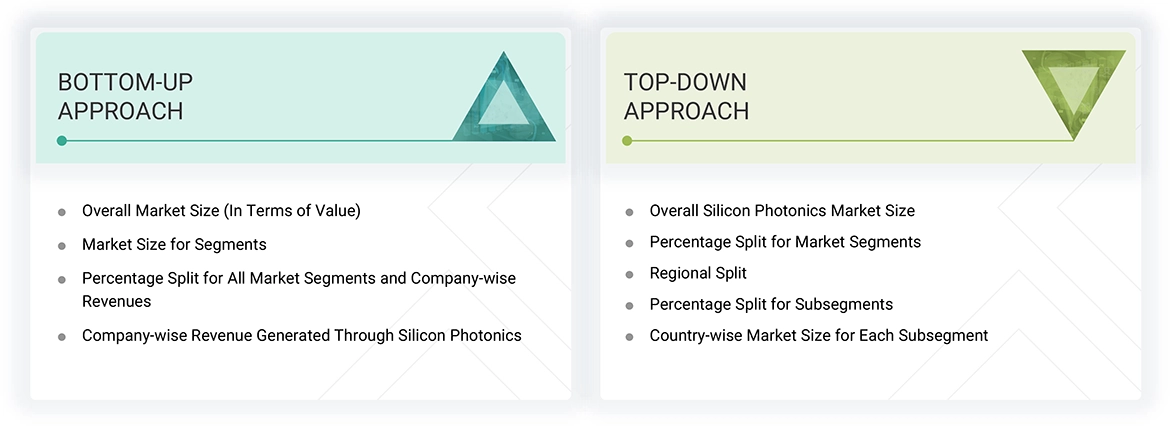
The study involved four major activities in estimating the current size of the global Silicon Photonics market—exhaustive secondary research collected information on the market and its peer and parent markets. The next step was to validate these findings, assumptions, and sizing with industry experts across the value chain through primary research. Both top-down and bottom-up approaches were employed to estimate the total market size. After that, market breakdown and data triangulation were used to estimate the market size of segments and subsegments.
Secondary Research
Various secondary sources have been referred to in the secondary research process to identify and collect important information for this study. These secondary sources include silicon photonics technology journals and magazines, annual reports, press releases, investor presentations of companies, white papers, certified publications and articles from recognized authors, and directories and databases such as Factiva, Hoovers, and OneSource.
Primary Research
Various primary sources from the supply and demand sides have been interviewed in the primary research process to obtain qualitative and quantitative information important for this report. The primary sources from the supply side included industry experts such as CEOs, VPs, marketing directors, technology and innovation directors, and related executives from key companies and organizations operating in the silicon photonics market. After complete market engineering (including calculations regarding market statistics, market breakdown, market size estimations, market forecasting, and data triangulation), extensive primary research was conducted to gather information as well as to verify and validate the critical numbers arrived at.
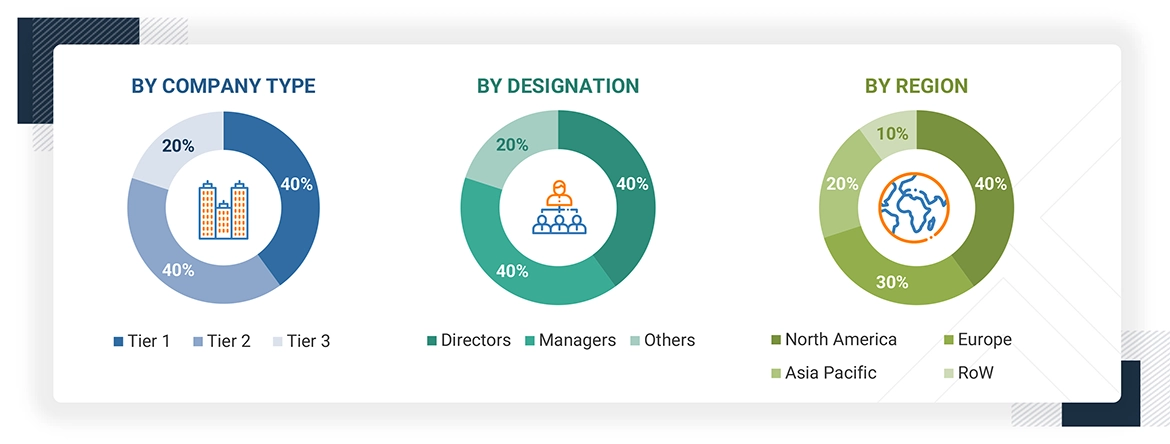
Note: Other designations include sales, marketing, and product managers. Tier 1 = USD 1 billion, Tier 2 = USD 0.5–1.0 billion, and Tier 3 = USD 0.5 billion.
To know about the assumptions considered for the study, download the pdf brochure
Market Size Estimation
In the complete market engineering process, top-down and bottom-up approaches and several data triangulation methods have been implemented to estimate and validate the size of the silicon photonics market and other dependent submarkets listed in this report.
- Extensive secondary research has identified key players in the industry and market.
- In terms of value, the industry’s supply chain and market size have been determined through primary and secondary research processes.
- All percentage shares, splits, and breakdowns have been determined using secondary sources and verified through primary sources.
Silicon Photonics Market : Top-Down and Bottom-Up Approach
Data Triangulation
After arriving at the overall market size from the estimation process explained above, the global market has been split into several segments and subsegments. Market breakdown and data triangulation procedures have been employed wherever applicable to complete the overall market engineering process and arrive at exact statistics for all segments and subsegments. The data has been triangulated by studying various factors and trends identified from both the demand and supply sides.
Market Definition
Silicon photonics is a technique that employs semiconductor-grade silicon to integrate photonic circuits and electronic components on a single microchip. This method minimizes system power consumption while increasing transmission bandwidth by employing silicon as an optical medium. Instead of electrical impulses, the technology transfers data using optical beams, which may send enormous amounts of data at a faster rate than electrical signals.
Key Stakeholders
- Component and material providers
- Semiconductor foundries
- Silicon photonics platform developers
- Silicon photonics product manufacturers and suppliers
- Assembly and testing vendors
- Original equipment manufacturers
- Research organizations and consulting companies
- Technology investors
- Associations, alliances, and organizations related to silicon photonics
- Analysts and strategic business planners
- End users
Report Objectives
- To describe and forecast the silicon photonics market size, in terms of value, by product, component, end user, and region
- To describe and forecast the market size across four key regions, namely, North America, Europe, Asia Pacific, and the Rest of the World (RoW), along with their respective country-level market size, in terms of value
- To provide details regarding the silicon photonic waveguide range
- To provide detailed information regarding the drivers, restraints, opportunities, and challenges of the silicon photonics market
- To strategically analyze the micromarkets1 concerning the individual growth trends, prospects, and their contribution to the silicon photonics market
- To map competitive intelligence based on company profiles, key player strategies, and key developments
- To provide a detailed overview of the silicon photonics value chain and ecosystem
- To provide information about the key technology trends and patents related to the silicon photonics market
- To provide information regarding trade data related to the silicon photonics market
- To analyze opportunities in the market for stakeholders by identifying high-growth segments of the silicon photonics ecosystem
- To benchmark the market players using the proprietary company evaluation matrix framework, which analyzes them on various parameters within the broad categories of market ranking/share and product portfolio
- To analyze competitive developments such as contracts, acquisitions, product launches and developments, collaborations, and partnerships, along with research & development (R&D), in the silicon photonics market
- To analyze the impact of the recession on the growth of the silicon photonics market
Available Customizations
With the given market data, MarketsandMarkets offers customizations according to a company’s specific needs. The following customization options are available for the report:
Company Information:
- Detailed analysis and profiling of additional market players (up to 5)
Key Questions Addressed by the Report
What is the current size of the Silicon Photonics Market?
The global Silicon Photonics Market was valued at approximately USD 2.16 billion in 2024 and is expected to grow significantly over the forecast period due to increasing demand for high-speed optical communication technologies.
What is the projected market size of the Silicon Photonics Market by 2030?
The market is projected to reach USD 9.65 billion by 2030, growing at a CAGR of 29.5% during 2025–2030.
What are the major growth drivers of the Silicon Photonics Market?
Key growth drivers include rising demand for high-bandwidth data transmission, expansion of AI and cloud computing infrastructure, increasing deployment of data centers, growth of 5G networks, and demand for energy-efficient communication systems.
Which product segment holds the largest share of the Silicon Photonics Market?
Transceivers are expected to account for the largest market share because of their extensive use in data centers, high-performance computing (HPC), and telecommunications applications.
Which component segment is expected to grow the fastest?
The lasers segment is projected to witness the highest CAGR during the forecast period due to its critical role in generating and transmitting optical signals for high-speed communication networks.
Which end-user industry is expected to grow at the highest rate?
Data Centers & High-Performance Computing (HPC) are expected to register the highest growth rate due to increasing AI workloads, cloud services, and demand for ultra-fast optical interconnects.
Which region dominates the Silicon Photonics Market?
North America currently holds the largest market share, supported by strong semiconductor ecosystems, leading technology companies, substantial R&D investments, and widespread adoption of cloud and AI technologies.
Which region is expected to witness the fastest growth during the forecast period?
Asia Pacific is expected to be the fastest-growing region, driven by investments in data centers, 5G infrastructure, high-performance computing, and semiconductor manufacturing, particularly in China, Japan, South Korea, and India.
Who are the leading companies operating in the Silicon Photonics Market?
Major players include Cisco Systems, Intel Corporation, MACOM, GlobalFoundries, and Lumentum Operations LLC. These companies are actively investing in product innovation, partnerships, and capacity expansion.
What are the key trends shaping the Silicon Photonics Market?
Major trends include adoption of optical interconnects, AI-driven data center expansion, co-packaged optics (CPO), quantum computing applications, energy-efficient networking, CMOS-integrated photonics, and next-generation high-speed optical modules.
What factors are driving the silicon photonics market size 2026 forecast?
Key growth factors include the expansion of AI and cloud computing, increasing data center requirements, 5G deployment, demand for high-bandwidth data transmission, and the growing adoption of high-performance computing and optical transceivers.
What are the key applications contributing to the silicon photonics market forecast?
Key applications include data centers, telecommunications, high-performance computing, healthcare, AI infrastructure, and other high-bandwidth data transmission applications.
Fact checked
Personalize This Research
- Triangulate with your Own Data
- Get Data as per your Format and Definition
- Gain a Deeper Dive on a Specific Application, Geography, Customer or Competitor
- Any level of Personalization
Let Us Help You
- What are the Known and Unknown Adjacencies Impacting the Silicon Photonics Market
- What will your New Revenue Sources be?
- Who will be your Top Customer; what will make them switch?
- Defend your Market Share or Win Competitors
- Get a Scorecard for Target Partners

Custom Market Research Services
We Will Customise The Research For You, In Case The Report Listed Above Does Not Meet With Your Requirements
Get 10% Free CustomisationTESTIMONIALS

Tetsuya Ohhira
Business Development Manager-Technology Business
Nikon Corporation,
Leading Japanese MNC specializing in optics and imaging productswww.nikon.com
MarketsandMarkets™ response
is quick. Their attitude is flexible and positive. Analyst Insights are globally considered and
significant. Client Services quickly respond to our inquiry and demand. Their wide range of global
surveys help us make our strategic plan.
We hope Knowledge Store will be easier to search
for a report.
VP - Marketing & Business Development
Leading Provider of Process Control Solutions
We engaged with MarketsandMarkets on a study to perform an analysis and recommend a Go-To-Market strategy for metrology and process control in the semiconductor market. The study was tailored to our targets and needs with well-defined milestones. Our overall experience with the MarketsandMarkets team was very good throughout the project in all aspects including the analysis methodologies used, the quality and depth of primary and secondary data sets, the professionalism and flexibility of the team and the ability to meet the target schedule and milestones. We want to thank MarketsandMarkets team for a job well done.
- US Silicon Photonics Market
- Canada Silicon Photonics Market
- Mexico Silicon Photonics Market
- Germany Silicon Photonics Market
- UK Silicon Photonics Market
- France Silicon Photonics Market
- Italy Silicon Photonics Market
- China Silicon Photonics Market
- Japan Silicon Photonics Market
- South Korea Silicon Photonics Market
Growth opportunities and latent adjacency in Silicon Photonics Market






VITTORIO
Oct, 2009
Dear Team Members, as an interviewed expert for this matter, I ask you to receive a PDF copy of the summary for this report. .
Angelica
Jan, 2019
I work in the field of silicon photonics components, and I am interested in receiving report specifically mentioning the market size for sensing component and automotive end user vertical. .
Bruce
Apr, 2026
Why is silicon photonics important for modern Data Centers and high-performance computing (HPC)?.
Brian
Apr, 2026
How does silicon photonics improve bandwidth and energy efficiency compared to traditional electronic interconnects?.
Kenneth
Apr, 2026
What are the key applications of silicon photonics in telecommunications, healthcare, and defense sectors?.
richard
Dec, 2009
Interested in silicon photonics market. Your report may receive beneficial publicity in a feature that I am due to write very soon. But I need free access for a limited period for this to happen..
richard
Mar, 2015
Need information on silicon photonic companies and their business models - service or product oriented ? .
Raphaël
Sep, 2019
My objective is to assess the market in which I'll soon work into, see which business segment is likely to grow the most, and how fast?.
Suzanne
Aug, 2018
Dear sir/madam, just a quick question about the report. We would like to know if we are mentioned in this report. Could you provide me with that information? .
Jeremy
Aug, 2011
I'm a student interested in photonics and learning about the field and what opportunities there are within it. I'm interested in the building blocks of silicon photonics, silicon photonics technology trends, a general market overview. I'm also interested in silicon optical interconnects and photovoltaics, as well as information on HP, Intel, Oracle, and Translucent. .
Yung
Mar, 2019
As an optical engineer, I am very much interested in the market of SIP. I believe this report can help us to analyze that if it is worth to develop the SIP in our own company..
Giuseppe
Feb, 2014
Need information on Silicon Photonics Market by Products (Silicon Optical Interconnects & Wavelength Division Multiplexer Filters & Others), Applications (Telecommunication, Datacom, High Performance Computing & Others) & Geography - Analysis & Forecast (2013 - 2020)..
Jaci
Jun, 2010
We are looking for the following on the Overall Photonics Market: market size, market growth, major players, various segments within Photonics (& their relative sizes and growth)..
Carlos
Nov, 2018
Hello, I would like to buy the corporate license of the silicon photonics report so that I can share it with all the members of our association. I am interested in acquiring 3-6 reports per year from you..
Linda
Oct, 2015
I would like to obtain an old report on this topic from 2010-2014 for research purposes. .
Sevil
Oct, 2022
I need this analysis in order to make an impactful presentation and a review paper on silicon photonics. .
Christian
Jul, 2015
My group is working in the area of silicon photonics and integrated optics, and we are analyzing the potential of commercializing our research. To this end, a copy of the report of an executive summary would be extremely helpful. .
Rudy
Jan, 2019
Objective is to obtain a better market picture of how silicon photonics technology will impact fiber data center links..