North America Smart Factory Market

North America Smart Factory Market by Component (Industrial Sensors, Industrial Robots, Industrial 3D Printing, Machine Vision Systems), Solution (SCADA, Manufacturing Execution Systems (MES), Plant Asset Management, Industrial Safety) - Forecast to 2030




OVERVIEW
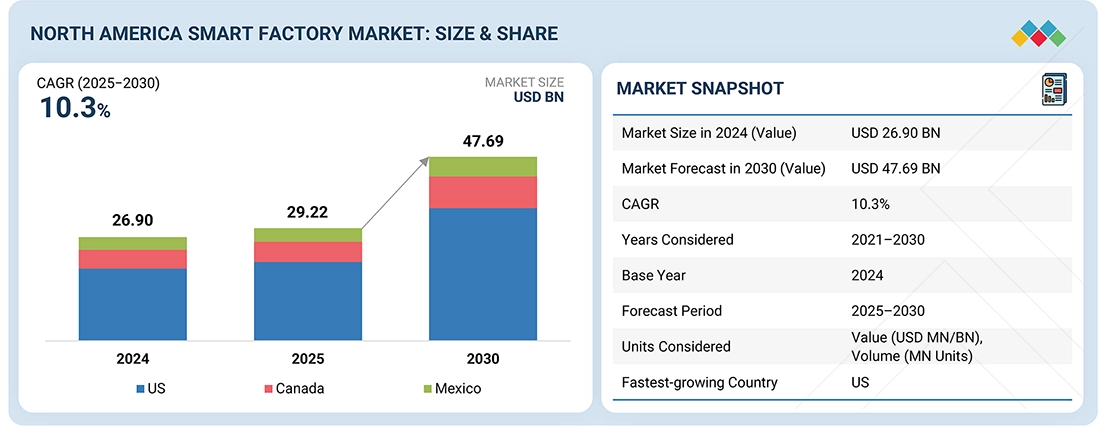
Source: Secondary Research, Interviews with Experts, MarketsandMarkets Analysis
The North America smart factory market is estimated at USD 29.22 billion in 2025 and projected to reach USD 47.69 billion by 2030, growing at a CAGR of 10.3% during the forecast period. The North America smart factory market is growing as manufacturers invest heavily in advanced production facilities to address labor shortages and improve efficiency. The strong adoption of automation and industrial software enables companies to improve productivity and gain better visibility across their factory operations.
KEY TAKEAWAYS
-
BY COUNTRYThe US is expected to dominate the North America smart factory market with a 70.0% share in 2025.
-
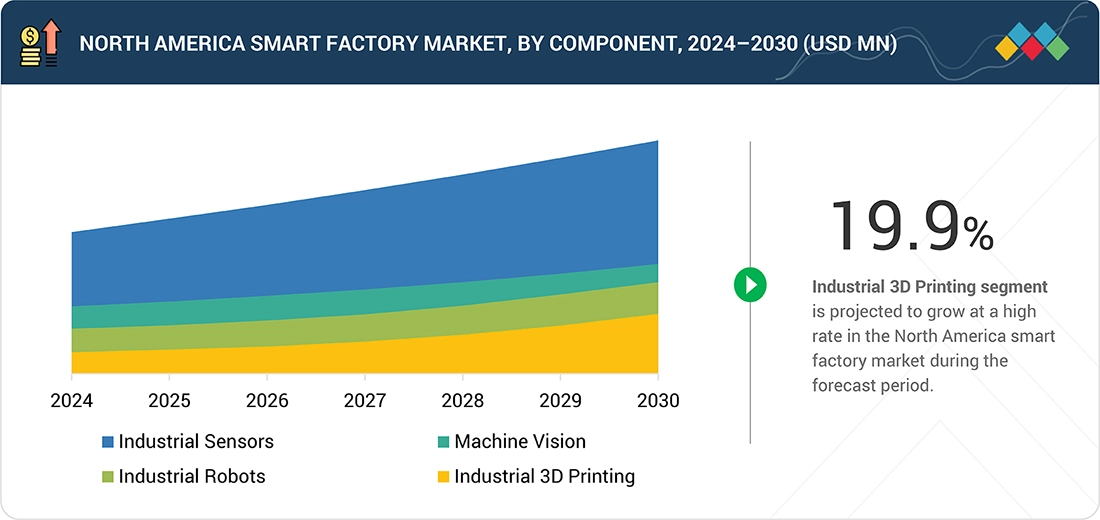
BY COMPONENTBy component, the industrial 3D printing segment is expected to grow at a CAGR of 19.8% during the forecast period.
-
BY SOLUTIONBy solution, the manufacturing execution systems (MES) are expected to dominate the market in 2025.
-
BY INDUSTRYProcess industries held the largest market share in the North America smart factory market in 2024.
-
Competitive Landscape - KEY PLAYERSSiemens, Schneider Electric, ABB, Rockwell Automation Inc., and Emerson Electric Co. were identified as some of the star players in the North America smart factory market, given their strong market share and product footprint.
-
Competitive Landscape - STARTUPS/SMESBright Machines, Inc., Vention, and Mantis Robotics, Inc., among others, have distinguished themselves among startups and SMEs by securing strong footholds in specialized niche areas, underscoring their potential as emerging market leaders.
The North America smart factory market is expanding as manufacturers modernize production facilities to improve efficiency and reduce reliance on manual labor. Strong investments in automation, robotics, and industrial software support higher productivity and consistent quality across operations. The rising demand for real-time visibility and data-driven decision-making is accelerating the adoption of connected factory systems. Continued reshoring of manufacturing and new greenfield projects further strengthen market growth.
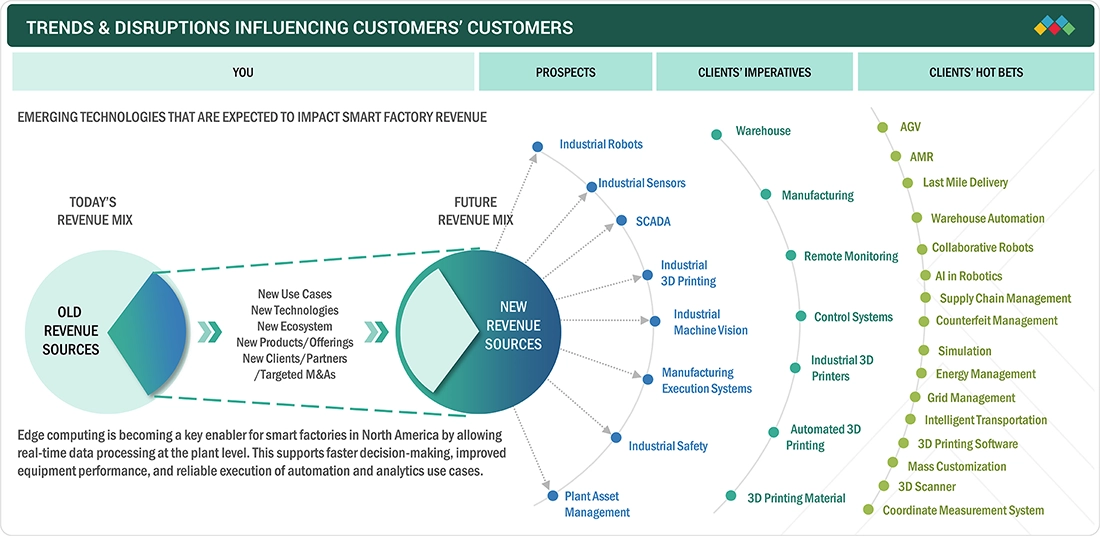
TRENDS & DISRUPTIONS IMPACTING CUSTOMERS' CUSTOMERS
The North America smart factory industry is undergoing a significant shift as manufacturers move from traditional automation toward connected, software-driven, and data-centric production models. Disruptive trends, such as industrial AI, edge computing, advanced robotics, machine vision, and cloud-enabled MES and SCADA platforms, reshape how factories generate value and scale operations. These technologies are expanding use cases across manufacturing plants, warehouses, and integrated production–logistics environments. Increasing adoption of autonomous systems, digital twins, and real-time monitoring enables higher flexibility, faster decision-making, and improved operational resilience. Together, these developments are redefining revenue streams and accelerating the transition toward intelligent, adaptive factories across North America.
Source: Secondary Research, Interviews with Experts, MarketsandMarkets Analysis
MARKET DYNAMICS

Level
-
Need for scalable, low-latency, and interoperable factory systems in US and Canada

-
Rising adoption of digital twins for production monitoring and asset optimization


Level
-
Limited standardization across OT platforms and industrial interfaces

-
High upfront costs for automation hardware and systems


Level
-
Expansion of software-driven smart factory platforms

-
Growing deployment of private wireless and edge-based factory networks


Level
-
Rising cybersecurity risks in connected production environments

-
Workforce adaptation to AI- and automation-driven operations

Source: Secondary Research, Interviews with Experts, MarketsandMarkets Analysis
Driver: Need for scalable, low-latency, and interoperable factory systems in US and Canada
The need for scalable, low-latency, and interoperable factory systems is rising across the US and Canada as manufacturers modernize operations. Growing deployment of connected machines, robots, and industrial software is increasing the demand for reliable real-time data exchange. This is accelerating the adoption of integrated smart factory architectures across greenfield and brownfield sites.
Restraint: Limited standardization across OT platforms and industrial interfaces
Limited standardization across OT platforms and industrial interfaces continues to slow smart factory integration in North America. Manufacturers often operate mixed-vendor environments with legacy control systems that are difficult to harmonize. This increases integration complexity, costs, and deployment timelines.
Opportunity: Expansion of software-driven smart factory platforms
The expansion of software-driven smart factory platforms creates strong growth opportunities across North America. Solutions such as MES, digital twins, industrial analytics, and edge-enabled monitoring gain traction as manufacturers seek flexibility and scalability. These platforms enable faster optimization, multi-site standardization, and data-driven decision-making.
Challenge: Rising cybersecurity risks in connected production environments
Rising cybersecurity risks in connected production environments continue to be a critical challenge for North America smart factories. Increased OT–IT connectivity expands the attack surface for ransomware and operational disruptions. Addressing these risks requires continuous investment in security architecture, monitoring, and workforce training.
NORTH AMERICA SMART FACTORY MARKET: COMMERCIAL USE CASES ACROSS INDUSTRIES
| COMPANY | USE CASE DESCRIPTION | BENEFITS |
|---|---|---|
 |
Fully automated smart factory in Fort Worth, Texas, for manufacturing rugged pick-up truck bed caps using robotic machines, Automated Guided Vehicles (AGVs), and Cisco Meraki cloud-managed network solutions for connectivity, automation, and video monitoring | Daily production increased by more than 350% (from 11 to 50 units) | Enabled 20-hour daily operations with remote monitoring | Provided scalable infrastructure for future robotic expansions |
 |
IIoT project using machine learning and historical process data to solve batching issues in beer production caused by yeast variances for one of the largest craft brewers in the US | Eliminated lost batches due to quality issues | Recaptured two weeks of extra production capacity per previously lost batch |
 |
Implementation of 8680i Wearable Scanners and Guided Work Solutions for real-time visibility and efficiency in processing 150,000 cases per night at a food distribution facility in Michigan | Enhanced operational accuracy | Significantly boosted productivity |
 |
Transition from seven disconnected CMMS systems to unified Asset Essentials and Origin software for maintenance and capital planning across 12 manufacturing facilities in North America | Reduced downtime through shared resources and parts | Streamlined workorder processes with mobile app features | Enabled accurate 15-year capital forecasting |
Logos and trademarks shown above are the property of their respective owners. Their use here is for informational and illustrative purposes only.
MARKET ECOSYSTEM
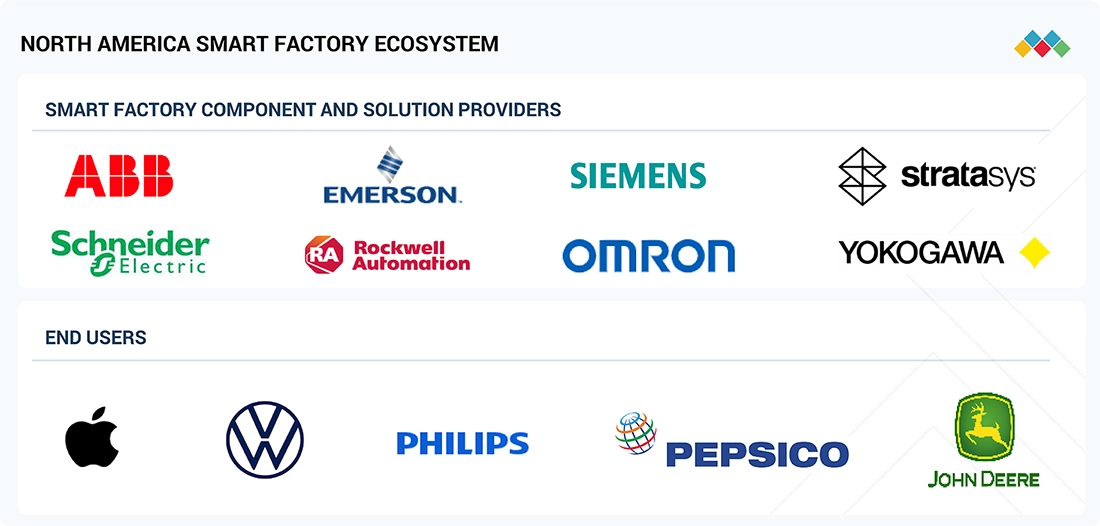
The North America smart factory ecosystem is built around a strong integration of automation hardware, industrial software, robotics, and digital manufacturing solutions. Technology providers support factories with control systems, sensors, robotics, industrial software, and advanced manufacturing tools that enable connected and data-driven operations. On the demand side, large manufacturers across automotive, electronics, consumer goods, healthcare, and industrial equipment are driving adoption to improve efficiency and flexibility. Collaboration between solution providers and end users is accelerating deployment of intelligent, scalable, and resilient factory systems across the region.
Logos and trademarks shown above are the property of their respective owners. Their use here is for informational and illustrative purposes only.
MARKET SEGMENTS
Source: Secondary Research, Interviews with Experts, MarketsandMarkets Analysis
North America Smart Factory Market, By Component
Industrial 3D printing is expected to grow at a high CAGR in the North America smart factory market as manufacturers adopt additive manufacturing for tooling, prototyping, and low-volume production. Growing demand for design flexibility, faster product development, and localized manufacturing is driving adoption across advanced industries. Integration of 3D printing with digital workflows and automation is further supporting growth.
North America Smart Factory Market, By Solution
Manufacturing execution systems (MES) segment is expected to dominate the North America smart factory market due to their central role in connecting shop-floor operations with enterprise systems. Manufacturers are increasingly deploying MES to gain real-time visibility, improve production efficiency, and ensure quality compliance. Strong adoption across discrete and process manufacturing supports the segment’s leading position.
North America Smart Factory Market, By Industry
Process industries are expected to capture the largest share of the North America smart factory market during the forecast period. High capital intensity and the need for continuous operations are driving investments in automation, monitoring, and digital control systems. Industries such as chemicals, oil & gas, food & beverages, and pharmaceuticals are leading adoption to improve safety, efficiency, and operational reliability.
REGION
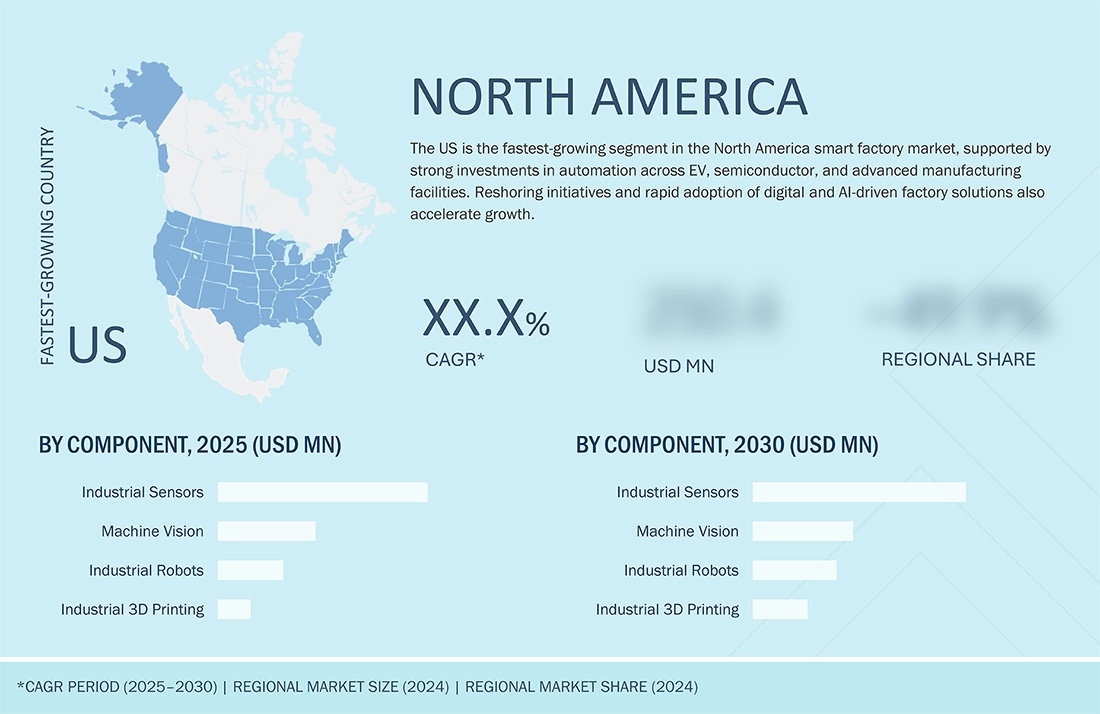
US to grow at the highest rate in North America smart factory market during forecast period
The US is expected to grow at the highest rate in the North America smart factory market during the forecast period, driven by strong investments in advanced manufacturing and factory modernization. Rapid adoption of automation, industrial software, and AI-enabled systems help manufacturers improve productivity and operational visibility. Ongoing reshoring initiatives and new greenfield facilities further accelerate smart factory deployments across the country.
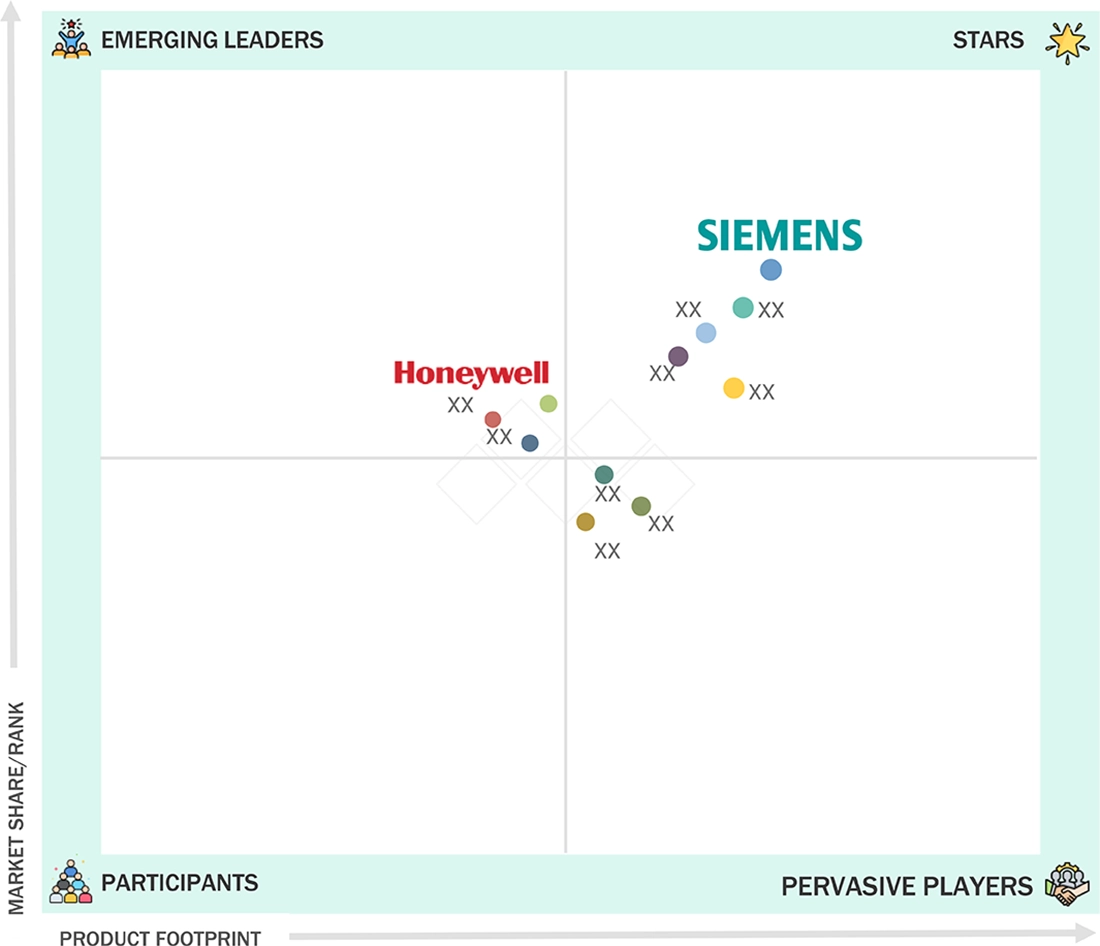
NORTH AMERICA SMART FACTORY MARKET: COMPANY EVALUATION MATRIX
In the North America smart factory company evaluation matrix, Siemens AG leads as a star player under the SCADA segment, driven by its broad SCADA portfolio, strong system integration, and widespread adoption across large manufacturing facilities. Honeywell International Inc. is positioned as an emerging player, supported by its strengths in process automation, connected plant solutions, and growing presence in cloud-enabled SCADA deployments.
Source: Secondary Research, Interviews with Experts, MarketsandMarkets Analysis
KEY MARKET PLAYERS
- ABB (Switzerland)
- Emerson Electric Co. (US)
- GE Vernova (US)
- Siemens AG (Germany)
- Rockwell Automation Inc. (US)
- Schneider Electric (France)
- Honeywell International Inc. (US)
- Mitsubishi Electric Corporation (Japan)
- Endress+Hauser Group Services AG (Switzerland)
- Yokogawa Electric Corporation (Japan)
MARKET SCOPE
| REPORT METRIC | DETAILS |
|---|---|
| Market Size in 2024 (Value) | USD 26.90 Billion |
| Market Forecast in 2030 (Value) | USD 47.69 Billion |
| Growth Rate | CAGR of 10.3% from 2025 to 2030 |
| Years Considered | 2021–2030 |
| Base Year | 2024 |
| Forecast Period | 2025–2030 |
| Units Considered | Value (USD Million/Billion), Volume (Million Units) |
| Report Coverage | Revenue Forecast, Company Ranking, Competitive Landscape, Growth Factors, and Trends |
| Segments Covered |
|
| Countries Covered | US, Canada, Mexico |
WHAT IS IN IT FOR YOU: NORTH AMERICA SMART FACTORY MARKET REPORT CONTENT GUIDE
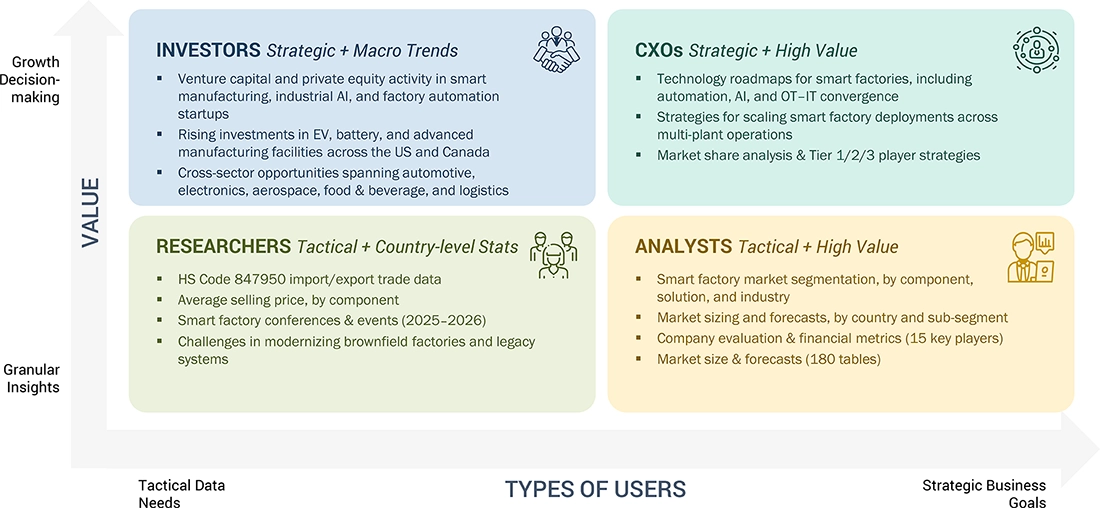
DELIVERED CUSTOMIZATIONS
We have successfully delivered the following deep-dive customizations:
| CLIENT REQUEST | CUSTOMIZATION DELIVERED | VALUE ADDS |
|---|---|---|
| North America Smart Factory Ecosystem Mapping | Mapped the regional smart factory ecosystem covering industrial automation hardware, robotics, industrial software (MES/MOM), machine vision, IIoT platforms, edge computing, and system integrators across the US and Canada | Provides clear visibility into ecosystem structure, interdependencies, and white-space opportunities, supporting informed market entry and expansion decisions |
| Competitive Benchmarking of Smart Factory Solution Providers | Benchmarked leading global and North America–headquartered players based on automation depth, software capabilities, robotics integration, industry focus, regional footprint, and customer adoption | Enables objective comparison of competitors, supports partnership, acquisition, and positioning strategies, and strengthens competitive intelligence |
| Industry- and Use Case–Specific Opportunity Assessment | Analyzed smart factory adoption and high-value use cases across automotive, EV & battery, electronics, aerospace, food & beverage, life sciences, and logistics manufacturing | Identifies revenue-generating opportunities, prioritizes target industries, and sharpens go-to-market and vertical expansion strategies |
| Technology Roadmap and Adoption Maturity Analysis | Assessed the adoption maturity of MES, AI-enabled automation, digital twins, AMRs/AGVs, machine vision, and edge–cloud architectures across greenfield and brownfield facilities | Supports phased investment planning and aligns technology deployment with near- and long-term digital transformation goals |
| Country-Level Market Sizing and Forecast Customization | Developed detailed market sizing and forecasts for the US and Canada by component, solution type, end industry, and deployment model | Improves the accuracy of revenue projections and supports region-specific strategic planning |
RECENT DEVELOPMENTS
- October 2025: Rockwell Automation unveiled a broad portfolio of new hardware, software, and edge technologies at Automation Fair 2025 in Chicago to accelerate smart factory adoption. New launches included next-generation ControlLogix controllers, edge gateways, industrial networking solutions, motor control systems, and modular I/O platforms, enabling simplified wiring, enhanced cybersecurity, improved machine-level data collection, and faster deployment of connected manufacturing systems.
- September 2025 : FANUC America showcased advanced smart factory automation solutions at FABTECH 2025 in Chicago, highlighting robotic welding, CNC machining, collaborative robots, and flexible automation cells designed for high-mix, low-volume manufacturing. Key demonstrations included coordinated multi-robot welding, space-saving arc welding cells, and newly released robots for harsh and wet machining environments, enabling higher productivity, reduced labor dependency, and scalable automation for North American manufacturers.
- September 2025: Hitachi Rail opened a USD 100 million lighthouse digital factory in Hagerstown, Maryland, designed to deliver up to 20 railcars per month for North American customers. The carbon-neutral facility incorporates over USD 30 million in digital enhancements, including AI-enabled asset optimization, smart manufacturing systems, and immersive digital experience centers, showcasing advanced smart factory practices while supporting large-scale production and regional job creation.
- May 2025 : Schneider Electric introduced open, software-defined automation innovations at Automate 2025, including its industrial AI copilot developed in collaboration with Microsoft. The solution integrates generative AI with industrial automation platforms to reduce repetitive tasks, improve productivity, support workforce efficiency, enable faster application development, and enhance predictive maintenance in US manufacturing facilities facing labor constraints.
Table of Contents
 Exclusive indicates content/data unique to MarketsandMarkets and not available with any competitors.
Methodology
The research study involved four major steps in estimating the size of the North America Smart Factory Market . Exhaustive secondary research has been done to collect important information about the market and peer markets. The next step has been to validate these findings and assumptions and size them with the help of primary research with industry experts across the value chain. Both top-down and bottom-up approaches have been used to estimate the market size. After this, the market breakdown and data triangulation approaches have been adopted to estimate the market sizes of segments and subsegments.
Secondary Research
Various secondary sources were referred to in the secondary research process to identify and collect the information required for this study. These sources include annual reports, press releases, investor presentations of companies, white papers, and articles from recognized authors. Secondary research was mainly done to obtain key information about the market’s value chain, the pool of key market players, market segmentation according to industry trends, regional outlook, and developments from market and technology perspectives.
In the North America Smart Factory Market report, the market size has been estimated using the top-down and bottom-up approaches, along with several other dependent submarkets. The major players in the market were identified using extensive secondary research, and their presence in the market was determined using secondary and primary research. All the percentage splits and breakdowns have been determined using secondary sources and verified through primary sources.
Primary Research
Extensive primary research has been conducted after understanding the North America Smart Factory Market scenario through secondary research. Several primary interviews have been conducted with key opinion leaders from demand- and supply-side vendors across North America. Approximately 40% of the primary interviews were conducted with the demand-side vendors and 60% with the supply-side vendors. Primary data has been collected mainly through telephonic interviews, which consist of 80% of the total primary interviews; questionnaires and emails have also been used to collect the data.
After successful interaction with industry experts, brief sessions were conducted with highly experienced independent consultants to reinforce the findings of our primary research. This, along with the in-house subject matter experts’ opinions, led us to the findings described in the report. The breakdown of primary respondents is as follows:
Market Size Estimation
In the complete market engineering process, top-down and bottom-up approaches and several data triangulation methods have been used to estimate and forecast the overall market segments and subsegments listed in this report. The key players in the market have been identified through secondary research, and their market shares in the respective regions have been determined through primary and secondary research. This entire procedure includes the study of annual and financial reports of the top market players and extensive interviews for key insights (quantitative and qualitative) with industry experts (CEOs, VPs, directors, and marketing executives).
All percentage shares, splits, and breakdowns have been determined using secondary sources and verified through primary sources. All the parameters affecting the markets covered in this research study have been accounted for, viewed in detail, verified through primary research, and analyzed to obtain the final quantitative and qualitative data. This data has been consolidated and supplemented with detailed inputs and analysis from MarketsandMarkets and presented in this report.
Bottom-Up Approach
- Identifying various industries using or expected to deploy different types of smart factory solutions at their facilities
- Analyzing use cases across regions and companies
- Estimating the size of the North America Smart Factory Market based on the demand from these industries and companies
- Tracking the ongoing and upcoming installation contracts, acquisitions, expansions, and product launches by various companies, and forecasting the market based on these developments and other critical parameters
- Conducting multiple discussions with key opinion leaders to understand smart factory components and solutions by companies in these industries, and analyzing the breakdown of the scope of work carried out by each major company providing smart factory components
- Arriving at the market estimates by analyzing the country-wise sales of smart factory solutions to companies, and combining this data to get the regional market estimates
- Verifying and cross-checking the estimates at each level through discussions with key opinion leaders, including CEOs, directors, operations managers, and domain experts at MarketsandMarkets
- Studying various paid and unpaid information sources, such as annual reports, press releases, and white papers
Top-Down Approach
- Information related to the revenue of key manufacturers and providers of smart factory components and solutions was studied and analyzed to estimate the size of the North America Smart Factory Market .
- Multiple discussions were conducted with key opinion leaders to understand the demand for smart factory components and analyze the break-up of the scope of work carried out by each major company.
- Revenue, geographic presence, key industries served, and the diverse offerings of all identified players in the North America Smart Factory Market were studied to estimate and arrive at the percentage split of different market segments.
- All major players in the North America Smart Factory Market were identified through secondary research and verified through brief discussions with industry experts.
- Multiple discussions were conducted with key opinion leaders of all major companies involved in developing smart factory solutions to validate the market split based on component, solution, industry, and region.
- Geographic splits were estimated through secondary sources based on factors such as the number of players offering smart factory solutions in a specific country or region, and the industries for which these players offer solutions.
Data Triangulation
After arriving at the overall market size from the estimation process explained above, the overall market has been split into several segments and subsegments. The data triangulation procedure has been employed wherever applicable to complete the overall market engineering process and arrive at the exact statistics for all segments and subsegments. The data has been triangulated by studying various factors and trends from both the demand and supply sides. Additionally, the market size has been validated using top-down and bottom-up approaches.
Market Definition
A smart factory is a highly digitalized and automated production system connected throughout all the production processes in a facility. It can self-optimize performance across a broad network, self-adapt to changing production conditions and requirements in real time, and autonomously run an entire production system. The main advantage of a smart factory is its ability to evolve with the changing needs of the organization. A smart factory uses a network to connect the virtual and physical elements of the production process to manufacturing operations. It represents an autonomous manufacturing environment that can handle any technical issues in real time during production using fragmented information and communication structures for the optimum management of production processes.
Key Stakeholders
- End Users
- Government Bodies, Venture Capitalists, and Private Equity Firms
- Smart Factory Manufacturers
- Smart Factory Solution & Component Distributors
- Smart Factory Industry Associations
- Professional Service/Solution Providers
- Research Institutions and Organizations
- Standards, Organizations, and Regulatory Authorities in North America Smart Factory Market
- System Integrators
- Technology Consultants
Report Objectives
- To describe and forecast the North America Smart Factory Market , in terms of value, based on component, solution, and industry, in terms of value
- To forecast the market size for the three major North American Countries: US, Canada, Mexico, in terms of value
- To provide detailed information regarding the drivers, restraints, opportunities, and challenges influencing market growth
- To provide a detailed overview of the smart factory value chain and ecosystem
- To strategically analyze micromarkets with respect to individual growth trends, prospects, and contributions to the total market
- To strategically profile the key players and comprehensively analyze their market positions in terms of ranking and core competencies
- To analyze competitive developments, such as product launches, acquisitions, collaborations, agreements, and partnerships, in the North America Smart Factory Market
- To provide ecosystem analysis, case study analysis, patent analysis, technology analysis, key conferences and events, Porter’s five forces analysis, regulatory landscape, impact of AI/Gen AI, and impact of the 2025 US Tariff on the North America Smart Factory Market Available customizations:
With the given market data, MarketsandMarkets offers customizations according to the specific requirements of companies. The following customization options are available for the report:
- Detailed analysis and profiling of additional market players based on various blocks of the supply chain


Personalize This Research
- Triangulate with your Own Data
- Get Data as per your Format and Definition
- Gain a Deeper Dive on a Specific Application, Geography, Customer or Competitor
- Any level of Personalization
Let Us Help You
- What are the Known and Unknown Adjacencies Impacting the North America Smart Factory Market
- What will your New Revenue Sources be?
- Who will be your Top Customer; what will make them switch?
- Defend your Market Share or Win Competitors
- Get a Scorecard for Target Partners

Custom Market Research Services
We Will Customise The Research For You, In Case The Report Listed Above Does Not Meet With Your Requirements
Get 10% Free CustomisationTESTIMONIALS

Tetsuya Ohhira
Business Development Manager-Technology Business
Nikon Corporation,
Leading Japanese MNC specializing in optics and imaging productswww.nikon.com
MarketsandMarkets™ response
is quick. Their attitude is flexible and positive. Analyst Insights are globally considered and
significant. Client Services quickly respond to our inquiry and demand. Their wide range of global
surveys help us make our strategic plan.
We hope Knowledge Store will be easier to search
for a report.
VP - Marketing & Business Development
Leading Provider of Process Control Solutions
We engaged with MarketsandMarkets on a study to perform an analysis and recommend a Go-To-Market strategy for metrology and process control in the semiconductor market. The study was tailored to our targets and needs with well-defined milestones. Our overall experience with the MarketsandMarkets team was very good throughout the project in all aspects including the analysis methodologies used, the quality and depth of primary and secondary data sets, the professionalism and flexibility of the team and the ability to meet the target schedule and milestones. We want to thank MarketsandMarkets team for a job well done.






Growth opportunities and latent adjacency in North America Smart Factory Market