North America Head-Up Display Market

North America Head-Up Display Market by Combiner HUD, Windshield HUD, Wearable HUD, Augmented reality (AR) HUD, Conventional HUD, Display Unit, Video Generator/Processing unit, and Projector/Projection unit-Forecast to 2030




OVERVIEW
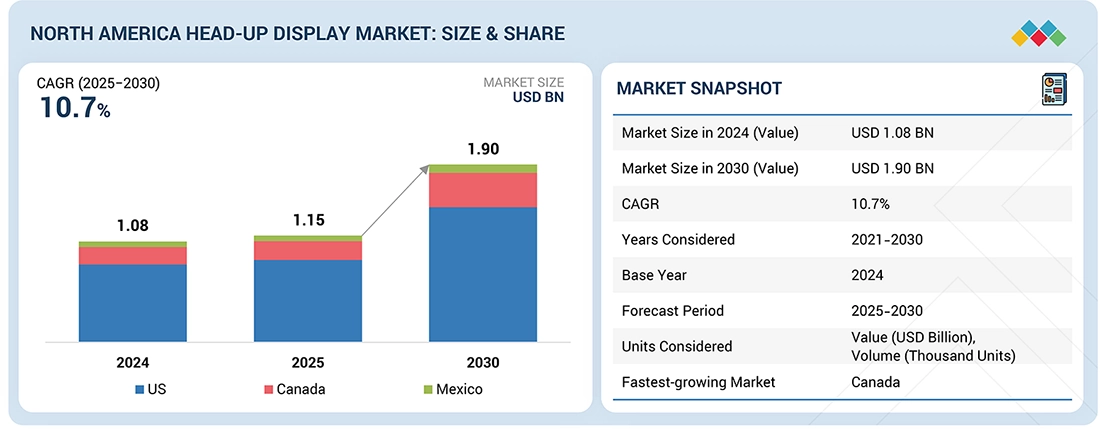
The North America head-up display market is projected to reach USD 1.90 billion by 2030 from USD 1.15 billion in 2025, at a CAGR of 10.7%. Growth is driven by rising integration of advanced driver-assistance systems, increasing demand for enhanced driver safety and situational awareness, and the strong presence of OEMs offering premium and mid-range vehicles in the region. Automakers are increasingly adopting windshield-based and AR head-up displays to reduce driver distraction and support real-time navigation, hazard alerts, and vehicle status visualization. Supportive regulatory emphasis on vehicle safety, growing consumer preference for connected and intelligent vehicles, and continuous investments in automotive electronics and software innovation are accelerating adoption across passenger cars and light commercial vehicles.
Market Size & Forecast
• 2025 Market Size: USD 1.15 Billion
• 2030 Projected Market Size: USD 1.90 Billion
• CAGR (2025-2030): 10.7%
• Wearable HUDs: Highest CAGR
• Canada: Fastest-growing Market
KEY TAKEAWAYS
-
BY COUNTRYBy country, Canada is expected to be the fastest-growing market at a CAGR of 12.7% CAGR during the forecast period.
-
BY COMPONENTBy component, video generators/processing units are likely to register the highest CAGR during the forecast period.
-
BY TYPEBy type, conventional HUDs are expected to dominate the market in 2025.
-
BY FORM FACTORBy form factor, wearable HUDs will register the highest CAGR during forecast period.
-
BY END USEBy end use, the automotive segment is expected to register the highest CAGR from 2025 to 2030.
-
COMPETITIVE LANDSCAPE - KEY PLAYERSThe Nippon Seiki, Continental, Valeo, DENSO, HARMAN International, and YAZAKI, among others, were identified as some of the star players in the North America head-up display market, given their strong market share and product footprint.
-
COMPETITIVE LANDSCAPE - STARTUPS/SMESCY Vision and Epic Optix, among others, have distinguished themselves as SMEs by securing strong footholds in specialized niche areas, underscoring their potential as emerging market leaders.
Countries such as the US, Canada, and Mexico are major contributors to the North America head-up display market growth. The strong presence of automotive OEMs and Tier 1 suppliers, increasing production of premium and electric vehicles, and rising integration of advanced driver-assistance systems are driving regional demand. The growing emphasis on vehicle safety and driver awareness, along with the rapid adoption of windshield-based and AR head-up displays, is supporting market expansion. Continuous investments in automotive electronics, software-defined vehicles, and human–machine interface technologies further strengthen adoption.
Source: Secondary Research, Interviews with Experts, MarketsandMarkets Analysis
TRENDS & DISRUPTIONS IMPACTING CUSTOMERS' CUSTOMERS
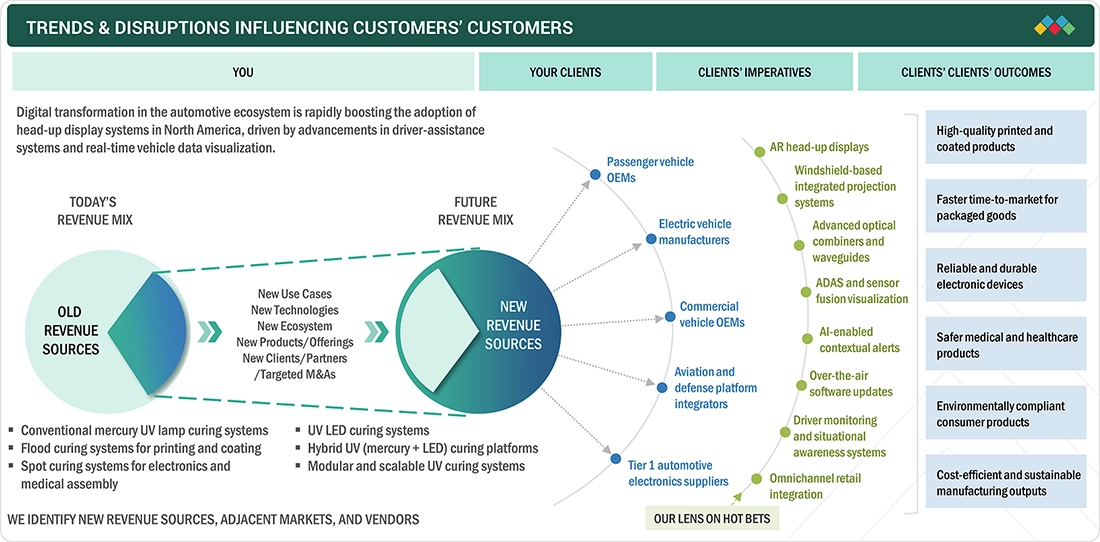
Customer expectations and technological advancements are reshaping vehicle interfaces across North America. Head-up displays have emerged as a critical enabler of safer and more intuitive driving, supporting the shift toward real-time, context-aware information delivery without diverting driver attention. The market is increasingly defined by windshield-based and augmented reality head-up displays enabled by advanced optics, high-brightness projection systems, and seamless integration with vehicle electronics and software platforms. Automakers and system suppliers are leveraging real-time vehicle data, navigation inputs, and sensor fusion from ADAS to deliver more precise and relevant visual cues directly in the driver’s line of sight.
Source: Secondary Research, Interviews with Experts, MarketsandMarkets Analysis
MARKET DYNAMICS

Level
-
Growing emphasis on vehicle and passenger safety

-
Rising integration of HUDs with ADAS and real-time data


Level
-
Spatial limitations in vehicle cockpits

-
Display visibility issues in bright sunlight or adverse conditions


Level
-
Increasing adoption of HUDs in electric and software-defined vehicles

-
Rising application in two-wheeler and commercial vehicles


Level
-
Regulatory challenges

-
Limited field of view (FOV)

Source: Secondary Research, Interviews with Experts, MarketsandMarkets Analysis
Driver: Growing emphasis on vehicle and passenger safety
Growing emphasis on vehicle and passenger safety remains a key driver for the adoption of head-up display systems. Road traffic accidents continue to cause significant fatalities and injuries worldwide, with driver distraction identified as one of the leading contributors. Increasing regulatory focus on road safety and rising awareness among consumers are pushing automakers to integrate technologies that reduce in-vehicle distraction.
Restraint: Spatial limitations in vehicle cockpits
Spatial limitations within vehicle cockpits act as a key restraint for the head-up display market. Windshield-based and AR head-up displays require significant dashboard and windshield space, creating integration challenges, particularly in compact and mid-sized vehicles. Automakers face difficulties in redesigning cockpit layouts to accommodate projection units without compromising ergonomics or interior aesthetics.
Opportunity: Increasing adoption of HUDs in electric and software-defined vehicles
Increasing adoption of electric and software-defined vehicles presents a strong growth opportunity for head-up displays. EVs rely heavily on digital interfaces for battery status, range, and energy management, while software-defined vehicles enable HUD features to evolve through over-the-air updates. HUDs provide a natural platform for real-time, contextual visualization of ADAS, V2X, and software-driven vehicle data, enhancing user experience and safety.
Challenge: Regulatory challenges
Regulatory compliance remains a key challenge for the head-up display market. Manufacturers must meet varying safety standards related to brightness, content visibility, and driver distraction across regions. Extensive testing and validation services are required to ensure compliance, increasing development time and costs. Balancing innovation with strict regulatory requirements while maintaining a consistent user experience limits the pace of advanced HUD feature deployment.
NORTH AMERICA HEAD-UP DISPLAY MARKET: COMMERCIAL USE CASES ACROSS INDUSTRIES
| COMPANY | USE CASE DESCRIPTION | BENEFITS |
|---|---|---|
 |
Nippon Seiki supplied windshield-based head-up display systems to leading North American passenger vehicle OEMs, focusing on speed, navigation, and warning visualization. HUDs were integrated with ADAS platforms to project critical driving information directly into the driver’s line of sight. | Improved driver focus and situational awareness | reduced in-vehicle distraction | enhanced safety compliance. OEMs benefited from improved cockpit ergonomics and higher customer acceptance of advanced safety features |
 |
Continental deployed advanced HUD solutions, including augmented reality capable displays, across premium and electric vehicle models in North America. These systems visualized navigation guidance, lane keeping cues, and hazard alerts using sensor fusion data. | Enhanced driving safety and comfort | improved ADAS effectiveness | differentiation for OEMs through premium user experience. AR HUDs supported a smoother transition toward semi-autonomous driving features. |
 |
Panasonic developed high-brightness HUD projection modules and optical components for North American automotive OEMs, enabling clear image visibility under varying lighting conditions. The systems were designed for seamless integration with connected vehicle platforms. | Reliable HUD performance in diverse driving environments | improved image clarity | reduced system failure rates. OEMs achieved improved product reliability and stronger positioning in connected vehicle offerings. |
 |
Valeo implemented compact HUD systems for mid segment passenger vehicles in North America, focusing on efficient space utilization and cost optimized designs. The solutions supported speed, navigation prompts, and driver assistance alerts. | Broader HUD adoption beyond premium vehicles | improved safety feature penetration | reduced cockpit complexity. Automakers benefited from scalable HUD integration across multiple vehicle platforms. |
 |
DENSO supplied HUD systems integrated with driver-assistance and vehicle sensing technologies for North American OEMs. The displays enabled real-time visualization of vehicle status, warnings, and navigation data. | Improved real-time driver awareness | enhanced safety outcomes | better integration with ADAS ecosystems. OEMs gained from robust system reliability and alignment with next-generation vehicle safety strategies. |
Logos and trademarks shown above are the property of their respective owners. Their use here is for informational and illustrative purposes only.
MARKET ECOSYSTEM
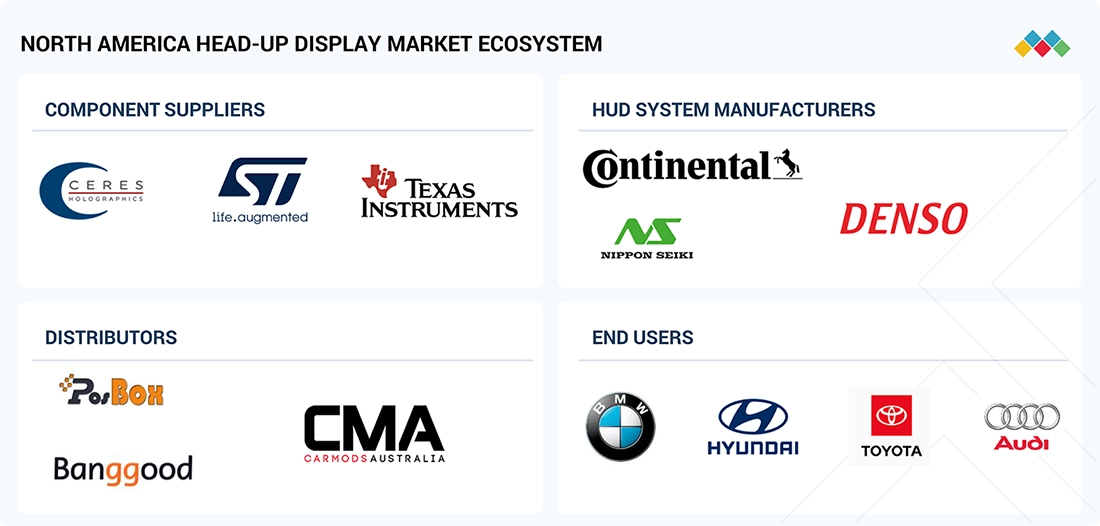
The North America head-up display industry ecosystem includes multiple interconnected layers comprising component suppliers, HUD system manufacturers, distributors, and end users. Component suppliers, such as optics specialists, semiconductor vendors, and holographic technology providers, supply critical elements that form the technological foundation of HUD systems, including projection units, waveguides, holographic optical elements, display drivers, and processing chips. On the HUD system manufacturing side, companies such as Nippon Seiki, Continental, DENSO, Panasonic, and Valeo design and integrate windshield-based and AR head-up display solutions by combining optics, electronics, and software platforms. Distribution and integration partners support OEM programs, aftermarket services, and regional supply chains. At the end-user level, passenger vehicles, electric vehicles, and premium automotive OEMs deploy HUDs across North America to enhance driver safety, situational awareness, and in-vehicle user experience.
Logos and trademarks shown above are the property of their respective owners. Their use here is for informational and illustrative purposes only.
MARKET SEGMENTS

Source: Secondary Research, Interviews with Experts, MarketsandMarkets Analysis
North America Head-up Display Market, By Country
Canada is expected to dominate growth within the North America head-up display market, supported by rising adoption of advanced vehicle safety technologies, increasing penetration of premium and electric vehicles, and strong regulatory emphasis on road safety. Growing investments in automotive innovation and connected vehicle infrastructure further support higher adoption across passenger and commercial vehicles.
North America Head-up Display Market, By Component
The video generators and processing units segment is expected to register the highest CAGR, driven by increasing demand for real time data processing, AR based visualization, and advanced graphics rendering. Integration with ADAS, sensor fusion, and AI driven decision systems requires high performance processing hardware, accelerating adoption across next generation HUD platforms.
North America Head-up Display Market, By Type
Conventional head-up displays are expected to dominate the market due to widespread adoption across premium and mid-range vehicles. Their proven reliability, lower system complexity, and cost-effectiveness compared to augmented reality make them the preferred choice for automakers seeking scalable safety and display solutions.
North America Head-up Display Market, By Form Factor
Wearable head-up displays are expected to witness the highest CAGR, supported by growing applications in defense, aviation, industrial safety, and specialized mobility use cases. Lightweight designs, hands-free information access, and compatibility with connected systems are driving adoption beyond traditional automotive environments.
North America Head-up Display Market, By End User
The automotive segment is expected to register the highest CAGR, driven by increasing vehicle production, rising safety regulations, and growing integration of ADAS and software-defined vehicle architectures. Expanding adoption of HUDs in electric and premium vehicles further accelerates growth across passenger and commercial automotive segments.
REGION
Canada is expected to be fastest-growing country in North America head-up display market during forecast period.
The North America head-up display market is witnessing strong growth driven by the region’s increasing focus on vehicle safety, advanced driver-assistance systems, and digitally enhanced in-vehicle user experience. Expanding adoption across passenger, premium, and electric vehicles is accelerating market expansion. Demand is rising for high-brightness projection units, advanced optics, and augmented reality-based HUDs, particularly in connected and software-defined vehicles requiring real-time, context-aware information delivery within the driver’s line of sight. Canada is expected to dominate the North America head-up display market owing to the rising adoption of advanced vehicle safety technologies, increasing penetration of premium and electric vehicles, and strong regulatory emphasis on road safety.
The Asia-Pacific head-up display market is projected to reach USD 3.26 billion by 2030, growing from USD 1.67 billion in 2025, at a CAGR of around 14.3%. The market is driven by rising vehicle production, rapid adoption of advanced driver-assistance systems, and increasing penetration of premium and electric vehicles across key automotive markets such as China, Japan, South Korea, and India. Demand for enhanced vehicle safety, improved driver awareness, and digitally advanced in-vehicle user experiences is also growing. Automakers across the region are increasingly integrating windshield-based and augmented reality head-up displays to support real-time navigation, hazard alerts, and vehicle status visualization.
The European head-up display market is projected to reach USD 1.48 billion by 2030, growing from USD 0.99 billion in 2025, at a CAGR of around 8.4% from 2025 to 2030. The market is driven by the increasing integration of advanced driver-assistance systems, stringent vehicle safety regulations, and high penetration of premium and technologically advanced vehicles across the region. European automakers are actively adopting windshield-based and augmented reality head-up displays to enhance driver safety, reduce distractions, and support real-time navigation, hazard warnings, and vehicle status visualization.
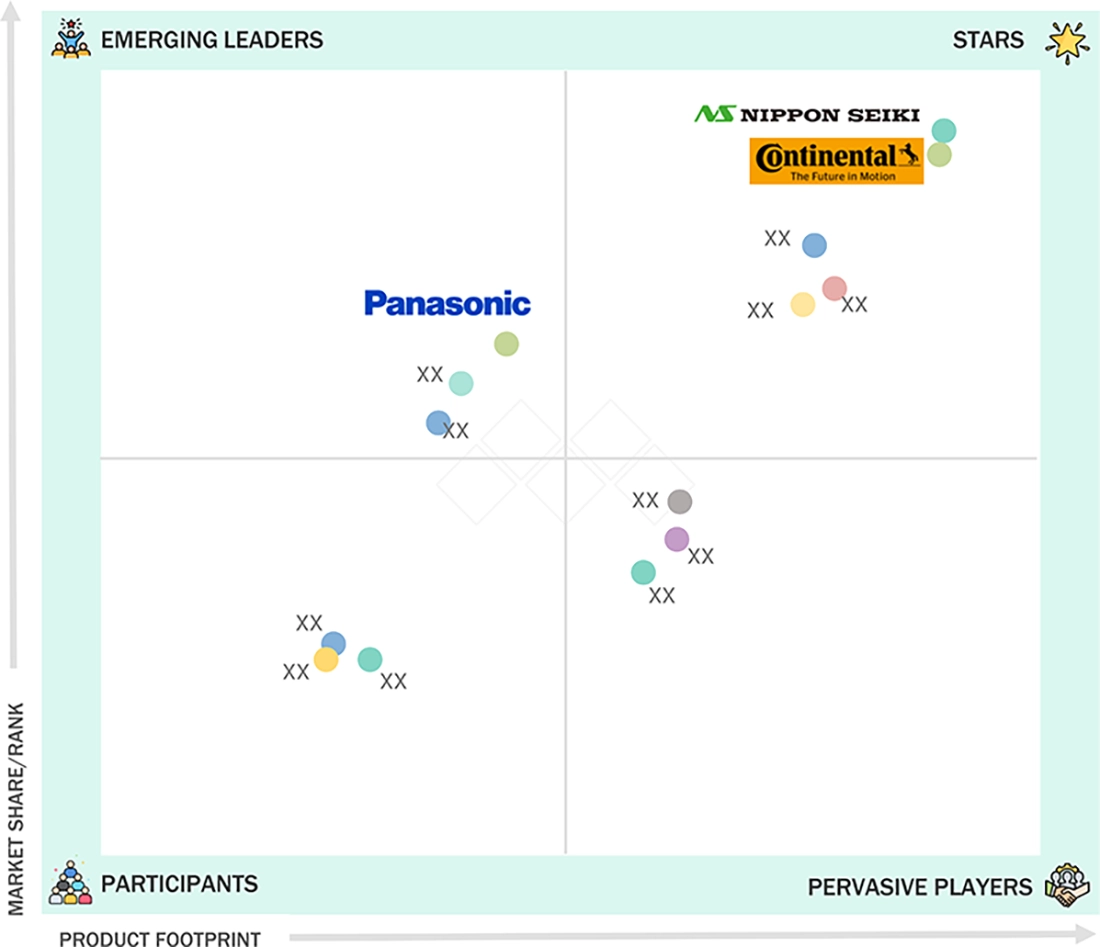
NORTH AMERICA HEAD-UP DISPLAY MARKET: COMPANY EVALUATION MATRIX
In the North America head-up display companies matrix, Nippon Seiki Co., Ltd. (Star) and Continental AG (Star) lead with strong market presence and extensive automotive HUD portfolios, enabling widespread adoption across passenger, premium, and electric vehicle segments. Their advanced windshield-based and AR head-up display solutions, deep integration with ADAS and vehicle electronics, and long-standing OEM partnerships drive large-scale deployments and reinforce their leadership position across the region. As an emerging player, Panasonic Corporation is strengthening its position through growing investments in next-generation automotive display technologies and selective OEM collaborations in North America.
Source: Secondary Research, Interviews with Experts, MarketsandMarkets Analysis
KEY MARKET PLAYERS
- Nippon Seiki Co., Ltd. (Japan)
- Continental AG (Germany)
- DENSO CORPORATION (Japan)
- E-LEAD ELECTRONIC CO. LTD (Taiwan)
- BAE Systems (UK)
- Yazaki Corporation (Japan)
- HARMAN International (US)
- Valeo (France)
- Panasonic Holdings Corporation (Japan)
- Garmin Ltd. (Switzerland)
MARKET SCOPE
| REPORT METRIC | DETAILS |
|---|---|
| Market Size in 2024 (Value) | USD 1.08 Billion |
| Market Size in 2030 (Value) | USD 1.90 Billion |
| Growth Rate | CAGR of 10.7% from 2025–2030 |
| Years Considered | 2021–2030 |
| Base Year | 2024 |
| Forecast Period | 2025–2030 |
| Units Considered | Value (USD Billion) and Volume (Thousand Units) |
| Report Coverage | Revenue Forecast, Company Ranking, Competitive Landscape, Growth Factors, and Trends |
| Segments Covered |
|
| Regional Scope | North America |
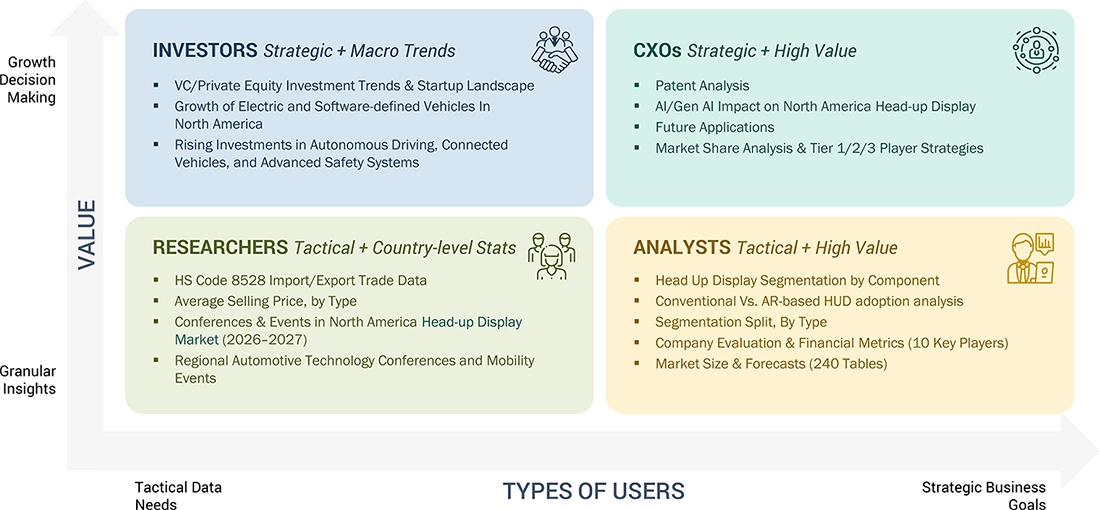
WHAT IS IN IT FOR YOU: NORTH AMERICA HEAD-UP DISPLAY MARKET REPORT CONTENT GUIDE
DELIVERED CUSTOMIZATIONS
We have successfully delivered the following deep-dive customizations:
| CLIENT REQUEST | CUSTOMIZATION DELIVERED | VALUE ADDS |
|---|---|---|
| North America Passenger Vehicle OEM (Premium & EV Focus) |
|
|
| Automotive Tier 1 Electronics Supplier |
|
|
| Electric Vehicle Startup or New OEM Entrant |
|
|
| Automotive Semiconductor or Optics Supplier |
|
|
| Mobility Technology or ADAS Software Provider |
|
|
RECENT DEVELOPMENTS
- April 2025 : Nippon Seiki Co., Ltd. entered a joint venture agreement with Emerging Display Technologies Corporation, a manufacturer of high-definition TFT LCD modules. Under this partnership, the two companies will establish a new jointly funded entity, EDT-India Private Limited, to manufacture TFT LCD modules in India.
- June 2024 : Valeo partnered with Dassault Systèmes to advance the digital transformation of its research and development operations. Through this collaboration, Valeo will utilize Dassault Systèmes' Global Modular Platform and Smart, Safe & Connected industry solution experiences, built on the 3DEXPERIENCE platform.
- January 2022 : Panasonic Holdings Corporation unveiled the AR-HUD 2.0, the first product to include a new patented eye-tracking system, ETS, enhancing the AR experience. This HUD also includes Al-powered navigation software with 3D AR overlays, icons, and mappings.
Table of Contents
 Exclusive indicates content/data unique to MarketsandMarkets and not available with any competitors.
Methodology
The study involved major activities in estimating the current market size for the North America head-up display market. Exhaustive secondary research was done to collect information on the market. The next step was to validate these findings, assumptions, and sizing with industry experts across the value chain using primary research. Different approaches, such as top-down and bottom-up, were employed to estimate the total market size. After that, the market breakup and data triangulation procedures were used to estimate the market size of the segments and subsegments of the North America head-up display market.
Secondary Research
The secondary research for this study involved gathering information from a range of credible sources. These included company annual reports, investor presentations, press releases, whitepapers, certified publications, and articles from reputable associations and government publications. Additional data was obtained from corporate filings, professional and trade associations, journals, and industry-recognized authors. Research from consortia, councils, and gold- and silver-standard websites, directories, and databases also contributed to the qualitative framework. Key global sources, such as the International Trade Centre (ITC) and the International Monetary Fund (IMF), were consulted to support and validate the market analysis.
Primary Research
Extensive primary research was conducted after understanding and analyzing the North America head-up display market scenario through secondary research. Several primary interviews were conducted with key opinion leaders from demand- and supply-side vendors across North America. Approximately 20% of the primary interviews were conducted with the demand side and 80% with the supply side. Primary data was collected through questionnaires, e-mails, and telephonic interviews. Various departments within organizations, such as sales, operations, and administration, were contacted to provide a holistic viewpoint in the report.
Market Size Estimation
Both top-down and bottom-up approaches were used to estimate and validate the total size of the North America head-up display market. These methods were also used extensively to estimate the size of various subsegments in the market. The research methodology used to estimate the market size includes the following:
Data Triangulation
After arriving at the overall size of the North America head-up display market through the process explained above, the overall market has been split into several segments. Data triangulation procedures have been employed to complete the overall market engineering process and arrive at the exact statistics for all the segments, wherever applicable. The data has been triangulated by studying various factors and trends from the demand and supply sides. The market has also been validated using top-down and bottom-up approaches.
Market Definition
A head-up display (HUD) is a visual system that projects key information, such as speed, navigation cues, or safety alerts, directly into the user’s line of sight, typically onto a windshield, combiner, or wearable device. Its purpose is to provide critical data without requiring the driver or pilot to look away from their primary viewpoint, thereby enhancing safety, reducing distractions, and improving situational awareness.
Key Stakeholders
- Raw material suppliers
- Original equipment manufacturers (OEMs)
- Original design manufacturers (ODM)
- Research institutes
- Head-up display solution providers
- Forums, alliances, and associations
- Governments and financial institutions
- Analysts and strategic business planners
- Distributors
- End users
Report Objectives
- To describe and forecast the size of the North America head-up display market, by type, component, form factor, and end user, in terms of value
- To describe and forecast the size of the North America head-up display market, by end user, in terms of volume
- To provide detailed information regarding the drivers, restraints, opportunities, and challenges influencing the growth of the North America head-up display market
- To provide an overview of the value chain pertaining to the North America head-up display ecosystem and the average selling prices of head-up displays
- To provide a detailed overview of the impact of AI/Gen AI and the US 2025 tariff on the North America head-up display market
- To provide information about key technological trends, trade analysis, and patents related to North America head-up displays
- To benchmark the market players using the proprietary company evaluation matrix framework, which analyzes them on various parameters within the broad categories of market ranking/share and product portfolio
- To analyze competitive developments, such as partnerships, acquisitions, agreements, collaborations, and product launches
- To strategically profile key players and analyze their market share, ranking, and core competencies
Customization Options
With the market data given, MarketsandMarkets offers customizations according to the company’s specific needs. The following customization options are available for the report:
Company Information:
- Detailed analysis and profiling of additional market players (up to 7)
Key Questions Addressed by the Report
What is the projected market value of the North America Head-Up Display (HUD) market?
The North America Head-Up Display (HUD) market is projected to reach a significant market value by the forecast period, driven by increasing demand for advanced driver assistance systems and enhanced in-vehicle safety features.
Which region is expected to dominate the North America Head-Up Display (HUD) market?
The United States is expected to dominate the North America Head-Up Display (HUD) market due to strong automotive innovation and early adoption of advanced technologies.
What are the key segments of the North America Head-Up Display (HUD) market?
The market is segmented by type, component, vehicle type, and country, with windshield HUDs and passenger vehicles accounting for a major share.
Who are the major key players in the North America Head-Up Display (HUD) market?
Major key players in the North America Head-Up Display (HUD) market include Continental AG, Denso Corporation, Visteon Corporation, Nippon Seiki Co., Ltd., and Panasonic Holdings Corporation.
What factors are driving the growth of the North America Head-Up Display (HUD) market?
The growth of the North America Head-Up Display (HUD) market is driven by rising focus on driver safety, increasing adoption of augmented reality HUDs, advancements in automotive electronics, and growing demand for premium vehicle features.


Personalize This Research
- Triangulate with your Own Data
- Get Data as per your Format and Definition
- Gain a Deeper Dive on a Specific Application, Geography, Customer or Competitor
- Any level of Personalization
Let Us Help You
- What are the Known and Unknown Adjacencies Impacting the North America Head-Up Display Market
- What will your New Revenue Sources be?
- Who will be your Top Customer; what will make them switch?
- Defend your Market Share or Win Competitors
- Get a Scorecard for Target Partners

Custom Market Research Services
We Will Customise The Research For You, In Case The Report Listed Above Does Not Meet With Your Requirements
Get 10% Free CustomisationTESTIMONIALS

Tetsuya Ohhira
Business Development Manager-Technology Business
Nikon Corporation,
Leading Japanese MNC specializing in optics and imaging productswww.nikon.com
MarketsandMarkets™ response
is quick. Their attitude is flexible and positive. Analyst Insights are globally considered and
significant. Client Services quickly respond to our inquiry and demand. Their wide range of global
surveys help us make our strategic plan.
We hope Knowledge Store will be easier to search
for a report.
VP - Marketing & Business Development
Leading Provider of Process Control Solutions
We engaged with MarketsandMarkets on a study to perform an analysis and recommend a Go-To-Market strategy for metrology and process control in the semiconductor market. The study was tailored to our targets and needs with well-defined milestones. Our overall experience with the MarketsandMarkets team was very good throughout the project in all aspects including the analysis methodologies used, the quality and depth of primary and secondary data sets, the professionalism and flexibility of the team and the ability to meet the target schedule and milestones. We want to thank MarketsandMarkets team for a job well done.






Growth opportunities and latent adjacency in North America Head-Up Display Market