



Polyols Market
Report Code
CH 3057
Published in
Aug, 2026, By MarketsandMarkets™
Polyols Market by Type (Polyether Polyols, Polyester Polyols), Application (Flexible Polyurethane Foam, Rigid Polyurethane Foam, CASE), End-use Industry (Building & Construction, Furnishing, Automotive, Electronics), and Region - Global Forecast to 2031

USD 22.49 BN
MARKET SIZE, 2031

CAGR 5.1%
(2026-2031)

316
REPORT PAGES

411
MARKET TABLES
OVERVIEW
Source: Secondary Research, Interviews with Experts, MarketsandMarkets Analysis
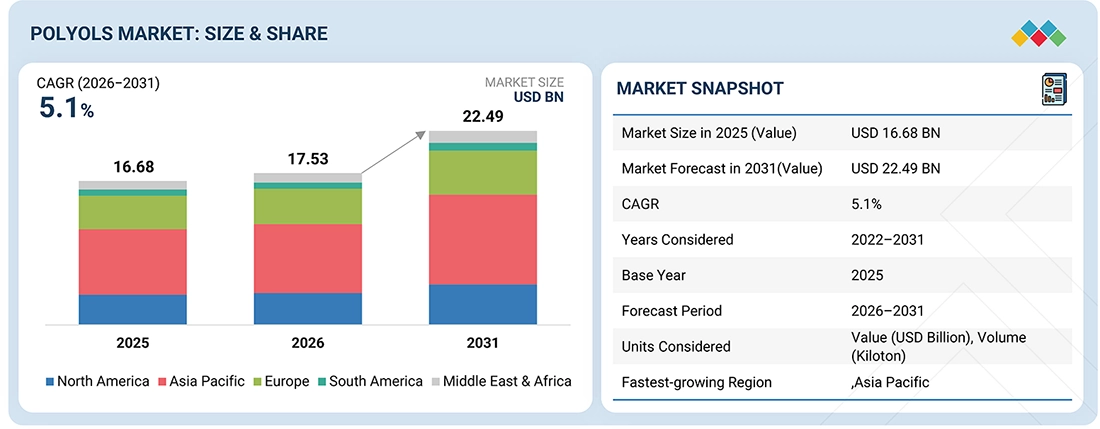
The polyols market is projected to grow from USD 17.53 billion in 2026 to USD 22.49 billion by 2031, at a CAGR of 5.1% during the forecast period. The polyols market is anticipated to experience substantial growth during the forecast period, due to growing demand for polyurethane products in the packaging, furniture, automobile and construction industries. The use of rigid polyurethane foams for thermal insulation is growing as investments in energy-efficient buildings continue to rise. The flexibility foam and interior material applications are driving the increasing adoption of polyols in the automotive industry for lightweight and fuel-efficient cars. The increasing need of consumers for comfortable furniture, mattresses and cushioning products is further contributing to the growth of the market. In addition, the use of bio-based and recycled polyols is growing, as is the use of stringent environmental standards and sustainability initiatives, resulting in new growth opportunities.
KEY TAKEAWAYS
-
By RegionAsia Pacific's polyols market dominated, with a share of 45.3% in 2025.
-
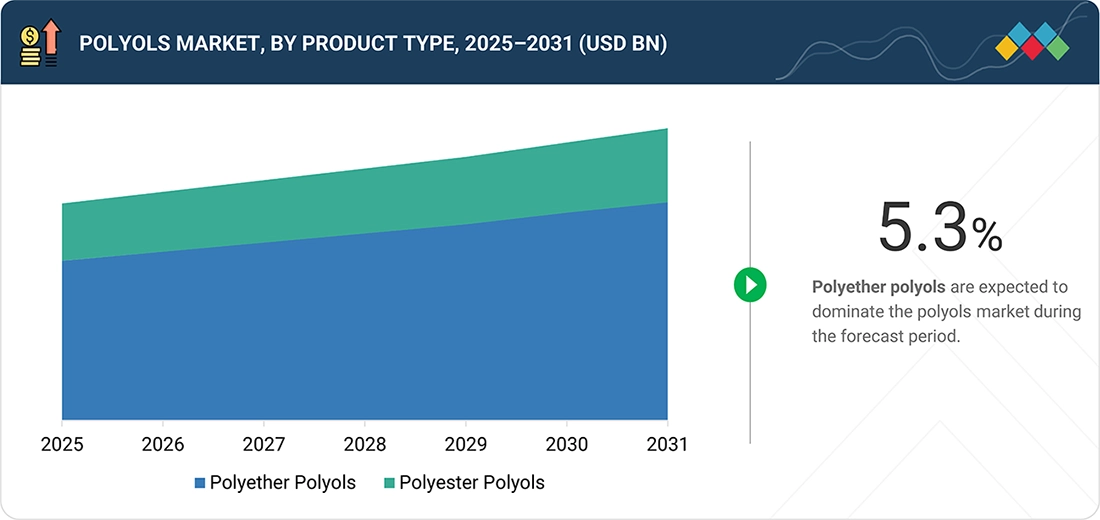
By TypeBy type, the polyether polyols segment is expected to lead, with a share of 73.8% in 2025, in terms of value.
-
By ApplicationBy application, flexible polyurethane foam is expected to be the leading segment in terms of value.
-
By End-use IndustryBy end-use industry, building & construction is expected to dominate the market, with a share of 28.7% in 2025, in terms of value.
-
Competitive Landscape - Key PlayersDOW, Covestro AG, BASF SE, Huntsman International LLC, Shell, Stepan Company, and Wanhua Chemical Group were identified as star players in the polyols market. These companies maintain strong market positions through a number of agreements and partnerships to cater to the growing demand for polyols across various end-use industries.
-
Competitive Landscape - StartupsZibo Dexin Lianbang Chemical Industry Co., Ltd., Shandong Longhua New Material Co., Ltd., Zhejiang Huafon New Materials Corp., Ltd., Shakun Industries, and InterPur Chemicals, among others, have distinguished themselves among startups and SMEs. These companies are gaining traction through expanding production capacities and investing in sustainable manufacturing technologies.
With the new developments of polyurethane formulations, the performance of products is being enhanced, and the application range is extended. Polyols are seeing an upward trend in consumption as the emerging economies, especially in the Asia Pacific region, experience rapid industrialization, urbanization, and infrastructure development.
TRENDS & DISRUPTIONS IMPACTING CUSTOMERS' CUSTOMERS
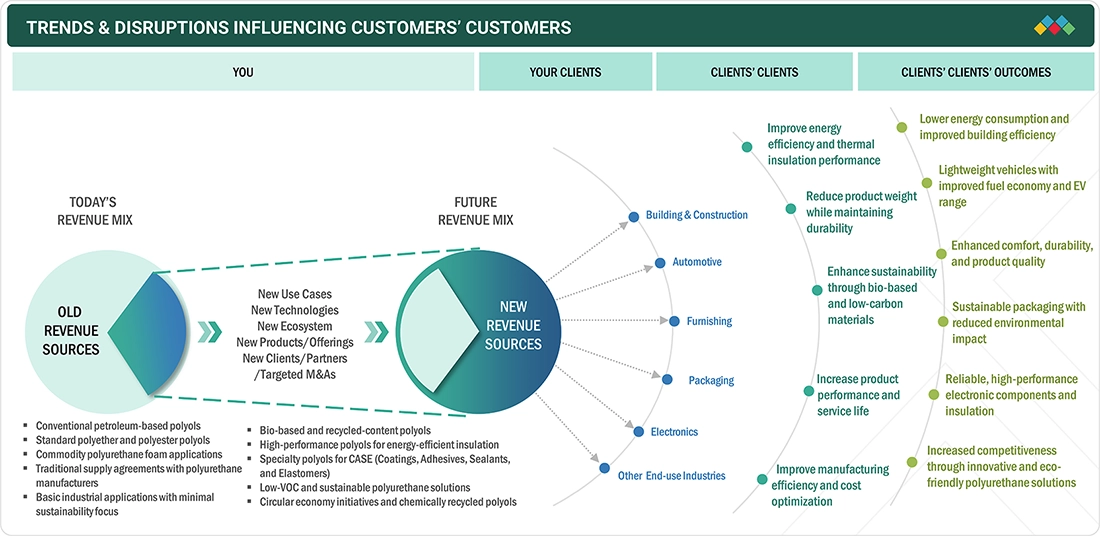
The polyols market is experiencing a transformation as bio-based and recycled polyols gain widespread acceptance, demand for polyols in construction, automotive, furniture, and insulation sectors continues to rise, and polyurethane technologies are constantly improving. Meanwhile, the market is experiencing disruptions due to fluctuating feedstock prices, uncertainty in supply chains, and increasingly stringent environmental regulations, leading manufacturers to diversify raw materials and invest in sustainable production processes.
Source: Secondary Research, Interviews with Experts, MarketsandMarkets Analysis
MARKET DYNAMICS

Drivers
Impact
Level
Level
-
Growth of packaging industry

-
Automotive light-weighting trend


RESTRAINTS
Impact
Level
Level
-
Complexity in recycling polyurethane products

-
Stringent environmental regulations for polyurethane foam


OPPORTUNITIES
Impact
Level
Level
-
Growing adoption of bio-based polyols

-
High-purity polyols for medical-grade applications


CHALLENGES
Impact
Level
Level
-
Eco-friendly alternatives

-
Cross-border compliance complexity for CASE polyols

Source: Secondary Research, Interviews with Experts, MarketsandMarkets Analysis
Driver: Automotive light-weighting trend
Lightweight vehicle design is a significant growth factor for the polyols market, as polyurethane foams contribute to minimizing the weight of vehicles while maintaining comfort, durability, and safety standards. Polyether polyols are used in the manufacture of seating, headrests, dashboards, and other interior parts, while rigid polyurethane foams offer lightweight insulation and structure. Automotive manufacturers are increasingly turning to advanced polyurethane materials as they strive to enhance fuel economy and increase driving range for EVs. The use of polyols in next-generation vehicle design and sustainable mobility is gaining momentum.
Restraint: Complexity in recycling polyurethane products
Polyurethanes are not easily melted and reprocessed like thermoplastics, making recycling polyurethane products difficult. The methods for recycling most plastics, including glycolysis and hydrolysis, are complex, expensive, and not yet commercialized. As a result, much polyurethane waste is disposed of by landfill or incineration, which pose environmental issues and regulatory pressures. These restrictions make it difficult to embrace circular economy practices and slow the sustainable growth of the polyols market.
Opportunity: Growing adoption of bio-based polyols
With rising demand for sustainable materials, bio-based polyols made from soybean oil, castor oil, and other renewable feedstocks are creating significant opportunities. These products will help reduce reliance on fossil-based raw materials and lower the carbon footprint in polyurethane production. Their use is gaining momentum across the construction industry and in the automotive, furniture, coatings, adhesives, sealants, and elastomers sectors, driven by supportive government policies, tougher environmental regulations, and growing consumer demand for green products. Market opportunities are expected to expand further through continuous innovation and investment in bio-based technologies.
Challenge: Cross-border compliance complexity for CASE polyols
CASE (Coatings, Adhesives, Sealants, and Elastomers) polyol manufacturers face significant challenges in meeting diverse regulatory requirements across international markets. Chemical regulations vary by region, including REACH in Europe, TSCA in the US, and the growing safety standards for Asian chemicals, which require comprehensive testing and certification. Operating under VOC limits and environmental standards also increases operating expenses and delays product approvals. These regulatory differences make international trade difficult, complicate supply chains, and pose challenges for companies seeking to expand internationally.
POLYOLS MARKET: COMMERCIAL USE CASES ACROSS INDUSTRIES
| COMPANY | USE CASE DESCRIPTION | BENEFITS |
|---|---|---|
 |
Covestro developed a sustainable cast polyurethane elastomer for offshore wind energy applications using Cardyon®, a CO2-based polyol. The solution was designed to deliver high durability, mechanical stability, and resistance to hydrolysis in harsh marine environments, while reducing dependence on fossil-based feedstocks and supporting environmental sustainability. | The CO2-based elastomer delivers excellent performance under dynamic loading, resists hydrolysis, and reduces the carbon footprint. It demonstrates the feasibility of using captured CO2 in demanding industrial applications, promoting circularity and sustainability across renewable energy sectors. |
 |
Huntsman produced TEROL® polyester polyols from recycled PET bottles to manufacture rigid polyurethane insulation foams. The goal was to divert plastic waste from landfills, improve building energy efficiency, and meet insulation performance and fire safety regulations for residential, commercial, and industrial applications. | TEROL® polyols improve compressive strength, thermal insulation, and flame-retardant performance while converting more than one billion PET bottles annually into valuable materials. This approach reduces plastic waste, lowers building energy consumption, and supports scalable, circular, and environmentally compliant construction solutions. |
 |
BASF engineered low-emission Lupranol® polyether polyols to reduce aldehyde emissions from polyurethane foams used in automotive interiors. The goal was to help OEMs meet strict VOC regulations while maintaining foam properties, including resilience, durability, and processability, for components such as headrests, seats, and insulation panels. | Low-emission polyols reduce formaldehyde and acetaldehyde by up to 20%, meeting VDA276 and BMW GS 97014-3 standards. The solution improves in-cabin air quality without affecting foam processing, supporting regulatory compliance and healthier environments for vehicle occupants. |
Logos and trademarks shown above are the property of their respective owners. Their use here is for informational and illustrative purposes only.
MARKET ECOSYSTEM
The polyols market ecosystem is characterized by a well-organized value-added chain that spans raw material sourcing, polyols production, distribution, and end-use products across various industries. Primary raw materials include petrochemical feedstocks such as propylene oxide, ethylene oxide, and glycerol, as well as renewable sources for bio-based polyols. Using sophisticated polymerization and modification technologies, polyol manufacturers such as BASF, Covestro, Dow, Huntsman, and Mitsui Chemicals convert these inputs into polyether polyols, polyester polyols, and specialty polyols. Distribution channels include direct bulk delivery, third-party distributors, and storage terminals, ensuring effective and timely supply to downstream industries. Polyols have wide-ranging end-use applications, including flexible and rigid polyurethane foams, coatings, adhesives, sealants, elastomers (CASE), automotive and construction applications, furniture, bedding, and packaging solutions.
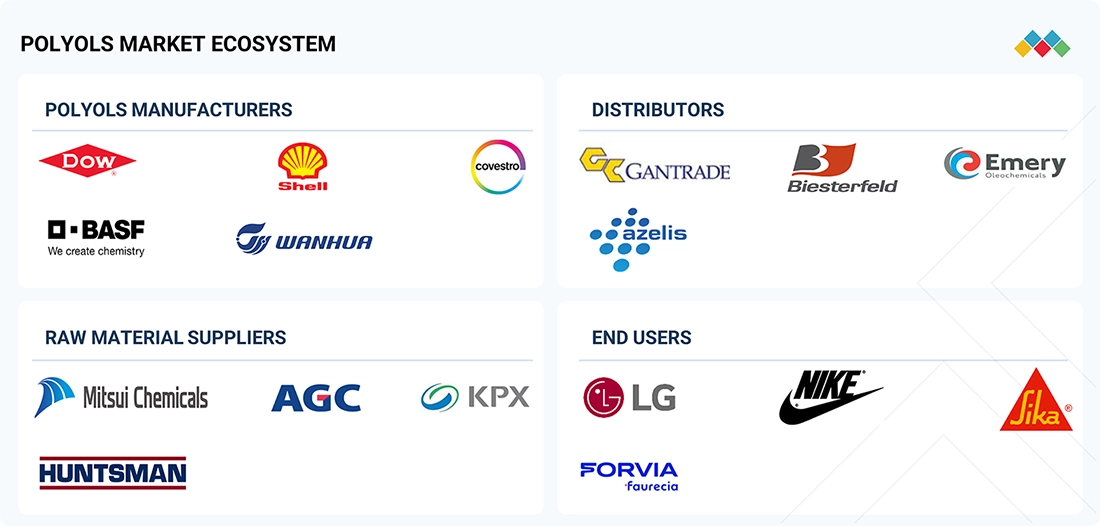
Logos and trademarks shown above are the property of their respective owners. Their use here is for informational and illustrative purposes only.
MARKET SEGMENTS
Source: Secondary Research, Interviews with Experts, MarketsandMarkets Analysis
Polyols Market, By Type
Polyether polyols propellant accounted for the largest share of the polyols market in 2025 due to their wide use in manufacturing flexible and rigid polyurethane foams. They are flexible, hydrolytically stable, and economical, and can be used for a variety of applications. They have excellent mechanical properties and are compatible with a wide range of additives, improving the performance of polyurethane. They also benefited from strong demand for their products from the construction, automotive, furniture, and appliance sectors.
Polyols Market, By Application
In 2025, flexible polyurethane foam accounted for the largest segment of the polyols market, as it is widely used in the furniture and bedding, automotive seating, and packaging industries. Due to its lightweight construction, durability, cushioning, and high level of comfort, it is the material of choice for consumer and industrial products. Urbanization has driven up consumption, as has the rising demand for comfortable furniture and vehicle interiors. The material also offers good resilience and durability, leading to more widespread use across end-use sectors.
Polyols Market, By End-use Industry
Building & construction accounted for the largest share of the polyols market in 2025, driven by rising demand for polyurethane insulation to improve the energy efficiency of residential and commercial buildings. Polyols are used in rigid polyurethane foam for wall insulation, roofing systems, doors, windows, and structural panels. Adoption is accelerating worldwide due to rapid urbanization, infrastructure development, and strict energy-efficiency regulations. The push for green buildings and sustainable construction has also contributed to demand. Government programs that encourage energy-efficient buildings are also driving long-term market growth.
REGION
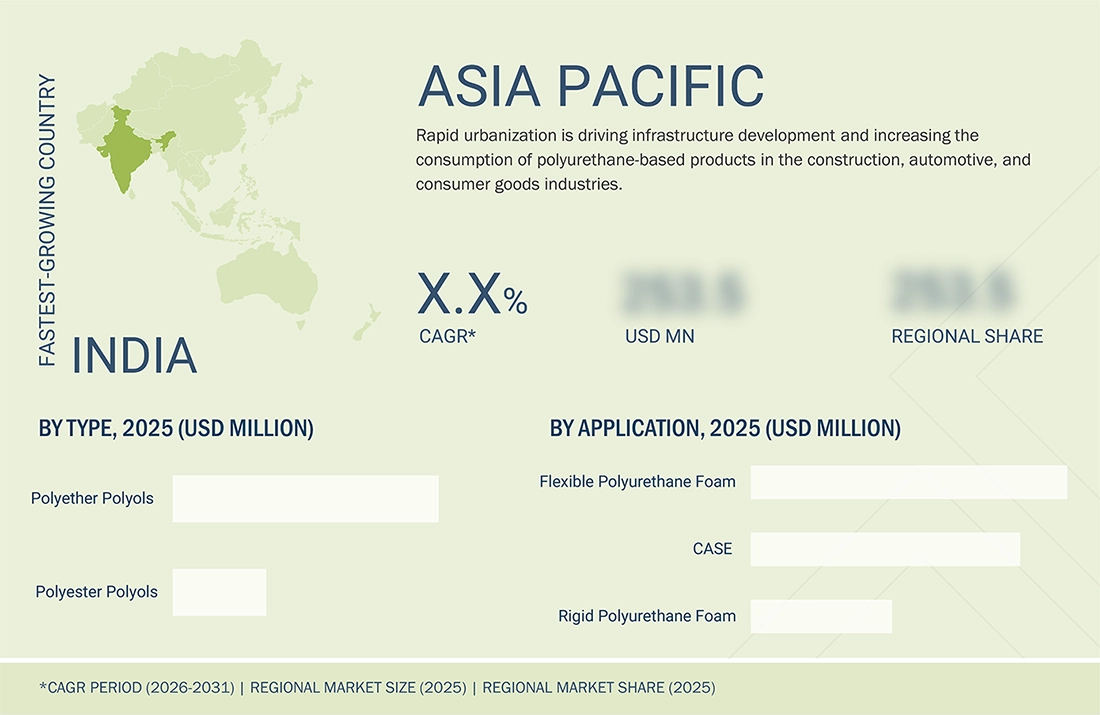
Asia Pacific is the leading region in the global polyols market
By region, Asia Pacific is the leading region in the polyols market, as the construction, automotive, furniture, and appliance industries are booming, especially in China, India, Japan, and South Korea. Polyurethane-based products have seen a significant surge in demand due to strong urbanization, infrastructure development, and rising disposable incomes in India. The region also has a strong manufacturing heritage, low manufacturing costs, and an abundant supply of raw materials. Polyol consumption is further driven by increased investments in industrial development and government support for energy-efficient buildings.
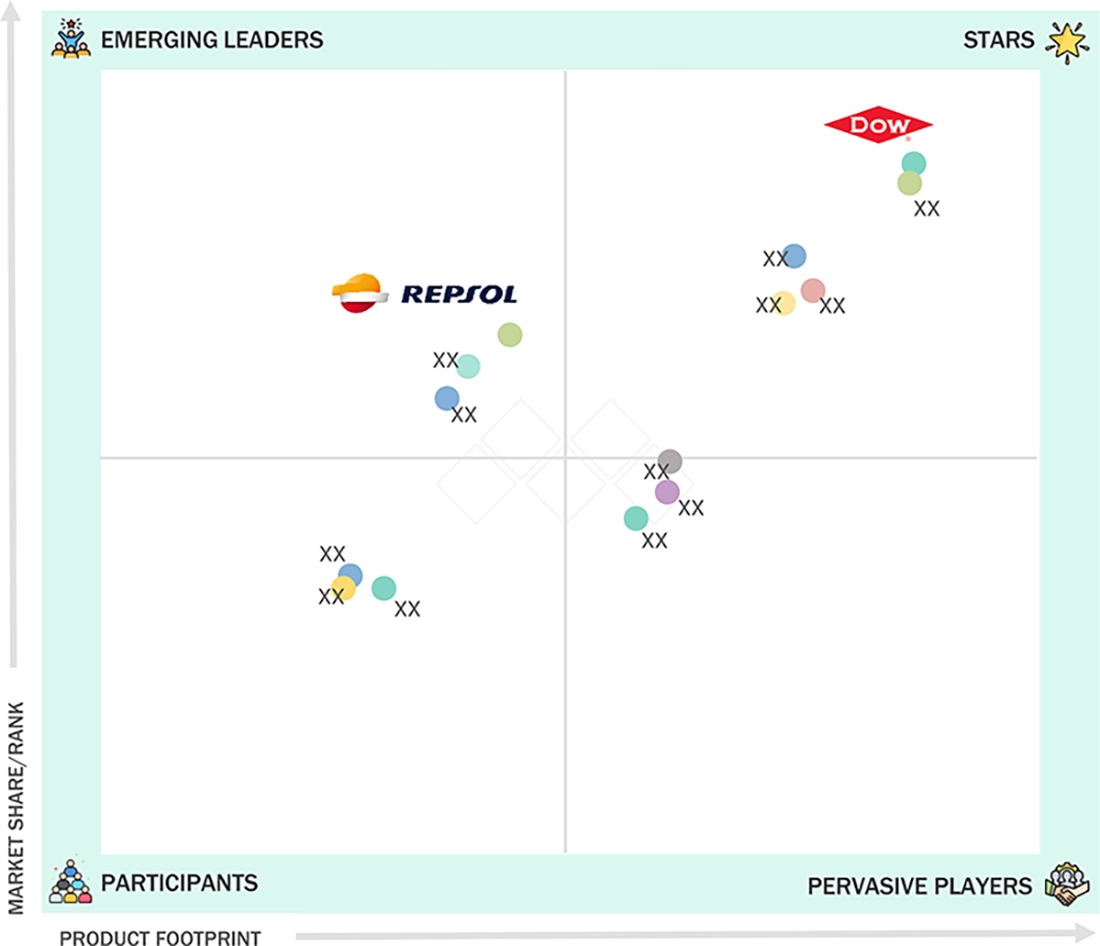
POLYOLS MARKET: COMPANY EVALUATION MATRIX
In the polyols market matrix, DOW (Star) leads due to its large production capacity, diversified polyols portfolio, and extensive global distribution network. Repsol S.A. (Emerging Leader) is gaining visibility for its innovative polyols solutions, focus on bio-based and specialty polyols, and strategic alliances to improve technological efficiency.
Source: Secondary Research, Interviews with Experts, MarketsandMarkets Analysis
KEY MARKET PLAYERS
- DOW (US)
- Covestro AG (Germany)
- BASF SE (Germany)
- Huntsman International LLC (US)
- Shell (UK)
- Stepan Company (US)
- Wanhua Chemical Group (China)
- Repsol S.A. (Spain)
- PCC SE (Germany)
- LANXESS (Germany)
- Zibo Dexin Lianbang Chemical Industry Co., Ltd. (China)
- Shandong Longhua New Material Co., Ltd (China)
- Zhejiang Huafon New Materials Corp., Ltd. (China)
- Shakun Industries (India)
- InterPur Chemicals (Spain)
MARKET SCOPE
| REPORT METRIC | DETAILS |
|---|---|
| Market Size in 2025 (Value) | USD 16.68 Billion |
| Market Size in 2026 (Value) | USD 17.53 Billion |
| Market Forecast in 2031 (Value) | USD 22.49 Billion |
| CAGR | 5.1% |
| Years Considered | 2022–2031 |
| Base Year | 2025 |
| Forecast Period | 2026–2031 |
| Units Considered | Value (USD Billion), Volume (Kiloton) |
| Report Coverage | Revenue forecast, company ranking, competitive landscape, growth factors, and trends |
| Segments Covered |
|
| Regions Covered | North America, Europe, Asia Pacific, South America, Middle East & Africa |
WHAT IS IN IT FOR YOU: POLYOLS MARKET REPORT CONTENT GUIDE
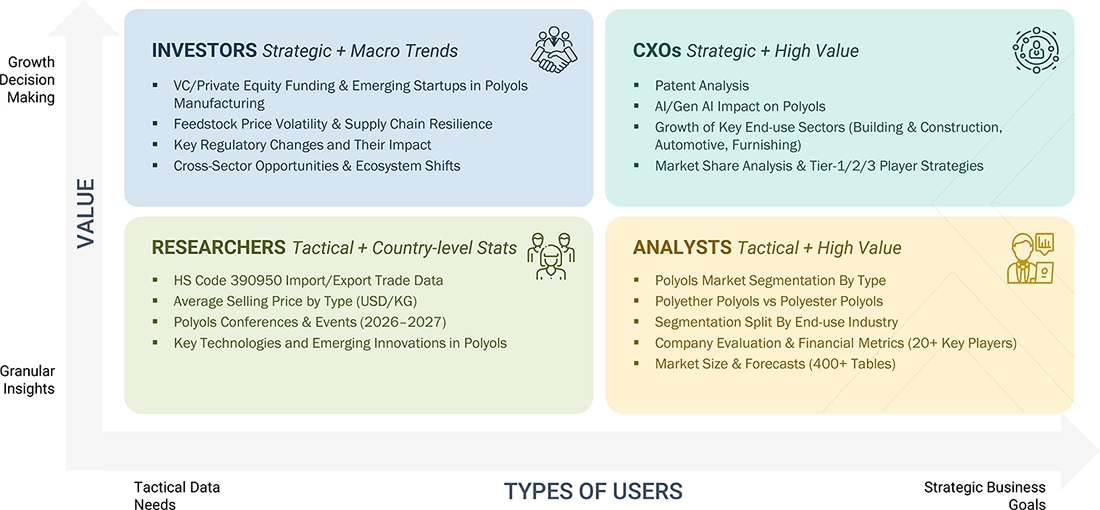
DELIVERED CUSTOMIZATIONS
We have successfully delivered the following deep-dive customizations:
| CLIENT REQUEST | CUSTOMIZATION DELIVERED | VALUE ADDS |
|---|---|---|
| Asia Pacific-based Polyols Market | Detailed company profiles of polyols market competitors (financials, product portfolio), type (polyether polyols and polyester polyols), and end-use industry (building & construction, automotive, furnishing, packaging, and other end-use industries) | Identified & profiled 20+ polyol producers across Asia Pacific Mapped demand trends across high-growth segments (building & construction, automotive, furnishing, packaging, and other end-use industries) |
| Europe-based Polyols Market | Detailed company profiles of polyols market competitors (financials, product portfolio), type (polyether polyols and polyester polyols), and end-use industry (building & construction, automotive, furnishing, packaging and other end-use industries) | Identified & profiled 20+ polyol producers across Europe Mapped demand trends across high-growth segments (building & construction, automotive, furnishing, packaging, and other end-use industries) |
RECENT DEVELOPMENTS
- March 2026: BASF SE (Germany) announced the first commercial production of its biomass-balance (BMB) polyether polyols in North America at its Geismar, Louisiana, site. The ISCC PLUS-certified portfolio uses renewable, bio-circular feedstocks through a mass-balance approach while maintaining the specifications and processing characteristics of conventional polyether polyols. The products are intended for sleep products, automotive and coatings, adhesives, sealants and elastomers (CASE) applications.
- October 2025: Huntsman International LLC (US) successfully manufactured Mannich polyol at its Houston Port facility following a production-consolidation project that began in January 2025. The project involved converting an existing polyester polyol reactor and adding the necessary production and storage capabilities, consolidating production of polyester and Mannich polyols for Huntsman Building Solutions across two sites instead of three.
- October 2025: DOW (US) announced plans to close its polyols plant in Tertre, Belgium, by the end of the first quarter of 2026. The planned shutdown was part of its polyurethane business’s effort to optimize its European production footprint, with the facility having an annual polyether polyol capacity of approximately 55,000 tonnes. Dow stated that it did not expect the closure to negatively affect customer supply or the required product mix.
- July 2025: Covestro AG (Germany) declared force majeure for relevant product deliveries from its Dormagen site following a fire at an external substation on July 12, 2025. The power outage affected polyether polyol operations, among other production units, disrupting supply of the affected products. Covestro reported that the force majeure declarations had not been fully cancelled by December 31, 2025.
- May 2025: BASF introduced the Sovermol® bio-based polyol line, including rapeseed-, soybean-, and castor-oil-derived, low-viscosity, 100% solids products ideal for coatings, adhesives, PU foams, and reactive diluents, expanding global availability (including Sovermol 805ap from India).
Table of Contents
 Exclusive indicates content/data unique to MarketsandMarkets and not available with any competitors.
TITLE
PAGE NO
1
INTRODUCTION
28
2
EXECUTIVE SUMMARY
32
3
PREMIUM INSIGHTS
38
4
MARKET OVERVIEW
Leverage bio-based polyols to capitalize on eco-friendly trends and unmet market needs.
42
4.1
INTRODUCTION
4.2
MARKET DYNAMICS
4.2.1
DRIVERS
4.2.1.1
EXPANDING PACKAGING INDUSTRY
4.2.1.2
INCREASING AUTOMOBILE LIGHTWEIGHTING TREND
4.2.1.3
RISING USE OF FLEXIBLE PU IN WEARABLES AND FOOTWEAR
4.2.2
RESTRAINTS
4.2.2.1
COMPLEXITY IN RECYCLING POLYURETHANE PRODUCTS
4.2.2.2
STRINGENT ENVIRONMENTAL REGULATIONS ASSOCIATED WITH POLYURETHANE FOAM
4.2.3
OPPORTUNITIES
4.2.3.1
GROWING ADOPTION OF BIO-BASED POLYOLS
4.2.3.2
ADOPTION OF HIGH-PURITY POLYOLS FOR MEDICAL-GRADE APPLICATIONS
4.2.4
CHALLENGES
4.2.4.1
SHIFT TOWARD ECO-FRIENDLY ALTERNATIVES
4.2.4.2
CROSS-BORDER COMPLIANCE COMPLEXITY RELATED TO CASE POLYOLS
4.3
UNMET NEEDS AND WHITE SPACES
4.3.1
UNMET NEEDS IN POLYOLS MARKET
4.3.1.1
HIGH-PERFORMANCE BIO-BASED POLYOLS WITH CONSISTENT QUALITY ACROSS DIVERSE RENEWABLE FEEDSTOCKS
4.3.1.2
LOW-CARBON POLYOLS THAT DELIVER PREMIUM MECHANICAL PERFORMANCE WITHOUT COST PENALTIES
4.3.1.3
UNIVERSAL RECYCLED POLYOLS SUITABLE FOR HIGH-VALUE POLYURETHANE APPLICATIONS
4.3.2
WHITE SPACE OPPORTUNITIES
4.3.2.1
CARBON-NEGATIVE POLYOLS CAPABLE OF PERMANENT LONG-TERM CARBON STORAGE
4.3.2.2
SELF-OPTIMIZING POLYOLS FOR ADAPTIVE POLYURETHANE PROCESSING ACROSS MULTIPLE MANUFACTURING CONDITIONS
4.4
INTERCONNECTED MARKETS AND CROSS-SECTOR OPPORTUNITIES
4.4.1
INTERCONNECTED MARKETS
4.4.2
CROSS-SECTOR OPPORTUNITIES
4.4.3
STRATEGIC MOVES BY TIER 1/2/3 PLAYERS
4.4.4
KEY MOVES AND STRATEGIC FOCUS
5
INDUSTRY TRENDS
Navigate competitive forces and macroeconomic shifts to leverage emerging polyol market opportunities.
54
5.1
PORTER’S FIVE FORCES ANALYSIS
5.1.1
THREAT OF NEW ENTRANTS
5.1.2
THREAT OF SUBSTITUTES
5.1.3
BARGAINING POWER OF SUPPLIERS
5.1.4
BARGAINING POWER OF BUYERS
5.1.5
INTENSITY OF COMPETITIVE RIVALRY
5.2
MACROECONOMIC ANALYSIS
5.2.1
INTRODUCTION
5.2.2
GDP TRENDS AND FORECASTS
5.2.3
GLOBAL CONSTRUCTION TRENDS
5.2.4
AUTOMOBILE PRODUCTION CYCLES
5.3
VALUE CHAIN ANALYSIS
5.4
ECOSYSTEM ANALYSIS
5.5
PRICING ANALYSIS
5.5.1
AVERAGE SELLING PRICE OF POLYOLS OFFERED BY KEY PLAYERS, BY TYPE
5.5.2
AVERAGE SELLING PRICE TREND, BY REGION
5.6
TRADE ANALYSIS
5.6.1
IMPORT DATA RELATED TO HS CODE 390950, BY COUNTRY, 2021–2025 (USD THOUSAND)
5.6.2
EXPORT DATA RELATED TO HS CODE 390950, BY COUNTRY, 2021–2025 (USD THOUSAND)
5.7
KEY CONFERENCES AND EVENTS, 2026–2027
5.8
TRENDS/DISRUPTIONS IMPACTING CUSTOMER BUSINESS
5.9
INVESTMENT AND FUNDING SCENARIO
5.10
CASE STUDY ANALYSIS
5.10.1
COVESTRO DEVELOPS SUSTAINABLE CAST ELASTOMER SOLUTION FOR OFFSHORE INDUSTRY USING CO2-BASED POLYOLS
5.10.2
HUNTSMAN TRANSFORMS PLASTIC WASTE INTO ENERGY-SAVING INSULATION THROUGH TEROL POLYESTER POLYOLS
5.10.3
BASF REDUCES INTERIOR CAR EMISSIONS WITH LOW-EMISSION LUPRANOL POLYETHER POLYOLS
5.11
IMPACT OF 2025 US TARIFFS ON POLYOLS MARKET
5.11.1
INTRODUCTION
5.11.2
KEY TARIFF RATES
5.11.3
PRICE IMPACT ANALYSIS
5.11.4
KEY IMPACT ON VARIOUS REGIONS
5.11.4.1
US
5.11.4.2
EUROPE
5.11.4.3
ASIA PACIFIC
5.11.5
IMPACT ON END-USE INDUSTRIES
5.12
TECHNOLOGICAL ADVANCEMENTS
5.12.1
KEY TECHNOLOGIES
5.12.1.1
POLYESTER-ESTERIFICATION
5.12.1.2
RING-OPENING POLYMERIZATION (ROP)
5.12.2
COMPLEMENTARY TECHNOLOGIES
5.12.2.1
BLOWING AGENT TECHNOLOGY
5.12.2.2
RECYCLING AND RECOVERY TECHNOLOGY
5.12.3
ADJACENT TECHNOLOGIES
5.12.3.1
CO2-BASED POLYOLS
5.12.3.2
SMART FOAMS AND COMPOSITES
5.13
TECHNOLOGY/PRODUCT ROADMAP
5.13.1
SHORT-TERM (2025–2027) | PROCESS OPTIMIZATION & CIRCULAR FEEDSTOCK INTEGRATION PHASE
5.13.2
MID-TERM (2027–2030) | ADVANCED CIRCULAR MANUFACTURING & LOW-CARBON PRODUCTION PHASE
5.13.3
LONG-TERM (2030–2035+): NET-ZERO & NEXT-GENERATION POLYOL PRODUCTION PHASE
5.14
PATENT ANALYSIS
5.15
FUTURE APPLICATIONS
5.15.1
POLYOLS FOR STRUCTURAL BATTERY COMPOSITES
5.15.2
POLYOLS FOR ADAPTIVE THERMAL REGULATING BUILDING ENVELOPES
5.15.3
POLYOLS FOR BIORESORBABLE 4D PRINTED MEDICAL IMPLANTS
5.15.4
POLYOLS FOR QUANTUM COMPUTING ENCAPSULATION MATERIALS
5.15.5
POLYOLS FOR NEUROMORPHIC BIOELECTRONIC INTERFACES
5.16
IMPACT OF AI/GENERATIVE AI ON POLYOLS MARKET
5.16.1
TOP USE CASES AND MARKET POTENTIAL
5.16.2
BEST PRACTICES IN AI ADOPTION
5.16.3
CASE STUDIES OF AI IMPLEMENTATION IN POLYOLS MARKET
5.16.4
INTERCONNECTED ADJACENT ECOSYSTEM AND IMPACT ON MARKET PLAYERS
5.16.5
CLIENTS’ READINESS TO ADOPT GENERATIVE AI IN POLYOLS MARKET
6
SUSTAINABILITY AND REGULATORY LANDSCAPE
Navigate complex regulations to leverage eco-friendly polyol innovations and reduce carbon footprints globally.
88
6.1
REGIONAL REGULATIONS AND COMPLIANCE
6.1.1
REGULATORY BODIES, GOVERNMENT AGENCIES, AND OTHER ORGANIZATIONS
6.1.2
INDUSTRY STANDARDS
6.2
SUSTAINABILITY INITIATIVES
6.2.1
CARBON IMPACT AND ECO-APPLICATIONS OF POLYOLS
6.2.1.1
CARBON IMPACT REDUCTION
6.2.1.2
ECO-APPLICATIONS
6.3
SUSTAINABILITY IMPACT AND REGULATORY POLICY INITIATIVES
6.4
CERTIFICATIONS, LABELING, AND ECO-STANDARDS
7
CUSTOMER LANDSCAPE & BUYER BEHAVIOR
Unlock revenue by navigating stakeholder influence and unmet needs in polyols' top industries.
97
7.1
DECISION-MAKING PROCESS
7.2
BUYER STAKEHOLDERS AND BUYING EVALUATION CRITERIA
7.2.1
KEY STAKEHOLDERS IN BUYING PROCESS
7.2.2
BUYING CRITERIA
7.3
ADOPTION BARRIERS & INTERNAL CHALLENGES
7.4
UNMET NEEDS FROM VARIOUS END-USE INDUSTRIES
7.5
MARKET PROFITABILITY
7.5.1
REVENUE POTENTIAL
7.5.2
COST DYNAMICS
7.5.3
MARGIN OPPORTUNITIES, BY END-USE INDUSTRY
8
POLYOLS MARKET, BY TYPE
Market Size & Growth Rate Forecast Analysis to 2031 in USD Million and Kilotons | 5 Data Tables
105
8.1
INTRODUCTION
8.2
POLYETHER POLYOLS
8.2.1
HIGH REACTIVITY, VERSATILE MOLECULAR DESIGN, AND COMPATIBILITY WITH VARIOUS ISOCYANATES TO DRIVE DEMAND
8.3
POLYESTER POLYOLS
8.3.1
ENHANCED POLYURETHANE STRENGTH IN COATINGS, ELASTOMERS, AND FOAMS TO DRIVE MARKET
9
POLYOLS MARKET, BY APPLICATION
Market Size & Growth Rate Forecast Analysis to 2031 in USD Million and Kilotons | 4 Data Tables
110
9.1
INTRODUCTION
9.2
FLEXIBLE POLYURETHANE FOAM
9.2.1
INCREASED USE IN CUSHIONING AND COMFORT APPLICATIONS
9.3
RIGID POLYURETHANE FOAMS
9.3.1
USE IN HIGH-PERFORMANCE INSULATION SYSTEMS
9.4
COATINGS, ADHESIVES, SEALANTS, AND ELASTOMERS (CASE)
9.4.1
HIGH MECHANICAL PERFORMANCE, CHEMICAL RESISTANCE, AND ENVIRONMENTAL DURABILITY
10
POLYOLS MARKET, BY END-USE INDUSTRY
Market Size & Growth Rate Forecast Analysis to 2031 in USD Million and Kilotons | 4 Data Tables
115
10.1
INTRODUCTION
10.2
BUILDING & CONSTRUCTION
10.2.1
ADOPTION OF HIGH-PERFORMANCE INSULATION SYSTEMS IN MODERN BUILDING AND CONSTRUCTION
10.3
AUTOMOTIVE
10.3.1
ABILITY TO SUPPORT LIGHTWEIGHT, DURABLE, AND LOW-EMISSION SOLUTIONS IN AUTOMOBILE APPLICATIONS
10.4
FURNISHING
10.4.1
ENHANCED COMFORT, DURABILITY, AND SUSTAINABILITY IN MODERN FURNISHING APPLICATIONS
10.5
PACKAGING
10.5.1
ABILITY TO OFFER HIGH-PERFORMANCE, INSULATED, AND SUSTAINABLE SOLUTIONS IN ADVANCED PACKAGING APPLICATIONS TO DRIVE MARKET
10.6
ELECTRONICS
10.6.1
ADOPTION TO DELIVER ESSENTIAL PROTECTION AND INSULATION IN ADVANCED ELECTRONIC COMPONENTS
10.7
OTHER END-USE INDUSTRIES
11
POLYOLS MARKET, BY REGION
Comprehensive coverage of 8 Regions with country-level deep-dive of 20 Countries | 292 Data Tables.
121
11.1
INTRODUCTION
11.2
ASIA PACIFIC
11.2.1
CHINA
11.2.1.1
NEW ENERGY VEHICLE (NEV) GROWTH, RAPID URBANIZATION, AND EXPANDING ELECTRONICS INDUSTRY TO PROPEL DEMAND
11.2.2
INDIA
11.2.2.1
RISING INFRASTRUCTURE DEVELOPMENT INVESTMENTS, EV ADOPTION, AND BOOMING FURNITURE INDUSTRY TO DRIVE DEMAND
11.2.3
JAPAN
11.2.3.1
GROWING AUTOMOTIVE AND FURNITURE INDUSTRIES TO FUEL DEMAND
11.2.4
SOUTH KOREA
11.2.4.1
EXPANDING EV INDUSTRY AND HOUSING DEVELOPMENT TO PROPEL DEMAND
11.2.5
THAILAND
11.2.5.1
BOOMING CONSTRUCTION, AUTOMOTIVE, AND ELECTRONICS INDUSTRIES TO DRIVE MARKET
11.2.6
INDONESIA
11.2.6.1
SMART CITY DEVELOPMENT AND INDUSTRIAL EXPANSION TO DRIVE DEMAND
11.2.7
REST OF ASIA PACIFIC
11.3
EUROPE
11.3.1
GERMANY
11.3.1.1
BOOMING AUTOMOTIVE, CONSTRUCTION, AND ELECTRONICS INDUSTRIES TO FUEL DEMAND
11.3.2
UK
11.3.2.1
ROBUST INFRASTRUCTURE DEVELOPMENT AND ADVANCEMENTS IN AUTOMOTIVE AND ELECTRONICS INDUSTRIES TO DRIVE DEMAND
11.3.3
FRANCE
11.3.3.1
RISING URBANIZATION AND INDUSTRIAL RESURGENCE TO DRIVE DEMAND
11.3.4
ITALY
11.3.4.1
INFRASTRUCTURE UPGRADES, INDUSTRIAL REVIVAL, AND EXPORT GROWTH TO PROPEL DEMAND
11.3.5
RUSSIA
11.3.5.1
ACCELERATING HOUSING TARGETS AND AUTOMOTIVE SECTOR REBOUND TO FUEL DEMAND
11.3.6
TURKEY
11.3.6.1
SURGING HOME SALES, VEHICLE PRODUCTION, AND FURNITURE EXPORTS TO FUEL DEMAND
11.3.7
REST OF EUROPE
11.4
NORTH AMERICA
11.4.1
US
11.4.1.1
SURGING CONSTRUCTION ACTIVITIES, EV ADOPTION, AND FURNITURE DEMAND TO DRIVE MARKET
11.4.2
CANADA
11.4.2.1
BOOMING CONSTRUCTION INDUSTRY AND EV INVESTMENTS TO FUEL DEMAND
11.4.3
MEXICO
11.4.3.1
INCREASING AUTOMOBILE PRODUCTION AND ELECTRONICS TRADE TO DRIVE DEMAND
11.5
MIDDLE EAST & AFRICA
11.5.1
GCC COUNTRIES
11.5.1.1
SAUDI ARABIA
11.5.1.1.1
RISING INFRASTRUCTURE DEVELOPMENT AND AUTOMOTIVE MARKET TO PROPEL DEMAND
11.5.1.2
UAE
11.5.1.2.1
EXPANDING REAL ESTATE SECTOR AND EV INFRASTRUCTURE GROWTH TO DRIVE DEMAND
11.5.1.3
REST OF GCC COUNTRIES
11.5.2
SOUTH AFRICA
11.5.2.1
EXPANDING REAL ESTATE SECTOR AND INCREASING AUTOMOBILE PRODUCTION TO FUEL DEMAND
11.5.3
REST OF MIDDLE EAST & AFRICA
11.6
SOUTH AMERICA
11.6.1
BRAZIL
11.6.1.1
SURGING CONSTRUCTION AND EV MANUFACTURING INVESTMENTS TO DRIVE DEMAND
11.6.2
ARGENTINA
11.6.2.1
RESIDENTIAL EXPANSION AND EV ADOPTION ACCELERATING MATERIAL NEEDS TO DRIVE DEMAND
11.6.3
REST OF SOUTH AMERICA
12
COMPETITIVE LANDSCAPE
Discover how market leaders and emerging players are reshaping the competitive landscape.
208
12.1
OVERVIEW
12.2
KEY PLAYER STRATEGIES/RIGHT TO WIN
12.3
REVENUE ANALYSIS
12.4
MARKET SHARE ANALYSIS
12.5
COMPANY VALUATION AND FINANCIAL METRICS
12.6
BRAND/PRODUCT COMPARISON
12.7
COMPANY EVALUATION MATRIX: KEY PLAYERS, 2025
12.7.1
STARS
12.7.2
EMERGING LEADERS
12.7.3
PERVASIVE PLAYERS
12.7.4
PARTICIPANTS
12.7.5
COMPANY FOOTPRINT: KEY PLAYERS, 2025
12.7.5.1
COMPANY FOOTPRINT
12.7.5.2
REGION FOOTPRINT
12.7.5.3
TYPE FOOTPRINT
12.7.5.4
APPLICATION FOOTPRINT
12.7.5.5
END-USE INDUSTRY FOOTPRINT
12.8
COMPANY EVALUATION MATRIX: STARTUPS/SMES, 2025
12.8.1
PROGRESSIVE COMPANIES
12.8.2
RESPONSIVE COMPANIES
12.8.3
DYNAMIC COMPANIES
12.8.4
STARTING BLOCKS
12.8.5
COMPETITIVE BENCHMARKING: STARTUPS/SMES, 2025
12.8.5.1
DETAILED LIST OF KEY STARTUPS/SMES
12.8.5.2
COMPETITIVE BENCHMARKING OF KEY STARTUPS/SMES
12.9
COMPETITIVE SCENARIO
12.9.1
PRODUCT LAUNCHES
12.9.2
DEALS
12.9.3
EXPANSIONS
13
COMPANY PROFILES
In-depth Company Profiles of Leading Market Players with detailed Business Overview, Product and Service Portfolio, Recent Developments, and Unique Analyst Perspective (MnM View)
233
13.1
KEY PLAYERS
13.1.1
DOW
13.1.1.1
BUSINESS OVERVIEW
13.1.1.2
PRODUCTS/SOLUTIONS/SERVICES OFFERED
13.1.1.3
RECENT DEVELOPMENTS
13.1.1.3.1
PRODUCT LAUNCHES
13.1.1.3.2
EXPANSIONS
13.1.1.3.3
OTHERS
13.1.1.4
MNM VIEW
13.1.1.4.1
KEY STRENGTHS/RIGHT TO WIN
13.1.1.4.2
STRATEGIC CHOICES
13.1.1.4.3
WEAKNESSES/COMPETITIVE THREATS
13.1.2
COVESTRO AG
13.1.3
BASF SE
13.1.4
HUNTSMAN INTERNATIONAL LLC
13.1.5
SHELL
13.1.6
STEPAN COMPANY
13.1.7
WANHUA CHEMICAL GROUP
13.1.8
REPSOL S.A.
13.1.9
PCC SE
13.1.10
LANXESS
13.2
OTHER PLAYERS
13.2.1
ZIBO DEXIN LIANBANG CHEMICAL INDUSTRY CO., LTD.
13.2.2
SHANDONG LONGHUA NEW MATERIAL CO., LTD.
13.2.3
ZHEJIANG HUAFON NEW MATERIALS CORP., LTD.
13.2.4
SHAKUN INDUSTRIES
13.2.5
MANALI PETROCHEMICALS LIMITED
13.2.6
POLYOLS & POLYMERS PVT LTD.
13.2.7
KURARAY CO., LTD.
13.2.8
SUMITOMO BAKELITE HIGH PERFORMANCE PLASTICS (SBHPP)
13.2.9
ERCA ADVANCED POLYMER SOLUTIONS
13.2.10
SINOCHEM HOLDINGS CORPORATION LTD.
13.2.11
DAICEL CORPORATION
13.2.12
EMERY OLEOCHEMICALS
13.2.13
SOLVAY
13.2.14
PERSTORP
13.2.15
ARAMCO
13.2.16
TOSOH CORPORATION
13.2.17
ARKEMA
13.2.18
PLUSKIM
13.2.19
PURINOVA SP. Z O.O.
13.2.20
PTT GLOBAL CHEMICAL PUBLIC COMPANY LIMITED
14
RESEARCH METHODOLOGY
299
14.1
RESEARCH DATA
14.1.1
SECONDARY DATA
14.1.1.1
KEY DATA FROM SECONDARY SOURCES
14.1.1.2
LIST OF SECONDARY SOURCES
14.1.2
PRIMARY DATA
14.1.2.1
KEY PRIMARY PARTICIPANTS
14.2
MARKET SIZE ESTIMATION
14.2.1
TOP-DOWN APPROACH
14.2.2
BOTTOM-UP APPROACH
14.2.3
BASE NUMBER CALCULATION
14.2.4
SUPPLY-SIDE ANALYSIS
14.3
GROWTH FORECAST
14.4
DATA TRIANGULATION
14.5
RESEARCH LIMITATIONS
14.6
RISK ASSESSMENT
15
APPENDIX
308
15.1
DISCUSSION GUIDE
15.2
KNOWLEDGESTORE: MARKETSANDMARKETS’ SUBSCRIPTION PORTAL
15.3
CUSTOMIZATION OPTIONS
15.4
RELATED REPORTS
15.5
AUTHOR DETAILS
LIST OF TABLES
TABLE 1
IMPACT OF PORTER’S FIVE FORCES ANALYSIS ON POLYOLS MARKET
TABLE 2
GLOBAL GDP GROWTH PROJECTION, 2021–2028 (USD TRILLION)
TABLE 3
ROLES OF COMPANIES IN POLYOLS ECOSYSTEM
TABLE 4
AVERAGE SELLING PRICE OF POLYOLS OFFERED BY KEY PLAYERS, BY TYPE, 2025 (USD/KG)
TABLE 5
AVERAGE SELLING PRICE TREND OF POLYOLS, BY REGION, 2022–2025 (USD/KG)
TABLE 6
IMPORT DATA RELATED TO HS CODE 390950, BY COUNTRY, 2021–2025 (USD THOUSAND)
TABLE 7
EXPORT DATA RELATED TO HS CODE 390950, BY COUNTRY, 2021–2025 (USD THOUSAND)
TABLE 8
POLYOLS MARKET: KEY CONFERENCES AND EVENTS, 2026-2027
TABLE 9
COVESTRO DEVELOPS SUSTAINABLE CAST ELASTOMER SOLUTION FOR OFFSHORE INDUSTRY USING CO2-BASED POLYOLS
TABLE 10
HUNTSMAN TRANSFORMS PLASTIC WASTE INTO ENERGY-SAVING INSULATION THROUGH TEROL POLYESTER POLYOLS
TABLE 11
BASF REDUCES INTERIOR CAR EMISSIONS WITH LOW-EMISSION LUPRANOL POLYETHER POLYOLS
TABLE 12
KEY TARIFF RATES, 2026
TABLE 13
POLYOLS MARKET: LIST OF MAJOR PATENTS IN 2025
TABLE 14
TOP USE CASES AND MARKET POTENTIAL
TABLE 15
BEST PRACTICES: COMPANIES IMPLEMENTING USE CASES
TABLE 16
POLYOLS MARKET: CASE STUDIES RELATED TO GENERATIVE AI IMPLEMENTATION
TABLE 17
NORTH AMERICA: REGULATORY BODIES, GOVERNMENT AGENCIES, AND OTHER ORGANIZATIONS
TABLE 18
EUROPE: REGULATORY BODIES, GOVERNMENT AGENCIES, AND OTHER ORGANIZATIONS
TABLE 19
ASIA PACIFIC: REGULATORY BODIES, GOVERNMENT AGENCIES, AND OTHER ORGANIZATIONS
TABLE 20
SOUTH AMERICA: REGULATORY BODIES, GOVERNMENT AGENCIES, AND OTHER ORGANIZATIONS
TABLE 21
MIDDLE EAST & AFRICA: REGULATORY BODIES, GOVERNMENT AGENCIES, AND OTHER ORGANIZATIONS
TABLE 22
GLOBAL INDUSTRY STANDARDS IN POLYOLS MARKET
TABLE 23
CERTIFICATIONS, LABELING, AND ECO-STANDARDS IN POLYOLS MARKET
TABLE 24
INFLUENCE OF STAKEHOLDERS ON BUYING PROCESS FOR TOP 3 END-USE INDUSTRIES OF POLYOLS
TABLE 25
KEY BUYING CRITERIA FOR TOP 3 END-USE INDUSTRIES IN POLYOLS
TABLE 26
UNMET NEEDS IN POLYOLS MARKET, BY END-USE INDUSTRY
TABLE 27
COMPARISON BETWEEN POLYETHER POLYOLS AND POLYESTER POLYOLS
TABLE 28
POLYOLS MARKET, BY TYPE, 2022–2024 (KILOTON)
TABLE 29
POLYOLS MARKET, BY TYPE, 2025–2031 (KILOTON)
TABLE 30
POLYOLS MARKET, BY TYPE, 2022–2024 (USD MILLION)
TABLE 31
POLYOLS MARKET, BY TYPE, 2025–2031 (USD MILLION)
TABLE 32
POLYOLS MARKET, BY APPLICATION, 2022–2024 (KILOTON)
TABLE 33
POLYOLS MARKET, BY APPLICATION, 2025–2031 (KILOTON)
TABLE 34
POLYOLS MARKET, BY APPLICATION, 2022–2024 (USD MILLION)
TABLE 35
POLYOLS MARKET, BY APPLICATION, 2025–2031 (USD MILLION)
TABLE 36
POLYOLS MARKET, BY END-USE INDUSTRY, 2022–2024 (KILOTON)
TABLE 37
POLYOLS MARKET, BY END-USE INDUSTRY, 2025–2031 (KILOTON)
TABLE 38
POLYOLS MARKET, BY END-USE INDUSTRY, 2022–2024 (USD MILLION)
TABLE 39
POLYOLS MARKET, BY END-USE INDUSTRY, 2025–2031 (USD MILLION)
TABLE 40
POLYOLS MARKET, BY REGION, 2022–2024 (KILOTON)
TABLE 41
POLYOLS MARKET, BY REGION, 2025–2031 (KILOTON)
TABLE 42
POLYOLS MARKET, BY REGION, 2022–2024 (USD MILLION)
TABLE 43
POLYOLS MARKET, BY REGION, 2025–2031 (USD MILLION)
TABLE 44
ASIA PACIFIC: POLYOLS MARKET, BY COUNTRY, 2022–2024 (KILOTON)
TABLE 45
ASIA PACIFIC: POLYOLS MARKET, BY COUNTRY, 2025–2031 (KILOTON)
TABLE 46
ASIA PACIFIC: POLYOLS MARKET, BY COUNTRY, 2022–2024 (USD MILLION)
TABLE 47
ASIA PACIFIC: POLYOLS MARKET, BY COUNTRY, 2025–2031 (USD MILLION)
TABLE 48
ASIA PACIFIC: POLYOLS MARKET, BY TYPE, 2022–2024 (KILOTON)
TABLE 49
ASIA PACIFIC: POLYOLS MARKET, BY TYPE, 2025–2031 (KILOTON)
TABLE 50
ASIA PACIFIC: POLYOLS MARKET, BY TYPE, 2022–2024 (USD MILLION)
TABLE 51
ASIA PACIFIC: POLYOLS MARKET, BY TYPE, 2025–2031 (USD MILLION)
TABLE 52
ASIA PACIFIC: POLYOLS MARKET, BY APPLICATION, 2022–2024 (KILOTON)
TABLE 53
ASIA PACIFIC: POLYOLS MARKET, BY APPLICATION, 2025–2031 (KILOTON)
TABLE 54
ASIA PACIFIC: POLYOLS MARKET, BY APPLICATION, 2022–2024 (USD MILLION)
TABLE 55
ASIA PACIFIC: POLYOLS MARKET, BY APPLICATION, 2025–2031 (USD MILLION)
TABLE 56
ASIA PACIFIC: POLYOLS MARKET, BY END-USE INDUSTRY, 2022–2024 (KILOTON)
TABLE 57
ASIA PACIFIC: POLYOLS MARKET, BY END-USE INDUSTRY, 2025–2031 (KILOTON)
TABLE 58
ASIA PACIFIC: POLYOLS MARKET, BY END-USE INDUSTRY, 2022–2024 (USD MILLION)
TABLE 59
ASIA PACIFIC: POLYOLS MARKET, BY END-USE INDUSTRY, 2025–2031 (USD MILLION)
TABLE 60
CHINA: POLYOLS MARKET, BY TYPE, 2022–2024 (KILOTON)
TABLE 61
CHINA: POLYOLS MARKET, BY TYPE, 2025–2031 (KILOTON)
TABLE 62
CHINA: POLYOLS MARKET, BY TYPE, 2022–2024 (USD MILLION)
TABLE 63
CHINA: POLYOLS MARKET, BY TYPE, 2025–2031 (USD MILLION)
TABLE 64
CHINA: POLYOLS MARKET, BY APPLICATION, 2022–2024 (KILOTON)
TABLE 65
CHINA: POLYOLS MARKET, BY APPLICATION, 2025–2031 (KILOTON)
TABLE 66
CHINA: POLYOLS MARKET, BY APPLICATION, 2022–2024 (USD MILLION)
TABLE 67
CHINA: POLYOLS MARKET, BY APPLICATION, 2025–2031 (USD MILLION)
TABLE 68
INDIA: POLYOLS MARKET, BY TYPE, 2022–2024 (KILOTON)
TABLE 69
INDIA: POLYOLS MARKET, BY TYPE, 2025–2031 (KILOTON)
TABLE 70
INDIA: POLYOLS MARKET, BY TYPE, 2022–2024 (USD MILLION)
TABLE 71
INDIA: POLYOLS MARKET, BY TYPE, 2025–2031 (USD MILLION)
TABLE 72
INDIA: POLYOLS MARKET, BY APPLICATION, 2022–2024 (KILOTON)
TABLE 73
INDIA: POLYOLS MARKET, BY APPLICATION, 2025–2031 (KILOTON)
TABLE 74
INDIA: POLYOLS MARKET, BY APPLICATION, 2022–2024 (USD MILLION)
TABLE 75
INDIA: POLYOLS MARKET, BY APPLICATION, 2025–2031 (USD MILLION)
TABLE 76
JAPAN: POLYOLS MARKET, BY TYPE, 2022–2024 (KILOTON)
TABLE 77
JAPAN: POLYOLS MARKET, BY TYPE, 2025–2031 (KILOTON)
TABLE 78
JAPAN: POLYOLS MARKET, BY TYPE, 2022–2024 (USD MILLION)
TABLE 79
JAPAN: POLYOLS MARKET, BY TYPE, 2025–2031 (USD MILLION)
TABLE 80
JAPAN: POLYOLS MARKET, BY APPLICATION, 2022–2024 (KILOTON)
TABLE 81
JAPAN: POLYOLS MARKET, BY APPLICATION, 2025–2031 (KILOTON)
TABLE 82
JAPAN: POLYOLS MARKET, BY APPLICATION, 2022–2024 (USD MILLION)
TABLE 83
JAPAN: POLYOLS MARKET, BY APPLICATION, 2025–2031 (USD MILLION)
TABLE 84
SOUTH KOREA: POLYOLS MARKET, BY TYPE, 2022–2024 (KILOTON)
TABLE 85
SOUTH KOREA: POLYOLS MARKET, BY TYPE, 2025–2031 (KILOTON)
TABLE 86
SOUTH KOREA: POLYOLS MARKET, BY TYPE, 2022–2024 (USD MILLION)
TABLE 87
SOUTH KOREA: POLYOLS MARKET, BY TYPE, 2025–2031 (USD MILLION)
TABLE 88
SOUTH KOREA: POLYOLS MARKET, BY APPLICATION, 2022–2024 (KILOTON)
TABLE 89
SOUTH KOREA: POLYOLS MARKET, BY APPLICATION, 2025–2031 (KILOTON)
TABLE 90
SOUTH KOREA: POLYOLS MARKET, BY APPLICATION, 2022–2024 (USD MILLION)
TABLE 91
SOUTH KOREA: POLYOLS MARKET, BY APPLICATION, 2025–2031 (USD MILLION)
TABLE 92
THAILAND: POLYOLS MARKET, BY TYPE, 2022–2024 (KILOTON)
TABLE 93
THAILAND: POLYOLS MARKET, BY TYPE, 2025–2031 (KILOTON)
TABLE 94
THAILAND: POLYOLS MARKET, BY TYPE, 2022–2024 (USD MILLION)
TABLE 95
THAILAND: POLYOLS MARKET, BY TYPE, 2025–2031 (USD MILLION)
TABLE 96
THAILAND: POLYOLS MARKET, BY APPLICATION, 2022–2024 (KILOTON)
TABLE 97
THAILAND: POLYOLS MARKET, BY APPLICATION, 2025–2031 (KILOTON)
TABLE 98
THAILAND: POLYOLS MARKET, BY APPLICATION, 2022–2024 (USD MILLION)
TABLE 99
THAILAND: POLYOLS MARKET, BY APPLICATION, 2025–2031 (USD MILLION)
TABLE 100
INDONESIA: POLYOLS MARKET, BY TYPE, 2022–2024 (KILOTON)
TABLE 101
INDONESIA: POLYOLS MARKET, BY TYPE, 2025–2031 (KILOTON)
TABLE 102
INDONESIA: POLYOLS MARKET, BY TYPE, 2022–2024 (USD MILLION)
TABLE 103
INDONESIA: POLYOLS MARKET, BY TYPE, 2025–2031 (USD MILLION)
TABLE 104
INDONESIA: POLYOLS MARKET, BY APPLICATION, 2022–2024 (KILOTON)
TABLE 105
INDONESIA: POLYOLS MARKET, BY APPLICATION, 2025–2031 (KILOTON)
TABLE 106
INDONESIA: POLYOLS MARKET, BY APPLICATION, 2022–2024 (USD MILLION)
TABLE 107
INDONESIA: POLYOLS MARKET, BY APPLICATION, 2025–2031 (USD MILLION)
TABLE 108
REST OF ASIA PACIFIC: POLYOLS MARKET, BY TYPE, 2022–2024 (KILOTON)
TABLE 109
REST OF ASIA PACIFIC: POLYOLS MARKET, BY TYPE, 2025–2031 (KILOTON)
TABLE 110
REST OF ASIA PACIFIC: POLYOLS MARKET, BY TYPE, 2022–2024 (USD MILLION)
TABLE 111
REST OF ASIA PACIFIC: POLYOLS MARKET, BY TYPE, 2025–2031 (USD MILLION)
TABLE 112
REST OF ASIA PACIFIC: POLYOLS MARKET, BY APPLICATION, 2022–2024 (KILOTON)
TABLE 113
REST OF ASIA PACIFIC: POLYOLS MARKET, BY APPLICATION, 2025–2031 (KILOTON)
TABLE 114
REST OF ASIA PACIFIC: POLYOLS MARKET, BY APPLICATION, 2022–2024 (USD MILLION)
TABLE 115
REST OF ASIA PACIFIC: POLYOLS MARKET, BY APPLICATION, 2025–2031 (USD MILLION)
TABLE 116
EUROPE: POLYOLS MARKET, BY COUNTRY, 2022–2024 (KILOTON)
TABLE 117
EUROPE: POLYOLS MARKET, BY COUNTRY, 2025–2031 (KILOTON)
TABLE 118
EUROPE: POLYOLS MARKET, BY COUNTRY, 2022–2024 (USD MILLION)
TABLE 119
EUROPE: POLYOLS MARKET, BY COUNTRY, 2025–2031 (USD MILLION)
TABLE 120
EUROPE: POLYOLS MARKET, BY TYPE, 2022–2024 (KILOTON)
TABLE 121
EUROPE: POLYOLS MARKET, BY TYPE, 2025–2031 (KILOTON)
TABLE 122
EUROPE: POLYOLS MARKET, BY TYPE, 2022–2024 (USD MILLION)
TABLE 123
EUROPE: POLYOLS MARKET, BY TYPE, 2025–2031 (USD MILLION)
TABLE 124
EUROPE: POLYOLS MARKET, BY APPLICATION, 2022–2024 (KILOTON)
TABLE 125
EUROPE: POLYOLS MARKET, BY APPLICATION, 2025–2031 (KILOTON)
TABLE 126
EUROPE: POLYOLS MARKET, BY APPLICATION, 2022–2024 (USD MILLION)
TABLE 127
EUROPE: POLYOLS MARKET, BY APPLICATION, 2025–2031 (USD MILLION)
TABLE 128
EUROPE: POLYOLS MARKET, BY END-USE INDUSTRY, 2022–2024 (KILOTON)
TABLE 129
EUROPE: POLYOLS MARKET, BY END-USE INDUSTRY, 2025–2031 (KILOTON)
TABLE 130
EUROPE: POLYOLS MARKET, BY END-USE INDUSTRY, 2022–2024 (USD MILLION)
TABLE 131
EUROPE: POLYOLS MARKET, BY END-USE INDUSTRY, 2025–2031 (USD MILLION)
TABLE 132
GERMANY: POLYOLS MARKET, BY TYPE, 2022–2024 (KILOTON)
TABLE 133
GERMANY: POLYOLS MARKET, BY TYPE, 2025–2031 (KILOTON)
TABLE 134
GERMANY: POLYOLS MARKET, BY TYPE, 2022–2024 (USD MILLION)
TABLE 135
GERMANY: POLYOLS MARKET, BY TYPE, 2025–2031 (USD MILLION)
TABLE 136
GERMANY: POLYOLS MARKET, BY APPLICATION, 2022–2024 (KILOTON)
TABLE 137
GERMANY: POLYOLS MARKET, BY APPLICATION, 2025–2031 (KILOTON)
TABLE 138
GERMANY: POLYOLS MARKET, BY APPLICATION, 2022–2024 (USD MILLION)
TABLE 139
GERMANY: POLYOLS MARKET, BY APPLICATION, 2025–2031 (USD MILLION)
TABLE 140
UK: POLYOLS MARKET, BY TYPE, 2022–2024 (KILOTON)
TABLE 141
UK: POLYOLS MARKET, BY TYPE, 2025–2031 (KILOTON)
TABLE 142
UK: POLYOLS MARKET, BY TYPE, 2022–2024 (USD MILLION)
TABLE 143
UK: POLYOLS MARKET, BY TYPE, 2025–2031 (USD MILLION)
TABLE 144
UK: POLYOLS MARKET, BY APPLICATION, 2022–2024 (KILOTON)
TABLE 145
UK: POLYOLS MARKET, BY APPLICATION, 2025–2031 (KILOTON)
TABLE 146
UK: POLYOLS MARKET, BY APPLICATION, 2022–2024 (USD MILLION)
TABLE 147
UK: POLYOLS MARKET, BY APPLICATION, 2025–2031 (USD MILLION)
TABLE 148
FRANCE: POLYOLS MARKET, BY TYPE, 2022–2024 (KILOTON)
TABLE 149
FRANCE: POLYOLS MARKET, BY TYPE, 2025–2031 (KILOTON)
TABLE 150
FRANCE: POLYOLS MARKET, BY TYPE, 2022–2024 (USD MILLION)
TABLE 151
FRANCE: POLYOLS MARKET, BY TYPE, 2025–2031 (USD MILLION)
TABLE 152
FRANCE: POLYOLS MARKET, BY APPLICATION, 2022–2024 (KILOTON)
TABLE 153
FRANCE: POLYOLS MARKET, BY APPLICATION, 2025–2031 (KILOTON)
TABLE 154
FRANCE: POLYOLS MARKET, BY APPLICATION, 2022–2024 (USD MILLION)
TABLE 155
FRANCE: POLYOLS MARKET, BY APPLICATION, 2025–2031 (USD MILLION)
TABLE 156
ITALY: POLYOLS MARKET, BY TYPE, 2022–2024 (KILOTON)
TABLE 157
ITALY: POLYOLS MARKET, BY TYPE, 2025–2031 (KILOTON)
TABLE 158
ITALY: POLYOLS MARKET, BY TYPE, 2022–2024 (USD MILLION)
TABLE 159
ITALY: POLYOLS MARKET, BY TYPE, 2025–2031 (USD MILLION)
TABLE 160
ITALY: POLYOLS MARKET, BY APPLICATION, 2022–2024 (KILOTON)
TABLE 161
ITALY: POLYOLS MARKET, BY APPLICATION, 2025–2031 (KILOTON)
TABLE 162
ITALY: POLYOLS MARKET, BY APPLICATION, 2022–2024 (USD MILLION)
TABLE 163
ITALY: POLYOLS MARKET, BY APPLICATION, 2025–2031 (USD MILLION)
TABLE 164
RUSSIA: POLYOLS MARKET, BY TYPE, 2022–2024 (KILOTON)
TABLE 165
RUSSIA: POLYOLS MARKET, BY TYPE, 2025–2031 (KILOTON)
TABLE 166
RUSSIA: POLYOLS MARKET, BY TYPE, 2022–2024 (USD MILLION)
TABLE 167
RUSSIA: POLYOLS MARKET, BY TYPE, 2025–2031 (USD MILLION)
TABLE 168
RUSSIA: POLYOLS MARKET, BY APPLICATION, 2022–2024 (KILOTON)
TABLE 169
RUSSIA: POLYOLS MARKET, BY APPLICATION, 2025–2031 (KILOTON)
TABLE 170
RUSSIA: POLYOLS MARKET, BY APPLICATION, 2022–2024 (USD MILLION)
TABLE 171
RUSSIA: POLYOLS MARKET, BY APPLICATION, 2025–2031 (USD MILLION)
TABLE 172
TURKEY: POLYOLS MARKET, BY TYPE, 2022–2024 (KILOTON)
TABLE 173
TURKEY: POLYOLS MARKET, BY TYPE, 2025–2031 (KILOTON)
TABLE 174
TURKEY: POLYOLS MARKET, BY TYPE, 2022–2024 (USD MILLION)
TABLE 175
TURKEY: POLYOLS MARKET, BY TYPE, 2025–2031 (USD MILLION)
TABLE 176
TURKEY: POLYOLS MARKET, BY APPLICATION, 2022–2024 (KILOTON)
TABLE 177
TURKEY: POLYOLS MARKET, BY APPLICATION, 2025–2031 (KILOTON)
TABLE 178
TURKEY: POLYOLS MARKET, BY APPLICATION, 2022–2024 (USD MILLION)
TABLE 179
TURKEY: POLYOLS MARKET, BY APPLICATION, 2025–2031 (USD MILLION)
TABLE 180
REST OF EUROPE: POLYOLS MARKET, BY TYPE, 2022–2024 (KILOTON)
TABLE 181
REST OF EUROPE: POLYOLS MARKET, BY TYPE, 2025–2031 (KILOTON)
TABLE 182
REST OF EUROPE: POLYOLS MARKET, BY TYPE, 2022–2024 (USD MILLION)
TABLE 183
REST OF EUROPE: POLYOLS MARKET, BY TYPE, 2025–2031 (USD MILLION)
TABLE 184
REST OF EUROPE: POLYOLS MARKET, BY APPLICATION, 2022–2024 (KILOTON)
TABLE 185
REST OF EUROPE: POLYOLS MARKET, BY APPLICATION, 2025–2031 (KILOTON)
TABLE 186
REST OF EUROPE: POLYOLS MARKET, BY APPLICATION, 2022–2024 (USD MILLION)
TABLE 187
REST OF EUROPE: POLYOLS MARKET, BY APPLICATION, 2025–2031 (USD MILLION)
TABLE 188
NORTH AMERICA: POLYOLS MARKET, BY COUNTRY, 2022–2024 (KILOTON)
TABLE 189
NORTH AMERICA: POLYOLS MARKET, BY COUNTRY, 2025–2031 (KILOTON)
TABLE 190
NORTH AMERICA: POLYOLS MARKET, BY COUNTRY, 2022–2024 (USD MILLION)
TABLE 191
NORTH AMERICA: POLYOLS MARKET, BY COUNTRY, 2025–2031 (USD MILLION)
TABLE 192
NORTH AMERICA: POLYOLS MARKET, BY TYPE, 2022–2024 (KILOTON)
TABLE 193
NORTH AMERICA: POLYOLS MARKET, BY TYPE, 2025–2031 (KILOTON)
TABLE 194
NORTH AMERICA: POLYOLS MARKET, BY TYPE, 2022–2024 (USD MILLION)
TABLE 195
NORTH AMERICA: POLYOLS MARKET, BY TYPE, 2025–2031 (USD MILLION)
TABLE 196
NORTH AMERICA: POLYOLS MARKET, BY APPLICATION, 2022–2024 (KILOTON)
TABLE 197
NORTH AMERICA: POLYOLS MARKET, BY APPLICATION, 2025–2031 (KILOTON)
TABLE 198
NORTH AMERICA: POLYOLS MARKET, BY APPLICATION, 2022–2024 (USD MILLION)
TABLE 199
NORTH AMERICA: POLYOLS MARKET, BY APPLICATION, 2025–2031 (USD MILLION)
TABLE 200
NORTH AMERICA: POLYOLS MARKET, BY END-USE INDUSTRY, 2022–2024 (KILOTON)
TABLE 201
NORTH AMERICA: POLYOLS MARKET, BY END-USE INDUSTRY, 2025–2031 (KILOTON)
TABLE 202
NORTH AMERICA: POLYOLS MARKET, BY END-USE INDUSTRY, 2022–2024 (USD MILLION)
TABLE 203
NORTH AMERICA: POLYOLS MARKET, BY END-USE INDUSTRY, 2025–2031 (USD MILLION)
TABLE 204
US: POLYOLS MARKET, BY TYPE, 2022–2024 (KILOTON)
TABLE 205
US: POLYOLS MARKET, BY TYPE, 2025–2031 (KILOTON)
TABLE 206
US: POLYOLS MARKET, BY TYPE, 2022–2024 (USD MILLION)
TABLE 207
US: POLYOLS MARKET, BY TYPE, 2025–2031 (USD MILLION)
TABLE 208
US: POLYOLS MARKET, BY APPLICATION, 2022–2024 (KILOTON)
TABLE 209
US: POLYOLS MARKET, BY APPLICATION, 2025–2031 (KILOTON)
TABLE 210
US: POLYOLS MARKET, BY APPLICATION, 2022–2024 (USD MILLION)
TABLE 211
US: POLYOLS MARKET, BY APPLICATION, 2025–2031 (USD MILLION)
TABLE 212
CANADA: POLYOLS MARKET, BY TYPE, 2022–2024 (KILOTON)
TABLE 213
CANADA: POLYOLS MARKET, BY TYPE, 2025–2031 (KILOTON)
TABLE 214
CANADA: POLYOLS MARKET, BY TYPE, 2022–2024 (USD MILLION)
TABLE 215
CANADA: POLYOLS MARKET, BY TYPE, 2025–2031 (USD MILLION)
TABLE 216
CANADA: POLYOLS MARKET, BY APPLICATION, 2022–2024 (KILOTON)
TABLE 217
CANADA: POLYOLS MARKET, BY APPLICATION, 2025–2031 (KILOTON)
TABLE 218
CANADA: POLYOLS MARKET, BY APPLICATION, 2022–2024 (USD MILLION)
TABLE 219
CANADA: POLYOLS MARKET, BY APPLICATION, 2025–2031 (USD MILLION)
TABLE 220
MEXICO: POLYOLS MARKET, BY TYPE, 2022–2024 (KILOTON)
TABLE 221
MEXICO: POLYOLS MARKET, BY TYPE, 2025–2031 (KILOTON)
TABLE 222
MEXICO: POLYOLS MARKET, BY TYPE, 2022–2024 (USD MILLION)
TABLE 223
MEXICO: POLYOLS MARKET, BY TYPE, 2025–2031 (USD MILLION)
TABLE 224
MEXICO: POLYOLS MARKET, BY APPLICATION, 2022–2024 (KILOTON)
TABLE 225
MEXICO: POLYOLS MARKET, BY APPLICATION, 2025–2031 (KILOTON)
TABLE 226
MEXICO: POLYOLS MARKET, BY APPLICATION, 2022–2024 (USD MILLION)
TABLE 227
MEXICO: POLYOLS MARKET, BY APPLICATION, 2025–2031 (USD MILLION)
TABLE 228
MIDDLE EAST & AFRICA: POLYOLS MARKET, BY COUNTRY, 2022–2024 (KILOTON)
TABLE 229
MIDDLE EAST & AFRICA: POLYOLS MARKET, BY COUNTRY, 2025–2031 (KILOTON)
TABLE 230
MIDDLE EAST & AFRICA: POLYOLS MARKET, BY COUNTRY, 2022–2024 (USD MILLION)
TABLE 231
MIDDLE EAST & AFRICA: POLYOLS MARKET, BY COUNTRY, 2025–2031 (USD MILLION)
TABLE 232
MIDDLE EAST & AFRICA: POLYOLS MARKET, BY TYPE, 2022–2024 (KILOTON)
TABLE 233
MIDDLE EAST & AFRICA: POLYOLS MARKET, BY TYPE, 2025–2031 (KILOTON)
TABLE 234
MIDDLE EAST & AFRICA: POLYOLS MARKET, BY TYPE, 2022–2024 (USD MILLION)
TABLE 235
MIDDLE EAST & AFRICA: POLYOLS MARKET, BY TYPE, 2025–2031 (USD MILLION)
TABLE 236
MIDDLE EAST & AFRICA: POLYOLS MARKET, BY APPLICATION, 2022–2024 (KILOTON)
TABLE 237
MIDDLE EAST & AFRICA: POLYOLS MARKET, BY APPLICATION, 2025–2031 (KILOTON)
TABLE 238
MIDDLE EAST & AFRICA: POLYOLS MARKET, BY APPLICATION, 2022–2024 (USD MILLION)
TABLE 239
MIDDLE EAST & AFRICA: POLYOLS MARKET, BY APPLICATION, 2025–2031 (USD MILLION)
TABLE 240
MIDDLE EAST & AFRICA: POLYOLS MARKET, BY END-USE INDUSTRY, 2022–2024 (KILOTON)
TABLE 241
MIDDLE EAST & AFRICA: POLYOLS MARKET, BY END-USE INDUSTRY, 2025–2031 (KILOTON)
TABLE 242
MIDDLE EAST & AFRICA: POLYOLS MARKET, BY END-USE INDUSTRY, 2022–2024 (USD MILLION)
TABLE 243
MIDDLE EAST & AFRICA: POLYOLS MARKET, BY END-USE INDUSTRY, 2025–2031 (USD MILLION)
TABLE 244
GCC COUNTRIES: POLYOLS MARKET, BY TYPE, 2022–2024 (KILOTON)
TABLE 245
GCC COUNTRIES: POLYOLS MARKET, BY TYPE, 2025–2031 (KILOTON)
TABLE 246
GCC COUNTRIES: POLYOLS MARKET, BY TYPE, 2022–2024 (USD MILLION)
TABLE 247
GCC COUNTRIES: POLYOLS MARKET, BY TYPE, 2025–2031 (USD MILLION)
TABLE 248
GCC COUNTRIES: POLYOLS MARKET, BY APPLICATION, 2022–2024 (KILOTON)
TABLE 249
GCC COUNTRIES: POLYOLS MARKET, BY APPLICATION, 2025–2031 (KILOTON)
TABLE 250
GCC COUNTRIES: POLYOLS MARKET, BY APPLICATION, 2022–2024 (USD MILLION)
TABLE 251
GCC COUNTRIES: POLYOLS MARKET, BY APPLICATION, 2025–2031 (USD MILLION)
TABLE 252
SAUDI ARABIA: POLYOLS MARKET, BY TYPE, 2022–2024 (KILOTON)
TABLE 253
SAUDI ARABIA: POLYOLS MARKET, BY TYPE, 2025–2031 (KILOTON)
TABLE 254
SAUDI ARABIA: POLYOLS MARKET, BY TYPE, 2022–2024 (USD MILLION)
TABLE 255
SAUDI ARABIA: POLYOLS MARKET, BY TYPE, 2025–2031 (USD MILLION)
TABLE 256
SAUDI ARABIA: POLYOLS MARKET, BY APPLICATION, 2022–2024 (KILOTON)
TABLE 257
SAUDI ARABIA: POLYOLS MARKET, BY APPLICATION, 2025–2031 (KILOTON)
TABLE 258
SAUDI ARABIA: POLYOLS MARKET, BY APPLICATION, 2022–2024 (USD MILLION)
TABLE 259
SAUDI ARABIA: POLYOLS MARKET, BY APPLICATION, 2025–2031 (USD MILLION)
TABLE 260
UAE: POLYOLS MARKET, BY TYPE, 2022–2024 (KILOTON)
TABLE 261
UAE: POLYOLS MARKET, BY TYPE, 2025–2031 (KILOTON)
TABLE 262
UAE: POLYOLS MARKET, BY TYPE, 2022–2024 (USD MILLION)
TABLE 263
UAE: POLYOLS MARKET, BY TYPE, 2025–2031 (USD MILLION)
TABLE 264
UAE: POLYOLS MARKET, BY APPLICATION, 2022–2024 (KILOTON)
TABLE 265
UAE: POLYOLS MARKET, BY APPLICATION, 2025–2031 (KILOTON)
TABLE 266
UAE: POLYOLS MARKET, BY APPLICATION, 2022–2024 (USD MILLION)
TABLE 267
UAE: POLYOLS MARKET, BY APPLICATION, 2025–2031 (USD MILLION)
TABLE 268
REST OF GCC COUNTRIES: POLYOLS MARKET, BY TYPE, 2022–2024 (KILOTON)
TABLE 269
REST OF GCC COUNTRIES: POLYOLS MARKET, BY TYPE, 2025–2031 (KILOTON)
TABLE 270
REST OF GCC COUNTRIES: POLYOLS MARKET, BY TYPE, 2022–2024 (USD MILLION)
TABLE 271
REST OF GCC COUNTRIES: POLYOLS MARKET, BY TYPE, 2025–2031 (USD MILLION)
TABLE 272
REST OF GCC COUNTRIES: POLYOLS MARKET, BY APPLICATION, 2022–2024 (KILOTON)
TABLE 273
REST OF GCC COUNTRIES: POLYOLS MARKET, BY APPLICATION, 2025–2031 (KILOTON)
TABLE 274
REST OF GCC COUNTRIES: POLYOLS MARKET, BY APPLICATION, 2022–2024 (USD MILLION)
TABLE 275
REST OF GCC COUNTRIES: POLYOLS MARKET, BY APPLICATION, 2025–2031 (USD MILLION)
TABLE 276
SOUTH AFRICA: POLYOLS MARKET, BY TYPE, 2022–2024 (KILOTON)
TABLE 277
SOUTH AFRICA: POLYOLS MARKET, BY TYPE, 2025–2031 (KILOTON)
TABLE 278
SOUTH AFRICA: POLYOLS MARKET, BY TYPE, 2022–2024 (USD MILLION)
TABLE 279
SOUTH AFRICA: POLYOLS MARKET, BY TYPE, 2025–2031 (USD MILLION)
TABLE 280
SOUTH AFRICA: POLYOLS MARKET, BY APPLICATION, 2022–2024 (KILOTON)
TABLE 281
SOUTH AFRICA: POLYOLS MARKET, BY APPLICATION, 2025–2031 (KILOTON)
TABLE 282
SOUTH AFRICA: POLYOLS MARKET, BY APPLICATION, 2022–2024 (USD MILLION)
TABLE 283
SOUTH AFRICA: POLYOLS MARKET, BY APPLICATION, 2025–2031 (USD MILLION)
TABLE 284
REST OF MIDDLE EAST & AFRICA: POLYOLS MARKET, BY TYPE, 2022–2024 (KILOTON)
TABLE 285
REST OF MIDDLE EAST & AFRICA: POLYOLS MARKET, BY TYPE, 2025–2031 (KILOTON)
TABLE 286
REST OF MIDDLE EAST & AFRICA: POLYOLS MARKET, BY TYPE, 2022–2024 (USD MILLION)
TABLE 287
REST OF MIDDLE EAST & AFRICA: POLYOLS MARKET, BY TYPE, 2025–2031 (USD MILLION)
TABLE 288
REST OF MIDDLE EAST & AFRICA: POLYOLS MARKET, BY APPLICATION, 2022–2024 (KILOTON)
TABLE 289
REST OF MIDDLE EAST & AFRICA: POLYOLS MARKET, BY APPLICATION, 2025–2031 (KILOTON)
TABLE 290
REST OF MIDDLE EAST & AFRICA: POLYOLS MARKET, BY APPLICATION, 2022–2024 (USD MILLION)
TABLE 291
REST OF MIDDLE EAST & AFRICA: POLYOLS MARKET, BY APPLICATION, 2025–2031 (USD MILLION)
TABLE 292
SOUTH AMERICA: POLYOLS MARKET, BY COUNTRY, 2022–2024 (KILOTON)
TABLE 293
SOUTH AMERICA: POLYOLS MARKET, BY COUNTRY, 2025–2031 (KILOTON)
TABLE 294
SOUTH AMERICA: POLYOLS MARKET, BY COUNTRY, 2022–2024 (USD MILLION)
TABLE 295
SOUTH AMERICA: POLYOLS MARKET, BY COUNTRY, 2025–2031 (USD MILLION)
TABLE 296
SOUTH AMERICA: POLYOLS MARKET, BY TYPE, 2022–2024 (KILOTON)
TABLE 297
SOUTH AMERICA: POLYOLS MARKET, BY TYPE, 2025–2031 (KILOTON)
TABLE 298
SOUTH AMERICA: POLYOLS MARKET, BY TYPE, 2022–2024 (USD MILLION)
TABLE 299
SOUTH AMERICA: POLYOLS MARKET, BY TYPE, 2025–2031 (USD MILLION)
TABLE 300
SOUTH AMERICA: POLYOLS MARKET, BY APPLICATION, 2022–2024 (KILOTON)
TABLE 301
SOUTH AMERICA: POLYOLS MARKET, BY APPLICATION, 2025–2031 (KILOTON)
TABLE 302
SOUTH AMERICA: POLYOLS MARKET, BY APPLICATION, 2022–2024 (USD MILLION)
TABLE 303
SOUTH AMERICA: POLYOLS MARKET, BY APPLICATION, 2025–2031 (USD MILLION)
TABLE 304
SOUTH AMERICA: POLYOLS MARKET, BY END-USE INDUSTRY, 2022–2024 (KILOTON)
TABLE 305
SOUTH AMERICA: POLYOLS MARKET, BY END-USE INDUSTRY, 2025–2031 (KILO TON)
TABLE 306
SOUTH AMERICA: POLYOLS MARKET, BY END-USE INDUSTRY, 2022–2024 (USD MILLION)
TABLE 307
SOUTH AMERICA: POLYOLS MARKET, BY END-USE INDUSTRY, 2025–2031 (USD MILLION)
TABLE 308
BRAZIL: POLYOLS MARKET, BY TYPE, 2022–2024 (KILOTON)
TABLE 309
BRAZIL: POLYOLS MARKET, BY TYPE, 2025–2031 (KILOTON)
TABLE 310
BRAZIL: POLYOLS MARKET, BY TYPE, 2022–2024 (USD MILLION)
TABLE 311
BRAZIL: POLYOLS MARKET, BY TYPE, 2025–2031 (USD MILLION)
TABLE 312
BRAZIL: POLYOLS MARKET, BY APPLICATION, 2022–2024 (KILOTON)
TABLE 313
BRAZIL: POLYOLS MARKET, BY APPLICATION, 2025–2031 (KILOTON)
TABLE 314
BRAZIL: POLYOLS MARKET, BY APPLICATION, 2022–2024 (USD MILLION)
TABLE 315
BRAZIL: POLYOLS MARKET, BY APPLICATION, 2025–2031 (USD MILLION)
TABLE 316
ARGENTINA: POLYOLS MARKET, BY TYPE, 2022–2024 (KILOTON)
TABLE 317
ARGENTINA: POLYOLS MARKET, BY TYPE, 2025–2031 (KILOTON)
TABLE 318
ARGENTINA: POLYOLS MARKET, BY TYPE, 2022–2024 (USD MILLION)
TABLE 319
ARGENTINA: POLYOLS MARKET, BY TYPE, 2025–2031 (USD MILLION)
TABLE 320
ARGENTINA: POLYOLS MARKET, BY APPLICATION, 2022–2024 (KILOTON)
TABLE 321
ARGENTINA: POLYOLS MARKET, BY APPLICATION, 2025–2031 (KILOTON)
TABLE 322
ARGENTINA: POLYOLS MARKET, BY APPLICATION, 2022–2024 (USD MILLION)
TABLE 323
ARGENTINA: POLYOLS MARKET, BY APPLICATION, 2025–2031 (USD MILLION)
TABLE 324
REST OF SOUTH AMERICA: POLYOLS MARKET, BY TYPE, 2022–2024 (KILOTON)
TABLE 325
REST OF SOUTH AMERICA: POLYOLS MARKET, BY TYPE, 2025–2031 (KILOTON)
TABLE 326
REST OF SOUTH AMERICA: POLYOLS MARKET, BY TYPE, 2022–2024 (USD MILLION)
TABLE 327
REST OF SOUTH AMERICA: POLYOLS MARKET, BY TYPE, 2025–2031 (USD MILLION)
TABLE 328
REST OF SOUTH AMERICA: POLYOLS MARKET, BY APPLICATION, 2022–2024 (KILOTON)
TABLE 329
REST OF SOUTH AMERICA: POLYOLS MARKET, BY APPLICATION, 2025–2031 (KILOTON)
TABLE 330
REST OF SOUTH AMERICA: POLYOLS MARKET, BY APPLICATION, 2022–2024 (USD MILLION)
TABLE 331
REST OF SOUTH AMERICA: POLYOLS MARKET, BY APPLICATION, 2025–2031 (USD MILLION)
TABLE 332
POLYOLS MARKET: OVERVIEW OF STRATEGIES ADOPTED BY MARKET PLAYERS, JANUARY 2021–JUNE 2026
TABLE 333
POLYOLS MARKET: DEGREE OF COMPETITION, 2025
TABLE 334
POLYOLS MARKET: REGION FOOTPRINT
TABLE 335
POLYOLS MARKET: TYPE FOOTPRINT
TABLE 336
POLYOLS MARKET: APPLICATION FOOTPRINT
TABLE 337
POLYOLS MARKET: END-USE INDUSTRY FOOTPRINT
TABLE 338
POLYOLS MARKET: DETAILED LIST OF KEY STARTUPS/SMES
TABLE 339
POLYOLS MARKET: COMPETITIVE BENCHMARKING OF KEY STARTUPS/SMES (1/2)
TABLE 340
POLYOLS MARKET: COMPETITIVE BENCHMARKING OF KEY STARTUPS/SMES (2/2)
TABLE 341
POLYOLS MARKET: PRODUCT LAUNCHES, JANUARY 2021–JUNE 2026
TABLE 342
POLYOLS MARKET: DEALS, JANUARY 2021–JUNE 2026
TABLE 343
POLYOLS MARKET: EXPANSIONS, JANUARY 2021–JUNE 2026
TABLE 344
DOW: COMPANY OVERVIEW
TABLE 345
DOW: PRODUCTS/SOLUTIONS/SERVICES OFFERED
TABLE 346
DOW: PRODUCTS LAUNCHES
TABLE 347
DOW: DEALS
TABLE 348
DOW: EXPANSIONS
TABLE 349
DOW: OTHERS
TABLE 350
COVESTRO AG: COMPANY OVERVIEW
TABLE 351
COVESTRO AG: PRODUCTS/SOLUTIONS/SERVICES OFFERED
TABLE 352
COVESTRO AG: PRODUCT LAUNCHES
TABLE 353
COVESTRO AG: DEALS
TABLE 354
COVESTRO AG: OTHERS
TABLE 355
BASF SE: COMPANY OVERVIEW
TABLE 356
BASF SE: PRODUCTS/SOLUTIONS/SERVICES OFFERED
TABLE 357
BASF SE: PRODUCT LAUNCHES
TABLE 358
BASF SE: DEALS
TABLE 359
BASF SE: EXPANSIONS
TABLE 360
HUNTSMAN INTERNATIONAL LLC: COMPANY OVERVIEW
TABLE 361
HUNTSMAN INTERNATIONAL LLC: PRODUCTS/SOLUTIONS/SERVICES OFFERED
TABLE 362
HUNTSMAN INTERNATIONAL LLC: DEALS
TABLE 363
HUNTSMAN INTERNATIONAL LLC: EXPANSIONS
TABLE 364
SHELL: COMPANY OVERVIEW
TABLE 365
SHELL: PRODUCTS/SOLUTIONS/SERVICES OFFERED
TABLE 366
SHELL: DEALS
TABLE 367
SHELL: EXPANSIONS
TABLE 368
STEPAN COMPANY: COMPANY OVERVIEW
TABLE 369
STEPAN COMPANY: PRODUCTS/SOLUTIONS/SERVICES OFFERED
TABLE 370
STEPAN COMPANY: PRODUCT LAUNCHES
TABLE 371
STEPAN COMPANY: DEALS
TABLE 372
STEPAN COMPANY: EXPANSIONS
TABLE 373
WANHUA CHEMICAL GROUP: COMPANY OVERVIEW
TABLE 374
WANHUA CHEMICAL GROUP: PRODUCTS/SOLUTIONS/SERVICES OFFERED
TABLE 375
WANHUA CHEMICAL GROUP: PRODUCT LAUNCHES
TABLE 376
WANHUA CHEMICAL GROUP: DEALS
TABLE 377
WANHUA CHEMICAL GROUP: EXPANSIONS
TABLE 378
REPSOL S.A.: COMPANY OVERVIEW
TABLE 379
REPSOL S.A.: PRODUCTS/SOLUTIONS/SERVICES OFFERED
TABLE 380
REPSOL S.A.: PRODUCT LAUNCHES
TABLE 381
REPSOL S.A.: DEALS
TABLE 382
REPSOL S.A.: EXPANSIONS
TABLE 383
PCC SE: COMPANY OVERVIEW
TABLE 384
PCC SE: PRODUCTS/SOLUTIONS/SERVICES OFFERED
TABLE 385
PCC SE: PRODUCT LAUNCHES
TABLE 386
PCC SE: DEALS
TABLE 387
PCC SE: EXPANSIONS
TABLE 388
LANXESS: COMPANY OVERVIEW
TABLE 389
LANXESS: PRODUCTS/SOLUTIONS/SERVICES OFFERED
TABLE 390
LANXESS: PRODUCT LAUNCHES
TABLE 391
LANXESS: OTHERS
TABLE 392
ZIBO DEXIN LIANBANG CHEMICAL INDUSTRY CO., LTD.: COMPANY OVERVIEW
TABLE 393
SHANDONG LONGHUA NEW MATERIAL CO., LTD: COMPANY OVERVIEW
TABLE 394
ZHEJIANG HUAFON NEW MATERIALS CORP., LTD.: COMPANY OVERVIEW
TABLE 395
SHAKUN INDUSTRIES: COMPANY OVERVIEW
TABLE 396
MANALI PETROCHEMICALS LIMITED: COMPANY OVERVIEW
TABLE 397
POLYOLS & POLYMERS PVT LTD: COMPANY OVERVIEW
TABLE 398
KURARAY CO., LTD.: COMPANY OVERVIEW
TABLE 399
SUMITOMO BAKELITE HIGH PERFORMANCE PLASTICS (SBHPP): COMPANY OVERVIEW
TABLE 400
ERCA ADVANCED POLYMER SOLUTIONS: COMPANY OVERVIEW
TABLE 401
SINOCHEM HOLDINGS CORPORATION LTD.: COMPANY OVERVIEW
TABLE 402
DAICEL CORPORATION: COMPANY OVERVIEW
TABLE 403
EMERY OLEOCHEMICALS LLC: COMPANY OVERVIEW
TABLE 404
SOLVAY: COMPANY OVERVIEW
TABLE 405
PERSTORP: COMPANY OVERVIEW
TABLE 406
ARAMCO: COMPANY OVERVIEW
TABLE 407
TOSOH CORPORATION: COMPANY OVERVIEW
TABLE 408
ARKEMA: COMPANY OVERVIEW
TABLE 409
PLUSKIM: COMPANY OVERVIEW
TABLE 410
PURINOVA SP. Z O.O.: COMPANY OVERVIEW
TABLE 411
PTT GLOBAL CHEMICAL PUBLIC COMPANY LIMITED: COMPANY OVERVIEW
LIST OF FIGURES
FIGURE 1
POLYOLS MARKET: SEGMENTATION AND REGIONAL SCOPE
FIGURE 2
KEY INSIGHTS AND MARKET HIGHLIGHTS
FIGURE 3
POLYOLS MARKET, 2022–2031
FIGURE 4
MAJOR STRATEGIES ADOPTED BY KEY PLAYERS IN POLYOLS MARKET (2021–2025)
FIGURE 5
DISRUPTIVE TRENDS IMPACTING GROWTH OF POLYOLS MARKET DURING FORECAST PERIOD
FIGURE 6
HIGH-GROWTH SEGMENTS AND EMERGING FRONTIERS IN POLYOLS MARKET, 2026–2031
FIGURE 7
ASIA PACIFIC TO REGISTER HIGHEST GROWTH DURING FORECAST PERIOD
FIGURE 8
GROWING ADOPTION OF BIO-BASED AND HIGH-PURITY POLYOLS IN MEDICAL-GRADE APPLICATIONS TO CREATE LUCRATIVE OPPORTUNITIES FOR MARKET PLAYERS
FIGURE 9
POLYETHER POLYOLS SEGMENT AND CHINA ACCOUNTED FOR LARGEST MARKET SHARES IN 2025
FIGURE 10
POLYETHER POLYOLS SEGMENT DOMINATED POLYOLS MARKET IN 2025
FIGURE 11
FLEXIBLE POLYURETHANE FOAM SEGMENT LED POLYOLS MARKET IN 2025
FIGURE 12
BUILDING & CONSTRUCTION SEGMENT DOMINATED POLYOLS MARKET IN 2025
FIGURE 13
INDIA TO REGISTER HIGHEST CAGR DURING FORECAST PERIOD
FIGURE 14
POLYOLS MARKET: DRIVERS, RESTRAINTS, OPPORTUNITIES, AND CHALLENGES
FIGURE 15
ESTIMATED GLOBAL RETAIL E-COMMERCE GROWTH, 2023–2027 (%)
FIGURE 16
POLYOLS MARKET: PORTER’S FIVE FORCES ANALYSIS
FIGURE 17
GLOBAL CONSTRUCTION INDUSTRY VALUE ADDED (USD TRILLION), 2018-2025
FIGURE 18
GLOBAL ELECTRIC CAR SALES, 2020-2025, (MILLION UNITS)
FIGURE 19
POLYOLS MARKET: VALUE CHAIN
FIGURE 20
POLYOLS MARKET: ECOSYSTEM ANALYSIS
FIGURE 21
AVERAGE SELLING PRICE OF POLYOLS OFFERED BY KEY PLAYERS, BY TYPE, 2025 (USD/KG)
FIGURE 22
AVERAGE SELLING PRICE TREND OF POLYOLS, BY REGION, 2022–2025 (USD/KG)
FIGURE 23
IMPORT DATA RELATED TO HS CODE 390950, BY COUNTRY, 2021–2025 (USD THOUSAND)
FIGURE 24
EXPORT DATA RELATED TO HS CODE 390950, BY COUNTRY, 2021–2025 (USD THOUSAND)
FIGURE 25
TRENDS/DISRUPTIONS IMPACTING CUSTOMER BUSINESS
FIGURE 26
INVESTMENT AND FUNDING SCENARIO, 2021–2025
FIGURE 27
LIST OF MAJOR PATENTS RELATED TO POLYOLS, 2016–2025
FIGURE 28
REGIONAL ANALYSIS OF PATENTS GRANTED FOR POLYOLS, 2016–2025
FIGURE 29
POLYOLS MARKET: DECISION-MAKING FACTORS
FIGURE 30
INFLUENCE OF STAKEHOLDERS ON BUYING PROCESS FOR TOP 3 END-USE INDUSTRIES
FIGURE 31
KEY BUYING CRITERIA FOR TOP 3 END-USE INDUSTRIES
FIGURE 32
ADOPTION BARRIERS & INTERNAL CHALLENGES
FIGURE 33
POLYETHER POLYOLS SEGMENT TO HOLD LARGER MARKET SHARE IN 2031
FIGURE 34
FLEXIBLE POLYURETHANE FOAM SEGMENT TO HOLD LARGEST MARKET SHARE IN 2031
FIGURE 35
BUILDING & CONSTRUCTION SEGMENT TO HOLD LARGEST MARKET SHARE IN 2025
FIGURE 36
ASIA PACIFIC TO BE FASTEST-GROWING MARKET FOR POLYOLS DURING FORECAST PERIOD
FIGURE 37
ASIA PACIFIC: POLYOLS MARKET SNAPSHOT
FIGURE 38
EUROPE: POLYOLS MARKET SNAPSHOT
FIGURE 39
POLYOLS MARKET: REVENUE ANALYSIS OF KEY PLAYERS, 2021–2025 (USD BILLION)
FIGURE 40
POLYOLS MARKET SHARE ANALYSIS, 2025
FIGURE 41
POLYOLS MARKET: COMPANY VALUATION, 2026 (USD BILLION)
FIGURE 42
POLYOLS MARKET: FINANCIAL MATRIX (EV/EBITDA RATIO), 2026
FIGURE 43
POLYOLS MARKET: YEAR-TO-DATE PRICE AND FIVE-YEAR STOCK BETA, 2026
FIGURE 44
POLYOLS MARKET: BRAND/PRODUCT COMPARISON
FIGURE 45
POLYOLS MARKET: COMPANY EVALUATION MATRIX (KEY PLAYERS), 2025
FIGURE 46
POLYOLS MARKET: COMPANY FOOTPRINT
FIGURE 47
POLYOLS MARKET: COMPANY EVALUATION MATRIX (STARTUPS/SMES), 2025
FIGURE 48
DOW: COMPANY SNAPSHOT
FIGURE 49
COVESTRO AG: COMPANY SNAPSHOT
FIGURE 50
BASF SE: COMPANY SNAPSHOT
FIGURE 51
HUNTSMAN INTERNATIONAL LLC: COMPANY SNAPSHOT
FIGURE 52
SHELL: COMPANY SNAPSHOT
FIGURE 53
STEPAN COMPANY: COMPANY SNAPSHOT
FIGURE 54
WANHUA CHEMICAL GROUP: COMPANY SNAPSHOT
FIGURE 55
REPSOL S.A.: COMPANY SNAPSHOT
FIGURE 56
PCC SE: COMPANY SNAPSHOT
FIGURE 57
LANXESS: COMPANY SNAPSHOT
FIGURE 58
POLYOLS MARKET: RESEARCH DESIGN
FIGURE 59
KEY DATA FROM PRIMARY SOURCES
FIGURE 60
BREAKDOWN OF INTERVIEWS WITH EXPERTS
FIGURE 61
KEY INDUSTRY INSIGHTS
FIGURE 62
MARKET SIZE ESTIMATION: TOP-DOWN APPROACH
FIGURE 63
MARKET SIZE ESTIMATION: BOTTOM-UP APPROACH
FIGURE 64
POLYOLS MARKET: SUPPLY SIDE
FIGURE 65
POLYOLS MARKET: DATA TRIANGULATION
FIGURE 66
RESEARCH ASSUMPTIONS
FIGURE 67
FACTOR ANALYSIS
Methodology
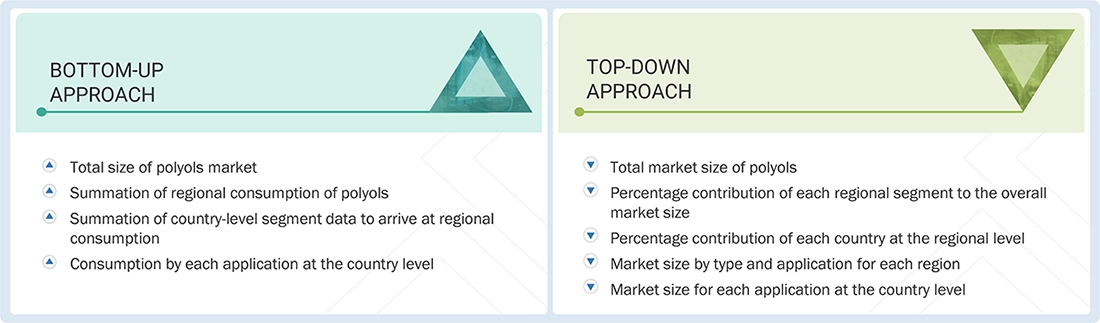
The study involved four major activities to estimate the current size of the global polyols market. Exhaustive secondary research was carried out to collect information on the market, the peer product market, and the parent product group market. The next step was to validate these findings, assumptions, and sizes with the industry experts across the value chain of polyols through primary research. The top-down and bottom-up approaches were employed to estimate the overall size of the polyols market. After that, market breakdown and data triangulation procedures were used to determine the size of different market segments.
Secondary Research
The market for companies offering polyols was arrived at through secondary data available through paid and unpaid sources, analyzing the product portfolios of major companies in the ecosystem, and rating the companies by their performance and quality. For this study, various secondary sources, such as Business Standard, Bloomberg, the World Bank, and Factiva, were referred to identify and collect information on the polyols market. In the secondary research process, various secondary sources were referred to identify and collect information related to the study. Secondary sources included annual reports, press releases, and investor presentations of polyols vendors, forums, certified publications, and whitepapers. Secondary research was used to obtain critical information on the industry’s value chain, the total pool of key players, market classification, and segmentation from market- and technology-oriented perspectives.
Primary Research
In the primary research process, various primary sources from the supply and demand sides were interviewed to obtain qualitative and quantitative information for this report. The primary sources from the supply side included industry experts, such as chief executive officers (CEOs), vice presidents (VPs), marketing directors, technology and innovation directors, and related key executives from several key companies and organizations operating in the polyols market. After the complete market engineering (calculations for market statistics, market breakdown, market size estimations, market forecasting, and data triangulation), extensive primary research was conducted to gather information and verify and validate the critical numbers arrived at.
Primary research was also conducted to identify the segmentation types, industry trends, competitive landscape of polyols offered by various market players, and key market dynamics, such as drivers, restraints, opportunities, challenges, trends, and key player strategies. In the complete market engineering process, the top-down and bottom-up approaches and several data triangulation methods were extensively used to perform the market estimation and market forecasting for the overall market segments and subsegments listed in this report. Extensive qualitative and quantitative analysis was performed throughout the market engineering process to list key information/insights throughout the report.
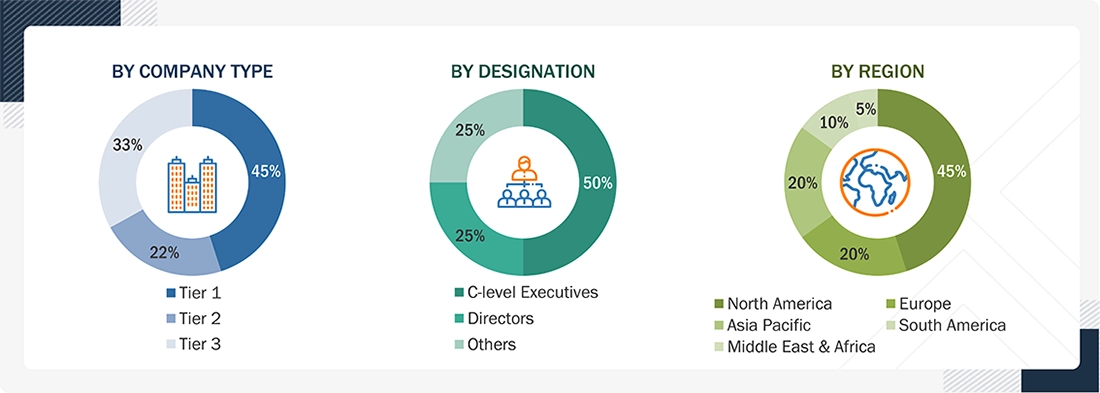
To know about the assumptions considered for the study, download the pdf brochure
Market Size Estimation
The top-down and bottom-up approaches were used to estimate and validate the size of the global polyols market. These approaches were also used extensively to estimate the size of various dependent market segments. The research methodology used to estimate the market size included the following:
Data Triangulation
After arriving at the overall market size using the market size estimation processes, the market was split into several segments and subsegments. The data triangulation and market breakup procedures were employed, wherever applicable, to complete the overall market engineering process and arrive at the exact statistics of each market segment and subsegment. The data was triangulated by studying various factors and trends from the demand and supply sides.
Market Definition
According to the Polyurethane Manufacturers Association (PMA), a polyol is a chemical compound containing more than one reactive hydroxyl (–OH) group per molecule. These hydroxyl groups are vital for the polyol’s role in polyurethane production because they chemically react with di- or poly-isocyanates to create urethane linkages. This reaction forms the core of polyurethane polymers, which are used in many applications, including flexible and rigid foams, coatings, adhesives, sealants, and elastomers. The number and arrangement of hydroxyl groups within a polyol molecule determine its reactivity and functionality, directly impacting the physical, mechanical, and thermal properties of the final polyurethane material.
Key Stakeholders
- Raw material suppliers
- Polyol manufacturers
- Retailers and distributors
- Research & development entities
- Industry associations and regulatory bodies
- End users
Report Objectives
- To define, describe, and forecast the size of the global polyols market, by type, application, and end-use industry, in terms of value and volume
- To forecast the market size of segments for North America, Europe, Asia Pacific, South America, and the Middle East & Africa, along with their respective countries, in terms of value and volume
- To provide detailed information on the significant drivers, restraints, opportunities, and challenges influencing the market
- To strategically analyze micromarkets concerning individual growth trends, prospects, and their contribution to the market
- To assess the growth opportunities in the market for stakeholders and provide details on the competitive landscape for market leaders
- To strategically profile key players and comprehensively analyze their market shares and core competencies
- To analyze competitive developments, such as acquisitions, product launches, investments, expansions, and agreements in the polyols market
- To provide the impact of AI/Gen AI on the market
- To provide the macroeconomic outlook for each region covered under the study, and the impact of the 2025 US tariff on the market
Available customizations:
With the given market data, MarketsandMarkets offers customizations according to client-specific needs.
The following customization options are available for the polyols report:
Product Analysis
- A product matrix that gives a detailed comparison of the product portfolio of each company
Regional Analysis
- A further breakdown of the polyols market for additional countries
Company Information
- Detailed analysis and profiling of additional market players (up to five)
Key Questions Addressed by the Report
What are the major drivers influencing the growth of the polyols market?
The main drivers are the growth of the packaging industry, the automotive lightweighting trend, and the expanding use of flexible polyurethane (PU) in wearables and footwear.
What are the major challenges in the polyols market?
Eco-friendly alternatives and cross-border compliance complexity pose significant challenges for the polyols market.
What are the restraining factors in the polyols market?
Complexity in recycling polyurethane products and strict environmental regulations for polyurethane foam are key restraining factors.
What is the key opportunity in the polyols market?
The growing adoption of bio-based polyols and high-purity polyols for medical-grade applications offers substantial growth opportunities.
Who are the key players in the polyols market?
Key players include DOW (US), Covestro AG (Germany), BASF SE (Germany), Huntsman International LLC (US), Shell (UK), Stepan Company (US), Wanhua Chemical Group (China), Repsol S.A. (Spain), PCC SE (Germany), and LANXESS (Germany).
Fact checked
Personalize This Research
- Triangulate with your Own Data
- Get Data as per your Format and Definition
- Gain a Deeper Dive on a Specific Application, Geography, Customer or Competitor
- Any level of Personalization
Let Us Help You
- What are the Known and Unknown Adjacencies Impacting the Polyols Market
- What will your New Revenue Sources be?
- Who will be your Top Customer; what will make them switch?
- Defend your Market Share or Win Competitors
- Get a Scorecard for Target Partners

Custom Market Research Services
We Will Customise The Research For You, In Case The Report Listed Above Does Not Meet With Your Requirements
Get 10% Free CustomisationTESTIMONIALS

We at Nissan Chemicals Corporation have been clients of MarketsandMarkets for more than a year now. We recently consulted MarketsandMarkets for a study, the team at MarketsandMarkets was extremely professional and organized. The business insights were very detailed and aligned well with our expectations that really helped us formulate the Business Plans and device new strategies for development themes. MarketsandMarkets offers a unique combination of expertise and dedicated engagement model. Their research findings have helped us in designing our Pricing Strategy which will make it easier for us to predict the future sales and profits for the next ten years. We look forward to working with MarketsandMarkets in the future.
VP of Strategy & New Business Development
Leading Specialty Chemical Company
The MarketsandMarkets Engagement Model, composed of both the Knowledge Store and advisory custom research, has greatly helped us in understanding our markets and making strategic decisions. The Knowledge Store is a fast way to allow everyone in our organization to understand more about most any market they are interested in. The ability to then get custom research done and get answers to specific strategic questions and market insight has been spectacular. The Markets and Markets team feel more like colleagues than vendors and their services have helped us change our culture where statements of things like growth opportunities and competitive position are always backed by industry research.

Rich Gibson,
Director, Corporate Strategy
Milliken & Company,
Leading Industrial Manufacturer of specialty chemical, floor covering, performance and protective textile materials, and healthcaremilliken.com
MarketsandMarkets is a trusted resource that helps us to better understand markets that are near-adjacencies-whether its technology, value chain or geography. Their Knowledge Store platform provides a dashboard of markets and their characteristics which is easy to use and saves us time.
Adam Shaw,
Market Development and Strategy Manager
AdvanSix Inc. USA,
An American Leader in Chemicalswww.advansix.com
The Knowledge Store from MarketsandMarkets is a valuable tool which has helped my team acquire greater insight in to the end markets that our business serves. This has enabled us to help our company build stronger strategies throughout our planning process.
TOSHIO KINOSHITA
Senior Chif Consultion Research & Consulting Division
Mitsubishi Chemical Research Corporation,
Leading Manufacturer of Chemical Productswww.mitsubishichem-res.co.jp/en/

We recently engaged with MarketsandMarkets for a study, the team not only clearly understood our business objectives but was also extremely professional in the way they handled the entire project. The study was efficiently conducted in a phase-wise manner, and the engagement model furnished us with high-quality business insights that far exceeded our expectations at each phase. We were especially happy that MarketsandMarkets could provide us with both, an English as well as a Japanese version of the study. A special thanks to the Analyst Team and Client Services Team, whose fluency in Japanese enhanced our comfort level, as we could converse with them in our preferred language.
Independent entrepreneurs
Arrow Precision
We approached MarketsandMarkets for study on Proppants Market, and their work exceeded our expectations. The study conducted was comprehensive and enabled us to view the market through the various dimensions. In addition, the team was extraordinarily responsive throughout the process and resolved our queries on time. I strongly recommend MarketsandMarkets and will certainly consider them for additional market assessments we will need in the future.
Global engineering company, Japan
Deputy Manager,
Strategic Planning OfficeThe high-quality insights shared by the MarketsandMarkets team helped us understand the pharmaceutical plant designers in a specific geography. It also captured the risks that we may likely face in communicating with our potential partners. The study would enable us identify partners, which would impact our future growth.
- Rest Of Asia Pacific Polyols Market
- GCC Countries Polyols Market
- –Rest Of The GCC Countries Polyols Market
- Rest Of South America Polyols Market
- South America Polyols Market
- Rest Of Europe Polyols Market
- China Polyols Market
- India Polyols Market
- Japan Polyols Market
- South Korea Polyols Market
- Thailand Polyols Market
- Indonesia Polyols Market
- Germany Polyols Market
- UK Polyols Market
- France Polyols Market
- Italy Polyols Market
- Russia Polyols Market
- Turkey Polyols Market
- Canada Polyols Market
- Mexico Polyols Market
- US Polyols Market
- Saudi Arabia Polyols Market
- UAE Polyols Market
- South Africa Polyols Market
- Brazil Polyols Market
- Argentina Polyols Market
Growth opportunities and latent adjacency in Polyols Market






Laleh
Jul, 2019
Would like to understand polyester polyols via PET scrap technology and difference between Polyol polyester based and polyether based polyol.
Ravi
Jan, 2019
Opportunities in Polyol Trading for various applications in India.
Ravi
Jan, 2019
Information on Polyol trading in India and APAC..
LANDUCCI
Mar, 2013
Need information on PUR raw materials.
LANDUCCI
Mar, 2013
UV stabilization market and heat applications.
LANDUCCI
Mar, 2013
Marke data for Heat and UV stabilization market and raw materials information.
LANDUCCI
Mar, 2013
Specifc information on uses of heat and UV stabilization during Polyol and PU system production.
LANDUCCI
Mar, 2013
Antioxidants and UV stabilizers for Polyol and Polyurethane appliucation.
LANDUCCI
Mar, 2013
Information on heat and UV stabilization needs (antioxydants, UV stabilizers and HALS) of PUR at raw material producers (polyol)and systems house & processors. .
LANDUCCI
Mar, 2013
Information on heat and UV stabilization needs (antioxydants, UV stabilizers and HALS) of PUR at raw material producers (polyol)and systems house & processors .
LANDUCCI
Mar, 2013
General information on polyols and understand UV stabilization needs (antioxydants, UV stabilizers and HALS) of PUR at raw material producers levels.
LANDUCCI
Mar, 2013
Specific interest in PUR market .
LANDUCCI
Mar, 2013
Interested in Polyurethane Resin market.
LANDUCCI
Mar, 2013
heat and UV stabilization needs (antioxydants, UV stabilizers and HALS) of PUR at raw material producers (polyol)and systems house & processors..
LANDUCCI
Mar, 2013
UV curing market /UV stabilizers.
LANDUCCI
Mar, 2013
UV stabalizer market report.
WALTER
Jan, 2015
Interested in information for Flexible PU Slabstock foam.
Patrícia
Mar, 2019
General information on polyols.
paul
Jul, 2019
Demand of polyol polyurethane production and its application in construction industry .
J
Oct, 2014
Information about the polyester polyol market for Paints and coatings, by demand, by application, any sub-segment applications .
tondamanati
Dec, 2015
Information on xylitol study.
Jeff
Jul, 2019
Market information on Global Specialty Polyols.
James
Feb, 2013
Beginning the commercialization of the bio-based polyester polyol, interested in obtaining more market info..
Jason
Dec, 2017
Interested in the South-Korean PPG market (sample) to make a full report purchase.
Raja
Jul, 2015
Important physical delivery points, relevant quality labels/specifications for polyols and average Transaction Volume/Value. .
Ralph
May, 2014
Interested in Polyols market.
Doug
Mar, 2013
market and competitive dynamics for aliphatic polyester polyol within the Query not ClearFTA region with understanding of captive production vs. merchant market .
Doug
Mar, 2013
Specific information on North America aliphatic polyester polyol market .
Maciej
Feb, 2014
Interested in polyester polyol market, manufacturers, new trends in production and application.
Mustafa
Feb, 2019
Interested in Polyols market, use of Polyester and Polyether in flexible polyurethane foam application..