 Download PDF
 Request Customisation
 Speak to Analyst
 Get Free Sample Pages


Anti-Counterfeit Packaging Market
Report Code
PK 4055
Published in
May, 2026, By MarketsandMarkets™
Anti-Counterfeit Packaging Market by Technology (Mass Encoding, RFID, Hologram, Tamper Evidence, Forensic Markers), End-use Industry (Food & Beverage, Pharmaceutical, Personal Care, Apparel & Footwear, Luxury Goods), and Region - Global Forecast to 2031

USD 316.68 BN
MARKET SIZE, 2031

CAGR 6.82%
(2026-2031)

380
REPORT PAGES

375
MARKET TABLES
ANTI-COUNTERFEIT PACKAGING MARKET
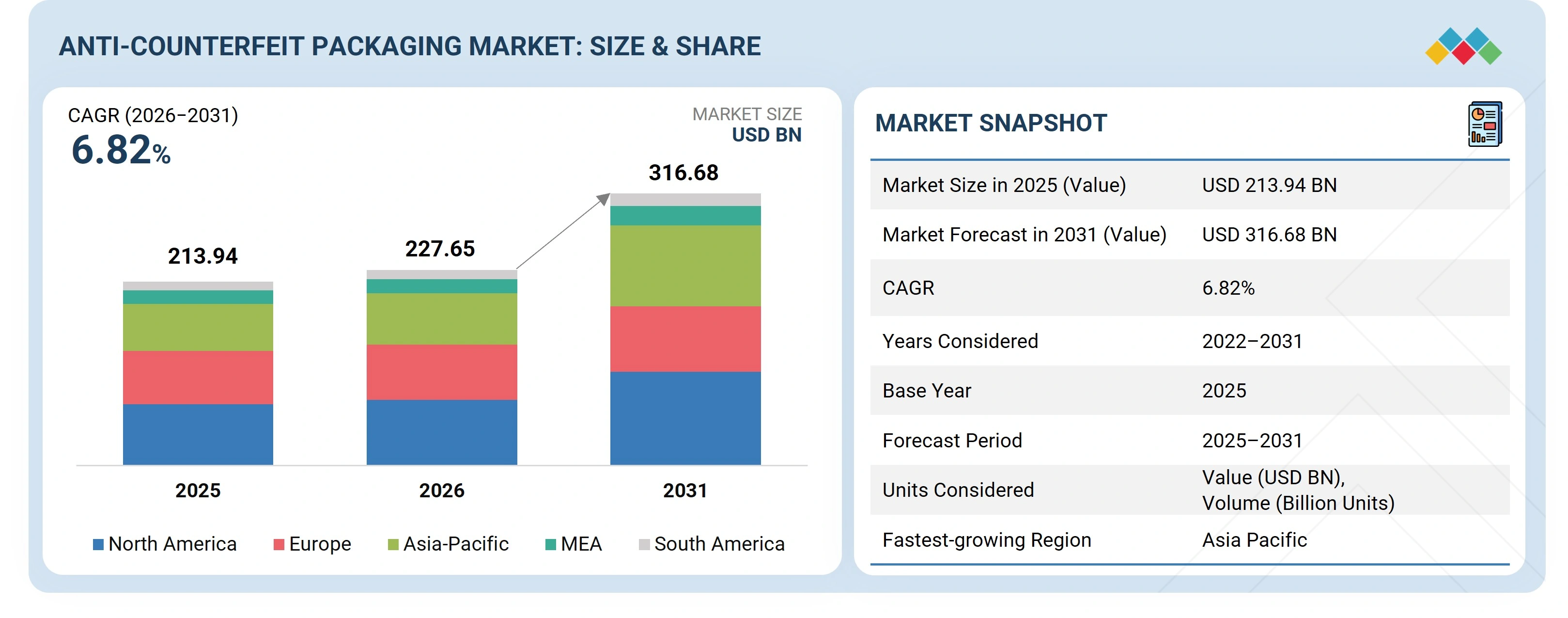
Source: Secondary Research, Interviews with Experts, MarketsandMarkets Analysis | Updated on : May 20, 2026
Anti-counterfeit packaging market is projected to grow from USD 227.65 billion in 2026 to USD 316.7 billion by 2031, at a CAGR of 6.82% from 2026 to 2031. The demand for anti-counterfeit packaging is attributed to the demand from the pharmaceutical industry due to evolving pharma crimes, strict regulations for packaging, active adoption of anti-counterfeit packaging by retailers, and increasing focus of manufacturers on brand protection.
KEY TAKEAWAYS
-
By RegionNorth America accounted for a significant share of 33.4% of the global anti-counterfeit packaging market in 2025.
-
By TypeBy technology, the RFID segment is projected to register the highest CAGR of 10.19% during the forecast period.
-
By End-use IndustryBy end-use industry, the pharmaceutical segment dominated the market in 2025, accounting for a share of 38.3%.
-
Competitive Landscape - Key PlayersCCL Industries Inc. (Canada), 3M (US), SATO Corporation (Japan), Zebra Technologies Corporation (US), and SICPA Holding SA (Switzerland) were identified as star players in the anti-counterfeit packaging market (global), given their strong market share and product footprint.
-
Competitive Landscape - Startups/SMEsScantrust SA (Switzerland) and Selinko (Belgium) have distinguished themselves among startups and SMEs by securing strong footholds in specialized niche areas, underscoring their potential as emerging market leaders.
The market for anti-counterfeit packaging is expanding due to regulatory pressures, growing counterfeit activity, and globalization. Regulations from the FDA and the European Medicines Agency are promoting serialization and traceability. The market is also driven by the growth of e-commerce, which poses greater supply chain threats, as well as the development of technologies like RFID, blockchain, and smart packaging. Growth is also driven by emerging markets in Asia Pacific. Brands are increasing their investments to combat counterfeits, improve revenue protection, maintain compliance, and increase brand trust.
TRENDS & DISRUPTIONS IMPACTING CUSTOMERS' CUSTOMERS
Critical developments in the anti-counterfeit packaging sector include rapid take-up of serialization and QR-based mass encoding, largely to comply with the FDA and European Medicines Agency regulations. Real-time tracking is becoming more popular among brands that use smart technologies such as RFID, NFC and blockchain. NeuroTags and other AI-based technologies are being used for invisible authentication. Further, there is a trend towards consumer interaction, offering smartphone-based product authentication, and a growing need for eco-friendly and tamper-proof packaging.

Source: Secondary Research, Interviews with Experts, MarketsandMarkets Analysis
ANTI-COUNTERFEIT PACKAGING MARKET DYNAMICS

Drivers
Impact
Level
Level
-
Evolving pharmaceutical crime landscape

-
Implementation of stringent regulations


RESTRAINTS
Impact
Level
Level
-
Growing complexity of counterfeit operations

-
Significant initial investment


OPPORTUNITIES
Impact
Level
Level
-
Ongoing developments in technologies

-
Customized solutions across various industries


CHALLENGES
Impact
Level
Level
-
Barriers to consumer understanding

-
High R&D investment

Source: Secondary Research, Interviews with Experts, MarketsandMarkets Analysis
Driver: Implementation of stringent regulations
The main driver for the anti-counterfeit packaging market is the swift adoption of rigorous global standards in pharmaceuticals, food, and high-value consumer goods. Regulations like the Drug Supply Chain Security Act (DSCSA), overseen by the FDA, and the Falsified Medicines Directive (FMD), overseen by the European Medicines Agency, mandate product-level serialization, anti-tamper features, and traceability. Such regulations render anti-counterfeit packaging a mandatory compliance measure rather than a value-addition. Regulations in emerging markets are also tightening, particularly in pharmaceutical exports and high-end consumer products, increasing the market potential. Further, food safety regulators globally are also implementing more stringent traceability and labeling regulations to prevent adulteration and misbranding. This is driving companies to invest in innovative technologies like RFID, blockchain-based traceability, and digital authentication. With impending regulatory deadlines, companies are ramping up investments in safe packaging. The transition from voluntary to mandatory adoption is driving significant market growth worldwide.
Restraint: Growing complexity of counterfeit operations
One of the major factors restraining the anti-counterfeit packaging market is the growing complexity of counterfeiting. Fake products are no longer simple copies; counterfeiters now replicate products with high fidelity through advanced printing, digital copying, and infiltrating the supply chain. This complicates detection, even using technologies such as QR codes and holograms. Often, counterfeiters produce packaging with quality equivalent to the original, negating the impact of overt measures. Also, the fragmented world supply chain provides opportunities for fake products to enter the market. Organized crime is also using online platforms and global distribution networks to sell counterfeit goods. This creates a need for companies to continually add security layers, thereby increasing costs and complexity. The never-ending "technology race" between counterfeiters and brand owners makes single-layer systems unsustainable in the long term, leading to the adoption of multi-layered solutions based on serialization, RFID and forensic markers. This increasing complexity is a key limiting factor for the cost and efficiency of the market.
Opportunity: Ongoing developments in technologies
Ongoing innovations in technology offer a significant opportunity in the anti-counterfeit packaging market for secure, scalable, and economical packaging solutions. AI-powered authentication techniques enable invisible digital watermarks to be embedded in packaging designs, reducing the need for printed labels. Likewise, blockchain is enhancing supply chain visibility through a secure and tamper-proof record of the product journey. Improvements in RFID and NFC technologies, with lower costs and increased read reliability, are enabling their widespread adoption. Smart packaging with IoT sensors now enables real-time monitoring of product temperature, tampering and location, especially for pharmaceuticals and fresh produce. Digital watermarking technologies, such as those developed by Digimarc, also add to covert authentication without compromising design. Further, the ubiquity of smartphones globally enables direct authentication by customers, enhancing consumer engagement and confidence. As these technologies intersect, they are enabling multi-dimensional smart packaging ecosystems that provide more than authentication; they can provide analytics, traceability, and interaction with consumers, creating opportunities for growth.
Challenge: Ongoing West Asia War impact
The geopolitical situation and conflict in the West Asian region have negatively impacted the anti-counterfeit packaging market, primarily due to global supply chain disruptions and price instability in resource markets. Packaging materials such as films, adhesives, and inks are often sourced from petrochemicals and crude oil. Regional tensions affect the supply and price of crude oil, which in turn affects the cost and availability of packaging materials. Delays and higher costs in major transportation routes also impact global supply chain efficiency. Insecurity also creates uncertainty for manufacturers' business planning and delays deployment of smart packaging systems in impacted trade routes. Furthermore, rising inflation driven by volatile energy prices reduces end-user procurement budgets, especially in cost-sensitive sectors such as food and FMCG. Technology roll-out projects, particularly in RFID and smart packaging, can be impacted by supply chain constraints on electronic components. In summary, geopolitical instability is a macroeconomic factor that drives up costs, impairs predictability and temporarily hampers the rate of adoption in certain geographies.
ANTI-COUNTERFEIT PACKAGING MARKET: COMMERCIAL USE CASES ACROSS INDUSTRIES
| COMPANY | USE CASE DESCRIPTION | BENEFITS |
|---|---|---|
 |
Implementation of secure QR codes with serialization on wine labels to authenticate products and detect counterfeits; integrated with a mobile app and scan analytics dashboard | Real-time product authentication, counterfeit detection alerts, improved brand protection, enhanced consumer engagement, and supply chain visibility through scan data insights |
 |
Deployment of EPC-enabled RFID tagging for apparel to uniquely identify products, automate order fulfillment, and replace manual processes with standardized barcode and RFID systems | Over 99.5% order accuracy, 98.8% reduction in chargebacks, strong ROI within 8 months, improved productivity, scalability, and enhanced customer satisfaction |
 |
Item-level RFID tagging across all products to enable real-time inventory tracking, improve supply chain visibility, and enhance omnichannel retail operations | Improved inventory accuracy and product availability, reduced stockouts, enhanced customer experience, faster checkout (up to 50%), and increased operational efficiency |
Logos and trademarks shown above are the property of their respective owners. Their use here is for informational and illustrative purposes only.
ANTI-COUNTERFEIT PACKAGING MARKET ECOSYSTEM
Anti-counterfeit packaging stakeholders include raw material manufacturers of inks, films, adhesives, RFID chips, and security pigments, which constitute the foundation of secure packaging products. Packaging manufacturers process these into serialized labels, smart tags, tamper-evident packaging, and digital authentication, incorporating technologies such as RFID and blockchain. Technology providers and distributors enable deployment across international supply chains via software and tracking technologies. Users include pharmaceuticals, food & beverage, electronic and luxury goods.

Logos and trademarks shown above are the property of their respective owners. Their use here is for informational and illustrative purposes only.
ANTI-COUNTERFEIT PACKAGING MARKET SEGMENTS

Source: Secondary Research, Interviews with Experts, MarketsandMarkets Analysis
Anti-counterfeit Packaging Market, By Technology
Mass encoding is the largest technology category in the anti-counterfeit packaging market due to its affordability, scalability, and regulatory compliance. It mainly consists of barcodes, QR codes, and variable data printing, which allow unit-level identification of products. This segment is supported by serialization mandates from regulatory authorities such as the U.S. Food and Drug Administration (FDA) and the European Medicines Agency (EMA), which require unit-level traceability for pharmaceuticals and, increasingly, for food and consumer packaged goods. Mass encoding does not require additional hardware and is therefore widely accessible to manufacturers in developed and emerging economies, unlike RFID or NFC. It can seamlessly integrate with existing packaging systems, reducing costs and disruptions. Additionally, the pervasive use of smartphones has improved their usefulness, enabling quick verification and information for consumers and suppliers alike. It is also compatible with cloud-based traceability platforms, facilitating real-time tracking and analytics. Mass encoding is suitable for high-speed production processes, as it can be applied to cartons, labels, flexible packaging, and bottles. All this makes mass encoding the most popular and cost-effective anti-counterfeit packaging technology in the world.
Anti-counterfeit Packaging Market, By End-use Industry
The pharmaceutical sector is the largest end-use market for anti-counterfeit packaging technologies due to the stringent regulatory environment, high value of pharmaceuticals, and the dangers posed by counterfeit medicines. There are strict government regulations in place to ensure the safety and integrity of pharmaceuticals. Major standards, including the FDA's Drug Supply Chain Security Act and the European Medicines Agency's Falsified Medicines Directive, require serialization, tamper-proof packaging, and traceability for prescription medicines. These laws drive mass adoption and implementation across the pharmaceutical supply chain. Further, pharmaceuticals are highly susceptible to counterfeiting due to their high margins and a complex global supply chain involving multiple stakeholders, including manufacturers, wholesalers, and pharmacies. The growth of e-commerce and international trade has also increased vulnerability to counterfeiting. Health risks, which can result in serious injury or death, make this a highly sensitive industry. Pharmaceutical firms are also investing significantly in digital authentication, RFID, and blockchain-based traceability to secure their brands and meet global standards. This, together with ever-increasing regulation and the shift towards biologics and specialty pharmaceuticals, keeps pharmaceuticals as the fastest-growing market for anti-counterfeit packaging.
REGION
North America to be largest region in global anti-counterfeit packaging market during forecast period
North America dominates the anti-counterfeit packaging market largely because of the presence of stringent regulations, early adoption of technologies, and the presence of global solution providers. A key factor is the strong regulatory environment, particularly in the pharmaceutical industry. The U.S. Food and Drug Administration (FDA) mandated Drug Supply Chain Security Act (DSCSA) requires full traceability and serialization of prescription drugs, driving bulk, non-voluntary demand for anti-counterfeit technologies. This stringent approach is mirrored in food, medical devices, and consumer products, driving adoption across the board. The second factor is the technological infrastructure. The region boasts pioneers such as 3M, Zebra Technologies and Avery Dennison, which innovate in RFID, smart labels, and digital authentication technologies. This fosters rapid development and deployment of new technologies such as IoT-connected packaging and blockchain traceability. Elevated consumer and brand protection concerns also play a major role. The threat of counterfeiting in industries such as pharmaceuticals, luxury goods, and electronics is well understood, driving companies to take a proactive approach to secure packaging. Moreover, its advanced retail and e-commerce ecosystem requires secure and traceable goods through sophisticated supply chains. Finally, robust enforcement and legal sanctions against counterfeiting ensure compliance. The region's high per capita consumption means companies can afford to invest in newer, potentially more expensive technologies, which makes North America the biggest market.

ANTI-COUNTERFEIT PACKAGING MARKET: COMPANY EVALUATION MATRIX
CCL Industries Inc. (Star) is a star player in the global anti-counterfeit packaging market due to its global scale, diversified security labeling portfolio, and strong presence across high-growth end-use industries such as pharmaceuticals, food & beverage, and personal care. SATO Corporation (Emerging leader) is considered an emerging strong player in the anti-counterfeit packaging market due to its strong expertise in auto-identification (AIDC), labeling hardware, and track-and-trace solutions. These strategic initiatives, combined with its global expansion and diversified portfolio, position SATO as a rising and increasingly influential player in the anti-counterfeit packaging market.

Source: Secondary Research, Interviews with Experts, MarketsandMarkets Analysis
KEY MARKET PLAYERS
- CCL Industries Inc. (Canada)
- 3M (US)
- SATO Corporation (Japan)
- Zebra Technologies Corporation (US)
- SICPA Holding SA (Switzerland)
- Intelligent Label Solutions (UK)
- SML Group (China)
- Dover Corporation (US)
- AlpVision SA (Switzerland)
- Authentix Inc. (US)
MARKET SCOPE
| REPORT METRIC | DETAILS |
|---|---|
| Market Size in 2025 (Value) | USD 213.94 Billion |
| Market Forecast in 2031 (Value) | USD 316.68 Billion |
| Growth Rate | CAGR of 6.82% from 2026–2031 |
| Years Considered | 2022–2031 |
| Base Year | 2025 |
| Forecast Period | 2026–2031 |
| Units Considered | Value (USD Billion), Volume (Billion Units) |
| Report Coverage | Revenue forecast, company ranking, competitive landscape, growth factors, and trends |
| Segments Covered |
|
| Regions Covered | North America, Asia Pacific, Europe, South America, Middle East & Africa |
WHAT IS IN IT FOR YOU: ANTI-COUNTERFEIT PACKAGING MARKET REPORT CONTENT GUIDE

DELIVERED CUSTOMIZATIONS
We have successfully delivered the following deep-dive customizations:
| CLIENT REQUEST | CUSTOMIZATION DELIVERED | VALUE ADDS |
|---|---|---|
| Anti-counterfeit Packaging Market -Emerging Applications | Detailed analysis of anti-counterfeit packaging in emerging applications, which included digital healthcare ecosystems, agri-food traceability, and circular economy and recycling verification | Identified different emerging applications of anti-counterfeit packaging for different regions, based on technology |
| CLIENT REQUEST | CUSTOMIZATION DELIVERED | VALUE ADDS | | | | | ||
| Deeper analysis of high-growth end-use industries | Detailed demand breakdown for semiconductor, healthcare, metal fabrication, and environmental monitoring sectors | Consumption pattern analysis across industries | Purity requirement mapping for specialt | ||
| Assessment of competitive positioning in specialty gas mixtures | Benchmarking of key players based on blending capabilities, purity levels, distribution models, and technology integration | Comparative analysis of product portfolios and certification cap |
RECENT DEVELOPMENTS
- March 2026 : CCL Industries Inc. signed an agreement to acquire Sleever International Company SA, a global provider of shrink sleeve labels, application equipment, and decorating services. This will help CCL Industries Inc. enhance anti-counterfeit capabilities through advanced sleeve technologies, expanded global footprint, and improved authentication, innovation, and secure packaging solutions.
- May 2025 : SATO Corporation partnered with Loftware Inc., a global leader in enterprise labeling and artwork management solutions, to launch a cloud-connected label printing solution that integrates cloud software with SATO printers. This has helped its anti-counterfeit packaging business by enabling real-time, standardized, and secure label generation, improving traceability, compliance, and authentication.
- November 2024 : Zebra Technologies Corporation signed a one-year MOU with Singapore Manufacturing Federation to support SMEs through training, knowledge transfer, and technology adoption, focusing on improving productivity, innovation, and workforce capabilities across manufacturing and related sectors.
Table of Contents
 Exclusive indicates content/data unique to MarketsandMarkets and not available with any competitors.
TITLE
PAGE NO
1
INTRODUCTION
30
2
EXECUTIVE SUMMARY
35
3
PREMIUM INSIGHTS
40
4
MARKET OVERVIEW
Pharmaceutical market pivots on tech-driven brand protection amid rising counterfeit sophistication and regulatory pressures.
44
4.1
INTRODUCTION
4.2
MARKET DYNAMICS
4.2.1
DRIVERS
4.2.1.1
EVOLVING PHARMACEUTICAL CRIME LANDSCAPE
4.2.1.2
IMPLEMENTATION OF STRINGENT REGULATIONS
4.2.1.3
PROACTIVE INVOLVEMENT OF RETAIL CHAINS IN COMBATING COUNTERFEITING
4.2.1.4
INCREASING MANUFACTURER FOCUS ON BRAND PROTECTION
4.2.2
RESTRAINTS
4.2.2.1
GROWING COMPLEXITY OF COUNTERFEIT OPERATIONS
4.2.2.2
SIGNIFICANT INITIAL INVESTMENT
4.2.3
OPPORTUNITIES
4.2.3.1
ONGOING TECHNOLOGICAL DEVELOPMENTS
4.2.3.2
CUSTOMIZED SOLUTIONS ACROSS VARIOUS INDUSTRIES
4.2.3.3
INCREASING DEMAND FROM EMERGING MARKETS
4.2.4
CHALLENGES
4.2.4.1
BARRIERS TO CONSUMER UNDERSTANDING
4.2.4.2
HIGH R&D INVESTMENT
4.2.4.3
ONGOING WEST ASIA WAR IMPACT
4.3
UNMET NEEDS AND WHITE SPACES
4.3.1
INTELLIGENT AUTHENTICATION & CONSUMER ENGAGEMENT
4.3.2
INTEROPERABILITY & GLOBAL STANDARDIZATION
4.3.3
COST-EFFECTIVE & SCALABLE SECURITY SOLUTIONS
4.3.4
RESILIENCE AGAINST NEXT-GEN COUNTERFEITING
4.3.5
SUSTAINABLE & COMPLIANT SECURITY PACKAGING
4.4
INTERCONNECTED MARKETS AND CROSS-SECTOR OPPORTUNITIES
4.4.1
INTERCONNECTED MARKETS
4.4.2
CROSS-SECTOR OPPORTUNITIES
4.4.2.1
PHARMACEUTICALS ↔ FOOD & BEVERAGE
4.4.2.2
ELECTRONICS ↔ PHARMACEUTICALS
4.4.2.3
LUXURY GOODS ↔ PERSONAL CARE
4.4.2.4
AUTOMOTIVE ↔ ELECTRONICS
4.4.2.5
LUXURY GOODS ↔ APPAREL & FOOTWEAR
4.4.2.6
ELECTRONICS ↔ LUXURY GOODS
4.5
STRATEGIC MOVES BY TIER-1/2/3 PLAYERS
4.5.1
TIER 1 PLAYERS: GLOBAL LEADERS DRIVING CONSOLIDATION AND INNOVATION
4.5.1.1
CCL INDUSTRIES, INC. – “ACQUISITION OF ALT TECHNOLOGIES”
4.5.1.2
SICPA (E7 GROUP) – “STRATEGIC PARTNERSHIP WITH 7I HOLDING”
4.5.2
TIER 2 PLAYERS: REGIONAL INNOVATORS AND NICHE LEADERS
4.5.2.1
INTELLIGENT LABEL SOLUTIONS “START OF INDONESIAN OPERATIONS”
4.5.2.2
SML GROUP – “RFID PARTNERSHIP WITH LANDMARK GROUP”
4.5.3
TIER 3 PLAYERS: STRENGTHENING SUSTAINABILITY IN THE AMMONIA MARKET
4.5.3.1
SCANTRUST SA – “QR CODE ANTI-COUNTERFEITING FOR MARCHESI ANTINORI”
5
INDUSTRY TRENDS
Navigate competitive dynamics and pricing shifts with strategic insights on anti-counterfeit packaging trends.
59
5.1
PORTER’S FIVE FORCES ANALYSIS
5.1.1
BARGAINING POWER OF SUPPLIERS
5.1.2
BARGAINING POWER OF BUYERS
5.1.3
INTENSITY OF COMPETITIVE RIVALRY
5.1.4
THREAT OF NEW ENTRANTS
5.1.5
THREAT OF SUBSTITUTES
5.2
MACROECONOMIC ANALYSIS
5.2.1
INTRODUCTION
5.2.2
GDP TRENDS AND FORECASTS
5.3
VALUE CHAIN ANALYSIS
5.4
ECOSYSTEM ANALYSIS
5.4.1
PRICING ANALYSIS
5.4.2
AVERAGE SELLING PRICE TREND OF KEY PLAYERS, BY TECHNOLOGY
5.4.3
AVERAGE SELLING PRICE RANGE OF ANTI-COUNTERFEIT PACKAGING, BY REGION, 2022–2026
5.4.4
AVERAGE SELLING PRICE TREND OF ANTI-COUNTERFEIT PACKAGING, BY REGION
5.5
TRADE ANALYSIS
5.5.1
EXPORT SCENARIO (HS CODE 8523)
5.5.2
IMPORT SCENARIO (HS CODE 8523)
5.6
KEY CONFERENCES AND EVENTS, 2026–2027
5.7
TRENDS/DISRUPTIONS IMPACTING CUSTOMER BUSINESS
5.8
INVESTMENT AND FUNDING SCENARIO
5.9
CASE STUDY ANALYSIS
5.9.1
CASE STUDY 1: ANTI-COUNTERFEITING WITH QR CODES FOR WINE PRODUCER MARCHESI ANTINORI
5.9.2
CASE STUDY 2: LAUNCHING A SUCCESSFUL RFID SOLUTION FOR SOUTHERN FRIED COTTON
5.9.3
CASE STUDY 3: IMPLEMENTING RFID FOR DECATHLON RETAIL OPERATIONS
5.10
IMPACT OF 2025 US TARIFF: ANTI-COUNTERFEIT PACKAGING MARKET
5.10.1
INTRODUCTION
5.10.2
KEY TARIFF RATES
5.10.3
PRICE IMPACT ANALYSIS
5.10.4
IMPACT ON COUNTRY/REGION
5.10.4.1
US
5.10.4.2
EUROPE
5.10.4.3
ASIA PACIFIC
5.10.5
END-USE INDUSTRY IMPACT
6
TECHNOLOGICAL ADVANCEMENTS, AI-DRIVEN IMPACT, PATENTS, INNOVATIONS, AND FUTURE APPLICATIONS
AI-driven innovations reshape anti-counterfeit packaging with smart, self-responsive, and blockchain-linked solutions.
75
6.1
KEY TECHNOLOGIES
6.1.1
SERIALIZATION
6.1.2
TAMPER-PROOF PACKAGING
6.2
COMPLEMENTARY TECHNOLOGIES
6.2.1
NEUROTAGS
6.2.2
WATERMARKING
6.3
TECHNOLOGY/PRODUCT ROADMAP
6.3.1
SHORT-TERM (2026–2028): INTEGRATION & COST OPTIMIZATION PHASE
6.3.2
MID-TERM (2028–2031): DIGITALIZATION & INTELLIGENT SYSTEMS PHASE
6.3.3
LONG-TERM (2031–2035+): AUTONOMOUS & INVISIBLE SECURITY PHASE
6.4
PATENT ANALYSIS
6.4.1
INTRODUCTION
6.4.2
METHODOLOGY
6.4.3
ANTI-COUNTERFEIT PACKAGING MARKET, PATENT ANALYSIS, 2016–2025
6.5
FUTURE APPLICATIONS
6.5.1
AI-ENABLED SELF-RESPONSIVE ANTI-COUNTERFEIT PACKAGING
6.5.2
BLOCKCHAIN-LINKED DIGITAL IDENTITY PACKAGING
6.5.3
ENERGY-HARVESTING SMART PACKAGING SYSTEMS
6.6
IMPACT OF AI/GEN AI ON ANTI-COUNTERFEIT PACKAGING MARKET
6.6.1
TOP USE CASES AND MARKET POTENTIAL
6.6.2
BEST PRACTICES IN ANTI-COUNTERFEIT PACKAGING MARKET
6.6.3
CASE STUDIES OF AI IMPLEMENTATION IN ANTI-COUNTERFEIT PACKAGING MARKET
6.6.3.1
INTERCONNECTED ECOSYSTEM AND IMPACT ON MARKET PLAYERS
6.6.4
CLIENTS’ READINESS TO ADOPT GENERATIVE AI IN ANTI-COUNTERFEIT PACKAGING MARKET
7
SUSTAINABILITY AND REGULATORY LANDSCAPE
Regulatory shifts spark sustainable innovation, eco-materials, and lifecycle accountability in packaging industries.
86
7.1
REGIONAL REGULATIONS AND COMPLIANCE
7.1.1
REGULATORY BODIES, GOVERNMENT AGENCIES, AND OTHER ORGANIZATIONS
7.1.2
INDUSTRY STANDARDS
7.2
SUSTAINABILITY INITIATIVES
7.2.1
SHIFT TO ECO-FRIENDLY & RECYCLABLE MATERIALS (SMART LABELS)
7.2.2
COMPOSTABLE & BIODEGRADABLE SECURITY INKS
7.2.3
CIRCULAR ECONOMY & REUSABLE PACKAGING SYSTEMS
7.3
IMPACT OF REGULATORY POLICY ON SUSTAINABILITY INITIATIVES
7.3.1
REGULATORY MANDATES DRIVING MATERIAL INNOVATION
7.3.2
EXTENDED PRODUCER RESPONSIBILITY (EPR) EXPANDING LIFECYCLE ACCOUNTABILITY
7.3.3
DIGITALIZATION AS A LOW-CARBON COMPLIANCE STRATEGY
8
CUSTOMER LANDSCAPE & BUYER BEHAVIOR
Unlock profitability by understanding buyer dynamics and unmet needs across industries.
92
8.1
DECISION-MAKING PROCESS
8.2
BUYER STAKEHOLDERS AND BUYING EVALUATION CRITERIA
8.2.1
KEY STAKEHOLDERS IN BUYING PROCESS
8.2.2
BUYING CRITERIA
8.3
ADOPTION BARRIERS & INTERNAL CHALLENGES
8.4
UNMET NEEDS FROM VARIOUS END-USE INDUSTRIES
8.5
MARKET PROFITABILITY
8.5.1
REVENUE POTENTIAL
8.5.2
COST DYNAMICS
8.5.3
MARGIN OPPORTUNITIES BY END-USE INDUSTRIES
9
ANTI-COUNTERFEIT PACKAGING MARKET, BY TECHNOLOGY
Market Size & Growth Rate Forecast Analysis to 2031 in USD Billion and Units | 4 Data Tables
99
9.1
INTRODUCTION
9.2
MASS ENCODING
9.2.1
RISING DEMAND FOR TRACK AND TRACE TECHNOLOGIES IN PACKAGING TO PROPEL MARKET
9.2.2
BARCODES
9.2.3
DIGITAL MASS SERIALIZATION
9.2.4
DIGITAL MASS ENCRYPTION
9.3
RADIO FREQUENCY IDENTIFICATION (RFID)
9.3.1
TECHNOLOGICAL ADVANCEMENTS IN PACKAGING INDUSTRY TO BOOST MARKET
9.4
HOLOGRAMS
9.4.1
RISING DEMAND FOR THREE-DIMENSIONAL NON-IMITATIVE HOLOGRAMS TO PROPEL MARKET
9.5
FORENSIC MARKERS
9.5.1
INCORPORATION OF ADVANCED SCIENTIFIC TECHNIQUES IN ANTI-COUNTERFEIT PACKAGING TO BOOST MARKET
9.6
TAMPER EVIDENCE
9.6.1
RISING DEMAND FOR PACKAGING SOLUTIONS WITH VISUAL INDICATIONS TO PROPEL MARKET
9.7
OTHER TECHNOLOGIES
10
ANTI-COUNTERFEIT PACKAGING MARKET, BY END-USE INDUSTRY
Market Size & Growth Rate Forecast Analysis to 2031 in USD Billion and Units | 4 Data Tables
107
10.1
INTRODUCTION
10.2
FOOD & BEVERAGE
10.2.1
RISING DEMAND FOR TRACK AND TRACE PACKAGING TO PROPEL MARKET
10.3
PHARMACEUTICAL
10.3.1
GOVERNMENT INITIATIVES TO COMBAT COUNTERFEITING TO PROPEL MARKET
10.4
APPAREL & FOOTWEAR
10.4.1
THREAT FROM COUNTERFEIT APPAREL & FOOTWEAR PRODUCTS AND BRAND IMITATIONS TO PROPEL MARKET
10.5
AUTOMOTIVE
10.5.1
ADOPTION OF ANTI-COUNTERFEIT PACKAGING SOLUTIONS BY AUTOMOTIVE MANUFACTURERS TO BOOST MARKET
10.6
PERSONAL CARE
10.6.1
RISING CONSUMER AWARENESS ABOUT FALSIFIED COSMETICS TO PROPEL MARKET
10.7
ELECTRONICS & ELECTRICAL
10.7.1
RISING DEMAND FOR AUTHENTIC AND RELIABLE ELECTRONIC GOODS TO BOOST MARKET
10.8
LUXURY GOODS
10.8.1
ADOPTION OF AUTHENTICATION TECHNOLOGIES BY LUXURY BRANDS TO BOOST MARKET
10.9
OTHER END-USE INDUSTRIES
11
ANTI-COUNTERFEIT PACKAGING MARKET, BY REGION
Comprehensive coverage of 8 Regions with country-level deep-dive of 19 Countries | 264 Data Tables.
117
11.1
INTRODUCTION
11.2
NORTH AMERICA
11.2.1
US
11.2.1.1
GROWING NEED FOR EFFECTIVE TRACEABILITY AND TRACKING TECHNOLOGIES TO DRIVE MARKET
11.2.2
CANADA
11.2.2.1
GOVERNMENT INITIATIVES TO COMBAT COUNTERFEITING TO DRIVE MARKET
11.2.3
MEXICO
11.2.3.1
INCREASING PREVALENCE OF COUNTERFEIT GOODS TO DRIVE MARKET
11.3
EUROPE
11.3.1
GERMANY
11.3.1.1
GROWING DEMAND FOR HIGH-END AND PREMIUM PRODUCTS TO DRIVE MARKET
11.3.2
FRANCE
11.3.2.1
INCREASING COUNTERFEITING ACTIVITIES TO DRIVE MARKET
11.3.3
UK
11.3.3.1
INCREASING AWARENESS OF CUSTOMERS ABOUT COUNTERFEITING TO DRIVE MARKET
11.3.4
ITALY
11.3.4.1
INCREASING FALSIFICATION OF LUXURY GOODS TO DRIVE MARKET
11.3.5
RUSSIA
11.3.5.1
GOVERNMENT INITIATIVES TO COMBAT COUNTERFEITING TO DRIVE MARKET
11.3.6
SPAIN
11.3.6.1
INCREASING CONCERNS ABOUT PRODUCT AUTHENTICITY AND SAFETY TO DRIVE MARKET
11.3.7
REST OF EUROPE
11.4
ASIA PACIFIC
11.4.1
CHINA
11.4.1.1
AVAILABILITY OF LOW-COST LABOR AND ADVANCED MANUFACTURING CAPABILITIES TO DRIVE MARKET
11.4.2
INDIA
11.4.2.1
EXPANSION OF PHARMACEUTICAL MARKET TO DRIVE MARKET
11.4.3
JAPAN
11.4.3.1
GOVERNMENT INITIATIVES TO COMBAT COUNTERFEITING TO DRIVE GROWTH
11.4.4
AUSTRALIA
11.4.4.1
GROWTH OF E-COMMERCE AND RETAIL SECTORS TO DRIVE MARKET
11.4.5
REST OF ASIA PACIFIC
11.5
SOUTH AMERICA
11.5.1
BRAZIL
11.5.1.1
GROWING NEED FOR EFFECTIVE TRACEABILITY AND TRACKING TECHNOLOGIES TO DRIVE MARKET
11.5.2
ARGENTINA
11.5.2.1
GOVERNMENT INITIATIVES TO COMBAT COUNTERFEITING TO DRIVE MARKET
11.5.3
REST OF SOUTH AMERICA
11.6
MIDDLE EAST & AFRICA
11.6.1
GCC COUNTRIES
11.6.1.1
SAUDI ARABIA
11.6.1.1.1
INCREASING AWARENESS AMONG CONSUMERS ABOUT PRODUCT AUTHENTICITY TO DRIVE GROWTH
11.6.1.2
UAE
11.6.1.2.1
GROWING DEMAND FOR SECURE PACKAGING SOLUTIONS TO DRIVE MARKET
11.6.1.3
REST OF GCC COUNTRIES
11.6.2
SOUTH AFRICA
11.6.2.1
INCREASING PREVALENCE OF COUNTERFEIT PRODUCTS AND DEMAND FOR BRAND PROTECTION TO DRIVE MARKET
11.6.3
TURKEY
11.6.3.1
STRATEGIC GEOGRAPHICAL LOCATION BETWEEN EUROPE AND ASIA FOR TRADING COUNTERFEIT GOODS TO DRIVE MARKET
11.6.4
REST OF MIDDLE EAST & AFRICA
12
COMPETITIVE LANDSCAPE
Uncover key players' strategies and market shares shaping the competitive landscape.
253
12.1
OVERVIEW
12.2
KEY PLAYER STRATEGIES
12.3
MARKET SHARE ANALYSIS
12.4
REVENUE ANALYSIS OF KEY PLAYERS
12.5
COMPANY VALUATION AND FINANCIAL METRICS
12.6
BRAND COMPARISON
12.7
COMPANY EVALUATION QUADRANT, KEY PLAYERS
12.7.1
STARS
12.7.2
EMERGING LEADERS
12.7.3
PERVASIVE PLAYERS
12.7.4
PARTICIPANTS
12.7.4.1
COMPANY FOOTPRINT
12.7.4.2
REGIONAL FOOTPRINT
12.7.4.3
TECHNOLOGY FOOTPRINT
12.7.4.4
END-USE INDUSTRY FOOTPRINT
12.8
COMPANY EVALUATION MATRIX: STARTUPS/SMES, 2025
12.8.1
PROGRESSIVE COMPANIES
12.8.2
RESPONSIVE COMPANIES
12.8.3
DYNAMIC COMPANIES
12.8.4
STARTING BLOCKS
12.8.5
COMPETITIVE BENCHMARKING: STARTUPS/SMES, 2025
12.8.5.1
DETAILED LIST OF KEY STARTUPS/SMES
12.8.5.1.1
COMPETITIVE BENCHMARKING OF KEY STARTUPS/SMES
12.9
COMPETITIVE SCENARIO
12.9.1
PRODUCT LAUNCHES/DEVELOPMENTS/ENHANCEMENT
12.9.2
DEALS
12.9.3
EXPANSIONS
12.9.4
OTHER DEVELOPMENTS
13
COMPANY PROFILE
289
13.1
KEY PLAYERS
13.1.1
AVERY DENNISON CORPORATION
13.1.1.1
BUSINESS OVERVIEW
13.1.1.2
PRODUCTS/SOLUTIONS/SERVICES OFFERED
13.1.1.3
RECENT DEVELOPMENTS
13.1.1.3.1
PRODUCT LAUNCHES
13.1.1.3.2
DEALS
13.1.1.3.3
EXPANSION
13.1.1.4
MNM VIEW
13.1.1.4.1
RIGHT TO WIN
13.1.1.4.2
STRATEGIC CHOICES
13.1.1.4.3
WEAKNESSES & COMPETITIVE THREATS
13.1.2
CCL INDUSTRIES INC
13.1.2.1
BUSINESS OVERVIEW
13.1.2.2
PRODUCTS/SOLUTIONS/SERVICES OFFERED
13.1.2.3
RECENT DEVELOPMENTS
13.1.2.3.1
DEALS
13.1.2.3.2
EXPANSIONS
13.1.2.4
MNM VIEW
13.1.2.4.1
RIGHT TO WIN
13.1.2.4.2
STRATEGIC CHOICES
13.1.2.4.3
WEAKNESSES & COMPETITIVE THREATS
13.1.3
3M
13.1.3.1
BUSINESS OVERVIEW
13.1.3.2
PRODUCTS/SOLUTIONS/SERVICES OFFERED
13.1.3.3
RECENT DEVELOPMENTS
13.1.3.3.1
PRODUCT LAUNCHES
13.1.3.3.2
EXPANSIONS
13.1.3.3.3
OTHERS
13.1.3.4
MNM VIEW
13.1.3.4.1
RIGHT TO WIN
13.1.3.4.2
STRATEGIC CHOICES
13.1.3.4.3
WEAKNESSES & COMPETITIVE THREATS
13.1.4
SATO CORPORATION
13.1.4.1
BUSINESS OVERVIEW
13.1.4.2
PRODUCTS/SOLUTIONS/SERVICES OFFERED
13.1.4.3
RECENT DEVELOPMENTS
13.1.4.3.1
PRODUCT LAUNCHES
13.1.4.3.2
DEALS
13.1.4.3.3
EXPANSIONS
13.1.4.4
MNM VIEW
13.1.4.4.1
RIGHT TO WIN
13.1.4.4.2
STRATEGIC CHOICES
13.1.4.4.3
WEAKNESSES & COMPETITIVE THREATS
13.1.5
ZEBRA TECHNOLOGIES CORPORATION
13.1.5.1
BUSINESS OVERVIEW
13.1.5.2
PRODUCTS/SOLUTIONS/SERVICES OFFERED
13.1.5.3
RECENT DEVELOPMENTS
13.1.5.3.1
PRODUCT LAUNCHES
13.1.5.3.2
DEALS
13.1.5.3.3
EXPANSIONS
13.1.5.4
MNM VIEW
13.1.5.4.1
RIGHT TO WIN
13.1.5.4.2
STRATEGIC CHOICES
13.1.5.4.3
WEAKNESSES & COMPETITIVE THREATS
13.1.6
SICPA HOLDING SA
13.1.6.1
BUSINESS OVERVIEW
13.1.6.2
PRODUCTS/SOLUTIONS/SERVICES OFFERED
13.1.6.3
RECENT DEVELOPMENTS
13.1.6.3.1
DEALS
13.1.6.4
MNM VIEW
13.1.6.4.1
RIGHT TO WIN
13.1.6.4.2
STRATEGIC CHOICES
13.1.6.4.3
WEAKNESSES & COMPETITIVE THREATS
13.1.7
INTELLIGENT LABEL SOLUTIONS
13.1.7.1
BUSINESS OVERVIEW
13.1.7.2
PRODUCTS/SOLUTIONS/SERVICES OFFERED
13.1.7.3
RECENT DEVELOPMENTS
13.1.7.3.1
PRODUCT LAUNCHES
13.1.7.3.2
EXPANSIONS
13.1.7.3.3
OTHER DEVELOPMENTS
13.1.7.4
MNM VIEW
13.1.8
SML GROUP
13.1.8.1
BUSINESS OVERVIEW
13.1.8.2
PRODUCTS/SOLUTIONS/SERVICES OFFERED
13.1.8.3
RECENT DEVELOPMENTS
13.1.8.3.1
PRODUCT LAUNCHES
13.1.8.3.2
DEALS
13.1.8.4
MNM VIEW
13.1.9
ALPVISION S.A.
13.1.9.1
BUSINESS OVERVIEW
13.1.9.2
PRODUCTS/SOLUTIONS/SERVICES OFFERED
13.1.9.3
MNM VIEW
13.1.10
AUTHENTIX, INC.
13.1.10.1
BUSINESS OVERVIEW
13.1.10.2
PRODUCTS/SOLUTIONS/SERVICES OFFERED
13.1.10.2.1
DEALS
13.1.10.3
MNM VIEW
13.1.11
DOVER CORPORATION
13.1.11.1
BUSINESS OVERVIEW
13.1.11.2
PRODUCTS/SOLUTIONS/SERVICES OFFERED
13.1.11.2.1
PRODUCT LAUNCH
13.1.11.3
MNM VIEW
13.2
OTHER PLAYERS
13.2.1
AMPACET CORPORATION
13.2.2
3D AG
13.2.3
TRACELINK INC.
13.2.4
ADVANCE TRACK & TRACE
13.2.5
ELUCEDA LTD.
13.2.6
IMPINJ, INC.
13.2.7
TRUTAG TECHNOLOGIES, INC.
13.2.8
EDGYN
13.2.9
MICROTAG TEMED LTD.
13.2.10
CERTILOGO SPA
13.2.11
TAGLET INC.
13.2.12
PROOFTAG
13.2.13
SELINKO
13.2.14
SCANTRUST SA
13.2.15
PIQR
14
RESEARCH METHODOLOGY
356
14.1
RESEARCH DATA
14.1.1
SECONDARY DATA
14.1.1.1
KEY DATA FROM SECONDARY SOURCES
14.1.2
PRIMARY DATA
14.1.2.1
KEY DATA FROM PRIMARY SOURCES
14.2
MARKET SIZE ESTIMATION
14.3
DATA TRIANGULATION
14.4
RESEARCH ASSUMPTIONS
14.5
RISK ASSESSMENT
14.6
GROWTH RATE ASSUMPTIONS
15
APPENDIX
363
15.1
DISCUSSION GUIDE
15.2
KNOWLEDGESTORE: MARKETSANDMARKETS’ SUBSCRIPTION PORTAL
15.3
CUSTOMIZATION OPTIONS
15.4
RELATED REPORTS
15.5
AUTHOR DETAILS
LIST OF TABLES
TABLE 1
ANTI-COUNTERFEIT PACKAGING MARKET: PORTER’S FIVE FORCES ANALYSIS
TABLE 2
WORLD REAL GDP (ANNUAL PERCENTAGE CHANGE), 2023–2027
TABLE 3
ECOSYSTEM ANALYSIS
TABLE 4
AVERAGE SELLING PRICE OF TECHNOLOGY, BY KEY PLAYER, 2025 (USD/’00 UNIT)
TABLE 5
AVERAGE SELLING PRICE TREND, BY REGION, 2022–2026 (USD/’00 UNIT)
TABLE 6
EXPORT DATA RELATED TO HS CODE 8523-COMPLIANT PRODUCTS, BY COUNTRY, 2021–2025 (USD MILLION)
TABLE 7
IMPORT DATA RELATED TO HS CODE 8523-COMPLIANT PRODUCTS, BY COUNTRY, 2021–2025 (USD MILLION)
TABLE 8
ANTI-COUNTERFEIT PACKAGING MARKET: DETAILED LIST OF CONFERENCES AND EVENTS, 2026–2027
TABLE 9
ANTI-COUNTERFEIT PACKAGING MARKET: LIST OF KEY PATENTS, 2025
TABLE 10
TOP USE CASES AND MARKET POTENTIAL
TABLE 11
BEST PRACTICES: COMPANIES IMPLEMENTING USE CASES
TABLE 12
ANTI-COUNTERFEIT PACKAGING MARKET: CASE STUDIES RELATED TO GEN AI IMPLEMENTATION
TABLE 13
NORTH AMERICA: LIST OF REGULATORY BODIES, GOVERNMENT AGENCIES, AND OTHER ORGANIZATIONS
TABLE 14
EUROPE: LIST OF REGULATORY BODIES, GOVERNMENT AGENCIES, AND OTHER ORGANIZATIONS
TABLE 15
ASIA PACIFIC: LIST OF REGULATORY BODIES, GOVERNMENT AGENCIES, AND OTHER ORGANIZATIONS
TABLE 16
MIDDLE EAST & AFRICA: LIST OF REGULATORY BODIES, GOVERNMENT AGENCIES, AND OTHER ORGANIZATIONS
TABLE 17
SOUTH AMERICA: LIST OF REGULATORY BODIES, GOVERNMENT AGENCIES, AND OTHER ORGANIZATIONS
TABLE 18
GLOBAL INDUSTRY STANDARDS IN ANTI-COUNTERFEIT PACKAGING MARKET
TABLE 19
INFLUENCE OF STAKEHOLDERS ON BUYING PROCESS, BY END-USE INDUSTRY (%)
TABLE 20
KEY BUYING CRITERIA, BY END-USE INDUSTRY
TABLE 21
UNMET NEEDS IN ANTI-COUNTERFEIT PACKAGING MARKET, BY END-USE INDUSTRY
TABLE 22
ANTI-COUNTERFEIT PACKAGING MARKET, BY TECHNOLOGY, 2022–2024 (USD BILLION)
TABLE 23
ANTI-COUNTERFEIT PACKAGING MARKET, BY TECHNOLOGY, 2025–2031 (USD BILLION)
TABLE 24
ANTI-COUNTERFEIT PACKAGING MARKET, BY TECHNOLOGY, 2022–2024 (BILLION UNITS)
TABLE 25
ANTI-COUNTERFEIT PACKAGING MARKET, BY TECHNOLOGY, 2025–2031 (BILLION UNITS)
TABLE 26
ANTI-COUNTERFEIT PACKAGING MARKET, BY END-USE INDUSTRY, 2022–2024 (USD BILLION)
TABLE 27
ANTI-COUNTERFEIT PACKAGING MARKET, BY END-USE INDUSTRY, 2025–2031 (USD BILLION)
TABLE 28
ANTI-COUNTERFEIT PACKAGING MARKET, BY END-USE INDUSTRY, 2022–2024 (BILLION UNITS)
TABLE 29
ANTI-COUNTERFEIT PACKAGING MARKET, BY END-USE INDUSTRY, 2025–2031 (BILLION UNITS)
TABLE 30
ANTI-COUNTERFEIT PACKAGING MARKET, BY REGION, 2022–2024 (USD BILLION)
TABLE 31
ANTI-COUNTERFEIT PACKAGING MARKET, BY REGION, 2025–2031 (USD BILLION)
TABLE 32
ANTI-COUNTERFEIT PACKAGING MARKET, BY REGION, 2022–2024 (BILLION UNITS)
TABLE 33
ANTI-COUNTERFEIT PACKAGING MARKET, BY REGION, 2025–2031 (BILLION UNITS)
TABLE 34
NORTH AMERICA: ANTI-COUNTERFEIT PACKAGING MARKET, BY COUNTRY, 2022–2024 (USD BILLION)
TABLE 35
NORTH AMERICA: ANTI-COUNTERFEIT PACKAGING MARKET, BY COUNTRY, 2025–2031 (USD BILLION)
TABLE 36
NORTH AMERICA: ANTI-COUNTERFEIT PACKAGING MARKET, BY COUNTRY, 2022–2024 (BILLION UNITS)
TABLE 37
NORTH AMERICA: ANTI-COUNTERFEIT PACKAGING MARKET, BY COUNTRY, 2025–2031 (BILLION UNITS)
TABLE 38
NORTH AMERICA: ANTI-COUNTERFEIT PACKAGING MARKET, BY TECHNOLOGY, 2022–2024 (USD BILLION)
TABLE 39
NORTH AMERICA: ANTI-COUNTERFEIT PACKAGING MARKET, BY TECHNOLOGY, 2025–2031 (USD BILLION)
TABLE 40
NORTH AMERICA: ANTI-COUNTERFEIT PACKAGING MARKET, BY TECHNOLOGY, 2022–2024 (BILLION UNITS)
TABLE 41
NORTH AMERICA: ANTI-COUNTERFEIT PACKAGING MARKET, BY TECHNOLOGY, 2025–2031 (BILLION UNITS)
TABLE 42
NORTH AMERICA: ANTI-COUNTERFEIT PACKAGING MARKET, BY END-USE INDUSTRY, 2022–2024 (USD BILLION)
TABLE 43
NORTH AMERICA: ANTI-COUNTERFEIT PACKAGING MARKET, BY END-USE INDUSTRY, 2025–2031 (USD BILLION)
TABLE 44
NORTH AMERICA: ANTI-COUNTERFEIT PACKAGING MARKET, BY END-USE INDUSTRY, 2022–2024 (BILLION UNITS)
TABLE 45
NORTH AMERICA: ANTI-COUNTERFEIT PACKAGING MARKET, BY END-USE INDUSTRY, 2025–2031 (BILLION UNITS)
TABLE 46
US: ANTI-COUNTERFEIT PACKAGING MARKET, BY TECHNOLOGY, 2022–2024 (USD BILLION)
TABLE 47
US: ANTI-COUNTERFEIT PACKAGING MARKET, BY TECHNOLOGY, 2025–2031 (USD BILLION)
TABLE 48
US: ANTI-COUNTERFEIT PACKAGING MARKET, BY TECHNOLOGY, 2022–2024 (BILLION UNITS)
TABLE 49
US: ANTI-COUNTERFEIT PACKAGING MARKET, BY TECHNOLOGY, 2025–2031 (BILLION UNITS)
TABLE 50
US: ANTI-COUNTERFEIT PACKAGING MARKET, BY END-USE INDUSTRY, 2022–2024 (USD BILLION)
TABLE 51
US: ANTI-COUNTERFEIT PACKAGING MARKET, BY END-USE INDUSTRY, 2025–2031 (USD BILLION)
TABLE 52
US: ANTI-COUNTERFEIT PACKAGING MARKET, BY END-USE INDUSTRY, 2022–2024 (BILLION UNITS)
TABLE 53
US: ANTI-COUNTERFEIT PACKAGING MARKET, BY END-USE INDUSTRY, 2025–2031 (BILLION UNITS)
TABLE 54
CANADA: ANTI-COUNTERFEIT PACKAGING MARKET, BY TECHNOLOGY, 2022–2024 (USD BILLION)
TABLE 55
CANADA: ANTI-COUNTERFEIT PACKAGING MARKET, BY TECHNOLOGY, 2025–2031 (USD BILLION)
TABLE 56
CANADA: ANTI-COUNTERFEIT PACKAGING MARKET, BY TECHNOLOGY, 2022–2024 (BILLION UNITS)
TABLE 57
CANADA: ANTI-COUNTERFEIT PACKAGING MARKET, BY TECHNOLOGY, 2025–2031 (BILLION UNITS)
TABLE 58
CANADA: ANTI-COUNTERFEIT PACKAGING MARKET, BY END-USE INDUSTRY, 2022–2024 (USD BILLION)
TABLE 59
CANADA: ANTI-COUNTERFEIT PACKAGING MARKET, BY END-USE INDUSTRY, 2025–2031 (USD BILLION)
TABLE 60
CANADA: ANTI-COUNTERFEIT PACKAGING MARKET, BY END-USE INDUSTRY, 2022–2024 (BILLION UNITS)
TABLE 61
CANADA: ANTI-COUNTERFEIT PACKAGING MARKET, BY END-USE INDUSTRY, 2025–2031 (BILLION UNITS)
TABLE 62
MEXICO: ANTI-COUNTERFEIT PACKAGING MARKET, BY TECHNOLOGY, 2022–2024 (USD BILLION)
TABLE 63
MEXICO: ANTI-COUNTERFEIT PACKAGING MARKET, BY TECHNOLOGY, 2025–2031 (USD BILLION)
TABLE 64
MEXICO: ANTI-COUNTERFEIT PACKAGING MARKET, BY TECHNOLOGY, 2022–2024 (BILLION UNITS)
TABLE 65
MEXICO: ANTI-COUNTERFEIT PACKAGING MARKET, BY TECHNOLOGY, 2025–2031 (BILLION UNITS)
TABLE 66
MEXICO: ANTI-COUNTERFEIT PACKAGING MARKET, BY END-USE INDUSTRY, 2022–2024 (USD BILLION)
TABLE 67
MEXICO: ANTI-COUNTERFEIT PACKAGING MARKET, BY END-USE INDUSTRY, 2025–2031 (USD BILLION)
TABLE 68
MEXICO: ANTI-COUNTERFEIT PACKAGING MARKET, BY END-USE INDUSTRY, 2022–2024 (BILLION UNITS)
TABLE 69
MEXICO: ANTI-COUNTERFEIT PACKAGING MARKET, BY END-USE INDUSTRY, 2025–2031 (BILLION UNITS)
TABLE 70
EUROPE: ANTI-COUNTERFEIT PACKAGING MARKET, BY COUNTRY, 2022–2024 (USD BILLION)
TABLE 71
EUROPE: ANTI-COUNTERFEIT PACKAGING MARKET, BY COUNTRY, 2025–2031 (USD BILLION)
TABLE 72
EUROPE: ANTI-COUNTERFEIT PACKAGING MARKET, BY COUNTRY, 2022–2024 (BILLION UNITS)
TABLE 73
EUROPE: ANTI-COUNTERFEIT PACKAGING MARKET, BY COUNTRY, 2025–2031 (BILLION UNITS)
TABLE 74
EUROPE: ANTI-COUNTERFEIT PACKAGING MARKET, BY TECHNOLOGY, 2022–2024 (USD BILLION)
TABLE 75
EUROPE: ANTI-COUNTERFEIT PACKAGING MARKET, BY TECHNOLOGY, 2025–2031 (USD BILLION)
TABLE 76
EUROPE: ANTI-COUNTERFEIT PACKAGING MARKET, BY TECHNOLOGY, 2022–2024 (BILLION UNITS)
TABLE 77
EUROPE: ANTI-COUNTERFEIT PACKAGING MARKET, BY TECHNOLOGY, 2025–2031 (BILLION UNITS)
TABLE 78
EUROPE: ANTI-COUNTERFEIT PACKAGING MARKET, BY END-USE INDUSTRY, 2022–2024 (USD BILLION)
TABLE 79
EUROPE: ANTI-COUNTERFEIT PACKAGING MARKET, BY END-USE INDUSTRY, 2025–2031 (USD BILLION)
TABLE 80
EUROPE: ANTI-COUNTERFEIT PACKAGING MARKET, BY END-USE INDUSTRY, 2022–2024 (BILLION UNITS)
TABLE 81
EUROPE: ANTI-COUNTERFEIT PACKAGING MARKET, BY END-USE INDUSTRY, 2025–2031 (BILLION UNITS)
TABLE 82
GERMANY: ANTI-COUNTERFEIT PACKAGING MARKET, BY TECHNOLOGY, 2022–2024 (USD BILLION)
TABLE 83
GERMANY: ANTI-COUNTERFEIT PACKAGING MARKET, BY TECHNOLOGY, 2025–2031 (USD BILLION)
TABLE 84
GERMANY: ANTI-COUNTERFEIT PACKAGING MARKET, BY TECHNOLOGY, 2022–2024 (BILLION UNITS)
TABLE 85
GERMANY: ANTI-COUNTERFEIT PACKAGING MARKET, BY TECHNOLOGY, 2025–2031 (BILLION UNITS)
TABLE 86
GERMANY: ANTI-COUNTERFEIT PACKAGING MARKET, BY END-USE INDUSTRY, 2022–2024 (USD BILLION)
TABLE 87
GERMANY: ANTI-COUNTERFEIT PACKAGING MARKET, BY END-USE INDUSTRY, 2025–2031 (USD BILLION)
TABLE 88
GERMANY: ANTI-COUNTERFEIT PACKAGING MARKET, BY END-USE INDUSTRY, 2022–2024 (BILLION UNITS)
TABLE 89
GERMANY: ANTI-COUNTERFEIT PACKAGING MARKET, BY END-USE INDUSTRY, 2025–2031 (BILLION UNITS)
TABLE 90
FRANCE: ANTI-COUNTERFEIT PACKAGING MARKET, BY TECHNOLOGY, 2022–2024 (USD BILLION)
TABLE 91
FRANCE: ANTI-COUNTERFEIT PACKAGING MARKET, BY TECHNOLOGY, 2025–2031 (USD BILLION)
TABLE 92
FRANCE: ANTI-COUNTERFEIT PACKAGING MARKET, BY TECHNOLOGY, 2022–2024 (BILLION UNITS)
TABLE 93
FRANCE: ANTI-COUNTERFEIT PACKAGING MARKET, BY TECHNOLOGY, 2025–2031 (BILLION UNITS)
TABLE 94
FRANCE: ANTI-COUNTERFEIT PACKAGING MARKET, BY END-USE INDUSTRY, 2022–2024 (USD BILLION)
TABLE 95
FRANCE: ANTI-COUNTERFEIT PACKAGING MARKET, BY END-USE INDUSTRY, 2025–2031 (USD BILLION)
TABLE 96
FRANCE: ANTI-COUNTERFEIT PACKAGING MARKET, BY END-USE INDUSTRY, 2022–2024 (BILLION UNITS)
TABLE 97
FRANCE: ANTI-COUNTERFEIT PACKAGING MARKET, BY END-USE INDUSTRY, 2025–2031 (BILLION UNITS)
TABLE 98
UK: ANTI-COUNTERFEIT PACKAGING MARKET, BY TECHNOLOGY, 2022–2024 (USD BILLION)
TABLE 99
UK: ANTI-COUNTERFEIT PACKAGING MARKET, BY TECHNOLOGY, 2025–2031 (USD BILLION)
TABLE 100
UK: ANTI-COUNTERFEIT PACKAGING MARKET, BY TECHNOLOGY, 2022–2024 (BILLION UNITS)
TABLE 101
UK: ANTI-COUNTERFEIT PACKAGING MARKET, BY TECHNOLOGY, 2025–2031 (BILLION UNITS)
TABLE 102
UK: ANTI-COUNTERFEIT PACKAGING MARKET, BY END-USE INDUSTRY, 2022–2024 (USD BILLION)
TABLE 103
UK: ANTI-COUNTERFEIT PACKAGING MARKET, BY END-USE INDUSTRY, 2025–2031 (USD BILLION)
TABLE 104
UK: ANTI-COUNTERFEIT PACKAGING MARKET, BY END-USE INDUSTRY, 2022–2024 (BILLION UNITS)
TABLE 105
UK: ANTI-COUNTERFEIT PACKAGING MARKET, BY END-USE INDUSTRY, 2025–2031 (BILLION UNITS)
TABLE 106
ITALY: ANTI-COUNTERFEIT PACKAGING MARKET, BY TECHNOLOGY, 2022–2024 (USD BILLION)
TABLE 107
ITALY: ANTI-COUNTERFEIT PACKAGING MARKET, BY TECHNOLOGY, 2025–2031 (USD BILLION)
TABLE 108
ITALY: ANTI-COUNTERFEIT PACKAGING MARKET, BY TECHNOLOGY, 2022–2024 (BILLION UNITS)
TABLE 109
ITALY: ANTI-COUNTERFEIT PACKAGING MARKET, BY TECHNOLOGY, 2025–2031 (BILLION UNITS)
TABLE 110
ITALY: ANTI-COUNTERFEIT PACKAGING MARKET, BY END-USE INDUSTRY, 2022–2024 (USD BILLION)
TABLE 111
ITALY: ANTI-COUNTERFEIT PACKAGING MARKET, BY END-USE INDUSTRY, 2025–2031 (USD BILLION)
TABLE 112
ITALY: ANTI-COUNTERFEIT PACKAGING MARKET, BY END-USE INDUSTRY, 2022–2024 (BILLION UNITS)
TABLE 113
ITALY: ANTI-COUNTERFEIT PACKAGING MARKET, BY END-USE INDUSTRY, 2025–2031 (BILLION UNITS)
TABLE 114
RUSSIA: ANTI-COUNTERFEIT PACKAGING MARKET, BY TECHNOLOGY, 2022–2024 (USD BILLION)
TABLE 115
RUSSIA: ANTI-COUNTERFEIT PACKAGING MARKET, BY TECHNOLOGY, 2025–2031 (USD BILLION)
TABLE 116
RUSSIA: ANTI-COUNTERFEIT PACKAGING MARKET, BY TECHNOLOGY, 2022–2024 (BILLION UNITS)
TABLE 117
RUSSIA: ANTI-COUNTERFEIT PACKAGING MARKET, BY TECHNOLOGY, 2025–2031 (BILLION UNITS)
TABLE 118
RUSSIA: ANTI-COUNTERFEIT PACKAGING MARKET, BY END-USE INDUSTRY, 2022–2024 (USD BILLION)
TABLE 119
RUSSIA: ANTI-COUNTERFEIT PACKAGING MARKET, BY END-USE INDUSTRY, 2025–2031 (USD BILLION)
TABLE 120
RUSSIA: ANTI-COUNTERFEIT PACKAGING MARKET, BY END-USE INDUSTRY, 2022–2024 (BILLION UNITS)
TABLE 121
RUSSIA: ANTI-COUNTERFEIT PACKAGING MARKET, BY END-USE INDUSTRY, 2025–2031 (BILLION UNITS)
TABLE 122
SPAIN: ANTI-COUNTERFEIT PACKAGING MARKET, BY TECHNOLOGY, 2022–2024 (USD BILLION)
TABLE 123
SPAIN: ANTI-COUNTERFEIT PACKAGING MARKET, BY TECHNOLOGY, 2025–2031 (USD BILLION)
TABLE 124
SPAIN: ANTI-COUNTERFEIT PACKAGING MARKET, BY TECHNOLOGY, 2022–2024 (BILLION UNITS)
TABLE 125
SPAIN: ANTI-COUNTERFEIT PACKAGING MARKET, BY TECHNOLOGY, 2025–2031 (BILLION UNITS)
TABLE 126
SPAIN: ANTI-COUNTERFEIT PACKAGING MARKET, BY END-USE INDUSTRY, 2022–2024 (USD BILLION)
TABLE 127
SPAIN: ANTI-COUNTERFEIT PACKAGING MARKET, BY END-USE INDUSTRY, 2025–2031 (USD BILLION)
TABLE 128
SPAIN: ANTI-COUNTERFEIT PACKAGING MARKET, BY END-USE INDUSTRY, 2022–2024 (BILLION UNITS)
TABLE 129
SPAIN: ANTI-COUNTERFEIT PACKAGING MARKET, BY END-USE INDUSTRY, 2025–2031 (BILLION UNITS)
TABLE 130
REST OF EUROPE: ANTI-COUNTERFEIT PACKAGING MARKET, BY TECHNOLOGY, 2022–2024 (USD BILLION)
TABLE 131
REST OF EUROPE: ANTI-COUNTERFEIT PACKAGING MARKET, BY TECHNOLOGY, 2025–2031 (USD BILLION)
TABLE 132
REST OF EUROPE: ANTI-COUNTERFEIT PACKAGING MARKET, BY TECHNOLOGY, 2022–2024 (BILLION UNITS)
TABLE 133
REST OF EUROPE: ANTI-COUNTERFEIT PACKAGING MARKET, BY TECHNOLOGY, 2025–2031 (BILLION UNITS)
TABLE 134
REST OF EUROPE: ANTI-COUNTERFEIT PACKAGING MARKET, BY END-USE INDUSTRY, 2022–2024 (USD BILLION)
TABLE 135
REST OF EUROPE: ANTI-COUNTERFEIT PACKAGING MARKET, BY END-USE INDUSTRY, 2025–2031 (USD BILLION)
TABLE 136
REST OF EUROPE: ANTI-COUNTERFEIT PACKAGING MARKET, BY END-USE INDUSTRY, 2022–2024 (BILLION UNITS)
TABLE 137
REST OF EUROPE: ANTI-COUNTERFEIT PACKAGING MARKET, BY END-USE INDUSTRY, 2025–2031 (BILLION UNITS)
TABLE 138
ASIA PACIFIC: ANTI-COUNTERFEIT PACKAGING MARKET, BY COUNTRY, 2022–2024 (USD BILLION)
TABLE 139
ASIA PACIFIC: ANTI-COUNTERFEIT PACKAGING MARKET, BY COUNTRY, 2025–2031 (USD BILLION)
TABLE 140
ASIA PACIFIC: ANTI-COUNTERFEIT PACKAGING MARKET, BY COUNTRY, 2022–2024 (BILLION UNITS)
TABLE 141
ASIA PACIFIC: ANTI-COUNTERFEIT PACKAGING MARKET, BY COUNTRY, 2025–2031 (BILLION UNITS)
TABLE 142
ASIA PACIFIC: ANTI-COUNTERFEIT PACKAGING MARKET, BY TECHNOLOGY, 2022–2024 (USD BILLION)
TABLE 143
ASIA PACIFIC: ANTI-COUNTERFEIT PACKAGING MARKET, BY TECHNOLOGY, 2025–2031 (USD BILLION)
TABLE 144
ASIA PACIFIC: ANTI-COUNTERFEIT PACKAGING MARKET, BY TECHNOLOGY, 2022–2024 (BILLION UNITS)
TABLE 145
ASIA PACIFIC: ANTI-COUNTERFEIT PACKAGING MARKET, BY TECHNOLOGY, 2025–2031 (BILLION UNITS)
TABLE 146
ASIA PACIFIC: ANTI-COUNTERFEIT PACKAGING MARKET, BY END-USE INDUSTRY, 2022–2024 (USD BILLION)
TABLE 147
ASIA PACIFIC: ANTI-COUNTERFEIT PACKAGING MARKET, BY END-USE INDUSTRY, 2025–2031 (USD BILLION)
TABLE 148
ASIA PACIFIC: ANTI-COUNTERFEIT PACKAGING MARKET, BY END-USE INDUSTRY, 2022–2024 (BILLION UNITS)
TABLE 149
ASIA PACIFIC: ANTI-COUNTERFEIT PACKAGING MARKET, BY END-USE INDUSTRY, 2025–2031 (BILLION UNITS)
TABLE 150
CHINA: ANTI-COUNTERFEIT PACKAGING MARKET, BY TECHNOLOGY, 2022–2024 (USD BILLION)
TABLE 151
CHINA: ANTI-COUNTERFEIT PACKAGING MARKET, BY TECHNOLOGY, 2025–2031 (USD BILLION)
TABLE 152
CHINA: ANTI-COUNTERFEIT PACKAGING MARKET, BY TECHNOLOGY, 2022–2024 (BILLION UNITS)
TABLE 153
CHINA: ANTI-COUNTERFEIT PACKAGING MARKET, BY TECHNOLOGY, 2025–2031 (BILLION UNITS)
TABLE 154
CHINA: ANTI-COUNTERFEIT PACKAGING MARKET, BY END-USE INDUSTRY, 2022–2024 (USD BILLION)
TABLE 155
CHINA: ANTI-COUNTERFEIT PACKAGING MARKET, BY END-USE INDUSTRY, 2025–2031 (USD BILLION)
TABLE 156
CHINA: ANTI-COUNTERFEIT PACKAGING MARKET, BY END-USE INDUSTRY, 2022–2024 (BILLION UNITS)
TABLE 157
CHINA: ANTI-COUNTERFEIT PACKAGING MARKET, BY END-USE INDUSTRY, 2025–2031 (BILLION UNITS)
TABLE 158
INDIA: ANTI-COUNTERFEIT PACKAGING MARKET, BY TECHNOLOGY, 2022–2024 (USD BILLION)
TABLE 159
INDIA: ANTI-COUNTERFEIT PACKAGING MARKET, BY TECHNOLOGY, 2025–2031 (USD BILLION)
TABLE 160
INDIA: ANTI-COUNTERFEIT PACKAGING MARKET, BY TECHNOLOGY, 2022–2024 (BILLION UNITS)
TABLE 161
INDIA: ANTI-COUNTERFEIT PACKAGING MARKET, BY TECHNOLOGY, 2025–2031 (BILLION UNITS)
TABLE 162
INDIA: ANTI-COUNTERFEIT PACKAGING MARKET, BY END-USE INDUSTRY, 2022–2024 (USD BILLION)
TABLE 163
INDIA: ANTI-COUNTERFEIT PACKAGING MARKET, BY END-USE INDUSTRY, 2025–2031 (USD BILLION)
TABLE 164
INDIA: ANTI-COUNTERFEIT PACKAGING MARKET, BY END-USE INDUSTRY, 2022–2024 (BILLION UNITS)
TABLE 165
INDIA: ANTI-COUNTERFEIT PACKAGING MARKET, BY END-USE INDUSTRY, 2025–2031 (BILLION UNITS)
TABLE 166
JAPAN: ANTI-COUNTERFEIT PACKAGING MARKET, BY TECHNOLOGY, 2022–2024 (USD BILLION)
TABLE 167
JAPAN: ANTI-COUNTERFEIT PACKAGING MARKET, BY TECHNOLOGY, 2025–2031 (USD BILLION)
TABLE 168
JAPAN: ANTI-COUNTERFEIT PACKAGING MARKET, BY TECHNOLOGY, 2022–2024 (BILLION UNITS)
TABLE 169
JAPAN: ANTI-COUNTERFEIT PACKAGING MARKET, BY TECHNOLOGY, 2025–2031 (BILLION UNITS)
TABLE 170
JAPAN: ANTI-COUNTERFEIT PACKAGING MARKET, BY END-USE INDUSTRY, 2022–2024 (USD BILLION)
TABLE 171
JAPAN: ANTI-COUNTERFEIT PACKAGING MARKET, BY END-USE INDUSTRY, 2025–2031 (USD BILLION)
TABLE 172
JAPAN: ANTI-COUNTERFEIT PACKAGING MARKET, BY END-USE INDUSTRY, 2022–2024 (BILLION UNITS)
TABLE 173
JAPAN: ANTI-COUNTERFEIT PACKAGING MARKET, BY END-USE INDUSTRY, 2025–2031 (BILLION UNITS)
TABLE 174
AUSTRALIA: ANTI-COUNTERFEIT PACKAGING MARKET, BY TECHNOLOGY, 2022–2024 (USD BILLION)
TABLE 175
AUSTRALIA: ANTI-COUNTERFEIT PACKAGING MARKET, BY TECHNOLOGY, 2025–2031 (USD BILLION)
TABLE 176
AUSTRALIA: ANTI-COUNTERFEIT PACKAGING MARKET, BY TECHNOLOGY, 2022–2024 (BILLION UNITS)
TABLE 177
AUSTRALIA: ANTI-COUNTERFEIT PACKAGING MARKET, BY TECHNOLOGY, 2025–2031 (BILLION UNITS)
TABLE 178
AUSTRALIA: ANTI-COUNTERFEIT PACKAGING MARKET, BY END-USE INDUSTRY, 2022–2024 (USD BILLION)
TABLE 179
AUSTRALIA: ANTI-COUNTERFEIT PACKAGING MARKET, BY END-USE INDUSTRY, 2025–2031 (USD BILLION)
TABLE 180
AUSTRALIA: ANTI-COUNTERFEIT PACKAGING MARKET, BY END-USE INDUSTRY, 2022–2024 (BILLION UNITS)
TABLE 181
AUSTRALIA: ANTI-COUNTERFEIT PACKAGING MARKET, BY END-USE INDUSTRY, 2025–2031 (BILLION UNITS)
TABLE 182
REST FOR ASIA PACIFIC: ANTI-COUNTERFEIT PACKAGING MARKET, BY TECHNOLOGY, 2022–2024 (USD BILLION)
TABLE 183
REST FOR ASIA PACIFIC: ANTI-COUNTERFEIT PACKAGING MARKET, BY TECHNOLOGY, 2025–2031 (USD BILLION)
TABLE 184
REST FOR ASIA PACIFIC: ANTI-COUNTERFEIT PACKAGING MARKET, BY TECHNOLOGY, 2022–2024 (BILLION UNITS)
TABLE 185
REST FOR ASIA PACIFIC: ANTI-COUNTERFEIT PACKAGING MARKET, BY TECHNOLOGY, 2025–2031 (BILLION UNITS)
TABLE 186
REST FOR ASIA PACIFIC: ANTI-COUNTERFEIT PACKAGING MARKET, BY END-USE INDUSTRY, 2022–2024 (USD BILLION)
TABLE 187
REST FOR ASIA PACIFIC: ANTI-COUNTERFEIT PACKAGING MARKET, BY END-USE INDUSTRY, 2025–2031 (USD BILLION)
TABLE 188
REST FOR ASIA PACIFIC: ANTI-COUNTERFEIT PACKAGING MARKET, BY END-USE INDUSTRY, 2022–2024 (BILLION UNITS)
TABLE 189
REST FOR ASIA PACIFIC: ANTI-COUNTERFEIT PACKAGING MARKET, BY END-USE INDUSTRY, 2025–2031 (BILLION UNITS)
TABLE 190
SOUTH AMERICA: ANTI-COUNTERFEIT PACKAGING MARKET, BY COUNTRY, 2022–2024 (USD BILLION)
TABLE 191
SOUTH AMERICA: ANTI-COUNTERFEIT PACKAGING MARKET, BY COUNTRY, 2025–2031 (USD BILLION)
TABLE 192
SOUTH AMERICA: ANTI-COUNTERFEIT PACKAGING MARKET, BY COUNTRY, 2022–2024 (BILLION UNITS)
TABLE 193
SOUTH AMERICA: ANTI-COUNTERFEIT PACKAGING MARKET, BY COUNTRY, 2025–2031 (BILLION UNITS)
TABLE 194
SOUTH AMERICA: ANTI-COUNTERFEIT PACKAGING MARKET, BY TECHNOLOGY, 2022–2024 (USD BILLION)
TABLE 195
SOUTH AMERICA: ANTI-COUNTERFEIT PACKAGING MARKET, BY TECHNOLOGY, 2025–2031 (USD BILLION)
TABLE 196
SOUTH AMERICA: ANTI-COUNTERFEIT PACKAGING MARKET, BY TECHNOLOGY, 2022–2024 (BILLION UNITS)
TABLE 197
SOUTH AMERICA: ANTI-COUNTERFEIT PACKAGING MARKET, BY TECHNOLOGY, 2025–2031 (BILLION UNITS)
TABLE 198
SOUTH AMERICA: ANTI-COUNTERFEIT PACKAGING MARKET, BY END-USE INDUSTRY, 2022–2024 (USD BILLION)
TABLE 199
SOUTH AMERICA: ANTI-COUNTERFEIT PACKAGING MARKET, BY END-USE INDUSTRY, 2025–2031 (USD BILLION)
TABLE 200
SOUTH AMERICA: ANTI-COUNTERFEIT PACKAGING MARKET, BY END-USE INDUSTRY, 2022–2024 (BILLION UNITS)
TABLE 201
SOUTH AMERICA: ANTI-COUNTERFEIT PACKAGING MARKET, BY END-USE INDUSTRY, 2025–2031 (BILLION UNITS)
TABLE 202
BRAZIL: ANTI-COUNTERFEIT PACKAGING MARKET, BY TECHNOLOGY, 2022–2024 (USD BILLION)
TABLE 203
BRAZIL: ANTI-COUNTERFEIT PACKAGING MARKET, BY TECHNOLOGY, 2025–2031 (USD BILLION)
TABLE 204
BRAZIL: ANTI-COUNTERFEIT PACKAGING MARKET, BY TECHNOLOGY, 2022–2024 (BILLION UNITS)
TABLE 205
BRAZIL: ANTI-COUNTERFEIT PACKAGING MARKET, BY TECHNOLOGY, 2025–2031 (BILLION UNITS)
TABLE 206
BRAZIL: ANTI-COUNTERFEIT PACKAGING MARKET, BY END-USE INDUSTRY, 2022–2024 (USD BILLION)
TABLE 207
BRAZIL: ANTI-COUNTERFEIT PACKAGING MARKET, BY END-USE INDUSTRY, 2025–2031 (USD BILLION)
TABLE 208
BRAZIL: ANTI-COUNTERFEIT PACKAGING MARKET, BY END-USE INDUSTRY, 2022–2024 (BILLION UNITS)
TABLE 209
BRAZIL: ANTI-COUNTERFEIT PACKAGING MARKET, BY END-USE INDUSTRY, 2025–2031 (BILLION UNITS)
TABLE 210
ARGENTINA: ANTI-COUNTERFEIT PACKAGING MARKET, BY TECHNOLOGY, 2022–2024 (USD BILLION)
TABLE 211
ARGENTINA: ANTI-COUNTERFEIT PACKAGING MARKET, BY TECHNOLOGY, 2025–2031 (USD BILLION)
TABLE 212
ARGENTINA: ANTI-COUNTERFEIT PACKAGING MARKET, BY TECHNOLOGY, 2022–2024 (BILLION UNITS)
TABLE 213
ARGENTINA: ANTI-COUNTERFEIT PACKAGING MARKET, BY TECHNOLOGY, 2025–2031 (BILLION UNITS)
TABLE 214
ARGENTINA: ANTI-COUNTERFEIT PACKAGING MARKET, BY END-USE INDUSTRY, 2022–2024 (USD BILLION)
TABLE 215
ARGENTINA: ANTI-COUNTERFEIT PACKAGING MARKET, BY END-USE INDUSTRY, 2025–2031 (USD BILLION)
TABLE 216
ARGENTINA: ANTI-COUNTERFEIT PACKAGING MARKET, BY END-USE INDUSTRY, 2022–2024 (BILLION UNITS)
TABLE 217
ARGENTINA: ANTI-COUNTERFEIT PACKAGING MARKET, BY END-USE INDUSTRY, 2025–2031 (BILLION UNITS)
TABLE 218
REST OF SOUTH AMERICA: ANTI-COUNTERFEIT PACKAGING MARKET, BY TECHNOLOGY, 2022–2024 (USD BILLION)
TABLE 219
REST OF SOUTH AMERICA: ANTI-COUNTERFEIT PACKAGING MARKET, BY TECHNOLOGY, 2025–2031 (USD BILLION)
TABLE 220
REST OF SOUTH AMERICA: ANTI-COUNTERFEIT PACKAGING MARKET, BY TECHNOLOGY, 2022–2024 (BILLION UNITS)
TABLE 221
REST OF SOUTH AMERICA: ANTI-COUNTERFEIT PACKAGING MARKET, BY TECHNOLOGY, 2025–2031 (BILLION UNITS)
TABLE 222
REST OF SOUTH AMERICA: ANTI-COUNTERFEIT PACKAGING MARKET, BY END-USE INDUSTRY, 2022–2024 (USD BILLION)
TABLE 223
REST OF SOUTH AMERICA: ANTI-COUNTERFEIT PACKAGING MARKET, BY END-USE INDUSTRY, 2025–2031 (USD BILLION)
TABLE 224
REST OF SOUTH AMERICA: ANTI-COUNTERFEIT PACKAGING MARKET, BY END-USE INDUSTRY, 2022–2024 (BILLION UNITS)
TABLE 225
REST OF SOUTH AMERICA: ANTI-COUNTERFEIT PACKAGING MARKET, BY END-USE INDUSTRY, 2025–2031 (BILLION UNITS)
TABLE 226
MIDDLE EAST & AFRICA: ANTI-COUNTERFEIT PACKAGING MARKET, BY COUNTRY, 2022–2024 (USD BILLION)
TABLE 227
MIDDLE EAST & AFRICA: ANTI-COUNTERFEIT PACKAGING MARKET, BY COUNTRY, 2025–2031 (USD BILLION)
TABLE 228
MIDDLE EAST & AFRICA: ANTI-COUNTERFEIT PACKAGING MARKET, BY COUNTRY, 2022–2024 (BILLION UNITS)
TABLE 229
MIDDLE EAST & AFRICA: ANTI-COUNTERFEIT PACKAGING MARKET, BY COUNTRY, 2025–2031 (BILLION UNITS)
TABLE 230
MIDDLE EAST & AFRICA: ANTI-COUNTERFEIT PACKAGING MARKET, BY TECHNOLOGY, 2022–2024 (USD BILLION)
TABLE 231
MIDDLE EAST & AFRICA: ANTI-COUNTERFEIT PACKAGING MARKET, BY TECHNOLOGY, 2025–2031 (USD BILLION)
TABLE 232
MIDDLE EAST & AFRICA: ANTI-COUNTERFEIT PACKAGING MARKET, BY TECHNOLOGY, 2022–2024 (BILLION UNITS)
TABLE 233
MIDDLE EAST & AFRICA: ANTI-COUNTERFEIT PACKAGING MARKET, BY TECHNOLOGY, 2025–2031 (BILLION UNITS)
TABLE 234
MIDDLE EAST & AFRICA: ANTI-COUNTERFEIT PACKAGING MARKET, BY END-USE INDUSTRY, 2022–2024 (USD BILLION)
TABLE 235
MIDDLE EAST & AFRICA: ANTI-COUNTERFEIT PACKAGING MARKET, BY END-USE INDUSTRY, 2025–2031 (USD BILLION)
TABLE 236
MIDDLE EAST & AFRICA: ANTI-COUNTERFEIT PACKAGING MARKET, BY END-USE INDUSTRY, 2022–2024 (BILLION UNITS)
TABLE 237
MIDDLE EAST & AFRICA: ANTI-COUNTERFEIT PACKAGING MARKET, BY END-USE INDUSTRY, 2025–2031 (BILLION UNITS)
TABLE 238
GCC COUNTRIES: ANTI-COUNTERFEIT PACKAGING MARKET, BY TECHNOLOGY, 2022–2024 (USD BILLION)
TABLE 239
GCC COUNTRIES: ANTI-COUNTERFEIT PACKAGING MARKET, BY TECHNOLOGY, 2025–2031 (USD BILLION)
TABLE 240
GCC COUNTRIES: ANTI-COUNTERFEIT PACKAGING MARKET, BY TECHNOLOGY, 2022–2024 (BILLION UNITS)
TABLE 241
GCC COUNTRIES: ANTI-COUNTERFEIT PACKAGING MARKET, BY TECHNOLOGY, 2025–2031 (BILLION UNITS)
TABLE 242
GCC COUNTRIES: ANTI-COUNTERFEIT PACKAGING MARKET, BY END-USE INDUSTRY, 2022–2024 (USD BILLION)
TABLE 243
GCC COUNTRIES: ANTI-COUNTERFEIT PACKAGING MARKET, BY END-USE INDUSTRY, 2025–2031 (USD BILLION)
TABLE 244
GCC COUNTRIES: ANTI-COUNTERFEIT PACKAGING MARKET, BY END-USE INDUSTRY, 2022–2024 (BILLION UNITS)
TABLE 245
GCC COUNTRIES: ANTI-COUNTERFEIT PACKAGING MARKET, BY END-USE INDUSTRY, 2025–2031 (BILLION UNITS)
TABLE 246
SAUDI ARABIA: ANTI-COUNTERFEIT PACKAGING MARKET, BY TECHNOLOGY, 2022–2024 (USD BILLION)
TABLE 247
SAUDI ARABIA: ANTI-COUNTERFEIT PACKAGING MARKET, BY TECHNOLOGY, 2025–2031 (USD BILLION)
TABLE 248
SAUDI ARABIA: ANTI-COUNTERFEIT PACKAGING MARKET, BY TECHNOLOGY, 2022–2024 (BILLION UNITS)
TABLE 249
SAUDI ARABIA: ANTI-COUNTERFEIT PACKAGING MARKET, BY TECHNOLOGY, 2025–2031 (BILLION UNITS)
TABLE 250
SAUDI ARABIA: ANTI-COUNTERFEIT PACKAGING MARKET, BY END-USE INDUSTRY, 2022–2024 (USD BILLION)
TABLE 251
SAUDI ARABIA: ANTI-COUNTERFEIT PACKAGING MARKET, BY END-USE INDUSTRY, 2025–2031 (USD BILLION)
TABLE 252
SAUDI ARABIA: ANTI-COUNTERFEIT PACKAGING MARKET, BY END-USE INDUSTRY, 2022–2024 (BILLION UNITS)
TABLE 253
SAUDI ARABIA: ANTI-COUNTERFEIT PACKAGING MARKET, BY END-USE INDUSTRY, 2025–2031 (BILLION UNITS)
TABLE 254
UAE: ANTI-COUNTERFEIT PACKAGING MARKET, BY TECHNOLOGY, 2022–2024 (USD BILLION)
TABLE 255
UAE: ANTI-COUNTERFEIT PACKAGING MARKET, BY TECHNOLOGY, 2025–2031 (USD BILLION)
TABLE 256
UAE: ANTI-COUNTERFEIT PACKAGING MARKET, BY TECHNOLOGY, 2022–2024 (BILLION UNITS)
TABLE 257
UAE: ANTI-COUNTERFEIT PACKAGING MARKET, BY TECHNOLOGY, 2025–2031 (BILLION UNITS)
TABLE 258
UAE: ANTI-COUNTERFEIT PACKAGING MARKET, BY END-USE INDUSTRY, 2022–2024 (USD BILLION)
TABLE 259
UAE: ANTI-COUNTERFEIT PACKAGING MARKET, BY END-USE INDUSTRY, 2025–2031 (USD BILLION)
TABLE 260
UAE: ANTI-COUNTERFEIT PACKAGING MARKET, BY END-USE INDUSTRY, 2022–2024 (BILLION UNITS)
TABLE 261
UAE: ANTI-COUNTERFEIT PACKAGING MARKET, BY END-USE INDUSTRY, 2025–2031 (BILLION UNITS)
TABLE 262
REST OF GCC COUNTRIES: ANTI-COUNTERFEIT PACKAGING MARKET, BY TECHNOLOGY, 2022–2024 (USD BILLION)
TABLE 263
REST OF GCC COUNTRIES: ANTI-COUNTERFEIT PACKAGING MARKET, BY TECHNOLOGY, 2025–2031 (USD BILLION)
TABLE 264
REST OF GCC COUNTRIES: ANTI-COUNTERFEIT PACKAGING MARKET, BY TECHNOLOGY, 2022–2024 (BILLION UNITS)
TABLE 265
REST OF GCC COUNTRIES: ANTI-COUNTERFEIT PACKAGING MARKET, BY TECHNOLOGY, 2025–2031 (BILLION UNITS)
TABLE 266
REST OF GCC COUNTRIES: ANTI-COUNTERFEIT PACKAGING MARKET, BY END-USE INDUSTRY, 2022–2024 (USD BILLION)
TABLE 267
REST OF GCC COUNTRIES: ANTI-COUNTERFEIT PACKAGING MARKET, BY END-USE INDUSTRY, 2025–2031 (USD BILLION)
TABLE 268
REST OF GCC COUNTRIES: ANTI-COUNTERFEIT PACKAGING MARKET, BY END-USE INDUSTRY, 2022–2024 (BILLION UNITS)
TABLE 269
REST OF GCC COUNTRIES: ANTI-COUNTERFEIT PACKAGING MARKET, BY END-USE INDUSTRY, 2025–2031 (BILLION UNITS)
TABLE 270
SOUTH AFRICA: ANTI-COUNTERFEIT PACKAGING MARKET, BY TECHNOLOGY, 2022–2024 (USD BILLION)
TABLE 271
SOUTH AFRICA: ANTI-COUNTERFEIT PACKAGING MARKET, BY TECHNOLOGY, 2025–2031 (USD BILLION)
TABLE 272
SOUTH AFRICA: ANTI-COUNTERFEIT PACKAGING MARKET, BY TECHNOLOGY, 2022–2024 (BILLION UNITS)
TABLE 273
SOUTH AFRICA: ANTI-COUNTERFEIT PACKAGING MARKET, BY TECHNOLOGY, 2025–2031 (BILLION UNITS)
TABLE 274
SOUTH AFRICA: ANTI-COUNTERFEIT PACKAGING MARKET, BY END-USE INDUSTRY, 2022–2024 (USD BILLION)
TABLE 275
SOUTH AFRICA: ANTI-COUNTERFEIT PACKAGING MARKET, BY END-USE INDUSTRY, 2025–2031 (USD BILLION)
TABLE 276
SOUTH AFRICA: ANTI-COUNTERFEIT PACKAGING MARKET, BY END-USE INDUSTRY, 2022–2024 (BILLION UNITS)
TABLE 277
SOUTH AFRICA: ANTI-COUNTERFEIT PACKAGING MARKET, BY END-USE INDUSTRY, 2025–2031 (BILLION UNITS)
TABLE 278
TURKEY: ANTI-COUNTERFEIT PACKAGING MARKET, BY TECHNOLOGY, 2022–2024 (USD BILLION)
TABLE 279
TURKEY: ANTI-COUNTERFEIT PACKAGING MARKET, BY TECHNOLOGY, 2025–2031 (USD BILLION)
TABLE 280
TURKEY: ANTI-COUNTERFEIT PACKAGING MARKET, BY TECHNOLOGY, 2022–2024 (BILLION UNITS)
TABLE 281
TURKEY: ANTI-COUNTERFEIT PACKAGING MARKET, BY TECHNOLOGY, 2025–2031 (BILLION UNITS)
TABLE 282
TURKEY: ANTI-COUNTERFEIT PACKAGING MARKET, BY END-USE INDUSTRY, 2022–2024 (USD BILLION)
TABLE 283
TURKEY: ANTI-COUNTERFEIT PACKAGING MARKET, BY END-USE INDUSTRY, 2025–2031 (USD BILLION)
TABLE 284
TURKEY: ANTI-COUNTERFEIT PACKAGING MARKET, BY END-USE INDUSTRY, 2022–2024 (BILLION UNITS)
TABLE 285
TURKEY: ANTI-COUNTERFEIT PACKAGING MARKET, BY END-USE INDUSTRY, 2025–2031 (BILLION UNITS)
TABLE 286
REST OF MIDDLE EAST & AFRICA: ANTI-COUNTERFEIT PACKAGING MARKET, BY TECHNOLOGY, 2022–2024 (USD BILLION)
TABLE 287
REST OF MIDDLE EAST & AFRICA: ANTI-COUNTERFEIT PACKAGING MARKET, BY TECHNOLOGY, 2025–2031 (USD BILLION)
TABLE 288
REST OF MIDDLE EAST & AFRICA: ANTI-COUNTERFEIT PACKAGING MARKET, BY TECHNOLOGY, 2022–2024 (BILLION UNITS)
TABLE 289
REST OF MIDDLE EAST & AFRICA: ANTI-COUNTERFEIT PACKAGING MARKET, BY TECHNOLOGY, 2025–2031 (BILLION UNITS)
TABLE 290
REST OF MIDDLE EAST & AFRICA: ANTI-COUNTERFEIT PACKAGING MARKET, BY END-USE INDUSTRY, 2022–2024 (USD BILLION)
TABLE 291
REST OF MIDDLE EAST & AFRICA: ANTI-COUNTERFEIT PACKAGING MARKET, BY END-USE INDUSTRY, 2025–2031 (USD BILLION)
TABLE 292
REST OF MIDDLE EAST & AFRICA: ANTI-COUNTERFEIT PACKAGING MARKET, BY END-USE INDUSTRY, 2022–2024 (BILLION UNITS)
TABLE 293
REST OF MIDDLE EAST & AFRICA: ANTI-COUNTERFEIT PACKAGING MARKET, BY END-USE INDUSTRY, 2025–2031 (BILLION UNITS)
TABLE 294
ANTI-COUNTERFEIT PACKAGING MARKET: OVERVIEW OF MAJOR STRATEGIES ADOPTED BY KEY PLAYERS, JANUARY 2021–MARCH 2026
TABLE 295
ANTI-COUNTERFEIT PACKAGING MARKET: DEGREE OF COMPETITION
TABLE 296
ANTI-COUNTERFEIT PACKAGING MARKET: REGIONAL FOOTPRINT
TABLE 297
ANTI-COUNTERFEIT PACKAGING MARKET: TECHNOLOGY FOOTPRINT
TABLE 298
ANTI-COUNTERFEIT PACKAGING MARKET: END-USE INDUSTRY FOOTPRINT
TABLE 299
ANTI-COUNTERFEIT PACKAGING MARKET: DETAILED LIST OF KEY STARTUPS/SMES, 2025
TABLE 300
ANTI-COUNTERFEIT PACKAGING MARKET: COMPETITIVE BENCHMARKING OF KEY STARTUPS/SMES, BY TECHNOLOGY
TABLE 301
ANTI-COUNTERFEIT PACKAGING MARKET: COMPETITIVE BENCHMARKING OF KEY STARTUPS/SMES, BY END-USE INDUSTRY
TABLE 302
ANTI-COUNTERFEIT PACKAGING MARKET: COMPETITIVE BENCHMARKING OF KEY STARTUPS/SMES, BY REGION
TABLE 303
ANTI-COUNTERFEIT PACKAGING MARKET: PRODUCT LAUNCHES/ DEVELOPMENTS/ ENHANCEMENT, JANUARY 2021–MARCH 2026
TABLE 304
ANTI-COUNTERFEIT PACKAGING MARKET: DEALS, JANUARY 2021 – MARCH 2026
TABLE 305
ANTI-COUNTERFEIT PACKAGING MARKET: EXPANSIONS, JANUARY 2021 – MARCH 2026
TABLE 306
ANTI-COUNTERFEIT PACKAGING MARKET: OTHER DEVELOPMENTS, JANUARY 2021 – MARCH 2026
TABLE 307
AVERY DENNISON CORPORATION: COMPANY OVERVIEW
TABLE 308
AVERY DENNISON CORPORATION: PRODUCTS/SOLUTIONS/SERVICES OFFERED
TABLE 309
AVERY DENNISON CORPORATION: PRODUCT LAUNCHES, JANUARY 2021–MARCH 2026
TABLE 310
AVERY DENNISON CORPORATION: DEALS, JANUARY 2021–MARCH 2026
TABLE 311
AVERY DENNISON CORPORATION: EXPANSION, JANUARY 2021–MARCH 2026
TABLE 312
CCL INDUSTRIES INC.: COMPANY OVERVIEW
TABLE 313
CCL INDUSTRIES INC: PRODUCTS/SOLUTIONS/SERVICES OFFERED
TABLE 314
CCL INDUSTRIES INC: DEALS, JANUARY 2021–MARCH 2026
TABLE 315
CCL INDUSTRIES INC: EXPANSIONS, JANUARY 2021–MARCH 2026
TABLE 316
3M: COMPANY OVERVIEW
TABLE 317
3M: PRODUCTS/SOLUTIONS/SERVICES OFFERED
TABLE 318
3M: PRODUCT LAUNCHES, JANUARY 2021–MARCH 2026
TABLE 319
3M COMPANY: EXPANSIONS, JANUARY 2021–MARCH 2026
TABLE 320
3M COMPANY: OTHERS, JANUARY 2021–MARCH 2026
TABLE 321
SATO CORPORATION: COMPANY OVERVIEW
TABLE 322
SATO CORPORATION: PRODUCTS/SOLUTIONS/SERVICES OFFERED
TABLE 323
SATO CORPORATION: PRODUCT LAUNCHES, JANUARY 2021–MARCH 2026
TABLE 324
SATO CORPORATION: DEALS, JANUARY 2021–MARCH 2026
TABLE 325
SATO CORPORATION: EXPANSION, JANUARY 2021–MARCH 2026
TABLE 326
ZEBRA TECHNOLOGIES CORPORATION: COMPANY OVERVIEW
TABLE 327
ZEBRA TECHNOLOGIES CORPORATION: PRODUCTS/SOLUTIONS/ SERVICES OFFERED
TABLE 328
ZEBRA TECHNOLOGIES CORPORATION: PRODUCT LAUNCHES, JANUARY 2021–MARCH 2026
TABLE 329
ZEBRA TECHNOLOGIES CORPORATION: DEALS, JANUARY 2021–MARCH 2026
TABLE 330
ZEBRA TECHNOLOGIES CORPORATION: EXPANSION, JANUARY 2021–MARCH 2026
TABLE 331
SICPA HOLDING SA.: COMPANY OVERVIEW
TABLE 332
SICPA HOLDING SA.: PRODUCTS/SOLUTIONS/SERVICES OFFERED
TABLE 333
SICPA HOLDING SA.: DEALS, JANUARY 2021–MARCH 2026
TABLE 334
INTELLIGENT LABEL SOLUTIONS: COMPANY OVERVIEW
TABLE 335
INTELLIGENT LABEL SOLUTIONS: PRODUCTS/SOLUTIONS/SERVICES OFFERED
TABLE 336
INTELLIGENT LABEL SOLUTIONS: PRODUCT LAUNCHES, JANUARY 2021–MARCH 2026
TABLE 337
INTELLIGENT LABEL SOLUTIONS: EXPANSION, JANUARY 2021–MARCH 2026
TABLE 338
INTELLIGENT LABEL SOLUTIONS: NEW PRODUCT DEVELOPMENT, JANUARY 2021–MARCH 2026
TABLE 339
SML GROUP: COMPANY OVERVIEW
TABLE 340
SML GROUP: PRODUCTS/SOLUTIONS/SERVICES OFFERED
TABLE 341
SML GROUP: PRODUCT LAUNCHES, JANUARY 2021–MARCH 2026
TABLE 342
SML GROUP: DEALS, JANUARY 2021–MARCH 2026
TABLE 343
ALPVISION S.A.: COMPANY OVERVIEW
TABLE 344
ALPVISION S.A.: PRODUCTS/SOLUTIONS/SERVICES OFFERED
TABLE 345
AUTHENTIX, INC.: COMPANY OVERVIEW
TABLE 346
AUTHENTIX, INC.: PRODUCTS/SOLUTIONS/SERVICES OFFERED
TABLE 347
AUTHENTIX, INC.: DEALS, JANUARY 2021–MARCH 2026
TABLE 348
DOVER CORPORATION: COMPANY OVERVIEW
TABLE 349
DOVER CORPORATION: PRODUCTS/SOLUTIONS/SERVICES OFFERED
TABLE 350
INTELLIGENT LABEL SOLUTIONS: PRODUCT LAUNCH, JANUARY 2021–MARCH 2026
LIST OF FIGURES
FIGURE 1
ANTI-COUNTERFEIT PACKAGING MARKET SEGMENTATION AND REGIONAL SCOPE
FIGURE 2
KEY INSIGHTS AND MARKET HIGHLIGHTS
FIGURE 3
ANTI-COUNTERFEIT PACKAGING MARKET, 2022–2031
FIGURE 4
MAJOR STRATEGIES ADOPTED BY KEY PLAYERS IN THE ANTI-COUNTERFEIT PACKAGING MARKET (2020–2025)
FIGURE 5
DISRUPTIVE TRENDS IMPACTING GROWTH OF THE ANTI-COUNTERFEIT PACKAGING MARKET DURING FORECAST PERIOD
FIGURE 6
HIGH-GROWTH SEGMENTS AND EMERGING FRONTIERS IN ANTI-COUNTERFEIT PACKAGING MARKET, 2026–2031
FIGURE 7
ASIA PACIFIC TO REGISTER HIGHEST GROWTH DURING FORECAST PERIOD
FIGURE 8
HIGH DEMAND FOR ANTI-COUNTERFEIT PACKAGING IN FOOD & BEVERAGE SECTOR TO CREATE LUCRATIVE OPPORTUNITIES FOR MARKET PLAYERS
FIGURE 9
MASS ENCODING AND US ACCOUNTED FOR LARGEST MARKET SHARES IN 2025
FIGURE 10
MASS ENCODING SEGMENT DOMINATED ANTI-COUNTERFEIT PACKAGING MARKET IN 2025
FIGURE 11
FOOD & BEVERAGE DOMINATED ANTI-COUNTERFEIT PACKAGING MARKET IN 2025
FIGURE 12
INDIA TO REGISTER HIGHEST CAGR DURING FORECAST PERIOD
FIGURE 13
DRIVERS, RESTRAINTS, OPPORTUNITIES, AND CHALLENGES IN ANTI-COUNTERFEIT PACKAGING MARKET
FIGURE 14
GLOBAL PHARMACEUTICAL CRIME INCIDENTS, 2019-2024
FIGURE 15
GLOBAL SEIZURE SIZES – CY 2024
FIGURE 16
REGIONAL PHARMACEUTICAL CRIME INCIDENTS – CY 2024
FIGURE 17
ANTI-COUNTERFEIT PACKAGING MARKET: PORTER’S FIVE FORCES ANALYSIS
FIGURE 18
VALUE CHAIN ANALYSIS
FIGURE 19
ECOSYSTEM MAP
FIGURE 20
AVERAGE SELLING PRICE TREND OF KEY PLAYERS, BY TECHNOLOGY
FIGURE 21
AVERAGE SELLING PRICE TREND OF ANTI-COUNTERFEIT PACKAGING, BY REGION (USD/’00 UNIT)
FIGURE 22
EXPORT DATA FOR HS CODE 8523-COMPLIANT PRODUCTS, BY COUNTRY, 2021–2025 (USD MILLION)
FIGURE 23
IMPORT DATA FOR HS CODE 8523-COMPLIANT PRODUCTS, BY COUNTRY, 2021–2025 (USD MILLION)
FIGURE 24
TRENDS AND DISRUPTIONS IMPACTING CUSTOMER BUSINESS
FIGURE 25
INVESTMENT AND FUNDING SCENARIO, 2021–2025
FIGURE 26
LIST OF MAJOR PATENTS FOR ANTI-COUNTERFEIT PACKAGING, 2016–2025
FIGURE 27
MAJOR PATENTS APPLIED AND GRANTED RELATED TO ANTI-COUNTERFEIT PACKAGING, BY COUNTRY/REGION, 2016–2025
FIGURE 28
ANTI-COUNTERFEIT PACKAGING MARKET DECISION-MAKING FACTORS
FIGURE 29
INFLUENCE OF STAKEHOLDERS ON BUYING PROCESS, BY END-USE INDUSTRY
FIGURE 30
KEY BUYING CRITERIA, BY END-USE INDUSTRY
FIGURE 31
ADOPTION BARRIERS & INTERNAL CHALLENGES
FIGURE 32
RFID SEGMENT TO REGISTER HIGHEST GROWTH RATE DURING FORECAST PERIOD
FIGURE 33
PHARMACEUTICAL SEGMENT TO DOMINATE MARKET DURING FORECAST PERIOD
FIGURE 34
INDIA TO RECORD FASTEST GROWTH DURING FORECAST PERIOD
FIGURE 35
ASIA PACIFIC TO RECORD FASTEST GROWTH DURING FORECAST PERIOD
FIGURE 36
NORTH AMERICA: ANTI-COUNTERFEIT PACKAGING MARKET SNAPSHOT
FIGURE 37
EUROPE: ANTI-COUNTERFEIT PACKAGING MARKET SNAPSHOT
FIGURE 38
ANTI-COUNTERFEIT PACKAGING MARKET SHARE ANALYSIS, 2025
FIGURE 39
REVENUE ANALYSIS OF KEY COMPANIES IN ANTI-COUNTERFEIT PACKAGING MARKET
FIGURE 40
ANTI-COUNTERFEIT PACKAGING MARKET: COMPANY VALUATION, 2025 (USD BILLION)
FIGURE 41
ANTI-COUNTERFEIT PACKAGING MARKET: FINANCIAL MATRIX: EV/EBITDA RATIO, 2025
FIGURE 42
ANTI-COUNTERFEIT PACKAGING MARKET: YEAR-TO-DATE PRICE AND FIVE-YEAR STOCK BETA, 2025
FIGURE 43
ANTI-COUNTERFEIT PACKAGING MARKET: BRAND COMPARISON
FIGURE 44
ANTI-COUNTERFEIT PACKAGING MARKET: COMPANY EVALUATION MATRIX, KEY PLAYERS, 2025
FIGURE 45
ANTI-COUNTERFEIT PACKAGING MARKET: COMPANY OVERALL FOOTPRINT
FIGURE 46
ANTI-COUNTERFEIT PACKAGING MARKET: COMPANY EVALUATION MATRIX (STARTUPS/SMES), 2025
FIGURE 47
AVERY DENNISON CORPORATION: COMPANY SNAPSHOT
FIGURE 48
CCL INDUSTRIES INC: COMPANY SNAPSHOT (2025)
FIGURE 49
3M: COMPANY SNAPSHOT (2025)
FIGURE 50
SATO CORPORATION: COMPANY SNAPSHOT (2025)
FIGURE 51
ZEBRA TECHNOLOGIES CORPORATION: COMPANY SNAPSHOT (2025)
FIGURE 52
DOVER CORPORATION: COMPANY SNAPSHOT (2025)
FIGURE 53
ANTI-COUNTERFEIT PACKAGING MARKET: RESEARCH DESIGN
FIGURE 54
STAKEHOLDERS INVOLVED AND BREAKDOWN OF PRIMARY INTERVIEWS
FIGURE 55
MARKET SIZE ESTIMATION: BOTTOM-UP APPROACH
FIGURE 56
MARKET SIZE ESTIMATION: TOP-DOWN APPROACH
FIGURE 57
MARKET SIZE ESTIMATION: SUPPLY-SIDE
FIGURE 58
ANTI-COUNTERFEIT PACKAGING MARKET: DATA TRIANGULATION
Methodology
The study involved four major activities to estimate the current size of the global anti-counterfeit packaging market. Exhaustive secondary research was carried out to collect information on the market, the peer product market, and the parent product group market. The next step was to validate these findings, assumptions, and sizes with the industry experts across the value chain of anti-counterfeit packaging through primary research. The top-down and bottom-up approaches were employed to estimate the overall size of the anti-counterfeit packaging market. After that, market breakdown and data triangulation procedures were used to determine the size of different segments of the market.
Secondary Research
The market for companies offering anti-counterfeit packaging was arrived at by studying the secondary data available through paid and unpaid sources, analyzing the product portfolios of the major companies in the ecosystem, and rating the companies by their performance and quality. Various secondary sources, such as Business Standard, Bloomberg, World Bank, and Factiva, were referred to identify and collect information for this study on the anti-counterfeit packaging market. In the secondary research process, various secondary sources were referred to identify and collect information related to the study. Secondary sources included annual reports, press releases, investor presentations, anti-counterfeit packaging vendors, forums, certified publications, and white papers. The secondary research was used to obtain critical information on the industry’s value chain, the total pool of key players, market classification, and segmentation from the market and technology-oriented perspectives.
Primary Research
In the primary research process, various primary sources from the supply and demand sides were interviewed to obtain qualitative and quantitative information for this report. The primary sources from the supply side included industry experts, such as Chief Executive Officers (CEOs), Vice Presidents (VPs), marketing directors, technology and innovation directors, and related key executives from several key companies and organizations operating in the anti-counterfeit packaging market. After the complete market engineering (calculations for market statistics, market breakdown, market size estimations, market forecasting, and data triangulation), extensive primary research was conducted to gather information and verify and validate the critical numbers arrived at. Primary research was also conducted to identify the segmentation types, industry trends, competitive landscape of anti-counterfeit packaging offered by various market players, and key market dynamics, such as drivers, restraints, opportunities, challenges, industry trends, and key player strategies. In the complete market engineering process, the top-down and bottom-up approaches and several data triangulation methods were extensively used to perform the market estimation and market forecasting for the overall market segments and subsegments listed in this report. Extensive qualitative and quantitative analysis was performed on the complete market engineering process to list key information/insights throughout the report.
The following is the breakdown of primary respondents:

Notes: Others include sales, marketing, and product managers.
Tier 1: > USD 1 billion; Tier 2: USD 500 million–1 billion; and Tier 3: < USD 500 million
To know about the assumptions considered for the study, download the pdf brochure
Market Size Estimation
The top-down and bottom-up approaches were used to estimate and validate the size of the global anti-counterfeit packaging market. These approaches were also used extensively to estimate the size of various dependent market segments.
The research methodology used to estimate the market size included the following approaches:
Anti-Counterfeit Packaging Market : Top-Down and Bottom-Up Approach

Data Triangulation
After arriving at the overall market size using the market size estimation processes, the market was split into several segments and subsegments. The data triangulation and market breakup procedures were employed, wherever applicable, to complete the overall market engineering process and arrive at the exact statistics of each market segment and subsegment. The data was triangulated by studying various factors and trends from both the demand and supply sides.
Market Definition
Anti-counterfeiting involves various methods and techniques to protect products from being illegally duplicated, distributed, or sold. Anti-counterfeit packaging encompasses any packaging that integrates features or technologies designed to prevent unauthorized parties from copying, tampering with, or diverting the product. These features can be visible, hidden, or forensic, based on the required level of security and verification. The technologies used in anti-counterfeit packaging are mass encoding, RFID, holograms, forensic markers, and others. These technologies can be utilized in various types of packaging, such as bottles, cartons, and bags. They can either be integrated into the packaging materials themselves or added as separate components. The anti-counterfeit packaging solution is widely used in the end-use industries such as pharmaceutical, personal care, and food & beverage.
Key Stakeholders
- Raw Material Suppliers
- Regulatory Bodies
- Government and Consulting Firms
- End Users
- Research and Development Organizations
- Anti-counterfeit Packaging Manufacturers, Dealers, Traders, and Suppliers
Report Objectives
- To define, describe, and forecast the size of the global anti-counterfeit packaging market based on technology, end-use industry, and region in terms of value and volume
- To provide detailed information on the significant drivers, restraints, opportunities, and challenges influencing the market
- To analyze and forecast the market based on technology and end-use industry
- To strategically analyze micro markets concerning individual growth trends, prospects, and their contribution to the market
- To assess the growth opportunities in the market for stakeholders and provide details on the competitive landscape for market leaders
- To forecast the market size of segments for North America, Europe, Asia Pacific, South America, and the Middle East & Africa
- To strategically profile key players and comprehensively analyze their market shares and core competencies
- To analyze competitive developments, such as expansions, partnerships, and acquisitions, in the anti-counterfeit packaging market
- To provide the impact of AI on the anti-counterfeit packaging market
Available customizations:
With the given market data, MarketsandMarkets offers customizations according to client-specific needs.
The following customization options are available for the anti-counterfeit packaging report:
Product Analysis
- A product matrix that gives a detailed comparison of the product portfolio of each company
Regional Analysis
- A further breakdown of the anti-counterfeit packaging market for additional countries
Company Information
- Detailed analysis and profiling of additional market players (up to five)
Need a Tailored Report?
Customize this report to your needs
Get 10% FREE Customization
Customize This Report
Fact checked
Personalize This Research
- Triangulate with your Own Data
- Get Data as per your Format and Definition
- Gain a Deeper Dive on a Specific Application, Geography, Customer or Competitor
- Any level of Personalization
Let Us Help You
- What are the Known and Unknown Adjacencies Impacting the Anti-Counterfeit Packaging Market
- What will your New Revenue Sources be?
- Who will be your Top Customer; what will make them switch?
- Defend your Market Share or Win Competitors
- Get a Scorecard for Target Partners

Custom Market Research Services
We Will Customise The Research For You, In Case The Report Listed Above Does Not Meet With Your Requirements
Get 10% Free CustomisationTESTIMONIALS

We at Nissan Chemicals Corporation have been clients of MarketsandMarkets for more than a year now. We recently consulted MarketsandMarkets for a study, the team at MarketsandMarkets was extremely professional and organized. The business insights were very detailed and aligned well with our expectations that really helped us formulate the Business Plans and device new strategies for development themes. MarketsandMarkets offers a unique combination of expertise and dedicated engagement model. Their research findings have helped us in designing our Pricing Strategy which will make it easier for us to predict the future sales and profits for the next ten years. We look forward to working with MarketsandMarkets in the future.
VP of Strategy & New Business Development
Leading Specialty Chemical Company
The MarketsandMarkets Engagement Model, composed of both the Knowledge Store and advisory custom research, has greatly helped us in understanding our markets and making strategic decisions. The Knowledge Store is a fast way to allow everyone in our organization to understand more about most any market they are interested in. The ability to then get custom research done and get answers to specific strategic questions and market insight has been spectacular. The Markets and Markets team feel more like colleagues than vendors and their services have helped us change our culture where statements of things like growth opportunities and competitive position are always backed by industry research.

Rich Gibson,
Director, Corporate Strategy
Milliken & Company,
Leading Industrial Manufacturer of specialty chemical, floor covering, performance and protective textile materials, and healthcaremilliken.com
MarketsandMarkets is a trusted resource that helps us to better understand markets that are near-adjacencies-whether its technology, value chain or geography. Their Knowledge Store platform provides a dashboard of markets and their characteristics which is easy to use and saves us time.
Adam Shaw,
Market Development and Strategy Manager
AdvanSix Inc. USA,
An American Leader in Chemicalswww.advansix.com
The Knowledge Store from MarketsandMarkets is a valuable tool which has helped my team acquire greater insight in to the end markets that our business serves. This has enabled us to help our company build stronger strategies throughout our planning process.
TOSHIO KINOSHITA
Senior Chif Consultion Research & Consulting Division
Mitsubishi Chemical Research Corporation,
Leading Manufacturer of Chemical Productswww.mitsubishichem-res.co.jp/en/

We recently engaged with MarketsandMarkets for a study, the team not only clearly understood our business objectives but was also extremely professional in the way they handled the entire project. The study was efficiently conducted in a phase-wise manner, and the engagement model furnished us with high-quality business insights that far exceeded our expectations at each phase. We were especially happy that MarketsandMarkets could provide us with both, an English as well as a Japanese version of the study. A special thanks to the Analyst Team and Client Services Team, whose fluency in Japanese enhanced our comfort level, as we could converse with them in our preferred language.
Independent entrepreneurs
Arrow Precision
We approached MarketsandMarkets for study on Proppants Market, and their work exceeded our expectations. The study conducted was comprehensive and enabled us to view the market through the various dimensions. In addition, the team was extraordinarily responsive throughout the process and resolved our queries on time. I strongly recommend MarketsandMarkets and will certainly consider them for additional market assessments we will need in the future.
Global engineering company, Japan
Deputy Manager,
Strategic Planning OfficeThe high-quality insights shared by the MarketsandMarkets team helped us understand the pharmaceutical plant designers in a specific geography. It also captured the risks that we may likely face in communicating with our potential partners. The study would enable us identify partners, which would impact our future growth.
- Canada Anti-Counterfeit Packaging Market
- Mexico Anti-Counterfeit Packaging Market
- US Anti-Counterfeit Packaging Market
- Germany Anti-Counterfeit Packaging Market
- France Anti-Counterfeit Packaging Market
- UK Anti-Counterfeit Packaging Market
- Italy Anti-Counterfeit Packaging Market
- Russia Anti-Counterfeit Packaging Market
- Spain Anti-Counterfeit Packaging Market
- China Anti-Counterfeit Packaging Market
- India Anti-Counterfeit Packaging Market
- Japan Anti-Counterfeit Packaging Market
- Australia Anti-Counterfeit Packaging Market
- Brazil Anti-Counterfeit Packaging Market
- Argentina Anti-Counterfeit Packaging Market
- Saudi Arabia Anti-Counterfeit Packaging Market
- UAE Anti-Counterfeit Packaging Market
- South Africa Anti-Counterfeit Packaging Market
- Turkey Anti-Counterfeit Packaging Market
- South America Anti-Counterfeit Packaging Market
- Rest Of Europe Anti-Counterfeit Packaging Market
- Rest Of Asia Pacific Anti-Counterfeit Packaging Market
- Rest Of South America Anti-Counterfeit Packaging Market






Growth opportunities and latent adjacency in Anti-Counterfeit Packaging Market