



Retail Analytics Market Size, Share, Growth, Opportunities & Latest Trends
Report Code
TC 2663
Published in
Sep, 2026, By MarketsandMarkets™
Retail Analytics Market by Solution (Enterprise Suite, Customer Intelligence, Planning & Decision Intelligence, AI Suite), Application (Sales, Merchandising, Marketing, Supply Chain, Inventory), Retail Type, Region - Market Size, Share & Forecast to 2032

USD 23.21 BN
MARKET SIZE, 2032

CAGR 11.9%
(2026-2032)

400
REPORT PAGES

350
MARKET TABLES
OVERVIEW
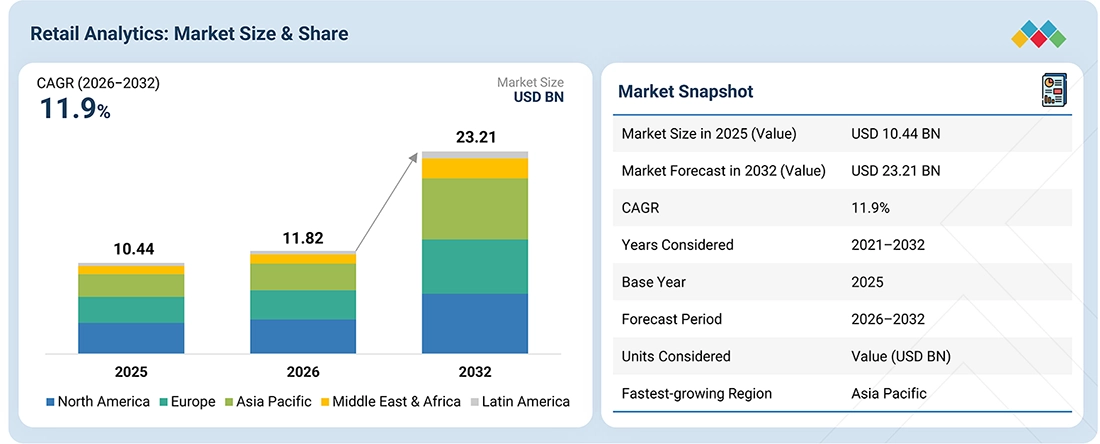
Source: Secondary Research, Interviews with Experts, MarketsandMarkets Analysis
The retail analytics market is projected to reach USD 11.82 billion in 2026 and USD 23.21 billion by 2032. This represents an 11.9% CAGR, supported by retailer investments in integrated, AI-enabled decision-making environments. Organizations increasingly combine transaction, inventory, customer, pricing, merchandising, and supply chain data across connected operations. Demand is strengthening for predictive forecasting, inventory optimization, customer segmentation, pricing intelligence, and real-time performance monitoring. Retailers deploy analytics to improve assortment planning, promotion effectiveness, replenishment, store productivity, and customer engagement. AI and machine learning support demand prediction, automated recommendations, inventory allocation, and more responsive retail decisions. Cloud analytics environments help retailers consolidate fragmented datasets and scale analytical capabilities across channels efficiently. Continued digital commerce growth, omnichannel operations, and AI adoption will accelerate retail analytics market development globally.
KEY TAKEAWAYS
-
BY REGIONThe Asia Pacific region is poised to register the highest CAGR of 14.9% over the forecast period.
-
BY OFFERINGBy offering, the solutions segment is estimated to account for the largest share of 75.5% in 2026.
-
BY ANALYTICS TYPEBy analytics type, autonomous & agentic analytics are slated to grow the fastest between 2026 and 2032.
-
BY APPLICATIONBy application, the enterprise decision intelligence segment is expected to witness the highest growth rate over the forecast period.
-
BY RETAIL TYPEBy retail type, the beauty & personal care retail segment is expected to witness the fastest growth rate over the forecast period.
-
COMPETITIVE LANDSCAPE - KEY PLAYERSThe competitive landscape is characterized by strategic alliances and continuous innovation across increasingly AI-driven retail analytics environments. Oracle Corporation, Salesforce, Microsoft Corporation, Adobe, SAP SE, and Teradata Corporation continue to expand advanced retail analytics capabilities. Their platforms strengthen forecasting, merchandising, customer analytics, pricing optimization, inventory management, automation, and real-time retail decision-making capabilities.
-
COMPETITIVE LANDSCAPE - STARTUPS/SMESAptos LLC, Circana LLC, CommerceIQ Inc., Placer Labs Inc., RetailNext Inc., SymphonyAI Holdings Inc., and ThoughtSpot Inc., among others, have differentiated themselves among startups and SMEs by establishing strong positions in specialized areas, underscoring their potential as emerging participants in the retail analytics market.
The retail analytics market in 2026 is advancing beyond traditional reporting toward AI-enabled operational decision-making. Key adoption drivers include omnichannel expansion, artificial intelligence, cloud adoption, and rising retail data volumes worldwide. These factors are shifting analytics from isolated reporting functions to integrated, enterprise-wide retail decision environments. Advances in predictive analytics improve demand forecasting, pricing, assortment planning, and inventory allocation across complex retail networks. Real-time data processing enables faster monitoring of sales, promotions, inventory positions, and changing customer behavior. Cloud platforms increasingly consolidate transaction, merchandising, loyalty, supply chain, and store information within unified environments. Artificial intelligence supports automated recommendations, customer segmentation, anomaly detection, and more responsive merchandising decisions for retailers. Retailers increasingly connect point-of-sale, ecommerce, inventory, and supplier information to strengthen operational visibility and coordination. These capabilities strengthen forecasting accuracy, profitability, inventory availability, customer engagement, and enterprise-wide retail performance overall.
TRENDS & DISRUPTIONS IMPACTING CUSTOMERS' CUSTOMERS
The retail analytics market is shifting from traditional reporting toward unified, AI-enabled, real-time retail decision intelligence. Retailers connect sales, POS, inventory, customer, pricing, promotion, fulfillment, and store data across enterprise systems. Cloud-native, composable architectures are reducing fragmentation while embedding scalable analytics directly into operational retail workflows. Predictive and prescriptive analytics are strengthening demand forecasting, inventory optimization, pricing, promotions, assortments, and planning decisions. Grocery, apparel, electronics, pharmacy, beauty, home, automotive, and specialty retailers are accelerating adoption of advanced analytics. Edge AI and in-store intelligence are extending analytics toward shelves, frontline operations, environments, and execution. Generative AI and autonomous agents are accelerating insight generation, scenario evaluation, workflow coordination, and decision execution. Retailers increasingly prioritize product availability, personalized experiences, faster decisions, reliable fulfillment, loyalty, and greater customer convenience. These disruptions are reshaping technology investments, competitive positioning, solution architectures, partnerships, and retail analytics economics.
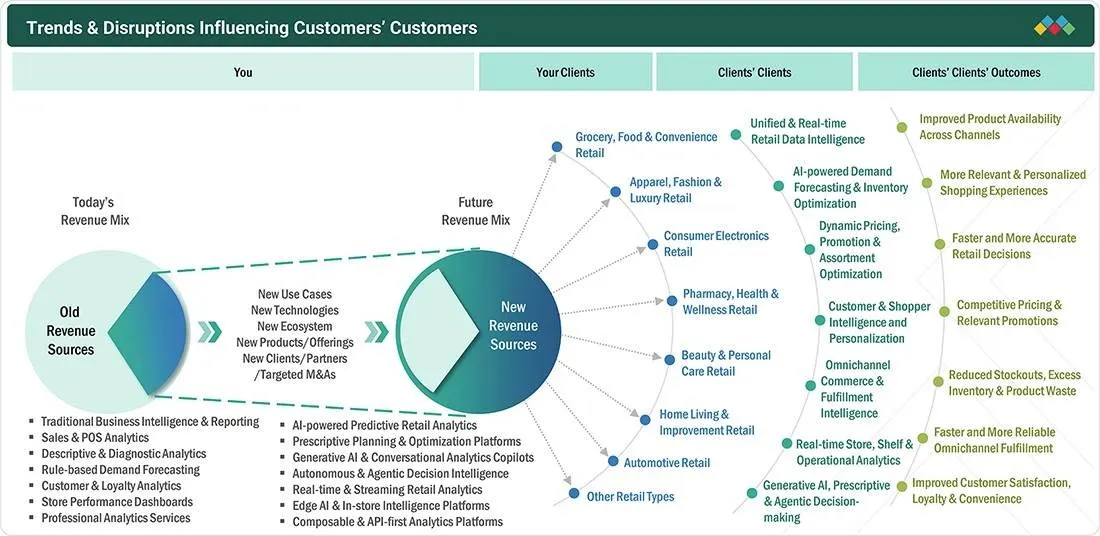
Source: Secondary Research, Interviews with Experts, MarketsandMarkets Analysis
MARKET DYNAMICS

Drivers
Impact
Level
Level
-
Increasing adoption of AI-driven demand forecasting and inventory optimization

-
Rapid growth of omnichannel retailing and digital commerce data


RESTRAINTS
Impact
Level
Level
-
Fragmented retail data across POS, ecommerce, loyalty, and supply chain systems

-
High cost and complexity of integrating enterprise-scale retail analytics platforms


OPPORTUNITIES
Impact
Level
Level
-
Expansion of generative AI and conversational analytics across retail decision workflows

-
Increasing use of predictive analytics for hyperlocal demand and replenishment planning


CHALLENGES
Impact
Level
Level
-
Achieving a unified analytical view across physical and digital retail channels

-
Converting large volumes of retail data into timely and actionable decisions

Source: Secondary Research, Interviews with Experts, MarketsandMarkets Analysis
Driver: Increasing adoption of AI-driven demand forecasting and inventory optimization
Retail analytics adoption is accelerating as retailers use AI-driven demand forecasting and inventory optimization to manage volatile consumer demand and complex omnichannel operations. Traditional forecasting methods often struggle with seasonality, promotions, local demand variations, assortment complexity, and rapidly changing purchasing behavior. AI and machine learning models analyze sales, inventory, pricing, promotions, and external signals to generate more granular forecasts across products, stores, channels, and planning periods. These forecasts support replenishment, purchasing, allocation, inventory positioning, workforce planning, and broader supply chain decisions. Retailers are also using AI-enabled inventory optimization to balance product availability with carrying costs, reduce stockouts, and respond faster to demand shifts. Vendors such as Oracle, SAP, and RELEX are embedding forecasting, replenishment, and optimization capabilities into retail platforms. As retail operations become more complex, AI-driven forecasting is increasingly essential for connecting demand prediction with operational inventory decisions and improving overall planning responsiveness across increasingly data-intensive retail networks worldwide.
Restraint: Fragmented retail data across POS, ecommerce, loyalty, and supply chain systems
Fragmented retail data across point-of-sale, ecommerce, loyalty, inventory, merchandising, and supply chain systems remains a major restraint for retail analytics adoption. Disconnected environments create inconsistent definitions, duplicate records, incomplete customer and product views, and mismatched identifiers across channels. These issues reduce data quality and complicate efforts to generate trusted forecasts, dashboards, recommendations, and performance measurements. Retailers often require substantial cleansing, mapping, reconciliation, and governance before analytics platforms can deliver reliable outputs. Missing links between transactions, loyalty profiles, inventory records, suppliers, marketplaces, warehouses, and stores can distort customer insights and inventory visibility. Omnichannel operations further increase complexity because different systems, data structures, and update frequencies must be synchronized. Although standards such as GS1 support common identifiers and interoperability, retailers still face legacy systems and inconsistent master data. As a result, fragmented data increases implementation costs, delays deployments, weakens confidence in analytics, and limits enterprise-wide adoption of advanced retail analytics capabilities globally.
Opportunity: Expansion of generative AI and conversational analytics across retail decision workflows
Generative AI and conversational analytics are creating opportunities by expanding access to retail decision support beyond specialist analysts. Natural-language interfaces allow business users to interrogate complex retail datasets without writing queries or relying on predefined dashboards. These capabilities help merchandising, operations, marketing, and store teams obtain faster answers from governed enterprise data. Vendors are embedding generative AI into retail workflows for automated summaries, performance interpretation, forecasting support, inventory analysis, and conversational exploration. This broadens analytics usage among managers, store associates, planners, and executives who may lack technical expertise. The opportunity also extends to cloud providers, software vendors, and systems integrators supporting enterprise AI adoption. Retailers increasingly require platforms that combine trusted data, semantic models, generative interfaces, security controls, and workflow integration. Vendors can differentiate through domain-specific agents, embedded recommendations, automated summaries, and conversational analytics. Expanding generative AI capabilities can accelerate platform modernization and create new services opportunities across retail analytics.
Challenge: Achieving a unified analytical view across physical and digital retail channels
Achieving a unified analytical view across physical and digital retail channels remains a persistent challenge. Retailers operate stores, ecommerce sites, mobile applications, marketplaces, social channels, and fulfillment touchpoints simultaneously. Data from these environments often remains fragmented across point-of-sale, commerce, loyalty, marketing, inventory, and fulfillment systems. Different formats, identifiers, timestamps, definitions, and update frequencies complicate integration and cross-channel measurement. Retailers must reconcile customer, transaction, product, promotion, inventory, and behavioral data before generating reliable enterprise insights. Physical and digital channels also capture shopper behavior differently, making cross-channel identity resolution difficult. Inconsistent synchronization can distort inventory availability, purchasing behavior, campaign attribution, and fulfillment performance. Establishing a unified view requires governance, standardized metrics, data-quality controls, security policies, and coordination across technology and business teams. Legacy platforms and older interfaces further increase modernization complexity. Until these integration barriers are resolved, retail analytics environments may remain fragmented, reducing the value retailers derive from advanced analytics investments.
RETAIL ANALYTICS MARKET : COMMERCIAL USE CASES ACROSS INDUSTRIES
| COMPANY | USE CASE DESCRIPTION | BENEFITS |
|---|---|---|
 |
Cape Union Mart implemented Oracle Retail Merchandising Cloud Service, Oracle Retail Merchandise Financial Planning Cloud Service, Oracle Retail Assortment Planning Cloud Service, and Oracle Retail Science Cloud Services to modernize merchandising, financial planning, and demand forecasting. The retailer replaced manual, spreadsheet-based processes with an integrated cloud platform, improving visibility across inventory, assortment, planning, and fulfillment while supporting more accurate, data-driven retail decisions. | Doubled order fulfillment capacity with fewer warehouse staff | Automated assortment and financial-planning workflows | Improved inventory visibility and merchandise assortments | Generated more accurate demand forecasts for seasonal trends | Enabled seamless cross-channel fulfillment supporting the DARE customer initiative |
 |
CHRIST implemented SAP Commerce Cloud and SAP Emarsys to create a unified commerce and customer engagement environment across more than 200 connected stores. The retailer consolidated sales, behavioral, and historical customer data to support personalized marketing, improve order management and ship-from-store operations, and deliver more consistent experiences across point-of-sale, ecommerce, email, web, and mobile wallet channels. | Increased revenue by 30–40% year-over-year | Achieved 99.9% site availability despite 150% higher Cyber Week traffic | Reduced campaign creation time to under one hour | Expanded the ecommerce team from 10 to over 100 members | Improved order fulfillment across 200+ connected stores |
 |
Walgreens implemented Blue Yonder’s AI-based Order Management microservices to strengthen real-time inventory visibility and order promising across its omnichannel network. The retailer uses analytics-driven inventory and fulfillment information to calculate accurate order options across more than 200 million item-store combinations, helping customers receive reliable 30-minute order-ready commitments while improving speed, proximity-based fulfillment, and overall digital commerce execution. | Enabled a 30-minute customer order promise | Improved real-time inventory visibility across 200+ million item-store combinations | Strengthened order accuracy through AI-based fulfillment decisions | Improved fulfillment speed and proximity to customers | Enhanced omnichannel fulfillment reliability and digital commerce execution |
Logos and trademarks shown above are the property of their respective owners. Their use here is for informational and illustrative purposes only.
MARKET ECOSYSTEM
The retail analytics ecosystem brings together platforms supporting decisions across merchandising, operations, customers, and supply chains. Traditional and rule-based analytics solutions provide reporting, dashboards, performance monitoring, and decision support for retailers. Adobe, Lightspeed, Teradata, Domo, Shopify, and Circana strengthen this segment through established analytical and reporting capabilities. AI-embedded and predictive analytics platforms apply machine learning to forecasting, customer insights, inventory, and planning. Salesforce, Microsoft, Adobe, SAP, Oracle, and Zebra support predictive intelligence across increasingly connected retail environments. Prescriptive and optimization analytics combine advanced models with recommendations for pricing, assortment, replenishment, and fulfillment decisions. Salesforce, Manhattan Associates, UiPath, Adobe, Oracle, and Blue Yonder strengthen optimization-oriented analytics across retail workflows. Autonomous and agentic analytics increasingly enable conversational exploration, automated recommendations, continuous monitoring, and workflow-driven actions. Salesforce, Microsoft, Domo, Manhattan Associates, ThoughtSpot, and RELEX are advancing autonomous decision support across retail operations.
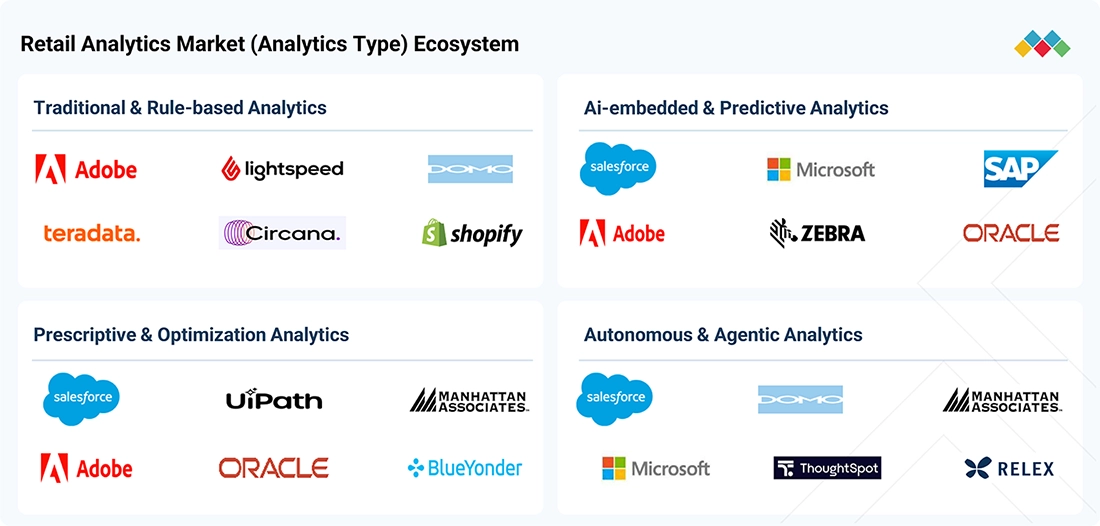
Logos and trademarks shown above are the property of their respective owners. Their use here is for informational and illustrative purposes only.
MARKET SEGMENTS
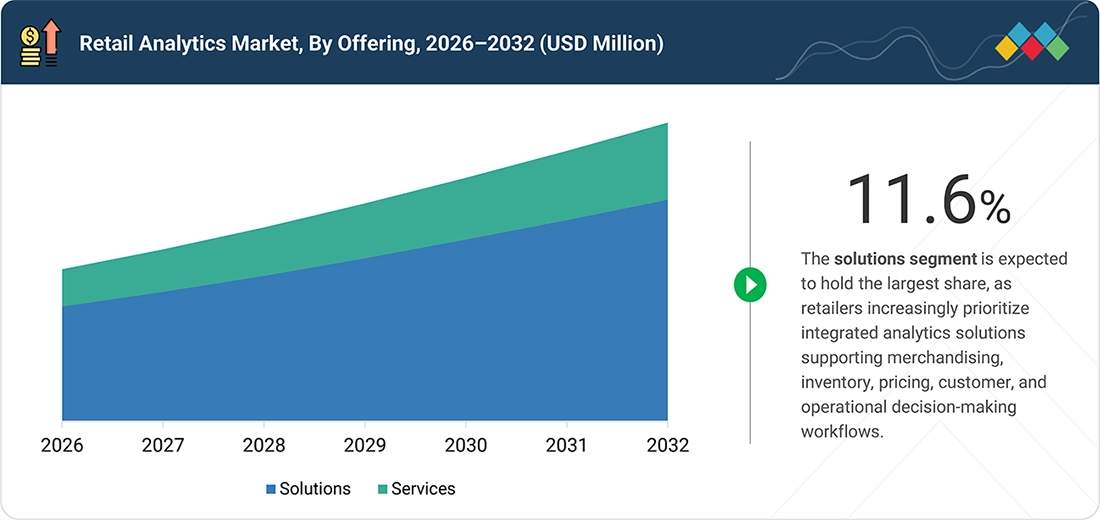
Source: Secondary Research, Interviews with Experts, MarketsandMarkets Analysis
Retail Analytics Market, By Offering
By offering, the solutions segment is estimated to account for the largest market share globally. Retailers increasingly prioritize integrated analytics solutions supporting merchandising, inventory, pricing, customer, and operational decision-making workflows. These solutions efficiently consolidate data across point-of-sale, ecommerce, loyalty, supply chain, merchandising, and store systems. Advanced platforms enable forecasting, assortment optimization, customer segmentation, pricing intelligence, and real-time performance monitoring capabilities. Cloud-native architectures further improve scalability, interoperability, automation, and integration across distributed retail technology environments globally. Vendors continue enhancing solutions through machine learning, generative AI, computer vision, and embedded decision intelligence. Large retailers prefer centralized analytics solutions supporting governance and standardized insights across multiple functions and channels. These capabilities collectively strengthen solution demand across diverse retail formats, geographies, and deployment environments globally.
Retail Analytics Market, By Analytics Type
By analytics type, AI-embedded and predictive analytics are estimated to account for the largest market share. Retailers increasingly use predictive models to anticipate demand, customer behavior, inventory requirements, and promotional performance. AI-embedded platforms combine machine learning with retail data to generate forecasts, recommendations, and operational insights. These capabilities support pricing optimization, assortment planning, replenishment, customer segmentation, and store-level decision-making across networks. Real-time processing further enables retailers to adjust decisions quickly as demand, inventory, and customer conditions change. Vendors continue embedding AI models directly within analytics platforms, reducing dependence on separate data science tools. Growing adoption of generative AI also strengthens predictive workflows through conversational insights and automated recommendations. Together, these capabilities reinforce AI-embedded and predictive analytics as the dominant analytics type across retail.
Retail Analytics Market, By Application
By application, enterprise decision intelligence is expected to witness the fastest growth across the retail analytics market. Retailers increasingly need unified intelligence that connects merchandising, operations, finance, supply chains, customers, and store performance. Enterprise decision intelligence combines analytics, AI models, business rules, and workflows to support coordinated decisions. These capabilities help organizations move beyond isolated dashboards toward continuous, cross-functional analysis and operational recommendations. Retail executives can evaluate performance, identify risks, simulate outcomes, and prioritize actions using shared information. Generative AI and conversational interfaces further expand access to enterprise insights across nontechnical business users. Vendors are embedding agentic capabilities that connect analytical findings directly with planning, execution, and automation workflows. These developments accelerate enterprise decision intelligence adoption as retailers pursue faster, coordinated, and measurable decision-making.
Retail Analytics Market, By Retail Type
By retail type, beauty and personal care retail is expected to witness the fastest market growth. Beauty retailers increasingly combine ecommerce, stores, social commerce, loyalty, and digital engagement across customer journeys. Frequent product launches, personalization requirements, and trend-driven purchasing create strong demand for real-time analytics capabilities. Analytics supports assortment planning, inventory allocation, promotion effectiveness, customer segmentation, and personalized product recommendations effectively. Retailers also analyze social, loyalty, transaction, and browsing signals to identify emerging preferences and trends. AI-enabled tools help beauty retailers improve demand forecasting, targeted engagement, pricing, and campaign optimization decisions. Omnichannel expansion further increases requirements for synchronized customer, inventory, and product intelligence across touchpoints globally. These factors collectively accelerate analytics adoption across beauty and personal care retailers seeking differentiated experiences.
REGION
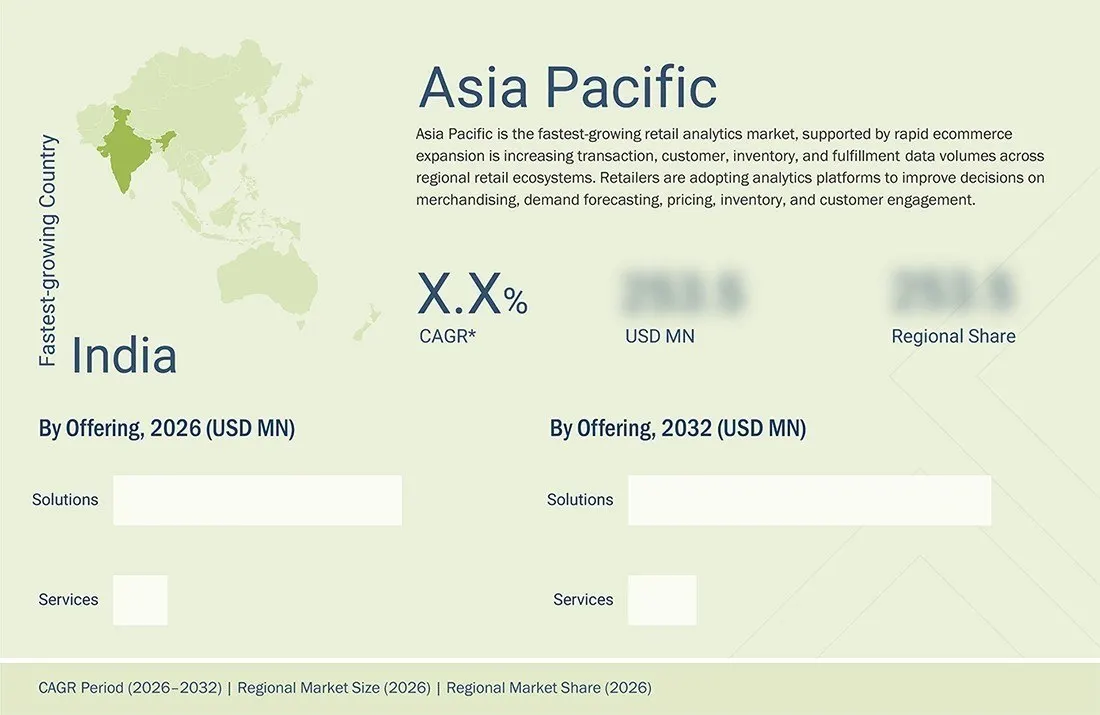
Asia Pacific to be fastest-growing region in reatail analytics market during forecast period
Asia Pacific is projected to register the highest CAGR in the retail analytics market during the forecast period. Rapid ecommerce expansion is increasing transaction, customer, inventory, and fulfillment data volumes across regional retail ecosystems. Retailers are adopting analytics platforms to improve merchandising, demand forecasting, pricing, inventory, and customer engagement decisions. Rising cloud adoption improves deployment scalability, integration flexibility, and real-time processing across distributed retail operations. Mobile-first consumer behavior is strengthening demand for personalized recommendations, localized promotions, and omnichannel shopping experiences. Digital payment growth further expands transactional data available for customer analytics, fraud monitoring, and performance optimization. Investments in AI, loyalty platforms, and store digitization are accelerating analytics adoption across retail enterprises. China, India, Japan, South Korea, Australia, and Southeast Asia remain key contributors to regional growth. Comparatively lower analytics penetration also creates substantial headroom for sustained market expansion across emerging retail economies.
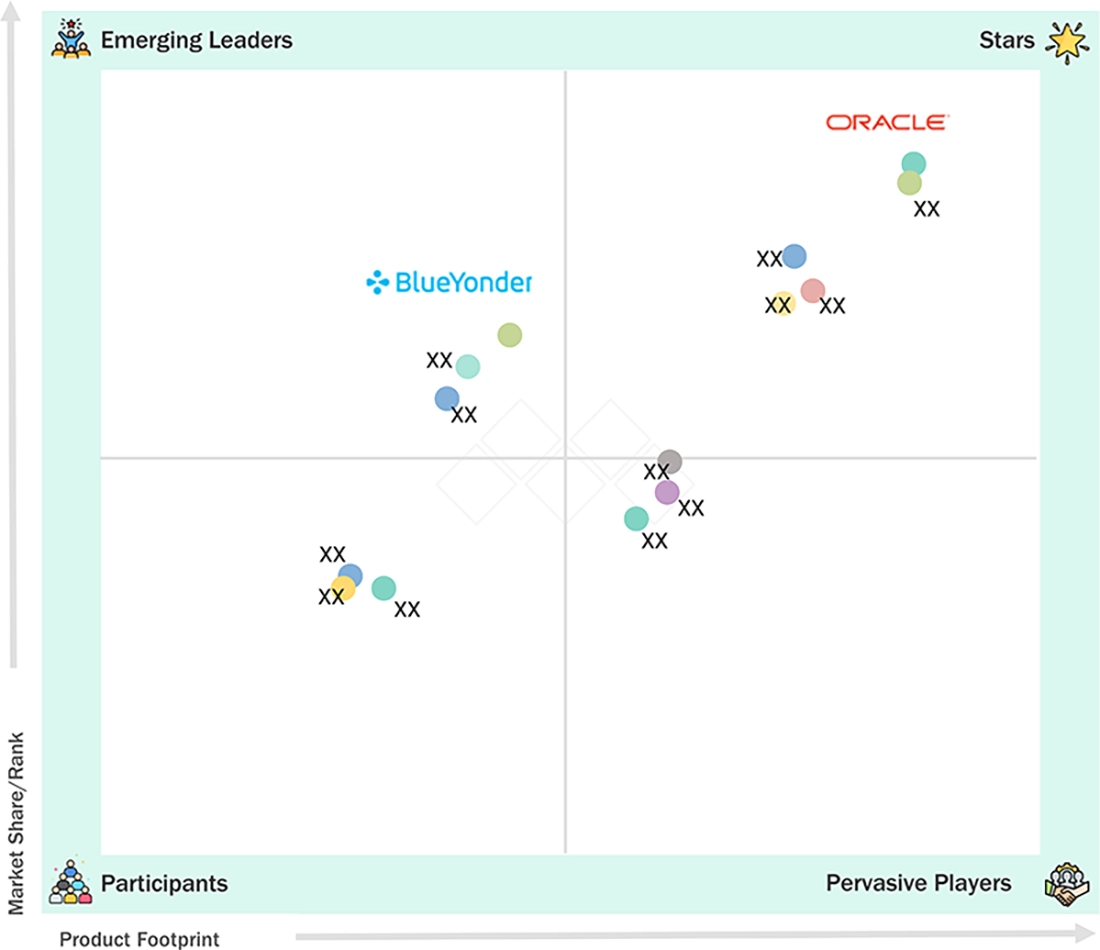
RETAIL ANALYTICS MARKET: COMPANY EVALUATION MATRIX
Oracle is a leading retail analytics vendor through its integrated Oracle Retail Analytics and Planning ecosystem. The company connects merchandising, pricing, inventory, customer, planning, and operational data across unified retail environments. Its AI-driven forecasting, segmentation, optimization, and retail intelligence capabilities strengthen enterprise decision-making across complex operations. Cloud-based applications also support assortment planning, demand forecasting, inventory optimization, pricing, and performance analytics at scale. Oracle reinforces its leadership through broad retail functionality, AI innovation, enterprise integrations, and established global customer adoption. Blue Yonder Group is an emerging retail analytics company through its AI-powered supply chain and commerce solutions. The company combines demand forecasting, inventory optimization, order management, merchandising, and fulfillment intelligence across retail operations. Its predictive and prescriptive analytics support retailers with planning, replenishment, allocation, pricing, and inventory decisions. Blue Yonder increasingly embeds artificial intelligence and automation to improve responsiveness across complex omnichannel retail networks. These capabilities strengthen its emerging position within the evolving global retail analytics market and competitive landscape.
Source: Secondary Research, Interviews with Experts, MarketsandMarkets Analysis
KEY MARKET PLAYERS
- Oracle Corporation (US)
- Salesforce, Inc. (US)
- Microsoft Corporation (US)
- SAP SE (Germany)
- Adobe Inc. (US)
- Zebra Technologies Corporation (US)
- Shopify Inc. (Canada)
- Teradata Corporation (US)
- Lightspeed Commerce Inc. (Canada)
- Manhattan Associates, Inc. (US)
- UiPath Inc. (US)
- Strategy Incorporated (US)
- Domo, Inc. (US)
- NielsenIQ (NIQ) (US)
- SAS Institute Inc. (US)
- Databricks, Inc. (US)
- Infor, Inc. (US)
- Sensormatic Solutions LLC (US)
MARKET SCOPE
| REPORT METRIC | DETAILS |
|---|---|
| Market Size in 2025 (Value) | USD 10.44 Billion |
| Market Forecast in 2026 (Value) | USD 11.82 Billion |
| Market Forecast in 2032 (Value) | USD 23.21 Billion |
| Growth Rate | 11.9% |
| Years Considered | 2021–2032 |
| Base Year | 2025 |
| Forecast Period | 2026–2032 |
| Units Considered | Value (USD Billion) |
| Report Coverage | Revenue forecast, company ranking, competitive landscape, growth factors, and trends |
| Segments Covered |
|
| Regions Covered | North America, Europe, Asia Pacific, Middle East & Africa, Latin America |
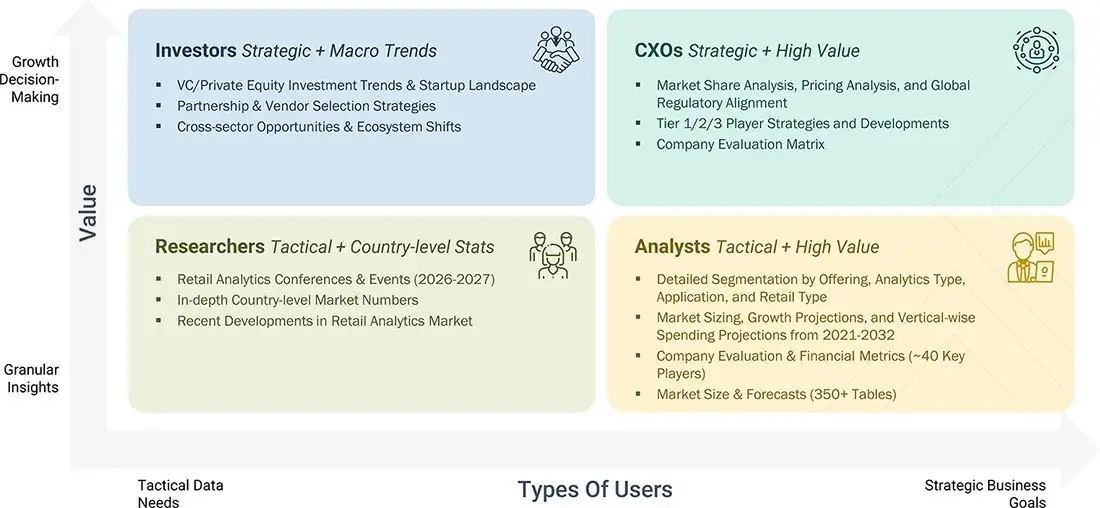
WHAT IS IN IT FOR YOU: RETAIL ANALYTICS MARKET REPORT CONTENT GUIDE
DELIVERED CUSTOMIZATIONS
We have successfully delivered the following deep-dive customizations:
| CLIENT REQUEST | CUSTOMIZATION DELIVERED | VALUE ADDS |
|---|---|---|
| Leading Retail Analytics Provider (North America) |
|
|
| Leading Retail Analytics Provider (Europe) |
|
|
RECENT DEVELOPMENTS
- August 2026 : Adobe expanded Customer Journey Analytics with Brand Visibility, formerly LLM Optimizer, strengthening measurement of AI-driven customer discovery. The integration helps retailers connect LLM-originated traffic with website engagement and downstream outcomes, enabling analysis of how generative AI discovery influences product exploration, customer engagement, and conversion performance.
- May 2026 : Salesforce launched the Tableau Agentic Analytics Platform, enabling AI agents to interpret enterprise data, business semantics, and context. For retailers, the platform supports trusted analysis and autonomous action across customer, sales, merchandising, inventory, store, and operational performance workflows, strengthening enterprise-wide decision intelligence.
- April 2026 : Oracle enhanced Retail Insights Cloud Service with Store Grades Reporting and Sales Liability Reporting capabilities. The enhancements enable retailers to aggregate location performance by store grades and combine completed sales with unfulfilled customer-order liabilities, improving visibility into merchandise performance, location-level demand, and omnichannel sales activity.
- March 2026 : Microsoft expanded Dynamics 365 Commerce with Copilot-based summaries and insights for merchandising data. The capability summarizes channel merchandising configurations, automatically validates product, category, and catalog data, and identifies potential risks, helping retailers improve merchandising accuracy, data quality, and product and channel decisions.
- January 2026 : Salesforce expanded its partnership with Google by supporting Universal Commerce Protocol within Agentforce Commerce. The collaboration enables retailers to expose product and commerce information across Google AI surfaces, supporting conversational product discovery, shopper-intent understanding, personalized shopping experiences, and AI-assisted checkout journeys.
Table of Contents
 Exclusive indicates content/data unique to MarketsandMarkets and not available with any competitors.
TITLE
PAGE NO
1
INTRODUCTION
15
2
EXECUTIVE SUMMARY
3
PREMIUM INSIGHTS
4
MARKET OVERVIEW
Summarizes the competitive environment, macro signals, and segment-level movements driving market outcomes.
4.1
INTRODUCTION
4.2
MARKET DYNAMICS
4.2.1
DRIVERS
4.2.2
RESTRAINTS
4.2.3
OPPORTUNITIES
4.2.4
CHALLENGES
4.3
UNMET NEEDS AND WHITE SPACES
4.4
INTERCONNECTED MARKETS AND CROSS-SECTOR OPPORTUNITIES
4.5
STRATEGIC MOVES BY TIER 1/2/3 PLAYERS
5
INDUSTRY TRENDS
Explains the evolving landscape through demand-side drivers, supply-side constraints, and opportunity hotspots.
5.1
EVOLUTION OF RETAIL ANALYTICS
5.2
PORTER’S FIVE FORCES ANALYSIS
5.3
MACROECONOMIC OUTLOOK
5.3.1
INTRODUCTION
5.3.2
GDP TRENDS AND FORECAST
5.3.3
TRENDS IN RETAIL ANALYTICS MARKET
5.4
SUPPLY CHAIN ANALYSIS
5.5
ECOSYSTEM ANALYSIS
5.6
PRICING ANALYSIS
5.7
KEY CONFERENCES AND EVENTS, 2026–2027
5.8
TRENDS/DISRUPTIONS IMPACTING CUSTOMER BUSINESS
5.9
INVESTMENT AND FUNDING SCENARIO
5.10
CASE STUDY ANALYSIS
6
TECHNOLOGICAL ADVANCEMENTS, PATENTS, INNOVATIONS, AND FUTURE APPLICATIONS
6.1
KEY TECHNOLOGIES
6.2
COMPLEMENTARY TECHNOLOGIES
6.3
ADJACENT TECHNOLOGIES
6.4
PATENT ANALYSIS
6.5
FUTURE APPLICATIONS
7
REGULATORY LANDSCAPE
7.1
REGIONAL REGULATIONS AND COMPLIANCE
7.1.1
REGULATORY BODIES, GOVERNMENT AGENCIES, AND OTHER ORGANIZATIONS
7.1.2
KEY REGULATIONS
7.1.3
INDUSTRY STANDARDS
8
CUSTOMER LANDSCAPE AND BUYER BEHAVIOR
8.1
INTRODUCTION
8.2
DECISION-MAKING PROCESS
8.3
KEY STAKEHOLDERS INVOLVED IN BUYING PROCESS AND THEIR EVALUATION CRITERIA
8.3.1
KEY STAKEHOLDERS IN BUYING PROCESS
8.3.2
BUYING CRITERIA
8.4
ADOPTION BARRIERS AND INTERNAL CHALLENGES
8.5
UNMET NEEDS OF VARIOUS RETAIL TYPES
9
RETAIL ANALYTICS MARKET, BY OFFERING (MARKET SIZE AND FORECAST TO 2032 – IN VALUE, USD MILLION)
(COMPARATIVE ASSESSMENT OF KEY OFFERINGS, THEIR MARKET POTENTIAL, AND DEMAND PATTERNS)
9.1
INTRODUCTION
9.1.1
OFFERING: RETAIL ANALYTICS MARKET DRIVERS
9.2
SOLUTION
9.2.1
ENTERPRISE ANALYTICS SUITES
9.2.2
CUSTOMER INTELLIGENCE PLATFORMS
9.2.3
PLANNING & DECISION INTELLIGENCE PLATFORMS
9.2.4
API-FIRST & HEADLESS ANALYTICS PLATFORMS
9.2.5
ADVANCED ANALYTICS PLATFORMS
9.3
SERVICES
9.3.1
PROFESSIONAL SERVICES
9.3.1.1
CONSULTING & ADVISORY
9.3.1.2
IMPLEMENTATION & INTEGRATION
9.3.1.3
SUPPORT & TRAINING
9.3.2
MANAGED SERVICES
10
RETAIL ANALYTICS MARKET, BY ANALYTICS TYPE (MARKET SIZE AND FORECAST TO 2032 – IN VALUE, USD MILLION)
(COMPARATIVE ASSESSMENT OF ANALYTICS TYPE, THEIR MARKET POTENTIAL, AND DEMAND PATTERNS)
10.1
INTRODUCTION
10.1.1
ANALYTICS TYPE: RETAIL ANALYTICS MARKET DRIVERS
10.2
TRADITIONAL & RULES-BASED ANALYTICS
10.3
AI-EMBEDDED & PREDICTIVE ANALYTICS
10.4
PRESCRIPTIVE & OPTIMIZATION ANALYTICS
10.5
AUTONOMOUS & AGENTIC ANALYTICS
11
RETAIL ANALYTICS MARKET, BY APPLICATION (MARKET SIZE AND FORECAST TO 2032 – IN VALUE, USD MILLION)
(COMPARATIVE ASSESSMENT OF APPLICATIONS, THEIR MARKET POTENTIAL, AND DEMAND PATTERNS)
11.1
INTRODUCTION
11.1.1
APPLICATION: RETAIL ANALYTICS MARKET DRIVERS
11.2
SALES & MERCHANDISING MANAGEMENT
11.2.1
SALES PERFORMANCE MANAGEMENT
11.2.2
MERCHANDISING & ASSORTMENT MANAGEMENT
11.2.3
PRICING & PROMOTION MANAGEMENT
11.2.4
PRODUCT & CATEGORY MANAGEMENT
11.2.5
SPACE & PLANOGRAM MANAGEMENT
11.2.6
OTHER USE CASES
11.3
MARKETING & CUSTOMER MANAGEMENT
11.3.1
CUSTOMER & SHOPPER MANAGEMENT
11.3.2
LOYALTY & RETENTION MANAGEMENT
11.3.3
PERSONALIZATION & RECOMMENDATION MANAGEMENT
11.3.4
CAMPAIGN & MARKETING MANAGEMENT
11.3.5
RETAIL MEDIA MANAGEMENT
11.3.6
OTHER USE CASES
11.4
OPERATIONS & SUPPLY CHAIN
11.4.1
DEMAND PLANNING & FORECASTING
11.4.2
INVENTORY & REPLENISHMENT MANAGEMENT
11.4.3
PROCUREMENT & SUPPLIER MANAGEMENT
11.4.4
SUPPLY CHAIN & LOGISTICS MANAGEMENT
11.4.5
FULFILLMENT & DISTRIBUTION MANAGEMENT
11.4.6
STORE OPERATIONS & EXECUTION MANAGEMENT
11.4.7
OTHER USE CASES
11.5
WORKFORCE & PRODUCTIVITY
11.5.1
WORKFORCE PLANNING & SCHEDULING
11.5.2
EMPLOYEE PRODUCTIVITY & PERFORMANCE MANAGEMENT
11.5.3
LABOR COST MANAGEMENT & OPTIMIZATION
11.5.4
WORKFORCE ENGAGEMENT & RETENTION MANAGEMENT
11.5.5
TASK & WORKFORCE OPERATIONS MANAGEMENT
11.5.6
OTHER USE CASES
11.6
FINANCIAL & PAYMENTS
11.6.1
REVENUE & MARGIN MANAGEMENT
11.6.2
PROFITABILITY & COST MANAGEMENT
11.6.3
PAYMENT & TRANSACTION MANAGEMENT
11.6.4
FINANCIAL PLANNING & FORECASTING
11.6.5
WORKING CAPITAL & CASH FLOW MANAGEMENT
11.6.6
OTHER USE CASES
11.7
ENTERPRISE DECISION INTELLIGENCE
11.7.1
BUSINESS PERFORMANCE & EXECUTIVE MANAGEMENT
11.7.2
PREDICTIVE & PRESCRIPTIVE DECISIONING
11.7.3
SCENARIO PLANNING & SIMULATION
11.7.4
AI-DRIVEN INSIGHTS & CONVERSATIONAL INTELLIGENCE
11.7.5
AUTONOMOUS & AGENTIC DECISIONING
11.7.6
OTHER USE CASES
12
RETAIL ANALYTICS MARKET, BY RETAIL TYPE (MARKET SIZE AND FORECAST TO 2032 – IN VALUE, USD MILLION)
(COMPARATIVE ASSESSMENT OF RETAIL TYPE, THEIR MARKET POTENTIAL, AND DEMAND PATTERNS)
12.1
INTRODUCTION
12.1.1
RETAIL TYPE: RETAIL ANALYTICS MARKET DRIVERS
12.2
GROCERY, FOOD & CONVENIENCE RETAIL
12.3
APPAREL, FASHION & LUXURY RETAIL
12.4
CONSUMER ELECTRONICS RETAIL
12.5
PHARMACY, HEALTH & WELLNESS RETAIL
12.6
BEAUTY & PERSONAL CARE RETAIL
12.7
HOME LIVING & IMPROVEMENT RETAIL
12.8
AUTOMOTIVE RETAIL
12.9
OTHER RETAIL TYPES
13
RETAIL ANALYTICS MARKET, BY REGION (MARKET SIZE AND FORECAST TO 2032 – IN VALUE, USD MILLION)
(ASSESSING GROWTH PATTERNS, INDUSTRY FORCES, REGULATORY LANDSCAPE, AND MARKET POTENTIAL ACROSS KEY GEOGRAPHIES AND COUNTRIES)
13.1
INTRODUCTION
13.2
NORTH AMERICA
13.2.1
NORTH AMERICA: MARKET DRIVERS
13.2.2
US
13.2.3
CANADA
13.3
EUROPE
13.3.1
EUROPE: MARKET DRIVERS
13.3.2
UK
13.3.3
GERMANY
13.3.4
FRANCE
13.3.5
SPAIN
13.3.6
ITALY
13.3.7
REST OF EUROPE
13.4
ASIA PACIFIC
13.4.1
ASIA PACIFIC: MARKET DRIVERS
13.4.2
CHINA
13.4.3
INDIA
13.4.4
JAPAN
13.4.5
SOUTH KOREA
13.4.6
ASEAN
13.4.7
REST OF ASIA PACIFIC
13.5
MIDDLE EAST AND AFRICA
13.5.1
MIDDLE EAST AND AFRICA: MARKET DRIVERS
13.5.2
SAUDI ARABIA
13.5.3
UAE
13.5.4
TURKEY
13.5.5
SOUTH AFRICA
13.5.6
REST OF MIDDLE EAST AND AFRICA
13.6
LATIN AMERICA
13.6.1
LATIN AMERICA: MARKET DRIVERS
13.6.2
BRAZIL
13.6.3
MEXICO
13.6.4
REST OF LATIN AMERICA
14
COMPETITIVE LANDSCAPE
(STRATEGIC ASSESSMENT OF LEADING PLAYERS, MARKET SHARE, REVENUE ANALYSIS, COMPANY POSITIONING, AND COMPETITIVE BENCHMARKS INFLUENCING MARKET POTENTIAL)
14.1
OVERVIEW
14.2
KEY PLAYER COMPETITIVE STRATEGIES/RIGHT TO WIN, 2022–2026
14.3
REVENUE ANALYSIS, 2021–2025
14.4
MARKET SHARE ANALYSIS,
14.5
PRODUCT COMPARISON
14.6
COMPANY EVALUATION MATRIX: TRADITIONAL/RULE-BASED RETAIL ANALYTICS PLAYERS,
14.6.1
STARS
14.6.2
EMERGING LEADERS
14.6.3
PERVASIVE PLAYERS
14.6.4
PARTICIPANTS
14.6.5
COMPANY FOOTPRINT: TRADITIONAL/RULE-BASED RETAIL ANALYTICS PLAYERS,
14.6.5.1
COMPANY FOOTPRINT
14.6.5.2
REGION FOOTPRINT
14.6.5.3
OFFERING FOOTPRINT
14.6.5.4
APPLICATION FOOTPRINT
14.6.5.5
RETAIL TYPE FOOTPRINT
14.7
COMPANY EVALUATION MATRIX: AI-ENABLED/AGENTIC RETAIL ANALYTICS PLAYERS,
14.7.1
STARS
14.7.2
EMERGING LEADERS
14.7.3
PERVASIVE PLAYERS
14.7.4
PARTICIPANTS
14.7.5
COMPANY FOOTPRINT: AI-ENABLED RETAIL ANALYTICS PLAYERS,
14.7.5.1
COMPANY FOOTPRINT
14.7.5.2
REGION FOOTPRINT
14.7.5.3
OFFERING FOOTPRINT
14.7.5.4
APPLICATION FOOTPRINT
14.7.5.5
RETAIL TYPE FOOTPRINT
14.8
COMPANY VALUATION AND FINANCIAL METRICS
14.9
COMPETITIVE SCENARIO
14.9.1
PRODUCT LAUNCHES
14.9.2
DEALS
15
COMPANY PROFILES
(IN-DEPTH REVIEW OF COMPANIES, PRODUCTS, SERVICES, RECENT INITIATIVES, AND POSITIONING STRATEGIES IN RETAIL ANALYTICS MARKET LANDSCAPE)
15.1
KEY PLAYERS
15.1.1
ORACLE CORPORATION
15.1.2
SALESFORCE, INC.
15.1.3
MICROSOFT CORPORATION
15.1.4
SAP SE
15.1.5
ADOBE INC.
15.1.6
ZEBRA TECHNOLOGIES CORPORATION
15.1.7
SHOPIFY INC.
15.1.8
TERADATA CORPORATION
15.1.9
LIGHTSPEED COMMERCE INC.
15.1.10
MANHATTAN ASSOCIATES, INC.
15.1.11
UIPATH INC. (PEAK AI LIMITED)
15.1.12
STRATEGY INCORPORATED
15.1.13
DOMO, INC.
15.1.14
NIELSENIQ (NIQ)
15.1.15
SAS INSTITUTE INC.
15.1.16
DATABRICKS, INC.
15.1.17
INFOR, INC.
15.1.18
SENSORMATIC SOLUTIONS LLC
15.2
OTHER PLAYERS
15.2.1
BLUE YONDER GROUP, INC. (US)
15.2.2
EPICOR SOFTWARE CORPORATION
15.2.3
CIRCANA, LLC
15.2.4
O9 SOLUTIONS, INC.
15.2.5
DUNNHUMBY LIMITED
15.2.6
QLIKTECH INTERNATIONAL AB (QLIK)
15.2.7
ALTERYX, INC.
15.2.8
SYMPHONYAI HOLDINGS INC.
15.2.9
RELEX SOLUTIONS OY
15.2.10
ADA DATA AI SOLUTIONS PTE. LTD
15.2.11
APTOS, LLC
15.2.12
THOUGHTSPOT, INC.
15.2.13
SIGMA COMPUTING, INC.
15.2.14
SISENSE LTD.
15.2.15
PLACER LABS, INC. (PLACER.AI)
15.2.16
COMMERCEIQ, INC.
15.2.17
SPINS (DATASEMBLY, INC.)
15.2.18
WAYFLYER (CONJURA LTD.)
15.2.19
WORLDAPP, INC. (FORM)
15.2.20
RETAILNEXT, INC.
15.2.21
DATAWEAVE SOFTWARE PRIVATE LIMITED
15.2.22
COMPETERA INC.
15.2.23
RETALON, INC.
15.2.24
FOCAL SYSTEMS, INC.
15.2.25
ALLOY.AI, INC.
16
RESEARCH METHODOLOGY
16.1
RESEARCH DATA
16.1.1
SECONDARY DATA
16.1.1.1
KEY DATA FROM SECONDARY SOURCES
16.1.1.2
LIST OF KEY SECONDARY SOURCES
16.1.2
PRIMARY DATA
16.1.2.1
KEY DATA FROM PRIMARY SOURCES
16.1.2.2
KEY PRIMARY PARTICIPANTS
16.1.2.3
BREAKDOWN OF PRIMARY INTERVIEWS
16.1.2.4
KEY INDUSTRY INSIGHTS
16.2
MARKET SIZE ESTIMATION
16.2.1
BOTTOM-UP APPROACH
16.2.2
TOP-DOWN APPROACH
16.2.3
MARKET SIZE CALCULATION FOR BASE YEAR
16.3
MARKET FORECAST APPROACH
16.3.1
SUPPLY SIDE
16.3.2
DEMAND SIDE
16.4
DATA TRIANGULATION
16.5
FACTOR ANALYSIS
16.6
RESEARCH ASSUMPTIONS
16.7
RESEARCH LIMITATIONS
16.8
RISK ASSESSMENT
17
APPENDIX
17.1
DISCUSSION GUIDE
17.2
KNOWLEDGESTORE: MARKETSANDMARKETS’ SUBSCRIPTION PORTAL
17.3
CUSTOMIZATIONS OPTIONS
17.4
RELATED REPORTS
17.5
AUTHOR DETAILS
Methodology
The research methodology for the retail analytics market report involved extensive secondary research using authoritative industry sources. Company publications, regulatory documents, association materials, standards publications, and government databases supported comprehensive market understanding. Peer-reviewed journals and reputable technology publications were reviewed to identify relevant developments influencing retail analytics adoption. In-depth interviews were conducted with analytics vendors, retailers, systems integrators, consultants, technology partners, and industry specialists. These interviews helped validate market trends, technology advancements, deployment models, adoption patterns, and regional demand dynamics. Primary respondents also provided perspectives on merchandising, inventory optimization, customer analytics, pricing, and operational intelligence requirements. Retailers and industry experts provided inputs to validate key qualitative and quantitative market information. The methodology combined secondary evidence and primary insights to strengthen segmentation, competitive assessment, and forecast assumptions. This structured approach supported consistent analysis across offerings, analytics types, applications, retail formats, regions, and countries.
Secondary Research
During secondary research, multiple authoritative sources were consulted to identify, collect, and validate information for this study. Secondary sources included annual reports, press releases, investor presentations, product documentation, technical papers, and corporate blogs. Government publications, industry associations, standards organizations, and official statistics supported validation of retail market developments. Company websites provided information on analytics solutions, artificial intelligence capabilities, customer deployments, partnerships, and product developments. Retailer disclosures supported assessment of technology adoption across merchandising, inventory, ecommerce, pricing, and store operations. Official statistical sources were reviewed to understand retail sales, ecommerce activity, digitalization, and broader economic conditions. Technology documentation supported evaluation of predictive analytics, optimization, cloud architectures, data integration, and decision intelligence capabilities. Together, these sources strengthened market segmentation, vendor assessment, technology mapping, and analysis of evolving customer requirements.
Recognized associations, standards bodies, government organizations, and multilateral institutions were also consulted throughout secondary research activities. Sources included the National Retail Federation, GS1, the United States Census Bureau, the OECD, and relevant national statistical authorities. These organizations provided information on retail activity, ecommerce adoption, standards, digital transformation, and technology-related operating trends. GS1 materials supported understanding of standardized identification, product information, interoperability, and data exchange across retail ecosystems. Government statistics supported validation of retail activity, ecommerce penetration, consumer spending patterns, and country-level market conditions. Vendor materials from Oracle, Microsoft, Salesforce, SAP, Adobe, and others supported competitive and technology assessments. Secondary research also covered industry value chains, vendor positioning, product developments, partnerships, acquisitions, and deployment patterns. Information was cross-checked across multiple sources wherever possible to improve consistency, reliability, and analytical defensibility. Primary interviews subsequently validated secondary findings concerning adoption priorities, implementation challenges, investment patterns, and competitive differentiation. No syndicated market research websites were used as information sources for developing the retail analytics analysis.
Primary Research
In the primary research process, diverse stakeholders across retail analytics supply and demand ecosystems were interviewed extensively. From the supply side, participants included executives, product managers, data scientists, consultants, and technology specialists. These respondents represented companies offering retail analytics platforms, business intelligence solutions, cloud services, and AI capabilities. Systems integrators, implementation partners, consulting firms, managed service providers, and digital transformation specialists were also consulted. Demand-side respondents included retailers, ecommerce operators, merchandising leaders, supply chain managers, and technology decision-makers globally. Additional participants included finance leaders, store operations teams, marketing executives, customer analytics specialists, and procurement professionals. These interviews helped assess adoption patterns, implementation challenges, investment priorities, technology requirements, and future spending intentions. Primary insights were evaluated alongside secondary evidence to improve consistency, reliability, and market-specific analytical depth.
The primary research ensured that all critical parameters influencing the retail analytics market, including demand forecasting requirements, inventory optimization, customer analytics, pricing intelligence, merchandising analytics, cloud adoption, artificial intelligence integration, predictive analytics, prescriptive analytics, and evolving retail use cases, were thoroughly assessed. Each factor was carefully analyzed, verified through primary interviews, and evaluated to obtain precise qualitative and quantitative inputs for the study.
Once the initial phase of market engineering was completed, including detailed calculations for market statistics, segment-specific growth forecasts, vendor revenue estimates, and data triangulation, a second round of primary research was conducted. This stage was crucial for refining and validating key data points, including solutions and services adoption, cloud and on-premises deployment patterns, enterprise-size distribution, retail-type demand, regional penetration, vendor positioning, and key market dynamics such as drivers, opportunities, challenges, and restraints. Additional validation covered increasing adoption of AI-driven demand forecasting, inventory optimization, generative AI, conversational analytics, enterprise decision intelligence, omnichannel analytics, real-time data processing, and managed retail analytics services across major retail segments.
The comprehensive market engineering process, together with top-down and bottom-up approaches and multiple data triangulation methods, was extensively employed to estimate and forecast the overall market, as well as all major segments and subsegments. Extensive qualitative and quantitative validation was conducted throughout the market engineering process to capture critical information and insights across the entire retail analytics value chain.
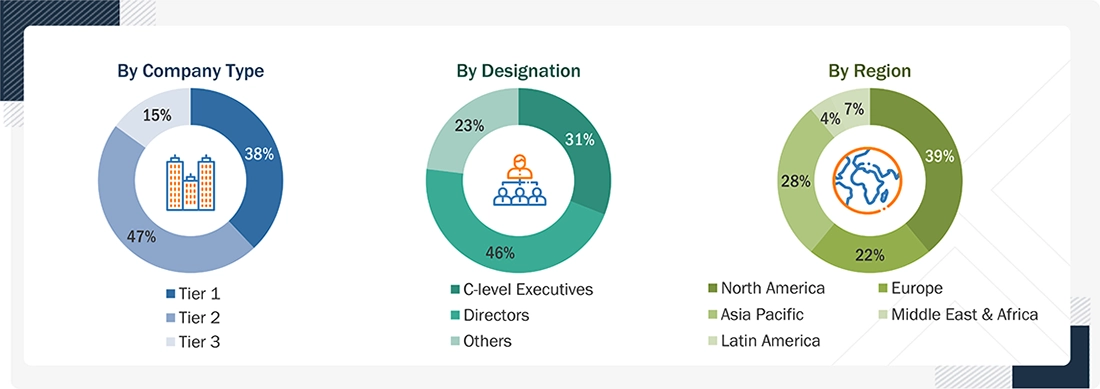
Note: Others include sales, marketing, and product managers; tier 1 companies’ revenues are more than USD 500 million, tier 2 companies’ revenues range between USD 500 and 100 million, and tier 3 companies’ revenues are equal to or less than USD 100 million.
To know about the assumptions considered for the study, download the pdf brochure
Market Size Estimation
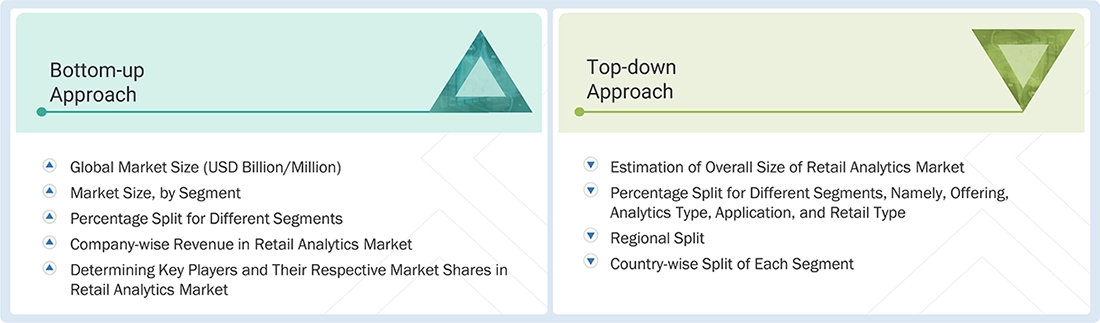
The top-down and bottom-up approaches were employed to estimate and forecast the retail analytics market, as well as its dependent submarkets. This multi-layered analysis was further reinforced through data triangulation, which incorporated primary and secondary research inputs. The market figures were also validated against the existing MarketsandMarkets repository for accuracy.
Data Triangulation
The market was divided into several segments and subsegments after determining the overall market size using the market size estimation processes described above. To complete the overall market engineering process and determine the exact statistics for each market segment and subsegment, data triangulation and market segmentation procedures were employed, wherever applicable. The overall market size was then used in the top-down approach to estimate the size of other individual markets by applying percentage splits to the market segmentation.
Market Definition
Retail analytics comprises software and services that collect, integrate, analyze, and interpret data generated across retail operations. These solutions process information from point-of-sale, ecommerce, loyalty, inventory, merchandising, supply chain, and customer interaction systems. Retail analytics converts operational and customer data into insights supporting pricing, assortment, replenishment, marketing, and store decisions. Platforms apply descriptive, diagnostic, predictive, and prescriptive techniques to explain performance and recommend actions across retail functions. Predictive models help retailers anticipate demand, purchasing behavior, inventory requirements, sales outcomes, and emerging operational risks. Prescriptive analytics combines forecasts with recommended actions for pricing, allocation, promotions, replenishment, and customer engagement decisions. Retailers also use analytics to evaluate loyalty, product performance, sell-through, inventory availability, and omnichannel customer behavior. Artificial intelligence and machine learning increasingly strengthen forecasting, recommendation, segmentation, anomaly detection, and automated decision-making capabilities. Retail analytics environments combine internal transaction histories with external information, including weather, economic, and competitive signals. These capabilities help retailers improve revenue, margins, customer satisfaction, operational efficiency, inventory productivity, and enterprise decision-making. The market includes analytics platforms, specialized applications, implementation services, managed services, and supporting data integration capabilities worldwide.
Key Stakeholders
- Retail analytics platform and solution providers
- Business intelligence and visualization platform providers
- Artificial intelligence and machine learning technology providers
- Retail merchandising and planning solution providers
- Pricing and promotion optimization solution providers
- Inventory and demand forecasting solution providers
- Customer analytics and personalization solution providers
- Point-of-sale and commerce technology providers
- Cloud service and data platform providers
- Systems integrators and implementation service providers
- Consulting and managed analytics service providers
- Retailers, distributors, technology partners, and data providers
Report Objectives
- To define, describe, and predict the retail analytics market by offering, analytics type, application, retail type, and region
- To provide detailed information related to major factors (drivers, restraints, opportunities, and industry-specific challenges) influencing market growth
- To analyze opportunities in the market and provide details of the competitive landscape for stakeholders and market leaders
- To forecast the market size of segments with respect to five main regions: North America, Europe, Asia Pacific, the Middle East & Africa, and Latin America
- To analyze each submarket with respect to individual growth trends, prospects, and contributions to the overall retail analytics market
- To analyze competitive developments, such as partnerships, new product launches, mergers & acquisitions, in the retail analytics market
- To analyze the impact of macroeconomic factors on the retail analytics market across all regions
Available customizations:
Using the provided market data, MarketsandMarkets offers customizations tailored to the company’s specific needs. The following customization options are available for the report.
Product analysis
- Product comparative analysis, which gives a detailed comparison of innovative products being offered by prominent vendors
Geographic analysis
- Further breakdown of additional European countries by offering, analytics type, application, and retail type
- Further breakdown of additional Asia Pacific countries by offering, analytics type, application, and retail type
- Further breakdown of additional Middle East & African countries by offering, analytics type, application, and retail type
- Further breakdown of additional Latin American countries by offering, analytics type, application, and retail type
Company information
- Detailed analysis and profiling of additional market players (up to five)
Key Questions Addressed by the Report
What is the current size of the Retail Analytics Market?
The retail analytics market is valued at USD 11.31 billion in 2026 and is projected to reach USD 20.65 billion by 2031 at a CAGR of 12.8%.
What is driving growth in the Retail Analytics Market?
Growing adoption of AI-enabled analytics, omnichannel retailing, and cloud-based retail intelligence platforms are accelerating market growth.
Which region dominates the Retail Analytics Market?
North America is expected to account for the largest market share of 33.7% in 2026 due to advanced digital retail infrastructure.
What are the emerging trends in the Retail Analytics Market?
Predictive analytics, AI-powered personalization, demand forecasting, and real-time inventory optimization are the key market trends shaping growth.
Who are the leading players in the Retail Analytics Market?
Major players include Microsoft, IBM, SAP, Oracle, and Salesforce
Which application segment offers the highest growth opportunities in retail analytics?
Price recommendation and optimization is expected to witness the highest CAGR of 15.8% during the forecast period
Fact checked
Personalize This Research
- Triangulate with your Own Data
- Get Data as per your Format and Definition
- Gain a Deeper Dive on a Specific Application, Geography, Customer or Competitor
- Any level of Personalization
Let Us Help You
- What are the Known and Unknown Adjacencies Impacting the Retail Analytics Market
- What will your New Revenue Sources be?
- Who will be your Top Customer; what will make them switch?
- Defend your Market Share or Win Competitors
- Get a Scorecard for Target Partners

Custom Market Research Services
We Will Customise The Research For You, In Case The Report Listed Above Does Not Meet With Your Requirements
Get 10% Free CustomisationTESTIMONIALS
- Asean Countries Retail Analytics Market
- Rest Of Asia Pacific Retail Analytics Market
- US Retail Analytics Market
- Canada Retail Analytics Market
- UK Retail Analytics Market
- Germany Retail Analytics Market
- France Retail Analytics Market
- Spain Retail Analytics Market
- Italy Retail Analytics Market
- Rest Of Europe Retail Analytics Market
- China Retail Analytics Market
- Japan Retail Analytics Market
- India Retail Analytics Market
- South Korea Retail Analytics Market
- Anz Retail Analytics Market
Growth opportunities and latent adjacency in Retail Analytics Market






Myra
Apr, 2026
How are AI and cloud technologies shaping the Retail Analytics industry and influencing long-term investment opportunities?.
Jason
Apr, 2026
From an investment standpoint, what makes retail analytics critical for the future of airport and aviation ecosystems?.