US Generative AI Market

US Generative AI Market by Software (Foundation Models, Model Enablement & Orchestration Tools, Gen AI SaaS), Modality (Text, Code, Video, Image, Multimodal), Application (Content Management, BI & Visualization, Search & Discovery) - Forecast to 2032




OVERVIEW
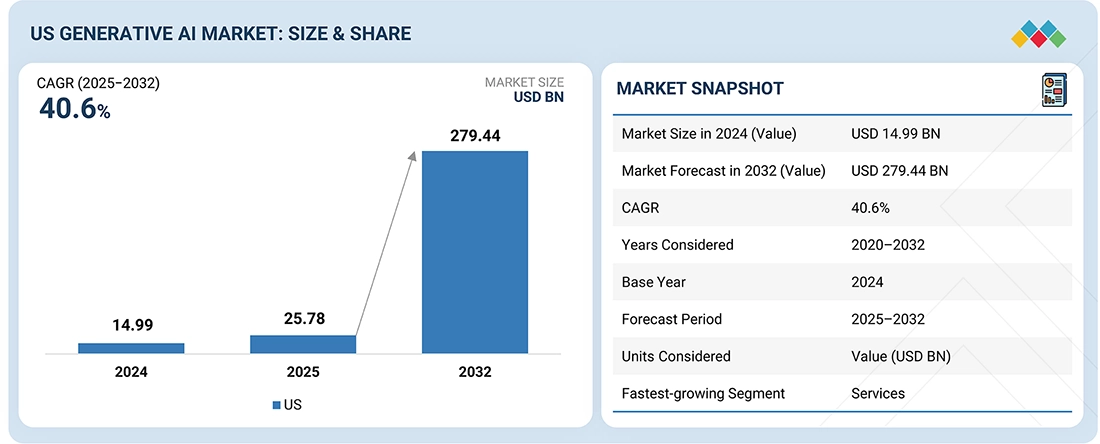
Source: Secondary Research, Interviews with Experts, MarketsandMarkets Analysis
The US generative AI market is projected to grow from USD 25.78 billion in 2025 to USD 279.44 billion by 2032, registering a CAGR of 40.6% during the forecast period. Growth is driven by the rising adoption of text, code, and multimodal generation tools that support content creation, accelerate research, and summarize knowledge across enterprise environments. Organizations are increasing investment in customized model variants, output-generation workflows, and secure prompt-handling mechanisms to ensure reliability and compliance. Expanding use of generative systems for drafting, analysis, and simulation is reshaping digital operations. These trends position GenAI as a core capability for US enterprises that aim to scale high-quality, trustworthy, and cost-efficient content automation.
KEY TAKEAWAYS
-
BY OFFERINGBy offering, the infrastructure segment is expected to account for the largest market share of 46.9% in 2025.
-
BY DATA MODALITYThe multimodal data segment is expected to register the highest CAGR of 57.4% during the forecast period.
-
BY APPLICATIONBy application, the content management segment is anticipated to hold the largest share (34.8%) of the US generative AI market in 2025.
-
BY END USERBy end user, the healthcare and life sciences segment is expected to witness the fastest growth between 2025 and 2032.
-
BY COMPETITIVE LANDSCAPENVIDIA, OpenAI, and Microsoft are identified as some of the leading players in the US generative AI market, given their strong market share and product footprint.
-
BY COMPETITIVE LANDSCAPEScale AI, Midjourney, and Jasper, among others, have distinguished themselves among startups and SMEs by securing strong footholds in specialized niche areas, underscoring their potential as emerging leaders.
The US generative AI market is accelerating as enterprises shift from experimentation to large-scale deployment, supported by strong investment activity and rapid product development. Current market trends include the rising adoption of agentic AI systems that automate workflows and the expansion of domain-specific models tailored for specific sectors. Demand for multimodal generative AI is rising as enterprises adopt unified text, image, audio, video, and code generation for complex tasks. Additionally, partnerships between cloud providers, AI model developers, and software vendors are driving broader commercialization across US industries.
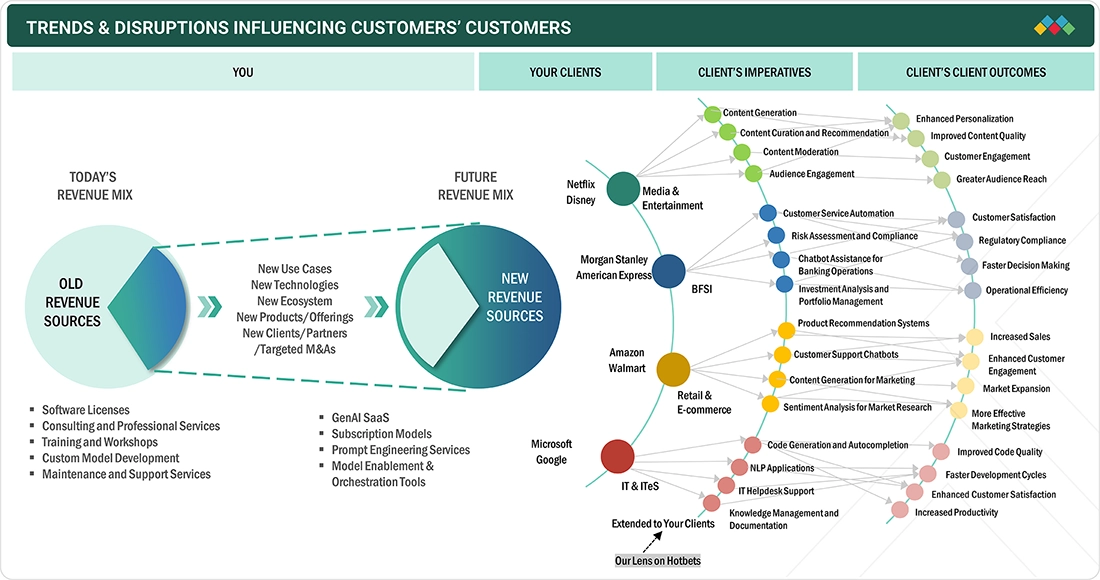
TRENDS & DISRUPTIONS IMPACTING CUSTOMERS' CUSTOMERS
Evolving trends in generative AI are shaping client priorities, driven by rising demand for content automation and intelligent decision support across different sectors. The current revenue largely comes from software licenses, consulting engagements, and ongoing support services. However, the market is quickly shifting toward scalable, recurring-revenue models, such as GenAI SaaS offerings and subscription-based consumption. This enables continuous optimization with seamless deployment and positions vendors to capture higher value through automation and operational intelligence at scale.
Source: Secondary Research, Interviews with Experts, MarketsandMarkets Analysis
MARKET DYNAMICS

Level
-
Rapid modernization of AI infrastructure and enterprise shift toward production-grade generative models

-
Rising enterprise adoption of automated content generation and agentic workflows


Level
-
Limited access to high-quality, domain-rich datasets required for reliable and compliant model training

-
Frequent model updates creating ongoing enterprise adjustment needs


Level
-
Expansion of enterprise copilots with intelligent search, reasoning, and workflow automation

-
Rising enterprise demand for advanced content generation, automated research, and knowledge acceleration


Level
-
Maintaining output accuracy and minimizing hallucinations in enterprise-grade deployments

Source: Secondary Research, Interviews with Experts, MarketsandMarkets Analysis
Driver: Rapid modernization of AI infrastructure and enterprise shift toward production-grade generative models
The US generative AI market is accelerating as enterprises expand high-performance compute capacity, adopt optimized inference frameworks, and invest in secure production environments. Improved cloud infrastructure, better model-serving pipelines, and faster deployment cycles are enabling continuous updates. Enterprises are also prioritizing scalable architectures and deeper integration with internal data systems, driving broad adoption of enterprise-grade generative AI solutions.
Restraint: Limited access to high-quality, domain-rich datasets required for reliable and compliant model training
Despite strong adoption, growth is limited by a shortage of domain-specific, regulation-compliant data necessary for accurate model development. Industries such as healthcare, finance, and public services encounter strict data protection rules, challenges in data annotation, and high preparation costs. The lack of high-quality training data increases the risks of bias and inaccuracies, limiting the scalability and reliability of enterprise generative AI deployments.
Opportunity: Expansion of enterprise copilots with intelligent search, reasoning, and workflow automation
The US generative AI market is seeing strong growth in enterprise AI copilots built into productivity tools, business applications, and developer platforms. These copilots use retrieval-augmented generation, vector search, and reasoning to support automation, recommendations, and content creation. Enterprises are embedding copilots into CRM and ERP software, creating opportunities for vendors that offer robust RAG frameworks and orchestration capabilities.
Challenge: Maintaining output accuracy and minimizing hallucinations in enterprise-grade deployments
A key challenge is ensuring accurate and reliable outputs in enterprise use cases. Generative AI must perform consistently in areas such as finance, healthcare, legal work, and customer operations. Models can still produce errors when data is limited or instructions are unclear. Enterprises need strong governance, validation, and monitoring practices to reduce risks. Trust, compliance, and reliability remain major barriers to large-scale adoption.
US GENERATIVE AI MARKET: COMMERCIAL USE CASES ACROSS INDUSTRIES
| COMPANY | USE CASE DESCRIPTION | BENEFITS |
|---|---|---|
 |
Fortune and Accenture developed an AI-driven platform that converts decades of business data into instantly accessible, interactive insights for decision-makers. | The platform accelerates insight discovery, improves strategic decision-making, enhances user experience, and broadens access to trusted business intelligence through unified, on-demand analytics. |
 |
Cisco leveraged Lumen5 to rapidly create customized social media videos, enabling faster content production and enhancing its global thought leadership presence. | The solution increased engagement, reduced video production time from days to minutes, boosted social media views, and enabled scalable, high-quality content creation across distributed teams. |
 |
Corewell Health used Abridge’s generative-AI platform to produce real-time clinical notes and reduce manual documentation workload. | The deployment enabled 90% of clinicians to give more focused patient attention, reduced after-hours documentation by 48%, decreased cognitive load by 61%, and improved overall job satisfaction for 85% of clinicians. |
 |
Tiger Analytics built a modern, governance-oriented data management platform consolidating disparate property, sales, and marketing systems. | Provided sales-team with real-time property demand insights, improved lead conversion tracking, and enabled data-driven asset and marketing decisions. |
 |
Fractal modernized the client’s PLM workflows using a metadata-driven medallion architecture to manage evolving schemas and secure data access. | Delivered timely insights, enabled fast product-decision cycles, improved governance with role-based access, and eliminated manual data errors. |
Logos and trademarks shown above are the property of their respective owners. Their use here is for informational and illustrative purposes only.
MARKET ECOSYSTEM
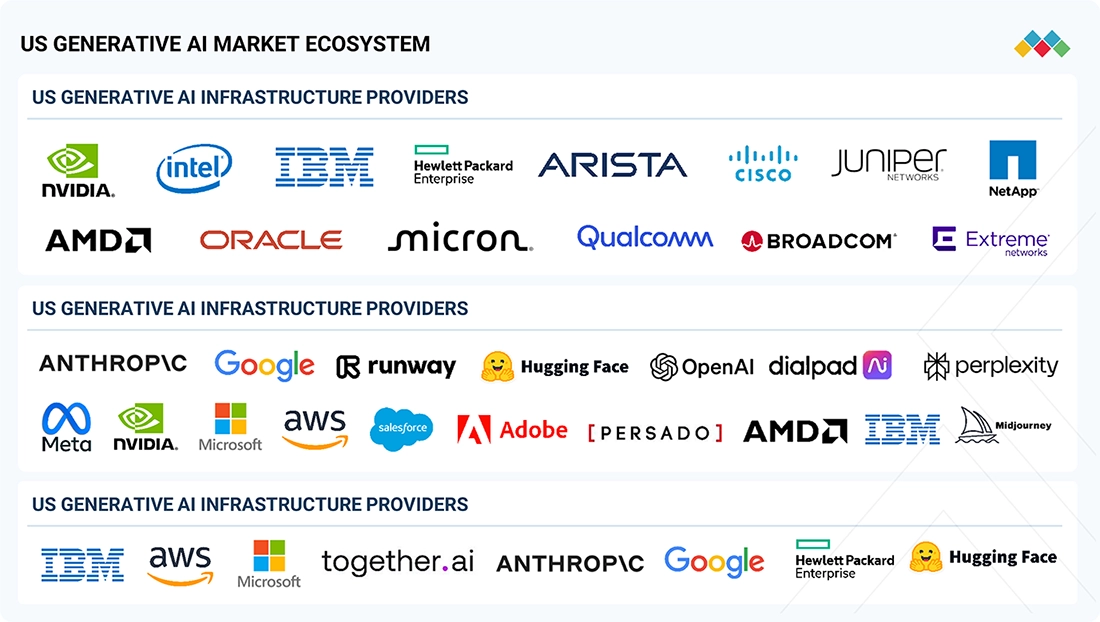
The US generative AI market ecosystem comprises a large network of infrastructure, software, and service providers that enable high-performance AI development and deployment. Infrastructure providers provide a foundation through advanced AI chips, high-bandwidth memory, and storage systems for training and inference workloads. Software providers deliver foundation models, orchestration frameworks, and GenAI SaaS platforms that support model customization and enterprise-grade integration. Service providers offer GenAI training and consulting, model development and fine-tuning, and high-quality training data services. Together, these stakeholders help enterprises deploy generative AI responsibly, efficiently, and at scale across a wide range of industry use cases.
Logos and trademarks shown above are the property of their respective owners. Their use here is for informational and illustrative purposes only.
MARKET SEGMENTS
Source: Secondary Research, Interviews with Experts, MarketsandMarkets Analysis
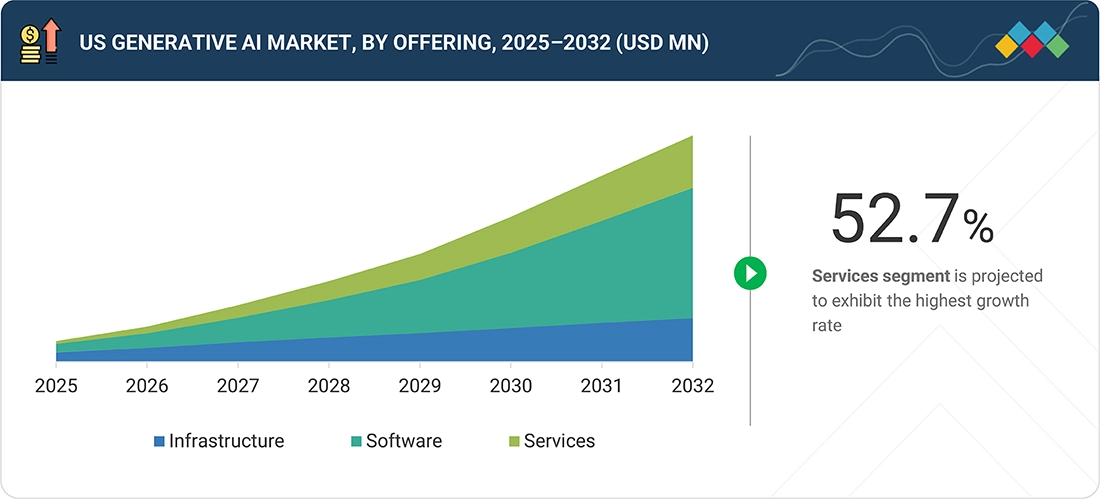
US Generative AI Market, by Offering
Services is the fastest-growing segment in the US generative AI market, driven by high enterprise demand for support in deploying GenAI solutions. Organizations are relying on service providers for data preparation, evaluation, governance design, and secure integration with existing technology. This growth is fueled by the rising pressure to convert GenAI pilots into scalable production systems and ensure compliance with evolving risk and security standards. This support helps move GenAI from pilots to large-scale production while meeting risk and compliance requirements.
US Generative AI Market, by Data Modality
Text data modality dominates the US generative AI market because text-driven LLMs serve as the core driver for the enterprise and consumer use cases. Organizations deploy text-based GenAI to automate content generation, enhance search and summarization, and enable agentic workflows that streamline decision-making. Enterprises are focusing on knowledge-based automation across customer service, compliance, marketing, and internal knowledge management.
US Generative AI Market, by Application
BI and visualization is the fastest-growing application segment, supported by strong enterprise demand for advanced analytics automation and decision-support tools. Organizations are leveraging GenAI to generate real-time insights, create visual dashboards, and streamline complex data interpretation. As organizations focus on data-driven decisions, GenAI-powered BI and visualization tools are improving productivity and accuracy of insights for both technical and non-technical users.
US Generative AI Market, by End User
Software and technology providers account for the largest market share because they are the earliest adopters of large-scale model development, GenAI-native product innovation, and AI-embedded software offerings. These companies integrate LLMs and multimodal agents directly into cloud platforms and customer-facing digital services. The need for continuous model training, inference optimization, and rapid feature deployment drives significant investment in generative AI infrastructure and APIs.
US GENERATIVE AI MARKET: COMPANY EVALUATION MATRIX
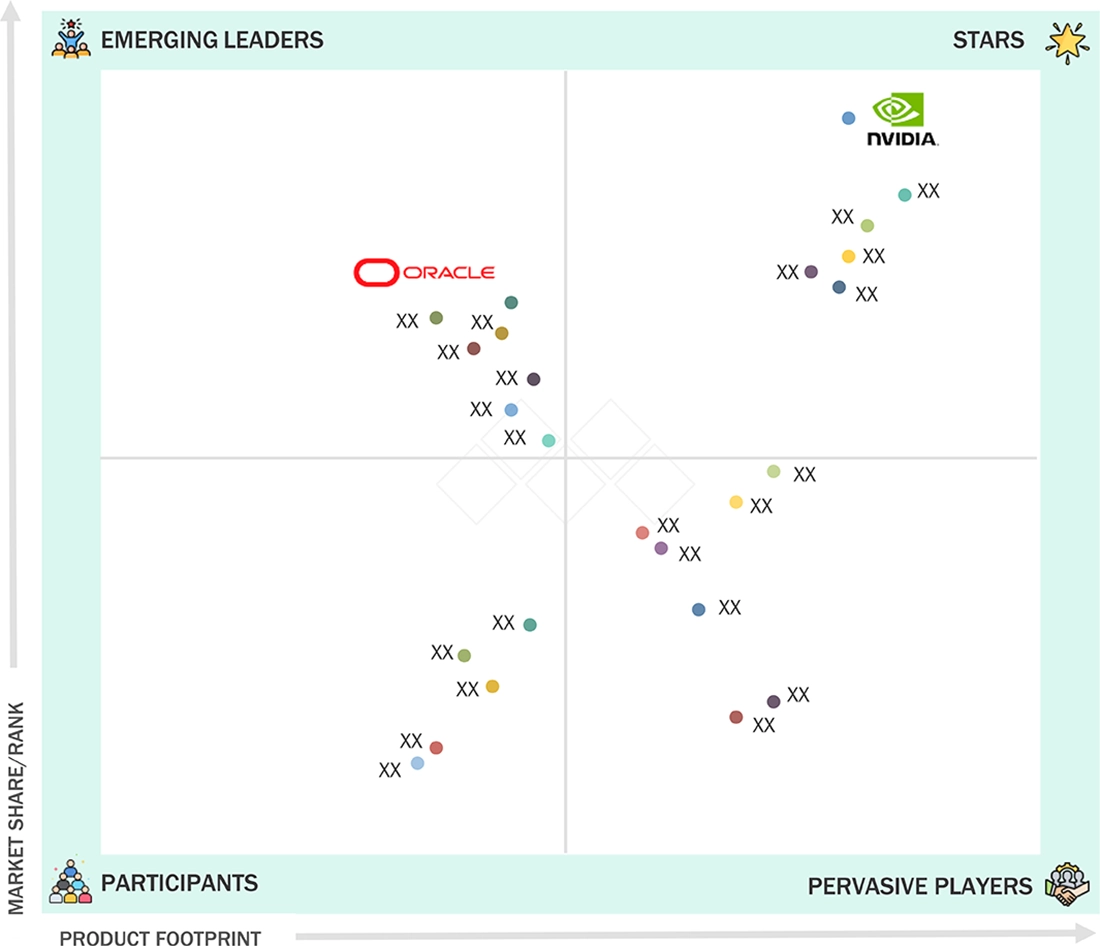
In the US generative AI market matrix, NVIDIA (star) leads the market with its strong software stack and AI model training infrastructure that support generative AI use across industries. Its GPUs, development frameworks, and AI workflow tools make it a key driver of advanced model innovation. Oracle (emerging leader) is expanding its presence through OCI Supercluster and built-in generative AI across Fusion, NetSuite, and industry cloud applications. With strengths in secure model hosting, governed in-database AI, and RAG, Oracle is seeing growing adoption in regulated industries and is positioned for steady enterprise growth.
Source: Secondary Research, Interviews with Experts, MarketsandMarkets Analysis
KEY MARKET PLAYERS
- NVIDIA (US)
- OpenAI (US)
- Microsoft (US)
- Google (US)
- AWS (US)
- HPE (US)
- AMD (US)
- Oracle (US)
- Innodata (US)
- iMerit (US)
- Salesforce (US)
- Telus Digital (US)
- Anthropic (US)
- Meta (US)
- Certific (US)
MARKET SCOPE
| REPORT METRIC | DETAILS |
|---|---|
| Market Size in 2024 (Value) | USD 14.99 Billion |
| Market Forecast in 2032 (Value) | USD 279.44 Billion |
| Growth Rate | CAGR of 40.6% During 2025–2032 |
| Years Considered | 2020–2032 |
| Base Year | 2024 |
| Forecast Period | 2025–2032 |
| Units Considered | Value (USD Billion) |
| Report Coverage | Revenue Forecast, Company Ranking, Competitive Landscape, Growth Factors, and Trends |
| Segments Covered |
|
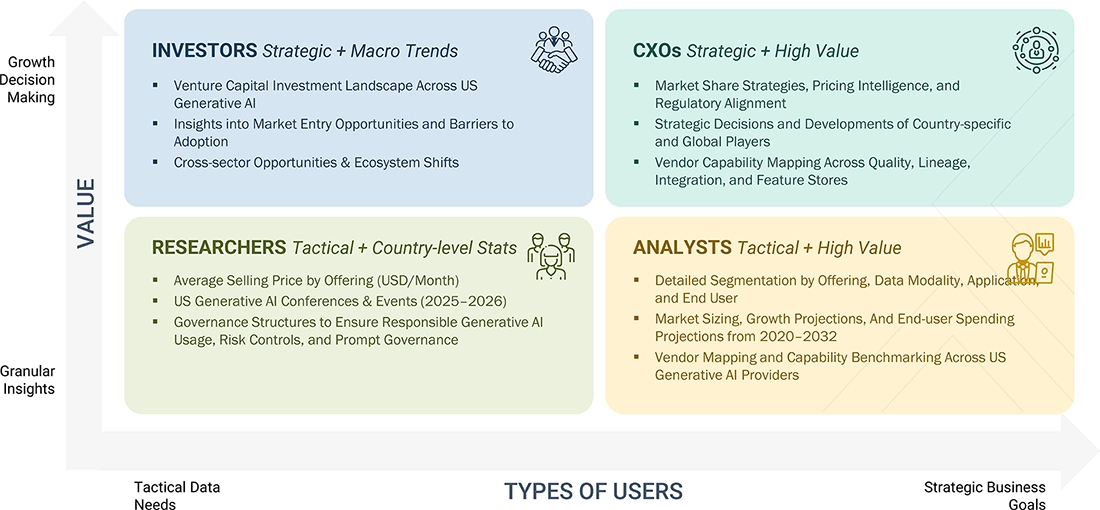
WHAT IS IN IT FOR YOU: US GENERATIVE AI MARKET REPORT CONTENT GUIDE
DELIVERED CUSTOMIZATIONS
We have successfully delivered the following deep-dive customizations:
| CLIENT REQUEST | CUSTOMIZATION DELIVERED | VALUE ADDS |
|---|---|---|
| Large US Retail & E-commerce Company |
|
|
| Financial Services & Insurance Firm |
|
|
RECENT DEVELOPMENTS
- December 2025 : NVIDIA and Synopsys formed a strategic partnership and investment agreement to speed up AI-based chip design and testing. This combines Synopsys design software with NVIDIA’s computing platforms. It shortens design timelines and support the development of advanced chips for large AI workloads.
- September 2025 : NVIDIA and OpenAI signed a letter of intent for a large computing infrastructure partnership. The plan focuses on using NVIDIA systems and software to expand OpenAI’s computing capacity and support training of advanced AI models.
- April 2025 : Anthropic and Google Cloud partnered to make Claude AI models available on Google’s Vertex AI platform. The setup allows government and defense organizations to use these models securely while meeting strict compliance and security requirements.
- January 2025 : NVIDIA launched new generative AI models and workflow tools for Omniverse at CES 2025. The update helps developers build robotics, industrial automation, and autonomous systems faster using ready-to-use templates and simulation tools.
Table of Contents
 Exclusive indicates content/data unique to MarketsandMarkets and not available with any competitors.
Methodology
The research methodology for the US Generative AI Market report involved the use of extensive secondary sources and directories, as well as various reputed open-source databases, to identify and collect information useful for this technical and market-oriented study. In-depth interviews were conducted with various primary respondents, including gen AI software providers, gen AI service providers, gen AI infrastructure providers, individual end users, and enterprise end-users; high-level executives of multiple companies offering generative AI solutions; and industry consultants to obtain and verify critical qualitative and quantitative information and assess the market prospects and industry trends.
Secondary Research
In the secondary research process, various secondary sources were referred to to identify and collect information for the study. The secondary sources included annual reports; press releases and investor presentations of companies; white papers, certified publications such as Journal of Generative AI Research (JAIR), Nature Machine Intelligence, Journal of Machine Learning Research (JMLR), Transactions on Machine Learning Research (TMLR), IEEE Transactions on Pattern Analysis and Machine Intelligence, ACM Transactions on Generative AI (TAI), Communications of the ACM, and Neural Information Processing Systems (NeurIPS); and articles from recognized associations and government publishing sources including but not limited to Association for Computational Linguistics (ACL), International Association for Machine Learning (IAMLE), Generative AI Industry Association (AIIA), International Speech Communication Association (ISCA), Natural Language Processing Association (NLPA), Machine Learning and AI Industry Research Association (MLAIRA), AI Infrastructure Alliance (AIIA), Stanford Center for Research on Foundation Models (CRFM), OpenAI Research Index, Google DeepMind Publications, Anthropic Research Archive, Allen Institute for AI (AI2), Partnership on AI, AI Infrastructure Alliance (AIIA), and national AI policy portals such as NITI Aayog, Digital Europe, and US National AI Initiative Office.
The secondary research was used to obtain key information about the industry’s value chain, the market’s monetary chain, the overall pool of key players, market classification and segmentation according to industry trends to the bottom-most level, regional markets, and key developments from the market and technology-oriented perspectives.
Primary Research
In the primary research process, a diverse range of stakeholders from both the supply and demand sides of the generative AI ecosystem were interviewed to gather qualitative and quantitative insights specific to this market. From the supply side, key industry experts, such as chief executive officers (CEOs), vice presidents (VPs), marketing directors, technology & innovation directors, as well as technical leads from vendors offering generative AI infrastructure, software & services, were consulted. Additionally, system integrators, service providers, and IT service firms that implement and support gen AI were included in the study. On the demand side, input from IT decision-makers, infrastructure managers, and business heads of prominent enterprise end users was collected to understand the user perspectives and adoption challenges within targeted industries.
The primary research ensured that all crucial parameters affecting the US Generative AI Market —from technological advancements and evolving use cases (content management, intelligent search & query, synthetic data generation, business intelligence & visualization, etc.) to regulatory and compliance needs (GDPR, CCPA, Europe AI Act, AIDA, etc.)—were considered. Each factor was thoroughly analyzed, verified through primary research, and evaluated to obtain precise quantitative and qualitative data for this market.
Once the initial phase of market engineering was completed, including detailed calculations for market statistics, segment-specific growth forecasts, and data triangulation, an additional round of primary research was undertaken. This step was crucial for refining and validating critical data points, such as Gen AI offerings (generative AI infrastructure, software & services), industry adoption trends, the competitive landscape, and key market dynamics like demand drivers (Innovation of cloud storage enabling easy access to data, the evolution of AI and deep learning, rise in content creation and creative applications), challenges (Concerns regarding misuse of generative AI for illegal activities, quality of output generated by generative AI models, computational complexity and technical challenges of generative AI), and opportunities (Increasing deployment of large language models, growing interest of enterprises in commercializing synthetic images, robust improvement in general ML leading to human baseline performance).
In the complete market engineering process, the top-down and bottom-up approaches and several data triangulation methods were extensively used to perform the market estimation and market forecast for the overall market segments and subsegments listed in this report. Extensive qualitative and quantitative analysis was performed on the complete market engineering process to record the critical information/insights throughout the report.
Source: MarketsandMarkets AnalysisMarket Size Estimation
Both top-down and bottom-up approaches were employed to estimate and forecast the US Generative AI Market and its dependent submarkets. This multi-layered analysis was further reinforced through data triangulation, incorporating both primary and secondary research inputs. The market figures were also validated against the existing MarketsandMarkets repository for accuracy. The following research methodology has been used to estimate the market size:
Data Triangulation
After arriving at the overall market size using the market size estimation processes as explained above, the market was split into several segments and subsegments. To complete the overall market engineering process and arrive at the exact statistics of each market segment and subsegment, data triangulation and market breakup procedures were employed, wherever applicable. The overall market size was then used in the top-down procedure to estimate the size of other individual markets via percentage splits of the market segmentation.
Market Definition
Many theoretical definitions of generative AI center on its core capability to produce new and original content across various modalities by learning from existing data patterns. Based on this, the Institute of Electrical and Electronics Engineers (IEEE) defines generative AI as a category of artificial intelligence models that are designed to generate new content, such as text, images, audio, or other types of data. Before generative AI came along, most ML models learned from datasets to perform tasks such as classification or prediction. Generative AI models use machine learning algorithms to learn patterns and structures from existing data and then produce new data that is similar in style or content to what they have been trained on.
Stakeholders
- Gen AI software developers
- Gen AI infrastructure providers
- Gen AI integrated service providers
- Gen AI training dataset providers
- Core data service providers
- Business analysts
- Cloud service providers
- Consulting service providers
- Enterprise end users
- Distributors and value-added resellers (VARs)
- Government agencies
- Independent software vendors (ISVs)
- Managed service providers
- Market research and consulting firms
- Support & maintenance service providers
- System integrators (SIs)/migration service providers
- Language service providers
- Technology providers
- Academia & research institutions
- Investors & venture capital firms
Report Objectives
- To define, describe, and forecast the US Generative AI Market by offering, data modality, application, and end user
- To provide detailed information related to major factors (drivers, restraints, opportunities, and industry-specific challenges) influencing market growth
- To analyze the micro markets with respect to individual growth trends, prospects, and their contribution to the total market
- To analyze the opportunities in the market for stakeholders by identifying the high-growth segments of the market
- To analyze opportunities in the market and provide details of the competitive landscape for stakeholders and market leaders
- To profile the key players and comprehensively analyze their market ranking and core competencies
- To analyze competitive developments, such as partnerships, product launches, and mergers and acquisitions, in the generative AI market
Available Customizations
With the given market data, MarketsandMarkets offers customizations as per the company’s specific needs. The following customization options are available for the report:
Product Analysis
- Product matrix provides a detailed comparison of the product portfolio of each company
Geographic Analysis as per Feasibility
- Further breakup of the North America market for Generative AI
- Further breakup of the Europe market for generative AI
- Further breakup of the Asia Pacific market for generative AI
- Further breakup of the Middle East & Africa market for generative AI
- Further breakup of the Latin America market for generative AI
Company Information
- Detailed analysis and profiling of additional market players (up to five)
Key Questions Addressed by the Report
What is the projected size of the US Generative AI Market by 2032?
The US generative AI market is projected to grow from USD 25.78 billion in 2025 to USD 279.44 billion by 2032, at a CAGR of 40.6% during the forecast period.
Which offering is expected to account for the largest share of the US Generative AI Market?
The infrastructure segment is expected to account for the largest market share of 46.9% in 2025.
Which data modality is projected to grow the fastest in the US Generative AI Market?
The multimodal data segment is expected to register the highest CAGR of 57.4% during the forecast period.
Which application holds the largest share of the US Generative AI Market?
The content management segment is expected to account for the largest market share of 34.8% in 2025.
Which end-user industry is expected to grow the fastest in the US Generative AI Market?
The healthcare and life sciences segment is expected to witness the fastest growth between 2025 and 2032.
What is driving enterprise adoption of generative AI in the US?
Growing adoption of foundation models, agentic AI systems, and multimodal AI capabilities for enterprise automation, knowledge management, and content generation is driving market growth.


Personalize This Research
- Triangulate with your Own Data
- Get Data as per your Format and Definition
- Gain a Deeper Dive on a Specific Application, Geography, Customer or Competitor
- Any level of Personalization
Let Us Help You
- What are the Known and Unknown Adjacencies Impacting the US Generative AI Market
- What will your New Revenue Sources be?
- Who will be your Top Customer; what will make them switch?
- Defend your Market Share or Win Competitors
- Get a Scorecard for Target Partners

Custom Market Research Services
We Will Customise The Research For You, In Case The Report Listed Above Does Not Meet With Your Requirements
Get 10% Free Customisation





Growth opportunities and latent adjacency in US Generative AI Market