US Pen Needles Market Size, Growth, Share & Trends Analysis

US Pen Needles Market by Type (Standard Pen Needles, Safety Pen Needles), Length (8mm, 5mm), Setting (Home Care Settings), Application (Glucagon-like Peptide-1 Therapy), Mode of Purchase (Over-the-counter Purchase, Online Purchase)- Forecast to 2031




OVERVIEW
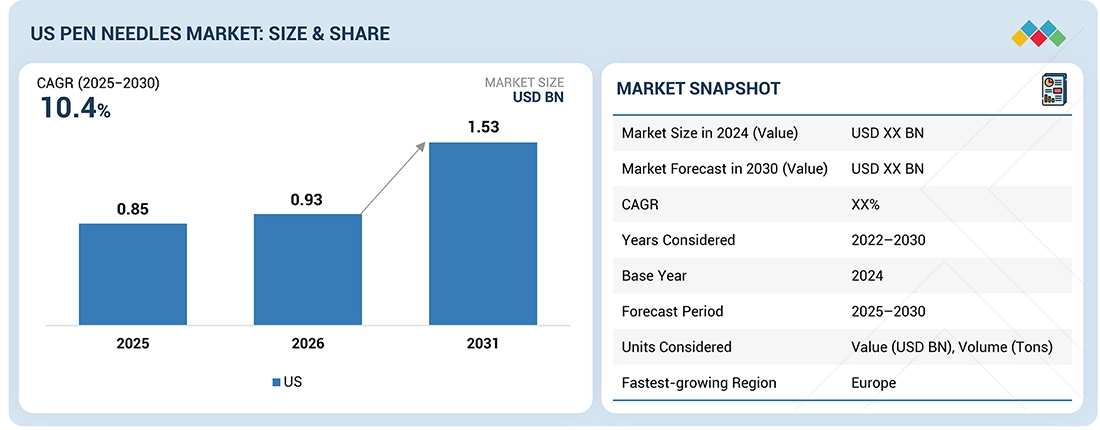
Source: Secondary Research, Interviews with Experts, MarketsandMarkets Analysis
The US pen needles market, valued at US$0.85 billion in 2025, stood at US$0.93 billion in 2026 and is projected to advance at a resilient CAGR of 10.4% from 2026 to 2031, culminating in a forecasted valuation of US$1.53 billion by the end of the period. Drivers include rising diabetes prevalence, aging, and obesity, and strong adoption of insulin pens that increase per-patient needle consumption. Restraints encompass pricing pressure, commoditization, reimbursement variability, and demand displacement from GLP-1 therapies. Opportunities lie in premiumization through safety-engineered and ultra-thin needles, smart/connected disposables, direct-to-patient subscription models, and OEM partnerships with pen manufacturers to drive uptake of higher-margin differentiated products and offset margin erosion, while expanding pharmacy and home-care distribution channels in the evolving outpatient care landscape.
KEY TAKEAWAYS
-
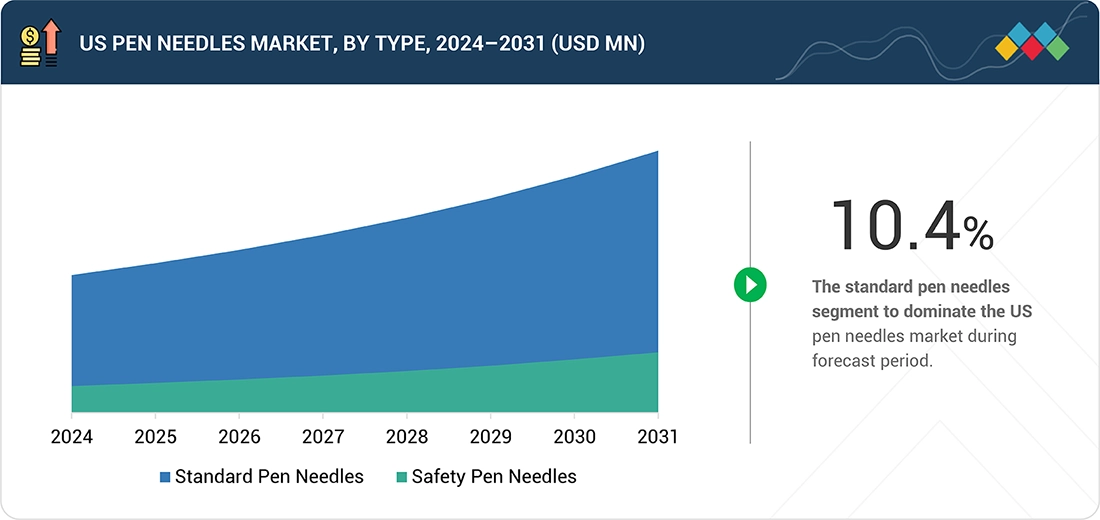
BY TYPEBy type, standard pen needles dominated the market, with a share of 83.4%, in 2025.
-
BY LENGTHBy length, 8mm segment dominated the market, with a share of 29.7% in 2024
-
BY APPLICATIONBy application, insulin therapy will be the fastest-growing segment in the forecast period.
-
BY MODE OF PURCHASEBy mode of purchase, the over-the-counter segment dominated the market, with a share of 34.8% in 2024
-
BY SETTINGBy setting, the home care segment is expected to register the highest CAGR of 10.8%.
-
COMPETITIVE LANDSCAPE - Key PlayersEmbecta Corp., Novo Norisk A/S, and B. Braun SE were identified as Star players in the US pen needles market, as they have focused on innovation and have broad industry coverage and strong operational & financial strengths.
-
COMPETITIVE LANDSCAPE - Start UpsAdvaCare Pharma, MHC Medical Products, and Wellion distinguished themselves among startups and SMEs due to their strong product portfolio and business strategy
The US pen needles market is driven by rising diabetes prevalence, an ageing population, and growing insulin-pen adoption that boosts per-patient consumption, while pricing pressure, reimbursement variability, and shifting demand due to GLP-1 therapies act as key restraints; however, substantial opportunities exist in safety-engineered and ultra-low-trauma needle innovation, smart/connected disposables, direct-to-patient subscription models, and OEM supply partnerships that enable premiumization, improved adherence, and stronger penetration across pharmacy, e-commerce, and home-care channels.
TRENDS & DISRUPTIONS IMPACTING CUSTOMERS' CUSTOMERS
The US IOLs market is unequivocally trending, with growing cataract volumes coupled with a greater interest in spectacle-free vision from patients. Surgeons are increasingly adopting premium toric, multifocal, EDOF, and adjustable options that can offer more customized results beyond what standard monofocal lenses provide. The migration is made easier because of ongoing innovations in lens materials and designs and image-guided surgery tools. At the same time, there is growing awareness about refractive cataract surgery, and this is making it necessary for service providers to rethink service offerings. Companies are developing new IOL platforms with a focus on improved vision, fewer side effects, and predictability.
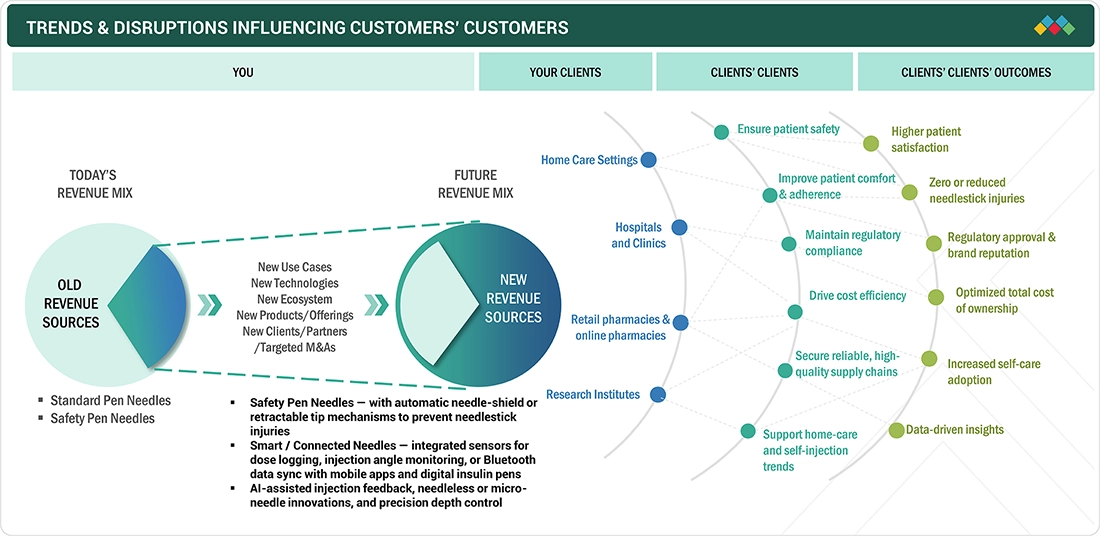
Source: Secondary Research, Interviews with Experts, MarketsandMarkets Analysis
MARKET DYNAMICS

Level
-
Rising diabetes prevalence

-
Shift toward home-based care and self-administration of injectable therapies


Level
-
High penetration of low-cost competitors


Level
-
Rising demand for ultra-thin, pain-minimizing, ergonomic pen needles to improve patient comfort


Level
-
Intense competition among major brands, private labels, and contract manufacturers.

Source: Secondary Research, Interviews with Experts, MarketsandMarkets Analysis
Driver: Rising diabetes prevalence
An escalating prevalence rate of diabetes, and more specifically an increase in the number of people with insulin-dependent Type 2 diabetes, is a principal driver of the US pen needles market. As more people enter advanced phases of diabetes, requiring insulin injection as a treatment, there will be an augmenting demand for easy-to-use and efficient injection devices. Pen needles have been preferred and increasingly adopted as an alternative offering greater convenience and accuracy compared to conventional injection devices. Moreover, with an ever-aging and expanding patient demographic with diabetes, there will be a heightened favor for shorter and thinner needles, promoting easier and more satisfactory user experiences. The need for safety and satisfaction will drive and sustain market demand, with an exponentially increasing demand rising from diabetes prevalence. Moreover, with an intensifying favor among medical practitioners for using insulin pens among patients because of ease and safeguarding against error, there will be an exponentially rising dependence on more frequent and repeated usage of needles, thus fueling the market.
Restraint: High penetration of low-cost competitors
Low-cost competitors account for the bulk of barriers in the US pen needles market since they exert unremitting downward pressure on price, as well as marginalize the great brands. The private label and contract-manufactured pen needles are essentially inferior in quality but are priced much lower than the established brands; thus, these would appeal to payers, group purchase organizations, and large chains of pharmacies. As more reimbursement systems become incentivized toward adopting the lowest-cost option, premium manufacturers must develop increasingly bright arguments why their higher prices should be justified, even when the premium they sell is for comfort, safety features, and brand trust. Thus, this particular scenario limits the commercial success of differentiated products and also retards innovation with respect to speed since the returns on R&D investment are getting tighter. In addition, aggressive contracts with low-cost dealers can lock in long-term agreement volumes, which reduces market share mobility for premium dealers. Ultimately, the expanding footprint of value brands turns pen needles into a commoditized category, restricting revenue growth and weakening pricing power for established manufacturers across the US market.
Opportunity: Rising demand for ultra-thin, pain-minimizing, ergonomic pen needles to improve patient comfort
Emerging demands are for ultra-thin, minimal pain, and very ergonomic pen needles, good opportunities in the US market as patient preference is increasingly governing a choice of device and adherence. As more and more people self-administer insulin or GLP-1 injections at home, their demands have grown considerably regarding needles that reduce pain, anxiety, and trauma at the site of injection. Manufacturers that provide such advanced designs, like tapered tips, multi-bevel needles, silicone lubrication, and flexible hub technologies, stand to differentiate themselves in a market otherwise characterized by commodity products. Innovations around comfort also appeal to newly diagnosed patients, older adults who have dexterity problems, and those who have to take a dose frequently. Healthcare providers will also prefer to recommend premium ergonomic needles once they see improvements in adherence and patient satisfaction. This transformation allows manufacturers to command better pricing and value-based contracts as well as build more robust partnerships with pharmaceutical companies that offer injectable therapies. The entire comfort trend offers opportunities for premiumization and continuous growth.
Challenge: Intense competition among major brands, private labels, and contract manufacturers.
In the US pen needles market, an intense competition between various major companies, private labels, and contract manufacturers poses the pertinent challenge of continuous price pressure, thereby minimizing any window for differentiation. Major players are concerned not only about competing against themselves but also with private-label products sold at a low cost that heavily feature on pharmacy shelves and payer formularies. The situation is exacerbated by the pressure exerted by contract manufacturers that provide high-volume, low-cost products with generic regulatory approval and performance. As a result, pen needles are increasingly seen by buyers as commodity items, encouraging the whole category toward commoditization. This renders standing ground for premium brands to hold onto their market share and prove that their price should be higher, even with sufficient comfort or safety features. This is further compounded by aggressive contracting by payers, GPOs, and retail chains, limiting access to certain brands and causing abrupt swings in volume. For manufacturers, competitive pressure makes customer acquisition costs go up, margins to reduce, and long-term investments in innovation and upgrades to manufacturing nearly impossible.
US PEN NEEDLES MARKET: COMMERCIAL USE CASES ACROSS INDUSTRIES
| COMPANY | USE CASE DESCRIPTION | BENEFITS |
|---|---|---|
 |
Offers a broad portfolio of standard and safety pen needles designed for diabetes patients requiring daily insulin delivery, with strong U.S. distribution and pharmacy partnerships. | Ensures reliable insulin administration, improves patient comfort and usability, and supports adherence through consistent product availability across retail and mail-order channels. |
 |
Provides high-quality, compatible pen needles optimized for use with its insulin pens, focusing on smooth injection experience, reduced penetration force, and patient-centric ergonomics. | Enhances injection comfort, minimizes pain, supports consistent dosing accuracy, and improves patient confidence in self-administration. |
 |
Manufactures safety-engineered pen needles tailored for clinical environments, focusing on needlestick injury prevention and compliance with safety standards. | Strengthens workplace safety, reduces occupational hazards, and supports hospitals and clinics in meeting regulatory safety requirements. |
 |
Utilizes proprietary needle-sharpening and lubrication technologies to deliver ultra-thin, high-precision needles for smoother insulin injections. | Provides high comfort with minimal tissue trauma, supports better patient experience in long-term diabetes management, and improves injection consistency. |
 |
Produces cost-efficient pen needles with high manufacturing quality and diverse gauge/length options suited for broad patient populations in the U.S. | Expands access with affordable, reliable products, supports dosing flexibility, and meets varied patient needs through product variety and quality assurance. |
Logos and trademarks shown above are the property of their respective owners. Their use here is for informational and illustrative purposes only.
MARKET ECOSYSTEM
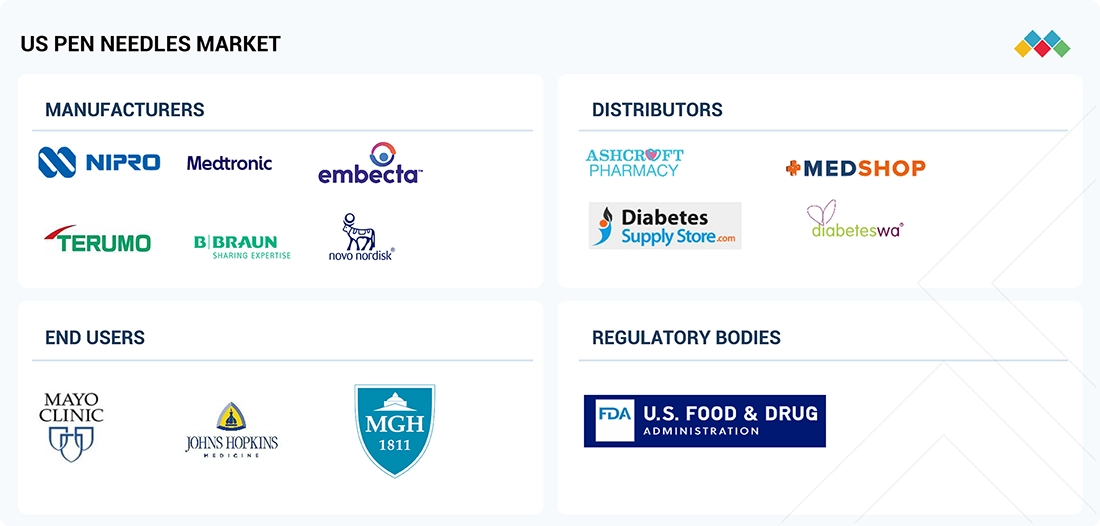
The U.S. pen needles market operates through a well-structured ecosystem involving manufacturers, distributors, healthcare providers, and payers. Manufacturers drive innovation in needle design, patient comfort, and safety features while ensuring compatibility with major insulin pens. Distributors, DME suppliers, and retail pharmacies enable broad access across hospitals, clinics, and home-care channels. Physicians and diabetes educators strongly influence product selection, focusing on patient comfort, injection ease, and adherence. Patients, as end users, shape demand for high-quality, reliable, and minimally painful pen needles. Payers and Medicare plans determine formulary placement, reimbursement, and preferred brands, significantly impacting market competition. Regulatory bodies and professional diabetes associations establish safety and usage standards, guiding market practices and influencing long-term industry dynamics.
Logos and trademarks shown above are the property of their respective owners. Their use here is for informational and illustrative purposes only.
MARKET SEGMENTS
Source: Secondary Research, Interviews with Experts, MarketsandMarkets Analysis
US Pen Needles Market, By Type
A high proportion of the US pen needle market is dominated by standard pen needles, as they offer general compatibility and credible performance at a significantly lower price compared to specialty or premium designs. Because they are available from pharmacies, payer-preferred formularies, and GPO contracts, they make them the default choice for the majority of insulin and GLP-1 users. Strong reimbursement support, very low training requirements, and the familiarity of the provider base further consolidate the standard needles' strength. Hence, standard needles are the most accessible and economical choice for populations with a large number of patients.
US Pen Needles Market, By Length
8 mm pen needles own the maximum share of the US market as they have been the most commonly used type of length in diabetes care for quite some time and are thus very familiar to both providers and patients. Their stronger historical use has built confidence in the clinical setting, particularly for individuals with high BMI who require deeper subcutaneous delivery. Broad reimbursement, availability in numerous pharmacies, and compatibility with most insulin pens have also bolstered the use of 8 mm needles. Consequently, many long-term insulin users would trust 8 mm needles as the default option.
US Pen Needles Market, By Application
Insulin therapy commands the largest market share in the US pen needles market due to the requirement for patients to administer lifelong injections regularly into their own bodies, creating a steady and large-volume demand scenario for the approximately two million diabetes patients who use insulin. The bulk of insulin users prefer pen devices to ensure convenience, accurate dosing, and ease of self-administration; hence, their steady consumption of needles. The gradual progression of Type 2 diabetes into insulin-dependent diabetes has also widened the population of users. Well-defined clinical guidelines, robust reimbursement, and no restrictions from major stakeholders strengthen the claim of insulin therapy being the leading driving force for pen needle usage in the US market.
US Pen Needles Market, By End User
Home care is the largest arena of pen needle business in the US because most diabetic patients self-administer their OW insulin or GLP-1 injections outside of the clinical setting, thus creating a substantial volume for convenient and easy-to-use pen needles. In-home management decreases healthcare visits, aligns with payer cost-containment interests, and promotes patient independence. Pharmacies and mail-order services facilitate wide access, and simple training makes self-injection practical across age groups. Therefore, home care will remain the primary use of the US pen needle market.
US Pen Needles Market, By Mode of Purchase
In the US pen needles market, over-the-counter (OTC) sales account for the bulk of sales because they allow daily, immediate, and cash purchasing away from the drug-prescribing requirements that hamper large classes of patients trying to manage their injections at home. Standard pen needles in pharmacies and retail chains are stocked in a great variety and at relatively low cost. At the time of retailing, such prices often reflect the payer's or pharmacy benefit manager's proclivities. The fact that OTC products avoid many of the administrative hurdles associated with refills means that patient compliance can be enhanced. Thus, the combination of being easily and economically available endows OTC outlets with the lion's share of the distribution in the US pen needles market.
US PEN NEEDLES MARKET: COMPANY EVALUATION MATRIX
In the US pen needles market, Embecta Corp. (Star) has a strong and established product portfolio and a vast geographic presence. Owen Mumford (Emerging Leader) has substantial product innovations compared to its competitors. While they have broad product portfolios, they lack a strong growth strategy for business development.
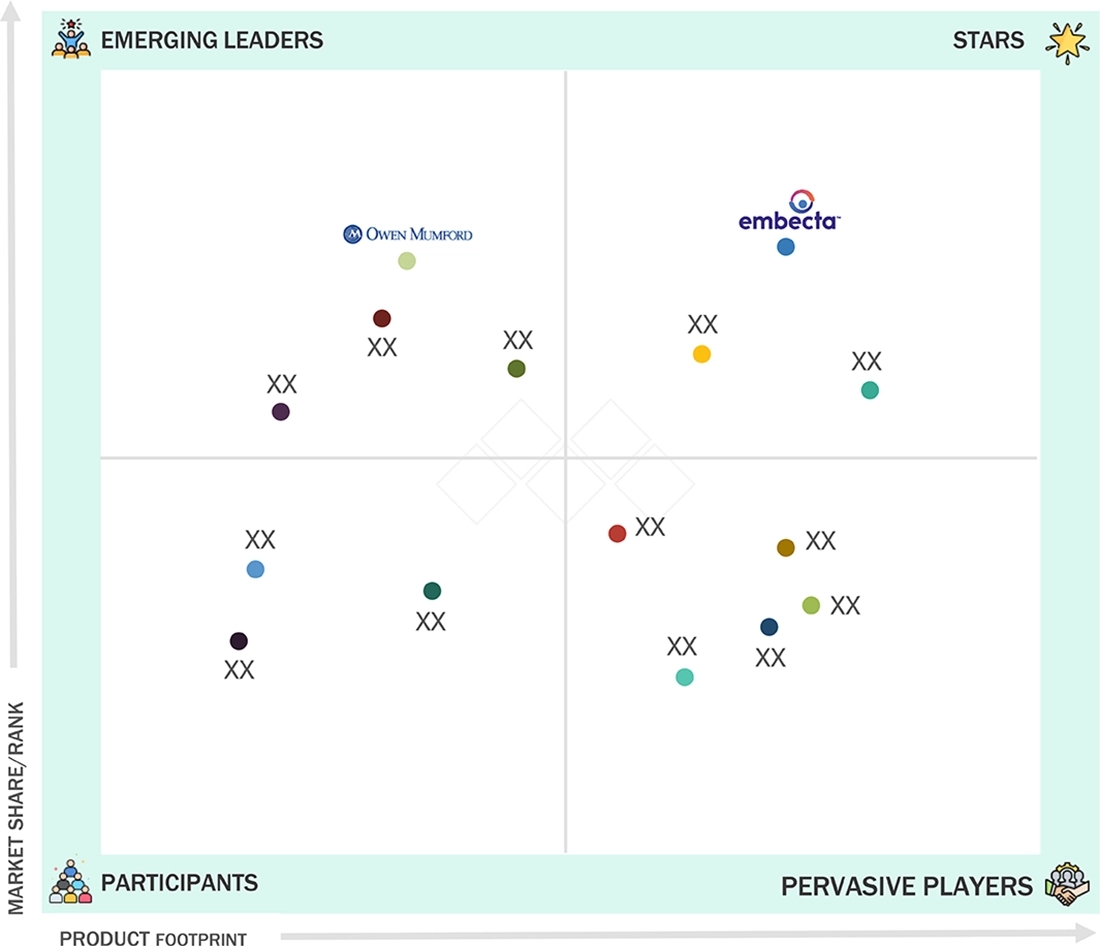
Source: Secondary Research, Interviews with Experts, MarketsandMarkets Analysis
KEY MARKET PLAYERS
- Embecta Corp. (US)
- Novo Nordisk A/S (Denmark)
- MTD Medical Technologies and Devices (Italy)
- B. Braun SE (Germany)
- Terumo Corporation (Japan)
- Owen Mumford (UK)
- NIPRO Corporation (Japan)
- Allison Medical, Inc. (US)
- AdvaCare Pharma (US)
- Berpu Medical Technology Co., Ltd. (China)
- ARKRAY, Inc. (Japan)
- GlucoRx Limited (UK)
- HTL-STREFA (Poland)
- UltiMed, Inc. (US)
- MHC Medical Products, LLC (US)
MARKET SCOPE
| REPORT METRIC | DETAILS |
|---|---|
| Market Size Value in 2026 (Value) | USD 0.93 BN |
| Revenue Forecast in 2031 (Value) | USD 1.53 BN |
| Growth Rate | 10.40% |
| Years Considered | 2024–2031 |
| Base Year | 2024 |
| Forecast Period | 2026–2031 |
| Units Considered | Value (USD MN), Volume (Thousand Units) |
| Report Coverage | Revenue forecast, company ranking, competitive landscape, growth factors, and trends |
| Segments Covered | By Type: Standard Pen Needles, Safety Pen Needles, By Length: 8mm, 5mm, 6mm, 4mm, 12mm, 10mm, By Application: Insulin Therapy, GLP-1 Therapy, Growth Hormone Therapy, Osteoporosis, Other Applications, By Mode of Purchase: Prescription based, Over the Counter (OTC), Online Purchase, Other Mode of Purchases, By End User: Home Care, Hospitals and Clinics and Other End User |
| Country Covered | US |
| Parent & Related Segment Reports |
Pen Needles Market Europe Pen Needles Market |
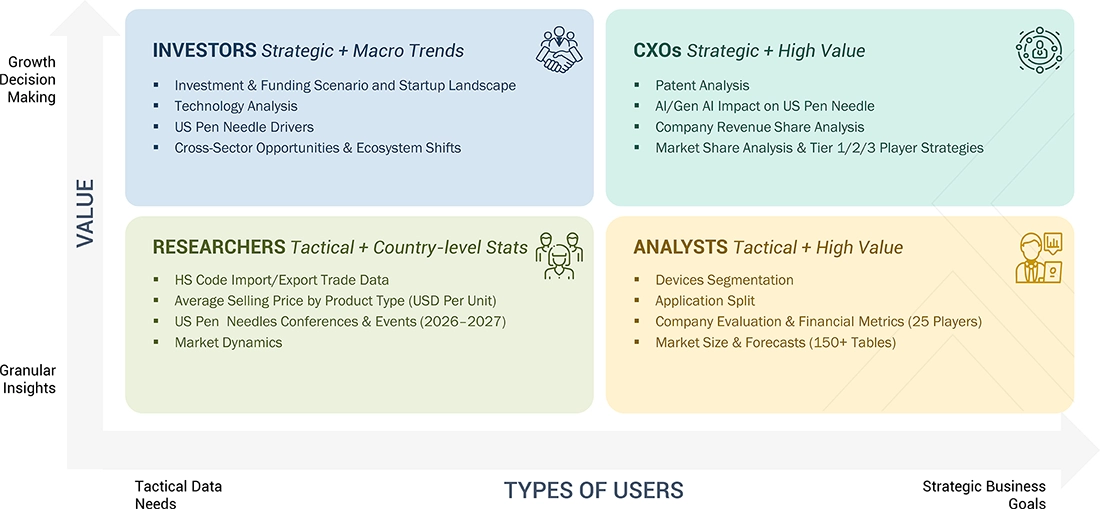
WHAT IS IN IT FOR YOU: US PEN NEEDLES MARKET REPORT CONTENT GUIDE
DELIVERED CUSTOMIZATIONS
We have successfully delivered the following deep-dive customizations:
| CLIENT REQUEST | CUSTOMIZATION DELIVERED | VALUE ADDS |
|---|---|---|
| Product Analysis | Comparison of pen needle types by length (4mm, 5mm, 6mm, 8mm, and 12mm), needle gauge, and compatibility with various insulin and GLP-1 pens. | Assessment of technological innovations such as ultra-thin wall designs, safety-engineered needles, and low-friction coatings to enhance injection comfort and precision. |
| Company Information | Profiles of key manufacturers such as BD (US), Novo Nordisk (Denmark), Ypsomed (Switzerland), B. Braun (Germany), Terumo (Japan), and Owen Mumford (UK). | Market share benchmarking and competitive landscape of leading players across North America, Europe, Asia Pacific, and the Middle East. |
| Geographic Analysis | Detailed regional assessment of North America, Europe, Asia Pacific, Latin America, and Middle East & Africa markets. | Country-level sizing, CAGR forecasts, and adoption analysis for major markets such as the US, Germany, Japan, China, and India. |
RECENT DEVELOPMENTS
- January 2023 : Embecta Corp. (US) expanded its presence in New Jersey with the opening of a new global headquarters in Parsippany.
- March 2023 : Novo Nordisk A/S (Denmark) The company aims to expand its presence in the US, near the greater Boston metro area, creating one of the largest R&D hubs outside Denmark.
- March 2024 : MTD (Medical Technology and Devices) (Italy), acquired Ypsomed’s pen needle and blood glucose monitoring (BGM) businesses. This strategic move will solidify MTD’s position as a globally leading player in pen needle production and will enhance its comprehensive solution portfolio of diabetes care.
- Nvember 2022 : Embecta Corp. (US) and Intuity Medical, Inc. (US) both companies signed a co-promotional agreement under which sales representatives of Embecta will promote Intuity Medical’s innovative POGO Automatic Blood Glucose Monitoring System to healthcare professionals within the US.
Table of Contents
 Exclusive indicates content/data unique to MarketsandMarkets and not available with any competitors.
Methodology
This research study involved the extensive use of both primary and secondary sources. It involved the study of various factors affecting the industry to identify the segmentation types, industry trends, key players, the competitive landscape of market players, and key market dynamics such as drivers, opportunities, challenges, restraints, and key player strategies.
Secondary Research
This research study involved the wide use of secondary sources, directories, databases such as Dun & Bradstreet, Bloomberg Businessweek, and Factiva, white papers, and companies’ house documents. Secondary research was undertaken to identify and collect information for this extensive, technical, market-oriented, and commercial study of the US Pen Needles Market. It was also used to obtain important information about the top players, market classification, and segmentation according to industry trends to the bottom-most level, geographic markets, and key developments related to the market. A database of the key industry leaders was also prepared using secondary research.
Primary Research
In the primary research process, various supply side and demand side sources were interviewed to obtain qualitative and quantitative information for this report. Primary sources from the supply side included industry experts such as CEOs, vice presidents, marketing and sales directors, technology & innovation directors, engineers, and related key executives from various companies and organizations operating in the US Pen Needles Market. Primary sources from the demand side included hospitals, clinics, researchers, lab technicians, purchase managers etc, and stakeholders in corporate & government bodies.
Market Size Estimation
The market size for US Pen Needles Market was calculated using data from four different sources, as will be discussed below. Each technique concluded and a weighted average of the four ways was calculated based on the number of assumptions each approach made. The market size for US Pen Needles Market was calculated using data from three distinct sources, as will be discussed below:
Data Triangulation
The entire market was split up into five segments when the market size was determined. Data triangulation and market breakdown processes were used where necessary to complete the entire market engineering process and arrive at the precise statistics for all segments.
Approach to derive the market size and estimate market growth.
Using secondary data from both paid and unpaid sources, the market rankings for the major players were determined following a thorough analysis of their sales of pen needles. Due to data restrictions, the revenue share in certain cases was determined after a thorough analysis of the product portfolio of big corporations and their individual sales performance. This information was verified at each stage by in-depth interviews with professionals in the field.
Market Definition
A pen needle is a hollow needle entrenched in a plastic hub and attached to injectable pens. Pen needles are available in a wide range of lengths and diameters and can be used by healthcare professionals and patients to deliver injectable medications into the patient’s body. Pen needles are electro-polished for smooth, thin, and fine-point tips and provide comfort and ease in penetration; they serve as an alternative drug delivery technique to the traditional method of injecting drugs.
Stakeholders
- Manufacturers of pen needles, insulin pens, injectable drug delivery devices, and diabetes supplies
- Original equipment manufacturing companies
- Suppliers and distributors of pen needles, insulin pens, injectable drug delivery devices, and diabetes supplies
- Healthcare service providers
- Teaching hospitals and academic medical centers
- Health insurance players
- Government bodies/municipal corporations
- Regulatory bodies
- Business research and consulting service providers
- Authorities framing reimbursement policies for pen needles
- Venture capitalists
- Market research and consulting firms
Report Objectives
- To define, describe, and forecast the US Pen Needles Market based on type, length, application, mode of purchase, setting and region.
- To provide detailed information about the major factors influencing the market growth (such as drivers, restraints, challenges, and opportunities)
- To strategically analyze micromarkets1 with respect to individual growth trends, prospects, and contributions to the overall US Pen Needles Market
- To analyze market opportunities for stakeholders and provide details of the competitive landscape for key players
- To forecast the size of the US Pen Needles Market in North America, Europe, the Asia Pacific, Latin America, Middle East & Africa and GCC Countries
- To profile the key players and comprehensively analyze their market shares and core competencies in the US Pen Needles Market
- To track and analyze competitive developments such as partnerships, expansions, acquisitions, collaborations, product launches, agreements, and other developments in the US Pen Needles Market
- To benchmark players within the US Pen Needles Market using the Company Evaluation Quadrant framework, which analyzes market players on various parameters within the broad categories of business strategy, market share, and product offerings.


Personalize This Research
- Triangulate with your Own Data
- Get Data as per your Format and Definition
- Gain a Deeper Dive on a Specific Application, Geography, Customer or Competitor
- Any level of Personalization
Let Us Help You
- What are the Known and Unknown Adjacencies Impacting the US Pen Needles Market
- What will your New Revenue Sources be?
- Who will be your Top Customer; what will make them switch?
- Defend your Market Share or Win Competitors
- Get a Scorecard for Target Partners

Custom Market Research Services
We Will Customise The Research For You, In Case The Report Listed Above Does Not Meet With Your Requirements
Get 10% Free CustomisationTESTIMONIALS

JAYANT RAJPUROHIT
Director of Market Insights, Data and Analytics
SFI Health,
Leading Pharmaceutical Companywww.sfihealth.com/

We at SFI Health approached MarketsandMarkets for an Opportunity Assessment on "Incidence and Prevalence of Focus Indications" as we wanted to know the most attractive HCPs like Physician, Functional MD, Naturopath and Pharmacist. The project was critical for us to ensure our focus on the right target which would enable sustainable growth and profitability for SFI Health. The business insights provided exceeded our expectations and we were extremely impressed. The team at MarketsandMarkets is highly professional and detail oriented and very well understood our business needs. MarketsandMarkets offers a unique combination of expertise and dedicated engagement model. We identified 2 new products to be launched in coming months, based on the research findings provided by MarketsandMarkets. We are happy with the services and would strongly recommend MarketsandMarkets to my peers in the industry.

BEATRIZ DE LA CALLE
Head of Commercial Analytics
Qualicaps,
Leading Pharmaceutical Companywww.qualicaps.com/

We partnered with MarketsandMarkets for an assessment study on hard empty capsules. The team was extremely professional in understanding our business requirements and we received timely responses to all our queries. The market intelligence and the recommendations has met our business requirements. We were extremely impressed to see the final study results; it really exceeded our expectations. The market intelligence offered by MarketsandMarkets, and clarity on next steps will help us achieve our business objective for the Year 2021. We are happy with the services and would strongly recommend MarketsandMarkets to my peers in the industry.

Bob Williams,
Senior Director Business Development & Innovation
Bracco Diagnostics Inc.,
Italian Multinational in life sciences sector and a World Leader in imaging diagnosticsimaging.bracco.com/us-en
We were pleased with targeted insights that MarketsandMarkets identified from a custom study on the 'Radiation Dose Management Solutions Market'. Your team identified and characterized the market participants as well as underlying trends accurately. This study was useful to Bracco in formulating business strategies for our dose monitoring product lines and we thank MarketsandMarkets for the job well done.
Cody Coonradt,
Market Development and Strategy Manager
3M Health Information Systems,
Leader in Health care Coding, Payment & Analytics Solutions.www.3m.com/3M/en_US/health-information-systems-us
The value for our organization comes from three things: depth of research, specificity of segments and being easy to work with. As important as the first two are, the third can't be underestimated. MarketsandMarkets, maybe more than any other research vendor, wants to know what is top of mind for our team and what big questions we are grappling to answer.
Their customer first approach and high value engagement model, have given us great analysis and excellent value for money






Growth opportunities and latent adjacency in US Pen Needles Market