
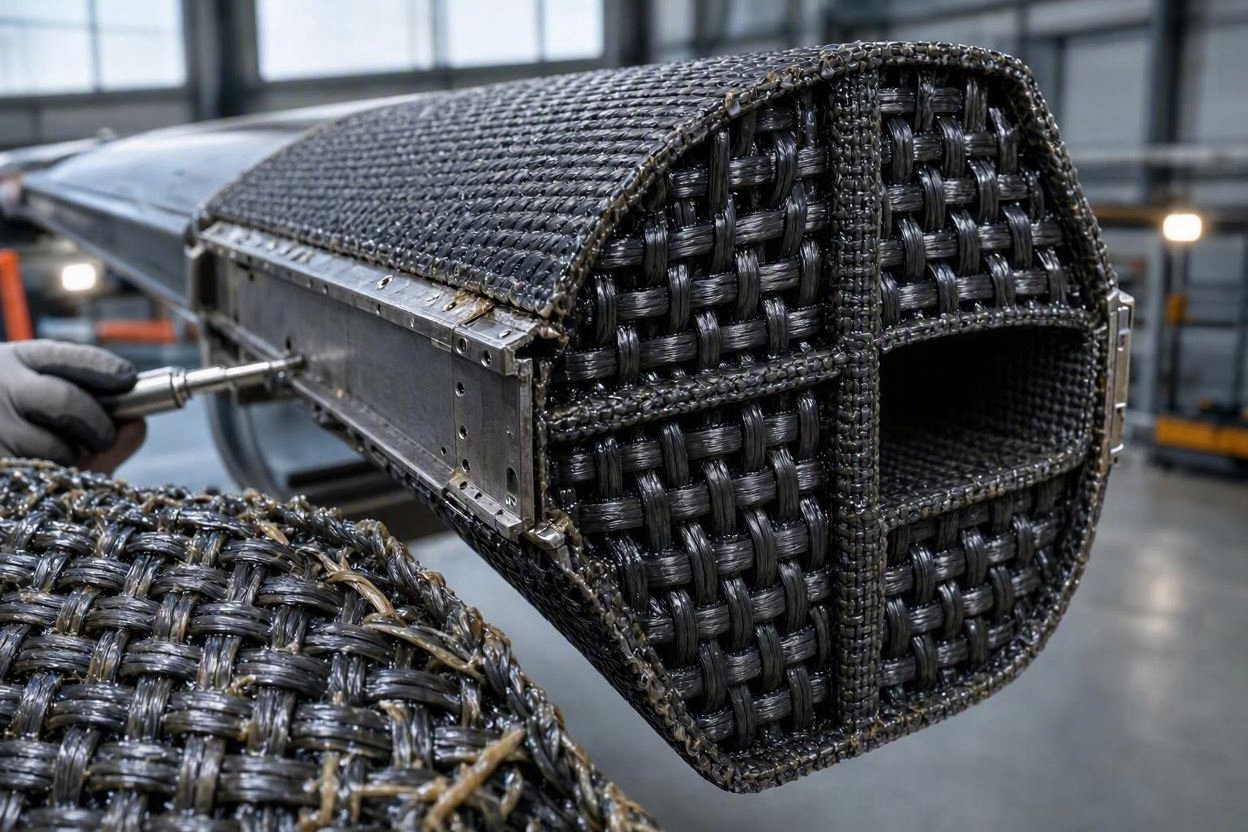
Transforming Aerospace Manufacturing: The Power of 3D Weaving in the Aerospace Industry
The aerospace industry is a realm of relentless innovation, where cutting-edge technologies drive advancements in performance, safety, and efficiency. Among these transformative technologies, 3D weaving in the aerospace industry stands out as a game-changer in composite manufacturing. This advanced technique creates three-dimensional fabric structures that enhance the strength, durability, and versatility of aerospace components. Unlike traditional two-dimensional weaving, 3D weaving interlaces fibers in multiple directions, producing complex, integrated structures that are revolutionizing aircraft design and production. This article delves into the intricacies of 3D weaving, its applications, benefits, challenges, and future potential in the aerospace sector, offering a comprehensive look at how this technology is shaping the skies.
The global 3D Weaving Market size was estimated at USD 34.05 million in 2024 and is predicted to increase from USD 32.8 million in 2025 to approximately USD 59.7 million by 2030, expanding at a CAGR of 12.7% from 2025 to 2030.
Understanding the Fundamentals of 3D Weaving Technology
3D weaving is a sophisticated textile manufacturing process that interweaves fibers in three dimensions—length, width, and depth—to create robust, seamless structures. In the context of 3D weaving in the aerospace industry, this technique is used to produce composite preforms, which are later infused with resin to form lightweight, high-strength components. Unlike conventional 2D fabrics, which are layered and prone to delamination, 3D woven structures integrate fibers in a way that enhances resistance to stress and damage. The process involves specialized looms that manipulate warp and weft yarns, along with additional z-yarns that bind the layers together, creating a cohesive, three-dimensional architecture. This technology allows for tailored fiber orientations, enabling engineers to design components that meet specific performance requirements for aerospace applications.
Historical Evolution of 3D Weaving in Aerospace Applications
The journey of 3D weaving in the aerospace industry began in the late 20th century as researchers sought to overcome the limitations of 2D composites. Early composite materials, while lightweight, often suffered from weak interlayer bonding, leading to issues like delamination under stress. The advent of 3D weaving addressed these challenges by introducing through-thickness reinforcement, significantly improving structural integrity. Initial applications focused on military aircraft, where high-performance materials were critical. Over time, advancements in loom technology and computer-aided design (CAD) enabled more complex 3D woven structures, expanding their use to commercial aviation and space exploration. Today, 3D weaving is a cornerstone of modern aerospace manufacturing, with ongoing research pushing the boundaries of its capabilities.
Key Benefits of 3D Weaving in Aerospace Component Manufacturing
The adoption of 3D weaving in the aerospace industry has unlocked a range of benefits that enhance aircraft performance and manufacturing efficiency. These advantages stem from the unique properties of 3D woven composites, which offer superior mechanical performance compared to traditional materials. Below are some of the key benefits:
Enhanced Structural Integrity: The interlocking fibers in 3D woven composites provide exceptional resistance to delamination and crack propagation, ensuring components can withstand extreme stresses during flight.
Reduced Weight: By optimizing fiber placement and minimizing resin use, 3D weaving creates lightweight components that improve fuel efficiency and payload capacity.
Complex Geometries: 3D weaving allows for the creation of intricate shapes without the need for extensive cutting or joining, reducing manufacturing time and costs.
Improved Durability: The integrated structure of 3D woven composites enhances resistance to fatigue, corrosion, and impact damage, extending component lifespan.
These benefits make 3D weaving in the aerospace industry a preferred choice for critical applications, from engine blades to fuselage panels.
Applications of 3D Weaving in Aerospace Engineering
The versatility of 3D weaving in the aerospace industry enables its use across a wide range of applications, each leveraging the technology’s ability to create high-performance, lightweight components. Some of the most prominent applications include:
- Turbine Engine Components: 3D woven composites are used in fan blades and turbine casings, where their strength and heat resistance improve engine efficiency and durability.
- Airframe Structures: Fuselage sections, wing skins, and structural supports benefit from the lightweight and robust nature of 3D woven materials, reducing overall aircraft weight.
- Thermal Protection Systems: In space exploration, 3D woven composites are employed in heat shields and re-entry vehicles, offering superior thermal resistance.
- Interior Components: Lightweight, durable panels and fittings inside aircraft cabins are increasingly made using 3D weaving, enhancing passenger safety and comfort.
These applications highlight the transformative impact of 3D weaving in the aerospace industry, enabling engineers to push the boundaries of design and performance.
The Manufacturing Process of 3D Woven Composites in Aerospace
The production of 3D woven composites for aerospace involves a series of precise steps, each critical to ensuring the quality and performance of the final component. The process begins with the design phase, where engineers use CAD software to model the desired 3D woven structure, specifying fiber types, orientations, and weave patterns. Advanced looms, equipped with computer-controlled mechanisms, then weave the fibers—typically carbon, glass, or aramid—into a three-dimensional preform. These preforms are subsequently infused with resin using techniques like resin transfer molding (RTM) or vacuum-assisted resin infusion (VARI). The resulting composite is cured under controlled conditions to achieve optimal strength and rigidity. Rigorous testing, including non-destructive evaluation, ensures that the components meet stringent aerospace standards. This intricate process underscores the precision and innovation driving 3D weaving in the aerospace industry.
Materials Used in 3D Weaving for Aerospace Applications
The choice of materials in 3D weaving in the aerospace industry is critical to achieving the desired performance characteristics. Common fibers include carbon, known for its high strength-to-weight ratio; aramid, valued for its impact resistance; and glass, used for cost-effective applications. These fibers are selected based on the specific requirements of the component, such as strength, stiffness, or thermal resistance. The resin matrix, typically epoxy or ceramic-based, binds the fibers together, providing additional strength and environmental protection. Advanced materials, such as ceramic matrix composites (CMCs), are increasingly used in high-temperature applications like turbine engines. The combination of these materials with 3D weaving techniques allows for the creation of composites that are both lightweight and exceptionally durable, making them ideal for aerospace demands.
Challenges in Implementing 3D Weaving in Aerospace Manufacturing
While 3D weaving in the aerospace industry offers significant advantages, it also presents several challenges that manufacturers must address. The complexity of 3D weaving requires specialized equipment and skilled operators, increasing initial investment costs. Designing and simulating 3D woven structures demands advanced software and expertise, which can be a barrier for smaller companies. Additionally, the integration of 3D woven composites into existing manufacturing processes can be challenging, as it requires compatibility with other materials and assembly techniques. Quality control is another critical issue, as defects in the weave can compromise component performance. Despite these challenges, ongoing advancements in automation, simulation tools, and material science are helping to mitigate these obstacles, making 3D weaving more accessible and cost-effective.
Download PDF Brochure @ https://www.marketsandmarkets.com/pdfdownloadNew.asp?id=88493628
Advancements in 3D Weaving Technology for Aerospace Innovation
The field of 3D weaving in the aerospace industry is rapidly evolving, driven by innovations in technology and materials. Automated weaving systems, equipped with artificial intelligence and machine learning, are improving the precision and efficiency of 3D weaving processes. These systems can optimize weave patterns in real-time, reducing waste and enhancing component quality. Additionally, advancements in fiber and resin technologies are expanding the capabilities of 3D woven composites, enabling their use in more demanding applications, such as hypersonic vehicles and reusable spacecraft. Research into hybrid weaving techniques, combining different fiber types within a single preform, is also opening new possibilities for tailored material properties. These advancements are positioning 3D weaving as a cornerstone of next-generation aerospace manufacturing.
The Role of 3D Weaving in Sustainable Aerospace Manufacturing
Sustainability is a growing priority in the aerospace industry, and 3D weaving in the aerospace industry plays a significant role in achieving environmental goals. By producing lightweight components, 3D woven composites contribute to improved fuel efficiency, reducing carbon emissions during aircraft operation. The ability to create complex shapes with minimal material waste also enhances resource efficiency during manufacturing. Furthermore, the durability and recyclability of certain 3D woven composites, such as those made with thermoplastic resins, support circular economy principles. As aerospace companies strive to meet stringent environmental regulations and consumer expectations, 3D weaving offers a pathway to greener, more sustainable manufacturing practices without compromising performance.
Comparing 3D Weaving to Traditional Composite Manufacturing Methods
To fully appreciate the impact of 3D weaving in the aerospace industry, it’s useful to compare it to traditional composite manufacturing methods, such as 2D lamination and tape laying. Traditional methods involve stacking flat layers of fabric, which are then bonded with resin. While effective, these methods are prone to delamination and require additional reinforcement, increasing weight and production time. In contrast, 3D weaving creates an integrated structure with through-thickness reinforcement, eliminating the need for extensive layering and reducing the risk of failure. Additionally, 3D weaving allows for greater design flexibility, enabling the production of complex geometries that are difficult to achieve with 2D methods. While 3D weaving may involve higher initial costs, its long-term benefits in performance and efficiency make it a superior choice for many aerospace applications.
Explore In-Depth Semiconductor & Electronics Market Research – https://www.marketsandmarkets.com/semiconductorand-electonics-market-research-87.html
The Future Potential of 3D Weaving in the Aerospace Industry
The future of 3D weaving in the aerospace industry is bright, with ongoing research and development poised to unlock new possibilities. Innovations in automation and digital twin technology are expected to streamline the design and production of 3D woven composites, reducing costs and improving scalability. The integration of smart materials, such as shape-memory alloys or sensors embedded within 3D woven structures, could enable self-monitoring components that detect damage in real-time. Additionally, the expansion of 3D weaving into emerging fields like urban air mobility and hypersonic flight promises to drive further advancements. As the aerospace industry continues to prioritize performance, efficiency, and sustainability, 3D weaving will remain at the forefront of innovation, shaping the next generation of aircraft and spacecraft.
The Impact of 3D Weaving on Aerospace Design and Innovation
The introduction of 3D weaving in the aerospace industry has fundamentally changed the way engineers approach design. By enabling the creation of complex, integrated structures, 3D weaving allows for greater design freedom, reducing the need for multiple components and fasteners. This not only simplifies assembly but also enhances the aerodynamic performance of aircraft. Furthermore, the ability to tailor fiber orientations and material properties enables engineers to optimize components for specific load conditions, improving overall efficiency. As 3D weaving continues to evolve, it is driving a new era of aerospace design, where innovation and performance go hand in hand.
FAQs
What is 3D weaving in the aerospace industry?
3D weaving in the aerospace industry is a manufacturing process that interlaces fibers in three dimensions to create composite preforms used in lightweight, high-strength components for aircraft and spacecraft.
How does 3D weaving improve aerospace components?
3D weaving enhances aerospace components by improving structural integrity, reducing weight, enabling complex geometries, and increasing durability through integrated fiber structures.
What materials are used in 3D weaving for aerospace?
Common materials include carbon, aramid, and glass fibers, combined with resin matrices like epoxy or ceramic-based resins, tailored to specific performance requirements.
What are the challenges of 3D weaving in aerospace?
Challenges include high initial costs, complex design processes, integration with existing manufacturing systems, and the need for rigorous quality control to ensure performance.
What is the future of 3D weaving in aerospace?
The future includes advancements in automation, smart materials, and applications in emerging fields like hypersonic flight, driving further innovation and efficiency in aerospace manufacturing.
See The Latest Semiconductor Reports:
Data Center Interconnect Market Size, Share & Trends : https://www.marketsandmarkets.com/Market-Reports/data-center-interconnect-market-40733195.html
Machine Control System Market Size, Share & Trends: https://www.marketsandmarkets.com/Market-Reports/machine-control-system-market-62579001.html
Hydrogen Detection Market Size, Share & Trends : https://www.marketsandmarkets.com/Market-Reports/hydrogen-detection-market-52631881.html
Environmental Remediation Market Size, Share & Trends : https://www.marketsandmarkets.com/Market-Reports/environmental-remediation-market-93290334.html
Control Valve Market Size, Share & Trends : https://www.marketsandmarkets.com/Market-Reports/control-valves-market-111759647.html
80% of the Forbes Global 2000 B2B companies rely on MarketsandMarkets to identify growth opportunities in emerging technologies and use cases that will have a positive revenue impact.
- Food Packaging Market Size Set for Strong Growth Through 2030 Amid Rising Demand for Convenience Foods
- Crop Protection Chemical Market Size, Share & Growth Forecast (2025–2030)
- Mulch Films Market: Driving Sustainable Agriculture Through Innovation
- Agricultural Adjuvants Market Analysis, Trends, and Growth Outlook (2026–2031)
- Japan Enterprise Asset Management Market Growth: AI and Smart Infrastructure Drive Demand


