Micro-Electro-Mechanical System (MEMS) Market Size, Share and Trends

Micro-Electro-Mechanical System (MEMS) Market by Sensor Type (Inertial Sensor, Pressure Sensor, Environmental Sensor, Optical Sensor), Actuator Type (Optical, Microfluidics, Inkjet Head, Radio Frequency), Vertical, and Region - Global Forecast to 2032




OVERVIEW
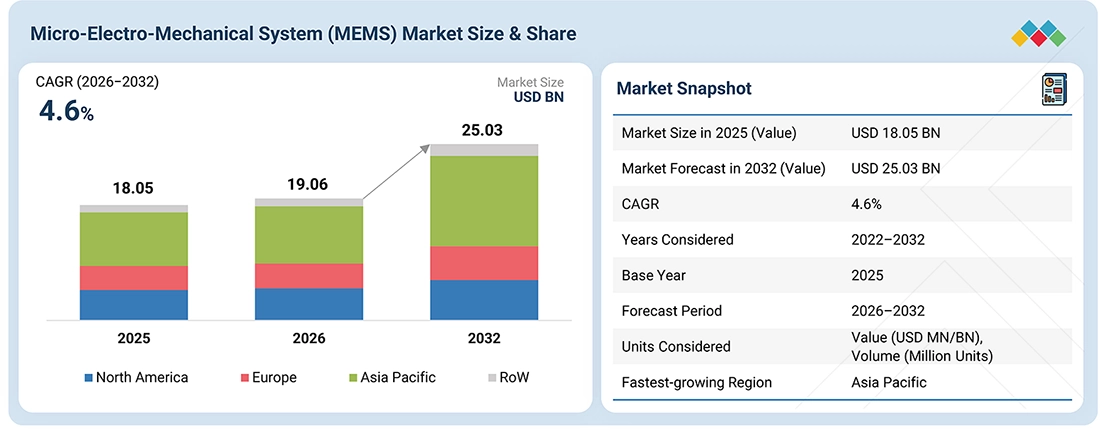
Source: Secondary Research, Interviews with Experts, MarketsandMarkets Analysis
The micro-electro-mechanical system (MEMS) market is projected to reach USD 25.03 billion by 2032 from USD 19.06 billion in 2026, at a CAGR of 4.6%. The market is witnessing steady growth, driven by the increasing adoption of MEMS sensors and actuators, rising demand for compact and high-performance sensing and actuation components, and growing use of MEMS across automotive, consumer electronics, healthcare, industrial, aerospace, defense, and telecom applications. The increasing need for motion sensing, pressure measurement, audio sensing, environmental monitoring, optical sensing, and RF functionality is boosting the adoption of MEMS in automotive safety and ADAS, smartphones and wearables, medical devices, industrial systems, communication equipment, and aerospace and defense applications. Additionally, advancements in MEMS miniaturization, fabrication, sensor integration, and device packaging are supporting market growth by improving sensing accuracy, response time, reliability, system compactness, and integration flexibility.
KEY TAKEAWAYS
-
BY REGIONBy region, Asia Pacific is expected to dominate the micro-electro-mechanical system (MEMS) market with ~46.8% share in 2026.
-
BY SENSOR TYPEBy sensor type, the microspeakers segment is expected to record a CAGR of 18.4% between 2026 and 2032.
-
BY ACTUATOR TYPEBy actuator type, the radio frequency segment is likely to exhibit ~6.3% growth rate during the forecast period.
-
BY VERTICALBy vertical, the telecom segment is expected to register a CAGR of ~12.2% from 2026 to 2032.
-
COMPETITIVE LANDSCAPE (KEY PLAYERS)Robert Bosch, Broadcom, TDK Corporation, STMicroelectronics, and Texas Instruments were identified as key players in the micro-electro-mechanical system (MEMS) market due to their MEMS-related sensor and actuator portfolios, semiconductor and microtechnology capabilities, and presence across automotive, consumer electronics, healthcare, industrial, aerospace, defense, and telecom applications.
-
COMPETITIVE LANDSCAPE (STARTUPS/SMES)Flusso, UltraSense Systems, Menlo Microsystems, SiTime Corporation, USound, and Advanced Hall Sensor, among others, have established positions in specialized MEMS and sensing applications, offering technologies related to miniaturized sensors, timing devices, audio solutions, RF components, and other MEMS-enabled technologies.
The micro-electro-mechanical system (MEMS) market is expected to grow significantly as industries increase investments in miniaturized sensing and actuation technologies across automotive, consumer electronics, healthcare, industrial, aerospace, defense, and telecom applications. Market growth is further supported by increasing demand for accurate motion sensing, pressure measurement, audio sensing, environmental monitoring, optical sensing, and RF functionality. These factors are driving the adoption of inertial sensors, pressure sensors, microphones, microspeakers, environmental sensors, optical sensors, optical actuators, microfluidics, inkjet heads, and RF MEMS devices. Product innovations and strategic developments by key players such as Robert Bosch, Broadcom, Qorvo, STMicroelectronics, Texas Instruments, Knowles Electronics, TDK Corporation, Infineon Technologies, Honeywell International, and Analog Devices are supporting market growth through advancements in MEMS sensing, actuation, miniaturization, integration, and packaging.
TRENDS & DISRUPTIONS IMPACTING CUSTOMERS' CUSTOMERS
Advanced MEMS sensors and actuators, miniaturized sensing systems, low-power architectures, and application-specific MEMS solutions are expanding the use of MEMS across automotive, consumer electronics, defense, aerospace, industrial, healthcare, and telecom applications. These innovations enable precise motion and pressure sensing, environmental monitoring, optical control, RF switching, fluid handling, and compact sensing solutions, creating new revenue opportunities beyond traditional MEMS applications. As customers increasingly prioritize smaller devices, higher sensing accuracy, lower power consumption, improved reliability, and greater system integration, manufacturers are moving toward highly integrated and application-specific MEMS solutions. This transition is driving wider adoption of MEMS across end-use industries and supporting the overall growth of the global micro-electro-mechanical system (MEMS) market.
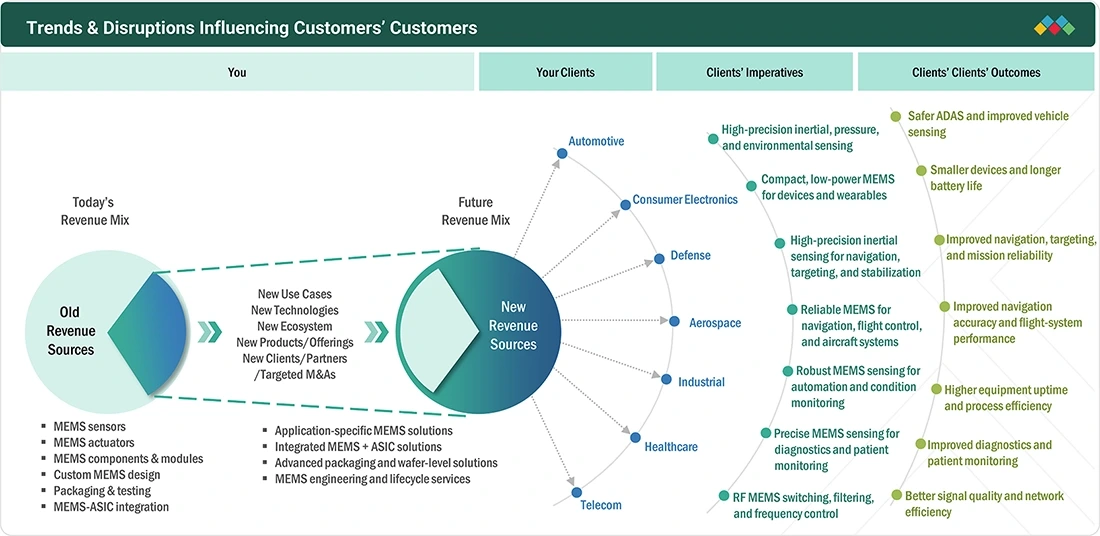
Source: Secondary Research, Interviews with Experts, MarketsandMarkets Analysis
MARKET DYNAMICS

Level
-
Increasing applications in consumer electronics and LTE networks

-
Rising demand for miniaturized devices


Level
-
High capital investment

-
Lack of standardized fabrication process technologies


Level
-
Implementation of sensor fusion technology in various industries

-
Flexibility to meet specific requirements of different applications


Level
-
Shortage of skilled designers

Source: Secondary Research, Interviews with Experts, MarketsandMarkets Analysis
Driver: Increasing applications in consumer electronics and LTE networks
Increasing adoption of MEMS in consumer electronics, automotive, and connected devices is driving the micro-electro-mechanical system (MEMS) market. Advances in miniaturization, low-power operation, and sensor integration are enabling MEMS to support motion sensing, pressure monitoring, microphones, environmental sensing, and other functions across smartphones, wearables, ADAS, and IoT-enabled devices.
Restraint: High capital investment
High capital investment required for MEMS manufacturing can limit market entry and expansion. MEMS fabrication requires specialized cleanroom facilities, advanced semiconductor manufacturing equipment, wafer-level processing, packaging, and testing infrastructure, resulting in significant upfront investment and increasing the financial burden for manufacturers.
Opportunity: Implementation of sensor fusion technology in various industries
Growing implementation of sensor fusion technology across automotive, industrial, healthcare, consumer electronics, and other applications is creating opportunities for MEMS manufacturers. Combining data from multiple MEMS sensors, such as accelerometers, gyroscopes, pressure sensors, and environmental sensors, can improve sensing accuracy, reliability, and contextual awareness, supporting the development of advanced and autonomous systems.
Challenge: Shortage of skilled designers
The shortage of skilled MEMS designers and engineers can constrain market development. MEMS design requires expertise across microfabrication, mechanical and electrical engineering, materials, semiconductor processes, packaging, and system integration. Limited availability of specialized talent can increase development timelines, design complexity, and costs for MEMS manufacturers.
MICRO-ELECTRO-MECHANICAL SYSTEM (MEMS) MARKET SIZE, SHARE AND TRENDS: COMMERCIAL USE CASES ACROSS INDUSTRIES
| COMPANY | USE CASE DESCRIPTION | BENEFITS |
|---|---|---|
 |
Robert Bosch develops MEMS sensors and related sensing solutions for automotive, consumer electronics, and industrial applications, including accelerometers, gyroscopes, pressure sensors, environmental sensors, and inertial sensor combinations. | Enables precise motion and pressure sensing | Supports ADAS, vehicle safety, and navigation applications | Improves device miniaturization and energy efficiency | Enables reliable sensing across automotive and consumer applications |
 |
Broadcom develops MEMS-based and microelectromechanical solutions for sensing, communications, and industrial applications, with capabilities spanning motion sensing, optical MEMS, and specialized sensing technologies. | Enables precise sensing and signal control | Supports compact system architectures | Improves sensing and communication performance | Enables integration into advanced electronic and industrial systems |
 |
STMicroelectronics develops MEMS sensors including accelerometers, gyroscopes, inertial modules, pressure sensors, microphones, and environmental sensors for automotive, industrial, consumer, and personal electronics applications. | Enables accurate motion, pressure, and environmental sensing | Supports context-aware and smart devices | Improves system integration and power efficiency | Enables advanced automotive, industrial, and consumer applications |
 |
Texas Instruments develops MEMS-based sensing and signal-processing solutions, including digital micromirror devices (DMDs) and support technologies for sensing, imaging, industrial, automotive, and consumer applications. | Enables precise optical control and imaging | Supports advanced projection and sensing systems | Improves system-level integration | Enables compact and high-performance optical applications |
 |
TDK develops MEMS sensors and sensor modules, including accelerometers, gyroscopes, inertial sensors, pressure sensors, and microphones, for automotive, industrial, consumer electronics, and IoT applications. | Enables precise motion and environmental sensing | Supports vehicle safety and navigation | Improves compact device integration and power efficiency | Enables sensing solutions for IoT, industrial, and consumer applications |
Logos and trademarks shown above are the property of their respective owners. Their use here is for informational and illustrative purposes only.
MARKET ECOSYSTEM
The micro-electro-mechanical system (MEMS) ecosystem comprises MEMS manufacturers, semiconductor and material suppliers, equipment providers, system integrators, and end users. MEMS manufacturers develop and produce sensors and microsystems such as accelerometers, gyroscopes, pressure sensors, microphones, inertial sensors, and environmental sensors, which are integrated into consumer electronics, automotive, industrial, healthcare, and aerospace applications. Key participants include Bosch, Broadcom, STMicroelectronics, Analog Devices, Texas Instruments, TDK, and Honeywell, supported by material and wafer suppliers and system-level technology providers. MEMS solutions enable applications across smartphones, wearables, automotive safety and navigation, industrial monitoring, medical devices, and aerospace systems. Demand is driven by consumer electronics, automotive, healthcare, industrial, aerospace & defense, and telecommunications applications, supported by increasing adoption of connected and intelligent sensing technologies.
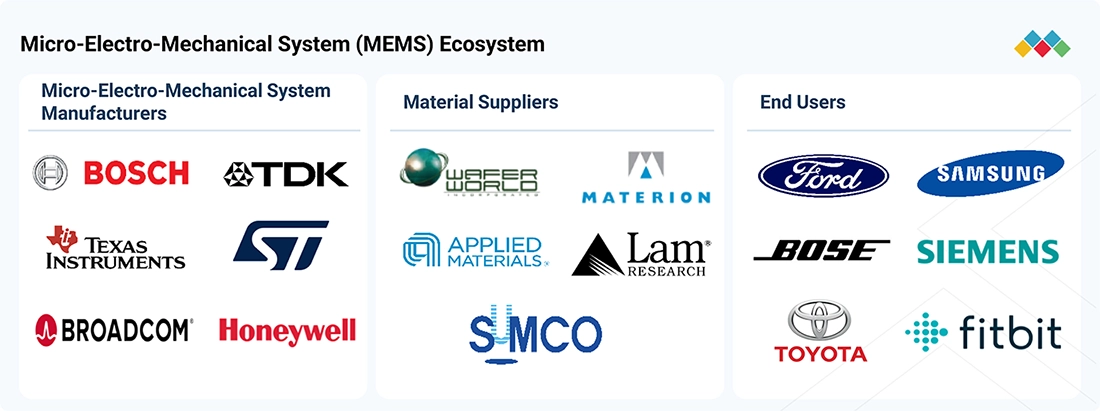
Logos and trademarks shown above are the property of their respective owners. Their use here is for informational and illustrative purposes only.
MARKET SEGMENTS
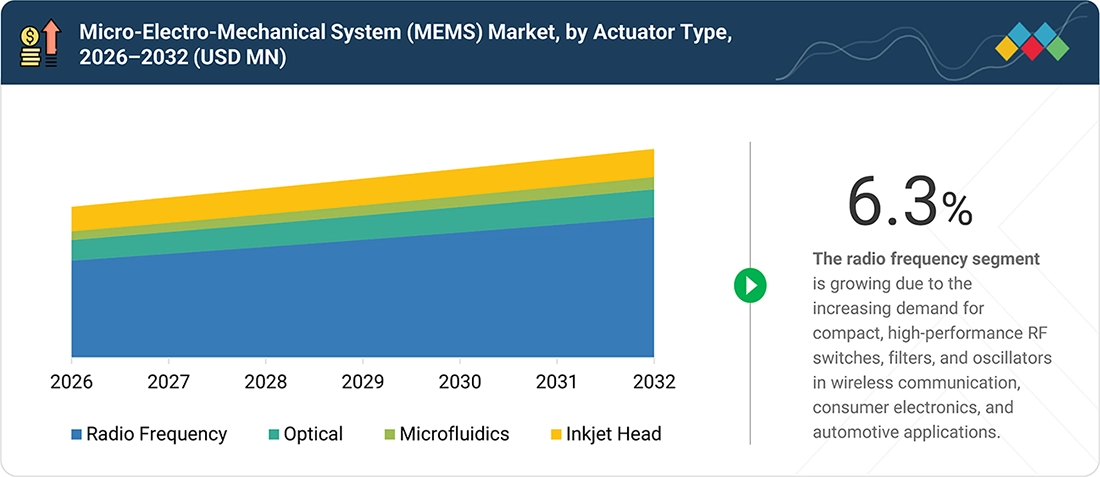
Source: Secondary Research, Interviews with Experts, MarketsandMarkets Analysis
By Sensor Type
Microspeakers are expected to witness the fastest growth among MEMS sensor types, driven by increasing demand for compact, lightweight, and power-efficient audio components in smartphones, wearables, hearables, smart speakers, and other consumer electronic devices. The growing adoption of true wireless stereo (TWS) earbuds and miniaturized wearable devices is increasing demand for MEMS-based audio solutions that offer consistent performance in small form factors. In addition, the integration of voice assistants, active noise cancellation (ANC), beamforming, and spatial audio is supporting the adoption of MEMS microphones and microspeakers. Increasing demand for high-fidelity audio, improved acoustic performance, and device miniaturization is further creating opportunities for MEMS-based audio components and for compact audio components in smartphones, wearables, hearables, and other consumer electronic devices.
By Actuator Type
RF actuators are expected to witness strong growth, supported by increasing adoption of MEMS-based RF switches, filters, and oscillators in wireless communication, telecom, and advanced electronic systems. The expansion of 5G networks, increasing deployment of high-frequency communication systems, and growing demand for compact RF front-end components are driving the need for high-performance RF MEMS solutions. The increasing complexity of RF architectures, including support for multiple frequency bands and carrier aggregation, is also creating demand for compact and efficient switching and filtering technologies. In addition, the growth of connected devices, IoT applications, satellite communication, and advanced wireless infrastructure is expected to expand the application scope of RF MEMS actuators. Increasing emphasis on lower power consumption, improved signal integrity, and miniaturization of RF components further supports market growth.
By Vertical
Telecom is expected to witness significant growth, driven by the increasing deployment of wireless communication infrastructure, demand for higher-frequency connectivity, and adoption of MEMS-based RF components. The expansion of 5G networks and ongoing development of next-generation wireless technologies are increasing demand for compact RF switches, filters, oscillators, and timing components. Rising data traffic, increasing smartphone and connected-device penetration, and growing deployment of small cells and advanced network equipment are further supporting demand for MEMS technologies. In addition, the expansion of IoT connectivity, edge computing, satellite communication, and high-speed wireless networks is creating new application opportunities for MEMS-based components. The increasing need for miniaturized, energy-efficient, and high-performance components in telecom infrastructure is expected to further support the growth of MEMS adoption in this vertical.
REGION
Asia Pacific to be fastest-growing market for micro-electro-mechanical system (MEMS) during forecast period
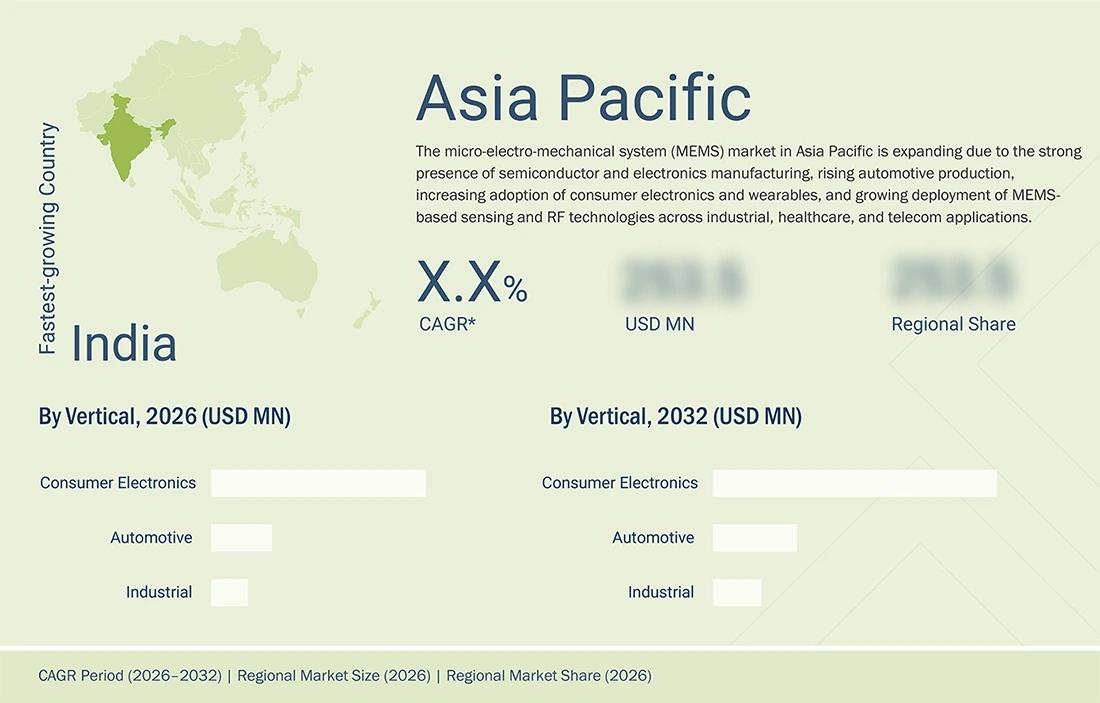
Asia Pacific is expected to be the fastest-growing region in the micro-electro-mechanical system (MEMS) market, driven by the strong electronics and semiconductor manufacturing base, expanding automotive production, and increasing adoption of MEMS-enabled consumer devices. Growing demand for inertial, pressure, microphone, environmental, optical, and RF MEMS across smartphones, wearables, vehicles, industrial equipment, and communication systems is supporting regional growth. China, Japan, South Korea, and India are contributing to demand through expanding electronics manufacturing, automotive electrification, semiconductor investments, and telecommunications infrastructure. The presence of leading MEMS manufacturers and a well-established semiconductor supply chain further supports the development and adoption of MEMS technologies across the region.
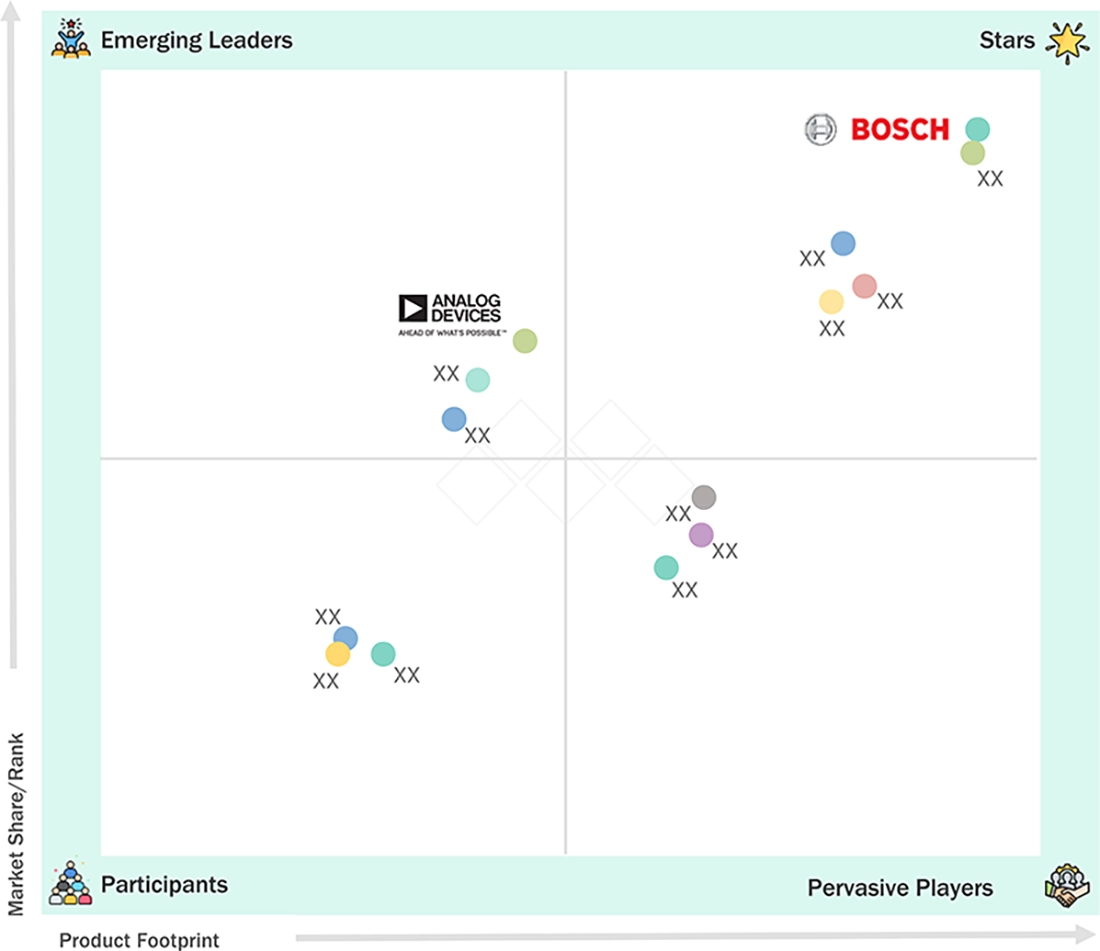
MICRO-ELECTRO-MECHANICAL SYSTEM (MEMS) MARKET SIZE, SHARE AND TRENDS: COMPANY EVALUATION MATRIX
Robert Bosch GmbH (Star) holds a strong position in the micro-electro-mechanical system (MEMS) market due to its broad portfolio of MEMS sensors, including inertial, pressure, environmental, and other sensing solutions serving automotive, consumer electronics, and industrial applications. Its strong presence across automotive and electronics markets, established manufacturing capabilities, broad application coverage, and continued focus on miniaturized and integrated sensing technologies support its strong market position. Analog Devices, Inc. (Emerging Leader) is strengthening its position through its portfolio of MEMS accelerometers, gyroscopes, and inertial measurement solutions serving industrial, automotive, healthcare, aerospace & defense, and robotics applications. Its focus on precision sensing, high-performance inertial measurement, integrated signal processing, and application-specific solutions is expanding its presence across advanced sensing applications.
Source: Secondary Research, Interviews with Experts, MarketsandMarkets Analysis
KEY MARKET PLAYERS
- Robert Bosch GmbH (Germany)
- Broadcom (US)
- TDK Corporation (Japan)
- STMicroelectronics (Switzerland)
- Texas Instruments Incorporated (US)
- Goertek Inc. (China)
- Hewlett Packard Enterprise (US)
- Infineon Technologies AG (Germany)
- Honeywell International Inc. (US)
- Analog Devices, Inc. (US)
MARKET SCOPE
| REPORT METRIC | DETAILS |
|---|---|
| Market Size in 2025 (Value) | USD 18.05 Billion |
| Market Forecast in 2026 (Value) | USD 19.06 Billion |
| Market Forecast in 2032 (Value) | USD 25.03 Billion |
| Growth Rate | CAGR of 4.6% from 2026–2032 |
| Years Considered | 2022–2032 |
| Base Year | 2025 |
| Forecast Period | 2026–2032 |
| Units Considered | Value (USD Million/Billion), Volume (Million Units) |
| Report Coverage | Revenue Forecast, Company Ranking, Competitive Landscape, Growth Factors, and Trends |
| Segments Covered |
|
| Regions Covered | North America, Europe, Asia Pacific, and RoW |
WHAT IS IN IT FOR YOU: MICRO-ELECTRO-MECHANICAL SYSTEM (MEMS) MARKET SIZE, SHARE AND TRENDS REPORT CONTENT GUIDE
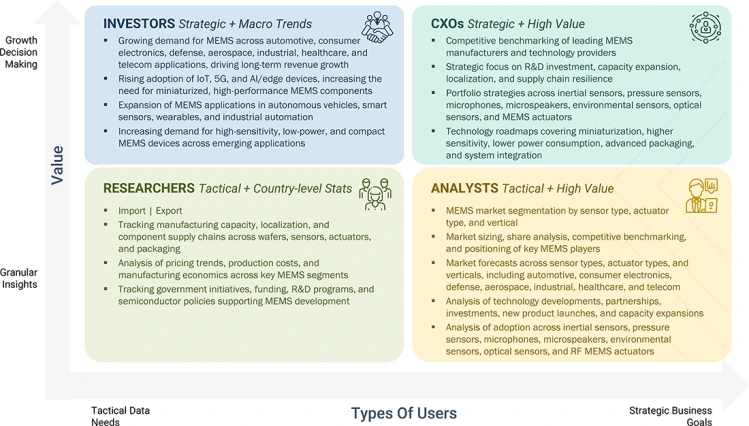
DELIVERED CUSTOMIZATIONS
We have successfully delivered the following deep-dive customizations:
| CLIENT REQUEST | CUSTOMIZATION DELIVERED | VALUE ADDS |
|---|---|---|
| MEMS Manufacturer/ Sensor & Actuator Manufacturer | Mapping MEMS products across inertial sensors, pressure sensors, microphones, microspeakers, environmental sensors, optical sensors, and MEMS actuators; benchmarking product specifications, sensing performance, miniaturization, power consumption, and application coverage; assessing sensor and actuator technologies | Identify high-growth MEMS applications; strengthen product positioning and portfolio strategy; support product development and go-to-market planning |
| MEMS Technology/ Component Supplier | Competitive mapping of MEMS sensors and actuators; benchmarking parameters such as sensitivity, accuracy, response time, operating range, power consumption, package size, and interface technologies; tracking advanced MEMS fabrication, packaging, and integration technologies | Identify technology white spaces; prioritize OEM and system-level engagements; support technology, component, and product roadmap planning |
| MEMS/Sensor System Integrator | Assessment of MEMS selection criteria across automotive, consumer electronics, industrial, healthcare, defense, aerospace, and IT & telecommunications applications; benchmarking integration with electronic systems, control units, IoT devices, wearables, and other system architectures; mapping application-specific deployment requirements | Strengthen competitive differentiation; identify high-value MEMS use cases; enable expansion into emerging sensing, automation, mobility, and connected-device applications |
| Consumer Electronics, Automotive & Industrial Equipment Enterprise | Mapping procurement and deployment strategies by region; evaluation of MEMS suppliers, product specifications, performance, customization, pricing, reliability, and technical support; benchmarking MEMS adoption in smartphones, wearables, ADAS, vehicle systems, industrial automation, and smart equipment | Support informed procurement and partnership decisions; improve supplier selection and system integration; identify opportunities for increased MEMS adoption |
| Enterprise/OEM/System Developer | Financial and competitive benchmarking of leading MEMS companies across North America, Europe, Asia Pacific, and RoW; market landscape mapping across sensor types, actuator types, and verticals; growth analysis by technology, vertical, and geography | Prioritize investment and partnership targets; validate market sizing and growth opportunities; identify attractive technology and vertical segments and mitigate market-entry risk |
RECENT DEVELOPMENTS
- August 2026 : TDK acquired assets from OQmented to strengthen its AR display technology portfolio. The acquisition adds MEMS-based laser beam scanning technology, IP, and engineering expertise. TDK plans to combine the technology with its eye-intent technology, full-color laser module, and MEMS mirror capabilities for smart-glass display systems.
- June 2026 : Bosch advanced research on sustainable MEMS production through its participation in a pan-European consortium. The initiative focuses on developing more sustainable manufacturing approaches for MEMS sensors, building on Bosch's large-scale MEMS production for mobility and consumer electronics.
- May 2026 : TDK introduced SensorStage software, an evaluation platform designed to simplify development and accelerate data analytics for TDK IMUs. The platform supports visualization and automated workflows for SmartMotion IMU development.
- February 2026 : STMicroelectronics completed its acquisition of NXP's MEMS sensors business for up to USD 950 million, strengthening ST's sensor portfolio in automotive safety and industrial applications. The acquired portfolio includes automotive motion and pressure sensors, as well as industrial pressure sensors and accelerometers.
- June 2025 : Bosch intensified its research into sustainable MEMS production as part of a pan-European consortium, targeting more sustainable production processes for MEMS sensors used in mobility and consumer electronics.
Table of Contents
 Exclusive indicates content/data unique to MarketsandMarkets and not available with any competitors.
Methodology
The study involved four major activities in estimating the current size of the micro-electro-mechanical system (MEMS) market. Extensive secondary research was conducted to gather information on the market, adjacent industries, and the broader semiconductor, sensor, microfabrication, MEMS manufacturing, advanced packaging, and electronic component ecosystem. This was followed by primary research with industry stakeholders across the value chain, including MEMS manufacturers, semiconductor companies, sensor suppliers, wafer and material suppliers, foundries, equipment providers, system integrators, distributors, technology developers, and end users across automotive, consumer electronics, healthcare, industrial, telecommunications, aerospace, and defense applications, to validate assumptions and market sizing.
Both top-down and bottom-up approaches were used to estimate the overall market size. Market breakdowns and data triangulation techniques were then applied to derive the size of individual segments and subsegments. Secondary and primary sources were jointly used to support a comprehensive technical and commercial analysis of the micro-electro-mechanical system (MEMS) market.
Secondary Research
Various secondary sources were referred to during the secondary research process to identify and collect information relevant to the micro-electro-mechanical system (MEMS) market. These sources included annual reports, press releases, investor presentations of key companies, product catalogs, technical datasheets, white papers, industry journals, certified publications, patents, industry associations, company websites, trade directories, government databases, and semiconductor, sensor, and MEMS industry sources.
Secondary research was conducted to obtain key insights into the market’s supply chain, value chain, competitive landscape, and segmentation across sensor type, actuator type, vertical, and region. It also helped analyze industry trends and adoption of inertial sensors, pressure sensors, microphones, microspeakers, environmental sensors, optical sensors, and radio frequency MEMS, along with their applications in automotive, consumer electronics, healthcare, industrial, telecommunications, aerospace, and defense sectors. The collected data was further analyzed to estimate the overall market size and validate findings, which were subsequently refined through primary research with industry experts and key stakeholders.
Primary Research
Extensive primary research was conducted after gaining knowledge about the current scenario of the micro-electro-mechanical system (MEMS) market through secondary research. Several primary interviews were conducted with experts from the demand and supply sides across four major regions: North America, Europe, Asia Pacific, and RoW. This primary data was collected through questionnaires, emails, and telephonic interviews.
Breakdown of Primary Interviews
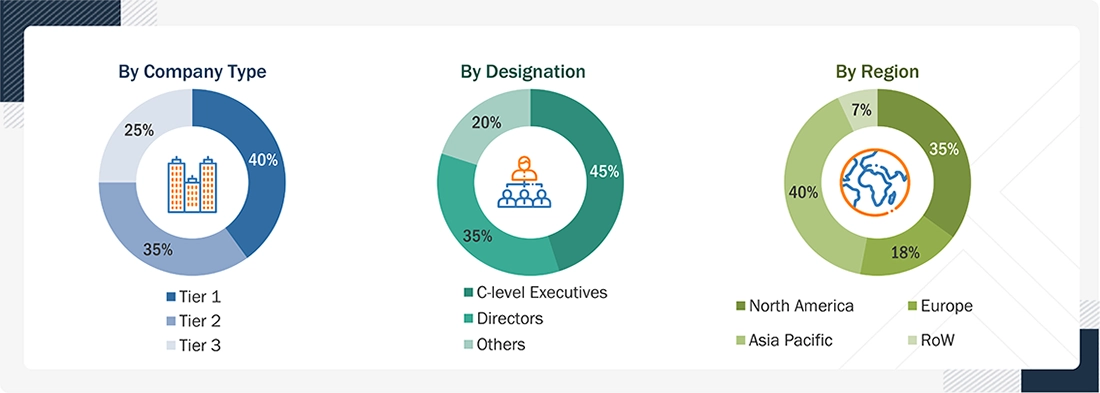
Note: The three tiers of the companies are defined based on their total revenue in 2025: Tier 1 - revenue greater than or equal to USD 1 billion; Tier 2 - revenue between USD 100 million and USD 1 billion; and Tier 3 revenue less than or equal to USD 100 million. Other designations include sales managers, marketing managers, and product managers.
To know about the assumptions considered for the study, download the pdf brochure
Market Size Estimation
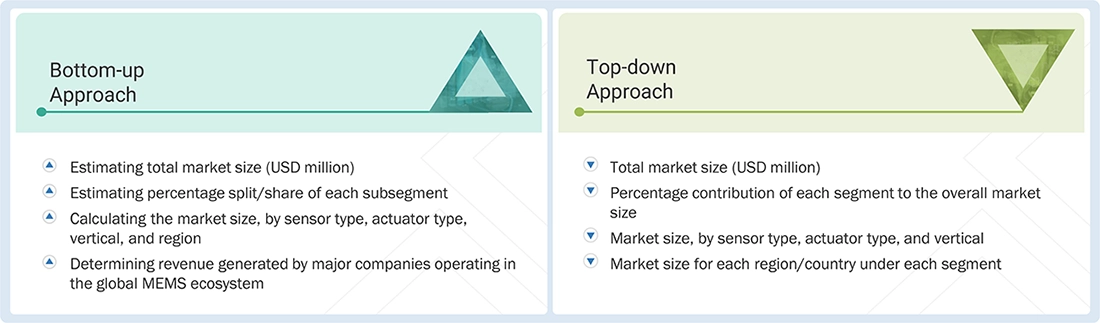
Both top-down and bottom-up approaches were used to estimate and validate the total size of the micro-electro-mechanical system (MEMS) market. These methods have also been used extensively to estimate the size of various subsegments in the market. The following research methodology was used to estimate the market size:
- Major players in the micro-electro-mechanical system (MEMS) market and related markets were identified through extensive secondary research.
- The industry’s value chain and market size (in terms of value) were determined through primary and secondary research processes.
- All percentage shares, splits, and segment-level breakdowns were determined using secondary sources and verified through primary sources.
Micro-Electro-Mechanical System Market : Top-Down and Bottom-Up Approach
Data Triangulation
After arriving at the overall size of the micro-electro-mechanical system (MEMS) market from the market size estimation process explained above, the total market was split into several segments and subsegments. Data triangulation and market breakdown procedures were employed, wherever applicable, to complete the overall market engineering process and arrive at the statistics for all segments and subsegments of the market. The data was triangulated by studying various factors and trends from both the demand and supply sides, including sensor type, actuator type, vertical, and regional developments. Along with this, the market size was validated using top-down and bottom-up approaches, with findings cross-checked against company-level revenues, product portfolios, application adoption, and industry-level developments.
Market Definition
Micro-electro-mechanical systems (MEMS) are miniaturized devices that integrate mechanical structures with electrical and electronic components to sense, measure, or actuate physical phenomena. MEMS technologies use microfabrication processes, primarily derived from semiconductor manufacturing, to produce compact devices with precise mechanical and electrical functions. The market covers inertial sensors, pressure sensors, microphones, microspeakers, environmental sensors, optical sensors, and MEMS actuators, including optical, microfluidic, inkjet, and RF actuators. These devices are used across automotive, consumer electronics, defense, aerospace, industrial, healthcare, and telecommunications applications.
MEMS play a critical role in applications requiring miniaturization, low power consumption, fast response, high sensitivity, and reliable sensing or actuation. They are widely integrated into smartphones, wearables, hearables, vehicles, ADAS, navigation systems, medical devices, industrial equipment, robotics, communication infrastructure, and aerospace systems. MEMS devices convert physical inputs such as acceleration, angular motion, pressure, sound, temperature, light, and electromagnetic signals into measurable electrical outputs, while MEMS actuators perform controlled mechanical or physical actions. A typical MEMS device consists of microscale mechanical structures, sensing or actuating elements, electrodes, and associated electronics, with designs varying according to the sensing principle, actuation mechanism, material, fabrication process, performance requirements, application, and operating environment.
Key Stakeholders
- Raw material and manufacturing equipment suppliers
- Electronic design automation (EDA) and design tool vendors
- Wafer manufacturers
- Government bodies, venture capitalists, and private equity firms
- Integrated device manufacturers (IDMs)
- Owners of intellectual property (related to MEMS components)
- MEMS technology platform developers
- MEMS component manufacturers
- Maintenance and service providers
- Distributors and traders
- Research organizations
- Semiconductor foundry service providers
- Organizations, forums, alliances, and associations
- End users from verticals such as aerospace, defense, industrial, and consumer electronics
Report Objectives
- To describe and forecast the micro-electro-mechanical system (MEMS) market size, by sensor type, actuator type, and vertical, in terms of value
- To describe and forecast the market for various segments across four main regions, namely North America, Europe, Asia Pacific, and RoW, in terms of value
- To describe and forecast the market for MEMS sensors and actuators in terms of volume
- To strategically analyze micromarkets with regard to individual growth trends, prospects, and contribution to the market
- To provide detailed information regarding drivers, restraints, opportunities, and challenges influencing the growth of the market
- To analyze opportunities for stakeholders by identifying high-growth segments in the market
- To provide a detailed overview of the value chain of the market
- To strategically analyze key MEMS technologies, average selling price by key players, trends impacting customers, ecosystem, regulatory landscape, patent landscape, Porter’s Five Forces, import and export scenarios, trade landscape, and case studies pertaining to the market
- To strategically profile key players in the market and comprehensively analyze their market share and core competencies
- To analyze competitive developments such as partnerships, acquisitions, expansions, collaborations, contracts, and product launches, along with R&D in the market
Available customizations:
With the given market data, MarketsandMarkets offers customizations according to the company’s specific needs. The following customization options are available for the report:
Company Information
-
Detailed analysis and profiling of additional market players (up to 5)
Key Questions Addressed by the Report
What is the current size of the MEMS Market?
The global MEMS (Micro-Electro-Mechanical Systems) market is valued at USD 19.06 billion in 2026 and is projected to reach USD 25.03 billion by 2032.
What is the expected CAGR of the MEMS Market during the forecast period?
The MEMS market is expected to grow at a CAGR of 4.6% from 2026 to 2032, driven by increasing adoption of IoT devices, smart electronics, and industrial automation.
What are the key growth drivers of the MEMS Market?
Major growth drivers include the proliferation of IoT devices, growing demand for miniaturized sensors, expansion of smart home technologies, wearable devices, automotive electronics, and industrial automation systems.
Which sensor type holds the largest share in the MEMS Market?
The Inertial Sensors segment is expected to account for the largest market share due to widespread use in smartphones, wearables, automotive safety systems, AR/VR devices, and industrial applications.
Which actuator segment is expected to grow the fastest?
The Radio Frequency (RF) MEMS segment is projected to register the highest CAGR due to increasing deployment in 5G infrastructure, wireless communication systems, RF switches, tunable filters, and satellite communications.
Which industry vertical is expected to witness the highest growth?
The Telecom sector is expected to grow at the highest CAGR owing to rapid 5G deployment, increasing data traffic, and demand for advanced RF MEMS components.
Which region is expected to be the fastest-growing MEMS market?
Asia Pacific is expected to register the highest CAGR during the forecast period, driven by strong electronics manufacturing ecosystems in China, Japan, South Korea, and Taiwan.
Who are the leading companies operating in the MEMS Market?
Key market players include Robert Bosch GmbH, Broadcom, Qorvo, Inc., STMicroelectronics, and Texas Instruments Incorporated.
What are the major trends shaping the MEMS industry?
Key trends include integration of MEMS in 5G networks, sensor fusion technology, growth of wearable electronics, expansion of industrial IoT, miniaturization of electronic devices, and increasing demand for low-power sensors.
What opportunities and challenges exist in the MEMS Market?
Major opportunities include the implementation of sensor fusion technologies and expansion of smart devices, while challenges include a shortage of skilled MEMS designers and complex manufacturing processes.


Personalize This Research
- Triangulate with your Own Data
- Get Data as per your Format and Definition
- Gain a Deeper Dive on a Specific Application, Geography, Customer or Competitor
- Any level of Personalization
Let Us Help You
- What are the Known and Unknown Adjacencies Impacting the Micro-Electro-Mechanical System (MEMS) Market
- What will your New Revenue Sources be?
- Who will be your Top Customer; what will make them switch?
- Defend your Market Share or Win Competitors
- Get a Scorecard for Target Partners

Custom Market Research Services
We Will Customise The Research For You, In Case The Report Listed Above Does Not Meet With Your Requirements
Get 10% Free CustomisationTESTIMONIALS

Tetsuya Ohhira
Business Development Manager-Technology Business
Nikon Corporation,
Leading Japanese MNC specializing in optics and imaging productswww.nikon.com
MarketsandMarkets™ response
is quick. Their attitude is flexible and positive. Analyst Insights are globally considered and
significant. Client Services quickly respond to our inquiry and demand. Their wide range of global
surveys help us make our strategic plan.
We hope Knowledge Store will be easier to search
for a report.
VP - Marketing & Business Development
Leading Provider of Process Control Solutions
We engaged with MarketsandMarkets on a study to perform an analysis and recommend a Go-To-Market strategy for metrology and process control in the semiconductor market. The study was tailored to our targets and needs with well-defined milestones. Our overall experience with the MarketsandMarkets team was very good throughout the project in all aspects including the analysis methodologies used, the quality and depth of primary and secondary data sets, the professionalism and flexibility of the team and the ability to meet the target schedule and milestones. We want to thank MarketsandMarkets team for a job well done.
- US Micro-Electro-Mechanical System (MEMS) Market
- Canada Micro-Electro-Mechanical System (MEMS) Market
- Mexico Micro-Electro-Mechanical System (MEMS) Market
- Germany Micro-Electro-Mechanical System (MEMS) Market
- UK Micro-Electro-Mechanical System (MEMS) Market
- France Micro-Electro-Mechanical System (MEMS) Market
- Italy Micro-Electro-Mechanical System (MEMS) Market
- Spain Micro-Electro-Mechanical System (MEMS) Market
- Netherlands Micro-Electro-Mechanical System (MEMS) Market
- Nordics Micro-Electro-Mechanical System (MEMS) Market
- Rest Of Europe Micro-Electro-Mechanical System (MEMS) Market
- China Micro-Electro-Mechanical System (MEMS) Market
- Japan Micro-Electro-Mechanical System (MEMS) Market
- India Micro-Electro-Mechanical System (MEMS) Market
- South Korea Micro-Electro-Mechanical System (MEMS) Market
- Australia Micro-Electro-Mechanical System (MEMS) Market
- Vietnam Micro-Electro-Mechanical System (MEMS) Market
- Thailand Micro-Electro-Mechanical System (MEMS) Market
- Indonesia Micro-Electro-Mechanical System (MEMS) Market
- Malaysia Micro-Electro-Mechanical System (MEMS) Market
- Rest Of Asia Pacific Micro-Electro-Mechanical System (MEMS) Market
- Saudi Arabia Micro-Electro-Mechanical System (MEMS) Market
- UAE Micro-Electro-Mechanical System (MEMS) Market
- Qatar Micro-Electro-Mechanical System (MEMS) Market
- Kuwait Micro-Electro-Mechanical System (MEMS) Market
- Bahrain Micro-Electro-Mechanical System (MEMS) Market
- Oman Micro-Electro-Mechanical System (MEMS) Market
- Rest Of Middle East Micro-Electro-Mechanical System (MEMS) Market
- Africa Micro-Electro-Mechanical System (MEMS) Market
- South America Micro-Electro-Mechanical System (MEMS) Market
- Middle East Micro-Electro-Mechanical System (MEMS) Market
Growth opportunities and latent adjacency in Micro-Electro-Mechanical System (MEMS) Market






Blake
Apr, 2026
Does the report include both sensors and actuators comprehensively?.
Paul
Apr, 2026
What are the most attractive investment pockets in the MEMS market?.
Hernan
Jan, 2019
Good day, I have send this request to know more analysis data for study the trends for MEMS Market..
Dragan
Apr, 2019
I need the information about MEMS market to make an investment for manufacturing MEMS-based devices..