Semiconductor Manufacturing Equipment Market Size, Share & Trends

Semiconductor Manufacturing Equipment Market Size, Share & Trends by Lithography, Wafer Surface Conditioning, Wafer Cleaning, Deposition, Assembly & Packaging, Dicing, Metrology, Bonding, Wafer Testing/IC Testing, Memory, Logic, Discrete, Analog - Global Forecast to 2032




SEMICONDUCTOR MANUFACTURING EQUIPMENT MARKET SIZE, SHARE & TRENDS
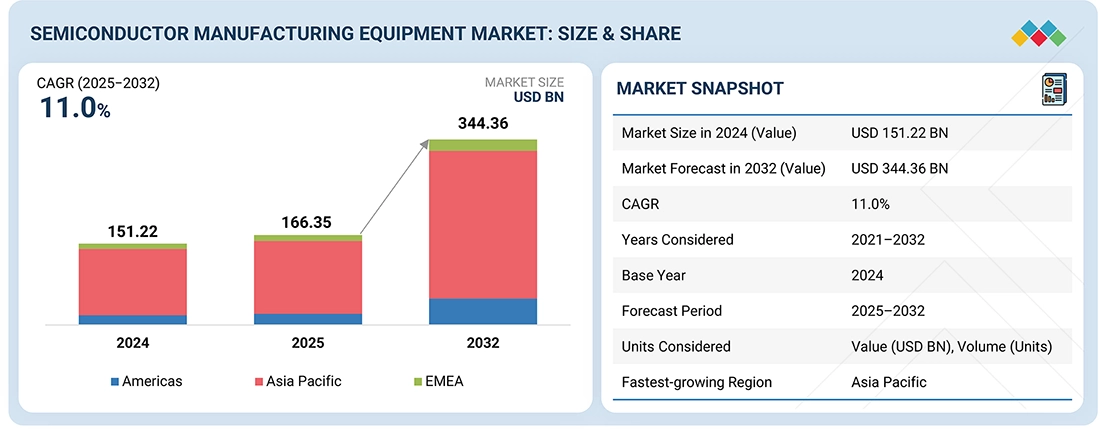
According to Marketsandmarkets, the semiconductor manufacturing equipment market size was valued at USD 166.35 billion in 2025 and is projected to reach USD 344.36 billion in 2032, growing at a CAGR of 11.0% from 2025 to 2032. The rapid adoption of artificial intelligence (AI) and high-performance computing (HPC) applications is significantly driving demand for advanced-node, high-performance semiconductors. Expansion of data centers for AI training and inference is fueling investments in cutting-edge logic and memory capacities, requiring sophisticated semiconductor manufacturing equipment. According to SEMI, transitions to leading-edge logic and memory technologies are expected to be a major factor propelling equipment sales, highlighting the critical role of AI and HPC in shaping the semiconductor equipment market.
MARKET SNAPSHOT TABLE
| REPORT METRIC | DETAILS |
|---|---|
| Market Size in 2025 (Value) | USD 166.35 Billion |
| Market Forecast in 2032 (Value) | USD 344.36 Billion |
| Growth Rate | CAGR of 11.0% from 2025-2032 |
| Years Considered | 2021-2032 |
| Base Year | 2024 |
| Forecast Period | 2025-2032 |
| Units Considered | Volume (Units) and Value (USD Billion) |
| Report Coverage | Revenue Forecast, Company Ranking, Competitive Landscape, Growth Factors, and Trends |
| Top Companies |
|
| Growth Driver |
|
| Segments Covered |
|
| Regions Covered | Americas, Asia Pacific, EMEA |
Market Size & Forecast
• 2025 Market Size: USD 166.35 Billion
• 2032 Projected Market Size: USD 344.36 Billion
• CAGR (2025-2032): 11.0%
• Manufacturing Phase: Largest Market Share
• Asia Pacific: Highest Market Share
KEY TAKEAWAYS
-
By RegionAsia Pacific accounted for 81% of the semiconductor manufacturing equipment market share in 2024.
-
By Manufacturing PhaseBy manufacturing phase, front-end semiconductor equipment held the largest market share of 70% in 2024.
-
By End UserBy end user, OSAT companies exhibit the fastest CAGR from 2025 to 2032.
-
By Front-end EquipmentBy front-end equipment, the lithography equipment segment is expected to dominate the market.
-
By Back-end EquipmentBy back-end equipment, the packaging equipment segment expected to record the highest CAGR during the forecast period.
The growing adoption of 5G technology, Internet of Things (IoT) devices, and electric vehicles (EVs) is significantly boosting semiconductor quipment demand. Deployment of 5G networks is driving the need for advanced chips in telecom infrastructure, base stations, and devices. Simultaneously, EVs rely heavily on semiconductors for power electronics, sensors, and control units, further increasing capacity requirements. Additionally, the expansion of IoT through smart devices and connected infrastructure is creating sustained long-term demand for semiconductors, thereby supporting growth of the semiconductor manufacturing equipment market.
Source: Secondary Research, Interviews with Experts, MarketsandMarkets Analysis
TRENDS & DISRUPTIONS IMPACTING CUSTOMERS' CUSTOMERS
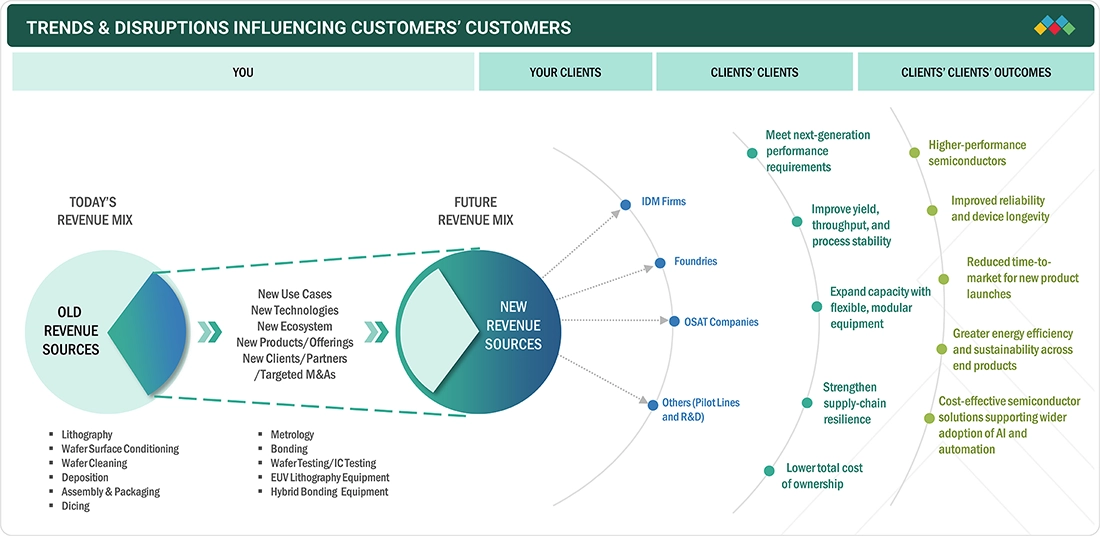
The semiconductor manufacturing equipment industry is undergoing a significant transformation driven by technological innovation, operational shifts, and sustainability pressures. Revenue streams are moving from legacy processes such as standard lithography, wafer cleaning, and metrology toward EUV lithography, hybrid bonding, and meeting the evolving demands of IDMs, foundries, OSATs, and R&D pilot lines. Breakthrough technologies such as extreme ultraviolet (EUV) lithography, 3D IC architectures, and AI/ML-enabled process control are enabling the production of smaller, more complex nodes for next-generation applications. Concurrently, sustainability and regulatory compliance are becoming critical competitive factors, while high development costs and technical challenges drive increased R&D investment.
Source: Secondary Research, Interviews with Experts, MarketsandMarkets Analysis
MARKET DYNAMICS

Level
-
Growing Inclination toward Miniaturization and Adoption of Advanced Manufacturing Processes

-
Accelerating Demand for Automotive Semiconductors


Level
-
High Ownership and Operational Costs

-
Rising Process Complexity and Yield Optimization Challenges


Level
-
Increasing Adoption of Advanced Packaging Technologies

-
Government Initiatives to Strengthen Domestic Semiconductor Manufacturing Ecosystems


Level
-
Capital- and Time-Intensive Compliance Requirements

-
Constant Technological Evolution

Source: Secondary Research, Interviews with Experts, MarketsandMarkets Analysis
Driver: Growing Inclination toward Miniaturization and Adoption of Advanced Manufacturing Processes
Miniaturization and the adoption of advanced manufacturing processes are significant revenue-driving forces in the semiconductor manufacturing equipment (SME) market. Smaller transistor geometries lead to higher performance, reduced power consumption, and increased functional density. These benefits are valued by end users, such as smartphone manufacturers, cloud data center operators, and automotive manufacturers .
Restraint: High Ownership and Operational Costs
The high ownership and operational costs associated with semiconductor manufacturing equipment pose a significant restraint to the market’s growth. As chip architectures become increasingly complex and technology nodes continue to shrink—moving toward 3 nm, 2 nm, and beyond—the cost of acquiring, operating, and maintaining advanced manufacturing tools has risen sharply. Cutting-edge equipment, such as extreme ultraviolet (EUV) lithography systems, developed primarily by ASML, exemplify this challenge. A single EUV lithography machine can cost over USD 200 million, making it one of the most expensive pieces of industrial equipment ever built. This means only a small group of leading-edge foundries and IDMs can afford to invest. This reduces the addressable customer base, slows equipment-purchase cycles, and delays fab-capacity expansion—factors that explicitly restrain market expansion.
Opportunity: Increasing Adoption of Advanced Packaging Technologies
The rapid adoption of advanced packaging technologies, such as system-in-package (SiP), fan-out wafer-level packaging (FOWLP), and 3D stacking has become a major growth driver for the semiconductor manufacturing equipment market. As semiconductor devices become smaller, faster, and more power-efficient, these packaging innovations are critical to improving performance, thermal management, and integration density.
Challenges: Capital- and Time-Intensive Compliance Requirements
Stringent regulatory policies is a major challenge in the semiconductor manufacturing equipment market because vendors must meet rigorous global standards related to safety, environmental impact, chemical handling, and export controls. Adhering to regulations such as RoHS, REACH, and US export restrictions increases product development costs, lengthens certification timelines, and complicates global sales, especially to regions with tight technology transfer rules. This makes compliance a costly and time-intensive barrier for semiconductor equipment manufacturers, slowing innovation and market expansion.
semiconductor-manufacturing-equipment-market: COMMERCIAL USE CASES ACROSS INDUSTRIES
| COMPANY | USE CASE DESCRIPTION | BENEFITS |
|---|---|---|
 |
Applied Materials delivers deposition, etch, ion implantation, metrology, and inspection systems widely used in front-end wafer processing. Its material engineering platforms enable the formation of complex multi-layer structures, interconnects, and next-generation packaging designs. | Applied Materials solutions increase device performance, reduce manufacturing variability, and optimize total cost of ownership. The company enables innovations such as new materials, advanced interconnects, and heterogeneous integration, supporting higher compute density and improved device power efficiency. |
 |
Lam Research delivers plasma etch, deposition, and cleaning solutions used across multiple critical process steps in wafer fabrication. Its equipment enables precise material removal, thin-film deposition, and chamber conditioning required to manufacture complex 3D device architectures. | Lam’s systems improve process uniformity, yield, and device reliability while reducing cycle time and production cost. The company supports advanced technologies such as 3D NAND, FinFET, and GAA transistors, enabling faster time to market for advanced semiconductor products. |
 |
TEL provides a broad portfolio of semiconductor production tools, including coater/developers for lithography, etch systems, deposition tools, and cleaning equipment. These systems are essential for critical wafer processes that shape, pattern, and prepare semiconductor layers. | Different types of semiconductor manufacturing equipment offered by TEL enhance throughput, pattern accuracy, and defect control, helping chipmakers scale advanced nodes efficiently. The company’s integrated solutions support improved line productivity, energy efficiency, and stable mass-production performance. |
 |
ASML provides advanced photolithography systems, particularly extreme ultraviolet (EUV) lithography, used to print the smallest semiconductor features at leading-edge nodes. These tools enable chipmakers to push Moore’s Law by achieving ultra-fine patterning with high precision and throughput. | ASML’s systems enable foundries and IDMs to manufacture chips with higher performance and lower power consumption, while achieving greater transistor density, reduced defect ratio, and higher overall fabrication efficiency. These capabilities directly support advanced logic and memory production at 5 nm, 3 nm, and subsequent technology nodes. |
 |
KLA Corporation specializes in process control, metrology, and inspection systems that monitor critical parameters throughout semiconductor manufacturing. Their equipment detects nanoscale defects, measures pattern dimensions, and analyzes process variations, ensuring quality and consistency across increasingly complex chip architectures. | KLA Corporation’s solutions enhance yield, prevent defects from reaching later stages, and strengthen manufacturing reliability by identifying process deviations at an early stage. This leads to lower scrap rates, more precise process optimization, and faster ramp-up of advanced nodes, thereby cutting production costs and shortening commercialization timeline for semiconductor manufacturers. |
Logos and trademarks shown above are the property of their respective owners. Their use here is for informational and illustrative purposes only.
MARKET ECOSYSTEM
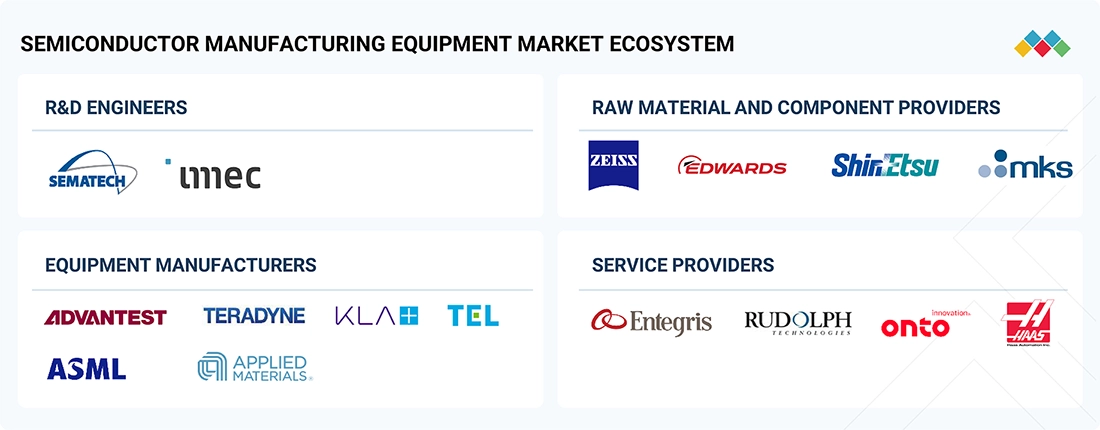
The semiconductor manufacturing equipment market growth ecosystem players include R&D engineers, raw material and component suppliers, equipment manufacturers, service providers, and end users such as foundries and IDMs. Rapid innovation in manufacturing technologies, supply chain resilience, and a strong focus on improving localized production capabilities have become key priorities amid global demand for advanced semiconductors in electronics, automotive, and AI applications. Strategic partnerships, rising investments in automation and sustainability initiatives, and continuous advancements in process tools drive the competitiveness and growth of this dynamic industry.
Logos and trademarks shown above are the property of their respective owners. Their use here is for informational and illustrative purposes only.
MARKET SEGMENTS
Source: Secondary Research, Interviews with Experts, MarketsandMarkets Analysis
Semiconductor Manufacturing Equipment Market, by Manufacturing Phase
The front-end manufacturing phase holds the largest market share because it involves the most complex, technology-intensive, and capital-heavy processes such as photolithography, deposition, wafer surface conditioning, wafer cleaning, and metrology that define the chip’s electrical functionality at nanometer scales. These steps require highly sophisticated and expensive equipment to create high-performance, miniaturized integrated circuits essential for advanced electronics. As chip designs grow more complex with emerging applications such as AI and 5G, the front-end phase demands continuous technology upgrades, driving high capital expenditure and resulting in its prominent share of the semiconductor manufacturing equipment market.
Semiconductor Manufacturing Equipment Market, By End User
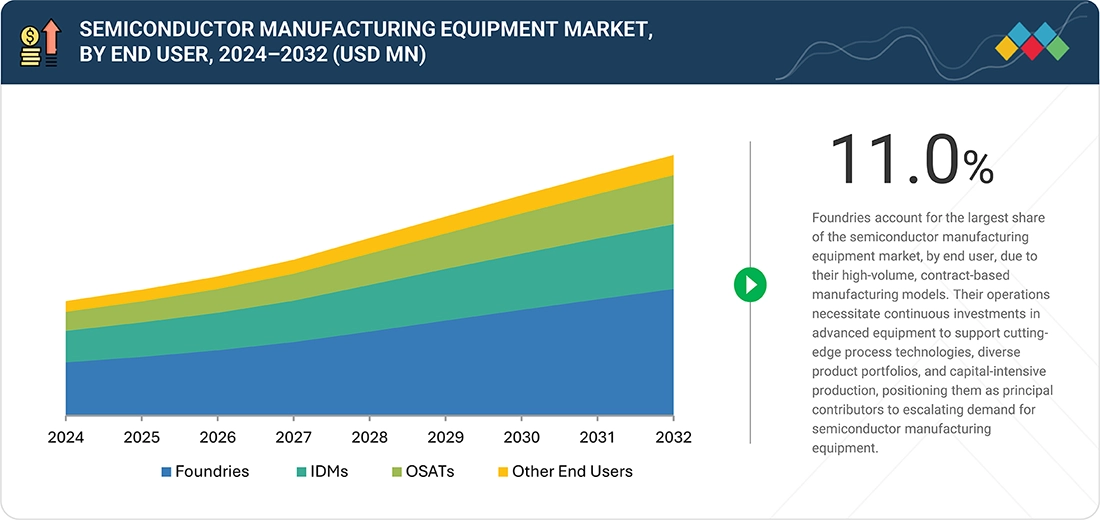
Foundries hold the largest share of the semiconductor manufacturing equipment end-user segment because they operate at the forefront of semiconductor fabrication, producing chips for a wide range of industries, including consumer electronics, automotive, and data centers. Their substantial capital investments in advanced technology nodes such as 5nm and 3nm necessitate extensive deployment of cutting-edge manufacturing equipment, including lithography, etching, deposition, and metrology tools. This high level of equipment utilization, coupled with the scale of foundry operations and their role as contract manufacturers for fabless companies, drives their dominant share of the equipment market. Furthermore, foundries’ ongoing commitment to innovation and capacity expansion amplifies their demand for next-generation fabrication tools, reinforcing their leadership position in the end-user business segment.
Semiconductor Manufacturing Equipment Market, By Front-end Equipment
Lithography equipment accounts for the largest share of the front-end semiconductor manufacturing equipment market trends because it performs the essential step of defining fine circuit patterns on silicon wafers, which enables device scaling and higher performance. As technology nodes advance to 5 nm, 3 nm, and beyond, lithography, particularly extreme ultraviolet (EUV) systems, has become more complex, capital-intensive, and indispensable, requiring tools with exceptionally high precision and resolution. Its critical role in supporting the production of smaller, faster, and more energy-efficient chips for applications in AI, 5G, automotive, and data centers continues to drive substantial investment and innovation. This foundational importance, coupled with the high cost and technical sophistication of lithography systems, firmly positions this segment as the dominant contributor to the front-end equipment market share.
Semiconductor Manufacturing Equipment Market, by Back-end Equipment
Testing equipment holds the largest share of the back-end semiconductor equipment market because such equipment are essential to produce semiconductor devices with high quality, functionality, and reliability. As chip complexity and integration increase with advanced packaging, memory stacks, and AI processors, testing demands become more sophisticated, requiring advanced automated test equipment and probe systems that can handle higher pin counts and more extensive testing routines. The growing emphasis on reliability, defect detection, and yield improvement in diverse end markets such as automotive, consumer electronics, and telecommunications also drives continuous investment in testing technologies, making this segment critical for semiconductor manufacturing success.
REGION
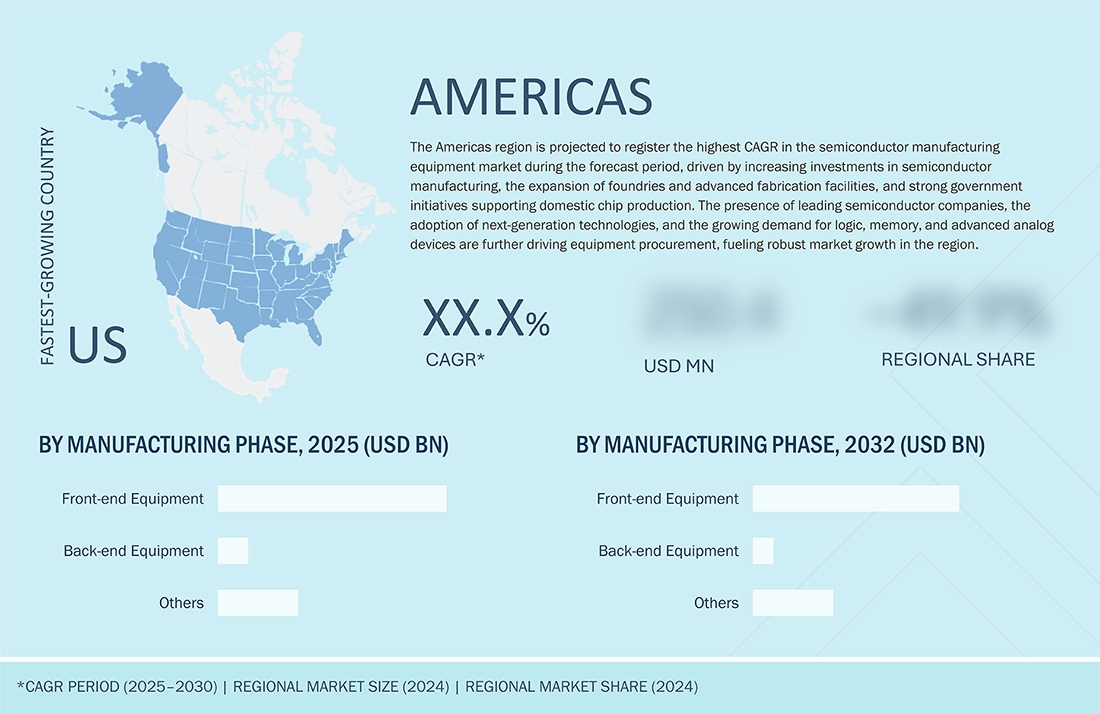
Americas to be fastest-growing region in global semiconductor manufaturing equipment market during forecast period
The Americas is poised to be the fastest-growing region in the global semiconductor manufacturing equipment market due to a combination of massive government incentives, such as the US CHIPS and Science Act, which unlock extensive funding to boost domestic chip production and R&D activities. This has led to significant investments in new fabrication facilities and technology clusters across states such as Arizona, Texas, and Ohio. The drive for supply chain resilience, nearshoring of manufacturing, and growth in advanced applications such as AI, automotive, and 5G further fuel demand for sophisticated manufacturing equipment in the region. Additionally, cross-border collaboration and increased local capacity expansion in Mexico and Brazil contribute to the robust growth momentum. Together, these factors position the Americas as a critical and rapidly expanding hub in the semiconductor equipment industry.
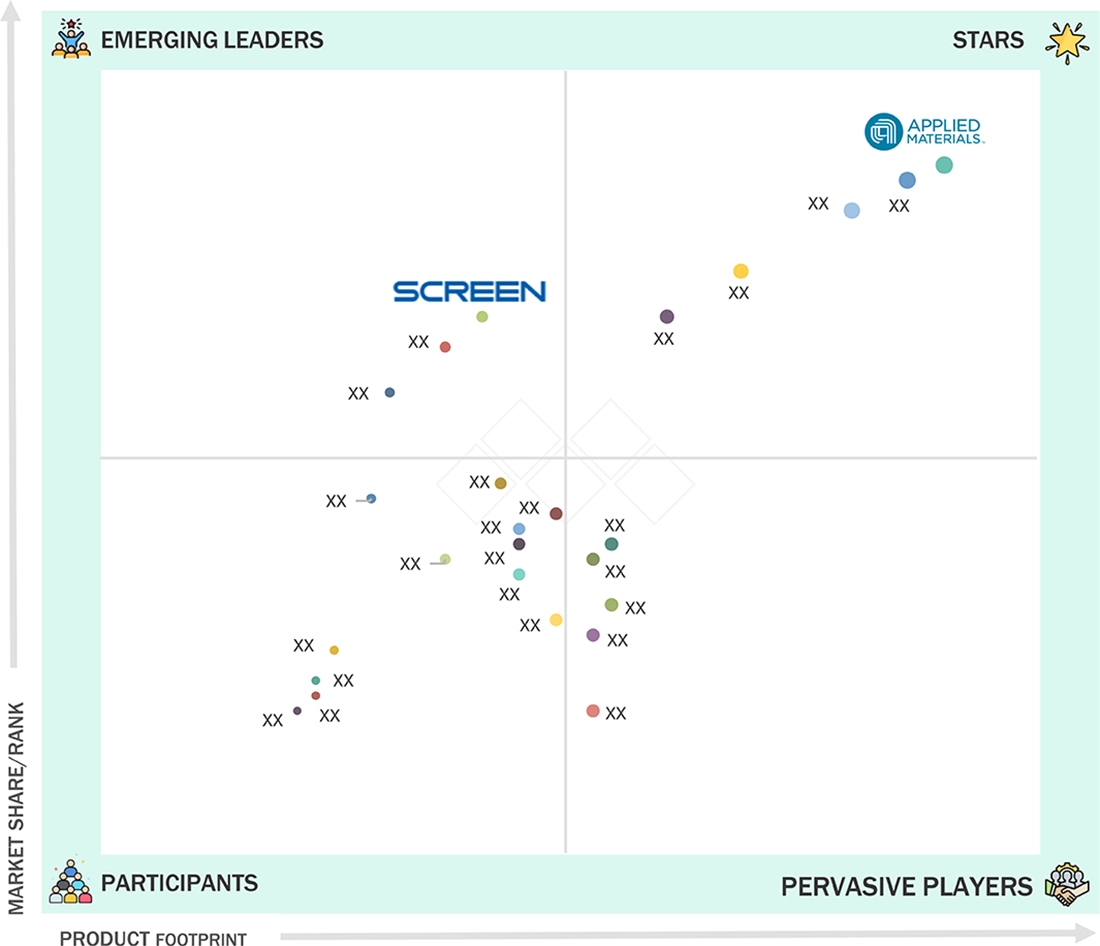
semiconductor-manufacturing-equipment-market: COMPANY EVALUATION MATRIX
In the semiconductor manufacturing equipment companies matrix, Applied Materials, Inc. is positioned as a star company due to its strong product footprint and dominant market share, reflecting its leadership in innovation and adoption across OEMs. SCREEN Semiconductor Solutions Co., Ltd., on the other hand, is seen as an emerging leader, holding a large market share but with a comparatively smaller product footprint, indicating strong growth potential as it expands its semiconductor manufacturing equipment market footprint.
Source: Secondary Research, Interviews with Experts, MarketsandMarkets Analysis
KEY MARKET PLAYERS
- Applied Materials, Inc.
- ASML
- Tokyo Electron Limited
- LAM RESEARCH CORPORATION
- KLA Corporation
- SCREEN Holdings Co., Ltd.
- Teradyne Inc.
- ZEISS
- ADVANTEST CORPORATION
- Hitachi High-Tech Corporation
- Plasma-Therm
- ASM International N.V.
- EV Group (EVG)
- Onto Innovation
- ADT – Advanced Dicing Technologies
WHAT IS IN IT FOR YOU: semiconductor-manufacturing-equipment-market REPORT CONTENT GUIDE
DELIVERED CUSTOMIZATIONS
We have successfully delivered the following deep-dive customizations:
| CLIENT REQUEST | CUSTOMIZATION DELIVERED | VALUE ADDS |
|---|---|---|
| Leading Foundry |
|
|
| Integrated Device Manufacturer (IDM) |
|
Insights on growing semiconductor manufacturing equipment adoption across regions |
| Fabless Design House Support |
|
|
| OSAT Provider (Packaging & Test) |
|
Identify the best-fit SME vendors for packaging and testing operations |
| R&D Facilities/Research Labs |
|
|
RECENT DEVELOPMENTS
- October 2025 : Applied Materials, Inc. (US) introduced the Kinex Bonding System, an advanced packaging tool that serves as the industry’s first integrated die-to-wafer hybrid bonder. The system unifies die placement with interconnect and bonding processes in a single platform, enabling the production of higher performance, lower power advanced logic and memory devices.
- September 2025 : Applied Materials, Inc. (AMAT) and GlobalFoundries Inc. (GF) partnered to establish a wave guide fabrication facility in Singapore to accelerate the adoption of AI-powered photonics. Under the collaboration, Applied Materials will apply its material engineering expertise to develop advanced waveguide components, while GF will act as the high-volume manufacturing partner leveraging its semiconductor fabrication infrastructure. The joint initiative is aimed at enabling ultra-efficient, lightweight optical systems for next-generation applications such as augmented reality (AR) and human-centric AI experiences and is built on Singapore’s growing photonics ecosystem of materials, sensors, integration, assembly, and test.
- September 2025 : ASML led and committed to a large Series C funding round for Mistral AI and entered a long-term strategic collaboration to apply Mistral’s AI models across ASML’s product portfolio (R&D, operations, product performance). ASML will join Mistral’s strategic committee to help shape AI integration into ASML systems.
- June 2025 : Tokyo Electron Limited (Japan) and imec extended their multi-year partnership to deepen joint R&D on patterning, advanced logic processing, future memory and 3D integration targeted beyond the 2 nm node. The agreement includes equipment access and pilot-line collaboration to accelerate technology readiness for advanced manufacturing.
- December 2024 : Tokyo Electron Limited (Japan) expanded its sputtering lineup with LEXIA-EX a high-performance, high-productivity sputtering system developed for advanced logic, DRAM, and 3D NAND applications, delivering improved throughput and process control for next-generation memory and logic metallization.
Table of Contents
 Exclusive indicates content/data unique to MarketsandMarkets and not available with any competitors.
Methodology
The study involved major activities in estimating the current market size for the semiconductor manufacturing equipment market. Exhaustive secondary research was done to collect information on the semiconductor manufacturing equipment industry. The next step was to validate these findings and assumptions, and validate them with industry experts across the supply chain through primary research. Different approaches, such as top-down and bottom-up, were employed to estimate the total market size. Following this, the market breakup and data triangulation procedures were used to determine the market size of the segments and subsegments within the semiconductor manufacturing equipment market.
Secondary Research
Secondary research for this study involved gathering information from various credible sources, such as company reports, white papers, journals, and industry publications. This process helps understand the supply and value chains, identify key players, analyze market segmentation and regional trends, and track major market and technology developments. The data collected was used to estimate the overall market size, which was later validated through primary research.
Primary Research
Extensive primary research was conducted after gaining knowledge about the current scenario of the semiconductor manufacturing equipment market through secondary research. Several primary interviews were conducted with experts from the demand and supply sides across three major regions—the Americas, Asia Pacific, and EMEA. This primary data was collected through questionnaires, emails, and telephonic interviews.
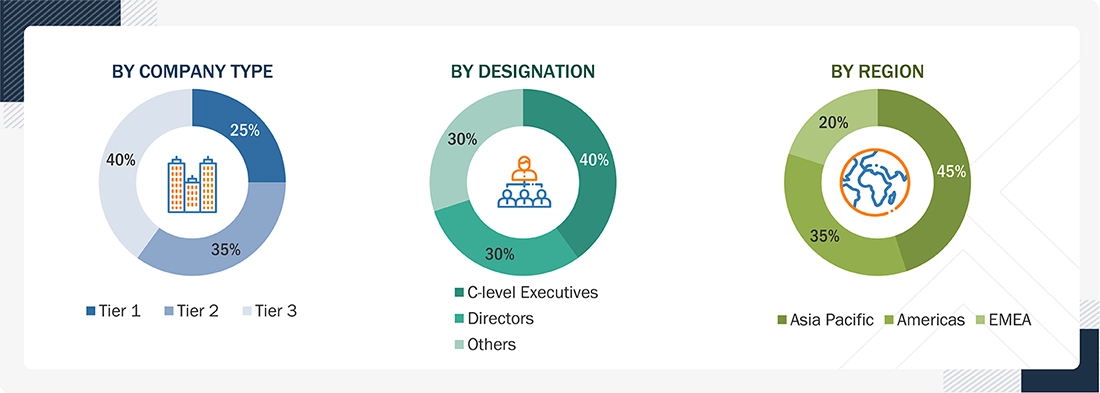
Notes: EMEA primarily encompasses Europe and the Rest of the Middle East & Africa.
Other designations include product managers, sales managers, and marketing managers.
Tier 1 companies include market players with revenues exceeding USD 500 million; Tier 2 companies earn revenues between USD 100 million and USD 500 million; and Tier 3 companies earn up to USD 100 million.
To know about the assumptions considered for the study, download the pdf brochure
Market Size Estimation
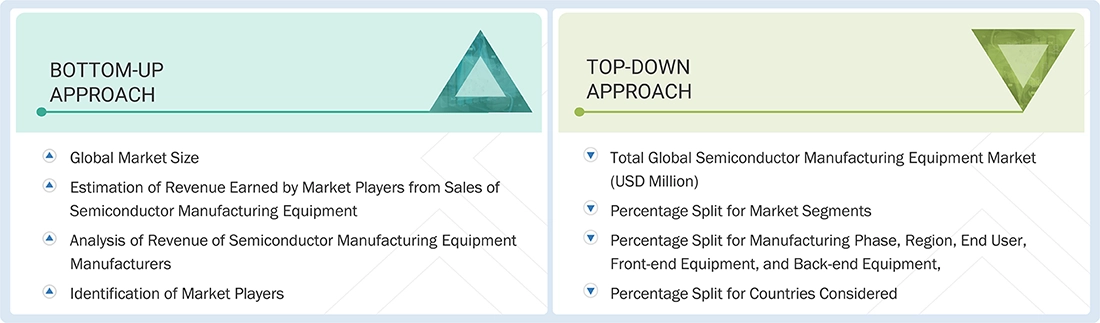
A bottom-up procedure was employed to determine the overall size of the semiconductor manufacturing equipment market.
- Identifying stakeholders in the semiconductor manufacturing equipment market that influence the entire market, along with participants across the value chain
- Analyzing major manufacturers of semiconductor manufacturing equipment, software, and after-sales service providers, as well as studying their product portfolios
- Analyzing trends related to the adoption of semiconductor manufacturing equipment based on the production phase (front-end, back-end)
- Tracking the recent developments in the market that include investments, R&D activities, product launches, collaborations, acquisitions, expansions, and partnerships, as well as forecasting the market size based on these developments and other critical parameters
- Carrying out multiple discussions with key opinion leaders to identify the adoption trends of semiconductor manufacturing equipment
- Segmenting the overall market into various other market sub-segments
- Validating the estimates at every level through discussions with key opinion leaders, such as chief executives (CXOs), directors, and operations managers, and finally with the domain experts at MarketsandMarkets
The top-down approach was used to estimate and validate the total size of the semiconductor manufacturing equipment market.
- Identifying top-line investments in the ecosystem, along with segment-level splits and significant developments
- Obtaining information related to the market revenue generated by the key players of the semiconductor manufacturing equipment market
- Conducting multiple discussions with key opinion leaders from major companies that manufacture semiconductor manufacturing equipment
- Estimating geographic splits using secondary sources based on the number of players in a specific region, the types of semiconductor manufacturing equipment provided, and various supply chain participants related to the market
Semiconductor Manufacturing Equipment Market: Top-Down and Bottom-Up Approach
Data Triangulation
After determining the overall market size using the market size estimation processes explained above, the market has been segmented into several segments and subsegments. Data triangulation and market breakdown procedures have been employed to complete the entire market engineering process and arrive at the exact statistics of each market segment and subsegment. The data has been triangulated by studying various factors and trends from the demand and supply sides in the semiconductor manufacturing equipment market.
Market Definition
Different types of semiconductor manufacturing equipment refer to specialized tools, machinery, and systems used to design, fabricate, assemble, test, and package semiconductor devices such as integrated circuits (ICs), memory chips, logic devices, sensors, and power semiconductors. All such equipment enables each stage of chip production—from front-end wafer fabrication processes such as lithography, etching, deposition, and cleaning to back-end processes including assembly, packaging, and testing. These tools ensure precision at the nanometer scale, enabling higher performance, improved yields, and advanced chip architectures required across various industries, including consumer electronics, automotive, telecommunications, and industrial automation.
Key Stakeholders
- Raw Material Suppliers
- Component and Subsystem Suppliers
- Semiconductor Equipment Manufacturers
- Technology Solution Providers
- IDMs (Integrated Device Manufacturers) and Foundries
- Chip Designers
- Software Developers
- Third-party Service Providers
- Distributors and Resellers
- Service Providers
- Regulatory Bodies
- Research and Development Institutes
- End Users
Report Objectives
- To define, describe, and forecast the size of the semiconductor manufacturing equipment market, by manufacturing phase, front-end equipment, back-end equipment, end user, and region, in terms of value
- To describe and forecast the size of the semiconductor manufacturing equipment market, by front-end equipment, in terms of volume
-
To forecast the market for various segments with respect to the main regions, namely,
the Americas; Asia Pacific; and Europe, Middle East, and Africa (EMEA), in terms of value - To provide global macroeconomic outlooks
- To provide detailed information regarding the drivers, restraints, opportunities, and challenges influencing the market’s growth
- To strategically analyze micromarkets with respect to individual growth trends, prospects, and contributions to the total market
- To provide ecosystem analysis, value chain, unmet needs and white spaces, interconnected market and cross-sector opportunities, trends/disruptions impacting customer business, technology analysis, pricing analysis, key stakeholders and buying criteria, case study analysis, trade analysis, patent analysis, Porter’s five forces, key conferences and events, AI impact, impact of 2025 US tariff, and regulations related to the semiconductor manufacturing equipment market
- To analyze the opportunities in the market for stakeholders by identifying high-growth segments and detailing the competitive landscape for market players
- To strategically profile key players and comprehensively analyze their market rankings, core competencies, company valuation, and financial metrics, and product/brand comparison, along with detailing the competitive landscape for the market leaders
- To analyze the competitive strategies, such as equipment launches, expansions, agreements, collaborations, and acquisitions, undertaken by market players
- To benchmark players within the market using the competitive leadership mapping framework, which analyzes market players on various parameters within the broad categories of business strategy excellence and strength of product portfolio
Available Customizations
With the given market data, MarketsandMarkets offers customizations according to the company‘s specific needs. The following customization options are available for the report.
Company Information
- Detailed analysis and profiling of additional market players (up to five)
Key Questions Addressed by the Report
What is the projected market value of the Semiconductor Manufacturing Equipment market?
The Semiconductor Manufacturing Equipment market is projected to reach a substantial market value by the forecast period, driven by increasing demand for advanced chips across various industries.
Which region is expected to dominate the Semiconductor Manufacturing Equipment market?
Asia Pacific is expected to dominate the Semiconductor Manufacturing Equipment market due to the strong presence of semiconductor fabrication facilities in countries such as Taiwan, South Korea, China, and Japan.
What are the key segments of the Semiconductor Manufacturing Equipment market?
The market is segmented by equipment type, dimension, application, and region, with front-end equipment and integrated circuit manufacturing accounting for a major share.
Who are the major key players in the Semiconductor Manufacturing Equipment market?
Major key players in the Semiconductor Manufacturing Equipment market include ASML Holding NV, Applied Materials, Inc., Lam Research Corporation, Tokyo Electron Limited, and KLA Corporation.
What factors are driving the growth of the Semiconductor Manufacturing Equipment market?
The growth of the Semiconductor Manufacturing Equipment market is driven by rising demand for consumer electronics, expansion of data centers, advancements in AI and 5G technologies, and increasing investments in semiconductor fabrication plants.


Personalize This Research
- Triangulate with your Own Data
- Get Data as per your Format and Definition
- Gain a Deeper Dive on a Specific Application, Geography, Customer or Competitor
- Any level of Personalization
Let Us Help You
- What are the Known and Unknown Adjacencies Impacting the Semiconductor Manufacturing Equipment Market
- What will your New Revenue Sources be?
- Who will be your Top Customer; what will make them switch?
- Defend your Market Share or Win Competitors
- Get a Scorecard for Target Partners

Custom Market Research Services
We Will Customise The Research For You, In Case The Report Listed Above Does Not Meet With Your Requirements
Get 10% Free CustomisationTESTIMONIALS

Tetsuya Ohhira
Business Development Manager-Technology Business
Nikon Corporation,
Leading Japanese MNC specializing in optics and imaging productswww.nikon.com
MarketsandMarkets™ response
is quick. Their attitude is flexible and positive. Analyst Insights are globally considered and
significant. Client Services quickly respond to our inquiry and demand. Their wide range of global
surveys help us make our strategic plan.
We hope Knowledge Store will be easier to search
for a report.
VP - Marketing & Business Development
Leading Provider of Process Control Solutions
We engaged with MarketsandMarkets on a study to perform an analysis and recommend a Go-To-Market strategy for metrology and process control in the semiconductor market. The study was tailored to our targets and needs with well-defined milestones. Our overall experience with the MarketsandMarkets team was very good throughout the project in all aspects including the analysis methodologies used, the quality and depth of primary and secondary data sets, the professionalism and flexibility of the team and the ability to meet the target schedule and milestones. We want to thank MarketsandMarkets team for a job well done.
- China Semiconductor Manufacturing Equipment Market
- Japan Semiconductor Manufacturing Equipment Market
- South Korea Semiconductor Manufacturing Equipment Market
- Taiwan Semiconductor Manufacturing Equipment Market
- India Semiconductor Manufacturing Equipment Market
- US Semiconductor Manufacturing Equipment Market
- Rest Of Asia Pacific Semiconductor Manufacturing Equipment Market
- Rest Of Americas Semiconductor Manufacturing Equipment Market
Growth opportunities and latent adjacency in Semiconductor Manufacturing Equipment Market




Ed
Jan, 2025
Is there a version of this report that focuses only on the front-end equipment market?.