Aerospace NDT Market Size, Share and Trends

Aerospace NDT Market Size, Share & Trends by Technique (Ultrasonic Testing, Radiographic Testing, and Eddy Current Testing), Aircraft Type (Commercial Aircraft, Spacecraft & Launch Vehicles), Application (Airframe & Structures, Avionics & Electronics), and Region - Global Forecast to 2032




AEROSPACE NDT MARKET SIZE, SHARE & TRENDS
According to Marketsandmarkets, The global aerospace NDT market size was valued at USD 2.91 billion in 2025 and is projected to reach USD 5.69 billion by 2032, growing at a CAGR of 9.9%. from 2025 to 2032 . Market growth is driven by the increasing demand for aircraft safety, reliability, and regulatory compliance across commercial, military, and general aviation sectors. The rising global aircraft fleet, along with aging aircraft requiring frequent inspection and maintenance, is significantly boosting demand for NDT solutions. Additionally, advancements in inspection technologies such as ultrasonic testing, digital radiography, and automated inspection systems are enhancing detection accuracy and efficiency. Growing investments in MRO infrastructure, expansion of aerospace manufacturing, and increasing adoption of composite materials are further supporting the widespread deployment of NDT solutions globally.
MARKET SNAPSHOT TABLE
| REPORT METRIC | DETAILS |
|---|---|
| Market Size in 2025 (Value) | USD 2.91 Billion |
| Market Forecast in 2032 (Value) | USD 5.69 Billion |
| CAGR | 9.9% |
| Years Considered | 2022–2032 |
| Base Year | 2025 |
| Forecast Period | 2026–2032 |
| Units Considered | USD Billion |
| Report Coverage | Revenue forecast, company ranking, competitive landscape, growth factors, and trends |
| Top Companies |
|
| Growth Drivers |
|
| Segments Covered |
|
| Regions Covered | North America, Asia Pacific, Europe, and RoW (the Middle East, Africa, Latin America) |
KEY TAKEAWAYS
-
BY OFFERINGServices hold the largest share of the aerospace NDT market due to the continuous and mandatory need for inspection, testing, certification, and maintenance activities across the aircraft lifecycle.
-
BY TECHNIQUEUltrasonic testing dominates the market due to high accuracy, deep penetration, ability to inspect composites, detect internal flaws, and widespread adoption in aerospace inspections.
-
BY TYPECommercial aircraft lead the market due to large global fleets, frequent maintenance cycles, strict safety regulations, and rising passenger traffic driving continuous inspection demand.
-
BY APPLICATIONAirframe & structures dominate the market due to continuous exposure to stress, fatigue, corrosion, requiring frequent inspections and strict regulatory compliance across aircraft lifecycle.
-
BY REGIONAsia Pacific is expected to witness the highest CAGR of 12.0% due to rising aircraft fleet expansion, increasing defense spending, growing MRO infrastructure, and indigenous aerospace manufacturing initiatives.
-
COMPETITIVE LANDSCAPE - KEY PLAYERSSGS SA, Wabtec Corporation, Baker Hughes Company, Intertek Group Plc, Bureau Veritas, among others, were identified as some of the star players in the aerospace NDT market size , given their strong market share and product footprint.
-
COMPETITIVE LANDSCAPE - STARTUPS/SMESDolphitech and Ether NDE, among others, have distinguished themselves among SMEs/startups by securing strong footholds in specialized niche areas, underscoring their potential as emerging market leaders.
Aerospace non-destructive testing (NDT) solutions are advanced inspection and evaluation methods used to assess the integrity, reliability, and safety of aircraft components and structures without causing damage. These solutions enable the detection of defects such as cracks, corrosion, voids, and material inconsistencies in critical parts including airframes, engines, avionics, and structural assemblies. Unlike destructive testing methods, aerospace NDT ensures continuous usability of components while maintaining strict compliance with aviation safety regulations. Aerospace NDT systems incorporate a wide range of technologies such as ultrasonic testing, radiographic testing, eddy current testing, magnetic particle testing, and thermography, often supported by automated inspection systems, robotics, and digital imaging tools. These solutions are extensively used across commercial aviation, military and defense, and business and general aviation sectors for manufacturing quality control and in-service maintenance, repair, and overhaul (MRO) activities.
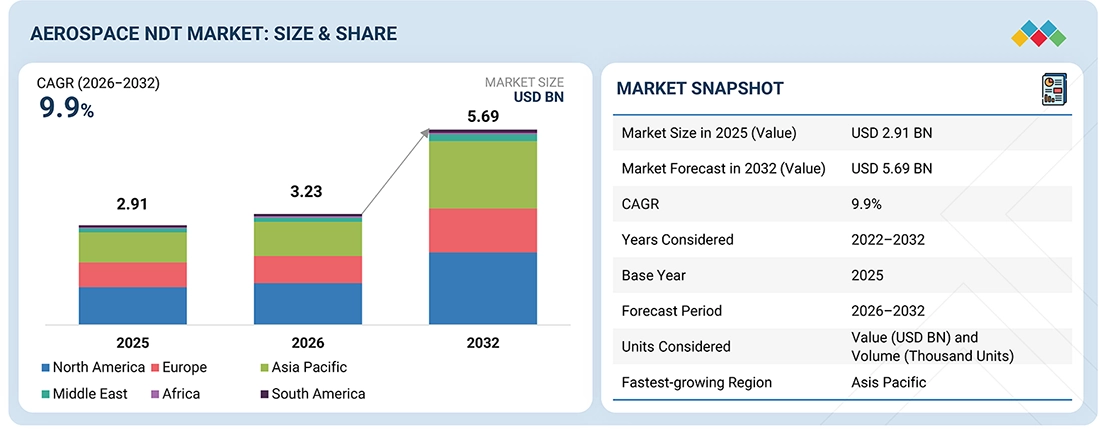
Source: Secondary Research, Interviews with Experts, MarketsandMarkets Analysis
TRENDS & DISRUPTIONS IMPACTING CUSTOMERS' CUSTOMERS
The impact on the aerospace NDT industry is shaped by the increasing emphasis on aircraft safety, regulatory compliance, and the need for efficient maintenance across expanding global fleets. Over the next 4 to 5 years, product and service portfolios are expected to evolve from conventional inspection methods toward integrated, automated, and data-driven NDT ecosystems with AI-enabled defect detection, real-time monitoring, and digital inspection reporting capabilities. Two key trends driving this transition include the growing adoption of advanced ultrasonic techniques such as phased array testing for high-precision inspection, and increasing use of robotics and drone-based NDT for accessing complex or hazardous structures. These innovations are enabling faster inspections, improved accuracy, reduced human error, and enhanced predictive maintenance strategies. The shift toward digital radiography, cloud-based data management, and inspection solutions tailored for composite materials is also improving operational efficiency, scalability, and lifecycle management across commercial aviation, defense, and MRO environments.
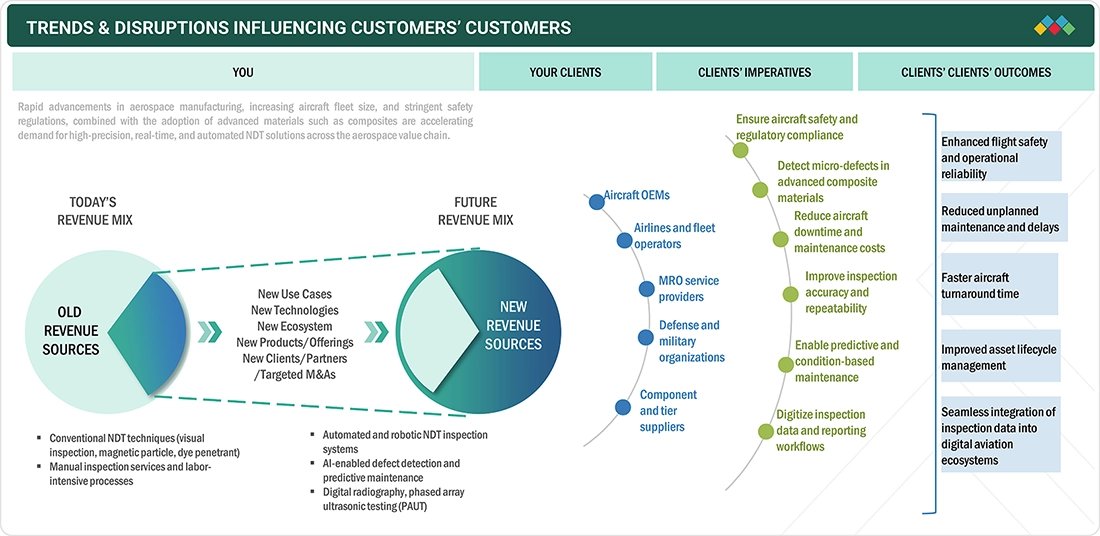
Source: Secondary Research, Interviews with Experts, MarketsandMarkets Analysis
AEROSPACE NDT MARKET DYNAMICS

Level
-
Increasing aircraft production and fleet expansion

-
Growing adoption of advanced materials and additive manufacturing


Level
-
High cost of advanced NDT equipment and implementation

-
Complexity in inspection of advanced aerospace components


Level
-
Integration of Al and automation in NDT

-
Expansion of space and defense programs


Level
-
Rapid technological advancements and need for continuous upgrades

-
Data management and integration issues

Source: Secondary Research, Interviews with Experts, MarketsandMarkets Analysis
Driver: Increasing aircraft production and fleet expansion
Rising global air passenger traffic and expanding defense budgets are driving aircraft production and fleet expansion. This increases the need for regular inspection, maintenance, and certification of aircraft components. Consequently, demand for aerospace NDT solutions grows significantly to ensure safety, structural integrity, and compliance throughout the aircraft lifecycle.
Restraint: High cost of advanced NDT equipment and implementation
Advanced NDT technologies such as phased array ultrasonic testing, digital radiography, and automated inspection systems involve high initial investment and maintenance costs. Small and mid-sized MRO providers often face budget constraints, limiting adoption. Additionally, training skilled personnel and integrating advanced systems further increase overall operational costs and implementation complexity.
Opportunity: Integration of Al and automation in NDT
The integration of artificial intelligence and automation is transforming aerospace NDT by enabling faster, more accurate defect detection and predictive maintenance. AI-driven analytics reduce human error and improve inspection efficiency, while robotics and automated systems enhance scalability. These advancements create significant growth opportunities for next-generation, data-driven NDT solutions.
Challenge: Rapid technological advancements and need for continuous upgrades
Rapid advancements in aerospace materials, manufacturing processes, and inspection technologies require continuous upgrades in NDT systems and skills. Keeping pace with evolving standards, especially for composite materials and digital inspection methods, is challenging. Companies must invest in ongoing training, certification, and technology upgrades to remain competitive and compliant.
AEROSPACE NDT MARKET: COMMERCIAL USE CASES ACROSS INDUSTRIES
| COMPANY | USE CASE DESCRIPTION | BENEFITS |
|---|---|---|
 |
Provides comprehensive aerospace NDT inspection, testing, and certification services across manufacturing and MRO operations, including ultrasonic, radiographic, and eddy current testing to ensure structural integrity and regulatory compliance | High inspection accuracy | Global certification expertise | Regulatory compliance assurance | Improved aircraft safety and reliability |
 |
Offers advanced NDT equipment and digital inspection solutions, including ultrasonic and remote visual inspection systems, widely used for aircraft component testing and maintenance applications | High-precision defect detection | Advanced imaging capabilities | Improved inspection efficiency | Reduced maintenance downtime |
 |
Delivers industrial and aerospace NDT solutions, including digital radiography, ultrasonic testing, and automated inspection technologies for critical component evaluation in aerospace manufacturing and maintenance | Enhanced defect detection accuracy | Faster inspection processes | Improved operational efficiency | Reliable performance in critical environments |
 |
Provides aerospace NDT and inspection services, including material testing, failure analysis, and certification for aircraft components and systems across global aerospace supply chains | End-to-end quality assurance | Compliance with international standards | Reduced risk of component failure | Improved product lifecycle management |
 |
Offers inspection, testing, and certification services for aerospace structures, materials, and systems, supporting OEMs and MRO providers with advanced NDT techniques and compliance verification | Strong regulatory support | Enhanced safety assurance | Global service network | Improved reliability of aerospace components |
Logos and trademarks shown above are the property of their respective owners. Their use here is for informational and illustrative purposes only.
AEROSPACE NDT MARKET ECOSYSTEM
The aerospace NDT ecosystem comprises equipment manufacturers, service providers, software and technology developers, system integrators, regulatory bodies, and end users working together to ensure aircraft safety and structural integrity. Equipment manufacturers develop NDT systems such as ultrasonic, radiographic, eddy current, and thermographic inspection tools for defect detection. Service providers deliver inspection, testing, and certification services across manufacturing and MRO operations. Software providers enable digital inspection reporting, data analytics, and predictive maintenance through AI-driven platforms. System integrators deploy automated and robotic inspection systems integrated with digital aviation infrastructure. Regulatory authorities ensure compliance with stringent airworthiness standards. End users, including aircraft OEMs, airlines, MRO providers, and defense organizations, adopt NDT solutions to enhance safety, ensure compliance, reduce downtime, and optimize lifecycle management of aerospace assets.
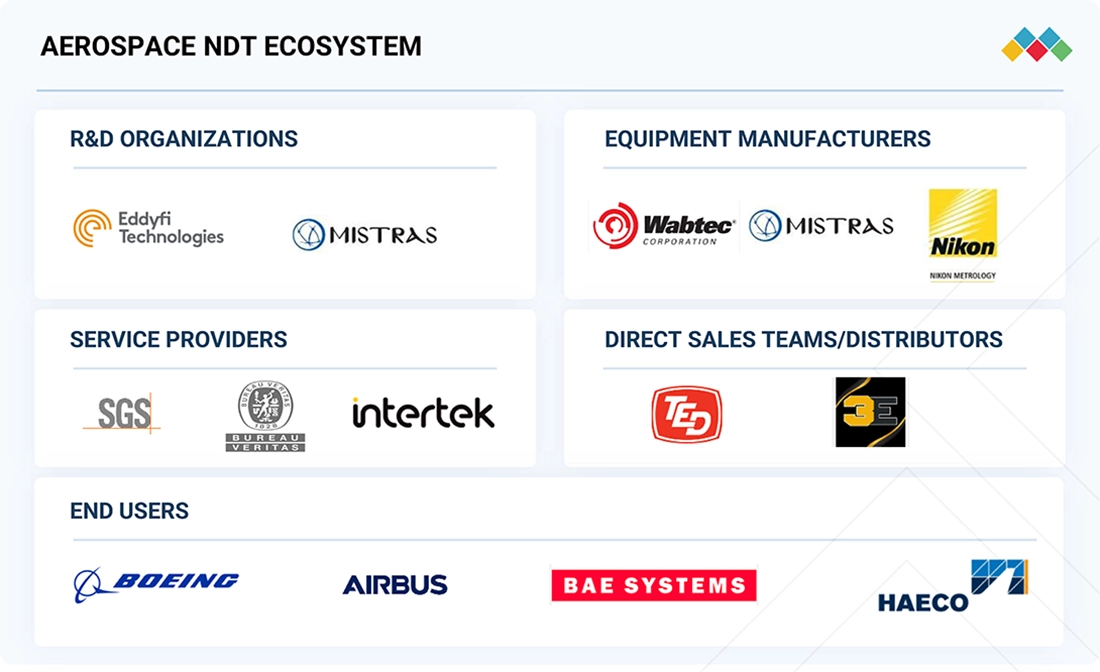
Logos and trademarks shown above are the property of their respective owners. Their use here is for informational and illustrative purposes only.
AEROSPACE NDT MARKET SEGMENTS
Source: Secondary Research, Interviews with Experts, MarketsandMarkets Analysis
Aerospace NDT Market, By Offering
Services hold the largest share of the aerospace NDT market due to the continuous and mandatory need for inspection, testing, certification, and maintenance activities across the aircraft lifecycle.
Aerospace NDT Market, By Technique
Ultrasonic testing leads the market due to high accuracy, deep penetration, ability to inspect composites, detect internal flaws, and widespread adoption in aerospace inspections.
Aerospace NDT Market, By Aircraft Type
Commercial aircraft dominate the aerospace NDT market due to large global fleets, frequent maintenance cycles, strict safety regulations, and rising passenger traffic driving continuous inspection demand.
Aerospace NDT Market, By Application
Airframe & structures dominate due to continuous exposure to stress, fatigue, corrosion, requiring frequent inspections and strict regulatory compliance across aircraft lifecycle.
Aerospace NDT Market, By Region
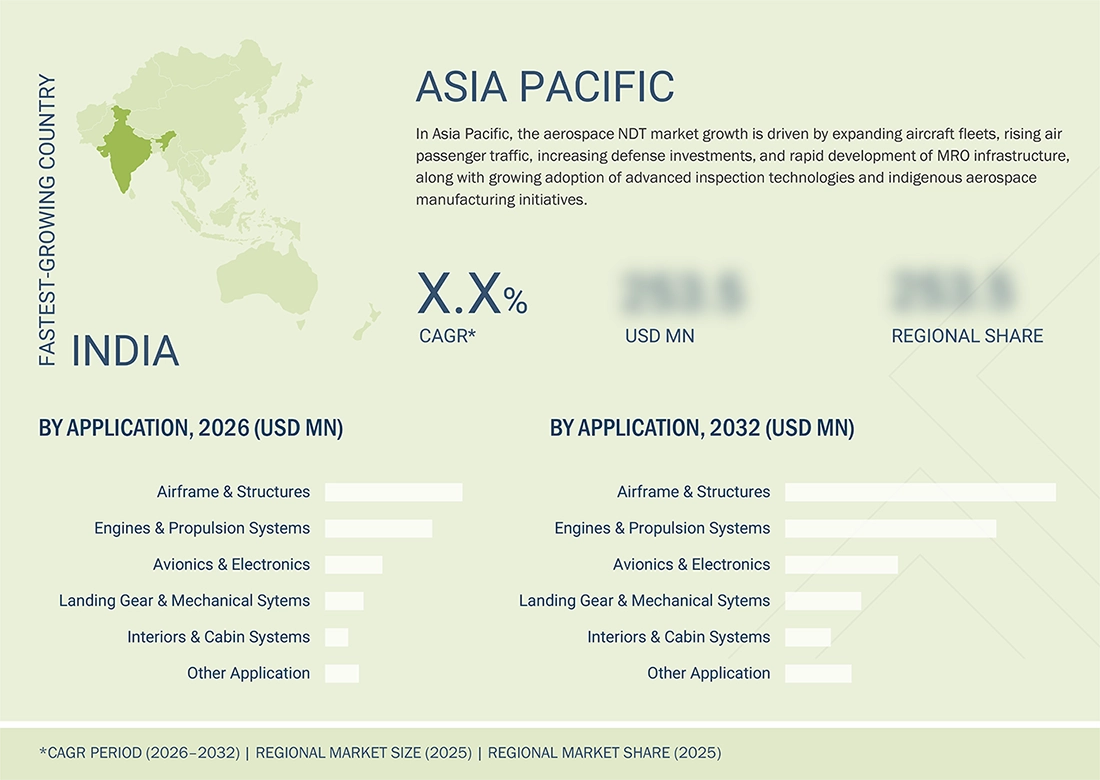
Asia Pacific is expected to witness the highest CAGR of 12.0% due to rising aircraft fleet expansion, increasing defense spending, growing MRO infrastructure, and indigenous aerospace manufacturing initiatives.
AEROSPACE NDT MARKET BY REGION
Asia Pacific to be fastest-growing market for aerospace NDT during forecast period
Asia Pacific is expected to witness the highest CAGR in the aerospace NDT market share due to expanding aircraft fleets, rising air passenger traffic, and increasing defense expenditures across the region. Growing investments in MRO infrastructure and aerospace manufacturing capabilities are accelerating demand for inspection services. Furthermore, the growing implementation of advanced NDT technologies, as well as the presence of emerging aerospace hubs, help drive market.
AEROSPACE NDT MARKET: COMPANY EVALUATION MATRIX
In the aerospace NDT companies matrix, SGS SA (Star) leads with a strong global footprint and a comprehensive portfolio of inspection, testing, and certification services across the aerospace value chain. Its advanced capabilities in ultrasonic, radiographic, and eddy current testing, combined with deep regulatory expertise and global laboratory infrastructure, strengthen its dominance across OEMs, MRO providers, and defense organizations. Continuous investments in digital inspection technologies, automation, and data-driven quality assurance further reinforce its leadership position. Applus+ (Emerging Leader) is gaining momentum through its expanding aerospace NDT service portfolio and growing presence in key aviation hubs. The company is strengthening its position with advanced inspection solutions, including automated and remote NDT techniques, supported by strategic acquisitions and partnerships. Its focus on innovation, operational efficiency, and expanding global service capabilities is driving increased adoption across aerospace manufacturing and maintenance sectors.

Source: Secondary Research, Interviews with Experts, MarketsandMarkets Analysis
KEY MARKET PLAYERS
- Baker Hughes Company (UK)
- Wabtec Corporation (US)
- SGS SA (Switzerland)
- Bureau Veritas (France)
- Element Materials Technology (UK)
- MISTRAS Group (US)
- DEKRA (Germany)
- Nikon Metrology, LLC (US)
- Intertek Group Plc (UK)
- Applus+ (Spain)
WHAT IS IN IT FOR YOU: AEROSPACE NDT MARKET REPORT CONTENT GUIDE
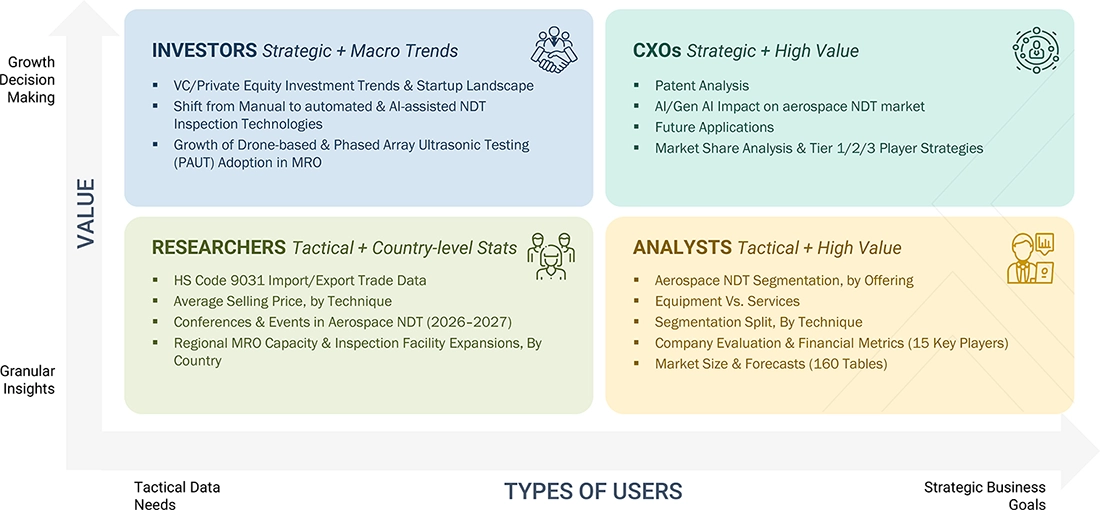
DELIVERED CUSTOMIZATIONS
We have successfully delivered the following deep-dive customizations:
| CLIENT REQUEST | CUSTOMIZATION DELIVERED | VALUE ADDS |
|---|---|---|
| NDT Equipment Manufacturer / OEM |
|
|
| MRO Service Provider / Airline Maintenance Organization |
|
|
| Regulatory Body / Aviation Authority / Standards Organization |
|
|
| Defense / Space / Industrial End Users |
|
|
RECENT DEVELOPMENTS IN AEROSPACE NDT MARKET
- June 2026: MISTRAS Group expanded its Houston, Texas, in-house laboratory with new equipment and services specifically supporting aerospace and defense manufacturing, including dedicated immersion ultrasonic inspection tanks, rotary ultrasonic inspection systems, fluorescent penetrant inspection, and 320 kV digital radiography. The expanded facility provides NDT capabilities for aerospace forgings, castings, composites, welds, additive-manufactured components, and machined products, alongside repair and rework services. The development directly expands MISTRAS’ aerospace NDT capacity and enables more inspection and manufacturing-support activities to be performed at a single facility.
- May 2026: Element Materials Technology expanded its Huntsville laboratory to increase advanced testing capabilities for aerospace, space, and defense customers. The investment added infrastructure and engineering capabilities covering environmental, dynamics, EMI/EMC, vibration, shock, thermal, vacuum and acoustic testing, enabling customers to conduct broader qualification programs at a single facility. While the expansion is directly focused on aerospace testing, the announcement does not identify the new capabilities specifically as NDT; therefore, I would not count this as a strict Aerospace NDT match under your exact-keyword rule.
- April 2026: Baker Hughes Company, through its Waygate Technologies business, announced the deployment of new automated Menu Directed Inspection (MDI) templates for GE Aerospace’s GEnx-1B and GEnx-2B engine borescope inspections. The templates standardize inspection procedures for critical engine components and combine visual guidance with data-management capabilities to improve inspection consistency and efficiency. Because Waygate Technologies identifies these aviation inspection solutions as NDT applications, the development directly relates to aerospace NDT and advances automated inspection of aircraft engines.
- January 2026: SGS SA introduced a digital inspection platform integrating NDT inspection data, analytics and reporting for aerospace components, according to the April 2026 MarketsandMarkets aerospace NDT market update. The platform is designed to improve traceability of inspection results and support aerospace manufacturers and MRO providers in managing inspection information across aircraft structures and propulsion systems. This is a direct Aerospace NDT development because the platform specifically integrates NDT data with aerospace-component inspection workflows.
- January 2026 : Wabtec Corporation launched the OmniScan X4 phased array ultrasonic testing platform that enhances aerospace inspection through improved signal processing, automated scanning capabilities, and advanced defect characterization.
Table of Contents
 Exclusive indicates content/data unique to MarketsandMarkets and not available with any competitors.
Methodology
The research study involved four major activities in estimating the aerospace NDT market size. Exhaustive secondary research has been done to collect important information about the market and peer markets. The next step has been to validate these findings and assumptions and size them with the help of primary research with industry experts across the value chain. Both top-down and bottom-up approaches have been used to estimate the market size. The market breakdown and data triangulation have been adopted to estimate the market sizes of segments and sub-segments.
Secondary Research
In the secondary research process, various secondary sources were referred to identify and collect information required for this study. The secondary sources include annual reports, press releases, investor presentations of companies, white papers, and articles from recognized authors. Secondary research has been mainly done to obtain key information about the market’s value chain, the pool of key market players, market segmentation according to industry trends, regional outlook, and developments from both market and technology perspectives.
Primary Research
In primary research, various sources from both the supply and demand sides have been interviewed to obtain the qualitative and quantitative insights required for this report. Primary sources from the supply side include experts such as CEOs, vice presidents, marketing directors, technology and innovation directors, and related executives from multiple key companies and organizations operating in the aerospace NDT ecosystem. After interacting with industry experts, brief sessions have been conducted with highly experienced independent consultants to reinforce the findings from our primary research. This, along with the in-house subject-matter experts’ opinions, has led us to the findings as described in the report. The breakdown of primary respondents is as follows:
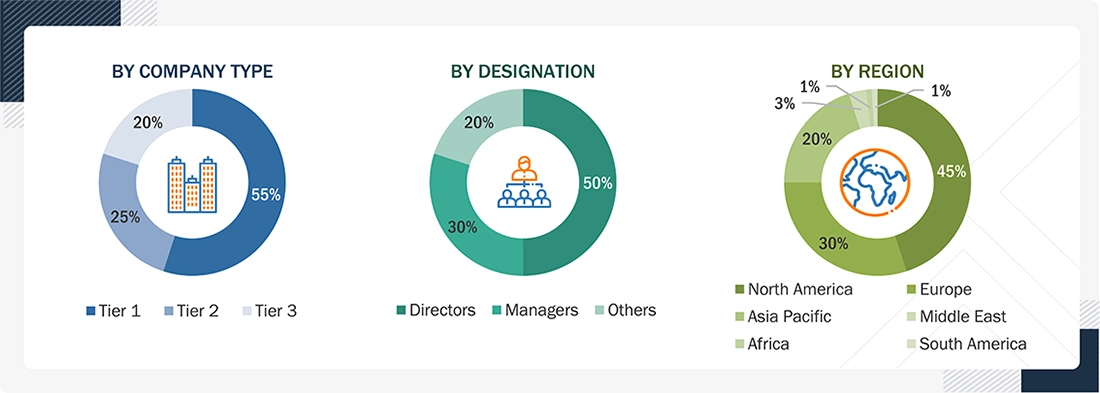
Note: Other designations include sales, marketing, and product managers.
To know about the assumptions considered for the study, download the pdf brochure
Market Size Estimation
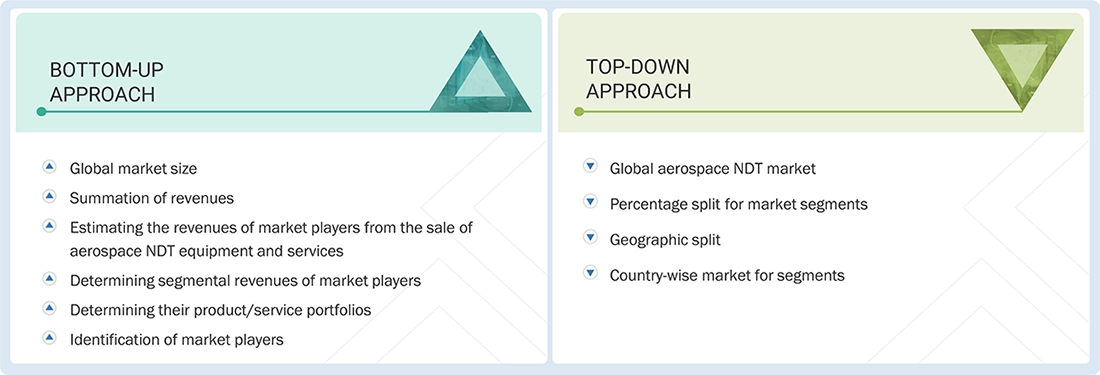
In the market engineering process, both top-down and bottom-up approaches and data triangulation methods have been used to estimate and validate the size of the aerospace NDT market and other dependent submarkets. The research methodology used to estimate the market sizes includes the following:
The bottom-up procedure has been employed to arrive at the overall size of the aerospace NDT market.
- Major companies that provide NDT equipment and services for the aerospace industry have been identified. This included analyzing company product and service offerings and presence across various regions.
- The segment-specific revenues of the companies, particularly those related to aerospace NDT equipment and services, have been determined.
- The product-specific and service-specific revenues of the companies, particularly those related to aerospace NDT, have been determined.
- These individual revenue figures have been compiled to determine the total revenue generated across the identified companies within the sector.
- The global size for the aerospace NDT market has been obtained using this consolidated data.
The top-down approach has been used to estimate and validate the total size of the aerospace NDT market.
- Identified top-line investments and spending in the ecosystem and major market developments to consider segment-level splits
- Estimated the overall aerospace NDT market size, then segmented the global market by allocating shares based on the segments considered
- Distributed segment-level markets into regions and countries by aligning regional aerospace NDT activity with economic indicators, presence of market players, and national development initiatives
Aerospace NDT Market : Top-Down and Bottom-Up Approach
Data Triangulation
After determining the overall market size through the previously explained estimation processes, we have divided the market into several segments and subsegments. Data triangulation and market breakdown procedures have been employed to complete the entire market engineering process and arrive at the exact statistics of each market segment and subsegment. The data has been triangulated by studying various factors and trends from the demand and supply sides of the aerospace NDT market.
Market Definition
The aerospace non-destructive testing (NDT) comprises equipment and integrated solutions used to inspect, evaluate, and ensure the structural integrity of aircraft, spacecraft, and their components without causing damage, as well as related services such as inspection services and calibration services. These solutions help find problems such as cracks, rust, gaps, and uneven materials early, making sure everything is safe, reliable, and meets strict aviation rules. Aerospace NDT techniques include ultrasonic testing (UT), radiographic testing (RT), eddy current testing (ECT), magnetic particle testing (MPT), liquid penetrant testing (LPT), visual testing (VT), and advanced methods such as phased array ultrasonic testing (PAUT), computed tomography (CT), and acoustic emission testing (AET). The ecosystem consists of NDT equipment (e.g., ultrasonic flaw detectors, X-ray/CT systems, eddy current instruments, and videoscopes), inspection services, and supporting infrastructure required for both in-factory and in-service inspections.
Key Stakeholders
- NDT Equipment Manufacturers
- NDT Component and Sensor Suppliers
- Inspection Service Providers
- Aerospace OEMs
- Aerospace Component Manufacturers
- Maintenance, Repair, and Overhaul (MRO) Service Providers
- NDT Technology and Solution Providers
- Defense and Military Organizations
- Space Agencies and Commercial Space Companies
- Regulatory and Certification Authorities
- Distributors and Resellers
Report Objectives
- To define, describe, segment, and forecast the aerospace NDT market size by offering, technique, aircraft type, application, and region, in terms of value
- To evaluate the aerospace NDT market size in four key regions: North America, Europe, Asia Pacific, and Middle East, Africa, South America, in terms of value
- To forecast the market for aerospace NDT, by technique, in terms of volume
- To provide detailed information regarding the key factors such as drivers, restraints, opportunities, and challenges influencing the growth of the market
- To analyze the aerospace NDT value chain and ecosystem, along with the average selling price for the technique and region segments
- To strategically study the regulatory landscape, tariffs, standards, patents, Porter’s five forces, import and export scenarios, trade values, and case studies pertaining to the market under study
- To understand micromarkets with regard to individual growth trends, prospects, and contributions to the overall market
- To offer the impact of AI/Gen AI on the aerospace NDT market
- To outline the macroeconomic outlook for the regions under study
- To analyze strategies such as product launches, collaborations, acquisitions, and partnerships adopted by players in the aerospace NDT market
- To profile key market players and comprehensively analyze their ranking based on their revenue, market share, and core competencies
Available customizations:
With the given market data, MarketsandMarkets offers customizations according to the specific requirements of companies. The following customization options are available for the report:
Country-wise Information:
- Country-wise breakdown for North America, Europe, Asia Pacific, the Middle East, Africa, and South America
Company Information:
- Detailed analysis and profiling of additional market players (up to five)
Key Questions Addressed by the Report
What is the current size of the Aerospace NDT Market?
The global Aerospace NDT Market is estimated at around USD 3.23 billion in 2026.
What is the projected market size of the Aerospace NDT Market by 2032?
The market is projected to reach approximately USD 5.69 billion by 2032.
What CAGR is expected for the Aerospace NDT Market during the forecast period?
The Aerospace NDT Market is expected to grow at a CAGR of 9.9% from 2026 to 2032.
What are the major trends shaping the Aerospace NDT Market?
Key trends include AI-enabled inspection, automated NDT systems, digital radiography, ultrasonic testing advancements, robotics, and integration of data analytics for predictive maintenance.
What is a major growth driver for the Aerospace NDT Market?
A key growth driver is increasing aircraft production and fleet expansion, which increases demand for inspection, maintenance, certification, and safety compliance across aircraft lifecycles.
Which companies are leading the Aerospace NDT Market?
Major players include SGS SA, Wabtec Corporation, Baker Hughes, Intertek Group, Bureau Veritas, Element Materials Technology, MISTRAS Group, DEKRA, Nikon Metrology, and Applus+.
Which industry segment is driving demand for Aerospace NDT solutions?
The commercial aviation sector drives significant demand due to expanding aircraft fleets, increasing passenger traffic, frequent maintenance cycles, and strict safety regulations.
Which NDT technique holds a major share in the Aerospace NDT Market?
Ultrasonic Testing (UT) holds a leading position due to its accuracy, deep inspection capability, and widespread use for detecting internal defects in aircraft structures and composites.
Which region is expected to witness the fastest growth in the Aerospace NDT Market?
Asia Pacific is expected to register the highest growth rate, supported by aircraft fleet expansion, defense investments, aerospace manufacturing, and MRO infrastructure development.
What does the Aerospace NDT Market report analysis indicate about the future?
The report indicates strong growth driven by rising aircraft manufacturing, aging fleets requiring inspections, increasing MRO activities, adoption of advanced materials, and demand for safer and more reliable aircraft operations.


Personalize This Research
- Triangulate with your Own Data
- Get Data as per your Format and Definition
- Gain a Deeper Dive on a Specific Application, Geography, Customer or Competitor
- Any level of Personalization
Let Us Help You
- What are the Known and Unknown Adjacencies Impacting the Aerospace NDT Market
- What will your New Revenue Sources be?
- Who will be your Top Customer; what will make them switch?
- Defend your Market Share or Win Competitors
- Get a Scorecard for Target Partners

Custom Market Research Services
We Will Customise The Research For You, In Case The Report Listed Above Does Not Meet With Your Requirements
Get 10% Free CustomisationTESTIMONIALS

Tetsuya Ohhira
Business Development Manager-Technology Business
Nikon Corporation,
Leading Japanese MNC specializing in optics and imaging productswww.nikon.com
MarketsandMarkets™ response
is quick. Their attitude is flexible and positive. Analyst Insights are globally considered and
significant. Client Services quickly respond to our inquiry and demand. Their wide range of global
surveys help us make our strategic plan.
We hope Knowledge Store will be easier to search
for a report.
VP - Marketing & Business Development
Leading Provider of Process Control Solutions
We engaged with MarketsandMarkets on a study to perform an analysis and recommend a Go-To-Market strategy for metrology and process control in the semiconductor market. The study was tailored to our targets and needs with well-defined milestones. Our overall experience with the MarketsandMarkets team was very good throughout the project in all aspects including the analysis methodologies used, the quality and depth of primary and secondary data sets, the professionalism and flexibility of the team and the ability to meet the target schedule and milestones. We want to thank MarketsandMarkets team for a job well done.
- Rest Of South America Aerospace NDT Market
- US Aerospace NDT Market
- Canada Aerospace NDT Market
- Mexico Aerospace NDT Market
- Germany Aerospace NDT Market
- UK Aerospace NDT Market
- France Aerospace NDT Market
- Spain Aerospace NDT Market
- Italy Aerospace NDT Market
- Netherlands Aerospace NDT Market
- Belgium Aerospace NDT Market
- Nordics Aerospace NDT Market
- Rest Of Europe Aerospace NDT Market
- Bahrain Aerospace NDT Market
- Kuwait Aerospace NDT Market
- Oman Aerospace NDT Market
- Qatar Aerospace NDT Market
- Rest Of Middle East Aerospace NDT Market
- Saudi Arabia Aerospace NDT Market
- UAE Aerospace NDT Market
- Rest Of Africa Aerospace NDT Market
- South Africa Aerospace NDT Market
- Argentina Aerospace NDT Market
- Brazil Aerospace NDT Market
Growth opportunities and latent adjacency in Aerospace NDT Market






Hugh
Apr, 2026
Which NDT techniques—ultrasonic, radiographic, or eddy current—are actually seeing the highest adoption and revenue growth today.
Bruce
Apr, 2026
How much of a competitive advantage do companies gain by integrating advanced technologies like drones, digital twins, and data analytics into NDT workflows.