Al in Clinical Workflow Market Size, Growth, Share & Trends Analysis

Al in Clinical Workflow Market by Offering (CDS, Documentation, Imaging, Analytics), Technology (NLP, ML, Computer Vision), Speciality (Radio, Cardio, Onco), Function (Diagnostics, POC), End User (Hospital, ASC, Imaging Center) - Global Forecasts to 2030




OVERVIEW
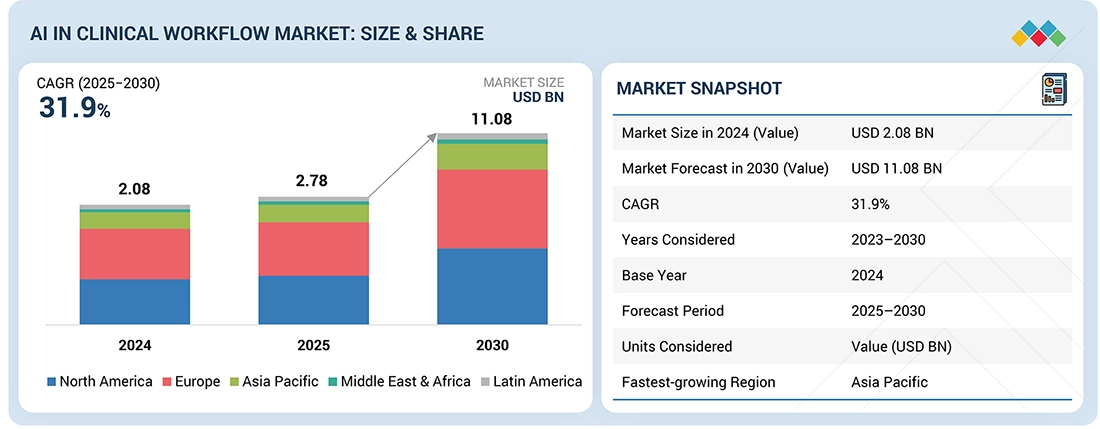
Source: Secondary Research, Interviews with Experts, MarketsandMarkets Analysis
The AI in clinical workflow market, valued at US$2.08 billion in 2024, stood at US$2.78 billion in 2025 and is projected to advance at a resilient CAGR of 31.9% from 2025 to 2030, culminating in a forecasted valuation of US$11.08 billion by the end of the period. The AI in clinical workflow market is driven by the rising adoption of digital healthcare and AI in the healthcare sector, the need to enhance the efficiency of clinical operations and lessen the burden of burnout among clinicians, and the rising adoption of AI for documentation, decision support, and imaging-related workflows. In addition, the rising adoption of generative and predictive AI, the increasing availability of healthcare data, the growing investments in modernizing healthcare information technologies, and the accelerated adoption of AI across healthcare institutions and telehealth delivery channels are fueling the market growth.
KEY TAKEAWAYS
-
By RegionThe North America AI in clinical workflow market accounted for the largest share of 39.8% of the market in 2024.
-
By OfferingBy offering, the software segment is expected to register the highest CAGR of 32.8%.
-
By TechnologyBy technology, the Natural Language Processing (NLP) segment is projected to grow at the fastest rate from 2025 to 2030, at a CAGR of 33.2%.
-
By SpecialtyBy specialty, the general/multi-specialty segment is expected to dominate the market.
-
By FunctionBy function, the in-visit clinical recording & information capture segment will grow the fastest during the forecast period.
-
By Integration TypeBy integration type, the integration platforms segment is expected to register fastest growth, growing at the highest CAGR.
-
By End UserBy end user, the inpatient facilities segment is expected to dominate the market, accounting for the largest share.
-
Competitive LandscapeEpic Systems Corporation, Microsoft Corporation, and Oracle were identified as some of the star players in the AI in clinical workflow market (global), given their strong market share and product footprint.
-
Competitive LandscapeSully AI and Lyrebird Health Inc., among others, have distinguished themselves among startups and SMEs by securing strong footholds in specialized niche areas, underscoring their potential as emerging market leaders.
The AI in clinical workflow market is growing at a rapid rate, with an increasing demand for optimizing efficiency in healthcare. New advancements in fields such as ML, NLP, and multimodal analytics are opening doors to perform tasks such as clinical document automation, real-time clinical decision support, clinical imaging workflows, and predictions related to clinical operational management. The development of partnership frameworks among such entities as health tech and healthcare institutions, expansion in investment scales within large and EHR-based AI systems, fields such as ambient intelligence, AI agents, and cloud-native tech, among innovations in the overall healthcare industry, are reshaping entities in the marketplace for clinical workflow management.
TRENDS & DISRUPTIONS IMPACTING CUSTOMERS' CUSTOMERS
The AI in clinical workflow market is emerging as more and more organizations such as hospitals, Inpatient facilities, and ambulatory organizations are looking at the potential offered by AI-enabled workflow solutions. With growing demands for the need to have faster, more accurate, and more reliable clinical decisions enabled by the capabilities of Generative AI Documentation, Predictive Analytics, Multimodal Data Intelligence, Workflow Automation, and Imaging Workflow AI, the manner in which clinical organizations are managing documentation, patient stratification, clinical coordination, and clinical resource allocation is being fundamentally changed. This, in turn, has created significant demand for the next generation EHR-integrated AI workflow solution.
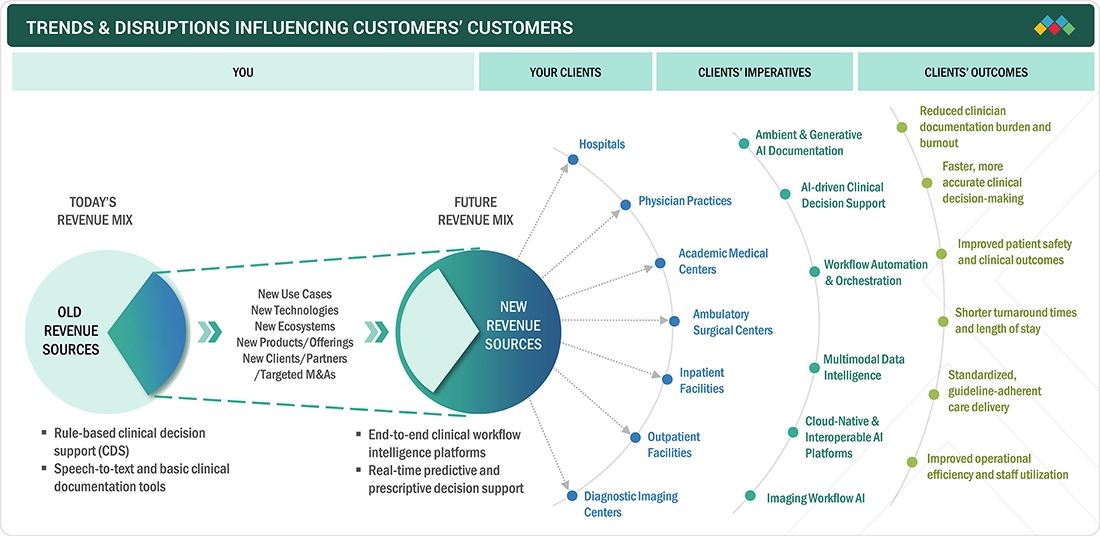
Source: Secondary Research, Interviews with Experts, MarketsandMarkets Analysis
MARKET DYNAMICS

Level
-
Growing clinician workload and documentation burden

-
Rising focus on improved care throughput and patient flow efficiency


Level
-
Regulatory and clinical validation requirements limiting rapid scale-up

-
Integration and customization challenges across complex care environments


Level
-
Expansion of AI-powered clinical documentation and ambient intelligence solutions

-
Growing adoption of AI-driven triage, escalation, and early-warning systems


Level
-
Low clinician acceptance due to usability issues

-
Operational challenges related to AI, governance, data drift, and security

Source: Secondary Research, Interviews with Experts, MarketsandMarkets Analysis
Driver: Growing clinician workload and documentation burden
Certain primary factors projected to fuel the adoption of AI in the clinical workflow market are the clinical workload increase, with a subsequent increase in the documentation burden of the latter. For example, rising patient volumes, staff shortages, and increased documentation requirements related to regulations and insurance have substantially contributed to a clinical workload increase, ultimately leading to burnout and reducing the time dedicated to patient care. The use of AI technology in this case, incorporating ambient documentation, automatically creating documentation entries, and optimally managing clinical workflow automation, will minimize human labor while increasing efficiency, and substantially fuel the adoption rate of AI technology in clinical workflow management.
Restraint: Regulatory and clinical validation requirements limiting rapid scale-up
Validation for regulatory and clinical practices acts as a major deterrent in the adoption of AI in clinical workflows. This is because the use of any form of AI that can impact a clinical outcome is expected to undergo rigorous testing for efficacy and safety. This acts as an impediment to the adoption of AI in the market.
Opportunity: Expansion of AI-powered clinical documentation and ambient intelligence solutions
Growing physician workload and documentation pressure are the major factors fueling the adoption of AI in the clinical workflow market. Rising patient volumes, physician shortages, and increasing regulatory pressures have impacted the amount of physician time for patient interaction, thereby leading to physician burnout. AI-assisted clinical workflow management solutions, such as ambient documentation systems and automatic clinical summarization, are reducing documentation pressure, thereby driving market growth.
Challenge: Low clinician acceptance due to usability issues
The lack of acceptance from clinicians due to usability problems remains a significant challenge for AI in the clinical workflow market. Often, the AI-powered clinical workflow management systems require the clinician to learn and work according to a different user interface, clinical workflow, or method of documentation. This can hinder the already optimized clinical workflows that a healthcare institution follows. To add to the fact that the clinician has limited time, the lack of adequate user training will contribute to a lack of acceptance of AI systems.
AL IN CLINICAL WORKFLOW MARKET: COMMERCIAL USE CASES ACROSS INDUSTRIES
| COMPANY | USE CASE DESCRIPTION | BENEFITS |
|---|---|---|
 |
Generative and ambient AI for clinical documentation, patient summarization, and workflow automation embedded within EHRs and care platforms | Reduces clinician documentation burden| Improves care efficiency| Enables real-time clinical insights at the point of care |
 |
Embedded AI for predictive risk scoring, clinical decision support, patient flow management, and automated documentation within the Epic HER | Enhances care standardization| Improves patient safety and increases clinician productivity through native workflow integration |
 |
AI-driven analytics, population health management, and workflow optimization across clinical and financial systems | Enables data-driven clinical decisions| Improves operational efficiency| Supports value-based care initiatives. |
 |
AI-enabled imaging, patient monitoring, and enterprise workflow orchestration across acute and ambulatory care | Improves diagnostic confidence| Accelerates clinical workflows| Enhances continuity of care |
 |
AI for imaging workflow automation, intelligent worklist prioritization, and clinical decision support | Reduces turnaround times| Optimizes imaging throughput, and improves diagnostic accuracy |
Logos and trademarks shown above are the property of their respective owners. Their use here is for informational and illustrative purposes only.
MARKET ECOSYSTEM
The AI in clinical workflow market ecosystem comprises major health information technology players, AI-born start-ups, regulatory organizations, and healthcare organizations that collaborate to increase the adoption of AI in clinical workflows. Major players (Microsoft Corporation, Epic Systems, Oracle, Philips, and Siemens Healthineers) provide integrated solutions with EHR systems in areas such as documentation, decision support, imaging, and coordination. There are startups (Lyrebird Health, Sully.ai, and SPRY Therapeutics) that are primarily focused on capabilities in areas such as ambient documentation, conversation AI, and workflow automation. Regulation-oriented organizations (FDA, EMA, NHS, and NMPA) are focused on ensuring that safety standards and privacy and regulations are met, and top healthcare organizations (Mayo Clinic & Cleveland Clinic) are working towards embedding AI in their clinical workflows to decrease documentation time, make better decisions, and increase outcomes.
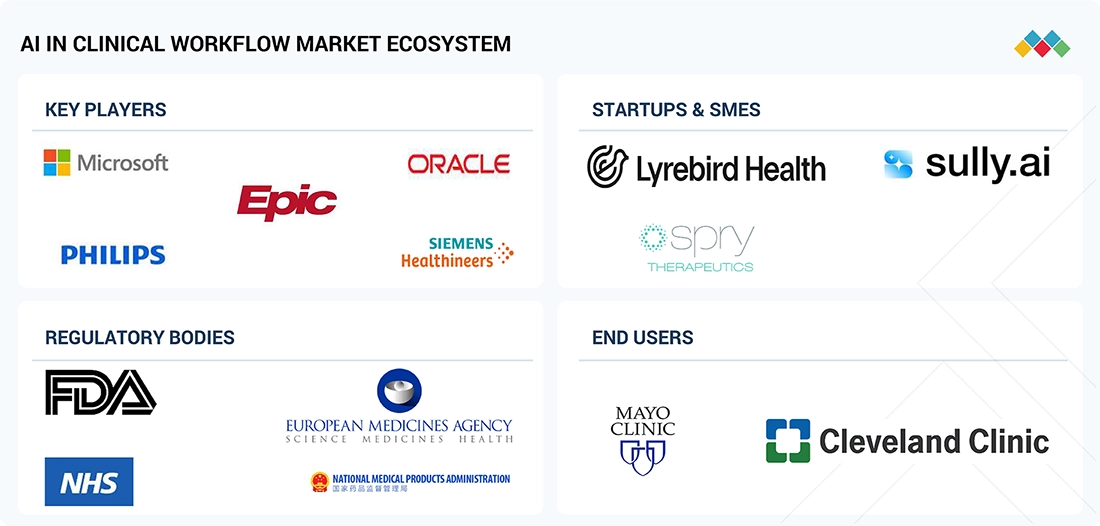
Logos and trademarks shown above are the property of their respective owners. Their use here is for informational and illustrative purposes only.
MARKET SEGMENTS
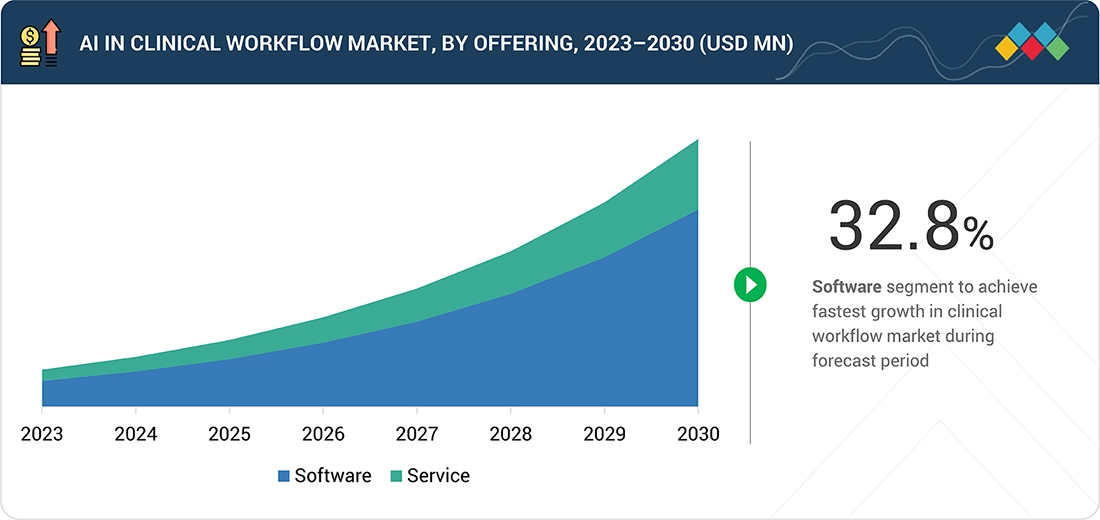
Source: Secondary Research, Interviews with Experts, MarketsandMarkets Analysis
AI in clinical workflow Market, By Offering
The software segment held the largest share by offering in the AI in clinical workflow market in 2024. The major market share in this segment can be primarily attributed to the widespread adoption of AI-based software solutions used in automating clinical documentation, clinical diagnosis, appointment management, and coordination of care. The major preference of AI-based software platforms in the healthcare industry can be attributed to their scalability and ease of deployment in existing health information technology infrastructure.
AI in clinical workflow Market , By Technology
The machine learning and deep learning segment held the largest share by technology in the AI in clinical workflow market in 2024. This dominance is due to the development and use of sophisticated algorithms capable of handling large sets of structured and unstructured clinical information such as images, electronic healthcare records, and patient diagnoses. AI-powered machine learning algorithms have shown improvements in accuracy, simplifications in decision-making processes, and the ability to support real-time decision-making for clinical insights.
AI in clinical workflow Market, By Specialty
The general/multi-specialty segment had the highest share by specialty in the market of AI in clinical workflow in 2024. The vast adoption rate in this sector can be attributed to the versatility that these solutions provide to their services in various medical sections in a hospital and integrated health delivery systems. General and multi-specialty practitioners adopt technology to optimize end-to-end processes, which span from patient admission to diagnosis and final discharge.
AI in clinical workflow Market, By Function
Diagnostics & Results Interpretation accounted for the largest market share in the market by function for AI in Clinical Workflow. The reason for this can be attributed to the increased complexity that has arisen from the data created through imaging, lab results, and reports. The technology for AI-assisted diagnostic platforms has enabled increased accuracy and reduced interpretation time, making it an essential requirement for the high-throughput environment of a hospital or diagnostic center.
AI in clinical workflow Market, By Integration Type
The segment of integrated platforms held the largest share by integration type in the AI in clinical workflow market in 2024. The major portion of this market is driven by healthcare providers seeking collaborative and end-to-end solutions that integrate AI capabilities with today’s healthcare IT solutions, including EHRs, PACS, and Hospital Information Systems.
AI in clinical workflow Market, By End User
The inpatient facilities sector represented the largest market share by end user in the AI for clinical workflow market in 2024. This is because hospitals experience a large flow of patients and have strict government regulations. To overcome these challenges, inpatient facilities have started to adopt AI-enabled workflow solutions to optimize diagnostic efficiency and patient outcomes. As a result, inpatient healthcare settings have a significantly higher adoption rate compared to outpatient facilities.
REGION
Asia Pacific to be fastest-growing region in global AI in clinical workflow market during forecast period
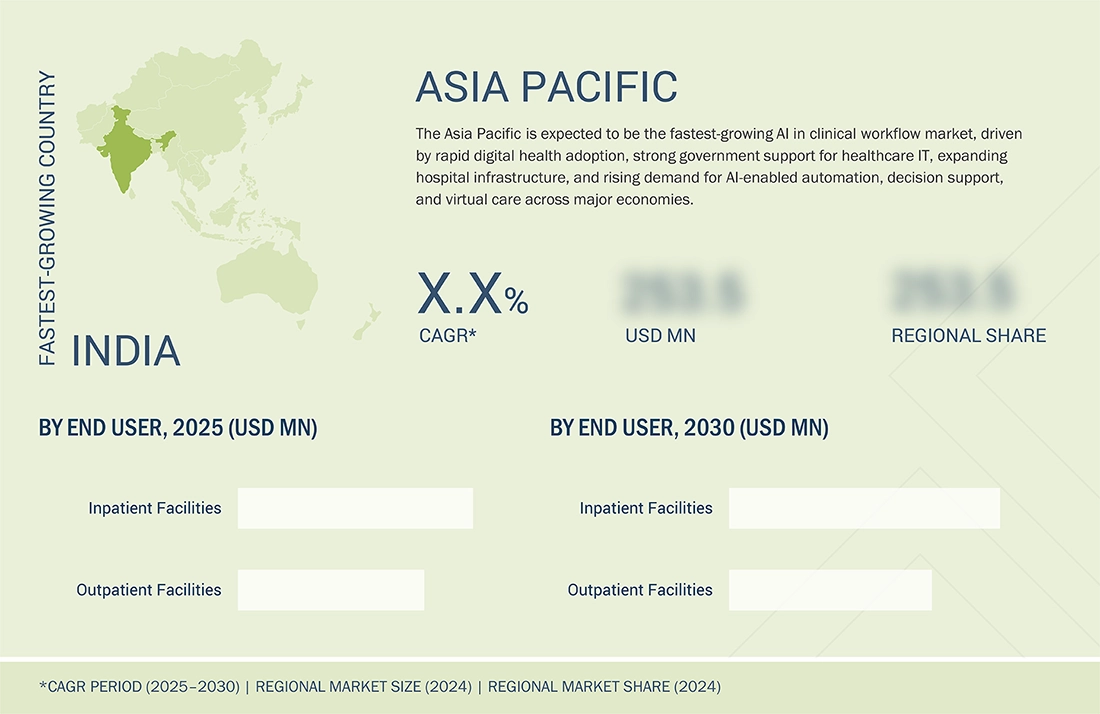
The Asia Pacific market for AI in clinical workflow is poised to grow at the fastest rate during the forecast period. Factors such as the adoption of digital transformation strategies in the healthcare industry, the use of AI in EHR systems, and governments' initiatives to develop smart hospitals are encouraging the adoption of AI in clinical workflow management in this region. Several Asian countries, including China, India, Japan, South Korea, and Singapore, have also started to adopt AI in clinical workflows such as documentation, decision support, imaging, and care coordination.
AL IN CLINICAL WORKFLOW MARKET: COMPANY EVALUATION MATRIX
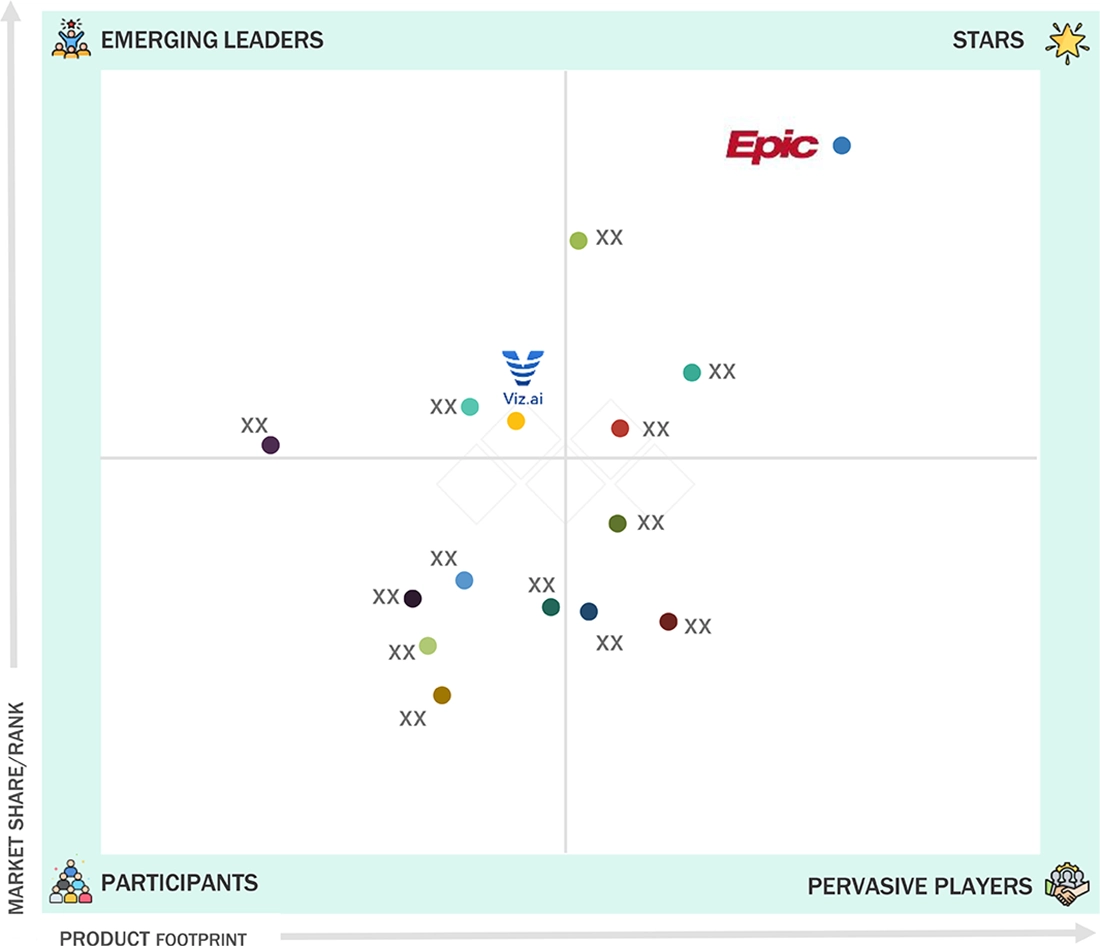
In the AI in clinical workflow market matrix, Epic Systems Corporation (Star) is given its dominant market position with a broad, enterprise-wide AI workflow portfolio embedded within its EHR platform. This supports clinical documentation, diagnostics, care coordination, and operational workflows across large hospital networks. Viz.ai (Emerging Leader) in its AI-driven diagnostic and care coordination solutions, especially in time-sensitive specialties like stroke and cardiology, where decision-making and workflow acceleration need to be much faster. While Epic maintains its leading position through scale, deep integration, and a large installed base in both inpatient and multi-specialty facilities, Viz.ai is gaining ground in the leaders' quadrant with increased demand for real-time, specialty-focused AI workflow solutions across healthcare systems.
Source: Secondary Research, Interviews with Experts, MarketsandMarkets Analysis
KEY MARKET PLAYERS
- Microsoft (US)
- Epic Systems Corporation (US)
- Oracle (US)
- Koninklijke Philips N.V. (Netherlands)
- Siemens Healthineers AG (Germany)
- Health Catalyst, Inc. (US)
- NextGen Healthcare (US)
- Abridge AI, Inc. (US)
- GE Healthcare (US)
- Optum, Inc. (US)
- Veradigm LLC (US)
- Augmedix, Inc. (US)
- Viz.ai, Inc. (US)
- Aidoc Medical Ltd. (Israel)
- Qure.ai Technologies Pvt. Ltd. (India)
- Concord Technologies, Inc. (US)
- PathAI, Inc. (US)
- Baxter International Inc. (Hillrom) (US)
- Cisco Systems, Inc. (US)
- athenahealth, Inc. (US)
MARKET SCOPE
| REPORT METRIC | DETAILS |
|---|---|
| Market Size in 2024 (Value) | USD 2.08 BN |
| Market Forecast in 2030 (Value) | USD 11.08 BN |
| Growth Rate | 31.9% |
| Years Considered | 2023–2030 |
| Base Year | 2024 |
| Forecast Period | 2025–2030 |
| Units Considered | Value (USD BN) |
| Report Coverage | Revenue forecast, company ranking, competitive landscape, growth factors, and trends |
| Segments Covered |
|
| Regions Covered | North America, Asia Pacific, Europe, Latin America, Middle East & Africa |
| Parent & Related Segment Reports |
Artificial Intelligence (AI) in Healthcare Market US Artificial Intelligence (AI) in Healthcare Market Europe AI in Healthcare Market AI Agents in Healthcare Market AI in Hospital Operations Market Stroke AI Market |
WHAT IS IN IT FOR YOU: AL IN CLINICAL WORKFLOW MARKET REPORT CONTENT GUIDE
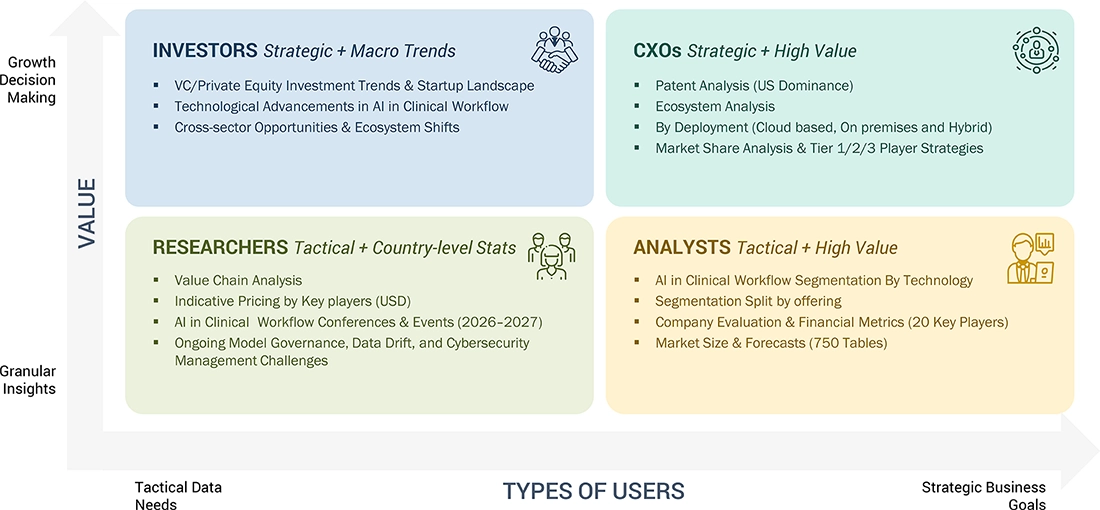
DELIVERED CUSTOMIZATIONS
We have successfully delivered the following deep-dive customizations:
| CLIENT REQUEST | CUSTOMIZATION DELIVERED | VALUE ADDS |
|---|---|---|
| Competitive Landscape Mapping | Profiles and comparative analysis of leading AI clinical workflow vendors across care settings-inpatient, outpatient, emergency, and ambulatory-and workflow functions-clinical documentation, CDS, imaging workflows, care coordination, revenue cycle, population health. The report includes benchmarking of AI capabilities such as NLP, LLMs, predictive analytics, and computer vision; interoperability with EHRs; deployment models such as cloud/on-prem; scalability; and depth of automation. Cover product portfolios, partnerships that include EHR, cloud and device vendors, and MA activity. |
|
| Market Entry & Growth Strategy |
|
|
| Regulatory, Data Privacy & Operational Risk Analysis |
|
Strengthens regulatory and compliance readiness for AI-enabled clinical solutions. Enhances trust, adoption, and procurement confidence among providers and payers. Supports risk mitigation strategies for real-world AI deployment, scaling, and long-term sustainability. |
RECENT DEVELOPMENTS
- October 2025 : Microsoft (US) extended its leading AI clinical assistant, Dragon Copilot, to specifically support nursing workflows with the first commercially available ambient AI solution for this purpose. This enables nurses to streamline documentation from patient interactions, surface relevant clinical information, and automate routine tasks, such as creating flow sheet documentation, all within their normal workflow.
- March 2025 : Microsoft Corp. has launched Microsoft Dragon Copilot, the world’s first AI assistant built for clinical workflows, which brings together the trusted voice dictation and ambient AI capabilities of Dragon Medical One (DMO) with the ambient listening capabilities of DAX Copilot, as well as generative AI and healthcare-specific guardrails. Dragon Copilot combines the natural language voice dictating technology found in Dragon Medical One with the ambient listening capabilities of DAX Copilot, allowing clinicians to ease their workflow by automating routine tasks and assisting in the sharing of relevant and important information in the case, all from within the workflow. Microsoft Cloud for Healthcare’s Dragon Copilot is expected to help improve the overall well-being and efficiency of the clinicians.
- October 2024 : GE HealthCare (US) announced the launch of its Artificial Intelligence Innovation Lab, featuring five innovative projects that utilize AI to integrate artificial intelligence throughout the continuum of care. This encompasses initiatives including Health Companion, an agentive AI concept intended for the provision of multi-disciplinary clinical knowledge in the palm of a clinician's hands, initiatives to optimize the early prediction of recurrence of triple negative breast cancer using the power of deep learning, and the use of artificial intelligence to reduce manual searches and summarizations.
Table of Contents
 Exclusive indicates content/data unique to MarketsandMarkets and not available with any competitors.
Methodology
This study involved the extensive use of both primary and secondary sources. The research process involved the study of various factors affecting the industry to identify the segmentation types, industry trends, key players, competitive landscape, key market dynamics, and key player strategies.
Secondary Research
Secondary research process involves the widespread use of secondary sources, directories, databases (such as Bloomberg Business, Factiva, and D&B Hoovers), white papers, annual reports, companies house documents, investor presentations, and SEC filings of companies. Secondary research was used to identify and collect information useful for the extensive, technical, market-oriented, and commercial study of the Al in Clinical Workflow Market. It was also used to obtain important information about the key players and market classification & segmentation according to industry trends to the bottom-most level, and key developments related to market and technology perspectives. A database of the key industry leaders was also prepared using secondary research.
Primary Research
In the primary research process, various sources from both the supply and demand sides were interviewed to obtain qualitative and quantitative information for this report. The primary sources from the supply side include industry experts such as CEOs, vice presidents, marketing and sales directors, technology & innovation directors, and related key executives from various key companies and organizations operating in the global Al in Clinical Workflow Market. The primary sources from the demand side included industry experts, such as doctors, nurses, and purchase managers in hospitals.
Primary research was conducted to validate the market segmentation, identify key players in the market, and gather insights on key industry trends & key market dynamics.
Market Size Estimation
The market size estimates and forecasts provided in this study are derived through a mix of the bottom-up approach (segmental analysis of major segments) and top-down approach (assessment of utilization/adoption/penetration trends, by type, end user, and region).
Data Triangulation
After arriving at the market size, the total Al in Clinical Workflow Market was divided into several segments and subsegments. To complete the overall market engineering process and arrive at the exact statistics for all segments & subsegments, data triangulation, and market breakdown procedures were employed, wherever applicable.
Objectives of the Study
- To define, describe, segment, and forecast the Al in Clinical Workflow Market by products, end user, and region
- To provide detailed information about the factors influencing market growth (drivers, restraints, opportunities, and industry-specific challenges)
- To analyze micromarkets1 with respect to individual growth trends, prospects, and contributions to the overall market
- To analyze market opportunities for stakeholders and provide details of the competitive landscape for key players
- To forecast the size of the Al in Clinical Workflow Market in five main regions North America, Europe, Asia Pacific, Latin America, and the Middle East & Africa (along with major countries)
- To profile key players in the Al in Clinical Workflow Market and comprehensively analyze their core competencies2 and market shares
- To track and analyze competitive developments such as acquisitions, product launches, expansions, collaborations, partnerships, agreements, and R&D activities of the leading players in the Al in Clinical Workflow Market
Available Customizations
With the given market data, MarketsandMarkets offers customizations as per the company’s specific needs. The following customization options are available for the report:
Company Information
- Detailed analysis and profiling of additional market players
Geographic Analysis
- Further breakdown of the Rest of Asia Pacific Al in Clinical Workflow Market into South Korea, Australia, New Zealand, and other countries
- Further breakdown of the Latin American Al in Clinical Workflow Market into Brazil, Mexico, and other countries


Personalize This Research
- Triangulate with your Own Data
- Get Data as per your Format and Definition
- Gain a Deeper Dive on a Specific Application, Geography, Customer or Competitor
- Any level of Personalization
Let Us Help You
- What are the Known and Unknown Adjacencies Impacting the Al in Clinical Workflow Market
- What will your New Revenue Sources be?
- Who will be your Top Customer; what will make them switch?
- Defend your Market Share or Win Competitors
- Get a Scorecard for Target Partners

Custom Market Research Services
We Will Customise The Research For You, In Case The Report Listed Above Does Not Meet With Your Requirements
Get 10% Free CustomisationTESTIMONIALS

JAYANT RAJPUROHIT
Director of Market Insights, Data and Analytics
SFI Health,
Leading Pharmaceutical Companywww.sfihealth.com/

We at SFI Health approached MarketsandMarkets for an Opportunity Assessment on "Incidence and Prevalence of Focus Indications" as we wanted to know the most attractive HCPs like Physician, Functional MD, Naturopath and Pharmacist. The project was critical for us to ensure our focus on the right target which would enable sustainable growth and profitability for SFI Health. The business insights provided exceeded our expectations and we were extremely impressed. The team at MarketsandMarkets is highly professional and detail oriented and very well understood our business needs. MarketsandMarkets offers a unique combination of expertise and dedicated engagement model. We identified 2 new products to be launched in coming months, based on the research findings provided by MarketsandMarkets. We are happy with the services and would strongly recommend MarketsandMarkets to my peers in the industry.

BEATRIZ DE LA CALLE
Head of Commercial Analytics
Qualicaps,
Leading Pharmaceutical Companywww.qualicaps.com/

We partnered with MarketsandMarkets for an assessment study on hard empty capsules. The team was extremely professional in understanding our business requirements and we received timely responses to all our queries. The market intelligence and the recommendations has met our business requirements. We were extremely impressed to see the final study results; it really exceeded our expectations. The market intelligence offered by MarketsandMarkets, and clarity on next steps will help us achieve our business objective for the Year 2021. We are happy with the services and would strongly recommend MarketsandMarkets to my peers in the industry.

Bob Williams,
Senior Director Business Development & Innovation
Bracco Diagnostics Inc.,
Italian Multinational in life sciences sector and a World Leader in imaging diagnosticsimaging.bracco.com/us-en
We were pleased with targeted insights that MarketsandMarkets identified from a custom study on the 'Radiation Dose Management Solutions Market'. Your team identified and characterized the market participants as well as underlying trends accurately. This study was useful to Bracco in formulating business strategies for our dose monitoring product lines and we thank MarketsandMarkets for the job well done.
Cody Coonradt,
Market Development and Strategy Manager
3M Health Information Systems,
Leader in Health care Coding, Payment & Analytics Solutions.www.3m.com/3M/en_US/health-information-systems-us
The value for our organization comes from three things: depth of research, specificity of segments and being easy to work with. As important as the first two are, the third can't be underestimated. MarketsandMarkets, maybe more than any other research vendor, wants to know what is top of mind for our team and what big questions we are grappling to answer.
Their customer first approach and high value engagement model, have given us great analysis and excellent value for money






Growth opportunities and latent adjacency in Al in Clinical Workflow Market