AI in Hospital Operations Market Size, Growth, Share & Trends Analysis

AI in Hospital Operations Market by Offering (Dashboard, Workflow, Interoperability), Use Case (Patient Flow, RCM, Staff Management, Patient Engagement), Technology (ML, NLP), End User (Hospital, ASC, Imaging Center), & Region - Global Forecasts to 2030




OVERVIEW
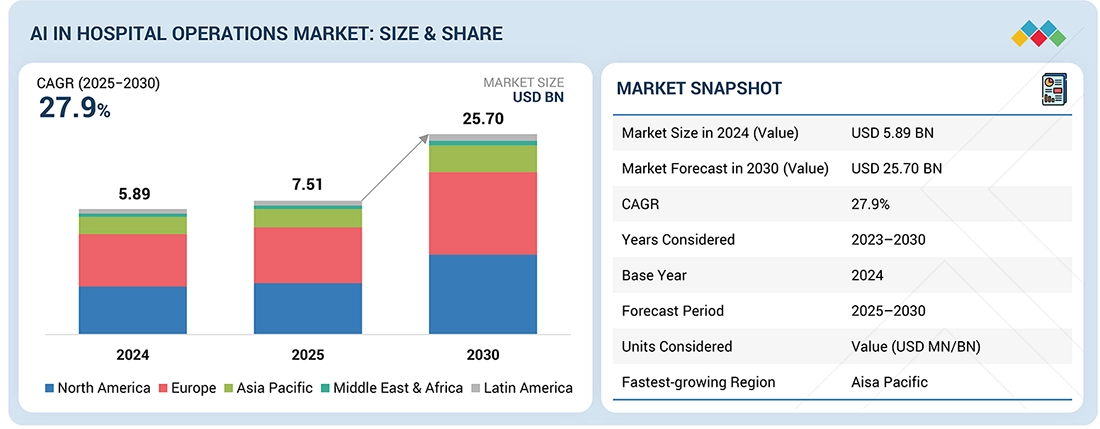
Source: Secondary Research, Interviews with Experts, MarketsandMarkets Analysis
The AI in hospital operations market is projected to reach USD 25.70 billion by 2030 from USD 7.51 billion in 2025, at a CAGR of 27.9% from 2025 to 2030. The growth of the AI in hospital operations market is driven by increasing workforce shortages, rising administrative burden, and the need to improve operational efficiency while maintaining quality of care.
KEY TAKEAWAYS
-
By RegionThe North America AI in hospital operations market accounted for a 38.2% revenue share in 2024.
-
By OfferingBy offering, the software segment is expected to register the highest CAGR of 28.8%.
-
By Use CaseBy use case, the patient engagement & front-office operations segment is projected to grow at the fastest rate from 2025 to 2030.
-
By Integration TypeBy integration type, the integrated solutions segment is expected to dominate the market.
-
By TechnologyBy technology, the natural language processing (NLP) segment will grow the fastest during the forecast period.
-
By End UserBy end user, the outpatient facilities segment is expected to dominate the market, growing at the highest CAGR of 28.2%.
-
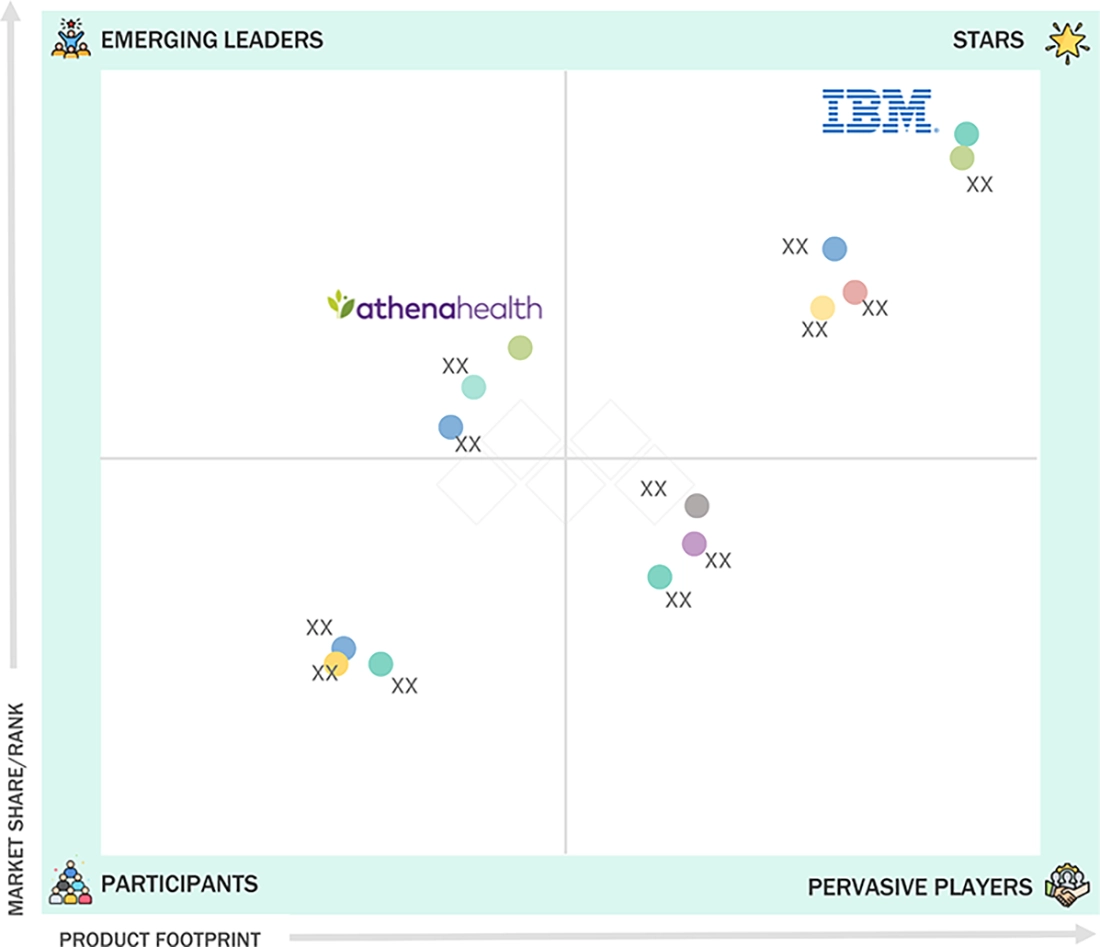
Competitive LandscapeIBM, Microsoft, and Siemens Healthineers AG were identified as some of the star players in the AI in hospital operations market (global), given their strong market share and product footprint.
-
Competitive LandscapeArtisight, Deskfactors Inc. (Murphi.AI), and Sully AI, among others, have distinguished themselves among startups and SMEs by securing strong footholds in specialized niche areas, underscoring their potential as emerging market leaders.
The AI in hospital operations market is noticing immense adoption, with increasing emphasis on improving efficiency, mitigating staffing shortages, and addressing administrative complexities in healthcare settings. Healthcare facilities are increasingly turning to AI to manage patient flow, staffing, revenue cycles, and real-time analytics. New business models emerging, including partnerships between health delivery entities and AI solution provider companies, integrations within cloud platforms, and advances in predictive analytics and generative technologies, are completely disrupting this space.
TRENDS & DISRUPTIONS IMPACTING CUSTOMERS' CUSTOMERS
Factors such as evolving care delivery models, workforce constraints, and system-wide inefficiencies are driving the impact on end users in the AI in hospital operations market. Segments include hospitals, outpatient facilities, and ambulatory care centers, as well as healthcare service organizations. Areas of focus would also cover operational efficiency, patient flow management, and cost control. The moves toward AI-driven automation, real-time operational monitoring, and value-based care models, against the backdrop of an increased number of regulatory and reporting requirements, have a direct bearing on the performance, margins, and patient experience of hospitals. These pressures, in turn, accelerate demand for sophisticated AI-enabled hospital operations platforms and services that shape the growth path of the market.
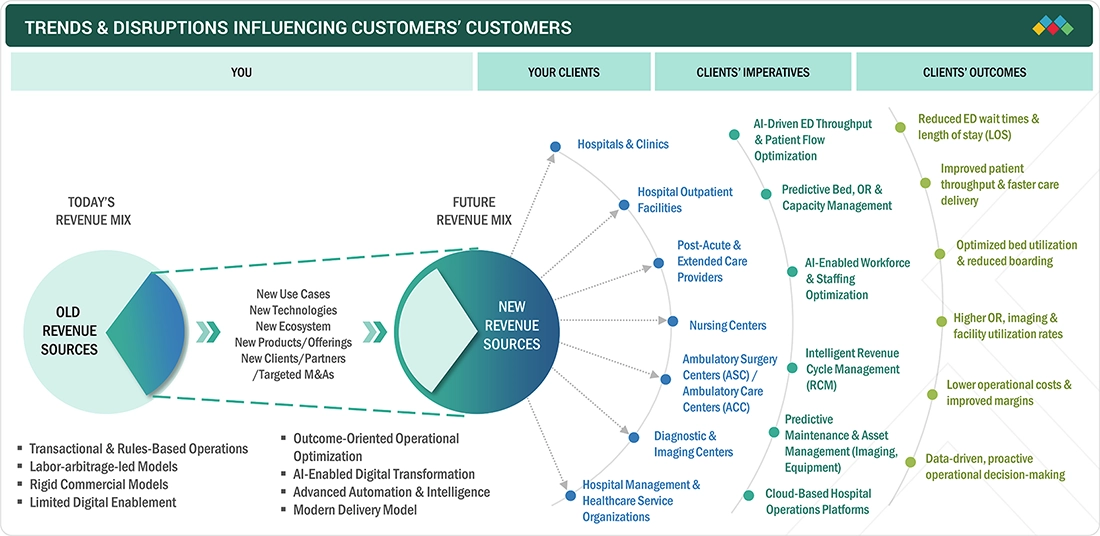
Source: Secondary Research, Interviews with Experts, MarketsandMarkets Analysis
MARKET DYNAMICS

Level
-
Growing workforce shortages and administrative burden

-
Demonstrated operational and financial returns


Level
-
Data privacy, security, and regulatory compliance concerns

-
Fragmented data environments and interoperability challenge


Level
-
Expansion of AI-driven revenue cycle optimization

-
Scalable patient flow and capacity management across hospital networks


Level
-
Scaling solutions beyond pilot implementations

-
Ongoing data governance and model maintenance requirements

Source: Secondary Research, Interviews with Experts, MarketsandMarkets Analysis
Driver: Growing workforce shortages and administrative burden
Increasing manpower shortages and administrative burden are major driving factors for the market of AI in hospital operations, as hospitals are finding it increasingly tough to hire and retain both medical and non-medical staff, while the burden of administration also keeps increasing. Activities such as planning, record-keeping, billing, and coordination utilize considerable manpower, leading to exhaustion. Manifold automation through AI technology, predictive resource planning, as well as intelligent resource management, assists in less manual handling, optimizing resource utilization, so as to leave healthcare professionals to devote their time to patient care, thus increasing adoption for AI in hospital operations.
Restraint: Data privacy, security, and regulatory compliance concerns
Data privacy, security, and regulatory requirements are a major hindering factor in the market for AI in hospital operations, as hospitals cope with large amounts of confidential patient and operating-related data. The stringent norms regarding the protection of data, security, and healthcare-related compliance add to the complexity and associated cost of implementation of AI solutions, especially if it is a cloud-based solution. Issues regarding the protection of intellectual property and healthcare regulation could be a reason for delay in decision-making and large-scale adoption of AI in hospital operations.
Opportunity: Expansion of AI-driven revenue cycle optimization
The opportunity in revenue cycle optimization using AI is immense in the marketplace of AI in hospital operations, since healthcare institutions are striving to improve their revenues and minimize their revenue cycle losses due to the rising costs of operations in general. The analytics and automation tools based on AI have immense possibilities in optimizing the coding, claims, denials, and payment prediction to enable faster payments in order to achieve maximum revenue cycle performance in healthcare delivery mechanisms due to the transition to value-based care.
Challenge: Scaling solutions beyond pilot implementations
Scalability of the solution from pilot project stages to full implementation in the AI in hospital operations market also presents a challenge, given the fact that many organizations lack the capacity to implement from pilot stages to full implementation. This is especially the case when it comes to the integration of the solution with existing systems, along with other challenges. Also, the demonstration of the return on investment in the solution presents a challenge.
AI IN HOSPITAL OPERATIONS MARKET: COMMERCIAL USE CASES ACROSS INDUSTRIES
| COMPANY | USE CASE DESCRIPTION | BENEFITS |
|---|---|---|
 |
AI-driven predictive analytics to optimize ED throughput, bed capacity, and staffing levels across hospitals. | Reduced patient length of stay, improved resource utilization, and data-driven operational decision-making. |
 |
Cloud-based AI platforms enabling real-time hospital operations dashboards, workflow automation, and interoperability. | Improved operational visibility, reduced administrative burden, and scalable hospital operations. |
 |
AI-enabled optimization of diagnostic and imaging workflows, including scheduling, utilization, and turnaround times. | Higher equipment utilization, faster diagnostics, and improved clinical and operational efficiency. |
 |
AI-powered hospital command centers for enterprise-wide patient flow and capacity management. | Reduced overcrowding, smoother patient flow, and improved patient experience. |
 |
AI-enhanced EHR and analytics platforms to optimize admissions, discharge planning, and revenue cycle operations. | Improved hospital throughput, faster reimbursements, and unified clinical–administrative workflows. |
Logos and trademarks shown above are the property of their respective owners. Their use here is for informational and illustrative purposes only.
MARKET ECOSYSTEM
The overall market ecosystem for AI in the management of hospitals comprises the providers of AI technologies/cloud infrastructure, the integrators/healthcare IT service providers, and the end users (hospitals, ambulatory care, and organizations providing health services). End users focus on enhancing efficiency, reducing costs, and improving patient satisfaction. Providers develop a scalable solution that is hospital information system/EHR-agnostic. Such collaboration across the value chain becomes essential for Innovative, compliant, and sustainable growth in the market.
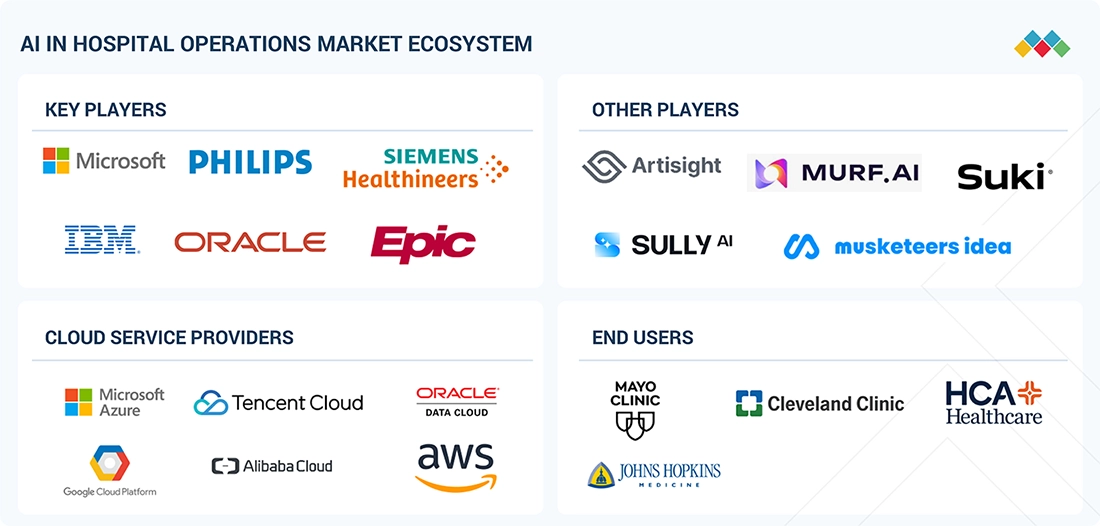
Logos and trademarks shown above are the property of their respective owners. Their use here is for informational and illustrative purposes only.
MARKET SEGMENTS
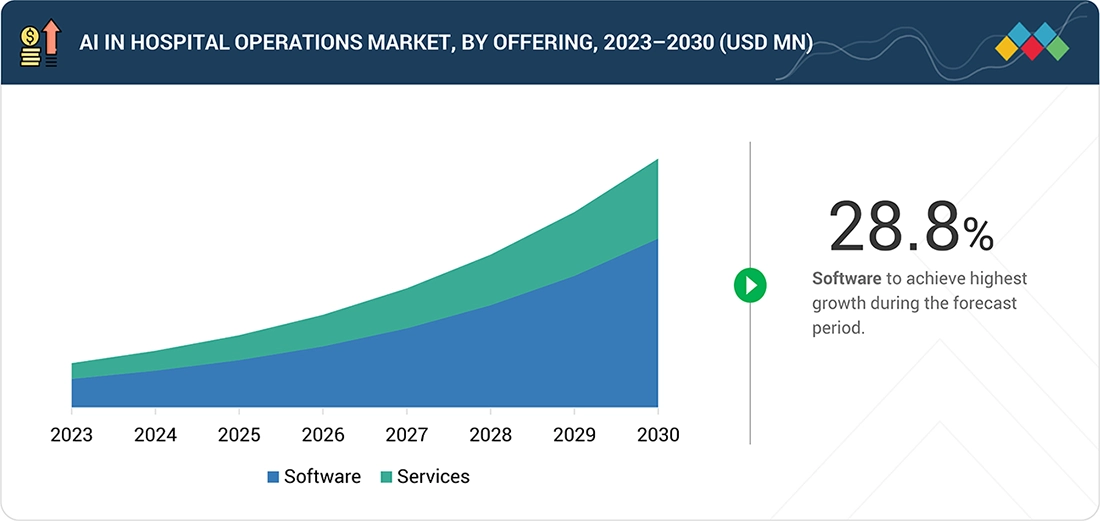
Source: Secondary Research, Interviews with Experts, MarketsandMarkets Analysis
AI in Hospital Operations Market, By Offering
As of 2024, software accounted for the largest share of the global market for AI in hospital operations and is set to retain the dominant position through 2025. The growing adoption of AI software platforms in various hospital operations, such as patient flow management, bed management, workforce management, revenue cycle management, and predictive operational intelligence, is driving the adoption of AI in hospital operations. Currently, hospitals are focused on improved efficiency, optimization of costs, and performance optimization. Therefore, the basic product offering that supports smart hospital operations using AI is AI software. The adoption of AI in hospital operations is driven by the increased adoption of electronic health records systems in hospitals. Therefore, this basic product offering supports smart hospital operations using AI.
AI in Hospital Operations Market, By Use Case
In 2024, revenue cycle & admin automation emerged as the primary use of AI in hospital operations because of the challenges of rising hospital costs, better cash flow, & administrative efficiency. AI applications in revenue cycle & admin in hospitals help in patient registration, benefits verification, medical coding, claim submission, claim denial, & billing optimization because they result in faster payments & shorter revenue cycles. Machine learning & natural language processing applications of AI in hospital operations are required to improve accuracy, ensure compliance, & facilitate challenging interactions with payers because of rising hospital costs & manpower shortages.
AI in Hospital Operations Market, By Integration Type
The integrated solutions segment is expected to remain dominant in the global AI-enabled hospital operations market, driven by the growing adoption of end-to-end solutions that can smoothly integrate AI functionality with existing healthcare and administrative processes in hospitals. Integrated solutions for AI are integrated with EHRs, hospital information systems, revenue cycle solutions, and workforce management solutions, making it possible to have smooth and integrated data flow and decision-making in real time and automated workflows across various departments. The ability to remove data silos and shift away from point solutions has made integrated solutions prove to be most efficient and help healthcare organizations optimize and quickly realize benefits from AI solutions.
AI in Hospital Operations Market, By Technology
As of 2024, the largest market share of the AI in hospital operations market was led by the machine learning and deep learning technologies, which will continue to have the largest share until the end of 2025. Machine learning and deep learning have the capability of handling large structured and unstructured data types from the healthcare industry and identifying actionable insights. Machine learning and deep learning models can keep adapting to the healthcare data types, helping them improve and attain a high level of optimization. Because of the efficiency, scalability, and interoperability that these technologies provide to the healthcare systems, they will continue to have the largest market share for AI hospital operations.
AI in Hospital Operations Market, By End User
The inpatient facilities segment is expected to have the largest market for AI in hospital operations, as inpatient facilities are connected with complex care, which requires continuous observation and operational decision-making. Inpatient facilities have AI-based systems fully embedded in them for managing inpatient beds, ICUs, labor, and discharge, as inpatient facilities are more associated with high operational expenditure compared to other types, such as an outpatient facility, which can have operational decision-making performed by AI in order to cut down on operational expenditure associated with inpatient facilities. AI in hospital operations assists in automating specific inpatient facility operational tasks, which involve data analysis tasks associated with discharge, thereby making inpatient facilities the largest segment for AI in hospital operations.
REGION
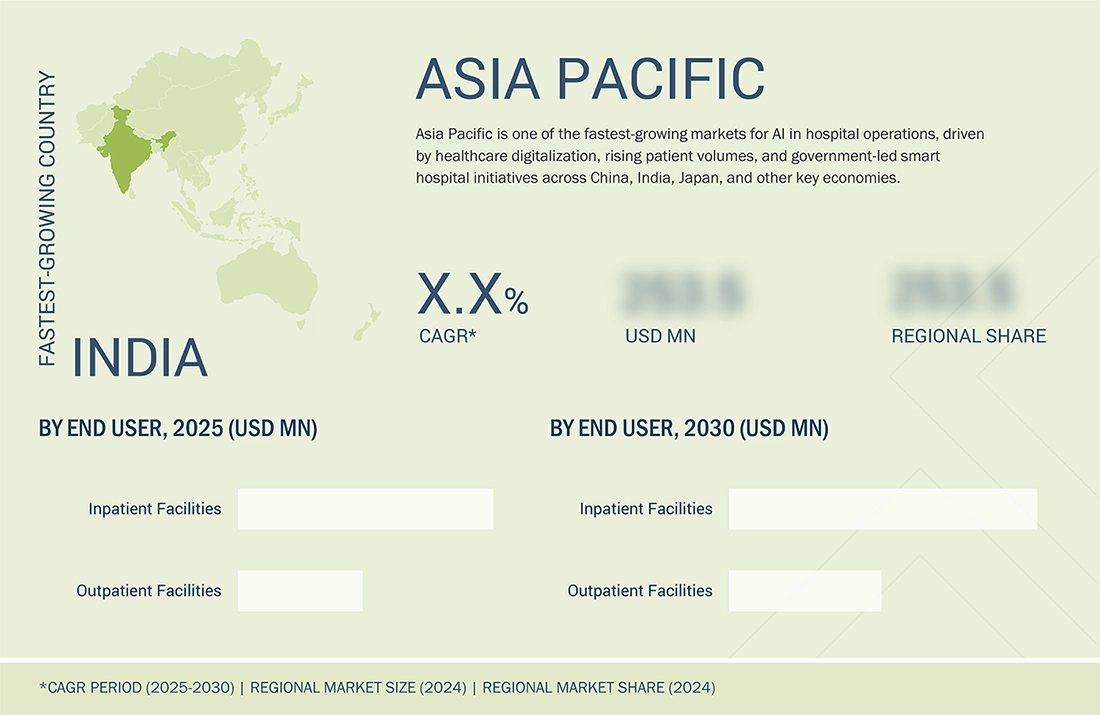
Aisa Pacific to be fastest-growing region in global AI in hospital operations market during forecast period
The Asia Pacific is expected to register the fastest growth rate during the forecast period. Digital transformation, rising patient base, and the need to enhance efficiency and quality of hospital operations are factors contributing to the high growth of the market in the Asia Pacific. China, India, Japan, Korea, and Australia are embracing the use of AI in hospitals for patient flow management, workforce management, revenue cycle management, and predictive analytics. Digital healthcare initiatives by governments, the use of electronic health records, and investment in improving the healthcare infrastructure of a country are also surging the use of AI in hospitals.
AI IN HOSPITAL OPERATIONS MARKET: COMPANY EVALUATION MATRIX
The market matrix of the AI in the hospital operations industry has IBM (Star) leading the market with a strong market share primarily due to the company’s robust AI platforms, deep analytics capabilities, as well as their successful implementations in large hospital operations. AthenaHealth (Emerging Leader) is slowly making inroads in the market with the company’s cloud-native platforms that are AI-driven in nature and are designed as administration as well as revenue cycle management platforms, particularly for the needs of the hospital as well as the ambulatory care setting. Although IBM has a strong lead in the market with the company’s scale, technology capabilities, as well as comprehensive enterprises in the market, athenahealth has a strong potential to shift towards the “Leader” market position.
Source: Secondary Research, Interviews with Experts, MarketsandMarkets Analysis
KEY MARKET PLAYERS
- IBM (US)
- Microsoft (US)
- Siemens Healthineers AG (Germany)
- Koninklijke Philips N.V.(Netherland)
- Oracle (US)
- Epic Systems (US)
- Veradigm LLC (US)
- SAS Institute Inc. (US)
- Qventus (US)
- Optum Inc. (Unitedhealth Group) (US)
- Cisco Systems, Inc. (US)
- Athena Health (US)
- Concord Technologies (US)
- Health Catalyst (US)
- LeanTaaS (US)
- Notable (US)
- Viz.AI (US)
- Aidoc (Israel)
- Augmedix (US)
- Avaamo (US)
MARKET SCOPE
| REPORT METRIC | DETAILS |
|---|---|
| Market Size in 2024 (Value) | USD 7.51 Billion |
| Market Forecast in 2030 (Value) | USD 25.70 Billion |
| Growth Rate | CAGR of 27.9% from 2025-2030 |
| Years Considered | 2023-2030 |
| Base Year | 2024 |
| Forecast Period | 2025-2030 |
| Units Considered | Value (USD Million/Billion) |
| Report Coverage | Revenue forecast, company ranking, competitive landscape, growth factors, and trends |
| Segments Covered |
|
| Regions Covered | North America, Asia Pacific, Europe, South America, Middle East & Africa |
| Parent & Related Segment Reports |
Artificial Intelligence (AI) in Healthcare Market US Artificial Intelligence (AI) in Healthcare Market Europe AI in Healthcare Market AI in Clinical Workflow Market AI Agents in Healthcare Market Stroke AI Market |
WHAT IS IN IT FOR YOU: AI IN HOSPITAL OPERATIONS MARKET REPORT CONTENT GUIDE
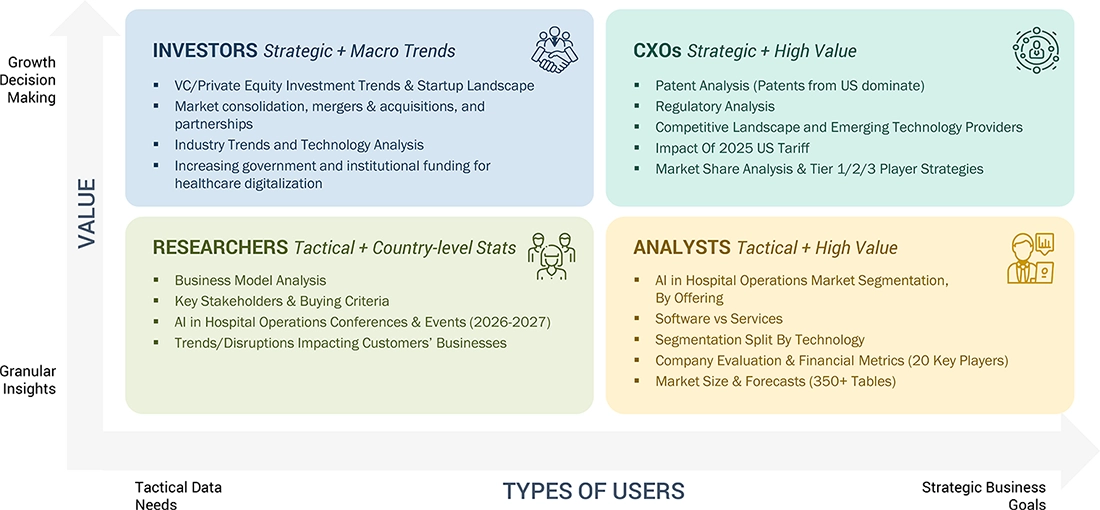
DELIVERED CUSTOMIZATIONS
We have successfully delivered the following deep-dive customizations:
| CLIENT REQUEST | CUSTOMIZATION DELIVERED | VALUE ADDS |
|---|---|---|
| Large Multi-Specialty Hospital Network |
|
|
| Academic Medical Center / Teaching Hospital |
|
|
| AI Software Vendor (Hospital Ops Focused) |
|
|
| Healthcare IT / Digital Health Platform Provider |
|
|
RECENT DEVELOPMENTS
- November 2025 : GE HealthCare partnered with The Queen’s Health Systems in Honolulu and Duke Health in Durham to improve health care operating systems in hospitals with the use of artificial intelligence.
- November 2025 : Tampa General Hospital teamed up with Hyro to integrate its use of AI voice agents for patient access and call center solutions, thus decreasing wait times and issues regarding appointment and billing inquiries.
- July 2025 : Waystar agreed to the acquisition of clinical intelligence and revenue cycle management software firm Iodine Software, which uses AI. This is aimed at expanding the AI platform offered by the firm.
Table of Contents
 Exclusive indicates content/data unique to MarketsandMarkets and not available with any competitors.
Methodology
The study involved significant activities in estimating the current size of the AI in Hospital Operations market. Exhaustive secondary research was done to collect information on the AI in Hospital Operations market. The next step was to validate these findings, assumptions, and sizing with industry experts across the value chain using primary research. Different approaches, such as top-down and bottom-up, were employed to estimate the total market size. After that, the market breakup and data triangulation procedures were used to estimate the market size of the segments and subsegments of the AI in Hospital Operations market.
Secondary Research
This research study involved the wide use of secondary sources, directories, and databases such as Dun & Bradstreet, Bloomberg Businessweek, and Factiva; white papers, annual reports, and companies’ house documents; investor presentations; and the SEC filings of companies. The market for the companies offering AI in Hospital Operations solutions is arrived at by secondary data available through paid and unpaid sources, analyzing the product portfolios of the major companies in the ecosystem, and rating the companies by their performance and quality. Various sources were referred to in the secondary research process to identify and collect information for this study. The secondary sources include annual reports, press releases, investor presentations of companies, white papers, journals, certified publications, and articles from recognized authors, directories, and databases.
Various secondary sources were referred to in the secondary research process to identify and collect information related to the study. These sources included annual reports, press releases, investor presentations of AI in Hospital Operations vendors, forums, certified publications, and whitepapers. The secondary research was used to obtain critical information on the industry’s value chain, the total pool of key players, market classification, and segmentation from the market and technology-oriented perspectives.
Primary Research
In the primary research process, various sources from both the supply and demand sides were interviewed to obtain qualitative and quantitative information for this report. Primary sources are mainly industry experts from the core and related industries and preferred suppliers, manufacturers, distributors, technology developers, researchers, and organizations related to all segments of this industry’s value chain. In-depth interviews were conducted with various primary respondents, including key industry participants, subject-matter experts (SMEs), C-level executives of key market players, and industry consultants, among other experts, to obtain and verify the critical qualitative and quantitative information as well as assess prospects.
Primary research was conducted to identify segmentation types, industry trends, key players, and key market dynamics such as drivers, restraints, opportunities, challenges, industry trends, and strategies adopted by key players.
After the complete market engineering (calculations for market statistics, market breakdown, market size estimations, market forecasting, and data triangulation), extensive primary research was conducted to gather information and verify and validate the critical numbers arrived at.
In the complete market engineering process, the top-down and bottom-up approaches and several data triangulation methods were extensively used to perform the market estimation and market forecasting for the overall market segments and subsegments listed in this report. Extensive qualitative and quantitative analysis was performed on the complete market engineering process to list the key information/insights throughout the report.
Market Size Estimation
The market size estimates and forecasts provided in this study are derived through a mix of the bottom-up approach (revenue share analysis of leading players) and top-down approach (assessment of utilization/adoption/penetration trends by offering, function, application, deployment, tool, end user, and region).
Data Triangulation
After arriving at the overall market size—using the market size estimation processes—the market was split into several segments and subsegments. To complete the overall market engineering process and arrive at the exact statistics of each market segment and sub-segment, data triangulation and market breakdown procedures were employed, wherever applicable. The data was triangulated by studying various factors and trends from both the demand and supply sides in the AI in Hospital Operations market.
Market Definition
AI in Hospital Operations market encompasses the application of artificial intelligence technologies, such as machine learning, natural language processing, computer vision, and robotics, to improve healthcare delivery, enhance operational efficiencies, and provide personalized care. These solutions address a wide range of use cases, including diagnostic imaging, predictive analytics, drug discovery, patient engagement, remote monitoring, and administrative workflows, enabling healthcare providers, payers, and pharmaceutical companies to drive innovation and improve outcomes.
Stakeholders
- AI in healthcare software vendors
- AI in healthcare service providers
- Independent software vendors (ISVs)
- Platform providers
- Technology providers
- System integrators
- Cloud service providers
- Healthcare IT service providers
- Hospitals and surgical centers
- Diagnostic imaging centers
- Academic institutes and research laboratories
- Forums, alliances, and associations
- Government organizations
- Institutional investors and investment banks
- Investors/Shareholders
- Venture capitalists
- Research and consulting firms
Report Objectives
- To define, describe, and forecast the global AI in Hospital Operations market based on offering, function, application, deployment, tools, end user, and region
- To provide detailed information regarding the factors influencing the growth of the market (such as the drivers, restraints, opportunities, and challenges)
- To strategically analyze micromarkets with respect to individual growth trends, prospects, and contributions to the overall AI in Hospital Operations market
- To analyze market opportunities for stakeholders and provide details of the competitive landscape for market leaders
- To forecast the size of the AI in Hospital Operations market in five main regions (along with their respective key countries): North America, Europe, the Asia Pacific, Latin America, and the Middle East & Africa
- To profile key players and comprehensively analyze their product portfolios, market positions, and core competencies in the market
- To track and analyze competitive developments such as product & service launches, expansions, partnerships, agreements, and collaborations; and acquisitions in the AI in Hospital Operations market
- To benchmark players within the AI in Hospital Operations market using the Company Evaluation Matrix framework, which analyzes market players on various parameters within the broad categories of business strategy, market share, and product offering


Personalize This Research
- Triangulate with your Own Data
- Get Data as per your Format and Definition
- Gain a Deeper Dive on a Specific Application, Geography, Customer or Competitor
- Any level of Personalization
Let Us Help You
- What are the Known and Unknown Adjacencies Impacting the AI in Hospital Operations Market
- What will your New Revenue Sources be?
- Who will be your Top Customer; what will make them switch?
- Defend your Market Share or Win Competitors
- Get a Scorecard for Target Partners

Custom Market Research Services
We Will Customise The Research For You, In Case The Report Listed Above Does Not Meet With Your Requirements
Get 10% Free CustomisationTESTIMONIALS

JAYANT RAJPUROHIT
Director of Market Insights, Data and Analytics
SFI Health,
Leading Pharmaceutical Companywww.sfihealth.com/

We at SFI Health approached MarketsandMarkets for an Opportunity Assessment on "Incidence and Prevalence of Focus Indications" as we wanted to know the most attractive HCPs like Physician, Functional MD, Naturopath and Pharmacist. The project was critical for us to ensure our focus on the right target which would enable sustainable growth and profitability for SFI Health. The business insights provided exceeded our expectations and we were extremely impressed. The team at MarketsandMarkets is highly professional and detail oriented and very well understood our business needs. MarketsandMarkets offers a unique combination of expertise and dedicated engagement model. We identified 2 new products to be launched in coming months, based on the research findings provided by MarketsandMarkets. We are happy with the services and would strongly recommend MarketsandMarkets to my peers in the industry.

BEATRIZ DE LA CALLE
Head of Commercial Analytics
Qualicaps,
Leading Pharmaceutical Companywww.qualicaps.com/

We partnered with MarketsandMarkets for an assessment study on hard empty capsules. The team was extremely professional in understanding our business requirements and we received timely responses to all our queries. The market intelligence and the recommendations has met our business requirements. We were extremely impressed to see the final study results; it really exceeded our expectations. The market intelligence offered by MarketsandMarkets, and clarity on next steps will help us achieve our business objective for the Year 2021. We are happy with the services and would strongly recommend MarketsandMarkets to my peers in the industry.

Bob Williams,
Senior Director Business Development & Innovation
Bracco Diagnostics Inc.,
Italian Multinational in life sciences sector and a World Leader in imaging diagnosticsimaging.bracco.com/us-en
We were pleased with targeted insights that MarketsandMarkets identified from a custom study on the 'Radiation Dose Management Solutions Market'. Your team identified and characterized the market participants as well as underlying trends accurately. This study was useful to Bracco in formulating business strategies for our dose monitoring product lines and we thank MarketsandMarkets for the job well done.
Cody Coonradt,
Market Development and Strategy Manager
3M Health Information Systems,
Leader in Health care Coding, Payment & Analytics Solutions.www.3m.com/3M/en_US/health-information-systems-us
The value for our organization comes from three things: depth of research, specificity of segments and being easy to work with. As important as the first two are, the third can't be underestimated. MarketsandMarkets, maybe more than any other research vendor, wants to know what is top of mind for our team and what big questions we are grappling to answer.
Their customer first approach and high value engagement model, have given us great analysis and excellent value for money






Growth opportunities and latent adjacency in AI in Hospital Operations Market