 Request Customisation
 Speak to Analyst
 Get Free Sample Pages


Dental Equipment Market
Report Code
MD 2666
Published in
Feb, 2026, By MarketsandMarkets™
Dental Equipment Market by Product [Therapeutic (Dental Chairs, Dental Units, CAD/CAM, Dental Lasers, Nd:YAG Lasers, Carbon Dioxide Lasers), Diagnostic (Dental Imaging, CBCT)], End User (Dental Hospitals & Dental Clinics) - Global Forecast to 2031

$8.71B
MARKET SIZE, 2026
$12.34B
MARKET SIZE, 2031

7.2%
CAGR (2026-2031)

2026-2031
FORECAST PERIOD
DENTAL EQUIPMENT MARKET SIZE, SHARE & GROWTH SNAPSHOT
Source: Secondary Research, Interviews with Experts, MarketsandMarkets Analysis
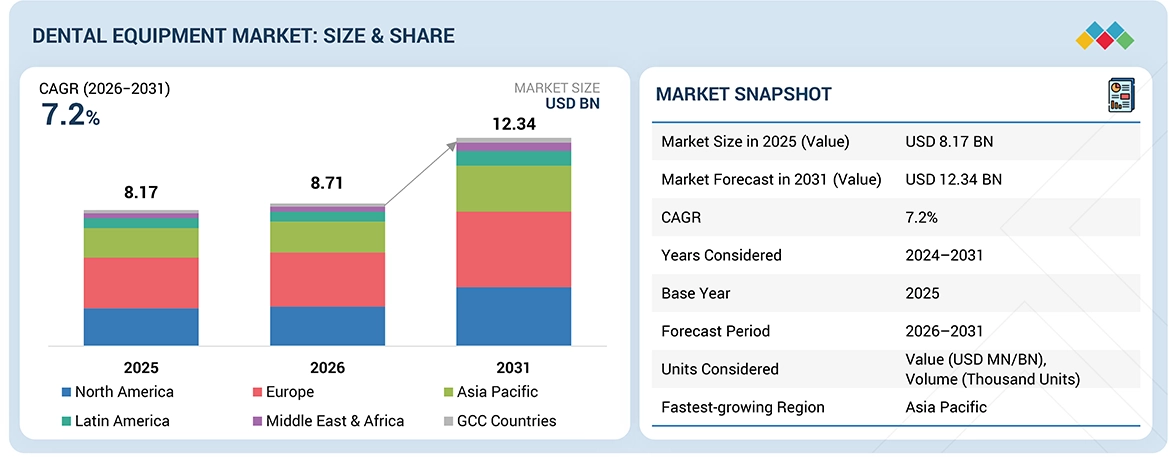
The global dental equipment market is projected to grow from USD 8.71 billion in 2026 to USD 12.34 billion by 2031, at a CAGR of 7.2% during the forecast period. The market was valued at USD 8.17 billion in 2025. The market for dental equipment is experiencing growth, driven by a rising prevalence of oral problems such as cavities, periodontal diseases, tooth loss, and malocclusions. These issues are often attributed to poor oral hygiene, unhealthy dietary habits, harmful behaviors like smoking, and an increasing geriatric population in developing countries. Additionally, there is growing awareness of the importance of oral health, which has led to a greater emphasis on preventive and aesthetic dentistry. This shift has encouraged more people to seek routine check-ups and dental care. Advancements in modern technology within the dental industry, including digital imaging, CAD/CAM technology, laser treatments, and 3D printing, have enhanced accuracy, effectiveness, and patient comfort in dental procedures. As dental practices and hospitals become more affordable and accessible, particularly in developing countries, there is a collective increase in oral health services, including dental tourism. This overall trend is contributing to the expansion of the dental equipment market.
KEY TAKEAWAYS
-
MARKET SNAPSHOT:
Base Year Market Size (2025): USD 8.17 Billion
Current Market Size (2026): USD 8.71 Billion
Forecast Market Size (2031): USD 12.34 Billion
CAGR (2026–2031): 7.2% -
SEGMENT LEADERSHIP:
Regional Leader: Europe accounted for the largest share of 37.4% of the dental equipment market in 2025.
Product Type Leader: Therapeutic dental equipment accounted for the largest share of 61.1% of the dental equipment market in 2025.
End User Leader: Dental hospitals & clinics held the largest share of 69.9% of the dental equipment market in 2025. -
MARKET OUTLOOK & COMPETITIVE LANDSCAPE:
Dentsply Sirona and Planmeca Oy were recognized as star players due to their established and strong product portfolios.
Companies such as Overjet have distinguished themselves among startups and SMEs by securing strong footholds in specialized niche areas, underscoring their potential as emerging market leaders.
The dental equipment market is expanding due to several factors, including the increasing demand for dental care, technological advancements, and improved access to healthcare services. The rising prevalence of dental issues such as cavities, periodontal diseases, tooth loss, and malocclusions—often resulting from poor oral hygiene, unhealthy dietary habits, smoking, and an aging population—is fueling the need for advanced dental care. Additionally, growing awareness of dental health and a greater emphasis on preventive and cosmetic dentistry are encouraging more people to visit their dentists regularly and invest in advanced dental equipment. Innovations in technology, including digital imaging, CAD/CAM, intraoral scanners, laser dentistry, and 3D printing, are enhancing the accuracy of diagnoses and the efficiency of dental procedures.
TRENDS & DISRUPTIONS IMPACTING CUSTOMERS' CUSTOMERS
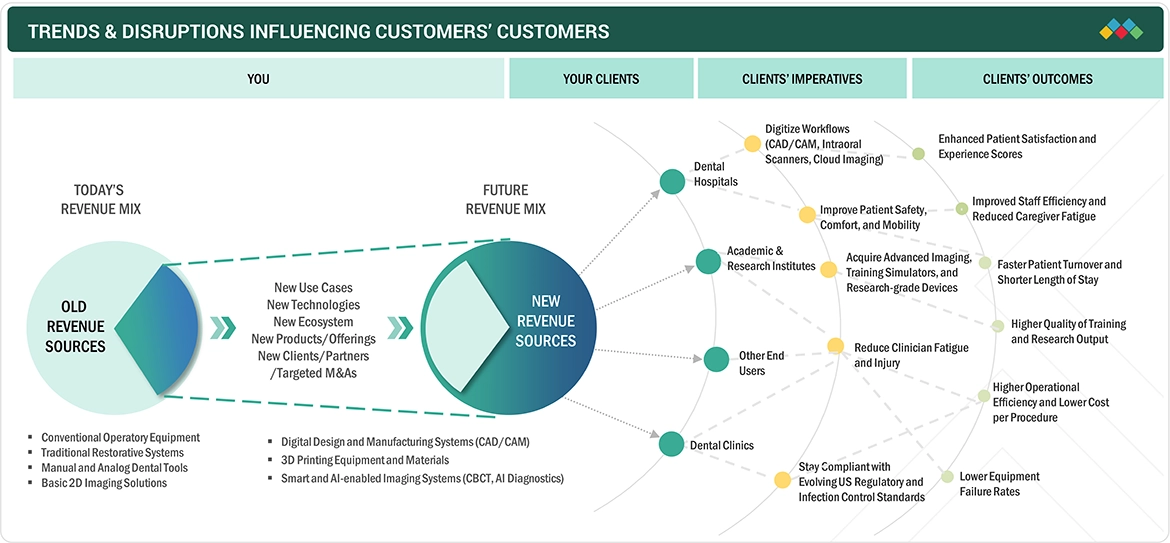
The market is undergoing significant changes driven by new needs and technological advancements. Currently, the market is primarily dominated by conventional operatory equipment, traditional restorative solutions, standard instruments, and 2D imaging solutions, which together account for about 20% of revenue. However, it is projected that the revenue composition will shift rapidly towards more advanced solutions, including CAD/CAM technology, 3D printers and materials, as well as AI-powered imaging solutions such as CBCT. These advanced solutions are expected to contribute approximately 80% of revenue. This shift is largely fueled by increasing demand from dental hospitals, clinics, universities, and other institutions seeking to enhance patient safety, satisfaction, and efficiency. Key drivers of this technological transformation will include the need for digital transformation, the procurement of advanced imaging and simulation solutions, addressing clinician fatigue, and developing solutions that comply with regulatory standards. As a result, customers will be better positioned to achieve improved patient satisfaction, enhanced staff productivity, faster procedures, increased overall productivity, higher quality research, and reduced downtime and failure of machines and instruments. Consequently, there is a growing focus on the transition towards value-driven, technology-enabled dentistry.
Source: Secondary Research, Interviews with Experts, MarketsandMarkets Analysis
MARKET DYNAMICS

Drivers
Impact
Level
Level
-
Development of technologically advanced solutions

-
Rise in oral health disorders


RESTRAINTS
Impact
Level
Level
-
High cost of dental imaging systems and lack of reimbursement for dental procedures


OPPORTUNITIES
Impact
Level
Level
-
Impact of DSOs on dental industry

-
Increasing number of dental laboratories investing in CAD/CAM technologies


CHALLENGES
Impact
Level
Level
-
Dearth of trained dental practitioners

Source: Secondary Research, Interviews with Experts, MarketsandMarkets Analysis
Driver: Rising demand for advanced cosmetic dental procedures
The dental equipment market is significantly influenced by the growing demand for high-end cosmetic dental treatments. This demand is continuously expanding due to increasing beauty consciousness and the importance of a good dental appearance in both personal and professional lives. Popular procedures include teeth whitening, veneers, clear aligners, dental implants, and smile design, which are gaining traction worldwide, regardless of a country's economic status. This trend is intensifying the demand for the latest innovations in dental technology, such as digital imaging systems, intraoral scanners, CAD/CAM systems, laser dentistry tools, and 3D printing technologies. These advancements allow dentists to plan treatments with high precision and achieve excellent cosmetic results. Additionally, social media marketing, rising disposable incomes, and the popularity of minimally invasive cosmetic treatments are driving the adoption of advanced cosmetic dental procedures. As a result, the dental equipment market is positioned for steady growth.
Restraint: High cost of dental imaging systems and lack of reimbursement for dental procedures
The high cost of dental imaging equipment and inadequate reimbursement for dental procedures are significant barriers to the growth of the dental equipment market. Advanced technologies such as CBCT equipment, digital radiology systems, and intraoral scanners come with substantial expenses. These costs go beyond the initial purchase price to include maintenance and training requirements, making it challenging for small to mid-sized dental practices to afford or even consider adopting such equipment. Additionally, the lack of reimbursement for dental services in various international markets—particularly for advanced or aesthetic procedures—further hampers dentists' ability to invest in high-cost equipment.
Opportunity: Increasing number of dental laboratories investing in CAD/CAM technologies
CAD/CAM technologies are widely adopted in dental laboratories for the production of prosthetics and restorations, presenting a significant opportunity for entry into the dental equipment market. Dental labs are increasingly utilizing digital processes to enhance precision and speed, ensuring accurate fabrications for crowns, bridges, dentures, and dental implants. As a result, CAD/CAM technologies, along with milling machines, 3D printing instruments, and improved dental materials, enable laboratories to create high-quality personalized restorations efficiently, requiring less manpower and reducing errors compared to traditional manual methods. Furthermore, the growing collaboration between dental practices and laboratories, along with the rising demand for same-day dental care and the shift towards digital dental practices, is accelerating the adoption of CAD/CAM technologies. This trend is driving increased investment and demand within the dental equipment market.
Challenge: Dearth of trained dental practitioners
The shortage of trained dental professionals is a significant barrier to the growth of the dental equipment market. Advanced dental technologies, such as digital imaging solutions, CAD/CAM technology, laser dentistry, and robotic and AI-enabled systems, require skilled operators for optimal performance. Unfortunately, there is a critical lack of trained dental professionals, especially in emerging regions, which limits the usage of these advanced solutions and forces many to rely on traditional methods and practices. Additionally, the high costs and time associated with training and certifying dental professionals further restricts the adoption of advanced technologies.
DENTAL EQUIPMENT MARKET: COMMERCIAL USE CASES ACROSS INDUSTRIES
| COMPANY | USE CASE DESCRIPTION | BENEFITS |
|---|---|---|
 |
Dentsply Sirona's Primeprint is a high-precision dental 3D printing system for in-office and laboratory use. It enables rapid production of dental restorations, including surgical guides, crowns, bridges, and splints, through an automated, fully integrated digital workflow. Primeprint can be seamlessly integrated with intraoral scanners and CAD/CAM software, enabling efficient chairside and lab-based fabrication. | Primeprint improves workflow efficiency by reducing turnaround times and minimizing reliance on external laboratories. Its high accuracy ensures consistent restoration quality, while automation reduces manual errors and labor costs. The system supports same-day dentistry, enhances patient satisfaction, and enables dental practices to expand their digital services. |
 |
CBCT systems are part of Planmeca's 3D imaging solutions, used for advanced diagnostics and treatment planning in implantology, orthodontics, endodontics, and maxillofacial surgery. Such systems provide a three-dimensional visualization of dental and craniofacial structures in great detail, supporting very precise clinical decision-making. | Planmeca’s 3D imaging improves diagnostic accuracy and treatment predictability while enhancing patient safety through optimized radiation dosing. High-quality imaging enables precise planning of complex procedures, reduces procedural risks, and improves clinical outcomes, making it a critical tool for modern dental practices. |
 |
The Align Technology intraoral scanner captures highly accurate digital impressions for orthodontic, restorative, and cosmetic dental procedures. These eliminate the use of conventional impression materials and integrate directly into digital treatment planning and aligner manufacturing workflows. | Intraoral scanners enhance patient comfort by eliminating messy impressions and reducing chair time. They improve impression accuracy, enable faster case submission, and support seamless digital workflows. This leads to improved treatment efficiency, better clinical outcomes, and higher patient satisfaction. |
 |
Envista's dental curing lights are used to polymerize light-cured dental materials, such as composites, adhesives, and sealants, in restorative dentistry. These devices are widely used in routine restorative and cosmetic procedures in dental clinics. | Envista's curing lights provide a steady, powerful light output, ensuring the material is thoroughly cured and the restoration lasts. Their comfortable design makes the clinician's work easier, while fast curing times reduce procedure time, thereby enhancing practice efficiency and patient throughput. |
 |
Carestream Dental's dental chairs support various procedures by positioning patients securely while providing ergonomic access for clinicians. These chairs are utilized in general dentistry, orthodontics, and surgical applications within dental clinics and hospitals. | Carestream’s dental chairs are designed to prioritize patient comfort and safety during procedures while simultaneously enhancing clinician ergonomics and workflow efficiency. Features such as advanced positioning and integrated delivery systems help operators avoid fatigue, ensure smooth procedures, and create a clinical environment that is both productive and welcoming for patients. |
Logos and trademarks shown above are the property of their respective owners. Their use here is for informational and illustrative purposes only.
MARKET ECOSYSTEM
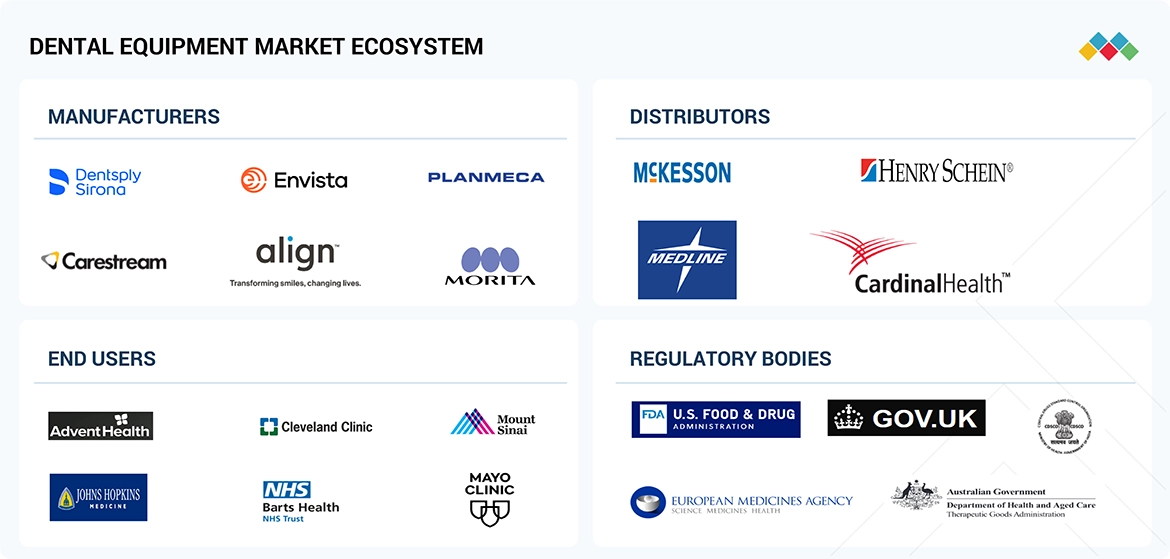
The dental equipment market ecosystem consists of an integrated network of manufacturers, distributors, end users, and government health regulation authorities, all contributing to the market's growth. Key manufacturers, such as Dentsply Sirona, Envista, Planmeca, Carestream Dental, Align, and MORITA, focus on developing innovative diagnostic, therapeutic, and digital dental technologies and devices to meet global market needs. These technologies and devices are distributed through effective networks, including Henry Schein, McKesson, Medline, and Cardinal Health. They ultimately reach end users, which include dental hospitals, dental clinics, and major healthcare organizations like the renowned Mayo Clinic, Cleveland Clinic, Johns Hopkins Medicine, and the UK's National Health Service (NHS). This distribution aims to enhance the efficiency and quality of healthcare services provided to these core end-user groups. Additionally, government health regulation authorities, such as the FDA, EMA, and various nation-specific agencies, play a crucial role in ensuring the quality and safety of devices and technologies in the global market.
Logos and trademarks shown above are the property of their respective owners. Their use here is for informational and illustrative purposes only.
MARKET SEGMENTS
Source: Secondary Research, Interviews with Experts, MarketsandMarkets Analysis
Dental Equipment Market, by Product Type
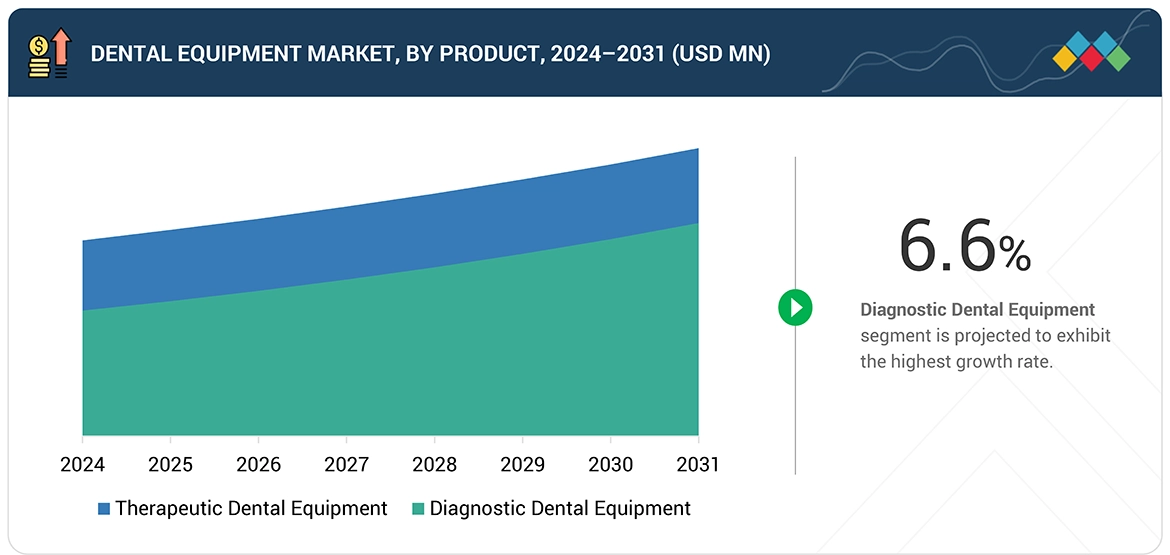
Therapeutic dental equipment constitutes the majority of the dental equipment market due to the increasing demand for treatment-based dental procedures in both developed and emerging regions. The rise in oral health issues such as dental caries, periodontal diseases, tooth loss, and malocclusion has led to a greater need for restorative, endodontic, orthodontic, and surgical treatments. This, in turn, has driven up the demand for dental handpieces, lasers, electrosurgical units, and implant systems. Unlike diagnostic devices, therapeutic equipment is used directly during dental procedures. Therefore, if it is not highly durable, its parts often need to be replaced or maintained. This creates opportunities for repeat purchases, fostering a growing market. Additionally, the preference for non-invasive and high-tech treatment methods, the expansion of dental clinics and hospitals, and patients’ desire for aesthetically pleasing, corrective teeth all contribute to the continued dominance of therapeutic dental equipment in the market.
Dental Equipment Market, by End User
In the dental equipment market, dental hospitals & clinics hold the largest share due to the high volume of dental procedures performed and their established infrastructure. These facilities serve as key sources of referrals for a variety of treatments, including preventive, restorative, surgical, orthodontic, and cosmetic procedures, all of which require advanced dental equipment. Dental hospitals & clinics are open to adopting new technologies such as digital imaging, CAD/CAM systems, dental chairs, and therapeutic devices. This willingness enhances the precision of diagnoses, improves treatment efficiency, and benefits patients. Additionally, factors such as the presence of trained dental professionals, access to funding, favorable reimbursement mechanisms in developed regions, and patient preference for facilities equipped with advanced technologies significantly contribute to dental hospitals & clinics maintaining a dominant position in the market.
REGION
Asia Pacific to be fastest-growing region in global dental equipment market during forecast period
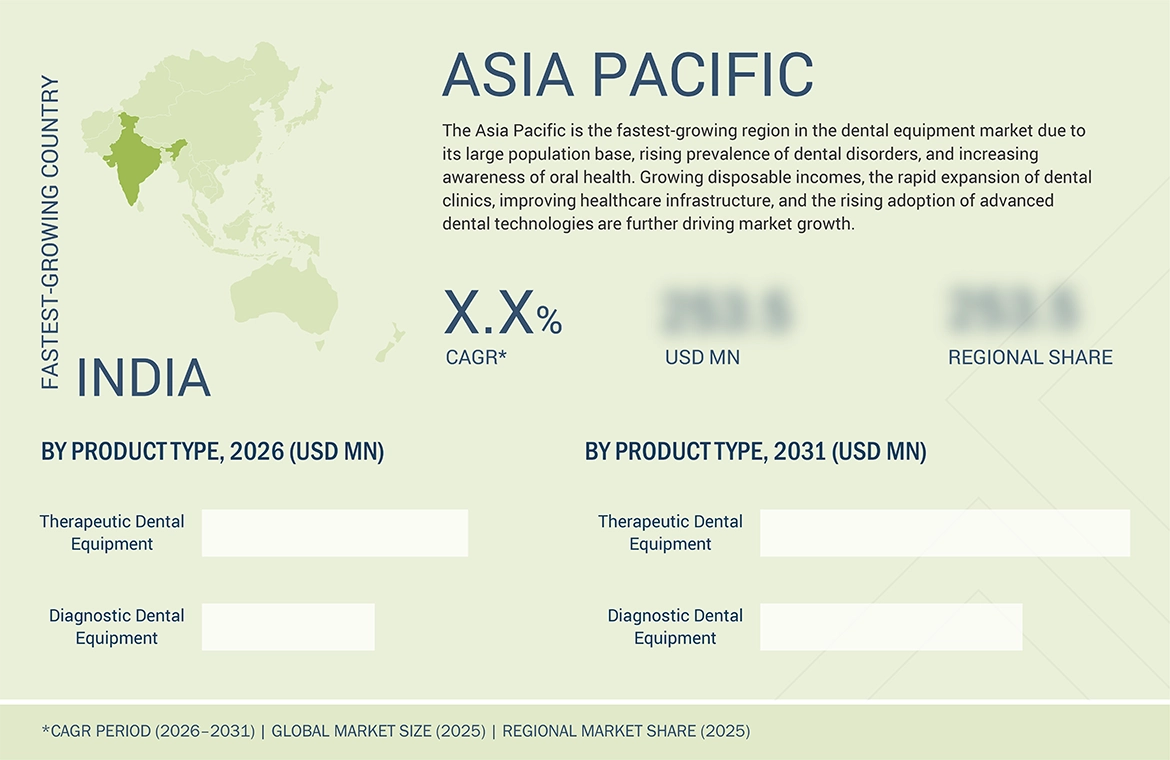
The Asia Pacific market is expected to experience the highest growth rate in the dental equipment sector, driven by several factors related to the region's demographics, economy, and healthcare industry. This region has a large population that suffers from a rising number of dental diseases, largely due to dietary habits, tobacco use, and poor oral health practices in various countries. Increased public awareness regarding oral health, along with a growing middle class and rising affluence, is also leading to higher spending on dental care and advanced treatments. Additionally, the expansion of dental facilities and advancements in the healthcare industry further contribute to the growth of the dental equipment market in this region. Moreover, governments in countries that attract significant dental tourism—such as India, Thailand, and South Korea—help fuel the potential in the dental equipment market due to the affordable treatment options available.
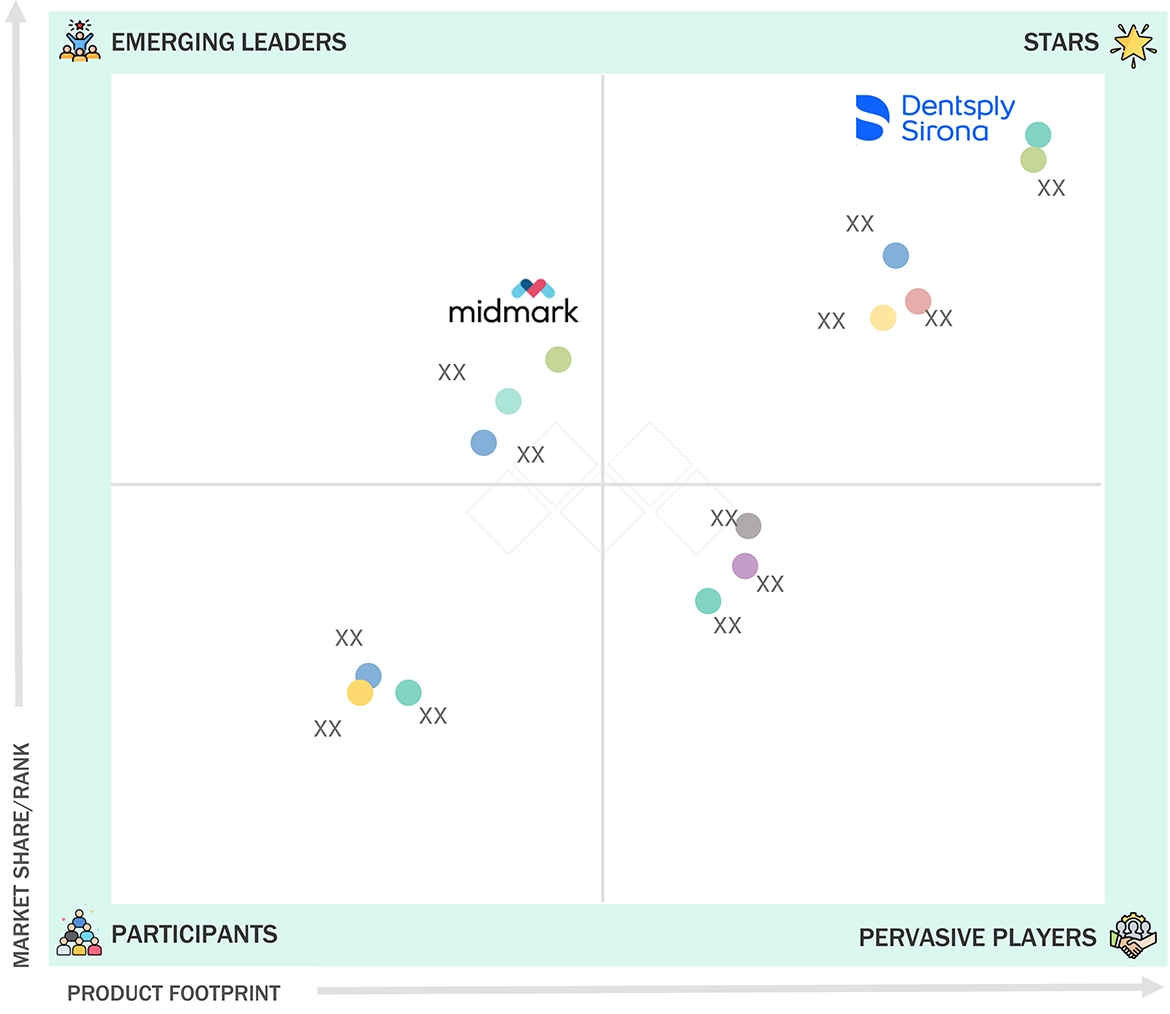
DENTAL EQUIPMENT MARKET: COMPANY EVALUATION MATRIX
In the dental equipment market, Dentsply Sirona (US) and Planmeca Oy (Finland) are the leading companies, identified as "Stars" due to their unmatched global presence, strong brand recognition, and comprehensive portfolios of dental equipment. 3Shape A/S (Denmark) is categorized as an "Emerging Leader" and is rapidly gaining traction with its versatile products, which include medical gas and equipment for various therapeutic and diagnostic applications.
Source: Secondary Research, Interviews with Experts, MarketsandMarkets Analysis
KEY MARKET PLAYERS
MARKET SCOPE
| REPORT METRIC | DETAILS |
|---|---|
| Market Size in 2025 (Value) | USD 8.17 Billion |
| Revenue Forecast in 2031 (Value) | USD 12.34 Billion |
| Growth Rate | CAGR of 7.2% from 2026–2031 |
| Years Considered | 2024–2031 |
| Base Year | 2025 |
| Forecast Period | 2026–2031 |
| Units Considered | Value (USD Million/Billion), Volume (Thousand Units) |
| Report Coverage | Revenue Forecast, Company Ranking, Competitive Landscape, Growth Factors, and Trends |
| Segments Covered |
|
| Regions Covered | North America, Europe, Asia Pacific, Latin America, Middle East & Africa, and GCC Countries |
| Related Segment & Geographic Reports |
United States Dental Equipment Market Europe Dental Equipment Market MEA Dental Equipment Market North America Dental Equipment Market APAC Dental Equipment Market |
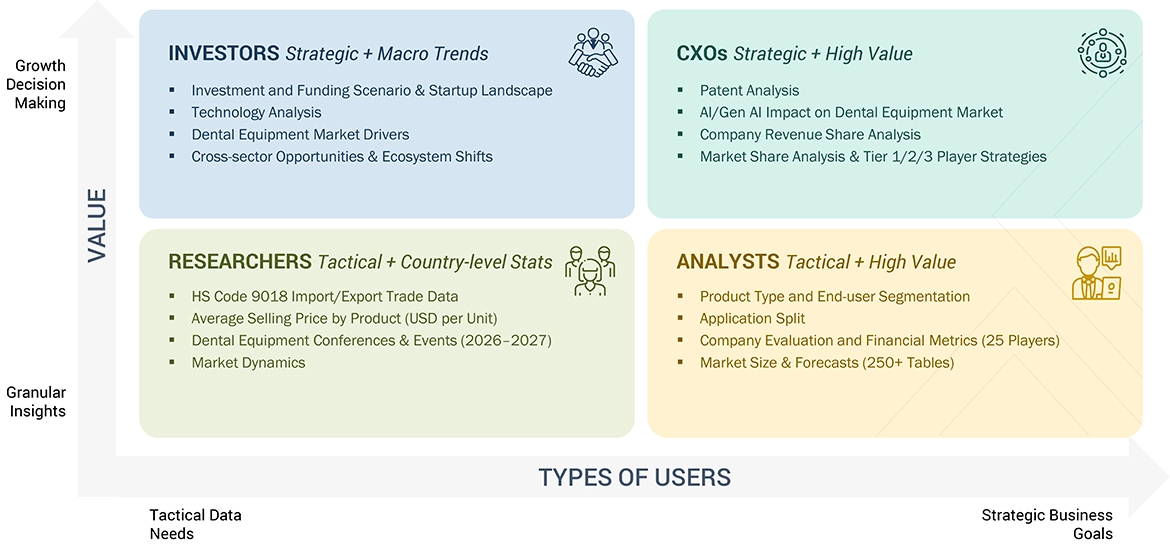
WHAT IS IN IT FOR YOU: DENTAL EQUIPMENT MARKET REPORT CONTENT GUIDE
DELIVERED CUSTOMIZATIONS
We have successfully delivered the following deep-dive customizations:
| CLIENT REQUEST | CUSTOMIZATION DELIVERED | VALUE ADDS |
|---|---|---|
| Volume Analysis | Market assessment, by volume (units), for dental equipment used in dental ecosystems |
|
| Product Analysis | Further breakdown of other applications in the market | Insights on other applications involved in the market |
| Company Information |
|
Insights on market share analysis by country |
| Geographic Analysis |
|
Country-level demand mapping for new product launches and localization strategy planning |
RECENT DEVELOPMENTS
- October 2024 : Align Technology launched the Invisalign Palatal Expander System in the US as part of its ongoing effort to expand its comprehensive range of orthodontic products. This system offers a less invasive and digitally guided option for palatal expansion, which enhances treatment precision, improves patient comfort and clinical outcomes, and integrates seamlessly with Align’s digital orthodontic workflow.
- February 2024 : Carestream Dental introduced the CS 8200 3D Access system, a compact and versatile imaging solution. This system supports panoramic imaging, cone beam computed tomography (CBCT), and object imaging. It provides high-quality images while significantly reducing radiation exposure, making it both more diagnostic and safer for use in a dental environment.
Table of Contents
 Exclusive indicates content/data unique to MarketsandMarkets and not available with any competitors.
TITLE
PAGE NO
1
INTRODUCTION
33
2
EXECUTIVE SUMMARY
37
3
PREMIUM INSIGHTS
42
4
MARKET OVERVIEW
Seize growth in dental tourism and advanced solutions amid rising oral health demands and cost challenges.
46
4.1
INTRODUCTION
4.2
MARKET DYNAMICS
4.2.1
DRIVERS
4.2.1.1
DEVELOPMENT OF TECHNOLOGICALLY ADVANCED SOLUTIONS
4.2.1.2
RISING PREVALENCE OF ORAL HEALTH DISORDERS
4.2.1.3
RISING DEMAND FOR ADVANCED COSMETIC DENTAL PROCEDURES
4.2.1.4
GROWING MARKET FOR DENTAL TOURISM IN EMERGING ECONOMIES
4.2.2
RESTRAINTS
4.2.2.1
HIGH COST OF DENTAL IMPLANTS AND IMAGING SYSTEMS AND LACK OF REIMBURSEMENT FOR DENTAL PROCEDURES
4.2.3
OPPORTUNITIES
4.2.3.1
IMPACT OF DENTAL SERVICE ORGANIZATIONS (DSOS)
4.2.3.2
INCREASING NUMBER OF DENTAL LABORATORIES INVESTING IN CAD/CAM TECHNOLOGIES
4.2.3.3
GROWING FOCUS ON EMERGING MARKETS
4.2.4
CHALLENGES
4.2.4.1
LOW DENTIST-TO-POPULATION RATIO
4.3
UNMET NEEDS AND WHITE SPACES
4.3.1
UNMET NEEDS
4.3.2
WHITE SPACE OPPORTUNITIES
4.4
INTERCONNECTED MARKETS AND CROSS-SECTOR OPPORTUNITIES
4.4.1
INTERCONNECTED MARKETS
4.4.2
CROSS-SECTOR OPPORTUNITIES
4.5
STRATEGIC MOVES BY TIER 1/2/3 PLAYERS
5
INDUSTRY TRENDS
Uncover strategic insights into dental equipment market dynamics and upcoming tariff impacts.
58
5.1
PORTER’S FIVE FORCES ANALYSIS
5.1.1
THREAT FROM NEW ENTRANTS
5.1.2
THREAT FROM SUBSTITUTES
5.1.3
BARGAINING POWER OF SUPPLIERS
5.1.4
BARGAINING POWER OF BUYERS
5.1.5
INTENSITY OF COMPETITIVE RIVALRY
5.2
MACROECONOMIC OUTLOOK
5.2.1
INTRODUCTION
5.2.2
GDP TRENDS AND FORECAST
5.2.3
TRENDS IN DENTAL EQUIPMENT MARKET
5.3
VALUE CHAIN ANALYSIS
5.4
ECOSYSTEM ANALYSIS
5.5
SUPPLY CHAIN ANALYSIS
5.6
PRICING ANALYSIS
5.6.1
AVERAGE SELLING PRICE OF DENTAL EQUIPMENT, BY KEY PLAYERS, 2022–2025
5.7
TRADE ANALYSIS
5.8
KEY CONFERENCES & EVENTS
5.9
TRENDS/DISRUPTIONS IMPACTING CUSTOMER BUSINESS
5.10
INVESTMENT & FUNDING SCENARIO
5.11
CASE STUDY ANALYSIS
5.12
IMPACT OF 2025 US TARIFFS: OVERVIEW
5.13
INTRODUCTION
5.14
KEY TARIFF RATES
5.15
PRICE IMPACT ANALYSIS
5.15.1
IMPACT ON COUNTRY/REGION
5.15.1.1
US
5.15.1.2
EUROPE
5.15.1.3
ASIA PACIFIC
5.15.2
IMPACT ON END-USE INDUSTRIES
6
TECHNOLOGICAL ADVANCEMENTS, AI-DRIVEN IMPACT, PATENTS, INNOVATIONS, AND FUTURE APPLICATIONS
AI-driven innovations revolutionize dental care with robot dentists and predictive caries detection.
77
6.1
KEY EMERGING TECHNOLOGIES
6.1.1
RISING NUMBER OF MINIMALLY INVASIVE DENTAL PROCEDURES
6.1.2
CARIES DETECTION TECHNOLOGY
6.2
COMPLEMENTARY TECHNOLOGIES
6.2.1
ROBOT DENTISTS AND AI
6.3
ADJACENT TECHNOLOGIES
6.3.1
VIRTUAL REALITY
6.3.2
LASER DENTISTRY
6.4
TECHNOLOGY/PRODUCT ROADMAP
6.4.1
SHORT TERM |RECENT TECHNOLOGIES| FOUNDATION & EARLY COMMERCIALIZATION
6.4.2
MID TERM (2027–2030) | EXPANSION & STANDARDIZATION
6.4.3
LONG TERM (2030–2035+) | MASS COMMERCIALIZATION & DISRUPTION
6.5
PATENT ANALYSIS
6.5.1
PATENT PUBLICATION TRENDS FOR DENTAL EQUIPMENT
6.5.2
INSIGHTS: JURISDICTION AND TOP APPLICANT ANALYSIS
6.5.3
TOP APPLICANTS & OWNERS (COMPANIES/INSTITUTIONS) FOR DENTAL EQUIPMENT PATENTS (JANUARY 2015−DECEMBER 2025)
6.5.4
TOP APPLICANT COUNTRIES/REGIONS PATENTS FOR DENTAL EQUIPMENT (JANUARY 2015−DECEMBER 2025)
6.6
IMPACT OF AI/GENERATIVE AI ON DENTAL EQUIPMENT MARKET
6.6.1
TOP USE CASES AND MARKET POTENTIAL
6.6.2
INTERCONNECTED ADJACENT ECOSYSTEMS AND IMPACT ON MARKET PLAYERS
6.6.3
CLIENTS’ READINESS TO ADOPT GENERATIVE AI IN DENTAL EQUIPMENT MARKET
6.7
SUCCESS STORIES AND REAL-WORLD APPLICATIONS
6.7.1
DENTSPLY SIRONA: AI-POWERED DIGITAL WORKFLOW & SAME-DAY DENTISTRY
6.7.2
PLANMECA: AI-ENABLED IMAGING & DIAGNOSTIC AUTOMATION
6.7.3
ALIGN TECHNOLOGY: DIGITAL SCANNING & AI-DRIVEN ORTHODONTIC ECOSYSTEM
7
REGULATORY LANDSCAPE
Navigate global regulatory complexities with insights into standards, certifications, and regional authorities.
89
7.1
REGULATORY BODIES, GOVERNMENT AGENCIES, AND OTHER ORGANIZATIONS
7.1.1
INDUSTRY STANDARDS
7.1.1.1
NORTH AMERICA
7.1.1.1.1
US
7.1.1.1.2
CANADA
7.1.1.2
EUROPE
7.1.1.3
ASIA PACIFIC
7.1.1.3.1
CHINA
7.1.1.3.2
JAPAN
7.1.1.4
LATIN AMERICA
7.1.1.4.1
BRAZIL
7.1.1.4.2
MEXICO
7.1.1.5
MIDDLE EAST
7.1.1.6
AFRICA
7.2
CERTIFICATIONS, LABELING, AND ECO-STANDARDS
8
CUSTOMER LANDSCAPE & BUYER BEHAVIOR
Navigate complex buyer dynamics by understanding stakeholder influence and unmet industry needs.
96
8.1
DECISION-MAKING PROCESS
8.2
BUYER STAKEHOLDERS AND BUYING EVALUATION CRITERIA
8.2.1
INFLUENCE OF KEY STAKEHOLDERS
8.2.2
BUYING CRITERIA
8.3
ADOPTION BARRIERS & INTERNAL CHALLENGES
8.4
UNMET NEEDS FROM VARIOUS END-USE INDUSTRIES
9
DENTAL EQUIPMENT MARKET, BY TYPE
Market Size & Growth Rate Forecast Analysis to 2031 in USD Million and Units | 59 Data Tables
99
9.1
INTRODUCTION
9.2
THERAPEUTIC DENTAL EQUIPMENT
9.2.1
DENTAL OPERATORY & TREATMENT CENTER EQUIPMENT
9.2.1.1
DENTAL UNITS
9.2.1.1.1
INSTRUMENT DELIVERY SYSTEMS
9.2.1.1.2
DENTAL CHAIRS
9.2.1.2
DENTAL HANDPIECES
9.2.1.2.1
RISING DEMAND FOR COSMETIC DENTISTRY TO DRIVE GROWTH
9.2.1.3
DENTAL LIGHT-CURING EQUIPMENT
9.2.1.3.1
GROWING DEMAND FOR IN-OFFICE TEETH WHITENING PROCEDURES TO DRIVE GROWTH
9.2.1.4
ELECTROSURGICAL SYSTEMS
9.2.1.4.1
RISING NEED FOR MINIMALLY INVASIVE PROCEDURES TO DRIVE GROWTH
9.2.1.5
OTHER DENTAL OPERATORY & TREATMENT CENTER EQUIPMENT
9.2.2
DENTAL LABORATORY EQUIPMENT
9.2.2.1
CAD/CAM SYSTEMS
9.2.2.1.1
INCREASING ADOPTION OF SINGLE-TOOTH IMPLANTS, VENEERS, AND CROWNS TO DRIVE GROWTH
9.2.2.2
MILLING EQUIPMENT
9.2.2.2.1
INCREASING USE OF MILLING MACHINES IN CREATING AND MODIFYING DENTAL PROSTHESIS TO DRIVE GROWTH
9.2.2.3
3D PRINTING EQUIPMENT
9.2.2.3.1
RISING ADOPTION OF 3D PRINTERS IN DENTAL INDUSTRY TO DRIVE GROWTH
9.2.2.4
CASTING MACHINES
9.2.2.4.1
GROWING ADOPTION OF CASTING MACHINES IN CREATING CUSTOM DENTAL RESTORATIONS TO DRIVE DEMAND
9.2.2.5
CERAMIC FURNACES
9.2.2.5.1
USE HIGH PRESSURES AND TEMPERATURES TO PROCESS CERAMIC MATERIALS
9.2.2.6
OTHER DENTAL LABORATORY EQUIPMENT
9.2.3
DENTAL LASERS
9.2.3.1
SOFT-TISSUE LASERS
9.2.3.1.1
DIODE LASERS
9.2.3.1.2
CARBON DIOXIDE LASERS
9.2.3.1.3
ND:YAG LASERS
9.2.3.2
ALL-TISSUE LASERS
9.2.3.2.1
ER:YAG LASERS
9.2.3.2.2
ER,CR:YSGG LASERS
9.3
DIAGNOSTIC DENTAL EQUIPMENT
9.3.1
EXTRAORAL IMAGING SYSTEMS
9.3.1.1
PANORAMIC SYSTEMS
9.3.1.1.1
USED IN EVERYDAY DENTAL PRACTICES
9.3.1.2
3D CBCT SYSTEMS
9.3.1.2.1
GROWTH IN DENTAL IMPLANTS AND INCREASE IN NUMBER OF VENDORS OFFERING CBCT UNITS TO DRIVE DEMAND
9.3.1.3
PANORAMIC & CEPHALOMETRIC SYSTEMS
9.3.1.3.1
RISING NEED FOR SINGLE DIGITAL PLATFORM FOR DENTAL TREATMENTS
9.3.2
INTRAORAL IMAGING SYSTEMS
9.3.2.1
INTRAORAL X-RAY SYSTEMS
9.3.2.1.1
GROWING DEMAND FOR EFFICIENT AND FASTER INTRAORAL DIAGNOSTICS TO DRIVE GROWTH
9.3.2.2
INTRAORAL SENSORS
9.3.2.2.1
INCREASING NEED FOR REDUCED OPERATING TIME TO DRIVE GROWTH
9.3.2.3
INTRAORAL PHOTOSTIMULABLE PHOSPHOR SYSTEMS
9.3.2.3.1
CAN BE USED MULTIPLE TIMES WITH MINIMAL DEGRADATION DURING DENTAL IMAGING
9.3.2.4
INTRAORAL CAMERAS
9.3.2.4.1
HELP IN EARLY DETECTION AND ACCURATE REPRESENTATION OF DENTAL CONDITIONS
9.3.3
DENTAL IMAGING SOFTWARE
9.3.3.1
OFFERS SOPHISTICATED WORKFLOW
10
DENTAL EQUIPMENT MARKET, BY END USER
Market Size & Growth Rate Forecast Analysis to 2031 in USD Million | 6 Data Tables
156
10.1
INTRODUCTION
10.2
HOSPITALS & CLINICS
10.2.1
INCREASING NUMBER OF DENTAL HOSPITALS & CLINICS IN EMERGING MARKETS TO DRIVE SEGMENTAL GROWTH
10.3
ACADEMIC & RESEARCH INSTITUTES
10.3.1
GROWING NUMBER OF INDUSTRY-ACADEMIC AGREEMENTS AND RISING FUNDING FOR DENTAL RESEARCH PROJECTS TO DRIVE SEGMENTAL GROWTH
10.4
OTHER END USERS
11
DENTAL EQUIPMENT MARKET, BY REGION
Comprehensive coverage of 9 Regions with country-level deep-dive of 15 Countries | 311 Data Tables.
164
11.1
INTRODUCTION
11.2
EUROPE
11.2.1
MACROECONOMIC OUTLOOK
11.2.2
GERMANY
11.2.2.1
FAVORABLE GOVERNMENT POLICIES AND INCREASING PREVALENCE OF EDENTULISM TO DRIVE MARKET
11.2.3
FRANCE
11.2.3.1
FAVORABLE GOVERNMENT HEALTHCARE STRATEGIES TO DRIVE MARKET
11.2.4
UK
11.2.4.1
INCREASING INCIDENCE OF DENTAL DISORDERS TO DRIVE DEMAND
11.2.5
ITALY
11.2.5.1
LOW-COST TREATMENTS AND GROWING PENETRATION OF DENTAL PRODUCTS TO DRIVE MARKET
11.2.6
SPAIN
11.2.6.1
INCREASING DEMAND FOR COSMETIC DENTISTRY AND GROWING MEDICAL TOURISM TO DRIVE MARKET
11.2.7
REST OF EUROPE (ROE)
11.3
NORTH AMERICA
11.3.1
MACROECONOMIC OUTLOOK
11.3.2
US
11.3.2.1
FAVORABLE REIMBURSEMENT POLICIES TO DRIVE MARKET
11.3.3
CANADA
11.3.3.1
RISING INCIDENCE OF DENTAL CARIES TO DRIVE DEMAND
11.4
ASIA PACIFIC
11.4.1
MACROECONOMIC OUTLOOK
11.4.2
CHINA
11.4.2.1
GROWING NUMBER OF SPECIALIZED DENTAL HOSPITALS AND CLINICS TO DRIVE MARKET
11.4.3
JAPAN
11.4.3.1
RISING GERIATRIC POPULATION AND FAVORABLE REIMBURSEMENT SCENARIO TO DRIVE MARKET
11.4.4
INDIA
11.4.4.1
GROWTH OF DENTAL CARE SECTOR AND RISING FOREIGN INVESTMENT TO DRIVE MARKET
11.4.5
AUSTRALIA
11.4.5.1
FAVORABLE GOVERNMENT INITIATIVES AND GROWING DENTAL DISEASES TO DRIVE DEMAND
11.4.6
SOUTH KOREA
11.4.6.1
INCREASE IN GERIATRIC POPULATION SEEKING ADVANCED DENTAL TREATMENTS TO DRIVE MARKET
11.4.7
REST OF ASIA PACIFIC (ROAPAC)
11.5
LATIN AMERICA
11.5.1
MACROECONOMIC OUTLOOK
11.5.2
BRAZIL
11.5.2.1
GROWING TREND OF COSMETIC DENTISTRY TO DRIVE MARKET
11.5.3
MEXICO
11.5.3.1
IMPROVING HEALTHCARE INFRASTRUCTURE AND AVAILABILITY OF SKILLED DENTISTS TO DRIVE MARKET
11.5.4
ARGENTINA
11.5.4.1
INCREASING DENTAL TOURISM TO DRIVE MARKET
11.5.5
REST OF LATIN AMERICA
11.6
MIDDLE EAST & AFRICA (MEA)
11.6.1
MACROECONOMIC OUTLOOK FOR MIDDLE EAST & AFRICA
11.6.2
GCC COUNTRIES
11.6.2.1
GROWING DEMAND FOR PERSONALIZED DENTISTRY TO DRIVE MARKET
11.6.3
MACROECONOMIC OUTLOOK FOR GCC COUNTRIES
12
COMPETITIVE LANDSCAPE
Uncover strategic moves and market positions shaping the dental equipment industry's competitive edge.
288
12.1
INTRODUCTION
12.2
KEY PLAYER STRATEGIES/RIGHT TO WIN
12.2.1
OVERVIEW OF STRATEGIES ADOPTED BY PLAYERS IN DENTAL EQUIPMENT MARKET
12.3
REVENUE ANALYSIS, 2020-2025
12.4
MARKET SHARE ANALYSIS, 2025
12.5
COMPANY EVALUATION MATRIX: KEY PLAYERS, 2025
12.5.1
STARS
12.5.2
EMERGING LEADERS
12.5.3
PERVASIVE PLAYERS
12.5.4
PARTICIPANTS
12.5.5
COMPANY FOOTPRINT: KEY PLAYERS, 2025
12.6
COMPANY EVALUATION MATRIX: STARTUPS/SMES, 2025
12.6.1
PROGRESSIVE COMPANIES
12.6.2
RESPONSIVE COMPANIES
12.6.3
DYNAMIC COMPANIES
12.6.4
STARTING BLOCKS
12.6.5
COMPETITIVE BENCHMARKING: STARTUPS/SMES, 2025
12.7
COMPANY VALUATION & FINANCIAL METRICS
12.8
BRAND/PRODUCT COMPARATIVE ANALYSIS
12.9
COMPETITIVE SCENARIO
12.9.1
PRODUCT LAUNCHES
12.9.2
DEALS
12.9.3
EXPANSIONS
13
COMPANY PROFILES
In-depth Company Profiles of Leading Market Players with detailed Business Overview, Product and Service Portfolio, Recent Developments, and Unique Analyst Perspective (MnM View)
307
13.1
KEY PLAYERS
13.1.1
DENTSPLY SIRONA
13.1.1.1
BUSINESS OVERVIEW
13.1.1.2
PRODUCTS OFFERED
13.1.1.3
RECENT DEVELOPMENTS
13.1.1.3.1
PRODUCT LAUNCHES
13.1.1.3.2
DEALS
13.1.1.4
MNM VIEW
13.1.1.4.1
RIGHT TO WIN
13.1.1.4.2
STRATEGIC CHOICES
13.1.1.4.3
WEAKNESSES AND COMPETITIVE THREATS
13.1.2
PLANMECA OY
13.1.3
SOLVENTUM
13.1.4
INSTITUT STRAUMANN AG
13.1.5
ENVISTA HOLDINGS CORPORATION
13.1.6
ALIGN TECHNOLOGY INC.
13.1.7
A-DEC
13.1.8
J. MORITA CORP.
13.1.9
IVOCLAR VIVADENT
13.1.10
GC CORPORATION
13.1.11
MIDMARK CORPORATION
13.1.12
3SHAPE
13.2
OTHER PLAYERS
13.2.1
ULTRADENT PRODUCTS
13.2.2
BIOLASE, INC.
13.2.3
BEGO GMBH & CO. KG
13.2.4
YOSHIDA DENTAL MFG. CO., LTD
13.2.5
DENTALEZ INC.
13.2.6
SOURCE: COMPANY WEBSITE CARESTREAM DENTAL LLC
13.2.7
TAKARA BELMONT CORPORATION
13.2.8
NOVA INSTRUMENTS
13.2.9
NEWTOM
13.2.10
MILLENNIUM DENTAL TECHNOLOGIES INC.
13.2.11
PREXION INC.
13.2.12
BRASSELER USA
13.2.13
AMD LASERS
13.2.14
ASEPTICO
13.2.15
BIEN-AIR DENTAL
14
RESEARCH METHODOLOGY
361
14.1
RESEARCH DATA
14.1.1
SECONDARY DATA
14.1.1.1
KEY DATA FROM SECONDARY SOURCES
14.1.2
PRIMARY DATA
14.1.2.1
KEY DATA FROM PRIMARY SOURCES
14.1.2.2
KEY INDUSTRY INSIGHTS
14.2
MARKET SIZE ESTIMATION
14.2.1
BOTTOM-UP APPROACH
14.2.2
TOP-DOWN APPROACH
14.2.3
BASE NUMBER ESTIMATION
14.2.3.1
SUPPLY-SIDE ANALYSIS (REVENUE SHARE ANALYSIS)
14.2.3.2
COMPANY PRESENTATIONS AND PRIMARY INTERVIEWS
14.3
MARKET FORECAST APPROACH
14.4
DATA TRIANGULATION
14.5
RESEARCH ASSUMPTIONS
14.6
FACTOR ANALYSIS
14.7
RISK ASSESSMENT
14.8
RESEARCH LIMITATIONS
14.8.1
METHODOLOGY-RELATED LIMITATIONS
15
APPENDIX
376
15.1
DISCUSSION GUIDE
15.2
KNOWLEDGESTORE: MARKETSANDMARKETS’ SUBSCRIPTION PORTAL
15.3
CUSTOMIZATION OPTIONS
15.4
RELATED REPORTS
15.5
AUTHOR DETAILS
LIST OF TABLES
TABLE 1
CURRENCY CONVERSION RATE, 2019–2024 (UNIT OF USD)
TABLE 2
SOME TECHNOLOGICAL ADVANCEMENTS USED IN DENTISTRY
TABLE 3
PROJECTED INCREASE IN ABOVE-65 AGE GROUP, BY REGION, 2019–2050 (MILLION)
TABLE 4
AVERAGE PROCEDURAL COSTS IN TOP 10 DENTAL TOURISM DESTINATIONS (USD)
TABLE 5
AVERAGE COST OF DENTAL TREATMENT, BY COUNTRY (2024-2025)
TABLE 6
LIST OF SOME RECENT DEALS BACKED BY PRIVATE EQUITY IN US, 2020–2023
TABLE 7
PER CAPITA NATIONAL INCOME, 2000–2020 (USD)
TABLE 8
DENTAL EQUIPMENT MARKET: UNMET NEEDS
TABLE 9
IMPACT OF PORTER’S FIVE FORCES ON DENTAL EQUIPMENT MARKET
TABLE 10
GDP PERCENTAGE CHANGE, BY KEY COUNTRIES, 2021-2030
TABLE 11
DENTAL EQUIPMENT MARKET: ECOSYSTEM ANALYSIS
TABLE 12
AVERAGE SYSTEM COST OF DENTAL EQUIPMENT SYSTEMS, 2023-2025
TABLE 13
AVERAGE COST RANGE OF DENTAL EQUIPMENT, BY REGION, 2021-2023 (USD)
TABLE 14
IMPORT DATA FOR DENTAL EQUIPMENT (HS CODE 9021), BY COUNTRY, 2020–2024 (USD THOUSAND)
TABLE 15
EXPORT DATA FOR DENTAL EQUIPMENT (HS CODE 9021), BY COUNTRY, 2020–2024 (USD THOUSAND)
TABLE 16
DENTAL EQUIPMENT MARKET: KEY CONFERENCES & EVENTS, 2026-2027
TABLE 17
CAE STUDY 1: DIGITAL DENTISTRY WORKFLOW USING CAD/CAM SYSTEMS FOR SAME-DAY RESTORATIONS
TABLE 18
CASE STUDY 2: AI-ENABLED DENTAL IMAGING FOR EARLY DIAGNOSIS AND TREATMENT PLANNING
TABLE 19
CASE STUDY 3: LASER DENTISTRY FOR MINIMALLY INVASIVE SOFT TISSUE PROCEDURES
TABLE 20
US ADJUSTED RECIPROCAL TARIFF RATES
TABLE 21
KEY PRODUCT-RELATED TARIFFS EFFECTIVE FOR DENTAL EQUIPMENT
TABLE 22
LIST OF PATENTS IN DENTAL EQUIPMENT MARKET (2022−2025)
TABLE 23
TOP USE CASES AND MARKET POTENTIAL
TABLE 24
INTERCONNECTED ADJACENT ECOSYSTEMS AND IMPACT ON MARKET PLAYERS
TABLE 25
NORTH AMERICA: REGULATORY BODIES, GOVERNMENT AGENCIES, AND OTHER ORGANIZATIONS
TABLE 26
EUROPE: REGULATORY BODIES, GOVERNMENT AGENCIES, AND OTHER ORGANIZATIONS
TABLE 27
ASIA PACIFIC: REGULATORY BODIES, GOVERNMENT AGENCIES, AND OTHER ORGANIZATIONS
TABLE 28
LATIN AMERICA: REGULATORY BODIES, GOVERNMENT AGENCIES, AND OTHER ORGANIZATIONS
TABLE 29
MIDDLE EAST & AFRICA: REGULATORY BODIES, GOVERNMENT AGENCIES, AND OTHER ORGANIZATIONS
TABLE 30
CERTIFICATIONS, LABELING, AND ECO-STANDARDS IN DENTAL EQUIPMENT MARKET
TABLE 31
INFLUENCE OF STAKEHOLDERS ON BUYING PROCESS FOR TOP PRODUCT TYPES (%)
TABLE 32
KEY BUYING CRITERIA FOR TOP PRODUCT TYPES
TABLE 33
DENTAL EQUIPMENT MARKET: UNMET NEEDS/END USER EXPECTATIONS
TABLE 34
DENTAL EQUIPMENT MARKET, BY TYPE, 2024–2031 (USD MILLION)
TABLE 35
THERAPEUTIC DENTAL EQUIPMENT MARKET, BY TYPE, 2024–2031 (USD MILLION)
TABLE 36
THERAPEUTIC DENTAL EQUIPMENT MARKET, BY COUNTRY, 2024–2031 (USD MILLION)
TABLE 37
DENTAL OPERATORY & TREATMENT CENTER EQUIPMENT MARKET, BY TYPE, 2024–2031 (USD MILLION)
TABLE 38
DENTAL OPERATORY & TREATMENT CENTER EQUIPMENT MARKET, BY COUNTRY, 2024–2031 (USD MILLION)
TABLE 39
DENTAL UNITS MARKET, BY TYPE, 2024–2031 (USD MILLION)
TABLE 40
DENTAL UNITS MARKET, BY COUNTRY, 2024–2031 (USD MILLION)
TABLE 41
INSTRUMENT DELIVERY SYSTEMS MARKET, BY COUNTRY, 2024–2031 (USD MILLION)
TABLE 42
DENTAL CHAIRS MARKET, BY COUNTRY, 2024–2031 (USD MILLION)
TABLE 43
DENTAL HANDPIECES MARKET, BY COUNTRY, 2024–2031 (USD MILLION)
TABLE 44
DENTAL LIGHT-CURING EQUIPMENT MARKET, BY COUNTRY, 2024–2031 (USD MILLION)
TABLE 45
ELECTROSURGICAL SYSTEMS MARKET, BY COUNTRY, 2024–2031 (USD MILLION)
TABLE 46
OTHER DENTAL OPERATORY & TREATMENT CENTER EQUIPMENT MARKET, BY COUNTRY, 2024–2031 (USD MILLION)
TABLE 47
DENTAL LABORATORY EQUIPMENT MARKET, BY TYPE, 2024–2031 (USD MILLION)
TABLE 48
DENTAL LABORATORY EQUIPMENT MARKET, BY COUNTRY, 2024–2031 (USD MILLION)
TABLE 49
VOLUME DATA: CAD/CAM SYSTEMS MARKET, BY REGION, 2024–2031 (THOUSAND UNITS)
TABLE 50
CAD/CAM SYSTEMS MARKET, BY COUNTRY, 2024–2031 (USD MILLION)
TABLE 51
VOLUME DATA: MILLING EQUIPMENT MARKET, BY REGION, 2024–2031 (THOUSAND UNITS)
TABLE 52
MILLING EQUIPMENT MARKET, BY COUNTRY, 2024–2031 (USD MILLION)
TABLE 53
VOLUME DATA: 3D PRINTING EQUIPMENT MARKET, BY REGION, 2024–2031 (THOUSAND UNITS)
TABLE 54
3D PRINTING EQUIPMENT MARKET, BY COUNTRY, 2024–2031 (USD MILLION)
TABLE 55
VOLUME DATA: CASTING MACHINES MARKET, BY REGION, 2024–2031 (THOUSAND UNITS)
TABLE 56
CASTING MACHINES MARKET, BY COUNTRY, 2024–2031 (USD MILLION)
TABLE 57
VOLUME DATA: CERAMIC FURNACES MARKET, BY REGION, 2024–2031 (THOUSAND UNITS)
TABLE 58
CERAMIC FURNACES MARKET, BY COUNTRY, 2024–2031 (USD MILLION)
TABLE 59
VOLUME DATA: OTHER DENTAL LABORATORY EQUIPMENT MARKET, BY REGION, 2024–2031 (THOUSAND UNITS)
TABLE 60
OTHER DENTAL LABORATORY EQUIPMENT MARKET, BY COUNTRY, 2024–2031 (USD MILLION)
TABLE 61
DENTAL LASERS MARKET, BY TYPE, 2024–2031 (USD MILLION)
TABLE 62
DENTAL LASERS MARKET, BY COUNTRY, 2024–2031 (USD MILLION)
TABLE 63
SOFT-TISSUE LASERS MARKET, BY TYPE, 2024–2031 (USD MILLION)
TABLE 64
SOFT-TISSUE LASERS MARKET, BY COUNTRY, 2024–2031 (USD MILLION)
TABLE 65
DIODE LASERS MARKET, BY COUNTRY, 2024–2031 (USD MILLION)
TABLE 66
CARBON DIOXIDE LASERS MARKET, BY COUNTRY, 2024–2031 (USD MILLION)
TABLE 67
ND:YAG LASERS MARKET, BY COUNTRY, 2024–2031 (USD MILLION)
TABLE 68
ALL-TISSUE LASERS MARKET, BY TYPE, 2024–2031 (USD MILLION)
TABLE 69
ALL-TISSUE LASERS MARKET, BY COUNTRY, 2024–2031 (USD MILLION)
TABLE 70
ER:YAG LASERS MARKET, BY COUNTRY, 2024–2031 (USD MILLION)
TABLE 71
ER,CR:YSGG LASERS MARKET, BY COUNTRY, 2024–2031 (USD MILLION)
TABLE 72
DIAGNOSTIC DENTAL EQUIPMENT MARKET, BY TYPE, 2024–2031 (USD MILLION)
TABLE 73
DIAGNOSTIC DENTAL EQUIPMENT MARKET, BY COUNTRY, 2024–2031 (USD MILLION)
TABLE 74
EXTRAORAL IMAGING SYSTEMS MARKET, BY TYPE, 2024–2031 (USD MILLION)
TABLE 75
EXTRAORAL IMAGING SYSTEMS MARKET, BY COUNTRY, 2024–2031 (USD MILLION)
TABLE 76
KEY PANORAMIC SYSTEMS AVAILABLE IN MARKET
TABLE 77
PANORAMIC SYSTEMS MARKET, BY COUNTRY, 2024–2031 (USD MILLION)
TABLE 78
KEY 3D CBCT SYSTEMS AVAILABLE IN MARKET
TABLE 79
3D CBCT SYSTEMS MARKET, BY COUNTRY, 2024–2031 (USD MILLION)
TABLE 80
KEY PANORAMIC & CEPHALOMETRIC SYSTEMS AVAILABLE IN MARKET
TABLE 81
PANORAMIC & CEPHALOMETRIC SYSTEMS MARKET, BY COUNTRY, 2024–2031 (USD MILLION)
TABLE 82
INTRAORAL IMAGING SYSTEMS MARKET, BY TYPE, 2024–2031 (USD MILLION)
TABLE 83
INTRAORAL IMAGING SYSTEMS MARKET, BY COUNTRY, 2024–2031 (USD MILLION)
TABLE 84
KEY INTRAORAL X-RAY UNITS AVAILABLE IN MARKET
TABLE 85
INTRAORAL X-RAY SYSTEMS MARKET, BY COUNTRY, 2024–2031 (USD MILLION)
TABLE 86
KEY INTRAORAL SENSORS AVAILABLE IN MARKET
TABLE 87
INTRAORAL SENSORS MARKET, BY COUNTRY, 2024–2031 (USD MILLION)
TABLE 88
KEY PHOTOSTIMULABLE PHOSPHOR SYSTEMS AVAILABLE IN MARKET
TABLE 89
INTRAORAL PHOTOSTIMULABLE PHOSPHOR SYSTEMS MARKET, BY COUNTRY, 2024–2031 (USD MILLION)
TABLE 90
KEY INTRAORAL CAMERAS AVAILABLE IN MARKET
TABLE 91
INTRAORAL CAMERAS MARKET, BY COUNTRY, 2024–2031 (USD MILLION)
TABLE 92
DENTAL IMAGING SOFTWARE MARKET, BY COUNTRY, 2024–2031 (USD MILLION)
TABLE 93
DENTAL EQUIPMENT MARKET, BY END USER, 2024–2031 (USD MILLION)
TABLE 94
TOP DESTINATIONS FOR COST-EFFECTIVE DENTAL TREATMENT
TABLE 95
DENTAL EQUIPMENT MARKET FOR HOSPITALS & CLINICS, BY COUNTRY, 2024–2031 (USD MILLION)
TABLE 96
TOP 10 NIDCR GRANTS TO US DENTAL INSTITUTIONS
TABLE 97
DENTAL EQUIPMENT MARKET FOR ACADEMIC & RESEARCH INSTITUTES, BY COUNTRY, 2024–2031 (USD MILLION)
TABLE 98
DENTAL EQUIPMENT MARKET FOR OTHER END USERS, BY COUNTRY, 2024–2031 (USD MILLION)
TABLE 99
DENTAL EQUIPMENT MARKET, BY REGION, 2024–2031 (USD MILLION)
TABLE 100
EUROPE: DENTAL EQUIPMENT MARKET, BY COUNTRY, 2024–2031 (USD MILLION)
TABLE 101
EUROPE: DENTAL EQUIPMENT MARKET, BY TYPE, 2024–2031 (USD MILLION)
TABLE 102
EUROPE: THERAPEUTIC DENTAL EQUIPMENT MARKET, BY TYPE, 2024–2031 (USD MILLION)
TABLE 103
EUROPE: DENTAL OPERATORY & TREATMENT CENTER EQUIPMENT MARKET, BY TYPE, 2024–2031 (USD MILLION)
TABLE 104
EUROPE: DENTAL UNITS MARKET, BY TYPE, 2024–2031 (USD MILLION)
TABLE 105
EUROPE: DENTAL LABORATORY EQUIPMENT MARKET, BY TYPE, 2024–2031 (USD MILLION)
TABLE 106
EUROPE: DENTAL LASERS MARKET, BY TYPE, 2024–2031 (USD MILLION)
TABLE 107
EUROPE: SOFT-TISSUE LASERS MARKET, BY TYPE, 2024–2031 (USD MILLION)
TABLE 108
EUROPE: ALL-TISSUE LASERS MARKET, BY TYPE, 2024–2031 (USD MILLION)
TABLE 109
EUROPE: DIAGNOSTIC DENTAL EQUIPMENT MARKET, BY TYPE, 2024–2031 (USD MILLION)
TABLE 110
EUROPE: EXTRAORAL IMAGING SYSTEMS MARKET, BY TYPE, 2024–2031 (USD MILLION)
TABLE 111
EUROPE: INTRAORAL IMAGING SYSTEMS MARKET, BY TYPE, 2024–2031 (USD MILLION)
TABLE 112
EUROPE: DENTAL EQUIPMENT MARKET, BY END USER, 2024–2031 (USD MILLION)
TABLE 113
TOTAL TURNOVER AND EXPORT IN GERMAN DENTAL INDUSTRY, 2011–2021 (USD BILLION)
TABLE 114
GERMANY: KEY MACROECONOMIC INDICATORS
TABLE 115
GERMANY: DENTAL EQUIPMENT MARKET, BY TYPE, 2024–2031 (USD MILLION)
TABLE 116
GERMANY: THERAPEUTIC DENTAL EQUIPMENT MARKET, BY TYPE, 2024–2031 (USD MILLION)
TABLE 117
GERMANY: DENTAL OPERATORY & TREATMENT CENTER EQUIPMENT MARKET, BY TYPE, 2024–2031 (USD MILLION)
TABLE 118
GERMANY: DENTAL UNITS MARKET, BY TYPE, 2024–2031 (USD MILLION)
TABLE 119
GERMANY: DENTAL LABORATORY EQUIPMENT MARKET, BY TYPE, 2024–2031 (USD MILLION)
TABLE 120
GERMANY: DENTAL LASERS MARKET, BY TYPE, 2024–2031 (USD MILLION)
TABLE 121
GERMANY: SOFT-TISSUE LASERS MARKET, BY TYPE, 2024–2031 (USD MILLION)
TABLE 122
GERMANY: ALL-TISSUE LASERS MARKET, BY TYPE, 2024–2031 (USD MILLION)
TABLE 123
GERMANY: DIAGNOSTIC DENTAL EQUIPMENT MARKET, BY TYPE, 2024–2031 (USD MILLION)
TABLE 124
GERMANY: EXTRAORAL IMAGING SYSTEMS MARKET, BY TYPE, 2024–2031 (USD MILLION)
TABLE 125
GERMANY: INTRAORAL IMAGING SYSTEMS MARKET, BY TYPE, 2024–2031 (USD MILLION)
TABLE 126
GERMANY: DENTAL EQUIPMENT MARKET, BY END USER, 2024–2031 (USD MILLION)
TABLE 127
FRANCE: KEY MACROECONOMIC INDICATORS
TABLE 128
FRANCE: DENTAL EQUIPMENT MARKET, BY TYPE, 2024–2031 (USD MILLION)
TABLE 129
FRANCE: THERAPEUTIC DENTAL EQUIPMENT MARKET, BY TYPE, 2024–2031 (USD MILLION)
TABLE 130
FRANCE: DENTAL OPERATORY & TREATMENT CENTER EQUIPMENT MARKET, BY TYPE, 2024–2031 (USD MILLION)
TABLE 131
FRANCE: DENTAL UNITS MARKET, BY TYPE, 2024–2031 (USD MILLION)
TABLE 132
FRANCE: DENTAL LABORATORY EQUIPMENT MARKET, BY TYPE, 2024–2031 (USD MILLION)
TABLE 133
FRANCE: DENTAL LASERS MARKET, BY TYPE, 2024–2031 (USD MILLION)
TABLE 134
FRANCE: SOFT-TISSUE LASERS MARKET, BY TYPE, 2024–2031 (USD MILLION)
TABLE 135
FRANCE: ALL-TISSUE LASERS MARKET, BY TYPE, 2024–2031 (USD MILLION)
TABLE 136
FRANCE: DIAGNOSTIC DENTAL EQUIPMENT MARKET, BY TYPE, 2024–2031 (USD MILLION)
TABLE 137
FRANCE: EXTRAORAL IMAGING SYSTEMS MARKET, BY TYPE, 2024–2031 (USD MILLION)
TABLE 138
FRANCE: INTRAORAL IMAGING SYSTEMS MARKET, BY TYPE, 2024–2031 (USD MILLION)
TABLE 139
FRANCE: DENTAL EQUIPMENT MARKET, BY END USER, 2024–2031 (USD MILLION)
TABLE 140
UK: MACROECONOMIC INDICATORS
TABLE 141
UK: DENTAL EQUIPMENT MARKET, BY TYPE, 2024–2031 (USD MILLION)
TABLE 142
UK: THERAPEUTIC DENTAL EQUIPMENT MARKET, BY TYPE, 2024–2031 (USD MILLION)
TABLE 143
UK: DENTAL OPERATORY & TREATMENT CENTER EQUIPMENT MARKET, BY TYPE, 2024–2031 (USD MILLION)
TABLE 144
UK: DENTAL UNITS MARKET, BY TYPE, 2024–2031 (USD MILLION)
TABLE 145
UK: DENTAL LABORATORY EQUIPMENT MARKET, BY TYPE, 2024–2031 (USD MILLION)
TABLE 146
UK: DENTAL LASERS MARKET, BY TYPE, 2024–2031 (USD MILLION)
TABLE 147
UK: SOFT-TISSUE LASERS MARKET, BY TYPE, 2024–2031 (USD MILLION)
TABLE 148
UK: ALL-TISSUE LASERS MARKET, BY TYPE, 2024–2031 (USD MILLION)
TABLE 149
UK: DIAGNOSTIC DENTAL EQUIPMENT MARKET, BY TYPE, 2024–2031 (USD MILLION)
TABLE 150
UK: EXTRAORAL IMAGING SYSTEMS MARKET, BY TYPE, 2024–2031 (USD MILLION)
TABLE 151
UK: INTRAORAL IMAGING SYSTEMS MARKET, BY TYPE, 2024–2031 (USD MILLION)
TABLE 152
UK: DENTAL EQUIPMENT MARKET, BY END USER, 2024–2031 (USD MILLION)
TABLE 153
ITALY: MACROECONOMIC INDICATORS
TABLE 154
ITALY: DENTAL EQUIPMENT MARKET, BY TYPE, 2024–2031 (USD MILLION)
TABLE 155
ITALY: THERAPEUTIC DENTAL EQUIPMENT MARKET, BY TYPE, 2024–2031 (USD MILLION)
TABLE 156
ITALY: DENTAL OPERATORY & TREATMENT CENTER EQUIPMENT MARKET, BY TYPE, 2024–2031 (USD MILLION)
TABLE 157
ITALY: DENTAL UNITS MARKET, BY TYPE, 2024–2031 USD MILLION)
TABLE 158
ITALY: DENTAL LABORATORY EQUIPMENT MARKET, BY TYPE, 2024–2031 (USD MILLION)
TABLE 159
ITALY: DENTAL LASERS MARKET, BY TYPE, 2024–2031 (USD MILLION)
TABLE 160
ITALY: SOFT-TISSUE LASERS MARKET, BY TYPE, 2024–2031 (USD MILLION)
TABLE 161
ITALY: ALL-TISSUE LASERS MARKET, BY TYPE, 2024–2031 (USD MILLION)
TABLE 162
ITALY: DIAGNOSTIC DENTAL EQUIPMENT MARKET, BY TYPE, 2024–2031 (USD MILLION)
TABLE 163
ITALY: EXTRAORAL IMAGING SYSTEMS MARKET, BY TYPE, 2024–2031 (USD MILLION)
TABLE 164
ITALY: INTRAORAL IMAGING SYSTEMS MARKET, BY TYPE, 2024–2031 (USD MILLION)
TABLE 165
ITALY: DENTAL EQUIPMENT MARKET, BY END USER, 2024–2031 (USD MILLION)
TABLE 166
SPAIN: MACROECONOMIC INDICATORS
TABLE 167
SPAIN: DENTAL EQUIPMENT MARKET, BY TYPE, 2024–2031 (USD MILLION)
TABLE 168
SPAIN: THERAPEUTIC DENTAL EQUIPMENT MARKET, BY TYPE, 2024–2031 (USD MILLION)
TABLE 169
SPAIN: DENTAL OPERATORY & TREATMENT CENTER EQUIPMENT MARKET, BY TYPE, 2024–2031 (USD MILLION)
TABLE 170
SPAIN: DENTAL UNITS MARKET, BY TYPE, 2024–2031 (USD MILLION)
TABLE 171
SPAIN: DENTAL LABORATORY EQUIPMENT MARKET, BY TYPE, 2024–2031 (USD MILLION)
TABLE 172
SPAIN: DENTAL LASERS MARKET, BY TYPE, 2024–2031 (USD MILLION)
TABLE 173
SPAIN: SOFT-TISSUE LASERS MARKET, BY TYPE, 2024–2031 (USD MILLION)
TABLE 174
SPAIN: ALL-TISSUE LASERS MARKET, BY TYPE, 2024–2031 (USD MILLION)
TABLE 175
SPAIN: DIAGNOSTIC DENTAL EQUIPMENT MARKET, BY TYPE, 2024–2031 (USD MILLION)
TABLE 176
SPAIN: EXTRAORAL IMAGING SYSTEMS MARKET, BY TYPE, 2024–2031 (USD MILLION)
TABLE 177
SPAIN: INTRAORAL IMAGING SYSTEMS MARKET, BY TYPE, 2024–2031 (USD MILLION)
TABLE 178
SPAIN: DENTAL EQUIPMENT MARKET, BY END USER, 2024–2031 (USD MILLION)
TABLE 179
ROE: DENTAL EQUIPMENT MARKET, BY TYPE, 2024–2031 (USD MILLION)
TABLE 180
ROE: THERAPEUTIC DENTAL EQUIPMENT MARKET, BY TYPE, 2024–2031 (USD MILLION)
TABLE 181
ROE: DENTAL OPERATORY & TREATMENT CENTER EQUIPMENT MARKET, BY TYPE, 2024–2031 (USD MILLION)
TABLE 182
ROE: DENTAL UNITS MARKET, BY TYPE, 2024–2031 (USD MILLION)
TABLE 183
ROE: DENTAL LABORATORY EQUIPMENT MARKET, BY TYPE, 2024–2031 (USD MILLION)
TABLE 184
ROE: DENTAL LASERS MARKET, BY TYPE, 2024–2031 (USD MILLION)
TABLE 185
ROE: SOFT-TISSUE LASERS MARKET, BY TYPE, 2024–2031 (USD MILLION)
TABLE 186
ROE: ALL-TISSUE LASERS MARKET, BY TYPE, 2024–2031 (USD MILLION)
TABLE 187
ROE: DIAGNOSTIC DENTAL EQUIPMENT MARKET, BY TYPE, 2024–2031 (USD MILLION)
TABLE 188
ROE: EXTRAORAL IMAGING SYSTEMS MARKET, BY TYPE, 2024–2031 (USD MILLION)
TABLE 189
ROE: INTRAORAL IMAGING SYSTEMS MARKET, BY TYPE, 2024–2031 (USD MILLION)
TABLE 190
ROE: DENTAL EQUIPMENT MARKET, BY END USER, 2024–2031 (USD MILLION)
TABLE 191
US: DENTAL EXPENDITURE, 2014–2023 (USD BILLION)
TABLE 192
NORTH AMERICA: DENTAL EQUIPMENT MARKET, BY COUNTRY, 2024–2031 (USD MILLION)
TABLE 193
NORTH AMERICA: DENTAL EQUIPMENT MARKET, BY TYPE, 2024–2031 (USD MILLION)
TABLE 194
NORTH AMERICA: THERAPEUTIC DENTAL EQUIPMENT MARKET, BY TYPE, 2024–2031 (USD MILLION)
TABLE 195
NORTH AMERICA: DENTAL OPERATORY & TREATMENT CENTER EQUIPMENT MARKET, BY TYPE, 2024–2031 (USD MILLION)
TABLE 196
NORTH AMERICA: DENTAL UNITS MARKET, BY TYPE, 2024–2031 (USD MILLION)
TABLE 197
NORTH AMERICA: DENTAL LABORATORY EQUIPMENT MARKET, BY TYPE, 2024–2031 (USD MILLION)
TABLE 198
NORTH AMERICA: DENTAL LASERS MARKET, BY TYPE, 2024–2031 (USD MILLION)
TABLE 199
NORTH AMERICA: SOFT-TISSUE LASERS MARKET, BY TYPE, 2024–2031 (USD MILLION)
TABLE 200
NORTH AMERICA: ALL-TISSUE LASERS MARKET, BY TYPE, 2024–2031 (USD MILLION)
TABLE 201
NORTH AMERICA: DIAGNOSTIC DENTAL EQUIPMENT MARKET, BY TYPE, 2024–2031 (USD MILLION)
TABLE 202
NORTH AMERICA: EXTRAORAL IMAGING SYSTEMS MARKET, BY TYPE, 2024–2031 (USD MILLION)
TABLE 203
NORTH AMERICA: INTRAORAL IMAGING SYSTEMS MARKET, BY TYPE, 2024–2031 (USD MILLION)
TABLE 204
NORTH AMERICA: DENTAL EQUIPMENT MARKET, BY END USER, 2024–2031 (USD MILLION)
TABLE 205
US: MACROECONOMIC INDICATORS
TABLE 206
US: DENTAL EQUIPMENT MARKET, BY TYPE, 2024–2031 (USD MILLION)
TABLE 207
US: THERAPEUTIC DENTAL EQUIPMENT MARKET, BY TYPE, 2024–2031 (USD MILLION)
TABLE 208
US: DENTAL OPERATORY & TREATMENT CENTER EQUIPMENT MARKET, BY TYPE, 2024–2031 (USD MILLION)
TABLE 209
US: DENTAL UNITS MARKET, BY TYPE, 2024–2031 (USD MILLION)
TABLE 210
US: DENTAL LABORATORY EQUIPMENT MARKET, BY TYPE, 2024–2031 (USD MILLION)
TABLE 211
US: DENTAL LASERS MARKET, BY TYPE, 2024–2031 (USD MILLION)
TABLE 212
US: SOFT-TISSUE LASERS MARKET, BY TYPE, 2024–2031 (USD MILLION)
TABLE 213
US: ALL-TISSUE LASERS MARKET, BY TYPE, 2024–2031 (USD MILLION)
TABLE 214
US: DIAGNOSTIC DENTAL EQUIPMENT MARKET, BY TYPE, 2024–2031 (USD MILLION)
TABLE 215
US: EXTRAORAL IMAGING SYSTEMS MARKET, BY TYPE, 2024–2031 (USD MILLION)
TABLE 216
US: INTRAORAL IMAGING SYSTEMS MARKET, BY TYPE, 2024–2031 (USD MILLION)
TABLE 217
US: DENTAL EQUIPMENT MARKET, BY END USER, 2024–2031 (USD MILLION)
TABLE 218
CANADA: MACROECONOMIC INDICATORS
TABLE 219
CANADA: DENTAL EQUIPMENT MARKET, BY TYPE, 2024–2031 (USD MILLION)
TABLE 220
CANADA: THERAPEUTIC DENTAL EQUIPMENT MARKET, BY TYPE, 2024–2031 (USD MILLION)
TABLE 221
CANADA: DENTAL OPERATORY & TREATMENT CENTER EQUIPMENT MARKET, BY TYPE, 2024–2031 (USD MILLION)
TABLE 222
CANADA: DENTAL UNITS MARKET, BY TYPE, 2024–2031 (USD MILLION)
TABLE 223
CANADA: DENTAL LABORATORY EQUIPMENT MARKET, BY TYPE, 2024–2031 (USD MILLION)
TABLE 224
CANADA: DENTAL LASERS MARKET, BY TYPE, 2024–2031 (USD MILLION)
TABLE 225
CANADA: SOFT-TISSUE LASERS MARKET, BY TYPE, 2024–2031 (USD MILLION)
TABLE 226
CANADA: ALL-TISSUE LASERS MARKET, BY TYPE, 2024–2031 (USD MILLION)
TABLE 227
CANADA: DIAGNOSTIC DENTAL EQUIPMENT MARKET, BY TYPE, 2024–2031 (USD MILLION)
TABLE 228
CANADA: EXTRAORAL IMAGING SYSTEMS MARKET, BY TYPE, 2024–2031 (USD MILLION)
TABLE 229
CANADA: INTRAORAL IMAGING SYSTEMS MARKET, BY TYPE, 2024–2031 (USD MILLION)
TABLE 230
CANADA: DENTAL EQUIPMENT MARKET, BY END USER, 2024–2031 (USD MILLION)
TABLE 231
ASIA PACIFIC: DENTAL EQUIPMENT MARKET, BY COUNTRY, 2024–2031 (USD MILLION)
TABLE 232
ASIA PACIFIC: DENTAL EQUIPMENT MARKET, BY TYPE, 2024–2031 (USD MILLION)
TABLE 233
ASIA PACIFIC: THERAPEUTIC DENTAL EQUIPMENT MARKET, BY TYPE, 2024–2031 (USD MILLION)
TABLE 234
ASIA PACIFIC: DENTAL OPERATORY & TREATMENT CENTER EQUIPMENT MARKET, BY TYPE, 2024–2031 (USD MILLION)
TABLE 235
ASIA PACIFIC: DENTAL UNITS MARKET, BY TYPE, 2024–2031 (USD MILLION)
TABLE 236
ASIA PACIFIC: DENTAL LABORATORY EQUIPMENT MARKET, BY TYPE, 2024–2031 (USD MILLION)
TABLE 237
ASIA PACIFIC: DENTAL LASERS MARKET, BY TYPE, 2024–2031 (USD MILLION)
TABLE 238
ASIA PACIFIC: SOFT-TISSUE LASERS MARKET, BY TYPE, 2024–2031 (USD MILLION)
TABLE 239
ASIA PACIFIC: ALL-TISSUE LASERS MARKET, BY TYPE, 2024–2031 (USD MILLION)
TABLE 240
ASIA PACIFIC: DIAGNOSTIC DENTAL EQUIPMENT MARKET, BY TYPE, 2024–2031 (USD MILLION)
TABLE 241
ASIA PACIFIC: EXTRAORAL IMAGING SYSTEMS MARKET, BY TYPE, 2024–2031 (USD MILLION)
TABLE 242
ASIA PACIFIC: INTRAORAL IMAGING SYSTEMS MARKET, BY TYPE, 2024–2031 (USD MILLION)
TABLE 243
ASIA PACIFIC: DENTAL EQUIPMENT MARKET, BY END USER, 2024–2031 (USD MILLION)
TABLE 244
CHINA: MACROECONOMIC INDICATORS
TABLE 245
CHINA: DENTAL EQUIPMENT MARKET, BY TYPE, 2024–2031 (USD MILLION)
TABLE 246
CHINA: THERAPEUTIC DENTAL EQUIPMENT MARKET, BY TYPE, 2024–2031 (USD MILLION)
TABLE 247
CHINA: DENTAL OPERATORY & TREATMENT CENTER EQUIPMENT MARKET, BY TYPE, 2024–2031 (USD MILLION)
TABLE 248
CHINA: DENTAL UNITS MARKET, BY TYPE, 2024–2031 (USD MILLION)
TABLE 249
CHINA: DENTAL LABORATORY EQUIPMENT MARKET, BY TYPE, 2024–2031 (USD MILLION)
TABLE 250
CHINA: DENTAL LASERS MARKET, BY TYPE, 2024–2031 (USD MILLION)
TABLE 251
CHINA: SOFT-TISSUE LASERS MARKET, BY TYPE 2024–2031 (USD MILLION)
TABLE 252
CHINA: ALL-TISSUE LASERS MARKET, BY TYPE, 2024–2031 (USD MILLION)
TABLE 253
CHINA: DIAGNOSTIC DENTAL EQUIPMENT MARKET, BY TYPE, 2024–2031 (USD MILLION)
TABLE 254
CHINA: EXTRAORAL IMAGING SYSTEMS MARKET, BY TYPE, 2024–2031 (USD MILLION)
TABLE 255
CHINA: INTRAORAL IMAGING SYSTEMS MARKET, BY TYPE, 2024–2031 (USD MILLION)
TABLE 256
CHINA: DENTAL EQUIPMENT MARKET, BY END USER, 2024–2031 (USD MILLION)
TABLE 257
JAPAN: MACROECONOMIC INDICATORS
TABLE 258
JAPAN: DENTAL EQUIPMENT MARKET, BY TYPE, 2024–2031 (USD MILLION)
TABLE 259
JAPAN: THERAPEUTIC DENTAL EQUIPMENT MARKET, BY TYPE 2024–2031 (USD MILLION)
TABLE 260
JAPAN: DENTAL OPERATORY & TREATMENT CENTER EQUIPMENT MARKET, BY TYPE, 2024–2031 (USD MILLION)
TABLE 261
JAPAN: DENTAL UNITS MARKET, BY TYPE, 2024–2031 (USD MILLION)
TABLE 262
JAPAN: DENTAL LABORATORY EQUIPMENT MARKET, BY TYPE, 2024–2031 (USD MILLION)
TABLE 263
JAPAN: DENTAL LASERS MARKET, BY TYPE, 2024–2031 (USD MILLION)
TABLE 264
JAPAN: SOFT-TISSUE LASERS MARKET, BY TYPE, 2024–2031 (USD MILLION)
TABLE 265
JAPAN: ALL-TISSUE LASERS MARKET, BY TYPE, 2024–2031 (USD MILLION)
TABLE 266
JAPAN: DIAGNOSTIC DENTAL EQUIPMENT MARKET, BY TYPE, 2024–2031 (USD MILLION)
TABLE 267
JAPAN: EXTRAORAL IMAGING SYSTEMS MARKET, BY TYPE, 2024–2031 (USD MILLION)
TABLE 268
JAPAN: INTRAORAL IMAGING SYSTEMS MARKET, BY TYPE, 2024–2031 (USD MILLION)
TABLE 269
JAPAN: DENTAL EQUIPMENT MARKET, BY END USER, 2024–2031 (USD MILLION)
TABLE 270
INDIA: MACROECONOMIC INDICATORS
TABLE 271
INDIA: DENTAL EQUIPMENT MARKET, BY TYPE, 2024–2031 (USD MILLION)
TABLE 272
INDIA: THERAPEUTIC DENTAL EQUIPMENT MARKET, BY TYPE, 2024–2031 (USD MILLION)
TABLE 273
INDIA: DENTAL OPERATORY & TREATMENT CENTER EQUIPMENT MARKET, BY TYPE, 2024–2031 (USD MILLION)
TABLE 274
INDIA: DENTAL UNITS MARKET, BY TYPE, 2024–2031 (USD MILLION)
TABLE 275
INDIA: DENTAL LABORATORY EQUIPMENT MARKET, BY TYPE, 2024–2031 (USD MILLION)
TABLE 276
INDIA: DENTAL LASERS MARKET, BY TYPE, 2024–2031 (USD MILLION)
TABLE 277
INDIA: SOFT-TISSUE LASERS MARKET, BY TYPE, 2024–2031 (USD MILLION)
TABLE 278
INDIA: ALL-TISSUE LASERS MARKET, BY TYPE, 2024–2031 (USD MILLION)
TABLE 279
INDIA: DIAGNOSTIC DENTAL EQUIPMENT MARKET, BY TYPE, 2024–2031 (USD MILLION)
TABLE 280
INDIA: EXTRAORAL IMAGING SYSTEMS MARKET, BY TYPE, 2024–2031 (USD MILLION)
TABLE 281
INDIA: INTRAORAL IMAGING SYSTEMS MARKET, BY TYPE, 2024–2031 (USD MILLION)
TABLE 282
INDIA: DENTAL EQUIPMENT MARKET, BY END USER, 2024–2031 (USD MILLION)
TABLE 283
AUSTRALIA: MACROECONOMIC INDICATORS
TABLE 284
AUSTRALIA: DENTAL EQUIPMENT MARKET, BY TYPE, 2024–2031 (USD MILLION)
TABLE 285
AUSTRALIA: THERAPEUTIC DENTAL EQUIPMENT MARKET, BY TYPE, 2024–2031 (USD MILLION)
TABLE 286
AUSTRALIA: DENTAL OPERATORY & TREATMENT CENTER EQUIPMENT MARKET, BY TYPE, 2024–2031 (USD MILLION)
TABLE 287
AUSTRALIA: DENTAL UNITS MARKET, BY TYPE, 2024–2031 (USD MILLION)
TABLE 288
AUSTRALIA: DENTAL LABORATORY EQUIPMENT MARKET, BY TYPE, 2024–2031 (USD MILLION)
TABLE 289
AUSTRALIA: DENTAL LASERS MARKET, BY TYPE, 2024–2031 (USD MILLION)
TABLE 290
AUSTRALIA: SOFT TISSUE LASERS MARKET, BY TYPE, 2024–2031 (USD MILLION)
TABLE 291
AUSTRALIA: ALL-TISSUE LASERS MARKET, BY TYPE, 2024–2031 (USD MILLION)
TABLE 292
AUSTRALIA: DIAGNOSTIC DENTAL EQUIPMENT MARKET, BY TYPE, 2024–2031 (USD MILLION)
TABLE 293
AUSTRALIA: EXTRAORAL IMAGING SYSTEMS MARKET, BY TYPE, 2024–2031 (USD MILLION)
TABLE 294
AUSTRALIA: INTRAORAL IMAGING SYSTEMS MARKET, BY TYPE, 2024–2031 (USD MILLION)
TABLE 295
AUSTRALIA: DENTAL EQUIPMENT MARKET, BY END USER, 2024–2031 (USD MILLION)
TABLE 296
SOUTH KOREA: NUMBER OF FOREIGN PATIENTS VISITING DENTAL FACILITIES, 2017–2021
TABLE 297
SOUTH KOREA: MACROECONOMIC INDICATORS
TABLE 298
SOUTH KOREA: DENTAL EQUIPMENT MARKET, BY TYPE, 2024–2031 (USD MILLION)
TABLE 299
SOUTH KOREA: THERAPEUTIC DENTAL EQUIPMENT MARKET, BY TYPE, 2024–2031 (USD MILLION)
TABLE 300
SOUTH KOREA: DENTAL OPERATORY & TREATMENT CENTER EQUIPMENT MARKET, BY TYPE, 2024–2031 (USD MILLION)
TABLE 301
SOUTH KOREA: DENTAL UNITS MARKET, BY TYPE, 2024–2031 (USD MILLION)
TABLE 302
SOUTH KOREA: DENTAL LABORATORY EQUIPMENT MARKET, BY TYPE, 2024–2031 (USD MILLION)
TABLE 303
SOUTH KOREA: DENTAL LASERS MARKET, BY TYPE, 2024–2031 (USD MILLION)
TABLE 304
SOUTH KOREA: SOFT-TISSUE LASERS MARKET, BY TYPE, 2024–2031 (USD MILLION)
TABLE 305
SOUTH KOREA: ALL-TISSUE LASERS MARKET, BY TYPE, 2024–2031 (USD MILLION)
TABLE 306
SOUTH KOREA: DIAGNOSTIC DENTAL EQUIPMENT MARKET, BY TYPE, 2024–2031 (USD MILLION)
TABLE 307
SOUTH KOREA: EXTRAORAL IMAGING SYSTEMS MARKET, BY TYPE, 2024–2031 (USD MILLION)
TABLE 308
SOUTH KOREA: INTRAORAL IMAGING SYSTEMS MARKET, BY TYPE, 2024–2031 (USD MILLION)
TABLE 309
SOUTH KOREA: DENTAL EQUIPMENT MARKET, BY END USER 2024–2031 (USD MILLION)
TABLE 310
ROAPAC: DENTAL EQUIPMENT MARKET, BY TYPE, 2024–2031 (USD MILLION)
TABLE 311
ROAPAC: THERAPEUTIC DENTAL EQUIPMENT MARKET, BY TYPE, 2024–2031 (USD MILLION)
TABLE 312
ROAPAC: DENTAL OPERATORY & TREATMENT CENTER EQUIPMENT MARKET, BY TYPE, 2024–2031 (USD MILLION)
TABLE 313
ROAPAC: DENTAL UNITS MARKET, BY TYPE, 2024–2031 (USD MILLION)
TABLE 314
ROAPAC: DENTAL LABORATORY EQUIPMENT MARKET, BY TYPE, 2024–2031 (USD MILLION)
TABLE 315
ROAPAC: DENTAL LASERS MARKET, BY TYPE, 2024–2031 (USD MILLION)
TABLE 316
ROAPAC: SOFT-TISSUE LASERS MARKET, BY TYPE, 2024–2031 (USD MILLION)
TABLE 317
ROAPAC: ALL-TISSUE LASERS MARKET, BY TYPE, 2024–2031 (USD MILLION)
TABLE 318
ROAPAC: DIAGNOSTIC DENTAL EQUIPMENT MARKET, BY TYPE, 2024–2031 (USD MILLION)
TABLE 319
ROAPAC: EXTRAORAL IMAGING SYSTEMS MARKET, BY TYPE, 2024–2031 (USD MILLION)
TABLE 320
ROAPAC: INTRAORAL IMAGING SYSTEMS MARKET, BY TYPE, 2024–2031 (USD MILLION)
TABLE 321
ROAPAC: DENTAL EQUIPMENT MARKET, BY END USER 2024–2031 (USD MILLION)
TABLE 322
LATIN AMERICA: DENTAL EQUIPMENT MARKET, BY COUNTRY, 2024–2031 (USD MILLION)
TABLE 323
LATIN AMERICA: DENTAL EQUIPMENT MARKET, BY TYPE, 2024–2031 (USD MILLION)
TABLE 324
LATIN AMERICA: THERAPEUTIC DENTAL EQUIPMENT MARKET, BY TYPE, 2024–2031 (USD MILLION)
TABLE 325
LATIN AMERICA: DENTAL OPERATORY & TREATMENT CENTER EQUIPMENT MARKET, BY TYPE, 2024–2031 (USD MILLION)
TABLE 326
LATIN AMERICA: DENTAL UNITS MARKET, BY TYPE, 2024–2031 (USD MILLION)
TABLE 327
LATIN AMERICA: DENTAL LABORATORY EQUIPMENT MARKET, BY TYPE, 2024–2031 (USD MILLION)
TABLE 328
LATIN AMERICA: DENTAL LASERS MARKET, BY TYPE, 2024–2031 (USD MILLION)
TABLE 329
LATIN AMERICA: SOFT-TISSUE LASERS MARKET, BY TYPE, 2024–2031 (USD MILLION)
TABLE 330
LATIN AMERICA: ALL-TISSUE LASERS MARKET, BY TYPE, 2024–2031 (USD MILLION)
TABLE 331
LATIN AMERICA: DIAGNOSTIC DENTAL EQUIPMENT MARKET, BY TYPE, 2024–2031 (USD MILLION)
TABLE 332
LATIN AMERICA: EXTRAORAL IMAGING SYSTEMS MARKET, BY TYPE, 2024–2031 (USD MILLION)
TABLE 333
LATIN AMERICA: INTRAORAL IMAGING SYSTEMS MARKET, BY TYPE, 2024–2031 (USD MILLION)
TABLE 334
LATIN AMERICA: DENTAL EQUIPMENT MARKET, BY END USER, 2024–2031 (USD MILLION)
TABLE 335
BRAZIL: MACROECONOMIC INDICATORS
TABLE 336
BRAZIL: DENTAL EQUIPMENT MARKET, BY TYPE, 2024–2031 (USD MILLION)
TABLE 337
BRAZIL: THERAPEUTIC DENTAL EQUIPMENT MARKET, BY TYPE, 2024–2031 (USD MILLION)
TABLE 338
BRAZIL: DENTAL OPERATORY & TREATMENT CENTER EQUIPMENT MARKET, BY TYPE, 2024–2031 (USD MILLION)
TABLE 339
BRAZIL: DENTAL UNITS MARKET, BY TYPE, 2024–2031 (USD MILLION)
TABLE 340
BRAZIL: DENTAL LABORATORY EQUIPMENT MARKET, BY TYPE, 2024–2031 (USD MILLION)
TABLE 341
BRAZIL: DENTAL LASERS MARKET, BY TYPE, 2024–2031 (USD MILLION)
TABLE 342
BRAZIL: SOFT-TISSUE LASERS MARKET, BY TYPE, 2024–2031 (USD MILLION)
TABLE 343
BRAZIL: ALL-TISSUE LASERS MARKET, BY TYPE, 2024–2031 (USD MILLION)
TABLE 344
BRAZIL: DIAGNOSTIC DENTAL EQUIPMENT MARKET, BY TYPE, 2024–2031 (USD MILLION)
TABLE 345
BRAZIL: EXTRAORAL IMAGING SYSTEMS MARKET, BY TYPE, 2024–2031 (USD MILLION)
TABLE 346
BRAZIL: INTRAORAL IMAGING SYSTEMS MARKET, BY TYPE, 2024–2031 (USD MILLION)
TABLE 347
BRAZIL: DENTAL EQUIPMENT MARKET, BY END USER, 2024–2031 (USD MILLION)
TABLE 348
MEXICO: MACROECONOMIC INDICATORS
TABLE 349
MEXICO: DENTAL EQUIPMENT MARKET, BY TYPE, 2024–2031 (USD MILLION)
TABLE 350
MEXICO: THERAPEUTIC DENTAL EQUIPMENT MARKET, BY TYPE, 2024–2031 (USD MILLION)
TABLE 351
MEXICO: DENTAL OPERATORY & TREATMENT CENTER EQUIPMENT MARKET, BY TYPE, 2024–2031 (USD MILLION)
TABLE 352
MEXICO: DENTAL UNITS MARKET, BY TYPE, 2024–2031 (USD MILLION)
TABLE 353
MEXICO: DENTAL LABORATORY EQUIPMENT MARKET, BY TYPE, 2024–2031 (USD MILLION)
TABLE 354
MEXICO: DENTAL LASERS MARKET, BY TYPE, 2024–2031 (USD MILLION)
TABLE 355
MEXICO: SOFT-TISSUE LASERS MARKET, BY TYPE, 2024–2031 (USD MILLION)
TABLE 356
MEXICO: ALL-TISSUE LASERS MARKET, BY TYPE, 2024–2031 (USD MILLION)
TABLE 357
MEXICO: DIAGNOSTIC DENTAL EQUIPMENT MARKET, BY TYPE, 2024–2031 (USD MILLION)
TABLE 358
MEXICO: EXTRAORAL IMAGING SYSTEMS MARKET, BY TYPE, 2024–2031 (USD MILLION)
TABLE 359
MEXICO: INTRAORAL IMAGING SYSTEMS MARKET, BY TYPE, 2024–2031 (USD MILLION)
TABLE 360
MEXICO: DENTAL EQUIPMENT MARKET, BY END USER, 2024–2031 (USD MILLION)
TABLE 361
ARGENTINA: MACROECONOMIC INDICATORS
TABLE 362
ARGENTINA: DENTAL EQUIPMENT MARKET, BY TYPE, 2024–2031 (USD MILLION)
TABLE 363
ARGENTINA: THERAPEUTIC DENTAL EQUIPMENT MARKET, BY TYPE, 2024–2031 (USD MILLION)
TABLE 364
ARGENTINA: DENTAL OPERATORY & TREATMENT CENTER EQUIPMENT MARKET, BY TYPE, 2024–2031 (USD MILLION)
TABLE 365
ARGENTINA: DENTAL UNITS MARKET, BY TYPE, 2024–2031 (USD MILLION)
TABLE 366
ARGENTINA: DENTAL LABORATORY EQUIPMENT MARKET, BY TYPE, 2024–2031 (USD MILLION)
TABLE 367
ARGENTINA: DENTAL LASERS MARKET, BY TYPE, 2024–2031 (USD MILLION)
TABLE 368
ARGENTINA: SOFT-TISSUE LASERS MARKET, BY TYPE, 2024–2031 (USD MILLION)
TABLE 369
ARGENTINA: ALL-TISSUE LASERS MARKET, BY TYPE, 2024–2031 (USD MILLION)
TABLE 370
ARGENTINA: DIAGNOSTIC DENTAL EQUIPMENT MARKET, BY TYPE, 2024–2031 (USD MILLION)
TABLE 371
ARGENTINA: EXTRAORAL IMAGING SYSTEMS MARKET, BY TYPE, 2024–2031 (USD MILLION)
TABLE 372
ARGENTINA: INTRAORAL IMAGING SYSTEMS MARKET, BY TYPE, 2024–2031 (USD MILLION)
TABLE 373
ARGENTINA: DENTAL EQUIPMENT MARKET, BY END USER, 2024–2031 (USD MILLION)
TABLE 374
REST OF LATIN AMERICA: DENTAL EQUIPMENT MARKET, BY TYPE, 2024–2031 (USD MILLION)
TABLE 375
REST OF LATIN AMERICA: THERAPEUTIC DENTAL EQUIPMENT MARKET, BY TYPE, 2024–2031 (USD MILLION)
TABLE 376
REST OF LATIN AMERICA: DENTAL OPERATORY & TREATMENT CENTER EQUIPMENT MARKET, BY TYPE, 2024–2031 (USD MILLION)
TABLE 377
REST OF LATIN AMERICA: DENTAL UNITS MARKET, BY TYPE, 2024–2031 (USD MILLION)
TABLE 378
REST OF LATIN AMERICA: DENTAL LABORATORY EQUIPMENT MARKET, BY TYPE, 2024–2031 (USD MILLION)
TABLE 379
REST OF LATIN AMERICA: DENTAL LASERS MARKET, BY TYPE, 2024–2031 (USD MILLION)
TABLE 380
REST OF LATIN AMERICA: SOFT-TISSUE LASERS MARKET, BY TYPE, 2024–2031 (USD MILLION)
TABLE 381
REST OF LATIN AMERICA: ALL-TISSUE LASERS MARKET, BY TYPE, 2024–2031 (USD MILLION)
TABLE 382
REST OF LATIN AMERICA: DIAGNOSTIC DENTAL EQUIPMENT MARKET, BY TYPE, 2024–2031 (USD MILLION)
TABLE 383
REST OF LATIN AMERICA: EXTRAORAL IMAGING SYSTEMS MARKET, BY TYPE, 2024–2031 (USD MILLION)
TABLE 384
REST OF LATIN AMERICA: INTRAORAL IMAGING SYSTEMS MARKET, BY TYPE, 2024–2031 (USD MILLION)
TABLE 385
REST OF LATIN AMERICA: DENTAL EQUIPMENT MARKET, BY END USER, 2024–2031 (USD MILLION)
TABLE 386
MEA: DENTAL EQUIPMENT MARKET, BY TYPE, 2024–2031 (USD MILLION)
TABLE 387
MEA: THERAPEUTIC DENTAL EQUIPMENT MARKET, BY TYPE, 2024–2031 (USD MILLION)
TABLE 388
MEA: DENTAL OPERATORY & TREATMENT CENTER EQUIPMENT MARKET, BY TYPE, 2024–2031 (USD MILLION)
TABLE 389
MEA: DENTAL UNITS MARKET, BY TYPE, 2024–2031 (USD MILLION)
TABLE 390
MEA: DENTAL LASERS MARKET, BY TYPE 2024–2031 (USD MILLION)
TABLE 391
MEA: SOFT-TISSUE LASERS MARKET, BY TYPE, 2024–2031 (USD MILLION)
TABLE 392
MEA: ALL-TISSUE LASERS MARKET, BY TYPE, 2024–2031 (USD MILLION)
TABLE 393
MEA: DENTAL LABORATORY EQUIPMENT MARKET, BY TYPE, 2024–2031 (USD MILLION)
TABLE 394
MEA: DIAGNOSTIC DENTAL EQUIPMENT MARKET, BY TYPE, 2024–2031 (USD MILLION)
TABLE 395
MEA: EXTRAORAL IMAGING SYSTEMS MARKET, BY TYPE, 2024–2031 (USD MILLION)
TABLE 396
MEA: INTRAORAL IMAGING SYSTEMS MARKET, BY TYPE, 2024–2031 (USD MILLION)
TABLE 397
MEA: DENTAL EQUIPMENT MARKET, BY END USER, 2024–2031 (USD MILLION)
TABLE 398
GCC COUNTRIES: DENTAL EQUIPMENT MARKET, BY TYPE, 2024–2031 (USD MILLION)
TABLE 399
GCC COUNTRIES: THERAPEUTIC DENTAL EQUIPMENT MARKET, BY TYPE, 2024–2031 (USD MILLION)
TABLE 400
GCC COUNTRIES: DENTAL OPERATORY & TREATMENT CENTER EQUIPMENT MARKET, BY TYPE, 2024–2031 (USD MILLION)
TABLE 401
GCC COUNTRIES: DENTAL UNITS MARKET, BY TYPE, 2024–2031 (USD MILLION)
TABLE 402
GCC COUNTRIES: DENTAL EQUIPMENT MARKET EQUIPMENT, BY TYPE, 2024–2031 (USD MILLION)
TABLE 403
GCC COUNTRIES: DENTAL LASERS MARKET, BY TYPE, 2024–2031 (USD MILLION)
TABLE 404
GCC COUNTRIES: SOFT-TISSUE LASERS MARKET, BY TYPE, 2024–2031 (USD MILLION)
TABLE 405
GCC COUNTRIES: ALL-TISSUE LASERS MARKET, BY TYPE, 2024–2031 (USD MILLION)
TABLE 406
GCC COUNTRIES: DIAGNOSTIC DENTAL EQUIPMENT MARKET, BY TYPE, 2024–2031 (USD MILLION)
TABLE 407
GCC COUNTRIES: EXTRAORAL IMAGING SYSTEMS MARKET, BY TYPE, 2024–2031 (USD MILLION)
TABLE 408
GCC COUNTRIES: INTRAORAL IMAGING SYSTEMS MARKET, BY TYPE, 2024–2031 (USD MILLION)
TABLE 409
GCC COUNTRIES: DENTAL EQUIPMENT MARKET, BY END USER, 2024–2031 (USD MILLION)
TABLE 410
MAJOR STRATEGIES ADOPTED BY KEY PLAYERS IN DENTAL EQUIPMENT MARKET, JANUARY 2022–MARCH 2026
TABLE 411
DENTAL EQUIPMENT MARKET: DEGREE OF COMPETITION
TABLE 412
DENTAL EQUIPMENT MARKET: REGION FOOTPRINT
TABLE 413
DENTAL EQUIPMENT MARKET: PRODUCT FOOTPRINT
TABLE 414
DENTAL EQUIPMENT MARKET: END USER FOOTPRINT
TABLE 415
DENTAL EQUIPMENT MARKET: LIST OF KEY STARTUP/SME PLAYERS
TABLE 416
DENTAL EQUIPMENT MARKET: COMPETITIVE BENCHMARKING OF KEY STARTUP/SME PLAYERS
TABLE 417
DENTAL EQUIPMENT MARKET: PRODUCT LAUNCHES (JANUARY 2022–MARCH 2026)
TABLE 418
DENTAL EQUIPMENT MARKET: DEALS (JANUARY 2022–MARCH 2026)
TABLE 419
DENTAL EQUIPMENT MARKET: EXPANSIONS (JANUARY 2022–MARCH 2026)
TABLE 420
DENTSPLY SIRONA: COMPANY OVERVIEW
TABLE 421
DENTSPLY SIRONA: PRODUCTS OFFERED
TABLE 422
DENTSPLY SIRONA: PRODUCT LAUNCHES
TABLE 423
DENTSPLY SIRONA: DEALS
TABLE 424
PLANMECA OY: COMPANY OVERVIEW
TABLE 425
PLANMECA OY: PRODUCTS OFFERED
TABLE 426
PLANMECA OY: PRODUCT LAUNCHES
TABLE 427
PLANMECA OY: DEALS
TABLE 428
SOLVENTUM: COMPANY OVERVIEW
TABLE 429
SOLVENTUM: PRODUCTS OFFERED
TABLE 430
SOLVENTUM: PRODUCT LAUNCHES
TABLE 431
SOLVENTUM: OTHERS
TABLE 432
INSTITUT STRAUMANN AG: COMPANY OVERVIEW
TABLE 433
INSTITUT STRAUMANN AG: PRODUCTS OFFERED
TABLE 434
INSTITUT STRAUMANN AG: PRODUCT LAUNCHES
TABLE 435
INSTITUT STRAUMANN AG: DEALS
TABLE 436
INSTITUT STRAUMANN AG: EXPANSIONS
TABLE 437
INSTITUT STRAUMANN AG: OTHERS
TABLE 438
ENVISTA HOLDINGS CORPORATION: COMPANY OVERVIEW
TABLE 439
ENVISTA HOLDINGS CORPORATION: PRODUCTS OFFERED
TABLE 440
ENVISTA HOLDINGS CORPORATION: PRODUCT LAUNCHES
TABLE 441
ENVISTA HOLDINGS CORPORATION: DEALS
TABLE 442
ENVISTA HOLDINGS CORPORATION: EXPANSIONS
TABLE 443
ALIGN TECHNOLOGY INC.: COMPANY OVERVIEW
TABLE 444
ALIGN TECHNOLOGY INC.: PRODUCTS OFFERED
TABLE 445
ALIGN TECHNOLOGY INC.: PRODUCT LAUNCHES
TABLE 446
ALIGN TECHNOLOGY INC.: DEALS
TABLE 447
A-DEC: COMPANY OVERVIEW
TABLE 448
A-DEC: PRODUCTS OFFERED
TABLE 449
A-DEC:: DEALS
TABLE 450
J. MORITA CORP.: COMPANY OVERVIEW
TABLE 451
J. MORITA CORP.: PRODUCTS OFFERED
TABLE 452
J. MORITA CORP.: PRODUCT LAUNCHES
TABLE 453
J. MORITA CORP.: DEALS
TABLE 454
IVOCLAR VIVADENT: COMPANY OVERVIEW
TABLE 455
IVOCLAR VIVADENT: PRODUCTS OFFERED
TABLE 456
IVOCLAR VIVADENT: PRODUCT LAUNCHES
TABLE 457
IVOCLAR VIVADENT: DEALS
TABLE 458
GC CORPORATION: COMPANY OVERVIEW
TABLE 459
GC CORPORATION: PRODUCTS OFFERED
TABLE 460
GC CORPORATION: DEALS
TABLE 461
MIDMARK CORPORATION: COMPANY OVERVIEW
TABLE 462
MIDMARK CORPORATION: PRODUCTS OFFERED
TABLE 463
MIDMARK CORPORATION: DEALS
TABLE 464
3SHAPE: COMPANY OVERVIEW
TABLE 465
3SHAPE: PRODUCTS OFFERED
TABLE 466
3SHAPE: PRODUCT LAUNCHES
TABLE 467
3SHAPE: DEALS
LIST OF FIGURES
FIGURE 1
KEY INSIGHTS AND MARKET HIGHLIGHTS
FIGURE 2
DENTAL EQUIPMENT MARKET, 2026–2031
FIGURE 3
MAJOR STRATEGIES ADOPTED BY KEY PLAYERS IN DENTAL EQUIPMENT MARKET
FIGURE 4
DISRUPTIVE TRENDS IMPACTING GROWTH OF DENTAL EQUIPMENT MARKET
FIGURE 5
HIGH-GROWTH SEGMENTS AND EMERGING FRONTIERS IN DENTAL EQUIPMENT MARKET, 2025
FIGURE 6
ASIA PACIFIC TO REGISTER HIGH GROWTH DURING FORECAST PERIOD
FIGURE 7
RISING PREVALENCE OF CHRONIC DISEASES TO DRIVE GROWTH IN DENTAL EQUIPMENT MARKET
FIGURE 8
EUROPE TO DOMINATE MARKET THROUGHOUT FORECAST PERIOD
FIGURE 9
THERAPEUTIC DENTAL EQUIPMENT ACCOUNTED FOR LARGEST SHARE OF ASIA PACIFIC DENTAL EQUIPMENT MARKET IN 2025
FIGURE 10
CHINA TO GROW AT HIGHEST CAGR DURING FORECAST PERIOD
FIGURE 11
EMERGING ECONOMIES TO REGISTER HIGHER GROWTH RATES DURING FORECAST PERIOD
FIGURE 12
DRIVERS, RESTRAINTS, OPPORTUNITIES, AND CHALLENGES IN DENTAL EQUIPMENT MARKET
FIGURE 13
PORTER’S FIVE FORCES ANALYSIS OF DENTAL EQUIPMENT MARKET
FIGURE 14
DENTAL EQUIPMENT MARKET: VALUE CHAIN ANALYSIS
FIGURE 15
DENTAL EQUIPMENT MARKET: ECOSYSTEM ANALYSIS
FIGURE 16
DENTAL EQUIPMENT MARKET: SUPPLY CHAIN ANALYSIS
FIGURE 17
INVESTMENT & FUNDING SCENARIO IN DENTAL EQUIPMENT MARKET, 2020–2024
FIGURE 18
GLOBAL PATENT PUBLICATION TRENDS (JANUARY 2015–MARCH 2026)
FIGURE 19
INFLUENCE OF STAKEHOLDERS ON BUYING PROCESS FOR TOP PRODUCT TYPES
FIGURE 20
KEY BUYING CRITERIA FOR TOP PRODUCT TYPES
FIGURE 21
DENTAL EQUIPMENT MARKET: GEOGRAPHIC SNAPSHOT
FIGURE 22
NORTH AMERICA: DENTAL EQUIPMENT MARKET SNAPSHOT
FIGURE 23
ASIA PACIFIC: DENTAL EQUIPMENT MARKET SNAPSHOT
FIGURE 24
REVENUE ANALYSIS OF TOP 3 PLAYERS IN DENTAL EQUIPMENT MARKET (2020-2025)
FIGURE 25
MARKET SHARE ANALYSIS OF KEY PLAYERS (2025)
FIGURE 26
DENTAL EQUIPMENT MARKET: COMPANY EVALUATION MATRIX (KEY PLAYERS), 2025
FIGURE 27
DENTAL EQUIPMENT MARKET: COMPANY FOOTPRINT
FIGURE 28
DENTAL EQUIPMENT MARKET: COMPANY EVALUATION MATRIX (STARTUPS/SMES), 2025
FIGURE 29
EV/EBITDA OF KEY VENDORS
FIGURE 30
YEAR-TO-DATE (YTD) PRICE, TOTAL RETURN, AND 5-YEAR STOCK BETA OF KEY VENDORS
FIGURE 31
NUMBER OF DEALS AND FUNDING (2022-2025)
FIGURE 32
BRAND/PRODUCT COMPARATIVE ANALYSIS
FIGURE 33
DENTSPLY SIRONA: COMPANY SNAPSHOT
FIGURE 34
SOLVENTUM: COMPANY SNAPSHOT
FIGURE 35
INSTITUT STRAUMANN AG: COMPANY SNAPSHOT
FIGURE 36
ENVISTA HOLDINGS CORPORATION: COMPANY SNAPSHOT
FIGURE 37
ALIGN TECHNOLOGY INC.: COMPANY SNAPSHOT
FIGURE 38
DENTAL EQUIPMENT MARKET: RESEARCH DESIGN
FIGURE 39
DENTAL EQUIPMENT MARKET: KEY DATA FROM SECONDARY SOURCES
FIGURE 40
DENTAL EQUIPMENT MARKET: PRIMARY SOURCES
FIGURE 41
DENTAL EQUIPMENT MARKET: KEY DATA FROM PRIMARY SOURCES
FIGURE 42
DENTAL EQUIPMENT MARKET: KEY INDUSTRY INSIGHTS
FIGURE 43
BREAKDOWN OF PRIMARY INTERVIEWS: SUPPLY-SIDE AND DEMAND -SIDE PARTICIPANTS
FIGURE 44
BREAKDOWN OF PRIMARY INTERVIEWS (SUPPLY SIDE): BY COMPANY TYPE, DESIGNATION, AND REGION
FIGURE 45
BREAKDOWN OF PRIMARY INTERVIEWS (DEMAND SIDE): BY END USER, DESIGNATION, AND REGION
FIGURE 46
DENTAL EQUIPMENT MARKET: BOTTOM-UP APPROACH
FIGURE 47
DENTAL EQUIPMENT MARKET: TOP-DOWN APPROACH
FIGURE 48
SUPPLY-SIDE DENTAL EQUIPMENT MARKET SIZE ESTIMATION: REVENUE SHARE ANALYSIS
FIGURE 49
REVENUE SHARE ANALYSIS ILLUSTRATION FOR ENVISTA HOLDINGS IN DENTAL EQUIPMENT MARKET
FIGURE 50
SUPPLY-SIDE DENTAL EQUIPMENT MARKET ESTIMATION (2024)
FIGURE 51
CAGR PROJECTIONS: SUPPLY-SIDE ANALYSIS IN DENTAL EQUIPMENT MARKET
FIGURE 52
DENTAL EQUIPMENT MARKET: DATA TRIANGULATION
FIGURE 53
DENTAL EQUIPMENT MARKET: FACTOR ANALYSIS
Methodology
This research study relied heavily on both primary and secondary sources. It involved studying various factors affecting the industry to identify segmentation types, industry trends, key players, the competitive landscape, and key market dynamics, including drivers, opportunities, challenges, restraints, and key player strategies.
Secondary Research
This research study involved the wide use of secondary sources, directories, databases such as Dun & Bradstreet, Bloomberg Businessweek, and Factiva, white papers, and companies’ house documents. Secondary research was undertaken to identify and collect information for this extensive, technical, market-oriented, and commercial study of the dental equipment market. It was also used to obtain important information on the top players, market classification, segmentation by industry trends, bottom-level geographic markets, and key developments in the market. A database of the key industry leaders was also prepared using secondary research.
Primary Research
In the primary research process, various supply-side and demand-side sources were interviewed to obtain qualitative and quantitative information for this report. Primary sources from the supply side included industry experts such as CEOs, vice presidents, marketing & sales directors, technology & innovation directors, engineers, and related key executives from various companies and organizations operating in the dental equipment market. Primary sources from the demand side included hospitals, clinics, researchers, lab technicians, purchase managers, and stakeholders in corporate & government bodies.
A breakdown of the primary respondents for the dental equipment market is provided below:
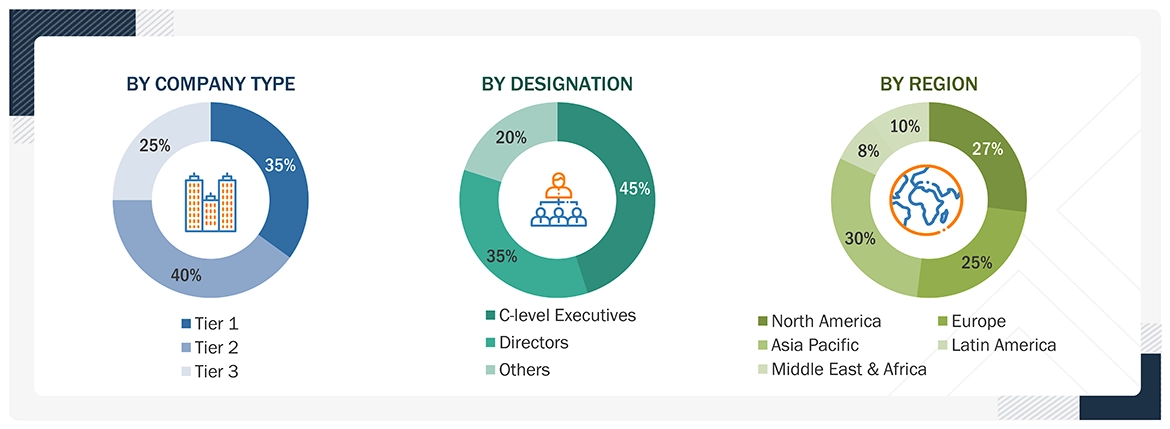
Note 1: C-level executives include CEOs, COOs, CTOs, and VPs.
Note 2: Others include sales, marketing, and product managers.
Note 3: Companies are classified into tiers based on their total revenue. As of 2025: Tier 1 = >USD 1 billion, Tier 2 = USD 500 million to USD 1 billion, and Tier 3 = <USD 500 million.
Note: Tier 1 companies’ revenue is more than USD 10 billion; Tier 2 companies’ revenue ranges between USD 1 and 10 billion; and Tier 3 companies’ revenue ranges between USD 500 million and USD 1 billion
To know about the assumptions considered for the study, download the pdf brochure
Market Size Estimation
The research methodology used to estimate the size of the dental equipment market includes the following details. The market sizing was conducted on a global basis.
Country-level Analysis: The size of the dental equipment market was obtained from the annual presentations of leading players and secondary data available in the public domain. The share of products in the overall dental equipment market was obtained from secondary data and validated by primary participants to arrive at the total dental equipment market. Primary participants further validated the numbers.
Geographic Market Assessment (By Region and Country): The geographic assessment was done using the following approaches:
Approach 1: Geographic revenue contributions/splits of leading players in the market (wherever available) and respective growth trends.
Approach 2: Geographic adoption trends for individual product segments by end users and growth prospects for each of the segments (assumptions and indicative estimates validated from primary interviews).
At each point, the assumptions and approaches were validated by industry experts contacted during the primary research. Considering the limitations of data available from secondary research, revenue estimates for individual companies (for the overall dental equipment market and geographic market assessment) were ascertained based on a detailed analysis of their respective product offerings, geographic reach/strength (direct or through distributors or suppliers), and the shares of the leading players in a particular region or country.
Global Dental Equipment Market Size: Bottom-up Approach & Top-down Approach

Data Triangulation
The market was divided into several segments when determining market size. Data triangulation and market breakdown processes were used as needed to complete the market engineering process and obtain precise statistics for all segments.
Approach to derive the market size and estimate market growth:
Using secondary data from both paid and unpaid sources, the market rankings for the major players were determined following a thorough analysis of their dental equipment sales. Due to data restrictions, the revenue share in certain cases was determined after a thorough analysis of the product portfolio of big corporations and their individual sales performance. This information was verified at each stage by in-depth interviews with professionals in the field.
Market Definition
Dental equipment encompasses the tools and instruments used to diagnose and treat a range of dental diseases and disorders. These supplies are utilized by dentists, dental hygienists, and dental laboratories. The category includes a variety of dental equipment, such as diagnostic tools and therapeutic instruments.
Key Stakeholders
- Manufacturers and distributors of medical devices
- Dental equipment manufacturers
- Contract manufacturers of dental equipment
- Distributors of dental equipment
- Research and consulting firms
- Raw material suppliers of dental equipment
- Dental hospitals & clinics
- Dental laboratories and associations
- Dental practitioners
- Dental laboratory technicians
- Healthcare institutions
- Diagnostic laboratories
- Academic institutions
- Research institutions
- Government associations
- Market research & consulting firms
- Venture capitalists & investors
Report Objectives
- To define, describe, and forecast the dental equipment market based on product type, end user, and region
- To provide detailed information about the major factors influencing the market growth (such as drivers, restraints, challenges, and opportunities)
- To strategically analyze micromarkets with respect to individual growth trends, prospects, and contributions to the overall dental equipment market
- To analyze market opportunities for stakeholders and provide details of the competitive landscape for key players
- To forecast the size of the dental equipment market in North America, Europe, the Asia Pacific, Latin America, the Middle East & Africa, and GCC Countries
- To profile the key players and comprehensively analyze their market shares and core competencies in the dental equipment market
- To track and analyze competitive developments such as partnerships, expansions, acquisitions, collaborations, product launches, agreements, and other developments in the dental equipment market
- To benchmark players within the dental equipment market using the Company Evaluation Quadrant framework, which analyzes market players on various parameters within the broad categories of business strategy, market share, and product offerings
Available customizations:
Based on the given market data, MarketsandMarkets offers customizations tailored to your company’s specific needs. The following customization options are available for the report:
Company Information
- Detailed analysis and profiling of additional market players (up to 5)
Geographic Analysis
- Further breakdown of the Rest of Europe dental equipment market into Switzerland, Austria, Belgium, and others
- Further breakdown of the Rest of Asia Pacific dental equipment market into Singapore, Malaysia, and others
Company Information
- Detailed analysis and profiling of additional market players
Need a Tailored Report?
Customize this report to your needs
Get 10% FREE Customization
Customize This Report
Fact checked
Personalize This Research
- Triangulate with your Own Data
- Get Data as per your Format and Definition
- Gain a Deeper Dive on a Specific Application, Geography, Customer or Competitor
- Any level of Personalization
Let Us Help You
- What are the Known and Unknown Adjacencies Impacting the Dental Equipment Market
- What will your New Revenue Sources be?
- Who will be your Top Customer; what will make them switch?
- Defend your Market Share or Win Competitors
- Get a Scorecard for Target Partners

Custom Market Research Services
We Will Customise The Research For You, In Case The Report Listed Above Does Not Meet With Your Requirements
Get 10% Free CustomisationTESTIMONIALS

JAYANT RAJPUROHIT
Director of Market Insights, Data and Analytics
SFI Health,
Leading Pharmaceutical Companywww.sfihealth.com/

We at SFI Health approached MarketsandMarkets for an Opportunity Assessment on "Incidence and Prevalence of Focus Indications" as we wanted to know the most attractive HCPs like Physician, Functional MD, Naturopath and Pharmacist. The project was critical for us to ensure our focus on the right target which would enable sustainable growth and profitability for SFI Health. The business insights provided exceeded our expectations and we were extremely impressed. The team at MarketsandMarkets is highly professional and detail oriented and very well understood our business needs. MarketsandMarkets offers a unique combination of expertise and dedicated engagement model. We identified 2 new products to be launched in coming months, based on the research findings provided by MarketsandMarkets. We are happy with the services and would strongly recommend MarketsandMarkets to my peers in the industry.

BEATRIZ DE LA CALLE
Head of Commercial Analytics
Qualicaps,
Leading Pharmaceutical Companywww.qualicaps.com/

We partnered with MarketsandMarkets for an assessment study on hard empty capsules. The team was extremely professional in understanding our business requirements and we received timely responses to all our queries. The market intelligence and the recommendations has met our business requirements. We were extremely impressed to see the final study results; it really exceeded our expectations. The market intelligence offered by MarketsandMarkets, and clarity on next steps will help us achieve our business objective for the Year 2021. We are happy with the services and would strongly recommend MarketsandMarkets to my peers in the industry.

Bob Williams,
Senior Director Business Development & Innovation
Bracco Diagnostics Inc.,
Italian Multinational in life sciences sector and a World Leader in imaging diagnosticsimaging.bracco.com/us-en
We were pleased with targeted insights that MarketsandMarkets identified from a custom study on the 'Radiation Dose Management Solutions Market'. Your team identified and characterized the market participants as well as underlying trends accurately. This study was useful to Bracco in formulating business strategies for our dose monitoring product lines and we thank MarketsandMarkets for the job well done.
Cody Coonradt,
Market Development and Strategy Manager
3M Health Information Systems,
Leader in Health care Coding, Payment & Analytics Solutions.www.3m.com/3M/en_US/health-information-systems-us
The value for our organization comes from three things: depth of research, specificity of segments and being easy to work with. As important as the first two are, the third can't be underestimated. MarketsandMarkets, maybe more than any other research vendor, wants to know what is top of mind for our team and what big questions we are grappling to answer.
Their customer first approach and high value engagement model, have given us great analysis and excellent value for money
- Germany Dental Equipment Market
- France Dental Equipment Market
- UK Dental Equipment Market
- Italy Dental Equipment Market
- Spain Dental Equipment Market
- Canada Dental Equipment Market
- US Dental Equipment Market
- China Dental Equipment Market
- Japan Dental Equipment Market
- India Dental Equipment Market
- Australia Dental Equipment Market
- South Korea Dental Equipment Market
- Brazil Dental Equipment Market
- Mexico Dental Equipment Market
- Argentina Dental Equipment Market
Growth opportunities and latent adjacency in Dental Equipment Market






MnM Analyst
Sep, 2023
Hi Ivan,
The growth of the European dental manufacturing market is attributed to a number of factors, including:
1. Increasing geriatric population: The aging population in Europe is leading to an increase in the prevalence of dental diseases, such as cavities, gum disease, and tooth loss. This is driving the demand for dental implants, crowns, bridges, and other restorative devices.
2. Growing awareness about oral health: There is a growing awareness about the importance of oral health among the general population in Europe. This is leading to an increase in the demand for preventive dental care, such as dental cleanings and checkups.
3. Advances in dental technology: There have been significant advances in dental technology in recent years. This has led to the development of new dental products and services, such as 3D printing, laser dentistry, and digital imaging. These new technologies are making it possible to provide more accurate and efficient dental care.
4. Increased disposable income: The rising disposable income of consumers in Europe is making it possible for them to afford more expensive dental care. This is driving the demand for high-end dental products and services.
The European dental manufacturing market is highly competitive. Some of the major players in the market include:
1. 3M
2. Dentsply Sirona
3. Straumann
4. Danaher
5. Henry Schein
6. Zimmer Biomet
7. Planmeca
8. Ivoclar Vivadent
9. GC Corporation
10. Biolase Inc.
These companies are investing heavily in research and development to develop new products and services that meet the needs of consumers. They are also expanding their geographic presence to tap into new markets.
The European dental manufacturing market is expected to continue to grow in the coming years. The growth of the market will be driven by the factors mentioned above, as well as by the increasing demand for dental care in emerging markets, such as China and India..
Ivan
Sep, 2023
WHAT IS EUROPE OF GLOBAL DENTAL MANUFACTURING MARKET.
Aiden
Jun, 2026
I reviewed the Dental Equipment Market report and found the segmentation of restorative and diagnostic systems particularly useful for assessing vendor positioning across hospital and clinic procurement cycles..
Luna
Jun, 2026
While going through the Dental Equipment Market insights, I focused on the integration of CAD/CAM and digital imaging technologies, which clarified how workflow automation is reshaping chairside treatment efficiency..
Grayson
Jun, 2026
From an investment standpoint in the Dental Equipment Market, I see steady opportunities in emerging economies where outpatient dental infrastructure expansion is driving sustained capital equipment demand..