Autonomous Forklift Market

Autonomous Forklift Market by Tonnage (<3, 3-5, >5), Navigation (Laser, Vision, Optical Tape, Magnetic, SLAM, Inductive Guidance), Sales Channel, Application, End-use Industry, Forklift Type, Propulsion, Component, and Region - Global Forecast to 2033




OVERVIEW
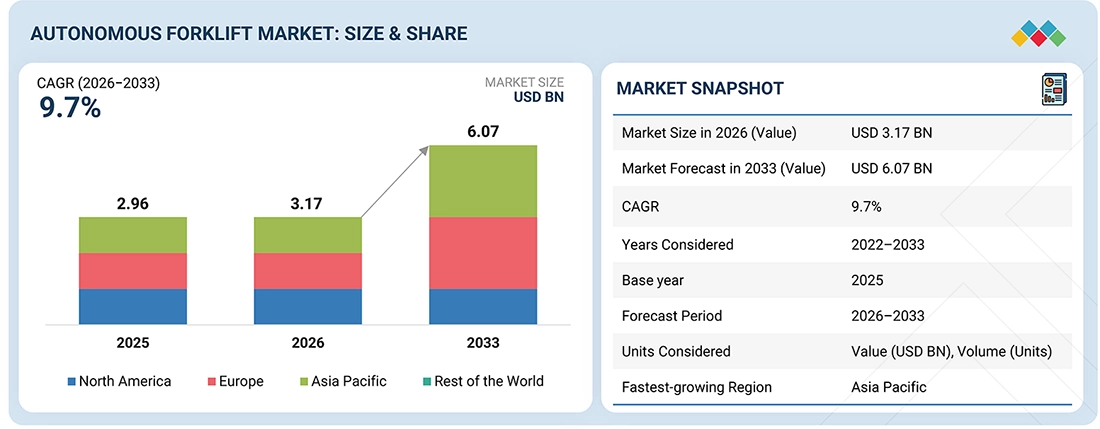
Source: Secondary Research, Interviews with Experts, MarketsandMarkets Analysis
The Autonomous Forklift market is projected to grow from USD 3.17 billion in 2026 to USD 6.07 billion by 2033, at a CAGR of 9.7% during the forecast period. The growth of the autonomous forklift market is primarily driven by the increasing adoption of automation across warehouses, distribution centers, and manufacturing facilities, where businesses are looking to improve efficiency, address labor shortages, and enhance workplace safety. In addition, stringent warehouse safety regulations are encouraging the adoption of autonomous forklifts to reduce workplace accidents and ensure consistent material handling operations. Businesses are increasingly turning to automation to enhance productivity, minimize operational risks, support 24/7 operations, and gain a competitive edge. The market is further propelled by advancements in AI, IoT, and sensor fusion technologies, particularly the integration of LiDAR and 3D vision systems which enable real-time path optimization and precision navigation in warehouse.
Autonomous Forklift Market Size and Forecast:
- Market Size Value in 2026: USD 3.17 billion
- Revenue Forecast in 2033: USD 6.07 billion
- Growth Rate: CAGR of 9.7% from 2026 to 2033
- Data available from 2022 to 2033
- Base year: 2025
- Forecast period: 2026–2033
- Largest Growing Region: Asia Pacific
- Units Considered: Value (USD Billion), Volume (Units)
Key Autonomous Forklift Market Trends and Insights
- Autonomous Forklift Market Growth: Growth is driven by rapid warehouse automation, expanding e-commerce and logistics operations, increasing labor shortages, and the need to improve operational efficiency and workplace safety.
-
Technology Impact: AI-powered navigation, LiDAR, 3D vision systems, IoT connectivity, SLAM technology, and real-time fleet management enable autonomous forklifts to optimize routes, improve accuracy, and enhance warehouse productivity.
- Growing Trends: The Autonomous Forklift market is witnessing increased adoption of laser-guided and vision-guided autonomous forklifts, cloud-based fleet management platforms, predictive maintenance, electric autonomous forklifts, and smart warehouse integration.
- Growth Opportunities: Opportunities are driven by rising investments in Industry 4.0, growing adoption of automated material handling systems, expansion of manufacturing and healthcare logistics, and increasing demand for autonomous warehouse operations.
KEY TAKEAWAYS
-
BY REGIONEurope is expected to account for the largest share of ~40% of the autonomous forklift market in 2026.
-
BY NAVIGATION TECHNOLOGYThe magnetic guidance segment is expected to hold the largest market share during the forecast period.
-
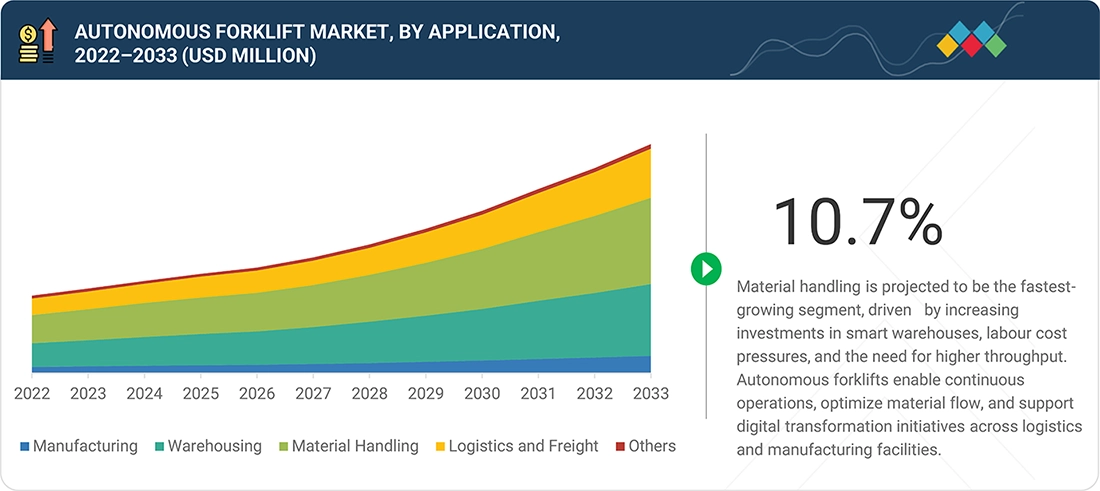
BY APPLICATIONMaterial handling is the largest and fastest-growing application segment for the autonomous forklift market.
-
BY TONNAGE CAPACITYBelow 3 ton autonomous forklifts dominate the market in 2026.
-
BY FUEL SOURCEElectric autonomous forklifts are projected to dominate the market in 2026.
-
BY TYPEIndoor autonomous forklifts are expected to dominate the market during the forecast period.
-
BY FORKLIFT TYPEThe pallet stackers segment is expected to grow at the highest CAGR of 9.9% during the forecast period.
-
BY SALES CHANNELLeasing autonomous forklifts are expected to register the highest CAGR of 10.7% during the forecast period.
-
BY END-USE INDUSTRYThe healthcare industry is expected to register the fastest growth rate during the forecast period.
-
COMPETITIVE LANDSCAPE (KEY PLAYERS)The autonomous forklift market is led by globally established players such as Toyota Industries Corporation (Japan), KION Group AG (Germany), Jungheinrich AG (Germany), and Hyster-Yale Materials Handling, Inc. (US). These companies adopted product launches/developments, partnerships, agreements, mergers & acquisitions, expansions, and contracts to gain traction in the high-growth autonomous forklift market.
The autonomous forklift market is growing from standalone vehicle automation toward intelligent material flow ecosystems that connect autonomous forklifts, AMRs, warehouse software, and enterprise systems. Warehouses are increasingly adopting AI-driven navigation, fleet orchestration platforms, and real-time analytics to improve throughput, reduce labor dependency, and optimize asset utilization. The market is also witnessing a shift from fixed-path autonomous forklifts to natural navigation autonomous forklifts capable of dynamic navigation and collaborative operation within mixed traffic environments. Furthermore, OEMs are expanding beyond equipment sales by offering software platforms, predictive maintenance solutions, and fleet optimization services, while emerging technologies such as digital twins, multi-robot orchestration, and autonomous yard-to-warehouse operations are reshaping the future of warehouse automation.
TRENDS & DISRUPTIONS IMPACTING CUSTOMERS' CUSTOMERS
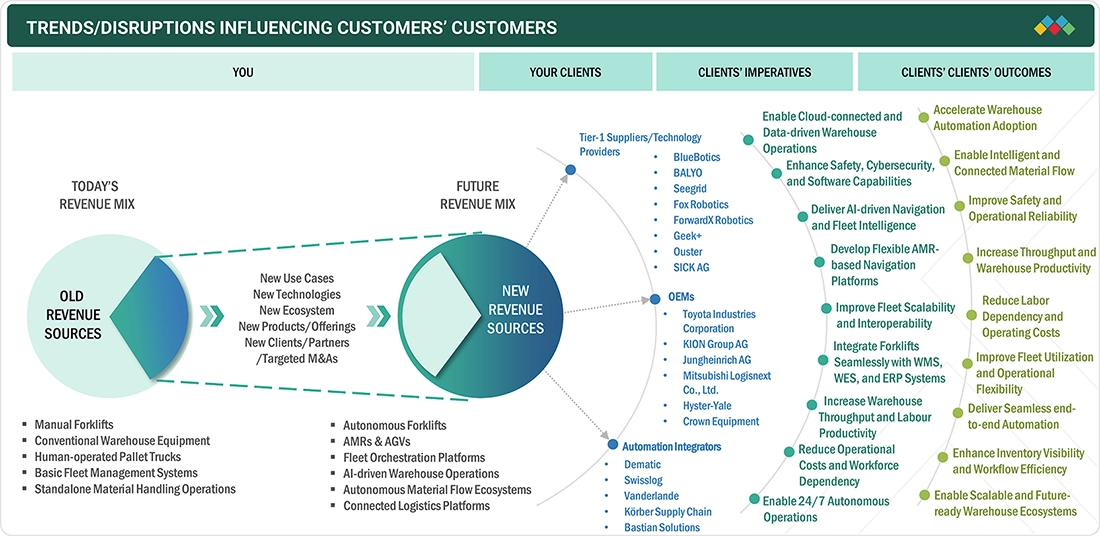
Trends and disruptions in the autonomous forklift market highlights the ongoing shift from conventional material handling equipment to intelligent, connected, and autonomous warehouse ecosystems. The market is driven by advancements in AI-based navigation, fleet orchestration software, and autonomous material flow solutions, alongside increasing demand for 24/7 operations and higher warehouse productivity. The growing integration of autonomous forklifts with WMS, WES, ERP, and cloud-based analytics platforms is enabling real-time decision-making, improved asset utilization, and end-to-end warehouse automation, reshaping the future of intralogistics operations.
Source: Secondary Research, Interviews with Experts, MarketsandMarkets Analysis
MARKET DYNAMICS

Level
-
Warehouse Labor Shortages and Shift Toward Autonomous Material Handling

-
Expansion of E-commerce and Logistics Fulfillment Centers Driving 24/7 Automation and Higher Asset Utilization


Level
-
High Initial Capital Investment and Integration Costs


Level
-
AI-enabled Fleet Management and Smart Warehouse Ecosystems

-
Expansion of Smart Factories and Data-driven Intralogistics Operations


Level
-
Scalability and Operational Flexibility in Dynamic Environments

-
High Integration Complexity and Facility Digitalization Requirements

Source: Secondary Research, Interviews with Experts, MarketsandMarkets Analysis
Driver: Warehouse Labor Shortages and the Shift Toward Autonomous Material Handling
Warehouse labor shortages are emerging as a key driver for the autonomous forklift market as warehouses struggle with workforce shortages, rising labor costs, and high employee turnover. To maintain productivity and support 24/7 operations, companies are increasingly adopting autonomous forklifts to reduce labor dependency and improve operational efficiency. During peak seasons, warehouses often rely on temporary and contract workers to manage higher order volumes. However, unfamiliarity with site-specific safety procedures and warehouse workflows can increase accident rates, product damage risks, and operational disruptions, further driving demand for autonomous material handling solutions that deliver consistent and safe operations. The growth is expected as e-commerce expansion and higher warehouse throughput requirements rise. Consequently, warehouse operations are evolving from traditional manual facilities to semi-automated warehouses, smart warehouses, and highly autonomous distribution centers, increasing the need for autonomous forklifts and connected material handling systems. Globally, demand is increasing across e-commerce, logistics, manufacturing, retail, and food & beverage industries. Major companies such as Amazon, Walmart, DHL, DB Schenker, and Toyota Motor Corporation are increasingly using warehouse automation and autonomous material-handling technologies to improve operational efficiency and address labor challenges. OEMs such as Toyota Industries Corporation, KION Group AG, Jungheinrich AG, Mitsubishi Logisnext Co., Ltd., and Hyster-Yale Materials Handling, Inc. are expanding autonomous forklift portfolios with AI-based navigation, LiDAR, machine vision, and warehouse management system integration capabilities. North America and Europe currently lead adoption due to labor constraints and automation investments, while China, Japan, and South Korea are rapidly expanding deployment to support growing logistics and manufacturing activities. Autonomous forklifts are increasingly moving beyond large distribution centers into mid-sized warehouses and production facilities. Persistent labor shortages are accelerating warehouse automation, positioning autonomous forklifts as a critical component of next-generation material handling operations.
Restraint: High Initial Capital Investment and Integration Costs
The high initial investment required for autonomous forklift deployment remains a significant restraint to market growth, particularly among small and medium-sized warehouse and distributors. Autonomous forklifts typically cost substantially more than conventional forklifts due to the inclusion of advanced technologies such as LiDAR, cameras, AI-based navigation software, fleet management systems, and safety features. Beyond equipment costs, companies must also invest in software integration, charging infrastructure, employee training, and implementation services, increasing the overall project expenditure. Additionally, deploying autonomous forklifts often requires modifications to existing warehouse layouts, including changes to aisle configurations, storage areas, traffic routes, and safety zones to support autonomous operations. These facility redesign requirements add further implementation costs and increase the overall investment burden for warehouse operators. The challenge becomes more pronounced in brownfield facilities where autonomous forklifts must be integrated with existing warehouse management systems, warehouse execution systems, and mixed manual-automation workflows. Changes in warehouse layouts, operational processes, and system configurations often require additional customization, testing, and recalibration, resulting in longer deployment timelines and higher maintenance costs. While large organizations are increasingly investing in warehouse automation, many SMEs continue to struggle to justify the upfront costs despite the long-term benefits of improved productivity, safety, and labor efficiency. To address this challenge, OEMs such as Jungheinrich AG and Toyota Industries Corporation are offering integrated autonomous forklift solutions that simplify deployment and reduce compatibility concerns. However, the overall investment requirement remains a key barrier, particularly in cost-sensitive markets where labor costs are relatively lower and automation payback periods are longer. Despite strong long-term operational benefits, high upfront investment and integration complexity continue to limit the adoption of autonomous forklifts in many warehouse environments.
Opportunity: AI-Enabled Fleet Management and Smart Warehouse Ecosystems
The emergence of AI-enabled fleet management and smart warehouse ecosystems presents a significant growth opportunity for the autonomous forklift market. As warehouses are getting digitalized, autonomous forklifts are evolving from standalone material handling equipment into connected assets that continuously exchange data with warehouse management systems, robotics platforms, storage systems, and other automated infrastructure. This enables real-time task allocation, route optimization, congestion management, and improved fleet utilization across warehouse operations. The growing demand is expected to continue as warehouse operators move toward autonomous material flow ecosystems in which AI orchestrates forklifts, AMRs, AS/RS systems, conveyors, and robotic picking solutions through a unified control platform. Emerging technologies such as digital twins, predictive analytics, edge AI, and V2X communication are enabling warehouses to optimize inventory movement, reduce operational bottlenecks, and improve overall throughput. Companies such as Amazon, DHL, JD.com, and Walmart are increasingly investing in intelligent warehouse ecosystems designed around automation, data visibility, and autonomous decision-making. In parallel, OEMs, including Toyota Industries Corporation, KION Group AG, Jungheinrich AG, and Mitsubishi Logisnext Co., Ltd., are enhancing fleet intelligence, digital integration, and predictive operational capabilities. North America and Europe currently lead adoption of AI-driven warehouse ecosystems, while China, Japan, and South Korea are rapidly deploying smart logistics and smart factory solutions. As warehouses progress toward highly automated, lights-out operations, autonomous forklifts are expected to play an increasingly central role in enabling synchronized, intelligent material flow. The shift toward AI-orchestrated warehouse ecosystems is creating a major opportunity for autonomous forklifts to become the backbone of future autonomous material flow networks.
Challenge: Scalability and Operational Flexibility in Dynamic Environments
Maintaining scalability and operational flexibility in dynamic warehouse environments remains a key challenge for the autonomous forklift market. While autonomous forklifts perform efficiently in structured settings, many warehouses and manufacturing facilities experience frequent layout modifications, changing inventory locations, seasonal demand fluctuations, and unpredictable human and vehicle traffic. These constantly changing conditions can affect navigation efficiency, route optimization, and overall fleet performance. The challenge becomes more pronounced as operators expand deployments from a few autonomous vehicles to large-scale fleets operating across multiple warehouse zones. Coordinating autonomous forklifts alongside manual forklifts, AMRs, conveyors, AS/RS systems, and human workers requires advanced fleet orchestration and real-time decision-making capabilities to prevent congestion, bottlenecks, and operational disruptions. This issue is particularly evident in high-throughput environments such as e-commerce fulfillment centers, third-party logistics facilities, retail distribution hubs, and automotive manufacturing plants, where workflows and material movement patterns frequently change. Although advancements in AI, digital twins, and predictive fleet management are improving adaptability, achieving seamless performance across highly dynamic environments remains a significant technical challenge. Balancing large-scale deployment with the flexibility needed to operate efficiently in constantly changing warehouse environments remains a critical challenge for the adoption of autonomous forklifts.
AUTONOMOUS FORKLIFT MARKET: COMMERCIAL USE CASES ACROSS INDUSTRIES
| COMPANY | USE CASE DESCRIPTION | BENEFITS |
|---|---|---|
 |
Smart warehouse automation through autonomous forklift fleets connected with WMS and enterprise systems | Higher throughput, lower labor costs, and improved operational visibility |
 |
End-to-end automated material flow using autonomous forklifts and warehouse automation solutions | Faster order fulfillment, optimized warehouse utilization, and reduced downtime |
 |
Autonomous pallet transport and intralogistics automation for manufacturing and distribution facilities | Improved productivity, lower operating costs, and enhanced process reliability |
 |
AI-enabled autonomous forklift deployment for repetitive and high-volume material handling tasks | Reduced human intervention, increased accuracy, and improved warehouse safety |
 |
Connected autonomous forklift ecosystems leveraging analytics and real-time fleet optimization | Better fleet utilization, predictive maintenance, and improved ROI on automation investments |
Logos and trademarks shown above are the property of their respective owners. Their use here is for informational and illustrative purposes only.
MARKET ECOSYSTEM
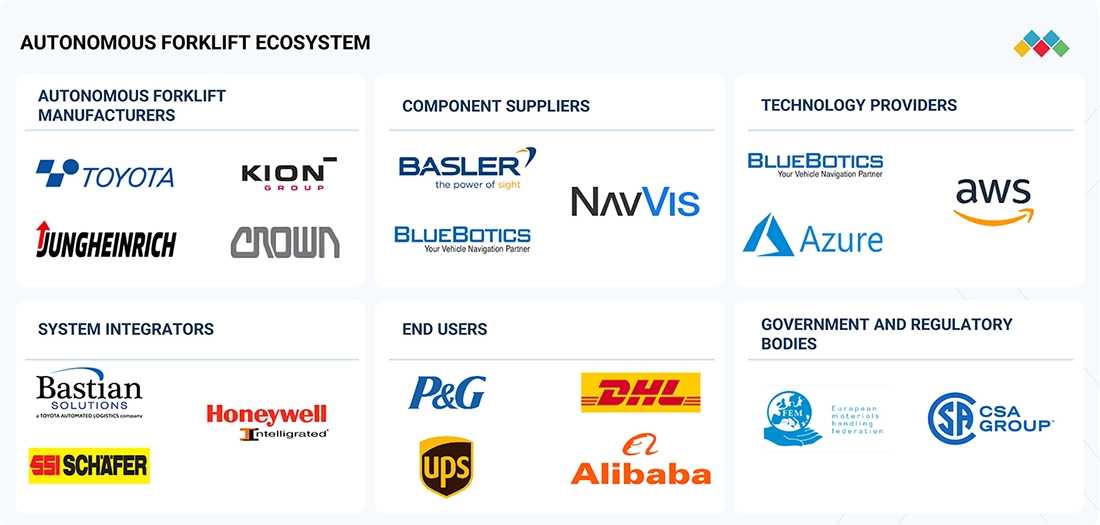
This section highlights the autonomous forklift ecosystem, comprising OEMs, component suppliers, technology providers, system integrators, end users, and regulatory bodies. Together, these stakeholders drive innovation, enable seamless deployment of autonomous material handling solutions, and support the advancement of warehouse automation, operational efficiency, and workplace safety.
Logos and trademarks shown above are the property of their respective owners. Their use here is for informational and illustrative purposes only.
MARKET SEGMENTS
Source: Secondary Research, Interviews with Experts, MarketsandMarkets Analysis
Autonomous Forklift Market, by Navigation Technology
Magnetic guidance navigation technology is expected to dominate the autonomous forklift market due to its reliability, cost-effectiveness, and suitability for structured warehouse environments with fixed routes. It is widely adopted across warehousing, food & beverage, retail, and manufacturing facilities for repetitive pallet handling operations. Meanwhile, laser-guided navigation is gaining traction in Europe, particularly in automotive and pharmaceutical industries, where high positioning accuracy and inventory traceability are critical. The integration of AI-powered obstacle detection, sensor fusion, and real-time path optimization is further enhancing navigation performance and supporting smart warehouse automation.
Autonomous Forklift Market, by Application
The material handling industry is expected to account for the largest share of the autonomous forklift market owing to the increasing automation of warehouse, manufacturing, and distribution operations. Autonomous forklifts improve material flow, reduce labor dependency, and enhance operational efficiency in high-throughput environments. The rapid growth of e-commerce fulfillment centers, third-party logistics (3PL) facilities, and automotive manufacturing plants is accelerating demand for autonomous material handling solutions. Additionally, the need for 24/7 warehouse operations, inventory accuracy, and workplace safety continues to drive adoption across industries.
Autonomous Forklift Market, by Tonnage Capacity
Autonomous forklifts with a tonnage capacity below 3 tons are anticipated to dominate the market due to their widespread adoption across e-commerce, retail, food & beverage, pharmaceutical, and third-party logistics (3PL) warehouses. The segment primarily consists of autonomous pallet jacks, pallet stackers, and lightweight reach trucks, which are extensively used for pallet transport, replenishment, put-away, and retrieval operations. These forklifts offer an optimal balance between maneuverability, load-handling capability, and operational flexibility, making them well-suited for high-density warehouse environments. Increasing warehouse automation, fulfillment center expansion, and demand for efficient material flow are further supporting segment growth. Meanwhile, higher-capacity autonomous forklifts are gaining traction in ports, heavy manufacturing, metals, and container handling operations, where larger loads and rugged operating conditions are common.
Autonomous Forklift Market, by Fuel Source
Electric autonomous forklifts are expected to lead the market due to their lower operating costs, reduced maintenance requirements, and alignment with sustainability initiatives. The growing availability of lithium-ion batteries, advancements in battery management systems, and expanding charging infrastructure are accelerating adoption globally. Electric forklifts also integrate more effectively with autonomous software and warehouse automation platforms. In parallel, hydrogen fuel cell-powered autonomous forklifts are emerging as a promising solution for high-utilization and multi-shift operations, particularly in large distribution centers seeking fast refueling and minimal downtime.
Autonomous Forklift Market, by Type
Indoor autonomous forklifts are projected to hold the largest market share owing to their extensive deployment across warehouses, distribution centers, manufacturing facilities, and e-commerce fulfillment centers. The controlled indoor environment enables autonomous forklifts to operate with greater accuracy, safety, and efficiency, making them well-suited for repetitive material handling tasks. Growing investments in warehouse automation, smart logistics infrastructure, and high-density storage facilities are further driving segment growth. Additionally, the increasing adoption of warehouse management systems (WMS), real-time inventory tracking, and automated material flow solutions is accelerating the demand for indoor autonomous forklift operations globally.
Autonomous Forklift Market, by Forklift Type
Pallet jacks are expected to dominate the autonomous forklift market due to their widespread use in horizontal pallet movement and warehouse transportation operations. Typically operating below 3 tons, they are extensively used across e-commerce, retail, food & beverage, pharmaceutical, and 3PL warehouses, where efficient material flow and high-volume pallet handling are critical. Their compact design and suitability for repetitive point-to-point tasks make them ideal for automated warehouse environments. The rapid expansion of fulfillment centers and smart warehouses is further driving demand, while advancements in navigation, fleet management, and WMS integration continue to enhance operational efficiency.
Autonomous Forklift Market, by Sales Channel
The in-house sales channel is projected to account for the largest share of the autonomous forklift market as leading OEMs increasingly focus on direct customer engagement, customized automation solutions, and end-to-end project execution. Large warehouses, manufacturing facilities, and logistics operators prefer working directly with autonomous forklift manufacturers to ensure seamless integration with warehouse management systems (WMS), fleet management platforms, and existing operational infrastructure. The growing demand for tailored automation solutions, technical support, training, and after-sales services further strengthens the position of in-house sales channels. Additionally, direct customer relationships enable OEMs to better address complex automation requirements and support long-term digital transformation initiatives. Furthermore, Leasing and rental models are gaining traction among SMEs due to their lower upfront costs, financial flexibility, and easier access to warehouse automation technologies.
Autonomous Forklift Market, by End-use Industry
The food & beverage industry is expected to hold the largest share of the autonomous forklift market owing to its high-volume material handling requirements, stringent hygiene standards, and need for continuous warehouse operations. Autonomous forklifts help food & beverage companies improve inventory accuracy, ensure consistent material flow, and reduce operational disruptions in temperature-controlled and high-throughput environments. The growing adoption of automated warehousing, increasing labor shortages, and rising demand for supply chain efficiency are further accelerating deployment across the sector. Meanwhile, industries such as warehousing & logistics, automotive, manufacturing, retail, and ports & terminals are increasingly adopting autonomous forklifts to enhance productivity, safety, and operational reliability. Also, the food & beverage industry has majority of pallet handling operations typically involve loads ranging from 0.5 to 2.5 tons, making below 3-ton autonomous forklifts, particularly pallet jacks and pallet stackers, the preferred choice for warehouse transportation, storage, and order fulfillment activities.
REGION
Asia Pacific to be the largest region in the global autonomous forklift market by 2033
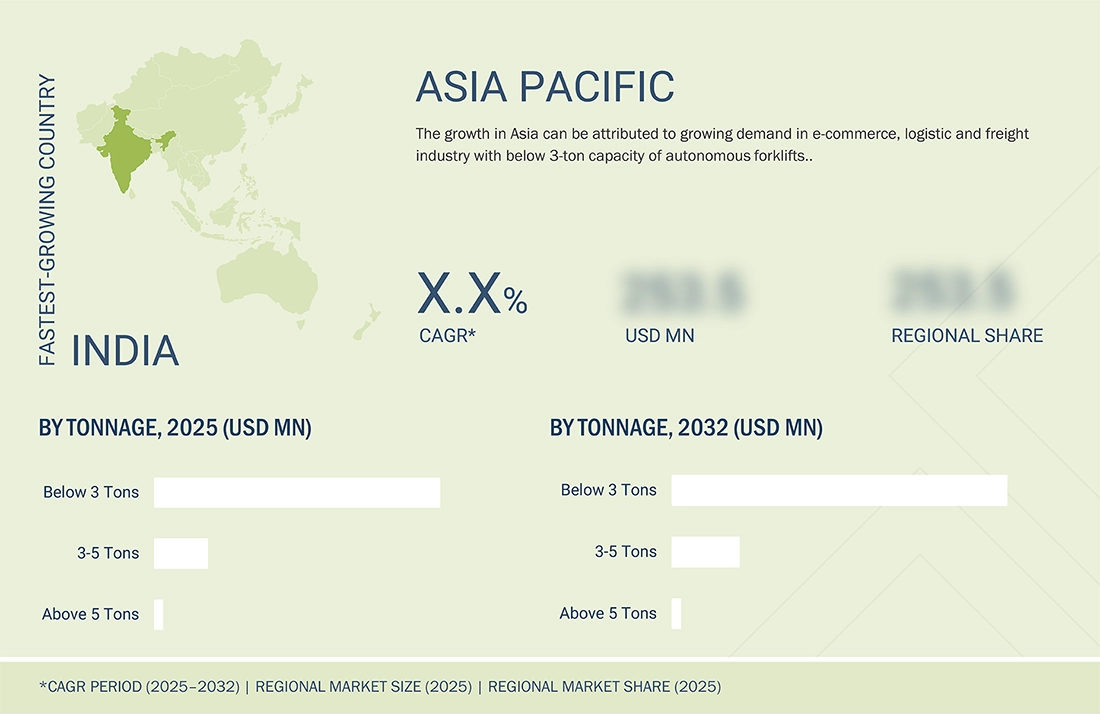
The Asia Pacific autonomous forklift market is the second-largest market in 2026, driven by rapid industrialization, expanding warehouse infrastructure, and increasing investments in automation across manufacturing, logistics, and e-commerce sectors, particularly in China, Japan, and India. Major logistics hubs such as Shanghai, Singapore, Tokyo, Mumbai, and Seoul face high industrial land costs, encouraging the development of high-rack storage facilities, narrow-aisle warehouses, and space-optimized distribution centers. This is accelerating the adoption of autonomous forklifts that can operate accurately within tight spaces while improving storage density and material flow efficiency. The region is witnessing strong demand for below 3-ton autonomous forklifts, particularly pallet jacks and pallet stackers, across e-commerce, retail, food & beverage, pharmaceutical, and third-party logistics (3PL) industries, where pallet loads typically remain below 2–3 tons. These industries increasingly rely on autonomous forklifts to support inventory traceability, space optimization, and round-the-clock warehouse operations. OEMs and technology providers are focusing on localized manufacturing, cost-effective automation solutions, and seamless integration with warehouse management systems (WMS), while advancements in AI-based navigation, LiDAR, and fleet management technologies continue to enhance productivity and operational consistency across modern warehouse environments.
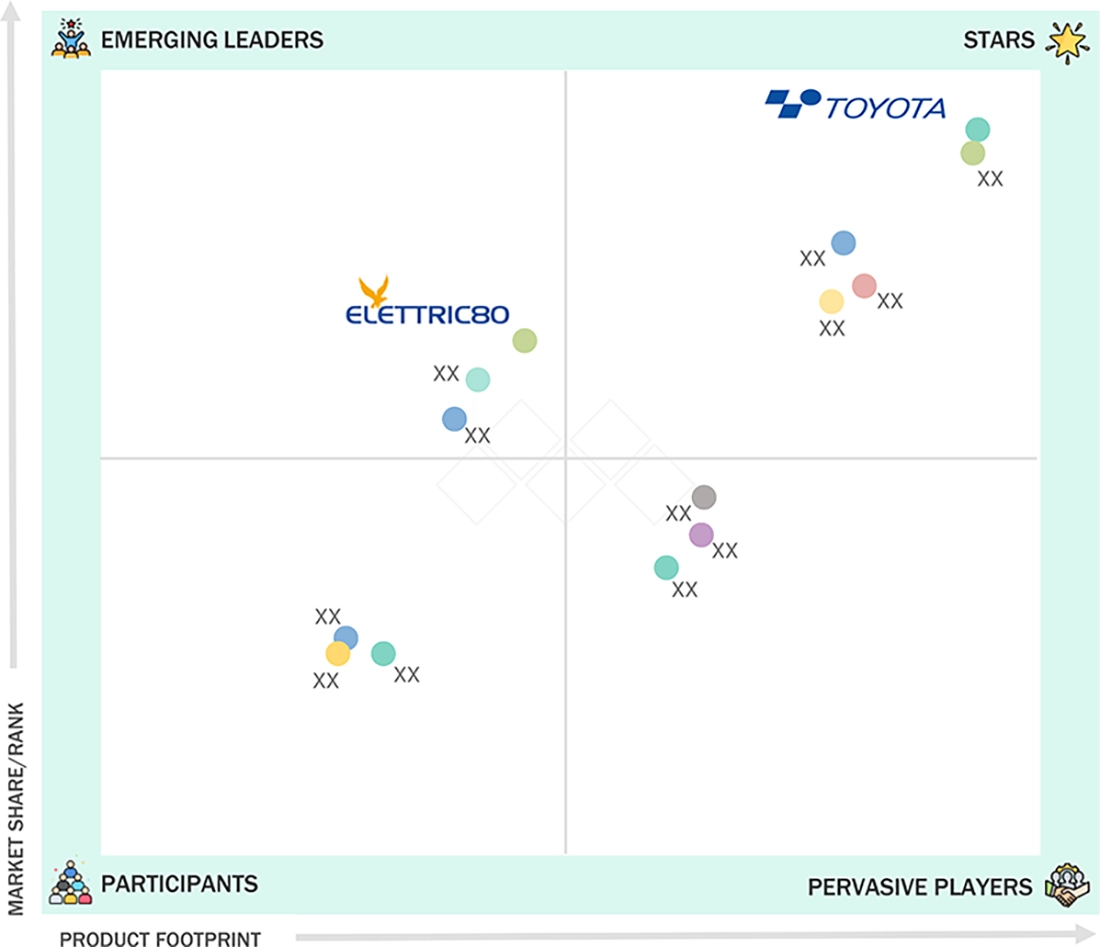
AUTONOMOUS FORKLIFT MARKET: COMPANY EVALUATION MATRIX
In the autonomous forklift market matrix, Toyota Industrial Corporation is positioned as a Star due to its strong global presence and diverse product portfolio. The company excels in automation and demonstrates its ability to meet evolving market demands for efficient automated material handling solutions, which enhances its brand recognition and customer trust. Electric 80 Group is classified as an Emerging Leader, gaining traction with its integrated automated logistics systems, autonomous forklifts, and smart warehouse solutions designed for high-volume industrial environments. The company shows strong growth potential as it works toward advancing into the leaders' quadrant.
Source: Secondary Research, Interviews with Experts, MarketsandMarkets Analysis
KEY MARKET PLAYERS
- • Toyota Industries Corporation
- • KION Group AG
- • Mitsubishi Logisnext Co., Ltd.
- • Jungheinrich AG
- • Hyster-Yale Materials Handling, Inc.
- • AGILOX Services GmbH
- • Swisslog Holding AG
- • Oceaneering International, Inc.
- • Balyo SA
- • Mobile Industrial Robots
- • Anhui Heli Co., Ltd
- • Seegrid Corporation
MARKET SCOPE
| REPORT METRIC | DETAILS |
|---|---|
| Market Size in 2025 (Value) | USD 2.96 Billion |
| Market Size in 2026 (Value) | USD 3.17 Billion |
| Market Forecast in 2033 (Value) | USD 6.07 Billion |
| Growth Rate | CAGR of 9.7% from 2026 to 2033 |
| Years Considered | 2022-2033 |
| Base Year | 2025 |
| Forecast Period | 2026-2033 |
| Units Considered | Value (USD Million/Billion), Volume (Units) |
| Report Coverage | Revenue Forecast, Regional Market Shares, Competitive Landscape, Driving Factors, Trends & Disruptions, OEM Analysis, Total Cost of Ownership, and Others |
| Segments Covered |
|
| Regional Scope | Asia Pacific, Europe, North America, Rest of the World |
WHAT IS IN IT FOR YOU: AUTONOMOUS FORKLIFT MARKET REPORT CONTENT GUIDE
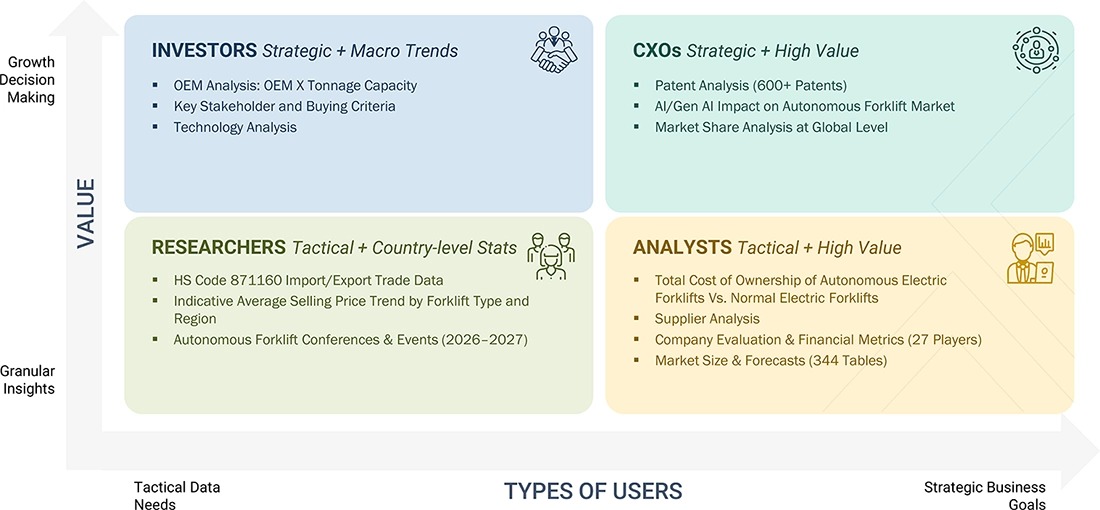
DELIVERED CUSTOMIZATIONS
We have successfully delivered the following deep-dive customizations:
| CLIENT REQUEST | CUSTOMIZATION DELIVERED | VALUE ADDS |
|---|---|---|
| Autonomous forklift market, by type, at the country level | • Country-level market for indoor autonomous forklifts and outdoor autonomous forklifts for countries such as India, Japan, Germany, the US, Canada, and Others | • Market opportunity and investment priority by country and use case |
RECENT DEVELOPMENTS
- April 2026 : Toyota Automated Logistics was launched in April 2026, integrating Toyota Industries’ warehouse automation businesses to provide cohesive logistics automation and enhanced synergy between automation and material handling.
- April 2026 : Yale has launched a new automated stacker with up to 3,300 lb capacity and approx. 13 ft lift height for vertical pallet positioning.
- March 2026 : KION announced work with NVIDIA on functional safety certification using 360° perception for autonomous industrial trucks, including object/worker/robot detection for trailer-loading automation.
- Aug-25 : Swisslog launched IntraMove AMRs for dynamic horizontal pallet transport with payload versions of 600 kg, 1,500 kg, and 3,000 kg, integrated lifting, scalable fleet operation and flexible top modules.
- March 2025 : AGILOX OFL is featuring free-lift capability up to 1,200 mm, 800 kg payload, AI-supported X-SWARM navigation, and infrastructure-free deployment.
Table of Contents
 Exclusive indicates content/data unique to MarketsandMarkets and not available with any competitors.
Methodology
The study involved four major activities in estimating the current size of the autonomous forklift market. Exhaustive secondary research was conducted to collect information on the market, peer, and parent markets. The next step was to validate these findings and assumptions and size them with industry experts across value chains through primary research. The bottom-up and top-down approaches were employed to estimate the complete market size. Thereafter, market breakdown and data triangulation processes were used to estimate the market size of segments and subsegments.
Secondary Research
In the secondary research process, various secondary sources such as company websites, press releases, industry association publications, intralogistics magazine articles, directories, technical handbooks, World Economic Outlook, trade websites, and technical articles were used to identify and collect information useful for an extensive commercial study of the autonomous forklift market.
Primary Research
Extensive primary research has been conducted after understanding the autonomous forklift market scenario through secondary research. Several primary interviews have been conducted with market experts from the supply side (autonomous forklift OEMs) and demand side (dealers, e-commerce companies, warehouses, etc.) across major regions, namely, North America, Europe, and the Asia Pacific. Approximately 70% and 30% of primary interviews have been conducted from the demand and supply sides, respectively. Primary data has been collected through questionnaires, emails, and telephonic interviews. In the canvassing of primaries, we have strived to cover various departments within organizations, such as sales, operations, design, and marketing, to provide a holistic viewpoint in our report.
After interacting with industry participants, we conducted brief sessions with highly experienced independent consultants to reinforce the findings from our primaries. This, along with the opinions of the in-house subject-matter experts, led us to the findings described in this report.
Breakdown of Primaries:
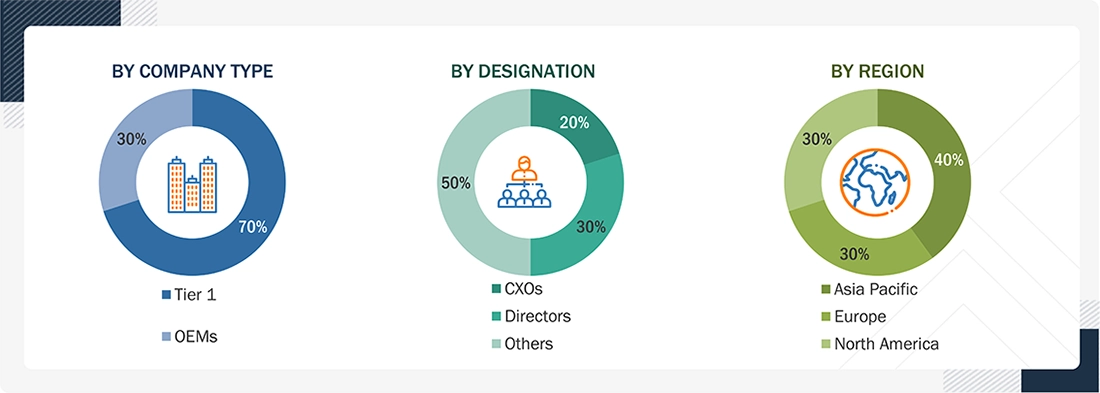
Note: Others include sales, marketing, and product managers.
To know about the assumptions considered for the study, download the pdf brochure
Market Size Estimation
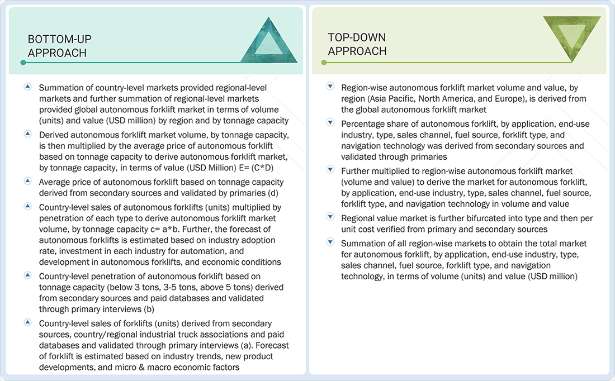
The bottom-up approach was used to estimate and validate the size of the autonomous forklift market by tonnage capacity and region. The top-down approach was used to derive market size by navigation technology, type, application, forklift type, propulsion, sales channel, tonnage capacity, and end-use industry. To determine the autonomous forklift market size by tonnage capacity, the country-level estimated value share of autonomous forklifts for each tonnage capacity was multiplied by the average selling price (below 3 tons, 3-5 tons, above 5 tons). The country-level market sizes were summed up to arrive at the regional market size, which was further added to derive the autonomous forklift market size.
Autonomous Forklift Market: Top-down Approach
The top-down approach was followed to determine the market size by application, end-use industry, type, sales channel, fuel source, forklift type, tonnage capacity, and navigation technology in terms of volume and value for autonomous forklifts. The region-wise autonomous forklift market volume and value by region (Asia Pacific, North America, Europe, Rest of the World) were derived from the global autonomous forklift market. The percentage share of autonomous forklifts by application, industry, type, sales channel, fuel source, forklift type, and navigation technology was derived from secondary sources and validated through primary sources. It was further multiplied by the region-wise autonomous forklift market volume and value. The market volume and value for autonomous forklifts by application, industry, type, sales channel, fuel source, forklift type, paper & pulp by tonnage capacity, and navigation technology were derived through this. The summation of all region-wise markets was carried out to obtain the total market for autonomous forklifts by type and industry in terms of volume (units) and value (USD million)
Autonomous Forklift Market : Top-Down and Bottom-Up Approach
Data Triangulation
All percentage shares, splits, and breakdowns were determined using secondary sources and verified through primary sources. All parameters that are expected to affect the markets covered in this research study were accounted for, viewed in extensive detail, verified through primary research, and analyzed to obtain the final quantitative and qualitative data. This data was consolidated, supplemented with detailed inputs and analysis from MarketsandMarkets, and presented in the report.
Market Definition
According to Toyota Industries Corporation (Japan), an autonomous forklift is a driverless forklift equipped with unique autopilot technology that enables reliable, accurate operation for transporting, stacking, or picking. The autopilot system can operate independently and alongside manually operated equipment.
Key Stakeholders
- OEMs
- Autonomous technology providers
- Hardware & software providers
- Dealer/distributors
- Battery manufacturers
- Robotic providers
Report Objectives
-
To define, describe, and forecast the autonomous forklift market in terms of value (USD million) and volume (units) based on the following segments:
- By tonnage capacity (below 3 tons, 3-5 tons, and above 5 tons)
- By application (manufacturing, warehousing, material handling, logistics, freight, and others)
- By navigation technology (laser guidance, magnetic guidance, vision guidance, inductive guidance, optical tape guidance, SLAM, and others)
- By industry (third-party logistics, food and beverages, automotive, paper and pulp, metals and heavy machinery, e-commerce, aviation, semiconductors and electronics, healthcare, and others)
- By fuel source (electric, ICE, and alternate fuels)
- By sales channel (in-house purchase and leasing)
- By forklift type (pallet jacks and pallet stackers)
- By type (indoor and outdoor)
- By region (Asia Pacific, Europe, North America, and the Rest of the World)
Available customizations:
Along with the market data, MarketsandMarkets offers customizations per company-specific needs.
The following customization options are available for the report
Key Questions Addressed by the Report
What is the current market size of the Autonomous Forklift Market, and how is it expected to grow?
The Autonomous Forklift Market is projected to grow from USD 3.17 billion in 2026 to USD 6.07 billion by 2033, at a CAGR of 9.7% during the forecast period.
What are the key factors driving the growth of the Autonomous Forklift Market?
The market is driven by increasing warehouse automation, rising labor shortages, rapid e-commerce growth, and advancements in AI-based navigation and autonomous material handling technologies.
Which region is expected to dominate the Autonomous Forklift Market during the forecast period?
Asia Pacific is expected to dominate the Autonomous Forklift Market due to its expanding manufacturing sector, growing logistics industry, and increasing adoption of warehouse automation.
What are the latest trends shaping the Autonomous Forklift Market?
Key trends include SLAM-based navigation, AI-powered vision systems, lithium-ion battery adoption, fleet management software, and integration with warehouse management systems (WMS).
Who are the leading companies in the Autonomous Forklift Market, and what strategies are they adopting?
Leading companies are focusing on product innovation, AI-enabled autonomous solutions, strategic partnerships, and expanding their intelligent material handling portfolios to strengthen their market presence.


Personalize This Research
- Triangulate with your Own Data
- Get Data as per your Format and Definition
- Gain a Deeper Dive on a Specific Application, Geography, Customer or Competitor
- Any level of Personalization
Let Us Help You
- What are the Known and Unknown Adjacencies Impacting the Autonomous Forklift Market
- What will your New Revenue Sources be?
- Who will be your Top Customer; what will make them switch?
- Defend your Market Share or Win Competitors
- Get a Scorecard for Target Partners

Custom Market Research Services
We Will Customise The Research For You, In Case The Report Listed Above Does Not Meet With Your Requirements
Get 10% Free CustomisationTESTIMONIALS

JIM NAAS
PRODUCT DIRECTOR, WEASLER
Weasler Engineering, a CentroMotion organization
Global Provider of Industrial Actuation & Control Solutionswww.weasler.com
Our organization was interested in learning more about the attractiveness of a particular market space. We contacted MarketsandMarkets to help us based on previous positive experiences we had with them. The results did not disappoint! We discussed our objectives with them, and the team at MarketsandMarkets developed and executed a proposal that met our needs precisely. We were very impressed by their level of expertise, the quality of the analysis and their insightful recommendations. We would not hesitate in working with them again in the future.

Matt Kardel,
Vice President
Aptiv,
A global technology company that develops safer, greener and more connected solutions.www.aptiv.com
We contracted with
MarketsandMarkets to evaluate the value chain and potential go-to-market partners related to our
interest in the Fleet Management space. The team successfully completed the work on time and at the
pricing agreed. MarketsandMarkets listened and understood our objectives and collaborated well with
us to help us get the visibility we needed to make an investment.
We have subsequently used
MarketsandMarkets again related to Smart Cities to good results.
- Germany Autonomous Forklift Market
- UK Autonomous Forklift Market
- France Autonomous Forklift Market
- Russia Autonomous Forklift Market
- Italy Autonomous Forklift Market
- Spain Autonomous Forklift Market
- Poland Autonomous Forklift Market
- Mexico Autonomous Forklift Market
- Canada Autonomous Forklift Market
- US Autonomous Forklift Market
- China Autonomous Forklift Market
- India Autonomous Forklift Market
- Japan Autonomous Forklift Market
- South Korea Autonomous Forklift Market
- Thailand Autonomous Forklift Market
- Malaysia Autonomous Forklift Market
- Singapore Autonomous Forklift Market
Growth opportunities and latent adjacency in Autonomous Forklift Market






Alex
May, 2022
We would like to know more about Autonomous Forklift Market by level of autonomy (level1, level2, level3)..