Biometric Identity Verification Market

Biometric Identity Verification Market by Hardware (Sensors, Biometric Scanners/Readers), Technology (Fingerprint, Facial, Iris, Voice Recognition), Authentication Type (MFA), Application (Access Control, KYC, Law Enforcement) - Global Forecast to 2030




OVERVIEW
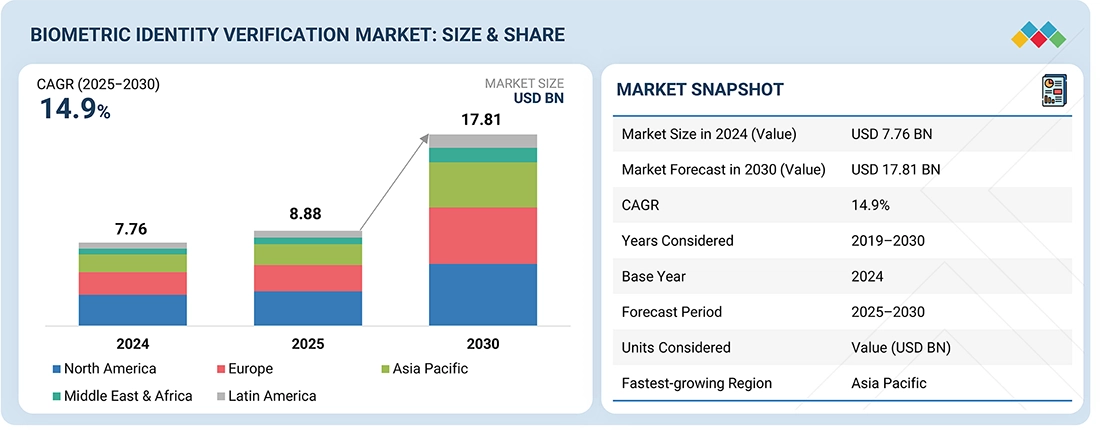
Source: Secondary Research, Interviews with Experts, MarketsandMarkets Analysis
The biometric identity verification market is projected to reach USD 17.81 billion by 2030, rising from USD 8.88 billion in 2025, at a CAGR of 14.9% from 2025 to 2030. The biometric identity verification market focuses on delivering secure, and efficient, ways to authenticate a person’s identity. Due to the continued growth of remote onboarding, digital payments, and e-government services, many companies are widely introducing a variety of advanced biometric technologies. The types of biometric technologies being introduced include facial recognition, iris recognition, and fingerprint recognition, all of which are enhanced through AI-driven liveness detection and anti-spoofing capabilities. These advancements combined provide enhanced mechanisms for establishing a person's identity, and ultimately reducing the risk of fraudulent activity in both digital and tangible channels.
KEY TAKEAWAYS
-
BY REGIONThe North America biometric identity verification market will dominate in terms of market share in 2025.
-
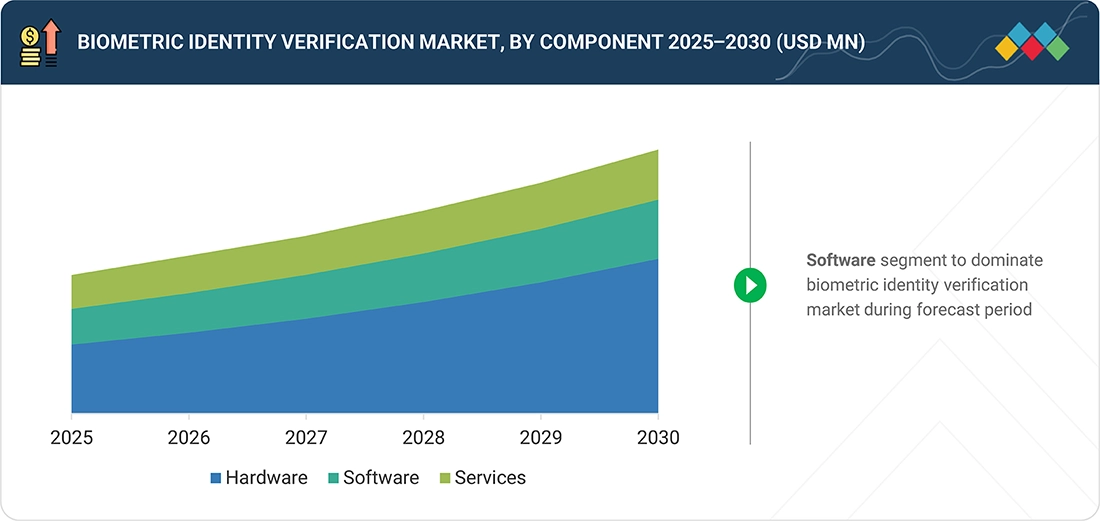
BY COMPONENTBy component, the software segment is expected to dominate the market in the forecast period with a high CAGR of 16.5%.
-
BY TECHNOLOGYBy technology, the iris recognition segment will grow faster with a CAGR of 15.2%.
-
BY AUTHENTICATION TYPEBy authentication type, the single-factor authentication segment is expected to hold the largest market size.
-
BY ORGANIZATION SIZEBy organization size, the SMEs segment is expected to register the highest CAGR of 16.5%.
-
BY MOTILITYBy motility, the portable segment is projected to grow at the fastest rate from 2025 to 2030.
-
BY APPLICATIONBy application, the logical access & digital authentication segment is expected to dominate the market with the largest market size from 2025 to 2030.
-
BY VERTICALBy vertical, the BFSI vertical is expected to dominate in terms of market share during the forecast period.
-
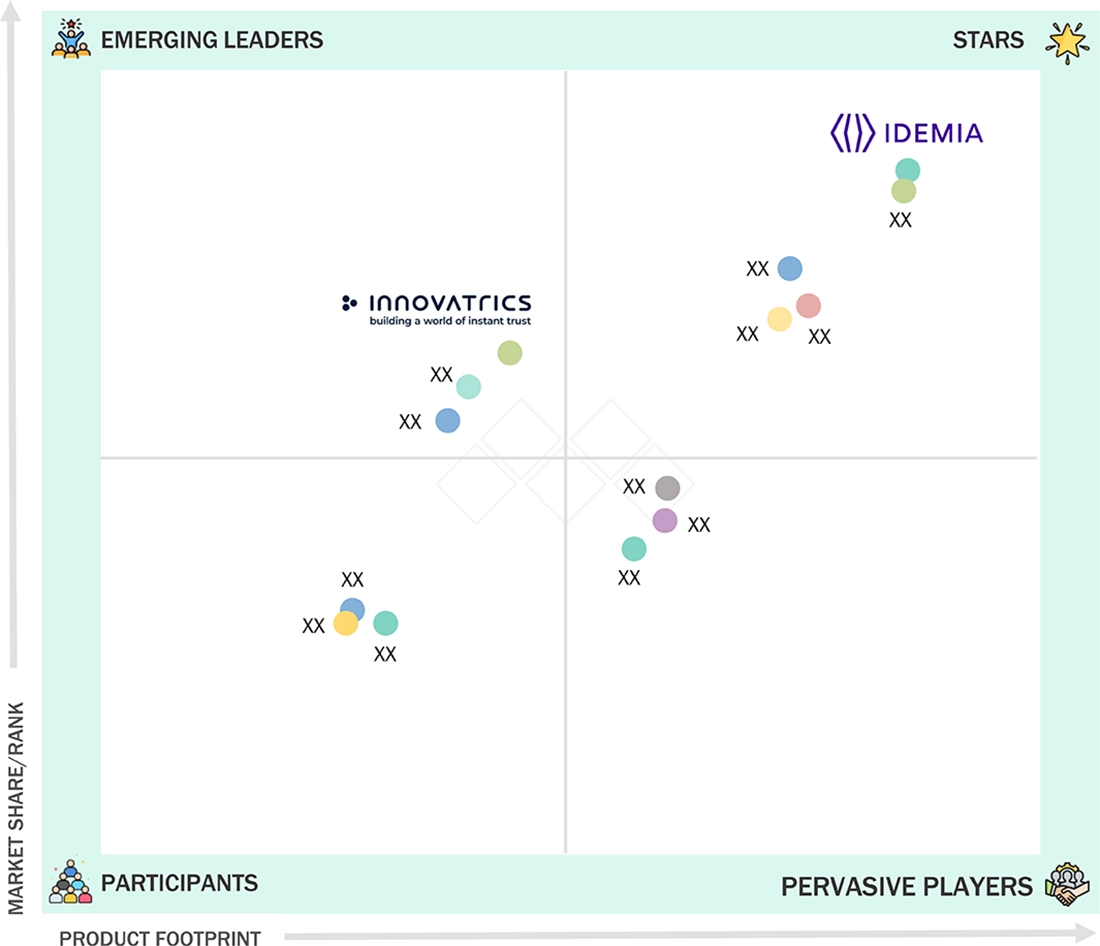
COMPETITIVE LANDSCAPEIDEMIA, NEC Corporation and Thales are star players due to their growing implementation of multimodal biometric identification, increased utilization of AI in determining user identity and strong implementation of global technology in governmental and business environments. They also provide secure, scalable digital identity solutions to support government and enterprise institutions.
-
COMPETITIVE LANDSCAPEStartups/SMEs include Sumsub, ZKTeco, and Persona, which provide more agile solution with cost-effective pricing and greater efficiency in the form of enhanced speed in processing biometric data through a user's profile. They deliver configurable workflows for each user's profile, and the ability to conform to and support the diverse compliance needs of digital-first companies through their products.
-
COMPETITIVE LANDSCAPEThe Europe Identity Verification Market is projected to reach USD 7.72 billion by 2030, rising from USD 3.53 billion in 2025, at a CAGR of 16.9% from 2025 to 2030.
-
COMPETITIVE LANDSCAPEThe US Identity Verification Market is projected to reach USD 8.16 billion by 2030 from USD 4.34 billion in 2025, at a CAGR of 13.5% from 2025 to 2030.
-
COMPETITIVE LANDSCAPEThe Middle East and Africa Identity Verification Market is projected to reach USD 2.38 billion by 2030 from USD 1.17 billion in 2025, at a CAGR of 15.2% during the forecast period.
Rapid growth in the biometric identity verification market is fueled by rising digital fraud, remote onboarding, and a rapidly expanding digital public infrastructure. Across the BFSI industries, government, and healthcare sectors, companies are adopting AI-enhanced dummy signatures (Biometric Modalities) for secure identity verification through facial, iris, and fingerprint recognition. Global adoption of more advanced liveness detection techniques, along with many clients opting for a multimodal authentication approach, is accelerating adoption. The rise in digital payments and e-commerce has also contributed to the global momentum driving this industry.
TRENDS & DISRUPTIONS IMPACTING CUSTOMERS' CUSTOMERS
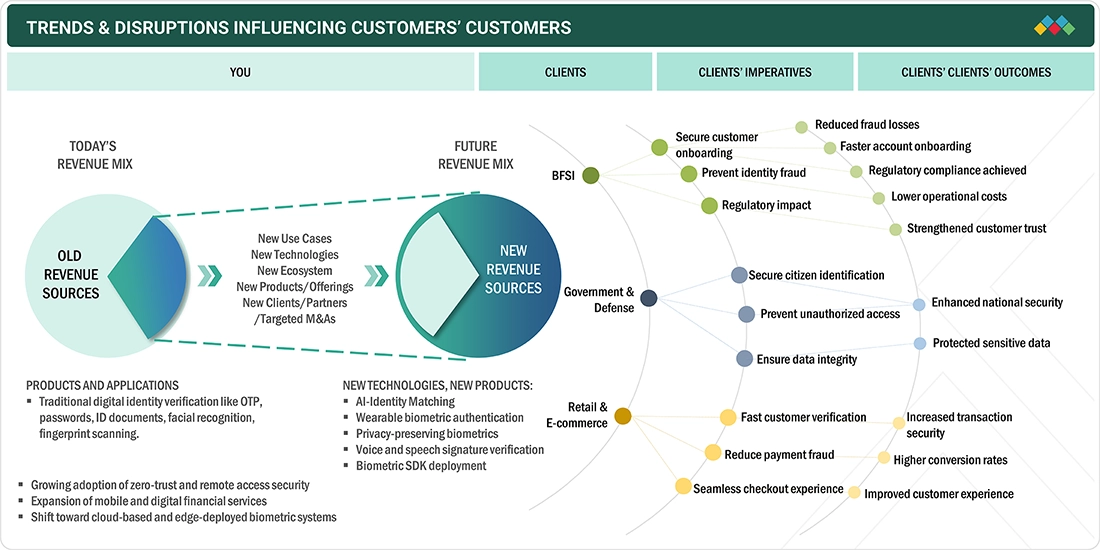
The figure illustrates the transition underway in the biometric identity verification market, moving from traditional authentication methods such as passwords, PINs, and token verification to more advanced AI-powered biometric solutions. Future revenue growth will come from multimodal biometrics, behavioral biometrics, liveness detection, deepfake protection, and cloud-based identity verification systems. Sectors such as BFSI, government & defense, retail & e-commerce, and healthcare are focused on secure onboarding, fraud prevention, regulatory requirements, and smooth user experiences. These projects aim to improve operational efficiency, enhance security, and mitigate risks associated with identity.
Source: Secondary Research, Interviews with Experts, MarketsandMarkets Analysis
MARKET DYNAMICS

Level
-
AI-driven multimodal biometrics boost verification accuracy

-
Cloud-based platforms enabling scalable real-time identity verification


Level
-
High computational cost of advanced biometric algorithms

-
Integration complexity with legacy IT and security systems


Level
-
Behavioral biometrics for continuous authentication

-
Privacy-preserving techniques increasing regulatory-compliant deployment potential


Level
-
Rapidly evolving deepfake and spoofing threats

-
Cross-device and environmental variability affecting recognition accuracy

Source: Secondary Research, Interviews with Experts, MarketsandMarkets Analysis
Driver: AI-driven multimodal biometrics boost verification accuracy
By combining facial recognition, fingerprint, iris, and voice analysis through AI-powered multimodal biometric technologies, the efficiency and effectiveness of biometric verification have improved dramatically. Using deep learning algorithms, AI-powered multimodal biometric devices can verify or cross-validate multiple biometric types (facial recognition, fingerprint, iris, and voice) in parallel, thereby providing greater accuracy with fewer false positives and false negatives. In the BFSI and government sectors, where the security of personal identity is paramount, this increased precision enables faster onboarding while providing better protection against fraud and a smoother user verification experience across platforms.
Restraint: High computational cost of advanced biometric algorithms
Real-time computation of biometric methods requires advanced computing power and the most current technologies, such as advanced biometric algorithms, which demand significant computing power, memory, and optimized infrastructure to deliver low-latency, high-accuracy results. The computational demands of these advanced biometric solutions also drive higher deployment costs, greater energy consumption, and increased complexity. This makes the adoption of these solutions prohibitive for both SME organizations and mobile computational devices that may have limited processing capabilities. Therefore, the adoption of biometrics for verification purposes will continue to grow at a slower pace than anticipated.
Opportunity: Behavioral biometrics for continuous authentication
Behavioral biometrics related to keystrokes, mouse movement patterns, gait patterns, and device usage can facilitate continuous authentication after the first login. Real-time analysis of users’ behavior generates anomalies that indicate possible fraudulent activities and takeovers. Rising demand for frictionless security and dynamic authentication methods is driving adoption of these biometrics. Consequently, behavioral biometrics are opening new avenues to enhance security and deliver improved experiences in financial services and other sectors.
Challenge: Rapidly evolving deepfake and spoofing threats
Deepfakes and more advanced spoofing techniques are increasing exponentially. At this pace, biometric identification faces numerous challenges. Attackers can now generate highly believable synthetic images of faces, voices, and even fingerprints, evading traditional detection techniques. Ongoing innovation in anti-spoofing techniques, liveness detection, and AI-based anomaly detection is required to stay one step ahead of market trends and advancements. It is imperative to note that organizations must maintain trust and system integrity through threat monitoring.
BIOMETRIC IDENTITY VERIFICATION MARKET: COMMERCIAL USE CASES ACROSS INDUSTRIES
| COMPANY | USE CASE DESCRIPTION | BENEFITS |
|---|---|---|
 |
IDEMIA partnered with a major European airport to deploy biometric e-gates for passenger boarding, enabling facial recognition-based automated immigration clearance. | Faster passenger processing, reduced manual verification errors, enhanced security, and improved traveler experience. |
 |
NEC Corporation implemented multimodal biometric verification (face + fingerprint) for a large Japanese bank’s mobile banking app, enabling secure and convenient customer authentication. | Reduced fraud risk, faster account access, increased customer trust, and lower operational costs. |
 |
Daon deployed its IdentityX platform for a US-based fintech company to enable behavioral biometrics for continuous authentication during online transactions. | Real-time fraud detection, improved transaction security, enhanced customer convenience, and reduced account takeover incidents. |
 |
HID Global integrated biometric access control into a multinational manufacturing facility, replacing traditional keycards for employee entry. | Enhanced physical security, eliminated credential sharing, simplified access management, and increased operational efficiency. |
 |
Persona enabled biometric onboarding for a US-based gig economy platform, verifying driver and worker identities using selfie and document verification. | Safer platform environment, faster onboarding, reduced fraudulent accounts, and improved user trust. |
Logos and trademarks shown above are the property of their respective owners. Their use here is for informational and illustrative purposes only.
MARKET ECOSYSTEM
The ecosystem of biometric identity verification comprises hardware vendors, software suppliers, and service providers offering multimodal biometric capture devices, sophisticated recognition algorithms, and biometric verification services. Together, they enable secure, real-time authentication, fraud detection, and digital onboarding in high-risk, high-volume environments. Sectors of prime importance, such as BFSI, government and defense, healthcare, retail and e-commerce, and IT & ITeS, are witnessing increased adoption of biometric technology. These industries are working to improve security, meet compliance obligations, and provide frictionless, scalable identity experiences.
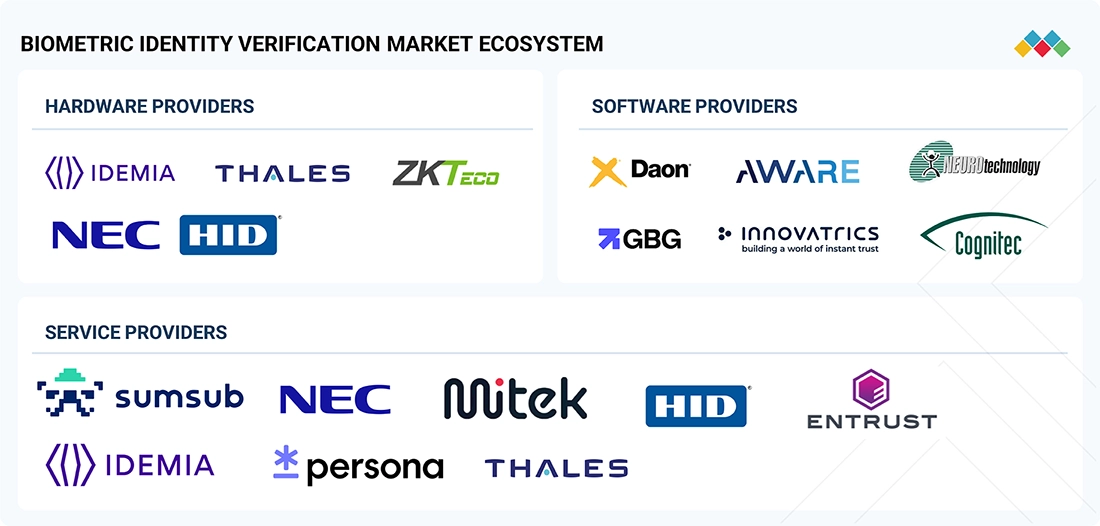
Logos and trademarks shown above are the property of their respective owners. Their use here is for informational and illustrative purposes only.
MARKET SEGMENTS
Source: Secondary Research, Interviews with Experts, MarketsandMarkets Analysis
Biometric Identity Verification Market, By Component
The hardware segment is anticipated to hold the largest market share in the biometric identity verification market in 2025. This is due to the increasing use of biometric sensors, scanners, facial capture technology, and multimodal enrollment systems. Organizations are seeking a high-accuracy solution that is foolproof for identity verification. The hardware component fulfills these attributes in verification environments.
Biometric Identity Verification Market, By Technology
The fingerprint recognition segment is expected to lead the biometric identity verification market in 2025. This leadership is driven by the maturity, cost-effectiveness, and high accuracy of fingerprint recognition. Additionally, fingerprint recognition has been widely deployed in consumer devices, business systems, border control applications, and financial institutions. Its ability to support multimodal biometrics further reinforces its market leadership.
Biometric Identity Verification Market, By Authentication Type
The single-factor authentication market is anticipated to have the largest market share by 2025. This is because it is increasingly being adopted for mobile phones, employee verification, and physical access verification. The reason for its adoption is its fast verification time, minimal effort required from users, and easy availability. As a consequence, it is currently the most prevalent method of verification
Biometric Identity Verification Market, By Organization Size
In the biometric identity verification market, the large enterprises segment is expected to grow rapidly. Large enterprises are adopting biometric solutions at an increasing rate, targeting improvements in entrance security, the elimination of counterfeit credentials, and compliance requirements. Large businesses tend to have broad networks of operation.
Biometric Identity Verification Market, By Motility
The fixed segment is anticipated to hold the largest market share in 2025, driven by the extensive use of this technology in border control. It is ideal for controlled environments that demand a high degree of accuracy of biometric terminals.
Biometric Identity Verification Market , By Application
The logical access and digital authentication segment is expected to lead the biometric identity verification market in 2025, driven by rapid digitalization and the need for secure logins. Biometric authentication improves fraud prevention and eliminates the weaknesses associated with passwords.
Biometric Identity Verification Market, By Vertical
In 2025, the BFSI segment is expected to hold the largest share in the biometric identity verification market, driven by escalating identity fraud, KYC/AML compliance requirements, and the need for secure onboarding and transaction authentication. Banks and financial institutions are rapidly integrating biometrics to strengthen digital trust, automate verification, and improve the customer experience across branches and digital platforms.
REGION
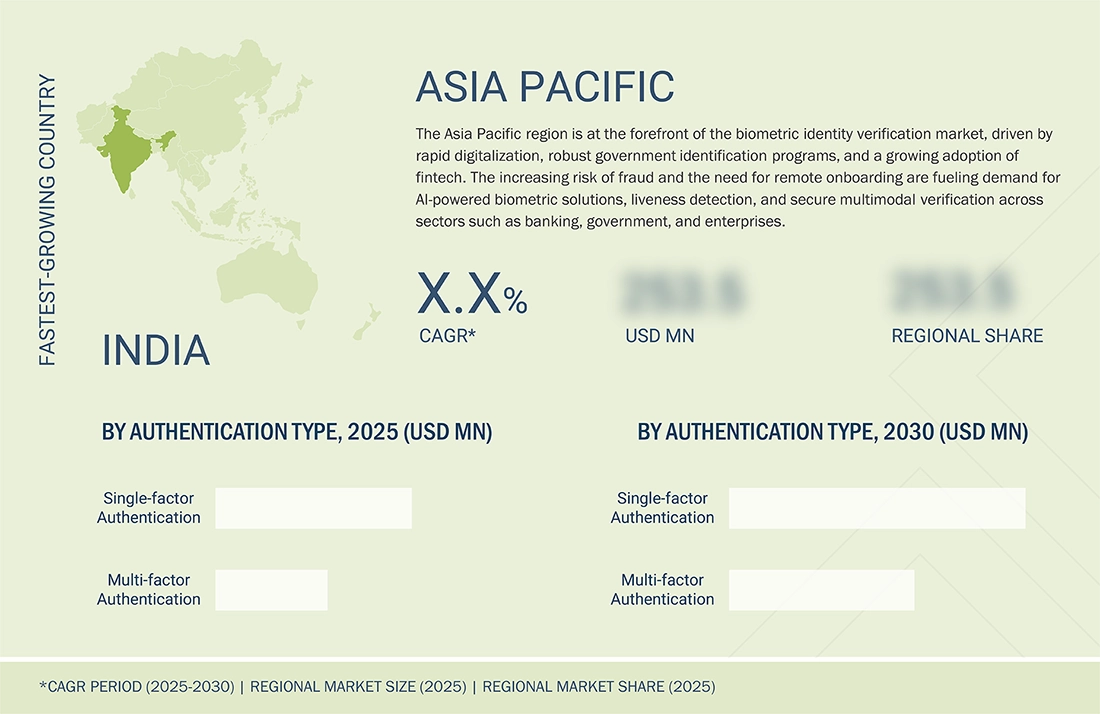
Asia Pacific to be fastest-growing region in global biometric identity verification market during forecast period
The Asia Pacific biometric identity verification market has strong growth potential, driven by large-scale digital identity implementations, increased mobile device adoption, and a growing need for frictionless biometric identity verification. Governments and organizations are increasingly adopting biometric identity verification solutions. Additionally, biometric identity verification in Asia Pacific offers higher security compared with other biometric identity solutions for KYC, border control, and online onboarding. These applications are being driven by a growing need for cyber fraud prevention, regulations, and enhanced liveness detection using AI. The technologies developed enable high levels of identity verification accuracy across BFSI, government, healthcare, and emerging digital sectors.
BIOMETRIC IDENTITY VERIFICATION MARKET: COMPANY EVALUATION MATRIX
In the biometric identity verification market, IDEMIA (Star) leads with a robust global footprint and comprehensive solutions across multimodal biometrics, liveness detection, and secure identity platforms. Innovatrics (Emerging Leader) is rapidly growing through AI-driven facial recognition, scalable SDKs, and innovative authentication technologies, poised to advance into the leaders’ quadrant.
Source: Secondary Research, Interviews with Experts, MarketsandMarkets Analysis
KEY MARKET PLAYERS
- IDEMIA (France)
- NEC Corporation (Japan)
- Thales (France)
- HID Global (US)
- Entrust (US)
- GBG (UK)
- Innovatrics (Slovakia)
- Mitek Systems (US)
- Aware, Inc. (US)
- Cognitec Systems (Germany)
- Daon (US)
MARKET SCOPE
| REPORT METRIC | DETAILS |
|---|---|
| Market Size in 2024 (Value) | USD 7.76 Billion |
| Market Forecast in 2030 (Value) | USD 17.81 Billion |
| Growth Rate | CAGR of 14.9% during 2025-2030 |
| Years Considered | 2019-2030 |
| Base Year | 2024 |
| Forecast Period | 2025-2030 |
| Units Considered | Value (USD Billion) |
| Report Coverage | Revenue forecast, company ranking, competitive landscape, growth factors, and trends |
| Segments Covered |
|
| Regions Covered | North America, Europe, Asia Pacific, Middle East & Africa, Latin America |
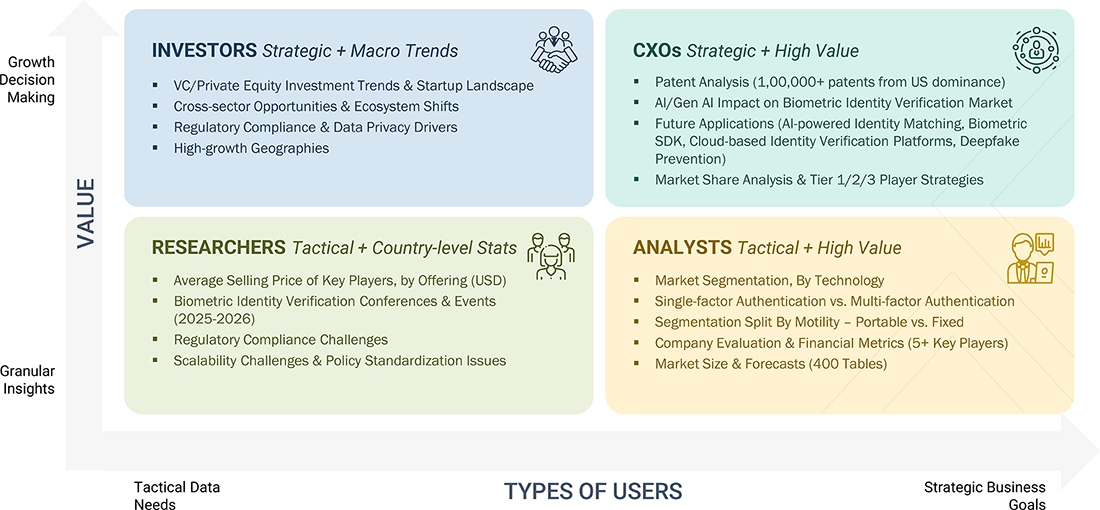
WHAT IS IN IT FOR YOU: BIOMETRIC IDENTITY VERIFICATION MARKET REPORT CONTENT GUIDE
DELIVERED CUSTOMIZATIONS
We have successfully delivered the following deep-dive customizations:
| CLIENT REQUEST | CUSTOMIZATION DELIVERED | VALUE ADDS |
|---|---|---|
| Leading Hardware Provider (US) | Product Analysis: Biometric identity verification product matrix offering a detailed comparison of each company's portfolio, including facial, fingerprint, iris, voice, and palm/vein recognition, AI-driven identity matching, liveness detection, and fraud prevention solutions | Better understanding of market positioning, product differentiation, and innovation strategies to guide informed business and investment decisions |
| Leading Software Provider (EU) | Company Information: Comprehensive profiling and assessment of additional market participants (up to 5), covering capabilities, solution offerings, technological expertise, and strategic initiatives in biometric authentication and identity verification | Holistic view of the biometric identity verification ecosystem, highlighting growth opportunities, emerging trends, and potential areas for partnerships or strategic collaborations |
RECENT DEVELOPMENTS
- December 2025 : IDEMIA Public Security signed a strategic MoU with MATARAT Holding to deploy biometric identity solutions across 27 airports in Saudi Arabia, aiming to enable seamless, biometric-based passenger flows.
- October 2025 : Cognitec began the deployment of 250 biometric camera devices with the Australian Department of Home Affairs, for facial image capture, quality checks, and traveler identity verification at major international airports.
- October 2025 : Vega IT formed a strategic partnership with Daon to integrate biometric identity verification and authentication into cross-channel customer onboarding and enterprise security solutions.
- February 2025 : Sumsub and TELUS Digital expanded their partnership, with Sumsub now supporting remote employee verification and onboarding globally for TELUS’s clients, enhancing identity verification and document & biometric checks.
- January 2025 : Entrust added AI-powered facial biometric authentication to its IDaaS platform, enabling on-device encrypted biometric identifiers for phishing-resistant, passwordless multi-factor authentication.
Table of Contents
 Exclusive indicates content/data unique to MarketsandMarkets and not available with any competitors.
Methodology
This study involved estimating the current Biometric Identity Verification Market size. Exhaustive secondary research was carried out to collect information on the identity verification industry. The next step was to validate these findings, assumptions, and sizing with industry experts across the value chain using primary research. Different approaches, such as top-down and bottom-up, were employed to estimate the total market size. After that, the market breakup and data triangulation procedures were used to estimate the market size of the segments and subsegments of the Biometric Identity Verification Market.
Secondary Research
The market for companies offering identity verification solutions and services was arrived at by using secondary data available through paid and unpaid sources, analyzing the product portfolios of the major companies in the ecosystem, and rating the companies by their performance and quality. Various sources were referred to in the secondary research process to identify and collect information for this study. The secondary sources included annual reports, press releases, investor presentations of companies, white papers, journals, certified publications, and articles from recognized authors, directories, and databases.
In the secondary research process, various secondary sources were referred to to identify and collect information related to the study. Secondary sources included annual reports, press releases, and investor presentations of identity verification vendors, forums, certified publications, and whitepapers. Secondary research was used to obtain essential information on the industry’s value chain, the total pool of key players, market classification, and segmentation from the market and technology-oriented perspectives.
Primary Research
In the primary research process, various supply and demand sources were interviewed to obtain qualitative and quantitative information for this report. The primary sources from the supply side included industry experts, such as Chief Executive Officers (CEOs), Vice Presidents (VPs), marketing directors, technology and innovation directors, and related key executives from various key companies and organizations operating in the Biometric Identity Verification Market.
After the complete market engineering (calculations for market statistics, market breakdown, market size estimations, market forecasting, and data triangulation), extensive primary research was conducted to gather information and verify and validate the critical numbers arrived at. Primary research was also undertaken to identify the segmentation types, industry trends, competitive landscape of identity verification hardware, software, and services offered by various market players, and fundamental market dynamics, such as drivers, restraints, opportunities, challenges, industry trends, and key player strategies.
In the complete market engineering process, the top-down and bottom-up approaches and several data triangulation methods were extensively used to perform the market estimation and market forecasting for the overall market segments and subsegments listed in this report. Extensive qualitative and quantitative analysis was performed on the complete market engineering process to list the key information/insights throughout the report.
Market Size Estimation
Top-down and bottom-up approaches were used to estimate and validate the size of the Biometric Identity Verification Market and the size of various other dependent sub-segments. The research methodology used to estimate the market size included the following details: key players in the market were identified through secondary research, and their market shares in the respective regions were determined through primary and secondary research. This entire procedure included the study of the annual and financial reports of the top market players, as well as extensive interviews for key insights with industry leaders, such as CEOs, VPs, directors, and marketing executives.
All percentage splits and breakdowns were determined using secondary sources and verified through primary sources. All possible parameters that affect the market covered in this research study were accounted for, viewed in extensive detail, verified through primary research, and analyzed to get the final quantitative and qualitative data. This data was consolidated and added to detailed inputs and analysis from MarketsandMarkets.
Data Triangulation
After arriving at the overall market size using the market size estimation processes explained above, the market was split into several segments and subsegments. The data triangulation and market breakup procedures were employed, wherever applicable, to complete the overall market engineering process and arrive at the exact statistics of each market segment and subsegment. The data was triangulated by studying various factors and trends from both the demand and supply sides.
Market Definition
According to MarketsandMarkets, identity verification is a process of verifying an individual’s identity by using publicly or privately available databases. The solutions offered in the Biometric Identity Verification Market help organizations verify an individual's identity quickly and easily, thereby actively improving customer experience and complying with privacy laws, anti-money laundering (AML) legislation, and know-your-customer (KYC) requirements.
Stakeholders
- Government agencies
- Consulting firms
- Information technology (IT) security agencies
- Raw material/component suppliers
- Research organizations and consulting companies
- Government bodies, such as regulating authorities and policymakers
- Venture capitalists and private equity firms
- Chief technology and data officers
- Identity verification service professionals
- Business analysts
- Information technology (IT) professionals
- Consultants/consultancies/advisory firms
Report Objectives
- To define, describe, and forecast the Biometric Identity Verification Market based on offering, type, deployment mode, organization size, application, vertical, and region
- To forecast the market size of five main regions: North America, Europe, Asia Pacific (APAC), Middle East & Africa (MEA), and Latin America
- To analyze the subsegments of the market concerning individual growth trends, prospects, and contributions to the overall market
- To provide detailed information related to the primary factors (drivers, restraints, opportunities, and challenges) influencing the growth of the market
- To analyze opportunities in the market for stakeholders by identifying high-growth segments of the market
- To profile the key players of the market and comprehensively analyze their market size and core competencies
- To track and analyze competitive developments, such as product launches, mergers and acquisitions, partnerships, agreements, and collaborations in the Biometric Identity Verification Market
Available Customizations
With the given market data, MarketsandMarkets offers customizations based on company-specific needs. The following customization options are available for the report:
Geographic Analysis as per Feasibility
- Further breakup of the Asia Pacific market into countries contributing 75% to the regional market size
- Further breakup of the North American market into countries contributing 75% to the regional market size
- Further breakup of the Latin American market into countries contributing 75% to the regional market size
- Further breakup of the Middle Eastern and African market into countries contributing 75% to the regional market size
- Further breakup of the European market into countries contributing 75% to the regional market size
Company Information
- Detailed analysis and profiling of additional market players (up to 5)
Key Questions Addressed by the Report
What is driving the growth of the Biometric Identity Verification Market?
The Biometric Identity Verification Market is driven by increasing digital transformation, rising identity fraud, growing adoption of remote onboarding, and stricter regulatory requirements for identity verification. Organizations are deploying biometric technologies to strengthen security, improve customer experience, and streamline digital identity verification processes.
Why are organizations investing in the Biometric Identity Verification Market?
Organizations invest in biometric identity verification solutions to enhance fraud prevention, enable secure customer onboarding, improve authentication accuracy, support regulatory compliance, and reduce operational costs associated with manual identity verification.
Which technologies are shaping the Biometric Identity Verification Market?
Key technologies include facial recognition, fingerprint recognition, iris recognition, voice biometrics, palm recognition, AI-powered identity verification, passive liveness detection, behavioral biometrics, cloud-based verification platforms, and mobile biometric authentication.
What are the latest trends in the Biometric Identity Verification Market?
Major trends include passwordless authentication, AI-enabled biometric verification, passive liveness detection, decentralized digital identity, multimodal biometrics, cloud-native identity verification platforms, and increased adoption across banking, healthcare, government, and eCommerce sectors.
What is the market outlook for the Biometric Identity Verification Market?
The market outlook remains positive as enterprises continue investing in digital identity infrastructure to support secure remote authentication, regulatory compliance, fraud mitigation, and seamless customer experiences across digital channels.
Which regions offer significant opportunities in the Biometric Identity Verification Market?
North America remains a leading market due to advanced cybersecurity infrastructure and digital identity adoption. Asia Pacific is expected to witness strong growth driven by digital government initiatives, financial inclusion programs, increasing smartphone penetration, and expanding digital payment ecosystems.
What should buyers consider before selecting a biometric identity verification solution?
Buyers should evaluate biometric accuracy, liveness detection capabilities, AI performance, regulatory compliance, integration with existing identity management systems, cloud compatibility, scalability, user experience, and vendor expertise across multiple industries.
How does biometric identity verification improve business operations?
Biometric identity verification helps organizations accelerate customer onboarding, reduce identity fraud, automate authentication workflows, strengthen compliance, improve operational efficiency, and enhance customer trust while minimizing manual verification efforts.
What challenges are influencing the Biometric Identity Verification Market?
Key challenges include evolving privacy regulations, biometric spoofing attempts, presentation attacks, integration with legacy infrastructure, varying regional compliance requirements, and balancing security with user convenience.
Why is the Biometric Identity Verification Market attracting long-term investment?
The market continues to attract long-term investment because organizations increasingly require trusted digital identity solutions for secure online transactions, digital transformation, fraud prevention, and regulatory compliance. Growing demand for AI-powered and passwordless authentication solutions is expected to support sustained market growth across industries.


Personalize This Research
- Triangulate with your Own Data
- Get Data as per your Format and Definition
- Gain a Deeper Dive on a Specific Application, Geography, Customer or Competitor
- Any level of Personalization
Let Us Help You
- What are the Known and Unknown Adjacencies Impacting the Biometric Identity Verification Market
- What will your New Revenue Sources be?
- Who will be your Top Customer; what will make them switch?
- Defend your Market Share or Win Competitors
- Get a Scorecard for Target Partners

Custom Market Research Services
We Will Customise The Research For You, In Case The Report Listed Above Does Not Meet With Your Requirements
Get 10% Free CustomisationTESTIMONIALS






Growth opportunities and latent adjacency in Biometric Identity Verification Market