Cell Culture Equipment Market Size, Growth, Share & Trends Analysis

Cell Culture Equipment Market by Type (Supporting, Bioreactors, Storage), Application (Biopharma Production, Diagnostics, Tissue Engineering), End User (Pharma & Biotech Companies, Hospitals & Diagnostic Labs, Academia), Region - Global Forecast to 2031




OVERVIEW
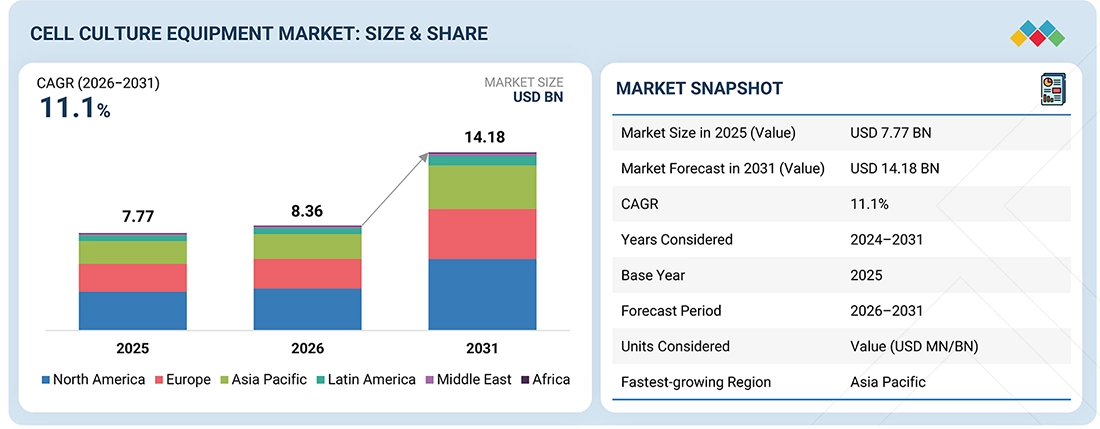
Source: Secondary Research, Interviews with Experts, MarketsandMarkets Analysis
The Cell Culture Equipment market, valued at USD 7.77 billion in 2025, stood at USD 8.36 billion in 2026 and is projected to advance at a resilient CAGR of 11.1% from 2026 to 2031, culminating in a forecasted valuation of USD 14.18 billion by the end of the period. Cell culture equipment encompasses the instruments used to grow and maintain cells in controlled laboratory environments for medical, research, and production purposes. These systems support various applications, including biopharmaceutical manufacturing, vaccine development, tissue engineering, and regenerative medicine.
KEY TAKEAWAYS
-
By TypeThe supporting equipment segment held the largest market share at 43.3% in 2025, driven by the broad and recurring use across almost every cell culture workflow, including contamination control, environmental monitoring, sterilization, and storage.
-
By ApplicationBy application, the biopharmaceutical production segment is projected to maintain a significant share during the forecast period, supported by the expansion of pharmaceutical manufacturing capacity and rising demand for cell culture-based vaccines and biologics.
-
By End UserBy end user, pharmaceutical and biotechnology companies represent the largest segment, reflecting their extensive use of cell culture systems for drug development, monoclonal antibody production, and biosimilar manufacturing.
-
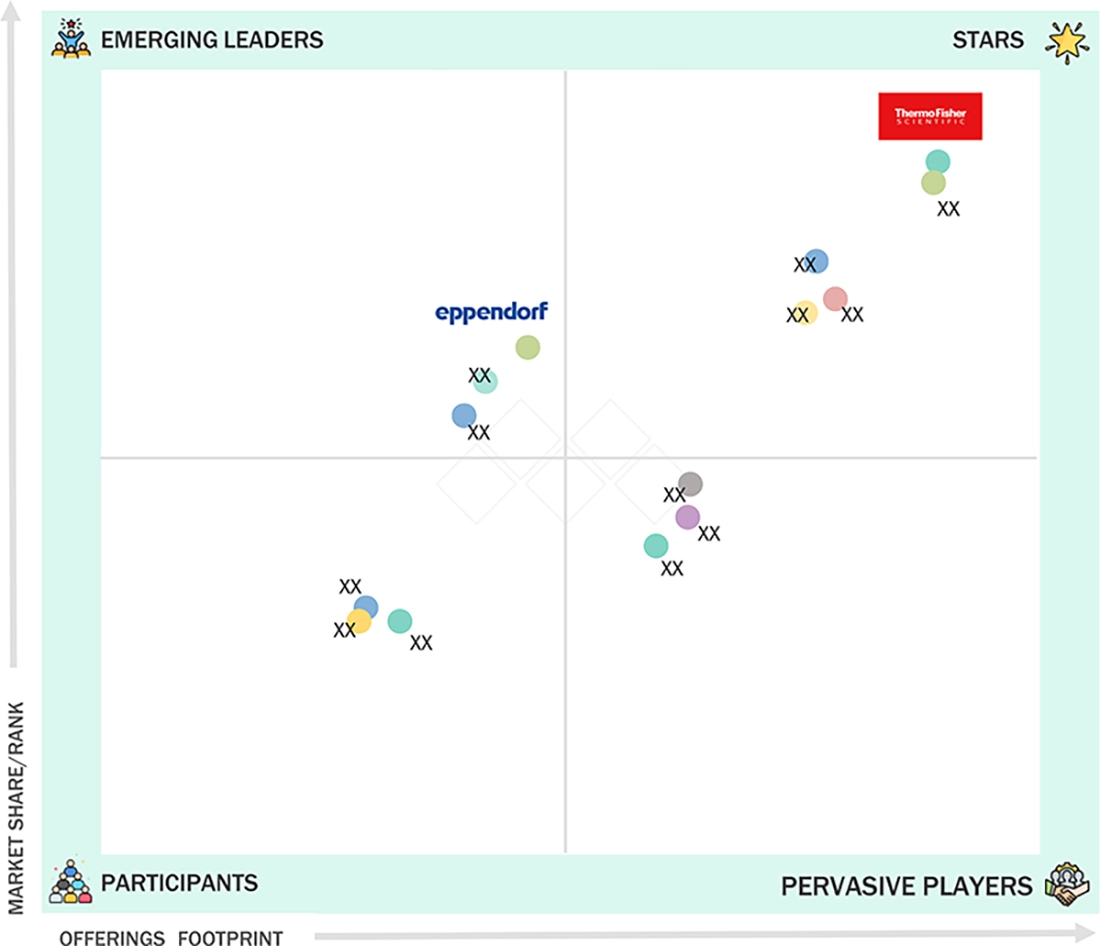
Competitive Landscape - Star PlayersThermo Fisher Scientific, Danaher, and Merck KGaA were identified as star players in the cell culture equipment market, given their comprehensive product portfolios, strong market presence, and continuous innovation in cell culture technologies.
-
Competitive Landscape - StartupsSolida Biotech and Cellexus have distinguished themselves among emerging companies by securing strong footholds in specialized niche areas, underscoring their potential as emerging market leaders.
The cell culture equipment market is expanding quickly, driven by increased research and development in cell-based therapies, higher production of monoclonal antibodies and biosimilars, and the growing use of technologically advanced products for high-demand applications like cell and gene therapy and regenerative medicine.
TRENDS & DISRUPTIONS IMPACTING CUSTOMERS' CUSTOMERS
The global cell culture equipment market is experiencing a strong phase of technology-driven growth, fueled by increasing demand from biopharmaceutical companies, research institutions, and advanced therapy developers. Adoption is speeding up for single-use bioprocessing platforms because these systems provide greater manufacturing flexibility, help lower contamination risks, and enable quicker changeovers across small-, mid-, and large-scale production environments. Automation is also playing a larger role, as automated bioreactor platforms enhance process consistency, decrease manual labor, and allow for smoother scale-up from development to cGMP manufacturing. Simultaneously, the market benefits from wider use of cell culture systems in mAbs, vaccines, recombinant proteins, and cell and gene therapy workflows, which drives the need for scalable and validated equipment. This progress is further supported by regulatory focus on quality-by-design, process understanding, and lifecycle-based validation, all of which promote the use of robust, standardized, and well-controlled cell culture equipment in modern biomanufacturing settings.
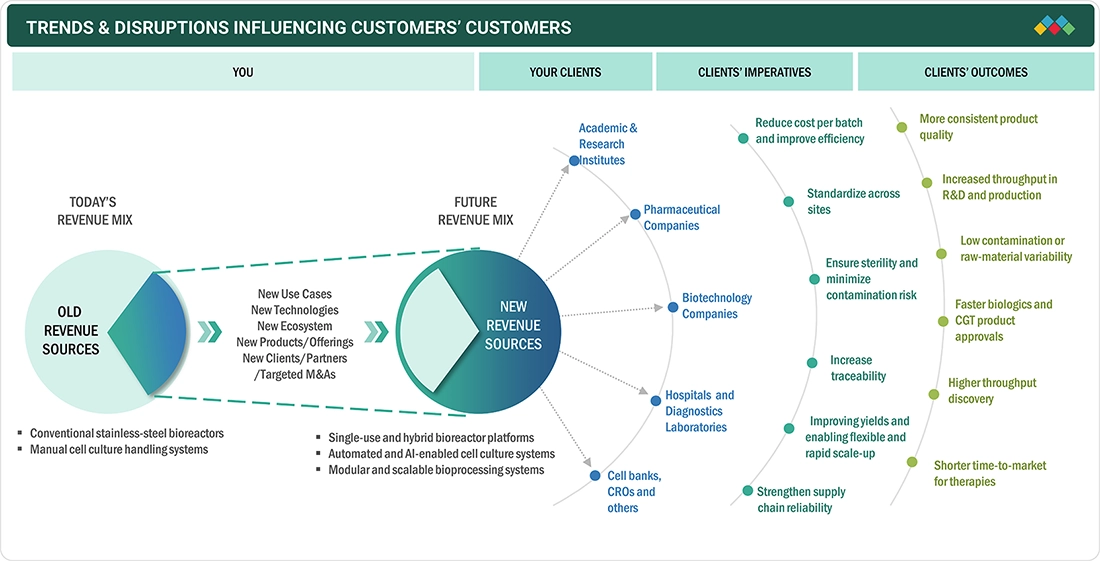
Source: Secondary Research, Interviews with Experts, MarketsandMarkets Analysis
MARKET DYNAMICS

Level
-
Increasing research and development activities in cell-based research and biopharmaceutical production

-
Rising commercialization of cell-based products including monoclonal antibodies and biosimilars


Level
-
Ethical concerns regarding cell studies and regulatory complexities


Level
-
Technological advancements and expanding applications in therapeutics and diagnostics


Level
-
High costs associated with cell culture technology and stringent regulatory requirements

Source: Secondary Research, Interviews with Experts, MarketsandMarkets Analysis
Driver: Increasing research and development activities in cell-based research and biopharmaceutical production
The growing research and development in cell-based research and biopharmaceutical production is driving demand for cell culture equipment. Academic institutions, biotechnology firms, and pharmaceutical companies are investing heavily in cell culture technologies to support drug discovery, vaccine development, and biologics production, creating sustained demand for advanced culture systems.
Restraint: Ethical concerns regarding cell studies and regulatory complexities
Ethical concerns surrounding the use of certain cell types, particularly stem cells and animal-derived components, along with complex regulatory requirements, can restrict the adoption and development of cell culture technologies. Differences in ethical standards and regulatory frameworks across regions create challenges for manufacturers seeking to introduce new cell culture products globally.
Opportunity: Technological advancements and expanding applications in therapeutics and diagnostics
Technological advancements in cell culture equipment, including automation, real-time monitoring, and three-dimensional culture systems, present significant growth opportunities. These innovations enable more physiologically relevant models, improve reproducibility, and support expanding applications in regenerative medicine, tissue engineering, and personalized diagnostics.
Challenge: High costs associated with cell culture technology and stringent regulatory requirements
High costs associated with advanced cell culture equipment, combined with stringent regulatory requirements for validation and quality control, remain key challenges. Manufacturers and end users must balance investment in cutting-edge technologies with the need to meet rigorous compliance standards and maintain cost-effective operations.
CELL CULTURE EQUIPMENT MARKET: COMMERCIAL USE CASES ACROSS INDUSTRIES
| COMPANY | USE CASE DESCRIPTION | BENEFITS |
|---|---|---|
 |
CGT Catapult used Thermo Fisher’s DynaDrive Single-Use Bioreactor and HyPerforma G3Lite Bioprocess Controller to build a scalable AAV production workflow using HEK293 suspension cells for cell and gene therapy manufacturing. | Helped establish a robust and scalable viral vector process, supported both low- and high-volume production, reduced the need for extra equipment or facility expansion, and enabled cell viability above 95% in subsequent experiments. |
 |
Synthon selected Sartorius as a supplier of single-use cell culture and downstream equipment for its GMP biologics facility, including Biostat STR 500 L and 2000 L bioreactors, shaking incubators, Flexact systems, and control software. | Supported smooth scale-up from lab scale to 2000 L, enabled an end-to-end single-use process, reduced cross-contamination risk, improved flexibility in a multi-product biologics facility, and supported successful GMP production runs. |
Logos and trademarks shown above are the property of their respective owners. Their use here is for informational and illustrative purposes only.
MARKET ECOSYSTEM
The cell culture equipment market is a collaborative ecosystem where equipment manufacturers, pharmaceutical companies, research institutions, and contract service providers work together to advance cell-based research and production. Companies supply a variety of products, including bioreactors, incubators, culture media, sera, and disposable vessels. Contract research organizations and contract development and manufacturing organizations support preclinical and clinical development, as well as the scale-up of cell-based products. Ultimately, pharmaceutical companies, biotechnology firms, and research institutions utilize the equipment, benefiting from technological innovations and evolving regulatory frameworks.
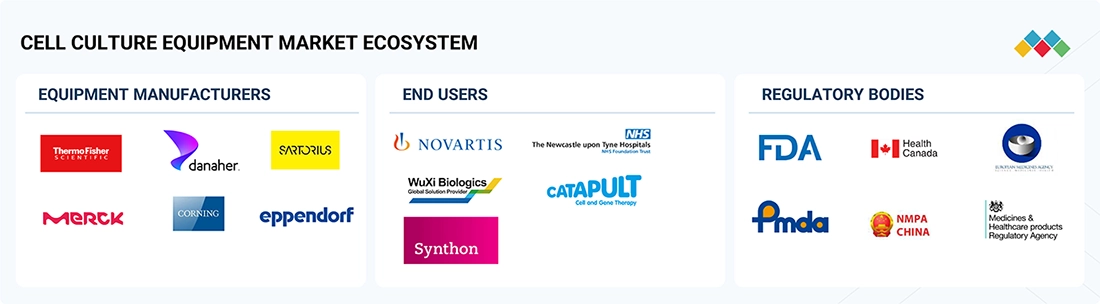
Logos and trademarks shown above are the property of their respective owners. Their use here is for informational and illustrative purposes only.
MARKET SEGMENTS
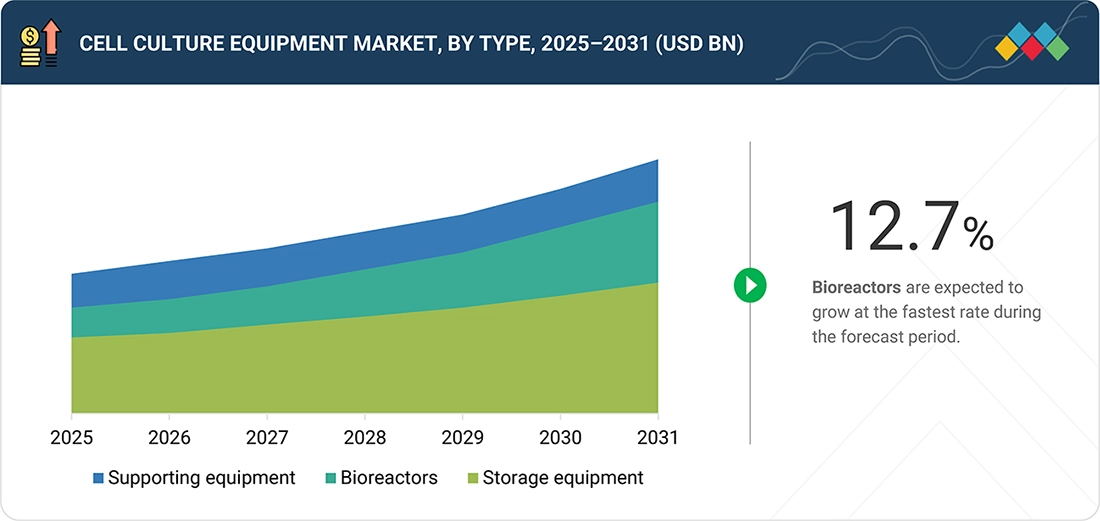
Source: Secondary Research, Interviews with Experts, MarketsandMarkets Analysis
Cell Culture Equipment Market, by Type
Supporting equipment dominated the market in 2025, accounting for 43.3% of the market share. This segment includes filtration systems, cell counters, carbon dioxide incubators, centrifuges, autoclaves, microscopes, biosafety cabinets, and other supporting equipment. Growth of this segment is supported by the expanding number of cell culture laboratories, increasing biopharmaceutical production activities, and the need for contamination control and controlled culture environments. In addition, continuous demand for laboratory infrastructure in academic research, contract research organizations, and biomanufacturing facilities is driving the adoption of these systems across cell culture workflows.
Cell Culture Equipment Market, by Application
Biopharmaceutical production accounted for the largest share of the cell culture equipment market. The expansion of pharmaceutical manufacturing capacity, increasing production of monoclonal antibodies and biosimilars, and rising demand for cell culture-based vaccines are driving growth in this segment. The ongoing need for biologics and the acceleration of vaccine development programs have further reinforced the importance of cell culture equipment in biopharmaceutical production.
REGION
North America to hold predominant market share during forecast period
North America holds a predominant share of the cell culture equipment market, driven by well-established healthcare infrastructure, high research and development investments, and the presence of major pharmaceutical and biotechnology companies. The region benefits from strong government support for biomedical research, advanced academic institutions, and a robust regulatory framework that facilitates the development and commercialization of cell-based products. Additionally, significant private sector investment in cell and gene therapy development is supporting sustained demand for advanced cell culture technologies.
CELL CULTURE EQUIPMENT MARKET: COMPANY EVALUATION MATRIX
Thermo Fisher Scientific, recognized as a leading player in the cell culture equipment market, offers a comprehensive portfolio that includes bioreactors, incubators, culture media, sera, and a wide range of consumables for research and biomanufacturing applications. The company boasts a strong global presence and collaborates with pharmaceutical companies, biotechnology firms, and research institutions globally. Another significant player is Danaher, identified as a star player through its subsidiary Cytiva. The company is strengthening its position by providing integrated bioprocessing solutions, single-use technologies, and advanced cell culture platforms designed for scalable biopharmaceutical production.
Source: Secondary Research, Interviews with Experts, MarketsandMarkets Analysis
KEY MARKET PLAYERS
MARKET SCOPE
| REPORT METRIC | DETAILS |
|---|---|
| Market Size in 2025 (Value) | 7.77 |
| Market Forecast in 2031 (Value) | 14.18 |
| Growth Rate | CAGR of 11.1% from 2026-2031 |
| Years Considered | 2024-2031 |
| Base Year | 2025 |
| Forecast Period | 2026-2031 |
| Units Considered | Value (USD Billion) |
| Report Coverage | Revenue Forecast, Company Ranking, Competitive Landscape, Growth Factors, and Trends |
| Segments Covered | By Type: Supporting Equipment (Filtration Systems, Cell Counters, Carbon Dioxide Incubators, Centrifuges, Autoclaves, Microscopes, Biosafety Cabinets, Other Supporting Equipment), Bioreactors, Storage Equipment; By Application: Biopharmaceutical Production, Diagnostics, Tissue Engineering and Regenerative Medicine, Drug Screening and Development, Other Applications; By End User: Pharmaceutical & Biotechnology Companies, Hospitals and Diagnostic Labs, Research and Academic Institutes, Other End Users |
| Regions Covered | North America, Europe, Asia Pacific, Latin America, Middle East, Africa |
| Parent & Related Segment Reports |
Cell Culture Market North America Cell Culture Market Europe Cell Culture Market Asia Pacific Cell Culture Market Cell Culture Reagents Market Middle East Cell Culture Market Germany Cell Culture Market Japan Cell Culture Market Latin America Cell Culture Market Biopharmaceutical Cell Culture Market Cell Culture Vessels Market |
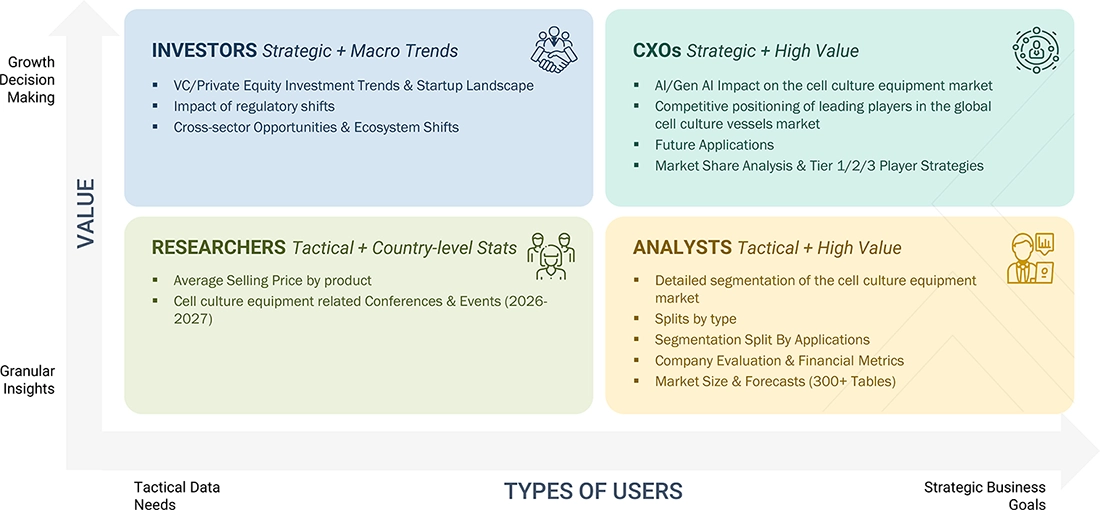
WHAT IS IN IT FOR YOU: CELL CULTURE EQUIPMENT MARKET REPORT CONTENT GUIDE
DELIVERED CUSTOMIZATIONS
We have successfully delivered the following deep-dive customizations:
| CLIENT REQUEST | CUSTOMIZATION DELIVERED | VALUE ADDS |
|---|---|---|
| Understanding adoption patterns for single-use versus reusable cell culture equipment | Assessed usage trends of single-use bioreactors, and traditional stainless-steel systems across pharmaceutical manufacturing, contract manufacturing organizations, and research institutions, highlighting differences in adoption based on production scale, contamination risk management, and operational flexibility | Helps clients align product development strategies with end-user preferences, optimize manufacturing approaches, and identify opportunities for hybrid system offerings |
| Identifying regional supply chain and distribution networks | Mapped regional distributors, contract manufacturing organizations, and equipment service providers across North America, and Europe, with insights into local regulatory requirements, installation support, and after-sales service capabilities | Supports market entry strategies, strengthens distribution partnerships, improves customer support infrastructure, and reduces time-to-market for new products |
RECENT DEVELOPMENTS
- March 2026 : PHCbi launched the LiCellGrow Cell Expansion System for cell and gene therapy process development, enabling real-time metabolic monitoring and automated culture control to improve cell quality and manufacturing efficiency.
- February 2024 : Danaher highlighted that Cytiva’s new Xcellerex X-platform bioreactor is helping improve manufacturing yields while reducing the time and cost of biologics production. This reflects continued investment in scalable single-use bioreactor technologies for cell culture and upstream bioprocessing.
Table of Contents
 Exclusive indicates content/data unique to MarketsandMarkets and not available with any competitors.
Methodology
This research study involved the extensive use of secondary sources, directories, and databases to identify and collect valuable information for the analysis of the global cell culture equipment market. In-depth interviews were conducted with various primary respondents, including key industry participants, subject-matter experts (SMEs), C-level executives of key market players, and industry consultants, to obtain and verify critical qualitative and quantitative information and assess the growth prospects of the market. The global market size estimated through secondary research was then triangulated with inputs from primary research to arrive at the final market size.
Secondary Research
Secondary research was used mainly to identify and collect information for the extensive, technical, market-oriented, and commercial study of the cell culture equipment market. The secondary sources used for this study include World Health Organization (WHO), Food and Drug Administration, American Society for Cell Biology (ASCB), National Institutes of Health (NIH), International Society for Cell & Gene Therapy (ISCT), American Society for Gene and Cell Therapy (ASGCT), Centers of Disease Control and Prevention (CDC), International Serum Industry Association (ISIA), Pharmaceutical Research and Manufacturers of America (PhRMA), International Society for Vaccines (ISV), International Federation of Pharmaceutical Manufacturers & Associations (IFPMA), the Society for In Vitro Biology (SIVB), Japan Agency for Medical Research and Development, European Federation of Pharmaceutical Industries and Associations (EFPIA), American Type Culture Collection (ATCC), and the Alliance for Regenerative Medicine (ARM); corporate filings such as annual reports, SEC filings, investor presentations, and financial statements; press releases; trade, business, professional associations and among others. These sources were also used to obtain key information about major players, market classification, and segmentation according to industry trends, regional/country-level markets, market developments, and technology perspectives.
Primary Research
After acquiring foundational knowledge about the global cell culture equipment market through secondary research, extensive primary research was conducted. Multiple interviews were held with market experts from the demand side, including representatives from pharmaceutical and biopharmaceutical companies, hospitals & diagnostic laboratories, research & academic institutes, and CROs. Additionally, experts from the supply side were interviewed, including C-level and D-level executives, product managers, and marketing and sales managers from key manufacturers, distributors, and channel partners.
These interviews spanned five major regions: North America, Europe, Asia Pacific, Latin America, and the Middle East & Africa. Approximately 70% of the primary interviews were conducted with supply-side participants, while the remaining 30% were with demand-side participants. The primary data was collected through various methods, including questionnaires, emails, online surveys, personal interviews, and telephone interviews.
To know about the assumptions considered for the study, download the pdf brochure
Market Size Estimation
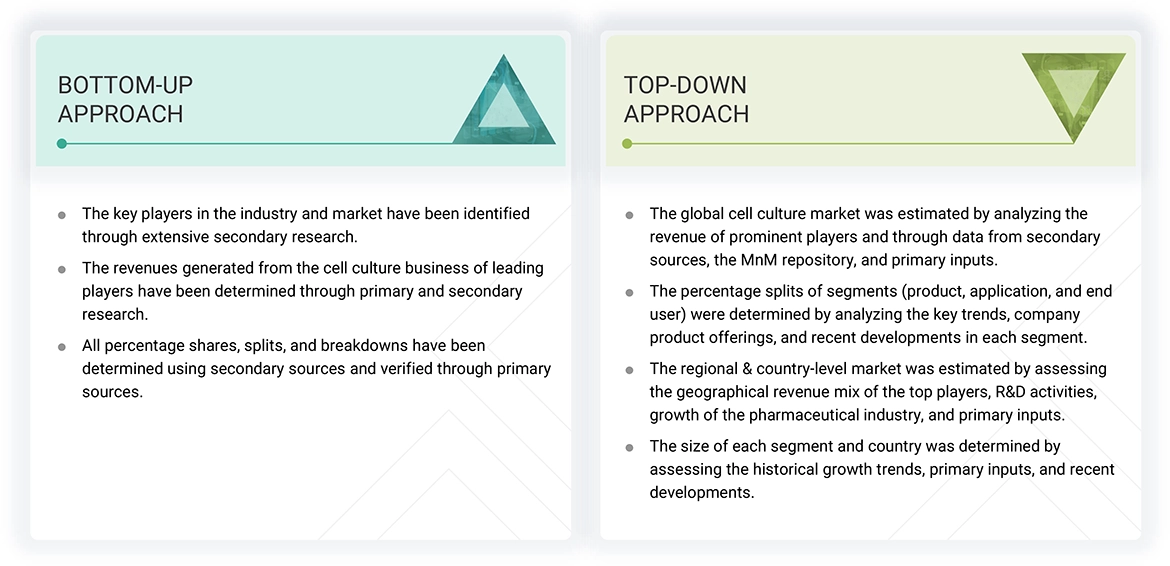
Both top-down and bottom-up approaches were used to estimate and validate the total size of the cell culture equipment market. These methods were also used extensively to estimate the size of various subsegments in the market. The research methodology used to estimate the market size includes the following:
Bottom-up Approach and Top-down Approach
After arriving at the overall market size from the market size estimation process, the total market was split into several segments and subsegments.
Data Triangulation
After arriving at the market size from the market size estimation process explained above, the total market was divided into several segments and subsegments. To complete the overall market engineering process and arrive at the exact statistics for all segments and subsegments, data triangulation and market breakdown procedures were employed, wherever applicable. The data was triangulated by studying various factors and trends from both the demand and supply sides.
Market Definition
Cell culture equipment refers to removing cells from an animal or plant and their subsequent growth in an artificial environment under controlled conditions. It is a process of growing cells outside their natural environment, typically in a laboratory setting. This technique allows researchers to study cells in a controlled environment, providing insights into their behavior, growth, metabolism, and response to various stimuli.
Stakeholders
- Cell Culture Equipment and Reagents Manufacturers
- Analytical and Life Science Instrumentation Companies
- Academic and Research Institutes
- Pharmaceutical and Biotechnology Companies
- Life Science Companies
- Venture Capitalists and Investors
- Government Organizations
- Private Research Firms
- Contract Research Organizations (CROs)
- Hospitals and Diagnostic Laboratories
- Cell Banks
Report Objectives
- To define, describe, and forecast the global cell culture equipment market based on the product, application, end user, and region
- To provide detailed information regarding the major factors influencing the growth of the market (such as drivers, restraints, opportunities, and challenges)
- To strategically analyze micro-markets with respect to individual growth trends, future prospects, and contributions to the overall cell culture equipment market
- To analyze opportunities in the market for stakeholders and provide details of the competitive landscape for market leaders
- To forecast the size of the market segments with respect to six main regions, namely, North America, Europe, Asia Pacific, Latin America, the Middle East, and Africa
- To strategically profile the key players and comprehensively analyze their product portfolios, market positions, and core competencies
- To track and analyze competitive developments such as acquisitions, product launches, expansions, and R&D activities in the cell culture equipment market
- To benchmark players within the cell culture equipment market using the ‘Company Evaluation Matrix’ framework, which analyzes market players based on various parameters within the broad categories of business and product strategy


Personalize This Research
- Triangulate with your Own Data
- Get Data as per your Format and Definition
- Gain a Deeper Dive on a Specific Application, Geography, Customer or Competitor
- Any level of Personalization
Let Us Help You
- What are the Known and Unknown Adjacencies Impacting the Cell Culture Equipment Market
- What will your New Revenue Sources be?
- Who will be your Top Customer; what will make them switch?
- Defend your Market Share or Win Competitors
- Get a Scorecard for Target Partners

Custom Market Research Services
We Will Customise The Research For You, In Case The Report Listed Above Does Not Meet With Your Requirements
Get 10% Free CustomisationTESTIMONIALS

JAYANT RAJPUROHIT
Director of Market Insights, Data and Analytics
SFI Health,
Leading Pharmaceutical Companywww.sfihealth.com/

We at SFI Health approached MarketsandMarkets for an Opportunity Assessment on "Incidence and Prevalence of Focus Indications" as we wanted to know the most attractive HCPs like Physician, Functional MD, Naturopath and Pharmacist. The project was critical for us to ensure our focus on the right target which would enable sustainable growth and profitability for SFI Health. The business insights provided exceeded our expectations and we were extremely impressed. The team at MarketsandMarkets is highly professional and detail oriented and very well understood our business needs. MarketsandMarkets offers a unique combination of expertise and dedicated engagement model. We identified 2 new products to be launched in coming months, based on the research findings provided by MarketsandMarkets. We are happy with the services and would strongly recommend MarketsandMarkets to my peers in the industry.

BEATRIZ DE LA CALLE
Head of Commercial Analytics
Qualicaps,
Leading Pharmaceutical Companywww.qualicaps.com/

We partnered with MarketsandMarkets for an assessment study on hard empty capsules. The team was extremely professional in understanding our business requirements and we received timely responses to all our queries. The market intelligence and the recommendations has met our business requirements. We were extremely impressed to see the final study results; it really exceeded our expectations. The market intelligence offered by MarketsandMarkets, and clarity on next steps will help us achieve our business objective for the Year 2021. We are happy with the services and would strongly recommend MarketsandMarkets to my peers in the industry.

Bob Williams,
Senior Director Business Development & Innovation
Bracco Diagnostics Inc.,
Italian Multinational in life sciences sector and a World Leader in imaging diagnosticsimaging.bracco.com/us-en
We were pleased with targeted insights that MarketsandMarkets identified from a custom study on the 'Radiation Dose Management Solutions Market'. Your team identified and characterized the market participants as well as underlying trends accurately. This study was useful to Bracco in formulating business strategies for our dose monitoring product lines and we thank MarketsandMarkets for the job well done.
Cody Coonradt,
Market Development and Strategy Manager
3M Health Information Systems,
Leader in Health care Coding, Payment & Analytics Solutions.www.3m.com/3M/en_US/health-information-systems-us
The value for our organization comes from three things: depth of research, specificity of segments and being easy to work with. As important as the first two are, the third can't be underestimated. MarketsandMarkets, maybe more than any other research vendor, wants to know what is top of mind for our team and what big questions we are grappling to answer.
Their customer first approach and high value engagement model, have given us great analysis and excellent value for money






Growth opportunities and latent adjacency in Cell Culture Equipment Market