Drone (UAV) Detection Market Growth, Trends, & Forecast

Drone (UAV) Detection Market by Architecture (Single-Sensor, Multi-Sensor), End User (Civil, Critical Infrastructure, Defense, Homeland Security), Offering, Deployment, Range, Technology, Region - Global Forecast to 2031


DRONE (UAV) DETECTION MARKET OVERVIEW
According to Marketsandmarkets, the Global Drone (UAV) Detection Market Size is projected to grow from USD 1.14 billion in 2026 to USD 3.34 billion by 2031, growing at a CAGR of 24.0% from 2026-2031. The growth of the market is primarily driven by the increasing use of drones, rising security concerns around critical infrastructure and military facilities, and the need to detect unauthorized drone activity. Increasing adoption of radar, RF, EO/IR, acoustic, and multi-sensor detection systems is also supporting market growth.
REPORT SCOPE
| REPORT METRIC | DETAILS |
|---|---|
| Market Size in 2025 (Value) | USD 0.94 Billion |
| Market Size in 2026 (Value) | USD 1.14 Billion |
| Market Forecast in 2031 (Value) | USD 3.34 Billion |
| CAGR | 24.0% |
| Years Considered | 2021–2031 |
| Base Year | 2025 |
| Forecast Period | 2026–2031 |
| Units Considered | USD Billion/Million |
| Report Coverage | Revenue Forecast, Company Ranking, Competitive Landscape, Growth Factors, and Trends |
| Top Companies |
|
| Growth Drivers |
|
| Segments Covered |
|
| Regions Covered | North America, Europe, Asia Pacific, Middle East, Rest of the World |
KEY DRONE (UAV) DETECTION MARKET TAKEAWAYS
-
BY ARCHITECTUREMulti-sensor systems are the fastest-growing segment due to the need to combine radar, RF, EO/IR, and acoustic inputs for more reliable drone detection. The ability to detect different drone signatures and reduce the limitations of individual sensors is supporting their adoption across military, airport, and critical infrastructure applications.
-
BY DEPLOYMENTVehicle-mounted systems are the fastest-growing segment due to the need for drone detection during mobile military, border, and security operations. Their ability to carry larger sensors and processing equipment while supporting stationary and on-the-move detection is increasing their use across changing operational locations.
-
BY RANGEMedium-range (6–20 km) systems are the fastest-growing segment due to the need to detect drones before they approach sensitive sites and restricted airspace. This range provides suitable coverage for military bases, airports, borders, and critical infrastructure while supporting the detection and tracking of small and low-flying drones.
-
BY REGIONNorth America is the fastest-growing region due to increasing investment in drone detection across military bases, airports, borders, and critical infrastructure. Growing concerns around unauthorized drone activity and continued deployment of radar, RF, EO/IR, and multi-sensor systems are supporting regional growth.
-
Competitive Landscape - Key PlayersLeonardo DRS (US), SAAB AB (Sweden), and Hensoldt AG (Germany) were identified as some of the star players in the drone detection market, given their strong market share and product footprint.
-
Competitive Landscape - Startups/SMEsMatrixSpace, Inc. (US) and SkySafe, Inc.(US) have identified itself among SMEs by securing strong footholds in specialized niche areas, underscoring its potential as an emerging leader in the drone detection market.
The Drone Detection Industry is growing as detection systems improve in identifying small and low-flying drones. Developments in sensor integration, RF signal analysis, and automated drone classification are helping operators detect and track different types of drones across changing operating environments.
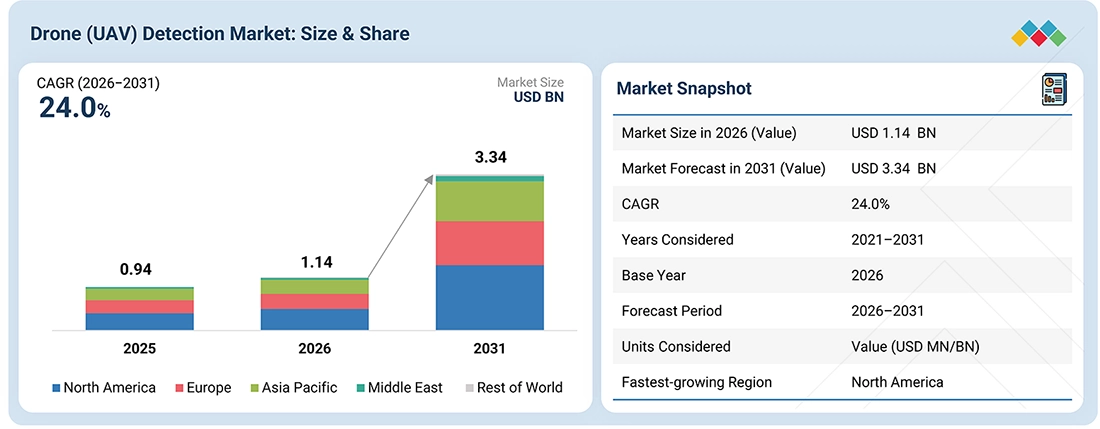
Source: Secondary Research, Interviews with Experts, MarketsandMarkets Analysis
TRENDS & DISRUPTIONS IMPACTING CUSTOMERS' CUSTOMERS
The drone detection market is shifting from individual detection systems toward networked, multi sensor, and AI-supported solutions. Current revenue is mainly associated with air defense systems, system integration and customization services, maintenance and support contracts, upgrades, and retrofits. Future demand is expected to place greater emphasis on critical infrastructure, private fleets, integrated smart city security solutions and customizable multi sensor detection platforms. Technology development is being shaped by swarm detection, LiDAR tracking, AI-enabled multi-sensor systems and AI-powered multi-sensor architectures. These technologies can improve the ability to detect, classify and track multiple drones while combining information from different sensor types. The changing technology mix also affects the wider value chain. Counter UAS system providers/integrators, critical infrastructure operators and distributors and suppliers are positioned as key customers, while downstream demand comes from governments and regulatory bodies, military organizations, critical infrastructure operators, law enforcement agencies and private security firms. This creates demand for systems that can support different operating environments and security requirements.
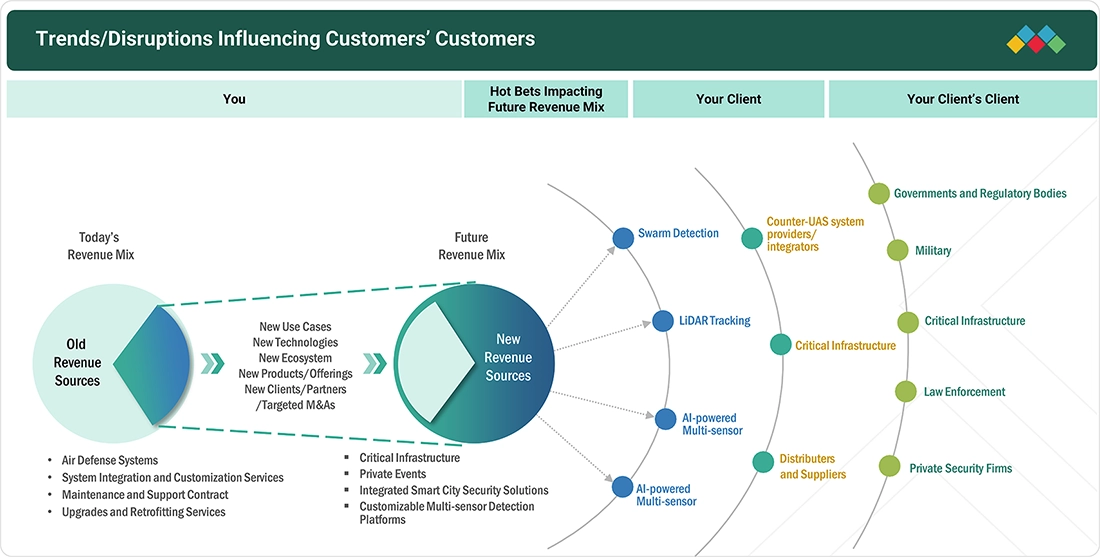
Source: Secondary Research, Interviews with Experts, MarketsandMarkets Analysis
DRONE (UAV) DETECTION MARKET DYNAMICS

Level
-
§Increased need for drone detection systems

-
§Regional conflicts and geopolitical tensions


Level
-
§High initial deployment and operational costs

-
§Evolving regulatory frameworks


Level
-
§Expansion of IoT and AI in drone detection systems

-
§Advancements in detection technologies


Level
-
§Cybersecurity risks in connected detection systems

-
§Accuracy issues in complex environments

Source: Secondary Research, Interviews with Experts, MarketsandMarkets Analysis
Driver: Increased need for drone detection systems
Rising use of small drones across civilian and defense airspace is increasing the need to detect unauthorized flights near airports, military facilities, critical infrastructure, borders, and public venues. Organizations are deploying radar, RF, EO/IR, acoustic, and multi-sensor systems to improve awareness of low-altitude drone activity.
Restraint: High initial deployment and operational costs
Drone detection systems can require multiple sensors, processing hardware, software, networking equipment, installation and ongoing maintenance. Large facilities may need several sensor locations to achieve suitable coverage. These costs can limit deployment among smaller commercial facilities and organizations with limited security budgets.
Opportunity: Expansion of IoT and AI in drone detection systems
Integration of AI and connected sensors is improving how drone detection systems process as well as share information. AI can support the target classification, sensor fusion, and behavioral analysis, while connected architectures allow radar, RF, EO/IR, and acoustic sensors to exchange information across multiple locations and provide a common operating picture.
Challenge: Cybersecurity risks in connected detection systems
Networked drone detection systems exchange sensor data, tracks, alerts along with identification information across connected devices and command platforms. This connectivity can create cybersecurity risks if communication links, software, or interfaces are not adequately protected. Secure data exchange, access controls, software updates along with network monitoring are therefore important deployment requirement.
DRONE (UAV) DETECTION MARKET: COMMERCIAL USE CASES ACROSS INDUSTRIES
| COMPANY | USE CASE DESCRIPTION | BENEFITS |
|---|---|---|
 |
Radar-Based Drone Detection & Classification – The IRIS radar is designed to detect and track small drones in low-altitude airspace. It provides 360-degree coverage and uses radar information, including micro-Doppler signatures, to help classify drones and distinguish them from birds and other objects. | Continuous Small-Drone Monitoring – Provides continuous detection without depending on communication signals from the drone. Automated tracking and classification help operators monitor multiple targets and reduce incorrect alerts caused by non-drone objects. |
 |
RF-Based Drone Detection & Identification – EnforceAir monitors RF communication between drones and their controllers to detect, locate, and identify unauthorized drone activity around government facilities, military installations, and major events. The system can be deployed from fixed locations or vehicles depending on the monitoring requirement. | Passive RF Monitoring & Geolocation – Provides information on detected drones and their controllers without relying on radar emissions. Mobile deployment allows detection coverage to be moved between locations, while RF analysis supports identification and location of compatible drone activity. |
 |
Radar-Based Airspace & Drone Surveillance – Ground Master 200 Multi-Mission radars provide mobile airspace surveillance for the Brazilian Air Force, including detection and tracking of small and low-altitude aerial targets. The radar uses 4D AESA technology and can be rapidly deployed as monitoring requirements change. | Mobile Radar Detection & Tracking – Provides extended airspace monitoring and tracking of small aerial targets from a deployable radar platform. Rapid setup and extended autonomous operation allow surveillance coverage to be established at different locations according to operational requirements. |
Logos and trademarks shown above are the property of their respective owners. Their use here is for informational and illustrative purposes only.
DRONE (UAV) DETECTION MARKET ECOSYSTEM
The drone detection market ecosystem includes regulatory bodies, technology and system providers, and end users that together support the development, deployment, and operation of drone detection systems. Regulatory bodies, including aviation and civil aviation authorities, establish requirements related to airspace use, drone operations, Remote ID, safety and the deployment of detection technologies. Technology and system providers develop radar, RF, EO/IR, acoustic, multi-sensor, processing, tracking, and airspace-monitoring solutions. Companies shown in the ecosystem include RTX (US), Northrop Grumman Corporation (US), Teledyne FLIR LLC (US), Saab AB (Sweden), Thales (France), Lockheed Martin Corporation (US), and Elbit Systems Ltd. (Israel). Their offerings range from individual sensors to integrated systems that detect, classify, identify, and track drones. End users include defense organizations, police and law enforcement agencies, government security organizations, aviation operators, and other security users. Their requirements vary by application, with military users requiring battlefield and base surveillance, law enforcement agencies monitoring public and sensitive locations, and aviation users focusing on unauthorized drone activity around airports along with controlled airspace.
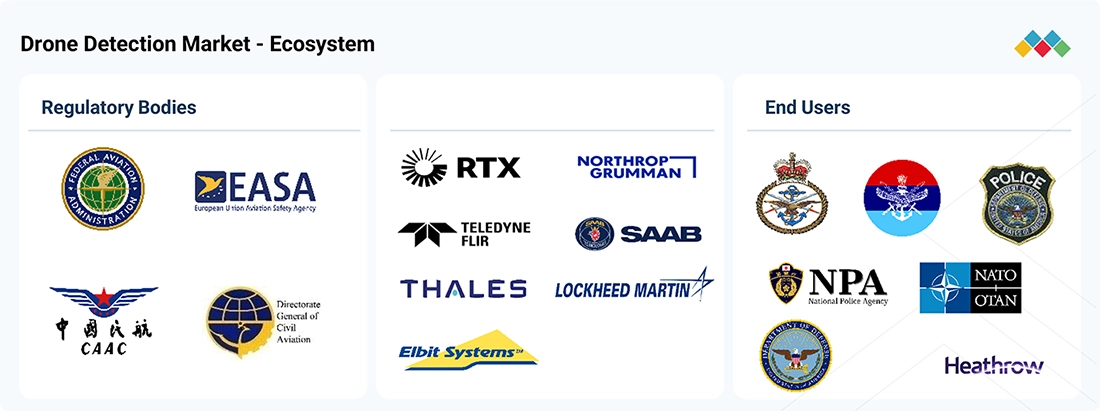
Logos and trademarks shown above are the property of their respective owners. Their use here is for informational and illustrative purposes only.
DRONE (UAV) DETECTION MARKET SEGMENTS
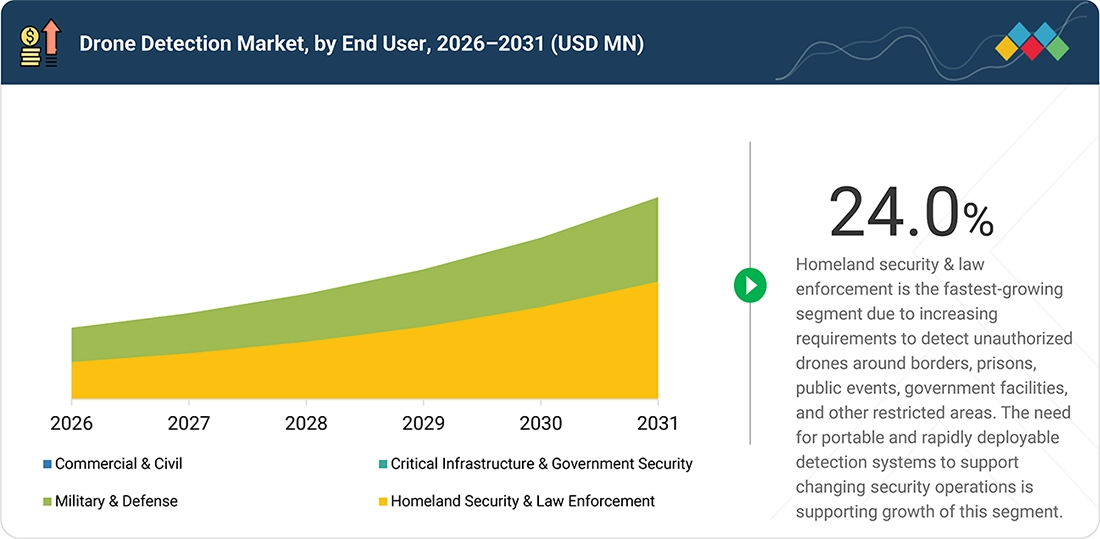
Source: Secondary Research, Interviews with Experts, MarketsandMarkets Analysis
Drone Detection Market, By Architecture
Multi-sensor systems are the fastest-growing segment due to the need to combine radar, RF, EO/IR, and acoustic inputs for more reliable drone detection. The ability to detect different drone signatures and reduce the limitations of individual sensors is supporting their adoption across military, airport, and critical infrastructure applications.
Drone Detection Market, By Offering
Sensor fusion & geolocation software is the fastest-growing subsegment due to the need to combine data from multiple detection sensors and determine the location of drones and their operators. Increasing use of multi-sensor systems and the need for a common, accurate drone track are supporting growth of this software segment.
Drone Detection Market, By Deployment
Vehicle-mounted systems are the fastest-growing segment due to the need for drone detection during mobile military, border, and security operations. Their ability to carry larger sensors and processing equipment while supporting stationary and on-the-move detection is increasing their use across changing operational locations.
Drone Detection Market, By Range
Medium-range (6–20 km) systems are the fastest-growing segment due to the need to detect drones before they approach sensitive sites and restricted airspace. This range provides suitable coverage for military bases, airports, borders, and critical infrastructure while supporting the detection and tracking of small and low-flying drones.
Drone Detection Market, By End User
Homeland security & law enforcement is the fastest-growing segment due to increasing requirements to detect unauthorized drones around borders, prisons, public events, government facilities, and other restricted areas. The need for portable and rapidly deployable detection systems to support changing security operations is supporting growth of this segment.
Drone Detection Market, By Technology
AI-powered systems are the faster-growing segment due to the increasing need to detect, classify, and track small drones in complex environments. AI-based processing helps analyze sensor data, distinguish drones from other objects, and combine inputs from multiple sensors, supporting segmental growth.
DRONE (UAV) DETECTION MARKET REGION
North America to be the fastest-growing region in the drone detection market during the forecast period
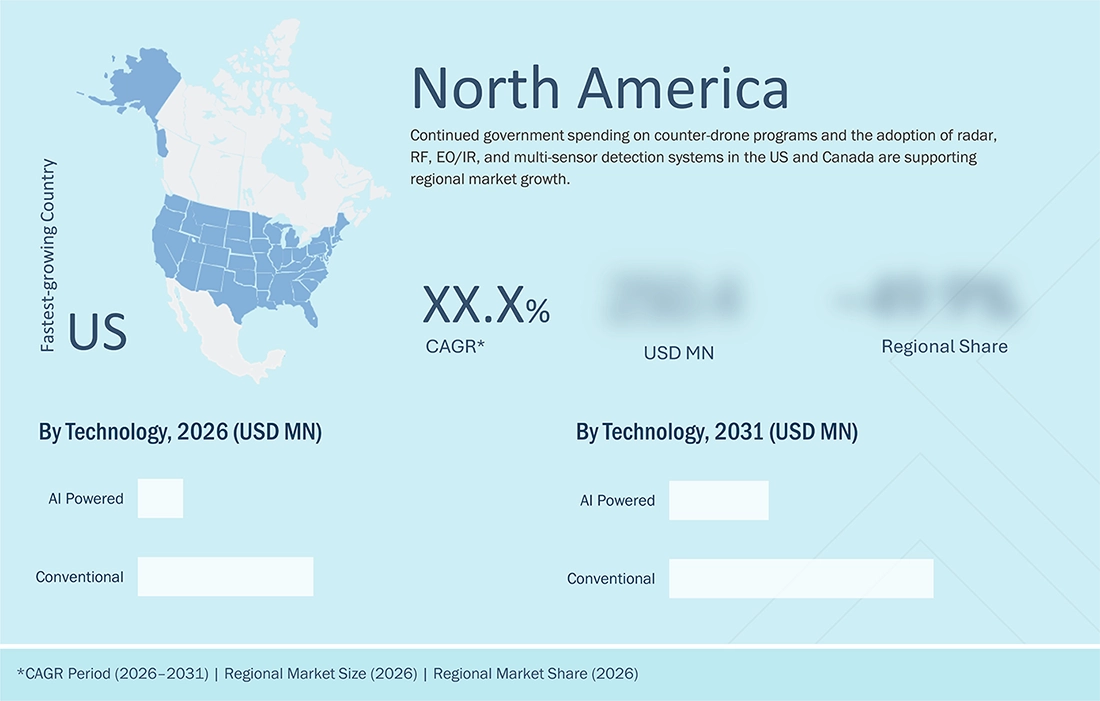
North America is projected to register the highest CAGR during the forecast period, supported by increasing requirements to detect unauthorized drones around military bases, airports, borders, and critical infrastructure. Continued government spending on counter-drone programs and the adoption of radar, RF, EO/IR, and multi-sensor detection systems in the US and Canada are supporting regional market growth.
DRONE (UAV) DETECTION MARKET: COMPANY EVALUATION MATRIX
The company evaluation matrix for the drone detection market assesses companies based on their product footprint and market position. It compares players based on the range of drone detection technologies, deployment options, geographic presence, customer base, and recent developments. Leonardo DRS leads the market with a strong product portfolio, manufacturing technologies, and a broad customer base, while Teledyne FLIR LLC is recognized as an emerging leader in this market.
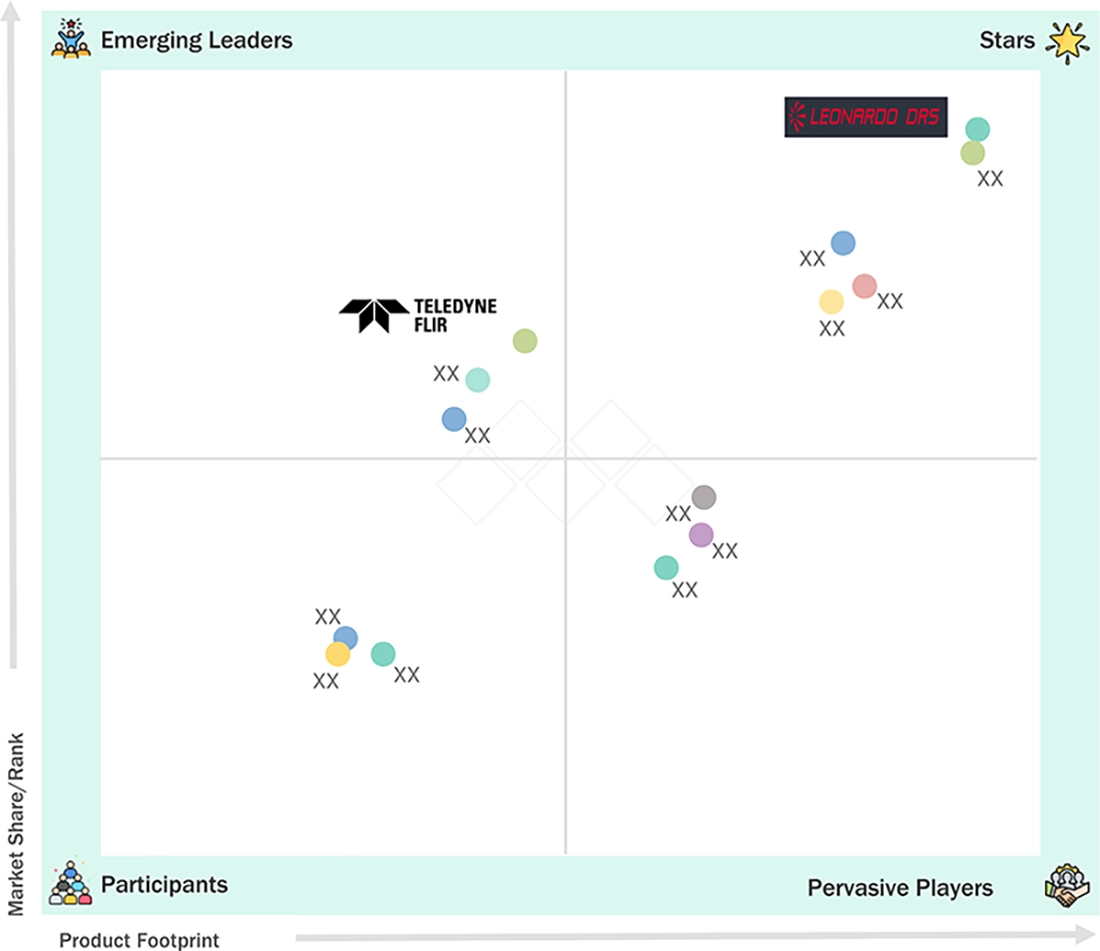
Source: Secondary Research, Interviews with Experts, MarketsandMarkets Analysis
KEY DRONE (UAV) DETECTION MARKET PLAYERS
List of Top Drone (UAV) Detection Market Companies
- Leonardo DRS, Inc.
- SRC, Inc.
- Saab AB
- HENSOLDT AG
- Echodyne Corp.
- Fortem Technologies, Inc.
- Teledyne FLIR LLC
- Robin Radar Systems B.V.
- Blighter Surveillance Systems Ltd.
- Anduril Industries, Inc.
- Axon Enterprise, Inc. (Dedrone)
- DroneShield Limited
- Rohde & Schwarz GmbH & Co. KG
- Aaronia AG
- Sentrycs
WHAT IS IN IT FOR YOU: DRONE (UAV) DETECTION MARKET REPORT CONTENT GUIDE
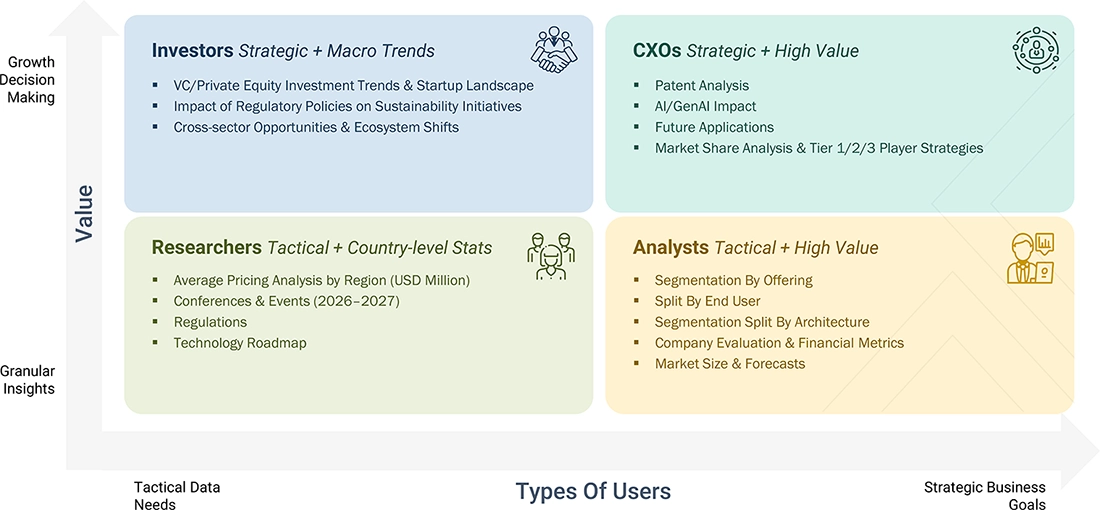
DELIVERED CUSTOMIZATIONS
We have successfully delivered the following deep-dive customizations:
| CLIENT REQUEST | CUSTOMIZATION DELIVERED | VALUE ADDS |
|---|---|---|
| Leading Manufacturer | Additional segment breakdown for countries | Additional country-level market sizing tables for segments/subsegments covered at the regional/global level to gain an understanding of market potential by each country |
| Emerging Leader | Additional company profiles | Competitive information on targeted players to gain granular insights into direct competition |
| Regional Market Leader | Additional country market estimates | Additional country-level deep dive for a more targeted understanding of the total addressable market |
RECENT DEVELOPMENTS
- September 2026 : The U.S. Air Force issued a solicitation for passive RF drone detection equipment for Joint Base McGuire-Dix-Lakehurst. The requirement includes 18 passive RF detect, track, and identify systems, including options, to support detection and identification of small drones.
- September 2026 : The Indian Army issued a tender for the development and supply of an SDR-based drone detection system. The requirement covers one system and focuses specifically on detecting drones using software-defined radio technology.
- August 2026 : The Port of Long Beach issued a procurement for a radar-based UAV detection system for fixed and mobile deployment. The system is intended to detect unauthorized drones around port facilities and support deployment at fixed locations as well as on vehicles and boats.
Table of Contents
 Exclusive indicates content/data unique to MarketsandMarkets and not available with any competitors.
Methodology
This research study involves the use of secondary sources, company publications, government databases, procurement records, technical papers and industry associations to collect information related to the Drone Detection Market. Primary research includes discussions with industry participants such as drone detection system providers, radar and RF sensor manufacturers, EO/IR and acoustic sensor providers, software developers, system integrators, distributors, and end users. Interviews with industry experts, company executives, and other participants are used to validate information on market size, segment trends, technology adoption, competitive activity, and future market developments. Both qualitative and quantitative inputs are considered to assess the market and its segments.
Secondary Research
In the secondary research process, various sources are referred to for identifying and collecting information related to the drone detection market. These sources include company annual reports, press releases, investor presentations, product documents, government and defense publications, procurement databases, technical papers, journals, patents, industry associations, and recognized news sources. Secondary research is used to gather information on the market supply chain, competitive landscape, market segmentation, regional presence, technology developments, contracts, partnerships, product developments, and deployment of drone detection systems. Information on radar, RF, EO/IR, acoustic, multi-sensor systems, detection software, and related technologies is also reviewed to understand changes in the market. The collected information is analyzed to estimate the overall market and individual segments using bottom-up and top-down approaches. The findings from secondary research are further checked and validated through primary research with relevant industry participants and subject matter experts.
Primary Research
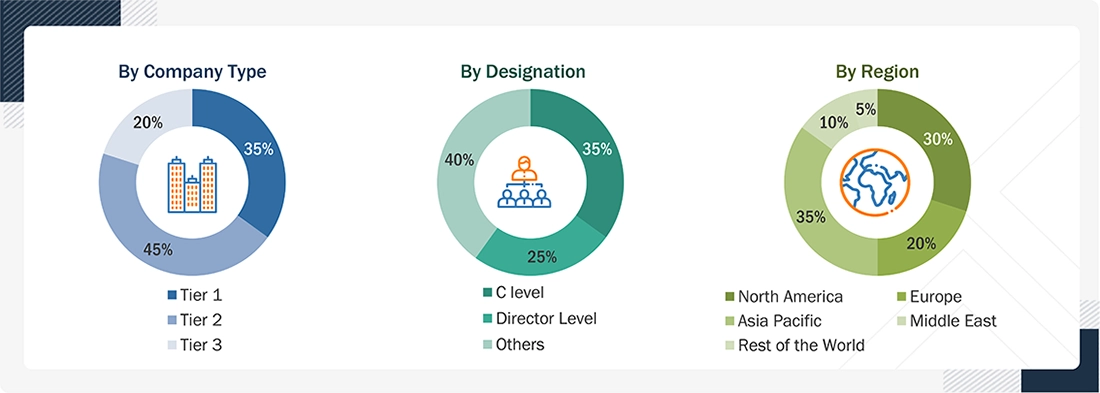
Extensive primary research was conducted after acquiring information on the drone detection market through secondary research. Several primary interviews were conducted with market experts from the demand and supply sides across major countries of North America, Europe, Asia Pacific, the Middle East, and the Rest of the World. Primary data was collected through questionnaires, emails, and telephonic interviews.
To know about the assumptions considered for the study, download the pdf brochure
Market Size Estimation
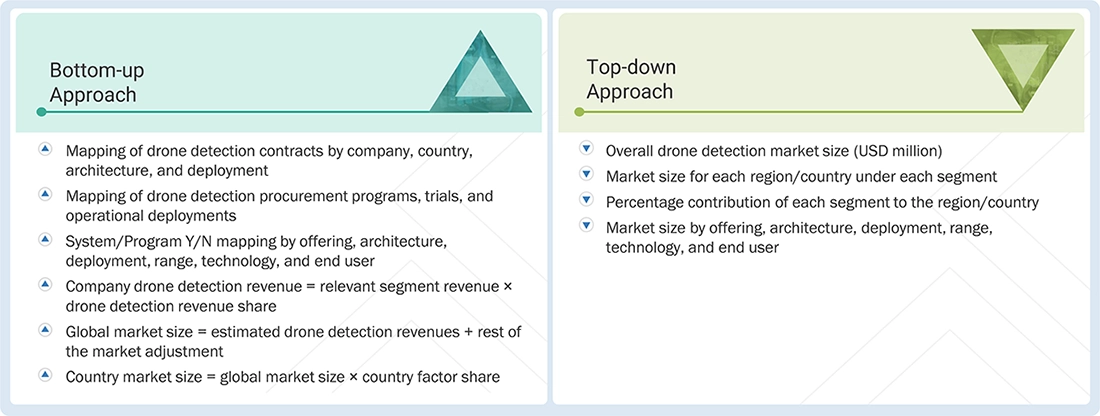
Top-down and bottom-up approaches were used to estimate and validate the size of the drone detection market. The research methodology used to estimate the size of the market included the following details:
- Key players in the drone detection market were identified through secondary research, and their market shares were determined through a combination of primary and secondary research. This included a study of the annual and financial reports of the top market players, as well as extensive interviews with leaders, including directors, engineers, marketing executives, and other key stakeholders of leading companies operating in the market.
- All percentage shares, splits, and breakdowns were determined using secondary sources and verified through primary sources.
- All possible parameters that affect the markets covered in this research study were accounted for, viewed in extensive detail, verified through primary research, and analyzed to obtain the final quantitative and qualitative data on the drone detection market. This data was consolidated, enhanced with detailed input, analyzed by MarketsandMarkets, and presented in this report.
Drone (UAV) Detection Market: Top-Down and Bottom-Up Approach
Data Triangulation
After determining the overall market size, the total market was classified into several segments and subsegments. The data triangulation and market breakdown procedures explained below were implemented, wherever applicable, to complete the overall market engineering process and arrive at the estimated market numbers for the market segments and subsegments. The data were triangulated by examining various factors and trends on both the demand and supply sides. Additionally, the market size was validated using top-down and bottom-up approaches.
Market Definition
The drone detection market focuses on technologies and systems that detect and identify unmanned aerial vehicles (UAVs) or drones. The market includes many solutions that aim to secure airspace, protect critical infrastructure, and prevent unauthorized drone activities, such as potential threats to national security, privacy violations, or smuggling operations.
Drone detection technologies often use radar systems, radio frequency (RF) sensors, and optical sensors to monitor and detect drone activities in real time. The market caters to several applications, including military & defense, government & law enforcement, and critical infrastructure.
Key Stakeholders
- Government agencies and regulators
- Military and defense organizations
- Critical infrastructure operators
- Law enforcement and security agencies
- Technology providers and system integrators
- Drone detection system manufacturers
- Service providers and maintenance companies
- Private security firms
- Research and development institutions
- End users and operators
Report Objectives
- To define, describe, segment, and forecast the size of the drone detection market based on offering, architecture, deployment, range, technology, end user, and region
- To forecast the size of various segments of the market with respect to major regions: North America, Europe, Asia Pacific, the Middle East, and the Rest of the World, along with major countries in each of these regions
- To identify and analyze the drivers, restraints, opportunities, and challenges influencing the growth of the market
- To identify industry trends, market trends, and technology trends currently prevailing in the market
- To analyze micromarkets with respect to growth trends, prospects, and their contribution to the overall market
- To analyze opportunities in the market for stakeholders by identifying key market trends
- To profile key market players and comprehensively analyze their market share and core competencies
- To evaluate the degree of competition in the market by analyzing recent developments, such as contracts, agreements, and acquisitions adopted by leading market players
- To identify detailed financial positions, key products, and unique selling points of leading companies in the market
- To provide a detailed competitive landscape of the market, along with market share analysis and revenue analysis of key players
Available customizations:
MarketsandMarkets offers the following customizations for this market report:
- Additional country-level analysis of the drone detection market
- Profiling of other market players (up to five)
Product Analysis
-
Product matrix, which provides a detailed comparison of the product portfolios of each company in the drone detection market
Key Questions Addressed by the Report
What is the projected size of the drone detection market by 2031?
The drone detection market is estimated at USD 1.14 billion in 2026 and is projected to reach USD 3.34 billion by 2031, growing at a CAGR of 24.0%. Increasing security concerns around critical infrastructure, military facilities, and unauthorized drone activity are supporting market growth.
What are the major factors driving the drone detection market?
The increasing need for drone detection systems and regional conflicts and geopolitical tensions are major market drivers. Growing use of small drones near airports, military facilities, borders, and critical infrastructure is increasing demand for reliable detection and tracking solutions.
Which region is expected to grow fastest in the drone detection market?
North America is expected to register the highest CAGR during the forecast period. Government spending on counter drone programs and adoption of radar, RF, EO/IR, and multi sensor detection systems in the United States and Canada are supporting regional growth.
Which architecture segment is expected to grow fastest?
Multi sensor systems are the fastest growing architecture segment. Combining radar, RF, electro optical and infrared, and acoustic inputs helps improve detection reliability and reduce the limitations of individual sensors across military, airport, and critical infrastructure applications.
Which deployment segment is projected to grow fastest?
Vehicle mounted systems are the fastest growing deployment segment. Their ability to carry larger sensors and processing equipment while supporting stationary and mobile detection is increasing their use in military, border, and security operations.
What are the key technology trends in the drone detection market?
Key trends include AI powered detection, sensor fusion, RF signal analysis, automated drone classification, swarm detection, and LiDAR tracking. These technologies help operators detect, classify, and track multiple drones using information from different sensor types.
What opportunities exist in the drone detection market?
The expansion of IoT and AI in drone detection systems and advances in detection technologies present significant opportunities. Connected sensors and AI can support target classification, sensor fusion, behavioral analysis, and information sharing across multiple locations.
What are the major restraints affecting the drone detection market?
High initial deployment and operational costs can limit adoption, particularly among smaller facilities and organizations with restricted security budgets. Evolving regulatory frameworks are another restraint affecting market deployment.
Which technology and end user segments are expected to grow fastest?
AI powered systems are the faster growing technology segment because they improve the detection, classification, and tracking of drones in complex environments. Homeland security and law enforcement is the fastest growing end user segment, driven by the need to protect borders, prisons, public events, government facilities, and other restricted areas.
Who are the key players in the drone detection market?
Key players include Leonardo DRS, SRC, Saab AB, HENSOLDT AG, Echodyne, Fortem Technologies, Teledyne FLIR, Robin Radar Systems, Blighter Surveillance Systems, Anduril Industries, Dedrone, and DroneShield. Leonardo DRS is identified as a leading player, while Teledyne FLIR is recognized as an emerging leader in the company evaluation matrix.


Personalize This Research
- Triangulate with your Own Data
- Get Data as per your Format and Definition
- Gain a Deeper Dive on a Specific Application, Geography, Customer or Competitor
- Any level of Personalization
Let Us Help You
- What are the Known and Unknown Adjacencies Impacting the Drone (UAV) Detection Market
- What will your New Revenue Sources be?
- Who will be your Top Customer; what will make them switch?
- Defend your Market Share or Win Competitors
- Get a Scorecard for Target Partners

Custom Market Research Services
We Will Customise The Research For You, In Case The Report Listed Above Does Not Meet With Your Requirements
Get 10% Free CustomisationTESTIMONIALS



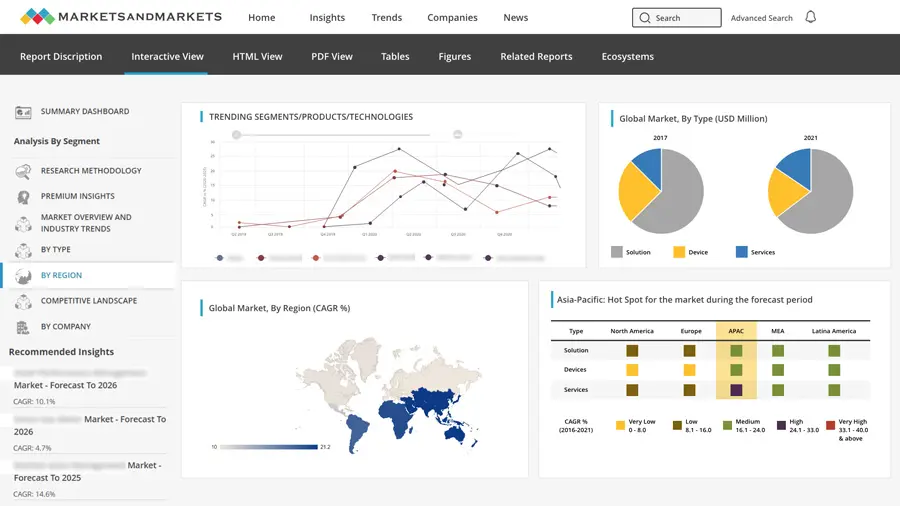
Growth opportunities and latent adjacency in Drone (UAV) Detection Market