Enterprise Content Management Market

Enterprise Content Management Market by Offering (Solutions [Document Management, Record Management], Services), Business Function (Sales & Marketing, Human Resources), Deployment Mode, Organization Size, Vertical, and Region - Global Forecast to 2031




OVERVIEW
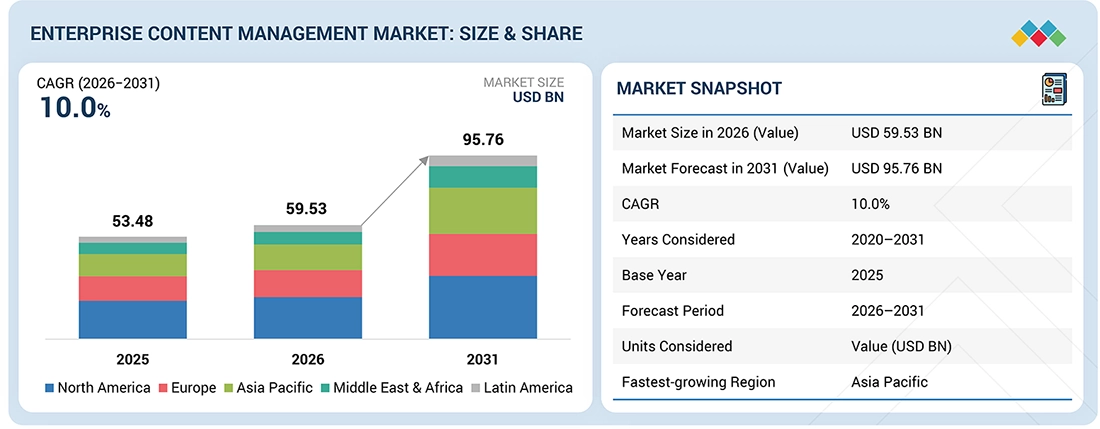
Source: Secondary Research, Interviews with Experts, MarketsandMarkets Analysis
The enterprise content management (ECM) market size is estimated to grow from USD 59.53 billion in 2026 to USD 95.76 billion by 2031, at a Compound Annual Growth Rate (CAGR) of 10.0%. The market is experiencing sustained growth as more organizations are embracing digital transformation, enterprise automation, and cloud information management. The creation of more data within enterprises, such as contracts, multimedia content, operational documents, and compliance data, is leading more organizations to embrace AI-based document processing and content management systems. ECM systems are becoming intelligent information management systems that are enabling organizations to automate metadata management, document classification, and compliance reporting. The work-from-home culture is becoming more common within organizations, and collaboration is becoming a necessity; thus, more organizations are embracing cloud information management strategies that are enabling ECM to become a cornerstone for digital business operations.
KEY TAKEAWAYS
-
BY REGIONNorth America is expected to hold the largest market value of USD 21.93 billion in 2026.
-
BY SOLUTION TYPEThe web & mobile content management segment is expected to grow at the highest CAGR of 12.8% during the forecast period.
-
BY BUSINESS FUNCTIONThe human resources segment is estimated to hold the largest market value of USD 18.15 billion in 2026.
-
BY SERVICEThe managed services segment is projected to grow at the fastest rate during the forecast period.
-
BY ORGANIZATION SIZEThe large enterprise segment is estimated to hold the largest market value in 2026.
-
BY VERTICALThe healthcare & life sciences segment is projected to grow at the fastest rate during the forecast period.
-
COMPETITIVE LANDSCAPEMajor vendors in the enterprise content management (ECM) market are focusing on cloud deployment, AI-based document processing, and integration with enterprise applications to strengthen their market positions. Companies such as Microsoft, OpenText, Box, Hyland Software, and IBM are enhancing their platforms with document lifecycle management, workflow automation, and content governance capabilities to support enterprise information management.
-
COMPETITIVE LANDSCAPEThe ECM ecosystem also includes emerging providers such as GemShelf Inc., Ripcord, and Ephesoft that focus on document capture, intelligent document processing, and automated data extraction to support enterprise document digitization and content processing.
Enterprise content management is shifting from basic document storage toward platforms that support automated document workflows and structured information governance. Vendors are integrating AI-based classification, metadata generation, and low-code workflow capabilities to manage enterprise content more efficiently. As organizations expand digital operations and regulatory requirements become more complex, ECM platforms are increasingly being used to control document lifecycles, ensure compliance, and support enterprise-wide content accessibility.
TRENDS & DISRUPTIONS IMPACTING CUSTOMERS' CUSTOMERS
Enterprise content management is shifting beyond traditional document storage toward AI-powered content lifecycle management platforms. Modern ECM solutions now incorporate machine learning–based document classification, intelligent metadata generation, workflow automation, and enterprise content analytics. Organizations are deploying these platforms to improve content visibility, regulatory compliance, and operational efficiency across departments such as HR, finance, procurement, and legal. As enterprise operations become increasingly digital, ECM is emerging as a core component of enterprise knowledge management and digital process automation strategies.
Source: Secondary Research, Interviews with Experts, MarketsandMarkets Analysis
MARKET DYNAMICS

Level
-
Increased need for compliance and audit management to enhance corporate governance

-
Growing need to enhance cotnent security & optimize business process with automated workflows


Level
-
Complexity of integration with legacy systems

-
Data security and privacy concerns


Level
-
Adoption of AI-driven document processing and intelligent content automation

-
Growing demand for industry-specific ECM solutions


Level
-
Maintaining compliance with evolving data governance regulations

-
Managing large volumes of unstructured enterprise content

Source: Secondary Research, Interviews with Experts, MarketsandMarkets Analysis
Driver: Increased need for compliance and audit management to enhance corporate governance
The rising regulatory pressures in the areas of data protection, audit management, and corporate governance are important factors in the adoption of ECM solutions. Enterprises are facing a large volume of regulated documents and need to comply with various regulations in the areas of data retention, data protection, and others. ECM solutions provide a variety of features in the areas of audit management, access management, document retention, and compliance management, thereby helping organizations in improving their governance.
Restraint: Complexity of integration with legacy systems
Many businesses still use their outdated document storage systems together with their obsolete IT systems, which create difficulties for their ECM modernization projects. The deployment of ECM systems faces delays because organizations deal with multiple issues, including data silos, incompatible file formats, restricted interoperability, and complicated migration processes. Organizations need ECM systems that can connect with their current enterprise systems, their old database systems, and their active business processes, which demonstrates the need for open APIs, modular system design, and flexible integration solutions.
Opportunity: Adoption of AI-driven document processing and intelligent content automation
AI technology is changing the ECM market through its capability to perform intelligent document processing, automated metadata extraction, natural language processing, and predictive workflow automation. The technologies enable companies to automate document classification together with key data extraction and automated workflow processes, which results in reduced manual work and enhanced operational performance. AI-powered ECM systems improve enterprise search functions, together with knowledge discovery and real-time content analysis, which create major business expansion possibilities in the market.
Challenge: Maintaining compliance with evolving data governance regulations
Businesses encounter growing difficulties because they must comply with changing data protection laws and their requirements for data storage and international data management regulations. Organizations must ensure that content stored within ECM platforms adheres to strict security, audit, and regulatory requirements while remaining accessible to authorized teams. Enterprises need advanced content governance tools together with compliance automation and secure document lifecycle management systems to manage their requirements across multiple locations.
ENTERPRISE CONTENT MANAGEMENT MARKET: COMMERCIAL USE CASES ACROSS INDUSTRIES
| COMPANY | USE CASE DESCRIPTION | BENEFITS |
|---|---|---|
 |
Legal Aid Western Australia implemented the OpenText Extended ECM to replace its legacy document management system and support the digital transformation of legal services. The platform integrated content across core business systems and enabled secure management of sensitive legal documents. As part of the deployment, the organization migrated 15 million documents and provided centralized access to information for nearly 400 staff members across multiple offices. | The implementation created a secure and integrated repository for confidential legal content, reducing information duplication and improving document accessibility. Staff gained faster access to client information through connected workspaces and improved workflows. The platform also positioned the organization to expand digital legal services and enhance collaboration across distributed teams. |
 |
PowerSouth Energy Cooperative implemented ECM solutions from IBM, including IBM Datacap and IBM FileNet Content Manager, to capture and manage large volumes of inbound documents. The system enabled the company to digitize documents and store them in a centralized repository to support case management and content access across operations. | The implementation streamlined several operational processes and improved invoice processing by reducing manual data entry and minimizing errors. Employees were able to access documents directly from a centralized system without switching between applications, which improved efficiency and ensured access to the most up-to-date information. |
 |
Mitani, an Australian food manufacturing company, implemented the M-Files document management platform to replace manual and paper-based workflows and improve information sharing across teams. The solution centralized document storage, digitized processes such as quality assurance and compliance documentation, and introduced automated workflows to eliminate information silos. | The implementation streamlined internal processes, improved collaboration, and increased transparency across the organization. Quality assurance and compliance workflows became faster and automated. For example, batch QA processing time was reduced from about four days to less than two days, while improved information access helped the company innovate and respond to customers more quickly. |
 |
Mitsubishi Electric Power Products (MEPPI) implemented Agility CMS, a headless content management platform, as part of its digital transformation to manage digital content across multiple markets and product lines. The solution enabled the company to rebuild its main website and manage content across 3 major markets, 16 industries, and numerous products using a flexible and scalable CMS architecture. | The implementation improved content management efficiency, providing 15× better back-end experience and 80× easier page management for teams. It also enabled independent development of front-end, back-end, and content workflows, allowing faster website updates and supporting the company’s expanding digital presence across industries. |
Logos and trademarks shown above are the property of their respective owners. Their use here is for informational and illustrative purposes only.
MARKET ECOSYSTEM
The enterprise content management (ECM) market consists of platform vendors together with service providers, system integrators, and supporting technology partners who help organizations control their enterprise information. ECM solutions provide document management, records management, and digital asset management capabilities, which enable organizations to handle content throughout its entire lifecycle by acquiring, storing, structuring, and operating content. The platforms enable enterprises to achieve better operational productivity through automated workflow processes and content management systems, and secure information distribution systems. ECM solutions find application in multiple industries, which include healthcare, BFSI, legal, and government sectors, because these industries require facilities to handle extensive document collections while securing their data according to regulatory standards.
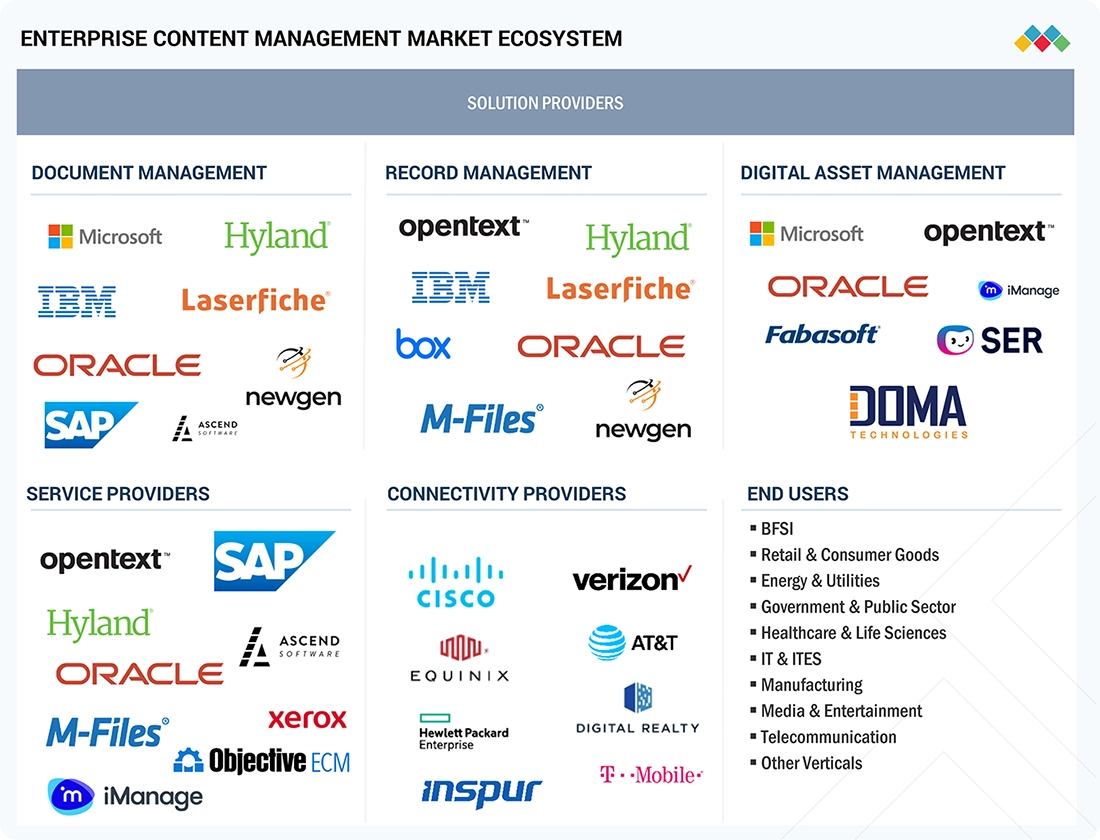
Logos and trademarks shown above are the property of their respective owners. Their use here is for informational and illustrative purposes only.
MARKET SEGMENTS
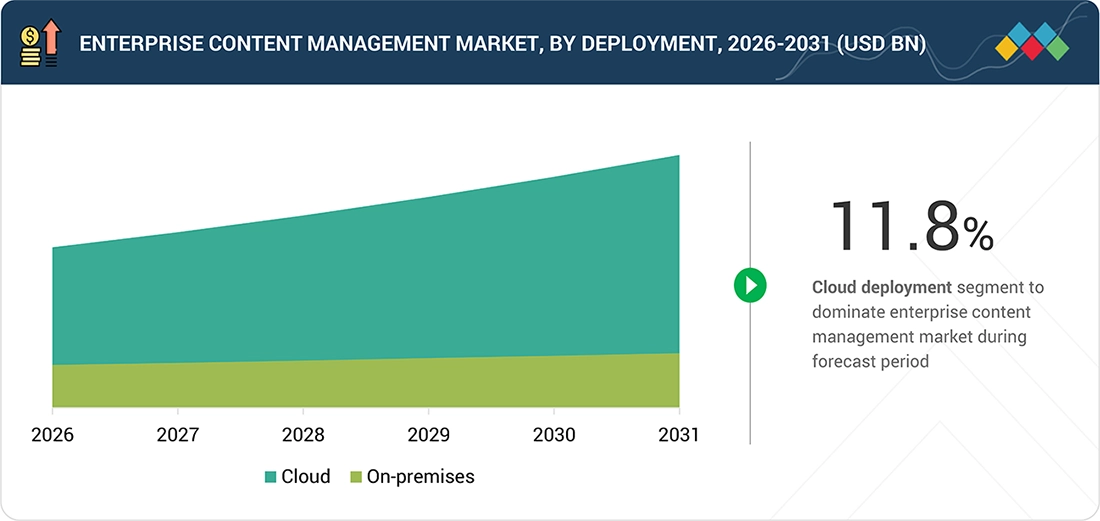
Source: Secondary Research, Interviews with Experts, MarketsandMarkets Analysis
Enterprise Content Management Market, By Offering
The solutions segment has the largest market share in the enterprise content management market due to the adoption of ECM solutions by organizations to handle the ever-increasing volume of enterprise documents, records, and digital content. The market is expanding due to the need for centralized content management, document workflows, and compliance management within the operations of enterprises. The latest ECM solutions provide document lifecycle management, intelligent document classification, automated document workflows, and analytics-driven governance capabilities that help organizations process documents efficiently and provide better visibility into information assets. The solutions segment is witnessing a healthy demand from industries such as BFSI, government, healthcare, manufacturing, and others, as enterprises are moving from legacy ECM solutions to cloud-based ECM solutions.
Enterprise Content Management Market, By Solution Type
Web & mobile content management platforms are gaining momentum as enterprises prioritize digital customer engagement, omnichannel content delivery, and mobile-first workforce productivity. Businesses increasingly require ECM solutions capable of managing content across websites, mobile applications, digital portals, and enterprise collaboration platforms. This shift is accelerating demand for API-driven content platforms, headless CMS architectures, and cloud-based digital content distribution systems, particularly in industries such as retail, telecommunications, media, and e-commerce.
Enterprise Content Management Market, By Services
Professional services hold the largest market value as organizations require consulting, deployment, integration, and training support to implement ECM systems effectively. Many enterprises operate with legacy document systems and require assistance in migrating content and integrating ECM platforms with enterprise applications such as ERP and CRM. As ECM platforms become more complex and incorporate AI-based capabilities, the demand for implementation expertise is increasing. Vendors and service providers play a key role in helping organizations configure workflows, ensure compliance, and align ECM systems with business processes. Sectors such as government, financial services, and healthcare often rely heavily on professional services due to strict regulatory and operational requirements.
Enterprise Content Management Market, By Business Function
Human resource functions are becoming the main users of ECM solutions because organizations need to handle digital employee records and onboarding documents and payroll records and compliance documents and workforce contracts. HR departments are replacing their traditional paper processes with digital systems that use automated document workflows, secure employee document repositories, and compliance content management systems. The adoption of ECM systems in HR operations receives enhanced support through their ability to connect with HRIS platforms, payroll systems, and workforce management tools.
Enterprise Content Management Market, By Organization Size
Large enterprises are observed to be the largest adopters of ECM solutions due to the high volume of documents, the presence of multiple departments in an organization, and high regulatory requirements. These organizations need to manage documents throughout their lifecycle and share knowledge across multiple departments in an organization. Hence, cloud-based ECM solutions integrated with enterprise applications have become a necessity in digital workplaces in organizations.
Enterprise Content Management Market, By Vertical
Healthcare & life sciences is emerging as the fastest-growing ECM vertical due to the rapid digitization of electronic medical records, patient documentation, clinical research files, and regulatory submissions. Healthcare providers must comply with strict data governance regulations, patient privacy requirements, and audit frameworks, making ECM platforms essential for secure medical information management. These systems help healthcare organizations maintain structured data storage, regulatory compliance, and improved accessibility to clinical and administrative documentation.
REGION
Asia Pacific to be fastest-growing enterprise content management market
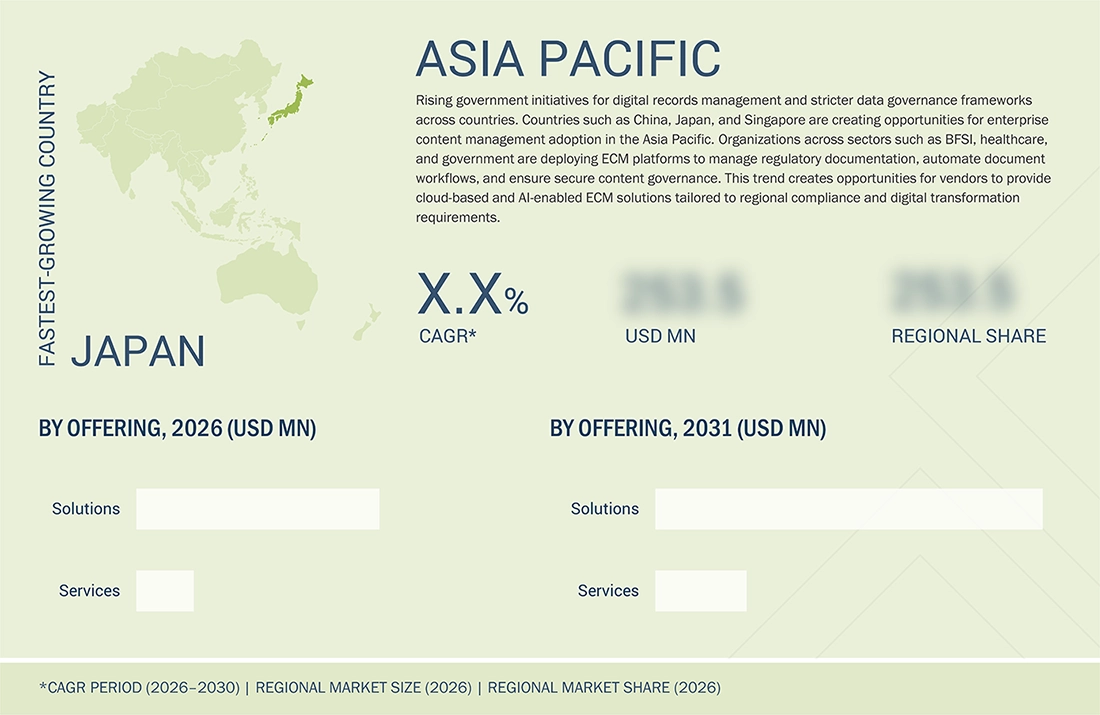
The Asia Pacific is projected to experience the fastest growth in the ECM market as governments and enterprises accelerate digital governance initiatives, enterprise digitization programs, and cloud infrastructure development. Countries across the region are implementing stronger data governance policies, digital records management frameworks, and enterprise digital transformation initiatives. These developments are increasing demand for cloud-based ECM platforms, AI-enabled document processing systems, and secure enterprise information management solutions.
ENTERPRISE CONTENT MANAGEMENT MARKET: COMPANY EVALUATION MATRIX
In the enterprise content management (ECM) market, Microsoft (Star) maintains a dominant position as its comprehensive business ecosystem connects all its content management features through SharePoint and Microsoft 365. Microsoft enables organizations to manage enterprise content through existing digital workflows by implementing AI-powered document management, workflow automation, and collaboration tools within their most popular productivity software. M-Files (Emerging Leader) expands its market presence through its AI-powered document processing and metadata-based content management system. The platform allows organizations to automatically classify documents while enhancing their ability to find information and maintain compliance through content governance, which enables better management of enterprise information.
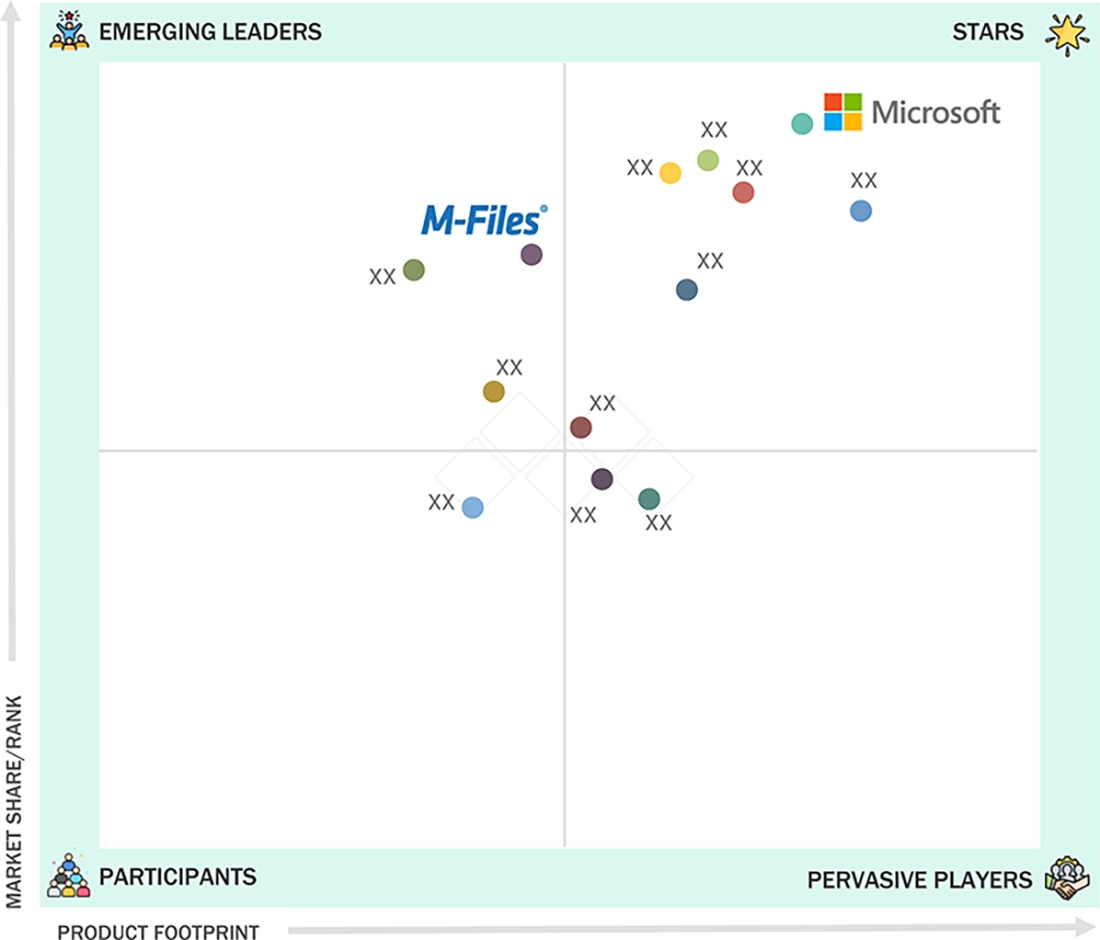
Source: Secondary Research, Interviews with Experts, MarketsandMarkets Analysis
KEY MARKET PLAYERS
- Microsoft (US)
- OpenText (Canada)
- BOX (US)
- Hyland (US)
- IBM (US)
- Adobe (US)
- Xerox (US)
- Atlassian (Australia)
- Kyocera Corporation (Japan)
- Oracle (US)
- iManage (US)
- Laserfiche (US)
- Newgen Software Technologies (India)
- Ascend Software (US)
- M-Files (US)
- DocuWare (Germany)
- Objective (Australia)
- Fabasoft (Austria)
- Doxis (Germany)
- GRM Information Management (US)
- Sqaure 9 Softworks (US)
- Systemware (US)
- Veeva (US)
- DocSend (US)
- AODocs (US)
- Ephesoft (US)
- Paper Alternative Solutions (US)
- dMACQ Softwaware (India)
- FileCloud (US)
- Ripcord (US)
- Shelf (US)
- PandaDoc (US)
- Templafy (Denmark)
MARKET SCOPE
| REPORT METRIC | DETAILS |
|---|---|
| Market Size in 2025 (Value) | USD 53.48 Billion |
| Market Size in 2026 (Value) | USD 59.53 Billion |
| Market Forecast in 2031 (Value) | USD 95.76 Billion |
| CAGR | 10.0% |
| Years Considered | 2020–2031 |
| Base Year | 2025 |
| Forecast Period | 2026–2031 |
| Units Considered | USD Billion |
| Report Coverage | Revenue forecast, company ranking, competitive landscape, growth factors, and trends |
| Segments Covered |
|
| Regions Covered | North America, Asia Pacific, Europe, the Middle East & Africa, Latin America |
WHAT IS IN IT FOR YOU: ENTERPRISE CONTENT MANAGEMENT MARKET REPORT CONTENT GUIDE
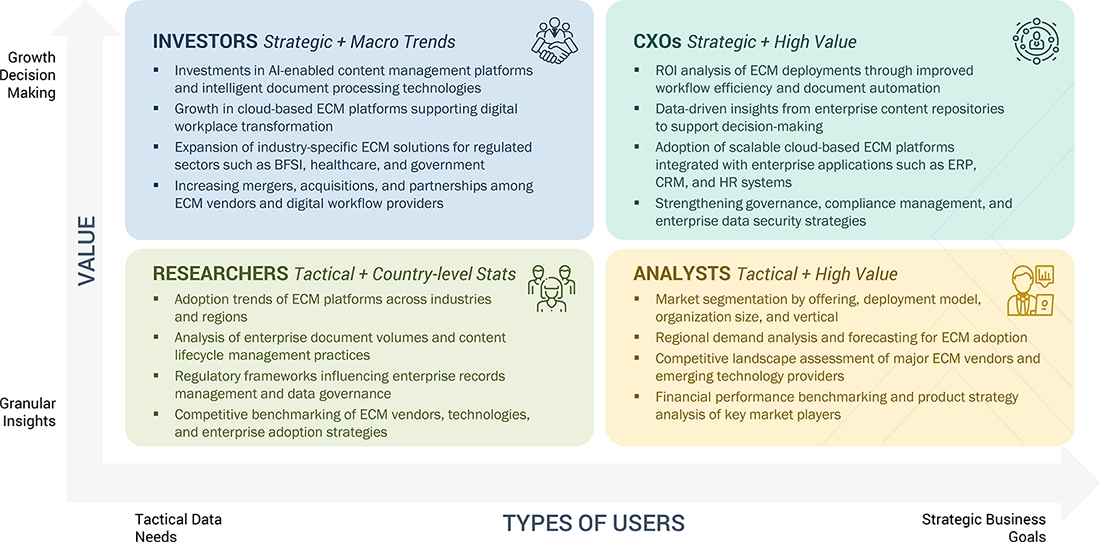
DELIVERED CUSTOMIZATIONS
We have successfully delivered the following deep-dive customizations:
| CLIENT REQUEST | CUSTOMIZATION DELIVERED | VALUE ADDS |
|---|---|---|
| BFSI Institution |
|
|
| Healthcare Provider |
|
|
| Manufacturing Enterprise |
|
|
RECENT DEVELOPMENTS
- November 2025 : OpenText introduced the OpenText AI Data Platform (AIDP) to strengthen secure enterprise information management and AI-driven automation. The platform integrates data management, governance, and AI capabilities to help organizations manage growing volumes of enterprise data while ensuring accuracy and compliance. It also supports AI agents, metadata-driven data governance, and integration with enterprise systems to enable contextual automation and analytics across business processes.
- November 2025 : Box and Tata Consultancy Services announced a strategic partnership to deliver AI-powered intelligent content management solutions for enterprises. The partnership combines Box’s AI-first content platform with TCS’s consulting and industry expertise to help organizations extract insights from unstructured data and automate document-driven workflows. It aims to support digital transformation across industries such as financial services, healthcare, manufacturing, retail, and the public sector by improving productivity, compliance, and content governance.
- August 2025 : Microsoft enhanced Microsoft SharePoint by integrating Microsoft 365 Copilot and other AI-driven features to improve enterprise content creation and management. The update introduced capabilities such as AI-assisted page authoring, automated content generation, and intelligent FAQ creation from organizational documents. These features help enterprises automate knowledge sharing, simplify content publishing, and improve collaboration across teams, highlighting the growing role of AI-enabled tools in enterprise content management platforms.
- February 2026 : Hyland expanded its Content Innovation Cloud to strengthen enterprise AI and agentic automation capabilities across its ECM portfolio. The update introduced enhancements in intelligent document processing, AI agent creation, and content federation to connect data across multiple repositories. These developments enable organizations to automate workflows, unify enterprise content, and improve governance while extracting insights from large volumes of unstructured data.
Table of Contents
 Exclusive indicates content/data unique to MarketsandMarkets and not available with any competitors.
Methodology
The study comprised four main activities to estimate the enterprise content management market size. We conducted significant secondary research to gather data on the market, the competing market, and the parent market. The following stage involved conducting primary research to confirm these conclusions and hypotheses and sizing with industry experts throughout the value chain. The overall market size was evaluated using a blend of top-down and bottom-up approach methodologies. After that, we estimated the market sizes of the various enterprise content management market segments using the market breakup and data triangulation techniques.
Secondary Research
The size of companies offering enterprise content management markets and services was determined based on secondary data from paid and unpaid sources. It was also arrived at by analyzing the product portfolios of major companies and rating the companies based on their performance and quality.
In the secondary research process, various sources were referred to identify and collect information for this study. Secondary sources included annual reports, press releases, and investor presentations of companies; white papers, journals, and certified publications; and articles from recognized authors, directories, and databases. The data was also collected from other secondary sources, such as journals, government websites, blogs, and vendors' websites. Additionally, the spending of various countries on the ECM market was extracted from the respective sources. Secondary research was mainly used to obtain the critical information related to the industry's value chain and supply chain to identify the key players based on solutions, services, market classification, and segmentation according to components of the major players, industry trends related to components, users, and regions, and the key developments from both market- and technology-oriented perspectives.
Primary Research
In the primary research process, various primary sources from both the supply and demand sides of the enterprise content management market were interviewed to obtain qualitative and quantitative information for this study. The primary sources from the supply side included industry experts, such as Chief Executive Officers (CEOs), Vice Presidents (VPs), marketing directors, technology and innovation directors, and related key executives from vendors providing enterprise content management offerings; associated service providers; and is operating in the targeted countries. all possible parameters that affect the market covered in this research study have been accounted for, viewed in extensive detail, verified through primary research, and analyzed to arrive at the final quantitative and qualitative data.
After the complete market engineering process (including calculations for market statistics, market breakup, market size estimations, market forecasting, and data triangulation), extensive primary research was conducted to gather information and verify and validate the critical numbers arrived at. The primary research also helped identify and validate the segmentation, industry trends, key players, competitive landscape, and market dynamics, such as drivers, restraints, opportunities, challenges, and key strategies. In the complete market engineering process, the bottom-up approach and several data triangulation methods were extensively used to perform market estimation and market forecasting for the overall market segments and subsegments listed in this report. An extensive qualitative and quantitative analysis of the complete market engineering process was performed to list the key information/insights throughout the report.
To know about the assumptions considered for the study, download the pdf brochure
Market Size Estimation
The enterprise content management market and related submarkets were estimated and forecasted using top-down and bottom-up methodologies. The bottom-up method was used to determine the market's overall size, using the revenues and product offerings of the major market players. This research ascertained and validated the precise value of the total parent market size through data triangulation techniques and primary interview validation. Next, using percentage splits of the market segments, the overall market size was utilized in the top-down approach to estimate the size of other individual markets.
The research methodology used to estimate the market size included the following:
- Primary and secondary research was utilized to determine the revenue contributions of the major market participants in each country after secondary research helped identify them.
- Throughout the process, critical insights were obtained by conducting in-depth interviews with industry professionals, including directors, CEOs, VPs, and marketing executives, and by reading the annual and financial reports of the top firms in the market.
- Primary sources were used to verify all percentage splits and breakups, which were calculated using secondary sources.
Data Triangulation
The market was divided into several segments and subsegments using the previously described market size estimation procedures once the overall market size was determined. When required, market breakdown and data triangulation procedures were employed to complete the market engineering process and specify the exact figures for every market segment and subsegment. The data was triangulated by examining several variables and patterns from government entities' supply and demand sides.
Market Definition
MarketsandMarkets defines Enterprise Content Management (ECM) as a systematic approach to managing an organization's entire information lifecycle. It involves capturing, storing, managing, and delivering content and documents related to organizational processes. ECM aims to organize, categorize, and secure content, making it easily accessible to authorized users. It encompasses document management, web content management, records management, digital asset management, and workflow management. ECM improves an organization's collaboration, efficiency, and compliance by centralizing content management.
Key Stakeholders
- Training and consulting service providers
- Information Technology (IT) infrastructure providers
- ECM solutions providers
- ECM service providers
- Government organizations and standardization bodies
- Regional associations
- ECM vendors
- Value-added resellers and distributors
Report Objectives
- To define, describe, and forecast the enterprise content management (ECM) market based on offering, business function, deployment mode, organization size, vertical, and region.
- To provide detailed information about the significant factors, such as drivers, opportunities, restraints, and challenges, influencing the growth of the market
- To analyze the opportunities in the market for stakeholders by identifying the high-growth segments of the market
- To forecast the market size concerning five main regions — North America, Europe, Asia Pacific, the Middle East & Africa, and Latin America
- To analyze the subsegments of the market concerning individual growth trends, prospects, and contributions to the overall market
- To profile the market's key players and analyze their size and core competencies comprehensively.
- To track and analyze the competitive developments, such as product enhancements, product launches, acquisitions, partnerships, and collaborations, in the enterprise content management market globally
Available Customizations
MarketsandMarkets provides customizations based on the company's unique requirements using market data. The following customization options are available for the report:
Product Analysis
- The product matrix provides a detailed comparison of each company's product portfolio.
Geographic Analysis
- Further breakup of the enterprise content management market
Company Information
- Detailed analysis and profiling of five additional market players
Key Questions Addressed by the Report
What is the projected size of the Enterprise Content Management Market by 2031?
The enterprise content management (ECM) market is estimated to grow from USD 59.53 billion in 2026 to USD 95.76 billion by 2031, at a CAGR of 10.0% during the forecast period.
Which solution segment is expected to grow the fastest in the Enterprise Content Management Market?
The web & mobile content management segment is expected to grow at the highest CAGR of 12.8% during the forecast period.
Which business function holds the largest share of the Enterprise Content Management Market?
The human resources segment is estimated to hold the largest market value of USD 18.15 billion in 2026.
Which service segment is projected to grow the fastest in the Enterprise Content Management Market?
The managed services segment is projected to grow at the fastest rate during the forecast period.
Which industry vertical is expected to witness the highest growth in the Enterprise Content Management Market?
The healthcare & life sciences segment is projected to grow at the fastest rate during the forecast period.
Why are organizations investing in enterprise content management solutions?
Organizations are investing in enterprise content management solutions to automate document-centric workflows, improve compliance, enable AI-based document processing, and support digital transformation initiatives.


Personalize This Research
- Triangulate with your Own Data
- Get Data as per your Format and Definition
- Gain a Deeper Dive on a Specific Application, Geography, Customer or Competitor
- Any level of Personalization
Let Us Help You
- What are the Known and Unknown Adjacencies Impacting the Enterprise Content Management Market
- What will your New Revenue Sources be?
- Who will be your Top Customer; what will make them switch?
- Defend your Market Share or Win Competitors
- Get a Scorecard for Target Partners

Custom Market Research Services
We Will Customise The Research For You, In Case The Report Listed Above Does Not Meet With Your Requirements
Get 10% Free CustomisationTESTIMONIALS






Growth opportunities and latent adjacency in Enterprise Content Management Market