Facility Management Market

Facility Management Market by Offering (Solutions (IWMS, BIM, Facility Operations & Security Management) and Services), Vertical (BFSI, Retail, Construction & Real Estate, Healthcare & Life Sciences) - Global Forecast to 2032




Updated on : Aug 30, 2026
OVERVIEW
Source: Secondary Research, Interviews with Experts, MarketsandMarkets Analysis
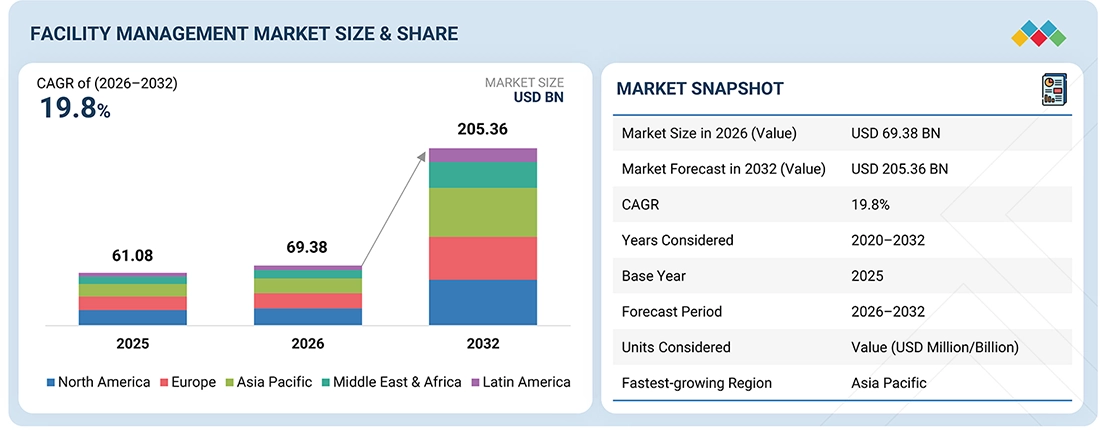
The facility management market is projected to expand from USD 69.38 billion in 2026 to USD 205.36 billion by 2032, at a CAGR of 19.8%. The market is being driven by increasing investments in digital transformation, smart buildings, and sustainability initiatives. Organizations are adopting AI-enabled Integrated Workplace Management Systems (IWMS), IoT-connected assets, predictive maintenance, and digital twin technologies to improve operational efficiency, optimize space utilization, and enhance asset performance. At the same time, growing focus on energy efficiency, ESG compliance, and hybrid workplace management is accelerating demand for intelligent facility management solutions.
Market Size and Forecast:
- 2025 Market Size: USD 61.08 billion
- 2026 Market Size: USD 69.38 billion
- 2032 Forecasted Market Size: USD 205.36 billion
- Growth Rate (2026-2032): CAGR of 19.8%
- Data available from 2020 to 2032
- Base year: 2025
- Forecast period: 2026–2032
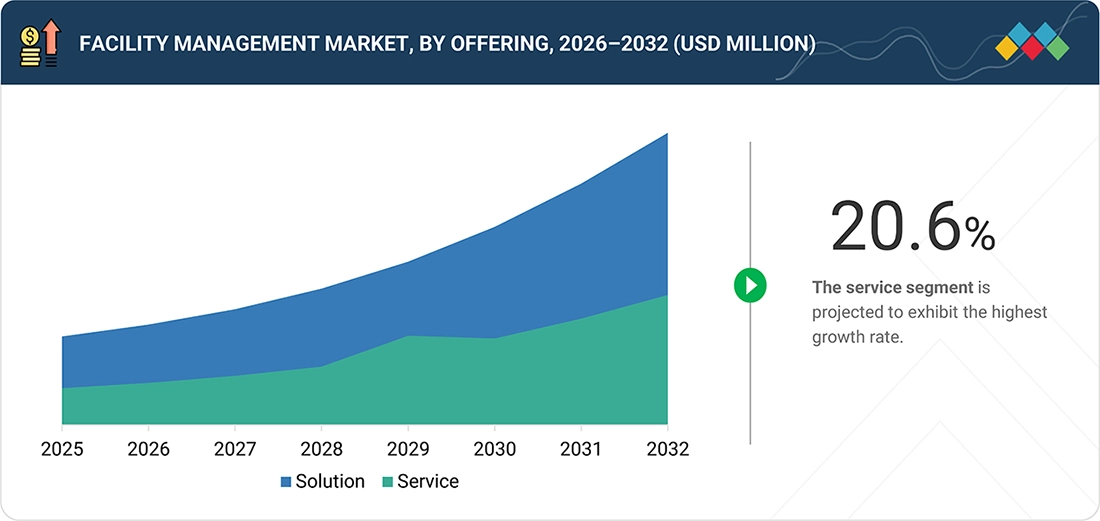
- The service segment is projected to exhibit the highest growth rate, at 20.6%.
Key Market Trends and Insights
- Key Trend: AI, IoT, BIM, IWMS, and digital twins are transforming intelligent facility management.
- Growth Opportunity: Smart buildings and sustainability initiatives are expanding facility management adoption.
-
AI Impact: AI enables predictive maintenance, energy optimization, and real-time facility monitoring.
- Future Outlook: Intelligent, sustainable, and connected buildings will drive future facility management growth.
KEY TAKEAWAYS
-
BY REGIONThe Asia Pacific region is projected to grow the fastest from 2026 to 2032.
-
BY VERTICALThe BFSI segment accounted for a 11.1% share in 2026.
-
BY OFFERINGThe services segment is expected to register the highest CAGR of 20.6%.
-
COMPETITIVE LANDSCAPE - KEY PLAYERSCompanies such as CBRE, JLL, IBM, and Johnson Controls were identified as some of the star players in the facility management market, given their strong market share and product footprint.
-
COMPETITIVE LANDSCAPE - STARTUPS/SMESCompanies such as Causeway Technologies, Service Work Global, UpKeep, and FacilityONE were identified as some of the star players in the facility management market, given their strong market share and product footprint.
Market growth is being driven by the widespread adoption of intelligent facility systems that combine operational efficiency with real-time data insights. As organizations prioritize safety, sustainability, and efficient workspace management, integrated solutions such as IWMS, BIM, and platforms for HVAC control, video surveillance, and emergency responses are seeing rapid deployment. The growing presence of smart infrastructure, pressure to meet energy efficiency norms, and the shift to hybrid working models have further accelerated this adoption. Additionally, increased focus on health and hygiene post-COVID has led to increased investments in touchless technologies, air quality monitoring, and predictive maintenance capabilities.
TRENDS & DISRUPTIONS IMPACTING CUSTOMERS' CUSTOMERS
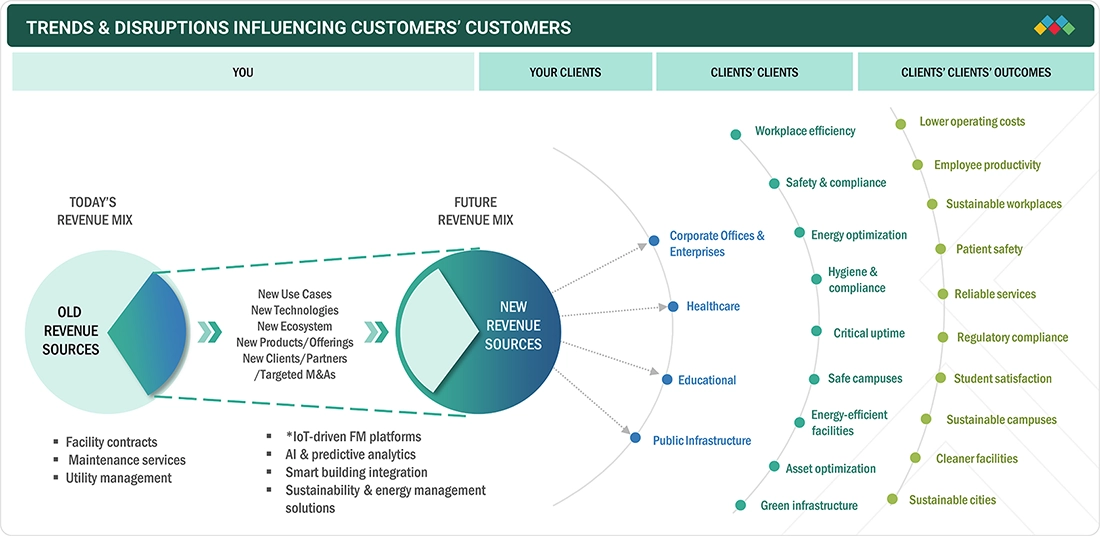
The impact on consumers’ business emerges from customer trends or disruptions. Hot belts are the clients of facility management solution providers, and target applications are the clients of facility management solution providers. Shifts, which are changing trends or disruptions, will impact the revenues of end users. The revenue impact on end users will affect the revenue of hotbeds, which will further affect the revenues of facility management solution providers. The facility management solutions are highly adopted in retail, BFSI, construction & real estate, and telecom sectors. They help in asset management, space utilization, and managing energy consumption, leading to their higher adoption.
Source: Secondary Research, Interviews with Experts, MarketsandMarkets Analysis
MARKET DYNAMICS

Level
-
Growing adoption of AI-enabled cloud facility management platforms

-
Increasing adoption of predictive and condition-based maintenance


Level
-
Shortage of skilled facility management professionals and fragmented data ecosystems

-
High implementation costs and integration complexity


Level
-
Expansion of smart buildings and ESG-driven facility modernization

-
Rising investments in sustainable and net-zero buildings


Level
-
Integration of facility management platforms with legacy enterprise and operational systems

-
Managing cybersecurity and data privacy across connected facilities

Source: Secondary Research, Interviews with Experts, MarketsandMarkets Analysis
Driver: Growing adoption of AI-enabled cloud facility management platforms
The increasing need for operational efficiency, predictive maintenance, energy optimization, and centralized asset visibility is driving the adoption of AI-enabled cloud facility management platforms. Modern IWMS and CMMS solutions integrate IoT sensors, digital twins, mobile applications, and advanced analytics to automate maintenance, optimize space utilization, and improve sustainability performance across distributed facilities. As organizations continue investing in smart buildings and hybrid workplaces, cloud-based FM platforms have become essential for improving operational resilience and reducing lifecycle costs. Johnson Controls continues to expand its OpenBlue platform with AI-driven analytics, digital twins, and connected building technologies that enable predictive maintenance, energy optimization, and intelligent building operations. Similarly, Planon has strengthened its AI-enabled facility management capabilities to automate maintenance planning and workplace operations while supporting enterprise sustainability objectives. These developments demonstrate how intelligent cloud platforms are transforming facility management from reactive maintenance into predictive, data-driven building operations.
Restraint: Shortage of skilled facility management professionals and fragmented data ecosystems
Despite increasing investments in digital facility management technologies, many organizations continue to face challenges due to a shortage of skilled facility management professionals and fragmented operational data. Modern facility management platforms require integration with building management systems (BMS), enterprise resource planning (ERP) software, IoT sensors, BIM models, and enterprise asset management applications. However, many organizations still operate disconnected legacy systems, inconsistent asset records, and manual maintenance processes, limiting the effectiveness of digital transformation initiatives. The lack of standardized data governance and digital expertise often results in longer implementation cycles, lower user adoption, and underutilization of advanced facility management capabilities. The challenge is particularly evident in organizations managing large multi-site facility portfolios, where inconsistent maintenance practices and disconnected operational systems reduce visibility across assets and facilities. Without standardized processes and skilled personnel capable of managing integrated digital platforms, organizations struggle to fully realize the operational and financial benefits of AI-enabled facility management solutions. As a result, workforce capability and data standardization remain key barriers to widespread adoption.
Opportunity: Expansion of smart buildings and ESG-driven facility modernization
Growing investments in smart buildings, sustainability initiatives, and ESG reporting are creating significant opportunities for facility management solution providers. Organizations across commercial real estate, healthcare, manufacturing, education, and public infrastructure are deploying intelligent building technologies to improve energy efficiency, reduce operating costs, and enhance occupant experiences. The integration of IoT sensors, AI, digital twins, and advanced analytics enables facility managers to continuously monitor building performance, optimize resource utilization, and support corporate sustainability goals while meeting increasingly stringent environmental regulations. Leading vendors are continuously expanding their sustainability-focused capabilities to address these evolving requirements. IBM Maximo Application Suite combines AI-driven predictive maintenance with asset performance management to improve operational efficiency and reduce equipment downtime, while Johnson Controls OpenBlue enables organizations to optimize energy consumption and monitor building performance through connected digital building technologies. Similarly, Eptura and Planon continue strengthening workplace intelligence, energy management, and ESG reporting capabilities within their cloud-based facility management platforms. The growing adoption of intelligent and sustainable buildings is expected to create substantial growth opportunities for the facility management market throughout the forecast period.
Challenge: Integration of facility management platforms with legacy enterprise and operational systems
Integrating modern facility management platforms with legacy enterprise applications and operational technologies remains one of the most significant challenges for organizations undergoing digital transformation. Many enterprises continue to operate aging ERP systems, proprietary building management systems, enterprise asset management platforms, and standalone operational applications that were not designed to exchange data seamlessly. This fragmented technology landscape complicates the deployment of advanced capabilities such as predictive maintenance, digital twins, AI-driven analytics, and enterprise-wide sustainability reporting, resulting in increased implementation complexity and project costs. The challenge becomes even more significant in large enterprises operating multiple facilities across different regions, where diverse technology environments require extensive API development, middleware integration, and master data standardization before intelligent facility management platforms can function effectively. Poor interoperability often leads to duplicated asset records, inconsistent maintenance data, limited operational visibility, and delayed realization of business value. As organizations continue investing in digital building technologies, ensuring seamless integration between legacy enterprise systems and next-generation facility management platforms will remain a critical challenge influencing implementation success.
FACILITY MANAGEMENT MARKET: COMMERCIAL USE CASES ACROSS INDUSTRIES
| COMPANY | USE CASE DESCRIPTION | BENEFITS |
|---|---|---|
 |
Gasunie, the Dutch natural gas transmission operator, consolidated nearly 90 facility management processes into Planon's Integrated Workplace Management System (IWMS). The implementation standardized work order management, service desk operations, move management, project management, and maintenance workflows across the organization, replacing fragmented legacy systems with a centralized platform. | Consolidated 90+ FM processes into a single IWMS platform | Standardized maintenance and work order management | Improved operational transparency and process efficiency | Reduced dependence on multiple legacy systems |
 |
King Abdullah Financial District Development & Management Company implemented IBM Maximo to manage maintenance and operational assets across one of the world's largest mixed-use business districts, comprising 94 buildings. The platform digitized maintenance planning, asset monitoring, and service operations to support continuous facility availability and efficient infrastructure management. | Centralized asset maintenance across a large mixed-use district | Improved maintenance response times | Enhanced operational reliability through digital asset management | Supported scalable smart city and facility operations |
 |
Boston Properties uses MRI Software's facility management platform to streamline building operations, maintenance management, contractor coordination, and tenant service delivery across its commercial real estate portfolio. MRI's solution enables property teams to manage work orders, preventive maintenance, inspections, and operational reporting through a centralized platform, improving service quality and operational efficiency across multiple facilities. The client notes that continuous product enhancements have helped deliver higher levels of customer service while improving collaboration among property teams, contractors, and tenants. | Improved collaboration between property teams, contractors, and tenants | Centralized maintenance and work order management | Enhanced customer service and tenant experience | Increased operational visibility through integrated facility management dashboards | Enabled proactive maintenance and faster issue resolution |
Logos and trademarks shown above are the property of their respective owners. Their use here is for informational and illustrative purposes only.
MARKET ECOSYSTEM
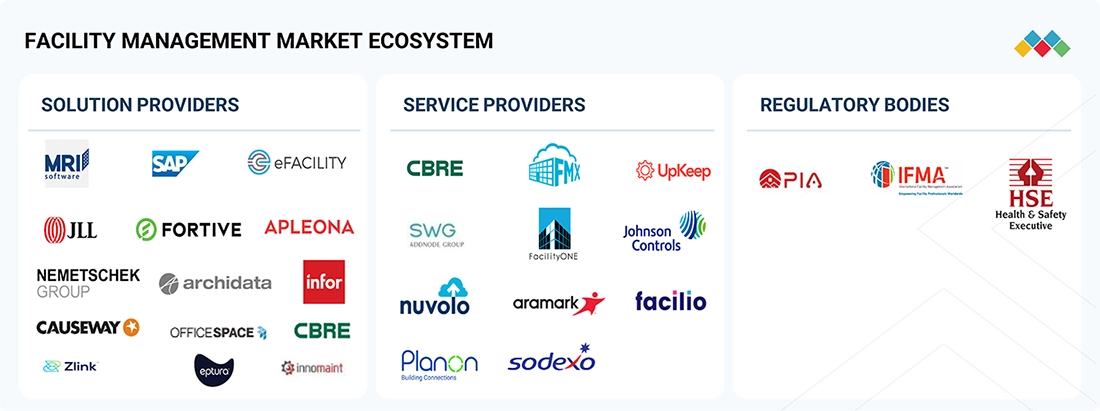
The facility management market consists of a diverse ecosystem with various stakeholders, such as solution providers, regulatory bodies, and service providers. It represents the facility management vendors offering comprehensive solutions for various industries.
Logos and trademarks shown above are the property of their respective owners. Their use here is for informational and illustrative purposes only.
MARKET SEGMENTS
Source: Secondary Research, Interviews with Experts, MarketsandMarkets Analysis
Facility Management Market, By Offering
The solutions segment within facility management encompasses a comprehensive suite of integrated technologies and services designed to streamline operations, enhance efficiency, and ensure compliance across various facility types. This segment includes offerings such as integrated workplace management systems (IWMS), building information modeling (BIM), and advanced security systems, which collectively address the multifaceted needs of modern facilities. The increasing complexity of building operations, driven by sustainability mandates, regulatory requirements, and the need for real-time data analytics, has led organizations to adopt these holistic solutions. Gasunie, the Netherlands’ main natural gas transportation network, had 90 different systems for facility processes. To improve efficiency and reduce costs, they consolidated these systems by implementing Planon's IWMS, which included modules for work order management, service desk, move management, project management, and maintenance management. This streamlined their processes down to just one system. King's College London, managing 4.3 million square feet across 130 buildings, used Planon's IWMS platform to gain control and transparency, reducing its maintenance backlog by 50% in three months and shifting from reactive to preventive maintenance.
Facility Management Market, By Vertical
The BFSI vertical is projected to account for the largest share of the facility management market during the forecast period, owing to its extensive branch networks, mission-critical infrastructure, stringent regulatory compliance requirements, and increasing investments in workplace modernization. Financial institutions require integrated facility management solutions to manage corporate offices, branch locations, data centers, and high-security facilities while ensuring business continuity, regulatory compliance, and operational resilience. Facility managers increasingly deploy integrated workplace management systems (IWMS), intelligent building automation, predictive maintenance, access control, surveillance systems, and energy management platforms to optimize asset performance and improve workplace efficiency. According to CBRE, organizations are increasingly adopting IoT-enabled sensors, AI-driven analytics, and IWMS to transition from reactive facility operations to predictive maintenance and intelligent workplace management. These capabilities are becoming increasingly important for BFSI organizations as they modernize physical workplaces, optimize real estate portfolios, and improve employee and customer experiences while maintaining secure and compliant operating environments.
REGION
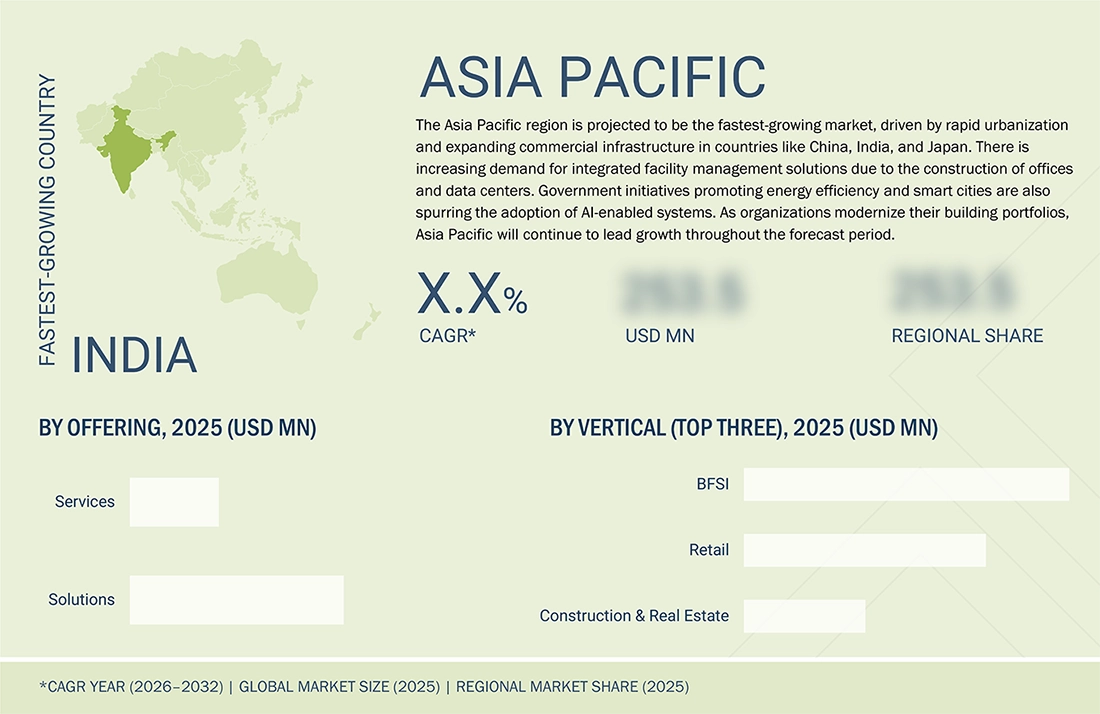
Asia Pacific is estimated to account for the largest market share during the forecast period
Asia Pacific is expected to be the fastest-growing market during the forecast period, driven by rapid urbanization, expanding commercial infrastructure, and increasing investments in smart buildings across China, India, Japan, Southeast Asia, and Australia. Rising construction of commercial offices, healthcare facilities, manufacturing plants, educational institutions, retail complexes, and data centers is generating significant demand for integrated facility management solutions that improve operational efficiency, asset performance, and sustainability. Governments across the region are also promoting energy-efficient buildings and digital infrastructure through smart city initiatives and green building regulations, encouraging organizations to adopt AI-enabled integrated workplace management systems (IWMS), IoT-based building monitoring, and predictive maintenance solutions. As enterprises continue modernizing their building portfolios and investing in digital facility operations, Asia Pacific is expected to remain the fastest-growing regional market throughout the forecast period.
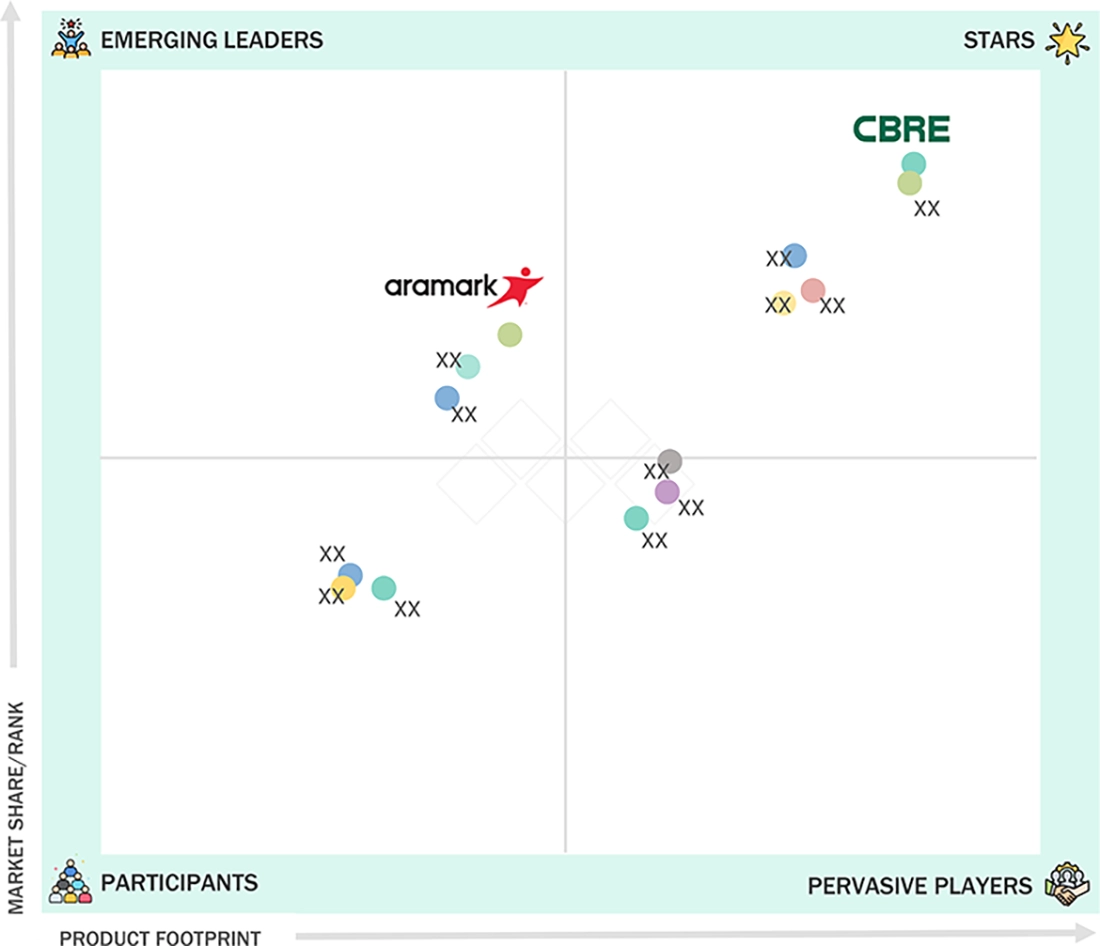
FACILITY MANAGEMENT MARKET: COMPANY EVALUATION MATRIX
In the facility management market matrix, CBRE Group (Star) leads with a strong market presence, delivering data-driven, technology-enabled solutions focusing on operational efficiency, sustainability, and tailored workplace experiences. Aramark (Emerging Leader) offers integrated support services and innovative solutions that enhance facility operations, sustainability, and occupant satisfaction. While CBRE Group dominates with scale and ecosystem integration, Aramark shows strong growth potential to advance toward the leaders’ quadrant with its expanding enterprise security portfolio.
Source: Secondary Research, Interviews with Experts, MarketsandMarkets Analysis
KEY MARKET PLAYERS
- CBRE Group (US)
- Jones Lang Lasalle (US)
- Nemetschek (Germany)
- Johnson Controls (US)
- IBM (US)
- Oracle (US)
- SAP (Germany)
- Fortive (US)
- MRI Software (US)
- Eptura (US)
- Planon (Netherlands)
- Apleona Group (Germany)
- Cushman & Wakefield (US)
- Sodexo (France)
- Aramark (US)
MARKET SCOPE
| REPORT METRIC | DETAILS |
|---|---|
| Market Size in 2025 (Value) | USD 61.08 Billion |
| Market Forecast in 2026 (Value) | USD 69.38 Billion |
| Market Forecast in 2032 (Value) | USD 205.36 Billion |
| Growth Rate | CAGR of 19.8% from 2026-2032 |
| Actual data | 2020–2032 |
| Base year | 2025 |
| Forecast period | 2026–2032 |
| Units considered | Value (USD) Million/Billion |
| Report Coverage | Revenue forecast, company ranking, competitive landscape, growth factors, and trends |
| Segments Covered |
|
| Regional Scope | North America, Europe, Asia Pacific, Middle East & Africa, Latin America |
WHAT IS IN IT FOR YOU: FACILITY MANAGEMENT MARKET REPORT CONTENT GUIDE
DELIVERED CUSTOMIZATIONS
We have successfully delivered the following deep-dive customizations:
| CLIENT REQUEST | CUSTOMIZATION DELIVERED | VALUE ADDS |
|---|---|---|
| Leading Service Provider (US) |
|
|
| Company Information | Detailed analysis and profiling of additional market players (up to five) |
|
RECENT DEVELOPMENTS
- July 2026 : JLL expanded its strategic partnership with Rolls-Royce by securing an expanded global mandate to provide Lease Administration, Transaction Management, and additional real estate services alongside its existing facilities management (FM) scope across Rolls-Royce's 16 million sq. ft. global portfolio. The agreement strengthened JLL's technology-led integrated FM capabilities through AI-enabled analytics, digitized processes, and portfolio optimization.
- December 2025 : Cushman & Wakefield secured a global contract extension with BHP to deliver an expanded portfolio of integrated workplace and real estate services across 19 offices in 12 countries. The renewed agreement included facility management, workplace experience, workplace change & engagement, occupancy data & analytics, procurement, and lease administration, reinforcing the growing demand for integrated facility management services among multinational enterprises.
- April 2025 : CBRE acquired J&J Worldwide Services, a Texas-based government facility management firm specializing in defense, healthcare, and mission-critical infrastructure. This move significantly expands CBRE’s capabilities in managing secure federal environments, aligning with its strategy to deepen its public sector FM portfolio.
- March 2025 : Trimble updated its Tekla Structures 2025 with advanced connected workflows, improving BIM-based coordination and lifecycle asset data supporting digital facility management through better design-to-operations integration.
- January 2025 : Johnson Controls acquired Webeasy, a Netherlands-based smart building automation and controls provider. This enhanced its OpenBlue platform and enabled the rapid deployment of energy-efficient building solutions across European markets.
- June 2024 : Nemetschek Group acquired GoCanvas to expand its capabilities in digital field workflows. These workflows enhanced data collection and operational efficiency, indirectly contributing to facility management through the continuity of construction to operations.
Table of Contents
 Exclusive indicates content/data unique to MarketsandMarkets and not available with any competitors.
Methodology
The research study involved four major activities in estimating the facility management market size. Exhaustive secondary research has been done to collect important information about the market and peer markets. The next step has been to validate these findings and assumptions and size them with the help of primary research with industry experts across the value chain. Both top-down and bottom-up approaches have been used to estimate the market size. Post which, the market breakdown and data triangulation have been adopted to estimate the market sizes of segments and sub-segments.
Secondary Research
The market size of the companies offering facility management solutions to various end users was arrived at based on the secondary data available through paid and unpaid sources, analyzing the product portfolios of major companies in the ecosystem, and rating the companies based on their performance and quality. In the secondary research process, various sources were referred to identify and collect information for the study. The secondary sources include annual reports, press releases, investor presentations of companies, white papers, certified publications, and articles from recognized associations and government publishing sources.
Secondary research was mainly used to obtain critical information about industry insights, the market’s monetary chain, the overall pool of key players, market classification and segmentation according to industry trends to the bottom-most level, regional markets, and key developments from both market-oriented and technology-oriented perspectives.
Primary Research
In the primary research process, various sources from the supply and demand sides were interviewed to obtain qualitative and quantitative information for the report, such as Chief Experience Officers (CXOs), Vice Presidents (VPs), directors from business development, marketing, and product development/innovation teams, and related key executives from facility management solutions vendors, system integrators, professional and managed service providers, industry associations, independent consultants, and key opinion leaders.
Primary interviews were conducted to gather insights, such as market statistics, data on revenue collected from platforms and services, market breakups, market size estimations, market forecasts, and data triangulation. Stakeholders from the demand side, such as Chief Information Officers (CIOs), Chief Finance Officers (CFOs), Chief Strategy Officers (CSOs), and the installation team of end users who use facility management solutions, were interviewed to understand buyers’ perspectives on suppliers, products, service providers, and their current use of facility management solutions which is expected to affect the overall facility management market growth.
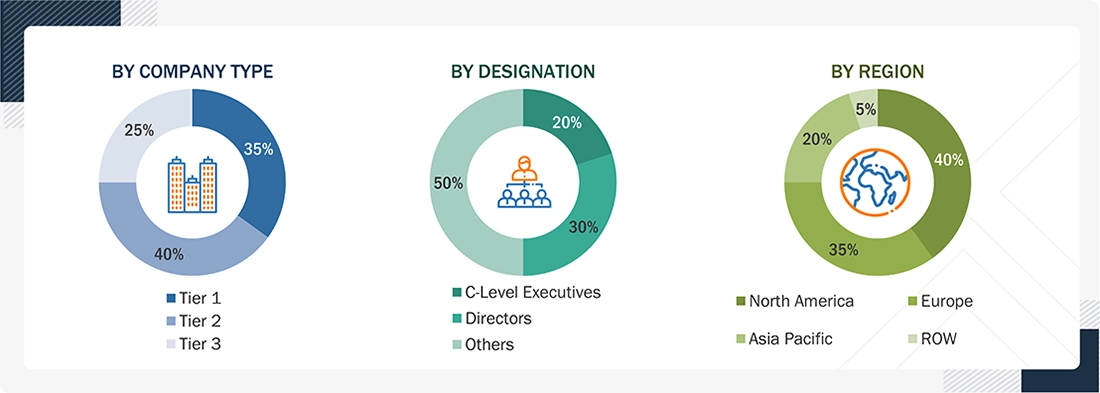
Notes: Tier 1 companies have revenues over USD 1 billion, Tier 2 companies have revenues between USD 500 million and 1 billion, and Tier 3 companies have revenues less than USD 500 million.
To know about the assumptions considered for the study, download the pdf brochure
Market Size Estimation
Both top-down and bottom-up approaches were used to estimate and validate the total size of the facility management market. These methods were also used extensively to estimate the size of various subsegments in the market. The research methodology used to estimate the market size includes the following:
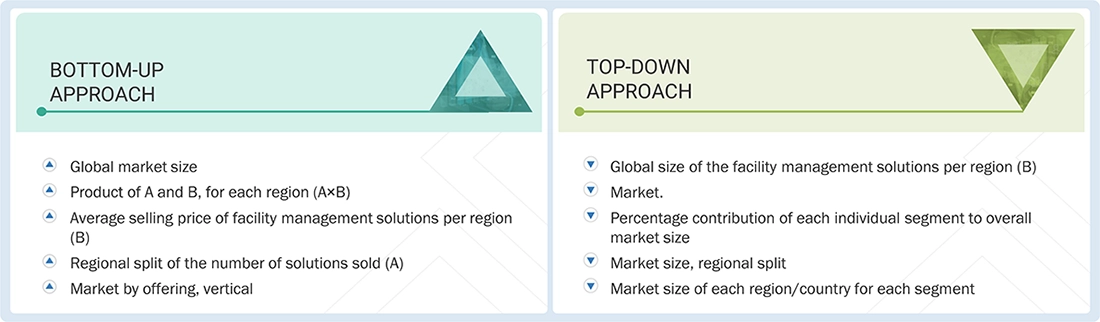
Data Triangulation
After arriving at the overall market size from the above estimation process, the facility management market has been split into several segments and sub-segments. To complete the overall market engineering process and arrive at the exact statistics for all segments and sub-segments, data triangulation and market breakdown procedures have been used, wherever applicable. The data has been triangulated by studying various factors and trends from both the demand and supply sides. The facility management market size has been validated using top-down and bottom-up approaches.
Market Definition
Facility management (FM) is an organizational function that integrates people, places, processes, and technology to ensure the effective, efficient, and sustainable operation of the built environment. It encompasses the planning, operation, maintenance, and optimization of physical assets, infrastructure, and workplace services to enhance occupant experience, improve operational efficiency, ensure regulatory compliance, and support an organization's core business objectives. Modern facility management increasingly leverages digital technologies such as integrated workplace management systems (IWMS), computerized maintenance management systems (CMMS), IoT, AI, digital twins, and data analytics to enable predictive maintenance, energy optimization, space utilization, and intelligent building operations.
Key Stakeholders
- Facility management solution providers
- Managed service providers
- Integration service providers
- Cloud service providers
- Facility management service providers
- Building automation solution providers
- Architects, engineers, and contractors
- Consultancy firms and advisory firms
- Regulatory agencies
- Technology consultants
- Governments
Report Objectives
- To determine, segment, and forecast the global facility management market by offering, solution, vertical, and region in terms of value
- To forecast the size of the market segments with respect to five main regions: North America, Europe, Asia Pacific, the Middle East & Africa, and Latin America
- To provide detailed information about the major factors (drivers, opportunities, threats, and challenges) influencing the growth of the market
- To study the complete value chain and related industry segments, and perform a value chain analysis of the facility management market landscape
- To strategically analyze the macro and micromarkets with respect to individual growth trends, prospects, and contributions to the total facility management market
- To analyze the industry trends, pricing data, patents, and innovations related to the market
- To analyze the opportunities for stakeholders by identifying the high-growth segments of the facility management market
- To profile the key players in the market and comprehensively analyze their market share/ranking and core competencies
- To track and analyze competitive developments, such as mergers & acquisitions, product launches & developments, partnerships, agreements, collaborations, business expansions, and R&D activities
Available customizations:
With the given market data, MarketsandMarkets offers customizations per the company’s specific needs. The following customization options are available for the report:
Geographic Analysis
- Further break-up of the Asia Pacific market into countries contributing 75% to the regional market size
- Further break-up of the North American market into countries contributing 75% to the regional market size
- Further break-up of the Latin American market into countries contributing 75% to the regional market size
- Further break-up of the Middle East & African market into countries contributing 75% to the regional market size
- Further break-up of the European market into countries contributing 75% to the regional market size
Company Information
- Detailed analysis and profiling of additional market players (up to five)
Key Questions Addressed by the Report
What is the projected size of the Facility Management Market by 2032?
The Facility Management market is projected to grow from USD 69.38 billion in 2026 to USD 205.36 billion by 2032, at a CAGR of 19.8% during the forecast period.
Which offering is expected to grow the fastest in the Facility Management Market?
The Services segment is projected to register the highest CAGR of 20.6% during the forecast period.
Which vertical holds the largest share of the Facility Management Market?
The BFSI vertical is expected to account for the largest market share, representing 11.1% of the market in 2026.
What is driving the growth of the Facility Management Market?
Increasing investments in digital transformation, smart buildings, sustainability initiatives, AI-enabled IWMS, IoT-connected assets, and predictive maintenance are driving market growth.
Which region is expected to grow the fastest in the Facility Management Market?
Asia Pacific is projected to register the highest growth during the forecast period.
What is a major trend shaping the Facility Management Market?
The growing adoption of AI-enabled Integrated Workplace Management Systems (IWMS), digital twins, and IoT-based predictive maintenance is a major trend shaping the market.


Personalize This Research
- Triangulate with your Own Data
- Get Data as per your Format and Definition
- Gain a Deeper Dive on a Specific Application, Geography, Customer or Competitor
- Any level of Personalization
Let Us Help You
- What are the Known and Unknown Adjacencies Impacting the Facility Management Market
- What will your New Revenue Sources be?
- Who will be your Top Customer; what will make them switch?
- Defend your Market Share or Win Competitors
- Get a Scorecard for Target Partners

Custom Market Research Services
We Will Customise The Research For You, In Case The Report Listed Above Does Not Meet With Your Requirements
Get 10% Free CustomisationTESTIMONIALS
- Canada Facility Management Market
- US Facility Management Market
- Germany Facility Management Market
- China Facility Management Market
- Brazil Facility Management Market
- France Facility Management Market
- Italy Facility Management Market
- Nordics Facility Management Market
- Rest Of Europe Facility Management Market






Growth opportunities and latent adjacency in Facility Management Market